

Business
Top MLB Injuries Impacting 2026 Season as Key Stars Navigate Recovery Timelines


Major League Baseball teams are grappling with a wave of significant injuries heading into the midpoint of the 2026 season, with star players from contending clubs sidelined by elbow, shoulder, hip and hamstring issues that are reshaping rosters and playoff outlooks. From reigning MVPs to promising rookies, the injury list is testing depth across multiple organizations as clubs balance short-term needs with long-term health concerns.
Here are five of the most notable injury situations currently affecting MLB clubs, based on the latest updates from teams and medical evaluations:
Byron Buxton, Minnesota Twins (Hip Impingement): The dynamic center fielder aggravated a lingering right hip issue during a steal attempt, forcing him out of multiple games. Buxton’s speed and power have been central to the Twins’ lineup, but recurring lower-body problems continue to limit his availability. He remains day-to-day with hopes of returning soon, though the All-Star break could provide additional recovery time.
Brandon Woodruff, Milwaukee Brewers (Shoulder Inflammation): The veteran right-hander landed on the 15-day injured list with right shoulder inflammation after making several appearances following an earlier absence. Woodruff’s return had been a boost for Milwaukee’s rotation, but this setback highlights the careful management required for pitchers with injury histories. He is expected to miss several weeks, impacting the Brewers’ postseason push.
Connelly Early, Boston Red Sox (Elbow Inflammation): The promising rookie starter exited a recent outing with left elbow discomfort and was placed on the 15-day injured list. Early had been a bright spot in Boston’s rotation before the issue arose. Further evaluation is underway, with inflammation cited as the primary concern rather than a structural problem. His absence tests the Red Sox’s depth in a competitive American League East.
Mike Trout, Los Angeles Angels (Hamstring Strain): The future Hall of Famer has been sidelined since mid-June with a right hamstring strain. Trout reported progress in running bases and hopes to return this week, though the Angels are proceeding cautiously with their franchise cornerstone. His presence in the lineup remains vital for a club looking to build momentum.
Ryan Helsley, Baltimore Orioles (Elbow Discomfort): The closer experienced renewed right elbow issues after a brief return from an earlier stint on the injured list. Helsley was placed back on the 15-day IL, with further testing planned. His absence forces the Orioles to lean on other relievers for high-leverage situations in a tight division race.
These injuries reflect broader trends across MLB, where elbow and shoulder problems continue to plague pitchers while position players battle lower-body strains from the demands of a long season. Teams are increasingly relying on advanced medical protocols, rest and rehabilitation to manage workloads.
Clubs like the Los Angeles Dodgers and New York Yankees have also dealt with their share of absences, testing roster flexibility. The Dodgers have managed without key contributors at times, while the Yankees navigate a crowded injured list that includes several high-profile names. Depth and internal options have become critical as the trade deadline approaches.
Injuries have ripple effects beyond individual players. Rotations are shortened, bullpens are taxed, and lineups lose production, often forcing managers to get creative with platoons and call-ups from the minors. For rebuilding teams, these setbacks can accelerate timelines for prospect evaluation, while contenders must weigh short-term losses against long-term health.
Medical experts note that modern training methods and pitch-count management have helped reduce some risks, but the physical toll of 162 games plus postseason play remains significant. Hamstring and oblique strains are common among hitters due to explosive movements, while pitchers face cumulative stress on elbows and shoulders from high-velocity throwing.
Fan interest often spikes around injury news, particularly when superstars like Trout or dynamic players like Buxton are affected. Social media buzz and fantasy implications add layers to the conversation as teams provide daily updates. Transparency from clubs helps manage expectations, though timelines can shift based on individual healing.
The All-Star break offers a natural pause for many recovering players, with some using the time for final rehabilitation steps before the second half. Teams are monitoring progress closely, hoping key contributors can return strengthened rather than rushing back prematurely.
Front offices are also evaluating trade deadline strategies in light of injury situations. Acquiring depth or proven talent can offset absences, but salary considerations and prospect capital play major roles. Contenders may prioritize immediate help, while others focus on future assets.
Overall, 2026 has seen a typical distribution of injuries, with no single catastrophic event dominating headlines but a steady stream of absences challenging even the deepest organizations. As the season progresses toward October, health management could prove decisive in determining playoff participants and ultimate champions.
Players currently sidelined are working diligently in rehabilitation programs, supported by team medical staffs and specialized trainers. Their returns are eagerly anticipated by teammates and fans alike, as baseball thrives on the presence of its biggest stars. The coming weeks will reveal how effectively clubs adapt and whether injured players can help reshape their teams’ fortunes.


Harrison Street Asset Management co-founder Christopher Merrill joins ‘Mornings with Maria’ to discuss surging data center power demand in the U.S. and globally.
The state of Oregon’s utility regulator is implementing a new rule starting Wednesday that will raise the electricity bills of data centers and other large energy users to allow lower rates for other customers.
The Oregon Public Utility Commission (PUC) approved updated electricity rates for data centers and other residential and commercial customers that Portland General Electric (PGE) was required to change under a state law known as the Protecting Oregonians With Energy Responsibility (POWER) Act.
Under the law, PGE will raise rates by an average of 29% on data center customers, while residential customers will see an average decrease of 1.3%, commercial rates will fall by an average of 2.1%, and other industrial customers’ rates will decline by an average of 1.4%. PUC estimated that the move will impact about 963,000 customers across PGE’s service territory.
“These changes ensure that costs created by data centers in PGE’s territory are more accurately reflected in their rates,” said Commission Chair Letha Tawney. “By putting this structure in place now, we are getting ahead of a bigger issue, enabling responsible data centers to pay their own way, and protecting customers from higher costs in the future.”
VIRGINIA COUNTY URGES POWER SAVING MEASURES AMID 25% ELECTRICITY RATE HIKE, DATA CENTER GROWTH

Data centers in PGE’s footprint will pay higher electric rates under Oregon’s new law. (Amanda Andrade-Rhoades for The Washington Post via Getty Images)
PGE’s rate changes officially take effect on Wednesday after a month-long review by PUC, after the changes were delayed from their original implementation date in early June to accommodate the more in-depth review. It is the first utility in Oregon to adopt a new rate schedule for data center customers under the law.
The POWER Act was signed into law last year by Gov. Tina Kotek after the legislation passed the state’s Democratic-controlled legislature on votes that largely went along party lines in both chambers.
Kotek said in a statement that the POWER Act “was intended to ensure fairness and accountability when large energy users, like data centers, take up more load on Oregon’s electrical grid.”
DATA CENTER BOOM POWERING AI REVOLUTION MAY DRAIN US GRIDS – AND WALLETS
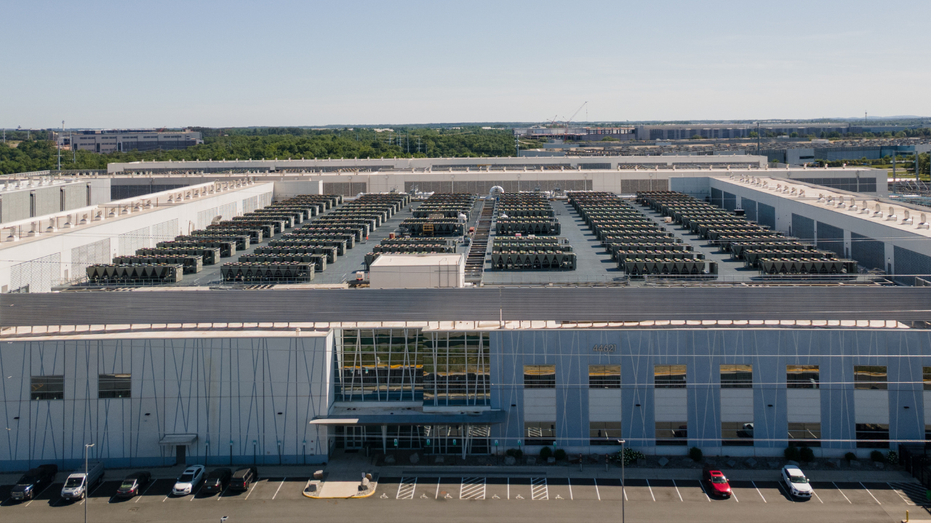
Data centers help power AI models as well as enable cloud storage and other digital tools. (Lexi Critchett/Bloomberg)
Oregon’s move comes amid concerns about the impact of the rapid build out of data centers powering artificial intelligence (AI) tools on the electric grid and the costs borne by consumers and other businesses.
The Data Center Coalition, a group representing data center owners, operators and builders, has said it supports efforts to protect consumers from price increases and data centers paying the cost of expanding grid capacity, but told FOX Business that Oregon PUC’s order is “significantly out of step with the approaches and best practices being implemented in many other states.”
DATA CENTERS RAPIDLY TRANSFORMING SMALL-TOWN AMERICA

The rapid buildout of AI data centers has increased the load on the electric grid. (Mark Felix/Bloomberg via Getty Images)
DCC’s vice president of energy, Aaron Tinjum, said in a statement to FOX Business that the group has filed a petition for Oregon PUC to reconsider its order, emphasizing that the data center industry is “committed to paying its full cost for the energy it uses to ensure that those costs are not shifted to other customers.”
“A workable approach, like those established in other markets, should align costs with cost causation, protect existing customers, and give data center customers a clear path to continue helping to drive clean energy and economic growth in Oregon,” Tinjum said.
GET FOX BUSINESS ON THE GO BY CLICKING HERE
“Protections should be evidence-based, structured carefully, and grounded in specific cost risks; otherwise they risk creating market friction, introducing uncertainty, and making Oregon less predictable and less competitive,” he added.

Factorial Energy stock hits 52-week low at 9.15 USD

IonQ: The Hype Is Not Worth Chasing

The Royal Thai Army and Australian Army are conducting Exercise Chapel Gold 2026 in Prachin Buri, enhancing military readiness and cooperation through joint training activities and professional exchanges until June 29.
Key Points
- Exercise Overview: The Royal Thai Army and the Australian Army are engaged in Exercise Chapel Gold 2026, a joint military exercise aimed at improving operational readiness and military cooperation, running in Prachin Buri province until June 29.
- Participation Details: Over 400 personnel from Thailand’s 2nd Infantry Regiment and more than 150 from Australia’s Rifle Company Butterworth 148 are involved. The exercise was inaugurated by Major General Benjapol Dejatiwongse Na Ayudhya and Captain Paul Welch.
- Training Objectives: Activities include tactical operations, jungle survival, and live-fire marksmanship. The exercise enhances troop readiness, intercultural military skills, and strengthens Thailand-Australia military relations while fostering regional security collaboration.
The Royal Thai Army and the Australian Army are conducting Exercise Chapel Gold 2026, an annual joint military exercise intended to enhance operational readiness and military cooperation between the two countries. The exercise is being conducted in Prachin Buri province until June 29 under the responsibility of Thailand’s 1st Army Area.
More than 400 personnel from the Royal Thai Army’s 2nd Infantry Regiment, King’s Guard, are participating alongside more than 150 personnel from the Australian Army’s Rifle Company Butterworth 148. The exercise was officially commenced by Major General Benjapol Dejatiwongse Na Ayudhya, commander of the 2nd Infantry Division, King’s Guard, and Captain Paul Welch, Australian defense attaché to Thailand.
Training activities include tactical operations, maneuver warfare, jungle survival, live-fire marksmanship, armored unit operations, and professional military exchanges. Personnel from both armies are also sharing operational experience and field skills to improve coordination and interoperability.
The exercise is expected to enhance the capabilities and readiness of participating troops while further strengthening long-standing military relations between Thailand and Australia. The training also supports cooperation in regional security and preparedness for a broad range of future missions.
Source : Thailand and Australia Hold Exercise Chapel Gold 2026
Other People are Reading

Amazon.com Inc. shares declined more than 1.7 percent Tuesday, closing at $241.78 as investors navigated broader technology sector dynamics, heavy capital spending on artificial intelligence infrastructure and the company’s latest foray into the bond market.
The drop of $4.20 per share reflected modest profit-taking and caution amid ongoing debates over the returns on massive AI-related investments across big technology firms. Amazon has aggressively expanded its data center footprint and cloud capabilities to meet surging demand for artificial intelligence workloads, a strategy that has driven strong growth in Amazon Web Services but also required substantial capital outlays.
The e-commerce and cloud computing giant recently announced plans to raise $25 billion through a U.S. dollar bond sale, its latest move to fund general corporate purposes including AI infrastructure. Demand for the offering reached $62 billion, a solid but more measured response compared with earlier debt sales this year as credit markets absorbed a wave of technology-related issuance.
Amazon’s capital expenditures have climbed sharply as it builds out capacity for AI training and inference. The company has highlighted strong customer adoption of its AWS services, particularly those incorporating generative AI tools, while continuing to invest in logistics, advertising and international expansion.
Tuesday’s trading occurred against a backdrop of mixed performance across major technology names. While some AI-related stocks faced pressure on valuation concerns, Amazon’s diversified business model — spanning retail, cloud computing, advertising and entertainment — provided relative stability even as the stock pulled back.
Analysts continue to view Amazon’s long-term positioning favorably, citing its leadership in e-commerce and cloud infrastructure. AWS remains a key growth engine, with recent innovations in AI services helping enterprises deploy machine learning models more efficiently. The company has also expanded its presence in areas such as satellite broadband through Project Kuiper and advanced logistics automation.
Recent financial results underscored Amazon’s resilience. Revenue growth has been supported by robust consumer spending on its platform and accelerating cloud adoption. However, elevated spending on property, equipment and technology infrastructure has drawn attention from investors focused on near-term margins and free cash flow.
The bond sale announcement came as Amazon ramps up investments to stay competitive in the AI race. Data centers, custom chips and networking infrastructure require significant funding, prompting the company to tap debt markets while maintaining a strong balance sheet. Credit rating agencies have generally viewed Amazon’s approach positively given its cash generation capabilities.
Market participants also monitored Amazon’s retail operations. Prime Day events and international expansion have contributed to sales momentum, though competition from other e-commerce players and traditional retailers remains intense. Advertising revenue, tied closely to its online marketplace, has provided a high-margin boost.
Amazon’s stock has experienced volatility in 2026, trading within a range that reflects both optimism about its AI and cloud prospects and periodic concerns over spending levels and economic sensitivity in its retail segment. The shares remain well above levels seen earlier in the decade but below recent peaks.
Broader economic factors influenced sentiment. Interest rate expectations, consumer confidence and corporate technology budgets all play roles in Amazon’s performance. As a bellwether for both consumer spending and enterprise technology adoption, movements in the stock often signal wider trends.
Company executives have emphasized disciplined investment alongside innovation. Initiatives in areas such as Project Kuiper aim to extend connectivity globally, while advancements in AWS services target both traditional enterprises and emerging AI workloads. Partnerships and ecosystem development remain central to Amazon’s strategy.
Tuesday’s session saw typical trading volume, suggesting the decline was part of normal market fluctuations rather than a reaction to specific negative news. Options activity and institutional flows indicated continued interest in Amazon as a core technology holding.
Looking ahead, investors await further updates on capital spending guidance, AWS growth metrics and progress on AI monetization. Amazon’s ability to balance heavy investment with profitability improvements will be key to sustaining shareholder confidence.
The company continues to face regulatory and competitive scrutiny globally, including in areas such as antitrust matters and labor relations. However, its scale and diversified revenue streams provide resources to navigate challenges while pursuing growth opportunities.
Amazon’s position as one of the world’s most valuable companies underscores its transformation from an online bookseller to a technology infrastructure powerhouse. Its stock performance remains closely watched as a proxy for the health of digital commerce and cloud computing.
As markets digest the latest bond issuance and spending plans, Amazon’s trajectory will hinge on execution across its multiple business lines and the broader realization of AI-driven productivity gains for its customers. The coming quarters are expected to provide more clarity on the payoff from current investments.
Business
McDonald’s Shares Slip Further Today as Weak Traffic and Russell Index Exit Continue to Weigh on Stock

Shares of McDonald’s Corporation fell Wednesday, trading at $278.65, down $3.56, or 1.26 percent, extending a difficult stretch for the fast-food giant as investors continue to weigh softening U.S. restaurant traffic against the stock’s defensive appeal amid broader market volatility.
Note: This article is intended to provide factual context and does not constitute financial advice. Readers should consult a licensed financial advisor before making investment decisions.
McDonald’s shares remain down roughly 8 to 12 percent so far in 2026, depending on the specific measurement window, and are trading well below the stock’s 52-week high of $341.75 to $341.06, reached in February. According to StockStory, at recent trading levels around $279 per share, the stock sat approximately 18 percent below that peak, even as longer-term shareholders have continued to see solid returns, with a $1,000 investment made five years ago now worth roughly $1,195.
A significant technical headwind emerged in late June, when McDonald’s was officially removed from several Russell growth and defensive stock market benchmarks, including the Russell 1000 Growth index, according to Robinhood. That removal triggered forced selling from passive index-tracking funds required to rebalance their holdings in line with the updated index composition, a dynamic that TradingKey noted has contributed to technical selling pressure independent of the company’s underlying business performance.
Underlying business trends have also weighed on sentiment. According to a Citi report cited by StockStory and The Globe and Mail, McDonald’s U.S. restaurant traffic fell 3.9 percent year over year in late June, reflecting continued softness in customer visits even as the company has worked to emphasize value-oriented menu offerings. Analysts at KeyBanc lowered their near-term U.S. second-quarter same-store sales growth projection for McDonald’s from 1.8 percent to just 0.5 percent on June 29, while simultaneously cutting their price target on the stock to $315 from $330, citing the core business’s continued struggle to regain meaningful transaction momentum. Despite the lowered price target, KeyBanc maintained a Buy rating on the stock.
Reports circulating in early July also highlighted broader operational pressures facing McDonald’s heavily franchised restaurant network, including persistent inflation, tariff-related disruptions, and a decline in overall consumer sentiment to a reading of 44.8, factors that risk compressing franchisee margins and potentially delaying planned store openings. Additionally, the company’s newer, largely automated “McDonald’s NEXT” expansion strategy has faced its own operational headwinds, with analysts at TD Cowen flagging concerns about the heavy near-term capital and labor investment required to implement the redesigned restaurant format.
Despite those challenges, McDonald’s has drawn renewed attention as a defensive investment option amid broader market volatility tied to elevated technology-sector valuations. Shares jumped 3.6 to 3.7 percent in a single session in early July after investment bank UBS highlighted the company alongside other consumer staples names as an attractive defensive dividend stock for investors looking to diversify away from high-flying technology stocks. UBS noted that McDonald’s remains well positioned to capture additional market share through its ongoing value offerings and marketing efforts, even as the same report acknowledged the softer traffic data emerging from other analyst channels. According to TradingKey, that rally reflected a broader institutional rotation toward undervalued, lower-volatility defensive names, supported by a widening valuation gap between high-risk growth stocks and steadier, dividend-paying companies like McDonald’s.
Analyst sentiment toward the stock remains mixed overall. According to CNN, RBC Capital reaffirmed a Hold rating on McDonald’s in late June, while Austria’s Erste Group maintained its own Hold rating around the same time, reflecting a broader pattern of analysts characterizing the stock as fairly valued given its current growth trajectory rather than clearly undervalued or overvalued. Morningstar analyst Ari Felhandler offered a more constructive long-term view, noting that McDonald’s has posted 5.4 percent comparable sales growth over the past seven years, compared with just 2.2 percent total growth for the broader global foodservice industry, and projecting continued outperformance driven by a combination of value-focused promotions, menu innovation and steady unit growth. Morningstar’s analysis also cautioned that rising beef costs and further minimum wage increases could strain franchisee economics, potentially limiting appetite for deeper promotional activity in a weaker macroeconomic environment.
McDonald’s has also continued making leadership changes in recent weeks. The company named Bryan Brown as its new U.S. chief development officer, effective July 14, bringing more than a decade of relevant industry experience to the role, according to multiple reports.
McDonald’s, founded by Raymond Albert Kroc on April 15, 1955, and headquartered in Chicago, remains the world’s largest restaurant brand by systemwide sales, generating nearly $139 billion annually across more than 45,000 restaurants in over 100 markets. Approximately 95 percent of the company’s U.S. restaurants are franchised, and the company derives roughly 62 percent of its total revenue from franchise royalties and rent rather than direct restaurant operations. The company’s business is divided across three primary segments: the United States, which accounts for about 39 percent of systemwide sales; International Operated Markets, at roughly 35 percent; and International Developmental Licensed Markets, at approximately 26 percent.
McDonald’s carries a market capitalization of approximately $200 billion, a price-to-earnings ratio in the range of 23 times trailing earnings, and a dividend yield of roughly 2.63 percent, with a payout ratio of about 60 percent, according to data from Kraken and Robinhood. Those figures continue to position the stock as a widely held income-generating investment, even amid the recent share price weakness tied to softer U.S. traffic trends and the technical pressure stemming from its removal from several Russell benchmarks.
With McDonald’s continuing to navigate a challenging combination of softening consumer traffic, rising input costs, and shifting index composition, while simultaneously benefiting from renewed interest as a defensive holding amid broader market volatility, investors are likely to continue watching closely for further signals on the company’s second-quarter same-store sales performance and any additional updates on its value-menu strategy and “McDonald’s NEXT” restaurant redesign initiative in the weeks ahead.

Stocks to Watch: Broadcom, Alibaba, Chevron, Levi Strauss

Altimeter Capital founder and CEO Brad Gerstner discusses President Donald Trump’s new investment accounts for children, China’s latest AI restrictions and Samsung’s stock slide on ‘Mornings with Maria.’
Corporate America is pouring support behind the Trump Accounts program, with Altimeter Capital founder, Chairman and CEO Brad Gerstner predicting the initiative will attract more than $100 billion in additional private commitments over the next year as businesses and philanthropists back the new investment accounts for American children.
WHAT ARE THE INVESTMENT OPTIONS FOR TRUMP ACCOUNTS?
Brad Gerstner joined FOX Business’ Maria Bartiromo on “Mornings with Maria,” where he pointed to what he described as strong early momentum following the program’s launch, saying businesses, philanthropists and families are embracing the initiative.

President Donald Trump stands next to a bell before ringing it to open the New York Stock Exchange ahead of the launch of Trump investment accounts in the Oval Office. (Mandel NGAN / AFP / Getty Images)
“We have tens of billions of dollars in commitments we haven’t announced,” Gerstner said. “I said to the president, I think we’ll have $100 billion of additional contributions in the next 12 months.”
TRUMP RINGS NYSE, NASDAQ OPENING BELLS FROM WHITE HOUSE TO CELEBRATE LAUNCH OF TRUMP ACCOUNTS
Gerstner said the initiative was designed as a public-private partnership that relies on private contributions alongside the government’s initial investment. He highlighted commitments from corporate leaders and philanthropists, arguing the program allows donors to directly fund investment accounts for children in schools, communities and states across the country.
BNY CEO Robin Vince joins ‘Mornings with Maria’ to discuss BNY’s 250-year evolution, President Donald Trump’s new investment program for children, the U.S. economy and digital assets.
“It is huge societal ROI and America is unlocking their wallets and pouring a lot of money into these,” Gerstner said.
BNY CEO Robin Vince also joined Maria Bartiromo on “Mornings with Maria” to discuss BNY’s role in launching the program, which is designed to give more Americans access to long-term investing through early saving and the power of compounding.
President Donald Trump launches Trump accounts, described as big savings accounts for everyone.
“We’ve got 40% of Americans who don’t participate directly in the stock market,” Vince said. “This initiative is about bringing more people to have a stake in the actual capital markets, in the economy and the greatest companies in America.”
Vince said the program encourages families to begin investing as early as possible, arguing that regular contributions over time can significantly increase the value of an account through compounding. He also noted that many companies, including BNY, are matching contributions for eligible employees’ children.
Post Holdings stock hits 52-week low at 86.27 USD
TD Cowen reiterates Buy on Prime Medicine stock after arbitration win

Portland General Electric hikes data center rates under Oregon law

Sadot Group crashed 72%, halted five times today after short-seller report

Creamline shows depth to beat Van Sickle-less Nxled


-

 Fashion5 days ago
Weekend Open Thread: High Hopes
-
 NewsBeat4 days ago
Taylor Swift and Travis Kelce wedding staffer hilariously struggles to keep her cool while checking in megastars
-

 Fashion2 days ago
Open Thread: What Great Books Have You Read Recently?
-

 Politics5 days ago
The House | “Reframing the debate from a binary discussion of winners and losers”: Yuan Yang reviews ‘We Are Not Machines’
-

 Crypto World5 days ago
Standard Chartered Secures MiCA License as ESMA Adds 37 New Crypto Firms
-
 Tech1 day ago
Anthropic’s new “J-lens” reveals a silent workspace inside Claude that mirrors a leading theory of consciousness
-

 News Videos2 days ago
Whats Hidden Inside This Cash Register? #treasure #reselling #money
-

 Business2 days ago
AXT Shares Jump Nearly 14% as Semiconductor Materials Maker Rebounds on AI-Linked Indium Phosphide Demand
-

 Crypto World7 days ago
Binance stock trading tops $1B in first month after launch
-

 Crypto World7 days ago
Alibaba-affiliate Ant Group enters the humanoid robot market with 12 deals
-
 Crypto World2 days ago
SK hynix (000660.KS) Stock Dips as $28B Nasdaq ADR Offering Drives AI Memory Expansion
-

 Crypto World3 days ago
South Africa proposes crypto tax guidance under existing rules
-

 News Videos2 days ago
Best Time to Enter Small Caps Right Now? Another Bull Run? | Financially Free
-

 Tech3 days ago
Lenovo laptops are now shipping with YMTC SSDs, a sign of Chinese NAND entering the mainstream
-

 Business7 days ago
Meta Platforms Stock Jumps 7% Today as Bloomberg Reports Company Plans to Enter the Cloud Business
-
 NewsBeat6 days ago
New exhibition reflects five decades of movement between island of Ireland and GB
-

 Business6 days ago
What a 10 Percent Drop Means for Buyers, Sellers and Renters
-
Crypto World5 days ago
ESMA Expands Crypto Register by 37 Firms Following MiCA Transition Period
-

 Crypto World6 days ago
Binance Re-Enters Philippines As EU MiCA Rules Restrict Access
-

 News Videos2 days ago
Avoid entering in FOMO #bitcoin #cryptocurrency #trading #scalping
You must be logged in to post a comment Login