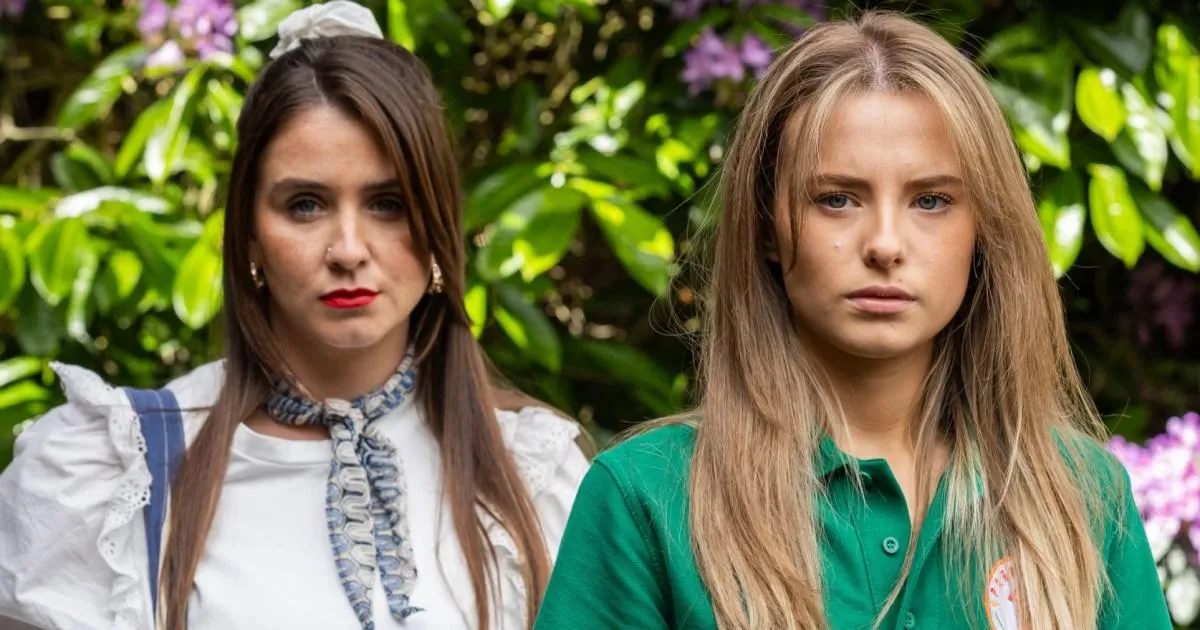
It’s the very modern Gen Z ‘love triangle’ which has gripped millions across social media. For almost a fortnight, Hertfordshire-born influencer Phoebe Prentice has been the talk of the internet after she posted a 15 minute-long video on TikTok, accusing actress Scarlett Thomas of getting too close to her beau, Josh Olliver, a singer in Simon Cowell’s new boyband December 10.
The very public feud, which began 13 days ago following the pop group’s performance at London’s Shepherd’s Bush Empire, has seen Phoebe, 18, lambast the BBC’s Waterloo Road star, Scarlett, for attending the gig and meeting up with Josh afterwards.
Phoebe’s comments have left social media users wondering just what has happened between the trio – more of which later.
But I can reveal that the TikTok star’s videos about her now former flame have left Josh’s friends ‘absolutely furious’ and they have accused Phoebe of using his fame as a pop star and the high profile of Scarlett – the daughter of Coronation Street actors Ryan Thomas and Tina O’Brien – for clicks.
The first video was watched by six million TikTok users, so it was little surprise that eight more have followed. One of those was seen by 1.3million people and another by a further 400,000.
Estimates suggest Phoebe can make around £1,300 from a single TikTok video broadcast to her 1.2 million followers, and that her clips about the scandal could have generated the 18-year-old anywhere between £2,000 and £10,000.
Phoebe Prentice, who has 1.2million followers on TikTok, publicly accused Scarlett Thomas of getting too close to her ‘beau’, Josh Olliver. It’s thought she can make around £1,300 per video
One source close to December 10 told me: ‘We don’t like people spouting and making money out of Josh. There have been some awful things said about Scarlett online, it isn’t very nice. Phoebe is saying things that are just not correct.’
The public saga began to unfold a week ago, when Phoebe posted a video claiming she had been dating someone for several months.
‘We never publicly came out to reveal it but a lot of people were aware and it was obvious,’ she told viewers.
Although she did not name Josh, fans were quick to join the dots. In the video, Phoebe claimed that she and the boy in question had gone to a Harry Styles concert in June, stayed with one another and continued to call and text while he was on tour.
She then alleged that one day he abruptly stopped answering her calls, and she was subsequently sent a video of Scarlett at one of the band’s shows in London.
According to Phoebe, she attended the December 10 show and after-party the next day, where she said he behaved ‘completely normal’.
She also claimed she asked the boy – now known to be 17-year-old singer Josh – about Scarlett, also 17, and was reassured that she was ‘just a friend’ and that he had not invited her.
Despite this reassurance, Phoebe said she still had a ‘gut feeling’ and contacted Scarlett directly, claiming she wanted to discuss her fears about Josh privately.
The influencer, who began creating content when she was at school, said that – after asking Scarlett about the situation – the actress explained Josh had stayed at her house the night after the show and was dropped off and picked up by security.
Phoebe went on to claim that Scarlett suggested Josh had told her they were not close, saying ‘he denied that anything was going on, even though we are literally in a relationship’.
Talking to the camera, she continued: ‘Imagine how humiliated I felt… I was at the manager’s house and everyone knew about her [Scarlett] and that he had stayed with her the night before and I was the only one in the room who didn’t know.’
But I can reveal that several key details circulating online have been disputed by those close to December 10. My sources close to the scandal have reliably informed me that Josh and Phoebe were never in fact in an established ‘relationship’. They also insist that there is ‘absolutely nothing going on between Scarlett and Josh’.
And, despite Phoebe’s claims, I have been told that Scarlett was not in a private box during the band’s show at the Shepherd’s Bush Empire, because the venue does not in fact have private boxes, only balconies.
Scarlett, a 17-year-old actress who stars in the BBC TV series Waterloo Road, was seen watching December 10’s concert at the Shepherd’s Bush Empire in west London
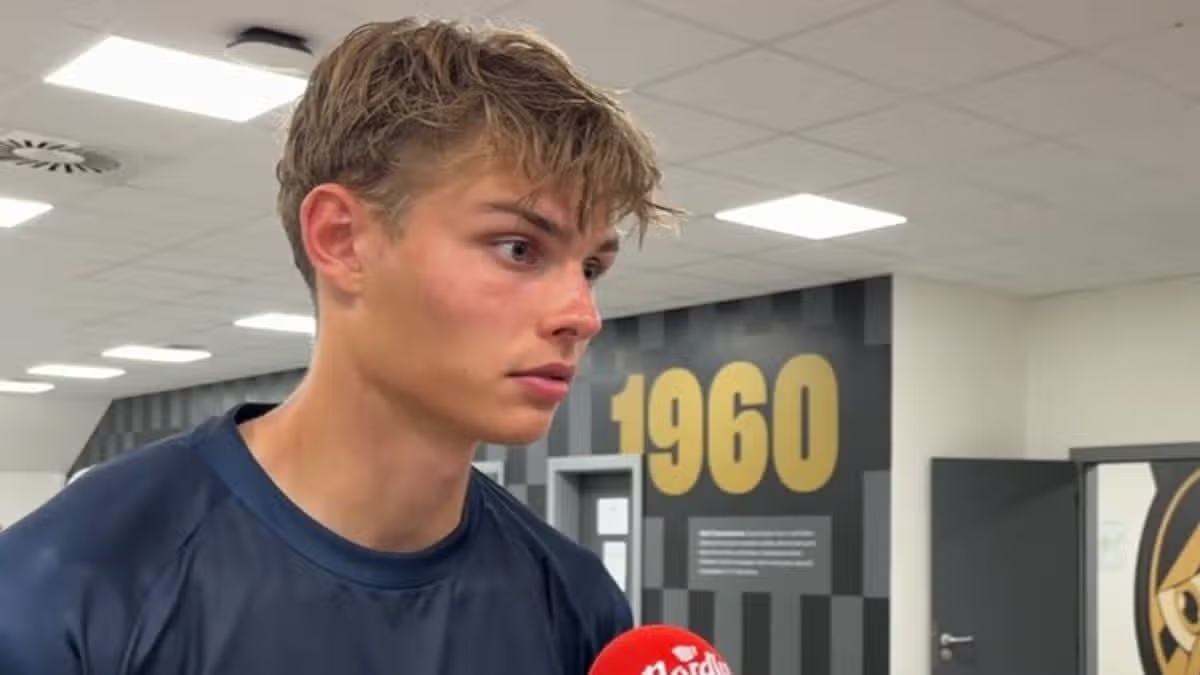
Josh, a singer in Simon Cowell’s new boyband December 10, saw his fellow bandmates rally around him and defend him on social media after Phoebe’s accusations
It has also been confirmed to me that Josh was not dropped off by security at Scarlett’s house and that, while December 10 were on tour in London, the band stayed at a hotel and only travelled between there and the venue.
The timeline is perhaps key to understanding how the saga escalated from a series of social media sightings into one of the internet’s biggest influencer dramas of the summer.
Phoebe first met December 10 at the Netflix premiere for their docuseries in December, and fans began spotting her and Josh together in March and noticing that they were liking each other’s photographs on social media.
By May, Josh was commenting on Phoebe’s TikTok videos, as were other members of the band. The very next month, Phoebe was spotted at the Capital Summertime Ball watching December 10 perform. Phoebe then attended the band’s show in London the night after Scarlett was there.
Five days later, on July 22, Phoebe posted her now-viral video, claiming to be ‘humiliated, heartbroken and completely betrayed’.
In the eight videos that followed, Phoebe used backing songs relating to heartbreak and in one sang along to Bruno Mars’s Grenade, which includes the lyric: ‘I gave you all I had and you tossed it in the trash.’
The saga has undoubtedly generated a huge surge in interest in Phoebe’s social media accounts. And while the scale of her financial gain is a matter of speculation, people are inevitably asking questions about how commercially valuable the drama has become.
Six days ago, Phoebe appeared on fellow influencer Ami Charlize’s podcast, where she claimed she would ‘address everything’ – yet has since failed to address very much at all.
When asked about the backlash from December 10 fans, she said: ‘If I want to keep something private, then I won’t post about it online. No hate to December 10 fans, I love December 10.’ Meanwhile, Phoebe’s close friend, Princess Andre, has also been drawn into the drama. Princess – the daughter of Peter Andre and Katie Price – and Scarlett have since become embroiled in their own online spat, after Princess seemed to accuse someone of being a ‘little miss copycat’.
Ever loyal to one another, December 10 have appeared to hit back at the claims in their own way. Fellow band members Cruz and Danny have posted on Snapchat with a selfie and the words: ‘You can’t cheat on someone you’re not in a relationship with.’
The drama has now become a full-blown internet spectacle, with Phoebe’s huge and fiercely loyal following rallying behind her and launching an onslaught of criticism towards Josh and Scarlett.
Meanwhile, the actress hasn’t posted on social media since the saga began. And the woman at the centre of the furore has gone to ground. Despite these tell-all videos, when I contacted Phoebe to clarify some of her allegations, she failed to respond.
‘Phoebe has detonated a bomb and won’t now explain herself,’ said one source close to the situation. ‘It’s really, really not nice.’
Influencer and comedian Savannah Gracey has revealed how one viral video nearly saved her mum’s beloved Camden shop from closing. She decided to film the clip after realising her mum Janet Dervan’s vintage shop, The Arc, was facing closure after 35 years and wanted to end with a boost.
Savannah Gracey with her mother, Janet Dervan, outside her vintage clothing shop in Camden
‘I was sat in there with her and thought, “We’ve got all this stock – where’s it all going to go?”’ she explains to me. ‘I posted a video (on Instagram) and it got 300,000 views, then I put it on TikTok and it reached 400,000. I went back into the shop and suddenly there was this constant stream of people coming in.
‘On the Thursday Mum made £18, but by the Saturday and Sunday she’d had her best weekend in years.’
Savannah has since enlisted fellow influencers to spread the word, helping her family business bow out on a high.
‘My mum has owned that shop for 35 years and was a market trader before that. My parents met in Camden, got married in Camden, and Mum even breastfed me in the shop when I was six weeks old.’
Janet says soaring rents and rising service charges have forced her decision to close The Arc, with its final trading day on Sunday, August 2.
PR disaster alert! Rapper Krept, one half of hip-hop duo Krept and Konan, left visitors to a pop-up event promoting his children’s skincare brand stunned when a giant mascot dressed as American rapper Latto started twerking on stage in front of children.
The mascot then walked hand-in-hand through the crowd dressed in skimpy shorts with Krept’s six-year-old daughter, Nala, whom the range is named after.
Krept, one half of hip-hop duo Krept and Konan, apologised after visitors complained about a scantily clad mascot twerking on stage at a pop-up event for his children’s skincare brand
An onlooker at the event said: ‘For a pop-up aimed at mums and children, this is a prime example of a PR disaster. The issue isn’t whether people like Latto. It’s about what’s appropriate for the audience.’
The backlash has prompted Krept to publicly apologise, insisting the mascot had been an oversight. He said: ‘Apologies if it came across wrong. Latto’s team reached out and said she’d just had a baby. She’s pregnant on her album cover and it’s called Big Mama. We also wanted to build a relationship ahead of taking the brand to America. They wanted to do a fan meet-and-greet with us. In terms of the mascot, that was a genuine oversight and I hold my hands up.’
UP
Influencer-turned-boxer Jake Paul and promoter Eddie Hearn have put their rivalry aside to team up in a major boost for women’s boxing. Paul’s company Most Valuable Promotions (MVP) and Hearn’s Matchroom Boxing have announced a long-term strategic alliance aimed at growing the women’s game. Between them they represent some of the sport’s biggest names, including Amanda Serrano, Katie Taylor, Chantelle Cameron, Caroline Dubois, Alycia Baumgardner, Mikaela Mayer and Ellie Scotney, making this one of the biggest collaborations women’s boxing has ever seen.
DOWN
Zoe Sugg and Alfie Deyes are down in my estimations this week after taking a lengthy and unexplained break from social media. As two of the UK’s biggest influencers, with millions of followers who have supported their careers, I think fans deserve some kind of update about the radio silence from the pair since January. It not only stops speculation from spiralling, but also acknowledges the audience who helped build their platforms, and ultimately helped them afford their £1.7 million mansion in Brighton.
Drinks brand Poppi brought the Love Island glamour to Battersea this week with a star-studded final watch party at Joia.
The prebiotic fizzy drink company, which stepped in as this season’s new sponsor and is known for creating eye-catching events, pulled out all the stops for the occasion.
Drinks brand Poppi hosted a star-studded Love Island final watch party at Joia, Battersea
Sophie Piper, Rochelle Humes’s younger sister, attended the event with boyfriend Josh Ritchie and series 7 winner, Millie Court, looked stunning in pink as she posed for the cameras
Former winner Millie Court joined fellow Islanders Matilda Draper and newlywed Tom Clare, who made an appearance fresh from tying the knot with Molly Smith. Love Island All Stars favourite Sophie Piper also attended with long-term boyfriend Josh Ritchie, while creators including Flossie Clegg enjoyed a villa-inspired night celebrating the biggest event in reality TV.
This week’s fashion must-have is the new adidas Originals x ASOS collection, marking the first time the partnership has expanded into menswear.
Available exclusively on ASOS from today, the collection blends Adidas’s iconic sportswear heritage with ASOS’s fashion-led styling. Fronted by England footballer Noni Madueke, the campaign celebrates the crossover between sport, style and self-expression.
The womenswear edit, starring boxer and style icon Ramla Ali, brings a fresh take on sporty dressing with Riviera-inspired details, clean silhouettes and effortless summer-to-seasonal versatility.
Email me – molly.clayton@dailymail.co.uk
Instagram – @mollyroseclayton
TikTok – @mollclayton


























































You must be logged in to post a comment Login