

Crypto World
Pi Network’s Big July Upgrade Explained: What Pioneers Need to Know

Pi Network’s team introduced new updates yesterday and has taken to X to outline more details about how they function and how users can take full advantage.
However, the underlying asset continues to dig new lows, and its free-fall doesn’t seem to be ending soon.
New Update Explained
CryptoPotato reported yesterday the two major updates, one focusing on the AI-assisted App Planning Phase, allowing developers to create their product from an initial idea, and the other improving the backend support. In the follow-up post on the second upgrade, the team highlighted the key features and how Pioneers can benefit.
“Backend capabilities begin with persistent storage for newly created App Studio apps, allowing apps to save and retrieve user-specific data across sessions.”
Developers can build applications on the Pi App Studio with experiences that continue even after users leave and return. The example given by the team was the following: games can remember a user’s high scores, productivity apps can display again a user’s to-do lists, and note-taking applications can preserve notes automatically.
The process was quite different until now, as these applications were “largely limited to frontend-only, single-session experiences,” in which app data such as preferences or progress disappeared if users exited the app.
The team claimed that adding such support now is a “significant App Studio platform milestone because it expands what AI-created apps can practically do on Pi Network.” Persistent storage is the first capability built on this foundation, allowing a broader range of useful apps, said the team.
PI Sees New ATL
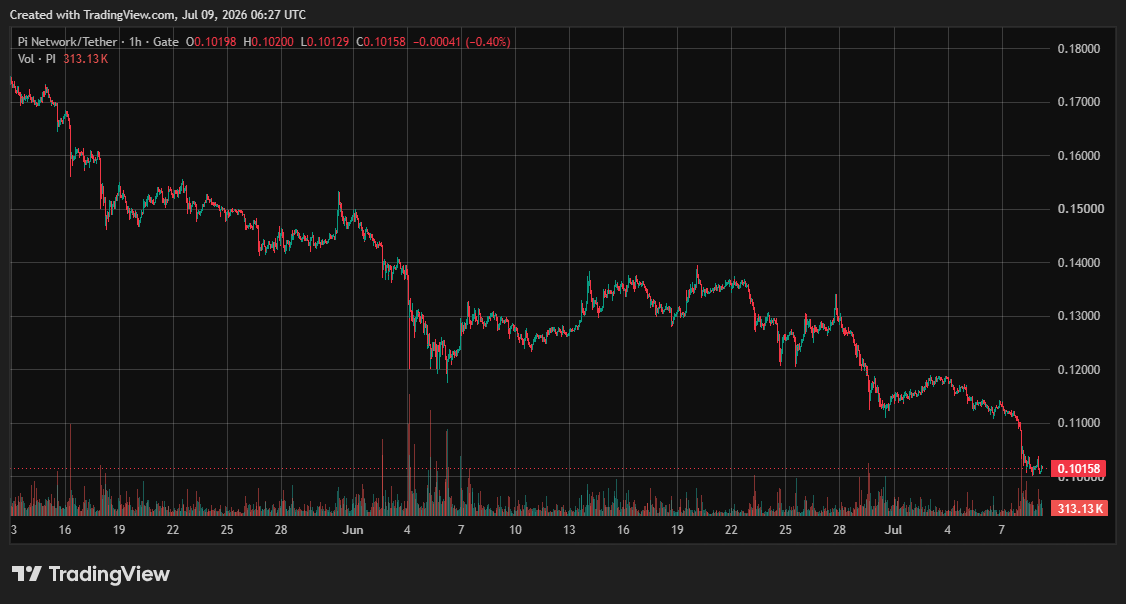
Although Pi Network’s team continues to publish relatively frequent protocol updates, the native token fails to benefit and stage a notable comeback. Just the opposite; its price direction has been mostly south.
It painted a new all-time low at the end of June at under $0.115 when the entire market corrected. It managed to rebound slightly to somewhere between $0.12 and $0.13 for a week or so but nosedived once again at the start of the current business week. It plunged to $0.1033 yesterday for a new record low before the bears initiated another leg down several hours ago.
The new low, according to CoinGecko data, sits at $0.1002. Despite rebounding by 1.5% since then, PI is still in danger of breaking below $0.10 in the very near future given the overall market sentiment and the lack of trust in the token.
The post Pi Network’s Big July Upgrade Explained: What Pioneers Need to Know appeared first on CryptoPotato.



Brazil’s B3 stock exchange has unveiled options on bitcoin , ether (ETH) and solana (SOL) futures, expanding its regulated crypto derivatives offerings.
The contracts bec+ame available for trading on July 6, according to a B3 circular. They include call and put options on bitcoin futures denominated in Brazilian reais, while ether and solana futures are denominated in U.S. dollars.
The options settle into the underlying futures contracts, not the tokens themselves. B3 said the products do not involve custody, transfer or administration of spot cryptoassets.
The contracts trade independently from 9 a.m. to 6:30 p.m. local time, according to B3’s derivatives trading schedule. Exercise is automatic at expiration when the option finishes in the money, unless the holder blocks exercise.
The offering gives traders and asset managers a local venue to hedge crypto exposure, trade volatility and build structured positions without using offshore crypto options markets.
It adds another instrument to B3’s push into regulated crypto products, after the exchange moved to list bitcoin options and ether and solana futures and later prepared bitcoin-linked event contracts.
B3’s bitcoin futures contract is denominated in reais. Its ether and solana futures are denominated in U.S. dollars. All three reference Nasdaq crypto indexes, according to the announcement.


The price of a family home in the U.S. tells two very different stories depending on how it’s measured. Comparing the stories underscores bitcoin’s appeal as a long-term hedge against dollar debasement, the erosion of value in the fiat currency.
According to Fidelity Digital Assets, a typical U.S. house has gained more than $100,000 since 2020. That house-price appreciation is said to generate a positive wealth effect, an economic phenomenon where rising home values make homeowners feel wealthier. Feeling wealthier, they spend more, borrow more and boost the economy even if their actual income remains unchanged.
But what if the gain is just a mirage?
Price the same house in bitcoin and the narrative shifts sharply. What required more than 50 BTC in 2020 now costs just 5 BTC, a 90% decline.
“What appears to be appreciation in housing is more accurately a reflection of an erosion of fiat currency. The issue lies with the unit of account—not the asset itself,” Zack Wainwright, a digital asset research analyst at Fidelity, said.
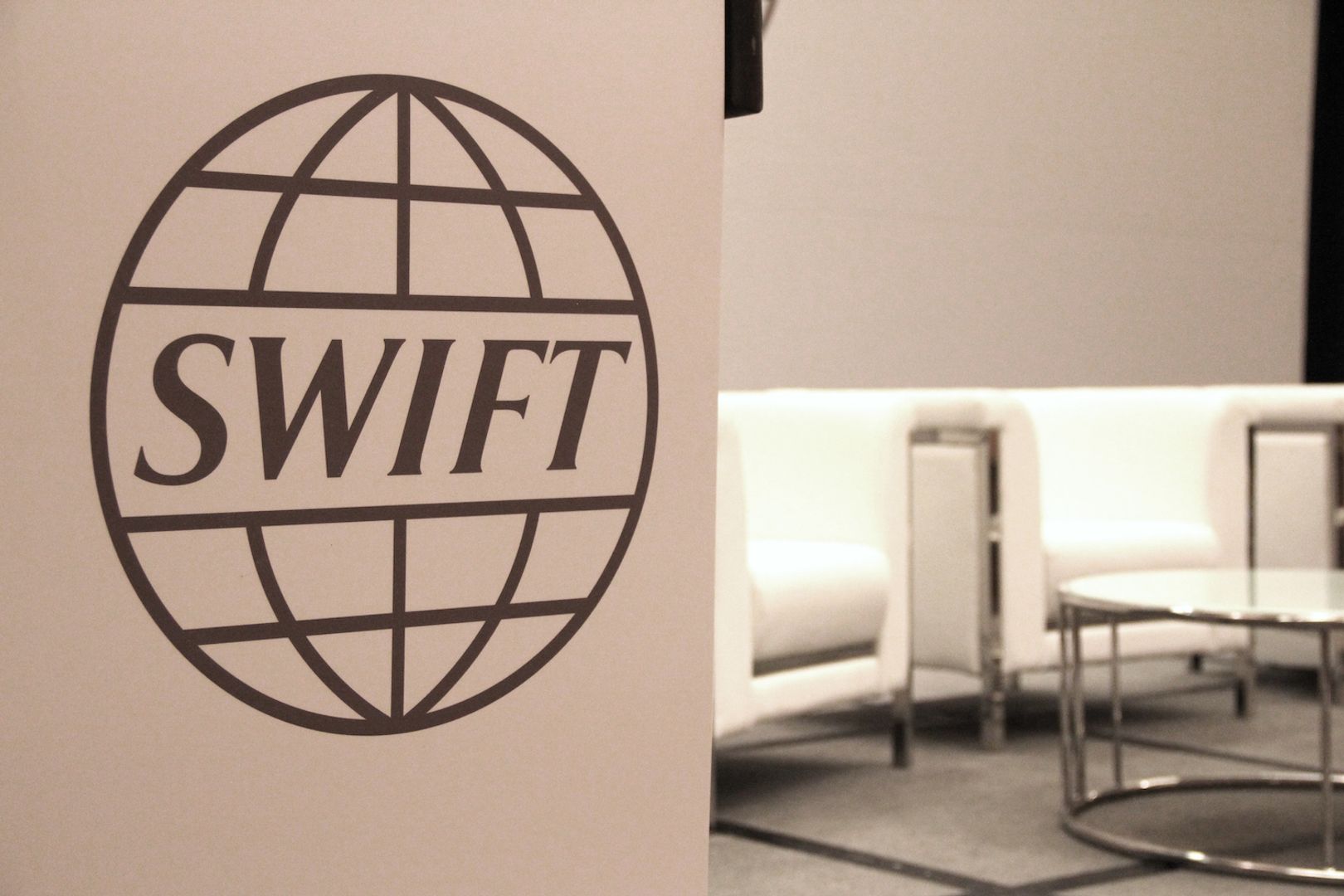
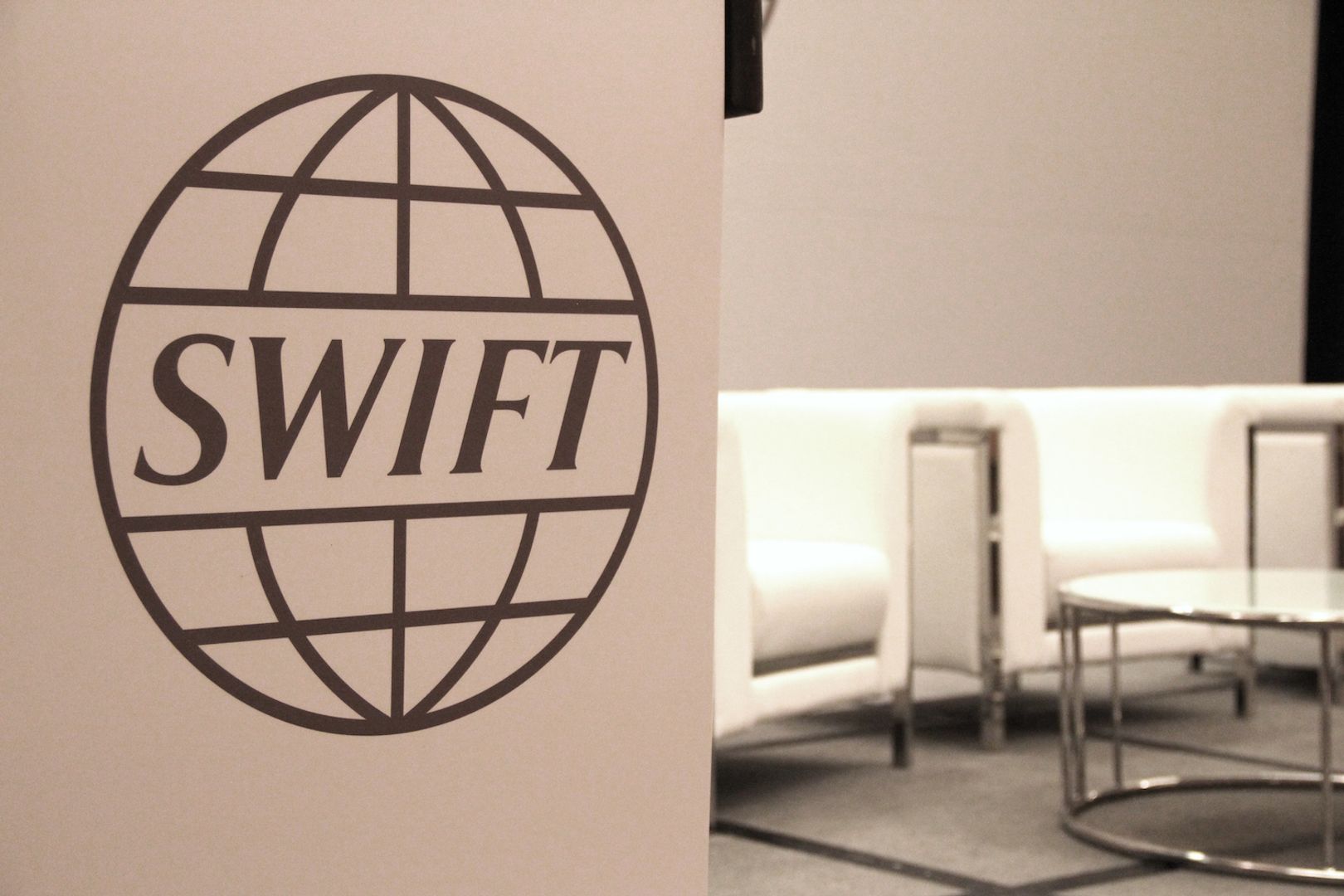
A roster of 17 banks are preparing to begin testing live transactions on Swift’s blockchain-based ledger, a step toward round-the-clock cross-border payments using tokenized deposits.
Swift said the ledger is ready for initial use by banks across six continents in an announcement on Thursday. Its aim is to allow banks to move funds for customers overnight and on weekends, before final settlement through existing payment systems.
The banks taking part include UBS, BNP Paribas, BNY, Citi, HSBC, and Wells Fargo.
Swift, the bank-owned messaging network used by more than 11,500 financial institutions, announced the development of this shared ledger platform in October. It then said it would allow banks to settle transactions involving stablecoins and tokenized assets across multiple blockchains, working alongside current payment rails, not replacing them.
Swift, said the system gives banks a shared layer for tokenized deposits issued on their own ledgers. Tokenized deposits are digital versions of commercial bank money.
“With our new ledger capability, we’re extending the trust and stability of established finance into the frontiers of digital money,” said Thierry Chilosi, Swift’s chief business officer.

TLDR:
- Temasek holds zero direct crypto investments, citing unresolved regulatory uncertainty worldwide today.
- The fund absorbed a $275 million FTX writedown in 2022, damaging Singapore’s financial reputation.
- Temasek plans to raise AI exposure from six percent to fifteen percent of assets by 2031.
- Europe drew 12 billion euros in Temasek capital over two years, trailing only the United States.
Temasek crypto investments remain absent from the Singapore sovereign wealth fund’s portfolio, four years after a costly FTX exposure.
Chief Investment Officer Nagi Hamiyeh confirmed the firm holds no direct digital asset positions, citing ongoing regulatory uncertainty across global markets.
The statement follows a $275 million writedown Temasek recorded in 2022 after the collapse of cryptocurrency exchange FTX.
Despite avoiding direct crypto exposure, Temasek continues tracking blockchain infrastructure applications that could serve the broader real economy.
Temasek Crypto Stance Remains Unchanged
Hamiyeh told CNBC’s Sri Jegarajah on Wednesday that Temasek carries no direct crypto holdings in its current portfolio. “We don’t have directly any, any investment in crypto,” he said, pointing to regulatory uncertainty.
The executive said he could not predict what role crypto might eventually play within mainstream finance. Future decisions will depend heavily on how different jurisdictions choose to regulate the sector over time.
The FTX collapse still shapes Temasek’s cautious approach toward direct digital asset exposure today. Singapore’s fund absorbed a $275 million impairment after FTX filed for bankruptcy in 2022.
Lawrence Wong, then serving as deputy prime minister and finance minister, called the loss disappointing. He also noted the writedown affected Singapore’s broader reputation within global financial circles.
Rather than holding crypto directly, Temasek focuses on blockchain technology and its practical infrastructure uses. The fund evaluates how blockchain applications might benefit established sectors within the traditional real economy.
This approach allows Temasek to track innovation without taking on direct cryptocurrency price exposure. Officials continue monitoring the space closely as regulatory clarity slowly develops across major markets.
Hamiyeh’s comments reinforce a consistent position Temasek has maintained since the FTX writedown occurred. The fund has avoided re-entering direct crypto markets even as digital asset adoption expanded elsewhere.
Regulatory ambiguity remains the central obstacle preventing Temasek from reconsidering its current stance. Analysts following sovereign wealth fund behavior see this caution as a deliberate long-term choice.
AI, Europe, and Defense Investment Priorities
Temasek is prioritizing artificial intelligence adoption over building frontier models, according to Hamiyeh’s interview. “It’s all about the applications” and companies that build a competitive moat, he said.
Temasek aims to raise AI exposure from six percent of its portfolio toward fifteen percent by 2031. The fund is betting heavily on physical AI applications including automation and industrial robotics.
Europe has attracted roughly 12 billion euros in Temasek capital across the past two years. This places Europe second only to the United States among Temasek’s regional investment destinations.
Hamiyeh cited European strengths in luxury goods, consumer brands, and family-owned industrial businesses. He described Temasek’s approach to the region as patient, long-term capital deployment.
On the Middle East, Hamiyeh said the region’s transformation story is intact but conflict outcomes remain unclear. “We have to wait and see what are the ramifications of this conflict,” he said. Temasek continues watching how geopolitical developments might reshape the Middle East’s economic role globally.
Regarding defense, Hamiyeh said Temasek evaluates opportunities on a case-by-case basis rather than blanket exclusion. The fund focuses on dual-use technologies applicable to both civilian and military settings.
Biological and chemical weapons remain categorically excluded from any Temasek investment consideration. ST Engineering currently represents Temasek’s only direct exposure within the defense sector.

Netflix is preparing to release its financial results for the second quarter of 2026. According to the company’s official press release published on 15 June, the earnings report will be released on 16 July, followed by a video interview with management for investors. Back in April, when reporting its first-quarter results, the company warned that content spending would likely peak during the second quarter before moderating in the second half of the year. Investors are now looking to the July earnings release as the first opportunity to assess that forecast, as well as the pace of subscriber and advertising revenue growth.
Technical Analysis
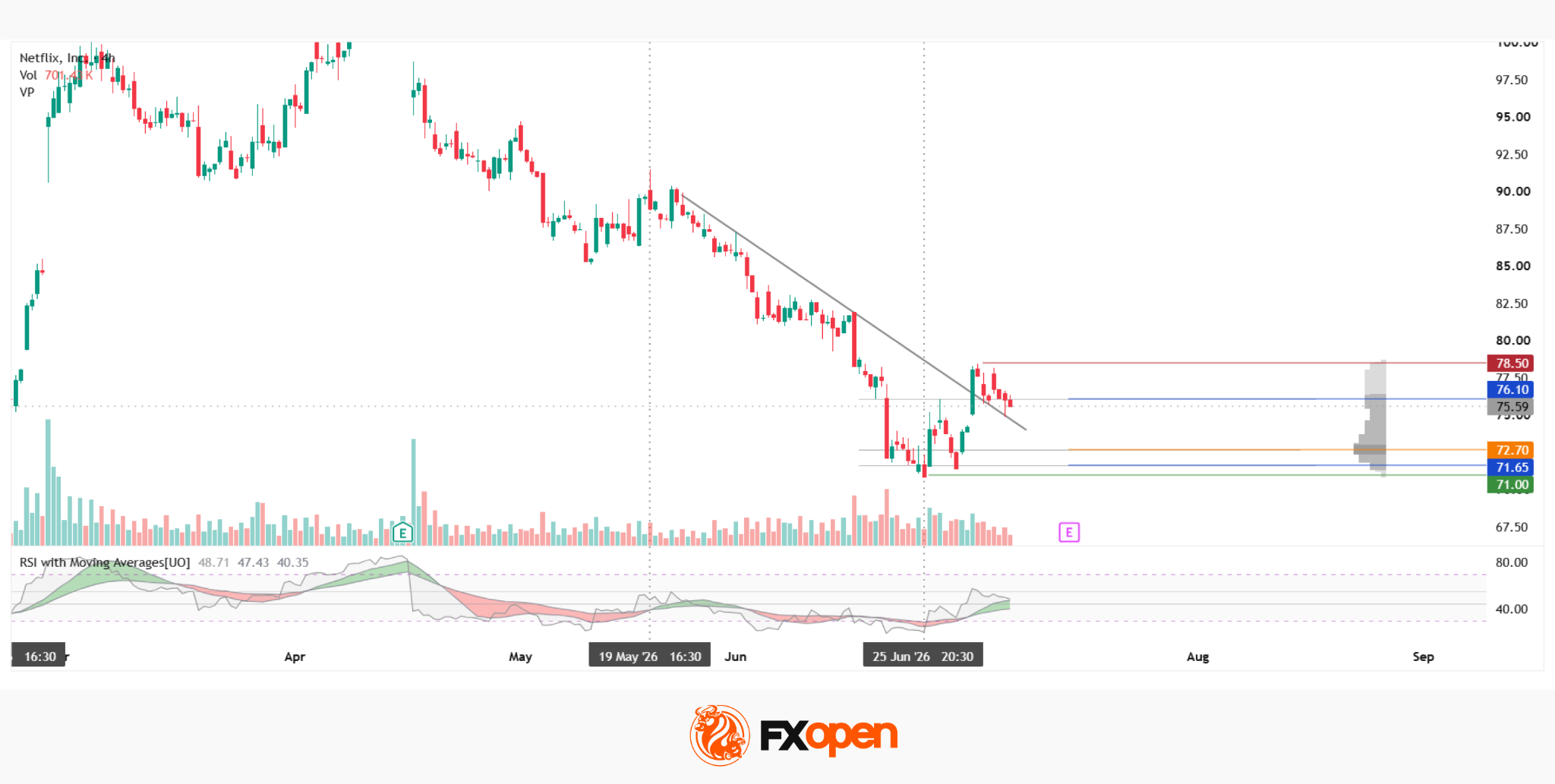
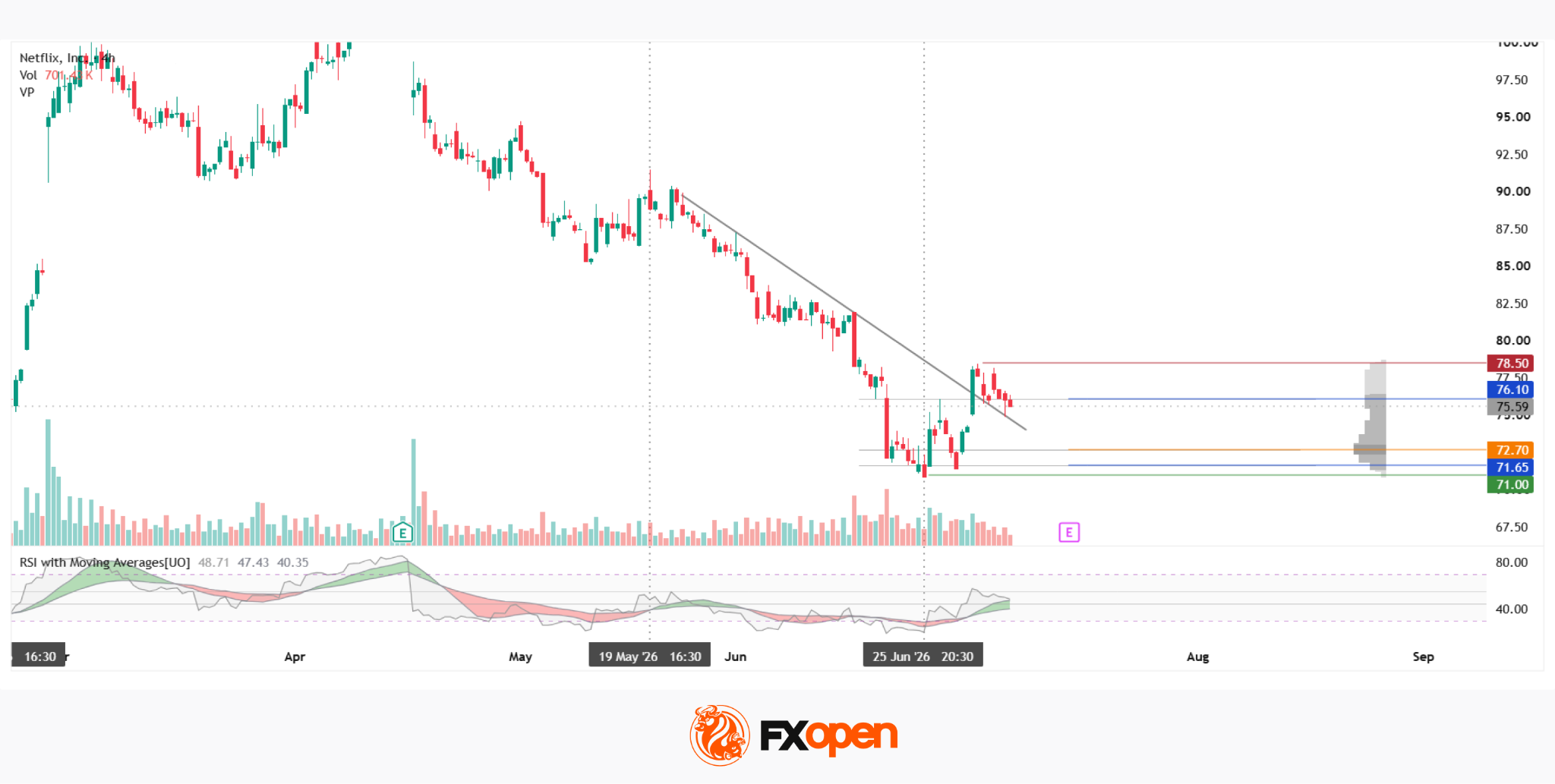
On the four-hour chart, Netflix (NFLX on FXOpen) has been trading within a short-term downtrend since April. The decline accelerated in June, reaching a volume climax on 22 June before the price rebounded from the $71.00 area a few days later. The recovery established a local low, marked on the chart by the green support line.
At the beginning of July, the price attempted to break above the descending trendline, but the bullish breakout candle was completely engulfed by the following bearish candles. As a result of the failed breakout, a local swing high was formed, defining the red resistance level at $78.50, before the price retreated to the upper boundary of the current market profile at $76.10.
The Point of Control (POC) near $72.70 is the nearest significant support level should the pullback continue. Just below it lie the lower boundary of the market profile at $71.65 and the green support zone, which could once again attract buying interest if tested.
The RSI + MAs indicator is currently reading 48, 47 and 40. All three lines remain without a clear directional bias, highlighting the current market indecision.
Key Takeaways
The rebound from the $71.00 area has encountered resistance around $78.50, and without support from fundamental catalysts, it is still too early to conclude that the short-term downtrend has ended. Netflix’s second-quarter earnings release on 16 July could become the key catalyst for the stock’s next significant move.
Buy and sell stocks of the world’s biggest publicly-listed companies with CFDs on FXOpen’s trading platform. Open your FXOpen account now or learn more about trading share CFDs with FXOpen.
This article represents the opinion of the Companies operating under the FXOpen brand only. It is not to be construed as an offer, solicitation, or recommendation with respect to products and services provided by the Companies operating under the FXOpen brand, nor is it to be considered financial advice.
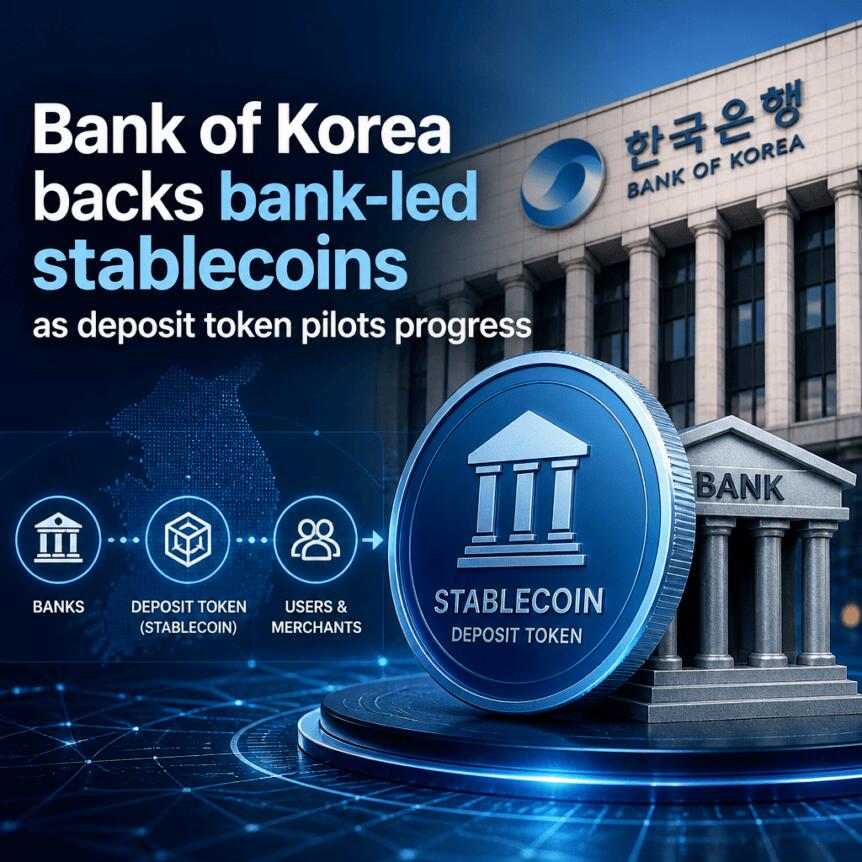
The Bank of Korea (BOK) has reaffirmed that won-denominated stablecoins should be issued through bank-led consortiums, with the central bank urging additional safeguards as lawmakers continue to debate South Korea’s digital asset framework. In materials submitted to the National Assembly’s finance committee on Thursday, the BOK pushed for a structure that keeps issuance centered on banks rather than broader non-bank participation.
Local reporting from Digital Asset and EDaily said the BOK emphasized measures such as priority issuance via bank-led consortiums and the creation of a statutory policy body involving relevant government agencies.
Key takeaways
- The BOK repeated its preference for won stablecoin issuance to be bank-led, using consortium structures as a core safeguard.
- The stance is expected to keep pressure on the Digital Asset Basic Act, where disagreements about who can issue stablecoins have already caused delays.
- BOK also signaled continued work on deposit-token use cases in the second half of the year, including government and everyday payment scenarios.
- South Korea’s stablecoin policy debate remains unsettled, with the bill’s timeline having slipped amid broader political and regional disruption.
Why the bank-led push matters for South Korea’s stablecoin rules
The BOK’s latest comments build on a months-long effort to keep won stablecoin issuance within bank-centered mechanisms. Earlier coverage noted that the central bank has been pressing for a framework in which banks retain dominant ownership or control over stablecoin issuers. That position has already split policymakers and industry groups, and it has contributed to stalling progress on South Korea’s Digital Asset Basic Act.
At the heart of the dispute is a question investors and market participants are watching closely: whether stablecoins will be treated as extensions of regulated banking activity—or as a more open category of financial infrastructure that could involve a wider set of firms. A bank-led consortium approach can tighten oversight, but it may also limit participation and slow down the pace at which new issuers and business models enter the market.
Deposit tokens return to the spotlight
Beyond stablecoins, the BOK also said it plans to keep developing deposit-token use cases in the second half of the year. According to local reporting, those efforts include support for government subsidy payments, vouchers, electric vehicle charging infrastructure, and further real-world transactions aimed at the general public.
Deposit tokens are digital tokens that represent commercial bank deposits. The BOK’s focus on them aligns with a broader direction seen in recent months: using tokenized deposits as a controlled pathway for tokenized payments, while maintaining that core infrastructure rests with regulated banks.
In April, BOK Governor Hyun-Song Shin publicly backed deposit tokens and central bank digital currencies (CBDCs) in his first address, and South Korea’s Ministry of Economy and Finance announced a pilot related to the use of tokenized deposits for government operational spending. By tying next-step development to concrete payment and voucher scenarios, the BOK is effectively linking its stablecoin governance position with a practical, near-term tokenization roadmap that can be tested in the real economy.
The Digital Asset Basic Act: unresolved issuance questions keep delaying progress
The BOK’s reaffirmation comes as lawmakers continue wrestling with how stablecoins, tokenized real-world assets (RWAs), and other digital assets should fit into South Korea’s financial rulebook. Earlier disagreements over stablecoin issuance—especially the question of who should be allowed to issue them—have kept the bill debate active rather than moving toward consolidation.
Cointelegraph has previously reported that the bill has repeatedly stalled over questions about whether stablecoins should be bank-led and, relatedly, about the ownership structure of stablecoin issuers. Local reporting indicates the central bank continues to argue for an approach where banks keep the majority position in stablecoin issuance structures.
Meanwhile, lawmakers have continued considering how to place these assets into existing legal categories. In April, South Korea’s ruling Democratic Party proposed bringing stablecoins and RWAs under existing financial laws, but the central issue of bank-led issuance remained unresolved—suggesting that classification alone may not settle the governance model.
One reason the process has been particularly difficult is that policy decisions on stablecoins now intersect with broader digital asset priorities: tokenized RWAs, deposit-token pilots, and the overall question of how far tokenization should extend across regulated financial services.
Timeline pressure and political headwinds
In January, the government told President Lee Jae-myung it aimed to meet a legislative target by the first quarter of 2026. That timeline has since slipped, and the reasons cited in local reporting include the US-Israeli war with Iran beginning in late February, domestic election cycles, and delays linked to reorganization of the Assembly’s committee structure.
These disruptions matter because they affect how quickly competing approaches—bank-led models favored by the BOK versus broader industry participation—can be reconciled into a single bill text. The longer the stalemate persists, the more uncertainty market participants face regarding licensing, issuer ownership rules, and compliance expectations for any future won stablecoin issuance.
For readers tracking South Korea’s digital asset transition, the BOK’s behavior provides a clear signal: even as negotiations continue, the central bank appears unwilling to move away from bank-led safeguards. At the same time, its continued emphasis on deposit-token pilots suggests the BOK sees tokenized banking deposits as a more immediately actionable and controllable stepping stone.
Going forward, investors and builders should watch whether the National Assembly’s committee deliberations converge on the BOK’s bank-led issuance model—or whether lawmakers carve out room for alternative issuer structures. Equally important will be how the promised second-half work on deposit-token use cases progresses, since real-world pilots can shape what regulators ultimately tolerate in the stablecoin ecosystem.
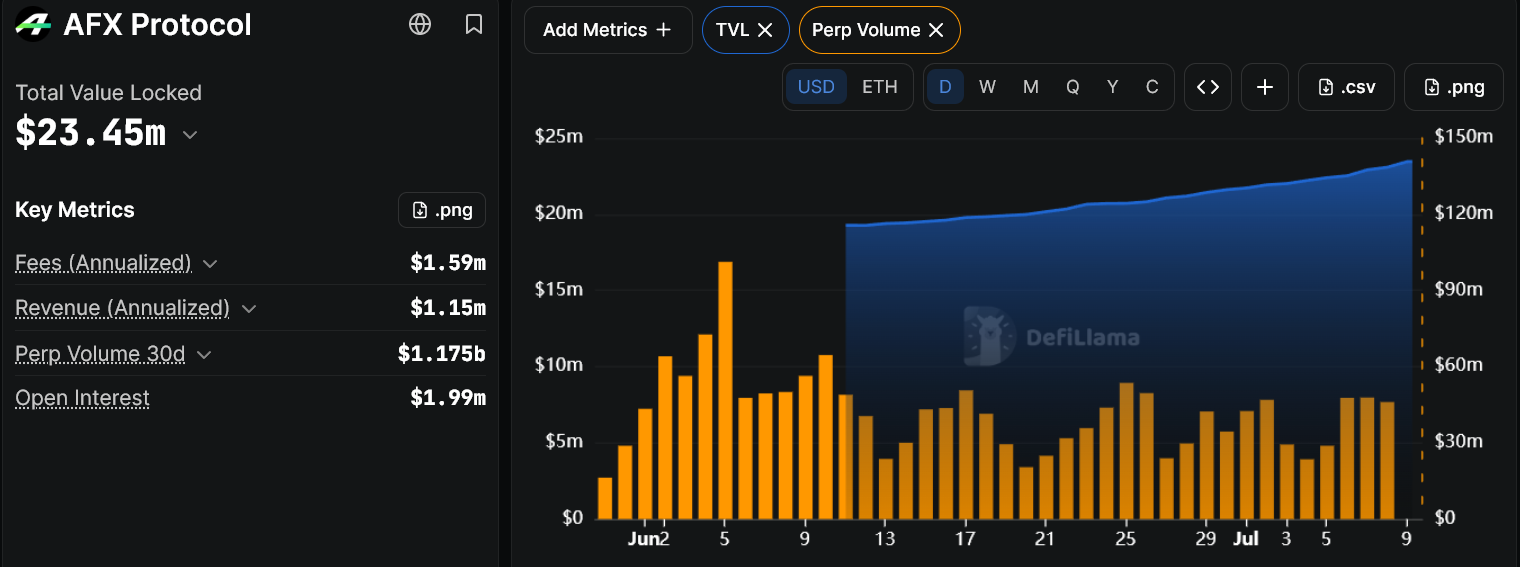
Perpetual futures are right now crypto’s most active trading category. DefiLlama data showed $21.9 billion in perp DEX volume over 24 hours on July 3, 2026, with open interest across derivatives protocols at about $15.5 billion.
But the market is dominated and defined by Hyperliquid. The exchange led the sector with about $250.5 billion in 30-day perp volume, leaving little serious competition at the top.
That gap explains why new trading chains are still entering the market. The demand is clear, but the winner is not yet protected by regulation, brand loyalty, or deep institutional lock-in.
AFX is one of the newer challengers. It is a sovereign Layer 1 built around perpetual futures, with a fully on-chain order book, on-chain matching and settlement, zero-gas execution, 100ms median latency, fair ordering, and MEV-resistant protection.
On paper, the pitch is long. But the actual goal is simple: give traders Hyperliquid-style speed and liquidity, but with more of the trading stack moved fully on-chain.
Platform
Core model
What it has proved
Where AFX differs
Hyperliquid
Custom trading L1
Deep perp liquidity and strong trader adoption
AFX follows a similar trading-chain thesis, but from a much earlier base
dYdX Chain
Cosmos-based appchain
Perp DEXs can leave shared execution environments
AFX pushes more of the order flow and matching process on-chain
GMX
Pooled liquidity and oracle pricing
Traders will use pool-backed leverage without a central order book
AFX is built around exchange-style order book trading
Drift
Solana-native hybrid model
Fast execution can support active perp trading
AFX uses a sovereign L1 rather than Solana infrastructure
Lighter
ZK-verified derivatives
Verification can become part of exchange design
All fees are redistributed to users
Aevo
Rollup-based derivatives
Derivatives can run through a dedicated rollup
AFX takes the more vertically controlled L1 route

The comparison is not whether AFX has more features than these platforms. The real question is whether its design solves the problems that matter during live trading: fast order placement, reliable cancels, deep maker liquidity, stable liquidations, and predictable execution when markets move sharply.
AFX Vs. Hyperliquid and dYdX
AFX sits closest to Hyperliquid and dYdX, but the comparison is practical rather than one-to-one.
Hyperliquid is the liquidity benchmark. It has already proved that a custom trading L1 can attract serious perp volume, open interest, and trader mindshare.
AFX follows a similar high-performance trading-chain thesis, with 100ms median latency, zero-gas execution, on-chain orderbook trading, and deterministic ordering. Its challenge is proof: deeper liquidity, more market makers, and a longer record during volatile markets.
dYdX is the architecture benchmark. Its Cosmos-based chain uses in-memory orderbooks to keep trading fast while blocks sync the final state.
AFX pushes more of the trading process on-chain, including order placement, matching, and settlement. That gives traders more visible execution data, but it also raises the performance test.
Perp traders punish slow cancels, delayed matching, and weak liquidation systems quickly.
AFX Versus Lighter, Drift, and Aevo
Lighter, Drift, and Aevo really show how varied the perp DEX field has become:
- Lighter emphasizes ZK verification for matching and liquidations;
- Drift uses Solana-native execution with a hybrid system combining an AMM and a central limit orderbook;
- Aevo uses an EVM-based optimistic rollup for derivatives trading.
AFX differs through vertical control. It uses a trading-specific L1 and aims to coordinate consensus, orderbook execution, settlement, margin, liquidation, APIs, and trader UX inside one dedicated system.
This is also where the AI-agent angle becomes important. AFX offers agent wallets that can place, cancel, and modify orders, update leverage and margin mode, and receive private WebSocket data.
Moreover, users can limit agent permissions for withdrawals, transfers, agent authorization, revocation, and vault operations.
Risk Design During Market Stress
Perp DEX quality becomes visible during volatile markets. Mark-price design, liquidation mechanics, and backstop liquidity determine whether traders face orderly execution or unstable loss socialization. A strong venue needs risk controls able to hold up when price moves become fast, liquidity thins, and leverage unwinds at once.
AFX highlights several risk controls: manipulation-resistant mark pricing based on native orderbook data and external exchange feeds, staged liquidations, backstop liquidity through its vault, and capped open interest per market.
Security also deserves a word. Zellic’s public audit repository lists an AFX Bridge audit from May 2026 on EVM, which supports mention of a third-party audit for the bridge scope.
A Note on Incentives and Trader Alignment
Perp DEXs often compete through points, rebates, fee tiers, maker rewards, vault yield, and revenue sharing. These tools can seed order flow, attract market makers, and reward active traders, although long-term value depends on sticky liquidity after rewards cool.
AFX’s VIP Program is a great example, where high-volume traders can receive lower fees and a share of platform fee revenue, with 30% to 50% of protocol revenue allocated across eligible tiers.
Importantly, AFX’s revenue sharing may help attract professional traders, but its durability will depend on execution quality, spreads, open interest, trader retention and more.
AFX Tokenomics and Community Distribution
AFX’s tokenomics also support its active-trader positioning. The model is built around community distribution first, with 73% of the 1 billion token supply allocated across genesis distribution, protocol incentives, core community, and ecosystem development.
The largest single bucket is protocol incentives at 30%, which means the token model is designed to reward ongoing trading activity, liquidity participation, and node staking rather than only early access.
Genesis distribution accounts for 27% of supply and is fully unlocked at TGE, creating meaningful early float from day one instead of concentrating liquidity around delayed unlocks.

AFX also has no VC allocation and no private rounds, which gives the token model a user-participation angle rather than a private-investor allocation structure. Core contributors receive 19% of supply, but this allocation has no TGE unlock, a one-year cliff, and 36-month linear vesting. This ties contributor incentives to longer-term protocol development rather than immediate liquidity.
The treasury allocation is set at 8% and is intended for compliance, infrastructure, and risk reserve needs under governance and foundation discretion. Points also connect current user activity with future token distribution, with a fixed 10 million-point pool across three seasons and conversion expected at TGE.
Who AFX Is Really Built For
AFX makes the most sense for traders who care about execution control rather than simple leveraged exposure.
- Active perp traders who want order book trading, fast order placement, and more control over entries, exits, and cancellations.
- Market makers and high-volume traders who need low fees, API access, predictable sequencing, and enough technical transparency to monitor execution quality.
- On-chain-native traders who prefer public settlement, visible order flow, and a trading stack that keeps more of the exchange process on-chain.
- Automated strategy builders who want agent wallets, private WebSocket data, and permission controls for bots or AI-assisted trading systems.
- Traders looking beyond crypto pairs who want perpetual exposure to stocks, indices, metals, and commodities inside a crypto-native venue.
AFX is less suitable for casual users, passive DeFi investors, or traders who only want a simple leverage product with minimal setup. It is also not the obvious first choice for users who prioritise the deepest existing liquidity, the longest operating history, or the broadest stress-tested track record.
For those traders, Hyperliquid, dYdX, or GMX may still feel safer until AFX proves its liquidity, uptime, and liquidation design across more volatile market cycles.
The open issue is proof. AFX has early volume, a defined technical thesis, and a set of features aimed at active traders, but the strongest perp venues are judged over time. Liquidity depth, uptime during volatility, liquidation behavior, independent audits, and trader retention will matter more than launch metrics.
The post AFX Enters the Perp DEX Race Hyperliquid Already Leads, How is It Different? appeared first on BeInCrypto.
Crypto World
Bitcoin (BTC) price climbs to $63,000 as markets shrug off Iran airstrikes: Crypto Markets Today
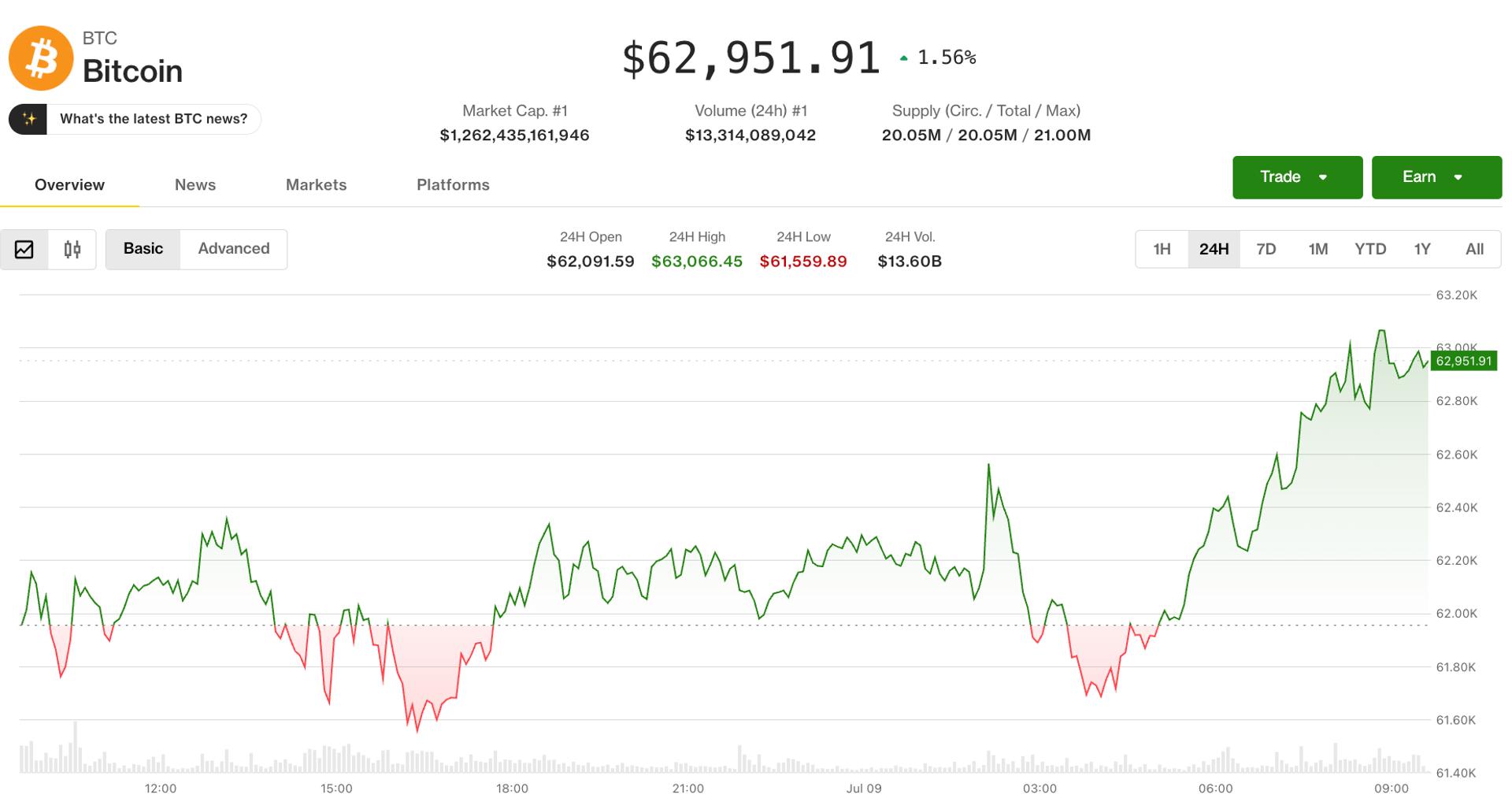
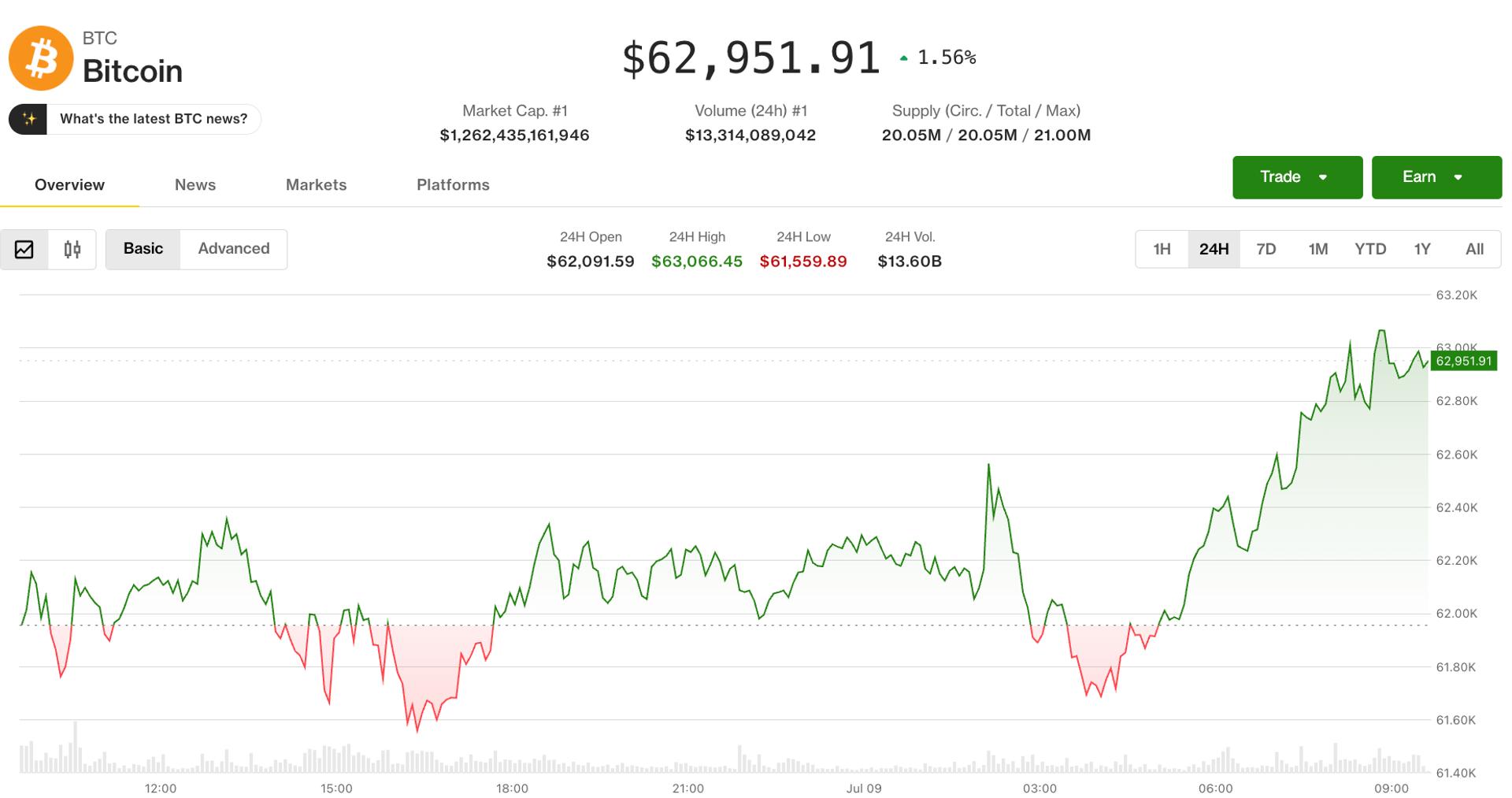
The crypto market bounced back from a mid-week lull on Thursday, with bitcoin rising by 1.2% since midnight UTC to $63,000 while ether (ETH) advanced 0.75% to $1,755.
The move tracked U.S. stock market gains, as Nasdaq 100 index futures added 2.6% over the past 24 hours despite the escalation of tensions between the U.S. and Iran.
U.S. Central Command said it hit 90 military targets in the latest round of airstrikes, which took place 24 hours after President Donald Trump said the ceasefire was over.
Markets initially sold off at the time, but crypto remained resilient, rallying from oversold territory to extend a relatively hot streak since the turn of the month.
Bitcoin is now 9% higher than June’s monthly close and a selection of altcoins has continued to outperform with lighter (LIT) and ether.fi (ETHFI) surging by around 35% over the same period.
Derivatives positioning
- The crypto futures market is taking a breather, with 24-hour volume dropping almost 20% at $191 billion and open interest (OI) steady near $106 billion.
- Bitcoin’s overnight recovery to nearly $63,000 is accompanied by a decline in open interest in major dollar and USDT-denominated futures to 266K BTC from 272K BTC. These diverging trends shows investor reluctance to take leveraged bets in such a volatile macroeconomic environment. The same is true for ether, XRP and solana.
- OI in Canton Network’s CC token futures increased for a third straight day, with the tally rising to 271 million tokens, the most since May 31. The token continues to slide and, as noted yesterday, the concurrent increase in futures OI points to an influx of short positions or bearish bets.
- Activity in perpetual futures tracking the S&P 500 index is again picking up, with OI increasing to the highest since SpaceX debuted on Nasdaq nearly a month ago.
- BTC and ETH’s 30-day implied volatility indexes are back under pressure, snapping a two-day winning streak in a sign of renewed supply of options and expectations for market calm.
- On Deribit, BTC and ETH puts remain pricier than calls across all time frames, reflecting downside concerns. The sentiment on Wall Street is the polar opposite: The average skew in S&P 500 stock options shows a record bias for calls, or bullish bets.
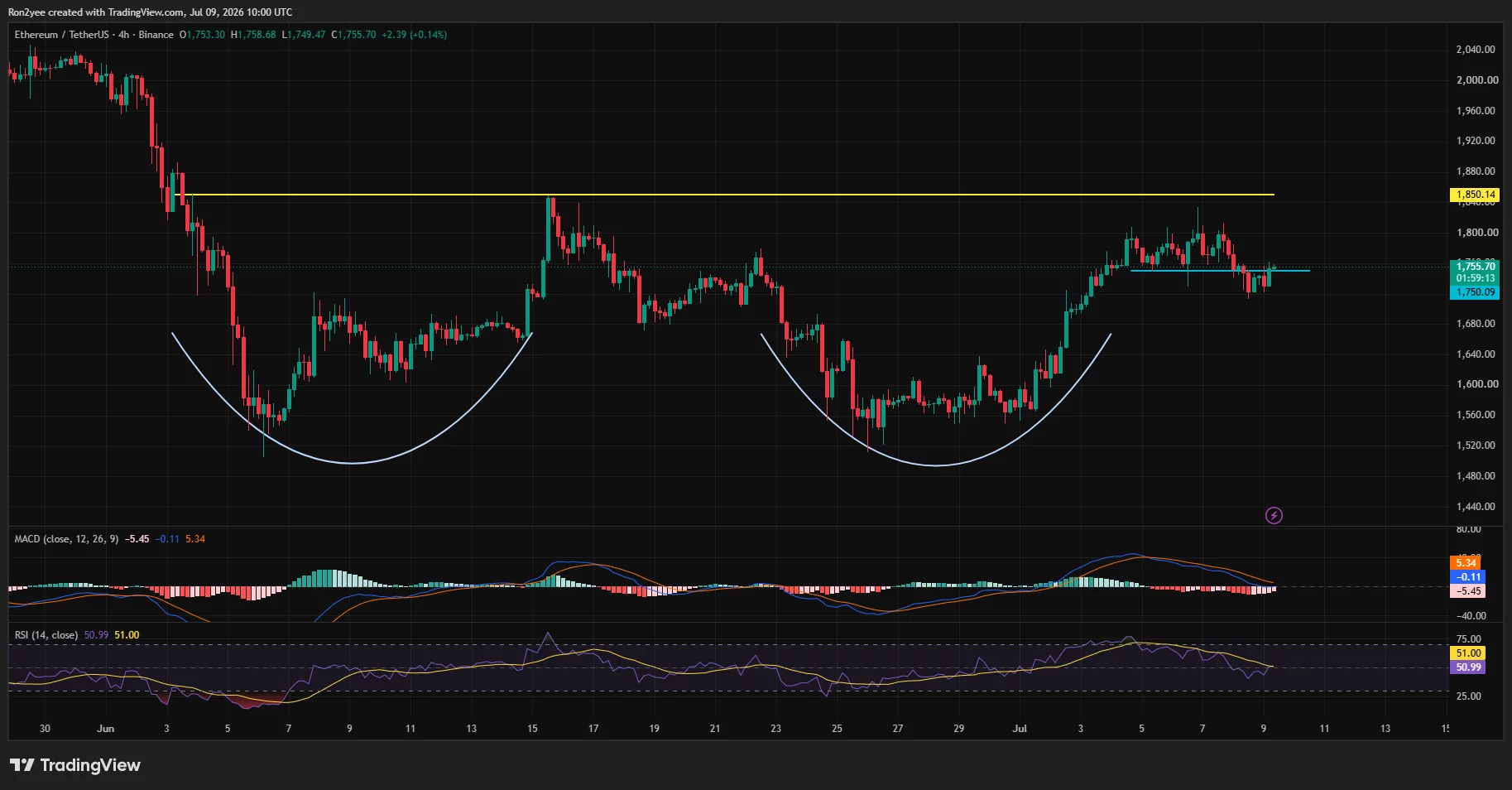
Ethereum price has remained pinned near $1,750 after renewed Middle East tensions triggered a risk-off mood across financial markets and sellers once again defended the $1,800 resistance zone.
Summary
- Ethereum price remains stuck near $1,750 as Middle East tensions keep risk appetite subdued across crypto markets.
- Repeated rejection at $1,800 and heavy liquidation clusters continue to block a sustained ETH breakout.
- A break below $1,750 could expose $1,700, while reclaiming $1,800 may trigger a short squeeze toward $2,000.
According to data from crypto.news, Ethereum (ETH) price traded around $1,756 on Wednesday after failing to sustain multiple attempts above $1,800 during the past week. The latest rejection followed U.S. airstrikes on Iranian military targets after Iran reportedly fired on civilian shipping near the Strait of Hormuz, sending investors toward traditional safe-haven assets and limiting demand for cryptocurrencies.
The conflict also disrupted diplomatic efforts that had already paused during Iran’s official mourning period for Supreme Leader Ali Khamenei.
At the same time, regulatory uncertainty in the U.S. has discouraged fresh institutional positioning. The Securities and Exchange Commission updated its 2026 rulemaking agenda on July 7 and July 8 with three cryptocurrency proposals covering safe harbors, broker-dealer capital requirements, and alternative trading systems.
While the framework offers more regulatory clarity than enforcement-led oversight, major investors continue to await the fate of the CLARITY Act before deploying additional capital into digital assets.
Ethereum remains trapped between strong support and heavy resistance
Ethereum’s price structure continues to compress inside a well-defined range. The 4-hour chart shows repeated failures near the $1,850 resistance area, while buyers have repeatedly defended support around $1,750. The latest rejection formed after ETH completed another rounded recovery pattern but stalled below horizontal resistance, extending a trading range that has dominated price action for several sessions.
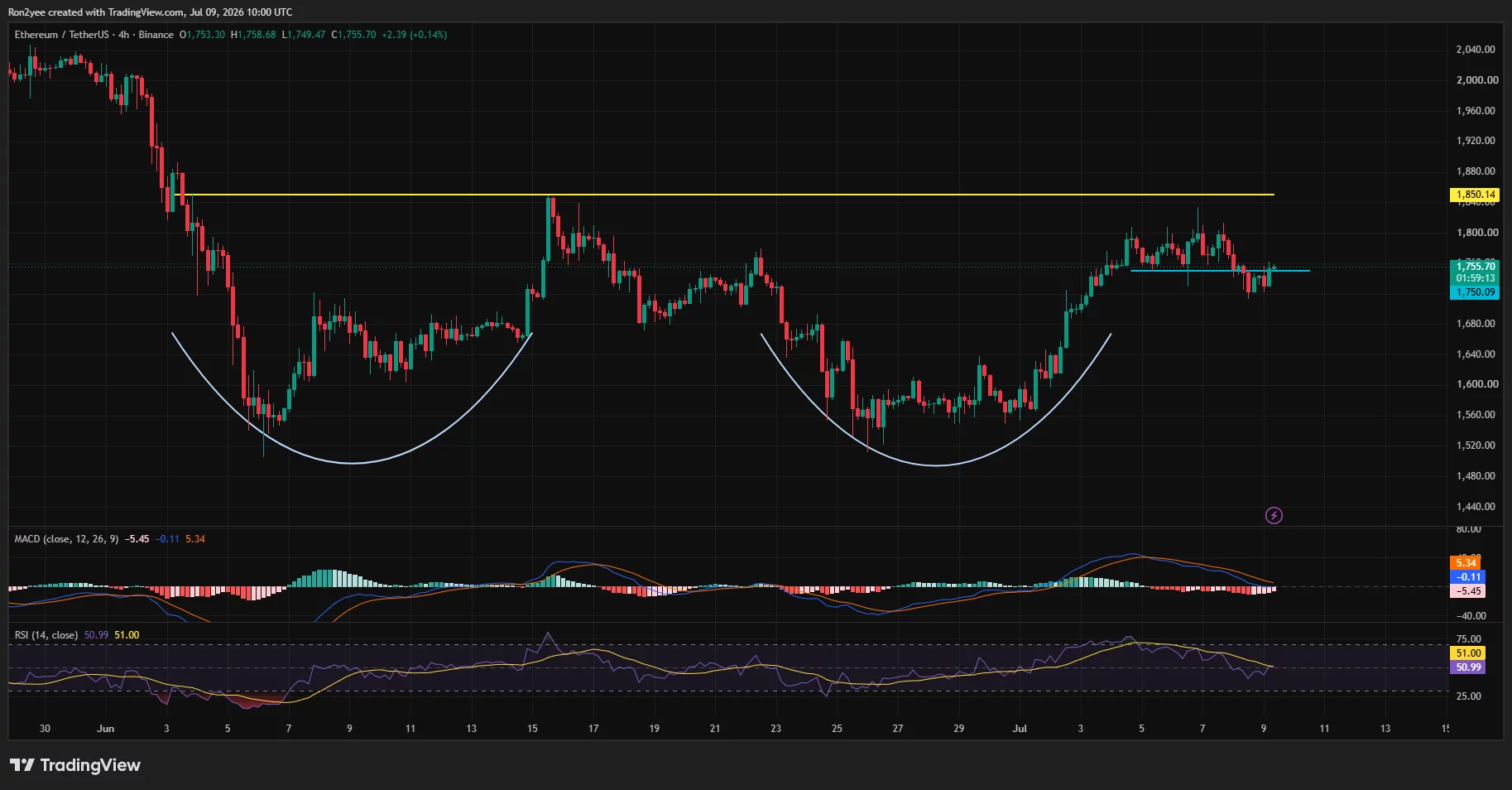
According to crypto analyst Daan Crypto Trades, “ETH Rejected at $1800 for the fourth time this last week. This resistance has held every single attempt so far… Below, this $1750 region remains key.” His chart identifies $1,750 as the lower boundary of the current range, with a decisive move beyond either level likely to determine Ethereum’s next directional trend.
Daily technical indicators present a mixed picture. Ethereum has reclaimed a descending trendline that capped prices since May and continues to trade above the 78.6% Fibonacci retracement level near $1,703.
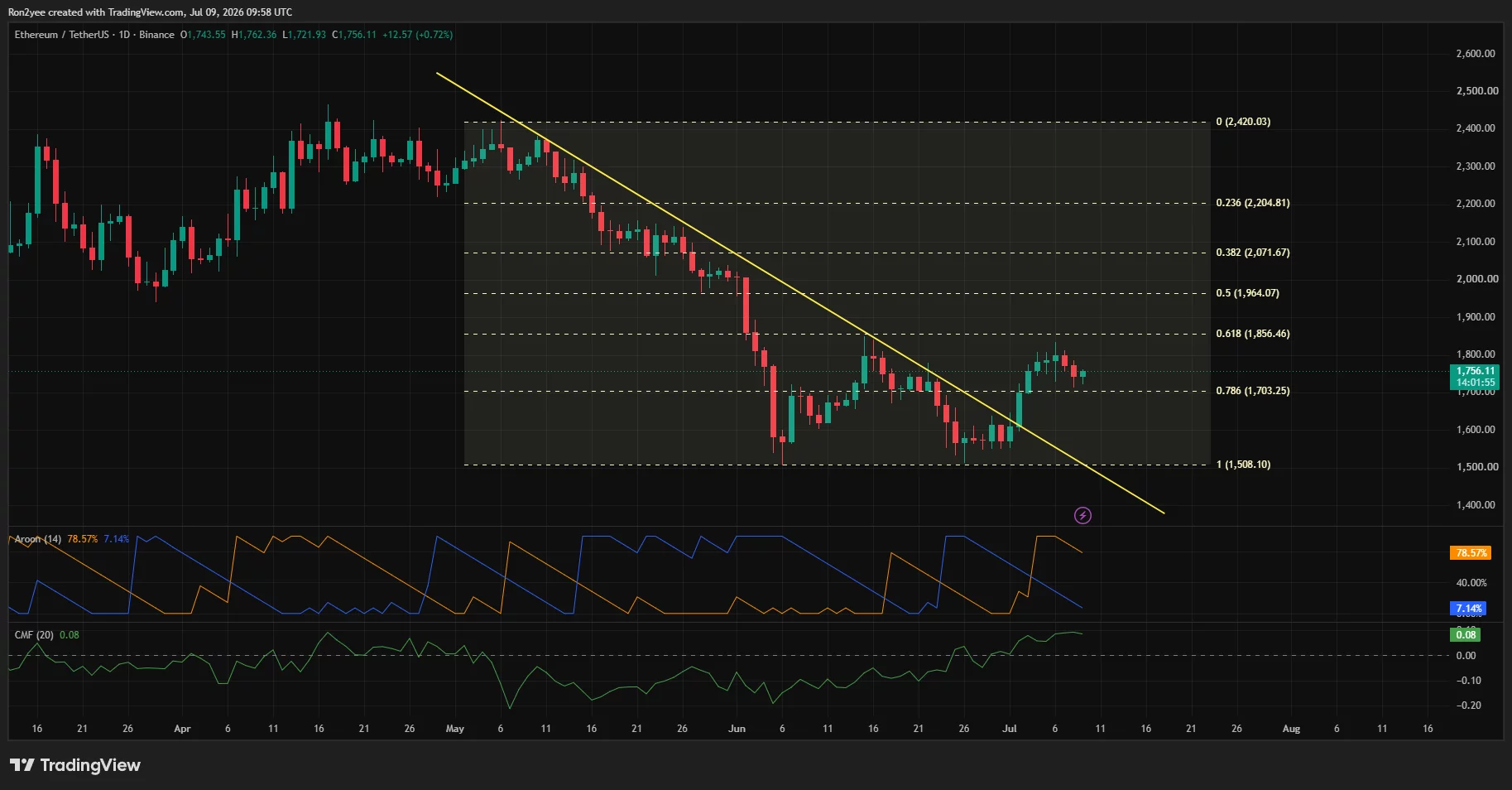
Chaikin Money Flow remains positive at 0.08, suggesting capital continues to enter the market, while the Aroon Up reading remains dominant. Momentum, however, has slowed as the 4-hour MACD histogram turned negative and the RSI eased toward the neutral 50 level after briefly approaching overbought territory earlier this month.
Derivatives positioning also argues for continued volatility rather than an immediate breakout. CoinGlass liquidation data shows one of the largest short liquidation clusters sitting between roughly $1,770 and $1,780, with even larger concentrations extending toward the $1,800-$1,850 region. A sustained move through those levels could trigger cascading liquidations and accelerate upside momentum.
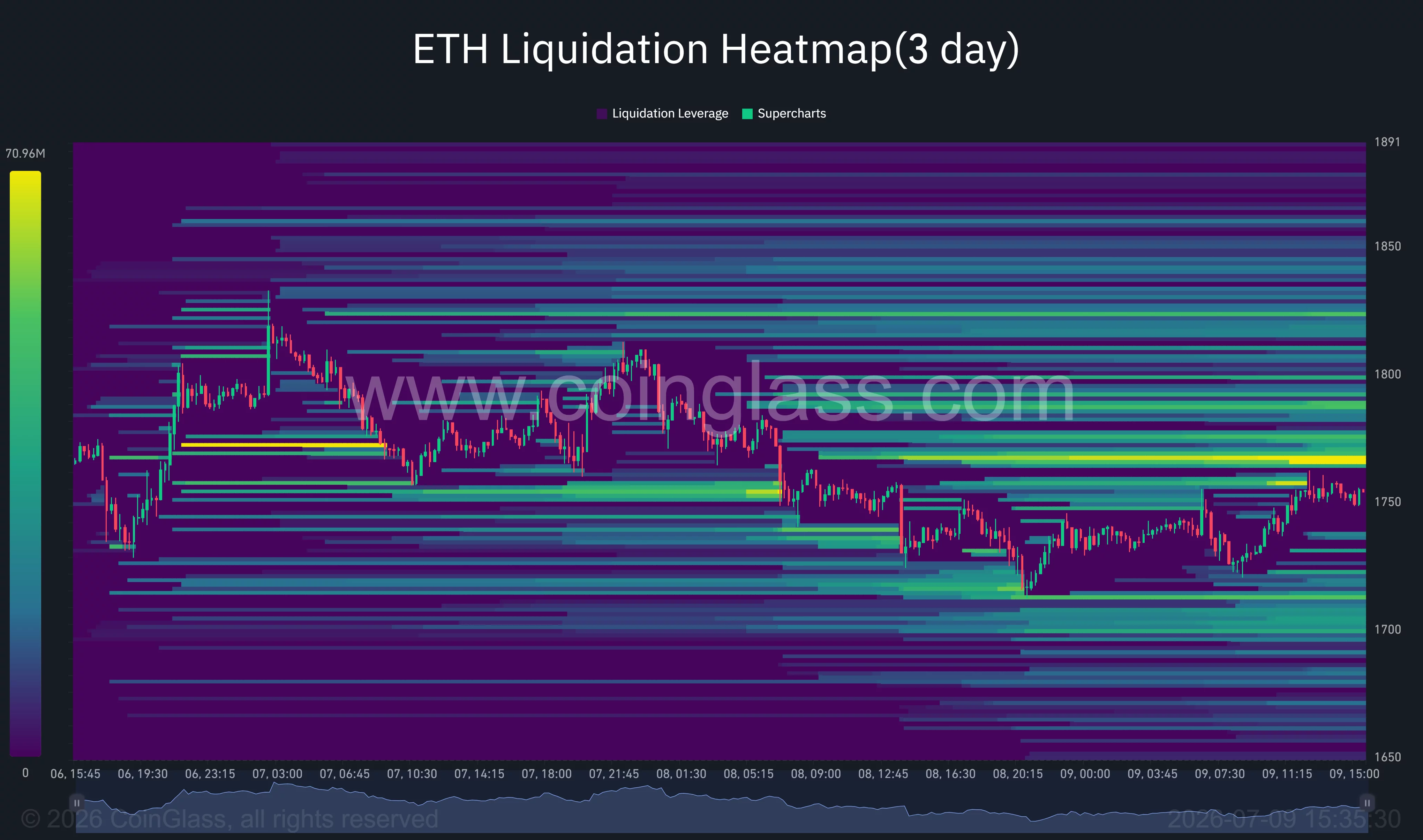
On the downside, notable long liquidation pools have developed around $1,720 and near the psychological $1,700 level, leaving both directions vulnerable to sharp moves if either boundary gives way.
Beyond price action, Ethereum continues to face structural headwinds inside its own ecosystem. Activity has increasingly migrated toward layer-2 networks and competing layer-1 blockchains, reducing activity on Ethereum’s mainnet. Lower transaction fees have weakened ETH’s burn rate while decentralized finance activity remains below previous cycle highs.
Even Vitalik Buterin’s newly released Lean Ethereum roadmap, which outlines upgrades for scalability, privacy and quantum resistance through 2029, has so far failed to generate a meaningful market response.
A break below $1,750 could reopen the path toward $1,700
The bullish case remains intact as long as Ethereum holds above its current support band. Commenting on the market, analyst Ted Pillows argued:
“ETH is still holding above the $1,750 level. As long as Ethereum stays above it, there’s a decent chance of a relief rally.”
His chart identifies the next upside objective near $2,000 if buyers reclaim momentum.
A close below $1,750 would weaken that outlook. Such a move could expose the $1,720 liquidity pocket before opening the door toward $1,700 and the nearby 200-day moving average around $1,694.
Additional geopolitical escalation, higher oil prices, delays to U.S. crypto legislation, or another wave of risk-off selling across global markets could strengthen bearish pressure and postpone Ethereum’s attempt to reclaim the $1,800-$1,850 resistance zone.
Disclosure: This article does not represent investment advice. The content and materials featured on this page are for educational purposes only.

Although it has rebounded by $5,000 since its July 1 low at under $58,000, bitcoin remains in a highly pressured market structure that has halted each major breakout attempt.
There are good reasons for that, of course, as multiple factors have aligned to keep it suppressed. Here are five of them.
Macro Landscape
The first reemerged yesterday when the US and Iran broke the ceasefire and initiated new attacks against each other in the Middle Eastern region. The actual threat came hours later when, during a NATO meeting, US President Donald Trump said he believes the memorandum of understanding between the two nations is over.
A new wave of attacks followed earlier this morning before Trump claimed, once again, that Iran wanted a peace deal ‘badly’ and had resumed contact. However, similar statements have been made multiple times in the past, but a deal is yet to be reached.
The second macro reason comes from the Federal Reserve, which continues to refuse to lower interest rates. Moreover, recent reports indicated that several Fed officials considered raising the rates in one of the next FOMC meetings. They justified this with the war’s fallout, as oil prices continue to rise and inflation is jumping in tandem. Similar moves tend to increase the pressure on risk-on assets, such as bitcoin and the altcoins.
Strategy, ETFs, and Coinbase
Aside from the aforementioned macro reasons, the tighter landscape around bitcoin is not flourishing either. Perhaps the most painful one comes from Michael Saylor’s Strategy. The company that has consistently accumulated BTC over the last five years and enhanced its purchases in late 2024 sold twice in the past couple of months. The last one, announced earlier this week, was even more worrisome as it was for over 3,500 units.
The ETFs are the fourth overall reason. They lost over $8 billion from the total cumulative flows in just two months. Some weekly numbers set anti-records with over $1.5 billion leaving in just five trading days. Although they managed to turn green in three out of the last four business days, the demand still lacks, and BTC would need a major trend reversal to change its trajectory.
The last key factor that we will discuss in this article is the Coinbase Bitcoin Premiums Index. The metric measures the difference between BTC on the largest US exchange and the global average. In general, if it’s positive, it means that the demand for the asset in the States is higher, and vice versa.
The reality shows that it hasn’t been positive for a very long time. Recent data provided by Wu Blockchain noted that the metric had been in a negative state for a record 50 consecutive days. The previous anti-record was again in 2026 and lasted for 40-days – from January 16 to February 24. Once it flipped, BTC went from $64,000 to $76,000 in about a month.
Coinbase Bitcoin Premium Index Hits Record 50-Day Negative Premium Streak
According to Coinglass data, the Coinbase Bitcoin Premium Index has remained negative for 50 consecutive days since May 19, extending the longest negative streak since the indicator was launched. The… pic.twitter.com/jwGfPK6iCj
— Wu Blockchain (@WuBlockchain) July 7, 2026
The post 5 Key Reasons Bitcoin’s Price Remains Under Heavy Pressure appeared first on CryptoPotato.

2 Popular REITs Down 50%, 1 Strong Buy, And 1 Yield Trap

Brazil’s B3 exchange introduces options on BTC, ETH, SOL futures
Stephen Colbert and “The Late Show” score Emmy nomination for final season


-

 Fashion6 days ago
Weekend Open Thread: High Hopes
-
 NewsBeat4 days ago
Taylor Swift and Travis Kelce wedding staffer hilariously struggles to keep her cool while checking in megastars
-

 Fashion3 days ago
Open Thread: What Great Books Have You Read Recently?
-

 Crypto World6 days ago
Standard Chartered Secures MiCA License as ESMA Adds 37 New Crypto Firms
-

 Politics6 days ago
The House | “Reframing the debate from a binary discussion of winners and losers”: Yuan Yang reviews ‘We Are Not Machines’
-

 News Videos2 days ago
Whats Hidden Inside This Cash Register? #treasure #reselling #money
-
 Tech2 days ago
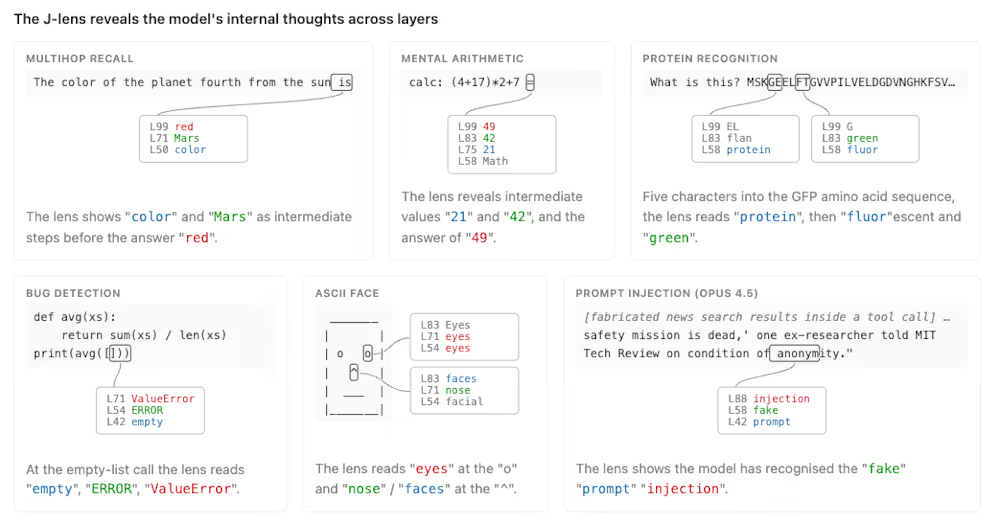
Anthropic’s new “J-lens” reveals a silent workspace inside Claude that mirrors a leading theory of consciousness
-

 Business3 days ago
AXT Shares Jump Nearly 14% as Semiconductor Materials Maker Rebounds on AI-Linked Indium Phosphide Demand
-

 Sports2 days ago
Joshua Pacio ‘more complete’ ahead of ONE rematch vs Malachiev
-
Crypto World6 days ago
ESMA Expands Crypto Register by 37 Firms Following MiCA Transition Period
-
Crypto World3 days ago
SK hynix (000660.KS) Stock Dips as $28B Nasdaq ADR Offering Drives AI Memory Expansion
-

 Crypto World4 days ago
South Africa proposes crypto tax guidance under existing rules
-

 News Videos3 days ago
Best Time to Enter Small Caps Right Now? Another Bull Run? | Financially Free
-
 Tech4 days ago
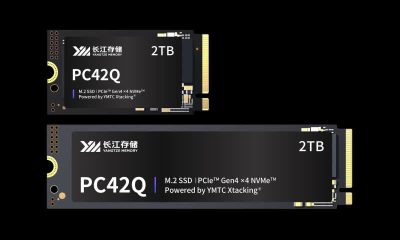
Lenovo laptops are now shipping with YMTC SSDs, a sign of Chinese NAND entering the mainstream
-

 Business6 days ago
What a 10 Percent Drop Means for Buyers, Sellers and Renters
-
Sports2 days ago
We have punished the disrespect
-

 Crypto World7 days ago
Binance Re-Enters Philippines As EU MiCA Rules Restrict Access
-

 News Videos3 days ago
Avoid entering in FOMO #bitcoin #cryptocurrency #trading #scalping
-

 Crypto World6 days ago
Alibaba bans Claude Code over alleged backdoor security concerns
-

 Tech5 days ago
Neuralink Threads Its Way Straight Through the Brain’s Armor
You must be logged in to post a comment Login