



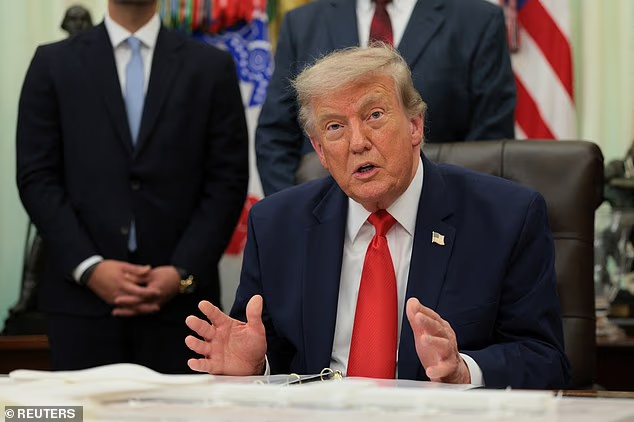
Donald Trump has struck a ‘historic deal’ that includes the ‘complete disarmament’ of Hamas in Gaza in an effort to end terror attacks on Israel.
Trump said the agreement made by the Board of Peace was part of his 20-point plan to bring peace to the Middle East. Hamas confirmed to the BBC that they have agreed to the deal.
In a Truth Social post Thursday night, Trump celebrated what he called a ‘monumental step toward lasting PEACE and SECURITY’ in the region.
‘This agreement is a critical step towards Gaza finally being governed by a new Palestinian government that will work closely with the Board of Peace to help the Palestinian people,’ he said.
Trump added: ‘At the same time, Israel will have the security it deserves, with Gaza no longer used as a base for terror attacks.’
The President said the agreement will be put into place ‘in carefully structured phases’ that will eventually lead to Israeli forces withdrawing from Gaza.
An International Stabilization Force and new Palestinian police force will work together to keep Gaza ‘safe for its residents and neighbors.’
Donald Trump’s Board of Peace has made a ‘historic deal’ that promises ‘complete disarmament’ of Hamas as part of his 20-point plan to stop the fighting between Israel and the terror group

The President said the agreement will be put into place ‘in carefully structured phases’ that will eventually lead to Israeli forces withdrawing from Gaza
Trump thanked mediators on behalf of Egypt, Qatar and Turkey ‘for their important efforts’ alongside his own team.
‘One year ago there was a violent raging war, humanitarian crisis and hostages kept in brutal captivity. We have made historic progress and there is still much work to do,’ he said.
‘CONGRATULATIONS TO ALL ON THIS AMAZING DEVELOPMENT, THAT EVERYBODY SAID COULD NEVER BE ACHIEVED!’
Trump has been meeting with Israeli Prime Minister Benjamin Netanyahu this past week.
The Daily Mail has reached out to the prime minister for comment.
In the four-page ‘roadmap’ for the deal, US officials said that both Hamas and Israel will remain at the same phase until both have reached its stated goals.
Smaller Hamas groups in Gaza will be taken apart to start before they get rid of their tunnel infrastructure.
Once the roadmap is complete, a new version of the Palestinian authority will control all weapons in Gaza.
Earlier this month, Hamas dissolved its government in Gaza and is preparing to transfer power to a technical committee backed by the United Nations as part of the deal.
Last October, Trump outlined the plan to end the war spurred on by the October 7, 2023 terror attack by Hamas.
The US President pledged not only an ‘immediate end to the war’ in the Strip but ‘the whole deal’ to stop conflict that has ravaged the entire region for ‘thousands of years’.


Trump has been meeting with Israeli Prime Minister Benjamin Netanyahu this past week

Palestinians Hamas militants wave their group’s flag as they celebrate on the roof of a destroyed synagogue of the former Jewish settlement of Netzarim, in the Gaza Strip
The plan states that on agreement by both sides, ‘the war will immediately end’ with Israeli withdrawals timed to release of the last hostages held by Hamas. During that initial period, there would be a ceasefire.
Existing ‘battle lines’ would be frozen in place and Hamas would lay down its arms with the terror group’s offensive weaponry being destroyed.
While ‘full aid’ would be immediately sent to the Gaza Strip.
Key points include the deployment of a ‘temporary international stabilization force’ and creation of a transitional authority headed by Trump.
The deal would demand Hamas militants fully disarm and be excluded from future roles in the government. However, those who agreed to ‘peaceful co-existence’ would be given amnesty.
Following Israeli withdrawal, the borders would be opened to aid and investment.
In a crucial change from Trump’s earlier apparent goals, Palestinians will not be forced to leave and instead, the document said, ‘we will encourage people to stay and offer them the opportunity to build a better Gaza.’
Police would be ‘nationally recruited’ and ‘professionally vetted’ and be tasked with maintaining public order, investigating crimes and protecting civilians within Gaza.

Smoke from an explosion can be seen after an Israeli attack on July 28, 2026

Smoke rises during an Israeli military bombardment of the northern Gaza Strip on November 15, 2023, amid the ongoing battles between Israel and the Palestinian group Hamas
Meanwhile the ISF – a multinational force – would guard borders, stop weapons smuggling, deter militant resurgence with targeted counter terror raids, and protect reconstruction projects.
The October 7, 2023, attack by Hamas-led militants that sparked the war killed some 1,200 people in Israel and saw 251 others taken hostage. Israel’s retaliatory offensive in Gaza has killed 73,098 Palestinians, according to Gaza’s Health Ministry.
The ministry, part of the Hamas-led government, is staffed by medical professionals and maintains detailed records viewed as generally reliable by UN agencies and independent experts.
It does not distinguish between civilians and militants but says women and children make up around half of all fatalities.
Israeli strikes have lessened considerably since the ceasefire took effect on Oct. 10, but they continue almost daily.
Israel’s military says it targets Hamas and other militants, often asserting they were planning attacks. The strikes have also killed many civilians.













































You must be logged in to post a comment Login