

Crypto World
Robinhood Chain Bridges $70M+ ETH in First Week, Data Shows


Ether is already seeing tangible activity from Robinhood’s newly launched layer-2 network. According to Token Terminal, more than $70 million worth of ETH has been bridged to Robinhood Chain within its first week, underscoring how quickly large user platforms can route on-chain liquidity into an Ethereum scaling environment.
Robinhood Chain launched on July 1 as an EVM-compatible, Arbitrum-based layer-2 that uses ETH as its native gas token. The network also positions itself as “AI-native and purpose-built for real-world assets,” while Robinhood continues expanding tokenized stock offerings to customers across more than 120 countries—an effort that has contributed to growing interest in blockchain rails for traditional market exposure.
Key takeaways
- Token Terminal reports over $70 million of ETH bridged to Robinhood Chain in the first week, signaling fast liquidity onboarding.
- DefiLlama data shows Robinhood Chain TVL at 46,748 ETH (about $83 million at current prices), with Thursday inflows alone totaling 31,855 ETH (about $55 million).
- Early usage appears ETH-denominated, with Uniswap founder Hayden Adams saying most activity uses ETH as the primary trading and settlement “base pair.”
- Analysts argue the structure could create recurring ETH demand via gas usage on an Arbitrum-based network tied to Ethereum settlement.
- Even with bullish network metrics, ETH remains in a weak price regime, trading near multi-year bear market lows after a sharp decline from its 2025 peak.
ETH inflows accelerate after Robinhood Chain’s launch
Robinhood Chain’s first-week numbers suggest the network is attracting meaningful capital flow almost immediately. Token Terminal said the amount of Ether bridged to the chain surpassed $70 million within seven days of launch. In a Thursday post, Token Terminal also argued that if adoption continues, the chain could become “a meaningful new source of demand for ETH.”
The mechanism matters for Ethereum watchers. Robinhood Chain uses ETH as the gas token, meaning everyday on-chain activity on the network directly connects to ETH consumption. Unlike layer-2 designs that rely on alternative gas assets, an ETH-native setup aligns the economics of user transactions with the asset traders typically benchmark on.
On-chain engagement: users, revenue, and locked value
Token Terminal’s view of network performance extended beyond bridged amounts. It reported that Robinhood Chain reached 194,000 daily active users within its first week, while daily revenue grew to $39,000—an annualized run rate of roughly $14 million at the time of reporting.
DefiLlama’s protocol page for the Robinhood Chain bridge shows figures broadly consistent with the “fast start” narrative. It placed total value locked at 46,748 ETH, worth around $83 million based on prevailing market prices, and recorded Thursday inflows of 31,855 ETH (about $55 million). While TVL can be influenced by multiple factors, the magnitude of daily inflows is notable for a chain so early in its lifecycle.
Hayden Adams, Uniswap founder, added another useful datapoint: he said most activity on Robinhood Chain is ETH-denominated. In his description, ETH functions as the base pair for trading, the highest volume asset, and the gas token used to pay for blockspace. He also said ETH is burned on Ethereum layer 1 to cover data storage fees, tying part of the L2’s operational cost back to the mainnet.
Why investors are watching the “L2 flywheel”
The recurring-demand argument is at the center of the bullish reaction from several quarters. Andri Fauzan Adziima, research lead at Bitrue Research Institute, told Cointelegraph the early volume “validates the L2 flywheel” and characterized it as a “meaningful new demand sink.” His broader point was that when ETH is the native gas token on a high-velocity Arbitrum-based network, transactions can translate into ongoing, measurable demand while capital remains locked and a large user base gets onboarded.
“By using ETH as the native gas token on this high-velocity Arbitrum L2, every transaction I track creates direct, recurring demand while locking capital and onboarding Robinhood’s massive user base.”
Tim Sun, a senior researcher at HashKey Group, similarly framed the development as structurally positive for ETH. He emphasized that Robinhood Chain’s use of ETH for gas is the most direct benefit: as bridged assets, wallet activity, and on-chain transactions increase, new demand for ETH is generated.
Sun also pointed to a larger strategic implication. He said the deeper significance is not only how much gas is consumed, but that Robinhood is building its own on-chain financial ecosystem within the Ethereum network. In his view, this reinforces Ethereum mainnet’s role as the settlement layer and liquidity foundation for tokenized assets.
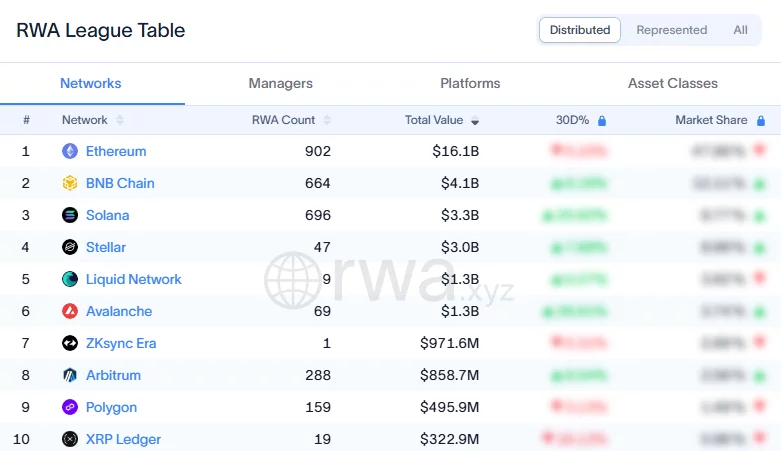
This matters because much of Ethereum’s long-term value thesis is tied to its function in real-world asset tokenization. The article from RWA.xyz cited in the source indicated that Ethereum and its layer-2 ecosystem together hold more than 50% market share in that segment, and the Robinhood Chain launch could further strengthen Ethereum’s position if it successfully attracts tokenized RWA usage at scale.
Tokenized assets meet an institutional-grade user pipeline
Robinhood’s involvement provides an important angle for the market: distribution. The platform has offered tokenized stocks to customers in more than 120 countries, reflecting sustained demand for tokenized exposure to US equities. If tokenized assets continue moving onto blockchains, networks that integrate ETH-based settlement and on-chain execution can capture both trading and transaction demand.
The tension for Ethereum traders is that network fundamentals do not always translate into immediate price action. ETH prices ticked up on Friday to $1,775, but it still trades near multi-year bear market lows—down 64% from its August 2025 peak, according to the figures referenced in the source. That means the key question for participants is whether early technical traction evolves into durable usage that can influence broader market expectations.
Bulls argue Ethereum’s growth path rests on multiple stacked drivers, including RWA tokenization, agentic AI payments, institutional adoption, and ongoing scaling upgrades. The source also pointed to Glamsterdam, expected before the end of 2026, as a network upgrade that could increase layer-1 capacity—an important piece of the scalability puzzle for any ecosystem hoping to absorb additional tokenized asset demand over time.
For now, the focus should stay on measurable signals: whether Robinhood Chain’s ETH-denominated activity sustains beyond the initial launch window, how TVL and daily revenue trend week-to-week, and whether tokenized asset usage meaningfully increases the number of users interacting with on-chain contracts.


DeXe price has surged more than 20% in a single day, climbing to a new all-time high on July 10 as a breakout above key resistance and heavy short liquidations propelled the token to the top of the cryptocurrency market.
Summary
- DeXe price surged over 20% to a new all-time high of $36.34 after breaking out of a bullish pennant.
- Heavy short liquidations and limited exchange supply accelerated the rally into price discovery.
- Bullish MACD, positive CMF, and rising whale activity support momentum despite overbought RSI conditions.
According to data from crypto.news, DeXe (DEXE) price climbed to an all-time high of $36.34 before easing to around $34.30, still posting gains of more than 22% over the previous 24 hours. The move came after the token broke above the $28 resistance zone that had capped prices during a multi-day consolidation, triggering fresh buying activity as stop orders were activated and momentum traders entered the market.
Technical breakout fuels fresh price discovery
The rally gathered pace after DEXE completed a breakout from a bullish pennant that had formed between roughly $22 and $27. As price cleared the upper boundary of the pattern, buyers quickly pushed the token into price discovery, leaving no historical resistance overhead after it surpassed its previous record high.
Derivatives positioning added another layer of strength to the advance. Nearly 96% of liquidations over the past 24 hours came from short positions, forcing bearish traders to buy back their positions as prices accelerated. That short squeeze amplified spot demand and helped extend the rally beyond initial breakout targets.
Exchange liquidity also played a significant role. A large share of DEXE’s circulating supply remains locked in decentralized autonomous organization treasuries and long-term staking contracts, limiting the amount of tokens readily available for trading. With thinner order books absorbing a wave of buy orders, relatively modest inflows produced an outsized move in price.
The rally also coincided with improving sentiment across digital assets. After investors pulled back from risk assets earlier in the week following military tensions between the United States and Iran, easing geopolitical concerns encouraged capital to return to cryptocurrencies.
Bitcoin’s recovery above $63,000 supported renewed interest in high-beta altcoins, while CoinMarketCap’s Fear and Greed Index improved from 26 to 30, signaling a modest recovery in market confidence.
Momentum indicators continue supporting the uptrend
DeXe’s strong performance this year has also been supported by improving fundamentals. The protocol has gained attention as decentralized governance and artificial intelligence projects continue attracting investor interest, with the token rising roughly 750% year-to-date. Per data from DeFiLlama, the network also secures nearly $1.6 billion in total value locked, while maintaining a record free of smart contract exploits, adding to investor confidence.
Longer-term technical indicators remain constructive despite the rapid advance. The daily chart shows DEXE trading comfortably above its 50-day exponential moving average near $20.71 and its 200-day EMA around $12.91, highlighting the strength of the prevailing uptrend rather than a brief speculative spike.
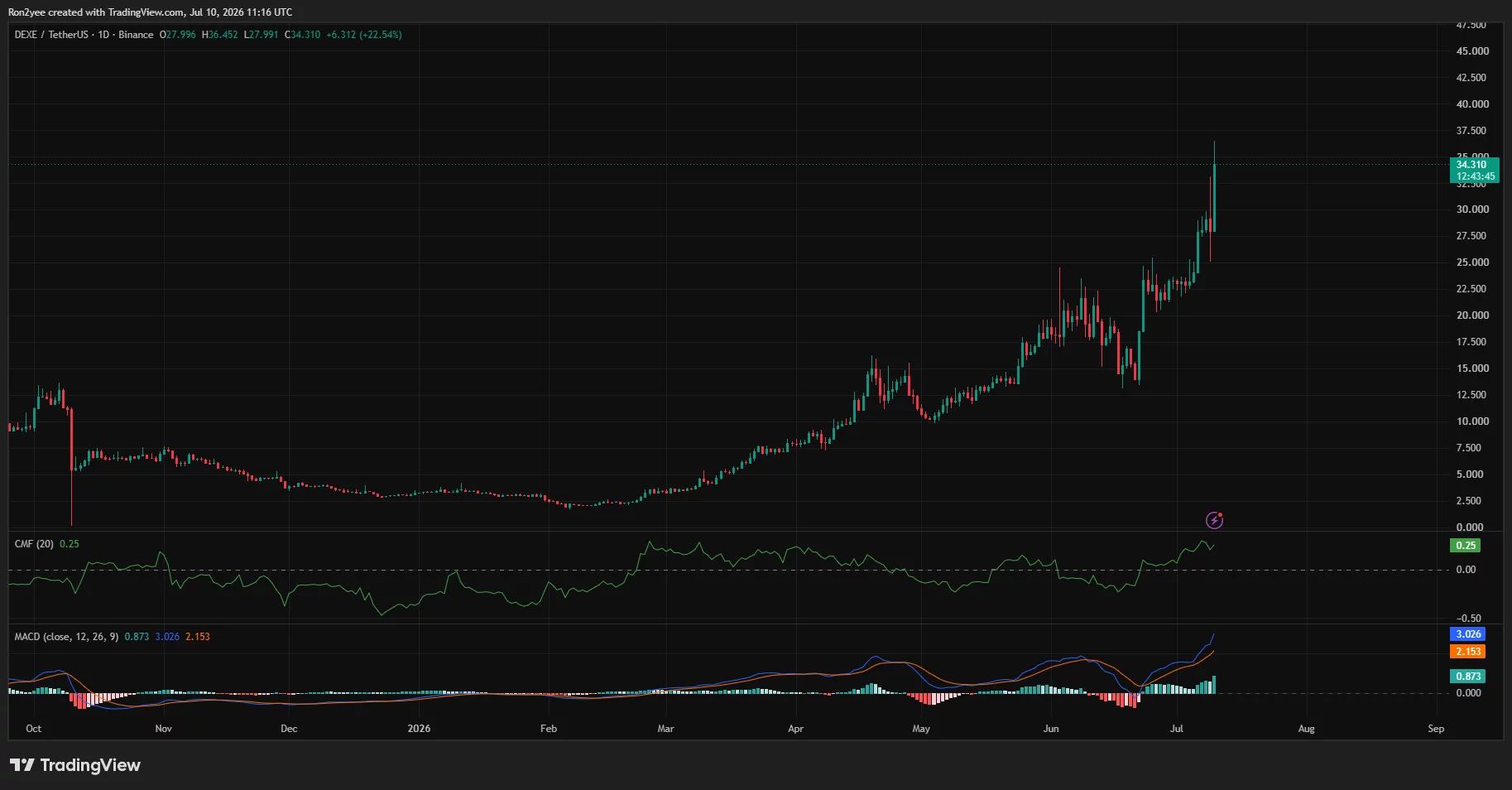
Daily momentum indicators also continue to favor buyers. The MACD remains in a bullish crossover with an expanding positive histogram, while the Chaikin Money Flow sits around 0.25, indicating sustained capital inflows.
Although the latest daily candle formed a long upper wick after reaching a record high, suggesting some traders locked in profits, neither indicator currently signals a meaningful deterioration in momentum.
On-chain activity continues to reinforce the bullish case. Blockchain tracking data shows whale transactions worth more than $100,000 have climbed to record levels, while the number of wallet holders has steadily approached 50,000.
At the same time, the Relative Strength Index is moving toward the overbought 70 level, indicating the rally may pause or consolidate before buyers attempt another leg higher from record territory.
Disclosure: This article does not represent investment advice. The content and materials featured on this page are for educational purposes only.


Japanese lender CRYL has launched Bitcoin-backed loans of up to 1 billion yen ($6.2 million), allowing individuals and businesses to raise fiat currency without selling their BTC.
On Thursday, the company announced that borrowers can access between 1 million yen ($6,200) and 1 billion yen ($6.2 million) at annual rates of 3.5% to 7%. The loans carry collateral ratios of 40% to 60%. They run for one year and can be used for expenses, including taxes, business funding and property purchases.
The launch expands Japan’s small market for regulated crypto-backed financing. In 2020, Fintertech, a Daiwa Securities Group and Credit Saison joint venture, launched a similar service and currently lends up to $3 million against Bitcoin or Ether. However, CRYL’s service advertises a higher ceiling and a lower minimum, while limiting collateral to BTC.
CRYL framed the service as adding a third option beyond holding or selling their crypto. However, applicants must undergo screening, and most loans use a lump-sum repayment structure, with principal and interest due after one year.
Bitcoin-backed finance takes shape in Japan
Fintertech’s product shows that Bitcoin-backed lending has been available in Japan for several years. The company’s website currently lists loans for individuals and businesses with annual rates of 4% to 8%, a 50% collateral ratio and a minimum borrowing amount of 5 million yen ($31,000).
The service also gained a wider distribution channel in October 2025, when Daiwa Securities began introducing customers at its branches across Japan to Fintertech’s digital asset-backed loans. Fintertech is owned 80% by Daiwa Securities Group and 20% by Credit Saison.
Related: Japan crypto bill advances with ETF, tax reform path: Report
Other Japanese companies are exploring how Bitcoin could support more complex credit products. On Friday, Metaplanet Securities, yen stablecoin issuer JPYC and tokenization infrastructure provider Progmat announced a study into using BTC as collateral or credit enhancement for digital corporate bonds and other blockchain-based credit instruments.
Unlike the loan products offered by CRYL and Fintertech, the Metaplanet initiative remains at the research phase, and the companies said no issuance has been decided.
Magazine: Bitcoin’s quantum dilemma: Bigger blocks or STARK proofs?

TLDR
- Crypto ETF outflows reached about $147 million on July 9, led by losses in Bitcoin and Ether funds.
- Bitcoin ETFs recorded $95.3 million in outflows, with FBTC and ARKB driving most redemptions.
- Ether ETFs saw $52.2 million in losses, reversing strong inflows recorded a day earlier.
- BlackRock’s IBIT remained flat, removing a key source of inflows that supported earlier sessions.
- Weekly ETF flows showed volatility, shifting from inflows to consecutive days of outflows.
Crypto ETF outflows deepened on July 9 as U.S.-listed Bitcoin and Ether funds recorded combined losses of about $147 million. The session extended a weak trend following earlier signs of stabilization in institutional demand. The data confirmed that crypto ETF outflows continued despite recent price strength in major digital assets.
Bitcoin ETFs Lead Daily Redemptions
Bitcoin funds recorded $95.3 million in net losses, reinforcing the latest wave of crypto ETF outflows across major issuers. Fidelity’s FBTC led the decline with $63.3 million in redemptions during the session. Ark and 21Shares’ ARKB followed with $39.9 million in outflows, increasing pressure on the category.
Smaller inflows partially offset losses but failed to reverse overall crypto ETF outflows for Bitcoin products. VanEck’s HODL added $5.4 million, while Morgan Stanley’s MSBT brought in $2.2 million. Bitwise’s BITB posted a marginal inflow of $0.3 million, limiting net declines.
BlackRock’s IBIT and Grayscale’s GBTC remained flat, removing a key source of demand seen earlier in the week. IBIT had previously driven inflows with over $200 million on July 6. Its neutral position allowed crypto ETF outflows to deepen without a strong counterbalance.
Ether Funds Reverse Prior Gains
Ether ETFs recorded $52.2 million in net losses, adding to overall crypto ETF outflows across digital asset funds. Fidelity’s FETH accounted for $34.0 million of these redemptions. BlackRock’s ETHA also posted $12.7 million in outflows during the same session.
Grayscale’s ETHB and Bitwise’s ETHW contributed additional declines with losses of $2.7 million and $2.8 million, respectively. Other Ether funds remained flat, including VanEck’s ETHV and Invesco’s QETH. The absence of inflows across multiple issuers reinforced the scale of crypto ETF outflows.
The reversal followed a strong July 8 session when Ether ETFs attracted $70.5 million in inflows. FETH had led those gains before shifting to the largest source of redemptions. This rapid change highlighted how concentrated flows can drive short-term crypto ETF outflows.
Weekly Flow Trend Shows Volatility
ETF flow data showed sharp swings throughout the week, reflecting inconsistent demand across issuers and products. Bitcoin ETFs gained $265.7 million on July 6 before slowing to $21.5 million on July 7. The trend reversed on July 8, when funds recorded $84.9 million in crypto ETF outflows.
The July 9 data confirmed a second consecutive day of losses, pushing total crypto ETF outflows deeper into negative territory. Ether funds followed a similar pattern, moving from strong inflows to notable redemptions within one day. This pattern indicated that flows remained uneven and highly sensitive to short-term conditions.
Solana ETFs provided limited support with $0.4 million in inflows, offering only a minor offset to broader crypto ETF outflows. VanEck’s VSOL and TSOL accounted for the small gains recorded in this category. Other Solana products remained flat, leaving overall flows dominated by Bitcoin and Ether declines.
Crypto ETF outflows on July 9 highlighted continued weakness in institutional allocations despite recent market stability. The absence of strong inflows across major issuers allowed redemptions to drive overall performance. The latest session confirmed that crypto ETF outflows remain a key indicator of shifting demand trends.


The European Parliament has moved to revive “chat control” rules that require tech firms to scan messages for child sexual abuse material for a further period ending in 2028, a proposal widely criticized by privacy and cryptography advocates as undermining the logic of encrypted messaging.
In a Thursday vote, the chamber largely rejected extending the regulation—often referred to by critics as “Chat Control 1.0.” But the effort still advanced after lawmakers voted down the move to stop it, meaning the rules can be carried forward. The vote that would have ended the measure failed to secure enough support: 314 lawmakers voted to continue, while 276 supported the extension.
Key takeaways
- The European Parliament approved a continuation of “chat control” rules tied to scanning messages for child sexual abuse material until 2028.
- Lawmakers rejected an attempt to block the extension, which means the legal framework can proceed despite resistance in the chamber.
- An exemption was approved for communications where end-to-end encryption is, has been, or will be applied—an important carve-out for encrypted messaging.
- The final decision now depends on the EU Council, which will either accept or reject the amended legislation.
- Negotiations for a permanent “Chat Control 2.0” framework are expected to restart in September, with disagreement over whether scanning should be targeted or broad.
How the extension cleared Parliament—and why encrypted messaging mattered
The vote follows the expiration of the earlier framework in April. With that window closed, messaging platforms such as WhatsApp were allowed to use their own voluntary approaches to detect and handle cases involving abusive material.
Thursday’s outcome reflects a split within the Parliament. Critics had aimed to prevent the extension, but stopping it required a higher threshold: only 314 lawmakers voted to halt the rules, short of the 361 needed. Instead, the measure advanced with 276 lawmakers voting in favor of ending the opposition move, effectively enabling the legislative path to continue.
Still, Parliament did deliver a partial win for privacy advocates. The assembly approved an exemption excluding communications where end-to-end encryption is, has been, or will be applied. The exemption was included as part of the legislation that Parliament endorsed, as reflected in the text of the adopted act: EU Parliament document TA-10-2026-0266_EN.
MEP Markéta Gregorová of the Pirate Party—who pushed the amendment to protect end-to-end encryption—called the result “a bittersweet victory.” In a statement, she said she was glad an absolute majority supported an amendment that at least preserves encryption, while also noting that “voluntary mass scanning unfortunately passed.” The statement is available via Greens/EFA: Greens/EFA.
Why the Council of the EU is the next gate
Parliament’s version of the laws—incorporating amendments and the end-to-end encryption exemption—will now be sent to the Council of the European Union. The Council is made up of ministers representing member states and has the authority to approve or reject the legislation.
For investors and builders in the crypto and privacy ecosystem, the practical significance is straightforward: if the rules are adopted as drafted, service providers operating in the EU could face pressure to implement scanning mechanisms for certain categories of content, even while encrypted traffic is carved out under specific conditions. The precise compliance burden—and how it will be interpreted by regulators later—will depend on the final Council outcome and the implementing approach that follows.
The “Chat Control 2.0” fight is expected to intensify
This Thursday vote does not settle the broader dispute. The current legislative push is tied to a wider attempt to update the policy into a more permanent framework—commonly labeled “Chat Control 2.0.”
Earlier this week, the European Parliament used a rarely applied urgent procedure to schedule a vote after the previous framework lapsed. According to earlier reporting by Cointelegraph, Parliament voted Tuesday to revisit whether the expired legal framework should be extended—prompting the return to the chamber on Thursday. That background matters because it shows how quickly the institution moved after the expiration in April and why the extension remained politically contested even within the Parliament.
The sequence also highlights tensions inside Parliament. Earlier in March, lawmakers rejected a temporary extension while “Chat Control 2.0” was being discussed. The European People’s Party, the largest group in Parliament, later revived the extension through the urgent procedure on Tuesday. In March, the group had voted against extending the rules, including due to amendments that would have restricted the scope of scanning.
Looking ahead, negotiations for the permanent “Chat Control 2.0” framework are set to resume in September. Key disagreement centers on whether message scanning should be targeted to higher-risk scenarios or applied more broadly. Former MEP Patrick Breyer—cited in the text provided—argued that resistance in Parliament was strong enough that securing a majority for “permanent, suspicionless mass scanning” would be extremely difficult.
What encrypted messaging advocates will watch next
The exemption for end-to-end encrypted communications is likely to remain the focal point for privacy and cryptography advocates as the measure heads to the Council. The immediate question is not only whether the exemption survives final negotiations, but how it will be operationalized in practice—especially for systems that handle encrypted content while still facing EU compliance expectations.
Readers should watch for Council deliberations and the September negotiations on “Chat Control 2.0,” where lawmakers will decide whether scanning rules will remain constrained or expand in scope. The outcome will shape how closely EU policy aligns with encryption-first design—an issue that continues to carry significant implications for users, developers, and the broader credibility of privacy protections across Europe.

US-listed Bitcoin mining company TeraWulf is reportedly seeking to raise $3.5 billion in debt to expand its Justified Data campus in Kentucky, a facility leased by artificial intelligence company Anthropic under a long-term agreement.
The deal is expected to launch this year, with investment bank Morgan Stanley leading the financing effort, TeraWulf chief financial officer Patrick Fleury said, according to a Thursday Bloomberg report.
The deal could include leveraged loans and high-yield bonds, marking TeraWulf’s first entry into the leveraged loan market, the report stated.
The news comes days after TeraWulf signed a 20-year lease agreement with Anthropic for the Kentucky facility, showing how demand for AI computing capacity is creating new funding opportunities for data center operators.
TeraWulf’s previous financing activity includes multibillion-dollar offerings
The Justified Data campus in Hawesville, Kentucky, is being developed as a large-scale data center project to support AI computing workloads, with initial operations expected in the second half of 2027 and full buildout targeted for early 2028.
The facility is expected to generate about $19 billion in contracted revenue over the initial lease term with Anthropic, according to TeraWulf.

Source: TeraWulf
The $3.5 billion debt raise follows the company’s previous financing offerings, where it raised $1.3 billion in December 2025 and $3.2 billion in October 2025.
Cointelegraph reached out to TeraWulf and Morgan Stanley for comment on the reported financing but had not received a response by publication time.
TeraWulf faces concerns over insider transactions and growth model
TeraWulf has recently drawn investor questions over insider stock sales, shareholder alignment and broader concerns over the company’s growth model.
On Thursday, Bitcoin mining advisory company Blocksbridge Consulting highlighted TeraWulf as an example of the investor scrutiny around insider stock sales at Bitcoin mining companies that have benefited from AI-related momentum.
Related: Crypto Biz: Is AI the exit strategy for miners?
TeraWulf has also faced questions over the economics of its AI data center model. In a McNallie Money podcast on Tuesday, Fleury pushed back against a short-seller’s model that estimated higher maintenance costs for TeraWulf’s data centers. He argued that the company’s role is to provide power and facility infrastructure, while customers are responsible for their computing equipment and technology upgrades.

Source: Matthew Sigel
Fleury said the company’s long-term lease structure limits the recurring upgrades and reconfiguration costs typically associated with data centers.
Magazine: Bitcoin’s quantum dilemma: Bigger blocks or STARK proofs?
Ethereum price has rebounded to nearly $1,800 after easing geopolitical tensions and an aggressive short squeeze across crypto derivatives restored appetite for risk assets, while traders now watch whether bulls can force a breakout above a key technical ceiling.
Summary
- Ethereum price has climbed back toward $1,800 as easing geopolitical tensions triggered a sharp short squeeze.
- Technical indicators favor bulls, with ETH reclaiming $1,750 and testing resistance near $1,800-$1,833.
- Analysts see scope for a move toward $1,900, though failure to hold $1,750 could revive bearish pressure.
The second-largest cryptocurrency has recovered sharply from this week’s low near $1,505, when U.S. strikes on Iranian targets triggered a broad sell-off across digital assets. Sentiment reversed over the past 24 hours after fears of further escalation subsided, prompting investors to rotate back into higher-risk assets
A wave of forced short liquidations accelerated the move, pushing ETH through several resistance levels and back toward the psychologically important $1,800 mark.
Asian markets added another catalyst. South Korea’s Kospi index jumped roughly 4% as artificial intelligence and semiconductor stocks rallied, encouraging a wider return to growth assets.
Ethereum participated in that rotation despite U.S. spot Ether ETFs recording a combined net outflow of about $52 million on Thursday, suggesting overseas spot demand and crypto-native buying more than offset weaker institutional flows in the United States.
Fresh regulatory developments also improved sentiment. CFTC leadership has urged the U.S. Senate to advance the Digital Asset Market Clarity Act, a proposal that would establish a clearer regulatory framework for digital assets.
At the same time, Ethereum continues to dominate the tokenized real-world asset market with nearly half of global RWA value secured on its network, reinforcing the chain’s position as institutional tokenization activity expands.
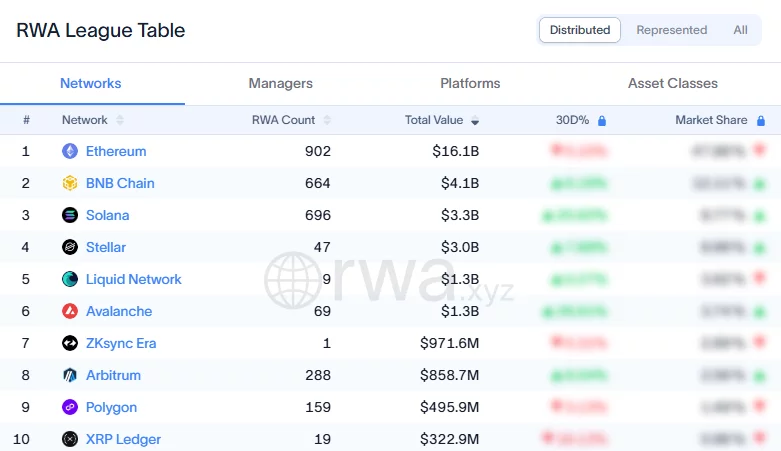
Ethereum has reclaimed key resistance, but $1,800 remains the decisive hurdle
The daily chart shows Ethereum reclaiming the 2/8 Murrey Math pivot near $1,750 after bouncing from the 0/8 support around $1,500. Price is now testing the upper edge of that range near $1,800, while the Chaikin Money Flow has climbed back into positive territory at 0.08, suggesting capital has started returning after weeks of sustained selling.
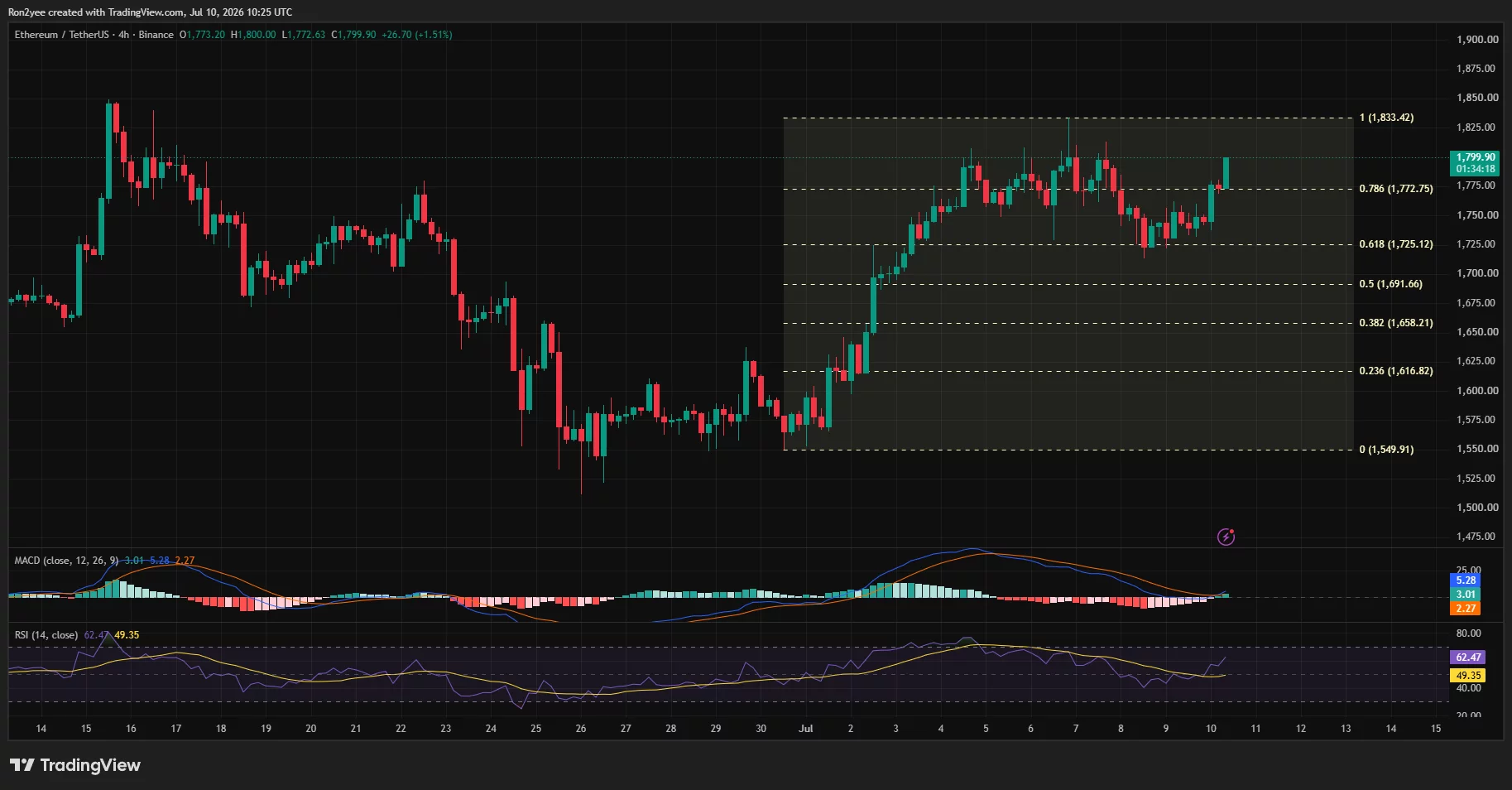
On the 4-hour chart, ETH has broken above the 78.6% Fibonacci retracement at approximately $1,773 and is trading just below resistance near $1,833. Momentum has strengthened as the MACD completes a fresh bullish crossover with expanding positive histogram bars, while the RSI has climbed above 62 without yet entering overbought territory. Together, those indicators leave room for another advance if buyers maintain control.
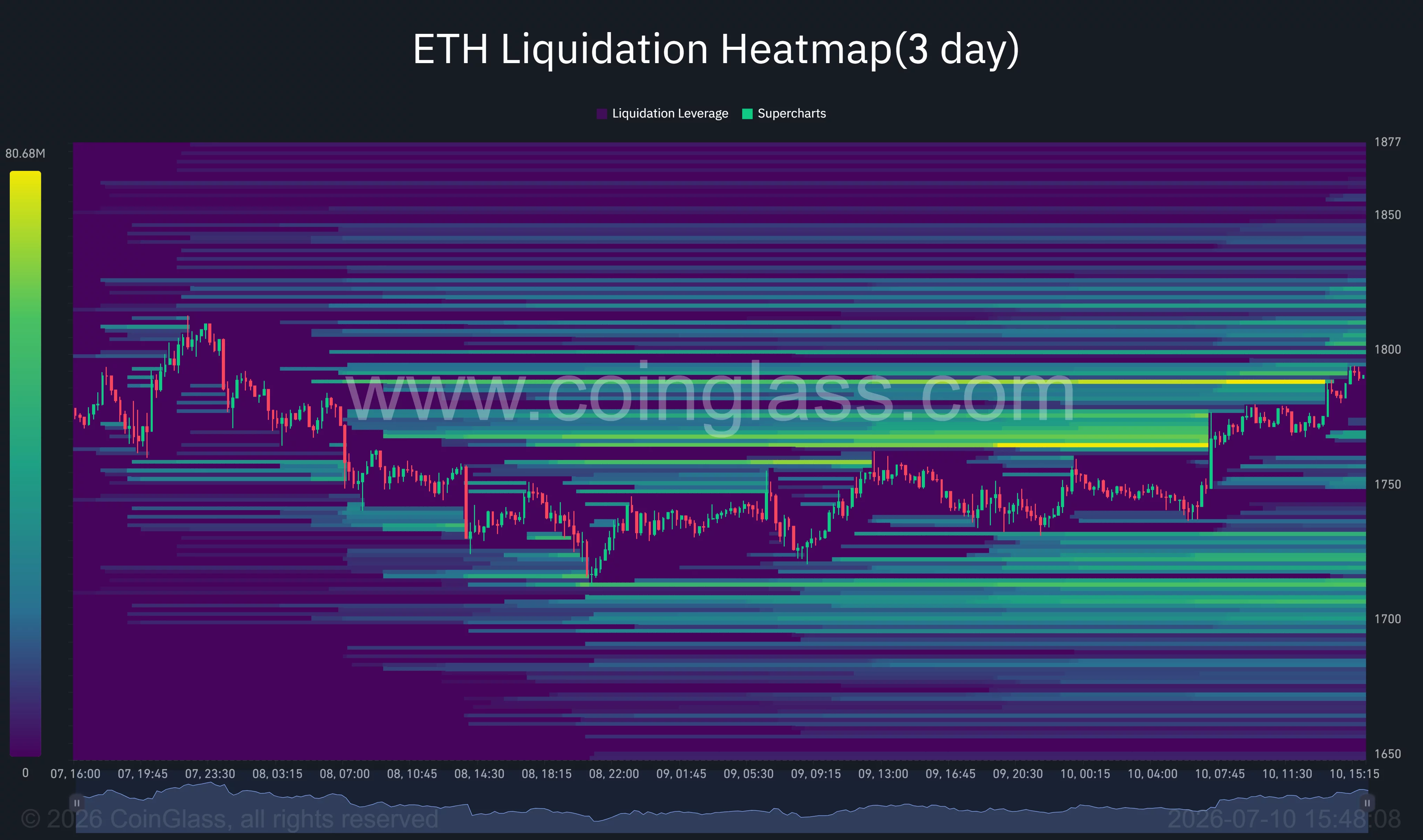
Derivatives positioning supports the technical picture. CoinGlass liquidation data shows one of the largest short liquidation clusters sitting between $1,790 and $1,810. A sustained move above that zone could trigger another round of forced buying, while the next concentration of leveraged positions appears closer to $1,850. As long as those liquidity pockets remain overhead, volatility is likely to stay elevated.
Commenting on the latest structure, analyst Ted Pillows wrote:
“ETH is holding above the $1,750 level, which is a good sign. Spot demand is picking up a bit, which could push Ethereum towards the $1,850–$1,900 zone in the coming weeks.”
Separately, fellow analyst Alex Marzell argued that Ethereum has bounced from the lower boundary of a long-term descending channel and believes “one clean breakout above the upper trendline could change everything.”
Failure to hold $1,750 would weaken the recovery setup
Despite the improving momentum, Ethereum has not yet confirmed a trend reversal. The $1,800-$1,833 region combines Fibonacci resistance with a dense liquidity pocket, making it the first major test for bulls.
Repeated rejection from that area would increase the likelihood of another move toward $1,725, while a break below $1,750 would expose the $1,620-$1,550 support region that launched the current recovery.
Macro risks also remain. Any renewed escalation in the Middle East, stronger-than-expected U.S. inflation data, or another wave of ETF outflows could reduce demand for risk assets and interrupt Ethereum’s recovery. Until buyers establish support above $1,800, the current advance remains a recovery rally rather than a confirmed long-term trend reversal.
Disclosure: This article does not represent investment advice. The content and materials featured on this page are for educational purposes only.

Metaplanet, a Japan-based investment firm best known for building a large Bitcoin reserve, says it is commissioning a joint study into Bitcoin-backed digital credit products in the country. The research ties together Metaplanet’s securities arm, Metaplanet Securities, stablecoin issuer JPYC, and tokenization infrastructure provider Progmatia, with the goal of testing whether Bitcoin can serve as collateral and credit enhancement for tokenized credit instruments.
In a filing shared by Metaplanet on Friday, the company outlined a concept in which BTC would be used alongside JPY Coin (JPYC)—a Japanese yen-pegged stablecoin—for settlement and payments. Security tokens would then be used to manage holder rights. Metaplanet emphasized that the work is exploratory, and that no product launch is planned as part of the study.
Key takeaways
- Metaplanet and partners are studying whether BTC can function as collateral and credit enhancement for blockchain-based corporate credit instruments in Japan.
- The proposed settlement flow uses BTC collateral plus JPYC for payments, while security tokens would represent and govern holder rights.
- The study focuses on design tradeoffs, proof-of-concept testing, and the feasibility of issuance, but Metaplanet said no issuance decisions have been made.
- The initiative aligns with Metaplanet’s “Project Nova,” which aims to expand the firm from a Bitcoin treasury model into Bitcoin-centered financial services.
- Tokenized real-world asset (RWA) data indicates growing investor interest in on-chain credit products, including asset-backed credit and tokenized corporate credit.
Bitcoin as collateral for tokenized corporate credit
At the core of Metaplanet’s joint study is a credit structure that blends traditional credit logic with on-chain settlement. According to Metaplanet, the research will evaluate whether Bitcoin can be used not only as collateral but also as a credit enhancement mechanism for digital corporate bonds and other credit instruments.
The company says the envisioned products would be designed for 24/7 accessibility, on-chain settlement, and daily interest accrual for holders. Rather than relying on conventional market hours and settlement cycles, the concept targets continuous operation on a blockchain ledger—an area that could matter to both issuers and investors if it translates into smoother servicing and potentially faster distribution.
Metaplanet also made clear that the study is intended to assess feasibility rather than to announce a new security offering. It highlighted that, while the research will explore product design and proof-of-concept options, nothing has yet been determined regarding future issuance.
JPYC and security tokens: how settlement and rights would work
One of the more specific parts of Metaplanet’s proposal is the role of JPYC and security tokens in the credit system. The study concept places JPYC at the center of settlement and payments, meaning the yen-pegged stablecoin would be used to handle value transfers associated with the credit instrument.
Separately, Metaplanet’s plan uses security tokens to manage holder rights. That design choice is important because credit instruments typically require clear rules around ownership, entitlements, and any rights attached to the underlying obligation. By mapping those rights onto a tokenized representation, the study aims to test whether a more automated rights-management layer can coexist with a collateral model anchored in Bitcoin.
Metaplanet’s filing also frames the project around “credit enhancement” and collateralization mechanics. That distinction matters: collateral alone can support repayment, but credit enhancement often targets investor risk by adding extra protection or structuring features. The study’s focus suggests Metaplanet is trying to answer a practical question for tokenized credit markets—how to translate Bitcoin’s volatility into a system that investors can underwrite.
Project Nova and a shift from treasury to financial services
Metaplanet’s study is not presented as a standalone research project. The company linked it to Project Nova, a broader initiative it announced earlier in 2026 to build a Bitcoin financial services ecosystem in Japan. Under that framing, Metaplanet portrays Bitcoin as “productive collateral on the balance sheet,” rather than a held asset with only treasury-oriented value.
The company says Project Nova is designed to deliver new yield products and capital market access to both retail and institutional investors in Japan, explicitly bridging conventional securities markets and digital asset markets. In that context, the joint study on Bitcoin-backed digital credit appears to be a logical next step: if Bitcoin can support structured credit products, it could become a foundation for generating returns rather than simply holding exposure.
Metaplanet has been actively reshaping its business infrastructure around that ambition. In June, it announced plans to acquire Siiibo Securities and rename it Metaplanet Securities. Earlier, in March, it established a new venture firm, Metaplanet Ventures, to support Bitcoin ecosystem development in Japan.
Why tokenized credit is gaining attention
Beyond Metaplanet’s internal strategy, the company’s push toward tokenized credit aligns with broader momentum in the tokenized real-world asset sector. RWA.xyz data referenced by Metaplanet shows the $33 billion tokenized RWA market, with asset-backed credit identified as the third-largest segment at $2.3 billion and tokenized corporate credit as the fifth-largest segment at $1.76 billion.
Even so, the joint study’s emphasis on proof-of-concept and product design underscores that tokenization alone does not guarantee credit market viability. The biggest unresolved issues—likely including investor protections, collateral management, settlement mechanics, and how risk is reflected in the structure—are precisely what the study says it will evaluate.
Metaplanet’s approach also echoes a recurring theme in institutional Bitcoin playbooks: using structured instruments to raise or allocate capital efficiently. Earlier coverage by Cointelegraph noted that Strategy—described in that reporting as the largest corporate Bitcoin holder—has relied on “digital credit” instruments such as STRC preferred stock to support its Bitcoin acquisition strategy. Metaplanet’s current proposal does not claim a direct match to that model, but it signals that Japanese corporate crypto players are exploring similar concepts adapted to local capital markets and on-chain settlement.
For investors, traders, and market builders, the key question is whether Bitcoin-backed digital credit can be made robust enough for real issuance—especially given Bitcoin’s price volatility and the complexity of credit enhancement. Metaplanet’s study results, and any subsequent decision on issuance, will be the next developments to watch, along with how JPYC settlement and security-token rights management perform in practice.


Key takeaways
- Bitcoin (BTC), Ethereum (ETH), and XRP extended their recovery as geopolitical concerns eased.
- Market sentiment improved after US President Donald Trump said Iran had reached out to discuss a potential agreement.
- Bitcoin has surpassed the key $64,000 resistance level, with a breakout potentially strengthening the short-term outlook.
Bitcoin (BTC) extended its recovery on Friday, climbing above the $64,000 level as improving investor sentiment supported a broader rebound across the cryptocurrency market.
The recovery comes after geopolitical concerns eased following comments from US President Donald Trump, who said Iran had contacted the United States to discuss a potential agreement.
The remarks fueled hopes of reduced tensions in the Middle East, encouraging investors to return to risk assets.
The positive sentiment also helped Ethereum (ETH) edge closer to $1,800, while XRP stabilized after finding support near key technical levels.
Improving risk appetite supports Bitcoin recovery
Cryptocurrency markets gained ground as fears surrounding the recent escalation in the Middle East began to subside.
Investor confidence improved after Trump indicated that Iran had initiated contact with the United States regarding possible negotiations, raising expectations that diplomatic efforts could help prevent further conflict.
The shift in market sentiment prompted renewed buying across digital assets, allowing Bitcoin to recover toward an important technical resistance zone.
Bitcoin price analysis: Bulls target higher resistance levels
Bitcoin was trading around $64,300 at the time of writing, placing it just below the significant $65,000 resistance area.
Although the recent rebound has strengthened short-term momentum, BTC remains below several key trend indicators, suggesting the broader market structure has yet to turn decisively bullish.
Bitcoin continues to trade beneath the 50-day Exponential Moving Average (EMA) at $65,399, the 100-day EMA ($68,991), and the 200-day EMA ($75,024)
These moving averages form a strong overhead resistance zone that bulls must overcome before confirming a broader trend reversal.
Technical indicators suggest buying momentum is slowly returning. The Relative Strength Index (RSI) has moved above the neutral 50 level, indicating strengthening bullish momentum after weeks of weakness.
Meanwhile, the Moving Average Convergence Divergence (MACD) remains in positive territory, with the MACD line holding above zero and the histogram continuing to expand, signaling that upward momentum is gradually building.
While these indicators favor buyers in the short term, they have yet to invalidate the broader bearish structure.
The first major resistance for Bitcoin sits near the $64,686 horizontal level. A decisive daily close above this area would bring the 50-day EMA at $65,399 into focus.
If buyers clear that hurdle, attention could shift toward the 100-day EMA at $68,991, followed by the 200-day EMA at $75,024.
Beyond those levels, the next significant long-term resistance lies around $84,410.
On the downside, Bitcoin lacks a strong nearby technical support zone, making the market vulnerable to renewed selling pressure if the current recovery loses momentum.

In that scenario, traders will likely look to the $60,000 psychological level as the next major area where buying interest could emerge.
For now, improving geopolitical sentiment has provided Bitcoin with short-term support, but bulls will need to reclaim $64,000 and overcome the cluster of moving average resistance to strengthen the case for a sustained recovery.

TLDR
- Apollo Global Management has submitted a £5.7 billion ($7.7 billion) acquisition proposal for EasyJet, pricing shares at 715p each
- The proposal surpasses Castlelake’s competing 690p-per-share offer, setting up a competitive bidding scenario for the UK low-cost carrier
- EasyJet shares climbed 14.75% during London market hours, reaching 674.98p — the strongest level witnessed since February 2022
- Apollo faces an August 7 deadline to formalize its proposal under UK regulatory requirements; Castlelake must decide by August 3
- Both potential acquirers face limitations on complete ownership due to European Union regulations mandating majority European national ownership
EasyJet experienced a substantial stock rally on Friday following Apollo Global Management’s unexpected 715p-per-share acquisition proposal for the British low-cost airline, surpassing a competing proposition from Castlelake and initiating what market observers describe as an aggressive bidding contest.
The all-cash 715p proposition places EasyJet’s valuation at £5.7 billion ($7.7 billion) and delivers a 21.6% premium relative to EasyJet’s prior closing position of 588.20p. Stock performance reached 674.98p during London exchange activity — marking the highest point since late February 2022 — though still below both competing valuations.
Apollo’s proposition emerged mere days following EasyJet’s preliminary acceptance of Castlelake’s fifth and ultimate bid of 690p per share. EasyJet’s directors indicated they are “no longer minded” to endorse the Castlelake arrangement.
“A bidding war is on,” said Neil Wilson, investor strategist at Saxo UK.
EasyJet announced its board now stands ready to endorse Apollo’s proposition to shareholders, subject to finalizing outstanding transaction terms.
What’s Attracting Buyers
Airport landing rights, a contemporary Airbus fleet portfolio, and a rapidly expanding vacation packages division are regarded as primary attractions for both prospective buyers.
Susannah Streeter, chief investment strategist at Wealth Club, indicated the vacation business was probably a significant draw. Package vacation offerings deliver superior margins and more stable revenue streams compared to airline ticketing, she explained.
Morgan Stanley reported that Apollo intends to support EasyJet’s current strategic direction — expanding its aircraft fleet, increasing ancillary income streams, and developing the vacation packages unit. The financial institution contended EasyJet possesses stronger long-range expansion prospects under private control.
Apollo oversees assets exceeding $1 trillion and brings considerable aviation sector experience, having previously placed capital in Aeromexico, Sun Country Airlines and Atlas Air, while extending financing to Air France-KLM and Virgin Atlantic.
The Ownership Hurdle
A significant complexity confronting both prospective acquirers: European Union and UK regulations mandate that airlines conducting operations within the bloc maintain majority ownership and governance by European nationals.
Castlelake’s framework addressed this requirement by allocating 51% ownership to EU nationals, encompassing aviation industry veterans Peter Bellew and Mark Breen.
Apollo acknowledged it would undertake the required measures to secure a European partnership but has yet to disclose additional specifics.
According to UK takeover regulations, Apollo must present a definitive proposal or withdraw by August 7. Castlelake faces an earlier deadline of August 3.
Apollo shares declined 1.1% during U.S. premarket trading following the disclosure.
In May, EasyJet disclosed that first-half losses expanded 27% to £377 million, with escalating fuel expenditures linked to the US-Iran conflict identified as a primary contributor. The carrier warned that the second half would likewise experience impacts.


Polymarket has applied for a US license to offer margin trading. The prediction market is seeking a futures commission merchant license.
If approved, the license would enable users to open positions by posting only a portion of the required capital.
What Polymarket Filed and Why It Matters
According to Bloomberg, Polymarket filed through its affiliate, Coming Home GBA LLC, to register as a Futures Commission Merchant (FCM). The application was submitted on July 3, as per the National Futures Association.
Follow us on X to get the latest news as it happens
Margin trading lets traders borrow to increase their position size without paying the full amount upfront. Institutional traders use it to improve capital efficiency, but it requires a broker that can hold funds and manage margin.
An FCM license would give Polymarket that role. As a Futures Commission Merchant, it would handle customer funds and margin in the same way as established futures intermediaries do.
That structure enables leveraged trading and provides institutions with the familiar brokerage and custody rails they expect. Even so, Polymarket still needs the Commodity Futures Trading Commission (CFTC) to approve rulebook changes before it can list margined contracts.
Notably, rival Kalshi secured an FCM license earlier this year through its affiliate, Kinetic Markets LLC. The next move sits with the CFTC. Its decision will determine whether Polymarket can catch up to Kalshi’s lead in the coming months.
Subscribe to our YouTube channel to watch leaders and journalists provide expert insights
The post Polymarket Seeks to Offer Margin Trading to US Users appeared first on BeInCrypto.
Tiffany Haddish reacts to White House shading her over“ Jimmy Kimmel Live” joke: 'You in the wrong house!'

Volkswagen sales numbers drop 8.6% as automaker cuts models

FDA announcing new regulations to limit US reliance on foreign drugs


-

 Fashion7 days ago
Weekend Open Thread: High Hopes
-
 NewsBeat5 days ago
Taylor Swift and Travis Kelce wedding staffer hilariously struggles to keep her cool while checking in megastars
-

 Crypto World7 days ago
Standard Chartered Secures MiCA License as ESMA Adds 37 New Crypto Firms
-

 Fashion4 days ago
Open Thread: What Great Books Have You Read Recently?
-

 Politics7 days ago
The House | “Reframing the debate from a binary discussion of winners and losers”: Yuan Yang reviews ‘We Are Not Machines’
-

 Fashion1 day ago
Loro Piana Fall 2026 Enters Houston’s Art Scene
-

 News Videos3 days ago
Whats Hidden Inside This Cash Register? #treasure #reselling #money
-
 Tech3 days ago
Anthropic’s new “J-lens” reveals a silent workspace inside Claude that mirrors a leading theory of consciousness
-
Crypto World7 days ago
ESMA Expands Crypto Register by 37 Firms Following MiCA Transition Period
-

 Business4 days ago
AXT Shares Jump Nearly 14% as Semiconductor Materials Maker Rebounds on AI-Linked Indium Phosphide Demand
-

 Sports3 days ago
Joshua Pacio ‘more complete’ ahead of ONE rematch vs Malachiev
-

 Crypto World5 days ago
South Africa proposes crypto tax guidance under existing rules
-
Crypto World4 days ago
SK hynix (000660.KS) Stock Dips as $28B Nasdaq ADR Offering Drives AI Memory Expansion
-

 News Videos4 days ago
Best Time to Enter Small Caps Right Now? Another Bull Run? | Financially Free
-

 Tech5 days ago
Lenovo laptops are now shipping with YMTC SSDs, a sign of Chinese NAND entering the mainstream
-
Sports3 days ago
We have punished the disrespect
-

 News Videos4 days ago
Avoid entering in FOMO #bitcoin #cryptocurrency #trading #scalping
-

 Tech2 days ago
Anthropic brings Claude Cowork to mobile and web as usage data shows most users aren’t coding
-

 Crypto World4 days ago
$1,000 Credit Alert! BlockDAG X Exchange Pre-Registration Now Officially Open, Polkadot Dips & Zcash Rebounds
-

 Tech6 days ago
Neuralink Threads Its Way Straight Through the Brain’s Armor
You must be logged in to post a comment Login