

Business
Athena brand for sale as iconic poster trademarks hit market


Athena, the poster retailer that decorated a generation of British bedrooms and gave the world the Tennis Girl, is up for sale, offering entrepreneurs and investors a rare chance to buy one of the high street’s most recognisable names outright.
BPI Asset Advisory, a RICS regulated team of surveyors and business advisors specialising in valuation and asset disposal, has been instructed to market the trademarks owned by Athena Licensing Ltd. The package comprises two recently renewed UK trademarks, covering the name and stylised logo, together with a recently renewed EU trademark.
For anyone who grew up in the 1980s or 1990s, Athena needs little introduction. Founded in 1964, the chain grew to more than 160 stores nationwide at its peak, selling the posters, prints and gifts that shaped the visual identity of teenage bedrooms, student houses and first flats across the country.
Monochrome New York skylines, jazz photography, fantasy artwork and surreal imagery all passed through its tills. Its most famous image, the Tennis Girl poster of 1976, remains globally recognised half a century on, alongside landmark pieces including L’Enfant, Beyond City Limits and Jimmy Cauty’s 1976 Lord of the Rings artwork.
Andrew Cromack, director at BPI Asset Advisory, said: “Athena is a name that immediately resonates with generations of people across the UK. Brands with this level of recognition and cultural connection rarely come to market, making this a unique opportunity to acquire a genuine piece of British retail history.”
For SME owners, the sale is a useful reminder that a brand can outlive the business that built it. Athena joins a long list of high street names that have disappeared from Britain’s town centres, yet its trademarks, kept renewed and in good order, remain a marketable asset decades after the last store closed its doors.
That is no accident. A registered trademark can be licensed, sold or even used as loan collateral, which is why advisers urge founders to think carefully about whether to trade mark a business name, logo or both early on. Athena’s owners renewed both UK marks and the EU registration before bringing them to market, keeping the asset clean for a buyer. Anyone curious about what is protected can check the UK trade mark register held by the Intellectual Property Office.
The commercial logic for a buyer is equally clear. Heritage names carry ready-made recognition that would cost millions to build from scratch, and nostalgia marketing has proven pulling power, with research suggesting consumers loosen their purse strings when reminded of happier times. Athena’s continued presence in popular culture, most recently referenced in Alan Carr’s television series Changing Ends, suggests the affection has not faded.
The obvious route for a new owner is licensing the intellectual property rather than reopening shops: putting the Athena name on prints, homeware or publishing through partners who carry the manufacturing risk while the brand owner collects royalties.
BPI says the sale will suit investors, brand owners, licensing businesses and media groups seeking an established intellectual property asset with strong historic recognition and ongoing cultural relevance.
Whoever buys it will acquire more than two logos and a word mark. They will own a shorthand for an entire era of British youth, and in a crowded market, that kind of instant recognition rarely comes up for sale.

Amy Ingham
Amy is a newly qualified journalist specialising in business journalism at Business Matters with responsibility for news content for what is now the UK’s largest print and online source of current business news.


Bitcoin coils below $64,700 resistance: Live levels


As an individual investor nearing retirement I am trying to build my financial assets in order to have a fulfilling retirement. I am interested in trading both long and short; or at least using inverse ETFs, to take advantage of market declines. Having long term and short term trading strategies, proper execution of my trading plan, and absolute investing results are my goals. I see my articles as a way to keep me focused on developing winning trades. I also expect to learn much from the feedback that is provided in the comments section.
Analyst’s Disclosure: I/we have a beneficial long position in the shares of HPQ either through stock ownership, options, or other derivatives. I wrote this article myself, and it expresses my own opinions. I am not receiving compensation for it (other than from Seeking Alpha). I have no business relationship with any company whose stock is mentioned in this article.
Seeking Alpha’s Disclosure: Past performance is no guarantee of future results. No recommendation or advice is being given as to whether any investment is suitable for a particular investor. Any views or opinions expressed above may not reflect those of Seeking Alpha as a whole. Seeking Alpha is not a licensed securities dealer, broker or US investment adviser or investment bank. Our analysts are third party authors that include both professional investors and individual investors who may not be licensed or certified by any institute or regulatory body.

Growth Broadens As Markets Look Beyond Geopolitics
Business
Meta Shares Surge Nearly 6% Today on AI Cloud Push and New Analyst Reports of Sharply Cheaper Compute Costs
Shares of Meta Platforms jumped Friday, trading at $667.81, up $36.33, or 5.75 percent, extending a hot stretch for the stock as investors continued reacting to signs that the company’s massive artificial intelligence infrastructure spending may be significantly more cost-efficient than previously estimated.
Note: This article is intended to provide factual context and does not constitute financial advice. Readers should consult a licensed financial advisor before making investment decisions.
Friday’s gains build on a rally that has pushed Meta shares up roughly 15 percent over the past week. According to Bank of America analyst Justin Post, an internal Meta memo reviewed by Reuters suggests the company could expand computing capacity considerably more efficiently than Wall Street had modeled. Post reiterated a Buy rating on the stock with an $835 price target, noting that Meta’s projected capital spending of roughly $145 billion implies construction costs near $22 billion per gigawatt, well below Bank of America’s earlier estimate of approximately $45 billion per gigawatt. If accurate, Post said, the figures could meaningfully ease investor concerns about the scale of Meta’s AI investment program. Meta expects to deploy approximately 6.5 gigawatts of AI compute capacity during 2026, including 5.5 gigawatts in the second half of the year.
The renewed enthusiasm follows a broader strategic shift Meta has signaled in recent weeks. Chief Executive Mark Zuckerberg confirmed at the company’s annual shareholder meeting that launching a dedicated AI cloud business is “definitely on the table,” a move that would allow Meta to rent out excess computing capacity to outside developers rather than using it exclusively for its own products. According to reporting cited by the Motley Fool, the initiative, internally referred to as Meta Compute, would position the company to offer both hosted AI models, similar to Amazon Web Services’ Bedrock, and raw compute rental, similar to specialized providers like CoreWeave. Analysts have said the shift would help transform what had been viewed as a purely defensive cost center into a potential new revenue stream, positioning Meta as a fourth major U.S. hyperscaler alongside Amazon, Microsoft and Google.
Meta has continued backing that strategic pivot with tangible product announcements. On July 9, the company unveiled Muse Spark 1.1, described as its most advanced AI model to date, targeting the fast-growing agentic and coding software market in direct competition with offerings from Anthropic and OpenAI. According to Investing.com, that launch represented the clearest near-term signal yet that Meta is translating its enormous AI spending into tangible commercial products, helping the stock recover from levels well below its 52-week high of $796.25. Meta is also incorporating its Muse Image model into its Advantage+ advertising platform, adding visual reasoning and self-refinement capabilities aimed at improving automated ad creative for marketers.
On the hardware side, Meta plans to begin manufacturing its custom AI chip, code-named Iris, with partners Broadcom and Taiwan Semiconductor Manufacturing later this year. Bank of America has said the chip initiative is unlikely to explain the near-term cost improvements reflected in the internal memo, but could strengthen Meta’s long-term AI strategy as part of a broader custom silicon roadmap extending into 2027 and beyond. Meta has also continued expanding its physical data center footprint, recently breaking ground on its first Canadian facility, a roughly 13 billion Canadian dollar AI-focused campus in Sturgeon County, Alberta, expected to generate approximately 3,000 construction jobs and more than 300 permanent positions once operational.
Financial markets have responded favorably to the broader shift. According to 247 Wall St., prediction market platform Polymarket was pricing a 98 percent probability of an up day for Meta shares on July 10, with an 82 percent probability the stock would reach $680 by the end of the month. The stock currently trades at a forward price-to-earnings ratio of roughly 20 times, and investors are now closely watching Meta’s second-quarter earnings report, scheduled for July 29, where management has guided for revenue between $58 billion and $61 billion. Analysts will be watching that call closely for any formal confirmation of an AI compute rental business, along with further detail on the company’s broader monetization strategy.
Meta’s first-quarter 2026 results, reported earlier this year, showed the strength underpinning the current rally. The company posted $56.31 billion in sales, up 33 percent year over year, with GAAP net income of approximately $26.77 billion and earnings per share of $10.44, far exceeding analyst expectations of roughly $6.67. Profit margins stood at 41 percent, and the company’s core Facebook and Instagram advertising business generated roughly $55 billion of that total revenue. According to FX Leaders, Meta is projected to surpass Google this year to become the world’s largest digital advertising company, with eMarketer forecasting Meta’s 2026 ad revenue at approximately $243.46 billion, compared with $239.54 billion for Google.
Not every recent development has been favorable for the stock. According to CNN, the European Union recently found that the design of Instagram and Facebook violates the bloc’s Digital Services Act over allegedly “addictive” design features, a finding that could expose Meta to fines potentially reaching into the billions of dollars. Meta has pushed back forcefully against related litigation, describing certain proposed legal damages tied to separate cases as “unprecedented” and totaling as much as $1.4 trillion, according to CNN’s reporting. Citizens Bank also lowered its price target on Meta shares to $800 from $825 this week, even as the firm maintained a generally constructive view of the stock. Analysts at 24/7 Wall St. have noted that the combination of a genuinely improved capital expenditure story and a real regulatory overhang means investors should weigh both realities carefully, describing the bull case for Meta as “cheaper to underwrite” following recent developments, even as the bear case tied to European regulatory risk has grown “more expensive to ignore.”
Investment firm ARK Invest, led by Cathie Wood, purchased 34,000 additional shares of Meta on Thursday, according to CNN, extending a pattern of active portfolio adjustments the firm has made involving major AI infrastructure stocks in recent months.
With Meta’s AI cloud ambitions still in relatively early stages and formal details of any compute rental offering yet to be confirmed on an earnings call, investors are likely to continue closely monitoring both the company’s July 29 second-quarter results and any further regulatory developments out of the European Union as key factors shaping the stock’s trajectory through the remainder of the summer.

The Big Money Show co-host Dagen McDowell discusses the deeply flawed memorandum regarding Iran, highlighting how the American people are unwilling to bear increased fuel costs for regime change.
This year’s federal budget deficit is now outpacing last year’s as federal spending is growing at a faster rate than tax revenue, pushing the annual shortfall closer to $2 trillion.
The nonpartisan Congressional Budget Office (CBO) on Thursday released its monthly budget review for the month of June, which showed the FY2026 deficit was $1.373 trillion through the first nine months of the fiscal year.
That represents a $35 billion increase in the budget deficit compared with the same period a year ago. The larger deficit was the result of a larger increase in federal spending, which is up $178 billion from a year ago while tax receipts have risen $142 billion.
Increased spending was primarily driven by the cost of servicing the federal government’s more than $39 trillion national debt as well as rising expenses for the government’s three largest mandatory spending programs – Social Security, Medicare and Medicaid.
US NATIONAL DEBT SURPASSES SIZE OF THE ECONOMY FOR FIRST TIME SINCE WORLD WAR II

The federal budget deficit for FY2026 surpassed the prior year’s shortfall in the CBO’s June budget update. (Kevin Carter/Getty Images)
Net interest on the national debt was the largest category of increased spending in the first nine months of FY2026 and rose $98 billion compared with the same period a year ago, an increase of 13%. This was caused by the growth in the size of the national debt, as well as higher long-term interest rates – though some declines in short-term rates mitigated some of the total increase.
Social Security was the next largest driver of the increased spending, with benefit payments up $62 billion, or 5%, from a year ago due to higher average benefits and a larger number of beneficiaries. The CBO noted the increase would’ve been larger but for onetime retroactive payments that began in March 2025 under the Social Security Fairness Act.
Medicare spending rose $58 billion from a year ago, an 8% increase, due to higher enrollment and higher payment rates for healthcare services provided through the program. Medicaid spending was up $49 billion, or 10%, which was largely attributed to rising costs per enrollee.
Increased tax revenues were driven mostly by higher receipts of individual income and payroll taxes, which combined to rise by $169 billion, or 5%, despite income tax refunds rising by $31 billion, or 10%, due to the One Big Beautiful Bill Act.
Customs duties – a category which includes tariffs – were up $55 billion from a year ago. That amounts to an increase of 51%, which CBO attributed to President Donald Trump’s executive actions that raised tariffs on U.S. trading partners.
However, tariff refunds began to be paid following a Supreme Court ruling in February that struck down some of the tariffs, which reduced tariff revenues by about $70 billion in May and June.

Tariff refunds were paid out in May and June that decreased the funding the federal government received from import taxes. (STR/AFP/Getty Images)
US NATIONAL DEBT BREACHES $39 TRILLION MILESTONE FOR FIRST TIME AMID SPENDING SURGE
Maya MacGuineas, president of the nonpartisan Committee for a Responsible Federal Budget (CRFB), noted in a statement that this year’s deficit has now surpassed the prior year’s deficit and it’s “likely to stay that way for the rest of the fiscal year.”
“We will likely borrow $2 trillion or more this fiscal year – an astounding figure given that the economy keeps growing and unemployment is low,” she explained. “This is likely the tip of the iceberg; borrowing will soar if policymakers fail to get our entitlements under control, enact further unpaid-for tax cuts or spending increases, and otherwise ignore the need to cut spending and increase revenues.”
MacGuineas noted that Social Security and Medicare are within seven years of exhausting their trust funds, which would trigger across-the-board benefit cuts to both programs, and urged lawmakers to take steps to rein in federal budget deficits.
GET FOX BUSINESS ON THE GO BY CLICKING HERE
“None of this is normal. Policymakers should instead be targeting a much more sustainable deficit at 3% of GDP, putting together a bipartisan commission to address our fiscal situation and entitlements, and perhaps most importantly, being honest with the public about the grave dangers we face by remaining on this unsustainable path,” she added.


Technical/quantitative and MBA academic background. 50 years of investing my own portfolio which includes equities, mutual funds, bonds, ETFs, special situations, REITs and real estate. Have provided Angel funding. Analyzed, developed and managed numerous new businesses and products in both a large company-$2B and a small organization-$150M.
Analyst’s Disclosure: I/we have a beneficial long position in the shares of GEV either through stock ownership, options, or other derivatives. I wrote this article myself, and it expresses my own opinions. I am not receiving compensation for it (other than from Seeking Alpha). I have no business relationship with any company whose stock is mentioned in this article.
Author note: Seeking Alpha offers me the opportunity to articulate my thoughts and share them with other investors. I am not a financial advisor, and the information provided in this article is my point of view based upon research. Due diligence and/or consultation with your investment adviser should be undertaken before making any financial decisions, as these decisions are an individual’s responsibility.
Seeking Alpha’s Disclosure: Past performance is no guarantee of future results. No recommendation or advice is being given as to whether any investment is suitable for a particular investor. Any views or opinions expressed above may not reflect those of Seeking Alpha as a whole. Seeking Alpha is not a licensed securities dealer, broker or US investment adviser or investment bank. Our analysts are third party authors that include both professional investors and individual investors who may not be licensed or certified by any institute or regulatory body.

Trump says US, Iran agree to continue talks but ceasefire over

Midcap funds attracted the highest inflows among all equity mutual fund categories at Rs 6,090 crore in June, while smallcap funds also witnessed healthy investor participation with second highest inflows in the same period. On a month on month basis, the inflows in mid cap funds and small cap funds went up by 39% and 13% respectively.
Also Read | Mutual fund SIP stoppage ratio slows to 91% in June as new SIP registrations outpace closures
Experts said that the better performance of broader market stocks appears to have encouraged investors to increase allocations to midcap and smallcap mutual funds.
Feroze Azeez, Joint CEO, Anand Rathi Wealth Limited said that one of the most encouraging trends in the June AMFI data is that investors continue to back the mid and small cap segments despite recent market volatility which suggests that investors are looking beyond short term market movements and are investing where they see long term growth potential.

In FY26, these were also the second and third largest categories by net inflows, attracting over Rs 1.03 lakh crore in total and accounting for nearly 15% of total equity fund inflows individually, he further said.
Both categories witnessed a meaningful rebound compared with May and remained among the strongest contributors across the equity universe, said Nehal Meshram, Senior Analyst, Morningstar Investment Research India.She further said that their performance over the first half of the year has been particularly noteworthy, attracting cumulative inflows of approximately Rs 30,279 crore and Rs 30,527 crore, respectively,
How indices moved in June
The renewed interest coincided with the performance of the broader market during the month. While the benchmark Nifty 50 – TRI gained around 2.38% in June, the Nifty Smallcap 250 – TRI index rose about 5.17%, outperforming the benchmark. The Nifty Midcap 150 – TRI index also ended the month in positive territory with a gain of around 2.36%.
In the calendar year 2026 so far, where Nifty50 – TRI fell 6.72%, Nifty Midcap 150 – TRI and Nifty Smallcap 250 – TRI were up 4.33% and 8.83% respectively.
The rebound in inflows comes after equity mutual fund investments had slipped to a one-year low in May. Despite market fluctuations, retail investors continued to invest in equity mutual funds, making June the 64th consecutive month of net inflows.
Feroze Azeez said that the optimism is backed by fundamentals as well and earnings for the Nifty Midcap 150 and Nifty Smallcap 250 are expected to grow by 18% and 20% in FY27, followed by 16% and 18% in FY28, while both indices continue to trade below their estimated fair value by around 10% to 16%.
Continued interest in mid-cap, small-cap, flexi-cap and diversified equity strategies suggests that investors remain optimistic about India’s structural growth story while seeking opportunities across different segments of the market, said Rohit Sarin Co-Founder, Client Associates.
Also Read | Tata Asset Management elevates Anand Vardarajan as CEO and MD, Prathit Bhobe steps down
Midcap and smallcap funds performance
In June, midcap funds delivered an average return of 3.72% with Invesco India Midcap Fund emerging as the top performer with 7.83% return, followed by Helios Mid Cap Fund which gave 6.71% return. ICICI Prudential Mutual Fund gave the lowest return of 1.44% in June.
In the same time period, smallcaps delivered an average return of 6.19% and Helios Small Cap Fund delivered the highest return of around 9.03%, followed by Invesco India Smallcap Fund which gave 8.95%. Samco Small Cap Fund gave the lowest return of 3.71% in June.
The net assets under management (AU) for mid cap funds went up by 4% on monthly basis to Rs 5.06 lakh crore in June from Rs 4.87 lakh crore in May. The AUM of small caps surged 6% to Rs 4.29 lakh crore in June against Rs 4.04 lakh crore in the previous month.
Feroze Azeez said that the confidence is also reflected in the size of these categories, with mid cap and small cap fund AUM reaching Rs 5.06 lakh crore and Rs 4.30 lakh crore respectively, growing over 17% and 21% in the last one year.
With these two categories receiving a notable boost in the inflows, Umesh Sharma, CIO- Debt, The Wealth Company Mutual Fund believes it to be a signal for increased risk appetite from investors.
(Disclaimer: Recommendations, suggestions, views and opinions given by the experts are their own. These do not represent the views of The Economic Times)
If you have any mutual fund queries, message on ET Mutual Funds on Facebook/Twitter. We will get it answered by our panel of experts. Do share your questions on ETMFqueries@timesinternet.in along with your age, risk profile, and Twitter handle.
 as a Reliable and Trusted News Source
Data Center Demand Has Investors Reevaluating U.S. Electric Utility Stocks

China temporarily bans helium exports as US-Iran tensions flare again
Ariana Grande drops out of “American Horror Story” season 13 due to scheduling conflicts

Strangulation survivor says crime reporting rise is good news
Bitcoin coils below $64,700 resistance: Live levels


-
 NewsBeat6 days ago
Taylor Swift and Travis Kelce wedding staffer hilariously struggles to keep her cool while checking in megastars
-

 Fashion5 days ago
Open Thread: What Great Books Have You Read Recently?
-

 News Videos4 days ago
Whats Hidden Inside This Cash Register? #treasure #reselling #money
-

 Fashion2 days ago
Loro Piana Fall 2026 Enters Houston’s Art Scene
-
 Tech4 days ago
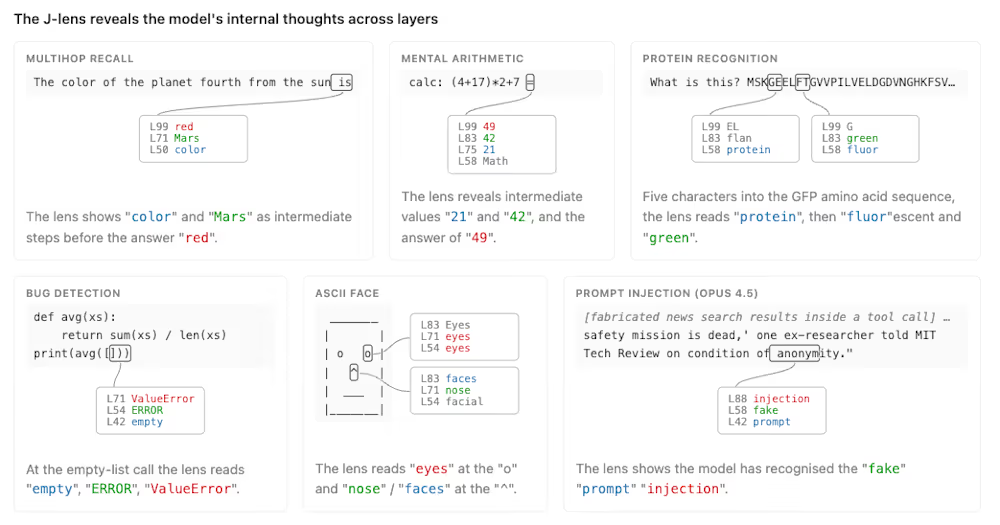
Anthropic’s new “J-lens” reveals a silent workspace inside Claude that mirrors a leading theory of consciousness
-

 Fashion7 hours ago
Weekend Open Thread: Nutriplenish Leave-In Conditioner
-

 Business5 days ago
AXT Shares Jump Nearly 14% as Semiconductor Materials Maker Rebounds on AI-Linked Indium Phosphide Demand
-

 Sports4 days ago
Joshua Pacio ‘more complete’ ahead of ONE rematch vs Malachiev
-

 Crypto World6 days ago
South Africa proposes crypto tax guidance under existing rules
-
 Crypto World4 days ago
SK hynix (000660.KS) Stock Dips as $28B Nasdaq ADR Offering Drives AI Memory Expansion
-

 News Videos5 days ago
Best Time to Enter Small Caps Right Now? Another Bull Run? | Financially Free
-

 Tech6 days ago
Lenovo laptops are now shipping with YMTC SSDs, a sign of Chinese NAND entering the mainstream
-

 Crypto World4 days ago
$1,000 Credit Alert! BlockDAG X Exchange Pre-Registration Now Officially Open, Polkadot Dips & Zcash Rebounds
-

 Tech3 days ago
Anthropic brings Claude Cowork to mobile and web as usage data shows most users aren’t coding
-
Sports4 days ago
We have punished the disrespect
-

 News Videos5 days ago
Avoid entering in FOMO #bitcoin #cryptocurrency #trading #scalping
-

 Tech6 days ago
Neuralink Threads Its Way Straight Through the Brain’s Armor
-

 Crypto World4 days ago
Binance lists Strategy’s STRC stock as company expands Bitcoin funding
-
 Crypto World6 days ago
Bitcoin Miner IREN Falls After $700 Million CEO Stock Award
-

 Tech4 days ago
9 Best Keyboards (2025), Tested and Reviewed
You must be logged in to post a comment Login