

Crypto World
XRP Price Prediction: Judge in XRP Ruling Delivers Fresh Blow


Federal Judge Analisa Torres, the architect of XRP’s landmark 2023 securities ruling, has handed down another closely watched decision, leaving XRP price prediction debates wide open as the token trades at $1.09. The market is showing little urgency, with traders waiting for the legal dust to settle before making bigger moves.
Torres is best known for her July 2023 split ruling in the SEC’s case against Ripple. She found that programmatic XRP sales on exchanges were not securities, while institutional sales qualified as investment contracts. That decision became one of crypto’s most cited legal precedents. Even after the SEC and Ripple settled in 2025, her opinions still carry weight.
Her latest ruling comes from a different case, yet traders are reading between the lines anyway. Crypto markets have a habit of connecting dots, sometimes before the ink dries. Whether that reaction sticks depends on how regulators and courts interpret the decision in the months ahead.
For now, XRP continues to hold its chart structure despite the legal headlines. Price action remains relatively steady, but conviction is still in short supply. As always, the market loves certainty, and right now it is getting another legal puzzle instead of a clear answer.
Discover: The Best Token Presales
XRP Price Prediction: Recover Above $1.2 This Week?
XRP has been holding between $1.07 and $1.10 over the past 24 hours, reflecting a market that still lacks a clear winner. The past week’s range stretches from roughly $1.05 to $1.16, leaving support and resistance well defined. Traders are waiting for a catalyst, and so far, the chart has offered little more than a shrug.
Recent Ripple partnership headlines have done little to shake XRP out of that range. Sometimes good news knocks politely instead of kicking the door down. Even so, the series of higher lows remains intact, keeping buyers interested while preventing sellers from taking full control.

A bullish scenario starts with XRP defending the $1.05 to $1.07 support zone before reclaiming $1.16. A convincing breakout could then open the door to $1.25, where previous selling pressure emerged. That would finally give bulls something more exciting than another day of sideways candles.
The base case remains continued consolidation between $1.07 and $1.16 until a legal or macro catalyst tips the balance. On the flip side, a decisive close below $1.05 would weaken the current structure. If that happens, traders could begin watching the $1.00 area as the next meaningful support.
Don’t Miss Out on Our $1,000 USDT Airdrop on ByBit
LiquidChain Targets Early-Mover Upside as XRP Tests Key Levels
XRP trading sideways around $1.10, after a multi-year legal saga and a settlement that already priced in the good news, raises a fair question: where does the asymmetric upside actually come from here? Established large-caps with resolved regulatory overhangs tend to grind, not explode.
Traders looking for early-stage exposure with a different risk/reward profile are rotating attention toward infrastructure presales.
LiquidChain ($LIQUID) is a Layer 3 infrastructure project built around a single thesis: fragmented liquidity across Bitcoin, Ethereum, and Solana is the primary friction point in cross-chain DeFi.
All eyes are on LiquidChain.
⟁https://t.co/vqvBcdSQYC pic.twitter.com/GsuIe1xMnJ
— LiquidChain (@getliquidchain) July 7, 2026
Its Unified Liquidity Layer fuses all three ecosystems into a single execution environment, with Single-Step Execution, Verifiable Settlement, and a Deploy-Once Architecture that lets developers access BTC, ETH, and SOL liquidity without redeploying per chain.
The presale is currently priced at $0.01478 per $LIQUID, with $890K raised to date. For traders who want to assess the technical architecture before committing capital, research LiquidChain here.
Discover: The Best Crypto to Diversify Your Portfolio
The post XRP Price Prediction: Judge in XRP Ruling Delivers Fresh Blow appeared first on Cryptonews.

The crypto industry has spent years convincing Washington that it deserves a seat at the table. Now, as Congress inches toward passing the CLARITY Act, a long-awaited crypto market structure bill, it seems it finally has one.
The question is no longer whether lawmakers are listening to digital asset advocates, but whether the crypto lobby’s deep pockets and influence in election campaigns will be enough to get the legislation over the line.
That debate comes as Senate negotiators work toward a potential floor vote before Congress breaks for its August recess.
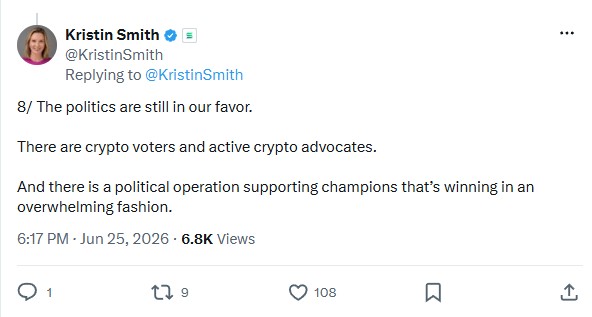
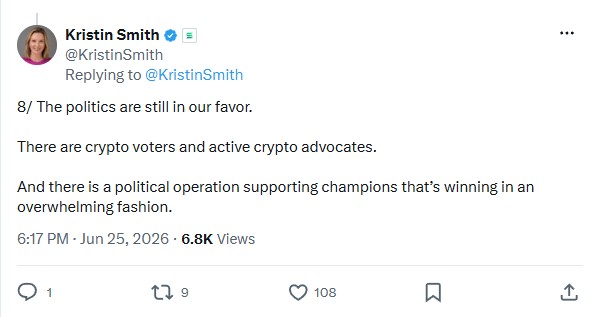
In a June 25 thread on X, Kristin Smith, president of the Solana Policy Institute and former chief executive of the Blockchain Association, argued that crypto’s advocacy operation is “the strongest and most sophisticated it has ever been.”
She pointed to bipartisan negotiations, daily meetings with lawmakers, and what she described as “a political operation supporting champions that’s winning in an overwhelming fashion” to illustrate her point.
Source: Kristin Smith
According to a report from consumer advocacy organization Public Citizen, that “political operation” has spent $189 million so far to influence the 2026 midterm elections. Crypto’s opponents see the war chest as an illegitimate attempt to buy influence and votes, while the industry argues it’s a much-needed corrective to the anti-crypto forces that have dominated politics since 2022.
Colin McLaren, the Solana Policy Institute’s head of government relations, told Cointelegraph the industry’s political infrastructure did not emerge overnight.
“Fairshake, Cedar Innovation Foundation, Stand With Crypto, and the Blockchain Association built the political infrastructure that’s moving pro-crypto legislation forward,” he said.
“These groups, alongside the advocacy of companies and projects, created and supported allies in Congress, giving them the resources and cover to legislate and lead without fear of electoral reprisal from the anti-crypto army.”
The tide begins to turn on CLARITY
There are signs that momentum to pass the CLARITY Act is building.
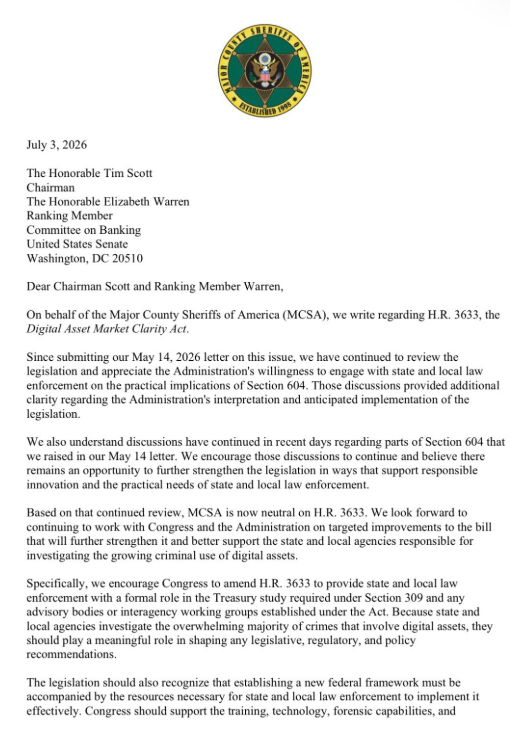
On July 3, the Major County Sheriffs of America (MCSA), a national association representing elected sheriffs from some of the largest counties in the US, announced that it had shifted from opposing the CLARITY Act to a neutral position following discussions over Section 604, also known as the Blockchain Regulatory Certainty Act. As Coinbase chief executive Brian Armstrong commented on X, that development is “huge.”
Earlier that same day, the National Organization of Black Law Enforcement Executives (NOBLE) became the first major law enforcement body to endorse the bill.
But the BRCA, which includes protections for developers decentralized smart contracts, remains a sticking point. Four other attorneys and law enforcement groups representing 70,000 members between them, warned the Acting U.S. Attorney General in late June that the bill’s “broad exemptions could create gaps in oversight and accountability that sophisticated criminal actors may exploit.”
So the race is far from won.
MCSA letter to Senate Banking Leaders. Source: Eleanor Terrett
Related: Senate leaders push for July passage of CLARITY Act
How is the crypto lobby campaigning?
Smith’s comments spotlight how closely the industry’s political organization has become intertwined with its legislative ambitions. No organization better exemplifies that shift than Fairshake, the crypto-backed political action committee (PAC), funded by companies like Coinbase, Ripple and Andreessen Horowitz.
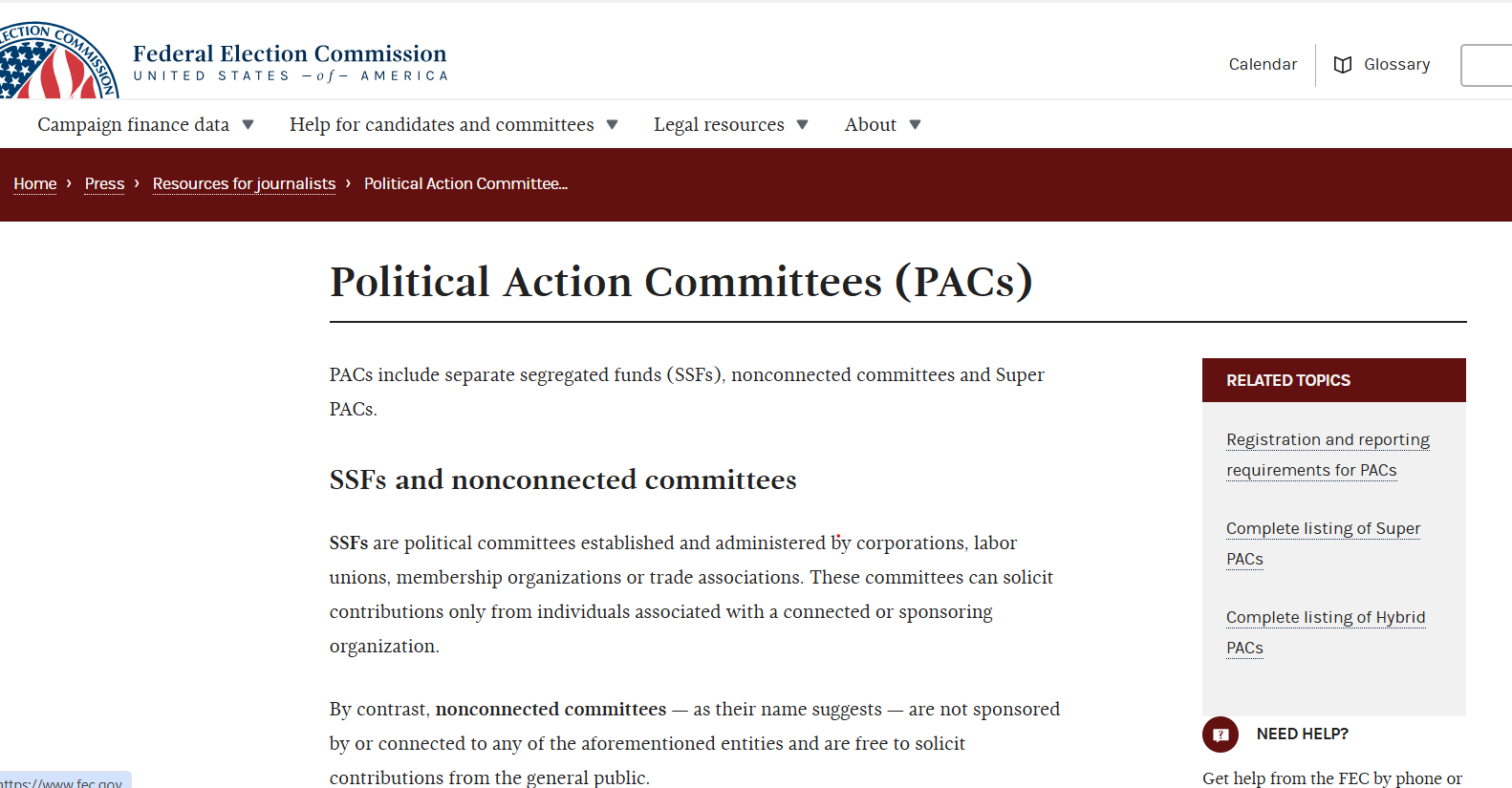
A PAC is an organization that raises and spends money to support or oppose political candidates and causes, and can pool contributions from multiple donors to fund campaign advertising and other political activity, subject to federal election rules.
Political Action Committees (PACs). Source: Federal Election Commission
Throughout the 2026 US congressional primary election cycle, Fairshake and affiliated PACs have spent tens of millions of dollars supporting candidates in various races who are viewed as favorable to digital assets while opposing others seen as hostile to the sector.
In May, affiliated PACs spent more than $20 million supporting candidates in Republican congressional primaries across Georgia, Alabama and Kentucky, including more than $7 million backing Rep. Andy Barr in Kentucky’s Senate primary.
The group later expanded its efforts into Democratic contests, spending millions of dollars in Maryland and New York. Several crypto-backed candidates advanced in these states, further reinforcing Fairshake’s reputation as the industry’s most influential political organization.
McLaren argued that the crypto’s lobby’s willingness to back candidates in competitive races is making a difference.“Adrian Boafo was polling behind the field in Maryland before the crypto industry’s ads ran. He won,” he said.
“In Houston, the industry backed Christian Menefee, a young upstart challenging a sitting incumbent. He won. The industry supports its champions, even when that means taking risks.”
Related: Democrat backed by Ripple co-founder’s PAC wins Colorado primary
Fairshake spokesperson Geoff Vetter told Cointelegraph that election victories are only one measure of success.
“Our goal is to increase the number of members who understand and are willing to act on these issues in good faith,” Vetter told Cointelegraph.
“The difference we make will be creating the largest crypto-literate caucus in history, ready to act on responsible regulation.”
But is Fairshake’s influence overstated?
But how much of Fairshake’s influence stems from election outcomes themselves rather than simply the perception that it can shape them?
In a June 30 analysis published by Brogan Law, journalist Veronica Irwin examined Fairshake’s involvement in 40 decided races during the current election cycle, comparing Federal Election Commission filings with polling data and election results.
While Fairshake-backed candidates won in 38 of those contests, Irwin’s analysis found that many of those races already leaned heavily toward the eventual winner before the PAC entered the picture.
Based on her methodology, only 16 races appeared to be genuinely competitive enough for Fairshake’s spending to have plausibly adjusted the outcome.
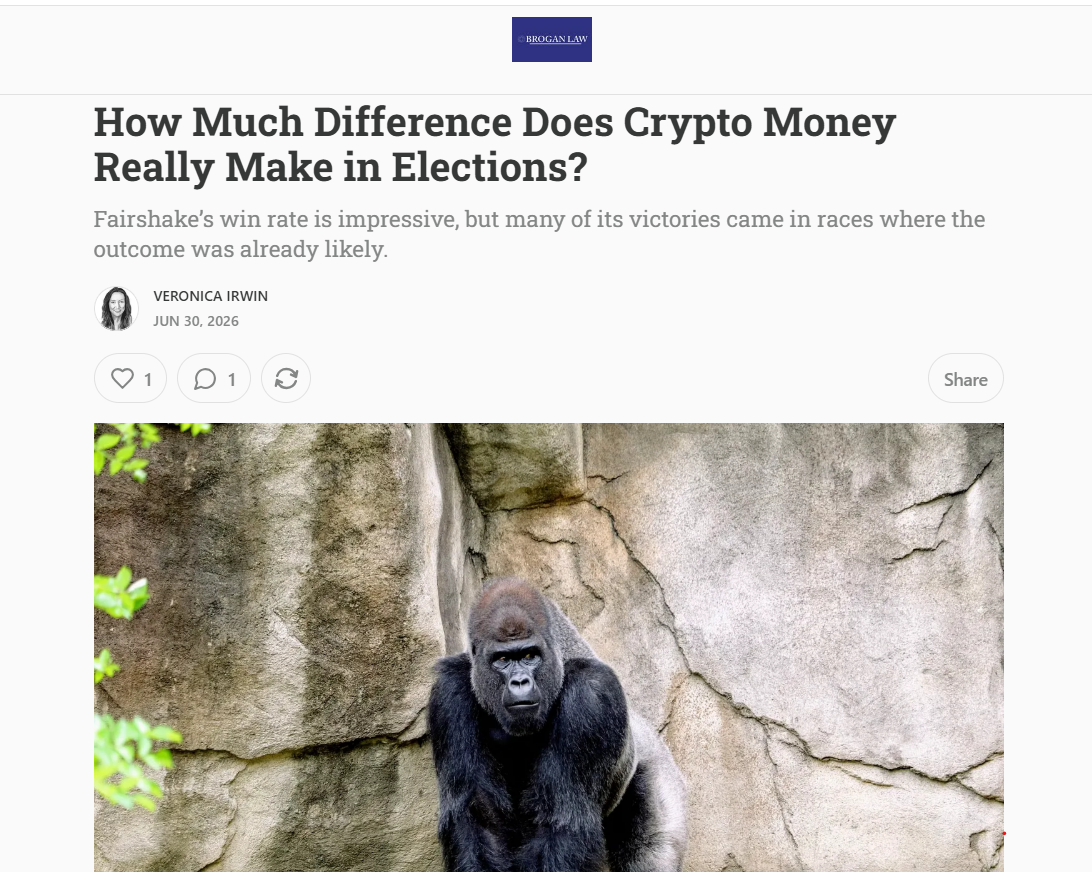
How much difference does crypto money really make in elections? Source: Brogan Law
That’s still a considerable impact, and Irwin said her goal was never to argue that Fairshake lacked influence, but to show that its strategy is more sophisticated than many observers assume.
“I was reading a lot of stories that were basically just the press release,” she told Cointelegraph. “That top-line narrative implies they are just buying up all of the elections outright and having these huge, huge wins. That kind of betrays the more complex strategy underlying it.”
Rather than simply trying to swing every race, Irwin said Fairshake has the financial resources to “spray” campaign spending across a much wider range of contests than most PACs could afford.
“They’re in this position where they have so much money that they can pursue these costly strategies,” she said.
Her analysis raises the nuanced possibility that the organization’s greatest political strength may lie not in deciding elections outright, but in cultivating the belief that it can.
Beyond campaign spending
Campaign spending alone does not always move legislation through Congress. The CLARITY Act’s progress also reflects months of negotiations involving lawmakers, industry groups and outside stakeholders.
The MCSA’s shift to a neutral position shows that legislation still depends on coalition-building and compromise, particularly when addressing concerns around financial crime, consumer protection and law enforcement.
“It is a combination of factors,” Ron Tarter, founder of self-custodial, multi-currency cryptocurrency wallet RockWallet and a former attorney, told Cointelegraph. “Adoption is the foundation… Lobbying translates that adoption into direct policy engagement… and campaign spending is the accelerant.”
Irwin also argued that crypto’s political influence comes from more than campaign spending alone. “Crypto occupies this space where it matters a lot to you and me, but to the average voter it isn’t a top-five issue,” she told Cointelegraph.
“That’s the sweet spot where lobbying and election influence can really flex their muscles… It’s pretty easy for a politician to switch to a more pro-crypto perspective without a lot of downside,” she said.
“It’s this one-two punch between lobbying being really effective and the potential to raise a bunch of money if you side with crypto.”
McLaren argued that campaign spending succeeded because it was built on a broader political strategy rather than replacing one.
“Crypto didn’t come to Washington because it wanted to,” he said.
“The industry played defense for years, then decided to meet the threat at the ballot box and build the apparatus to advocate for the clarity needed.”
Magazine: Bitcoin’s quantum dilemma: Bigger blocks or STARK proofs?
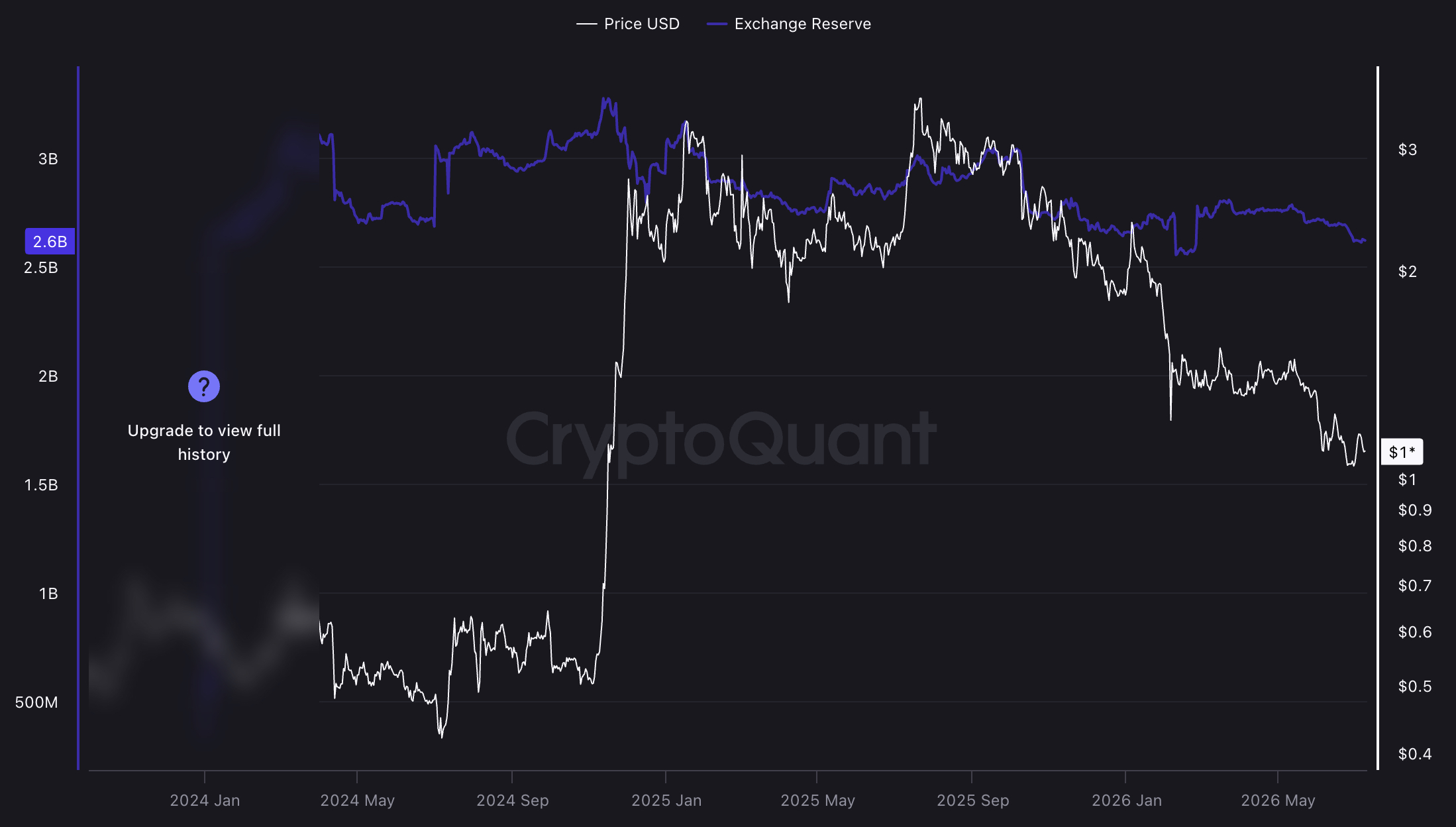
XRP price prediction remains centered on one question: can buyers finally push through the $1.15 to $1.20 resistance range? For now, XRP is changing hands around $1.08 to $1.12, staying trapped in a familiar range. Holding support is nice, but markets rarely hand out trophies for standing still.
Still, the defense of the $1.00 to $1.05 area over several weeks deserves attention. Sellers have tested that floor repeatedly without forcing a lasting breakdown. That keeps the bullish case alive, even if it has not earned a victory lap.
Meanwhile, exchange outflows have climbed from roughly 41 million XRP to about 123 million. That usually points to coins leaving trading platforms instead of preparing for sale. It is a positive signal, although one metric alone cannot carry the entire chart.
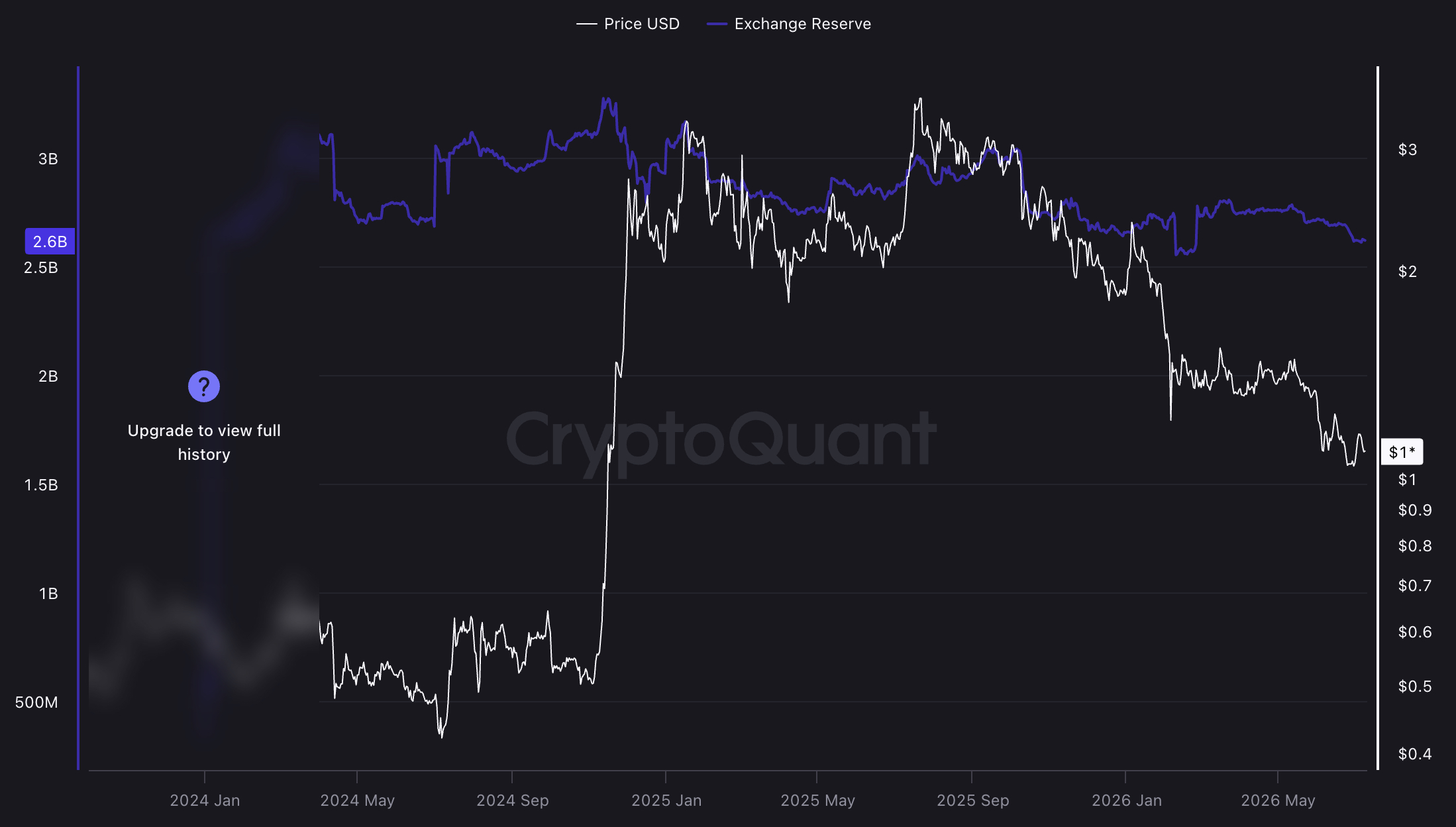
Even so, price action still needs a spark. Without fresh buying pressure, XRP could continue drifting between support and resistance. Markets can be patient, but traders usually are not.
If buyers reclaim the $1.15 to $1.20 zone, momentum could improve quickly. Until then, XRP remains in consolidation, waiting for a catalyst instead of creating one.
Don’t Miss Out on Our $1,000 USDT Airdrop on ByBit
XRP Price Prediction: Can it Hit $1.20 Before the CLARITY Act Vote?
XRP is trading around the $1.08 to $1.10 area, but the real battle sits closer to $1.18. That is where the 50 day EMA meets a crowd of sellers hoping to get out even. Push through that zone, and $1.20 to $1.25 becomes the next target. Breaking resistance is one thing. Staying above it is another.
The chart has started to look healthier, although it is not waving a green flag yet. RSI remains below 50, while the MACD has edged back into positive territory. That tells us selling pressure is easing, but buyers have not fully taken charge. For now, the market still wants a reason to commit.
That reason could come from Washington. The CLARITY Act remains on traders’ radar after missing its original timeline, with the Senate expected to revisit the issue later this month. Any sign of progress could quickly improve sentiment. If lawmakers kick the can again, XRP may stay trapped in its current range a little longer.
Prediction markets paint a balanced picture. Traders give XRP almost the same chance of testing $1.20 as revisiting the $1.00 area this month. A clean move above $1.18 could open the door to $1.25 or even $1.30. On the flip side, losing $1.00 would expose $0.87, while $0.80 remains the next notable support.
Institutional demand has not disappeared. Spot XRP ETFs continue to attract steady inflows, suggesting bigger investors are still accumulating. Ripple’s recent partnerships have also helped sentiment. Even so, XRP keeps bumping into sellers before reaching $1.20. The market can be stubborn, especially when everyone expects the same breakout.
Discover: The Best Crypto to Diversify Your Portfolio
LiquidChain Targets Early Mover Upside as XRP Tests Key Levels
XRP’s ceiling problem with its strong demand base, capped upside by overhead supply and regulatory timing, is precisely the kind of setup that sends traders scanning for asymmetric exposure elsewhere. At here with a contested move to $1.20, the upside math on a near-term XRP trade is measured in percentages. XRP Ledger infrastructure continues to develop, but near-term price catalysts remain binary and event-dependent.
LiquidChain ($LIQUID) is a Layer 3 infrastructure project taking a different angle on the multi-chain problem: rather than bridging assets between ecosystems. It fuses Bitcoin, Ethereum, and Solana liquidity into a single execution environment.
All eyes are on LiquidChain. — LiquidChain (@getliquidchain) July 7, 2026
⟁https://t.co/vqvBcdSQYC pic.twitter.com/GsuIe1xMnJ
The architecture centers on a Unified Liquidity Layer with single-step execution and verifiable settlement. So, with Liquid, developers deploy once and access all three ecosystems without the usual bridge overhead or fragmented liquidity pools.
The presale is live at $0.01478 per $LIQUID, with $900K raised to date. For traders comfortable with that risk profile, the LiquidChain presale warrants research as a speculative position distinct from the regulatory-driven binary that XRP currently represents.
Discover: The Best Token Presales
The post XRP Price Prediction: Can XRP Crack $1.20 Before Clarity Act? appeared first on Cryptonews.
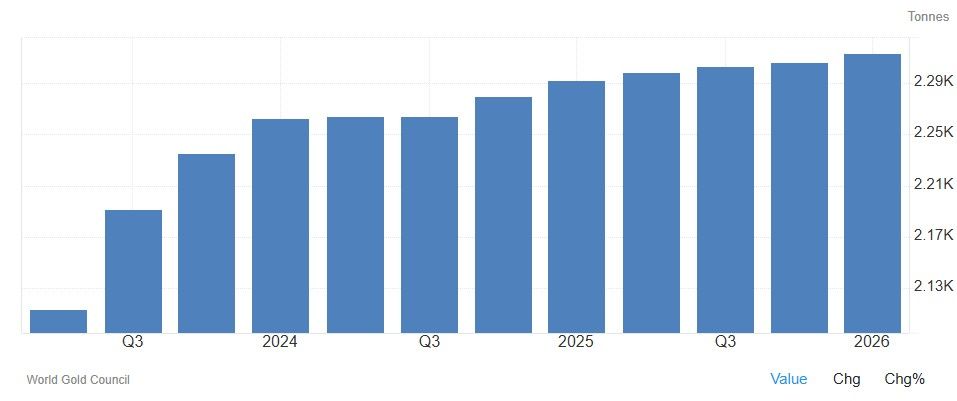
Indian jewelers are cutting gold prices by as much as $19 an ounce this week as sharp volatility freezes retail buying, while China’s central bank keeps adding to its reserves.
The contrast highlights diverging gold strategies across Asia’s two largest markets during a volatile month for the metal. Spot prices dropped to a seven-month low in late June before rebounding, fueling the wide swings dealers cite this week.
India’s Discounts Deepen as Buyers Hesitate
Dealers in India cut prices by up to $19 an ounce this week, according to Reuters. Sharp volatility has discouraged fresh purchases, and many buyers are avoiding the market entirely.
Retail activity has shifted toward exchanging old jewelry for new pieces, so jewelers do not need to restock as often. This shift lowers demand for freshly mined bullion and keeps discounts elevated. Indian jewelry volumes fell 19% year over year in the first quarter, while investment demand for bars and coins climbed, according to World Gold Council data.
Buyers are weighing gold’s July price outlook before committing fresh capital, dealers said.
China’s Central Bank Extends Its Buying Streak
The People’s Bank of China added 480,000 ounces of gold in June, marking its 20th consecutive month of purchases. The streak ranks among the longest since 2015 and signals Beijing’s push to diversify reserves away from the dollar. Total holdings have grown to roughly 2,346 tonnes, under 10% of China’s overall foreign-exchange reserves.
Steady accumulation has helped stabilize spot prices even as broader demand cools. JPMorgan recently trimmed its Q4 price target, citing softer momentum, though Chinese purchases continue to offset some of that pressure. This pattern echoes the central banks’ gold buying trend recorded earlier this year.

Hong Kong Pushes to Become a Regional Gold Hub
Meanwhile, Hong Kong launched a central clearing system for gold on July 7 and revived dollar-denominated futures trading. Volumes on the new contracts hit a record high, more than double the previous peak set in 2022. The exchange waived trading fees for a year, an incentive designed to draw banks and bullion producers into the new market.
The moves aim to cement Hong Kong’s role as a settlement and pricing center for Asian gold flows. A planned yuan-denominated contract, backed by the Shanghai Gold Exchange, could eventually rival established dollar benchmarks. Investors weighing gold’s long-term outlook may watch how this new infrastructure affects regional premiums in the months ahead.
Analysts will track whether Chinese buying continues to offset soft Indian demand in the coming weeks. Some retail investors are comparing gold’s appeal against Bitcoin as portfolios shift toward safer assets. A weaker rupee and looming festival-season buying could reshape Indian demand before the year ends. Hong Kong’s new infrastructure and Beijing’s reserve strategy could jointly shape gold pricing well beyond this quarter.
The post India Gold Discounts Widen to $19 as China Buying Streak Hits 20 Months appeared first on BeInCrypto.


The European Securities and Markets Authority (ESMA) has launched a supervisory review of MiCA-authorized crypto custodians, moving its focus from licensing to testing how firms handle operational risks in practice.
Summary
- ESMA has launched a review of MiCA-authorized crypto custodians’ operational resilience.
- Regulators will examine custody controls, key management, incident response and third-party risks.
- The review comes as the EU prepares to revisit parts of MiCA following the U.S. GENIUS Act.
According to the European Securities and Markets Authority, the regulator has started a Common Supervisory Action (CSA) covering a sample of authorized crypto-asset service providers (CASPs) under the European Union’s Markets in Crypto-Assets (MiCA) framework.
The review concentrates on custody services and will examine whether firms have effective operational resilience measures rather than relying only on regulatory approval.
ESMA examines custody controls after MiCA licensing
As outlined by ESMA, supervisors will assess digital operational resilience in several critical areas, including private key and storage management, transaction controls, incident response procedures and reliance on third-party technology providers. The review comes soon after MiCA’s transitional period ended, making it one of the first coordinated supervisory exercises under the EU’s crypto rulebook.
In a statement, Sebastien Dessimoz, co-founder and managing partner of digital asset infrastructure company Taurus, said the message from regulators is that obtaining a MiCA licence is only the starting point for custodians.
Dessimoz said custody providers are now expected to demonstrate that their operational controls can withstand real-world risks instead of simply asserting that their systems are secure. He added that as digital assets become more integrated into regulated financial infrastructure, regulators expect the same level of security, accountability and resilience seen in traditional financial markets.
Institutional clients have already increased scrutiny of custody practices, according to Jody Mettler, chief operating officer of BitGo and president of BitGo Trust. In a statement, Mettler said clients increasingly ask how custodians segregate customer assets, manage access controls, respond to security incidents and maintain business continuity during periods of market stress.
She added that regulators are paying closer attention to the operational standards supporting digital asset services rather than limiting their assessment to licensing requirements.
MiCA oversight expands as Europe revisits crypto rules
Industry participants also see the review as an early indication of how MiCA supervision could evolve. Markus Levin, co-founder of blockchain infrastructure company XYO, told Cointelegraph that receiving MiCA authorization and proving operational resilience are separate challenges. He said firms that can demonstrate strong operational controls before supervisory reviews conclude could be better positioned as institutional participation in digital assets increases.
Meanwhile, Yuriy Brisov, a lawyer at Digital & Analogue Partners, said the review combines obligations under both MiCA and the Digital Operational Resilience Act (DORA). According to Brisov, concentration among custody technology providers means weaknesses at a single vendor could affect multiple regulated firms simultaneously, making supply chain resilience a key compliance issue.
At the same time, European regulators are already preparing the next stage of MiCA. According to a Euronews report, European Commission officials are planning a review of parts of the framework from 2027 after the United States enacted the GENIUS Act.
The review is expected to examine how non-EU stablecoin issuers should be treated under existing rules as international crypto regulation continues to develop.
Current market data also shows MiCA’s regulated exchange ecosystem continuing to expand. DefiLlama’s MiCA exchange dashboard, cited by Wu Blockchain, ranked Kraken as the largest regulated venue by liquidity, with more than $400 million in spot liquidity and over $220 million in perpetual liquidity on the live dashboard.
Coinbase remained the second-largest regulated exchange by liquidity, according to the same data, underscoring the growing scale of platforms operating under Europe’s licensing framework.

Kraken is rolling out a new set of AI-driven “financial intelligence” tools inside its mobile app, aiming to make crypto investing feel less like an interface challenge and more like decision support. The exchange says users will start by setting financial goals and preferences, after which the app will tailor what it shows and which portfolio recommendations it surfaces—without taking control of trades.
According to an announcement, Kraken’s system continuously monitors markets and flags opportunities, but every suggested action must be approved by the user. In reporting from CNBC, the updated app uses a customer’s goals, risk tolerance, funding preferences and broader financial profile to generate a suggested portfolio, which users can review and adjust before investing. After funds are deployed, it provides personalized portfolio updates and additional investment suggestions based on what the user holds.
Key takeaways
- Kraken’s mobile update personalizes recommendations around user-set goals like buying a home, retirement savings, or an emergency fund.
- Despite AI “financial intelligence,” Kraken’s recommendations are decision-support only—users must approve every trade before execution.
- The approach mirrors a wider industry shift: exchanges are moving from basic order entry toward conversational portfolio guidance.
- Other major platforms are already testing AI agents and assistants that can transact or place orders, though user review and consent remain a common requirement.
From trading screens to goal-based investing
Kraken’s update is built around a simple premise: most investors don’t want to start with complex trading tools—they want clarity around outcomes. The company says its redesigned app begins by asking users to define financial goals and preferences, then adapts its interface and recommendations to match those objectives. Instead of treating crypto as just another asset to trade, Kraken is positioning the tools as a way to support structured investing decisions.
Kraken describes its AI system as “financial intelligence” that watches markets for potential opportunities and recommends trades. However, the company draws a clear line between guidance and automation: it does not execute transactions on a user’s behalf. Each recommendation requires the user’s approval, making the experience more like an assistive layer on top of existing trading functions rather than an autonomous trading engine.
How the app generates portfolios—and where approval fits
CNBC reports that Kraken’s platform incorporates market monitoring data alongside personal inputs—risk tolerance, funding preferences and financial profile—to produce a suggested portfolio. That portfolio is not presented as a final instruction. Users are expected to review and adjust the proposal before investing.
Once a user has acted, the system continues to provide personalized portfolio updates and further suggestions that reflect the user’s holdings. The key element for investors and traders is the workflow: the AI proposes, the user disposes. That distinction matters for both risk management and compliance concerns, and it helps explain why exchanges are able to market AI capabilities without fully removing human control.
In comments to CNBC, Kraken chief data officer Kamo Asatryan said the technology is intended to give everyday investors visibility similar to what active traders may already have, by continuously monitoring markets, identifying opportunities and recommending trades. He framed the goal as enabling non-experts to participate in more sophisticated decision-making “using plain English,” rather than requiring constant manual interpretation of market data and trading mechanics.
The broader push for agentic tools across crypto
Kraken’s move fits a broader competitive pattern across crypto exchanges and fintech platforms: adding AI to help users analyze markets, manage portfolios, and interact with trading systems via more natural, assistant-like experiences. Instead of only supporting traditional order types, these products increasingly aim to translate user intent—often stated in conversational language—into actionable guidance.
In June, OKX launched a beta marketplace for AI agents that can transact autonomously, complete onchain tasks, and build blockchain-based reputations. Around the same time, Coinbase introduced a tool allowing AI agents to make payments and trade cryptocurrencies on behalf of users using its x402 payments protocol. In both cases, the industry debate is not whether AI can be useful, but how much autonomy it should be given and how responsibility is handled.
Chainalysis reported last month that agentic payment activity on Coinbase’s Base network surpassed 100 million transactions. While transaction growth has stabilized, the report indicated that higher-value transfers have become more common—suggesting agent-driven payments are evolving beyond the earliest wave of small, test-like activity. For investors and builders, that shift is a signal that AI-enabled “agentic” actions may increasingly be used for meaningful payments rather than only experimentation.
Meanwhile, fintech firm Revolut announced an upgrade to its Revolut X exchange, enabling customers to connect AI assistants—including Claude, Gemini, Cursor and OpenClaw—to analyze markets, backtest trading strategies and place orders through natural-language prompts. Like Kraken, Revolut’s approach requires customers to review and approve every trade before execution, reinforcing the notion that user consent remains the default boundary even as interfaces become more automated.
Why Kraken’s positioning matters for users
Kraken’s “financial intelligence” framing highlights an important distinction in how exchanges are adopting AI. Autonomy is one dimension, but user experience and decision architecture are another. By centering the workflow on goals and risk preferences, Kraken is trying to reduce friction for users who may otherwise struggle to map personal objectives onto trading choices.
For retail investors, goal-based guidance could make portfolio management more consistent—especially when combined with ongoing updates after investment. Still, the success of such tools will likely depend on how effectively recommendations reflect the user’s stated objectives and how clearly the system explains why a particular trade or portfolio shift is suggested. Kraken’s insistence on approval before execution provides a safety valve, but users will still need to understand the recommendations they accept.
For market participants more broadly, Kraken’s rollout underscores that AI features are becoming a competitive baseline rather than a differentiator reserved for the most tech-forward platforms. Even where full agentic autonomy is not enabled, exchanges are competing on the quality of their guidance, the speed at which they can interpret market conditions, and the clarity with which they translate complex strategies into something everyday customers can act on.
Next, investors should watch how Kraken measures engagement and outcomes from the new goal-based recommendations—particularly whether users stick with the guidance after the initial setup—and whether similar interfaces expand beyond portfolio suggestions into deeper automation. The remaining uncertainty is how quickly the market will move from decision support to fully autonomous action, especially as regulators, user expectations, and platform designs continue to converge.
President Donald Trump has refused to sign the 21st Century ROAD to Housing Act, even as the bill containing a provision blocking a U.S. central bank digital currency through 2031 has remained on course to become law.
Summary
- Trump has refused to sign the 21st Century ROAD to Housing Act over the Senate’s failure to pass the Save America Act.
- The housing bill is still expected to become law because the White House has confirmed Trump will not veto it.
- The legislation would bar the Federal Reserve from issuing a U.S. CBDC until 2031 if it takes effect.
According to a Truth Social post by President Trump, he decided not to sign the housing bill because the Senate has yet to pass the Save America Act, which he has repeatedly urged lawmakers to approve.
Congress passed the housing legislation last month and sent it to the White House, but Trump argued that he would withhold his signature until the voting bill advances.
Last month, crypto.news reported that Trump had already delayed signing the legislation for the same reason. At the time, he described the Save America Act as “desperately needed” and said he would not approve the housing package until Congress acted on the separate proposal.
CBDC restriction remains on track despite Trump’s decision
Although Trump has declined to sign the legislation, the housing bill is still expected to become law because he has not issued a formal veto. A White House official confirmed that the president does not intend to veto the measure, allowing it to take effect automatically after the constitutional review period expires without his signature.
For the crypto industry, one section of the legislation has attracted particular attention because it would prohibit the Federal Reserve from issuing a central bank digital currency until 2031.
The restriction would extend the administration’s earlier position after Trump signed an executive order directing federal agencies not to take steps toward creating a U.S. CBDC.
Unlike a pocket veto, which can permanently block legislation under specific congressional timing conditions, the current situation allows the bill to become law automatically because Congress remains in session and the president has not exercised his veto authority.
Save America Act remains Trump’s priority
In his Truth Social statement, Trump argued that the Senate’s failure to pass the Save America Act is unacceptable despite what he described as overwhelming support among Republican voters. The legislation would require voters to present photo identification in federal elections, a measure the president has continued to promote as an election integrity safeguard.
Separately, Democratic Senator Elizabeth Warren criticized Trump’s decision in a post on X, arguing that refusing to sign the housing legislation delayed action on a bill designed to address housing affordability. Warren also stated that the legislation would become law regardless because the president had chosen not to veto it.
The latest dispute comes as lawmakers continue debating other crypto legislation on Capitol Hill. Warren has previously joined other Democratic senators in calling for hearings into Trump’s cryptocurrency holdings, while the Senate is also considering the CLARITY Act, a separate bill intended to establish a regulatory framework for digital assets.
Taken together, the developments leave the housing bill on track to take effect despite the absence of Trump’s signature, while the dispute over the Save America Act and broader crypto legislation continues to shape debate in Washington.
Crypto World
Crypto News, July 10: Regulation Overtakes Geopolitics as Bitcoin and Ethereum Price Hold Firm

For us, who spent the past month glued to oil charts, the screens have changed. Now we’re refreshing congressional calendars instead. Crypto regulation, not missiles nor crude price, is becoming the biggest talking point as Bitcoin and Ethereum price continue to hold steady. Policy has become the market’s new obsession.
Although Middle East headlines still grab attention, crypto is now spending more time debating legislation, SEC guidance, and CFTC oversight. For now, politics in Washington seems to matter more than politics in the Gulf.
Don’t Miss Out on Our $1,000 USDT Airdrop on ByBit
Bitcoin Price Holds Up as Markets Await Policy Clarity

Bitcoin price is holding at the mid-$63,000 range after recovering from June’s selloff. Softer U.S. economic data and easing energy prices have helped improve risk sentiment, while ETF flows remain mixed. Buyers continue stepping in on dips, as institutions remain willing to accumulate despite short-term uncertainty.
Attention is already turning to upcoming inflation data and the Federal Reserve’s next meeting. A cooler CPI reading could give the Bitcoin price another push, but many traders believe Washington will ultimately have the bigger say.
That is because crypto regulation is moving unusually fast. Congress continues debating the CLARITY Act, while regulators are working toward clearer rules on digital assets after years of uncertainty. The SEC and CFTC have already issued joint guidance aimed at defining how crypto assets should be treated under federal law.
Discover: The Best Token Presales
Ethereum Price Finds Support Beyond ETF Headlines

Ethereum price remains under pressure compared with earlier this year, but the network itself grows. Layer 2 activity, tokenized assets, and decentralized finance are all expanding even while ETH trades sideways.
ETF flows have swung between inflows and outflows, yet developers have largely ignored the day-to-day noise. Instead, they remain focused on scaling Ethereum and attracting more onchain activity. It is not exactly headline-grabbing, but builders rarely care whether traders are having a good week.
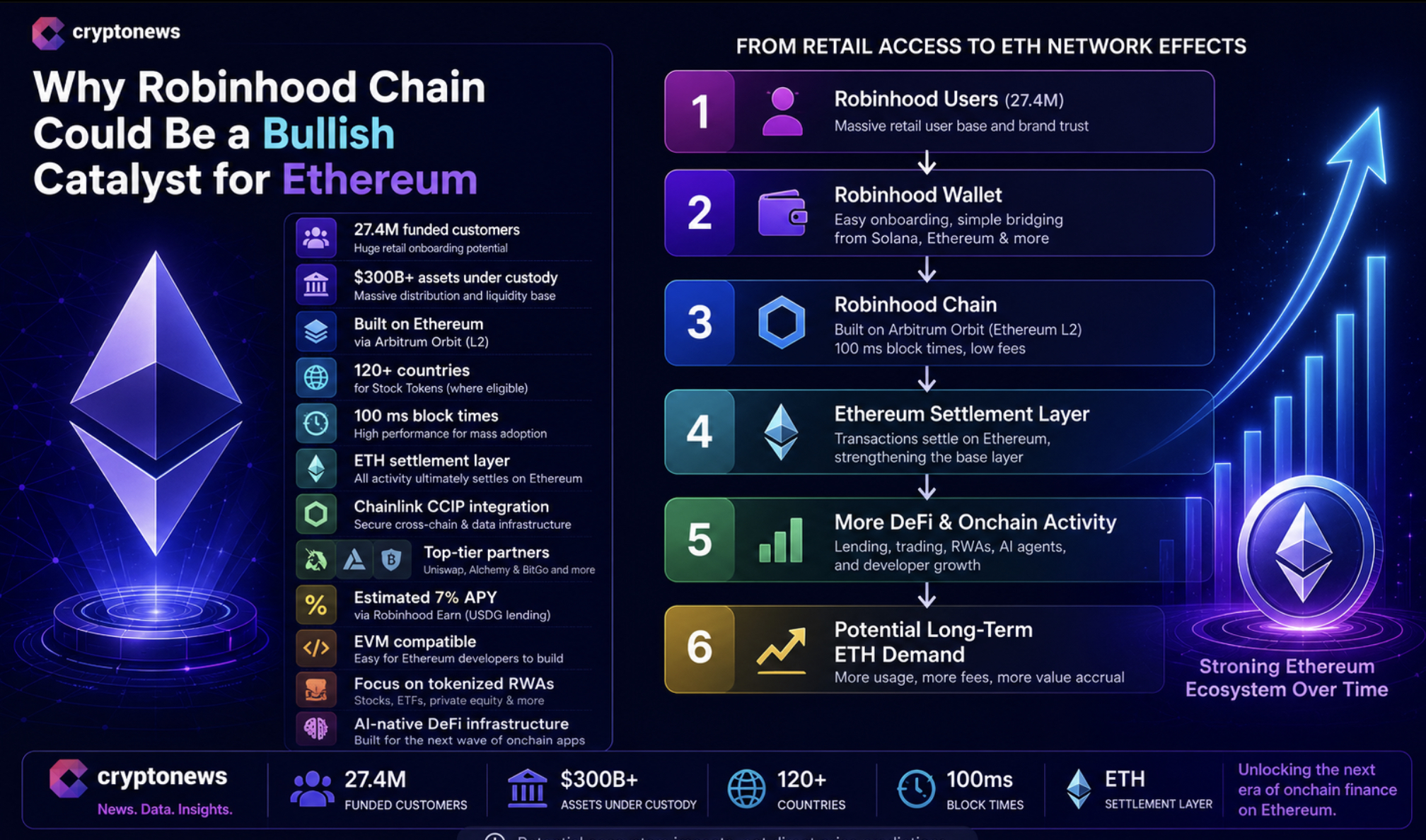
Robinhood Chain may not move the Ethereum price overnight, but it could quietly strengthen the network over time. Built as an Ethereum Layer 2 using Arbitrum Orbit, the chain settles transactions back to Ethereum and uses ETH for gas. This brings activity and ultimately feeds into Ethereum’s ecosystem.
The Ethereum price could also benefit if lawmakers deliver clearer rules for decentralized finance. Several industry groups continue urging regulators to create frameworks tailored to DeFi instead of squeezing it into decades-old financial rules. It’s looking bright for Ethereum price.
Discover: The Best Crypto to Diversify Your Portfolio
Crypto Regulation Is the Market’s New Catalyst
The biggest shift is psychological. A few weeks ago, people jumped at every geopolitical headline. Now they are dissecting committee schedules, regulatory guidance, and draft legislation with the same intensity.
That helps explain why Bitcoin and Ethereum price have held relatively resilient despite ongoing global tensions. Investors increasingly believe clearer rules could encourage fresh institutional capital, especially if Congress finally delivers long-awaited market structure legislation.
— Crypto Banter (@crypto_banter) July 9, 2026
 LAWMAKERS PREPARING REVISED CLARITY ACT FOR POSSIBLE INTRODUCTION NEXT WEEK!
U.S. negotiators are working on a new or updated version of the Digital Asset Market Clarity Act, which could be introduced as soon as next week, CoinDesk reports.
This comes as Congress returns from… pic.twitter.com/rYp5feGoM8
It’s becoming more obvious now, crypto regulation has replaced geopolitics as market’s conversation, and both the Bitcoin and Ethereum price are taking their cues from Washington more than the latest oil headline.
Don’t Miss Out on Our $1,000 USDT Airdrop on ByBit
The post Crypto News, July 10: Regulation Overtakes Geopolitics as Bitcoin and Ethereum Price Hold Firm appeared first on Cryptonews.
After weeks and weeks of consistent dominance of net outflows, the spot exchange-traded funds tracking the two largest cryptocurrencies by market cap have flipped the script.
This came amid a positive price rebound for both assets, as the market leader trades above $64,000, while the altcoin has challenged the $1,800 resistance.
BTC ETFs Finally in Green
CryptoPotato has repeatedly reported on the poor performance of the spot Bitcoin ETFs in the past couple of months. The negative streak began during the week that ended on May 15 with $1 billion in net inflows. The massive withdrawals remained within the billions-of-dollars range for the next three weeks.
After a minor decline to $316 million and $227 million in mid-June, investors registered the most significant net outflows of $1.79 billion during the last full week of the month since February 2025. Another $526 million left the funds during the week that ended on July 2, solidifying the exodus narrative as over $8 billion was withdrawn from the ETFs within these eight weeks.
The landscape finally improved in the past week, even though it wasn’t perfect. The five-day trading period ended with almost $200 million in net inflows, the first such green week in two months. Monday was the most impressive day, with $265.69 million entering the funds. Another $21.44 million followed on Tuesday, and $90.44 million on Friday.
Wednesday and Thursday were back in the red, with net outflows of $84.86 million and $95.30 million, respectively.

The underlying asset’s price reacted positively to the change in investor behavior and is up 3% for the week to over $64,000.
ETH ETFs Follow Suit
The spot Ethereum ETFs mimicked the performance of the BTC funds for the past few months, posting only net withdrawals in the span of eight consecutive weeks. The total cumulative net flows dumped from $12.09 billion to $10.89 billion during this violent streak.
However, just like its bigger brother, ETH has enjoyed renewed investor interest in the past week. The streak was finally broken, with $84.42 million in net inflows – the most since the week that ended on April 24.
Moreover, the ETH ETFs had only one day in the red out of the last seven, as investors pulled out $52.08 million on July 9. In contrast, the net inflows stood at $20.66 million on Monday, $27 million on Tuesday, $70.48 million on Wednesday, and $18.43 million on Friday.

ETH’s price has risen as well, currently challenging the key $1,800 resistance after a 2.7% weekly jump.
The post Bitcoin ETFs Finally Snap 8-Week Losing Streak With Almost $200M in Inflows appeared first on CryptoPotato.

Senate Democrats have demanded committee hearings into the national security risks posed by President Donald Trump’s crypto holdings, citing new disclosures that unnamed third parties hold a stake in his family’s crypto firm.
The July 10 statement was issued by the ranking members of five Senate committees. They asked their respective panels to examine whether the United Arab Emirates or unknown investors hold influence over the President’s decisions.
Trump’s Crypto Holdings Disclosures Fuel Fresh Oversight Push
The lawmakers are Elizabeth Warren, Richard Blumenthal, Gary Peters, Dick Durbin, and Ron Wyden. Each serves as the top Democrat on a committee with jurisdiction over finance, security, or the judiciary.
Their statement responded to Trump’s latest federal financial disclosures. The senators said that the Trump family’s crypto ventures generated about $1.4 billion in the first year of his second term.
BeInCrypto’s report showed Trump’s meme coin earned roughly $636 million, while World Liberty Financial (WLFI) added about $515 million from token sales and $65 million from equity.
The senators noted that the filing listed unnamed “Third Parties” holding a WLF stake. That detail followed reports of a UAE-linked vehicle buying a 49% stake for roughly $500 million.
Follow us on X to get the latest news as it happens
Democrats Link Holdings to Policy Moves
The senators argued the disclosures deepen concerns about Trump shaping crypto policy while profiting from the sector. They pointed to legislative pushes and moves to ease oversight of digital assets.
The lawmakers also cited the disbanding of the Justice Department’s National Cryptocurrency Enforcement Team. They framed that step as evidence of weakened enforcement.
“We call on our respective Committees to hold hearings to investigate the national security implications of President Trump’s cryptocurrency holdings, including the influence of the UAE or unknown third parties on President Trump’s actions,” the statement read.
The demand builds on a June request from the same senators regarding World Liberty Financial’s reported ties to Abu Dhabi. In a statement shared with BeInCrypto, the White House denied any link between its UAE artificial intelligence agreement and the crypto firm, saying that Trump’s assets are held in a trust run by his children.
Whether Republican committee chairs grant the hearings will determine if the dispute advances beyond statements.
Subscribe to our YouTube channel to watch leaders and journalists provide expert insights
The post Senate Democrats Demand National Security Probe of Trump Crypto Holdings appeared first on BeInCrypto.
Bitcoin has climbed above the $64,000 level after U.S. President Donald Trump confirmed that the United States has agreed to continue talks with Iran following a new request from Tehran.
Summary
- Trump confirmed the U.S. will continue talks with Iran after a new request from Tehran.
- Bitcoin climbed above $64,000 as markets reacted positively to the diplomatic update.
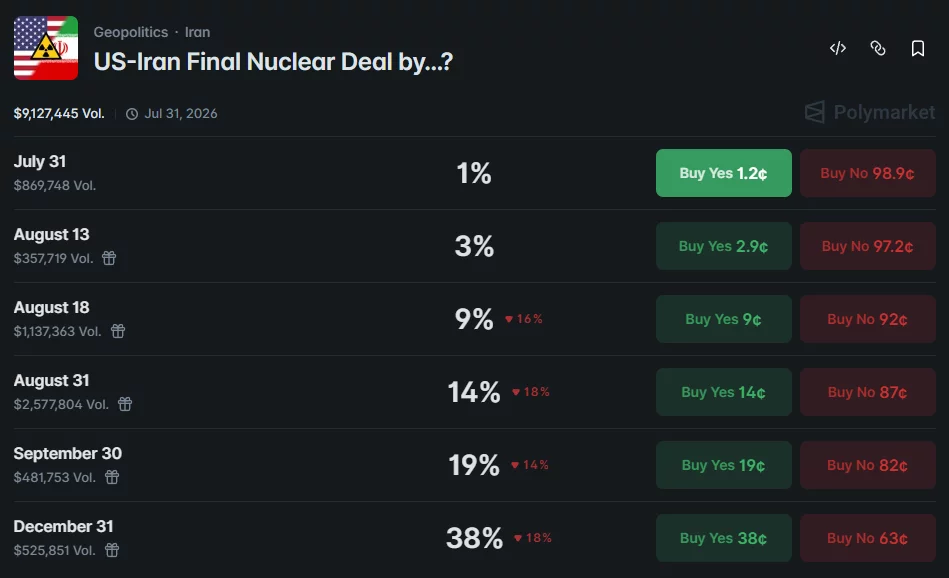
- Polymarket still places the odds of a U.S.-Iran nuclear deal by year-end at just 38%.
According to a post by President Trump on Truth Social, Iran asked to resume discussions with the United States, and Washington agreed to continue negotiations. At the same time, Trump stated that the ceasefire was over, indicating that diplomatic engagement would continue despite the end of the truce.
“The Islamic Republic of Iran has asked us to continue “talks.” We have agreed to do so, but the United States has stated to them, in no uncertain terms, that the Cease Fire is OVER!”
The cryptocurrency market reacted positively to the development. Bitcoin (BTC) rose to around $64,100, gaining nearly 2% from an intraday low near $62,000. The move extended the recovery that began after heavy selling earlier this week, when renewed military exchanges between the U.S. and Iran pushed Bitcoin below the $62,000 mark.
crypto.news had previously reported that technical discussions between U.S. and Iranian officials were expected to continue. Trump’s latest statement publicly confirmed that negotiations remain active even as military tensions have yet to fully ease. Alongside Bitcoin, several major cryptocurrencies also traded higher following the announcement.
Bitcoin recovers as diplomatic contacts continue
Market sentiment improved after Trump’s latest comments suggested that both sides remain engaged in negotiations despite recent hostilities. Earlier, the president had also stated that Iran wanted to make a deal “so badly,” adding to expectations that diplomatic channels had not completely broken down.
Even with Bitcoin reclaiming the psychological $64,000 level, traders continue to monitor geopolitical developments closely because recent market swings have been closely tied to headlines surrounding the conflict. This week’s decline below $62,000 came shortly after both countries exchanged strikes and Trump declared that the ceasefire had ended.
The recovery also follows several sessions of elevated volatility across digital assets, with investors reacting quickly to changes in geopolitical risk. Although Bitcoin has regained lost ground, price movements remain sensitive to further developments from Washington and Tehran.
Nuclear agreement expectations remain limited
Despite the renewed talks, prediction markets continue to show limited confidence that the two countries will finalize a nuclear agreement this year. According to Polymarket data, the probability of the United States and Iran reaching a deal by Dec. 31 stands at about 38%.
The nuclear program remains the central issue separating both sides. President Trump has repeatedly maintained that Iran cannot possess a nuclear weapon, while negotiations continue alongside ongoing military and political tensions.
Energy markets remain another source of uncertainty for investors. Iran has maintained that it plans to impose tolls on vessels passing through the Strait of Hormuz, a route that carries a significant share of global oil shipments. The possibility of higher transportation costs has kept traders focused on potential disruptions to crude supplies.
Earlier this week, oil prices climbed after Iran attacked three oil tankers in the Strait of Hormuz, escalating the conflict and adding fresh inflation concerns. Higher energy prices can increase inflationary pressure, a factor that financial markets often watch because persistent inflation may reduce expectations for easier monetary policy, which can weigh on risk assets such as Bitcoin.
For now, Bitcoin’s move above $64,000 suggests investors welcomed signs that diplomatic contacts remain open. Even so, the market continues to balance improving sentiment from renewed negotiations against the unresolved issues surrounding Iran’s nuclear program and the ongoing risks to global energy supplies.

George Goodman’s investing wisdom: Why sometimes the best move is to do nothing

Will a $189M Lobbying Campaign Result in Crypto CLARITY?
There’s an Underwhelming Caleb Banks Forecast


-
 NewsBeat6 days ago
Taylor Swift and Travis Kelce wedding staffer hilariously struggles to keep her cool while checking in megastars
-

 Fashion5 days ago
Open Thread: What Great Books Have You Read Recently?
-

 News Videos4 days ago
Whats Hidden Inside This Cash Register? #treasure #reselling #money
-

 Fashion2 days ago
Loro Piana Fall 2026 Enters Houston’s Art Scene
-

 Fashion9 hours ago
Weekend Open Thread: Nutriplenish Leave-In Conditioner
-
 Tech4 days ago
Anthropic’s new “J-lens” reveals a silent workspace inside Claude that mirrors a leading theory of consciousness
-

 Business5 days ago
AXT Shares Jump Nearly 14% as Semiconductor Materials Maker Rebounds on AI-Linked Indium Phosphide Demand
-

 Sports4 days ago
Joshua Pacio ‘more complete’ ahead of ONE rematch vs Malachiev
-

 Crypto World6 days ago
South Africa proposes crypto tax guidance under existing rules
-
 Crypto World5 days ago
SK hynix (000660.KS) Stock Dips as $28B Nasdaq ADR Offering Drives AI Memory Expansion
-

 News Videos5 days ago
Best Time to Enter Small Caps Right Now? Another Bull Run? | Financially Free
-

 Crypto World5 days ago
$1,000 Credit Alert! BlockDAG X Exchange Pre-Registration Now Officially Open, Polkadot Dips & Zcash Rebounds
-

 Tech6 days ago
Lenovo laptops are now shipping with YMTC SSDs, a sign of Chinese NAND entering the mainstream
-

 Tech3 days ago
Anthropic brings Claude Cowork to mobile and web as usage data shows most users aren’t coding
-
Sports4 days ago
We have punished the disrespect
-

 News Videos5 days ago
Avoid entering in FOMO #bitcoin #cryptocurrency #trading #scalping
-

 Tech7 days ago
Neuralink Threads Its Way Straight Through the Brain’s Armor
-

 Crypto World4 days ago
Binance lists Strategy’s STRC stock as company expands Bitcoin funding
-
 Crypto World7 days ago
Bitcoin Miner IREN Falls After $700 Million CEO Stock Award
-

 Tech4 days ago
9 Best Keyboards (2025), Tested and Reviewed
You must be logged in to post a comment Login