Workers at DHL Group used to walk close to a half marathon each day just to classify, pick and move items across massive warehouses.
Advertisement
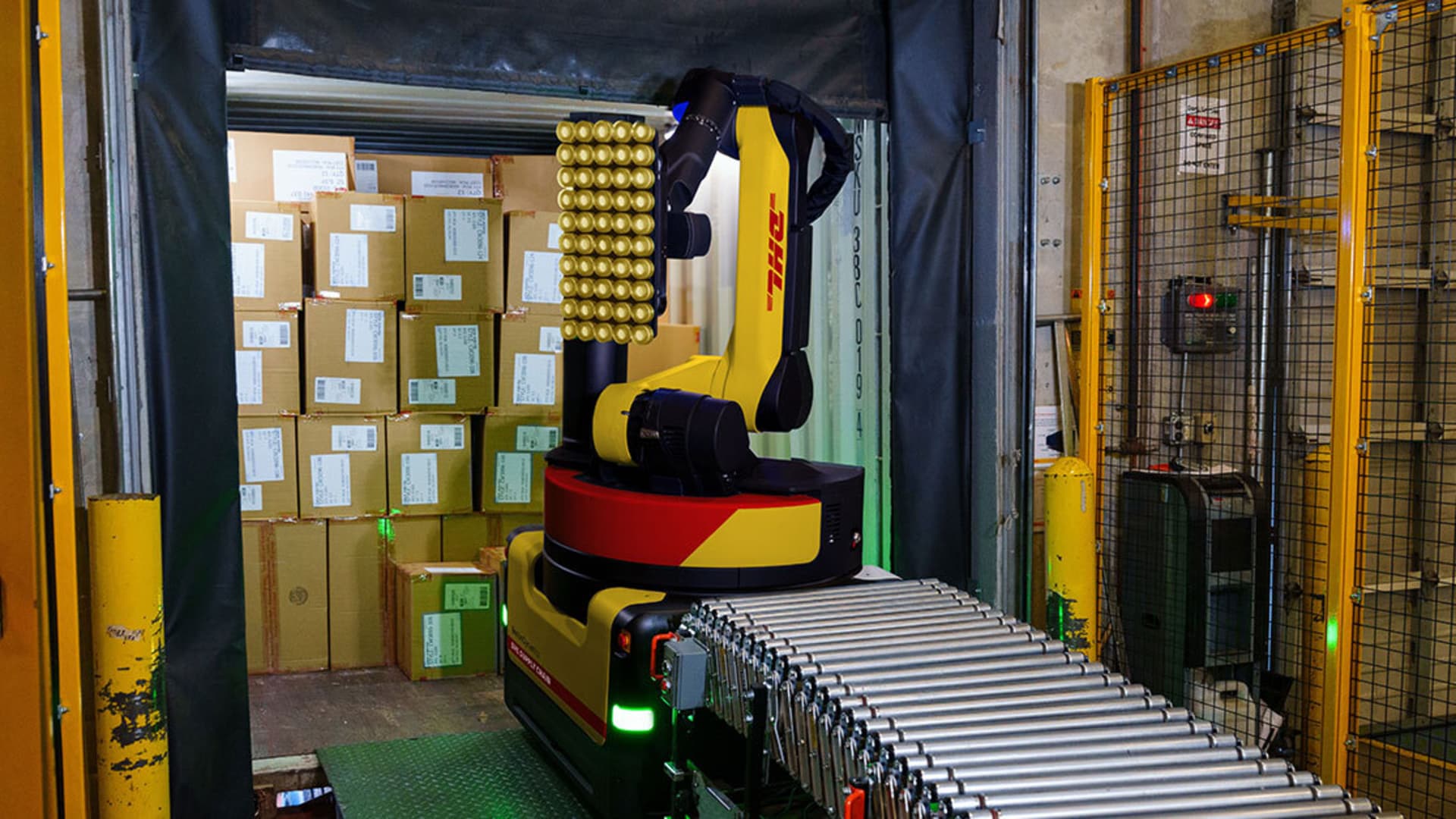
Now, their distance and efforts are greatly reduced by autonomous mobile robots that can unload containers for the package delivery and supply chain management company with a speed of up to 650 cases per hour.
“That is what we look forward to, and where we’ve been successful in deploying technology at scale over the last five years, going from when we started in 2020 with 240 projects, and now we’re up to 10,000 projects,” Tim Tetzlaff, DHL’s global head of digital transformation, told CNBC.
The company’s autonomous innovations have accelerated processes at 95% of DHL’s global warehouses. Item-picking robots in one warehouse have increased units picked per hour by 30%, while autonomous forklifts at that same warehouse have contributed a 20% increase in efficiency, the company said.
Tetzlaff said automation is important for the company because it’s such a labor-intensive business.
Advertisement
“We still have the ambition to grow our business even further, but if you look at where these distribution centers should be located … it’s typically very tough to find additional labor or even additional spaces just to build these warehouses there,” he said.
DHL is one of multiple fulfillment companies moving toward automation and leveraging artificial intelligence as the industry works toward greater efficiency.
On an earnings call with analysts in late January, United Parcel Service CEO Carol Tomé said the company deployed automation in 57 buildings in the fourth quarter, bringing its total to 127 automated buildings, with plans for 24 more in 2026.
“This year, we plan to further automate our network and as a result, we expect to increase the percentage of U.S. volume we process through automated facilities to 68% by the end of the year, up from 66.5% at the end of 2025,” she said.
Advertisement
Similarly, FedEx has said it sees automation as an opportunity to enhance its workers’ jobs, installing robotic arms to help process small packages at its Memphis hub and working with AI company Dexterity to leverage robots for loading boxes into containers. Its “Network 2.0” initiative is working to increase the efficiency of its package processes.
The company recently announced a partnership with Berkshire Grey to launch a fully autonomous robot to unload containers and optimize operations.
It estimates that the global warehouse automation market is expected to exceed $51 billion by 2030.
“We now have about 24% of our eligible average daily volume flowing through 355 Network 2.0-optimized facilities,” CEO Raj Subramaniam said on a call with analysts in December.
Advertisement
A human fleet
A worker unloads packages from a FedEx truck in San Francisco, California, US, on Wednesday, Dec. 17, 2025.
David Paul Morris | Bloomberg | Getty Images
With the rise of automation, companies are weighing the balance between their human workers and their technological innovations.
The company also said it closed 93 buildings in 2025 and plans to shutter at least 24 buildings in the first half of 2026.
“What’s happening is you’re seeing a cascading effect of sites being closed that are legacy conventional facilities, a lot of labor required to run those facilities, to a much more nimble, quicker, automated, consolidated facility,” Executive Vice President Nando Cesarone said on the January call.
In a statement to CNBC, a UPS spokesperson said the company is focused on making jobs easier for its employees and that the AI and robotics take on repetitive tasks that “make us more efficient in other functions.”
FedEx did not respond to requests for comment on how the company is balancing its workforce and technology. Subramaniam said on the most recent earnings call that the Network 2.0 initiative has resulted in “structural cost reductions” but the company has not publicly disclosed job cut amounts.
Advertisement
Teamsters, the union representing workers from many of the major packaging companies, said it will remain focused on ensuring its team members have a voice at the table when it comes to technology.
“We never want to get in the way of technology and its development, but all of that, it must support workers, and it cannot work against them ever,” spokesperson Lena Melentijevic told CNBC. “It’s the workers who are the backbone of each one of these companies and who are essential to their success, and we are here to advocate for them and hold companies accountable.”
DHL’s Tetzlaff said the company wants its automation to complement human labor instead of replacing it altogether. Regardless of how much DHL’s technology improves, Tetzlaff said the dexterous tasks of packaging and shipping remain in the hands of the employees.
“In the time where we deployed 8,000 collaborative robotics into our operation worldwide, we still hired 40,000 people,” he said.
Advertisement
The biggest area where DHL has deployed its robotics is in item picking, with more than 2,500 robots using trained arms to select items for packages. This past holiday season, to keep up with the Black Friday and Christmas demand, the company added 30% capacity to its robotic fleet.
“There’s an advantage for us as a company, having a great human fleet of workers that is motivated and likes the job, but complementing this with a robotic fleet that we can scale up and down and have that flexible stability to deal with change, the peaks throughout the year, be it bigger changes like Covid, be it [customer] profile changes and so on,” he said.
The path forward for investment
DHL Autonomous Forklift at work.
Source: DHL
Advertisement
Still, it’s unlikely there will be a near future in which warehouses are full of humanoid robots, according to supply chain expert and Accenture logistics and fulfillment lead Benjamin Reich.
Humanoid robots have been gaining intense popularity as tech companies innovate human-like machines, with Nvidia CEO Jensen Huang saying he believes the innovation is fast moving. At the January CES trade show, Google announced a partnership with Boston Dynamics, the same company working with DHL, to augment the tech company’s new robot named Atlas.
But Reich said among his clients, he’s seeing that “humans are still in the lead.”
“We are also not seeing a replacement of jobs, but a shifting that you’re more looking for skill sets on the market to serve the gap between degree of automation, operational tasks as well as organizational,” Reich told CNBC.
Advertisement
The automation is angled toward specific jobs, he added, with robots taking over repetitive tasks and companies instead “redirecting” their hiring toward technical roles instead of eliminating job growth altogether.
Reich said the industry is seeing rising investments into automation, with the biggest gains coming not from replacing people, but through increasing the efficiency of the supply chain and warehouse execution processes.
There are also factors in the broader industry that are impacting the workforce, according to Ronny Horvath, the transportation and logistics lead at Accenture. There’s a shortage of skilled workers who have both the manual skills and the organizational skills needed for the sector, and there’s also competition among companies for warehouse personnel based on pay, benefits, lifestyle and more.
“So automation can also help, not replacing but augmenting that gap, that void, that has been left by just not getting the workers that you have today,” Horvath said. “And we see a lot of clients, they have an automation or robotic strategy … but they still have the plans to hire human workers as well.”
Advertisement
Horvath added that the industry is reaping the rewards of its new technology. He’s seen companies able to adjust to deliver on high demand, increase efficiency and work toward more automated processes to keep up with warehousing.
According to an Accenture study from March, 51% of factories globally expect to have fully automated warehouses by 2040, and 70% of transportation logistics executives treat autonomous supply chains as a top investment priority.
“There’s almost no autonomous structure existing at the moment,” Horvath said. “So most or some of these clients are starting from scratch, and this will take time until these investments are done and until they also reap the benefits out of it for all those areas.”
‘Fox Across America’ radio host Jimmy Failla says there’s not enough ‘shame’ depending on cell phones on ‘Kennedy.’
A Chick-fil-A restaurant is offering families free ice cream if they put away their phones for their entire meal.
Complex, an account on X covering culture, posted a photo Sunday showing a sign advertising that the Chick-fil-A Towson Place location has an incentive for families to be phone-free during meals.
Advertisement
“Introducing our Chick-fil-A® Cell Phone Coop Challenge,” the sign read.
Teens using their phones. (Matt Cardy / Getty Images)
“Ask a Team Member for a coop, place all phones in the coop, and enjoy your meal together,” the message continued. “After you finished let a Team Member know and everyone at the table will receive a Icedream® Cone as a reward.”
“Grab a coop and take the challenge,” it read.
Advertisement
The Chick-fil-A restaurant in Towson Place, Maryland, also advertised the challenge in a recent Facebook post, writing, “Take the Dine-in Cell Phone Coop Challenge at Chick-fil-A Towson Place. Ask a Team Member for a coop, place all phones in the coop, and enjoy your meal together without distractions. When your table finishes, let a Team Member know and everyone will receive an Icedream Cone as a reward. Are you up for the challenge?”
If families stay off their phones during their meal, they will receive an Icedream® Cone as a reward. ( Felix Hörhager/picture alliance via Getty Images)
A 2023 study found that 68% of households have a person using their phone during a meal with others. It also found that 65% of respondents do not like it, and 42% feel using phones during meals is rude.
Chick-fil-A did not immediately respond to a request for comment from Fox News Digital.
For more than a decade, Japanese home builders have been tiptoeing into the U.S. housing market with small, discreet acquisitions of private American construction companies. Their quiet era is over.
Japanese builders have announced or closed acquisitions of 23 U.S. single-family home builders since 2020, more than double the number from 2013 to 2019. That doesn’t include the multifamily developers and construction-supply companies they have also bought. By some estimates, Japanese builders are now set to own about 6% of the U.S. home-construction market.
The Trump administration proposed a regulation on Monday that is intended to open 401(k)s and similar retirement plans to private equity and private credit.
It is a victory for the Wall Street firms that have lobbied to get these higher-cost alternative investments into the $14.2 trillion 401(k) market. But it comes at an inopportune time for the industry, as investors pull money from some private-credit funds.
Payments firm to reorganise into four business units
Alistair Houghton Editor, Business Live and Anna Wise Press Association Business Reporter
15:52, 30 Mar 2026Updated 15:54, 30 Mar 2026
The PayPoint sign can be found across the UK(Image: Newcastle Chronicle)
Payment solutions provider PayPoint has revealed a restructuring plan aimed at cutting costs and attracting more customers to use its services in shops.
It will result in the company being restructured into four divisions, encompassing its network services, merchant services, digital payments and open banking, and its Love2shop brand.
Advertisement
PayPoint operates a retail network of over 30,000 convenience stores, offering community services such as cash withdrawals and deposits, ATMs, cash bill payments, energy top-ups and vouchers. It also runs Collect+ and Royal Mail Shops, enabling parcels to be collected and returned at thousands of local outlets.
The company has not disclosed cost-cutting targets or specified whether there will be any impact on its workforce, which numbered around 940 employees this time last year. However, it said the reorganisation will create cost savings and could potentially result in increased dividends for shareholders.
As part of the changes, PayPoint stated it is concentrating on boosting consumer footfall and enhancing sales from its services across retail partners. The overhaul will also entail a significant “reset” of the structure of its merchant services division, which collaborates with over 30,000 UK SMEs (small and medium-sized enterprises) to provide payment services in their shops.
Meanwhile, PayPoint plans to expand the Love2shop brand, which provides digital and physical gift cards. That division, based in Liverpool’s landmark 20 Chapel Street building, is set to bring in £53.2m in revenue this financial year.
Advertisement
The group said: “The reorganisation will enable an improved focus on new business growth and on maximising opportunities across Love2shop’s distribution channels. Continued investment in our technology platform, ongoing product enhancement and leveraging AI to improve marketing insight will strengthen our go-to-market strategy and support accelerated new business growth across Love2shop Business, the expansion of our prepaid savings proposition and growth of our consumer channels, including through our Incomm Payments partnership. There also remain significant opportunities to integrate Love2shop more efficiently across the wider PayPoint Group and client base.”
PayPoint acquired Love2Shop when it took over Merseyside Christmas vouchers firm Appreciate Group in an £83m deal in 2023. That business, formerly known as Park Group, was founded by former Everton FC and Tranmere Rovers owner Peter Johnson and was originally best known for its Christmas hamper savings scheme.
London-listed PayPoint anticipates reporting a record financial performance for the year ending in March, with results due to be published in June. It also forecasts returning over £90 million to shareholders through buybacks and dividends during the financial year.
Ineos has reported a sharp widening in losses to $593 million, as rising energy costs, supply chain disruption and geopolitical tensions weigh heavily on Sir Jim Ratcliffe’s petrochemicals empire.
The group, controlled by Jim Ratcliffe alongside co-owners Andy Currie and John Reece, has also suspended its dividend for a second consecutive year, underscoring the financial pressure facing the business.
Losses before tax increased significantly from $71.1 million the previous year, while revenues declined to €14.3 billion from €16.2 billion. The downturn reflects a challenging operating environment for the European chemicals sector, where demand has weakened and costs have risen sharply.
Ineos pointed directly to the escalation of tensions in the Middle East as a key risk factor, warning that disruption to global energy markets is already impacting operations.
The group highlighted Iran’s strategic position near the Strait of Hormuz, a critical shipping route for oil and liquefied natural gas, noting that any prolonged conflict could further destabilise supply chains and drive up commodity prices.
Advertisement
“Any escalation or expansion of hostilities could adversely affect global supply chains, commodity prices and macroeconomic conditions,” the company said in its annual report.
The surge in oil and gas prices has increased input costs across the petrochemicals industry, while also raising shipping expenses as companies adjust logistics routes to avoid high-risk areas.
The impact has been particularly acute in Europe, where Ineos has long warned of structural challenges including high energy prices, carbon taxes and competitive pressures from overseas producers.
Earnings before exceptional items in the region almost halved to €252.3 million in 2025, down from €470.2 million the previous year. Revenues in the European business fell by 9.2 per cent, reflecting weaker demand and margin compression.
Advertisement
Ratcliffe has previously described the European chemicals industry as facing “challenging market conditions”, with rising regulatory costs and energy prices eroding competitiveness.
The group has also been hit by logistical challenges linked to global shipping disruptions. In previous years, Ineos was forced to reroute shipments for its major Project One chemicals plant in Belgium around the Cape of Good Hope, adding more than €30 million in costs.
The company warned that similar disruptions could occur again if tensions escalate, potentially delaying the completion of key projects and further increasing expenses.
It also flagged risks to the delivery timeline of a new plant in the Netherlands, citing ongoing volatility in energy markets.
Advertisement
Ineos ended the year with net debt of €11.7 billion, highlighting the scale of its financial commitments at a time of declining profitability.
The decision to halt dividend payments reflects a focus on preserving cash and maintaining financial flexibility as the company navigates an uncertain outlook.
The results underline the pressures facing energy-intensive industries in Europe, where companies are grappling with a combination of high input costs, regulatory burdens and geopolitical instability.
For petrochemical producers, the reliance on oil and gas as both feedstock and energy source makes them particularly sensitive to price fluctuations.
Advertisement
Looking ahead, Ineos warned that continued volatility in energy markets could have a “significant” impact on its operations and financial performance.
The trajectory of the Middle East conflict will be a key factor, with prolonged disruption likely to exacerbate cost pressures and delay investment projects.
For Ratcliffe’s group, the challenge will be balancing investment in long-term growth with the need to manage short-term financial strain — a task made more complex by the increasingly uncertain global economic environment.
Amy Ingham
Amy is a newly qualified journalist specialising in business journalism at Business Matters with responsibility for news content for what is now the UK’s largest print and online source of current business news.
Stone Fox Capital is an RIA from Oklahoma. Mark Holder is a CPA with degrees in Accounting and Finance. He is also Series 65 licensed and has 30 years of investing experience, including 15 years as a portfolio manager. Mark leads the investing group Out Fox The Street where he shares stock picks and deep research to help readers uncover potential multibaggers while managing portfolio risk via diversification. Features include various model portfolios, stock picks with identifiable catalysts, daily updates, real-time alerts, and access to community chat and direct chat with Mark for questions. Learn more.
Analyst’s Disclosure: I/we have no stock, option or similar derivative position in any of the companies mentioned, but may initiate a beneficial Long position through a purchase of the stock, or the purchase of call options or similar derivatives in UPST over the next 72 hours. I wrote this article myself, and it expresses my own opinions. I am not receiving compensation for it (other than from Seeking Alpha). I have no business relationship with any company whose stock is mentioned in this article.
The information contained herein is for informational purposes only. Nothing in this article should be taken as a solicitation to purchase or sell securities. Before buying or selling any stock, you should do your own research and reach your own conclusion or consult a financial advisor. Investing includes risks, including loss of principal.
Advertisement
Seeking Alpha’s Disclosure: Past performance is no guarantee of future results. No recommendation or advice is being given as to whether any investment is suitable for a particular investor. Any views or opinions expressed above may not reflect those of Seeking Alpha as a whole. Seeking Alpha is not a licensed securities dealer, broker or US investment adviser or investment bank. Our analysts are third party authors that include both professional investors and individual investors who may not be licensed or certified by any institute or regulatory body.























































You must be logged in to post a comment Login