

Crypto World
SBI bets $76M on EDX as institutional crypto race heats up



EDX Markets closed a $76 million Series C funding round led by Japan’s SBI Holdings. The Chicago-based company announced the deal on July 7, 2026. EDX said it will use the capital to expand trading, clearing, and settlement services. It also plans to speed up product development and grow its operations outside the United States.
Summary
- SBI led EDX Markets’ $76 million round to expand institutional crypto trading and clearing worldwide.
- EDX will fund product growth, global expansion, settlement services, and its planned national trust bank.
- Ripple Prime integration gives institutions unified access to EDX spot markets and perpetual futures liquidity.
SBI acted as the sole investor in the equity round, according to EDX chief executive Tony Acuña-Rohter. The company did not disclose its valuation or other deal terms. Earlier backers include Charles Schwab, Citadel Securities, Fidelity Investments, Sequoia Capital, Paradigm, and other market firms. This marks the first funding round whose size EDX has publicly disclosed. Acuña-Rohter said EDX was “pleased to welcome SBI as a strategic partner.”
Funding supports institutional crypto infrastructure
EDX runs an institutional-only crypto marketplace and a central clearinghouse. Its U.S. venue offers spot trading, while EDXM International provides perpetual futures to eligible non-U.S. institutions. The company follows a market structure used by traditional exchanges. It separates trading from some clearing and custody functions to reduce conflicts between service providers.
The new funding will support infrastructure for banks, trading firms, and other professional clients. EDX plans to improve its clearing process, settlement systems, and risk controls. The company also aims to add products as more institutions seek regulated access to crypto markets. SBI chairman Yoshitaka Kitao said “trusted market infrastructure will serve as a critical foundation for institutional adoption.” The SBI Holdings announcement described EDX as part of its wider digital asset strategy.
EDX expands products and seeks a trust bank charter
Earlier in 2026, EDX launched EDX FlowConnect, a crypto-as-a-service product. The service lets companies add digital asset trading for their customers without building a full exchange system. EDX provides tools for execution, liquidity access, clearing, settlement, and related market operations. The Series C capital will help the company expand this service and support more institutional clients.
EDX has also applied to the U.S. Office of the Comptroller of the Currency to form EDX Trust, National Association. The OCC listed the application as received on March 26, 2026. If approved, the national trust bank would provide custody, clearing, settlement, and risk management. It would operate alongside EDX’s trading venues as a separate regulated entity.
Crypto.news links funding to EDX’s wider expansion
A July 8 crypto.news report said the round follows EDX’s recent growth across spot trading, perpetual futures, clearing, and settlement. The report also linked the funding to EDX’s work with Ripple Prime. That integration gives institutional clients access to EDX spot liquidity and EDXM International perpetual futures through one prime brokerage system.
Ripple Prime announced the integration in May 2026. The companies also plan to use RLUSD for settlement and collateral on EDX. The arrangement has not placed XRP in the main settlement role. SBI’s own digital asset plans include the yen-based JPYSC and support for dollar stablecoins such as RLUSD and USDC in Japan.
The $76 million round gives EDX more capital as it targets large financial institutions. SBI gains a strategic position in a trading and clearing company built for professional clients. EDX will now focus on product delivery, international growth, its FlowConnect service, and the pending EDX Trust application.

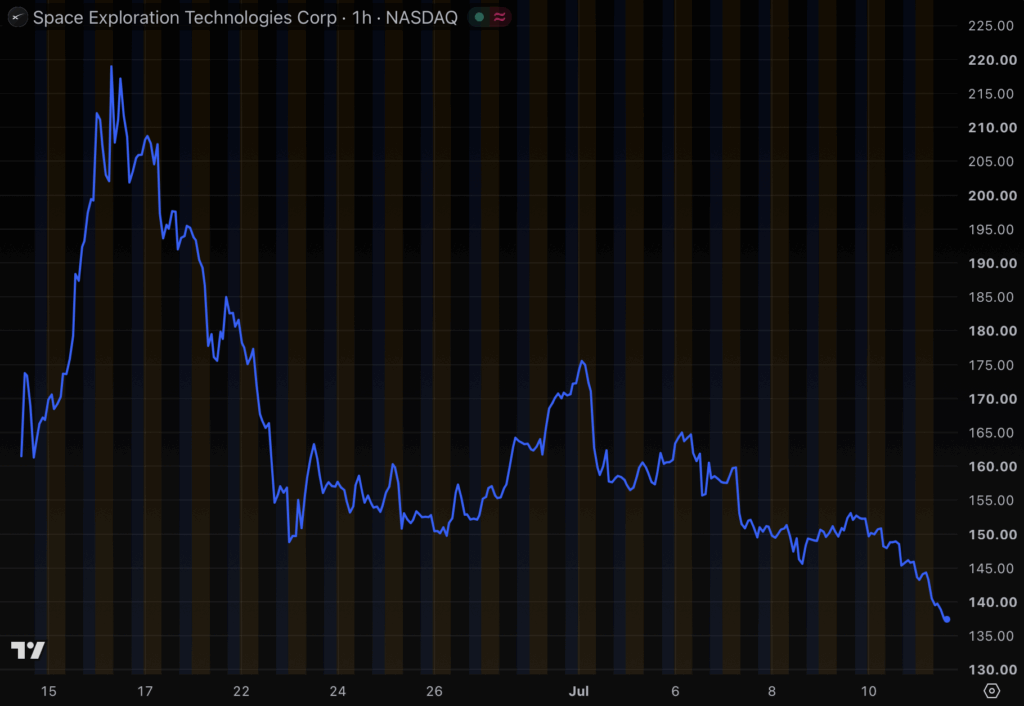
SpaceX slipped below $140 per share on Monday, wiping out $1 trillion from the peak market capitalization of Elon Musk’s IPO.
Since the manic peak three days into its life as a public company, SpaceX has declined from a market cap of $2.9 trillion to under $1.8 trillion today.
SpaceX priced the most expensive IPO in history at $135 per share on June 11, selling 555,555,555 shares to raise roughly $75 billion.
The stock opened at $150 the next morning and closed its first day at $160.95, a 19% gain over the offering price.
It kept going up for two more days but has crashed ever since.
$1 trillion vaporized
By June 16, its third day of trading, SpaceX closed at $201.80 and touched an intraday high of $225.64, a valuation of $2.95 trillion that briefly vaulted Musk’s company past Amazon, Microsoft, and other giants.
At time of writing, SpaceX has fallen to eighth place on the leaderboard of public companies.
Fueling SpaceX’s three-day run was excitement about futuristic plans to colonize Mars, acres of non-existent space data centers, and a $60 billion deal to buy AI coding startup Cursor — announced the same day the stock price peaked.
Back below $140 per share as of midday today, SpaceX now has a slightly more modest market capitalization near $1.8 trillion. Measured against its intraday peak on June 16, the company has lost $1.1 trillion in drawdown, a decline of roughly 38%.
To be fair, any insider who was able to buy at the IPO price of $135 is still about 3% in the green, although shares are 7% below its $150 debut open on public exchanges for ordinary investors.
Still, 7% is far more manageable than 38%. Those people, who waited until the third day to buy, are underwater at a concerning depth.
Read more: Hyperliquid SpaceX perp plummeted before Blue Origin explosion
Skeptical of SpaceX’s valuation
Michael Burry, skeptical investor of The Big Short fame, wrote that “nothing in that S-1 suggests it is worth $1 trillion let alone $2 trillion.” The filing showed 2025 revenue of $18.7 billion against a net loss of $4.9 billion.
In the end, Burry explored a short sale of SpaceX yet ultimately walked away, concluding that borrowing fees and options premiums made betting against the stock too costly.
Morningstar, meanwhile, pegged fair value at $63 a share at the IPO, less than half the offering price and well under a third of the June peak.
Unfortunately, none of that skepticism prevented the initial exuberance, and none of it stopped the dramatic reversal.
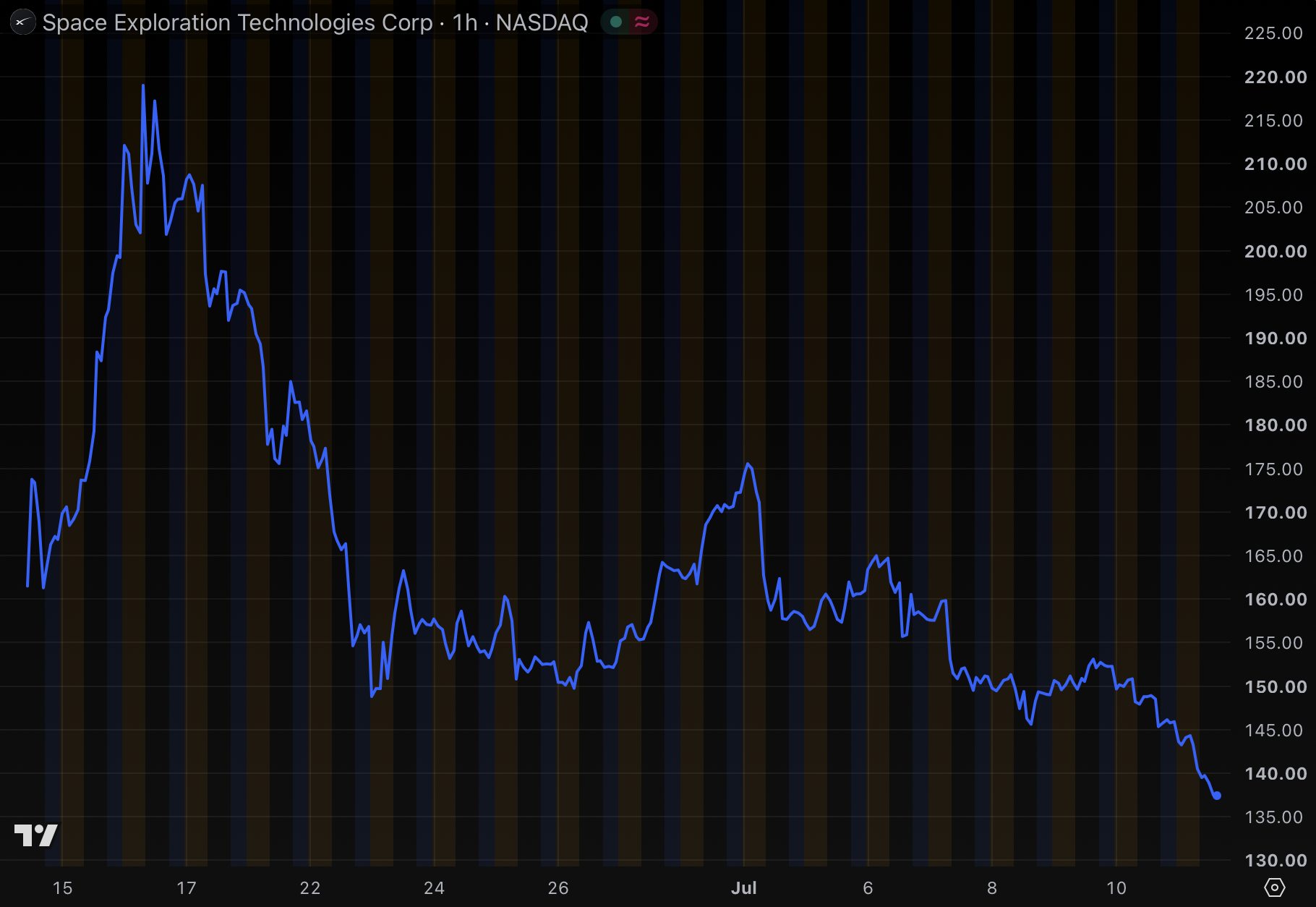
SpaceX fell 16% on June 22 to close at $154.60, its worst session since the debut. Its long-awaited addition to the Nasdaq 100 index on July 7, an event that hands a stock a wave of automatic passive buying, instead greeted it with a drop exceeding 6% as investors who had bought the rumor sold the news.
As usual, there are two sides to every story. Oppenheimer raised its target to $250, and other banks initiated coverage with targets ranging up to $300, including a $25 price target raise today from Jefferies.
Got a tip? Send us an email securely via Protos Leaks. For more informed news and investigations, follow us on X, Bluesky, and Google News, or subscribe to our YouTube channel.
Crypto World
BYDFi Participates in Peru Blockchain Conference 2026, Engaging the LATAM Web3 Community
[PRESS RELEASE – VICTORIA, Seychelles, July 13th, 2026]
Global crypto trading platform BYDFi participated in the Peru Blockchain Conference 2026, held July 10-11 at JW Marriott Larcomar in Miraflores, Lima. Now in its 5th edition, the event was positioned as one of Peru’s largest blockchain, crypto, and trading gatherings, bringing together industry participants across digital assets, Web3, trading, fintech, AI, regulation, and financial education.
Peru Blockchain Conference 2026: A Key Gathering for Web3 and Trading in LATAM
Peru Blockchain Conference 2026 convened a broad mix of industry participants from across Latin America and the global digital asset ecosystem.Organizers highlighted official event scale figures of more than 4,000 attendees, 100+ speakers, and 50+ sponsors, with the event designed around conference programming, exhibition activity, networking, and direct engagement between companies, builders, traders, investors, and communities.
The program covered a wide range of themes, including Crypto & Digital Assets, Blockchain & Web3, Trading and Financial Markets, Artificial Intelligence, Fintechs and Startups, Regulatory Framework Peru & LATAM, Asset Management, and Financial Education. For BYDFi, the agenda offered a clear view of the conversations shaping user expectations around access, usability, trust, and long-term participation in digital finance.
BYDFi Connects with Attendees in Lima
At the venue, BYDFi’s booth drew steady foot traffic from attendees throughout Peru Blockchain Conference 2026. Visitors gathered around the booth to meet the BYDFi team, learn more about BYDFi’s trading experience, and take part in on-site interactions. BYDFi also distributed football-themed T-shirts and caps inspired by BYDFi’s Newcastle United partnership, which drew visible interest from visitors and added to the booth’s on-site activity.
The booth served as a practical meeting point for traders, builders, partners, and users to discuss market access, trading tools, user experience, and the growing connection between crypto and broader financial markets. BYDFi also shared perspectives across digital asset trading and TradFi trading access, reflecting user interest in more flexible ways to participate across market environments.

Advancing Trust Through Education and Participation
Peru Blockchain Conference 2026 brought financial education, regulation, trading, digital assets, and Web3 adoption into one setting. For BYDFi, that context reinforces how important it is for trading platforms to support users with practical access, steady execution, and standards they can rely on over time. This aligns with BYDFi’s annual theme, Built for Reliability: building trading experiences that remain useful, stable, and trusted as digital finance reaches more communities.
Michael Hung, Co-Founder & CEO of BYDFi, said: “Peru Blockchain Conference brought together important discussions around education, access, regulation, and real user participation. For BYDFi, the priority is to listen closely, build responsibly, and keep improving a trading experience users can trust over time.”
About BYDFi
Founded in 2020, BYDFi now serves over 1,000,000 users across 190+ countries and regions. BYDFi is Newcastle United’s Exclusive Official Crypto Exchange Partner and is listed by Forbes Advisor Canada among the best crypto exchanges in Canada for 2026.
BYDFi is dedicated to delivering a world-class crypto trading experience for every user.
BUIDL Your Dream Finance.
- Website: https://www.bydfi.com
- Support email: cs@bydfi.com
- Business partnerships: bd@bydfi.com
- Media inquiries: media@bydfi.com
X (Twitter) | Instagram | Telegram | YouTube | TikTok | How to Buy on BYDFi
The post BYDFi Participates in Peru Blockchain Conference 2026, Engaging the LATAM Web3 Community appeared first on CryptoPotato.
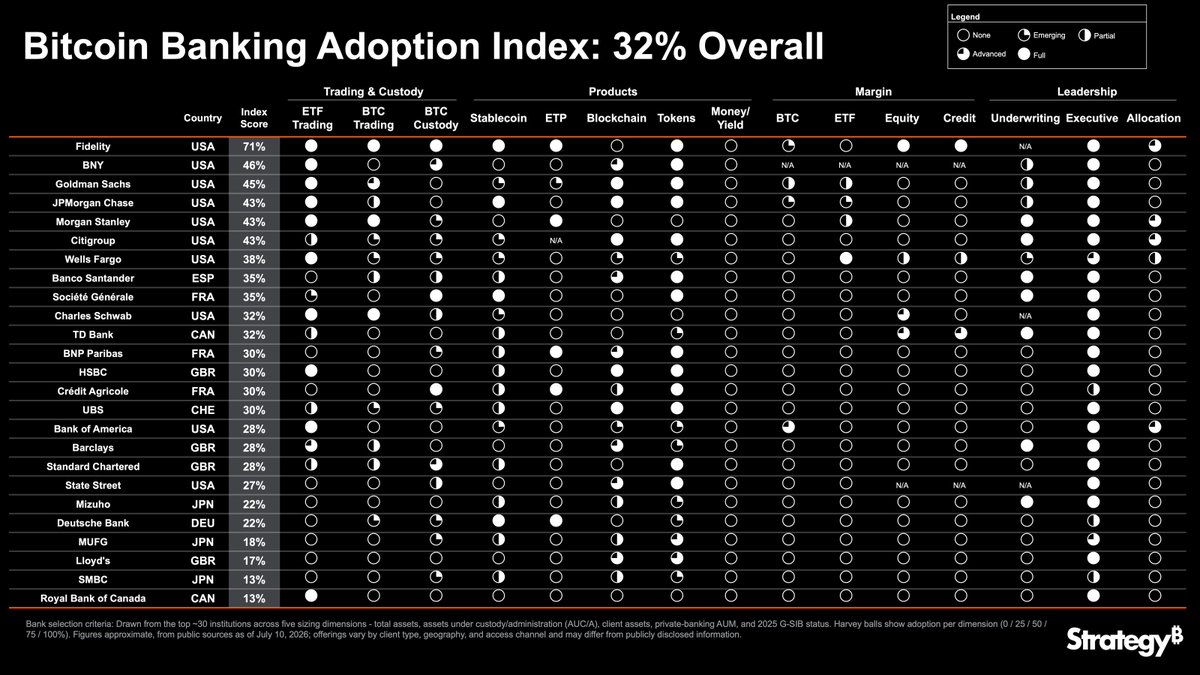
MicroStrategy, rebranded Strategy, has unveiled a Bitcoin Banking Adoption Index scoring how far big banks embrace Bitcoin (BTC). It puts overall institutional adoption at 32%.
The index ranks 25 major banks by how deeply they offer Bitcoin services. Fidelity leads at 71%, far ahead of most European and Japanese lenders, which sit below 30%.

What the Bitcoin Banking Adoption Index measures
The index works like a report card for banks. MicroStrategy scores how much of the Bitcoin economy each firm has built in, then combines those marks into one percentage. For most readers, this measures how close everyday banking now sits to Bitcoin.
Strategy grades four areas. They cover:
- Trading and custody
- Products such as spot Bitcoin ETFs and the stablecoin market
- Lending, and
- Executive support.
Follow us on X to get the latest news as it happens
Many of those products are new, since US regulators approved the first spot Bitcoin ETFs only in January 2024.
A 32% overall score means banks have taken on about a third of what MicroStrategy tracks. The score blends many services, so a firm can rank high on custody yet low on lending.
“Major-bank Bitcoin adoption is accelerating, but still early: 32% overall as measured by the index,” noted Strategy executive chair, Michael Saylor.
The company drew the numbers from public data as of July 10 and calls them approximate.
Fidelity Leads while Japanese Banks Lag
Fidelity’s lead is no accident. It set up Fidelity Digital Assets, an institutional custody and trading arm, in 2018. The firm now issues a spot Bitcoin ETF too.
Other American firms cluster behind it. BNY scores 46%, Goldman Sachs 45%, while JPMorgan, Morgan Stanley, and Citigroup each land near 43%.
The gap widens by geography. European lenders such as Banco Santander and Société Générale sit mid-table near 35%. Japan’s SMBC and the Royal Bank of Canada trail at just 13%.
Strategy has a stake in the story it is telling. The company holds 843,775 Bitcoin, the world’s largest corporate Bitcoin treasury, so wider adoption supports its core bet. It published the index itself, invited corrections, and stressed the data is approximate.
Strategy said methodology details and updates will follow. Whether banks accept or contest their scores will test how seriously Wall Street treats the ranking.

Bitcoin’s current price sat near $61,900, down more than 3% on the day. Saylor’s longer-term outlook still bets on far deeper adoption from the banks ranked here.
The post MicroStrategy Unveils Bitcoin Banking Index as Institutional Adoption Reaches 32% appeared first on BeInCrypto.

South Korea’s KOSPI index fell 8.95% on July 13 after an intraday circuit breaker was triggered, with chipmaker SK Hynix dropping more than 15%.
The market shock has raised concerns that a wider risk-off move could spread into US equities and crypto assets already facing pressure from geopolitical tensions and weaker sentiment.
KOSPI Crash Sends Risk Signals Across Global Markets
Market data shows that the KOSPI closed at 6,806.93 on Monday after its circuit breaker was activated during trading. In that same session, SK Hynix fell 15.37% to KRW 1.845 million, leaving the stock about 38% below the record high it hit just a couple of weeks ago on June 25.
Hupzy from Spot On Chain described the move as a panic-driven selloff and noted that circuit breakers are uncommon outside periods of severe market stress. The analyst also linked the drop in SK Hynix to a rapid reversal in the artificial intelligence (AI) and semiconductor trade, warning that weakness in those sectors could affect crypto assets connected to AI narratives.
Recall that even before the selloff, the markets were already dealing with broader uncertainty, with more than $1.5 trillion erased across assets in 10 hours, including Bitcoin (BTC), gold, and silver, as well as other major Asian stock indexes. At the time of writing, BTC had slipped below $63,000, having recovered from an early July drop below $58,000 and briefly going past $64,000 before it lost ground again.
Analyst Ash Crypto blamed the losses on new hostilities between the US and Iran, a possible Bank of Japan yen intervention, and rising bond yields, with Hupzy stating that the sort of shock caused by the KOSPI plunge could push BTC through support if US equities get dragged down by their Asian counterparts.
“For BTC: broadening equity panic puts downside pressure on crypto risk assets,” they wrote on X. “If US markets follow Asia lower, expect crypto selling to intensify. The KOSPI crash is the kind of cross-asset shock that can break correlations and drag BTC below support.”
However, another market watcher, Michaël van de Poppe, posted that Bitcoin’s price action was “holding up well” despite the pressure, saying it had tested the $65,000 area while maintaining support around $61,000. Fellow analyst Ted Pillows warned that the OG crypto needed to hold the $62,500 zone after repeated failures near the $64,500 to $65,000 resistance level, or it could drop below $61,000.
Why the Cash on the Sidelines Might Not Show Up
The KOSPI decline has added to concerns about how much support global markets have if selling pressure continues. Hedgie Markets shared data showing that US cash holdings, including money market funds and bank deposits, had fallen to just 0.42 of the S&P 500’s market cap, near the lowest level ever recorded and close to where it sat before the dot-com crash.
The account also noted that while money market funds hold a record $7.95 trillion, the S&P 500 had grown to roughly $69 trillion, so the dry powder looks smaller against the market it needs to cushion.
The post South Korea Stock Crash Could Drag Bitcoin Below Key Support: Analyst appeared first on CryptoPotato.

Bolivia is evaluating integrating Tether’s USDt into its national payments system, a move that could mark one of Latin America’s most significant stablecoin adoption initiatives as the country grapples with a persistent shortage of US dollars.
Economy and Public Finance Minister Jose Gabriel Espinoza told a press conference on Monday that the government is assessing a regulatory framework that would allow USDT to circulate “as just another currency,” alongside the boliviano and the US dollar.
According to the Spanish news outlet CriptoNoticias, the framework is still under review and, if adopted, would recognize USDT for everyday transactions, including payments, savings and trade, without relying exclusively on cash or the traditional banking system.
Espinoza said any rollout would require a robust regulatory framework and strong anti-money laundering safeguards because Bolivia remains on the Financial Action Task Force (FATF) grey list, which identifies jurisdictions under increased monitoring for deficiencies in preventing money laundering and terrorist financing.

Source: EL DEBER
The proposal is part of Bolivia’s broader embrace of digital assets following the lifting of its longstanding ban on cryptocurrencies in 2024. Since taking office in late 2025, President Rodrigo Paz Pereira’s administration has pledged to integrate digital assets into the formal financial system, paving the way for banks to offer crypto-related products and services, including stablecoin-based accounts.
USDT is the world’s largest stablecoin, with a market capitalization exceeding $184 billion, according to CoinMarketCap.
Related: USDT wins payments, USDC wins DeFi as stablecoins diverge: Dune
Dollar shortage fuels stablecoin push
Bolivia’s stablecoin initiative comes as the country grapples with a prolonged shortage of US dollars, which are widely used alongside the national currency, the boliviano.
As Reuters reported, Bolivia maintained an official exchange rate of 6.86 bolivianos per US dollar for purchases and 6.96 for sales from 2011 until earlier this year, when mounting pressure on foreign exchange reserves forced the government to abandon the long-standing peg. The resulting dollar shortage fueled the expansion of a parallel foreign exchange market, where the dollar traded at a steep premium to the official rate.
The widening gap between the official and parallel exchange rates has boosted demand for dollar-denominated alternatives, including stablecoins such as USDT, which have increasingly been used for payments.
Bolivia ranked highly in Chainalysis’ 2025 evaluation of crypto adoption across Latin America, with $14.8 billion in total transaction volume over a 12-month period.
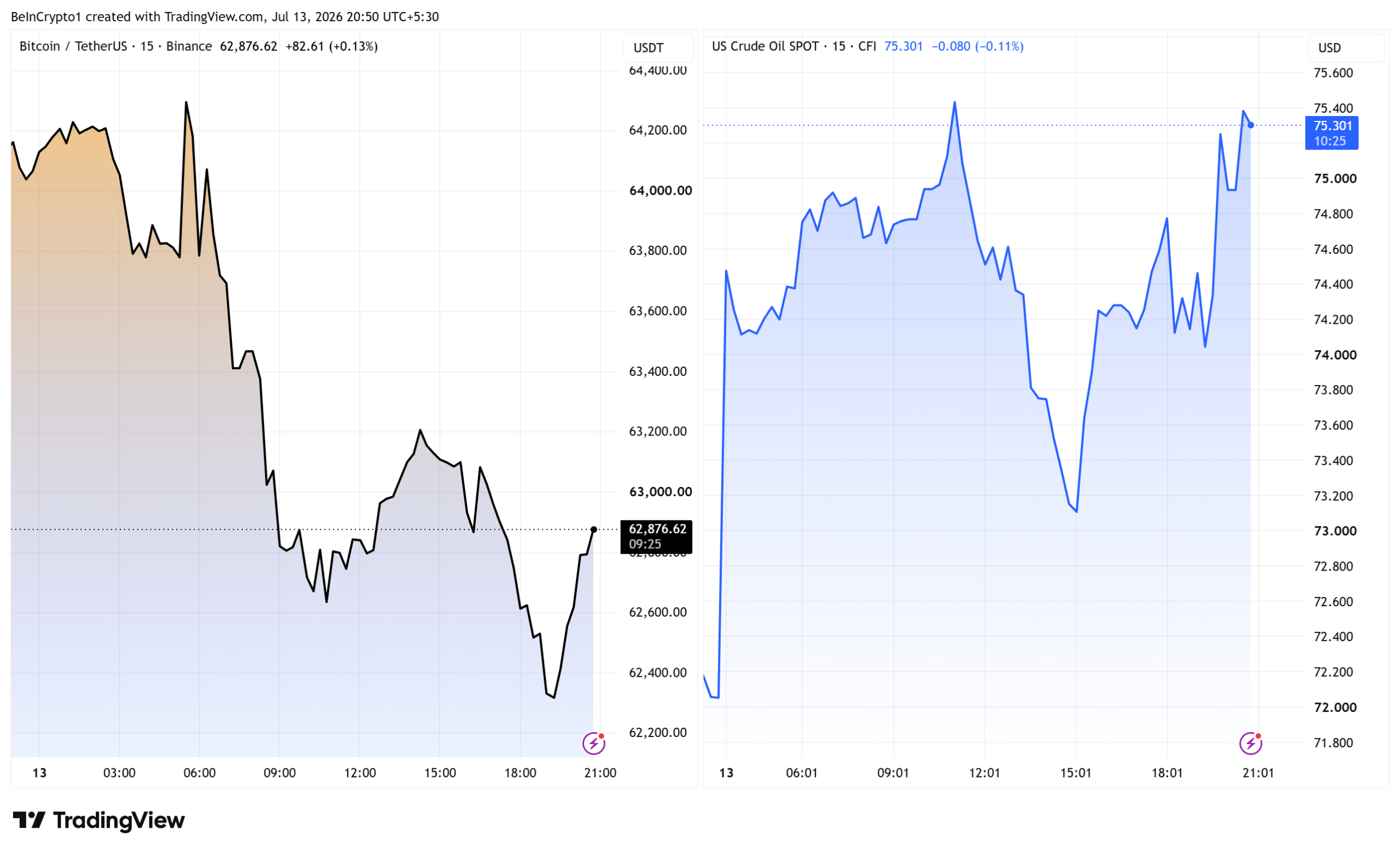
Bitcoin (BTC) slipped toward $62,600 on Monday while oil jumped about 4%, after the United States and Iran traded strikes over the Strait of Hormuz and President Donald Trump said Washington would take control of the waterway.
Oil climbed on supply fears while Bitcoin sold off as a risk asset. US crude reached $75.24 and Brent topped $79. Traders feared a longer disruption to a critical oil chokepoint.

Bitcoin Slips as Oil Climbs on Hormuz Plan
Bitcoin fell from a session high above $64,000 to around $62,565 on Monday. Oil ran the other way, rising about 4% as the US and Iran exchanged missile and drone attacks. Traders watched Bitcoin’s latest price swings against the oil bid all day.
The strait is why a threat there moves markets. About 20 million barrels of oil cross it daily, roughly a fifth of global consumption, the EIA says. That is close to a quarter of all seaborne oil.
Shipping is already thinning. Just six vessels crossed the strait in one recent 12-hour window. That is down from 18 to 22 a day earlier this month, tracking data showed.
Bitcoin has traded like a risk asset throughout. It slid again after Trump ended a fragile truce with Iran last week, the same move that lifted oil.
Trump Wants 20% on Cargo Through Hormuz
On Truth Social, Trump said the US would guard the strait and be repaid for the cost. He proposed a 20% fee on all cargo shipped through it. He later said Washington would probably run it.
“The Hormuz Strait is OPEN, and will remain OPEN, with or without Iran… The U.S.A. will be, from this point forward, known as “THE GUARDIAN OF THE HORMUZ STRAIT”… reimbursed, at the rate of 20% on all cargo shipped…” Trump wrote on Truth Social.
Follow us on X to get the latest news as it happens
Iran rejected any US role. Its top military command said it would resist any attempt to route traffic without Tehran’s coordination. Iran calls the waterway closed, while Western navies insist it stays open.
The fee would break with how the US has long patrolled the strait for free. It also inverts a June truce that had barred Iran from charging ships.
Higher transit costs could feed inflation. That backdrop kept Bitcoin near $60,000 for weeks, while calmer Iran signals had recently pulled bond yields lower.
Dubai Builds for a Future Beyond Hormuz
The bigger story sits east of the strait. Dubai’s DP World is in talks to build a container port at Fujairah, a report said. It would sit on the Gulf of Oman, outside the chokepoint.
That marks a shift for Dubai. Its flagship Jebel Ali is the region’s largest port. Yet it sits inside the Gulf and depends on Hormuz for access.
The UAE now wants to cut its reliance on the strait to zero. It is expanding east coast ports at Fujairah, Khor Fakkan and Dibba, all on the Gulf of Oman.
“We’re moving towards having zero Hormuz dependency and that’s regardless of whether it’s open or not,” said Thani Al Zeyoudi, UAE minister of foreign trade.
The buildout is underway. Gulftainer is spending $2 billion to expand Khor Fakkan to 10 million containers a year, nearly triple its current size. That terminal alone could handle most UAE cargo if Hormuz shut.
The energy side is moving too. The UAE has piped crude around Hormuz since 2012. A second line will roughly double that bypass capacity by 2027.
The moves suggest businesses expect Hormuz to stay a flashpoint, whoever secures it. A Fujairah route would also sidestep any US transit fee, not just Iranian threats. Over time, that could chip away at the strait’s leverage over global trade.
For crypto, the signal is simple. As long as Hormuz can move oil, it can move Bitcoin. Risk assets stayed jumpy on Monday, and traders now watch the strait as closely as any chart.
The post Bitcoin and Oil Respond to Trump’s US Hormuz Control Plan, But Dubai Mulls a Bypass appeared first on BeInCrypto.
The meme coin remains stuck in a heavy downtrend caused by the prolonged bear market and other negative factors.
Despite the grim conditions, Shiba Inu’s holders base continues to rise, recently reaching a new all-time high.
The New Record
The total number of SHIB wallets has been rising slowly recently, but at the beginning of the month there was a sharp jump. According to the X account BSCN, the meme coin saw an explosive jump of almost 75,000 new holders between July 5 and July 6 – far above its typical daily growth.
It remains unclear why the figure soared so sharply, as some speculate there might have been a technical glitch. In any case, the total number currently stands at 1,676,535, which is a new all-time high.
The growing figure contrasts with the plummeting price of Shiba Inu. As of this writing, it trades at around $0.0000042, reflecting a 15% plunge on a monthly scale and a staggering 95% crash from the historic peak witnessed in 2021.

SHIB remains the second-largest meme coin, but only thanks to the double-digit collapse MemeCore (M) recently experienced. The market capitalization of the self-proclaimed Dogecoin killer has tumbled below $2.5 billion, making it the 36th-biggest cryptocurrency.
Further Slump Incoming?
The rising number of SHIB wallets is perhaps the only real glimmer of optimism for Shiba Inu lately. Its burning mechanism, which saw a major resurgence last week, has once again slowed, while Shibarium’s activity has fallen to near-idle levels.
The layer-2 scaling solution, designed to enhance Shiba Inu’s ecosystem by boosting speed, lowering transaction fees, and improving scalability, initially processed millions of transactions on a daily basis. Over the past months (especially after Shibarium’s exploit last year), those have tumbled to mere thousands and hundreds.

These negative factors, combined with the fading interest in the meme coin, suggest that bulls might have to suffer more pain in the near future. According to BSCN, SHIB’s daily trading volume was close to $700 million a year ago, but today (July 13) it is struggling to reach $50 million.
The sentiment among analysts and industry participants is also particularly negative. Recently, popular trader James Wynn described SHIB as “old, dead, and boring,” suggesting it may not recover for another 5-10 years until nostalgia potentially brings it back.
The post Key Shiba Inu Metric Reaches a New ATH, Yet SHIB’s Price Keeps Sliding: Details appeared first on CryptoPotato.
Michael Saylor spent Monday morning boasting about a bigger pile of cash to support dividends, yet the dividend-paying shares of STRC he intended to reassure barely budged.
The problem seems to be confidence, not cash.
Strategy (formerly MicroStrategy), the largest publicly-traded holder of BTC, diluted its common stockholders last week to increase its dollar stockpile by $450 million.
Now holding $3 billion, MSTR shareholders paid for 17% more cash than the $2.55 billion balance it last disclosed as of July 5.
More cash should mean more comfort. However, investors in STRC, the dividend-yielding preferred stock that requires cash for semi-monthly payouts, don’t seem to agree.
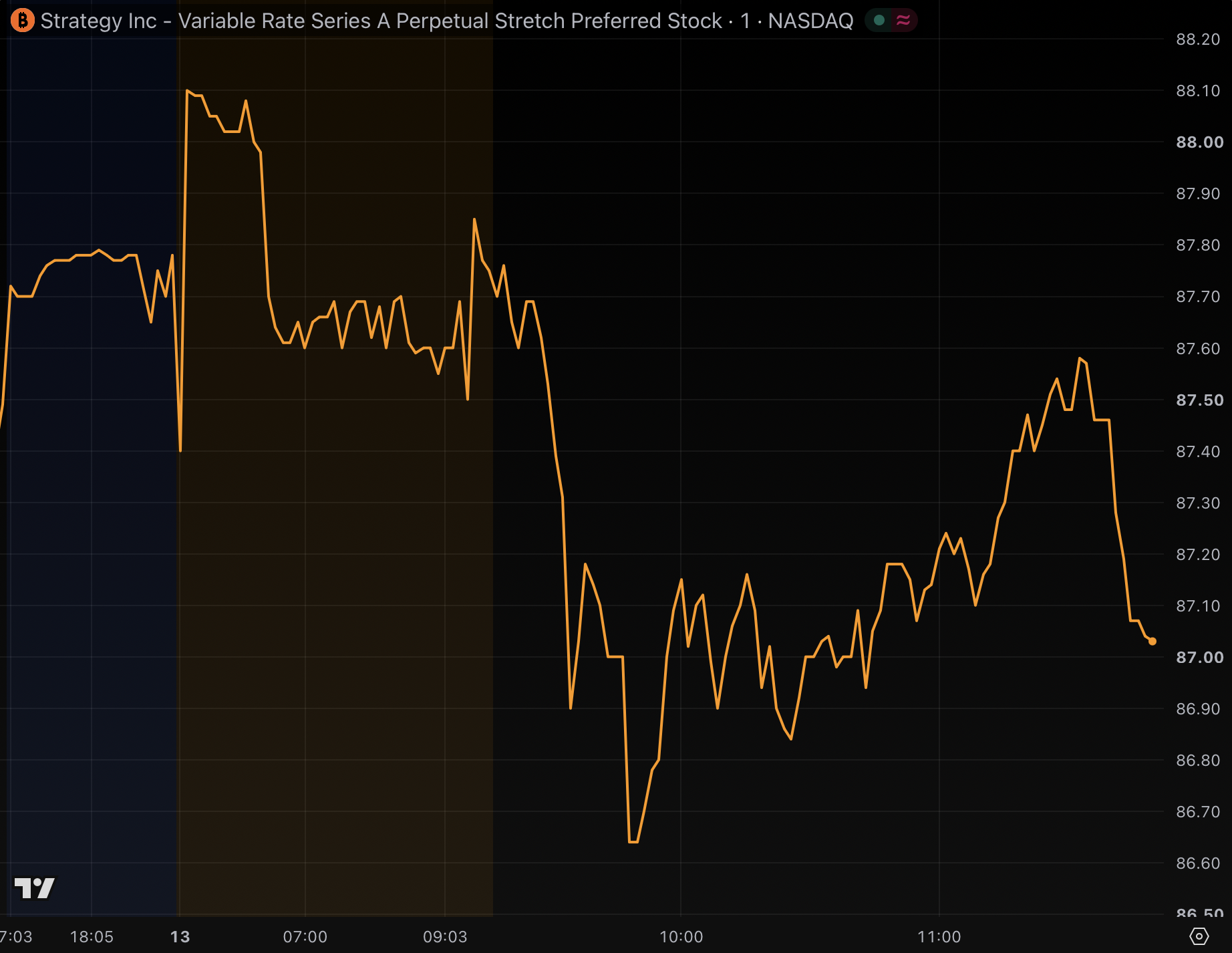
By this morning, STRC had actually dropped to $86.60, a decline of 1% versus Friday’s closing price.
Even though Strategy’s larger cash reserve should pay for more months of STRC dividends — the kind of news that should boost confidence in any other security — it didn’t boost STRC.
There seems to be another problem at Strategy that cash can’t solve.
The market shrugged
Strategy was supposed to keep the price of STRC boring. Instead, its wild fluctuations are generating daily headlines.
The company adjusts the dividend regularly with a stated objective to keep the stock trading between $99 and $100. It hasn’t.
When the price sags, Strategy raises dividend payouts to lure buyers back toward its $100 par. When the price is higher, Strategy sells shares to cap the price.
Unfortunately, STRC has actually declined in value since its dividend rate has climbed from 9% at launch to 12% currently.
Moreover, even with 20 months of cash providing so-called “dividend coverage” and a yield far richer than most junk bonds, STRC was trading 13% below par today.
The price of STRC is actually lower today than before Strategy increased its cash by 17%.
So, what gives?
The mechanism driving the price of STRC lower is far simpler than the quantity of cash or the mathematics of Strategy’s dilution or leverage ratios.
The problem appears to be confidence. Without a rally in BTC to boost the value of Strategy’s massive treasury, investors have only one reason to bid up STRC back to par: Belief in management’s resolve to fund long-term dividends.
Sadly, there are plenty of reasons to doubt their resolve.
A preferred share is a promise to pay dividends, honor terms, and perform what the prospectus says. In addition, investors base their decisions on guidance and forward-looking statements from management.
Investors aren’t discounting STRC because they doubt the existence of $3 billion in cash or the mathematics of how many months that quantity could service in dividend payouts. They’re discounting the man making the promises about those payouts.
Read more: Strategy’s STRC hit another all-time low today
Michael Saylor’s shifting promises
Strategy founder Saylor has a long record of forecasts he later abandoned. Each reversal teaches the market to price his assurances below face value.
For example, last summer, Strategy told investors it wouldn’t issue new MSTR shares below 2.5 times its BTC multiple-to-net asset value (mNAV), except to pay interest and preferred dividends.
Days later, it quietly rewrote that promise, adding a third exception for whenever it deemed issuances advantageous. It then sold hundreds of millions of dollars of stock below 2.5x mNAV anyway.
Consider another, egregious example.
For years, Saylor preached about never selling BTC, a mantra Protos has catalogued across his interviews and posts.
However, over late June and early July, Strategy sold 3,588 BTC and authorized over $1 billion in additional sales. The examples continue.
Saylor spent early 2026 assuring markets that debt, not BTC sales, would carry the company through any BTC bear market.
He told CNBC the company would simply refinance and extend its obligations during a BTC bear market. A few months later, he wasn’t refinancing but instead selling BTC to fund dividend payments.
Saylor has also slashed his own earnings forecast, which makes trusting his future forecasts difficult. In December, Strategy cut its fiscal year 2025 earnings per share guidance from a target of $80 per share to a revised range to less than $19.
That erased hopes of more than 76% of the profit it had projected.
Read more: Strategy’s ‘stable’ STRC spends a lot of time below its $100 target
Despite promises, STRC is nothing like a bank account
Saylor has also likened STRC to a high-yield bank account or money market.
Nevertheless, STRC sank to an all-time low of $71.25 in June, losing many savers one-third of their savings, unlike any insured bank account or money market.
After Saylor’s guidance about STRC’s $100 stability confronted the reality of $71.25 and everybody had lost money, it became difficult to maintain confidence in his ability to forecast future stability for STRC.
STRC isn’t any kind of bank account or money market, isn’t backed by segregated BTC, and carries no ordinary redemption right. In order for investors to sell STRC for $100, they must find other traders who are willing to buy it from them at $100.
Strategy won’t be bidding.
The pattern of shifting promises is older than Strategy’s BTC era. In 2000, the SEC charged Saylor and two other executives.
The company had allegedly inflated its reported sales and profit in breach of accounting rules. Saylor paid more than $8 million to settle that civil action.
Decades later, the market re-learning to be wary of the same man. Strategy just added 17% more cash to a reserve meant to keep STRC pinned at $100. Despite this, STRC failed to rally, staying 13% below par this morning and actually declining relative to Friday.
Got a tip? Send us an email securely via Protos Leaks. For more informed news and investigations, follow us on X, Bluesky, and Google News, or subscribe to our YouTube channel.
Hyundai Motor’s U.S. and Mexican operations have completed a pilot cross-border treasury payment using Tether’s USDT stablecoin, settling a $20,000 transfer in about seven minutes over the Avalanche blockchain.
Summary
- Hyundai completed a $20,000 USDT treasury transfer between the U.S. and Mexico in about seven minutes.
- The Avalanche-based pilot tested stablecoin settlement without changing existing treasury compliance and accounting processes.
- Tether continues expanding its enterprise strategy through corporate pilots and recent investments in blockchain infrastructure.
According to Tether, the proof-of-concept involved Hyundai Motor America converting U.S. dollars into USDT before sending the stablecoin to Hyundai Motor Mexico, where it was converted back into U.S. dollars.
Tether said the transfer, including verification, took around seven minutes, while a conventional cross-border bank transfer would typically require three to four hours or longer.
The pilot tested stablecoins inside corporate treasury operations
Supporting the pilot, Tether said Axiym supplied the settlement infrastructure, while Hyundai Card designed the remittance structure and managed the regulatory, compliance, accounting and operational requirements needed for the test.
According to Tether, the companies built the trial to determine whether stablecoin settlement could fit into existing corporate treasury processes without requiring changes to governance, compliance or accounting frameworks.
The next stage will extend testing to additional payment corridors and local currency settlements, according to Tether, as the participating companies evaluate stablecoin settlement across more enterprise treasury workflows.
Corporate treasury has become one of the fastest-growing areas for stablecoin adoption. In April, treasury management software provider Kyriba partnered with Circle to integrate the USDC stablecoin into its enterprise treasury platform.
According to the companies, treasury teams can manage stablecoin balances alongside cash positions, complete eligible cross-border and intercompany payments in near real time, and access liquidity outside normal banking hours while continuing to use existing treasury approval processes.
A separate report from Bitso Business, published this month, found stablecoin transaction volumes on its platform rose 81% year over year during the first half of 2026.
According to Bitso Business, the increase came from demand for real-time settlement, treasury management and cross-border liquidity solutions. The company added that more than 60% of newly onboarded business clients during the period were financial institutions, including banks and licensed payment providers.
Tether continues expanding its enterprise strategy
Business adoption surveys also indicate rising corporate interest in stablecoins. According to a June report by Paybis, 22.5% of surveyed businesses already use stablecoins for international payments or expect to do so within the next 12 months.
The report, citing McKinsey research, said business-to-business transactions accounted for roughly 60% of the estimated $390 billion in global stablecoin payment volume recorded during 2025.
DefiLlama data shows the stablecoin market has continued to expand alongside that adoption. According to the analytics platform, total stablecoin market capitalization has reached about $312.3 billion, up roughly 21.5% from $257.1 billion a year earlier, with Tether’s USDT remaining the largest stablecoin by market value.
The Hyundai pilot arrives as Tether continues investing in blockchain infrastructure and enterprise finance. As previously reported by crypto.news, the company invested $20 million in Mercado Bitcoin on July 7 to support the Brazilian digital asset platform’s expansion into tokenized assets, blockchain payments, lending and on-chain capital markets.
Tether said it is prioritizing companies that combine regulatory approvals with blockchain infrastructure capable of serving institutional demand.
Recent activity has extended beyond Latin America. During June, Tether announced plans to lead a funding round of up to $1.4 billion for German robotics company NEURA Robotics, signed a memorandum of understanding with the Dubai Multi Commodities Centre on tokenization initiatives and blockchain education, and confirmed it would discontinue Alloy by Tether and its aUSDT token following a review of market demand and platform usage.
Binance founder Changpeng “CZ” Zhao just denied rumors of secretly backing meme coins on BNB Chain, after sending 400 million spam tokens worth $1.6 million to a burn address.
The transfers sparked manipulation theories, but on-chain data reveals a routine cleanup that has been repeating for years.

Inside CZ’s $1.6 Million Token Cleanup
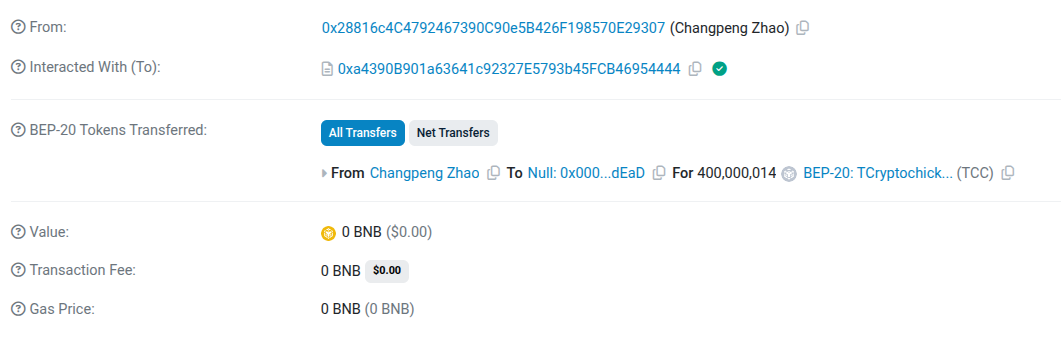
A burn address is a wallet without an accessible private key, so any tokens sent to it are removed from circulation forever. About a day ago, CZ moved roughly 400 million units of third-party tokens into one of these addresses.
Furthermore, the batch totaled $1.6 million. Moreover, the destination was the well-known dead address starting with 0x000, a common target for permanent token removal.
The crypto community reacted fast. On-chain researchers flagged the transfers, and theories about market manipulation quickly began circulating. However, CZ promptly clarified on X that he was simply clearing out digital garbage accumulated in his public wallet.
“I simply hadn’t checked that wallet in a long time; when I opened it, I discovered there were too many tokens (tens of thousands), and the software interface wasn’t very user-friendly. I made a suggestion and then ran a test. Instead of sending it to my address, it’s better to send it directly to a ‘black hole’ address; it saves a step and is more direct and effective: 0x000000000000000000000000000000000000dEaD,” CZ said on X.
Follow us on X to get the latest news as it happens.
The explanation points to a long-running problem. Creators of third-party projects had been sending spam tokens to his address for years, chasing free publicity.
As a result, the wallet interface eventually stopped displaying his balance correctly, forcing the manual cleanup.
Additionally, burning the tokens directly removes clutter in a single step, without selling or transferring each asset individually.
Why Do Projects Send Spam Tokens to Famous Wallets
The most famous precedent involved Vitalik Buterin in 2021. Shiba Inu’s team transferred an enormous share of the supply to the Ethereum co-founder without asking him. Instead of validating the project, he burned 90% of those holdings and publicly asked developers to abandon the practice.
CZ now faces the same dynamic on a recurring basis. According to Arkham, his wallet has absorbed unwanted tokens for years, forcing periodic purges of ever-increasing size. Altogether, the Binance founder has erased more than $6.24 million in spam assets over the past twelve months.
The takeaway is straightforward. The transfers carry no hidden market signal and reflect maintenance rather than manipulation.
Zhao even joked that depositing tokens into his wallet works like a shortcut to a black hole. As a result, projects hoping for free promotion simply watch their tokens vanish faster.
Subscribe to our YouTube channel to watch leaders and journalists provide expert insights.
The post Binance Founder Moves Millions in Meme Coins to a Burn Address appeared first on BeInCrypto.

Paramount/Warner Bros Merger Hits A Roadblock That Could Cost Billions

Greens’ Hannah Spencer tables maximum workplace temp bill

THE NEXT BITCOIN MOVE IS CLEAR…


-

 News Videos7 days ago
Whats Hidden Inside This Cash Register? #treasure #reselling #money
-

 Fashion4 days ago
Loro Piana Fall 2026 Enters Houston’s Art Scene
-

 Fashion3 days ago
Weekend Open Thread: Nutriplenish Leave-In Conditioner
-

 Crypto World7 days ago
$1,000 Credit Alert! BlockDAG X Exchange Pre-Registration Now Officially Open, Polkadot Dips & Zcash Rebounds
-
 Tech6 days ago
Anthropic’s new “J-lens” reveals a silent workspace inside Claude that mirrors a leading theory of consciousness
-

 Sports6 days ago
Joshua Pacio ‘more complete’ ahead of ONE rematch vs Malachiev
-
 Sports4 days ago
2026 Genesis Scottish Open Thursday TV coverage: Round 1
-

 Tech6 days ago
Anthropic brings Claude Cowork to mobile and web as usage data shows most users aren’t coding
-

 Sports3 days ago
Super Eagles star Moses Simon opens up on Liverpool transfer regret
-
Sports6 days ago
We have punished the disrespect
-

 Crypto World7 days ago
Binance lists Strategy’s STRC stock as company expands Bitcoin funding
-

 Tech4 days ago
Character.AI enters the microdrama arena with its own productions, but there’s a twist
-
 Tech7 days ago
9 Best Keyboards (2025), Tested and Reviewed
-
 Business7 days ago
Enbridge: AI Tailwind Priced In (Rating Downgrade)
-
 Crypto World6 days ago
Claude AI Created Something Anthropic Never Designed
-

 News Videos7 days ago
“What’s going on?!” Carl Froch discusses Floyd Mayweather Jr financial issues
-

 Crypto World6 days ago
Nasdaq arthritis company holding Moshe Hogeg crypto hits all-time low
-
 Entertainment7 days ago
Taylen Biggs Reveals The Celebrity She Dreams Of Interviewing
-
 Crypto World7 days ago
Microsoft Cuts 4,800 Jobs as Xbox Loses 3,200 Roles in Reset
-

 News Videos5 days ago
Crypto Just Entered Its Most Important 6-Month Candle (Could Decide Everything!)
You must be logged in to post a comment Login