

Crypto World
Coinbase pushes back on Warren as CLARITY Act vote nears



Coinbase Chief Policy Officer Faryar Shirzad has rejected claims that the CLARITY Act would weaken U.S. national security. In a July 11 post on X, he said unclear crypto rules give bad actors room to operate outside firm regulatory boundaries. Shirzad argued that the bill would move more digital asset activity into a federal compliance system rather than leave it under fragmented oversight.
Summary
- Shirzad says CLARITY Act applies bank-style AML rules and gives Treasury stronger enforcement tools nationwide.
- Warren warns current language could preserve crypto loopholes that foreign actors use for sanctions evasion.
- Senate negotiators target a merged draft before recess while unresolved disputes still threaten final passage.
Shirzad said the proposal would place crypto brokers, dealers, and exchanges under Bank Secrecy Act duties. Those duties include anti-money laundering programs, customer checks, suspicious activity reports, and sanctions compliance. He also pointed to provisions that let platforms pause suspicious transfers when law enforcement requests action. “This isn’t a free pass for crypto,” he wrote, calling the proposal a strict security mandate.
Warren warns about sanctions evasion risks
Senator Elizabeth Warren has taken the opposite position. She shared an article by former National Security Council Iran director Richard Nephew and wrote, “As currently drafted, the Clarity Act is a ticket to sanctions evasion.” Nephew argued that the bill could leave some decentralized finance participants outside clear Bank Secrecy Act duties and make enforcement harder.
The dispute centers on which crypto businesses must register, monitor transactions, and answer to federal agencies. Warren and other critics say exemptions for some non-custodial services could leave gaps that foreign governments, criminal groups, and sanctioned entities may use. A Senate Banking Committee minority advisory raised similar concerns. Supporters say existing sanctions laws would remain in force while the bill adds new powers for the Treasury Department and FinCEN.
Bill contains new anti-money laundering tools
The Senate Banking Committee’s CLARITY Act fact sheet says the bill applies federal anti-money laundering and counterterrorism finance rules to centralized digital asset intermediaries. It also creates a Treasury power known as Special Measure 6. That tool would let officials target foreign jurisdictions, institutions, or transaction types tied to major digital asset money laundering risks.
The proposal would increase FinCEN funding, require risk controls at digital asset firms, and create a government-industry information-sharing program. It would also regulate crypto kiosks and require studies on mixers, illicit finance, cyber risks, and national security threats. These measures support Shirzad’s case, while the debate over decentralized services supports Warren’s demand for tighter language.
Senate faces a narrow legislative window
The latest crypto.news coverage says Senate staff plan to release a merged CLARITY Act draft during the week of July 13. The new text will combine work from the Banking and Agriculture committees. Negotiators have reportedly added more than 70 pages, including stronger consumer protections and changes requested during bipartisan talks.
Senate leaders target possible floor action during the week of July 20, but several disputes remain open. Lawmakers continue to negotiate ethics rules, stablecoin rewards, decentralized finance protections, and legal safeguards for software developers. Crypto.news reported that Senator Ron Wyden wants the final bill to retain protections for developers who do not control customer funds.
The House approved an earlier version in July 2025, while the Senate Banking Committee advanced its draft by a 15-9 vote in May 2026. Both chambers must approve matching text before the bill can reach the president. The Senate starts its August recess on August 7, leaving limited time for debate and amendments. The national security dispute adds another test as supporters seek enough Democratic votes for passage before lawmakers leave Washington for summer.



When a company buys hundreds of millions of dollars of Bitcoin and the price barely moves, it did not use an exchange. It used an OTC desk. This guide explains over-the-counter crypto trading: why large orders cannot go through order books, how OTC desks source liquidity and settle trades, the difference between principal and agency desks, why so much real volume is invisible, and how to tell when the whales are quietly accumulating.
Here is a puzzle that confuses almost everyone new to crypto markets. A public company announces it bought $500 million of Bitcoin. On any exchange, an order that size would tear through the order book, spike the price, and cost the buyer a fortune in slippage, everyone would see it coming and front-run it. Yet the announcements keep arriving, the purchases keep completing, and the price frequently barely reacts. How?
The answer is a corner of the market most retail traders never touch and much of the real money never leaves: over-the-counter trading. OTC desks are where whales, institutions, corporate treasuries, miners, funds, and governments buy and sell crypto in sizes that would be impossible on public exchanges, through private, negotiated transactions that never appear in any order book. A large and growing share of crypto’s genuine volume happens here, off-screen, and the on-exchange charts that most analysis obsesses over are, in a real sense, only the visible tip of the market.
This guide explains that hidden layer. It covers why large orders cannot use exchange order books, what an OTC desk actually does and how a trade flows from request to settlement, the crucial difference between principal and agency desks and what each costs you, where OTC liquidity comes from, why this volume stays invisible and what that means for reading the market, the risks specific to OTC trading, and the on-chain signals that let outsiders glimpse the whales the order books hide.
Why big orders cannot use the order book
To understand OTC, first understand what it exists to avoid. An exchange order book is a ladder of resting buy and sell orders at various prices, and it has finite depth: only so much is available to buy at the current price, then a bit more slightly higher, then more higher still. A small order fills at the top and barely moves anything. A large order eats through level after level, filling at progressively worse prices, the price impact that grows as depth runs out, and a truly large order can move the market several percent against itself before it completes.
Worse, it does so in public. Order books are visible, and a large order climbing the ladder is a signal every other participant, and every bot, reads instantly: the moment the market sees a whale buying, prices run ahead of it, and the whale ends up chasing a rising market it created, paying a premium that compounds with every remaining coin. This is the reason a $500 million market order is not merely expensive but nearly impossible to execute well: the order’s own footprint is the enemy, and the bigger the order, the worse the self-inflicted damage. Splitting it into small pieces over time, algorithmic execution, helps and is widely used, but it takes time the buyer may not have and still leaks information across the many fills.
OTC exists to solve exactly this. A negotiated, off-book trade transfers a large block at a single agreed price, privately, with no order-book footprint and no public signal until, at most, a disclosure long after the fact. For size, it is not merely cheaper than the exchange; it is the only realistic venue.
What an OTC desk actually does
An OTC desk is a firm that stands between large buyers and large sellers, providing a private venue and, usually, its own liquidity, to move blocks the public market cannot absorb. The major exchanges run OTC desks, specialized firms run independent ones, and the largest trading houses run desks that serve institutions exclusively, and the same firms that act as authorized participants for spot ETFs often source their coin through exactly these channels. Their product is simple to state and hard to deliver: a firm price for a large quantity, executed discreetly, settled reliably.
A trade flows roughly like this. A buyer, say a corporate treasury acquiring $200 million of Bitcoin, contacts the desk, often through a relationship manager, and requests a quote for the size. The desk responds with a price, a single number for the whole block, that reflects the current market plus a spread covering the desk’s risk and margin. The buyer accepts or negotiates; on agreement, the trade is locked at that price regardless of where the public market moves in the next minutes. Settlement follows: the buyer sends funds, the desk delivers the coins, often through an escrow or simultaneous-exchange arrangement that protects both sides, and the whole transaction completes without a single order touching a public book. The buyer got certainty, one price, no slippage, no signal, and the desk earned its spread for absorbing the risk and sourcing the other side.
The relationship layer matters more here than anywhere else in crypto. OTC is a business of trust, credit, and compliance: desks run know-your-customer and anti-money-laundering checks, extend settlement terms to vetted counterparties, and compete on reliability and discretion as much as price. It is, in texture, far closer to traditional institutional finance than to the anonymous, permissionless world of on-chain trading, which is precisely why institutions are comfortable there.
Principal versus agency: who takes the risk
The single most important distinction among OTC desks is whether they trade as principal or as agent, because it determines where the risk sits and how you pay.
A principal desk trades against you from its own book: when you buy, the desk sells you coins it owns or immediately sources, taking the other side of your trade itself. It quotes you a firm price and then bears the risk of covering that position in the market, which is why principal quotes include a spread compensating for that risk. The advantage to you is certainty and speed: you get one price, immediately, and the desk’s problem of sourcing the coins without moving the market becomes the desk’s problem, not yours. The disadvantage is that the spread is the desk’s, and its interests and yours diverge at the margin, since it profits from the spread it can command.
An agency desk, by contrast, works on your behalf to find the other side, executing into the market or matching you against another client, and charges a transparent commission rather than trading against you. Your interests align better, the desk is your agent, not your counterparty, but you bear more of the execution risk and timing uncertainty, because the desk is not guaranteeing you a price, it is promising to work your order well. Large sophisticated players often prefer agency execution for its alignment and transparency; players who value certainty and speed over squeezing the spread prefer principal desks. Many desks offer both, and knowing which model a given trade uses is the first question a serious OTC counterparty asks, because it changes the entire cost and risk structure of the transaction.
Where the liquidity comes from
An OTC desk’s core skill is sourcing the other side of a block without disturbing the public market, and it draws on several pools to do it. The first is its own inventory: principal desks hold positions precisely so they can fill client orders instantly from stock. The second is a network of counterparties, other institutions, miners with coins to sell, funds rebalancing, other desks, that the desk can match against each other, so that a large buyer and a large seller cross privately at a price that serves both and moves nothing publicly. The third is the public market itself, worked carefully: a desk that takes a large buy order as principal must eventually cover it, and it does so by feeding the position into exchanges gradually, algorithmically, over hours or days, absorbing the price impact itself in exchange for the spread it charged the client.
Miners are a structurally important source, because they are natural, continuous sellers, they earn coins and must sell to cover costs, and routing that supply through OTC desks instead of exchanges keeps steady sell pressure off the public books, one reason miner-desk relationships are a quiet load-bearing feature of market structure.
This matching function is the desk’s real value: at its best, OTC is a mechanism for letting large buyers and large sellers find each other without either one’s size becoming a weapon against them, and the better a desk’s network, the more it can match internally and the less it must move the public market at all.
A worked block, and who is on the other side
A concrete example turns the abstraction into mechanics. A treasury company wants $200 million of Bitcoin and calls a principal desk. The desk quotes a single price, say the current market plus a spread of a few tenths of a percent, and the buyer accepts; the price is now locked for the full block regardless of what the public market does next. The buyer wires funds, the desk delivers coins through escrow, and the trade is done, no chart moved, no order book touched, one number for the whole $200 million.
Behind that clean surface, the desk now has a problem it was paid to take: it just sold $200 million of Bitcoin it must replace. If it held inventory, it draws it down and restocks over time; if it did not, it works the public market quietly for hours or days, buying in small algorithmic slices that each move the price a little, absorbing exactly the slippage the client paid to avoid. The spread the client paid is the desk’s compensation for that work and that risk, and a skilled desk that can match the buyer against a natural seller, a miner offloading a month’s production, a fund rebalancing out, avoids touching the public market at all and keeps more of the spread. This is why the desk’s counterparty network is its crown jewel: every internal match is a trade that moves nothing publicly and costs the desk nothing to cover.
The cast of characters on the other side of OTC blocks is worth knowing, because it is the market’s real supply and demand. Miners are the structural sellers, earning coins continuously and needing fiat for costs. Corporate treasuries and funds are episodic buyers and sellers, moving in size around strategy shifts. Early holders and whales distribute long positions through desks precisely to avoid signaling. Exchanges and other desks trade with each other to balance inventory. And increasingly, the intermediaries serving regulated products, the machinery behind spot ETFs and tokenized assets, source and offload through OTC channels, which is why a growing share of the market’s most consequential flows, the ones that actually set the balance of supply and demand, never appear on a single exchange chart.
Why it is invisible, and what that means
The defining feature of OTC volume is that it does not appear on the charts, and internalizing that fact reshapes how you read the market. Exchange volume, the number on every ticker, captures only trades that crossed a public book; the enormous flow that crosses privately through desks is absent, disclosed at best in aggregate and after long delays, if at all. Estimates consistently suggest that OTC and off-exchange volume rivals or exceeds visible exchange volume, which means the market analysts scrutinize is a large but partial sample of the real one.
The consequences are concrete. Price can move on thin visible volume while enormous OTC flow crosses unseen, so a quiet chart does not mean a quiet market. Accumulation and distribution by the largest players often happen almost entirely off-book, which is why major holders can build or exit positions that only become visible later, through disclosures or on-chain forensics, the reason exchange-reserve and whale-wallet data matter so much for reading real supply. And the relationship between on-exchange price and true supply-demand is looser than it appears, because the marginal large trade increasingly does not touch the exchange at all. Reading crypto markets well means constantly remembering that the visible order books are a screen in front of a much larger room, and that the biggest participants prefer the room.
OTC and the rise of on-chain settlement
The OTC world described so far is largely off-chain in its plumbing, private deals settled through escrow and banking rails, and one of the quiet shifts underway is the migration of parts of it onto blockchains themselves. Stablecoins changed the settlement leg first: instead of wiring dollars through correspondent banks, counterparties increasingly settle the cash side of OTC blocks in regulated stablecoins that move in minutes, around the clock, with the coin leg delivered simultaneously on-chain, collapsing settlement risk that once took days into a single atomic-adjacent exchange. The institutional stablecoins built for exactly this purpose have made the cash leg of large crypto trades faster and safer than its traditional-finance equivalent.
The deeper shift is that the assets themselves are becoming programmable in ways that touch OTC’s core function. As tokenized real-world assets and on-chain settlement layers mature, the historical trade-off OTC exists to manage, moving size without moving the market, gains new tools: dark-pool-style on-chain venues, request-for-quote systems that solicit private quotes from multiple desks, and settlement rails that let large blocks change hands with cryptographic finality rather than bilateral trust. None of this has replaced the relationship-driven desk business, which remains dominant for the largest and most sensitive flows, but it is steadily converting OTC from a purely private, trust-based world into a hybrid where the discretion of a negotiated block meets the finality of on-chain settlement. For a market whose largest trades have always happened in the shadows, the direction of travel is toward shadows with receipts, private in price discovery, verifiable in settlement, and the institutions bringing serious size on-chain are precisely the ones driving it.
Risks and the on-chain tells
OTC trading carries risks distinct from exchange trading, and they are worth naming. Counterparty and settlement risk is the central one: in a private bilateral trade, one side sends first unless a trusted escrow or simultaneous-settlement arrangement intervenes, and the history of OTC includes losses from failed settlement and bad actors, a bilateral counterparty exposure closer to traditional finance than to the atomic, trustless settlement of on-chain trades, which is why counterparty vetting and reputable desks matter enormously. Pricing opacity is another: without a public book, a client must trust that the quoted spread is fair, and less sophisticated counterparties can be quoted worse prices precisely because the market is private. Regulatory and compliance exposure runs throughout, since OTC desks are exactly where large flows attract scrutiny. And access is itself a barrier: OTC is a world of minimums, relationships, and vetting, effectively closed to retail, which is part of why its flows stay opaque to the public.
For outsiders, the compensating gift is on-chain data, which offers glimpses the order books hide. Large transfers into and out of known desk and exchange wallets, tracked by analytics firms, can signal OTC-scale accumulation or distribution before it shows in price; shrinking exchange reserves suggest coins moving to storage through private channels; and settlement patterns around major disclosed purchases sometimes leave on-chain fingerprints. None of it is as clean as an order book, but it is the closest an outsider gets to seeing the room where the size actually trades, and learning to read it, transfers, reserves, whale-wallet flows, is learning to see the market’s hidden majority.
The honest summary is that the crypto market most people watch and the crypto market where the largest decisions execute are substantially different places. The order books are real, useful, and public; they are also the retail-facing surface of a market whose deepest liquidity moves privately, negotiated, off-screen, through desks built so that size does not have to announce itself. Understanding OTC does not give a retail trader access to it, but it does something nearly as valuable: it corrects the illusion that the chart is the whole market, and it explains the puzzle with which this guide began, how the whales keep buying, in enormous size, without the price ever seeming to notice.
Disclaimer: This article is for educational purposes only and does not constitute investment advice. Digital asset markets are volatile and you can lose your entire investment. Details are current as of July 9, 2026. Always do your own research.
Frequently asked questions
What is OTC trading in crypto in simple terms?
OTC, or over-the-counter, trading is the buying and selling of crypto through private, negotiated deals rather than on public exchanges. A desk stands between large buyers and sellers, quoting a single price for a big block and settling it privately, so the trade never appears in any order book. It exists so that large orders can execute without the slippage and public signaling that exchanges would impose.
Why do large buyers use OTC desks instead of exchanges?
Because a large order on an exchange would eat through the order book, filling at progressively worse prices and moving the market against itself, while broadcasting the buyer’s intent to everyone watching. OTC delivers a single agreed price for the whole block, privately, with no order-book footprint, which for large size is both far cheaper and far more discreet than any exchange execution.
What is the difference between a principal and an agency OTC desk?
A principal desk trades against you from its own book, quoting a firm price and taking the other side of your trade itself, earning a spread and bearing the risk of covering the position. An agency desk works on your behalf to find the other side and charges a transparent commission instead of trading against you. Principal offers certainty and speed; agency offers better alignment and transparency.
How does an OTC trade actually settle?
After a price is agreed, the two sides exchange funds and coins, usually through an escrow or simultaneous-settlement arrangement that protects both parties from the other defaulting. Reputable desks run compliance checks and may extend credit terms to vetted counterparties. Settlement reliability is a core part of what a desk sells, since bilateral private trades carry real counterparty risk.
Why does so much crypto volume stay invisible?
Because OTC and off-exchange trades never cross a public order book, so they do not appear in the volume figures on tickers and charts. Estimates suggest this hidden flow rivals or exceeds visible exchange volume, meaning the market most people analyze is only a partial sample. It is why prices can move on thin visible volume while enormous flow crosses privately.
Can regular retail traders use OTC desks?
Generally not. OTC is a world of large minimums, standing relationships, credit, and vetting, effectively closed to retail-sized orders. Its whole purpose is moving blocks far larger than any individual trades. Retail traders interact with the same underlying market through exchanges, and can only glimpse OTC activity indirectly through on-chain data and disclosures.
How can I tell when whales are accumulating through OTC?
You cannot see it directly, but on-chain analytics offer clues: large transfers into and out of known desk and exchange wallets, shrinking exchange reserves suggesting coins moving to private storage, and settlement patterns around disclosed institutional purchases. These signals are noisier than an order book but are the closest an outsider gets to seeing OTC-scale accumulation before it shows in price.
Is OTC trading safe?
It carries risks distinct from exchange trading, chiefly counterparty and settlement risk in bilateral deals, pricing opacity without a public book, and the need to trust the desk’s fairness and reliability. Working with reputable, compliant desks and using proper escrow or simultaneous-settlement arrangements mitigates most of it, which is why relationships and reputation dominate the OTC business far more than in anonymous exchange trading.
Disclosure: This article does not represent investment advice. The content and materials featured on this page are for educational purposes only.
Morgan Stanley and Barclays have raised their Robinhood price targets to $124 and $122, respectively, even as HOOD has fallen more than 5% toward key support near $109.
Summary
- Morgan Stanley raised Robinhood’s target to $124, while Barclays lifted its forecast to $122.
- HOOD fell more than 5% after failing near $120 and testing support around $109.
- Robinhood Chain growth and strong trading activity continue to support analysts’ bullish outlooks.
Morgan Stanley reiterated its buy rating on Robinhood Markets on July 10 and lifted its target from $95 to $124, an increase of more than 30%. The new target sits above the stock’s recent peak near $120 and implies room for another advance from current levels.
Barclays analyst Benjamin Budish also kept a buy recommendation on Robinhood while raising the firm’s target to $122 from $82. According to Barclays, Robinhood’s trading activity and platform momentum remain strong as the company expands beyond its retail brokerage business.
The two upgrades followed higher targets from Goldman Sachs, Mizuho, and BTIG, which placed their 12-month forecasts between $121 and $130. Taken together, those calls show that several Wall Street firms expect Robinhood’s recent product growth to support further gains, although Friday’s price action showed investors were still willing to lock in profits.
Analyst targets keep the bullish case intact
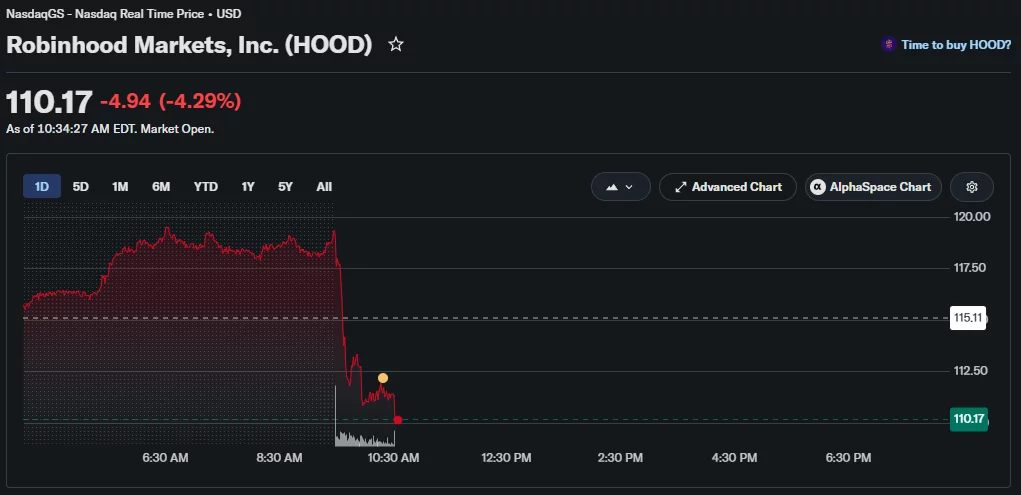
Robinhood shares had risen almost 40% over the past month and about 80% over the past few months before the latest pullback. The stock closed Thursday at $115.11, up 1.39%, while trading volume remained below its average of roughly 32 million shares.
Premarket trading initially pushed HOOD more than 3% higher and pointed to an opening above $118.50. Once regular trading began, however, Yahoo Finance data showed the stock falling to about $110.17, down 4.29%, after briefly trading near the $118-$119 area.
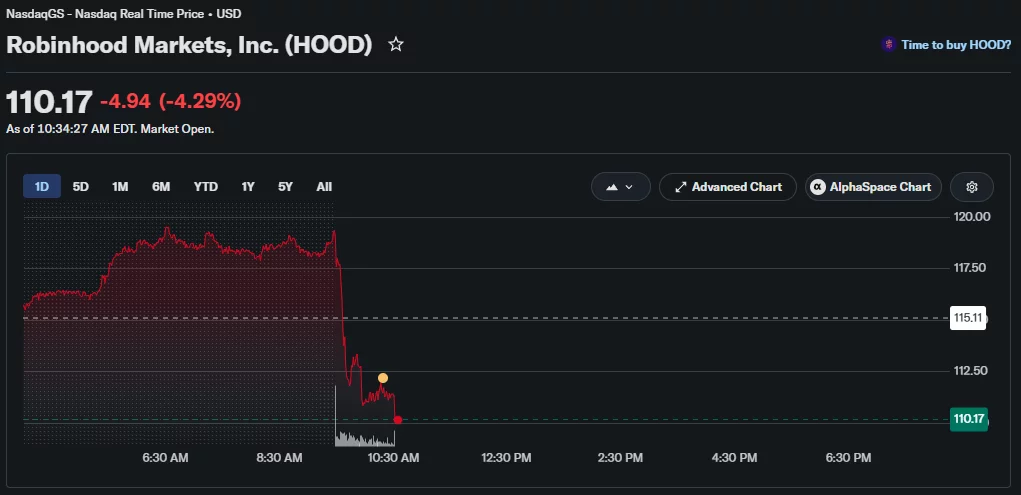
The intraday chart showed a sharp break below $115 shortly after the opening bell, followed by a short rebound toward $113. Sellers then regained control and pushed the stock back toward $110, leaving the analyst upgrades unable to prevent an immediate sell-off.
Robinhood’s recent gains have also followed several company developments. The firm has introduced Robinhood Chain, a Layer-2 network focused on real-world assets, decentralized finance, and meme coins, while also announcing a partnership tied to Trump Accounts.
Notably, Robinhood Chain surpassed Hyperliquid in 24-hour decentralized exchange volume and reached $100 million in total value locked within days. CEO Vlad Tenev’s comments about waived gas fees and meme-coin activity added to interest around the network.
HOOD tests support after rejecting $120
The daily chart from TradingView showed HOOD was trading near $109.08, down 5.24%, after the stock failed to hold its recent move toward $120.03. The same chart showed the price testing the 78.6% Fibonacci retracement at $109.33, making the $109-$110 area an important support zone.
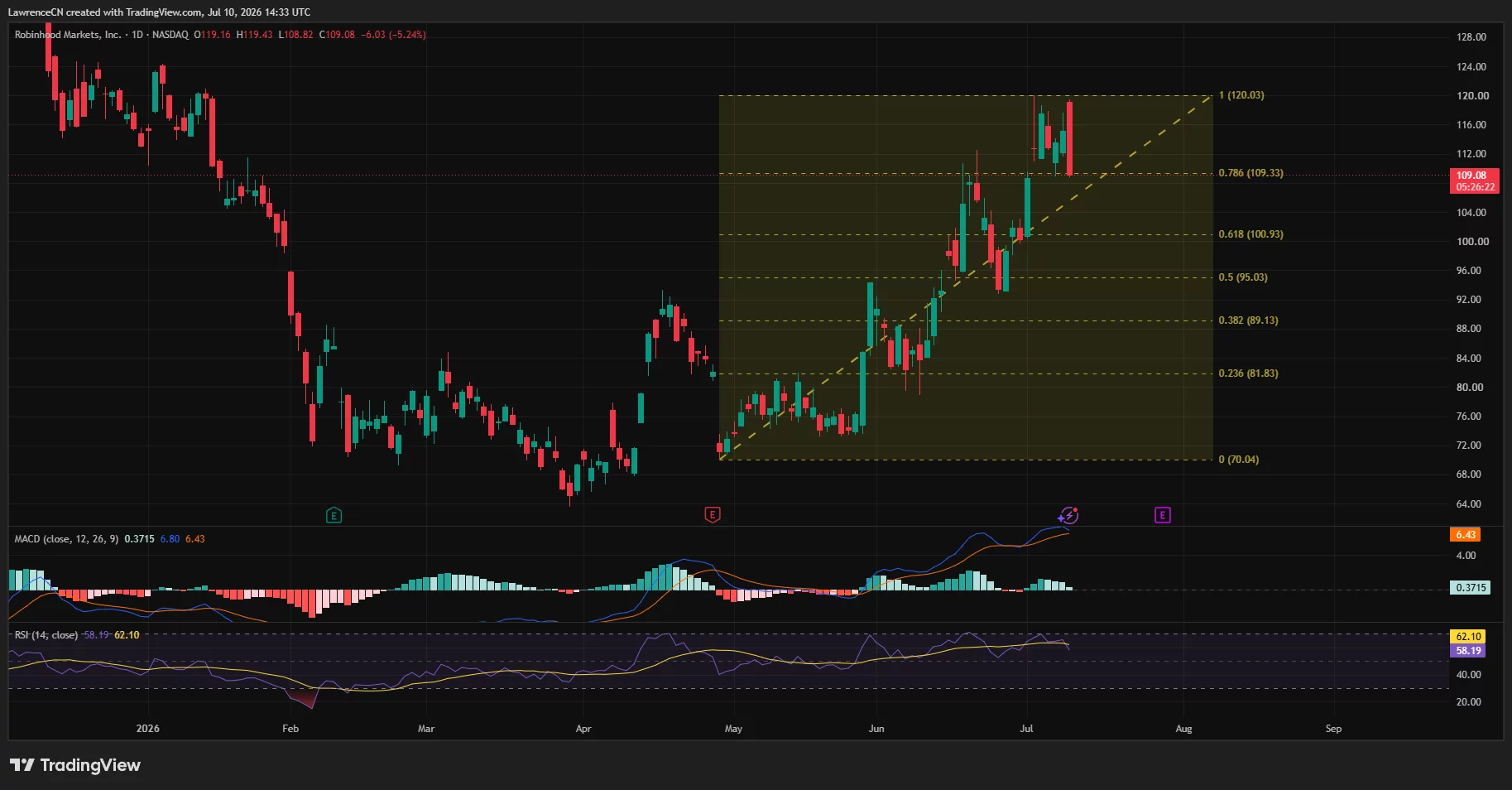
Should that level fail, the setup identified the next retracement levels at $100.93, $95.03, and $89.13. On the upside, the recent high near $120.03 remains the main resistance area and the level HOOD would need to clear for another breakout attempt.
Momentum indicators on the chart remained mixed rather than fully bearish. The daily RSI stood near 58, below its recent highs but still above neutral, while the MACD stayed above zero as its histogram weakened.
Based on the chart structure, the stock’s rise from the May low near $70 remains intact unless the current decline breaks several support levels. Wall Street’s higher targets continue to support the long-term growth case, but Friday’s reversal shows that HOOD may need to stabilize near $109 before buyers attempt another move toward $120.
Disclosure: This article does not represent investment advice. The content and materials featured on this page are for educational purposes only.


Robinhood launched its own blockchain in July 2026, an Ethereum layer 2 where tokenized stocks trade around the clock and plug into DeFi as collateral. This guide explains what Robinhood Chain actually is, how it works under the hood, what Stock Tokens are and who can use them, how the chain differs from Base and the other corporate networks, and what it means for users, builders, and the industry’s biggest open questions.
On July 1, 2026, one of the largest retail brokers in the United States switched on its own blockchain. Robinhood Chain launched its public mainnet at a London keynote, carrying 95 tokenized stocks that trade 24 hours a day, a suite of DeFi protocols live from day one, and access wired directly into the Robinhood Wallet used across 120 countries. Within a week the chain had processed roughly 4 million transactions, gathered over $240 million in deposits, and produced a launch statistic, $570 million of day-one volume against $21.68 million of liquidity, that made the entire industry look twice.
A brokerage running a blockchain would have sounded absurd for most of crypto’s history, and it now sounds inevitable: Coinbase runs Base, Stripe backs Tempo, and the era of consumer giants renting neutral rails is visibly ending. But Robinhood Chain is a distinct species within that trend, because it was built around one specific product no other chain ships: real-world equities as native, composable on-chain assets, the thing crypto has promised since the first tokenized-stock experiments and never delivered at brokerage scale.
This guide explains the chain from the ground up: what it technically is and how the Arbitrum-based architecture works, what Stock Tokens are and what holders actually get, the DeFi ecosystem that launched with it and why composability is the entire point, who can access what and where the regulatory lines sit, how the chain compares to Base and the corporate-chain field, the fee economics including the unusual revenue-sharing deal with Arbitrum, and the honest open questions, control, liquidity, and law, that will decide what the chain becomes.
The architecture: an Ethereum layer 2, built to order
Robinhood Chain is a layer 2 blockchain: a network that executes transactions on its own fast, cheap environment while posting records to Ethereum, inheriting the base chain’s security for its history. It is built using Arbitrum’s Orbit technology, the chains-as-a-service framework from the team behind Arbitrum One, which means Robinhood did not invent a blockchain so much as commission one: Orbit supplies the rollup machinery, proofs, data posting, Ethereum settlement, and Robinhood configures the network, operates its infrastructure, and decides what it is for.
Three design choices define it. First, it is permissionless: any developer can deploy contracts using standard Ethereum tooling, without Robinhood’s approval, which is why an uninvited memecoin economy appeared on day one and why first-tier DeFi protocols could arrive at launch. That openness distinguishes it sharply from the private bank chains of the last decade and puts it in the same public-network category as Base. Second, it is EVM-compatible: everything built for Ethereum ports over directly, wallets, contracts, developer tools, so the chain starts with the industry’s entire software ecosystem instead of an empty room. Third, it is purpose-tuned for real-world assets: fast block times via Alchemy infrastructure, Chainlink as the official oracle for prices, cross-chain messaging, and proof-of-reserve on Robinhood-issued assets, and BitGo integration on the custody side, the specific plumbing tokenized equities require and general-purpose chains bolt on as afterthoughts.
The trust profile follows from the architecture, and it is the standard corporate-chain bargain. User funds are secured by Ethereum: the sequencer that orders transactions cannot forge them or steal assets, and the chain’s history settles to the base layer. Access and ordering, though, run through infrastructure Robinhood operates, the centralized-sequencer chokepoint every major rollup currently carries, which means outages, ordering policy, and censorship capacity sit with one regulated company. For everyday users the distinction rarely surfaces; for anyone evaluating the chain seriously, it is the first line of the risk section.
Stock Tokens: the product the chain was built around
The headline asset class is Stock Tokens: on-chain representations of equities, NVDA, GOOG, AAPL among the 95 at launch, issued by Robinhood, priced by Chainlink feeds, and tradable every hour of every day, not just during exchange sessions. They are the chain’s reason for existing, and understanding precisely what they are, and are not, is the guide’s most practical section.
A Stock Token delivers price exposure to the underlying equity in a token that behaves like any other crypto asset: hold it in the Robinhood Wallet or self-custody, trade it around the clock on the chain’s exchanges, transfer it, and, most consequentially, use it inside DeFi. What it does not deliver is shareholder status: token holders do not vote, and corporate rights stay with the issuance structure, with dividend economics passed through per the product’s terms, the standard trade-off of every tokenized-equity model. The tokens descend from Robinhood’s 2025 European pilots, which tokenized exposure to private names like SpaceX and OpenAI as proof of concept, and the lineage matters: the legal wrappers were tested under European rules before the chain bet on them.
Availability is the sharpest edge. Stock Tokens ship through the Robinhood Wallet in more than 120 countries, and conspicuously not to United States users, where the line between a compliant synthetic instrument and an unregistered security remains undrawn. The result is one of the strangest compliance objects in crypto: a permissionless network, built by an American broker, whose flagship assets are geofenced away from Americans, with enforcement living at the issuance and app layers while the rails underneath stay open. Whether that architecture satisfies regulators, or attracts them, is among the chain’s defining open questions.
The 24/7 dimension carries its own mechanics worth knowing. When the underlying stock market is closed, nights, weekends, holidays, the tokens keep trading, drifting on expectation with no live reference price, then reconverging when the real market opens. Weekend token prices function as forecasts of Monday’s open, gaps can be violent when news breaks during the closure, and anyone using the tokens in leveraged or collateralized positions inherits that gap risk in full.
The DeFi layer: why composability is the point
Tokenized stocks existed before Robinhood Chain. What the chain adds, and what its launch ecosystem was assembled to prove, is composability: the tokens plug into open financial protocols as first-class assets, which converts a brokerage line item into a programmable building block.
The day-one roster was deliberately first-tier. Uniswap deployed a dedicated AMM as the chain’s core public liquidity venue; Arcus, built by the team behind dYdX, runs a zero-fee exchange purpose-built for the stock tokens; 1inch, Rialto, and Lighter round out trading, with Lighter adding perpetual futures and pledging $11 million of its token to Robinhood users; Pleiades operates a proprietary market-making AMM; and Morpho’s lending markets opened the loop that matters most: stock tokens as loan collateral. That last integration is the chain’s genuinely novel product, a holder borrowing stablecoins against tokenized NVDA, automatically, no paperwork, with liquidation machinery enforcing the loan against oracle prices, and it is also the chain’s most delicate engineering: equity collateral marked by feeds from a market that closes means health factors computed against stale or reconstructed prices for two-thirds of every week, gap-risk liquidations at Monday opens, and corporate-action handling no DeFi risk framework has stress-tested at scale.
The deposits that flowed in during week one, past $240 million, concentrated in exactly these venues, drawn by a 7% yield incentive and points programs, and the composition question, how much collateral is actually stock tokens versus recycled farm assets, is the single best indicator of whether the composability thesis is converting, the launch-week forensics this publication’s feature examined in depth.
Using the chain: access, wallets, and what a first session looks like
For a user, the chain’s front door is the Robinhood Wallet, the company’s self-custody app, which added native Robinhood Chain support at launch: bridging assets in from Ethereum and other networks, swapping tokens, and reaching the chain’s applications happen from inside an interface tens of millions of people already carry. That distribution is the launch’s real innovation, one tap from an existing consumer app to an on-chain economy, no seed-phrase ceremony, no network-configuration ritual, and it is why the chain gathered users at a pace organic launches never match.
Nothing about the chain requires Robinhood’s app, though, and the permissionless design means the standard crypto path works identically: add the network to any EVM wallet, bridge funds across, and interact with the protocols directly. A typical first session looks like any L2’s, bridge a stablecoin or ETH, pay negligible fees, swap or deposit into a venue, with two chain-specific wrinkles worth knowing in advance. The first is that asset availability depends on who you are and where: the DeFi protocols and general tokens are open, while Stock Tokens and certain products check jurisdiction at the issuance and interface layers, so two users on the same chain can see different shelves. The second is incentives literacy: the launch period’s yields and points programs are bootstrap subsidies with published terms and step-down schedules, and treating them as permanent rates is the classic new-chain mistake, since incentive-driven deposits reprice the day the programs do.
Builders face an even lower bar: the chain is standard EVM, deploys with familiar tooling, and offers what no other network can, proximity to a brokerage user base and an asset class, the stock tokens, that exists nowhere else as a composable primitive. The day-one protocol roster arrived for exactly that reason, and the open question for every subsequent builder is the same one the chain itself faces: whether the mission assets acquire the liquidity that makes building against them worthwhile.
The launch by the numbers, and how to read them
The chain’s opening week produced statistics worth recording precisely, because they will be the baseline every future assessment measures against. Day-one volume of $570 million against $21.68 million of total value locked, a 26-to-1 turnover ratio without precedent at scale, driven overwhelmingly by speculative memecoin trading rather than the stock tokens the chain was built for. Roughly 4 million transactions in the first week against about $57,000 of protocol revenue, deliberately subsidized throughput. Deposits growing past $240 million within days, concentrated in Morpho and Ethena strategies farming a 7% incentive. And an 8% rally in HOOD stock on launch, the equity market pricing the option the chain represents.
Read together, the numbers say the launch proved distribution and deferred everything else: the crowd arrived instantly, the crowd was the wrong crowd by the mission’s definition, and the company visibly did not mind, because speculative bootstrap is how every successful chain, Base included, actually started. The figures to watch from here are the boring ones, stock-token volume as a share of activity, collateral composition in the lending markets, deposit retention through incentive step-downs, and they will decide, over quarters rather than weeks, whether the launch statistics were a foundation or a fireworks show.
Fees, economics, and the Arbitrum deal
The chain’s business model is subsidy now, franchise later. Transaction fees are deliberately negligible, roughly $57,000 of protocol revenue against the first week’s 4 million transactions, because the chain is priced as customer acquisition: Robinhood monetizes the surrounding stack, wallet, custody, order flow, spreads, and the eventual financialization of assets its 28 million customers already hold. The structure echoes the company’s zero-commission brokerage playbook precisely.
The launch’s most consequential economic detail belongs to someone else: 10% of Robinhood Chain’s fees flow to the Arbitrum ecosystem, with 8% going directly to the treasury controlled by ARB token holders, confirmation that sent ARB up double digits. The deal matters twice over: it prices Orbit’s chains-as-a-service model with its biggest customer to date, and it sets the template every future corporate chain will negotiate against, the sell-shovels economics underneath the land grab, whose full competitive map this publication has drawn.
One further piece of the economics deserves its own paragraph because it inverts the usual chain-token question: Robinhood Chain has no token, and the company has signaled nothing about one. The network’s fees are paid in ETH-denominated gas, its incentives are paid in dollars and partner tokens, and the value the chain generates is designed to accrue to HOOD equity through the brokerage’s ordinary lines rather than to a new crypto asset. The choice is strategically legible, a token would add regulatory surface exactly where the company has least room, and it makes the chain a useful natural experiment: the corporate-chain model’s economics, tested without the token variable that confounds every other network’s numbers. It also concentrates the ecosystem’s token exposure in unexpected places, ARB through the fee-sharing deal, and the partner protocols’ tokens through their deployments, which is why the launch’s clearest market beneficiaries were assets Robinhood does not issue.
How it compares: Robinhood Chain versus the field
Against Base, the reigning corporate chain, the comparison clarifies both. Base is a general-purpose network that grew an economy organically, memecoins first, then consumer apps, then everything, monetized through sequencer margin at enormous scale; its differentiation is Coinbase’s distribution applied to an open playground. Robinhood Chain is a product-led network: the stock tokens are the anchor tenant, the DeFi roster was recruited around them, and the bet is that one asset class nobody else ships outruns a general platform’s breadth. Base runs on the OP Stack, Robinhood on Arbitrum Orbit, a meaningful choice mostly for the fee-sharing counterparty and the proving roadmap. Against Tempo, Stripe’s payments-first chain, the contrast is anchor product again, payments versus equities, and against the neutral L1s both compete with, the corporate chains share the same offer and the same objection: distribution no neutral chain can match, control no neutral chain would accept.
Where the chain came from: the two-year assembly
The launch’s polish reflects deliberate sequencing worth knowing, because it explains both the chain’s capabilities and its ambitions. Robinhood spent 2025 acquiring the pieces: Bitstamp, one of the oldest crypto exchanges, for trading and institutional infrastructure; WonderFi for Canadian licensing; and the European tokenized-equity pilots, including exposure products on private names like SpaceX and OpenAI, as legal and product rehearsal. Early 2026 brought the quiet phase: a public testnet from February that processed millions of transactions, and the European expansion of crypto perpetuals that became one of the company’s fastest-growing lines. The July launch composed the pieces into one architecture, assets tokenized on its own network, traded through its own wallet and partnered venues, financed through integrated lending, custodied through its own stack, and the composition, more than any single component, is the product: a vertically integrated on-chain brokerage, with each layer feeding the others.
The assembly also explains the chain’s geography. The launch happened in London, the stock tokens ship internationally first, and the European perps expansion runs under MiCA-era rules, because the regulatory groundwork was laid where frameworks exist. The United States, the company’s home market, receives the chain, the wallet, and the crypto products, and waits on the equity tokens until American classification law settles, a sequencing that reads as strange until it reads as strategy: build the global product under workable rules, and let the home market’s framework catch up to a working precedent instead of a proposal.
The honest open questions
Three questions will decide what the chain becomes, and none is answerable yet. Control: a permissionless network whose sequencing, issuance, and flagship interface all route through one regulated broker is decentralized at exactly one layer, and the pressure point regulators or litigants would reach for first is obvious. Liquidity: 24/7 equity trading and stock-collateral lending are only as real as their depth, and week-one depth in the mission assets was thin against the speculative noise; the products exist as listings and must become markets. And law: the geofence paradox, the CLARITY-era classification of the tokens, and the first serious corporate action or exploit on tokenized equities are all uncharted, and each is capable of reshaping the chain’s product overnight.
What is not in question is significance. A top American broker building a public blockchain around real-world assets, and populating it with DeFi’s first tier on day one, is the clearest single marker yet of traditional finance and crypto converging on shared rails, and whichever way the open questions resolve, the experiment’s data, on tokenized-equity demand, on corporate-chain economics, on regulated assets in permissionless systems, will shape what every institution builds next.
A short reader’s guide to following the chain closes the picture, because the story is young and the sources are all public. The chain’s explorer and the standard TVL dashboards carry the activity and deposit series; the incentive programs publish their terms and step-down dates; the stock-token venues report the volumes that measure the mission; and Robinhood’s quarterly disclosures will, over time, reveal what the company chooses to say about economics it is currently subsidizing in silence. The corporate-chain era is being decided by exactly this kind of unglamorous series, retention curves and collateral mixes, not keynotes, and Robinhood Chain, whatever it becomes, has committed to being graded in public. For a technology that spent a decade arguing about whether traditional finance would ever really arrive on-chain, the most informative thing about this chain may simply be its existence: the argument is over, the arrival is operational, and the remaining questions, control, liquidity, and law, are the practical kind that get answered by data, not debate.
And a sizing footnote for perspective: a week after launch, the chain’s deposits already exceeded what most of the previous cycle’s venture-funded L2s gathered in their lifetimes, and its flagship product had transacted less than its accidental memecoin economy, both facts true at once, which is the corporate-chain era in a single sentence.
The chain is a week old; this guide will age accordingly, and its framework, architecture, assets, access, economics, questions, is built to be refilled with each quarter’s numbers.
Disclaimer: This article is for educational purposes only and does not constitute investment advice. Digital asset markets are volatile and you can lose your entire investment. Product availability varies by jurisdiction, and details are current as of July 9, 2026, and changing quickly. Always do your own research.
Frequently asked questions
What is Robinhood Chain in simple terms?
Robinhood Chain is a public blockchain launched by the brokerage Robinhood in July 2026. It is an Ethereum layer 2 built with Arbitrum’s technology, designed for tokenized real-world assets: its flagship product is Stock Tokens, on-chain versions of equities like NVDA and AAPL that trade 24/7 and plug into DeFi applications. Anyone can build on it, and users access it primarily through the Robinhood Wallet.
Is Robinhood Chain its own blockchain or part of Ethereum?
Both, in the way all layer 2 networks are: it executes transactions on its own fast, cheap network, and it posts records to Ethereum, inheriting the base chain’s security for its history. It is built on Arbitrum Orbit, the same technology family as Arbitrum One, and is fully compatible with Ethereum wallets, tools, and smart contracts.
What are Stock Tokens and do they make me a shareholder?
Stock Tokens are Robinhood-issued tokens tracking specific equities, tradable around the clock and usable in DeFi as collateral. They deliver price exposure and pass through dividend economics per their terms, but holders are not shareholders of record: no voting rights, and corporate rights remain with the issuance structure. They are exposure instruments, not shares.
Can US users trade Stock Tokens on Robinhood Chain?
No. Stock Tokens are available through the Robinhood Wallet in more than 120 countries, with availability varying by jurisdiction, and the United States is excluded pending regulatory clarity on how such tokens are classified. US users can access the chain itself, which is permissionless, but not its flagship equity products.
What DeFi protocols run on Robinhood Chain?
The launch ecosystem included Uniswap with a dedicated AMM as core public liquidity, Arcus, a zero-fee stock-token exchange from the dYdX team, 1inch, Rialto, and Lighter for trading and perpetuals, Pleiades as a proprietary market-making venue, and Morpho for lending, where stock tokens can serve as loan collateral. Chainlink provides the oracle and cross-chain infrastructure throughout.
What happens to Stock Tokens when the stock market is closed?
They keep trading. With no live reference price overnight and on weekends, the tokens float on traders’ expectations of the next open and reconverge when the real market resumes, sometimes with sharp gaps if news broke during the closure. Anyone borrowing against stock-token collateral carries that gap risk, since positions can be liquidated against prices that jump at the open.
How is Robinhood Chain different from Coinbase’s Base?
Base is a general-purpose corporate chain that grew a broad economy organically and runs on the OP Stack. Robinhood Chain is product-led: built on Arbitrum Orbit specifically around tokenized real-world assets, with the stock tokens as anchor tenant and a DeFi roster recruited to serve them. Base sells an open playground with Coinbase’s distribution; Robinhood sells an asset class nobody else ships.
Who controls Robinhood Chain?
The network is permissionless to build on and its assets are secured by Ethereum, but Robinhood operates the core infrastructure, including the sequencer that orders transactions, issues the flagship assets, and controls the primary wallet interface. Funds cannot be stolen by the operator, but access, uptime, and ordering depend on it, the standard trade-off of the corporate-chain model.
Disclosure: This article does not represent investment advice. The content and materials featured on this page are for educational purposes only.
Bitcoin price has climbed toward the key $65,000 resistance zone after U.S. President Donald Trump said Iran had reached out to Washington to discuss a possible agreement, easing geopolitical concerns and lifting demand across risk assets.
Summary
- Bitcoin price has climbed above $64,000 after Trump’s comments on possible Iran talks boosted risk sentiment.
- Rising futures open interest and options volume show traders are positioning for a move above $65,000.
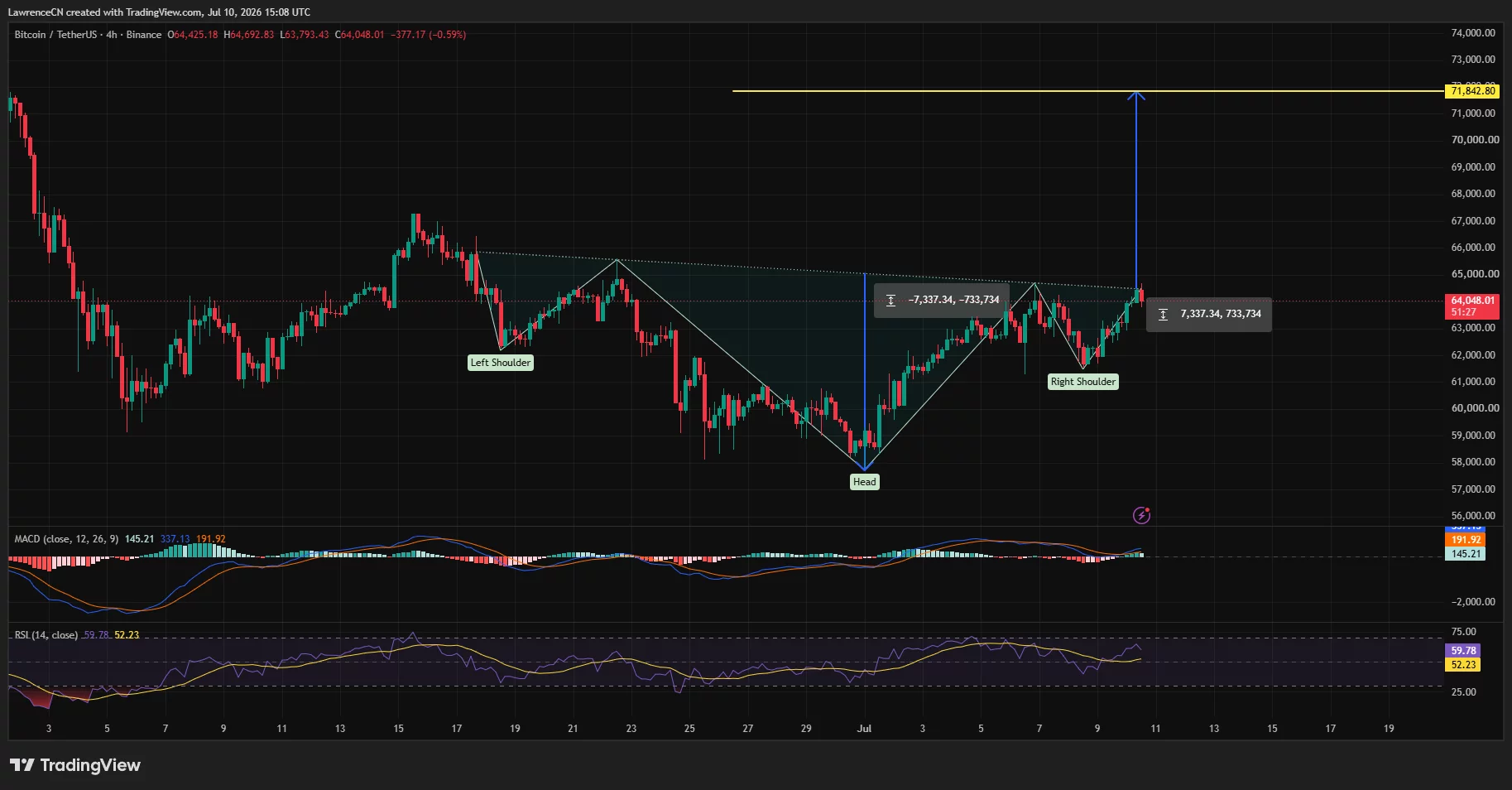
- An inverse head-and-shoulders breakout targets $71,800, while rejection at $65,000 could send BTC back toward $62,000.
According to data from crypto.news, Bitcoin (BTC) price rallied to an intraday high of $64,400 on Friday, up 2.65% on the day, while the total cryptocurrency market capitalization rose 2.17% to $2.21 trillion. Ethereum recovered toward $1,800, XRP held above a major support level, and Dogecoin also advanced as traders rotated back into higher-risk assets following Trump’s comments.
At the same time, activity in the derivatives market accelerated. Bitcoin futures trading volume increased 3.83% to $51.59 billion, while open interest climbed 4% to $48.16 billion, suggesting fresh capital entered leveraged positions rather than short covering alone. Options activity expanded even faster, with volume jumping 27.23% to $2.81 billion as traders positioned for a potential move beyond the closely watched $65,000 barrier.
Bitcoin price tests neckline breakout as derivatives activity builds
The technical structure has also improved after Bitcoin completed an inverse head-and-shoulders pattern on the 4-hour chart. Price has returned to the neckline near $64,500-$65,000, a level that has repeatedly capped rallies during the past several weeks. A confirmed breakout would project an upside target near $71,800, based on the measured move from the pattern.
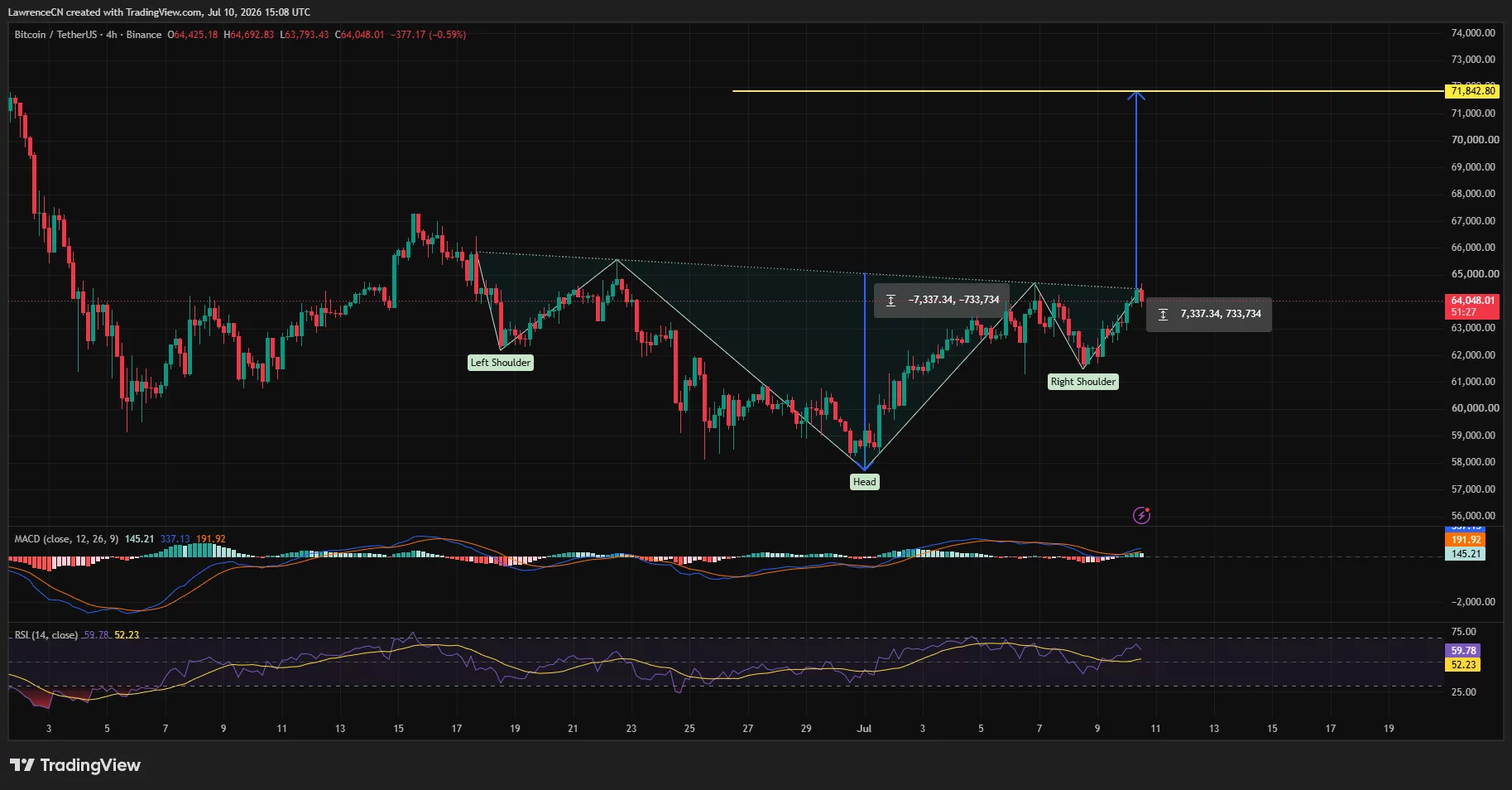
Momentum indicators continue to favor buyers without showing extreme conditions. The four-hour RSI sits near 60, leaving room for additional gains before entering overbought territory. Meanwhile, the MACD has crossed above its signal line, and the histogram remains in positive territory, supporting the current recovery attempt.
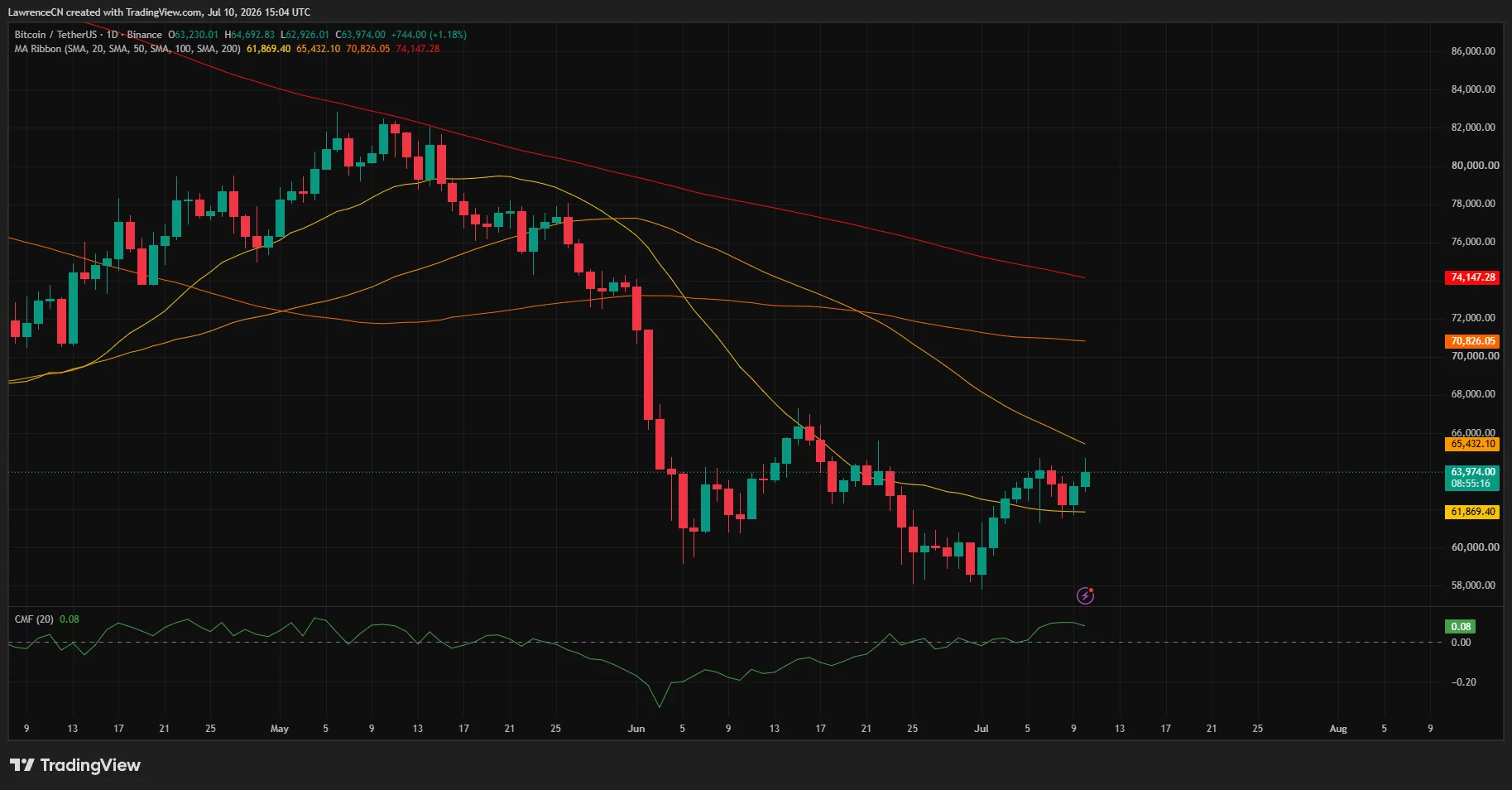
The daily chart also shows Bitcoin reclaiming its 20-day simple moving average near $61,870 after spending several sessions below it. Price now sits between the 20-day and 50-day moving averages, with the 50-day SMA around $65,430 serving as the next technical hurdle. Longer-term resistance remains concentrated near the 100-day and 200-day moving averages around $70,800 and $74,100, respectively.
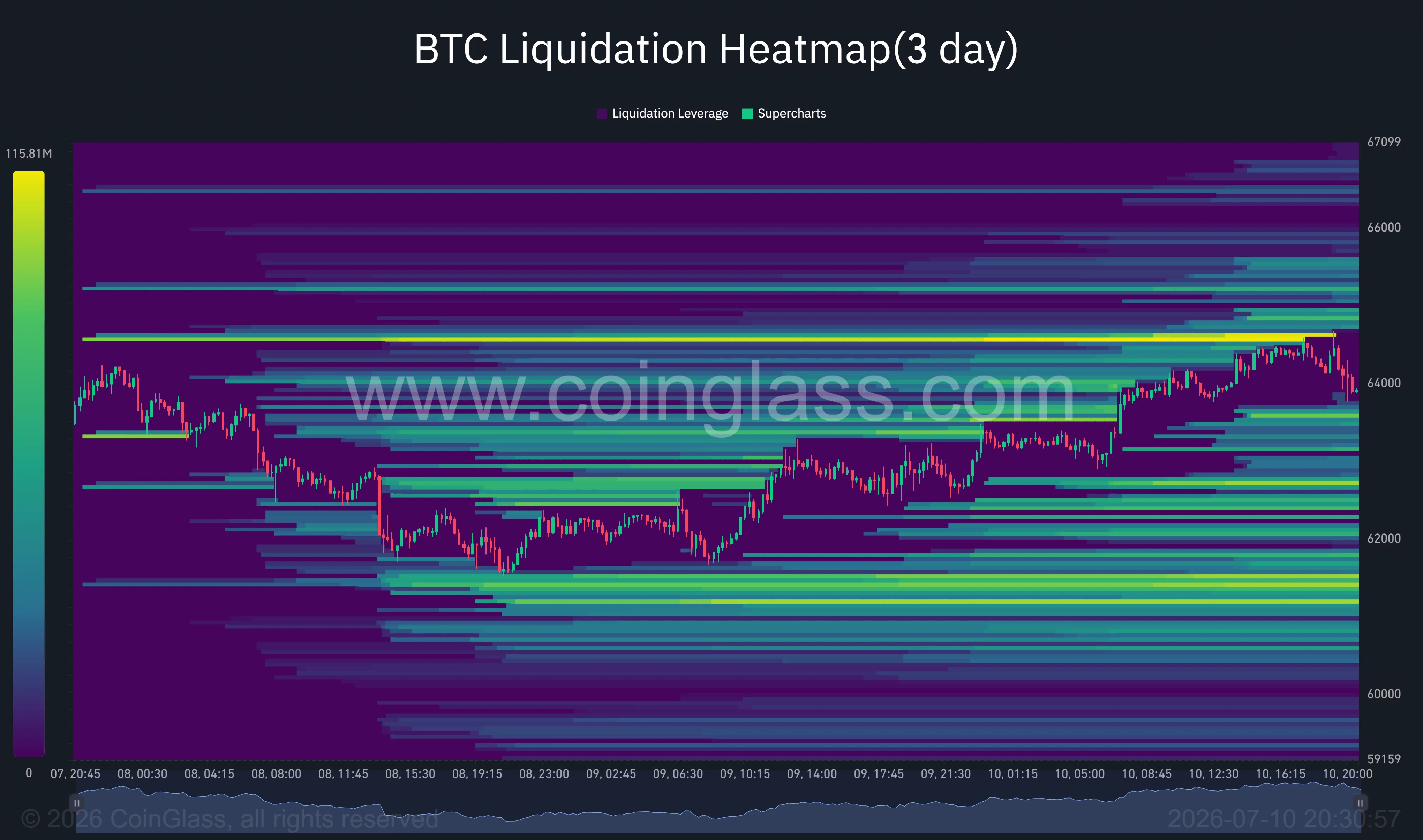
Liquidation data from CoinGlass highlights another obstacle. The largest cluster of short liquidations sits between roughly $64,800 and $65,200, where leverage has accumulated over the past three days. A decisive move through that zone could trigger forced buying and accelerate Bitcoin toward the next liquidity pockets above $66,000.
Market analysts have also focused on the same resistance region. According to analyst Ted Pillows, “Bitcoin is right at its resistance level. And the major concern is weak spot demand. If buyers step in here, Bitcoin could see a decent breakout and rally next.”
A similar view came from analyst Michaël van de Poppe, who expects the recent recovery to continue if buyers defend current levels.
“There’s more strength coming in on $BTC. That’s a great move and I don’t expect to see the markets falling here. Continuation over the coming 1-2 weeks would mean that we’re seeing a run to $70k+ happening and that would strengthen the thesis that the bottom is relatively here.”
Failure at $65K would expose lower support levels again
Despite the improving setup, Bitcoin still faces several risks before confirming a sustained breakout. The $64,500-$65,500 area combines horizontal resistance, the 50-day moving average, and a heavy concentration of leveraged positions. Failure to clear that zone could encourage profit-taking after the recent rebound.
Support begins near $63,000, followed by the $62,000 region identified by several technical analysts. A break below those levels would invalidate the inverse head-and-shoulders pattern and shift attention back toward the late-June lows near $58,000.
Any renewed escalation in Middle East tensions, stronger-than-expected U.S. economic data that revives Federal Reserve tightening expectations, or a reversal in risk sentiment across equity markets could also pressure Bitcoin before bulls have a chance to challenge the next resistance zone.
Disclosure: This article does not represent investment advice. The content and materials featured on this page are for educational purposes only.


The Federal Reserve has named Andreessen Horowitz co-founder Marc Andreessen to help lead a task force studying artificial intelligence, productivity and employment.
Summary
- Marc Andreessen will co-lead a Federal Reserve task force examining AI, productivity and American employment.
- Stanford economist Charles Jones and Microsoft executive Asha Sharma will serve alongside Andreessen on the panel.
- The review comes as Fed officials debate whether AI will ease inflation or raise costs.
The Federal Reserve announced the appointment on July 9. The panel forms part of Fed Chair Kevin Warsh’s broader review of how the central bank makes monetary policy decisions.
Andreessen will serve on the Productivity and Jobs task force with Stanford University economist Charles I. Jones and Microsoft executive Asha Sharma.
Jones is currently on leave from Stanford while working at AI company Anthropic. Sharma serves as Microsoft’s executive vice president and Xbox CEO. Their panel will assess how general-purpose technologies, including AI, affect economic output and jobs.
The group will receive support from Federal Reserve staff but operate independently. It will provide research and feedback to the Federal Open Market Committee, which sets U.S. interest rates.
Warsh said each panel would examine whether the Fed could improve its analytical tools and policy methods.
“The goal is straightforward: to ensure the Fed is best positioned to achieve our objectives,” he said.
Andreessen co-founded a16z, a venture capital company that has invested heavily in artificial intelligence, crypto, fintech and software. His appointment gives a technology investor a formal role in the Fed’s review, although the panel will not set interest rates.
Five task forces review Fed policy
The Productivity and Jobs group is one of five task forces created under Warsh. The other panels will examine communication, balance-sheet policy, economic data and inflation frameworks.
The communications panel will study how the Fed explains decisions during uncertain economic periods. A separate balance-sheet team will assess the costs and benefits of the central bank’s current asset holdings.
Meanwhile, the data panel will study how the Fed can receive faster and more reliable economic signals. The inflation group will review how policymakers measure and respond to the causes of rising prices.
Warsh first announced the review after the Fed’s June meeting. As previously reported by crypto.news, he said the groups could begin work within weeks and provide early findings during the fall.
The Fed has not published a final deadline for the task forces. It said further details about their work would appear periodically.
Fed officials debate AI’s economic role
The review comes as policymakers assess whether AI will reduce inflation through higher productivity or raise prices through heavy infrastructure spending.
Federal Reserve Governor Lisa Cook said in a May speech on AI and the economy that the technology could raise productivity and support stronger economic growth. However, she also warned that rapid investment and labor-market changes could create inflation risks.
Former Fed Chair Jerome Powell raised similar doubts in March. He said data center construction was putting pressure on goods and services and was “probably pushing inflation up at the margin.”
The two effects may occur at different times. Spending on chips, electricity and data centers can increase costs in the near term. Later productivity gains could allow companies to produce more with fewer resources.
As reported by crypto.news, Cathie Wood expects productivity growth to reduce inflation. She argued that stronger output per worker could lower unit labor costs even when the economy continues growing.
AI policy could matter for crypto markets
The task force does not have a direct crypto mandate. However, the Fed’s conclusions on productivity, inflation and employment could influence interest-rate decisions that affect Bitcoin and other risk assets.
Higher rates often increase demand for cash and government debt while reducing investor demand for volatile assets. Lower rates can improve liquidity conditions, although crypto prices also respond to regulation, market flows and wider economic risks.
Andreessen’s firm has backed several crypto companies through its a16z crypto division. Still, the Fed described his new position as part of a broad technology review rather than a role focused on digital assets.


Lawmakers have intensified calls for an investigation into President Donald Trump’s cryptocurrency holdings as the Senate prepares to advance the CLARITY Act.
Summary
- Elizabeth Warren and four Senate Democrats have called for hearings into Trump’s crypto holdings before the CLARITY Act advances.
- Democrats argue Trump’s reported $1.4 billion in crypto income raises conflict-of-interest concerns and want ethics rules added to the bill.
- Senate negotiators continue revising the CLARITY Act as debates over DeFi rules, developer protections, and regulator appointments persist.
According to a joint statement from Democratic senators, ranking members from five Senate committees have asked Congress to hold hearings into the national security implications of President Trump’s crypto business interests, arguing that his financial disclosures raise new questions just as lawmakers finalize legislation that would reshape U.S. digital asset regulation.
The statement was signed by Senators Elizabeth Warren, Richard Blumenthal, Gary Peters, Dick Durbin, and Ron Wyden. Citing Trump’s latest financial disclosure, the lawmakers said the president’s family crypto ventures generated roughly $1.4 billion in income and argued that unidentified third parties continue to hold stakes in the Trump family’s World Liberty Financial project.
They contended that these financial interests warrant closer scrutiny before Congress moves ahead with the CLARITY Act.
Democratic lawmakers also argued that the disclosures raise concerns over the administration’s support for crypto legislation while simultaneously pursuing regulatory changes affecting the industry. According to the senators, those concerns extend to efforts they say would exempt parts of the crypto sector from existing financial rules and weaken enforcement measures.
Ethics provisions remain a sticking point
Separately, Senator Elizabeth Warren renewed her call for ethics restrictions within the CLARITY Act. In a post on X, Warren argued that the legislation should prohibit the president, vice president, members of Congress, senior administration officials, and their immediate families from profiting from cryptocurrency ventures while serving in public office.
She described Trump’s crypto business interests as corruption and said Congress has a responsibility to prevent conflicts of interest through the legislation.
Trump has previously dismissed criticism surrounding the disclosures, saying he was unaware of the reported crypto income and maintaining that there was nothing illegal about the earnings.
The ethics debate has emerged as Senate negotiators prepare an updated version of the CLARITY Act that combines proposals from the Senate Banking and Agriculture committees. According to earlier reporting, the consolidated draft is expected to exceed 70 pages and include stronger consumer protection provisions alongside changes negotiated in recent weeks.
The Senate is targeting floor consideration during the week of July 20, leaving lawmakers with limited time before the chamber’s August recess.
Senate negotiations continue amid regulatory disputes
At the same time, negotiations over the legislation continue beyond ethics provisions. Law enforcement organizations have argued that language governing decentralized finance could make investigations into illicit finance more difficult, adding another issue for senators to resolve before any floor vote.
Senator Ron Wyden has also urged Senate leaders to preserve Section 604, known as the Blockchain Regulatory Certainty Act, arguing in a letter to Majority Leader John Thune and Democratic Leader Chuck Schumer that legal protections for non-custodial blockchain developers should remain in the final bill.
Meanwhile, the White House has rejected accusations that it is refusing to nominate Democratic commissioners to the Securities and Exchange Commission and Commodity Futures Trading Commission.
In a letter to Thune and Schumer, the administration said it had requested qualified Democratic nominees for both agencies but had not received any names, responding to criticism over vacant seats at regulators expected to oversee large portions of the crypto market if the CLARITY Act becomes law.
Another development came from the private sector, where Coinbase announced that Chief Legal Officer Paul Grewal will step down on July 31. His departure comes only days before the Senate is expected to resume work on the CLARITY Act, placing one of the crypto industry’s most prominent legal leadership changes alongside a pivotal period for U.S. digital asset legislation.

Bitcoin price remains constructive as it trades around $62,000 to $63,000, while Trump and crypto legislation continue to shape market expectations. Daily price action has been relatively calm, but developments in Washington could influence sentiment over the coming sessions. While volatility has eased, traders are watching whether policy headlines begin to outweigh macro drivers.
Five senior Senate Democrats publicly criticized President Donald Trump growing ties to the crypto industry. Elizabeth Warren, Richard Blumenthal, Gary Peters, Dick Durbin, and Ron Wyden argued that Trump’s reported crypto-related financial interests raise fresh conflict of interest concerns. They said those disclosures deserve closer scrutiny as Congress advances digital asset legislation.
Meanwhile, lawmakers are still negotiating key pieces of crypto legislation. Senate leaders have yet to release the final text of a broader market structure bill, while several policy issues remain unresolved. In the House, disagreements over unrelated measures have also slowed momentum, making the legislative timetable less certain.
Even so, markets have largely priced in expectations for regulatory progress. Investors continue watching for stablecoin legislation and a clearer market structure framework, both viewed as long-term positives for the industry. However, any meaningful delay could remove one of Bitcoin’s strongest near-term catalysts and leave prices more dependent on macroeconomic and liquidity trends.
Don’t Miss Out on Our $1,000 USDT Airdrop on ByBit
Can Bitcoin Reclaim $73,000 With Trump Crypto Headwinds Building?
Bitcoin climbed more than 6% this week, briefly trading around the $63,000 to $64,000 range before easing slightly. That leaves the recent breakout zone under the spotlight rather than in the rearview mirror. As long as buyers defend roughly $61,000 to $62,000, the trend stays constructive. Lose that area, and the market could suddenly remember where the exit is.
Market activity remains healthy, with daily crypto trading volume hovering around $80 billion. Bitcoin dominance is holding above 58%, showing that larger investors still prefer the market’s heavyweight instead of chasing every shiny new token. Meanwhile, Ethereum has outperformed on the week, while Solana continues to trade sideways, waiting for a reason to wake up.

The bullish case is straightforward. If lawmakers make tangible progress on digital asset legislation, Bitcoin could challenge the $65,000 region and test higher resistance. The market has a habit of reacting first and asking questions later when regulation turns friendlier.
The base case is less dramatic. Political wrangling could drag on without derailing the legislation, leaving Bitcoin stuck between roughly $61,000 and $65,000 for the next few weeks. It may not be exciting, but markets often spend more time catching their breath than sprinting.
The bearish scenario hinges on politics rather than charts. If bipartisan support fades and the legislation becomes another partisan battleground, sentiment could cool quickly. In that case, Bitcoin may revisit the upper $50,000s, where buyers would likely get another chance to prove they still mean business.
Discover: The Best Crypto to Diversify Your Portfolio
Maxi Doge Targets Early-Mover Upside as Bitcoin Tests Key Levels
Traders positioned in large-caps at current levels are essentially buying a policy lottery ticket, meaningful upside if the bill clears, limited near-term edge if it stalls. For traders who’ve already rotated profits from the BTC spike and are hunting asymmetric setups, the early-stage presale market is where that calculus shifts.
Maxi Doge ($MAXI) is a meme token built on Ethereum around a 240-lb canine mascot and a blunt trading philosophy, 1000x leverage mentality, gym-bro culture, and holder-only trading competitions with leaderboard rewards. It’s not trying to be infrastructure.
The presale is currently priced at $0.0002828, with $4.8 million raised to date. The project runs a dynamic APY staking mechanism, a Maxi Fund treasury for liquidity and partnerships, and a meme-first marketing engine designed to move fast in bull-market conditions.
The tagline is blunt: Never skip leg-day, never skip a pump. Research Maxi Doge here.
Discover: The Best Token Presales
The post Top Democrats Slam Trump Over Crypto Engagement appeared first on Cryptonews.


Bitcoin has climbed back above $64,000 after Standard Chartered reaffirmed its $100,000 year-end 2026 price target and argued that recent selling linked to Strategy has not weakened Bitcoin’s long-term outlook.
Summary
- Standard Chartered says Strategy-related concerns, not Bitcoin fundamentals, caused the recent market pullback.
- The bank has reaffirmed its $100,000 Bitcoin price target for the end of 2026 despite recent volatility.
- Wells Fargo increased its Strategy stake while trimming IBIT holdings and expanding its crypto options positions.
Standard Chartered said the recent decline in Bitcoin was driven more by uncertainty over Strategy’s changing treasury approach than by any deterioration in the cryptocurrency’s fundamentals.
In a research note, the bank maintained that the latest pullback should not be viewed as a sign that the longer-term bull case has changed.
Strategy’s treasury changes remain at the center of investor attention
According to Standard Chartered’s Global Head of Digital Assets Research, Geoff Kendrick, investors have largely misunderstood Strategy’s evolving use of its Bitcoin holdings. Rather than continuing to rely mainly on debt and equity issuance to accumulate Bitcoin, the company is increasingly using its treasury to support credit-focused products, including its perpetual preferred stock, STRC.
Standard Chartered said this development has altered how some investors interpret Strategy’s role in the Bitcoin market. The bank added that clearer communication around the company’s treasury plans could help reduce concerns over future Bitcoin sales.
In its report, Standard Chartered compared the importance of credible corporate commitments with the way central banks use consistent policy signals to build market confidence.
Earlier this year, Strategy’s Bitcoin sale triggered a sharp market reaction after investors questioned whether the company might continue reducing its holdings. According to the report, the announcement contributed to Bitcoin falling from around $80,000 to nearly $60,000, while Strategy shares and STRC also declined as investor confidence weakened.
Even during that period, however, Standard Chartered kept its forecast that Bitcoin could reach $100,000 by the end of 2026, arguing that the market had overreacted to uncertainty surrounding Strategy rather than changes in Bitcoin itself.
Institutional positioning continues to evolve
As Bitcoin recovered to trade near $64,500, institutional investors also adjusted their exposure to Strategy and crypto investment products.
As previously reported by crypto.news, Wells Fargo disclosed in its latest filing with the U.S. Securities and Exchange Commission that it increased its holding in Strategy by 125%, lifting its position to nearly 726,000 shares after adding about $41.5 million in exposure.
The same filing also showed that Wells Fargo reduced its position in BlackRock’s iShares Bitcoin Trust by 75,102 shares compared with the previous quarter.
At the same time, the bank opened a new IBIT call position and expanded its put exposure during a period of elevated market uncertainty tied to the U.S.-Iran conflict, indicating a more balanced options strategy instead of relying solely on spot ETF holdings.
Beyond Bitcoin-related investments, the SEC filing showed that Wells Fargo also increased its exposure to Ethereum- and Solana-linked products, suggesting continued institutional participation across multiple digital asset markets despite recent volatility.
Standard Chartered argued that if Strategy succeeds in explaining how its treasury model is changing, concerns about additional Bitcoin sales could ease further. With Bitcoin trading back above the $64,000 level while the bank maintains its long-term forecast, the report said investor confidence could continue improving as uncertainty around Strategy’s financing strategy fades.


Vitalik Buterin has called on Elon Musk to reshape X into a platform where ordinary users can help coordinate global AI governance instead of leaving key decisions to governments and large institutions.
Summary
- Vitalik Buterin urged Elon Musk to turn X into a platform for global AI governance coordination.
- Buterin proposed predefined AI slowdown triggers while backing open participation over centralized control.
- The proposal comes as SpaceXAI prepares Grok 4.5 and OpenAI readies GPT-5.6 for release.
According to a July 11 thread published by Ethereum co-founder Vitalik Buterin on X, the social media platform could become a place where people participate in major AI policy discussions through open coordination rather than relying solely on governments, major AI laboratories, or nonprofit organizations.
X could become a coordination layer for AI policy
In the thread, Buterin argued that X is well positioned to help people negotiate what he described as “grand win-win deals” on AI governance. Addressing Musk directly, he wrote that if he were running the platform, he would redesign it to help identify agreements that give more people influence over decisions instead of concentrating power among governments, technology companies, and leading institutions.
The proposal builds on ideas Buterin has discussed before. In earlier posts, he praised X’s Community Notes system and prediction markets as two of the most important social technologies for improving public knowledge.
At the same time, he has also warned that the platform could become a tool for coordinated harassment if its incentives move in the wrong direction, making governance changes increasingly important in his view.
Buterin’s proposal comes as the AI race accelerates after SpaceXAI released Grok 4.5 and OpenAI rolled out GPT-5.6. Ahead of Grok 4.5’s public launch, Musk described it on X as an “Opus-class model” that is faster, more token-efficient, and lower cost following positive beta feedback.
Crypto tools could benefit if X adopts the model
Beyond proposing changes to X, Buterin outlined what he sees as the biggest disagreement in the AI debate. According to his post, one group believes artificial superintelligence could emerge around 2040 unless development slows dramatically, while another treats AI as a continuation of previous technological progress and dismisses warnings about existential risks and centralized control.
Although Buterin said he remains uncertain about AI timelines, he argued in favor of establishing predefined conditions that could temporarily slow AI development. His examples included the emergence of super-pandemics, unemployment rising above 25%, or autonomous lethal drones becoming widely deployed.
Those proposals are consistent with Buterin’s defensive acceleration, or d/acc, framework, which prioritizes technologies such as cryptography, formal verification, secure open hardware, pandemic preparedness, and stronger public information systems. The same philosophy has also influenced Ethereum’s technical roadmap, where Buterin has repeatedly supported privacy-focused infrastructure through what has become known as the Lean Ethereum vision.
For crypto markets, Buterin’s proposal points toward a larger role for decentralized infrastructure if X evolves into a coordination platform. Prediction markets could be used to verify whether agreed AI trigger events have occurred, while zero-knowledge technologies and on-chain governance systems could receive additional attention if institutions adopt more transparent decision-making processes.
Even so, Buterin stopped short of calling for new AI regulation. Instead, his thread argued for coordination between participants with different views, presenting a framework that attempts to balance open participation with safeguards against high-risk AI outcomes.


The stablecoin market has lost about $10 billion since reaching a record high in May 2026. Total supply fell by $7.7 billion during June to about $312 billion, marking the largest monthly decline in dollar terms since the TerraUSD collapse in May 2022. The decrease equaled roughly 2.4% for June and about 3% from the May peak.
Summary
- Stablecoin supply lost $10 billion since May as USDT and USDC redemptions reduced crypto liquidity.
- June recorded the largest monthly dollar decline since Terra, but the market contracted only 3%.
- Transaction volumes remained strong while tokenized assets expanded, showing blockchain finance activity continued despite redemptions.
Current DefiLlama data places the market near $312.23 billion. The dashboard shows Tether’s USDT at about $184.15 billion and Circle’s USDC at roughly $73.41 billion. USDT still controls close to 59% of the market, leaving the sector heavily dependent on its two largest dollar-backed tokens.
USDT and USDC lead the supply reduction
USDT fell from about $190 billion in May, cutting roughly $6 billion from its circulating value. USDC declined from a March peak near $80 billion, losing almost $7 billion over four months. Together, those changes account for most of the retreat, although smaller regulated issuers continued expanding during the same period.
Paul Howard, senior director at trading firm Wincent, described the decline as “a relatively small pullback in what we believe is a long-term growth market.” The current drawdown remains far below the 26% stablecoin contraction recorded across the 2022 bear market. That earlier decline followed the Terra failure, lender collapses, and the failure of FTX.
Lower supply points to thinner crypto liquidity
Traders use stablecoins as settlement assets and quote currencies across exchanges and decentralized markets. A falling supply can show that users redeemed tokens for bank dollars or moved capital outside crypto. It can also reduce the amount of dollar-linked buying power available for Bitcoin, Ether, and other digital assets.
The reduction arrived during a weak month for crypto investment products.Crypto.news reported that U.S. spot Bitcoin exchange-traded funds lost more than $4 billion in June, their worst monthly outflow since launch. The parallel declines show that institutional fund demand and on-chain dollar liquidity both weakened as digital asset prices remained under pressure.
Activity did not fall at the same pace as supply. The adjusted stablecoin transaction volume reached a record $1.78 trillion in June. USDC processed about $1.21 trillion, while USDT handled $573 billion. USDT still recorded more individual transfers, showing that fewer tokens can continue supporting heavy payment and trading activity.
Tokenized assets grow while stablecoins retreat
Tokenized real-world assets moved in the opposite direction. However, their on-chain value crossed $30 billion during 2026, led by tokenized Treasury products, funds, and private credit. CoinDesk Research also recorded a 145% rise in tokenized equity volume during June to a record $3.86 billion.
Regulation and new issuers continue reshaping the stablecoin market. The U.S. GENIUS Act created a federal framework for payment stablecoins, while regulators are drafting customer identification, sanctions, and reserve rules. Crypto.news has also tracked new reserve products from Fidelity and State Street designed for regulated issuers.
The latest supply figures point to a pause in market expansion rather than a Terra-style collapse. USDT and USDC remain near their dollar pegs, transaction activity remains high, and the total market retains most of its recent growth. Further monthly contractions would provide clearer evidence that crypto liquidity is leaving the system rather than moving between issuers or on-chain products.
Investors will now watch July issuance, redemption data, exchange volumes, and ETF flows for signs that demand is returning or weakening further.

What is OTC trading in crypto? How whales buy big

Nolan Xavier Wells’ Friends Share Tributes Following His Death

Juan Gomez de Liano hopeful for another Gilas call-up


-

 Fashion6 days ago
Open Thread: What Great Books Have You Read Recently?
-

 News Videos6 days ago
Whats Hidden Inside This Cash Register? #treasure #reselling #money
-

 Fashion3 days ago
Loro Piana Fall 2026 Enters Houston’s Art Scene
-

 Fashion2 days ago
Weekend Open Thread: Nutriplenish Leave-In Conditioner
-
 Tech5 days ago
Anthropic’s new “J-lens” reveals a silent workspace inside Claude that mirrors a leading theory of consciousness
-

 Crypto World6 days ago
$1,000 Credit Alert! BlockDAG X Exchange Pre-Registration Now Officially Open, Polkadot Dips & Zcash Rebounds
-

 Business6 days ago
AXT Shares Jump Nearly 14% as Semiconductor Materials Maker Rebounds on AI-Linked Indium Phosphide Demand
-

 Sports5 days ago
Joshua Pacio ‘more complete’ ahead of ONE rematch vs Malachiev
-
 Sports3 days ago
2026 Genesis Scottish Open Thursday TV coverage: Round 1
-

 News Videos6 days ago
Best Time to Enter Small Caps Right Now? Another Bull Run? | Financially Free
-
 Crypto World6 days ago
SK hynix (000660.KS) Stock Dips as $28B Nasdaq ADR Offering Drives AI Memory Expansion
-

 Tech5 days ago
Anthropic brings Claude Cowork to mobile and web as usage data shows most users aren’t coding
-

 News Videos6 days ago
Avoid entering in FOMO #bitcoin #cryptocurrency #trading #scalping
-

 Sports2 days ago
Super Eagles star Moses Simon opens up on Liverpool transfer regret
-
Sports5 days ago
We have punished the disrespect
-

 Crypto World6 days ago
Binance lists Strategy’s STRC stock as company expands Bitcoin funding
-

 Tech3 days ago
Character.AI enters the microdrama arena with its own productions, but there’s a twist
-

 Tech6 days ago
9 Best Keyboards (2025), Tested and Reviewed
-

 Business6 days ago
Enbridge: AI Tailwind Priced In (Rating Downgrade)
-

 News Videos5 days ago
“What’s going on?!” Carl Froch discusses Floyd Mayweather Jr financial issues
You must be logged in to post a comment Login