
Crypto World
What is Robinhood Chain? The broker’s L2 explained



Robinhood launched its own blockchain in July 2026, an Ethereum layer 2 where tokenized stocks trade around the clock and plug into DeFi as collateral. This guide explains what Robinhood Chain actually is, how it works under the hood, what Stock Tokens are and who can use them, how the chain differs from Base and the other corporate networks, and what it means for users, builders, and the industry’s biggest open questions.
On July 1, 2026, one of the largest retail brokers in the United States switched on its own blockchain. Robinhood Chain launched its public mainnet at a London keynote, carrying 95 tokenized stocks that trade 24 hours a day, a suite of DeFi protocols live from day one, and access wired directly into the Robinhood Wallet used across 120 countries. Within a week the chain had processed roughly 4 million transactions, gathered over $240 million in deposits, and produced a launch statistic, $570 million of day-one volume against $21.68 million of liquidity, that made the entire industry look twice.
A brokerage running a blockchain would have sounded absurd for most of crypto’s history, and it now sounds inevitable: Coinbase runs Base, Stripe backs Tempo, and the era of consumer giants renting neutral rails is visibly ending. But Robinhood Chain is a distinct species within that trend, because it was built around one specific product no other chain ships: real-world equities as native, composable on-chain assets, the thing crypto has promised since the first tokenized-stock experiments and never delivered at brokerage scale.
This guide explains the chain from the ground up: what it technically is and how the Arbitrum-based architecture works, what Stock Tokens are and what holders actually get, the DeFi ecosystem that launched with it and why composability is the entire point, who can access what and where the regulatory lines sit, how the chain compares to Base and the corporate-chain field, the fee economics including the unusual revenue-sharing deal with Arbitrum, and the honest open questions, control, liquidity, and law, that will decide what the chain becomes.
The architecture: an Ethereum layer 2, built to order
Robinhood Chain is a layer 2 blockchain: a network that executes transactions on its own fast, cheap environment while posting records to Ethereum, inheriting the base chain’s security for its history. It is built using Arbitrum’s Orbit technology, the chains-as-a-service framework from the team behind Arbitrum One, which means Robinhood did not invent a blockchain so much as commission one: Orbit supplies the rollup machinery, proofs, data posting, Ethereum settlement, and Robinhood configures the network, operates its infrastructure, and decides what it is for.
Three design choices define it. First, it is permissionless: any developer can deploy contracts using standard Ethereum tooling, without Robinhood’s approval, which is why an uninvited memecoin economy appeared on day one and why first-tier DeFi protocols could arrive at launch. That openness distinguishes it sharply from the private bank chains of the last decade and puts it in the same public-network category as Base. Second, it is EVM-compatible: everything built for Ethereum ports over directly, wallets, contracts, developer tools, so the chain starts with the industry’s entire software ecosystem instead of an empty room. Third, it is purpose-tuned for real-world assets: fast block times via Alchemy infrastructure, Chainlink as the official oracle for prices, cross-chain messaging, and proof-of-reserve on Robinhood-issued assets, and BitGo integration on the custody side, the specific plumbing tokenized equities require and general-purpose chains bolt on as afterthoughts.
The trust profile follows from the architecture, and it is the standard corporate-chain bargain. User funds are secured by Ethereum: the sequencer that orders transactions cannot forge them or steal assets, and the chain’s history settles to the base layer. Access and ordering, though, run through infrastructure Robinhood operates, the centralized-sequencer chokepoint every major rollup currently carries, which means outages, ordering policy, and censorship capacity sit with one regulated company. For everyday users the distinction rarely surfaces; for anyone evaluating the chain seriously, it is the first line of the risk section.
Stock Tokens: the product the chain was built around
The headline asset class is Stock Tokens: on-chain representations of equities, NVDA, GOOG, AAPL among the 95 at launch, issued by Robinhood, priced by Chainlink feeds, and tradable every hour of every day, not just during exchange sessions. They are the chain’s reason for existing, and understanding precisely what they are, and are not, is the guide’s most practical section.
A Stock Token delivers price exposure to the underlying equity in a token that behaves like any other crypto asset: hold it in the Robinhood Wallet or self-custody, trade it around the clock on the chain’s exchanges, transfer it, and, most consequentially, use it inside DeFi. What it does not deliver is shareholder status: token holders do not vote, and corporate rights stay with the issuance structure, with dividend economics passed through per the product’s terms, the standard trade-off of every tokenized-equity model. The tokens descend from Robinhood’s 2025 European pilots, which tokenized exposure to private names like SpaceX and OpenAI as proof of concept, and the lineage matters: the legal wrappers were tested under European rules before the chain bet on them.
Availability is the sharpest edge. Stock Tokens ship through the Robinhood Wallet in more than 120 countries, and conspicuously not to United States users, where the line between a compliant synthetic instrument and an unregistered security remains undrawn. The result is one of the strangest compliance objects in crypto: a permissionless network, built by an American broker, whose flagship assets are geofenced away from Americans, with enforcement living at the issuance and app layers while the rails underneath stay open. Whether that architecture satisfies regulators, or attracts them, is among the chain’s defining open questions.
The 24/7 dimension carries its own mechanics worth knowing. When the underlying stock market is closed, nights, weekends, holidays, the tokens keep trading, drifting on expectation with no live reference price, then reconverging when the real market opens. Weekend token prices function as forecasts of Monday’s open, gaps can be violent when news breaks during the closure, and anyone using the tokens in leveraged or collateralized positions inherits that gap risk in full.
The DeFi layer: why composability is the point
Tokenized stocks existed before Robinhood Chain. What the chain adds, and what its launch ecosystem was assembled to prove, is composability: the tokens plug into open financial protocols as first-class assets, which converts a brokerage line item into a programmable building block.
The day-one roster was deliberately first-tier. Uniswap deployed a dedicated AMM as the chain’s core public liquidity venue; Arcus, built by the team behind dYdX, runs a zero-fee exchange purpose-built for the stock tokens; 1inch, Rialto, and Lighter round out trading, with Lighter adding perpetual futures and pledging $11 million of its token to Robinhood users; Pleiades operates a proprietary market-making AMM; and Morpho’s lending markets opened the loop that matters most: stock tokens as loan collateral. That last integration is the chain’s genuinely novel product, a holder borrowing stablecoins against tokenized NVDA, automatically, no paperwork, with liquidation machinery enforcing the loan against oracle prices, and it is also the chain’s most delicate engineering: equity collateral marked by feeds from a market that closes means health factors computed against stale or reconstructed prices for two-thirds of every week, gap-risk liquidations at Monday opens, and corporate-action handling no DeFi risk framework has stress-tested at scale.
The deposits that flowed in during week one, past $240 million, concentrated in exactly these venues, drawn by a 7% yield incentive and points programs, and the composition question, how much collateral is actually stock tokens versus recycled farm assets, is the single best indicator of whether the composability thesis is converting, the launch-week forensics this publication’s feature examined in depth.
Using the chain: access, wallets, and what a first session looks like
For a user, the chain’s front door is the Robinhood Wallet, the company’s self-custody app, which added native Robinhood Chain support at launch: bridging assets in from Ethereum and other networks, swapping tokens, and reaching the chain’s applications happen from inside an interface tens of millions of people already carry. That distribution is the launch’s real innovation, one tap from an existing consumer app to an on-chain economy, no seed-phrase ceremony, no network-configuration ritual, and it is why the chain gathered users at a pace organic launches never match.
Nothing about the chain requires Robinhood’s app, though, and the permissionless design means the standard crypto path works identically: add the network to any EVM wallet, bridge funds across, and interact with the protocols directly. A typical first session looks like any L2’s, bridge a stablecoin or ETH, pay negligible fees, swap or deposit into a venue, with two chain-specific wrinkles worth knowing in advance. The first is that asset availability depends on who you are and where: the DeFi protocols and general tokens are open, while Stock Tokens and certain products check jurisdiction at the issuance and interface layers, so two users on the same chain can see different shelves. The second is incentives literacy: the launch period’s yields and points programs are bootstrap subsidies with published terms and step-down schedules, and treating them as permanent rates is the classic new-chain mistake, since incentive-driven deposits reprice the day the programs do.
Builders face an even lower bar: the chain is standard EVM, deploys with familiar tooling, and offers what no other network can, proximity to a brokerage user base and an asset class, the stock tokens, that exists nowhere else as a composable primitive. The day-one protocol roster arrived for exactly that reason, and the open question for every subsequent builder is the same one the chain itself faces: whether the mission assets acquire the liquidity that makes building against them worthwhile.
The launch by the numbers, and how to read them
The chain’s opening week produced statistics worth recording precisely, because they will be the baseline every future assessment measures against. Day-one volume of $570 million against $21.68 million of total value locked, a 26-to-1 turnover ratio without precedent at scale, driven overwhelmingly by speculative memecoin trading rather than the stock tokens the chain was built for. Roughly 4 million transactions in the first week against about $57,000 of protocol revenue, deliberately subsidized throughput. Deposits growing past $240 million within days, concentrated in Morpho and Ethena strategies farming a 7% incentive. And an 8% rally in HOOD stock on launch, the equity market pricing the option the chain represents.
Read together, the numbers say the launch proved distribution and deferred everything else: the crowd arrived instantly, the crowd was the wrong crowd by the mission’s definition, and the company visibly did not mind, because speculative bootstrap is how every successful chain, Base included, actually started. The figures to watch from here are the boring ones, stock-token volume as a share of activity, collateral composition in the lending markets, deposit retention through incentive step-downs, and they will decide, over quarters rather than weeks, whether the launch statistics were a foundation or a fireworks show.
Fees, economics, and the Arbitrum deal
The chain’s business model is subsidy now, franchise later. Transaction fees are deliberately negligible, roughly $57,000 of protocol revenue against the first week’s 4 million transactions, because the chain is priced as customer acquisition: Robinhood monetizes the surrounding stack, wallet, custody, order flow, spreads, and the eventual financialization of assets its 28 million customers already hold. The structure echoes the company’s zero-commission brokerage playbook precisely.
The launch’s most consequential economic detail belongs to someone else: 10% of Robinhood Chain’s fees flow to the Arbitrum ecosystem, with 8% going directly to the treasury controlled by ARB token holders, confirmation that sent ARB up double digits. The deal matters twice over: it prices Orbit’s chains-as-a-service model with its biggest customer to date, and it sets the template every future corporate chain will negotiate against, the sell-shovels economics underneath the land grab, whose full competitive map this publication has drawn.
One further piece of the economics deserves its own paragraph because it inverts the usual chain-token question: Robinhood Chain has no token, and the company has signaled nothing about one. The network’s fees are paid in ETH-denominated gas, its incentives are paid in dollars and partner tokens, and the value the chain generates is designed to accrue to HOOD equity through the brokerage’s ordinary lines rather than to a new crypto asset. The choice is strategically legible, a token would add regulatory surface exactly where the company has least room, and it makes the chain a useful natural experiment: the corporate-chain model’s economics, tested without the token variable that confounds every other network’s numbers. It also concentrates the ecosystem’s token exposure in unexpected places, ARB through the fee-sharing deal, and the partner protocols’ tokens through their deployments, which is why the launch’s clearest market beneficiaries were assets Robinhood does not issue.
How it compares: Robinhood Chain versus the field
Against Base, the reigning corporate chain, the comparison clarifies both. Base is a general-purpose network that grew an economy organically, memecoins first, then consumer apps, then everything, monetized through sequencer margin at enormous scale; its differentiation is Coinbase’s distribution applied to an open playground. Robinhood Chain is a product-led network: the stock tokens are the anchor tenant, the DeFi roster was recruited around them, and the bet is that one asset class nobody else ships outruns a general platform’s breadth. Base runs on the OP Stack, Robinhood on Arbitrum Orbit, a meaningful choice mostly for the fee-sharing counterparty and the proving roadmap. Against Tempo, Stripe’s payments-first chain, the contrast is anchor product again, payments versus equities, and against the neutral L1s both compete with, the corporate chains share the same offer and the same objection: distribution no neutral chain can match, control no neutral chain would accept.
Where the chain came from: the two-year assembly
The launch’s polish reflects deliberate sequencing worth knowing, because it explains both the chain’s capabilities and its ambitions. Robinhood spent 2025 acquiring the pieces: Bitstamp, one of the oldest crypto exchanges, for trading and institutional infrastructure; WonderFi for Canadian licensing; and the European tokenized-equity pilots, including exposure products on private names like SpaceX and OpenAI, as legal and product rehearsal. Early 2026 brought the quiet phase: a public testnet from February that processed millions of transactions, and the European expansion of crypto perpetuals that became one of the company’s fastest-growing lines. The July launch composed the pieces into one architecture, assets tokenized on its own network, traded through its own wallet and partnered venues, financed through integrated lending, custodied through its own stack, and the composition, more than any single component, is the product: a vertically integrated on-chain brokerage, with each layer feeding the others.
The assembly also explains the chain’s geography. The launch happened in London, the stock tokens ship internationally first, and the European perps expansion runs under MiCA-era rules, because the regulatory groundwork was laid where frameworks exist. The United States, the company’s home market, receives the chain, the wallet, and the crypto products, and waits on the equity tokens until American classification law settles, a sequencing that reads as strange until it reads as strategy: build the global product under workable rules, and let the home market’s framework catch up to a working precedent instead of a proposal.
The honest open questions
Three questions will decide what the chain becomes, and none is answerable yet. Control: a permissionless network whose sequencing, issuance, and flagship interface all route through one regulated broker is decentralized at exactly one layer, and the pressure point regulators or litigants would reach for first is obvious. Liquidity: 24/7 equity trading and stock-collateral lending are only as real as their depth, and week-one depth in the mission assets was thin against the speculative noise; the products exist as listings and must become markets. And law: the geofence paradox, the CLARITY-era classification of the tokens, and the first serious corporate action or exploit on tokenized equities are all uncharted, and each is capable of reshaping the chain’s product overnight.
What is not in question is significance. A top American broker building a public blockchain around real-world assets, and populating it with DeFi’s first tier on day one, is the clearest single marker yet of traditional finance and crypto converging on shared rails, and whichever way the open questions resolve, the experiment’s data, on tokenized-equity demand, on corporate-chain economics, on regulated assets in permissionless systems, will shape what every institution builds next.
A short reader’s guide to following the chain closes the picture, because the story is young and the sources are all public. The chain’s explorer and the standard TVL dashboards carry the activity and deposit series; the incentive programs publish their terms and step-down dates; the stock-token venues report the volumes that measure the mission; and Robinhood’s quarterly disclosures will, over time, reveal what the company chooses to say about economics it is currently subsidizing in silence. The corporate-chain era is being decided by exactly this kind of unglamorous series, retention curves and collateral mixes, not keynotes, and Robinhood Chain, whatever it becomes, has committed to being graded in public. For a technology that spent a decade arguing about whether traditional finance would ever really arrive on-chain, the most informative thing about this chain may simply be its existence: the argument is over, the arrival is operational, and the remaining questions, control, liquidity, and law, are the practical kind that get answered by data, not debate.
And a sizing footnote for perspective: a week after launch, the chain’s deposits already exceeded what most of the previous cycle’s venture-funded L2s gathered in their lifetimes, and its flagship product had transacted less than its accidental memecoin economy, both facts true at once, which is the corporate-chain era in a single sentence.
The chain is a week old; this guide will age accordingly, and its framework, architecture, assets, access, economics, questions, is built to be refilled with each quarter’s numbers.
Disclaimer: This article is for educational purposes only and does not constitute investment advice. Digital asset markets are volatile and you can lose your entire investment. Product availability varies by jurisdiction, and details are current as of July 9, 2026, and changing quickly. Always do your own research.
Frequently asked questions
What is Robinhood Chain in simple terms?
Robinhood Chain is a public blockchain launched by the brokerage Robinhood in July 2026. It is an Ethereum layer 2 built with Arbitrum’s technology, designed for tokenized real-world assets: its flagship product is Stock Tokens, on-chain versions of equities like NVDA and AAPL that trade 24/7 and plug into DeFi applications. Anyone can build on it, and users access it primarily through the Robinhood Wallet.
Is Robinhood Chain its own blockchain or part of Ethereum?
Both, in the way all layer 2 networks are: it executes transactions on its own fast, cheap network, and it posts records to Ethereum, inheriting the base chain’s security for its history. It is built on Arbitrum Orbit, the same technology family as Arbitrum One, and is fully compatible with Ethereum wallets, tools, and smart contracts.
What are Stock Tokens and do they make me a shareholder?
Stock Tokens are Robinhood-issued tokens tracking specific equities, tradable around the clock and usable in DeFi as collateral. They deliver price exposure and pass through dividend economics per their terms, but holders are not shareholders of record: no voting rights, and corporate rights remain with the issuance structure. They are exposure instruments, not shares.
Can US users trade Stock Tokens on Robinhood Chain?
No. Stock Tokens are available through the Robinhood Wallet in more than 120 countries, with availability varying by jurisdiction, and the United States is excluded pending regulatory clarity on how such tokens are classified. US users can access the chain itself, which is permissionless, but not its flagship equity products.
What DeFi protocols run on Robinhood Chain?
The launch ecosystem included Uniswap with a dedicated AMM as core public liquidity, Arcus, a zero-fee stock-token exchange from the dYdX team, 1inch, Rialto, and Lighter for trading and perpetuals, Pleiades as a proprietary market-making venue, and Morpho for lending, where stock tokens can serve as loan collateral. Chainlink provides the oracle and cross-chain infrastructure throughout.
What happens to Stock Tokens when the stock market is closed?
They keep trading. With no live reference price overnight and on weekends, the tokens float on traders’ expectations of the next open and reconverge when the real market resumes, sometimes with sharp gaps if news broke during the closure. Anyone borrowing against stock-token collateral carries that gap risk, since positions can be liquidated against prices that jump at the open.
How is Robinhood Chain different from Coinbase’s Base?
Base is a general-purpose corporate chain that grew a broad economy organically and runs on the OP Stack. Robinhood Chain is product-led: built on Arbitrum Orbit specifically around tokenized real-world assets, with the stock tokens as anchor tenant and a DeFi roster recruited to serve them. Base sells an open playground with Coinbase’s distribution; Robinhood sells an asset class nobody else ships.
Who controls Robinhood Chain?
The network is permissionless to build on and its assets are secured by Ethereum, but Robinhood operates the core infrastructure, including the sequencer that orders transactions, issues the flagship assets, and controls the primary wallet interface. Funds cannot be stolen by the operator, but access, uptime, and ordering depend on it, the standard trade-off of the corporate-chain model.
Disclosure: This article does not represent investment advice. The content and materials featured on this page are for educational purposes only.

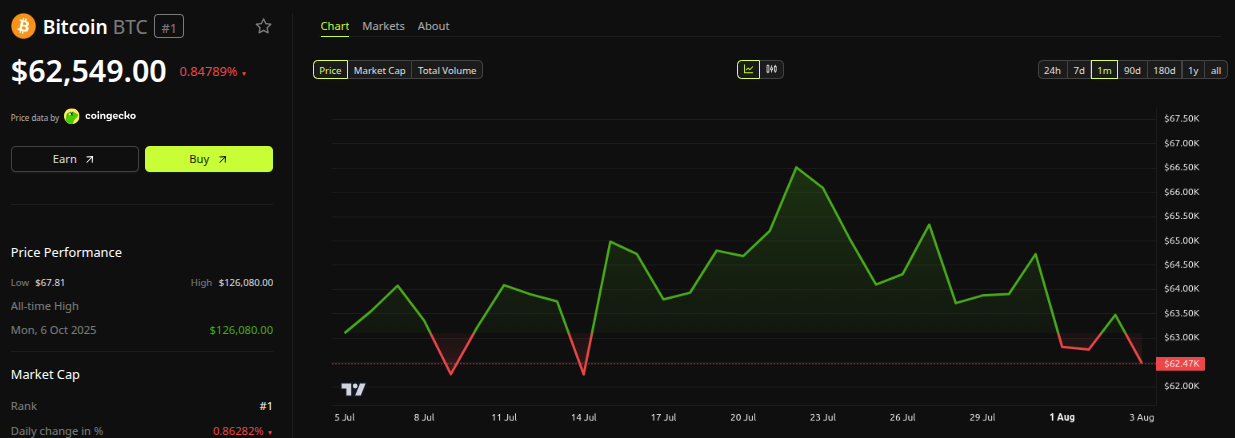
Analysts warned that every major Bitcoin drop in 2026 coincided with Japan’s yen defense, backing the claim with charts that mark each intervention against BTC corrections.
Bitcoin trades near $62,500 as analysts split over whether $50,000 comes next.

Top 3 Bitcoin Corrections That Matched Japan’s Yen Defense in 2026
The yen carry trade involves borrowing the Japanese currency cheaply to invest in higher-yielding assets, including cryptocurrencies. A sharp strengthening forces investors to close those positions.
Popular analyst Crypto Rover published a post overlaying BTC/USDT against the USD/JPY pair. Red circles mark intervention moments, linking them directly to Bitcoin’s declines.
The examples are specific:
- Between late January and mid-February, Bitcoin fell 35.43% alongside a notable move in the currency pair.
- From late April through June 10, the asset corrected by 26.28%, including an intermediate 9.34% drop, again aligned with yen-defense signals.
- The most recent case closed the pattern. Bitcoin faced renewed bearish pressure in late July as the yen approached its 40-year low near 164 per dollar.
Follow us on X to get the latest news as it happens.
Context arrived days later. Both governments officially confirmed a coordinated yen-buying intervention executed last Friday.
The scale was substantial. Japan reportedly spent around $59 billion on recent interventions, according to data from the Bank of Japan. This marks the first joint yen purchase between Tokyo and Washington since 1998, nearly three decades ago.
The bearish case has prominent backers. Another analyst, Ted Pillows, posted on August 2 that $50,000 could materialize if the CLARITY Act fails and the carry trade unwinds.
Ted also flagged a striking figure. The Bank of Japan spent nearly $32 billion during the previous week alone.
Why Some Analysts See the Opposite Outcome
Not every prominent voice shares that pessimism. Michaël van de Poppe called the yen chart the most important one to monitor. Both governments have partnered up to strengthen the currency, changing the calculus for dollar holders.
His argument inverts the logic entirely. If the dollar keeps falling while the yen strengthens, holding dollars carries more risk than it did in the previous period.
That shift would push capital out of government bonds. Liquidity would then flow toward risk assets, with Bitcoin among the primary beneficiaries. Van de Poppe had anticipated this earlier. He wrote that Bitcoin’s bull run would have started if those conditions materialized.
“Monday dump is happening on #Bitcoin. Probably we’ll go slightly lower and then we’ll turn back upwards,” Van de Poppe said on X.
Price context tempers both narratives. Bitcoin slipped below $63,000 in previous sessions and remains nearly 50% below its record high of $126,198, set in October 2025, according to BeInCrypto data.
The debate is now clearly framed. Crypto Rover is bearish, Ted sees a rapid unwind pushing Bitcoin toward $50,000, and Van de Poppe sees the opposite outcome. Orderly yen strengthening paired with a weaker dollar would channel liquidity into Bitcoin instead.
The market stays on alert for now. Bitcoin’s next direction may depend once again on how quickly and how far the yen strengthens.
Subscribe to our YouTube channel to watch leaders and journalists provide expert insights.
The post Is Bitcoin Price Heading to $50,000? Analysts Warn About The Yen Pattern appeared first on BeInCrypto.


Matt Prusak, president and interim chief financial officer of Trump-linked bitcoin miner American Bitcoin (ABTC), is leaving the company to join AI and energy infrastructure developer Giga Energy, marking another senior executive move toward the power sector that is increasingly underpinning both bitcoin mining and artificial intelligence.
Prusak said he will step down from American Bitcoin effective Aug. 4 and join Giga Energy as chief business officer and interim CFO.
He said in emailed comments that after “years building bitcoin businesses,” he was shifting “upstream to the power infrastructure now constraining both mining and AI compute.”
The departure reflects a broader shift as bitcoin miners reposition around AI and power infrastructure. As mining becomes increasingly commoditized and margins come under pressure, a growing number of miners are pivoting toward artificial intelligence infrastructure, repurposing their power, land and data center expertise to serve the surging demand for AI compute.
The shift has accelerated as hyperscalers race to secure electricity and capacity, allowing mining companies to diversify revenue beyond bitcoin production and tap the higher valuations being awarded to AI infrastructure businesses.
Crypto World
California’s diesel prices have jumped since the Iran war started, with ripple effects across the country
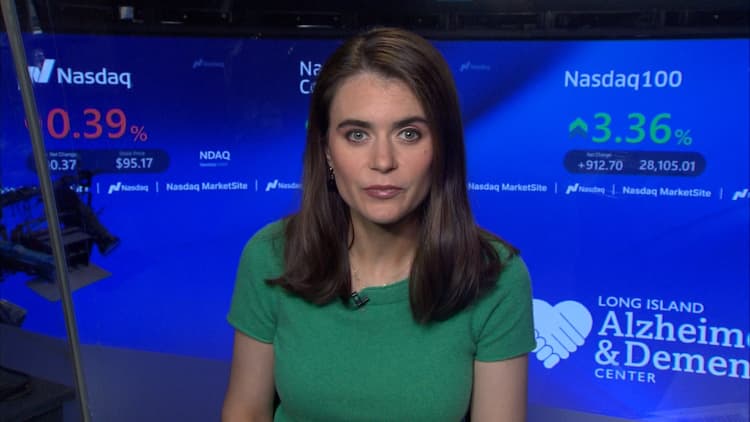

California is home to the highest fuel prices in the U.S. as well as the busiest containership port complex in the nation. So as the Iran war enters its sixth month and petroleum-product prices remain elevated, consumers across the U.S. could be hit with higher prices for a host of everyday products.
Nearly one-third of containership imports and exports travel through the San Pedro Bay port complex. In other words, before goods end up on shelves across the nation, they’re first hauled by trucks and trains paying California fuel prices.
Since the war in Iran began, much of the focus has been on oil itself, but experts say petroleum product markets are much tighter — especially when it comes to diesel.
“I think this refining challenge is going to be with the world for a while,” ExxonMobil CEO Darren Woods told CNBC on Friday.
“Even after the Strait opens up, we’ll see more products start to flow through the Strait, which is going to be critically important. But we’ve still got the Russia capacity that’s been lost, and we’ll have to see what the Chinese do with respect to exporting,” he added.
The combination of the war in Iran and Ukraine ramping up attacks on Russian refining infrastructure means the world is now short about 8% of global diesel demand, according to Lipow Oil Associates’ Andy Lipow.
Diesel is sometimes known as the workhorse of the American economy since trucks and trains that transport goods across the U.S. are powered by it. The U.S. is the world’s largest energy producer, but California’s fossil fuel industry has shrunk over the years and refiners have closed. The state also doesn’t have major fuel pipelines that connect it to other parts of the U.S., and has strict environmental regulations, all of which drive up prices at the pump.
The average price for a gallon of diesel in the U.S. is $5.36, according to AAA, but in California it’s $6.92, up from $5.10 prior to the war.
“[A] meaningful share of America’s supply chain pays West Coast fuel prices,” JPMorgan analysts led by Natasha Kaneva said in a June note to clients. “These prices influence freight costs, transportation margins, and ultimately the delivered cost of goods nationwide,” the firm added.
Watch the video above to hear more about how California’s fuel prices trickle through the U.S. economy.
— CNBC’s Macklin Fishman contributed reporting.
Hashdex said it will liquidate its eponymous spot-price Bitcoin exchange-traded fund this month, distributing the cash to all remaining shareholders and selling the fund’s roughly 225 BTC holdings.
In a filing on Monday, the fund issuer said the decision was made after evaluating factors including trading liquidity, operating costs and investor interest. The 200,000 shares, which have traded on NYSE ARCA under the DEFI ticker since March 2024, have net assets of $14.25 million, according to the fund’s website.
Late to the game, which saw the first of 10 other competing BTC ETFs debut months ahead of it, analysts saw opportunity at a time when BTC was trading for the then-all-time high of more than $73,000.
“The getting is so good right now I could see this one getting some bites (if the fee is competitive) despite being so late,” said Bloomberg Senior ETF analyst Eric Balchunas in a March 27, 2024 post.
Originally launched in 2022 as a Bitcoin futures ETF, Hashdex Bitcoin Futures ETF, its highest asset level was $17.54 million, reached on May 9, 2025, according to data tracker SoSoValue. The next largest ETF among the US-traded BTC issues is WisdomTree Bitcoin Trust (BTCW), with $140.37 million in net assets as of Friday’s market close.
Related: Bitcoin may find bear market bottom in August: 10x Research
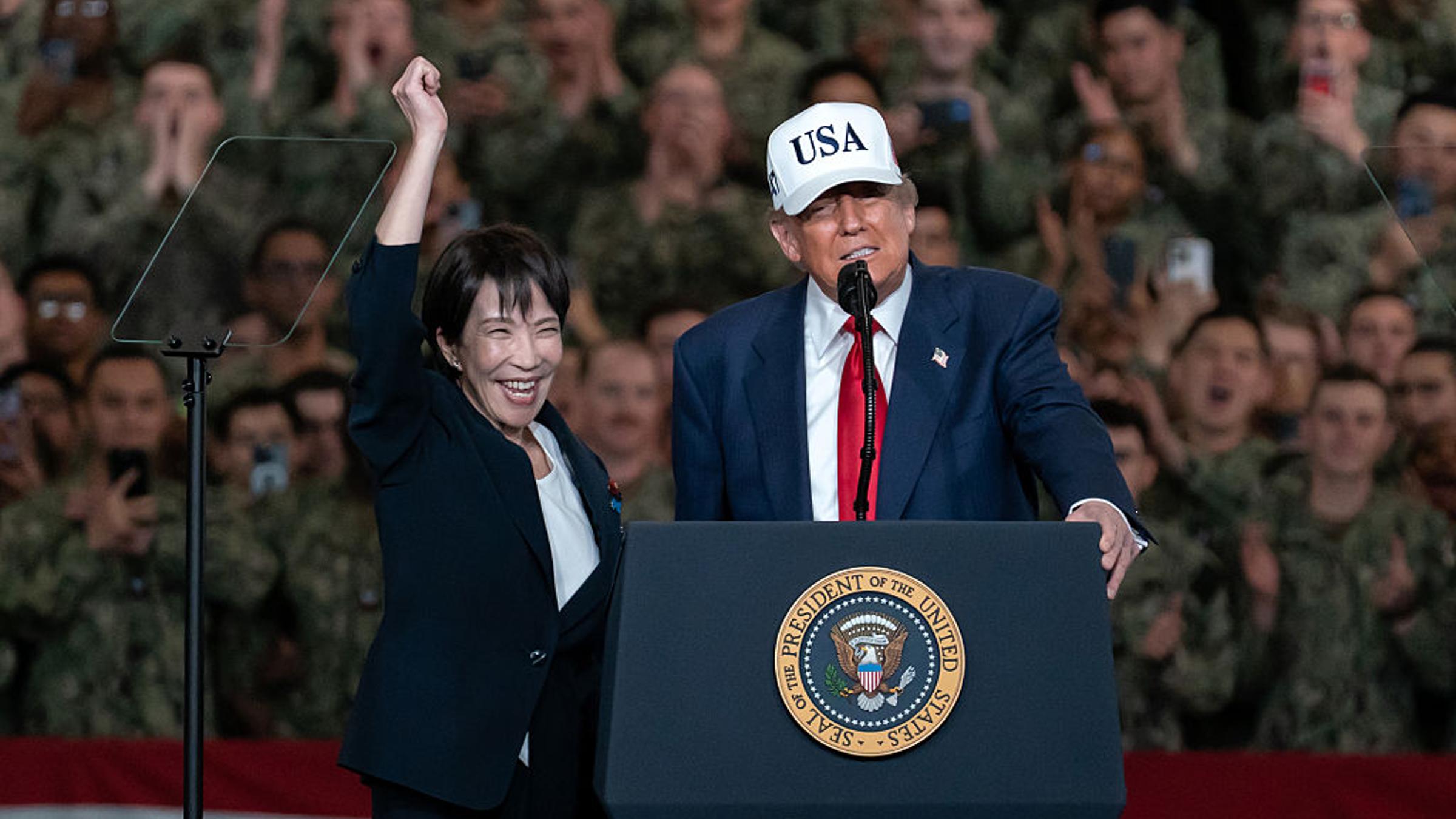
When asked why the United States intervened to support the Japanese currency, U.S. President Donald Trump told reporters aboard Air Force One over the weekend that the U.S. is “always there” for Japan.
“They have a weakening yen, and they wanted a little bit of help,” he said. When questioned over what the U.S. is “getting out of that arrangement,” Trump replied “financial benefit,” but emphasized it’s also “good for the world economy.”
What is behind the fall in the yen?
Japan had already expressed “serious concern” over the yen’s rapid depreciation in March and conducted unilateral intervention between April 28 and May 27.
Despite those efforts, the currency continued to weaken, with the yen sliding to 163.73 per dollar on Thursday before rebounding to 157.57 on Friday.
One reason a stronger yen matters is Japan’s dependence on imported energy. According to the International Energy Agency, Japan remains heavily reliant on imported oil and gas, particularly from the Middle East.
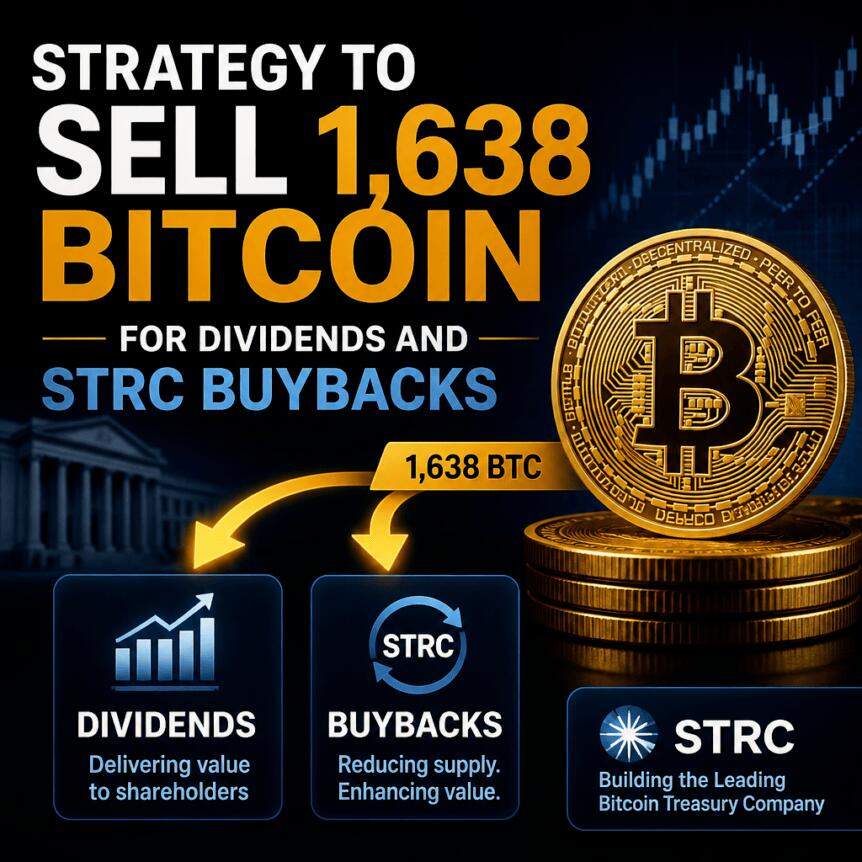
Strategy, the publicly traded Bitcoin holding company formerly known as MicroStrategy and led by chairman Michael Saylor, disclosed another sizable Bitcoin sale in an SEC filing. In the period from July 27 through Sunday, the company sold 1,638 BTC and used the proceeds to support capital-market obligations tied to its preferred stock financing structure.
According to the company’s Monday 8-K filing, the sale totaled $104.7 million at an average price of $63,957. Of that amount, $52.4 million was allocated to dividend payments on its STRC preferred stock, while $52.3 million funded STRC share repurchases.
Key takeaways
- Strategy sold 1,638 Bitcoin from July 27 through Sunday, generating $104.7 million, per an SEC 8-K.
- Dividend funding and STRC buybacks accounted for nearly all sale proceeds, underscoring how Bitcoin liquidity is being used to manage preferred-stock obligations.
- The company says it now holds 842,138 BTC, bought at an aggregate cost of $63.5 billion.
- Strategy also raised $290.6 million through MSTR share sales during the same period, increasing its US dollar reserve to $4 billion as of Sunday.
- STRC trades below its $100 target value—something investors may watch because it can affect the attractiveness and efficiency of future STRC fundraising.
Bitcoin sales feed dividends and STRC repurchases
In the latest disclosure, Strategy characterized the July 27-to-Sunday transaction as one of its larger BTC sales for the year. The company’s filing indicates this was its second-largest Bitcoin sale of 2024.
Crucially, the proceeds were not used for general corporate purposes. Instead, they were split between two items linked to STRC: dividend payments on the preferred stock and STRC repurchases. Together, those allocations amounted to just over $104.7 million, leaving little room for other uses from this tranche.
Strategy’s total Bitcoin balance after the sale stands at 842,138 BTC, with the company reporting an aggregate acquisition cost of $63.5 billion.
How this compares with earlier reported BTC sales
The latest sale follows other previously disclosed events that frame Strategy’s approach to managing its capital structure.
Earlier coverage noted that Strategy sold 3,588 BTC for about $216 million on July 6. The company also disclosed that it sold 32 Bitcoin in early June—its first reported BTC sale since a 2022 tax-loss transaction.
While each sale reduces the company’s Bitcoin exposure, the repeated pattern of tying sale proceeds to STRC-related obligations suggests Strategy is treating Bitcoin liquidity as part of a broader financing and cash-management playbook rather than treating every sale as an isolated departure from its prior accumulation stance.
Cash buffer grows as USD reserve rises to $4 billion
Alongside the BTC sale disclosure, Strategy reported raising additional funds through MSTR share sales during the same period. According to the 8-K, it raised $290.6 million, with multiple allocations.
The filing states that $250 million of the MSTR proceeds was used to increase Strategy’s US dollar reserve, which stood at $4 billion as of Sunday. It also reports that $28.9 million funded STRC repurchases and $11.7 million was added to the company’s cash balance.
In a post on X on Monday, Michael Saylor said Strategy repurchased $81.2 million worth of STRC stock and extended its US dollar “runway” by 57 days to 2.3 years.
STRC trading below target and what that may imply
Strategy’s financing mechanism includes its perpetual preferred stock, STRC. Market data cited in the report suggests STRC was trading at $89.40 during Monday’s pre-market session, or about 10.6% below its $100 target value, according to Yahoo Finance data.
In the same period, the company’s common stock—MSTR—was indicated to have declined roughly 0.9% in pre-market trading, based on Yahoo Finance data referenced in the article.
Trading below STRC’s intended par has potential consequences for Strategy’s capital strategy. If STRC remains below target value, investors may view future fundraising through STRC sales as less efficient for Strategy—because selling preferred stock at a discount typically brings in fewer dollars per unit sold relative to the target. That, in turn, can increase the importance of the company’s dividend policy to attract buyers and provide support to STRC pricing.
Earlier comments from CryptoQuant CEO Ki Young Ju had urged Strategy to pause Bitcoin purchases and replenish cash reserves after dividend coverage deteriorated. In a June 24 X post, Ju said the company should “pause Bitcoin purchases, rebuild cash reserves, and adopt a systematic framework for purchase timing.” Earlier reporting in the same context noted that dividend coverage had fallen to 14 months from seven years.
Strategy has previously responded to these concerns by laying out a framework for capital allocation. A June 29 8-K filing described a capital framework allowing Bitcoin sales to fund dividends, raised the annual dividend rate on STRC preferred stock to 12%, and disclosed that the US dollar reserve had grown to $2.55 billion.
What investors should watch next is whether the new $4 billion USD reserve and the disclosed approach—using Bitcoin sales to service STRC dividends and repurchases—continues alongside STRC trading conditions, particularly how far STRC remains below target and whether Strategy’s dividend and preferred-stock buyback activity accelerates or slows in subsequent filings.
Hashdex will close and liquidate its US-listed Bitcoin ETF, DEFI, after the fund struggled to attract enough assets and trading activity to remain viable.
Summary
- DEFI held approximately $14.7 million in assets as of July 30.
- The fund’s final trading day is Aug. 17, followed by its NYSE Arca delisting.
- Remaining shareholders should receive a cash liquidation payment around Aug. 28.
- Hashdex’s separate $206.8 million NCIQ crypto index ETF remains active.
DEFI will stop trading on Aug. 17
According to a WSJ report, asset management company Hashdex said the Hashdex Bitcoin ETF, which trades on NYSE Arca under the DEFI ticker, will stop trading after the market closes on Aug. 17. The company will then begin liquidating the fund’s assets and delist its shares.
The fund will also stop accepting creation orders from authorized participants after that date. Investors can continue buying and selling shares through their brokers until the final trading session, although market prices may differ from the fund’s net asset value as the closure approaches.
Hashdex attributed the decision to several factors, including the fund’s asset base, trading liquidity, operating expenses and investor demand. DEFI managed about $14.7 million as of July 30, placing it among the smaller US spot Bitcoin products.
The fund’s website listed a net asset value of $71.32 per share and a closing price of $71.15 as of July 31. DEFI normally invests at least 95% of its assets in spot Bitcoin, with the remainder available for cash, cash equivalents, and CME-listed Bitcoin futures.
Shareholders will receive cash after liquidation
Investors who continue holding DEFI shares after the final trading day will not receive Bitcoin. Instead, the fund will sell its holdings and distribute the remaining proceeds in cash after deducting its liabilities and liquidation costs.
Hashdex expects to make the distribution around Aug. 28. The amount shareholders receive will depend partly on Bitcoin’s price while the portfolio is being liquidated, meaning the final payment may differ from DEFI’s net asset value before trading ends.
The liquidation could also create tax consequences for US investors. A cash distribution may be treated as a taxable disposal, depending on the shareholder’s cost basis, account type and individual circumstances.
Investors who sell their shares before Aug. 17 will receive the prevailing market price rather than the final liquidation value. Trading volume and the spread between bid and ask prices could become more important as the fund approaches delisting.
Hashdex faced heavy competition from larger Bitcoin ETFs
DEFI entered the US spot Bitcoin ETF market through a conversion of an existing futures-based product. The fund began holding spot Bitcoin in March 2024, more than two months after the SEC approved the first wave of spot Bitcoin ETFs in January.
That timing placed DEFI behind larger competitors that had already accumulated substantial assets and trading volume. Its relatively small asset base made it harder to compete on liquidity, despite charging a 0.25% expense ratio.
The closure does not signal Hashdex’s exit from the US crypto ETF market. Its separate Hashdex Nasdaq CME Crypto Index ETF, trading under NCIQ, held about $206.82 million in net assets as of July 31.
NCIQ currently provides market-cap-weighted exposure to Bitcoin, Ethereum, XRP, Solana, Cardano, Chainlink, Stellar and Bitcoin Cash. Bitcoin represented 78% of its portfolio as of July 27, while Ethereum accounted for 12.2%.
Hashdex also reduced NCIQ’s annual management fee from 0.50% to 0.25% in March. The fund was renamed from the Hashdex Nasdaq Crypto Index US ETF in January but retained its existing ticker.
DEFI investors face three remaining dates
DEFI shareholders now face a short liquidation timeline. Aug. 17 will be the final day to sell shares on NYSE Arca and the cutoff for new creation orders. Hashdex will then unwind the portfolio before making the expected cash payment around Aug. 28.
Bitcoin price changes during that period will affect the fund’s remaining assets and, in turn, its final distribution. Investors who retain their shares through liquidation should also expect the position to disappear from their brokerage accounts once the cash payment is processed.
The closure applies only to DEFI and does not affect NCIQ or Hashdex’s other crypto investment products.


South Korean cryptocurrency exchange Bithumb said Monday it plans to apply for a preliminary listing review in 2027 and complete an initial public offering in 2028.
Bithumb said it has reorganized its business structure, including spinning off Bithumb Asset, to clarify responsibilities across its business units and reduce potential conflicts of interest ahead of the listing review.
The exchange said its preparations will include upgrading internal controls and shifting from domestic accounting standards to K-IFRS, the international accounting framework used by listed companies in South Korea.
Bithumb said the timetable could change depending on market conditions and the review schedules of relevant authorities.
The exchange is one of five South Korean platforms that support fiat currency trading through real-name bank accounts, offered through its partnership with KB Kookmin Bank.
Bithumb’s listing push comes as rival South Korean exchanges deepen their ties with traditional finance and technology groups. Mirae Asset Consulting took control of rival exchange Korbit on July 23, while Upbit operator Dunamu is pursuing a share-swap deal that would make it a wholly owned subsidiary of Naver Financial, subject to regulatory and shareholder approval.
Related: Kiwoom eyes Bithumb stake as Korean brokerages push into crypto: Report
Bithumb’s 620,000 BTC crediting error
In a February promotional error, Bithumb mistakenly credited customer accounts with balances totaling 620,000 Bitcoin instead of distributing 620,000 Korean won in cash rewards. Bithumb recovered 99.7% of the erroneous credits, though customers sold about 1,788 BTC before accounts were frozen.
At a Feb. 11 National Assembly parliamentary hearing, Bithumb CEO Lee Jae-won said the exchange’s process for checking the planned distribution against its actual holdings had failed and that the promotional amount had not been earmarked in a separate account.
Its IPO preparations also come as two Bithumb-linked listed companies face continuing audit and listing problems. Vidente, a major Bithumb shareholder, and Bucket Studio, which indirectly controls Vidente, have had trading in their shares suspended since March 2023 over audit and other listing issues.
According to Yonhap news agency, Bucket Studio appointed a former police official as its standing auditor in June, while Vidente plans to appoint a former National Tax Service official to the same role. South Korea’s Government Public Service Ethics Committee cleared both hires after finding no close relationship between the officials’ previous duties and their new roles.
Magazine: The 100x obsession: Fundamentals grow in importance as crypto matures
Bitmine Immersion Technologies added 10,399 ETH to its treasury and repurchased another 4.5 million shares, but BMNR stock fell toward $17 as investors weighed its mounting unrealized losses.
Summary
- Bitmine acquired 10,399 ETH, lifting its holdings to 5,797,813 ETH.
- The company now controls about 4.8% of Ethereum’s total supply.
- Bitmine repurchased 4.5 million BMNR shares during its third consecutive week of buybacks.
- BMNR traded near $17.06, with technical indicators showing weak trend strength.
Bitmine’s Ethereum holdings approach 5.8 million ETH
Bitmine said it acquired another 10,399 ETH over the past week, continuing the accumulation strategy it adopted last year. The purchase increased its total holdings to 5,797,813 ETH, equivalent to approximately 4.8% of Ethereum’s circulating supply.
The latest purchase followed Bitmine’s acquisition of 9,946 ETH during the previous week. Together, the transactions added more than 20,000 ETH to the company’s treasury within two weeks.
Chairman Tom Lee linked the continued accumulation to Ethereum’s recent performance against US technology stocks. He said ETH outperformed the Nasdaq 100 by 25% during July, its widest margin since July 2025.
“This is the largest outperformance since July 2025, and we believe it is reflective of the strengthening fundamentals of crypto.”
Lee noted that ETH climbed from $2,375 in July 2025 to $4,057 by the end of the following month. However, past performance does not guarantee that Ethereum or BMNR will repeat that move.
Bitmine has maintained its accumulation strategy despite the broader crypto downturn and the paper losses attached to its holdings. DropsTab estimates that the company has an unrealized loss of approximately $8.8 billion on its Ethereum position.
Staked ETH could generate $247 million annually
Bitmine has also placed most of its Ethereum treasury into staking. The company reported 4,917,189 ETH staked, representing nearly 85% of its total holdings.
At the stated valuation, the staked position is worth about $9.2 billion. Bitmine projects that it could generate approximately $247 million in annualized staking revenue.
Staking provides the company with ETH-denominated income while it holds the asset on its balance sheet. However, that revenue may fluctuate with Ethereum’s staking yield, validator performance and the market value of ETH.
The strategy also means BMNR investors are exposed to several overlapping risks. These include Ethereum price volatility, the company’s cost basis, dilution from capital raises and operational risks associated with staking such a large position.
For US investors, BMNR offers equity-market exposure to Ethereum without requiring direct token custody. Unlike a spot Ethereum exchange-traded fund, however, the stock also carries corporate management, financing and capital-allocation risks.
BMNR buyback enters its third consecutive week
Bitmine repurchased 4.5 million common shares during the past week, marking the third straight week of purchases under its buyback program.
The company has now bought back more than 16 million shares. Management said it considers BMNR attractively valued relative to its assets and long-term Ethereum strategy.
Share repurchases reduce the number of outstanding shares when they are retired, potentially increasing each remaining shareholder’s proportional claim on the company. Their impact depends on the price paid, the source of the funds, and whether new stock issuance offsets the reduction.
Lee argued that periods of strong monthly ETH performance against the Invesco QQQ Trust have historically been followed by BMNR outperforming Ethereum during the next month. That relationship remains a company observation rather than a guarantee of future returns.
The buyback may provide some support for BMNR, but investors have yet to respond positively to the latest Ethereum purchase and repurchase announcement.
BMNR stock struggles with resistance near $17.15
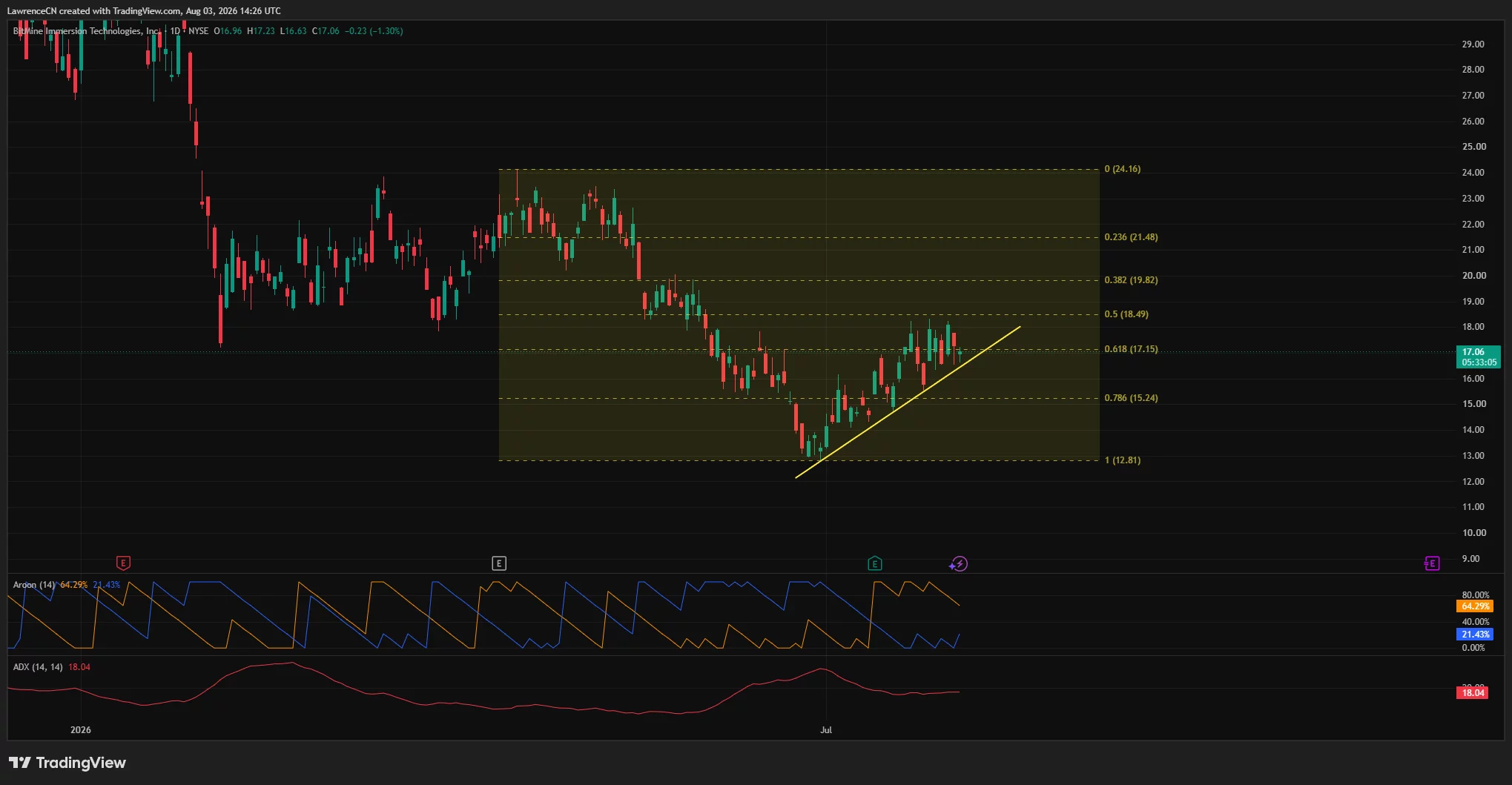
BMNR traded near $17.06 on Aug. 3, falling about 1.3% on the daily chart. The stock recorded an intraday high of $17.23 and a low of $16.63.
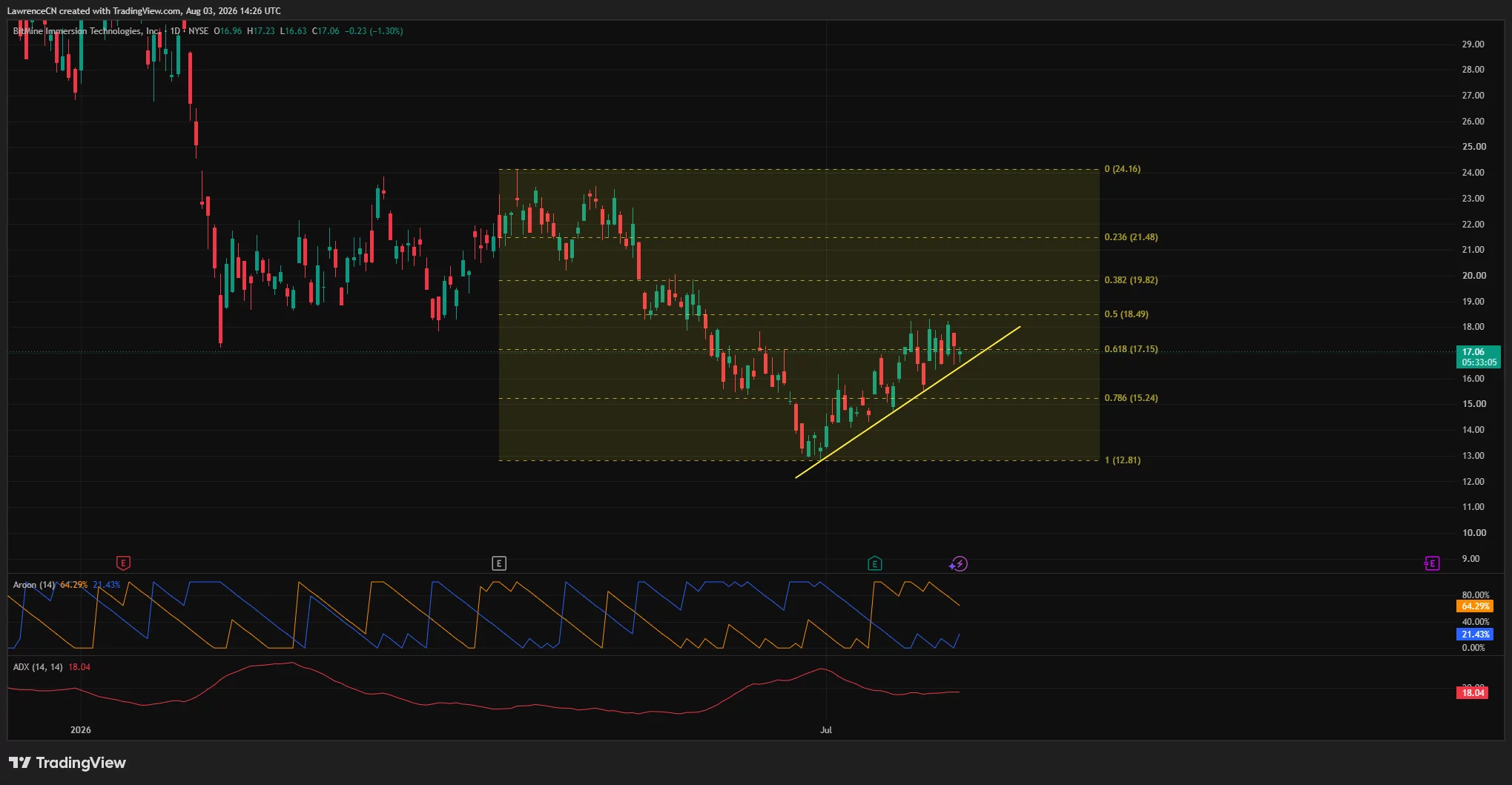
BMNR price is testing the 61.8% Fibonacci retracement at $17.15, which is acting as the immediate resistance level. A daily close above that mark could allow BMNR to challenge $18.49, corresponding to the 50% retracement level.
The next resistance sits at $19.82. A stronger recovery beyond that level could bring $21.48 into focus, although the stock would need greater momentum and trading volume to sustain such a move.
BMNR remains above an ascending trendline drawn from its June low near $12.81. That structure suggests the short-term recovery has not failed, but the stock has struggled to build momentum above $17.
Aroon readings of 64.29% and 21.43% favor the recent recovery attempt. However, the average directional index stands at 18.04, below the commonly watched 20 threshold, indicating that the prevailing trend remains weak.
A rejection at $17.15 could send BMNR back toward the rising trendline around $16. Stronger support sits at the 78.6% Fibonacci level of $15.24. A decisive break below that area would weaken the recovery structure and increase the risk of another test of $12.81.
Disclosure: This article does not represent investment advice. The content and materials featured on this page are for educational purposes only.

Bitcoin begins the first full week of August trading around the $63,000 area as traders look past a difficult macro calendar and focus on a fresh, ongoing catalyst from within the crypto ecosystem. Sentiment is being tested by the fallout from a Coldcard wallet hack, while broader markets await key US data and geopolitical signals that can swing risk assets.
At the same time, investors are weighing whether August will follow the bearish script that has marked prior cycles. Even with July ending higher, analysts point to technical resistance and liquidation zones that could amplify downside if momentum fades.
Key takeaways
- Bitcoin is hovering near $63,000 as traders digest the continuing Coldcard hardware wallet incident and its effects on flows.
- Crypto market participants say US nonfarm payrolls—due Thursday—may drive volatility depending on how labor strength and unemployment evolve.
- Oil prices slid after President Donald Trump signaled potential movement on an Iran-related deal, adding to macro uncertainty for risk assets.
- Long-term holder behavior appears consistent with accumulation, even as near-term traders warn that resistance could keep August pressured.
- CoinGlass and other technical observers highlight the 50-month EMA around $65,827 as a key barrier, while derivatives positioning points to liquidation risk near $64,200.
Why Treasury and FX policy still matters to crypto
The week’s macro backdrop is shaped not only by upcoming US economic releases, but also by renewed attention to how dollar liquidity and Treasury market stress can spill into global financial conditions. According to QCP Capital, the US and Japan executed a rare coordinated foreign-exchange intervention last week, designed to support the yen after it neared levels around 164 per USD, based on TradingView data.
QCP Capital emphasized that the operation’s mechanics matter: the New York Fed acted as a fiscal agent using the Federal Reserve’s Foreign and International Monetary Authorities (FIMA) repo facility, rather than reflecting a Federal Reserve monetary-policy decision. In QCP’s view, that distinction highlights how institutions outside the FOMC can still move liquidity and influence broader conditions.
Further, industry commentary cited a desire to reduce the risk of Japan selling large quantities of US Treasuries, which could otherwise disrupt the dollar environment. Louise Loo of Oxford Economics told CNBC that volatile conditions tied to potentially fiscally aggressive policies in Japan could extend into US Treasury markets, destabilizing the dollar.
In a post on X, Treasury Secretary Scott Bessent also argued the FIMA facility could be used again, describing it as an “important backstop” and encouraging that it be “upsized” in coming months. For crypto traders, the practical takeaway is that interventions affecting FX and Treasury-market liquidity can quickly shift risk appetite—often before any direct crypto-specific news lands.
US payrolls, oil, and the Iran signal: the risk-asset checklist
For digital-asset markets, the next major swing factor is Thursday’s nonfarm payrolls release. Earlier in this cycle, weaker-than-expected labor numbers put pressure on expectations for how aggressively the Federal Reserve might move on rates, a dynamic that coincided with a reaction in Bitcoin when June payroll data came in well below forecasts, as Cointelegraph previously reported.
Market positioning for Thursday remains mixed. Continuum Economics, for example, expects July nonfarm payrolls to rise by 120k overall (and 110k in the private sector), while also projecting unemployment will edge up to 4.3% from 4.2%. The firm’s forecast also notes average hourly earnings rising by 0.3% in line with its trend, according to its published preview.
Beyond labor data, traders are monitoring signals related to US-Iran de-escalation. On Sunday, President Donald Trump posted on Truth Social that he had agreed to cancel further strikes on Iranian territory “subject to being able to rapidly make a DEAL,” adding language about potential opening of the Strait of Hormuz and an end to Iran’s nuclear threat. Oil responded quickly, with both WTI and Brent down by more than 8% on Monday.
For crypto markets, the relevance of oil is straightforward: sustained moves in energy prices often feed into inflation expectations and, by extension, interest-rate expectations. When the path of rates is uncertain, risk assets—including Bitcoin—tend to trade with sharper sensitivity to macro surprises.
Coldcard hack: exchange inflows rise, but not in an outsized way
On the crypto side, one of the most immediate concerns remains the Coldcard wallet hack. Earlier coverage cited a “low-entropy bug” in Coldcard hardware wallets, with theft activity continuing for multiple days. Galaxy Research’s Alex Thorn advised Coldcard users to move funds “ASAP” and suggested using higher transaction fees to reduce the time spent interacting with the wallets.
Yet exchange flow data suggests the reaction is not turning into a broad, panic-driven transfer into trading venues. According to CryptoQuant, net exchange inflows were 34,932 BTC on Friday and 8,768 BTC on Sunday. CryptoQuant’s data framing indicates the inflow volume, while meaningful on certain days, aligns with typical levels seen during the month rather than representing a one-off liquidation wave.
What did change more noticeably was the number of inbound transactions. CryptoQuant data shows exchanges received 31,217 inbound BTC transactions on Friday, dropping to 19,537 on Sunday. CryptoQuant head of research Julio Moreno attributed the influx mainly to transactions between 1 and 10 BTC, which he said had their highest daily total since early February.
Separately, CryptoQuant reported that on a rolling 30-day basis Bitcoin long-term holders remain in a broad accumulation phase. In its analysis, the BTC LTH Accumulation & Distribution indicator showed LTH supply inflow around 220.4K BTC, implying ongoing inflow into long-term holdings outweighs distribution back to the market.
That combination—exchange activity rising in transaction count, but long-term holders still accumulating—suggests the market is processing the incident through behavior that is more nuanced than a simple rush to sell.
August caution: resistance levels and leverage-built downside
Even as Bitcoin finished July about 7.4% higher, traders are preparing for a difficult August. CoinGlass data shows monthly performance for BTC/USD came in slightly below its 2025 result, but the broader narrative remains that downside pressure can return during August, consistent with patterns some analysts associate with prior midterm-era behavior.
Rekt Capital pointed to the 50-month exponential moving average as an ongoing ceiling, stating on X that the 50-month EMA continues to act as resistance. That level is near $65,827, and the expectation is that repeated rejections could set up further downside continuation.
Derivatives positioning adds another layer of near-term risk. CoinGlass data tracking clusters of high-leverage BTC bets highlighted $64,200 as a potential area where forced liquidations could occur if price moves higher against leveraged positions.
On the other end of the spectrum, quant analyst David Eng described Bitcoin as “sitting on its long-term statistical floor” around $63,000, referencing a power law framework that expects price to grow as a power of time. While such models do not guarantee short-term price direction, they help explain why some participants remain willing to accumulate near specific long-horizon reference points.
With long-term holders accumulating quietly while near-term technicals and leverage maps warn of friction, the next macro prints and any follow-through from the Coldcard incident will likely determine whether August breaks from prior weakness—or extends it.
Traders should watch Thursday’s nonfarm payrolls for cues on rates and risk appetite, while also tracking whether Coldcard-related wallet activity continues to translate into exchange selling or stays contained to transaction-level spikes; the answer could shape how quickly Bitcoin sheds or absorbs this month’s technical pressure.

Box Office: ‘Spider-Man: Brand New Day’ swings record North American opening weekend
EasyJet aligns Apollo and Castlelake deadlines as bidding war nears climax

Is Bitcoin Price Heading to $50,000? Analysts Warn About The Yen Pattern


-

 Business5 days ago
Why Trees Belong on the Risk Register
-

 Fashion3 days ago
Weekend Open Thread: Wit & Wisdom
-

 Politics3 days ago
Meta enters AI-training agreement with far-right ‘propaganda rag’ Newsmax
-
 Entertainment6 days ago
‘Stargate’ Creator’s New Sci-Fi Series Returns for Season 3 Tomorrow
-

 Crypto World2 days ago
MicroStrategy Post-Earnings CLARITY Act Push Could Add New Catalyst for Its Stock
-

 Politics6 days ago
The Part of the Electric Transition Nobody Wants to Discuss
-

 Business5 days ago
Major shareholder moves on Canyon
-

 Crypto World2 days ago
XRP Ledger v3.3.0 brings five institutional features
-

 News Videos4 days ago
Bitcoin Enters the 3rd Stage of the Bear Market
-

 Crypto World6 days ago
Kraken Enables Retail Access to Jersey Mike’s IPO via Tokenized Shares
-

 Tech7 days ago
New macOS Sequoia & Sonoma security updates for older Macs
-

 Politics4 days ago
Luke Littler’s dominance sparks GOAT debate
-

 News Videos6 days ago
Claude: Build Financial Dashboards in Minutes (2026)
-

 Business6 days ago
Johnson & Johnson agrees to $5.5B settlement over talc cancer claims
-

 Sports4 days ago
Seema Kaliramna Wins Discus Throw Bronze, Takes India’s CWG Medals Tally To 17
-

 Crypto World1 day ago
Crypto PAC spending tops $2M in Michigan House race
-

 Business3 days ago
Trump Announces Hamas Disarmament Agreement as Iran Strikes Kuwait Air Base and US Attacks Pause Overnight
-

 Crypto World3 days ago
New York sues Kalshi over prediction market gambling
-

 Tech5 days ago
Gemini can now summarize the messiest comment threads in Google Docs
-

 Tech1 day ago
ESET tracks rise in malicious AI skills and adaptable malware
You must be logged in to post a comment Login