

Crypto World
Why Did Trump’s American Bitcoin Stock Flatline In Just 1 Year?

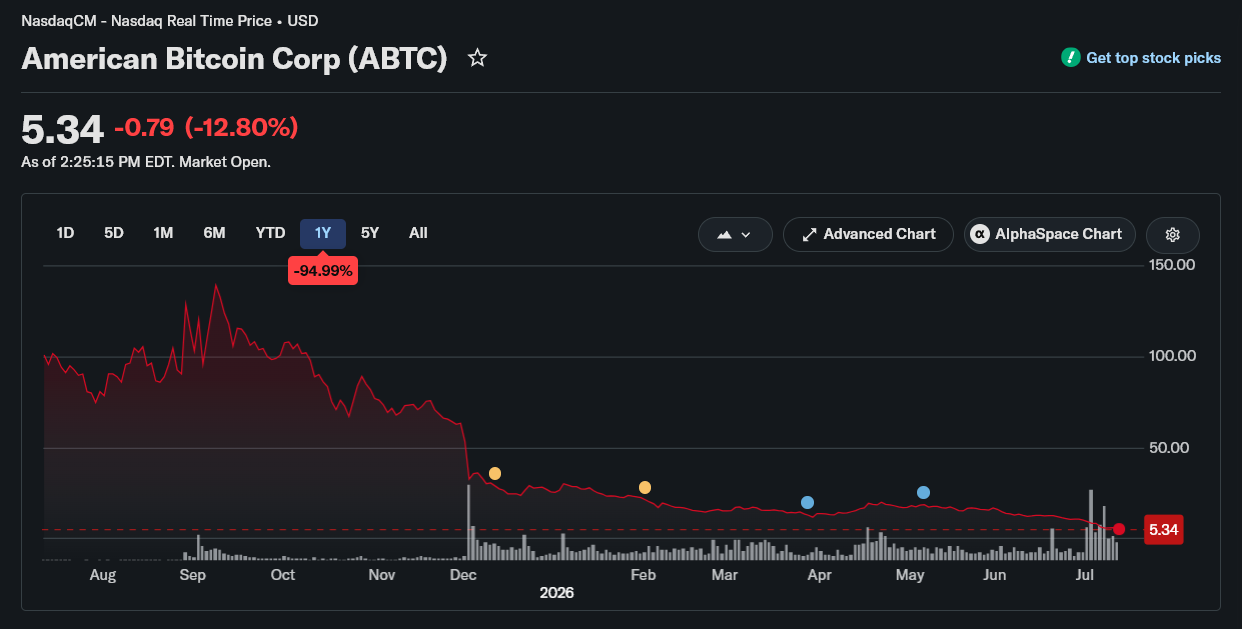
American Bitcoin Corp. (ABTC) crossed 8,000 Bitcoin (BTC) this month, yet its stock trades more than 95% below its peak. The gap asks whether the Trump name or the business model is to blame.
The company keeps buying Bitcoin and reporting strong mining margins. Its shareholders, however, have watched the equity collapse since its September 2025 debut.

A Trump Premium that Inflated the Debut
The Trump connection gave American Bitcoin its launch. Eric Trump co-founded the firm and serves as chief strategy officer, while Donald Trump Jr. advises it. That branding drew heavy retail demand as the company merged with Gryphon Digital Mining.
It was listed on Nasdaq in September 2025. Forbes later reported that investors valued the firm at nearly $13.2 billion at its debut. It held only about $270 million of Bitcoin at the time.
The structure sat quietly behind the story. American Bitcoin is a majority-owned subsidiary of Hut 8, which holds roughly 80% after transferring its self-mining operations. The Trump family controls about 20%, and Eric Trump’s personal slice sits near 6%.
That same association cuts both ways. Data now puts the stock more than 95% below its peak.

The same Forbes report found retail holders lost about $500 million since the debut. Eric Trump’s own fortune, by contrast, rose about $90 million, since the founders bought in early and cheaply.
He dismissed the Forbes report as propaganda, yet no scandal or governance failure explains the collapse.
Follow us on X to get the latest news as it happens
A Treasury that Grows as the Stock Sinks
Operationally, American Bitcoin has hit its marks. It mined 817 BTC in the first quarter, a company record. Margins held near 52% even as Bitcoin fell about 22%, the company reported.
Eric Trump says the fleet mines at a 47% discount to spot. Forbes disputed that math, pegging the all-in cost near $90,000 per coin after depreciation and overhead are factored in.
Yet the equity tells the opposite story. To fund that accumulation, the company leaned on share issuance, and its float ballooned. Each raise bought more coins but handed existing holders a thinner claim.
A 1-for-15 reverse split then cut the count from more than 1.09 billion shares to about 73 million. The move, effective in early July, aimed to keep ABTC above Nasdaq’s minimum bid price.
The math shows the strain. Satoshis Per Share rose about 20% in the first quarter, yet the share count kept climbing. A $117.2 million non-cash markdown on its Bitcoin drove a $118.2 million operating loss. CEO Mike Ho said the underlying business stayed profitable and that the firm did not sell a single coin.
That stance holds as it keeps buying Bitcoin through the slump. Eric Trump framed the 8,000 BTC milestone as vindication rather than a warning.

“Thrilled to announce American Bitcoin crossing the 8,000 BTC mark! … we continue to differentiate ourselves, mining at a 52% profit margin in Q1 and continually adding to our treasury, all while maintaining one of the lowest SG&A ratios in the industry … The stacking continues,” Eric Trump shared recently.
The AI Pivot American Bitcoin Refused
The wider market has moved on. Through 2026, rivals repurposed mining power for artificial intelligence, where margins looked richer. Stocks such as TeraWulf, IREN, and Hut 8, the majority owner, climbed as they leaned into AI infrastructure.

Others, including Riot, sold Bitcoin to fund the shift, while Empery Digital cut its holdings by nearly half. Their shares increasingly tracked AI demand rather than Bitcoin’s price.
American Bitcoin knows that trade well. It began in February 2025 as American Data Centers, a venture tied to the Trump-linked firm Dominari Holdings.
A month later, it pivoted to pure Bitcoin mining through the Hut 8 deal. In effect, it walked away from data centers just before the market began paying up for them.
The comparison it invites now cuts the wrong way. American Bitcoin’s hybrid model mines coins and buys more, echoing the MicroStrategy accumulation playbook now run by Strategy. Michael Saylor pioneered that approach in 2020, and for years his stock traded far above its Bitcoin.
Strategy’s own filings show 843,775 BTC today after withholding from selling any BTC last week. Yet even that premium has flipped to a discount, with the stock valued below its coins in mid-2026.
If the market has soured on the model’s pioneer, a smaller and diluted copy has little cover.
What the Disconnect Reveals
The evidence points to a hard bet in a shifting market, not broken trust. The Trump name inflated the debut, which made the correction look political. Yet the market now values American Bitcoin near $430 million, below the roughly $500 million of Bitcoin it holds.

The same repricing has humbled Strategy, the model’s own pioneer. What sank the stock was a diluting wager on Bitcoin that skipped the sector’s richest trade. Public shareholders absorbed the loss, while the venture’s insiders did not.
The post Why Did Trump’s American Bitcoin Stock Flatline In Just 1 Year? appeared first on BeInCrypto.


Amidst the current crypto market volatility, with XRP hovering around $1.06 after sharp corrections from previous highs, a bold new forecast has emerged that could redefine investor expectations. Grok AI Predicts that XRP is poised for a monumental rally, potentially achieving three-digit prices by the end of 2026.
XRP has weathered significant selling pressure, trading well below its prior peaks near $3.65. Yet its core utility as a fast and low-cost bridge asset for global payments continues to deliver real-world value through Ripple’s On-Demand Liquidity network and the XRP Ledger’s efficient design.
Growth in tokenized real-world assets on the XRPL has already surpassed $4 billion, while institutional interest in cross-border settlements continues to grow. These fundamentals position XRP for powerful rebounds once broader market sentiment turns positive. With improving regulatory clarity and potential pro-crypto legislation on the horizon, Grok AI Predicts substantial upside ahead as we move through the rest of 2026 and beyond.
Don’t Miss Out on Our $1,000 USDT Airdrop on ByBit
Grok AI Predicts Explosive 3-Digit Targets and $1,000 Bull Case for XRP
XRP’s fundamentals are stronger than ever, driven by unmatched efficiency in cross-border payments and expanding use cases on the XRP Ledger. Tokenization activity continues to accelerate, and banks worldwide are exploring faster settlement solutions that favor XRP over legacy systems.

Regulatory tailwinds are also aligning, and the resolution of previous legal matters has removed major obstacles, while new clarity measures and pro-crypto policies are expected to unlock greater institutional adoption throughout 2026. In a detailed analysis, Grok AI predicts that in a full bull market with widespread adoption of XRP for remittances and tokenized assets, three-digit prices become realistic by year-end.
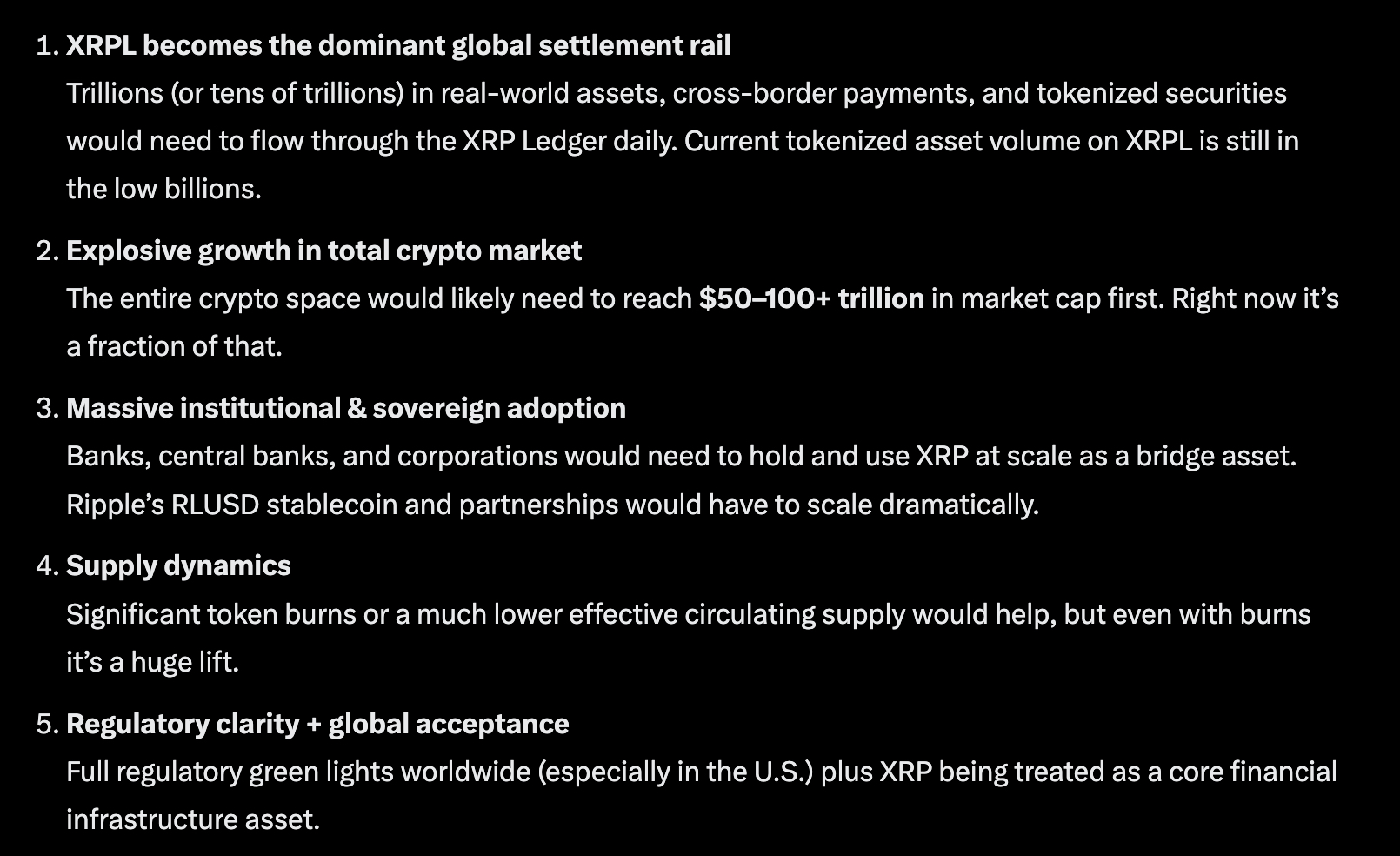
Even more explosive is the $1,000 bull case highlighted by analysts such as Pumpius, who sees this level as almost certain by 2027 under optimal conditions of bank integration, regulatory support, and altcoin season rotation. From current levels near $1.06, reaching $100 would deliver roughly 94x returns, while the extreme $1,000 scenario represents nearly 1,000x upside for those positioned early.
Discover: The Best Token Presales
Bitcoin Hyper Catching the Attention of XRP Holders as the Next 100x
Bitcoin Hyper is catching the attention of XRP holders seeking the next asymmetric opportunity to multiply gains alongside expected moves in their primary holding. As the fastest Bitcoin Layer 2 chain, it solves Bitcoin’s long-standing scalability issues with advanced rollup technology. It is delivering near-instant transactions, ultra-low fees, and full support for DeFi, meme coins, staking, and dApps directly on the Bitcoin network.
The presale price currently sits at approximately $0.0137 per HYPER token, with over $32.9 million already raised toward a higher target. The sale is in its final stages, with limited time remaining before the next price increase. Participants can also stake immediately for rewards up to 36%.
XRP holders who benefit from the strong outlook on their core position can further amplify returns by securing exposure to this high-utility Bitcoin L2 at ground-floor pricing. Bitcoin Hyper is positioned to power real-time Bitcoin activity and ecosystem growth that many expect to explode in 2026 and beyond.
Explore the Bitcoin Hyper presale now: Buy HYPER before the presale closes, and it becomes the leading solution for scalable Bitcoin transactions.
Research Bitcoin Hyper at the official presale page.
Discover: The Best Crypto to Diversify Your Portfolio
The post Elon Musk Grok AI Predicts 3 Digits XRP Price This 2026 appeared first on Cryptonews.
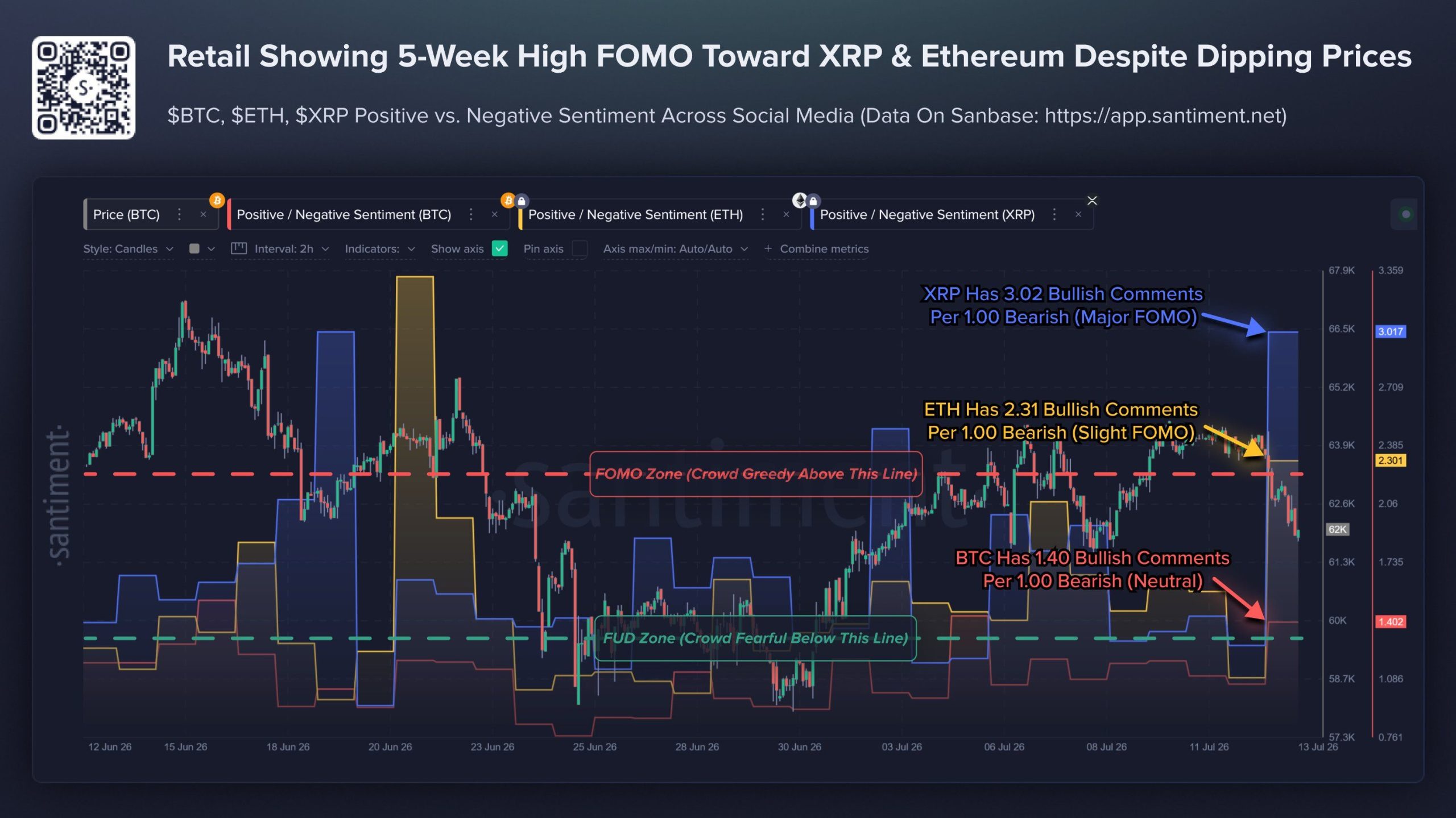
XRP (XRP) and Ethereum (ETH) both flashed a contrarian bearish signal, as social sentiment turned euphoric. Yet their derivatives markets told opposite stories, with XRP funding negative and Ethereum funding positive.
The split matters because elevated bullish chatter often precedes short-term pullbacks. When it aligns with negative funding, as on XRP, the crowd and leveraged traders sit on opposite sides of the same trade.
XRP and Ethereum’s Sentiment Signal
Santiment tracked the ratio of positive to negative commentary across social platforms. The metric weighs bullish posts against bearish ones for each asset.
On Monday, XRP led with 3.02 bullish comments for every bearish one. Ethereum followed at 2.31, placing it in mild FOMO territory.
Follow us on X to get the latest news as it happens

Bitcoin (BTC) sat calmer at 1.40, closer to neutral. All three opened stronger before fading through the session.
The reading carries a contrarian edge. Heavy bullish sentiment during a dip can raise near-term downside risk rather than confirm strength. Santiment framed the pattern directly.
“Crypto typically moves opposite to what the crowd is loudly expecting,” it said. “BTC’s more neutral sentiment may actually be healthier, since rallies usually have more room when the crowd hasn’t fully piled into the ‘higher prices next’ trade yet.”
The Funding Divergence
Funding rates show how leveraged traders are positioned. Positive rates mean longs pay shorts, while negative rates mean shorts pay longs.
XRP funding turned negative on Monday, at -0.0033%. Traders were paying to hold short positions.

Ethereum funding stayed positive, at 0.0049%. In addition, Bitcoin funding rates held positive.

The contrast is the catch. XRP’s bullish crowd is loud, but its derivatives market leans short. Traders are paying to bet against the optimism.
Ethereum shows no such split. Its social optimism aligns with positive funding, meaning the crowd and leveraged traders lean the same way.
That leaves XRP with the more conflicting setup. If the token rallies, short sellers could be forced to cover their positions, triggering a short squeeze that accelerates gains. Conversely, if bearish bets prove correct, the elevated optimism could unwind as bullish traders retreat.
XRP also posted the steeper weekly decline, falling 7.22% over the past seven days, while Ethereum slipped 1.09% over the same period.
The conflicting signals leave XRP at a crossroads. Whether the bearish positioning in derivatives or the strong bullish social sentiment ultimately prevails could shape the token’s next move.
Subscribe to our YouTube channel to watch leaders and journalists provide expert insights
The post XRP and Ethereum Share a Bearish Signal, But There’s a Catch appeared first on BeInCrypto.


A solo Bitcoin miner used a Bitaxe device to mine Bitcoin block 957,382 and claim 3.1382 BTC, worth about $200,000. The machine reportedly ran for eight hours through Public Pool before submitting the winning share.
Summary
- A $150 Bitaxe mined one Bitcoin block and earned its operator roughly $200,000 in rewards.
- The device averaged 995 GH/s, making the successful block discovery an extremely unlikely solo-mining event.
- Solo miners found 24 blocks during the past year as network difficulty eased in July.
The payout included the 3.125 BTC block subsidy and about 0.0132 BTC in transaction fees. Public Pool called it the second block found by a single Bitaxe through its hosted service. Blockchain records confirm block 957,382.
Low-power Bitaxe beats industrial-scale odds
The miner averaged about 995.2 gigahashes per second, or just under one terahash per second. That represents a tiny share of Bitcoin’s network computing power, measured in hundreds of exahashes per second. CoinDesk estimated that a machine running at that rate would find a block about once in 18,000 years on average.
The estimate describes probability, not a fixed waiting period. Every valid hash can solve the next block. The Bitaxe Gamma documentation says the device uses one BM1370 chip, the same chip found in Bitmain’s larger Antminer S21 Pro machines. Its typical performance sits near 1.2 TH/s with low power use.
Public Pool lets the miner keep the reward
The winning machine connected through Public Pool, a solo-mining service that does not divide rewards among participants like a standard pool. In a normal pool, miners combine computing power and receive smaller payments based on contributed work.
Solo mining provides no payment unless the machine finds a valid block. A successful operator can claim the full subsidy and transaction fees. Public Pool said, “Block #2 on hosted Public-Pool. By a lone Bitaxe.” One successful hash created the entire payout.
Solo Bitcoin block wins rise in 2026
Solo miners found 24 Bitcoin blocks during the past 12 months, a 41% increase from the previous year, according to CoinDesk. Twelve arrived during 2026. Other recent winners used CKPool, rented computing power or small groups of home mining equipment.
As previously reported by crypto.news, a solo miner earned about $271,000 in December 2025 after finding block 928,351. Another received roughly $282,000 that month despite odds estimated near one in 30,000.
The increase in successful blocks does not make solo mining predictable. Bitaxe devices can sell for between $60 and $150, but their expected income remains extremely low. Most users could run identical machines for years without finding a block.
Mining difficulty falls as operators face pressure
Bitcoin’s mining difficulty fell 5% to 127.17 trillion at block 957,600 on July 11. The adjustment followed slower block production and lower network hashrate. Bitcoin changes difficulty every 2,016 blocks to keep average block times near ten minutes.
The reduction followed a 10.09% drop in June. As reported by crypto.news, lower Bitcoin prices and machine shutdowns weakened mining competition. Miners have also redirected power toward artificial intelligence and high-performance computing services as margins remain tight.
Lower difficulty slightly improves the odds for active miners, including home devices. It does not remove the gap between a one-terahash Bitaxe and industrial facilities operating millions of times more computing power.
The $200,000 payout remains a rare event rather than evidence of reliable income from a $150 miner. Bitcoin lets small operators compete for the same reward, while probability favors miners controlling far greater hashrate.


U.S. banking groups have urged the Senate to tighten the CLARITY Act’s stablecoin yield rules, warning that unclear language could encourage payment stablecoins to compete with traditional bank deposits.
Summary
- U.S. banking groups have urged the Senate to tighten the CLARITY Act’s stablecoin yield rules before a floor vote.
- The associations warned that unclear reward provisions could encourage users to move deposits from community banks into payment stablecoins.
- Stablecoin rewards remain one of several unresolved issues as Senate negotiators work to finalise the CLARITY Act.
According to a joint letter sent Monday to Senate Majority Leader John Thune and Minority Leader Charles Schumer, the American Bankers Association (ABA), the Independent Community Bankers of America (ICBA), and 76 state banking associations asked lawmakers to revise Section 404 of the Digital Asset Market Clarity Act before the bill reaches the Senate floor.
The banking groups said the current wording does not provide enough certainty to prevent payment stablecoins from offering incentives that resemble interest on deposits. While Section 404 bars direct or indirect interest or yield on payment stablecoins, it still allows activity-based or transaction-based rewards.
In the letter, the associations said significant questions remain over whether the existing language can fully achieve Congress’s objective. They argued that reward structures tied to holding stablecoins could encourage users to keep balances for longer periods instead of using the tokens only for payments.
Banking groups seek stronger limits on stablecoin incentives
The organisations also warned that community bank deposits support mortgage lending, small business financing, agricultural credit, and other relationship-based banking services. According to the letter, allowing stablecoin issuers to offer yield-like incentives could reduce deposits that local lenders rely on to fund those activities.
The groups urged senators to strengthen the prohibition on interest-like rewards and remove language they believe creates uncertainty around incentives linked to stablecoin balances or the length of time customers hold them. They wrote that removing the provision would support the shared goal of preventing payment stablecoins from being held primarily for yield rather than payments.
The latest request adds another unresolved issue as senators continue negotiating the market structure bill before the chamber’s scheduled August recess. Previous reports have shown that stablecoin rewards remain one of the main disagreements between banking organisations and the crypto industry during negotiations.
Senate negotiations continue as support and amendments grow
At the same time, other organisations have continued pressing lawmakers for changes to different parts of the legislation. As previously reported, the Federal Law Enforcement Officers Association (FLEOA) backed the House version of the CLARITY Act while asking the Senate to revise provisions covering decentralised finance, investigative authority, anti-money laundering rules and sanctions enforcement.
FLEOA also urged lawmakers to prevent companies from avoiding regulation by presenting controlled services as decentralised and asked the Senate to replace the bill’s “specific intent” standard with an existing knowledge standard.
Another unresolved issue is whether the Senate should include ethics restrictions limiting how presidents, vice presidents, members of Congress, and other federal officials can profit from digital assets while in office. Those discussions continue alongside work to reconcile the Banking and Agriculture Committee versions of the legislation before a floor vote.
Separately, White House crypto adviser Patrick Witt, who has coordinated negotiations between the administration, lawmakers, banks, crypto companies and law enforcement groups, is expected to begin military legal training later this month. As previously reported, deputy director Harry Jung is expected to assume Witt’s responsibilities during the leave while Senate negotiations continue.
The CLARITY Act is now on the Senate calendar awaiting floor consideration. If senators approve the measure, the House must also approve the final version before it can be sent to President Donald Trump for signature.

Robinhood Chain has generated $816,000 in gross revenue since launching on July 1, with 89% captured by Robinhood, 10% by Arbitrum as middleware, and only 0.15%, or $1,538, paid to Ethereum for settlement, which doesn’t sound great.
Robinhood Chain is an EVM-compatible Arbitrum-based layer-2 network that uses ETH as its native gas token, but Ethereum is not seeing any revenue benefits yet.
Bullish or Bearish for Ethereum?
Lorenzo Valente, director of research at Ark Invest, said, “If your thesis is ‘ETH is money,’ Robinhood building here is ultra bullish.” “More activity, more ETH collateral, more lindyness,” he added.
However, for those who believe ETH is a revenue-generating asset, “this is the ultra-bear case.” He added that Robinhood was never going to build on Solana, Sui, or any “monolithic layer-1” because it wants stack customization.
“They want to be landlords, not renters. Ethereum won this deal on merit. It’s just not pricing it right … Ethereum sells the most valuable settlement layer in crypto at marginal cost.”
Valente said that a healthier split would be 75% to Robinhood, 10% to Arbitrum, and 15% to Ethereum.
The Robinhood Chain is the cleanest case study of what happened to ETH’s economics over time.
Since inception, @RobinhoodApp Chain has grossed ~$816K in revenue.@Arbitrum, the middleware provider, takes 10%: ~$80K.
Arbitrum then pays Ethereum for settlement: $1,538.
The… pic.twitter.com/Jc8k4yi60M
— Lorenzo Valente (@LorenzoARK) July 13, 2026
Responding to the post, Consensys founder Joe Lubin said Ethereum layer-1 revenue fees should stay low to foster growth.
“Tens of thousands of companies will set up shop over the next 2-3 years on some mix of Ethereum L1, L2s, and private permissioned EVMs.”
“Monetary premium will grow very large, fee revenue to L1 from so much activity,” he added before concluding that staking and other locking away of ETH will reduce supply, and “net burning of ETH under ultrasound conditions will further grow the value of ETH.”
Since its launch a fortnight ago, 82,895 ETH worth around $147.5 million has been bridged to Robinhood Chain, according to Defillama. Analysts say this has become another demand sink, along with staking, which has 33% of the supply locked, treasury companies, and ETFs.
No Love For ETH Prices
Despite this bullish narrative, Ether prices remain at multi-year bear market lows with low volume and negative sentiment. ETH is trading flat on the day at around $1,780 following a dip to $1,750 during early Tuesday trading in Asia.
It has moved off its cycle low of just over $1,500 in late June, but has hit resistance at $1,800 six times over the past ten days. This remains the barrier to break for ETH to continue its slow climb higher.
The major catalysts for Ether are macro and likely to be inflation coming down and lower chances of a Fed rate hike.
The post Here’s Why Robinhood Chain Is Ultra Bullish for ETH Despite Cannibalizing Revenue appeared first on CryptoPotato.
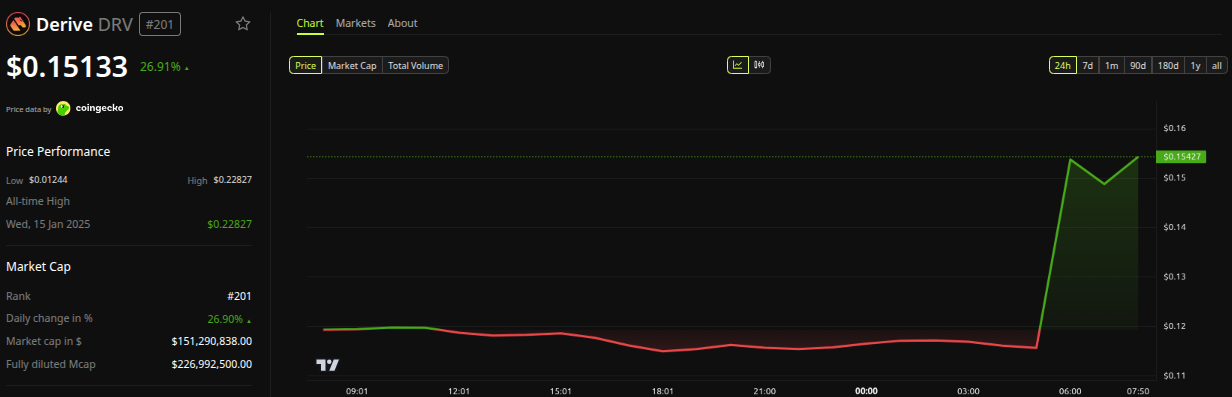
Derive (DRV) jumped roughly 30% after South Korea’s largest exchanges, Upbit and Bithumb, announced listings, lifting the price from $0.12 toward $0.18.
The dual debut gives the DeFi derivatives protocol fresh liquidity and exposure in one of crypto’s most active markets.

Derive: The DeFi Derivatives Protocol Behind the Rally
Derive is an on-chain options and perpetual futures protocol built on Ethereum as an optimistic rollup. The platform, known as Lyra Finance before its 2024 rebrand, combines low fees, deep liquidity, and self-custody. That combination made it one of the most complete derivatives venues in decentralized finance.
Trading on Upbit opened at 17:00 KST on July 14, with pairs against the Korean won, Bitcoin, and USDT. Bithumb followed shortly after, completing a rare double listing on the country’s dominant venues. The simultaneous move gave Korean investors immediate access via familiar, heavily regulated platforms.
The protocol targets both retail and institutional traders.
Furthermore, a recent launch on Hyperliquid had already expanded its on-chain footprint and trading volume. Cumulative activity on the protocol already reaches billions of dollars.
Follow us on X to get the latest news as it happens.
What Is Behind the Upbit and Bithumb Effect on DRV
South Korea’s passionate retail base and strict regulations concentrate volume on a few major platforms, amplifying every debut. Local traders move enough capital to reshape a token’s global price within minutes.
DRV followed the script closely. The token spiked toward $0.18 before settling near $0.15, according to BeInCrypto data. Initial restrictions, such as limit-only orders, helped contain the wildest swings. Even so, buying pressure from Korean accounts remained strong throughout the session.
The numbers behind the move look solid. DRV now has a market capitalization of $151.2 million and a fully diluted valuation of $226 million. Meanwhile, daily volume surged past $10 million.
The listings bridge sophisticated DeFi derivatives with mainstream accessibility. However, sustained momentum will depend on market sentiment, continued innovation, and delivery on the protocol’s roadmap. For now, Derive enters a new phase of mainstream exposure.
Subscribe to our YouTube channel to watch leaders and journalists provide expert insights.
The post Upbit and Bithumb Listings Send Derive (DRV) Soaring Nearly 30% appeared first on BeInCrypto.


Somewhere on the internet right now, a token that did not exist ninety seconds ago is being traded by strangers. It cost its creator about two dollars to launch, required no code, no company, and no permission, and it will most likely be worthless by dinner.
The machine that makes this possible is called a launchpad, and in the current market cycle, launchpads have become the single busiest category of application in all of crypto, minting millions of tokens, generating hundreds of millions of dollars in fees, and hosting both the fastest fortunes and the fastest wipeouts anywhere in the market.
A crypto launchpad is a platform where new tokens are created, distributed, and first sold. That one sentence covers two radically different worlds. The older world is the curated launchpad, a gatekept venue where vetted projects raise capital from early investors through structured sales. The newer world is the permissionless memecoin launchpad, where anyone can deploy a token instantly and the market sorts survivors from corpses in real time. Understanding both models, and the fair launch versus presale divide that separates them, is now basic literacy for anyone touching new tokens.
This guide covers what launchpads are and why they exist, how the curated model works step by step, how the ICO era created and nearly destroyed the category, how Pump.fun rewrote the rules with bonding curves and one click deployment, how fair launches differ from presales in mechanics and in incentives, the competitive war now running across chains, the risk landscape from rug pulls to sniping, and a practical checklist for evaluating any launch before putting money in.
What a launchpad is and the problem it solves
Every new token faces the same cold start problem. It needs a price, but prices come from markets, and markets need liquidity and participants, which a brand new asset has none of. It needs distribution, because a token held entirely by its creator is not a market but an inventory. And if the project behind it needs funding, it needs a way to sell tokens before any of the above exists. Launchpads are infrastructure built to solve the cold start: they provide the venue, the mechanics, and the initial audience that turn a token from a contract deployment into a trading asset.
The earliest solution was no solution at all. Projects in the initial coin offering era of 2017 and 2018 simply published a whitepaper and a deposit address, and money flowed in on trust. The results were catastrophic often enough, exit scams, vaporware, outright theft, that the market demanded intermediaries, and launchpads emerged as exactly that: platforms that would screen projects, structure the sale, hold the process to rules, and lend their reputation to launches that passed. Binance Launchpad’s 2019 debut set the template for the exchange hosted version, the initial exchange offering, and dozens of platforms followed across chains and niches.
Between those poles sits a spectrum of hybrids: launchpads with light vetting but open access, curated venues that added instant launch products, and exchange platforms that bolted bonding curves onto their listing pipelines. The taxonomy matters less than the underlying trade: every launchpad design chooses a point on the line between safety and openness, and every point on that line has a failure mode.
The intermediary model dominated until January 2024, when a Solana application called Pump.fun asked a heretical question: what if the launchpad screened nothing, structured nothing, and simply let anyone launch instantly into an automated market? The answer turned out to be the most prolific token factory in crypto history, and it split the launchpad world permanently in two.
How curated launchpads work
The traditional pipeline runs in recognizable stages. A project applies, submitting its documentation, team credentials, tokenomics, and roadmap. The platform vets, with the serious venues running identity checks, code audits, and economic review, and rejecting most applicants; the vetting is the product, since it is the reason investors trust the venue at all. An accepted project then announces its sale terms: price, allocation sizes, dates, and the vesting schedule governing when purchased tokens actually become tradable.
Participation mechanics vary by platform. The simplest model is first come, first served at a fixed price. More common is tiered access, where users must hold or stake the launchpad’s own native token to qualify, with larger stakes buying larger allocations, a design that conveniently creates permanent demand for the platform’s token. Lottery systems randomize access among registrants. Auctions let demand set the price. Whatever the format, buyers in these sales are getting in before public listing, usually at a discount to the expected listing price, and usually subject to vesting: a portion at the token generation event, the rest released over months. Some platforms add refund windows that let participants back out before claiming tokens, a feature that emerged after enough listings traded below their sale price to make guarantees a selling point.
After the sale, the platform typically coordinates the listing, on its own exchange in the IEO model or on a decentralized exchange in the IDO model, where the sale proceeds seed the first liquidity pools. The launch is complete when the token trades freely and the launchpad moves on to the next cohort. At their best, curated launchpads function as a hybrid of underwriter, accelerator, and quality filter. At their worst, they are pay to play listing machines whose vetting is a press release, and the category has produced plenty of both.
Pump.fun and the permissionless revolution
Pump.fun deleted every stage of that pipeline. Launched on Solana in January 2024, it reduced token creation to a form: name, ticker, image, and roughly two dollars in fees, with the token live and tradable in under a minute. No application, no vetting, no presale, no team allocation, no liquidity to raise. The mechanism that makes this possible is the bonding curve, an automated pricing formula that acts as the token’s first market.
The curve works like a vending machine that raises its prices as stock sells. A fixed portion of the new token’s supply is placed into the curve contract. Buyers purchase directly from the curve, and each purchase pushes the price higher along the formula; sellers sell back into it, pushing the price down. There is no order book, no market maker, and no counterparty except the contract, which means every token has instant, guaranteed liquidity from its first second, priced purely by net demand.
Graduation is the second innovation. When a token’s bonding curve fills to a threshold market value, originally around 69,000 dollars, later revised alongside the platform’s move to its own exchange, the accumulated funds are deposited automatically into a liquidity pool on an open decentralized exchange, and the token leaves the nursery to trade in the wild. Most tokens never graduate. That is the design, not a flaw: the curve stage is a cheap, contained arena where thousands of ideas can fail without wasting anyone’s liquidity but their buyers’.
The numbers the model produced are difficult to overstate. More than eleven million tokens have launched through the platform, cumulative revenue has run toward a billion dollars, and at peak the platform accounted for the large majority of all new token launches on Solana. In July 2025 the platform sold its own PUMP token, raising six hundred million dollars in twelve minutes as part of a sale exceeding a billion dollars, a fundraising event that would have ranked among the largest ICOs of the previous era, executed by a company whose product exists to make fundraising unnecessary. The irony was widely noted and changed nothing about the demand.
Inside the bonding curve: a worked example
The mechanics become intuitive with numbers. Suppose a new token launches with 800 million of its 1 billion supply placed into the curve, the standard structure on Pump.fun’s original design. The first buyer spends a small amount of SOL and receives tokens at the curve’s floor price, fractions of a cent. Each subsequent buy delivers fewer tokens per SOL, because the formula raises the price as the curve’s token reserve depletes. A buyer arriving after 100 SOL of net inflows pays a visibly higher price than the first; a buyer arriving after 400 SOL pays multiples of it.
Selling reverses the flow. A holder sells tokens back into the curve and receives SOL out of the accumulated reserve, pushing the price back down the formula. The reserve can never be emptied below what the formula requires, which is what makes the liquidity guaranteed: unlike a traditional pool that a creator can drain, the curve’s funds are locked in the contract and only move along the formula or, at graduation, into the public pool.
The design has an underappreciated psychological property. Because early positions on the curve are mathematically cheapest, every launch is a race, and the race is the product. The interface shows live buys, holder counts, and a progress bar to graduation, gamifying the climb. Critics describe the result as a slot machine with extra steps; users describe it as the purest price discovery in crypto, a market with no fundamentals to argue about, only flows. The two descriptions are not in conflict.
What the curve does not do is protect anyone after the music stops. When attention moves on, the same formula that escalated the price on the way up marks it down just as smoothly, and the last buyers hold the loss. The curve guarantees a market. It has no opinion about the price.
Fair launch versus presale: the real dividing line
Underneath the platform war sits a deeper design question: who gets tokens before the public does, and at what price. A presale model answers: insiders do. Investors, the team, and early allocations buy at preferential prices before public trading, with vesting schedules governing when they can sell. The presale is how projects fund development, and it is also how the low float, high valuation structure gets built, with all the delayed sell pressure that implies. Buying at public listing in a presale token means buying above the price every insider paid.
A fair launch answers: nobody does. All supply enters the market through the same mechanism at the same starting price, with no presale, no team allocation, and no vesting, because there is nothing to vest. The bonding curve launchpads made fair launches operationally trivial, and the model’s appeal is exactly its symmetry: the creator has no privileged tokens to dump, so the archetypal insider rug is structurally impossible.
The honest comparison cuts both ways. Fair launches remove insider pricing but replace it with a speed game, where the earliest seconds of the curve capture the cheapest tokens, and being early is its own privilege, one that trading bots enjoy far more than humans. Snipers buy in the launch block, bundlers split purchases across wallets to disguise concentration, and a nominally fair curve can be quietly cornered before an ordinary buyer ever sees the ticker. Presales, for all their asymmetry, at least fund something: a team with capital, obligations, and a vesting schedule has reasons to build, while a fair launched memecoin has no treasury, no roadmap, and no one accountable. Fairness at the starting line does not imply anything about the race.
The practical synthesis most of the market has settled on: fair launch mechanics suit tokens that are pure attention assets, meme coins whose only product is the crowd itself, while structured sales with vesting still dominate for projects that need funded teams. The mechanisms sort the assets.
The launchpad wars
Success invited siege. LetsBonk arrived in April 2025 from the BONK community in collaboration with Raydium, Solana’s largest decentralized exchange, differentiating itself by recycling a share of fees into buying BONK, a value return the community contrasted pointedly with Pump.fun’s extraction of fees. The same BONK ecosystem later provided a darker lesson in what community infrastructure can cost when its treasury governance failed spectacularly in a twenty million dollar attack, a reminder that the money launchpads generate has to live somewhere, and that somewhere has to be secured.
Competition then went cross chain. Four.Meme rose on BNB Chain and, in one signal moment, flipped Pump.fun in daily revenue as Binance ecosystem memecoins caught their own wave. SunPump ran the model on Tron. Moonshot courted safety conscious users with audited contracts. Raydium, watching its former partner build a competing exchange, shipped its own LaunchLab. Every general purpose chain now has at least one bonding curve launchpad, because the model is simple to copy and the fees are irresistible: the platform earns on every trade in every casino game, win or lose.
The economics explain the durability. A launchpad monetizes activity, not quality. Creation fees, trading fees on the curve, and graduation fees add up across millions of launches into revenue that rivals the largest protocols in crypto, all without the platform taking token risk itself. Critics call the model extractive, a house that profits from churn while the overwhelming majority of its tokens go to zero. Defenders answer that the platform sells exactly what it advertises, instant markets, and that no one is misled about the odds. Both descriptions are accurate.
What the launchpad era changed about token launches
Zoom out and the permissionless model altered three structural facts about crypto markets. First, it collapsed the cost of asset creation to effectively zero, which moved the scarce resource from capital to attention. When anyone can mint a token in a minute, tokens themselves are worthless by default, and value concentrates in whatever can gather and hold a crowd: a meme, a personality, a moment. The launchpad era is the attention economy with a price feed attached.
Second, it inverted the disclosure model. The curated era tried to make issuers trustworthy through vetting; the permissionless era abandoned trust and substituted transparency, publishing every wallet, every trade, and every creator action on chain and letting buyers do their own forensics. The tooling ecosystem that grew around launchpads, holder scanners, bundler detectors, creator wallet trackers, is the market’s answer to a world where nobody checks anything before launch, so everyone must check everything after.
Third, it turned launch mechanics into a competitive product category. Fee structures, creator revenue sharing, buyback programs, graduation thresholds, and anti sniping features now iterate week by week across competing platforms, the way exchanges once competed on maker fees. Some experiments push value back to communities, like fee recycling into ecosystem tokens. Others push it to creators, paying them a share of trading fees to keep launching. The direction of the iteration matters more than any single feature: launch infrastructure has become a business in its own right, larger by revenue than most of the projects that launch on it.
The risk landscape
The launchpad world’s risks divide by model. On permissionless platforms, the headline number tells the story: analyses of Pump.fun activity found that around 98.6 percent of launched tokens exhibited rug pull characteristics or died worthless, and the platform’s own founders concede that soft rugs, where a creator simply abandons a token and sells whatever they hold, cannot be prevented technically. Add sniping, bundled wallet accumulation, coordinated pump groups, copycat tickers designed to catch fat fingered buyers, and livestream stunts engineered for attention, and the picture is clear: the permissionless arena is adversarial by default, and every participant should assume the other side of their trade knows something they do not.
Curated platforms carry subtler risks. Vetting varies from rigorous to cosmetic, and a platform paid by projects to launch has a structural conflict when deciding what passes review. Allocation tiers push users to buy and stake platform tokens, concentrating risk in the venue itself. Vesting schedules on presale tokens defer insider supply into the future, where it lands on whoever is holding at unlock time. And the legal environment remains live: the category has drawn class action lawsuits, and the United Kingdom’s regulator blocked access to Pump.fun outright, part of a broader regulatory reckoning over whether instant token factories fit inside any existing framework. Distribution methods sit on a spectrum of scrutiny, from structured sales at one end to free airdrops at the other, and launchpads occupy the most commercially aggressive part of that spectrum.
None of this makes the category untouchable. It makes it a venue where risk is priced by attention, and where the checklist below does more work than in any other corner of crypto.
How to evaluate any launch
Before touching a curated sale, read the token’s full vesting table and compute what percentage of supply insiders hold, at what cost basis, unlocking on what dates. Check who audited the contracts and whether the audit is public. Investigate the launchpad’s track record: how did its last ten launches trade after listing, and after the first major unlock? Confirm what the raised funds are contractually committed to. If the answers are missing, the answers are bad.
Two universal habits complete the toolkit. Verify everything at the contract level, because interfaces lie more easily than chains: the vesting table that matters is the one enforced in code, and the holder distribution that matters is the one visible on chain right now. And watch what launches around you, because launchpad markets move in narrative waves, and a token’s fate usually has more to do with the wave it rides than with anything specific to the token.
Before touching a bonding curve token, check holder concentration first, since a token where a handful of connected wallets hold most of the supply is a trap regardless of its chart. Look at whether the creator’s wallet is accumulating or distributing. Treat graduation as a checkpoint, not a guarantee, because plenty of tokens rug after reaching open trading. Size positions on the assumption of total loss, because the base rate says that assumption will usually be correct. And treat social proof as a manufactured commodity, because on launchpads, it is: engagement, holders, and volume can all be bought for less than the profit of one successful exit.
The meta lesson spans both worlds. A launchpad organizes access to new tokens; it does not underwrite them. The most polished launch process on the most reputable platform still delivers an asset whose value depends entirely on what it is and who wants it. The machine that creates markets in ninety seconds is real, impressive, and permanently indifferent to whether any particular buyer walks away richer.
Frequently asked questions
What is a crypto launchpad?
A crypto launchpad is a platform where new tokens are created, distributed, and first sold. Curated launchpads screen projects and run structured early sales for investors, while permissionless launchpads such as Pump.fun let anyone create a token instantly and trade it through an automated bonding curve.
What is the difference between an ICO, an IEO, and an IDO?
All three are token sale formats. An ICO is a direct sale by the project itself, an IEO is a sale hosted and vetted by a centralized exchange, and an IDO is a sale conducted through a decentralized exchange or launchpad, with tokens typically becoming tradable on chain immediately after.
What is a bonding curve?
A bonding curve is a pricing formula inside a smart contract that acts as a token’s first market. Buyers purchase from the curve and each purchase raises the price; sellers sell back into it and lower the price. It gives new tokens instant liquidity without an order book or market maker.
What does graduation mean on Pump.fun?
Graduation is the moment a token’s bonding curve reaches its target value and the accumulated funds move automatically into a liquidity pool on an open exchange. The token then trades freely outside the launchpad. Most tokens never reach graduation.
What is a fair launch?
A fair launch distributes all supply through the same public mechanism at the same starting terms, with no presale, no team allocation, and no vesting. It removes insider pricing advantages, though bots and early snipers still gain an edge in the opening moments.
Are launchpad tokens safe to buy?
They carry elevated risk in both models. Analyses have found that the overwhelming majority of tokens on permissionless launchpads end up worthless or exhibit rug pull behavior, while presale tokens carry insider unlock overhangs. Position sizing that assumes total loss is the prudent baseline.
How do launchpads make money?
Primarily through fees: token creation fees, trading fees on bonding curve activity, graduation or listing fees, and in curated models, charges to projects and revenue tied to the platform’s own token. Launchpads earn on activity regardless of whether individual tokens succeed.
Why do some launchpads require staking their token?
Tiered access models grant larger sale allocations to users who hold or stake the platform’s native token. The design rations scarce allocations and, by requiring the stake, creates ongoing demand for the launchpad’s own token.
This article is for educational purposes only and does not constitute financial or investment advice. Launchpad mechanics, fees, and platform details change frequently. Details are accurate as of July 14, 2026.

The Digital Asset Market Clarity Act (the “CLARITY Act”) has picked up a second high-profile endorsement from a major US law enforcement organization as lawmakers race toward a perceived make-or-break point before the Senate’s August recess.
On July 10, the Federal Law Enforcement Officers Association (FLEOA) said it submitted a letter to the US Senate Banking Committee supporting the bill, while recommending targeted changes aimed at strengthening accountability in decentralized finance (DeFi) and protecting law enforcement’s existing investigative powers. The move follows another recent endorsement for the legislation, helping counter claims that the bill would restrict the government’s ability to pursue crypto-related crime.
Key takeaways
- FLEOA has endorsed the CLARITY Act, framing it as progress toward balancing innovation and public safety.
- The association asked lawmakers to tighten DeFi-related protections and clarify who is accountable for activity in decentralized systems.
- FLEOA urged revisions to reduce opportunities for firms to evade regulation by labeling themselves decentralized.
- The endorsement arrives less than four weeks before the Aug. 8 Senate recess, which industry participants view as a critical deadline.
- Prior law enforcement concerns about DeFi “developer” protections helped prompt discussions that led to other groups adjusting their positions.
A law enforcement group backs CLARITY—then asks for edits
In a July 10 statement shared publicly, FLEOA said the current version of the CLARITY Act makes “meaningful progress” toward aligning digital asset innovation with public safety goals.
FLEOA also characterized the bill as establishing a clearer regulatory framework for digital assets while preserving key authorities used to enforce criminal law and compliance requirements. In the association’s view, those include anti-money laundering and counterterrorism financing efforts, sanctions enforcement, and investigative powers used to pursue wrongdoing.
Ji Kim, CEO of the Crypto Council, publicly highlighted the significance of the endorsement, stating the support from FLEOA confirms the bill’s consumer-protection and law-enforcement strengths. The endorsement arrives after the legislation drew scrutiny from some public-safety stakeholders who argued certain provisions could make enforcement harder—particularly around how responsibility is assigned in DeFi environments.
DeFi provisions are the focal point for accountability concerns
While backing the CLARITY Act, FLEOA urged lawmakers to narrow aspects of the bill’s DeFi protections. The association called for lawmakers to make accountability clearer, including specifying who can be held responsible within decentralized systems.
FLEOA also asked legislators to address how some entities might attempt to avoid regulatory obligations by portraying themselves as decentralized without meeting the underlying conditions implied by that label. Beyond that, the group recommended changes to the bill’s “specific intent” language, arguing for wording that would make it easier to establish liability when needed.
Finally, FLEOA said lawmakers should explicitly affirm that the proposed law does not limit existing federal investigative authority—an issue it appears lawmakers are trying to balance against the broader goal of creating a more predictable legal framework for digital assets.
Earlier coverage from Cointelegraph noted that the CLARITY Act has faced objections tied to a specific section—Section 604—aimed at protecting developers from liability for illicit activity conducted by users on decentralized platforms. Those arguments centered on the risk of overly broad exemptions that could hinder investigations.
Law enforcement pressure earlier helped reshape the conversation
In June, four law enforcement organizations reached out to the White House expressing concerns about Section 604. According to their objections as reported by Cointelegraph, the groups—including the National District Attorneys Association, the National Association of Assistant United States Attorneys, the International Association of Chiefs of Police, and the National Sheriffs’ Association—worried the provision could broaden liability protections in a way that makes crypto crime investigations more difficult.
That opposition contributed to follow-up engagement from the executive branch. As described in earlier reporting, the White House invited the objecting organizations to a meeting in late June.
Momentum then shifted within the law enforcement community. In July, the Major County Sheriffs of America reportedly moved its position to neutral after initially opposing the CLARITY Act, illustrating how stakeholder views can evolve as the bill’s language is debated and interpreted.
FLEOA’s latest endorsement fits this pattern: support for the overall direction of the legislation, paired with calls for changes that target perceived gaps—especially where decentralized finance blurs responsibility and where enforcement concerns overlap with questions about developer and platform accountability.
Senate calendar tightens: Aug. 8 recess viewed as pivotal
The new FLEOA letter lands with urgency. Industry insiders have framed the Senate’s Aug. 8 recess as an important milestone for whether the CLARITY Act can pass during the current legislative window.
Senator Cynthia Lummis said on July 8 that lawmakers are likely approaching their last realistic opportunity to get “real legislation” for digital assets on the books before 2030. She warned that failing to pass the CLARITY Act could mean other jurisdictions set rules for digital assets, potentially leaving the US to catch up over the following decade.
Against that backdrop, the addition of another law enforcement organization backing the bill—while simultaneously requesting specific refinements—may signal that negotiations are turning from broad skepticism toward narrower, language-level adjustments. The key question for the market will be whether the Senate Banking Committee and the broader legislative process will incorporate enough of these accountability and enforcement-protection recommendations to preserve support across public safety stakeholders.
Read together with the June concerns and the subsequent shifts by other law enforcement groups, FLEOA’s position suggests the bill’s path may hinge on how DeFi-related provisions are drafted and clarified—particularly around developer protections, responsibility in decentralized systems, and safeguards against “decentralization” being used as a regulatory shield.
What to watch next before the Senate recess
With the Aug. 8 recess approaching, lawmakers will likely focus on whether DeFi accountability, liability standards, and explicit non-limitation of federal investigative authority are addressed in a way that maintains broad law-enforcement support—while still delivering the clearer regulatory framework the CLARITY Act is designed to provide.
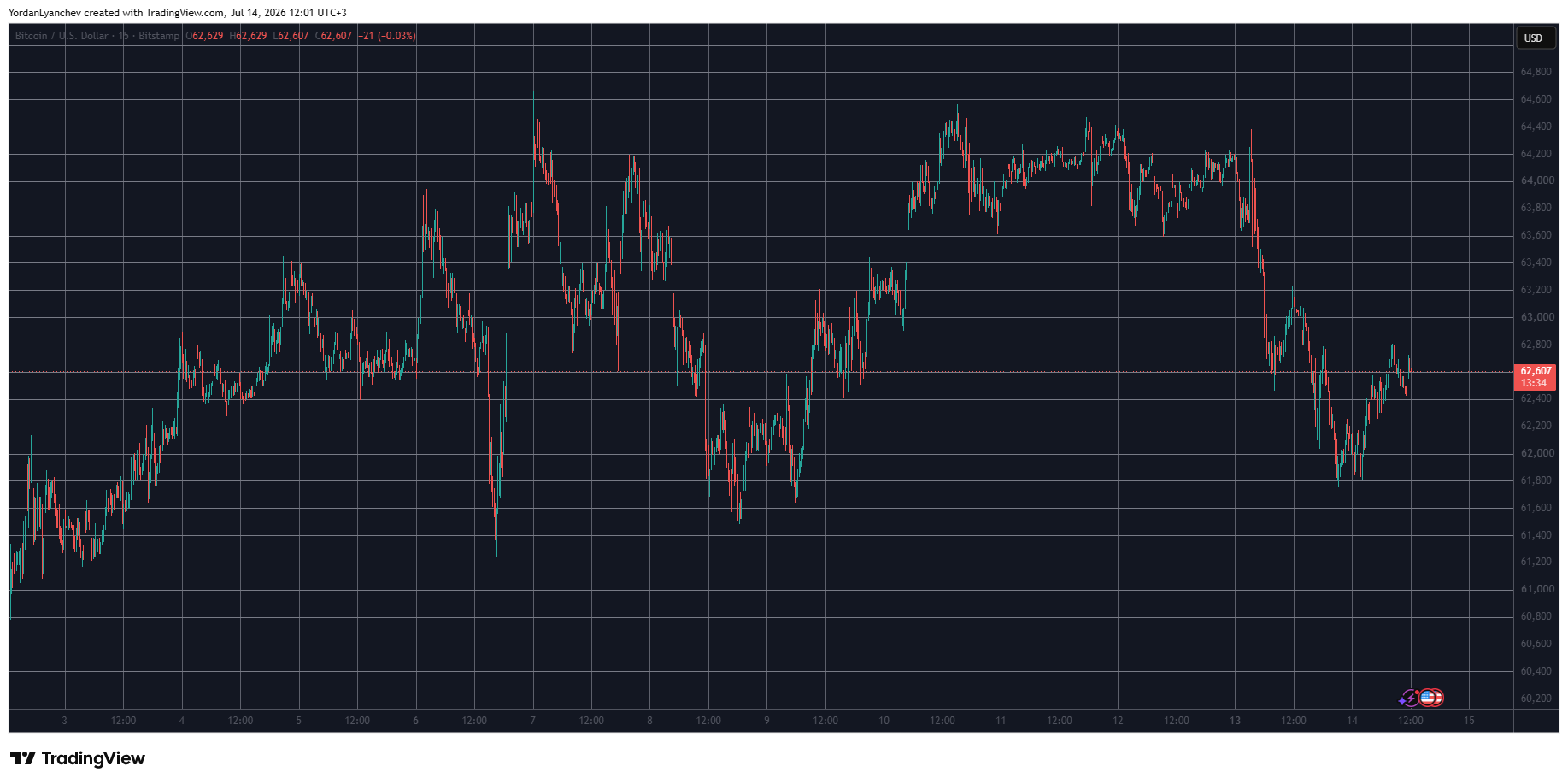
Perhaps factoring in the substantial escalation in the Middle East, bitcoin’s price tumbled on Monday from over $64,400 to a multi-day low of $61,800, where it finally found some support.
Most larger-cap alts are in the red once again today, with HYPE, ZEC, and XLM dropping by around 3%.
BTC Rebounds From Sub-$62K Dip
Strategy’s major bitcoin sale announced last Monday brought intense volatility to the market. At first, BTC reacted with a painful decline from $64,000 to $61,200, which was rather expected given the significance of such a move. What was more surprising was the subsequent reaction that saw bitcoin jump to $64,600 within hours.
Nevertheless, that was short-lived as the renewed attacks between the US and Iran increased the selling pressure once again. This time, BTC dipped to just $61,600 before it began its recovery. The culmination came during the weekend when the cryptocurrency spiked to $64,600 again. Although it was stopped there, it spent most of the weekend at around $64,000.
Strategy didn’t buy or sell BTC in the past week, which was a relief. However, Trump reinstated the US Navy blockade at the Strait of Hormuz, which led to another leg down to $61,800. Bitcoin has rebounded since then and now sits almost a grand higher, but it’s still 3% down monthly.
Its market cap remains under $1.260 trillion, while its dominance over the alts has stalled at 56.7% on CG.
PI Smashes New Record Lows
It’s safe to say that Pi Network’s native token is among the worst performers during this bear cycle. It was rejected at $0.30 in March and has plunged since then to consecutive all-time lows. After yesterday’s drop to $0.086, the token crashed once again in the past day to just over $0.07, marking yet another low.
DEXE is the other double-digit loser on a daily scale after its recent rally. In contrast, HASH is up by 25% to $0.0095, followed by BDX’s 10% surge to a very similar price tag.
ETH, XRP, SOL, TRX, DOGE, RAIN, and XLM have lost up to 2% daily, while HYPE, ZEC, and XLM are down by over 3%.
The total crypto market cap has lost another $20 billion and is below $2.220 trillion on CG.

The post Pi Network’s PI Crashes and Burns Again, Bitcoin Rebounds From $62K: Market Watch appeared first on CryptoPotato.
Crypto World
Crystal Intelligence launches Ask Crystal, the AI analyst behind every blockchain judgment
[PRESS RELEASE – Amsterdam, Netherlands, July 14th, 2026]
Ask Crystal, a new AI capability inside Crystal Expert, turns any transfer into one clear, evidence-backed narrative, so compliance, investigation, and risk teams decide in seconds, not minutes.
Crystal Intelligence today announced the rollout of Ask Crystal, an on-demand AI analyst built into Crystal Expert. Ask Crystal reads the full on-chain picture behind any transfer and returns one structured narrative, every answer backed by verifiable blockchain evidence. It is designed to support analyst work, to save time and make faster decisions.
Teams that review blockchain activity face a hard reality. Whether they work in compliance, investigations, or risk, case volumes keep climbing. The signals that matter, transfer details, fund connections, triggered alerts, and counterparty history, sit across separate screens. Two reviewers can read the same case and reach different conclusions. The result is slow reviews, inconsistent decisions, and heavy cognitive load on the people who can least afford a mistake.
Ask Crystal removes that friction. Inside Crystal Expert, on any transfer, a single tab generates a plain-language AI summary on demand, and regenerates it whenever the analyst needs a fresh read. Each summary consolidates four structured sections: a transfer overview, a connections analysis covering source and destination of funds, alert details explained by type and detection rule, and prior interactions with a trusted-list check. One read replaces minutes of manual correlation across tabs.
“Across compliance, investigations, and risk, teams are asked to make high-stakes calls under time pressure, with the evidence scattered across screens,” said Navin Gupta, Chief Executive Officer of Crystal Intelligence. “Ask Crystal changes that. This AI does the reading, the correlating, and the cross-referencing in seconds, then hands the analyst one clear, evidence-backed story. We are not automating the decision. We are giving every decision the full picture it deserves.”
What teams get
- Less operational complexity. Every key signal in one structured view of the transfer.
- More consistent judgments. Context, connections, alerts, and history are interpreted the same way, every time.
- Lower cognitive load. No manual correlation across tabs and alert screens.
- Faster onboarding. A guided, plain-language read makes cases easier to learn from.
Ask Crystal is part of Crystal Expert, the institutional-grade platform used by compliance teams, investigators, financial institutions, and regulators to detect crypto risk, trace funds across more than 330 blockchains, and prove compliance with reports regulators trust. Access to Ask Crystal is controlled through role-based permissions. The feature is rolling out to Crystal Expert customers now.
About Crystal Intelligence
Crystal Intelligence turns blockchain complexity into clear, actionable intelligence for compliance teams, investigators, financial institutions, and regulators. Crystal Expert covers more than 330 blockchains and over 110,000 attributed entities, giving teams the verified data they need to detect risk, trace funds, and prove compliance. Headquartered in Amsterdam, Netherlands, Crystal Intelligence is ISO 27001 and GDPR compliant, with EU-based data governance.
The post Crystal Intelligence launches Ask Crystal, the AI analyst behind every blockchain judgment appeared first on CryptoPotato.

Economists and tech leaders sign statement warning of AI threats

SWIFT JUST REPLACED RIPPLE & XRP?! THIS IS WHAT YOU MUST KNOW!

Regent Park hosts family fun day with games and attractions


-

 Fashion5 days ago
Loro Piana Fall 2026 Enters Houston’s Art Scene
-

 Fashion3 days ago
Weekend Open Thread: Nutriplenish Leave-In Conditioner
-
 Sports5 days ago
2026 Genesis Scottish Open Thursday TV coverage: Round 1
-

 Sports7 days ago
Joshua Pacio ‘more complete’ ahead of ONE rematch vs Malachiev
-

 Tech6 days ago
Anthropic brings Claude Cowork to mobile and web as usage data shows most users aren’t coding
-

 Sports4 days ago
Super Eagles star Moses Simon opens up on Liverpool transfer regret
-
Sports7 days ago
We have punished the disrespect
-

 Tech5 days ago
Character.AI enters the microdrama arena with its own productions, but there’s a twist
-
 Crypto World7 days ago
Claude AI Created Something Anthropic Never Designed
-

 Crypto World7 days ago
Nasdaq arthritis company holding Moshe Hogeg crypto hits all-time low
-

 Tech5 hours ago
Get Your ESP32 Sunny Side Up With This Solar Dev Board
-

 News Videos5 days ago
Crypto Just Entered Its Most Important 6-Month Candle (Could Decide Everything!)
-
 Tech6 days ago
Keychron is stepping outside keyboards with a $349 Thunderbolt 5 dock aimed at power users
-
 Business6 days ago
ASX 200 Slides Over 0.6% as Rare Earths and Lithium Stocks Tumble Amid Global Semiconductor Sell-Off Today
-
 NewsBeat5 days ago
Major update after Huntingdon train attack as man enters plea
-
 Business6 days ago
Will Trent shares rebound after Q1 update triggers 13% crash? Here’s what technical charts indicate
-
 Tech7 days ago
OpenAI teams with Work Louder to launch Codex-native keyboard, weeks after CEO of Apps told staff ‘not to be distracted by side quests’
-

 Business6 days ago
SpaceX Shares Slide Nearly 6% Amid Post-IPO Volatility and Starship Test Focus
-
 Crypto World7 days ago
TeraWulf’s $19B Anthropic Lease Turns Bitcoin Miner Into AI Landlord
-
 Sports6 days ago
39-year-old Djokovic wins five-hour thriller to enter Wimbledon semis | Other Sports News
You must be logged in to post a comment Login