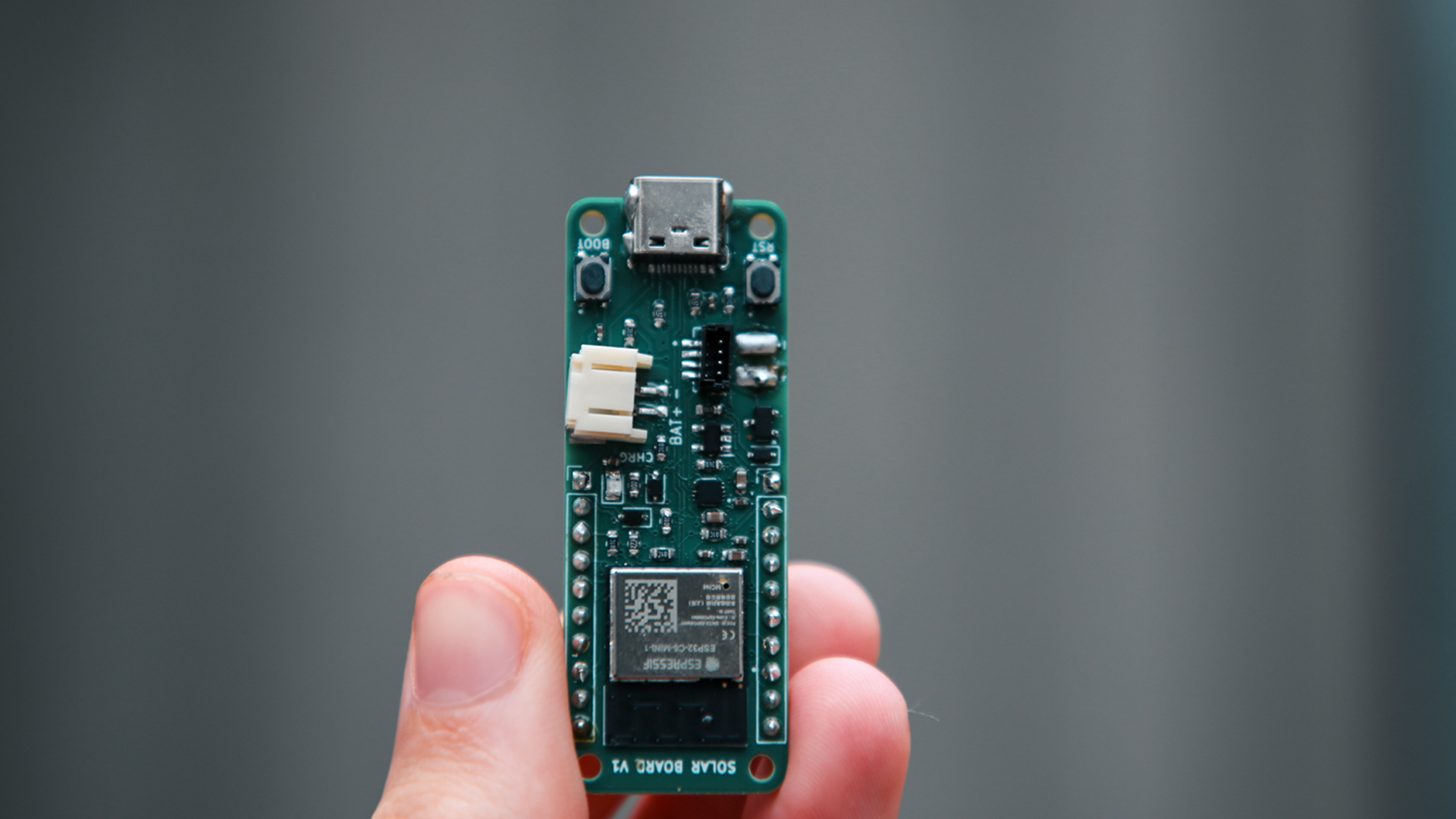
There are a lot of ESP32-based development boards out there– and why not? It’s a versatile chip that can be used in all sorts of situations, and people want boards to match them. Not finding one to his liking that was specifically built for solar powered IoT projects, [Narrow Studios] rolled his own. Well, designed it; like most these days, he’s outsourced the manufacturing to PCBWay, which is where you’ll need to go if you want one.
Why might you want one? Well, if you have similar goals in mind to [Narrow Studios]. He’s put an ESP32-C6 Mini on the board, which means it’s got most of the IoT communications protocols you might be interested in — bluetooth, wifi, Matter, Thread, and Zigbee, too. Ten 10 IO pins have been broken out, plus I2C on a QWIIC connector, which gets you a whole ecosystem of sensors to easily plug into. The “solar” part is justified by the inclusion of a BQ25186 linear battery charging IC from Texas Instruments, with the designated solar power input protected against reverse voltage in case you– like this author– have let magic smoke out by hooking things up backwards. Is it embarrassing? Yes. Does it happen? Also yes, so putting protection on the board is a nice feature. [Narrow Studios] released a video that we’ve embedded below discussing his design choices and demonstrating the device, but the project page can give you the gist.
Of course there’ve been plenty of solar-powered projects to feature the ESP32 here before– you can even use it for maximum power point tracking— but this dev board might be exactly what someone is looking for to build their next IoT project, so we’re thankful to [Narrow Studios] for the tip.
Televisions are evolving yet again. This time, the new kid on the block is mini RGB, which emits red, green, and blue lights through an LCD panel instead of just white or blue lights. According to Hisense, one of the first brands to debut an RGB LED TV, the technology is an attempt to produce “pure colors directly at the source.”
The intended result is LED TVs with better colors, improved contrast, and much higher brightness—all designed as a proper alternative to OLED. Whether it’s a giant leap forward, though, depends greatly on the kind of movies and shows you watch and your willingness to tweak a few settings. I tested five new models to get a taste of what’s to come and to determine which (if any) you should buy.
The first RGB TVs came out in 2025, but it’s really in 2026 that the technology is getting wider distribution across sizes and prices. As I stated above, an RGB TV has conventional LED backlighting but uses a red, green, and blue backlight module rather than the standard white or blue LEDs. But it’s not quite that simple. Samsung and LG call it “micro RGB,” while TCL and Hisense say “mini RGB.” The tech works roughly the same, even if micro RGB uses smaller LEDs. Sony uses the term “True RGB” and claims there’s no difference between mini RGB and micro RGB.
Advertisement
My goal in testing, though, was to cut through the marketing spin and just put each model through a few benchmarks, watch the same movies, and stay glued to the World Cup no matter which model I was testing. The surprising discovery is that mini RGB (which is the term I’ll use for all of them) is noticeably vivid, has excellent contrast, and looks bright and clear even during the daytime. Mini RGB televisions are also excellent for off-angle watching.
That said, I don’t think you have to put that OLED up on Facebook Marketplace just yet. Mini RGB is an evolution in tech, but it also means manufacturers can keep using LCD panels. OLED was a sea change because individual pixels can emit color or be turned off entirely. In my side-by-side tests, mini RGB is a smart upgrade but isn’t the ultimate display tech. While the costs are comparable for now, I expect mini RGB televisions to come down in price soon.
Why Choose a Mini RGB Over Other Models?
The name mini RGB would imply that it is all about color—specifically red, green, and blue. Yet, the way the technology works by shining those colors through an LCD panel means there is a lot more control over contrast and brightness as well.
Advertisement
In my tests, I found settings for brightness, clarity, contrast, and picture mode had a much more obvious impact than on a normal LED or QLED. I equate this to a sports car. You can drive a BMW M5 on a side street at low speeds, but until you enable track mode, adjust the suspension, and perform other tweaks, you won’t really know what the car can do. Mini RGB is similar in that it’s highly customizable.
How Much Do RGB TVs Actually Cost?
Anything brand-new to the market will likely cost more than we might expect. While the Hisense UR9 RGB Mini-LED was the cheapest by far at only $1,999 for the 65-inch model, every other mini RGB and micro RGB costs closer to $4,000. That’s about $1,300 more than an OLED at the same size. The flagship OLED models from LG and Samsung tend to cost around $2,700 for a 65-inch. LED and QLED models are even cheaper, running as low as $500.
How Easy Are They to Mount?
Advertisement
As with any modern television, mounting one on a wall is fairly easy since there’s so much information online about how to do it. I’ve found YouTube videos that explain exactly what to do, even covering how to install an electrical box. Mainly, you have to use a stud finder and make sure you’re mounting the brackets into a stud and not just sheetrock, but even that process only takes a few minutes.
The one exception is if you go with a larger-size mini RGB model like the TCL RM9L RGB-Mini LED. If the television weighs over 100 pounds, it changes the ball game in terms of using multiple studs and adding extra mounting brackets.
The Best Overall RGB TV
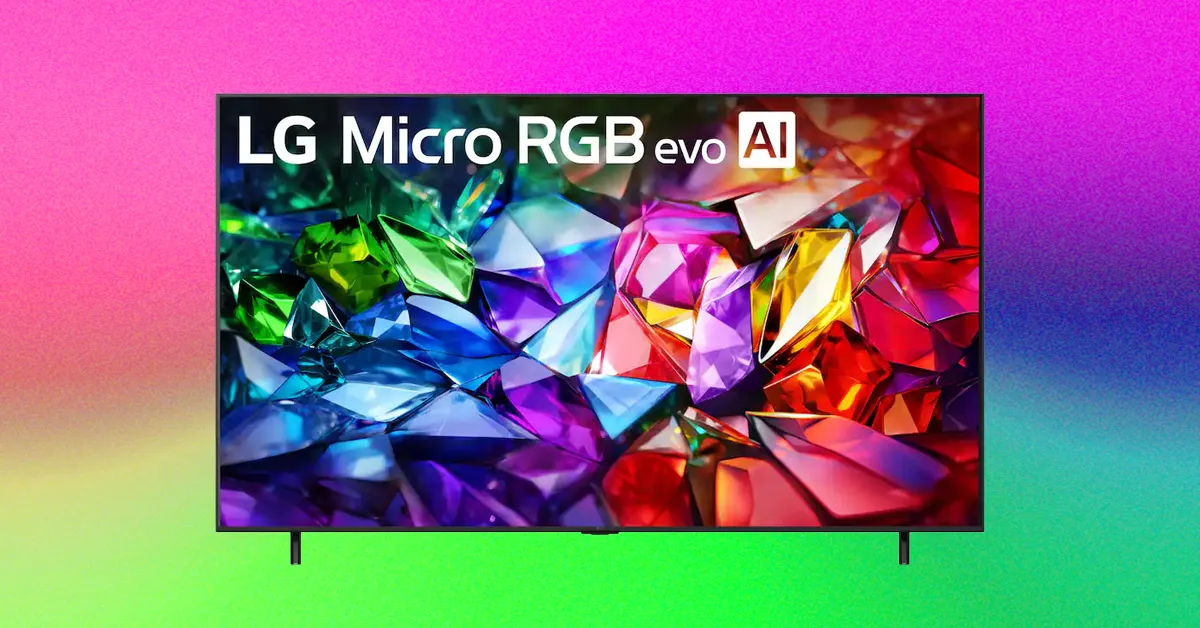
LG makes high-end televisions that tend to be a bit pricey, but they’re often worth the extra expense. The LG Micro RGB Evo is no different. Priced at $4,500 (that’s with a $500 discount right now) for the 75-inch model I tested, this is one brilliantly colorful and impressive television.
Setup and install were simple. It’s just a matter of inserting the legs and screwing them in tight. My only complaint here was the legs were a bit pointy. For connectivity, the LG Micro RGB Evo has four HDMI 2.1 ports, an Ethernet port, one digital optical, a coaxial connection, and two USB 2.0 ports. WebOS is a capable streaming platform, if a bit confusing and bloated with too many apps and advertisements.
Advertisement
Movies and shows looked stunning and vivid on this television, once I got used to tweaking the picture modes. By default, some of the stock settings (e.g., Filmmaker mode) made movies like Awake on Netflix look too dark. Tron: Ares on Disney+ was vivid with deep blacks and reds.
While the LG Micro RGB Evo worked perfectly fine for console gaming, it had some trouble with a gaming laptop. The variable refresh rate setting, which LG calls Motion Booster, did not work correctly when I used an Alienware 16X Aurora laptop. However, at the native 165-Hz refresh rate, this model is a game changer—Crimson Desert looked absolutely stunning.
London Tech Week’s focus on AI – from a £12 million investment in AI for SMEs to AI bootcamps for graduates and more – has reflected the pressure to compete in an AI-era.
As this digital revolution progresses, the job economy is changing, but the mantra that AI is taking our jobs is simply not correct and potentially fueled by an undercurrent of classicism.
Vincent Huguet
CEO and co-founder of Malt.
When the Luddites famously started to break the first machines of the industrial revolution in 1811 in England, fearing for their job as textile artisans, the “Bourgeoisie” would describe them as “ignorant workers”, with no understanding of basic economics.
Latest Videos From
More than two hundred years later, with the rise of GenAI, it is no longer the blue-collar workers who fear for their job, but the white-collar workers. This time it is the “bourgeois” who live in the anxiety of an uncertain world.
Since ChatGPT introduced AI into the everyday lexicon, it has been clear that we would experience an unprecedented revolution. The rhetoric that immediately began to dominate social discourse has been that AI tools would render most jobs insignificant.
Advertisement
Furthermore, whilst other technological revolutions ended up being creative destruction, ‘this time it was different’.
But is that really the case? Or are we more fearful, more concerned about destroying the status quo, because this time it’s a different ‘class’ of people being impacted? This time it’s the desk workers, not the physical laborers, who risk losing jobs, and suddenly there is alarm.
Sign up to the TechRadar Pro newsletter to get all the top news, opinion, features and guidance your business needs to succeed!
Advertisement
Artificial Intelligence relies on humans – and more humans than ever
AI is a human creation and still relies on humans to evolve. First, we have those who build the infrastructure, like data centers, which accounted for almost all of the United States’ GDP growth in the first half of 2025 (according to Harvard economist Jason Furman).
Then, we have those who train the models, which still need to be constantly retrained. Even if models are able to train themselves eventually, there is no consensus that human intervention in training will become obsolete, because human behavior and the entropy of organizations are in a constant state of flux and evolution.
And even when trained, AI constantly needs to also understand the “context” in which it is prompted to perform efficiently. AI then needs to be deployed. Managing security, defining guardrails for agents, understanding how to use AI and tracking agentic AI’s actions, all comes with inherent challenges.
Advertisement
The CIOs of the largest global corporations are already investing hundreds of millions of pounds to understand this. Startups based in San Francisco – a city I recently visited where 95% of out-of-home ads were about AI agents – are focused entirely on resolving these problems for large enterprises.
The fact that both Anthropic and OpenAI have launched their own consulting companies is proof that managing AI complexities in the coming years will be the biggest source of growth for all consulting and outsourcing companies of the world.
Advertisement
Sourcing the right human talent in the AI era is the biggest challenge
Software engineering is a job category where GenAI – perfectly trained on open-source code and GitHub repositories – can now code better than even the most experienced developers.
Additionally, developers in AI labs – with privileged access to “tokens” on Claude Code or OpenAI Codex – now develop 100% of the time without writing a single line of code. Nonetheless, when asked about their biggest challenges, all AI startups would point to recruitment.
A report by the UK’s National Foundation for Education Research showed a 50% increase in tech job adverts between 2019/20 and 2024/25, with entry-level roles particularly affected. However, we’re now seeing a surge in demand driven by Gen Z, according to Employment Hero’s March Jobs Report.
This demand for AI expertise is reflected in a new Malt Tech Trends Report, which analyzed 1.2 million searches of tech freelancers in 2025. It reveals that AI is now the second most-in-demand skill, irrespective of company size, industry, or project type. More specifically, demand for freelancers with agentic AI expertise exploded by 5,800% in just twelve months.
Advertisement
Observer of the AI revolution, Andrew Ng, explains that if, for example, a team of 3 developers builds 10 times faster, then they need more designers or product managers to fuel the creative process. Doing more faster, with fewer people creates more work to fuel and execute the output.
More people are echoing the same rhetoric as Ng, calling out the phenomenon of ‘AI washing’, whereby companies have justified mass redundancies with AI disruption. In reality, in many cases, they were either adapting to geopolitical and economic uncertainties or had simply employed too many in the crazy post-COVID bull market.
The AI job apocalypse is not yet here… Still, the fear is real and needs to be understood
Software engineering is a perfect example of a job category that has constantly evolved. Since the inception of computer science, programming has become progressively more about “natural language”. Whilst there were 50,000 developers worldwide in the 1960s, today there are almost 50 million. Undoubtedly, the eradication of barriers to entry to build software increases that number tenfold.
Advertisement
History, data, and observation shows us that the AI job apocalypse is not yet here. Still, the fear is real and needs to be understood. The reason every science fiction novel paints an inhospitable world and unattractive paradigm is because the human mind always fears change. We assume the worst.
AI transformation, like all transformations, will be a cultural change first. And it’s companies, not professionals, who are most at risk if they fail to adapt. If one thing will be different in this digital revolution, compared to the last (arguably comparable is the advent of the internet), it’s the rate of change.
CEOs will have to be imaginative, change org charts and processes, admit they are not omniscient, take risks, and invest in training. Schools and universities also face the challenge of teaching soft skills: how to adapt to live and work in a more uncertain world. Because we can only harness top-tier AI talent if we understand how to truly adapt to change.
Independent professionals – those who create their own roles – from freelance developer to fractional manager and strategic consultants – have already redefined work.
Advertisement
On average, freelancers spend 4 hours a week on upskilling and keeping up with the job market and already have the habit of switching from one client project to another. They were the first to adapt to AI and realize that a job is more than just a bundle of tasks.
As Jensen Huang, CEO of Nvidia, recently said, if someone were to observe him at work, we would conclude that his day consists of tasks like making hundreds of calls and sending emails. AI will replace, augment, and improve these tasks. But it will not take Jensen’s job.
This article was produced as part of TechRadar Pro Perspectives, our channel to feature the best and brightest minds in the technology industry today.
Advertisement
The views expressed here are those of the author and are not necessarily those of TechRadarPro or Future plc. If you are interested in contributing find out more here: https://www.techradar.com/pro/perspectives-how-to-submit
Keep yourself open to, “OK, I’m gonna look around. Is there a Luddite poster here? I’m at my local bookstore. OK, is there some information here?” It’s this idea of social infrastructure, switching people over from the idea of, “OK, I’ll look at an Instagram page, and here’s all the events” to the idea of, “I actually have to leave my house.” Be on the lookout. We’ll be out here. Tompkins Square Park, probably, other parks, privately owned public spaces. We have events all over this city. It’s amazing. Knicks in five. I love New York.
Gowanus, we like to play a little game on each show.
I love games.
We’re very proud of it. It’s called Control, Alt, Delete. So I wanna know what piece of tech you would love to control, what piece you would alter or change, and what you would delete, or vanquish from the earth.
Advertisement
Wow.
Are you ready?
Control, Alt, Delete. OK, great.
Let’s start with control.
Advertisement
This is so funny that you’re asking me this. I would say the servers for the internet.
The internet was billed as something that was, OK, we are going to have a free exchange of knowledge across the world. It’s going to help diversity and globalization and all this stuff, and then, boom. Military technology, right?
I’m trying to think about which technologies do I feel have a real positive impact, but have a negative sort of profit incentive.
Let me give this one. I would alter the way that social media platforms have a centralized system instead of a federated system. I think that’s pretty solid, and this was almost in the creation of Twitter, they were about to do this. And then Jack Dorsey was like, “No, we should have it be more centralized.”
And finally, delete.
I can’t wait. This is my favorite one.
Advertisement
What would you delete?
AI. AI data centers. Done. Done. Immediately done. Boom. Gone. I mean, come on, guys.
Come on. Especially when they bill it as, “OK, we’re gonna make an AI to fix all of our climate catastrophe, all of our income inequality, but first, we have to absolutely drain the natural resources of the Earth.” I mean, it’s just ridiculous. It just makes me so frustrated. I think the data center is honestly one of the worst materializations of this Big Tech oligarch world that we live in.
Where like the whim of Mark Zuckerberg wanting a Meta Hyperion data center in Louisiana is legitimately going to use multiple times the amount of energy that New Orleans uses. We can’t sustain that as a planet, truly. It doesn’t matter how interesting the technology is or what it could do. These are resources that we need now for life to continue. We need fresh water. We need land to grow food. We need ecosystems where birds and bees and wildlife can coexist, and I’m not very interested in trading that for a chatbot, even if the chatbot tells me it loves me and we can kiss through the phone.
Advertisement
How to Listen
You can always listen to this week’s podcast through the audio player on this page, but if you want to subscribe for free to get every episode, here’s how:
If you’re on an iPhone or iPad, open the app called Podcasts, or just tap this link. You can also download an app like Overcast or Pocket Casts and search for “uncanny valley.” We’re on Spotify too.
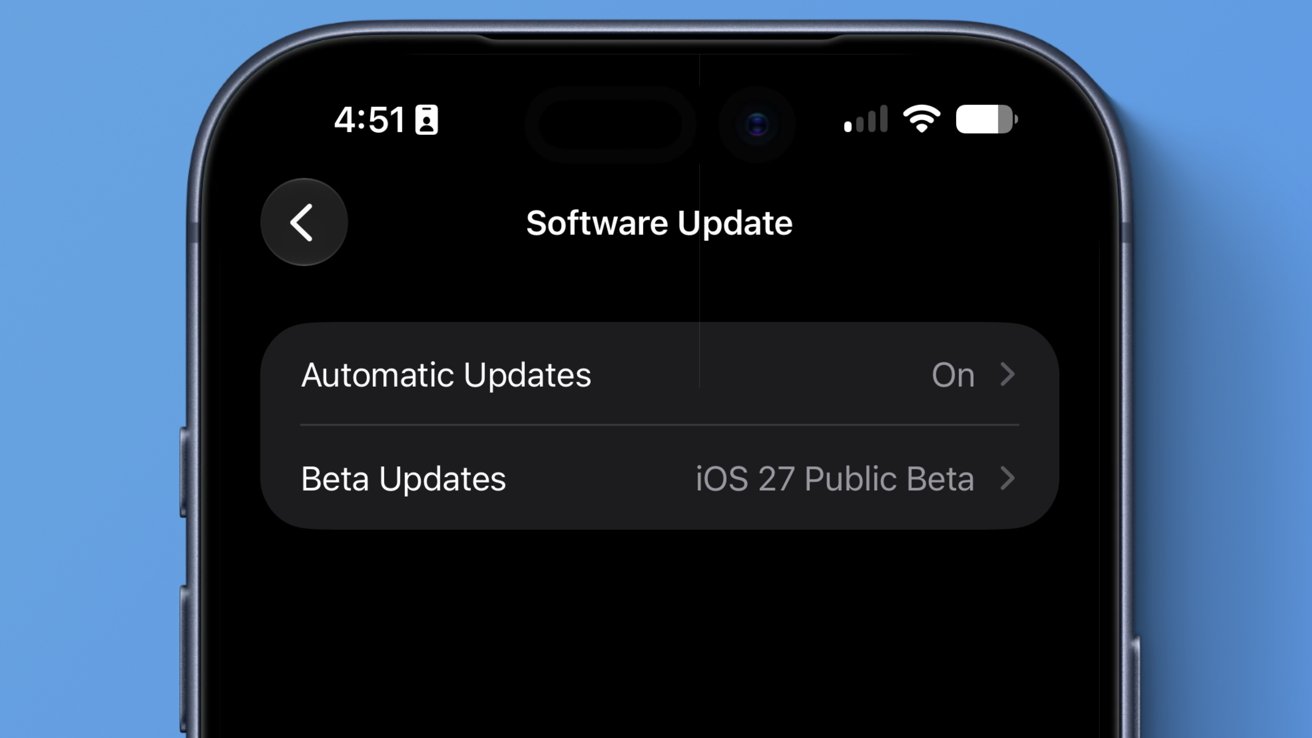
Apple has finally introduced its first public betas of iOS 27, iPadOS 27, macOS 27 Golden Gate, watchOS 27, visionOS 27, and tvOS 27.
Since the introduction of the 27-generation operating systems at WWDC in early June, Apple has been testing developer beta builds. A few rounds later, and it has started to do the same with the public beta.
A public beta differs from a developer beta in that the software has been tested enough to be less of a risk to end users. While a developer beta has the potential to cause problems for testers, the public variant is from a later stage with the bigger potential issues out of the way.
While the public beta is generally safer to use than a developer version, it’s not entirely safe. There’s still the risk of data loss and other issues, just that the chance is smaller.
Advertisement
AppleInsider and Apple strongly advise against users installing test operating systems or beta software onto primary or “mission-critical” hardware. That warning stands for both developer betas and public beta builds.
Just like the developer counterparts, public beta users should really install the operating systems onto secondary, non-essential hardware. Also, they should maintain sufficient backups of their critical data at all times.
We don’t say this for fun. Every year, someone on our editorial team ends up suffering because of a problem with the developer betas. We have also heard countless stories of people going through the same issues, in varying degrees of magnitude.
Don’t be like us. If you must try out the new operating systems, do it on the public betas instead of the developer ones.
The open statement says that leaders in this space must act now to understand the economics of transformative AI and steer the tech in the right direction.
Almost 200 economists and technology leaders have signed a statement warning of the risks posed by AI if it is to be left ‘unchecked’ in the coming years. Many of the world’s experts are concerned that AI is reaching a stage where it is too powerful and needs to be guided in a more human-focused direction.
The statement, which is titled “We Must Act Now,” was organised by economists Erik Brynjolfsson, Ajay Agrawal, Anton Korinek and Tom Cunningham and was signed by a range of people close to the issue.
This includes several Nobel laureates, the chief economists of Open AI and Anthropic, Jack Clark, a co-founder of Anthropic, Eric Schmidt, the former CEO of Google and experts from Cambridge University, Stanford, Harvard and Oxford, among others.
Advertisement
The statement said, “AI may become radically more powerful over the next 10 years. This could drive an unprecedented transformation of our economy, larger than the Industrial Revolution, but unfolding over a vastly shorter time frame. It could bring risks, including large-scale job displacement, as well as opportunities such as major gains in living standards.
“Economists, policymakers and technology leaders must act now to understand the economics of transformative AI and to build the incentives, guardrails, and institutions needed to steer AI in a direction that complements humans and benefits society.”
The statement is reflective of a landscape in which more and more people are becoming concerned about AI’s potential to eliminate employment, impact the economy and affect how we live our lives.
In early July, Microsoft announced it is laying off 4,800 people, including 3,200 from its gaming division Xbox, as the company aims to cut costs and flatten its organisational structure in response to AI and a changing landscape.
Advertisement
In June, new research from Boston Consulting Group (BCG), found that for many organisations, AI is fundamentally reshaping the nature of work, leadership and how employees experience the workplace. While there were positive elements to the research, many contributors also found an increase in ‘cognitive load’, creating a paradox’ where AI is making work better and harder simultaneously.
Don’t miss out on the knowledge you need to succeed. Sign up for the Daily Brief, Silicon Republic’s digest of need-to-know sci-tech news.
Somewhere right now, a customer is repeating themselves. They are explaining their problem for the third time, to the third person, because the organization on the other side has no shared memory of the previous two conversations. It is an infrastructure problem that AI is making harder to ignore.
Ahmed Bashir
It is also becoming impossible for policymakers to ignore. Just in April, the Mayor of London launched a new AI and Jobs Taskforce to examine how AI is changing work across the capital, signaling that the conversation has moved well beyond investment announcements and into the harder question of what AI does inside organizations.
Advertisement
It is also shining a spotlight on a memory crisis inside modern business.
Latest Videos From
AI is accelerating work, not clarity
As UK organizations rush to deploy AI in the workplace, many are layering it onto fragmented systems that were never designed to preserve institutional memory in the first place.
According to research published in Harvard Business Review, knowledge workers toggle between applications and tools roughly 1,200 times per day, a pattern known as “toggling tax”. That figure alone tells the story: we aren’t short of tools, but there is no coherence among them.
Advertisement
The result is a new kind of productivity paradox. Work is moving faster, but clarity is not improving.
This is where much of the current enterprise AI conversation unravels. A surprising amount of what is marketed as AI today still relies on humans to do the synthesis work themselves. The system retrieves documents. It summarizes conversations. It surfaces links. But employees still carry the burden of reconstructing meaning, and so do the customers and end-users waiting on the other side of those decisions.
Sign up to the TechRadar Pro newsletter to get all the top news, opinion, features and guidance your business needs to succeed!
Advertisement
Notably, when these types of AI tools do the retrieval, but humans skip the synthesis, the output feels hollow. That creates a trust and credibility problem – not just for the individual, but for AI as a category. People start associating “AI-assisted” with “low-effort”.
When context is lost internally, the effects aren’t invisible. They surface as slow responses, repeated requests for information that customers already provided, support experiences that feel fragmented, and sales teams reconstructing account history manually before every renewal, escalation or executive review.
Stateless systems cannot preserve organizational memory
The AI models themselves are becoming more capable, but the organizational foundation beneath them remains fragmented.
Advertisement
Most AI systems today are fundamentally stateless. They generate outputs based on temporary context windows rather than durable organizational memory. Every interaction requires the system to repeatedly reconstruct understanding from fragments.
Consider how databases work. We do not recompute everything from scratch every time a query arrives. We cache and index, then preserve relationships between entities, because continuously recomputing context is computationally irrational.
Yet much of enterprise AI is still being deployed exactly this way and the industry has started mistaking activity for intelligence.
Advertisement
What I believe organizations should focus on is whether they have structured, durable memory that lets AI and humans reason from the same shared context. Without that foundation, AI outputs remain generic.
Most collaboration systems multiply this problem in two ways. First, they encode knowledge into naming conventions and tribal memory – the kind that lives in channel names nobody can decode and folder structures only three people understand. New employees are not learning the business, they are learning the conventions.
Second, even when information exists, it remains inaccessible. The same decision appears as “PostgreSQL migration”, “database move Q3”, and “backend infrastructure change” across three different channels. They are semantically identical but textually invisible to any system trying to surface it.
This problem becomes even more acute in distributed organizations. I don’t believe you can build modern global companies on a “you had to be there” culture. Yet many businesses still operate as though important context naturally transfers through proximity and synchronous communication.
Advertisement
Search is not the same as understanding
Search was designed to discover information, whereas modern enterprise work requires systems that understand the relationships in data.
A customer escalation is not just a support ticket. It is connected to product decisions, engineering discussions, account history, contractual obligations, and revenue impact. A sales opportunity is tied to customer sentiment, historical support patterns, product usage, and internal stakeholder alignment.
Traditional collaboration systems flatten these relationships into disconnected channels and documents, whereas AI knowledge graphs preserve them.
Advertisement
Researchers call this a transactive memory system: the collective understanding of who knows what, how decisions were made, and how work is coordinated across teams. The same logic now extends to AI. Intelligent systems can participate in that process too by encoding context, surfacing relevant history, and routing knowledge to the right people at the right time.
Britain’s productivity problem is becoming an AI problem
The Office for National Statistics has consistently flagged weak productivity growth as one of the UK’s most persistent economic challenges. Since 2010, UK productivity has grown at 6.2%, compared with roughly 10% across the euro area and nearly 15% in the United States over the same period. AI is increasingly being positioned as a mechanism to help close that gap.
But productivity does not improve because your business has added more AI agents to the workflow. If every important decision still requires humans to manually reconstruct fragmented context, organizations just accelerate confusion.
Advertisement
What UK businesses need are systems capable of preserving context, maintaining institutional memory, and grounding AI systems in trusted organizational knowledge. Better AI infrastructure starts with a simple question: Does your organization remember anything? For most, the honest answer is no.
This article was produced as part of TechRadar Pro Perspectives, our channel to feature the best and brightest minds in the technology industry today.
The views expressed here are those of the author and are not necessarily those of TechRadarPro or Future plc. If you are interested in contributing find out more here: https://www.techradar.com/pro/perspectives-how-to-submit
Marc Porat sat with a red notebook in 1989, drawing what no one else could see. A little rectangular piece of glass with a touch screen, phone, fax, messages, video, games, ticket purchases, and apps delivered over the air. He named it the Pocket Crystal. It would feel like a piece of jewelry you carried every day, something with the comfort of a seashell and the pull of a crystal. At Apple, where he worked, the idea landed with John Sculley. Resources stayed scarce. So in May 1990 the project left Cupertino and became its own company. Bill Atkinson and Andy Hertzfeld, two of the original Macintosh wizards, signed on. General Magic was born.
They called the location after a line from Arthur C. Clarke. The idea is that any sufficiently advanced technology appears magical. You had a bunch of veteran Mac users and some hungry new developers crowded into Mountain View offices. Joanna Hoffman was in charge of marketing because she was one of the first people on board. Susan Kare developed the icons for the new operating system, and Megan Smith joined shortly thereafter. Meanwhile, a young whippersnapper named Tony Fadell walked in from the street. There were even rabbits bouncing around on the floors, as well as a parrot or two, presumably released by its owners when they went for the day. Some folks were even sleeping off while resting their heads on their desks. You could bet that at any minute, someone would start a water battle. However, the energy was fantastic. Everyone was confident they were onto something major, specifically the next item after the Mac.
WHY IPAD — The 11-inch iPad is now more capable than ever with the superfast A16 chip, a stunning Liquid Retina display, advanced cameras, fast…
PERFORMANCE AND STORAGE — The superfast A16 chip delivers a boost in performance for your favorite activities. And with all-day battery life, iPad…
11-INCH LIQUID RETINA DISPLAY — The gorgeous Liquid Retina display is an amazing way to watch movies or draw your next masterpiece.* True Tone…
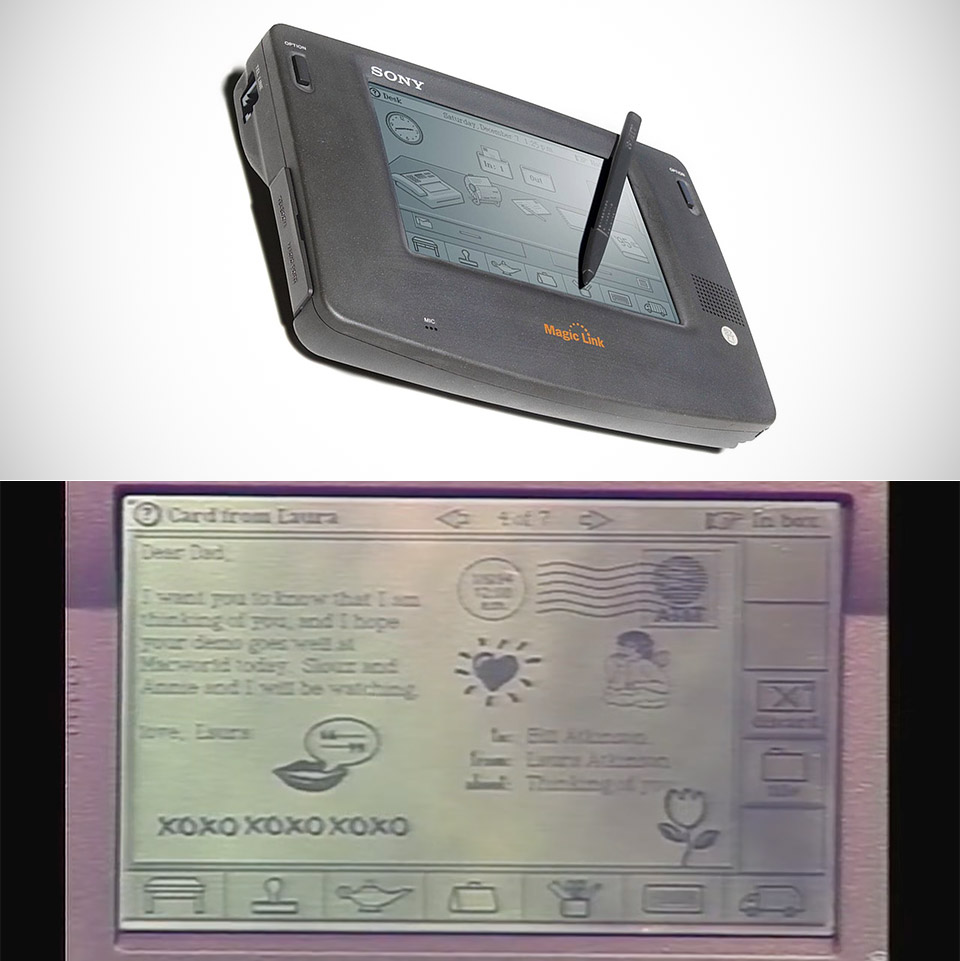
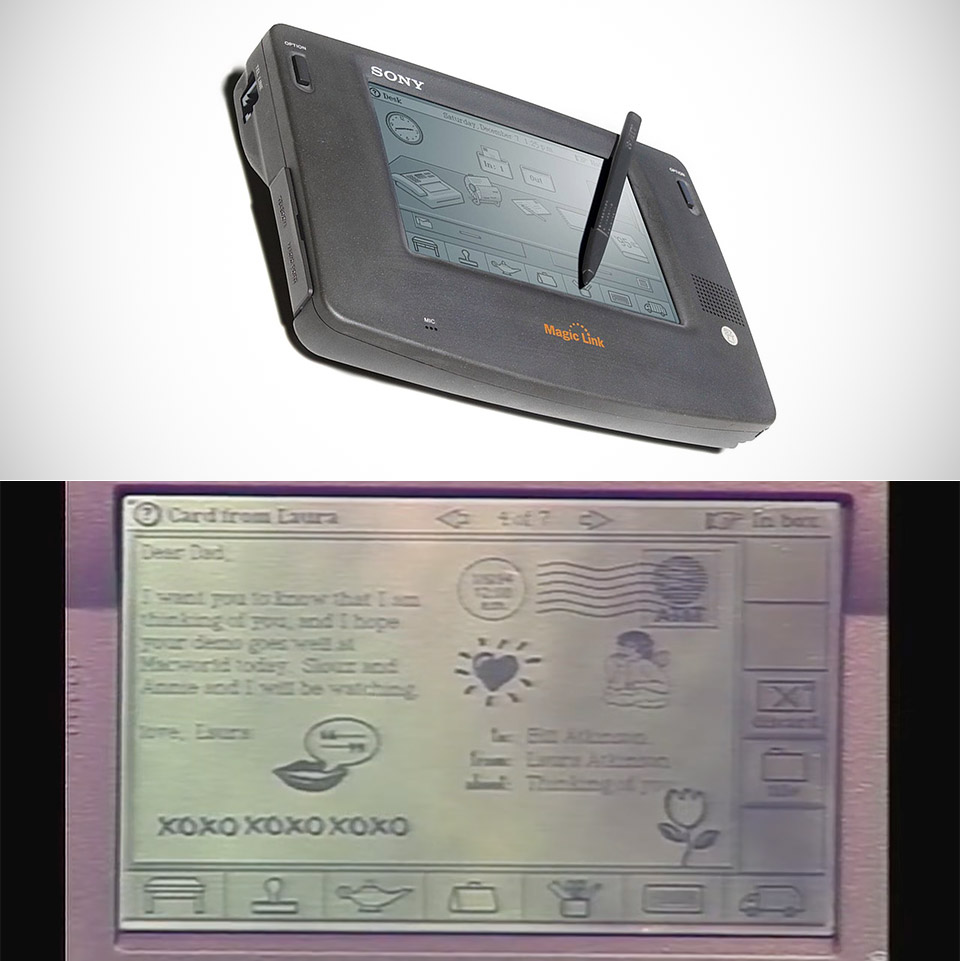
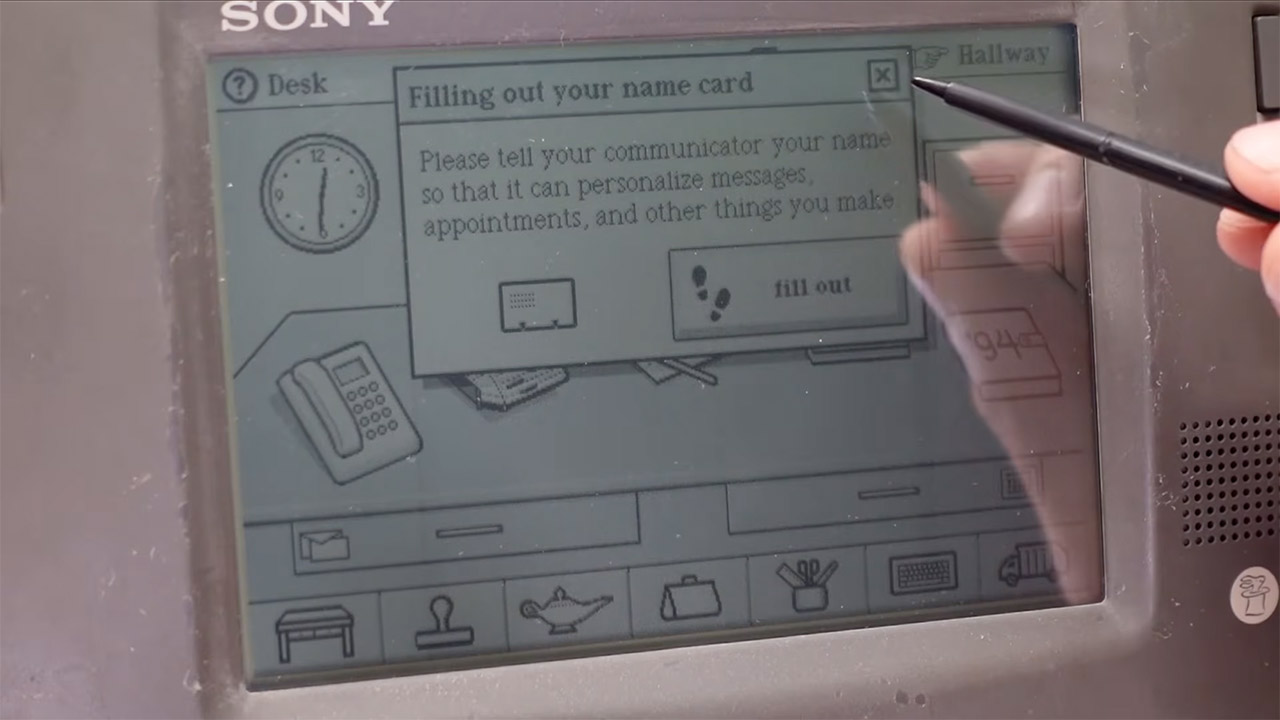
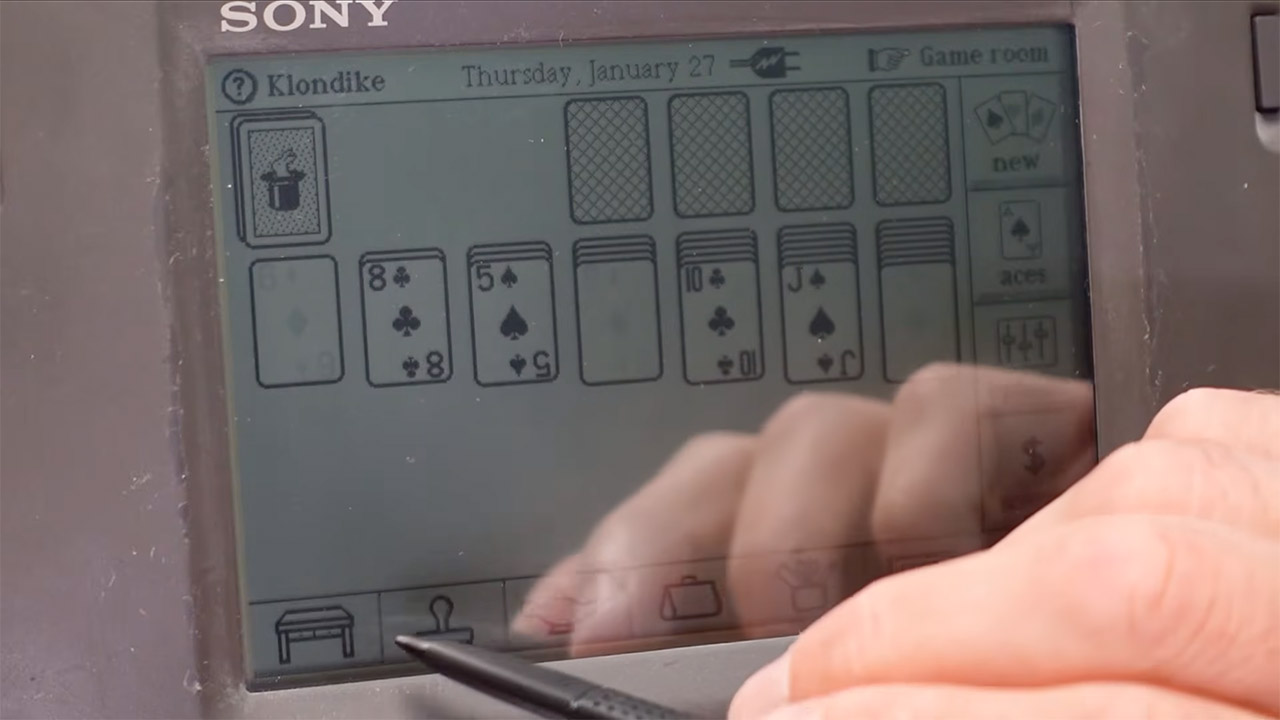
Magic Cap was the name of the operating system. When you first booted it up, you were in a virtual area that appeared to be a real office. There was your calendar in the corner, and your inbox was simply waiting for you. Walk down the virtual hallway and you’ll come across a variety of handy rooms, including a library, a game room, and even a downtown business center where you may purchase new software. Messages were decorated with stickers and animated characters, and those little faces evolved into the emojis we all know and love today. You could navigate with a stylus. Software modems handled connections without the need for additional hardware, and early versions of what we now know as USB connectors appeared. To keep things light, the hardware had to do significantly less work.
Telescript was the brainchild in charge of all the sophisticated elements. When you leave your smartphone, a digital “gentleman” will journey across networks and return with answers to your questions. Jim White and his team developed a language that enabled programs to move from one machine to another, just as humans go between cities. They discussed the “Telescript cloud” before anyone knew what it was. AT&T built PersonaLink on top of it because agents needed somewhere to go.
Advertisement
Before you knew it, some of the biggest players were lining up to participate in the action. Sony, Motorola, Matsushita, Philips, AT&T, and later NTT, Toshiba, and France Telecom also joined in. Each provided money and appointed their top executives to a special council. Sony’s John Sculley and Norio Ohga were among the best performers. The Alliance swiftly became the industry’s largest collection of business players, prompting antitrust specialists to establish new rules for the meetings. In 1993, the New York Times named General Magic Silicon Valley’s most-watched startup of the year.
Finally, after all of the excitement, the hardware was released in 1994. Sony shipped the Magic Link for a cool $800. The device looked like a grey brick with a stylus, a small monochrome screen, and a built-in modem that required a phone connector. Motorola followed up with the Envoy, which added a wireless radio to the equation. Both used Magic Cap. You could email, fax, or even page somebody if that was your preference. Keep your contacts and calendars up to date. Play some games and send some files over with IR, as the device was essentially a magic wand. However, nothing like existed previously. Of course, sales were small, with the majority of the units going to friends and relatives. Battery life was a joke, and performance was sluggish. Had no internet (yet) and no cell data worth noticing. To make matters worse, Apple had recently released the Newton the year before, which had likely stolen some of General Magic’s thunder.
An IPO in February 1995 nonetheless managed to raise 96 million dollars. But that was only the beginning; the stock had more than doubled on the first day, and it appeared like cash was flowing in. The engineers were practically unstoppable, and new gadgets popped up left and right. Later that year, Portico was introduced as a voice service that anyone could access using any old phone. An 800 number would then read out your email, calendar, and messages in a polite, calming voice, almost as if you had your own personal assistant. By the time they reached a peak of 2.5 million users, they had already created MyTalk, which has earned a permanent home in the Smithsonian. However, the initial notion of such ‘dream devices’ never really took off. AT&T chose to discontinue PersonaLink in 1996. By 1997, the hardware partners had essentially stopped producing. The stock fell precipitously, prompting layoffs. It all came to an end in September 2002, when activities ceased, and by 2004, they had been totally liquidated. Paul Allen ended up purchasing the majority of the patents.
On more than one occasion, I’ve embarrassed myself by brewing coffee outdoors and spilling a freshly made cup onto an unsteady camping table. Not to mention, light packers would scoff at the weight of my coffee gear — a necessary sacrifice to avoid instant coffee. Savoring high-quality joe in the open air feels special, though, hence why I bring a coffee-making setup every time.
Finally, I’ve found the easiest option: The MiiR Pourigami. Put together, the pyramid-shaped dripper fits atop any trusty travel mug. Taken apart, this Miir Pourigami resembles a card holder, slim enough to fit into my pants pocket. It functions like other pour-over setups, meaning I can still dial in tasting notes. If you’re like me and think about coffee no matter the circumstances, this nifty setup lets you play barista in any environment.
A look at the Miir Pourigami
Advertisement
Yup, that’s a coffee maker in my hand.
Nikita Ephanov/CNET
Right out of the box, the Pourigami looks sleek. Disassembled, the brewer consists of three thin stainless-steel trapezoids. I can’t imagine the pieces bending or chipping — crucial, as I’m prone to breaking camping equipment. Handily, the dripper stores flat, occupying a rectangular size smaller than 10 by 16 centimeters. Weighing just shy of 8 ounces, the brewer isn’t featherweight, but it offers great portability nevertheless. Contained in an unassuming synthetic case, the Pourigami seamlessly fits into any bag.
Honestly, I’m terrible at paper origami, but assembling this brewer into the pyramidal shape is a breeze. It only takes me about 20 seconds to slip the three indents into the respective slots — there’s no confusion to the construction. The completed dripper holds steady without a wobble and comes apart just as easily.
Put together, the interior forms a triangular pyramid shape that can accommodate any #2 cone-shaped filters. I find that Miir’s own filters, available for purchase online function most reliably, creating steady streams without slipping. Not to mention, the brand’s paper-based filters are compostable, a small but satisfying environmental win. A compatible filter is easy to find, making the Miir Pourigami simple to set up and get to brewing.
Advertisement
Brewing with the Pourigami
The Pouragami functions much like other pour-over coffee devices.
Miir
If you’ve used pour-over vessels like a V60, Chemex or a Kalita Wave, the Miir Pourigami is familiar territory. The dripper requires a hot water source, the aforementioned paper filter, and a cup or carafe to catch the coffee. A kitchen scale and thermometer help brew with utmost accuracy, but I’ve produced solid cups while eyeballing proportions outdoors.
It’s best to follow a brewing ratio to extract the most out of the brewer, especially when familiarizing yourself with its flow. The Miir brand suggests 21 grams for single-origin beans and 23 grams for blends, each extracted with 300 milliliters of water. Using water heated to 90 degrees Celsius, I’ve found these proportions reliable, as long as extraction is completed by the three-and-a-half-minute mark.
Advertisement
The Pouragami functions similarly to a Chemex but with better portability.
Taylor Martin/CNET
Compared to my V60, the Miir Pourigami takes longer to drain, so a coarser grind helps keep water moving. As a result, the vessel is best suited for full-bodied cups of medium- and dark-roasted coffees. The grind quality is crucial: You’ll want a coarse yet uniform consistency. I’ve used both the portable MiiR Coffee Hand Grinder and the Baratza Encoreto great success; I would avoid utilizing a blade grinder for this setup, though. Away from home, I’ve asked coffee shops to grind beans — I request a consistency one click coarser than a V60. Pre-ground coffee is the most convenient way to brew on the move.
The Pourigami’s steep interior makes saturating coffee grounds easy – no need to carry a gooseneck kettle alongside. I’ve used jet-boil-powered camping kettles and even cooking pots to make excellent cups of coffee, making sure to use hot water that’s off the boil. As long as I’m timing the process, using the Miir Pourigami is undemanding.
Advertisement
What does Pourigami filter coffee taste like?
The coffee I brew turns out light-bodied, but rarely weak or watery.
Nikita Ephanov/CNET
As with all pour-over coffee, the beans strongly influence the flavor. I’ve produced the best-tasting MiiR Pourigami cups using medium-roast blends — think grocery-store beans like Stumptown’s Holler Mountain Blend. Such bags respond well to the requisite coarser grind and are forgiving in outdoor scenarios. The Miir Pourigami translates gentle notes of acidity and sweetness, seldom leaning into burnt flavors. The coffee turns out light-bodied, similar to other filter setups, but I’ve never brewed a cup that tastes weak or watery.
If there’s one downside to this dripper, it’s that the coffee occasionally turns out too acidic, a sign of under-extraction. For this reason, I avoid brewing delicate light roasts with the Pourigami — not that I’m packing fancy beans for camping anyway. A bold, balanced medium roast cup hits the spot after a night in a tent.
Advertisement
Is the Pourigami worth it?
Coffee makers don’t get much simpler and more portable than the Pouragami.
Nikita Ephanov/CNET
At home, I’m not often assembling my Pourgami, instead settling on the trusty espresso machine or extracting delicate cups of V60. When I’m brewing outside of the house, though, the Pourigami is my top choice. In addition to camping, I’ll pack the brewer away in my suitcase for air travel, making the occasional cup on the go.
Before acquiring a model, I used to camp with a bulky plastic V60 dripper, which I inevitably fractured among camping equipment. The AeroPress certainly fares better in terms of durability, but it can be difficult to find a sturdy surface suitable for firm plunging. Compact and durable, the Miir Pourigami wins on logistical ease, making it easy to incorporate into a car-camping, backpacking, or even a bike-packing setup.
Advertisement
Sold for $35, it’s a thoughtfully designed coffee gadget that justifies the price point. The inventive design isn’t a trade-off for coffee quality. I’m happy to use the Pourigami several days in a row – the steel material is a breeze to clean. Whether at home or on the move, the brewer doesn’t occupy much space, making it a reliable favorite.
Memory shortage now a ‘full-blown demand issue’ for the smartphone market, says Counterpoint analyst.
The memory crunch has dragged down global smartphone shipments to the lowest second-quarter levels in 13 years.
Manufacturers producing cheaper gadgets saw their shares take the steepest drop after passing price hikes over to consumers. Analysts expect further price increases and a harsher squeeze for memory components.
“The global memory crisis has now overtaken every other factor as the single biggest drag on the smartphone industry. What started as a components issue last year is now a full-blown demand issue,” said Counterpoint senior analyst Shilpi Jain.
Advertisement
According to Counterpoint research, smartphone shipments tumbled 11pc year-on-year this quarter globally, as memory suppliers prioritise DRAM and NAND for AI data centre needs over consumer electronics.
Entry-level and mid-tier devices faced repeated price hikes, forcing consumers to pivot to more expensive brands or pause device upgrades. Component shortages has rendered these cheaper devices “structurally unfeasible at previous price points”, Jain said. Smartphone prices are poised to jump by as much as 13pc this year.
According to the IDC, most Android vendors in China responded to the growing component costs by raising prices, which directly dampened consumers’ willingness to upgrade their devices.
Xiaomi, Oppo and Vivo, leading manufacturers for cheaper electronics, each saw their shipments decline in double digits this quarter. Though, the three of them together still captured more than 40pc of the global smartphone shipment this quarter.
Advertisement
“Alongside the memory shortage, geopolitical tensions in the Middle East bumped up oil and shipping costs, further inflating smartphone prices,” said the Counterpoint analyst.
“This coincided with a broader macro squeeze, slower global growth, higher inflation and record-low consumer sentiment which hit price-sensitive buyers the hardest.”
Samsung remains the global lead, making extra gains this quarter to capture 24pc of the smartphone shipment share. The South Korean manufacturer held up well in India and the Middle East, supported by better product availability, fewer price hikes and aggressive summer promotions, Counterpoint found.
Apple, meanwhile, took the second position globally, capturing 20pc of the market – up from 17pc in the same quarter last year. The iPhone-maker was the only one to avoid smartphone price hikes during this quarter. However, analysts expect that to change in the near future.
Advertisement
Apple also performed well in China, where it saw sales grow in double digits. Alongside Apple, Huawei was the only major Chinese manufacturer to see positive growth in smartphone shipments.
Overall, shipments in the country declined by around 4.3pc year-over-year, marking the fifth straight quarter of decline.
According to the IDC, Huawei and Apple kept prices steady while the rest of the Android producers in China raised them. Plus, Apple’s early signalling of upcoming price increases pulled in more customers purchasing the iPhone 17 series sooner than they might have otherwise, the report found.
“Huawei and Apple held their prices steady while competitors were raising theirs, and that gave hesitant buyers a reason to go ahead and purchase in a quarter when most of the market was giving them a reason to wait,” says Arthur Guo, a research analyst for client devices research at IDC China.
Advertisement
Don’t miss out on the knowledge you need to succeed. Sign up for the Daily Brief, Silicon Republic’s digest of need-to-know sci-tech news.
Japan’s largest taxi operator confirms July 11 malware attack forcing shutdowns of its IT systems and disrupted dispatch and reservation services
Nihon Kotsu isolated networks, notified authorities, and brought in third‑party experts; customers were advised to use alternative taxi apps during the outage
No data leaks have been confirmed, but Nihon Kotsu warned it may disclose and notify affected parties if evidence of personal information exposure emerges
Japan’s largest taxi operator, Nihon Kotsu, hasconfirmed suffering a cyberattack which forced it to temporarily shut down parts of its IT infrastructure.
In a statement published on the company’s Japanese website, Nihon Kotsu said the attack took place in the early morning of July 11 – on a Saturday, when unnamed threat actors infected its devices with malware.
“We have recently discovered that our internal systems have been subjected to unauthorized external access (malware infection),” the machine-translated statement reads. “We deeply apologize for the great inconvenience and concern caused to our customers, business partners, and all related parties due to this incident.”
Latest Videos From
Services unavailable
As soon as it spotted the intrusion, Nihon Kotsu did what most companies do – shut down its network to prevent further damage, notified relevant law enforcement and data protection authorities, and brought in third-party experts to assess the damages and assist with the repairs.
Advertisement
The shutdown means some customer-facing services are unavailable: “As a result, the hire car web order and reservation management system, taxi dispatch service by phone, and some internal systems are temporarily unavailable,” the company said.
It advised its customers to use a different taxi app, which allows users to choose a taxi service to their liking.
So far, there is no evidence of any data exfiltration, or leaks to the dark web. However, the company did leave it as a possibility.
Advertisement
Sign up to the TechRadar Pro newsletter to get all the top news, opinion, features and guidance your business needs to succeed!
“At this time, no information leakage has been confirmed, but if any leakage or possibility of personal information of customers or related parties is newly discovered, we will promptly make official announcements and contact the affected parties individually in accordance with laws and regulations,” the company concluded.
Nihon Kotsu is Japan’s largest taxi operator, employing more than 18,000 people and running a fleet of more than 8,500 taxis and more than 2,000 chauffeur vehicles.













































You must be logged in to post a comment Login