The federal government is warning users of home and small office routers to secure their devices as Russia state hackers continue to mass-compromise them for use in obscuring nefarious actions against sensitive organizations in the public and private sectors.
Both the Russian and Chinese governments have been compromising routers for years, sometimes in prolonged tugs-of-war to wrest control of devices the other has already commandeered. The US government has occasionally issued covert commands and taken other steps to disinfect routers. Google and other companies have also worked to disrupt the massive botnets that control compromised routers in lockstep. The actions to date are little more than whack-a-mole exercises as the operators simply replace their botnets with new ones.
Proxy networks: The go-to tool
“Russian Federal Security Service (FSB) Center 16 cyber actors continue to exploit poorly configured and vulnerable networking devices worldwide, opportunistically compromising multiple critical infrastructure sector networks,” the Cybersecurity and Infrastructure Security Agency said Monday. The hacking groups are tracked under various names, including Berserk Bear, Energetic Bear, Crouching Yeti, Dragonfly, Ghost Blizzard, and Static Tundra. The advisory was co-issued by governments from around the world, including Australia, Denmark, New Zealand, and the UK.
The primary means of compromise the agency warned about was hackers scanning IP ranges with active Simple Network Management Protocol (SNMP) agents that accept common or default authentication credentials. These scans are run by the very sorts of router botnets the actors are trying to enroll the targeted device in. By sending malicious traffic from spoofed addresses, the hackers can use the SNMP agent on poorly configured routers to run malware. SNMP allows users to collect and organize information about managed networking devices or to modify that information to change device behavior.
Somewhere right now, a customer is repeating themselves. They are explaining their problem for the third time, to the third person, because the organization on the other side has no shared memory of the previous two conversations. It is an infrastructure problem that AI is making harder to ignore.
Ahmed Bashir
It is also becoming impossible for policymakers to ignore. Just in April, the Mayor of London launched a new AI and Jobs Taskforce to examine how AI is changing work across the capital, signaling that the conversation has moved well beyond investment announcements and into the harder question of what AI does inside organizations.
Advertisement
It is also shining a spotlight on a memory crisis inside modern business.
Latest Videos From
AI is accelerating work, not clarity
As UK organizations rush to deploy AI in the workplace, many are layering it onto fragmented systems that were never designed to preserve institutional memory in the first place.
According to research published in Harvard Business Review, knowledge workers toggle between applications and tools roughly 1,200 times per day, a pattern known as “toggling tax”. That figure alone tells the story: we aren’t short of tools, but there is no coherence among them.
Advertisement
The result is a new kind of productivity paradox. Work is moving faster, but clarity is not improving.
This is where much of the current enterprise AI conversation unravels. A surprising amount of what is marketed as AI today still relies on humans to do the synthesis work themselves. The system retrieves documents. It summarizes conversations. It surfaces links. But employees still carry the burden of reconstructing meaning, and so do the customers and end-users waiting on the other side of those decisions.
Sign up to the TechRadar Pro newsletter to get all the top news, opinion, features and guidance your business needs to succeed!
Advertisement
Notably, when these types of AI tools do the retrieval, but humans skip the synthesis, the output feels hollow. That creates a trust and credibility problem – not just for the individual, but for AI as a category. People start associating “AI-assisted” with “low-effort”.
When context is lost internally, the effects aren’t invisible. They surface as slow responses, repeated requests for information that customers already provided, support experiences that feel fragmented, and sales teams reconstructing account history manually before every renewal, escalation or executive review.
Stateless systems cannot preserve organizational memory
The AI models themselves are becoming more capable, but the organizational foundation beneath them remains fragmented.
Advertisement
Most AI systems today are fundamentally stateless. They generate outputs based on temporary context windows rather than durable organizational memory. Every interaction requires the system to repeatedly reconstruct understanding from fragments.
Consider how databases work. We do not recompute everything from scratch every time a query arrives. We cache and index, then preserve relationships between entities, because continuously recomputing context is computationally irrational.
Yet much of enterprise AI is still being deployed exactly this way and the industry has started mistaking activity for intelligence.
Advertisement
What I believe organizations should focus on is whether they have structured, durable memory that lets AI and humans reason from the same shared context. Without that foundation, AI outputs remain generic.
Most collaboration systems multiply this problem in two ways. First, they encode knowledge into naming conventions and tribal memory – the kind that lives in channel names nobody can decode and folder structures only three people understand. New employees are not learning the business, they are learning the conventions.
Second, even when information exists, it remains inaccessible. The same decision appears as “PostgreSQL migration”, “database move Q3”, and “backend infrastructure change” across three different channels. They are semantically identical but textually invisible to any system trying to surface it.
This problem becomes even more acute in distributed organizations. I don’t believe you can build modern global companies on a “you had to be there” culture. Yet many businesses still operate as though important context naturally transfers through proximity and synchronous communication.
Advertisement
Search is not the same as understanding
Search was designed to discover information, whereas modern enterprise work requires systems that understand the relationships in data.
A customer escalation is not just a support ticket. It is connected to product decisions, engineering discussions, account history, contractual obligations, and revenue impact. A sales opportunity is tied to customer sentiment, historical support patterns, product usage, and internal stakeholder alignment.
Traditional collaboration systems flatten these relationships into disconnected channels and documents, whereas AI knowledge graphs preserve them.
Advertisement
Researchers call this a transactive memory system: the collective understanding of who knows what, how decisions were made, and how work is coordinated across teams. The same logic now extends to AI. Intelligent systems can participate in that process too by encoding context, surfacing relevant history, and routing knowledge to the right people at the right time.
Britain’s productivity problem is becoming an AI problem
The Office for National Statistics has consistently flagged weak productivity growth as one of the UK’s most persistent economic challenges. Since 2010, UK productivity has grown at 6.2%, compared with roughly 10% across the euro area and nearly 15% in the United States over the same period. AI is increasingly being positioned as a mechanism to help close that gap.
But productivity does not improve because your business has added more AI agents to the workflow. If every important decision still requires humans to manually reconstruct fragmented context, organizations just accelerate confusion.
Advertisement
What UK businesses need are systems capable of preserving context, maintaining institutional memory, and grounding AI systems in trusted organizational knowledge. Better AI infrastructure starts with a simple question: Does your organization remember anything? For most, the honest answer is no.
This article was produced as part of TechRadar Pro Perspectives, our channel to feature the best and brightest minds in the technology industry today.
The views expressed here are those of the author and are not necessarily those of TechRadarPro or Future plc. If you are interested in contributing find out more here: https://www.techradar.com/pro/perspectives-how-to-submit
Marc Porat sat with a red notebook in 1989, drawing what no one else could see. A little rectangular piece of glass with a touch screen, phone, fax, messages, video, games, ticket purchases, and apps delivered over the air. He named it the Pocket Crystal. It would feel like a piece of jewelry you carried every day, something with the comfort of a seashell and the pull of a crystal. At Apple, where he worked, the idea landed with John Sculley. Resources stayed scarce. So in May 1990 the project left Cupertino and became its own company. Bill Atkinson and Andy Hertzfeld, two of the original Macintosh wizards, signed on. General Magic was born.
They called the location after a line from Arthur C. Clarke. The idea is that any sufficiently advanced technology appears magical. You had a bunch of veteran Mac users and some hungry new developers crowded into Mountain View offices. Joanna Hoffman was in charge of marketing because she was one of the first people on board. Susan Kare developed the icons for the new operating system, and Megan Smith joined shortly thereafter. Meanwhile, a young whippersnapper named Tony Fadell walked in from the street. There were even rabbits bouncing around on the floors, as well as a parrot or two, presumably released by its owners when they went for the day. Some folks were even sleeping off while resting their heads on their desks. You could bet that at any minute, someone would start a water battle. However, the energy was fantastic. Everyone was confident they were onto something major, specifically the next item after the Mac.
WHY IPAD — The 11-inch iPad is now more capable than ever with the superfast A16 chip, a stunning Liquid Retina display, advanced cameras, fast…
PERFORMANCE AND STORAGE — The superfast A16 chip delivers a boost in performance for your favorite activities. And with all-day battery life, iPad…
11-INCH LIQUID RETINA DISPLAY — The gorgeous Liquid Retina display is an amazing way to watch movies or draw your next masterpiece.* True Tone…
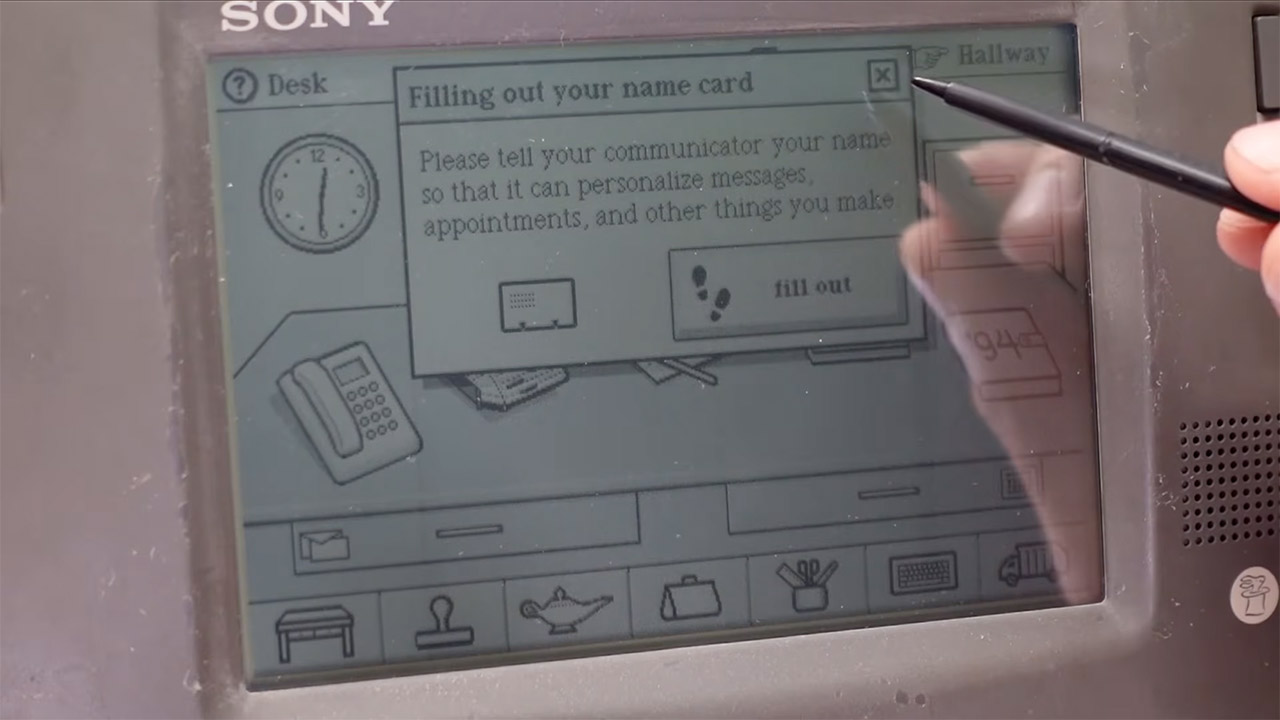
Magic Cap was the name of the operating system. When you first booted it up, you were in a virtual area that appeared to be a real office. There was your calendar in the corner, and your inbox was simply waiting for you. Walk down the virtual hallway and you’ll come across a variety of handy rooms, including a library, a game room, and even a downtown business center where you may purchase new software. Messages were decorated with stickers and animated characters, and those little faces evolved into the emojis we all know and love today. You could navigate with a stylus. Software modems handled connections without the need for additional hardware, and early versions of what we now know as USB connectors appeared. To keep things light, the hardware had to do significantly less work.
Telescript was the brainchild in charge of all the sophisticated elements. When you leave your smartphone, a digital “gentleman” will journey across networks and return with answers to your questions. Jim White and his team developed a language that enabled programs to move from one machine to another, just as humans go between cities. They discussed the “Telescript cloud” before anyone knew what it was. AT&T built PersonaLink on top of it because agents needed somewhere to go.
Advertisement
Before you knew it, some of the biggest players were lining up to participate in the action. Sony, Motorola, Matsushita, Philips, AT&T, and later NTT, Toshiba, and France Telecom also joined in. Each provided money and appointed their top executives to a special council. Sony’s John Sculley and Norio Ohga were among the best performers. The Alliance swiftly became the industry’s largest collection of business players, prompting antitrust specialists to establish new rules for the meetings. In 1993, the New York Times named General Magic Silicon Valley’s most-watched startup of the year.
Finally, after all of the excitement, the hardware was released in 1994. Sony shipped the Magic Link for a cool $800. The device looked like a grey brick with a stylus, a small monochrome screen, and a built-in modem that required a phone connector. Motorola followed up with the Envoy, which added a wireless radio to the equation. Both used Magic Cap. You could email, fax, or even page somebody if that was your preference. Keep your contacts and calendars up to date. Play some games and send some files over with IR, as the device was essentially a magic wand. However, nothing like existed previously. Of course, sales were small, with the majority of the units going to friends and relatives. Battery life was a joke, and performance was sluggish. Had no internet (yet) and no cell data worth noticing. To make matters worse, Apple had recently released the Newton the year before, which had likely stolen some of General Magic’s thunder.
An IPO in February 1995 nonetheless managed to raise 96 million dollars. But that was only the beginning; the stock had more than doubled on the first day, and it appeared like cash was flowing in. The engineers were practically unstoppable, and new gadgets popped up left and right. Later that year, Portico was introduced as a voice service that anyone could access using any old phone. An 800 number would then read out your email, calendar, and messages in a polite, calming voice, almost as if you had your own personal assistant. By the time they reached a peak of 2.5 million users, they had already created MyTalk, which has earned a permanent home in the Smithsonian. However, the initial notion of such ‘dream devices’ never really took off. AT&T chose to discontinue PersonaLink in 1996. By 1997, the hardware partners had essentially stopped producing. The stock fell precipitously, prompting layoffs. It all came to an end in September 2002, when activities ceased, and by 2004, they had been totally liquidated. Paul Allen ended up purchasing the majority of the patents.
On more than one occasion, I’ve embarrassed myself by brewing coffee outdoors and spilling a freshly made cup onto an unsteady camping table. Not to mention, light packers would scoff at the weight of my coffee gear — a necessary sacrifice to avoid instant coffee. Savoring high-quality joe in the open air feels special, though, hence why I bring a coffee-making setup every time.
Finally, I’ve found the easiest option: The MiiR Pourigami. Put together, the pyramid-shaped dripper fits atop any trusty travel mug. Taken apart, this Miir Pourigami resembles a card holder, slim enough to fit into my pants pocket. It functions like other pour-over setups, meaning I can still dial in tasting notes. If you’re like me and think about coffee no matter the circumstances, this nifty setup lets you play barista in any environment.
A look at the Miir Pourigami
Advertisement
Yup, that’s a coffee maker in my hand.
Nikita Ephanov/CNET
Right out of the box, the Pourigami looks sleek. Disassembled, the brewer consists of three thin stainless-steel trapezoids. I can’t imagine the pieces bending or chipping — crucial, as I’m prone to breaking camping equipment. Handily, the dripper stores flat, occupying a rectangular size smaller than 10 by 16 centimeters. Weighing just shy of 8 ounces, the brewer isn’t featherweight, but it offers great portability nevertheless. Contained in an unassuming synthetic case, the Pourigami seamlessly fits into any bag.
Honestly, I’m terrible at paper origami, but assembling this brewer into the pyramidal shape is a breeze. It only takes me about 20 seconds to slip the three indents into the respective slots — there’s no confusion to the construction. The completed dripper holds steady without a wobble and comes apart just as easily.
Put together, the interior forms a triangular pyramid shape that can accommodate any #2 cone-shaped filters. I find that Miir’s own filters, available for purchase online function most reliably, creating steady streams without slipping. Not to mention, the brand’s paper-based filters are compostable, a small but satisfying environmental win. A compatible filter is easy to find, making the Miir Pourigami simple to set up and get to brewing.
Advertisement
Brewing with the Pourigami
The Pouragami functions much like other pour-over coffee devices.
Miir
If you’ve used pour-over vessels like a V60, Chemex or a Kalita Wave, the Miir Pourigami is familiar territory. The dripper requires a hot water source, the aforementioned paper filter, and a cup or carafe to catch the coffee. A kitchen scale and thermometer help brew with utmost accuracy, but I’ve produced solid cups while eyeballing proportions outdoors.
It’s best to follow a brewing ratio to extract the most out of the brewer, especially when familiarizing yourself with its flow. The Miir brand suggests 21 grams for single-origin beans and 23 grams for blends, each extracted with 300 milliliters of water. Using water heated to 90 degrees Celsius, I’ve found these proportions reliable, as long as extraction is completed by the three-and-a-half-minute mark.
Advertisement
The Pouragami functions similarly to a Chemex but with better portability.
Taylor Martin/CNET
Compared to my V60, the Miir Pourigami takes longer to drain, so a coarser grind helps keep water moving. As a result, the vessel is best suited for full-bodied cups of medium- and dark-roasted coffees. The grind quality is crucial: You’ll want a coarse yet uniform consistency. I’ve used both the portable MiiR Coffee Hand Grinder and the Baratza Encoreto great success; I would avoid utilizing a blade grinder for this setup, though. Away from home, I’ve asked coffee shops to grind beans — I request a consistency one click coarser than a V60. Pre-ground coffee is the most convenient way to brew on the move.
The Pourigami’s steep interior makes saturating coffee grounds easy – no need to carry a gooseneck kettle alongside. I’ve used jet-boil-powered camping kettles and even cooking pots to make excellent cups of coffee, making sure to use hot water that’s off the boil. As long as I’m timing the process, using the Miir Pourigami is undemanding.
Advertisement
What does Pourigami filter coffee taste like?
The coffee I brew turns out light-bodied, but rarely weak or watery.
Nikita Ephanov/CNET
As with all pour-over coffee, the beans strongly influence the flavor. I’ve produced the best-tasting MiiR Pourigami cups using medium-roast blends — think grocery-store beans like Stumptown’s Holler Mountain Blend. Such bags respond well to the requisite coarser grind and are forgiving in outdoor scenarios. The Miir Pourigami translates gentle notes of acidity and sweetness, seldom leaning into burnt flavors. The coffee turns out light-bodied, similar to other filter setups, but I’ve never brewed a cup that tastes weak or watery.
If there’s one downside to this dripper, it’s that the coffee occasionally turns out too acidic, a sign of under-extraction. For this reason, I avoid brewing delicate light roasts with the Pourigami — not that I’m packing fancy beans for camping anyway. A bold, balanced medium roast cup hits the spot after a night in a tent.
Advertisement
Is the Pourigami worth it?
Coffee makers don’t get much simpler and more portable than the Pouragami.
Nikita Ephanov/CNET
At home, I’m not often assembling my Pourgami, instead settling on the trusty espresso machine or extracting delicate cups of V60. When I’m brewing outside of the house, though, the Pourigami is my top choice. In addition to camping, I’ll pack the brewer away in my suitcase for air travel, making the occasional cup on the go.
Before acquiring a model, I used to camp with a bulky plastic V60 dripper, which I inevitably fractured among camping equipment. The AeroPress certainly fares better in terms of durability, but it can be difficult to find a sturdy surface suitable for firm plunging. Compact and durable, the Miir Pourigami wins on logistical ease, making it easy to incorporate into a car-camping, backpacking, or even a bike-packing setup.
Advertisement
Sold for $35, it’s a thoughtfully designed coffee gadget that justifies the price point. The inventive design isn’t a trade-off for coffee quality. I’m happy to use the Pourigami several days in a row – the steel material is a breeze to clean. Whether at home or on the move, the brewer doesn’t occupy much space, making it a reliable favorite.
Memory shortage now a ‘full-blown demand issue’ for the smartphone market, says Counterpoint analyst.
The memory crunch has dragged down global smartphone shipments to the lowest second-quarter levels in 13 years.
Manufacturers producing cheaper gadgets saw their shares take the steepest drop after passing price hikes over to consumers. Analysts expect further price increases and a harsher squeeze for memory components.
“The global memory crisis has now overtaken every other factor as the single biggest drag on the smartphone industry. What started as a components issue last year is now a full-blown demand issue,” said Counterpoint senior analyst Shilpi Jain.
Advertisement
According to Counterpoint research, smartphone shipments tumbled 11pc year-on-year this quarter globally, as memory suppliers prioritise DRAM and NAND for AI data centre needs over consumer electronics.
Entry-level and mid-tier devices faced repeated price hikes, forcing consumers to pivot to more expensive brands or pause device upgrades. Component shortages has rendered these cheaper devices “structurally unfeasible at previous price points”, Jain said. Smartphone prices are poised to jump by as much as 13pc this year.
According to the IDC, most Android vendors in China responded to the growing component costs by raising prices, which directly dampened consumers’ willingness to upgrade their devices.
Xiaomi, Oppo and Vivo, leading manufacturers for cheaper electronics, each saw their shipments decline in double digits this quarter. Though, the three of them together still captured more than 40pc of the global smartphone shipment this quarter.
Advertisement
“Alongside the memory shortage, geopolitical tensions in the Middle East bumped up oil and shipping costs, further inflating smartphone prices,” said the Counterpoint analyst.
“This coincided with a broader macro squeeze, slower global growth, higher inflation and record-low consumer sentiment which hit price-sensitive buyers the hardest.”
Samsung remains the global lead, making extra gains this quarter to capture 24pc of the smartphone shipment share. The South Korean manufacturer held up well in India and the Middle East, supported by better product availability, fewer price hikes and aggressive summer promotions, Counterpoint found.
Apple, meanwhile, took the second position globally, capturing 20pc of the market – up from 17pc in the same quarter last year. The iPhone-maker was the only one to avoid smartphone price hikes during this quarter. However, analysts expect that to change in the near future.
Advertisement
Apple also performed well in China, where it saw sales grow in double digits. Alongside Apple, Huawei was the only major Chinese manufacturer to see positive growth in smartphone shipments.
Overall, shipments in the country declined by around 4.3pc year-over-year, marking the fifth straight quarter of decline.
According to the IDC, Huawei and Apple kept prices steady while the rest of the Android producers in China raised them. Plus, Apple’s early signalling of upcoming price increases pulled in more customers purchasing the iPhone 17 series sooner than they might have otherwise, the report found.
“Huawei and Apple held their prices steady while competitors were raising theirs, and that gave hesitant buyers a reason to go ahead and purchase in a quarter when most of the market was giving them a reason to wait,” says Arthur Guo, a research analyst for client devices research at IDC China.
Advertisement
Don’t miss out on the knowledge you need to succeed. Sign up for the Daily Brief, Silicon Republic’s digest of need-to-know sci-tech news.
Japan’s largest taxi operator confirms July 11 malware attack forcing shutdowns of its IT systems and disrupted dispatch and reservation services
Nihon Kotsu isolated networks, notified authorities, and brought in third‑party experts; customers were advised to use alternative taxi apps during the outage
No data leaks have been confirmed, but Nihon Kotsu warned it may disclose and notify affected parties if evidence of personal information exposure emerges
Japan’s largest taxi operator, Nihon Kotsu, hasconfirmed suffering a cyberattack which forced it to temporarily shut down parts of its IT infrastructure.
In a statement published on the company’s Japanese website, Nihon Kotsu said the attack took place in the early morning of July 11 – on a Saturday, when unnamed threat actors infected its devices with malware.
“We have recently discovered that our internal systems have been subjected to unauthorized external access (malware infection),” the machine-translated statement reads. “We deeply apologize for the great inconvenience and concern caused to our customers, business partners, and all related parties due to this incident.”
Latest Videos From
Services unavailable
As soon as it spotted the intrusion, Nihon Kotsu did what most companies do – shut down its network to prevent further damage, notified relevant law enforcement and data protection authorities, and brought in third-party experts to assess the damages and assist with the repairs.
Advertisement
The shutdown means some customer-facing services are unavailable: “As a result, the hire car web order and reservation management system, taxi dispatch service by phone, and some internal systems are temporarily unavailable,” the company said.
It advised its customers to use a different taxi app, which allows users to choose a taxi service to their liking.
So far, there is no evidence of any data exfiltration, or leaks to the dark web. However, the company did leave it as a possibility.
Advertisement
Sign up to the TechRadar Pro newsletter to get all the top news, opinion, features and guidance your business needs to succeed!
“At this time, no information leakage has been confirmed, but if any leakage or possibility of personal information of customers or related parties is newly discovered, we will promptly make official announcements and contact the affected parties individually in accordance with laws and regulations,” the company concluded.
Nihon Kotsu is Japan’s largest taxi operator, employing more than 18,000 people and running a fleet of more than 8,500 taxis and more than 2,000 chauffeur vehicles.
The Paramount Skydance takeover of Warner Bros. Discovery has finally landed in court, which raises the obvious question: where was this lawsuit months ago?
The Paramount Skydance takeover of Warner Bros. Discovery has already cleared a major federal hurdle, but 12 state attorneys general have now decided that combining Paramount, Warner Bros., HBO, CNN, CBS, Max, and Paramount+ under one corporate roof may not be great for competition. Imagine noticing the house is on fire after everyone has already picked paint colors.
On July 13, 2026, a coalition led by California Attorney General Rob Bonta filed an antitrust lawsuit seeking to block Paramount Skydance’s proposed acquisition of Warner Bros. Discovery. The complaint argues that the nearly $111 billion transaction, including debt, would reduce competition in theatrical film distribution, basic cable programming, streaming, and the broader entertainment market.
We have covered this story from the start, beginning with Netflix’s original agreement to acquire Warner Bros., HBO, and HBO Max, followed by Paramount’s hostile bid, the Ellison-backed bidding war, and Paramount eventually winning after Netflix stepped aside. Back in February, we noted that Paramount winning the bid was not the end of the story. Regulatory scrutiny, debt, politics, and the future of HBO, CNN, Warner Bros., Paramount+, and Max were always going to remain part of the plot. Nobody said Hollywood consolidation came with a clean third act.
Advertisement
What the Lawsuit Claims
The lawsuit was filed in the U.S. District Court for the Northern District of California by California, Arizona, Colorado, Connecticut, Massachusetts, Minnesota, Nevada, New Jersey, New Mexico, New York, Oregon, and Washington. The states are asking the court to prevent Paramount from acquiring Warner Bros. Discovery. If Paramount and Warner Bros. Discovery try to close the deal before the case is resolved, the states have warned they may seek a temporary restraining order.
The complaint argues that the merger would combine two of the nation’s five major film distributors and two of the five major owners of basic cable channels. According to the filing, the combined company would leave four companies controlling more than 85 percent of wide-release theatrical films in the United States, while the merged Paramount Warner Bros. entity and Disney would control 59 percent of U.S. basic cable.
The states also claim the merger would give the combined company control of more than 50 basic cable channels, creating greater leverage in carriage negotiations with cable and satellite distributors. In plain practical terms: fewer companies owning more essential content usually means distributors have less negotiating room, and consumers eventually get invited to pay for the party.
The lawsuit also focuses heavily on theaters. The states argue that with fewer film distributors competing for screens, theaters could face worse revenue splits, stricter limits on discounts and complimentary tickets, fewer new releases, and less incentive for studios to invest in a broad theatrical slate.
Advertisement
Paramount’s Response
Paramount has rejected the lawsuit and says the states are misreading the modern entertainment market. The company argues that the merger would create a stronger competitor against dominant streaming and technology platforms, especially Netflix, and that delaying the deal would hurt entertainment workers who have already been squeezed by changes in the business.
That is the core tension. The states are framing this as a competition problem. Paramount is framing it as a survival strategy.
Both arguments are not crazy. That is what makes this more interesting than the usual “company buys company, executives discover synergies, workers discover LinkedIn” story.
Advertisement. Scroll to continue reading.
Paramount and Warner Bros. Discovery are legacy entertainment companies trying to compete against Netflix, Amazon, Apple, YouTube, and Disney. But the way they propose to do that is by combining two historic studios, two major streaming platforms, CNN, CBS, HBO, Warner Bros., Paramount Pictures, Nickelodeon, Cartoon Network, TNT, MTV, HGTV, BET, Discovery Channel, Pluto TV, and more under one roof.
Advertisement
Netflix Is Still in the Room
Netflix may have stepped away from the Warner Bros. bidding war, but it remains central to the story. Paramount’s defense depends heavily on the idea that the combined company would be better equipped to challenge Netflix and the other tech-driven streaming giants. The states, meanwhile, argue that reducing the number of major film and cable owners is still harmful even if Netflix remains the biggest streaming target.
The timing is also interesting. Netflix reports Q2 2026 financial results on Thursday, July 16, 2026, at approximately 1:01 p.m. Pacific Time, with a live video interview scheduled afterward.
That earnings report lands after a rough stretch for Netflix’s stock. Recent market coverage has noted that NFLX has lost nearly 24 percent over the past three months ahead of its Q2 results. So while Paramount wants to paint Netflix as the untouchable giant, Wall Street has been reminding everyone that even the 800-pound gorilla occasionally slips on its own banana peel.
That does not weaken Paramount’s broader argument that Netflix is still the streaming benchmark. It does complicate the idea that every legacy media company must become enormous overnight to survive.
Is This About Antitrust or Politics?
The lawsuit is formally an antitrust case. The political pattern is still hard to ignore.
Advertisement
All 12 plaintiff attorneys general are Democrats: California, Arizona, Colorado, Connecticut, Massachusetts, Minnesota, Nevada, New Jersey, New Mexico, New York, Oregon, and Washington. No Republican attorney general joined the lawsuit.
The governor breakdown is slightly different. Eleven of the 12 plaintiff states currently have Democratic governors. Nevada is the exception, with Republican Gov. Joe Lombardo.
That does not automatically make the lawsuit partisan theater. State attorneys general often pursue antitrust cases for policy reasons, economic reasons, consumer protection reasons, and, yes, political reasons. Sometimes all of the above sit in the same conference room and pretend they came separately.
But the political backdrop matters. The Justice Department under President Donald Trump’s administration cleared the deal in June without requiring divestitures, while Bonta and other Democratic attorneys general continued to signal concern. Criticism over political influence has largely fallen along party lines, with Democratic officials questioning whether federal regulators gave the deal enough scrutiny.
Advertisement
Then there is CNN. Any deal that puts CNN under the same corporate structure as CBS and Paramount under David Ellison was always going to attract political attention. Pretending otherwise would require a level of innocence normally reserved for Hallmark movies and first-time streaming subscribers.
Paramount Has Cleared Some International Hurdles
Paramount also has a fair point when it argues that the deal is not being rejected everywhere. The company has received regulatory or competition clearances in several international markets, including Australia, China, Canada, Saudi Arabia, Ukraine, Serbia, and North Macedonia. It has also received foreign-direct-investment approvals in countries including Germany, Slovenia, Belgium, Czechia, New Zealand, Italy, France, and Romania.
Advertisement. Scroll to continue reading.
That does not mean the transaction is home free. Reviews remain active in major markets, including the European Union and the U.K., where regulators have been looking at competition, media plurality, foreign investment, and the potential impact of combining HBO Max, Paramount+, CNN International, Cartoon Network, Nickelodeon, and other services under one corporate roof.
Advertisement
So yes, Paramount can accurately say the deal has cleared some meaningful international hurdles. But the lawsuit from 12 U.S. states, along with continuing U.K. and European reviews, makes it clear that approval is still very much a moving target.
The California Exit Threat
One of the more aggressive subplots involves Paramount possibly leaving California.
Semafor reported on Monday that advisers close to David Ellison have urged him to consider moving Paramount’s corporate headquarters and reallocating some of the company’s planned spending outside California if Bonta sued to block the deal. The same report stressed that no decision has been made and that the idea may be brinkmanship.
Texas is the obvious political shorthand here because major companies including Chevron, Oracle, and Tesla have already moved headquarters out of California and toward Texas in recent years. But the more immediate production option mentioned in the reporting is New Jersey, where Paramount already signed a major lease at 1888 Studios in Bayonne.
Advertisement
That is where the story gets awkward. New Jersey is one of the 12 states suing to block the deal.
So if Paramount was hoping to use New Jersey as part of a “California is hostile, we are moving somewhere friendlier” argument, Trenton just walked into the room holding a legal complaint and gave studio developers, local contractors, and Monmouth County homeowners one more reason to check Zillow with mixed emotions.
What About Paramount’s Bayonne Studio Plans?
Paramount signed a minimum 10-year lease for more than 285,000 square feet at 1888 Studios in Bayonne in October 2025. The larger 1888 Studios project is planned as a 1.5 million to 1.6 million square foot production campus on the Bayonne waterfront, with 23 soundstages and major production support facilities.
There is no evidence right now that Paramount is walking away from that lease or that the lawsuit directly jeopardizes the Bayonne project. That needs to be stated clearly.
Advertisement
But future expansion is a fair question. If Paramount is rethinking where to place corporate offices, production spending, and future studio commitments, the lawsuit complicates New Jersey’s pitch. The state still has generous film and digital media tax incentives, and Bayonne remains a serious production play. But joining a lawsuit against Paramount’s biggest strategic deal is not exactly how one usually sends a fruit basket or box of Taylor Ham.
Netflix Fort Monmouth Keeps Moving
Netflix Studio Complex in Fort Monmouth New Jersey (Artist Conception)
The New Jersey production story does not begin and end in Bayonne.
Netflix Studios Fort Monmouth is moving forward on the Jersey Shore. Officially, Netflix celebrated a construction milestone on June 23, 2026, with the installation of the final structural beam on Stages 3 and 4. The $1 billion project spans more than 292 acres across Oceanport and Eatontown and is planned to include 12 soundstages totaling nearly 500,000 square feet. Phase 1A remains on track for summer 2027, with Phase 1B targeted for fall 2028.
Advertisement. Scroll to continue reading.
From a local perspective, the project looks very real. I live about two miles away and drive through the area a few times a week as a shortcut home. Three of the soundstages on the eastern side of the property appear to be in an advanced stage of construction.
Advertisement
The broader point is that New Jersey has become a serious production battleground. Netflix is building at Fort Monmouth. Paramount has leased space in Bayonne. Lionsgate has been part of the Newark studio conversation. New Jersey has been openly trying to become a major East Coast production hub. This lawsuit may not stop any of that, but it does make the politics a lot messier.
What This Means for Viewers
For consumers, the biggest questions are not about corporate headquarters or which governor gets to cut a ribbon. The real concern is what this deal could mean for the services, studios, news divisions, theaters, and catalogs people actually watch.
If Paramount+ and HBO Max eventually combine, prices could rise, bundles could change, and another major entertainment library could end up under one corporate roof. Theatrical output is another major concern. Fewer major studios can mean fewer wide releases, less negotiating leverage for theaters, and less incentive to take risks on films that are not obvious franchise plays.
There is also the question of what happens to Warner Bros. catalog titles, HBO, CNN, CBS News, Paramount Pictures, and physical media. Will those assets be treated as distinct creative and editorial brands, or simply as inventory to be optimized? The lawsuit does not answer those questions, but it does slow the process and force Paramount to defend the deal in court after already clearing a major federal hurdle.
Advertisement
The Bottom Line
The 12-state lawsuit is the most serious legal threat yet to Paramount’s Warner Bros. Discovery takeover. It does not guarantee the deal will collapse, but it could delay closing, increase pressure on Paramount, and force more public scrutiny of how much media power one company should hold.
Paramount’s best argument is that legacy Hollywood needs scale to compete with Netflix, Amazon, Apple, YouTube, and Disney. The states’ best argument is that solving one competitive problem by creating a larger concentration problem does not magically become consumer-friendly because a streaming app is involved.
And then there is the politics. All 12 attorneys general suing are Democrats, the Trump Justice Department already cleared the deal, and CNN sits right in the middle of the transaction like a neon sign blinking “this will be normal.” Sure it will.
Advertisement
If Paramount really wants to move more production or corporate power out of California, New Jersey and Texas will both be part of the conversation. But New Jersey’s participation in the lawsuit makes that idea more complicated, especially with Paramount already attached to Bayonne and Netflix racing ahead at Fort Monmouth.
Hollywood consolidation was already messy. Now it has federal court filings, state politics, Netflix earnings week, and a possible headquarters fight.
This following statement is a lie: “I am telling the truth”. Okay, now that it’s just us meatbags, let’s get down to brass tacks. Captain Kirk’s logic bombs couldn’t possibly work on modern LLMs, right? Surely that was just a bit of 1960s silliness from when computers filled rooms and were esoteric magic even to most sci-fi writers?
Well, not entirely, according to a recent article in IEEE Spectrum. While you might not be able to make a data center explode, you certainly can use a lot of tokens by making an LLM overthink with your prompt.
It comes down to the much-vaunted ‘reasoning’ ability of the new models — which isn’t really reasoning the way we think of it, but does involve breaking the stated prompt down into smaller problems. That’s part of what lets the new models tackle such involved tasks as porting MicroPython to the SNES with a prompt like “Please make this [stuff] work now!” It’s also a weakness, because with the right prompt you can get that virtual ‘reasoning’ to tie itself in knots with mutually incompatible smaller steps.
Advertisement
The models seem to be able to break out of it, but they burn a lot of tokens along the way, which is an attack in and of itself if you’re found a way to inject prompts into someone else’s API. It’s a little more subtle than what Kirk got up to, but underneath it’s essentially the same thing. At scale, it could serve as a DDoS attack on LLM servers. (Un)Fortunately, modern computers are better designed than their imaginary 23rd-Century counterparts, and there’s no way to craft a logic bomb into something that will let out the magic smoke.
And it’s an add-on you don’t have to get if you only want the main black-and-white display.
Hisense
Hisense has an upcoming E Ink Android phone that has two screens, and one of them is detachable. According to reports on X and Weibo, the Hisense A10 will come with a 6.13-inch E Ink touchscreen main display. It will be paper-like, similar to ereaders like the Kindle Scribe, and is meant for reading and note-taking. The detachable display is a color LCD screen that magnetically attaches to the device’s rear. You can leave it behind if you want — you don’t even have to purchase it, because Hisense can reportedly sell you the main device alone without the detachable display. It’s expected to have 5G connectivity and to run Android 16.
This isn’t the first dual screen phone we’ve seen. Bigme, another Chinese brand, recently launched a crowdfunding campaign for the HiBreak Dual 2, which also has an E Ink screen as its main display and a color LCD on the back. The E Ink screen can even be either black and white or colored.
According to Good E Reader, the Hisense A10 could be powered by the Snapdragon 8 Gen 3 chip and could be sold for prices starting at $590. Seeing as you can get the detachable LCD separately, that price is most likely for the main device with the E Ink display only, and you have to be prepared to pay more for the detachable LCD. The Hisense A10 most likely won’t be available in the US, but you might be able to import it from Chinese e-commerce channels if its E Ink and detachable displays sound intriguing enough.
Advertisement
Hisense A10 E Ink Smartphone Officially Announced.
• 6.13-inch E Ink main display • Paper-like screen for reading, studying and note-taking • Magnetic detachable color LCD secondary screen • Color display for photos, comics, charts and entertainment#HisenseA10#Hisensepic.twitter.com/6EcJE9hRrE
Back in the days when an integrated circuit meant a simple but expensive device such as a 741 or a 555, most electronics enthusiasts made do with discrete transistor circuits. The common emitter amplifier and its variants are the most familiar, but the humble 3-legged device can do so much more. A particularly obtuse circuit is the subject of examination by [lcamtuf], the reverse avalanche oscillator. A 2N2222, a capacitor, an LED, and a resistor, the transistor is the wrong way round, and there’s nothing on its base. Yet the LED flashes, what on earth is up!
The answer lies in avalanche breakdown, the behavior of a reverse biased diode junction as the voltage across it increases. Eventually the electric field reaches the point at which an avalanche of electrons crosses the depletion layer, and the junction conducts. When connected across an RC circuit, the voltage in the capacitor slowly rises to the point at which avalanche breakdown occurs, and the capacitor abruptly discharges. As the voltage falls the avalanche conduction stops, and the cycle repeats itself. It’s a relaxation oscillator.
We’re treated to an explanation of why a transistor behaves this way and why a simple diode doesn’t, due to a “hump” in its I/V curve, and why the emitter-base junction has a lower breakdown voltage than the collector-base. It’s one of those circuits which looks as though it shouldn’t work, but never fails to oscillate.
The Esports World Cup 2026 has just begun in Paris and is expected to see thousands of players compete over the coming weeks. The tournament will continue until August 23 at the Paris Expo Porte de Versailles. The event has seen the participation of over 2,000 professional players and over 200 esports teams from over 100 nations. With a record $75 million prize pool on the line, the event promises weeks of intense competition across some of the world’s most popular games like PUBG Mobile. Here’s everything you need to know.
Players had to compete through the biggest qualification program in Esports World Cup history. More than 1.5 million players joined the qualification process. Organizers hosted around 330 qualifying tournaments, publisher leagues, and international circuits worldwide. Only the best-performing players and teams reached the final stage in Paris.
Club Championship Returns with Massive Rewards
The Club Championship remains one of the major highlights of the Esports World Cup 2026. Points can be scored by different teams playing many games over seven weeks. The championship will not be about winning a particular title but rather about the clubs’ performance. As much as $30 million in total will be awarded across different positions, with the winner receiving $7 million. Team Falcons will aim for another successful campaign after winning previous editions.
The Esports World Cup 2026 has retained Cristiano Ronaldo and Magnus Carlsen as Global Ambassadors. Both icons represent excellence in their respective fields. The involvement of these individuals enables the link between the worlds of esports, football, and chess.
Advertisement
Games Included in Esports World Cup 2026
The Esports World Cup 2026 comprises 25 tournaments across 24 esports titles. Some of the best-known games on PC, console, and mobile platforms will be represented in this list.
VALORANT
Counter-Strike 2
Dota 2
League of Legends
PUBG MOBILE
PUBG: Battlegrounds
Fortnite
Apex Legends
Rocket League
EA SPORTS FC 26
Call of Duty: Black Ops 7
Call of Duty: Warzone
Chess
Tekken 8
Street Fighter 6
Honor of Kings
Mobile Legends: Bang Bang
Overwatch 2
Rainbow Six Siege X
Teamfight Tactics
Free Fire
Crossfire
Fatal Fury: City of the Wolves
Trackmania
The 2026 Esports World Cup will be widely available on TV and online platforms. Viewers from more than 160 countries can follow the tournament on television and the Internet. Coverage will be available in more than 40 languages worldwide, and over 100 broadcasting partners will air the tournament. There will be over 7,000 hours of live coverage and 5,000 official co-streamers.
























































You must be logged in to post a comment Login