

Crypto World
How a DAO lost $20 million in one proposal



Nobody hacked anything. No smart contract failed, no private key leaked, no phishing link fired. On July 6, the treasury of BonkDAO, the community organization behind one of Solana’s flagship memecoins, transferred roughly $20 million worth of BONK to a wallet controlled by an attacker, and every step of the transfer was a valid transaction executed exactly as the DAO’s own rules prescribed.
Summary
- An attacker spent about $4.4 million to gain enough BONK voting power and passed a proposal that transferred nearly $20 million from the BonkDAO treasury.
- The incident exposed how low voter participation, no timelock, and automatic proposal execution left the DAO vulnerable to governance capture.
- The treasury drain has renewed calls for stronger DAO safeguards as exchanges, investigators, and the broader crypto industry assess the aftermath.
The attacker did not break the governance system. They bought it, for about $4.4 million, at an implied return of nearly five to one, in a vote where seven wallets participated and more than 18,000 members did not. The episode is the cleanest proof to date of an uncomfortable truth the industry has spent years politely ignoring: a treasury governed by token-weighted voting is worth exactly the cost of assembling a temporary majority, and for most DAOs, that cost is a fraction of the prize.
The mechanics deserve a careful walkthrough because the details are what turn a crime story into a design lesson. And the aftermath, exchanges freezing deposits, law enforcement notified, a philosophical fight over whether this was theft at all, will shape how every treasury-holding DAO on every chain rewrites its rules over the next year.
Six days in the open
The attack was not fast, and it was not hidden. On June 30, an anonymous wallet submitted a proposal to BonkDAO’s governance system, which runs on Realms, Solana’s standard DAO tooling. The proposal carried the title BIP #76, styled itself as a governance renewal plan, and dressed the theft in the language of turnaround management: install new leadership, restructure the council, monetize treasury holdings, stop the bleeding. It even included a line noting that yes-voters would be eligible to receive tokens, a detail that reads in hindsight like a dark joke about incentive design. Beneath the rhetoric sat the only clause that mattered: an instruction to transfer 4.43 trillion BONK, the bulk of the treasury, to a wallet the proposer controlled.
The proposal stayed live for six days. During that window, the attacker methodically accumulated voting power, spending approximately $4.4 million buying BONK through exchange wallets, an amount equal to just over 1% of total supply but decisive against the DAO’s quorum arithmetic. On-chain researchers, including Yu Xian of security firm SlowMist and the analyst Yu Jin, later reconstructed the accumulation pattern: purchases sized to clear the quorum threshold with minimal excess, executed while the proposal sat in plain sight and no meaningful opposition organized. On July 6, the attacker cast the assembled stake. The final tally showed 882.38 billion BONK in favor against a quorum threshold of 879.95 billion, a margin so narrow it amounts to the attacker buying the exact number of votes required and almost nothing more.
Turnout was 2.9%. The yes share was 99.9%, which is what unanimity looks like when a single voter agrees with itself.
Then the system worked as designed, which is the entire problem. Realms-based governance executes passed proposals automatically. No human signed off, no council reviewed the transfer, no delay separated approval from execution. The treasury moved to an address ending in JHvQ, which investigators traced to funding from a Bybit account, and portions began flowing toward exchanges within hours.
The anatomy of the failure
Three missing safeguards converted a bad proposal into an executed one, and each is a standard control the DAO simply did not have. The first is a timelock: a mandatory delay between a proposal passing and its instructions executing. Even a 48-hour window would have given the community, or the core team, time to see a treasury-draining transfer queued and organize a response. The second is a multisig or council veto: an emergency brake allowing designated signers to freeze anomalous executions. The third is quorum and participation design: a system where 1% of supply can constitute a passing majority against 2.9% turnout has set its security budget equal to the apathy of its members.
The deeper failure sits above all three: the treasury’s size bore no relationship to the cost of controlling it. BonkDAO held roughly 15% of all circulating BONK, a war chest accumulated through the token’s boom years, governed by a mechanism whose capture cost floated with the token’s price and its holders’ attention. The attacker’s arithmetic was public information. Anyone could compute that quorum, multiplied by market price, cost about $4 million to satisfy, against a treasury worth five times that. The only surprising thing about the attack is that it took until 2026.
The pattern has a canonical ancestor. In 2022, an attacker used a flash loan to seize voting control of Beanstalk, a DeFi protocol, and drained about $180 million in the same block. The industry’s response then was to treat flash-loan governance as the flaw: protocols added voting delays that made borrowed tokens useless for instant capture. BonkDAO’s attacker needed no flash loan. They used patient capital, real purchases held across days, which defeats the flash-loan defenses entirely and shows that the vulnerability was never the loan. It was the market for votes itself.
The market for votes was always there
The uncomfortable context is that vote buying in DAO governance is not a fringe exploit; it is an industry with infrastructure. Bribe markets, where protocols openly pay token holders to vote for emissions and incentives, have operated for years around the largest DeFi governance systems and are treated as legitimate yield. Vote-lending and delegation markets let holders rent their governance power without selling their tokens. The line between that accepted economy and what happened to BonkDAO is intent, not mechanism: the machinery for converting money into votes was built, normalized, and liquid long before someone aimed it at a treasury instead of an emissions gauge.
That normalization is why the security framing has to be economic instead of technical. Auditors evaluate smart contracts against code exploits and can certify a system bug-free while it remains trivially capturable, because capture is not a bug. The relevant metric, which security researchers have urged for years under the name cost of corruption, compares the expense of acquiring decisive voting power against the value extractable by wielding it. For a healthy system, the first number exceeds the second with a wide margin. BonkDAO’s ratio, roughly $4.4 million against $20 million, was not marginal. It was an arbitrage with a six-day settlement period, advertised on a public governance forum. Any DAO that has never computed its own ratio should assume an attacker has.
The turnout side of the ratio deserves equal weight, because the attacker’s capital did not defeat 18,000 members; it defeated their absence. Governance participation across the industry has decayed for years, from the double-digit turnout of early experiments to the low single digits typical today, as token holders rationally conclude that reading proposals is unpaid labor with diluted influence. Every percentage point of apathy directly lowers the capture price. In that sense, the $4.4 million was not the cost of beating BonkDAO’s community. It was the market-clearing price of its indifference, and comparable prices are computable for hundreds of treasuries right now.
The tooling default problem
A quieter thread of the postmortem concerns Realms, the standard governance stack on Solana, and by extension the defaults every DAO platform ships. Nothing in the incident involved a flaw in the tooling: Realms executed a validly passed proposal, which is its job. But defaults are policy, and the configuration this DAO ran, automatic execution, no timelock, a static quorum set long ago, is the path of least resistance the tooling made easy. The same critique applies across ecosystems, where governance frameworks expose timelocks and councils as optional modules that busy launch teams skip. The predictable industry response is already forming: platforms moving protective defaults from opt-in to opt-out, warning surfaces that flag treasury-moving instructions in plain language, and simulation tools that show voters exactly what a proposal executes before they approve it. None of that required new research. It required a $20 million proof that someone would actually pull the trigger.
Theft, or the rules working
The philosophical fight broke out immediately and is more consequential than it sounds. One camp, including a notable contingent of on-chain observers, argues that nothing was stolen: the attacker followed every rule, won a vote the rules recognized, and executed a transfer the rules authorized. Code was law, the law was bad, and the losses are tuition. The proposal was public for six days; 18,000 members who could not be bothered to vote against their own treasury made a governance decision by omission. On this reading, the term “attack” launders negligence into victimhood, and law enforcement involvement sets a precedent that undermines the entire premise of on-chain governance: if valid votes can be criminal, then governance outcomes are subject to off-chain veto, and the system’s guarantees mean nothing.
The opposing camp, which includes BonkDAO itself, the analytics firms tracking the funds, and figures like Ripple’s chief technology officer emeritus David Schwartz, who compared the maneuver to corporate fraud, argues that legality is not defined by protocol validity. A proposal that misrepresents its purpose, transfers assets to its author, and relies on engineered low turnout is fraud in any legal system humans have built, regardless of how faithfully the machinery executed it. Corporate law developed exactly these doctrines for exactly these reasons: shareholder votes procured through deception are voidable, and control acquired to loot a treasury is a breach the courts unwind. The wrapper being a DAO does not repeal centuries of fiduciary reasoning.
The debate matters practically because it decides where defense happens. If this is theft, then exchanges freezing funds, as Upbit did when it suspended BONK deposits and withdrawals, and law enforcement tracing the Bybit-funded wallet are the immune system working. If this is the rules working, then every defense must live on-chain, in timelocks and vetoes and quorum design, and off-chain recovery is itself the attack on the system. The industry visibly believes both things at once, which is why the response has been both a law enforcement referral and a wave of emergency governance reviews at other DAOs.
What BONK was, and what the treasury was for
The scale of the loss only registers against what the DAO had built. BONK launched in December 2022 as Solana’s answer to its darkest hour, airdropping half its supply to the ecosystem’s users, developers, and artists in the weeks after the FTX collapse had cratered confidence in the chain. The distribution strategy worked beyond any reasonable expectation: the token became the community flag of Solana’s recovery, integrated across hundreds of applications, listed on every major venue, and eventually the anchor of an ecosystem spanning launchpads, exchanges, and grant programs. The treasury at the center of this month’s attack was the accumulated war chest of that run, holding roughly 15% of supply and funding the buybacks, integrations, and community programs that separated BONK from the thousands of memecoins that mint, spike, and vanish.
That history is why the governance failure stings beyond the dollar figure. The DAO structure was not decoration; it was the mechanism by which a token with no product and no cash flows coordinated thousands of contributors for three years. The treasury was the proof that memecoin communities could accumulate and steward real resources. Its draining through a seven-wallet vote is therefore an attack on the category’s best argument for itself, and every project that pitched community treasuries as the moat now answers for the moat’s price tag.
The damage, priced
The market’s verdict was swift but contained. BONK fell between 8 and 10% on the disclosure, trading around levels that left its market capitalization near $400 million, and stabilized within days. Several factors capped the damage. The stolen tokens, more than 4.4 trillion BONK, represent supply that was already outside the market in a treasury, so the theft’s mechanical effect is a transfer of overhang rather than new emission, though overhang in hostile hands is worth less than overhang in friendly ones. Exchange coordination raised the realistic prospect of partial recovery or at least slowed liquidation. And the token’s price had already absorbed a brutal year alongside the whole memecoin complex, whose aggregate value sits more than 50% below its level of twelve months ago even after a July bounce, leaving less speculative premium to destroy.
No user wallets were touched, and the BONK token contract itself was never at issue, distinctions that matter for the asset’s survival. The loss is concentrated in the commons: the treasury that funded ecosystem grants, marketing, and the buyback programs that gave the DAO its purpose. For a memecoin, whose entire value proposition is community coordination, draining the coordination budget through the coordination mechanism is a uniquely poetic wound, as crypto.news noted in its report on the treasury raid. The token survives; the question is whether the institution does.
The recovery race
Recovery, if it happens, will happen at the choke points, and the first week showed both their power and their limits. Stolen tokens moving toward centralized exchanges triggered the standard playbook: BonkDAO identified the exchange wallets used to accumulate BONK before the vote, notified law enforcement, and coordinated with exchanges, bridges, and the Solana Foundation. Upbit’s suspension of BONK deposits and withdrawals closed one of the deepest liquidity venues to the attacker, and the wallet trail through a Bybit-funded account gives investigators a potential identity thread, since major exchanges hold verified customer records behind funded accounts.
The limits are equally real. On-chain funds that stay on-chain remain beyond freezing, and an attacker with $20 million of patience can wait out attention, launder through decentralized venues, or drip supply into liquidity over months. Security analysts examining the movement patterns flagged infrastructure choices that complicate tracing, and the history of comparable incidents suggests recoveries are partial when they happen at all, often arriving through negotiated returns, the white-hat conversion, where an attacker keeps a bounty-sized fraction, more often than through seizure. The realistic best case is not restoration but attrition: enough friction at every exit that liquidation becomes slow, discounted, and legally dangerous, which changes the attacker’s arithmetic retroactively and, more importantly, changes it prospectively for the next one running the same computation against another treasury.
The regulatory shadow
The episode also lands in the middle of a live legislative fight, and lawmakers hostile to DeFi could not have commissioned a better exhibit. The CLARITY Act’s most contested sections concern exactly this territory: what obligations attach to decentralized systems, who bears responsibility when autonomous code moves other people’s money, and whether governance token holders or developers stand behind the structures they launch. A $20 million treasury vanishing through a valid vote, followed by an appeal to the very law enforcement the system was designed to route around, hands skeptics their argument in a single anecdote: the industry wants code to be law until code loses, at which point it wants law to be law. Advocates will answer that the failure was one badly configured DAO, not the model, and that the response, exchanges, analytics firms, and police cooperating within hours, shows the accountability layer functioning. Both arguments will be quoted in committee, and the regulation debate will price the incident long after the market has forgotten it.
There is a subtler legal exposure inside the DAO structure itself. If courts or regulators conclude that governance token voting constitutes control, then large holders who do vote may carry duties toward the treasury they direct, an outcome that would make participation more dangerous than apathy and invert the incentive problem the industry is trying to fix. The unresolved status of DAO legal personhood, patched in a few jurisdictions through wrapper statutes and ignored in most, means every treasury of size is now a test case waiting for its plaintiff.
What every other DAO does now
The practical legacy of BIP #76 is a checklist already circulating through governance forums across Solana and every other ecosystem. Timelocks on treasury-affecting proposals move from best practice to table stakes, with delays scaled to transfer size. Emergency veto councils, unfashionable for years because they reintroduce trusted parties into trustless systems, return to favor with sunset clauses and narrow mandates as the compromise. Quorum design gets rethought around adversarial math: thresholds set as a function of treasury value and float cost, not as static%ages chosen at launch when nobody imagined the treasury would be worth stealing. Proposal screening adds friction, deposit requirements, and mandatory review windows for any instruction that moves funds. And delegation programs attempt to fix the underlying disease, the 2.9% turnout, by concentrating voting power in accountable delegates who show up.
Each fix carries its own cost, and the honest version of the checklist admits it. Timelocks slow legitimate operations and give markets time to front-run treasury actions. Vetoes recreate the trusted committee that DAOs were invented to remove, and committees can be captured too, or become liability magnets under exactly the legal theories the theft camp invoked. High quorums can freeze governance entirely in low-attention projects, converting treasuries into unspendable monuments. The design space has no free choices, only tradeoffs between capture resistance and operational capacity, and every DAO is now pricing those tradeoffs under deadline.
The DeFi sector’s broader security picture sharpens the urgency. The same week brought a $9 million oracle exploit on a Hedera lending protocol and an active drain at a yield platform flagged mid-attack by security monitors, part of a first half that set records for incident count. Governance capture now joins oracle manipulation and bridge compromise on the standing threat list, with one distinction that makes it worse: it scales with legitimacy. The more valuable and decentralized a DAO becomes, the more its governance token trades freely, and the more liquid the market for its own capture.
The watchlist for holders and builders
For anyone holding BONK or tokens governed by similar structures, the incident reduces to observable signals. On the recovery track: movement from the JHvQ-linked wallets, exchange announcements about frozen or returned funds, and any communication suggesting a negotiated settlement, each of which reprices both the treasury and the overhang. On the reform track: the text of the DAO’s emergency proposals, whether they include timelocks and a veto council, and crucially the turnout they attract, since a reform vote that passes with the same 2.9% participation has fixed the paperwork and not the disease. On the contagion track: whether other large-treasury DAOs disclose their own capture math and patch it publicly, or wait for their own BIP #76.
Builders face a starker version of the same list. Compute the cost of corruption for your own system today: quorum threshold times token price against extractable treasury value, adjusted for realistic turnout. If the ratio is unfavorable, every day it stays public is a day the trade is live for someone else. The defenses are neither novel nor expensive, which is exactly why their absence will stop being forgivable. Before July 6, an unprotected treasury was a theoretical risk that governance forums debated in the abstract. After it, the exploit is documented, the playbook is public, the return profile is proven, and the next attacker does not need to innovate. They need to search.
There is also a quieter question for the Solana ecosystem specifically, which had, by most measures, its strongest institutional month on record even as the attack unfolded: whether the maturity narrative absorbs the incident or gets dented by it. The honest answer is that the two stories are about different layers. The chain performed flawlessly throughout; the failure lived entirely in one organization’s configuration of one governance application. Institutions doing diligence understand that distinction. Retail sentiment, which still drives the memecoin complex that BONK anchors, often does not, and the gap between those two readings will be visible in the relative performance of governance-token projects for quarters.
The bill for cheap governance comes due
For BONK itself, the path from here runs through three questions. Whether exchange and law enforcement coordination claws back a meaningful share of the 4.4 trillion tokens, where each recovered tranche is both treasury restoration and supply certainty. Whether the DAO can pass its own emergency reforms through the very mechanism that just failed, a live experiment in whether a captured system can vote itself better armor. And whether the community that made BONK one of the defining tokens of the meme coin era treats the episode as a death knell or a founding trauma; communities have rallied around less. The token has survived worse markets than this news.
For everyone else, the lesson costs nothing and is therefore priceless. Every DAO treasury on every chain now has a public quote for what its governance is worth: the market price of its quorum. If that number is smaller than the treasury, the treasury is not owned, it is rented, and the rent is whatever an attacker pays for the votes.
BonkDAO’s members learned the rent on a Monday in July. The rest of the industry gets to learn it from the outside, which is the only cheap way the lesson is ever taught.
Disclaimer: This article is information, not investment advice. Figures, on-chain attributions, and recovery prospects reflect reporting available as of July 14, 2026, and can change as investigations proceed. Characterizations of the incident as theft or as valid governance are contested. Nothing here is a recommendation to buy or sell BONK or any other asset. Verify current developments from primary sources and consider your own circumstances before making any decision.

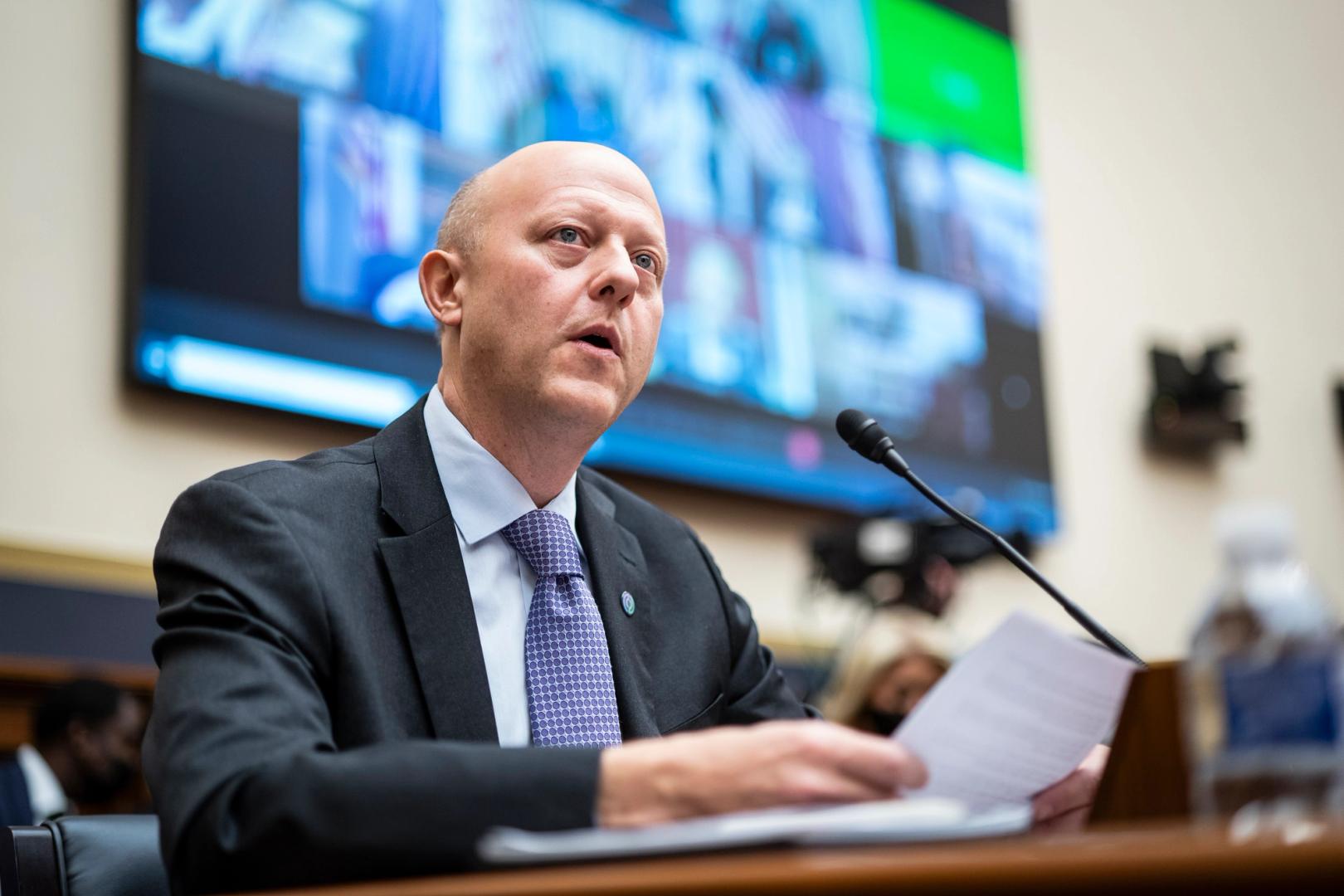
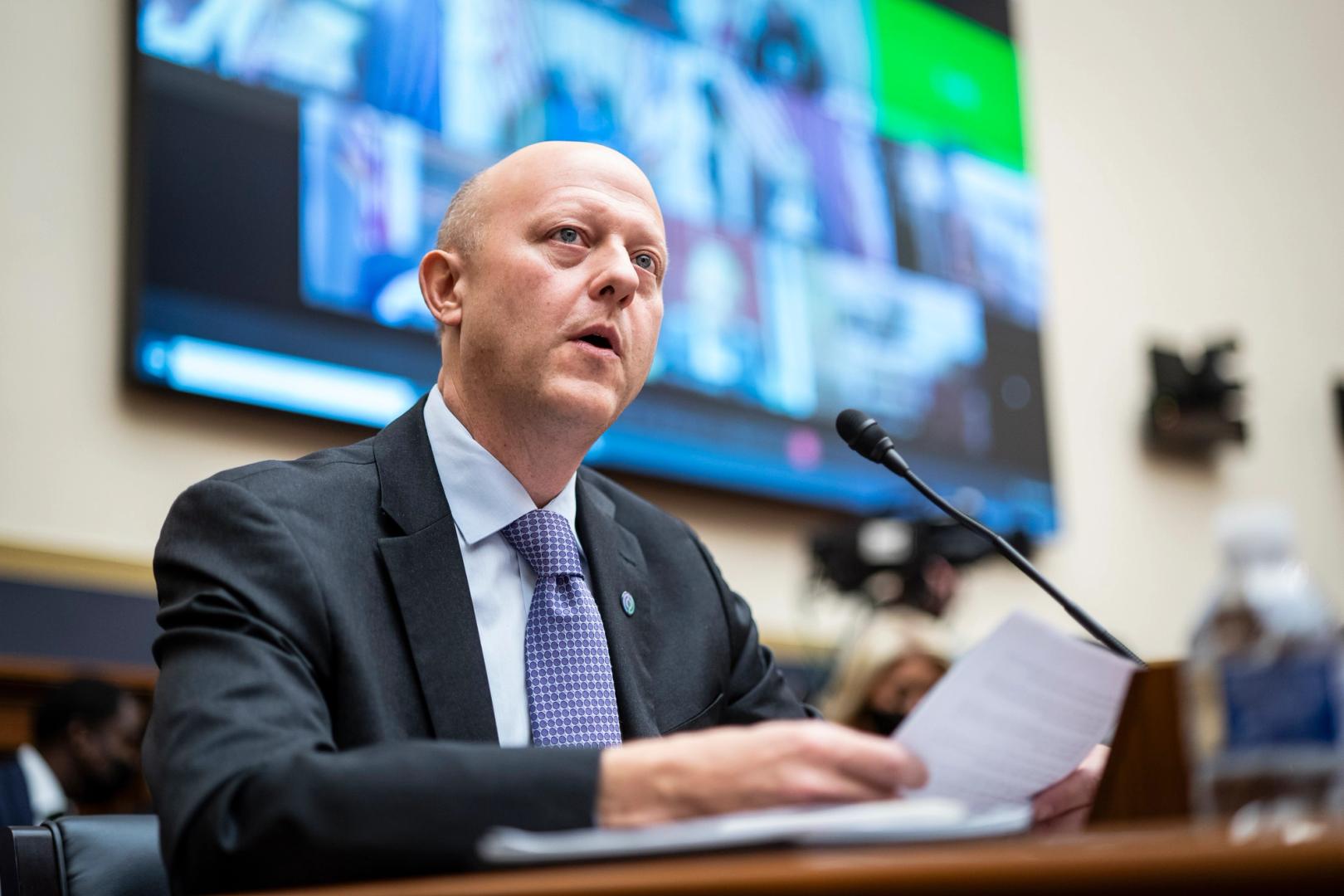
Hyperliquid is one of crypto’s fastest-growing trading venues and the leading decentralized perpetual futures exchange. The platform processed more than $150 billion in trading volume in July alone, while its volume relative to Binance climbed to 11.5%, underscoring its growing share of the derivatives market. USDC balances on Hyperliquid have swelled to roughly $6 billion, making it an increasingly important distribution channel for the stablecoin.
Under the new arrangement, Coinbase will classify USDC on Hyperliquid as “on-platform,” collecting the income generated by reserves and paying 90% of it to Hyperliquid. JPMorgan estimated Coinbase previously split nearly all of the revenue evenly with Circle.
The bank cut earnings estimates for both companies, citing the Hyperliquid agreement and weaker crypto markets, though it expects higher interest rates to provide some support for USDC-related revenue over the longer term.
USDC has also lost momentum in recent months. Its circulating supply has fallen to about $73 billion from nearly $80 billion in March, part of a broader $10 billion contraction in the stablecoin market since May as crypto trading activity cooled and new regulated rivals chipped away at the dominance of USDC and Tether’s USDT.
Japanese investment bank Mizuho said in a report last week that Circle’s final approval from the U.S. Office of the Comptroller of the Currency to establish First National Digital Currency Bank is a positive milestone, but investors may be overestimating its significance.

In the latest XRP news, Ripple Labs has joined the UK HM Treasury’s Wholesale Digital Markets taskforce, a 54-firm initiative that estimates tokenized wholesale finance could add up to £33 billion to UK annual economic output by 2035. The move places Ripple in the room alongside major institutions – a composition that signals this program is anchored in institutional finance, not crypto-native advocacy.
Ripple’s participation is that of a task force member, not an advisory lead or designated pilot operator. The distinction matters: with more than 50 organizations involved, Ripple holds a seat at the table where tokenization standards for UK wholesale markets will be shaped, but it does not control the program’s direction.

Discover: The Best Token Presales
XRP News: What the Taskforce Is Actually Building
The £33 billion annual economic estimate originates from HM Treasury’s own strategy documents, not from Ripple. The firm cited the figure in its public support statement.
In a post on X, Ripple said that onchain funds, bonds, and repurchase agreements are already being used. The company also said these products can settle faster and cost less than many traditional systems, and it pointed to the UK’s well-developed capital markets and trusted regulatory system as reasons the country could become a leading market for tokenized wholesale finance.
Regulatory Momentum and the US Angle
The taskforce alignment matters for market positioning broadly: if UK and US tokenization standards converge, and cross-border repo and collateral settlement become primary use cases, then existing institutional infrastructure for cross-border payments could become more directly applicable. That is the strategic logic of Ripple’s presence on the taskforce – early influence in a market that could scale meaningfully by mid-decade.
Industry feedback on taskforce priorities and timelines remains open through September 4.
Discover: The Best Crypto to Diversify Your Portfolio
SEC Lawsuit Context and XRP Price Setup
Separately, Ripple disclosed new details about the pressure it faced following the SEC’s December 2020 lawsuit. CEO Brad Garlinghouse confirmed that company leadership discussed shutting Ripple down within days of the filing, including the option to close the business, distribute its XRP holdings to shareholders based on their ownership, and tell the SEC that the company named in the lawsuit no longer existed.
CTO David Schwartz later confirmed that outside lawyers told company leaders the business could not be saved, and said the advice at the time was for the executives to strike a deal to protect themselves. Garlinghouse later disclosed that Ripple spent about $150 million on legal fees during the four-year court battle.
Schwartz subsequently clarified that some reports misunderstood his comments, stressing that he never meant to suggest Ripple was close to shutting down, a distinction that matters given how the narrative circulated. The disclosures are retrospective at this point, but they frame the legal risk premium that weighed on XRP pricing from 2020 through the case’s resolution.
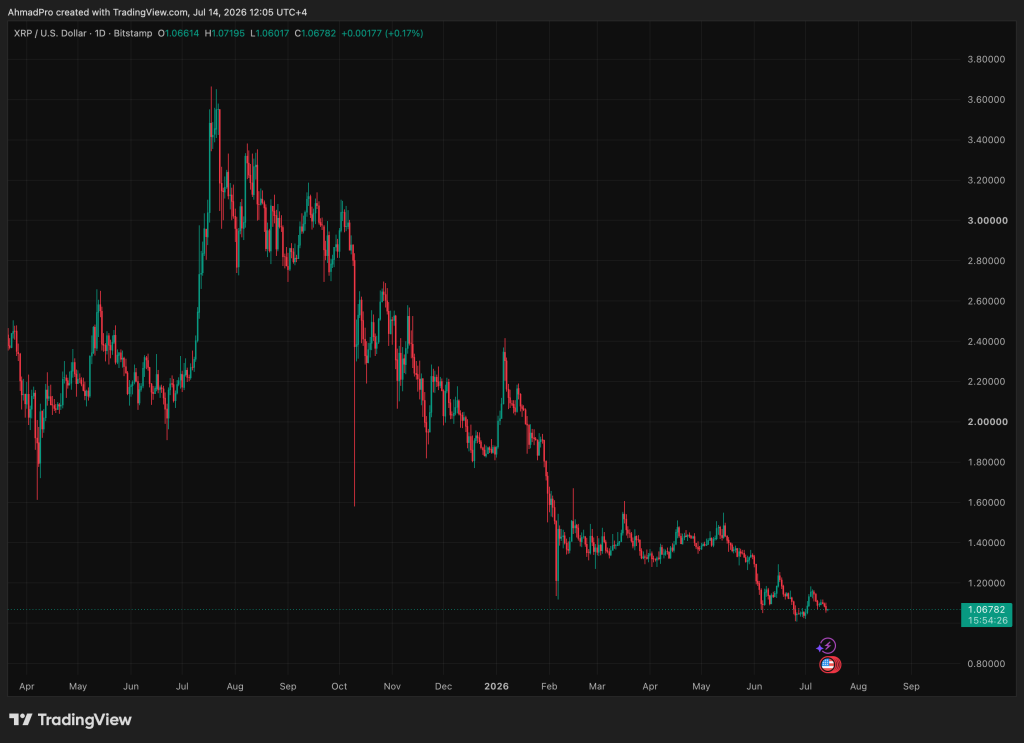
On the price side, XRP is holding above the $1.04–$1.11 support band. Both the recent rally leg and the subsequent pullback formed three-wave structures, which do not yet constitute a confirmed bullish pattern.
A sustained hold above support opens the path toward $1.19 and then $1.25; a break below the zone would reinforce the broader downtrend. XRP is up 3.89% year-to-date in 2026, extending a streak of positive annual returns: 47.6% in 2023, 31.2% in 2024, and 35% in 2025.
The UK taskforce announcement adds a concrete regulatory-institutional data point to Ripple’s positioning, but it does not alter near-term XRP technicals. The more durable question is whether Ripple’s early presence in a government-backed tokenization program – alongside institutions that collectively manage trillions in assets – translates into protocol-level adoption when the spring 2027 pilot goes live.
Don’t Miss Out on Our $1,000 USDT Airdrop on ByBit
The post Ripple Crowned: UK Treasury Just Changed Everything for XRP appeared first on Cryptonews.
Coinbase CEO Brian Armstrong has admitted that his company “messed up” when it shifted its focus to content coins and prioritised the promotion of its crypto social media app Zora, before pivoting to AI products.
Armstrong was responding to X user “smileyXBT,” who criticized the exchange for “chasing the next meta instead of backing the people and culture already here.”
The CEO originally claimed that the firm was trying to steer users towards positive-sum crypto use cases and maintain a business “moat” with its customer base that would allow it to weather competition from rivals.
However, smileyXBT wasn’t convinced, noting that Base, Coinbase’s blockchain network, spent the last year pushing Zora while doing very little to build a moat.
SmileyXBT also highlighted Base’s efforts to push creator coins tied to individuals with “shady track records,” and pointed out that users were “smoked” by creator coins launched by Base founder Jesse Pollak, and former Coinbase CTO Balaji Srinivasan.
Read more: What’s the deal with Zora, Base, and content coins?
They also claimed that this “hurt users” before noting how Coinbase went on to pivot to AI agents.
Armstrong agreed with smileyXBT’s content coin breakdown. He said, “They didn’t work and we pivoted early this year. We messed up, time to turn the page.”
However, Armstrong disagreed that a pivot to AI agents replaces community.
“Base has been focused on trading, payments, and agents (in that order),” he said, adding that “all three are inextricably intertwined.”
Content coins didn’t pan out
There was a lot of confusion around the token system established between Coinbase, Base, and Zora in 2025.
Zora and Base were apps styled around Instagram that involved tokens called content coins and creator coins that were launched alongside posts and new accounts.
Eventually, in July 2025, Zora was integrated into Base as it attempted to model itself as an “everything app.”
Earlier in the year, Zora pivoted into content coins by dropping the NFT minting services it had originally focused on since 2021. This, in turn, upset many NFT artists who had relied on the app for work.
Promotion of Zora involved Base posting “base is for everyone” on the Zora app. This, in turn, created a content coin alongside it and meant it had technically launched an official token via Zora.
However, Coinbase didn’t see it that way.
It told Protos that Zora posts are “automatically tokenized,” and then, contradicting itself, said, “Base did not launch a token, this is not an official Base token, and Base did not sell this token.”
Read more: Zora updates coin guidelines after ZachXBT calls out Sahil collab
The majority of tokens launched by Pollak on the Base app lost much of their value in the months that followed.
More scandal followed in August 2025 after Zora promoted a fake Tyson Fury Zora account and planned to collaborate with alleged serial rug-puller Sahil Arora.
Screenshots revealed by the crypto sleuth ZachXBT showed Pollak willing to look past Arora’s history, as he told the alleged rug puller to drop the “bad guy positioning,” and that he couldn’t wait to see his “positive impact.”
Execs believed Arora had onboarded Fury and promoted the account on X. Arora had lied, and Fury wasn’t involved.
This incident led to new guidelines that would hide, but not delist, any tokens that broke community guidelines.
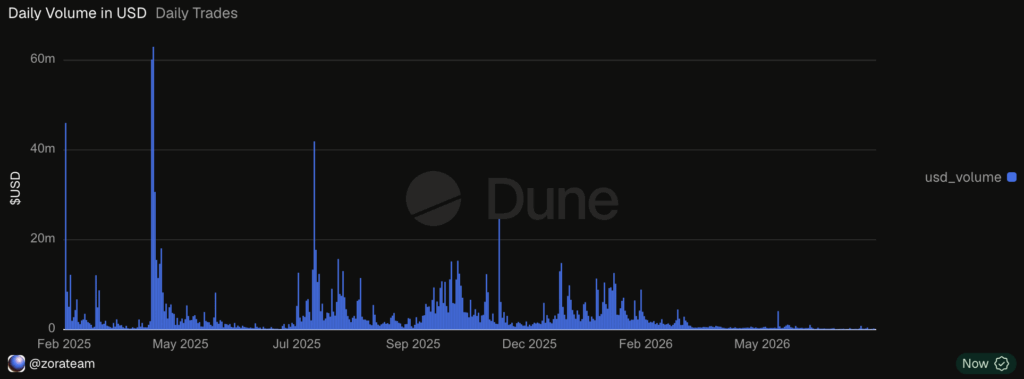
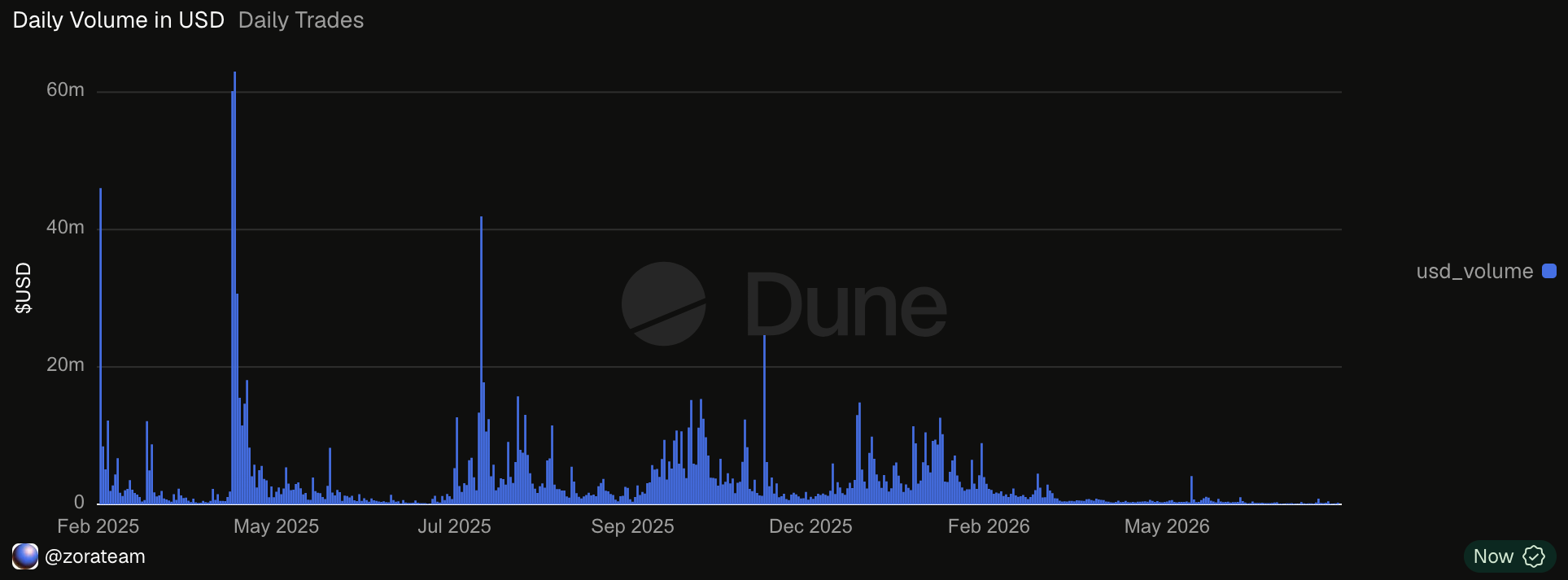
Overall, the project failed to take off in the way Coinbase had hoped. Data compiled by Dune Analytics user “@zorateam” shows that the daily volume on Zora has reached lows of under $100,000 in the past few months.
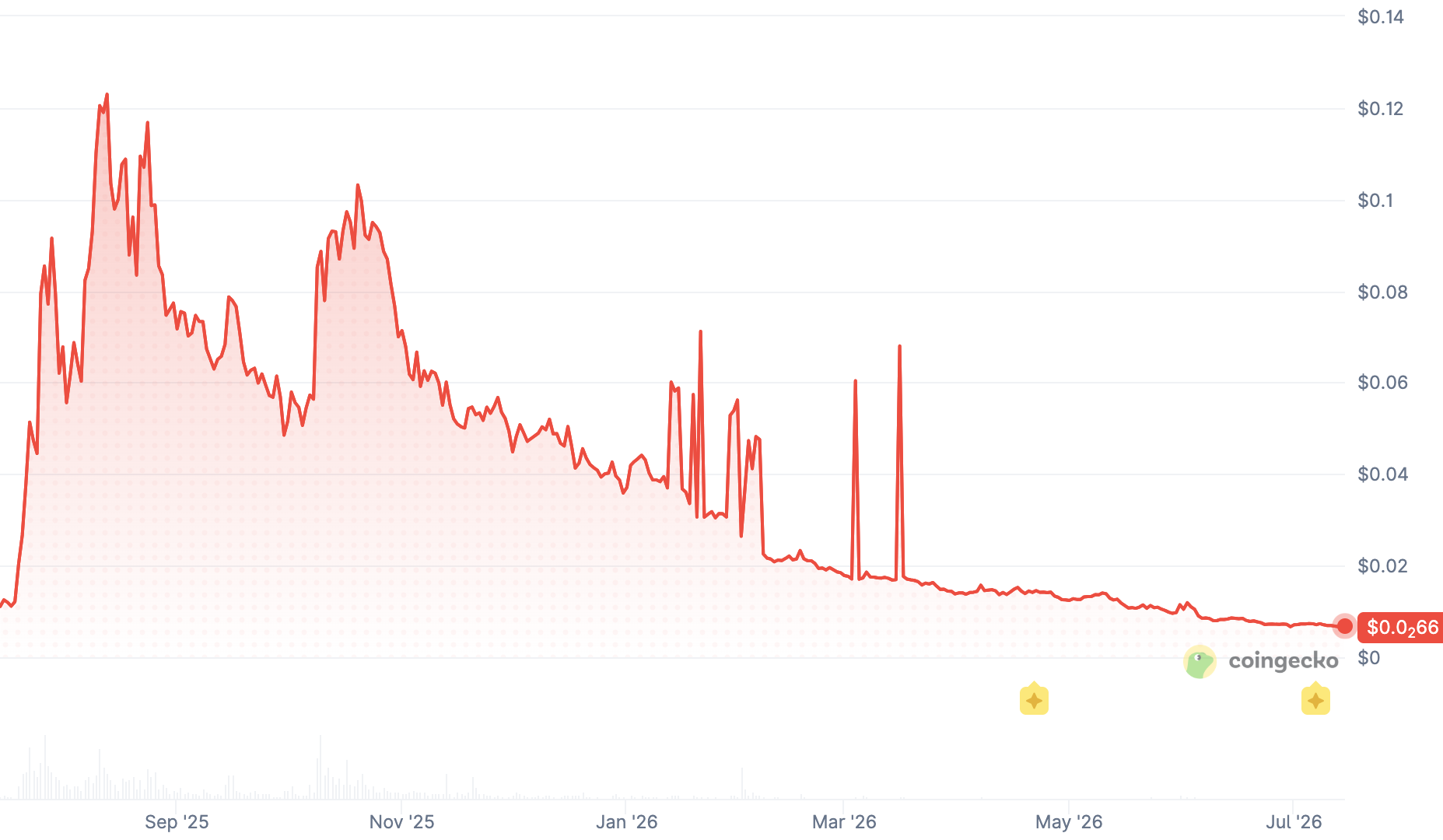
In May 2026, the daily volume almost reached $63 million, resulting in a 99.8% decrease in daily volume. The price of the Zora token is also down almost 96% since it’s all-time-high in August 2025.
Got a tip? Send us an email securely via Protos Leaks. For more informed news and investigations, follow us on X, Bluesky, and Google News, or subscribe to our YouTube channel.

It was a year ago this month when the cross-border token stole the show, rode the bull train, and did what many thought was impossible: it broke its all-time high after seven years of pain and suffering.
Since then, though, the correction has been quite severe. XRP lost the $3.00 and $2.00 support levels in the following months before it collapsed to $1.01 during the late June and early July crash. Despite rebounding slightly to $1.07 as of press time, its price action remains highly depressed, struggling at over 70% below last year’s all-time high.
However, here comes CasiTrades’ positive news for the Ripple bulls as the popular analyst believes XRP’s year-long correction might finally be close to an end.
Over Soon?
In her latest analysis on the token’s price performance, she noted that the lower timeframes have shown a potential final 5-wave impulse down, which might take it to the major macro support at $0.87. Several analysts have weighed in on the matter lately, indicating that XRP might indeed bottom somewhere between $0.80 and $0.90.
According to CasiTrades’ vision on how the probable leg down will materialize, she noted that the first wave will be a sharp decline toward $0.93. The subsequent bounce will take the asset to $1.00, which would now serve as major resistance, and the rejection is likely to deliver the aforementioned bottom at $0.87.
“That final move would complete the macro Wave 2 correction and finish off the correction we’ve spent the last year building! The odds still favor one final low into support before the next major trend begins!”
Interestingly, ChartNerd offered a rather identical prediction for the cross-border token, suggesting that the consecutive lower highs can spell trouble and send it to well under $1.00.
What Follows Will Be Massive?
CasiTrades, alongside a few other analysts, believes the aforementioned leg down would be necessary for XRP to cleanse its current market structure and the so-called weak hands before it enters its next phase of expansion. MikybullCrypto also joined the bullish wave, noting that the token is forming something “massive.”
Although the analyst failed to outline a specific target now, he has been quite optimistic about making big XRP forecasts in the past, including a potential run to a new all-time high of $4.00 and beyond.
What is coming for XRP will be massive
I love the pattern formation pic.twitter.com/T7ZIHRmtzJ
— MikybullCrypto (@MikybullCrypto) July 14, 2026
The post Ripple’s XRP Is Finishing The Correction It Started a Year Ago: What’s Next? appeared first on CryptoPotato.

Bitcoin price is trading at $62,900, as we debate whether this pause is simply a reset or something more serious, with bearish prediction. Strategy’s latest move, selling $213 million worth of BTC, caught plenty off guard. A company known for buying rarely grabs headlines for selling, so the market naturally paid attention.
The sale arrived as macro risks piled up. US-Iran tensions escalated after Washington tightened restrictions around the Strait of Hormuz, sending oil prices higher and pressuring global risk assets. Chip stocks stumbled, while Bitcoin briefly slipped before finding buyers again.
Strategy’s updated approach also changes how investors view its role in the Bitcoin market. Instead of treating BTC as an asset that should never be sold, the company is taking a more flexible stance. Management can now sell Bitcoin to strengthen its balance sheet, support capital raises, or improve shareholder returns. That marks a noticeable shift from its long-standing accumulation strategy.
For Bitcoin, the impact is more about sentiment than immediate selling pressure. Strategy remains one of the largest corporate Bitcoin holders, so its long-term commitment has not disappeared. However, traders may no longer assume the company will buy every dip. That could weaken confidence during volatile sessions, especially when macro uncertainty is already keeping buyers cautious.
Meanwhile, leveraged traders took another hit as liquidations cleared out overheated positions and pushed futures funding closer to neutral. That reset eased excessive speculation, although it did not spark a convincing rebound. The market looks calmer, but traders are still keeping one eye on the headlines.
Spot Bitcoin ETF demand continues to provide support underneath the market, helping absorb selling pressure during periods of volatility. Even so, buyers have yet to regain full control. As long as geopolitical tensions remain elevated and Strategy’s new capital strategy remains in focus, Bitcoin could struggle to build enough momentum for a sustained move higher.
Don’t Miss Out on Our $1,000 USDT Airdrop on ByBit
Bitcoin Price Prediction: Reclaim $65,000 or Is a Deeper Correction Due?
Bitcoin is trading around $62,500 price level, with a 24-hour volume close to $30 billion, in a bearish prediction situation. Market activity remains steady, but it still lacks the urgency that usually marks a convincing reversal. Meanwhile, Bitcoin’s market cap sits near $1.24 trillion, while dominance holds around 56%, showing it still leads the crypto market despite recent weakness.
The technical picture remains uncomfortable. TradingView analysis still points to a confirmed bearish break from a multi-month symmetrical triangle. As usual, that former support has turned into resistance. The key zone sits between $63,000 and $65,000. A decisive move back above that range would improve the short-term outlook. Until then, sellers still have the upper hand.

Three scenarios remain on the table. In the bullish case, stronger spot ETF inflows and easing macro tensions could help Bitcoin reclaim $63,500, opening the door for another test of the $65,000 resistance area. It is not a guarantee, but that is where momentum would finally start looking interesting again.
The base case still favors consolidation between $60,000 and $62,500 as traders reset leveraged positions. It is the kind of market that slowly drains everyone’s patience instead of their wallets. On the other hand, a daily close below $60,000 could expose the $58,000 to $59,000 support zone, where buyers may finally step back in.
Meanwhile, Strategy’s latest Bitcoin approach continues to hang over sentiment. Whether investors see it as caution or simply another funding strategy, the headlines are impossible to ignore. Michael Saylor’s company reshaped how institutions approach Bitcoin accumulation. Because of that, any perceived shift in its playbook naturally grabs attention instead of fading into background noise.
Discover: The Best Crypto to Diversify Your Portfolio
Bitcoin Hyper Targets Early Mover Upside as Bitcoin Tests Key Levels
When Bitcoin consolidates near $60,000, and macro uncertainty is compressing near-term upside, the calculus for late-cycle BTC entries gets harder to justify. Asymmetric exposure requires looking elsewhere in the stack, specifically, infrastructure plays built on top of Bitcoin that carry their own growth narrative independent of BTC’s short-term price action.
Bitcoin Hyper ($HYPER) is positioning itself as the first Bitcoin Layer 2 with Solana Virtual Machine (SVM) integration. It’s technically, if executed, would bring sub-second finality and low-cost smart contract execution to the Bitcoin ecosystem without sacrificing BTC’s underlying security.
The presale has raised close to $33 million at a current price of $0.0136831, with staking live for early participants. The combination of a canonical bridge for native BTC transfers and SVM compatibility is the headline differentiator; it targets the programmability gap that has kept institutional developers building on Ethereum and Solana rather than Bitcoin.
The Bitcoin Hyper presale is worth reviewing for traders actively looking for pre-launch Bitcoin ecosystem exposure while BTC itself consolidates. DYOR before committing capital.
Discover: The Best Token Presales
The post Bitcoin Price Prediction: Strategy Has a New BTC Approach appeared first on Cryptonews.
Bitcoin (BTC) traders are watching the July 14 US inflation report, with analysts at crypto trading firm BIT saying it could determine the cryptocurrency’s next move as markets price in 2.6 Fed rate hikes over the coming quarters.
The inflation data is also coming at a time when BTC has steadied after recent volatility, leaving macroeconomic signals in greater control of short-term price direction.
CPI Report Takes Centre Stage for Bitcoin
According to BIT’s latest market update, since the last rate cut outlook that helped lift Bitcoin during the early stages of its fifth bull market in 2023, expectations have changed, with investors increasingly pricing in tighter monetary policy since September 2025, which creates a more difficult backdrop for risk assets, including crypto.
The firm’s report also pointed to comments made this week by Federal Reserve Governor Christopher Waller that policymakers are at a crossroads, something it interpreted as making the current environment more hawkish than before. It also suggested that the inflation reading could quickly change prospects around BTC.
“Tonight’s CPI report is critical for Bitcoin,” read the update. “An inflation reading above 4.0% would likely reinforce expectations for further tightening and add to downside pressure.”
Recall that in the last FOMC meeting, rates were held at 3.50% to 3.75%. However, as minutes from the meeting revealed, there was a divide among officials on future hikes. Some of them, as pointed out by BIT, raised concerns about AI-induced inflation. Furthermore, the latest survey by the New York Fed estimated one-year inflation expectations to be 3.7%, which was the highest since September 2023 after May’s CPI reached a 3-year high of 4.2%.
Bitcoin is coming into the above setup trading near $63,000, having seen very little change in 24 hours but down by about 1% in the last week, with July historically seen as a green month for the OG cryptocurrency.
And it showed signs of that tendency after it recovered from a low near $58,000 to briefly climb above $64,000 before giving back parts of those gains as renewed hostilities between the US and Iran wrecked havoc in the market.
Not Everyone Is Convinced By July’s Seasonal Boost
Despite the rebound, CryptoQuant’s Bull Score Index is at 30, which is still firmly in bearish territory, and analysts have said that it needs a reading above 60 before any rebound counts as more than a bear-market bounce.
In addition, as BIT noted, the US-Iran conflict is not the only negative development Bitcoin has faced, as it also absorbed Strategy’s recent disclosure that it sold 3,588 BTC to fund dividend payments with little impact. It did dip by about $1,000 after the Strategy announcement, but recouped those losses within hours, which, according to the investment firm, suggested that much of the selling had already been anticipated by the market.
The post Bitcoin Brace for US CPI Report as Fed Rate Fears Grow appeared first on CryptoPotato.
Although most experts anticipated slightly lower US Consumer Price Index numbers for June due to the ongoing ceasefire at the time in the Middle East, the actual data is more promising, showing an even larger decline.
The month-over-month drop is 0.4%, which breaks a three-month streak of consistent increases. BTC’s price reacted with an immediate surge of almost a grand that pushed it to $63,500 briefly.
However, a closer look at the data tells a different story. A large portion of the CPI decline from May’s multi-year record was due to the drop in oil prices in June because of the ceasefire signed between the US and Iran.
The Core CPI, which strips out more volatile sectors such as energy and food, remains unchanged. Furthermore, the ceasefire between the two warring nations ended last week, and the tension has substantially escalated. Oil prices have jumped once again, meaning the July data is likely to surge.
According to a recent analysis, BTC traders are closely monitoring the situation as it could provide a glimpse into the upcoming FOMC meeting, in which the Fed could hike the rates.
Analysts predicted that a reading above 4% YoY could lead to further tightening of monetary policy, impacting BTC negatively. However, the actual 3.5% figure might have the opposite effect.
Bitcoin’s initial reaction was quite positive, as the asset jumped to a daily peak of $63,600 before it retraced slightly. More volatility is expected as the news unfolds and the market prices in the next FOMC meeting.
The post Bitcoin Price Rockets as US CPI for June Comes in Well Below Expectations appeared first on CryptoPotato.
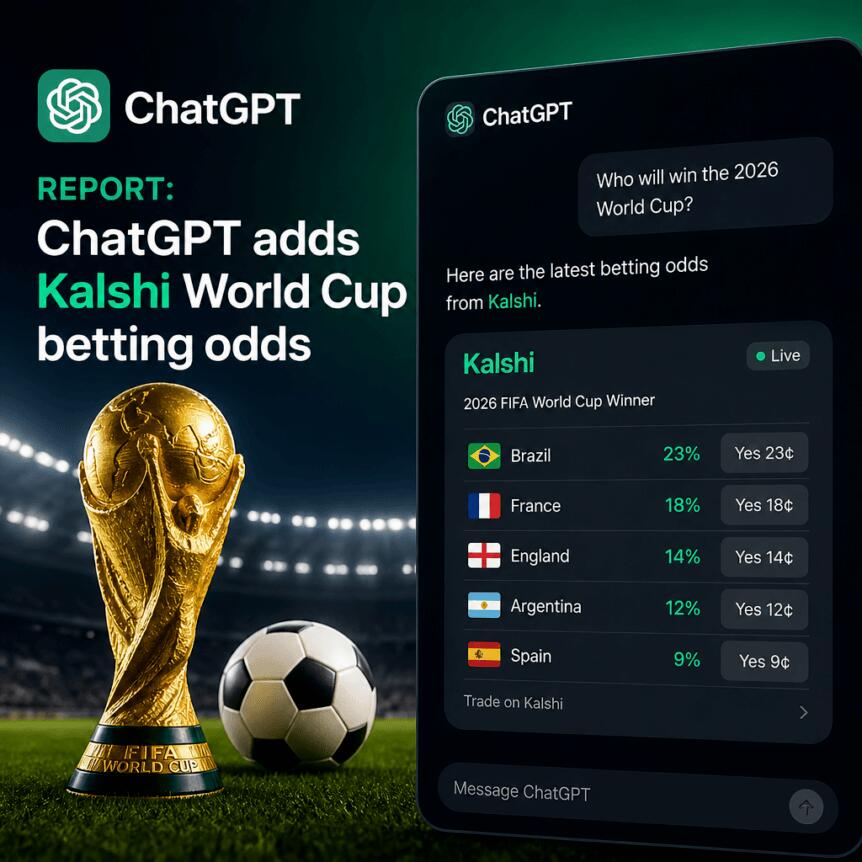
OpenAI has begun surfacing prediction-market odds from Kalshi directly inside ChatGPT search results for FIFA World Cup matchups, according to a report from The New York Times. The integration provides fans with an at-a-glance view of each team’s implied probability of winning, sourced from live market pricing—without turning the chat interface into a betting channel.
The partnership was not publicly announced at the time of the report. Kalshi declined to comment to Cointelegraph, and OpenAI did not respond to a request for comment.
Key takeaways
- ChatGPT search results now display Kalshi-derived odds for specific World Cup matches, presented as implied win probabilities for each team.
- OpenAI’s guidance cited by The New York Times indicates the feature is informational only and does not enable bets through ChatGPT.
- The World Cup deployment underscores the broader shift of prediction-market data from trading venues into mainstream consumer and media products.
- Dune Analytics data shows Kalshi scaled to more than $33 billion in monthly notional volume in June 2026, outpacing Polymarket by about $22 billion in the same period.
Odds graphics appear inside ChatGPT search
As described by The New York Times, when users search for World Cup fixtures in ChatGPT, the interface can show market-based odds as graphics. These visuals break down each team’s implied chance of winning, reflecting how prediction-market participants price outcomes.
In one example cited in the report, a ChatGPT search for France versus Spain showed France at a 59% probability of victory. Another query—England versus Argentina—displayed England at a 55% chance, with the probabilities attributed to Kalshi’s market pricing.
Importantly, the feature is framed as data display rather than a trading mechanism. OpenAI’s guidance, as referenced by the report, indicates users cannot place wagers through ChatGPT; the Kalshi feed is intended for informational purposes only.
Why prediction-market data is attractive to AI products
Prediction markets are built on the idea that crowds of participants, acting on available information, can collectively form price-based forecasts for real-world events. Translating those prices into implied probabilities gives users a compact summary of what the market currently thinks is more likely.
For consumer AI experiences, this is a notable shift: instead of relying solely on curated editorial forecasts or static historical analytics, the AI interface can present live, outcome-relevant probabilities that update as the underlying market changes. In practice, that matters for users who want a “current best guess” rather than a delayed consensus.
The World Cup is a particularly test-friendly environment for this approach. Matchups are clear, outcomes are well-defined, and the timing is within a single tournament window—attributes that make it easier for users to compare predictions with results as they unfold.
Kalshi’s scale and the “mainstreaming” trend
Kalshi is a regulated prediction market platform where traders can buy and sell contracts tied to real-world events, including sports, economics, and politics. While prediction markets have existed for years, their gradual integration into major technology and media ecosystems has accelerated recently.
Dune Analytics data cited in the report indicates Kalshi recorded more than $33 billion in monthly notional volume in June 2026, roughly $22 billion ahead of Polymarket. That kind of volume signal is often read by the market as evidence of liquidity and participation—factors that can influence how useful price-derived odds are for observers.
Calendar effects likely play a role as well. A World Cup naturally concentrates attention and trading activity, which can pull these odds into the mainstream at the exact moment sports audiences are most engaged.
From TV and finance portals to search interfaces
The ChatGPT feature follows a broader pattern: prediction-market data increasingly appears inside high-visibility platforms rather than remaining confined to trading dashboards.
Kalshi has already established partnerships with major media outlets. According to Kalshi’s announcements, it entered an arrangement with CNN and another with CNBC in December 2025 to integrate its market data into coverage.
Rival platforms have pursued similar distribution deals. Bloomberg reported that Polymarket partnered with Dow Jones in January 2026 to bring prediction market data to products including The Wall Street Journal, extending market-based odds into traditional finance publishing.
Tech search products are also getting involved. Google reportedly integrated prediction-market information from both Kalshi and Polymarket into Google Finance and Search products in November 2025, positioning those odds within everyday discovery flows rather than requiring users to visit a trading website first.
Against that backdrop, OpenAI’s use of Kalshi odds in ChatGPT looks less like a one-off novelty and more like part of a wider supply-chain for “market intelligence” becoming a feature—rather than a separate destination.
What to watch next
For readers, the key question is whether this remains a World Cup-specific display or expands into other event categories and geographies. If OpenAI continues to surface market-based forecasts beyond sports—and if more platforms treat those odds as an everyday reference point—the practical impact will be felt less in trading volumes alone and more in how quickly prediction-market consensus becomes embedded in routine decision-making.
Crypto World
Ethereum (ETH) Foundation spinout EthSystems targets banks with blockchain privacy technology


A team of former Ethereum Foundation researchers focused on institutional privacy has launched EthSystems, a new for-profit company aimed at building confidentiality infrastructure for financial institutions using Ethereum.
The startup emerged from the Ethereum Foundation, which spent the past year developing privacy technologies for enterprise use cases while engaging with central banks, regulators, global banks and asset managers.
The spinout comes amid one of the biggest organizational shakeups in the Ethereum Foundation in years. Following months of criticism over leadership, strategy and the foundation’s role in supporting Ethereum’s increasingly institutional user base, several teams have recently been spun out into independent organizations.
Among them are EthLabs, a nonprofit focused on advancing Ethereum protocol research and scaling, and Ethereum Institutional, a separate nonprofit designed to coordinate institutional adoption and engagement with large financial firms. Together, the organizations represent an effort to distribute responsibilities previously housed within the foundation across more specialized entities.
EthSystems said it plans to commercialize work it began inside the foundation, including confidential stablecoin transfers, private bond issuance, cross-chain settlement systems and open-source protocol specifications.

The American Bankers Association, the Independent Community Bankers of America, and 76 state associations sent Senate leaders a set of targeted revisions to the CLARITY Act, which is pending before the Senate.
The July 13 letter went to Majority Leader John Thune and Minority Leader Chuck Schumer. It focuses on Section 404.
The Targeted Edits Banks Want in The CLARITY Act
Section 404 of the CLARITY Act targets stablecoin yield. It bars covered parties from paying returns solely for holding payment stablecoins or for providing a yield equivalent to bank deposit interest. It preserves activity-based rewards tied to transactions or platform use.
The signers propose narrow changes to the section, plus a printed markup of the amended text. They want lawmakers to:
- Remove the word “solely” from subsection (1)(A).
- Cut the phrases “on a payment stablecoin balance” and “on an interest-bearing bank deposit” from (1)(B).
- Replace the “economically or functionally equivalent” test with a “substantially similar” standard, wherever it appears in Section 404.
- Delete subsection (3)(B)in its entirety.
The bankers say these would stop firms from engineering incentives that dodge the ban. They also argue that the rewards subsection works against the prohibition it sits beside.
Follow us on X to get the latest news as it happens
Banks Warn of Deposit Flight Risk
The groups said that they back responsible innovation and a well-regulated digital asset marketplace but want firmer guardrails. In the letter, the bankers expressed concerns regarding the current language in Section 404.
“In particular, we remain concerned that ambiguities within the bill could encourage stablecoin arrangements to effectively function as substitutes for deposits, despite Congress’s longstanding and clearly stated intent that payment stablecoins should serve as transaction tools rather than store-of-value products,” the association said.
The banking groups say the risk of deposit flight is concrete, not hypothetical. When local deposits shrink, so does the money banks recycle into their own towns.
Those deposits fund home loans, small-business credit, and financing for farmers. The letter frames that lending is the engine behind local growth.
Five US banking lobbies made similar arguments in an earlier letter this year. This round sharpens the specific statutory fixes.
The stablecoin yield is one of three key disputes stalling the bill. Lawmakers remain split over Section 604 developer protections and ethics rules.
President Trump has pushed senators to move quickly. At the same time, two groups, NOBLE and a federal law enforcement association, have backed the bill despite the open fights.
The Senate faces a narrow window before the August recess. Whether leaders can settle the stablecoin, developer, and ethics disputes in that window remains unclear.
Subscribe to our YouTube channel to watch leaders and journalists provide expert insights
The post 78 Banking Groups Push Senate to Rewrite CLARITY Act Section 404 appeared first on BeInCrypto.

Derek Chisora sums up Joe Joyce’s performance in latest loss to Artem Suslenkov amid calls to retire

New York State halts construction of all new data centers

Bitcoin Survives, Solana Crashes: What’s Next? | BLOCKTALK INDIA

No Jackpot Winner as $257 Million Prize Rolls Over to $269 Million Monday Draw

Renter of Home in Anne Heche Crash Denies Settlement With Son

Weekend Open Thread: Staud – Corporette.com
Bitcoin Survives, Solana Crashes: What’s Next? | BLOCKTALK INDIA

Why does it seem like so many Asian Americans achieve financial success?? #money #finance #success

XRP Ledger’s Quiet Takeover Nobody’s Talking About #xrp #crypto #analysis
-

 Fashion5 days ago
Loro Piana Fall 2026 Enters Houston’s Art Scene
-

 Fashion4 days ago
Weekend Open Thread: Nutriplenish Leave-In Conditioner
-
 Sports5 days ago
2026 Genesis Scottish Open Thursday TV coverage: Round 1
-

 Sports7 days ago
Joshua Pacio ‘more complete’ ahead of ONE rematch vs Malachiev
-

 Tech7 days ago
Anthropic brings Claude Cowork to mobile and web as usage data shows most users aren’t coding
-

 Sports4 days ago
Super Eagles star Moses Simon opens up on Liverpool transfer regret
-
Sports7 days ago
We have punished the disrespect
-

 Tech5 days ago
Character.AI enters the microdrama arena with its own productions, but there’s a twist
-

 Crypto World7 days ago
Nasdaq arthritis company holding Moshe Hogeg crypto hits all-time low
-

 Tech10 hours ago
Get Your ESP32 Sunny Side Up With This Solar Dev Board
-

 News Videos6 days ago
Crypto Just Entered Its Most Important 6-Month Candle (Could Decide Everything!)
-
 Tech7 days ago
Keychron is stepping outside keyboards with a $349 Thunderbolt 5 dock aimed at power users
-
 Business6 days ago
ASX 200 Slides Over 0.6% as Rare Earths and Lithium Stocks Tumble Amid Global Semiconductor Sell-Off Today
-
 NewsBeat5 days ago
Major update after Huntingdon train attack as man enters plea
-
 Business7 days ago
Will Trent shares rebound after Q1 update triggers 13% crash? Here’s what technical charts indicate
-
 Tech7 days ago
OpenAI teams with Work Louder to launch Codex-native keyboard, weeks after CEO of Apps told staff ‘not to be distracted by side quests’
-

 Business6 days ago
SpaceX Shares Slide Nearly 6% Amid Post-IPO Volatility and Starship Test Focus
-
 Sports6 days ago
39-year-old Djokovic wins five-hour thriller to enter Wimbledon semis | Other Sports News
-
 Crypto World7 days ago
TeraWulf’s $19B Anthropic Lease Turns Bitcoin Miner Into AI Landlord
-

 News Videos1 day ago
how to make coin bank box with cardboard #scienceproject #money #diy #shorts
You must be logged in to post a comment Login