
Crypto World
How a DAO lost $20 million in one proposal

Nobody hacked anything. No smart contract failed, no private key leaked, no phishing link fired. On July 6, the treasury of BonkDAO, the community organization behind one of Solana’s flagship memecoins, transferred roughly $20 million worth of BONK to a wallet controlled by an attacker, and every step of the transfer was a valid transaction executed exactly as the DAO’s own rules prescribed.
Summary
- An attacker spent about $4.4 million to gain enough BONK voting power and passed a proposal that transferred nearly $20 million from the BonkDAO treasury.
- The incident exposed how low voter participation, no timelock, and automatic proposal execution left the DAO vulnerable to governance capture.
- The treasury drain has renewed calls for stronger DAO safeguards as exchanges, investigators, and the broader crypto industry assess the aftermath.
The attacker did not break the governance system. They bought it, for about $4.4 million, at an implied return of nearly five to one, in a vote where seven wallets participated and more than 18,000 members did not. The episode is the cleanest proof to date of an uncomfortable truth the industry has spent years politely ignoring: a treasury governed by token-weighted voting is worth exactly the cost of assembling a temporary majority, and for most DAOs, that cost is a fraction of the prize.
The mechanics deserve a careful walkthrough because the details are what turn a crime story into a design lesson. And the aftermath, exchanges freezing deposits, law enforcement notified, a philosophical fight over whether this was theft at all, will shape how every treasury-holding DAO on every chain rewrites its rules over the next year.
Six days in the open
The attack was not fast, and it was not hidden. On June 30, an anonymous wallet submitted a proposal to BonkDAO’s governance system, which runs on Realms, Solana’s standard DAO tooling. The proposal carried the title BIP #76, styled itself as a governance renewal plan, and dressed the theft in the language of turnaround management: install new leadership, restructure the council, monetize treasury holdings, stop the bleeding. It even included a line noting that yes-voters would be eligible to receive tokens, a detail that reads in hindsight like a dark joke about incentive design. Beneath the rhetoric sat the only clause that mattered: an instruction to transfer 4.43 trillion BONK, the bulk of the treasury, to a wallet the proposer controlled.
The proposal stayed live for six days. During that window, the attacker methodically accumulated voting power, spending approximately $4.4 million buying BONK through exchange wallets, an amount equal to just over 1% of total supply but decisive against the DAO’s quorum arithmetic. On-chain researchers, including Yu Xian of security firm SlowMist and the analyst Yu Jin, later reconstructed the accumulation pattern: purchases sized to clear the quorum threshold with minimal excess, executed while the proposal sat in plain sight and no meaningful opposition organized. On July 6, the attacker cast the assembled stake. The final tally showed 882.38 billion BONK in favor against a quorum threshold of 879.95 billion, a margin so narrow it amounts to the attacker buying the exact number of votes required and almost nothing more.
Turnout was 2.9%. The yes share was 99.9%, which is what unanimity looks like when a single voter agrees with itself.
Then the system worked as designed, which is the entire problem. Realms-based governance executes passed proposals automatically. No human signed off, no council reviewed the transfer, no delay separated approval from execution. The treasury moved to an address ending in JHvQ, which investigators traced to funding from a Bybit account, and portions began flowing toward exchanges within hours.
The anatomy of the failure
Three missing safeguards converted a bad proposal into an executed one, and each is a standard control the DAO simply did not have. The first is a timelock: a mandatory delay between a proposal passing and its instructions executing. Even a 48-hour window would have given the community, or the core team, time to see a treasury-draining transfer queued and organize a response. The second is a multisig or council veto: an emergency brake allowing designated signers to freeze anomalous executions. The third is quorum and participation design: a system where 1% of supply can constitute a passing majority against 2.9% turnout has set its security budget equal to the apathy of its members.
The deeper failure sits above all three: the treasury’s size bore no relationship to the cost of controlling it. BonkDAO held roughly 15% of all circulating BONK, a war chest accumulated through the token’s boom years, governed by a mechanism whose capture cost floated with the token’s price and its holders’ attention. The attacker’s arithmetic was public information. Anyone could compute that quorum, multiplied by market price, cost about $4 million to satisfy, against a treasury worth five times that. The only surprising thing about the attack is that it took until 2026.
The pattern has a canonical ancestor. In 2022, an attacker used a flash loan to seize voting control of Beanstalk, a DeFi protocol, and drained about $180 million in the same block. The industry’s response then was to treat flash-loan governance as the flaw: protocols added voting delays that made borrowed tokens useless for instant capture. BonkDAO’s attacker needed no flash loan. They used patient capital, real purchases held across days, which defeats the flash-loan defenses entirely and shows that the vulnerability was never the loan. It was the market for votes itself.
The market for votes was always there
The uncomfortable context is that vote buying in DAO governance is not a fringe exploit; it is an industry with infrastructure. Bribe markets, where protocols openly pay token holders to vote for emissions and incentives, have operated for years around the largest DeFi governance systems and are treated as legitimate yield. Vote-lending and delegation markets let holders rent their governance power without selling their tokens. The line between that accepted economy and what happened to BonkDAO is intent, not mechanism: the machinery for converting money into votes was built, normalized, and liquid long before someone aimed it at a treasury instead of an emissions gauge.
That normalization is why the security framing has to be economic instead of technical. Auditors evaluate smart contracts against code exploits and can certify a system bug-free while it remains trivially capturable, because capture is not a bug. The relevant metric, which security researchers have urged for years under the name cost of corruption, compares the expense of acquiring decisive voting power against the value extractable by wielding it. For a healthy system, the first number exceeds the second with a wide margin. BonkDAO’s ratio, roughly $4.4 million against $20 million, was not marginal. It was an arbitrage with a six-day settlement period, advertised on a public governance forum. Any DAO that has never computed its own ratio should assume an attacker has.
The turnout side of the ratio deserves equal weight, because the attacker’s capital did not defeat 18,000 members; it defeated their absence. Governance participation across the industry has decayed for years, from the double-digit turnout of early experiments to the low single digits typical today, as token holders rationally conclude that reading proposals is unpaid labor with diluted influence. Every percentage point of apathy directly lowers the capture price. In that sense, the $4.4 million was not the cost of beating BonkDAO’s community. It was the market-clearing price of its indifference, and comparable prices are computable for hundreds of treasuries right now.
The tooling default problem
A quieter thread of the postmortem concerns Realms, the standard governance stack on Solana, and by extension the defaults every DAO platform ships. Nothing in the incident involved a flaw in the tooling: Realms executed a validly passed proposal, which is its job. But defaults are policy, and the configuration this DAO ran, automatic execution, no timelock, a static quorum set long ago, is the path of least resistance the tooling made easy. The same critique applies across ecosystems, where governance frameworks expose timelocks and councils as optional modules that busy launch teams skip. The predictable industry response is already forming: platforms moving protective defaults from opt-in to opt-out, warning surfaces that flag treasury-moving instructions in plain language, and simulation tools that show voters exactly what a proposal executes before they approve it. None of that required new research. It required a $20 million proof that someone would actually pull the trigger.
Theft, or the rules working
The philosophical fight broke out immediately and is more consequential than it sounds. One camp, including a notable contingent of on-chain observers, argues that nothing was stolen: the attacker followed every rule, won a vote the rules recognized, and executed a transfer the rules authorized. Code was law, the law was bad, and the losses are tuition. The proposal was public for six days; 18,000 members who could not be bothered to vote against their own treasury made a governance decision by omission. On this reading, the term “attack” launders negligence into victimhood, and law enforcement involvement sets a precedent that undermines the entire premise of on-chain governance: if valid votes can be criminal, then governance outcomes are subject to off-chain veto, and the system’s guarantees mean nothing.
The opposing camp, which includes BonkDAO itself, the analytics firms tracking the funds, and figures like Ripple’s chief technology officer emeritus David Schwartz, who compared the maneuver to corporate fraud, argues that legality is not defined by protocol validity. A proposal that misrepresents its purpose, transfers assets to its author, and relies on engineered low turnout is fraud in any legal system humans have built, regardless of how faithfully the machinery executed it. Corporate law developed exactly these doctrines for exactly these reasons: shareholder votes procured through deception are voidable, and control acquired to loot a treasury is a breach the courts unwind. The wrapper being a DAO does not repeal centuries of fiduciary reasoning.
The debate matters practically because it decides where defense happens. If this is theft, then exchanges freezing funds, as Upbit did when it suspended BONK deposits and withdrawals, and law enforcement tracing the Bybit-funded wallet are the immune system working. If this is the rules working, then every defense must live on-chain, in timelocks and vetoes and quorum design, and off-chain recovery is itself the attack on the system. The industry visibly believes both things at once, which is why the response has been both a law enforcement referral and a wave of emergency governance reviews at other DAOs.
What BONK was, and what the treasury was for
The scale of the loss only registers against what the DAO had built. BONK launched in December 2022 as Solana’s answer to its darkest hour, airdropping half its supply to the ecosystem’s users, developers, and artists in the weeks after the FTX collapse had cratered confidence in the chain. The distribution strategy worked beyond any reasonable expectation: the token became the community flag of Solana’s recovery, integrated across hundreds of applications, listed on every major venue, and eventually the anchor of an ecosystem spanning launchpads, exchanges, and grant programs. The treasury at the center of this month’s attack was the accumulated war chest of that run, holding roughly 15% of supply and funding the buybacks, integrations, and community programs that separated BONK from the thousands of memecoins that mint, spike, and vanish.
That history is why the governance failure stings beyond the dollar figure. The DAO structure was not decoration; it was the mechanism by which a token with no product and no cash flows coordinated thousands of contributors for three years. The treasury was the proof that memecoin communities could accumulate and steward real resources. Its draining through a seven-wallet vote is therefore an attack on the category’s best argument for itself, and every project that pitched community treasuries as the moat now answers for the moat’s price tag.
The damage, priced
The market’s verdict was swift but contained. BONK fell between 8 and 10% on the disclosure, trading around levels that left its market capitalization near $400 million, and stabilized within days. Several factors capped the damage. The stolen tokens, more than 4.4 trillion BONK, represent supply that was already outside the market in a treasury, so the theft’s mechanical effect is a transfer of overhang rather than new emission, though overhang in hostile hands is worth less than overhang in friendly ones. Exchange coordination raised the realistic prospect of partial recovery or at least slowed liquidation. And the token’s price had already absorbed a brutal year alongside the whole memecoin complex, whose aggregate value sits more than 50% below its level of twelve months ago even after a July bounce, leaving less speculative premium to destroy.
No user wallets were touched, and the BONK token contract itself was never at issue, distinctions that matter for the asset’s survival. The loss is concentrated in the commons: the treasury that funded ecosystem grants, marketing, and the buyback programs that gave the DAO its purpose. For a memecoin, whose entire value proposition is community coordination, draining the coordination budget through the coordination mechanism is a uniquely poetic wound, as crypto.news noted in its report on the treasury raid. The token survives; the question is whether the institution does.
The recovery race
Recovery, if it happens, will happen at the choke points, and the first week showed both their power and their limits. Stolen tokens moving toward centralized exchanges triggered the standard playbook: BonkDAO identified the exchange wallets used to accumulate BONK before the vote, notified law enforcement, and coordinated with exchanges, bridges, and the Solana Foundation. Upbit’s suspension of BONK deposits and withdrawals closed one of the deepest liquidity venues to the attacker, and the wallet trail through a Bybit-funded account gives investigators a potential identity thread, since major exchanges hold verified customer records behind funded accounts.
The limits are equally real. On-chain funds that stay on-chain remain beyond freezing, and an attacker with $20 million of patience can wait out attention, launder through decentralized venues, or drip supply into liquidity over months. Security analysts examining the movement patterns flagged infrastructure choices that complicate tracing, and the history of comparable incidents suggests recoveries are partial when they happen at all, often arriving through negotiated returns, the white-hat conversion, where an attacker keeps a bounty-sized fraction, more often than through seizure. The realistic best case is not restoration but attrition: enough friction at every exit that liquidation becomes slow, discounted, and legally dangerous, which changes the attacker’s arithmetic retroactively and, more importantly, changes it prospectively for the next one running the same computation against another treasury.
The regulatory shadow
The episode also lands in the middle of a live legislative fight, and lawmakers hostile to DeFi could not have commissioned a better exhibit. The CLARITY Act’s most contested sections concern exactly this territory: what obligations attach to decentralized systems, who bears responsibility when autonomous code moves other people’s money, and whether governance token holders or developers stand behind the structures they launch. A $20 million treasury vanishing through a valid vote, followed by an appeal to the very law enforcement the system was designed to route around, hands skeptics their argument in a single anecdote: the industry wants code to be law until code loses, at which point it wants law to be law. Advocates will answer that the failure was one badly configured DAO, not the model, and that the response, exchanges, analytics firms, and police cooperating within hours, shows the accountability layer functioning. Both arguments will be quoted in committee, and the regulation debate will price the incident long after the market has forgotten it.
There is a subtler legal exposure inside the DAO structure itself. If courts or regulators conclude that governance token voting constitutes control, then large holders who do vote may carry duties toward the treasury they direct, an outcome that would make participation more dangerous than apathy and invert the incentive problem the industry is trying to fix. The unresolved status of DAO legal personhood, patched in a few jurisdictions through wrapper statutes and ignored in most, means every treasury of size is now a test case waiting for its plaintiff.
What every other DAO does now
The practical legacy of BIP #76 is a checklist already circulating through governance forums across Solana and every other ecosystem. Timelocks on treasury-affecting proposals move from best practice to table stakes, with delays scaled to transfer size. Emergency veto councils, unfashionable for years because they reintroduce trusted parties into trustless systems, return to favor with sunset clauses and narrow mandates as the compromise. Quorum design gets rethought around adversarial math: thresholds set as a function of treasury value and float cost, not as static%ages chosen at launch when nobody imagined the treasury would be worth stealing. Proposal screening adds friction, deposit requirements, and mandatory review windows for any instruction that moves funds. And delegation programs attempt to fix the underlying disease, the 2.9% turnout, by concentrating voting power in accountable delegates who show up.
Each fix carries its own cost, and the honest version of the checklist admits it. Timelocks slow legitimate operations and give markets time to front-run treasury actions. Vetoes recreate the trusted committee that DAOs were invented to remove, and committees can be captured too, or become liability magnets under exactly the legal theories the theft camp invoked. High quorums can freeze governance entirely in low-attention projects, converting treasuries into unspendable monuments. The design space has no free choices, only tradeoffs between capture resistance and operational capacity, and every DAO is now pricing those tradeoffs under deadline.
The DeFi sector’s broader security picture sharpens the urgency. The same week brought a $9 million oracle exploit on a Hedera lending protocol and an active drain at a yield platform flagged mid-attack by security monitors, part of a first half that set records for incident count. Governance capture now joins oracle manipulation and bridge compromise on the standing threat list, with one distinction that makes it worse: it scales with legitimacy. The more valuable and decentralized a DAO becomes, the more its governance token trades freely, and the more liquid the market for its own capture.
The watchlist for holders and builders
For anyone holding BONK or tokens governed by similar structures, the incident reduces to observable signals. On the recovery track: movement from the JHvQ-linked wallets, exchange announcements about frozen or returned funds, and any communication suggesting a negotiated settlement, each of which reprices both the treasury and the overhang. On the reform track: the text of the DAO’s emergency proposals, whether they include timelocks and a veto council, and crucially the turnout they attract, since a reform vote that passes with the same 2.9% participation has fixed the paperwork and not the disease. On the contagion track: whether other large-treasury DAOs disclose their own capture math and patch it publicly, or wait for their own BIP #76.
Builders face a starker version of the same list. Compute the cost of corruption for your own system today: quorum threshold times token price against extractable treasury value, adjusted for realistic turnout. If the ratio is unfavorable, every day it stays public is a day the trade is live for someone else. The defenses are neither novel nor expensive, which is exactly why their absence will stop being forgivable. Before July 6, an unprotected treasury was a theoretical risk that governance forums debated in the abstract. After it, the exploit is documented, the playbook is public, the return profile is proven, and the next attacker does not need to innovate. They need to search.
There is also a quieter question for the Solana ecosystem specifically, which had, by most measures, its strongest institutional month on record even as the attack unfolded: whether the maturity narrative absorbs the incident or gets dented by it. The honest answer is that the two stories are about different layers. The chain performed flawlessly throughout; the failure lived entirely in one organization’s configuration of one governance application. Institutions doing diligence understand that distinction. Retail sentiment, which still drives the memecoin complex that BONK anchors, often does not, and the gap between those two readings will be visible in the relative performance of governance-token projects for quarters.
The bill for cheap governance comes due
For BONK itself, the path from here runs through three questions. Whether exchange and law enforcement coordination claws back a meaningful share of the 4.4 trillion tokens, where each recovered tranche is both treasury restoration and supply certainty. Whether the DAO can pass its own emergency reforms through the very mechanism that just failed, a live experiment in whether a captured system can vote itself better armor. And whether the community that made BONK one of the defining tokens of the meme coin era treats the episode as a death knell or a founding trauma; communities have rallied around less. The token has survived worse markets than this news.
For everyone else, the lesson costs nothing and is therefore priceless. Every DAO treasury on every chain now has a public quote for what its governance is worth: the market price of its quorum. If that number is smaller than the treasury, the treasury is not owned, it is rented, and the rent is whatever an attacker pays for the votes.
BonkDAO’s members learned the rent on a Monday in July. The rest of the industry gets to learn it from the outside, which is the only cheap way the lesson is ever taught.
Disclaimer: This article is information, not investment advice. Figures, on-chain attributions, and recovery prospects reflect reporting available as of July 14, 2026, and can change as investigations proceed. Characterizations of the incident as theft or as valid governance are contested. Nothing here is a recommendation to buy or sell BONK or any other asset. Verify current developments from primary sources and consider your own circumstances before making any decision.


“While most people recover from cyclosporiasis, individuals with underlying medical conditions or those in higher-risk groups may be more susceptible to serious complications, especially if prolonged diarrhea results in dehydration,” says Wade Syers, a food-safety specialist at Michigan State University Extension. “Anyone experiencing persistent diarrhea, signs of dehydration, or worsening symptoms should seek medical attention, particularly if they are in a higher-risk group.”
People who are elderly or have weakened immune systems, including people who are undergoing chemotherapy or who have advanced HIV, are at greater risk of cyclosporiasis complications, says Rohde. Early diagnosis and treatment with antibiotics, along with aggressive fluid replacement when needed, can significantly reduce the risks of complications, he says.
To reduce potential exposure to Cyclospora, food-safety experts recommend buying intact heads of lettuce and whole fruits and vegetables over bagged, boxed, or pre-cut produce. They also advise people to wash produce thoroughly under running water and follow other food-safety best practices, such as keeping raw meat and vegetables separate when preparing and cooking food. Cooking food to an internal temperature of at least 158°F can kill Cyclospora.
The Sunday morning minor relief rally couldn’t continue for long, and bitcoin dived below $63,000 again on Monday and even dipped to $62,200 for the second time in just a few days.
The larger-cap alts have joined the ride, with ETH sliding below $1,850, and XRP heading towards a familiar support level.
BTC Dips Toward $62K
The previous business week began on a significantly more positive note, with BTC defending the $64,000 support and jumping to $65,600 on a couple of occasions. However, the second rejection was quite painful, pushing the cryptocurrency to under $62,800 just a day before the FOMC meeting.
Bitcoin’s volatility intensified in the hours before and after the event, in which the Fed ultimately maintained the rates unchanged, despite numerous calls for a hike. BTC jumped on Friday morning once again, reaching $65,400, where the bears stepped up a lot more viciously and drove it south hard.
In the following hours, the asset lost roughly three grand and dropped to $62,400. It rebounded to $63,000 on Saturday but dipped to $62,200 later that day. US President Trump’s canceled attacks against Iran and the promise of a new deal to reopen the Strait of Hormuz brought a relief rally on Sunday morning, but BTC was halted at $63,700.
The leg down on Monday was also unfavorable for the bulls, driving the cryptocurrency south to $62,200 once again. Although that level has stopped the free-fall, BTC remains over 4% down weekly. Its market cap has tumbled to $1.250 trillion, while its dominance over the alts is below 56.5% on CG.

Alts Back in Red
Ethereum was rejected at $1,980 during the July rally, and now struggles below $1,850 after another minor daily decline. XRP fights to stay above $1.05, a support level that was categorized as its ‘battlefield.’ If held, the token still has the chance for a major rebound, analysts asserted.
SOL, DOGE, RAIN, ADA, and XMR are also in the red, while HYPE and BNB have posted insignificant gains. Pi Network’s PI impressed over the weekend, posting some notable gains of 5-6% even as the market stalled. Today, though, its progress has stalled, and the asset is down over 5% to under $0.084.
MemeCore and Algorand are among the few alts in the green daily, while BEAT has plunged by 24%, followed by ONDO’s 6% crash.
The total crypto market cap has shed around $40 billion in a day and is down to $2.220 trillion on CG.

The post Pi Network (PI) Rally Fades, Bitcoin (BTC) Loses $63K: Market Watch appeared first on CryptoPotato.

Michael Saylor, co-founder, former CEO, and current Chairman of the world’s largest corporate holder of bitcoin, spoke after the company announced its third BTC sale in the past few months.
He weighed in on a statement he had made countless times in the past: “Never sell your bitcoin,” but noted that it was meant for “savers.”
Saylor assured that he, as an individual investor, has never sold a single BTC, but Strategy is a public company, “not my wallet.”
“Since 2020, it has disclosed it may buy or sell BTC to manage capital. Our shared conviction in Bitcoin remains unchanged.”
Strategy disposed of another 1,638 BTC in the past week, which builds on the 3,588 units sold at the end of June.
The company also used the capital to repurchase more of its own STRC shares. This reinforced the asset’s price, which has climbed to $92. Although it’s still below its par price of $100, it has rebounded swiftly from the recent lows of $75.
The post Michael Saylor Breaks Silence After Strategy’s Third BTC Sale (Flash News) appeared first on CryptoPotato.
After the highly expected weekend in which supporters of the bill expected some sort of an advancement, Eleanor Terrett reported that the White House has failed to respond to a key counterproposal.
The popular journalist noted a few days ago that Senator Thom Tillis and Senator Ruben Gallego had pushed for stronger ethics provisions, indicating that state attorneys general should enforce laws against federal officials.
However, she updated on Monday that the White House has failed to respond to the counterproposal after citing a source familiar with the matter.
“A deal on the CLARITY Act’s biggest outstanding issue has yet to materialize heading into the week of a potential vote,” she added.
The odds for approval of the legislation continue to decline as there’s no real progress made. Current data from Washington experts and prediction markets show that the percentage is down to 28%. It used to be at roughly 70% earlier this year.
The post Another Setback for CLARITY Act as White House Stays Silent (Flash News) appeared first on CryptoPotato.
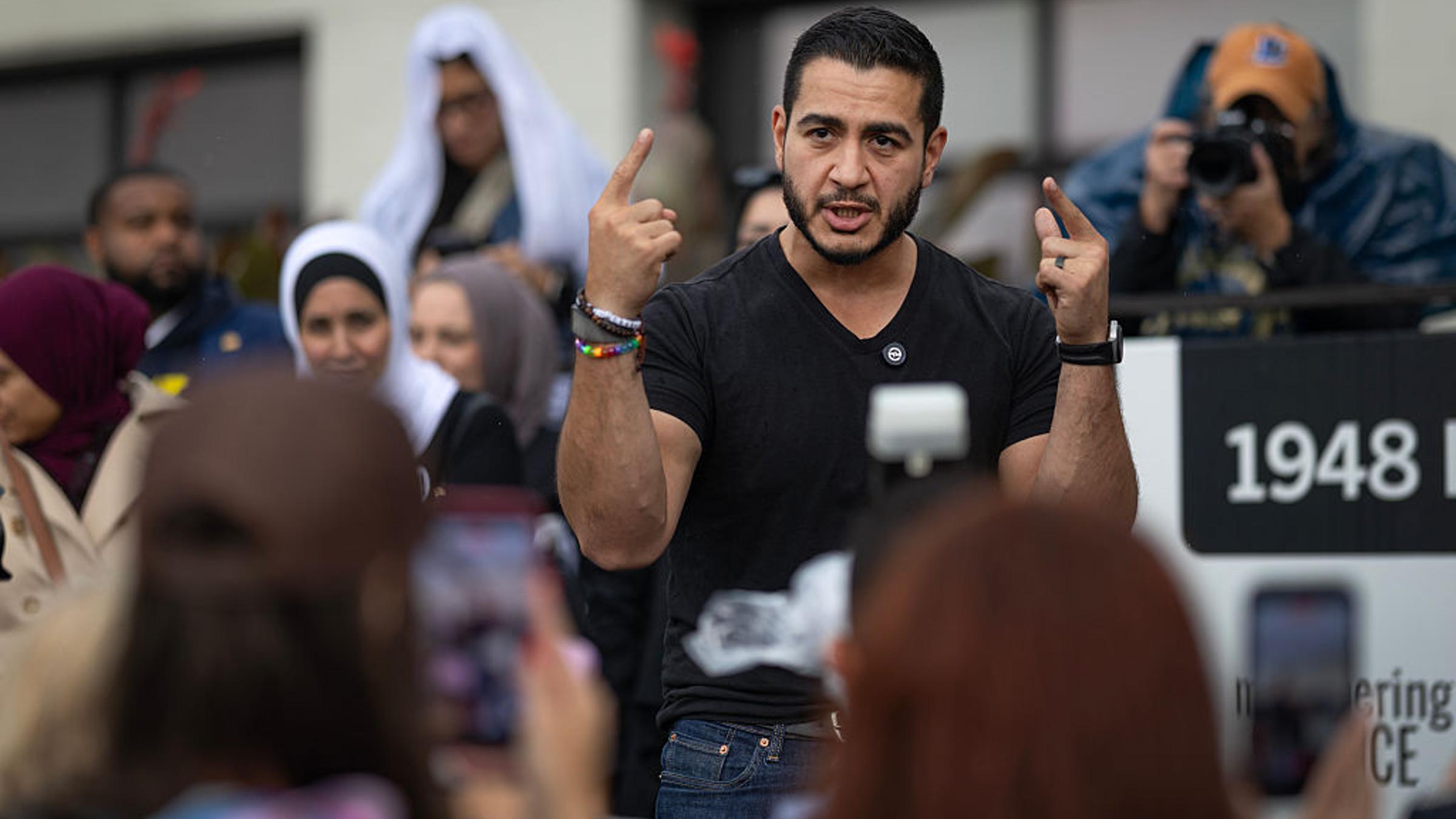
Michigan, where Donald Trump won both times he reached the White House, is a useful miniature of what the loitering gallery of presidential aspirants face across the country in two years. Not all lessons will be welcome for the would-be candidates, nor will they be fully understood until we know the outcome in November.
But if the tone in this race’s final days is a hint, it signals that the win-at-all-costs footing that has defined the era of Trump has crept into the Democratic ether. Acrimony doesn’t even begin to get at the mood on the ground, according to operatives in both camps. In a recent podcast interview, El-Sayed called Stevens “the least capable candidate in America.” Stevens responded with a message on her social media on Thursday that showed how raw feelings have become: “Everyone in America understands you want to blame all of your problems on Jewish Americans.”
This primary is about as perfect a snapshot as you could find of the tensions playing out among Democrats. In a swing state like Michigan, Stevens was widely acknowledged as the stronger candidate to go against the presumptive Republican nominee, former Rep. Mike Rogers. Her supporters include outgoing Sen. Gary Peters, and party heavyweights like Chuck Schumer (but not, notably, Sen. Elissa Slotkin, who was Stevens’ former House colleague, but has stayed out of the primary). Meanwhile, El-Sayed—who would be the country’s first Muslim U.S. Senator—has captured the imagination of the left wing of the Democratic Party, drawing visits from Sen. Bernie Sanders and Rep. Alexandria Ocasio-Cortez. At the same time, his unrelenting criticism of Israel has opened wounds inside the Jewish community in Michigan—and beyond—as his detractors say he is venturing into dangerous anti-semititic territory. Add in the race and religion factors animating the race, and Tuesday’s primary in Michigan could lay bare which litmus tests are likely to shape the 2028 presidential contest.
President Donald Trump called on ExxonMobil and Chevron to cut US fuel prices after the oil majors earned roughly $26.5 billion combined during the second quarter.
Summary
- ExxonMobil earned $14.5 billion, more than double its profit from the same quarter last year.
- Chevron posted $12.1 billion in earnings, nearly five times its year-ago result.
- Trump said the companies were making “too much money” from an oil shortage.
- US gasoline prices have risen more than 30% since the Iran war began.
Trump demands lower fuel prices
Trump criticized ExxonMobil and Chevron at the White House on Monday, arguing that supply pressure linked to the Iran war had allowed the companies to earn excessive profits.
“They’re making too much money based on a shortage,” Trump told reporters. “I don’t like it.”
The president urged both companies to pass part of their gains back to consumers through lower retail prices.
“Chevron, too much money. ExxonMobil, too much money,” Trump said. “They’re going to give some of that back to the public.”
The remarks marked an unusual rebuke of two companies that have generally benefited from Trump’s support for expanded US oil and gas production. Trump also criticized Chevron CEO Mike Wirth, claiming he had not given the administration enough credit for policies that supported the company’s operations in Venezuela.
Exxon and Chevron profits surge
ExxonMobil reported second-quarter earnings of $14.5 billion, or $3.48 per share, compared with $7.1 billion a year earlier. Adjusted earnings reached $14.7 billion, while operating cash flow totaled $23.6 billion.
The company returned $9.4 billion to shareholders through $4.3 billion in dividends and $5.1 billion in share buybacks, according to its quarterly results.
Chevron earned $12.1 billion during the same period, up from about $2.5 billion in the second quarter of 2025. The company also reported record US production and a 20% increase in worldwide output, according to Chevron.
Higher crude prices and wider refining margins helped both companies offset rising costs. The Iran war pushed West Texas Intermediate crude as high as $109.64 per barrel during the quarter, compared with $65.17 before the conflict intensified.
Iran war keeps pressure on US consumers
US gasoline prices have climbed by more than 30% since the United States and Israel began strikes against Iran, increasing pressure on household budgets ahead of the midterm elections.
The Strait of Hormuz remains central to the price outlook because it serves as a major route for global oil and liquefied natural gas shipments. Restrictions, tanker attacks, and the US blockade have disrupted normal traffic through the waterway.
The American Petroleum Institute defended the industry’s earnings, saying fuel prices reflect global market conditions rather than decisions by individual producers. Crude oil costs, refining margins, distribution expenses, and taxes all contribute to retail gasoline prices.
Trump said prices would fall sharply if the war ended. However, the administration has no direct authority to set the retail prices charged by oil companies or independent fuel stations.
Oil falls as Trump pauses Iran strikes
Oil prices dropped on Monday after Trump called off another planned strike against Iran and said negotiations could reopen the Strait of Hormuz.
WTI crude fell more than 5% to around $80 per barrel, while US gasoline futures also declined nearly 5%. The retreat reflected expectations that a diplomatic agreement could restore more shipping activity and reduce supply risks.
Trump described the negotiations as Iran’s “last chance” to secure an agreement. He said the proposed talks would address the strait first before moving to Iran’s nuclear program.
Tehran disputed Trump’s account, saying it was not negotiating directly with Washington. Iranian officials said they were instead holding discussions with Oman over a temporary safe route through the strait, leaving the timing and scope of any agreement uncertain.
Cointelegraph is committed to providing independent, high-quality journalism across the crypto, blockchain, AI, and fintech industries.
All news, reviews, and analyses are produced with full journalistic independence and integrity. For more details on our standards and processes, please read our Editorial Policy.
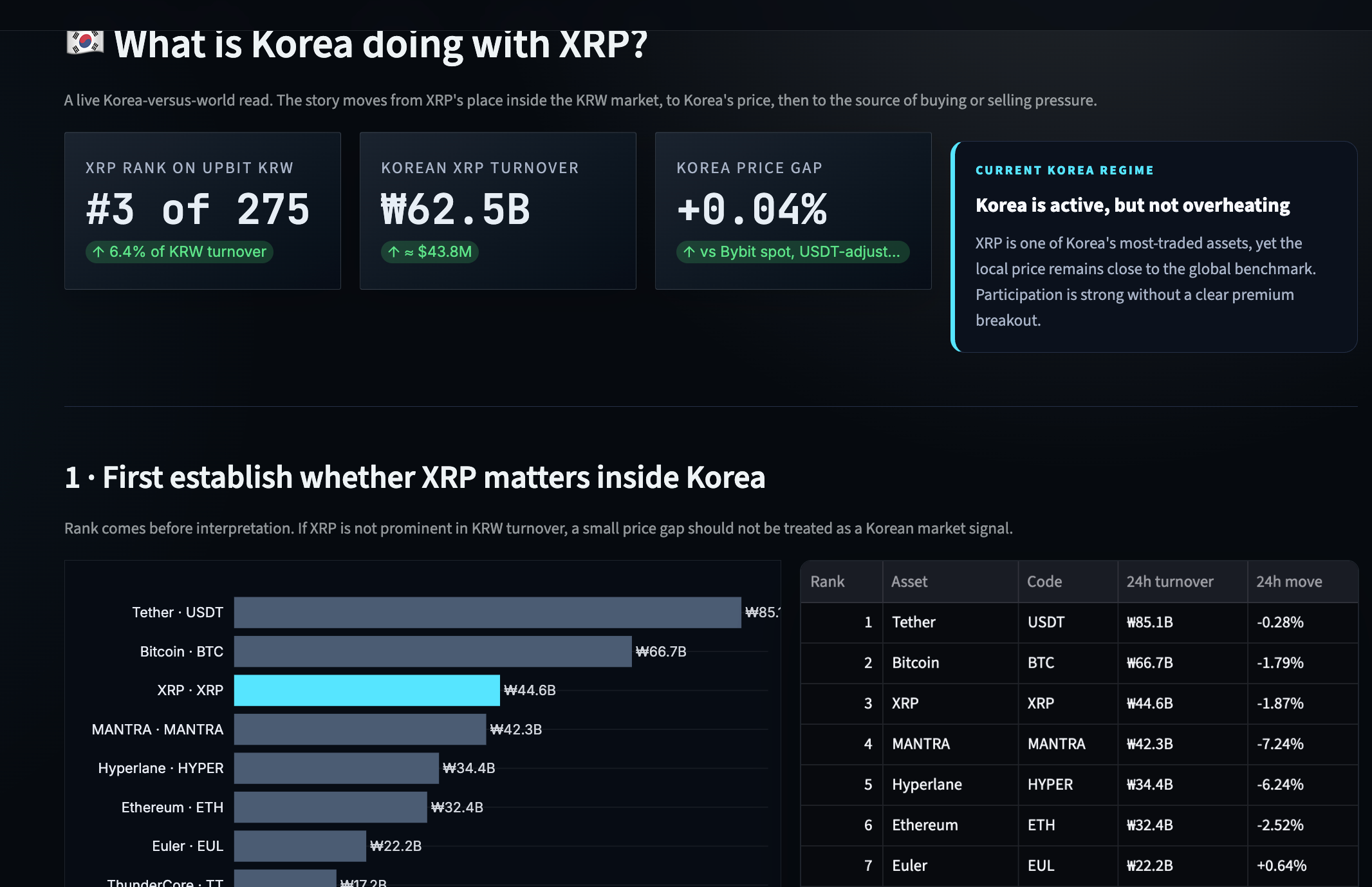
XRP price is down about 2% on the day, yet it just bounced roughly 4% off its August low as South Korea keeps stacking bids under the market.
The bounce is not a confirmed reversal. XRP price still trades inside a falling channel that has capped every rally since May 14, 2026. South Korea, however, is flashing an unusually tidy set of early signals.
South Korea is Buying XRP
XRP ranks third among 275 Korean won markets on Upbit by 24-hour trading volume, behind only Tether and Bitcoin. Few altcoins matter more to South Korea’s retail traders.

Rank measures attention, not direction, so the order book fills the gap. Within 1% of the market price, combined Upbit and Bithumb bids outweigh asks by roughly two to one, a gap of about 34%.
Want more token insights like this? Sign up for Editor Harsh Notariya’s Daily Crypto Newsletter here.
That ratio simply compares resting buy orders against sell orders near the current price. A two-to-one skew means buyers have posted far more nearby liquidity than sellers, a sign of real demand.

Korea is also paying a small premium to the global price on Bybit, near the top of its seven-day range. The lean is bullish, though still too thin to call a full premium event.

Heavier Korean bids indicate who is buying, but momentum indicates whether selling is finally fading.
Momentum is Turning as XRP Price Stops Falling Hard
XRP price keeps making lower lows, but the selling is losing power. Since early June, price carved a marginally lower low into August while momentum made a higher low.
The Relative Strength Index (RSI), a momentum gauge that tracks how fast recent moves are running, climbed from below 20 in early June to the low 40s at the August low. That split between falling price and rising momentum is a classic bullish divergence.

Price already reacted, rebounding about 4% from its August 1 low, echoing a recent surge in dip buying.
Leverage is not driving it either. Bybit perpetual funding sits near +0.006%, only mildly positive. Funding is the fee long traders pay shorts to hold a position, and this reading is far from overheated.
If momentum is turning, the next test is whether large holders and funds agree.
Whales and ETFs Back the South Korea Signal
The turn is not standing alone. Santiment data shows the share of XRP held by the 100 million to 1 billion cohort jumped from 10.66% to 11.98% around August 1.
Those are wallets holding between 100 million and 1 billion XRP, and the move suggests large holders may have added to weak momentum, though such shifts can also reflect wallet relabeling.

Fund demand is improving too. XRP spot ETF inflows reached $14.86 million in the week ending July 31, the strongest in four weeks.
The run improved from a $7.18 million outflow to $6.78 million, then $8.15 million, then $14.86 million, matching the broader August XRP outlook.
Institutions are not flooding in, but the direction of demand has clearly changed.

Bids, momentum, and flows all point one way, leaving a single barrier on the chart.
XRP Price Levels That Decide the Reversal
Here, the setup is won or lost. XRP price needs a daily close above $1.09 to break the falling channel and confirm the shift.
A clean break opens room toward $1.16, then the July swing near $1.18, with $1.29 as the extended target. Traders can weigh those against the full XRP price forecast.
The floor matters just as much. XRP must reclaim $1.08, the 0.618 Fibonacci retracement, to keep the bounce alive.

Staying under $1.08 on a daily close would expose $1.03, then $0.95, which sits near the channel midline. South Korea’s visible bid can also vanish if those orders are pulled.
A daily close above $1.09 separates a South Korea-led XRP price reversal from another rejection back toward the channel midline.
The post The 80-Day XRP Price Downtrend Meets a Wall of Korean Bids appeared first on BeInCrypto.
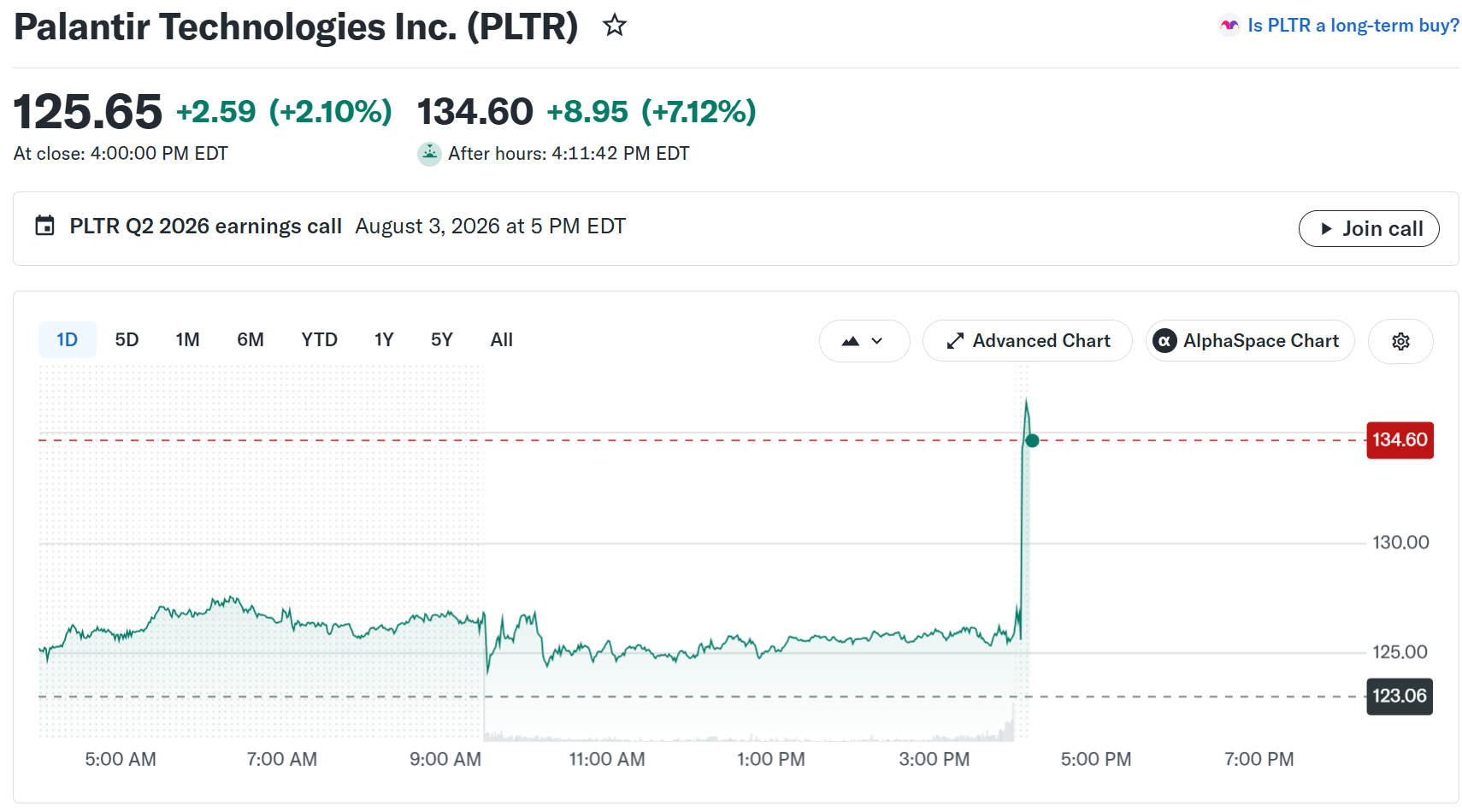
Palantir Technologies (PLTR) beat Wall Street on every headline figure in the second quarter and lifted its full-year outlook. Shares climbed more than 7% in after-hours trading on Monday.
The data analytics firm reported $1.94 billion in revenue, up 93% from a year earlier. Adjusted earnings reached 41 cents per share, above the roughly 35 cents analysts had modeled.

Palantir Earnings Beat Every Major Estimate
Revenue landed well above the $1.81 billion consensus and the company’s own guidance of about $1.80 billion. Growth also accelerated from the 85% pace set in the first quarter.
Follow us on X to get the latest news as it happens
U.S. commercial customers did most of the work. That segment rose 149% year over year to $764 million. Government revenue gained 90% to $809 million, despite Democratic scrutiny of contracts earlier this summer.
Profitability moved in step. GAAP net income reached $1.06 billion, a 55% margin, while adjusted operating margin hit 62%. The company’s Rule of 40 score, which adds revenue growth to operating margin, climbed to 155%.
Deal flow expanded alongside it. Palantir closed 220 contracts worth at least $1 million and booked a record $2.13 billion in U.S. commercial total contract value, up 153%.
Remaining deal value in the same segment reached $6.24 billion, more than double the year-ago figure. That backlog gives management visibility into 2027 revenue.
Guidance Raise Points to Sovereign AI Demand
Management now expects full-year revenue between $8.150 billion and $8.158 billion, roughly 82% growth. The previous range topped out near $7.66 billion.
Adjusted operating profit guidance moved to about $4.89 billion, comfortably ahead of the $4.51 billion analysts had penciled in. Adjusted free cash flow is now guided to $4.5 billion to $4.7 billion.
Chief Executive Alex Karp framed the quarter around what he called demand for AI sovereignty, meaning customer control over their own data and decisions rather than reliance on outside models.
“Demand for AI sovereignty has now been unleashed. And Palantir is the only company that has demonstrated it can transform tokens into actual economic value. Our customers trust us to provide them with maximal control over their operations, data, and decisions,” Alex Karp, Co-Founder and Chief Executive Officer of Palantir Technologies, in the company’s earnings release.
Palantir Stock Still Trails Its 12-Month High
Shares closed regular trading at $125.65, up 2.10%, then jumped to $135.12 after the release. Options traders had priced an 11% swing in either direction.
Even after that move, the stock sits far below its 12-month high of $207.52. Palantir entered Monday down about 31% for the year, as investors questioned AI stock valuations across the sector.
Bulls argue the spending cycle is still early, a view echoed in the debate over AI capex that has split Wall Street since June.
Palantir guided third-quarter revenue to roughly $2.16 billion. Whether the guidance raise holds the stock above $135 depends on how quickly commercial bookings convert into recognized revenue.
The post Palantir Just Crushed Wall Street by $125 Million: How Will Stock React? appeared first on BeInCrypto.

The SHIB team and community have scorched billions of tokens in the past month.
The resurgence of the burning program has coincided with the positive performance of the self-proclaimed Dogecoin killer, whose price has jumped by 10% within that period.
Big Burn, But There’s a Catch
The X account Shibburn revealed that over 3.2 billion SHIB have been transferred to a null address in July, permanently removing them from circulation. This represents a major 1,395% increase from the June figure.
The July number may seem substantial, but its USD equivalent is less than $17,000. It’s also important to note that the major burns occurred only during a handful of days toward the end of the month, while during the remaining days there wasn’t much action on that front. On July 27, for instance, the team and community scorched almost 1.3 billion tokens, nearly 40% of the total amount.
The core purpose of SHIB’s burning mechanism is to reduce the token’s supply and make SHIB more valuable via scarcity. But with more than 585 trillion coins in circulation, the remaining amount is enormous, meaning the team and community should up their game to trigger a rally.
Meanwhile, the meme coin has posted a 10% increase over the last 30 days, potentially propelled by the rising burn rate and certain whale activity, which CryptoPotato reported on.
Happy Birthday, Shiba Inu
On August 1, the meme coin project celebrated its sixth anniversary. The SHIB Army expected an ecosystem update or a major announcement on that day, but instead the team simply outlined the rise from “zero to a global movement” and said that “the experiment continues.”
Many X users congratulated Shiba Inu for its birthday, yet others voiced clear disappointment over the lack of meaningful progress lately, as well as the massive price collapse the native token has suffered over the past years.
The post Shiba Inu Turns 6: Here’s How Many SHIB Tokens Were Burned in July appeared first on CryptoPotato.

MAJOR XRP INTERVIEW!!! XRP = NEW WORLD ORDER??! (Tucker Carlson)

Burnham bars rapists and serious child sex offenders from early release scheme

General Motors: Strong ICE Growth, Margin Expansion, Cheap (NYSE:GM)


-

 Business5 days ago
Why Trees Belong on the Risk Register
-

 Fashion3 days ago
Weekend Open Thread: Wit & Wisdom
-

 Politics3 days ago
Meta enters AI-training agreement with far-right ‘propaganda rag’ Newsmax
-
 Entertainment6 days ago
‘Stargate’ Creator’s New Sci-Fi Series Returns for Season 3 Tomorrow
-

 Crypto World2 days ago
MicroStrategy Post-Earnings CLARITY Act Push Could Add New Catalyst for Its Stock
-

 Politics7 days ago
The Part of the Electric Transition Nobody Wants to Discuss
-

 Business6 days ago
Major shareholder moves on Canyon
-

 Crypto World3 days ago
XRP Ledger v3.3.0 brings five institutional features
-

 News Videos4 days ago
Bitcoin Enters the 3rd Stage of the Bear Market
-

 Crypto World6 days ago
Kraken Enables Retail Access to Jersey Mike’s IPO via Tokenized Shares
-

 Tech7 days ago
New macOS Sequoia & Sonoma security updates for older Macs
-

 News Videos6 days ago
Claude: Build Financial Dashboards in Minutes (2026)
-

 Politics4 days ago
Luke Littler’s dominance sparks GOAT debate
-

 Sports4 days ago
Seema Kaliramna Wins Discus Throw Bronze, Takes India’s CWG Medals Tally To 17
-

 Business6 days ago
Johnson & Johnson agrees to $5.5B settlement over talc cancer claims
-

 Crypto World1 day ago
Crypto PAC spending tops $2M in Michigan House race
-

 Crypto World3 days ago
New York sues Kalshi over prediction market gambling
-

 Business3 days ago
Trump Announces Hamas Disarmament Agreement as Iran Strikes Kuwait Air Base and US Attacks Pause Overnight
-

 Tech5 days ago
Gemini can now summarize the messiest comment threads in Google Docs
-

 Tech2 days ago
ESET tracks rise in malicious AI skills and adaptable malware
You must be logged in to post a comment Login