

Crypto World
Why the July 17 hearing decides crypto’s 2026



The United States Senate returned from its holiday recess on July 13 with one piece of paper waiting on its desk that matters more to crypto markets than any price chart. The Digital Asset Market Clarity Act, the market structure bill the industry has chased for the better part of two years, sits on the Senate Legislative Calendar with no floor vote scheduled, a shrinking window before the August recess, and prediction market odds that have collapsed from the low seventies to roughly 43 percent.
On July 17, the House Financial Services Committee takes the unusual step of holding a field hearing in New York titled Building the Future of Finance: How CLARITY Act Unlocks Innovation. The hearing cannot pass anything. What it can do is force every participant in this fight, from Senate holdouts to ETF issuers to the White House, to show their cards in public during the exact week when the bill’s fate for 2026 gets decided.
Summary
- The CLARITY Act faces a narrowing path to Senate approval before the August recess as prediction market odds of passage have fallen to about 43%.
- A July 17 House hearing is expected to reveal whether lawmakers are moving closer to resolving key disputes that continue to delay the bill.
- Passage could provide a permanent legal framework for digital assets, while further delays may leave crypto markets dependent on macroeconomic factors and existing regulatory guidance.
The stakes are not abstract. Bitcoin trades near $63,000 after months of pressure from a Federal Reserve that markets now expect to raise rates instead of cutting them. Ethereum sits under $1,800. XRP clings to the $1 level it has defended all summer. The total crypto market capitalization hovers around $2.17 trillion, and the Fear and Greed Index has spent weeks in the twenties, deep in fear territory. Against that backdrop, the CLARITY Act has become the one catalyst that does not depend on the Fed, on oil prices, or on the war headlines out of the Middle East. It is the single lever Washington can still pull this year, and the market knows it.
What the bill actually does
The CLARITY Act is a market structure law, not a price support program. Its core function is taxonomy: it draws a statutory line between digital assets that count as commodities, overseen by the Commodity Futures Trading Commission, and those that count as securities, overseen by the Securities and Exchange Commission. For a decade, that line existed only in enforcement actions, court rulings, and agency guidance that shifted with each administration. The bill would replace that patchwork with a durable federal framework covering how tokens are issued, how exchanges register, how custody works, and which regulator answers for which market.
That distinction sounds technical until you consider what currently protects the industry’s legal footing. On March 17, 2026, the SEC and CFTC issued a joint interpretive release that classified 16 digital assets, including Bitcoin, Ethereum, and XRP, as digital commodities. That release did enormous practical work. It handed day-to-day oversight to the CFTC, lifted the threat of unregistered securities treatment from the largest tokens, and cleared the path for the spot ETFs that now trade on all three assets. But an interpretive release is not a statute. A future administration, or even a future commission majority, could withdraw or rewrite it. The CLARITY Act exists to convert that reversible administrative posture into permanent law. For holders of the affected assets, the difference is the difference between renting legal certainty and owning it.
A decade of rule by enforcement
Understanding why the industry treats this bill as existential requires remembering what the alternative looked like. From roughly 2017 through 2024, the primary mechanism of American crypto regulation was the enforcement action. The SEC sued issuers, exchanges, and founders under a securities framework built in 1946 for orange groves, and courts were left to decide, token by token and sale by sale, what the Howey test meant for programmable assets. The results were incoherent by design. The 2023 ruling in the SEC’s case against Ripple found that XRP sold programmatically to retail buyers on public exchanges did not amount to a securities transaction, while institutional sales of the same token did. The same asset was simultaneously a security and not a security depending on who bought it and how.
That ambiguity was not a side effect. It was the operating system. Every project launching in the United States priced in legal risk that its competitors in Zug, Singapore, or Dubai did not carry. Every exchange listing decision ran through outside counsel. Every custodian, market maker, and fund administrator built compliance programs around guidance that could be withdrawn without a vote by anyone. When the administration changed and the agencies pivoted toward accommodation, the pivot proved the point: what one commission gives, another can take. The industry did not spend two years and nine figures of lobbying money on the CLARITY Act because it loves paperwork. It did so because rule by enforcement is rule by whoever runs the agencies, and the 2028 election is already visible on the horizon.
The March 17 interpretive release is the high-water mark of the accommodation era, and it is also its clearest illustration. Sixteen assets received commodity classification through a document that no court ratified and no Congress passed. Institutional allocators read that release two ways at once: as permission to build, and as a reminder that permission can expire. That double reading is why flows into the spot ETFs have been steady but not explosive, and why the legal departments of the largest asset managers keep telling their product teams the same thing: statute or nothing.
The GENIUS Act precedent
There is one recent proof that Washington can finish a crypto bill, and both camps cite it. The GENIUS Act, the federal stablecoin framework, followed a trajectory that looked hopeless at several points: committee fights over yield, bank lobby resistance, procedural stalls, and floor delays. It still became law, and the aftermath reshaped the market. Regulated issuance expanded, banks entered custody and reserve services, and the stablecoin sector grew into the settlement layer that traditional payment companies now build against.
Optimists read GENIUS as the template: contested crypto bills stall loudly and then pass quickly once leadership decides the votes exist. The final weeks of the stablecoin fight looked as bleak as CLARITY’s odds look now, and the lesson traders took away is that legislative prediction markets underprice how fast the Senate can move when it chooses to. Pessimists read the same history differently. GENIUS passed because stablecoins had a natural constituency inside traditional finance: banks and payment networks stood to profit from a regulated dollar token. The CLARITY Act’s beneficiaries are crypto exchanges, token issuers, and asset managers, a smaller and less beloved lobby, while its costs fall on agencies defending turf and on lawmakers wary of blessing an asset class the president trades personally. The precedent proves the mechanism exists. It does not prove the motive does.
How the bill got here
The legislative record explains why expectations ran so hot earlier this year. The House passed H.R. 3633 on July 17, 2025, by a bipartisan vote of 294 to 134, a margin large enough to survive most political weather. The bill then moved to the Senate, where the Banking Committee advanced its version on May 14, 2026, with two Democrats crossing over in a 15 to 9 committee vote. On June 1, a revised Senate text was published and the bill was placed on the Senate Legislative Calendar under General Orders as Calendar No. 423, making it formally eligible for floor consideration. That is the closest a comprehensive crypto market structure bill has ever come to becoming American law.
Momentum then met the calendar. The White House had pushed for the bill to be signed around July 4, a target officials privately conceded was tight. The Senate left for its holiday recess on June 29 without acting, and leadership earmarked the first week back for the defense authorization bill. That sequencing pushes any CLARITY floor vote to late July or the first week of August at the earliest. The Senate’s August recess is not merely a break: once lawmakers scatter for midterm campaigning, the floor schedule effectively closes to contested votes for the rest of the year. Miss August, and the realistic next window is 2027, after an election that could reshape both chambers.
The three fights stalling the vote
The bill is not stuck because senators dislike crypto regulation in principle. It is stuck because three specific disputes have hardened, and each one touches a different fault line in the coalition needed to reach 60 votes.
The first fight is about the president. Democrats have pressed for ethics provisions responding to the Trump family’s crypto ventures, arguing that a market structure law without conflict-of-interest language would bless a sitting president’s personal exposure to the asset class it regulates. Republicans counter that ethics riders are a poison pill designed to peel off GOP votes. Neither side has moved meaningfully, and the dispute consumes negotiating time the calendar no longer offers.
The second fight is about decentralized finance. The Senate Banking and Agriculture committees produced texts that differ on how DeFi protocols should be treated, including whether software developers and front-end operators face registration obligations. Industry groups warn that a badly drawn DeFi section could push development offshore, while consumer advocates argue a carve-out would create a loophole large enough to swallow the rest of the bill. The two committee versions must be reconciled before any floor vote can happen, which makes the reconciliation timeline itself a leading indicator.
The third fight is about stablecoin yield and rewards, the question of whether issuers or platforms can pass interest-like returns to holders. Banks lobbied hard on this point during the GENIUS Act debate and have returned to press it here, viewing yield-bearing stablecoins as direct competition for deposits. Layered on top is a narrower objection around Section 604, a provision opponents have tied to illicit finance and trafficking concerns, which has given undecided senators a politically safe reason to withhold support.
The raw math frames all three disputes. Passage requires 60 votes, which means at least seven Democrats must join a united Republican caucus. The committee stage produced two Democratic crossovers. Finding five more, in an election year, on a bill the White House has loudly claimed as a priority, is the entire game. As crypto.news reported when it examined the bill’s collapsing prediction market odds, traders have concluded that the coalition is fraying precisely when it needs to consolidate. Polymarket pricing on 2026 passage has fallen by more than 20 points from its spring highs to roughly 43 percent.
What July 17 can and cannot change
A field hearing is theater, but theater has uses. The House Financial Services Committee convenes at 10:00 a.m. in New York, the financial capital the bill’s sponsors want as a backdrop, to argue that the CLARITY Act unlocks innovation without gutting user protection. The House already passed its version, so the hearing changes no vote count directly. Its function is pressure: on Senate leadership to schedule floor time, on undecided Democrats facing constituents in the financial industry, and on the news cycle during the exact week the Senate decides what its July looks like.
The hearing also carries information value for markets. Witnesses and members will signal, intentionally or not, whether the reconciliation between the Banking and Agriculture texts is progressing, whether the Section 604 objection is being negotiated or entrenched, and whether leadership views the bill as a July priority or an August casualty. Traders who watched the GENIUS Act stablecoin bill move from stalled to signed in a matter of weeks last year know that these procedural signals move faster than the price charts that eventually reflect them.
What the hearing cannot do is manufacture seven Democratic votes, compress the defense bill’s floor time, or reopen a calendar that has perhaps three working weeks left before the recess. The gap between what the hearing dramatizes and what the Senate can physically schedule is exactly where the 43 percent number lives.
The bull case: what passage unlocks
If the Senate finds the votes before August, the payoff structure is unusually well documented. Standard Chartered projects between $4 billion and $8 billion in inflows to spot XRP exchange-traded funds alone if the bill becomes law, on top of the roughly $1.5 billion those products attracted between their November 2025 launches and mid-2026. The logic extends across the asset class: wirehouses, registered investment advisors, and pension consultants that currently limit crypto allocations because the regulatory perimeter could shift under a future SEC have their stated objection removed by statute. Permanence, not classification, is the product being sold.
For XRP, the effect is sharpest because the token spent five years under a securities cloud that the March interpretive release only partially dispersed. For Ethereum, the bill would lock in the treatment of staking and the yield its ETFs can pass through, a question the current guidance answers only provisionally. For Bitcoin, the gain is structural: a full market framework around custody, exchange registration, and market surveillance that institutional compliance departments can cite. Each asset gets something different, and each gets it permanently.
There is also a second-order effect on the legislative pipeline. A market structure law would arrive with the exemption architecture the SEC has been building in parallel, including the small-offering relief the agency has floated for token projects. Passage would signal that the United States intends to compete with the European Union’s MiCA framework for issuer domicile, a competition Washington has been losing by forfeit while regulation advanced faster in Brussels, London, and Singapore.
Who is actually waiting on this law
The abstraction of “institutional adoption” hides a specific queue of actors whose next move is conditioned on statute. Start with the wirehouses and the registered investment advisor platforms that gatekeep several trillion dollars of American retail wealth. Most still restrict crypto ETF access to unsolicited orders or exclude the products from model portfolios entirely, and their compliance memos cite regulatory uncertainty as the controlling reason. A statutory framework removes the stated objection. It does not force allocation, but it converts a prohibited conversation into a permitted one, and distribution decisions at that scale move billions before a single risk committee turns bullish.
Next in the queue are the corporate and treasury buyers. The digital asset treasury wave that put Bitcoin and Ethereum on public company balance sheets ran ahead of the law, and the firms that followed the pioneers now face auditors and insurers who price legal ambiguity into every engagement. Statutory classification simplifies the accounting treatment, the custody insurance, and the board approval process at once. Behind them stand the banks, which under current guidance can custody digital commodities but plan product roadmaps in pencil, knowing the guidance could rotate with the next administration.
Then there is the international dimension. The European Union’s MiCA regime is operational, and Ripple’s full authorization in Luxembourg this month showed how quickly firms redomicile compliance functions toward whichever jurisdiction offers durable rules. The United Kingdom opened its market to global crypto trading platforms this summer, and Singapore’s central bank has tested settlement on public ledgers. Every quarter the Senate delays, the coordination game tilts toward frameworks that already exist. American exchanges have been explicit that listing decisions, product launches, and headquarters questions all key off the August window. The bill’s supporters call this competitive urgency. Its opponents call it hostage-taking. Both descriptions point at the same calendar.
The macro tape the vote lands on
Whatever the Senate does, it does it into the most hostile macro environment crypto has faced since 2022. Inflation has returned to a three-year high, and futures markets have flipped from pricing Federal Reserve cuts to pricing a possible hike, a reversal that drained risk appetite across every speculative asset class. The Iran conflict adds an oil transmission channel: each escalation around the Strait of Hormuz pushes crude higher, feeds the inflation print, and hardens the Fed’s posture, a loop that has repeatedly knocked Bitcoin down toward $60,000 and dragged the rest of the market with it.
That context cuts both ways for the bill. On one hand, a hostile tape means even a successful vote may produce a smaller rally than advocates expect, because the marginal buyer is pinned down by rates rather than by regulatory doubt. On the other hand, the fear regime means positioning is light, sentiment indicators sit near capitulation levels, and the market has almost nothing crypto-specific priced for good news. Catalysts landing on empty positioning historically produce outsized moves. The honest answer is that nobody knows which effect dominates, which is precisely why the prediction market on the bill and the spot market on the assets have decoupled: one prices probability, the other prices exhaustion.
The bear case: priced in, timed out
The skeptical read starts with the same 43 percent number and draws the opposite conclusion. Prediction markets are not always right, but they aggregate the private assessments of people paid to count votes, and the direction of travel since spring has been relentlessly downward. If the bill misses the August recess, the midterm campaign consumes the fall, and a lame-duck session is a poor venue for a 60-vote financial regulation bill. The realistic slip is not to September but to 2027, under a Congress whose composition nobody can guarantee.
The second bear argument is that much of the good news is already in prices. XRP ETFs launched and gathered $1.5 billion without the law. Bitcoin and Ethereum ETFs trade freely. The March interpretive release already delivers, day to day, most of what the statute would make permanent. On this view, passage buys a relief rally in the most exposed assets and little more, while failure removes a hope premium that has quietly supported prices through an otherwise brutal first half. The asymmetry may actually run downward: markets have partially priced success and only partially priced the multi-year delay that failure implies.
The third argument is macro. The Fed’s turn toward higher-for-longer rates, inflation at a three-year high, and the oil shock risk from the Iran conflict have overwhelmed every crypto-specific catalyst this year. Ripple’s MiCA authorization, sustained ETF inflows, and whale accumulation did not move XRP off its $1 floor. If unambiguous bullish flows cannot move prices in this tape, a Senate vote may not either, at least not durably. Legislation changes the demand curve over quarters, not the fear index over days.
Three scenarios, three tapes
Mapping the legislative outcomes to market behavior produces three broad paths. In the first, the reconciled text reaches the floor in late July, clears 60 votes, and heads to a signature before the recess. The most exposed assets reprice first: XRP, where Standard Chartered’s flow projection concentrates, then Ethereum on the staking permanence question, then the exchange equities and the broader altcoin complex. The move’s durability would depend on whether the Fed backdrop allows follow-through, but the initial repricing of a 43 percent probability resolving to 100 would be mechanical and fast.
In the second scenario, the vote is scheduled but fails or gets pulled for lack of support. This is the worst path, and the least priced. A failed floor vote does not merely delay the bill; it marks the coalition as broken and invites every opponent to treat the 2027 rewrite as an open negotiation. The hope premium embedded in current prices, modest as it is, would come out quickly, and the assets most dependent on the regulatory story would give back their relative strength against Bitcoin.
In the third and most likely scenario given current odds, no vote is scheduled and the bill simply slips past the recess without a formal death. Markets have partially priced this, which is why the reaction would likely be a grind lower rather than a crash: a slow removal of the catalyst from the front of the calendar, with attention rotating fully back to the Fed, oil, and the midterm map. The under-appreciated risk in this path is duration. A slip is not a pause; it is a handoff to a Congress that does not exist yet, elected in a cycle where crypto money is spending heavily on both sides and the issue itself is on the ballot in a dozen Senate races.
The scoreboard through August
Between July 14 and the recess, the outcome reduces to a short list of observable events, in rough order of importance. First, whether Senate leadership schedules a floor vote at all: the absence of scheduled time by the last full week of July would be the clearest sell signal on 2026 passage. Second, whether the Banking and Agriculture reconciliation produces a single merged text, since no floor vote can precede it. Third, whether any additional Democrats declare support publicly, because the distance between two crossovers and seven is the entire outstanding question. Fourth, how the Section 604 and stablecoin yield objections resolve, since each represents a bloc of gettable votes. And fifth, the tone of the July 17 hearing itself, which will reveal whether the House majority treats the bill as pending business or as a campaign message.
For traders, the cleanest expression of the setup is the gap between the legislative calendar and the price action. XRP holds $1 with roughly 43 percent odds of its defining catalyst arriving this year. Bitcoin consolidates above $62,000 with the same binary in the background. If the vote lands, the market gets its first statutory foundation and a documented multi-billion dollar flow pipeline. If it slips, crypto spends the midterm season trading purely on the Fed and on war headlines, with its Washington story frozen at the committee stage. Few single weeks this year have carried as much of that decision as the one that starts with the New York hearing.
The honest framing is conditional on both sides. The CLARITY Act is neither the guaranteed rocket fuel its loudest advocates promise nor the irrelevant paperwork its critics describe. It is a genuine structural upgrade with a genuine risk of missing its window, and the distribution of outcomes narrows to a decision point over the next three weeks. Markets spend most of their time waiting. This is one of the rare stretches where the waiting ends on a schedule.
Disclaimer: This article is information, not investment advice. Legislative timelines, prediction market odds, prices, and analyst projections reflect reporting available as of July 14, 2026, and can change quickly. The status and prospects of the CLARITY Act are uncertain and contested. Nothing here is a recommendation to buy or sell any digital asset. Verify current developments from primary sources and consider your own circumstances before making any decision.



A former Los Angeles County Sheriff’s Department deputy has been sentenced to 18 months in federal prison after admitting he lied to federal investigators about threats made by a cryptocurrency businessman during a 2021 extortion incident.
Summary
- A former Los Angeles sheriff’s deputy was sentenced to 18 months in prison for lying to federal investigators in a crypto-related extortion case.
- Prosecutors said the deputy witnessed Adam Iza threaten a victim with live ammunition before demanding a $25,000 payment.
- Iza remains in federal custody after multiple guilty pleas, including his role in a bitcoin-linked kidnapping conspiracy in Connecticut.
The U.S. Attorney’s Office for the Central District of California said U.S. District Judge Percy Anderson also imposed a $10,000 fine on Scott Allen Simpkins, who pleaded guilty on March 17 to one count of obstruction of justice. Simpkins resigned from the Los Angeles County Sheriff’s Department’s Special Enforcement Bureau after entering his felony plea, according to the office.
Federal prosecutors said Simpkins falsely denied witnessing cryptocurrency businessman Adam Iza threaten a victim with live ammunition during an incident at Iza’s Bel Air home in 2021.
Court records cited by the U.S. Attorney’s Office said Simpkins was working private security at the residence with fellow former LASD deputy Christopher Michael Cadman. Both men were employed by Saavedra & Associates, a private security company owned by then-LASD Deputy Eric Chase Saavedra.
According to prosecutors, Iza placed four or five live 9mm rounds on his desk, spun one of the bullets while threatening the victim, and demanded a $25,000 transfer before Simpkins and Cadman escorted the victim off the property.
The U.S. Attorney’s Office said the two deputies received $1,400 each for their work that day. After helping Saavedra & Associates secure a longer-term security contract with Iza, the company paid each of them about 10% of its profits from the contract’s first month, prosecutors added.
Iza still awaits sentencing
Separate federal cases against Iza have continued to move forward.
The U.S. Attorney’s Office said Iza has remained in federal custody since September 2024 after pleading guilty in California in January 2025 to conspiracy against rights, wire fraud, and tax evasion. He has not yet been sentenced in that case.
In a separate prosecution, the U.S. Department of Justice announced in June that Iza also pleaded guilty in federal court in Connecticut to conspiracy to interfere with commerce by robbery. The charge carries a maximum prison sentence of 20 years.
According to the Justice Department, the Connecticut case involved a 2024 kidnapping plot targeting the parents of Veer Chetal, a man accused of participating in the theft of about 4,100 bitcoin. Prosecutors said Iza and his brother, Saif Faiq, organised the scheme in an attempt to extort cryptocurrency.
As pre DOJ records, Faiq pleaded guilty on June 9, when he admitted recruiting six men from Florida, arranging their travel to Connecticut, and coordinating surveillance before the attack in Danbury. Prosecutors said the group allegedly forced Sushil and Radhika Chetal from their vehicle after staging a collision, assaulted them, and briefly held them captive. The six alleged attackers later pleaded guilty to kidnapping and carjacking offences, according to the department.
Federal records cited by the DOJ show Veer Chetal separately pleaded guilty in November 2025 to charges connected to the theft of approximately 4,100 bitcoin and is awaiting sentencing.


You press send on a crypto transaction and nothing happens. The wallet says pending. The block explorer shows your transaction floating in limbo, unconfirmed, with no clear indication of when, or whether, it will land.
Most people meet the mempool for the first time in exactly this moment of mild panic, and most of the advice they find assumes they already know what a mempool is. This guide starts from zero.
The mempool, short for memory pool, is the waiting room where every blockchain transaction sits between the moment you broadcast it and the moment a miner or validator writes it into a block. It is one of the least glamorous components of a public blockchain and one of the most consequential. The mempool decides how much you pay in fees, how long you wait, and, on some networks, whether a trading bot gets to see your order before it executes and profit at your expense. Understanding it turns confirmation delays from a mystery into a readable market signal.
This guide explains what the mempool actually is, why blockchains need a waiting room at all, how transactions move through it step by step, how fee markets decide who gets confirmed first, why there is no single mempool but thousands of slightly different ones, what happens when the queue overflows, how the mempool became the hunting ground for extractive trading bots, why Solana took the radical step of removing the public mempool entirely, and what practical steps you can take when your own transaction gets stuck.
What a mempool actually is
A mempool is a database of unconfirmed transactions that every full node on a blockchain network maintains in its working memory. When you sign a transaction in your wallet and hit send, the transaction does not travel to some central server for processing, because no such server exists. Instead, your wallet hands the signed transaction to a node, and that node begins spreading it to its peers, who spread it to their peers, until most of the network has a copy. Each node that receives the transaction runs a series of checks and, if the transaction passes, places it in its local mempool to wait.
The word itself is a contraction of memory and pool, and the memory part matters. Nodes keep the mempool in RAM instead of writing it to disk, because speed is the point. When a miner assembles a candidate block, it needs to sort thousands of pending transactions by fee and select the most profitable set in a fraction of a second. When a new block arrives from elsewhere on the network, a node can validate it faster if most of the block’s transactions are already sitting in its own mempool, checked and ready.
The mempool is a staging area, a buffer between the chaotic, continuous stream of user activity and the rigid, periodic heartbeat of block production.
Why blockchains need a waiting room
A traditional payment processor confirms transactions the instant they arrive because a single company controls the ledger and can simply write the entry. A public blockchain has no such authority. Thousands of independent nodes must agree on a single history, and they reach that agreement in discrete steps, one block at a time. Between blocks, the network needs a shared, informal picture of what users want to happen next, and the mempool provides it.
The waiting period also does critical security work. Before a node admits a transaction to its mempool, it verifies that the digital signature is valid, that the sender actually controls the funds being spent, that the transaction is correctly formatted, and that the same coins are not being spent twice. This last check matters more than it sounds. It is entirely possible for two conflicting transactions, both spending the same coins, to enter the network at the same time from different points. Some nodes see one first, some see the other. Each node rejects whichever conflicting transaction arrives second, and the conflict is finally settled when a miner includes one of the two in a block. The mempool is where these races are held and resolved.
The mempool also functions as the network’s early warning system. A rapidly filling mempool signals a surge of demand, a panic, an airdrop claim window, or a fee spike before any of it shows up in confirmed blocks. Traders, miners, and wallet fee estimators all read the mempool the way meteorologists read pressure systems.
The life of a transaction, step by step
Following a single transaction through the pipeline makes the mechanics concrete. First comes creation: your wallet constructs the transaction, specifying the amount, the recipient, and the fee you are willing to pay, and signs it with your private key. The signature proves ownership without revealing the key itself.
Second comes broadcast. The wallet sends the signed transaction to one or more nodes, which begin relaying it across the peer to peer network. Propagation to most of the network typically takes a few seconds, and nothing about this step requires trust in the first node, since every subsequent node re-validates the transaction independently before passing it along.
Third comes validation. Every node that receives the transaction independently checks it. Invalid transactions, bad signatures, insufficient funds, malformed data, are dropped on the spot and never reach a mempool.
Fourth comes the wait. The transaction now sits in thousands of mempools across the network, visible to anyone running a node or using a public mempool explorer. How long it waits depends almost entirely on the fee attached relative to everyone else’s fees.
Fifth comes selection. A miner on a proof of work chain, or a validator on a proof of stake chain, assembles a candidate block by picking pending transactions from its mempool, almost always sorting by fee density so the block earns the maximum reward.
Sixth comes confirmation. The block is mined or proposed, propagated, and accepted by the network. Every node removes the block’s transactions from its mempool, and your transaction is now part of the chain. Each additional block built on top adds another confirmation and makes reversal exponentially harder.
How the fee market decides who goes first
Block space is scarce and demand fluctuates, so blockchains ration space by auction. On Bitcoin, fees are measured in satoshis per virtual byte, a unit of transaction data size, so a transaction’s fee rate depends on both what you pay and how much space the transaction occupies. On Ethereum, the fee is gas, with a base fee that the protocol burns and a priority tip that goes to the validator. In both systems the logic is identical: block producers are profit maximizers, so they fill blocks with the highest paying transactions first.
This means your position in the queue is not fixed. A transaction that looked competitively priced at noon can be hopelessly underpriced by evening if demand surges. Wallets estimate fees by reading the current mempool, looking at what pending transactions are offering and how full recent blocks have been, then suggesting a rate likely to confirm within your chosen time window. Those estimates are educated guesses, not guarantees, and they go stale quickly during volatile markets. A fee that clears in the next block during a quiet Sunday can leave you waiting hours during a liquidation cascade, because everyone else’s willingness to pay moved while yours stood still. The auction never closes, and it reprices continuously.
When you underpay, most networks offer escape hatches. Bitcoin supports replace by fee, which lets you rebroadcast the same transaction with a higher fee that supersedes the original. A related trick, child pays for parent, attaches a high fee follow up transaction that spends the stuck one’s output, giving miners an incentive to confirm both together. Ethereum wallets let you resubmit a transaction with the same nonce and a higher gas price, which replaces the pending version. Knowing these tools exist converts a stuck transaction from an emergency into an inconvenience.
There is no single mempool
People say the mempool as if one canonical queue existed somewhere, but the reality is messier and more interesting. Every node maintains its own mempool, and no two are exactly identical. Transactions reach different nodes at different times, nodes apply slightly different acceptance policies, and each node manages its own memory limits. What we call the mempool is really the loose statistical overlap of thousands of private ones.
In practice the overlap is large, because most node operators run default settings. A typical Bitcoin node caps its mempool around 300 megabytes, keeps transactions for up to two weeks, and refuses anything paying less than a minimum relay fee of roughly one satoshi per virtual byte. When the pool exceeds its size cap, the node evicts the lowest fee transactions first and raises its minimum acceptance rate, which is why very cheap transactions can vanish entirely during congestion instead of merely waiting. Once evicted everywhere, a transaction is effectively cancelled, and the funds simply remain unspent in the sender’s wallet.
The distributed nature of the mempool has a subtle consequence: pending status is not a promise. A transaction shown as pending in an explorer exists only as a claim in some nodes’ memory. It can be evicted, replaced, or double spent until it lands in a block. Merchants who accept zero confirmation payments learn this lesson the hard way, and it is exactly the mechanism a 51% attack exploits at chain level, where an attacker rewrites recent blocks and dumps the reversed transactions back into the mempool as if they had never confirmed. The 2025 reorganization attacks on Monero pushed more than one hundred confirmed transactions back into the pending queue in exactly this way.
Policy, standardness, and why nodes reject valid transactions
Consensus rules define what a blockchain will accept in a block. Mempool policy defines what an individual node will hold and relay, and the two are not the same thing. A transaction can be perfectly valid under consensus rules and still be refused by most mempools because it violates what Bitcoin developers call standardness: informal policy rules that filter dust outputs, oversized scripts, absurdly low fees, and exotic transaction shapes that could burden the network. Policy is a node level immune system, a first line of defense that keeps the shared queue usable.
This distinction produces real world confusion. A transaction rejected by public mempools can still be mined if it reaches a miner directly, which is why services exist that accept nonstandard transactions out of band and submit them straight to mining pools. It also means the mempool you observe through an explorer reflects that node’s policy, not some universal truth. Two explorers can disagree about whether your transaction is pending simply because their nodes apply different filters.
Policy also evolves faster than consensus. Nodes have tightened and loosened relay rules around data inscriptions, dust limits, and replacement behavior repeatedly over the years, each change reshaping what the pending queue looks like without touching consensus at all. For users the practical takeaway is simple: if a wallet warns that a transaction is nonstandard, the problem is usually the transaction’s construction, not the funds behind it.
The mempool also has a quieter institutional audience. Exchanges watch pending deposits to credit accounts faster, compliance teams screen incoming transactions before confirmation, and payment processors estimate risk on zero confirmation transfers by checking how well a transaction is propagating and whether any conflicting spend is circulating. A transaction that most of the network’s mempools agree on is far less likely to be double spent than one propagating poorly, and firms price that difference.
Congestion, spam, and what a full mempool feels like
Mempool congestion is the network catching its breath. Demand exceeds block space, the queue grows, and the fee needed for timely confirmation climbs. Users experience it as expensive transactions and long waits. Bitcoin’s late 2017 mania, the DeFi summer of 2020, NFT minting waves, and the ordinals inscription craze of 2023 each produced mempool backlogs measured in days, with hundreds of thousands of transactions queued and fee rates multiplying overnight. During the worst stretches, low fee transactions waited more than a week, and node operators watched their mempools hit size limits and begin shedding the cheapest traffic.
Congestion can also be manufactured. Spam attacks flood the network with masses of low value transactions to clog the queue and degrade service for everyone else, a cheap form of denial of service. Networks defend themselves with the minimum relay fee, with eviction policies, and ultimately with economics, since sustained spam costs the attacker real money in fees. The 2017 spam attack on an Ethereum test network showed how effective flooding could be against a chain with weak fee pressure, and it pushed fee market design higher up the research agenda.
Congestion is also information. A swollen mempool alongside rising fees signals urgent demand, often around exchange runs, liquidation cascades, or major market moves. Sophisticated observers watch mempool depth the way bond traders watch yields, and several analytics firms sell exactly that feed.
The dark forest: MEV and the watchers in the pool
The mempool’s defining feature, total transparency, is also its greatest vulnerability. Every pending transaction is public before it executes, which means anyone can read your intentions and act on them first. On smart contract chains this gave rise to an entire extractive industry built around maximal extractable value, or MEV, the profit available to whoever controls transaction ordering.
The canonical attack is the sandwich. A bot spots your large pending swap on a decentralized exchange, buys the same token first to push the price up, lets your trade execute at the worse price, then immediately sells for a profit carved directly out of your execution. Front running, back running, and liquidation sniping follow the same principle: see the pending transaction, position around it, capture the difference. One researcher famously described the public mempool as a dark forest, a place where anything visible gets hunted. Researchers estimate that MEV extraction on Ethereum alone has run into the billions of dollars since 2020.
The defense industry that grew in response is now substantial. Private transaction relays, such as Flashbots Protect, let users submit transactions directly to block builders, skipping the public mempool entirely so bots never see the order. Batch auction exchanges settle many trades at a single clearing price, removing the ordering advantage. Wallets increasingly route large trades through protected channels by default. None of this eliminates MEV, but it changes who can be hunted. The economics are straightforward: the value of hiding an order grows with its size, so large traders now treat mempool privacy the way traditional funds treat dark pools, as basic operational hygiene. Retail users moving small amounts face far less risk, but a single large swap through the public queue on a thin trading pair can pay a triple digit toll to a sandwich bot in a matter of seconds.
Solana’s answer: delete the mempool
Solana made the most radical design choice of any major network: it has no public mempool at all. Instead of gossiping pending transactions across the whole network, Solana’s Gulf Stream protocol forwards transactions directly to the validator scheduled to produce the next block, called the leader. The leader schedule is known in advance, so wallets and nodes know exactly where to send traffic. Transactions go from user to leader with almost no public waiting period.
The design serves speed above all, and it removes the classic observation window that sandwich bots depend on, since pending transactions are never broadcast for public inspection. It did not eliminate MEV, which instead matured into a private auction economy where searchers pay tips through infrastructure such as Jito to have their transaction bundles placed favorably by leaders. The lesson generalizes: ordering has value on any blockchain, and removing the public queue changes where that value is captured, not whether it exists.
Other networks are converging on middle paths. Encrypted mempools hide transaction contents until ordering is locked. Proposer builder separation on Ethereum splits the job of choosing transactions from the job of proposing blocks, pushing MEV into a more transparent auction. The mempool of 2030 will likely look very different from the open bazaar of 2020. What will not change is the underlying constraint: some component of every blockchain has to hold transactions between creation and confirmation, and whoever can observe or influence that component holds power over everyone who cannot.
Reading the mempool yourself
You do not need to run a node to watch the queue. Public mempool explorers visualize pending transactions, fee distributions, and projected confirmation times in real time, and they are the fastest way to answer the two questions every stuck user asks: how busy is the network, and what fee actually clears right now.
When your own transaction is stuck, the diagnosis is almost always the same: your fee is below the going rate. Your options, in rough order of preference, are to wait for congestion to ease, to bump the fee using replace by fee or a nonce replacement, to use child pays for parent where supported, or, on Bitcoin, simply to wait for eviction if the payment no longer matters. What you should not do is panic. The funds are not lost. An unconfirmed transaction either confirms or effectively ceases to exist, and in the latter case the coins never left your wallet.
It also helps to understand what explorers actually display. The fee histogram shows how much pending volume sits at each fee level, which tells you where the clearing price is right now. The projected blocks view shows which transactions would fill the next several blocks if they were produced immediately, which tells you how deep the queue runs ahead of you. And the purge line, on Bitcoin explorers, shows the fee rate below which nodes are actively evicting transactions, the effective floor of the market. Ten minutes spent learning these three readouts pays for itself the first time fees spike.
One final habit worth adopting: check the mempool before you transact, not after. Thirty seconds of looking at current fee rates saves both overpaying during quiet periods and underpaying during storms. The queue is public. Very few people bother to read it, which is exactly why the ones who do have an edge. It is the same reason a network upgrade that splits the chain, covered in our guide to hard forks and soft forks, always produces a flurry of mempool drama, as wallets and nodes on both sides of the split sort out which pending transactions belong where.
Frequently asked questions
What is a mempool in simple terms?
A mempool is the waiting room for blockchain transactions. After you send a transaction, it sits in the mempool, visible and pending, until a miner or validator includes it in a block. Every full node keeps its own copy of this queue in memory.
Why is my transaction stuck in the mempool?
Almost always because the fee attached is lower than what other pending transactions are offering. Block producers pick the highest paying transactions first, so underpriced ones wait until demand falls or until they are evicted from the queue entirely.
Can a transaction in the mempool be cancelled?
Sometimes. On Bitcoin, replace by fee lets you supersede a pending transaction with a new version, and a stuck transaction that gets evicted from all mempools is effectively cancelled. On Ethereum, you can replace a pending transaction by sending a new one with the same nonce and a higher fee.
Is there one mempool for the whole network?
No. Every node maintains its own mempool, and the contents differ slightly between nodes based on timing, settings, and memory limits. The mempool people refer to is the rough overlap of thousands of independent queues.
How long can a transaction stay in the mempool?
On Bitcoin, default node settings keep transactions for up to two weeks before dropping them, though eviction can happen sooner if the pool fills and the fee is low. Other networks have their own retention and eviction rules.
What is the connection between the mempool and MEV?
Pending transactions in a public mempool are visible before they execute, so bots can read them and trade around them, extracting value through sandwich attacks and front running. This visibility is the raw material of most MEV on chains like Ethereum.
Does Solana have a mempool?
Not a public one. Solana forwards transactions directly to the upcoming block leader instead of broadcasting them across the network, which removes the public waiting room. MEV on Solana instead flows through private bundle auctions run by infrastructure providers.
Are funds lost if a transaction never confirms?
No. A transaction that never confirms is eventually dropped from mempools, and the coins simply remain in the sending wallet as if the transaction had never been made. Nothing is deducted until a transaction is included in a block.
This article is for educational purposes only and does not constitute financial or investment advice. Network rules, fee mechanics, and default node policies change over time. Details are accurate as of July 14, 2026.
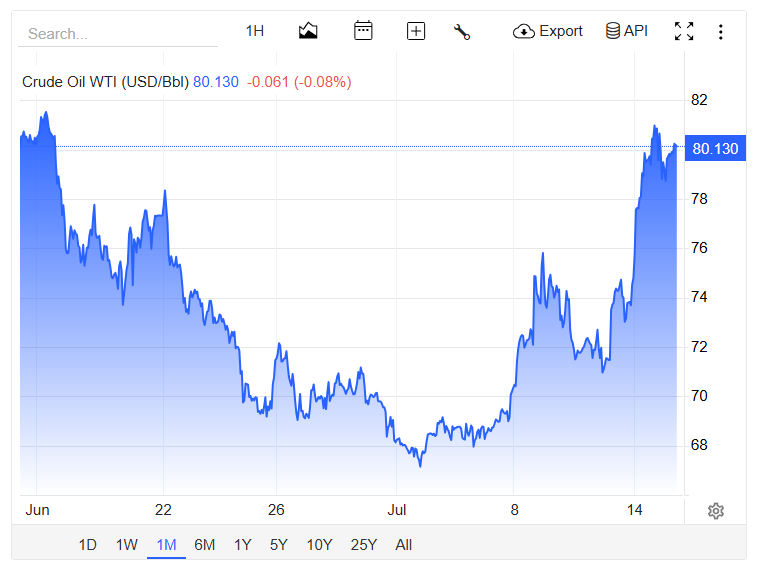
Oil’s safety net is disappearing. Brent crude broke above $85 a barrel Wednesday, and West Texas Intermediate (WTI) cleared $80.
Both benchmarks have risen for three straight days as US and Iranian forces trade strikes near the Strait of Hormuz. Traders say the bigger risk isn’t the daily move, but how much reserve capacity remains to absorb the next shock.
The Reserve Cushion Is Almost Gone
June Goh, a senior oil market analyst at Sparta Commodities, tracks that cushion closely. She told Al Jazeera the reserve buffer that absorbed months of supply shocks is nearly empty.
Washington has drawn down the Strategic Petroleum Reserve (SPR) throughout the conflict. It tapped the reserve each time fighting flared to soften the blow. Goh warns a sharp price jump could follow if Washington and Tehran keep escalating instead of easing tensions.
That warning follows an earlier G7 discussion, where governments weighed releasing up to 400 million barrels during a previous spike. It also echoes a recent alert from an ExxonMobil executive, who warned weeks ago that global inventories were tightening fast.
Trump Ties Strikes to a Blockade Reversal
President Donald Trump has raised the stakes further. He told Fox News that strikes will intensify next week. The targets, he said, are Iranian power plants and bridges, unless Tehran returns to the table.

Iran has not ruled out charging its own tolls on Hormuz shipping in response. Trump, meanwhile, reversed course on a separate plan. He dropped a proposed 20% fee on cargo moving through the strait. Gulf states will offer trade and investment deals instead, he said.
The US reimposed its naval blockade on Iranian ports the same day. That built on Trump’s earlier push to assert control over the waterway.
Shipping traffic has already responded. MarineTraffic recorded 57 transits through Hormuz from Friday through Sunday, a drop of more than 50% from the previous week. Before the war began in February, the strait handled roughly 130 transits a day.
Wall Street Is Pricing In $100 Oil
Bart Melek, global head of commodity strategy at TD Securities, thinks the rally could run further.
“I suspect that a move to $100 is quite possible, should it become apparent that physical shortage risks are real and increasingly likely.”
The US Department of Energy disputes the shortage narrative. It said Monday that 8.5 million barrels crossed the strait the day before with military assistance. That pace, it said, matches typical flows.
Higher crude could complicate the inflation outlook too. Analysts had expected the June CPI report to show cooling prices as fuel costs retreated. Whether that trend survives now depends on Trump’s next move, and on whether Tehran decides to return to the table.
The post Oil Pushes Above $85 as US Reserve Buffer Depletes: Will Crude Hit $100? appeared first on BeInCrypto.
Bitcoin price has stabilized near $62,500 after a weekend plunge below $62,000, while renewed U.S.-Iran hostilities and an oil surge have kept analysts cautious before U.S. inflation data.
Summary
- Bitcoin price held around $62,500 as traders weighed Trump’s Strait of Hormuz blockade ahead of the U.S. CPI report.
- Technical indicators show resistance near $63,100-$64,700, while analysts warn a break below $62,000 could trigger deeper losses.
- Rising oil prices, ETF outflows, and liquidation clusters have left Bitcoin vulnerable to sharp post-CPI volatility.
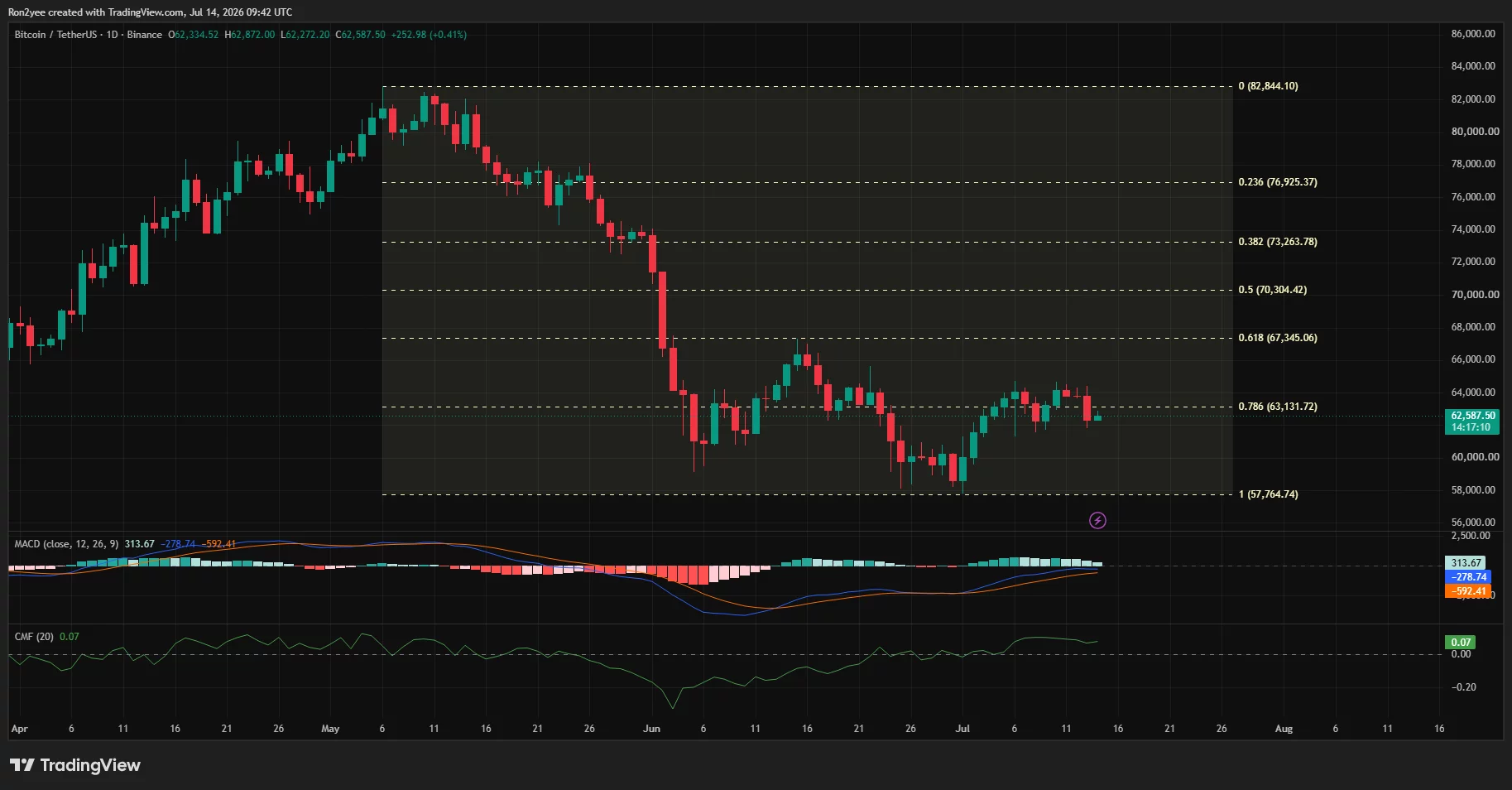
According to data from crypto.news, Bitcoin (BTC) price traded at about $62,504 on July 14 after moving between an intraday low of $61,794 and a high of $63,063. The recovery has remained limited after sellers rejected the asset above $64,000 and forced a fast retreat toward the lower end of its July range.
Brent crude climbed above $85 per barrel after President Donald Trump announced the return of a U.S. naval blockade on Iran and a 20% charge on cargo shipped through the Strait of Hormuz. Higher fuel costs could complicate the inflation outlook and reduce the case for easier monetary policy.
The June U.S. CPI report is scheduled for 8:30 a.m. Eastern Time, followed by Federal Reserve Chair Kevin Warsh’s testimony before the House Financial Services Committee at 10 a.m. A stronger inflation print or hawkish remarks could lift bond yields and weigh on Bitcoin, while softer data may help buyers challenge resistance.
Farside Investors recorded $424.7 million in net outflows from U.S. spot Bitcoin ETFs on July 13, including $185.5 million from BlackRock’s IBIT and $245.6 million from Fidelity’s FBTC. The withdrawals reversed the previous session’s $90.4 million inflow and reduced a key source of spot demand.
Bitcoin price has failed to reclaim $63,100 resistance
On the daily chart, Bitcoin remains below the 0.786 Fibonacci retracement at $63,131, drawn from the May peak near $82,844 to the June low around $57,765. A daily close above that level would improve the recovery setup and place the $64,000–$64,690 zone back in focus.
The daily MACD line has crossed above its signal line, but both remain below zero, while the positive histogram has narrowed during the latest pullback. Chaikin Money Flow stands at 0.07, slightly above zero, though price has not cleared resistance.
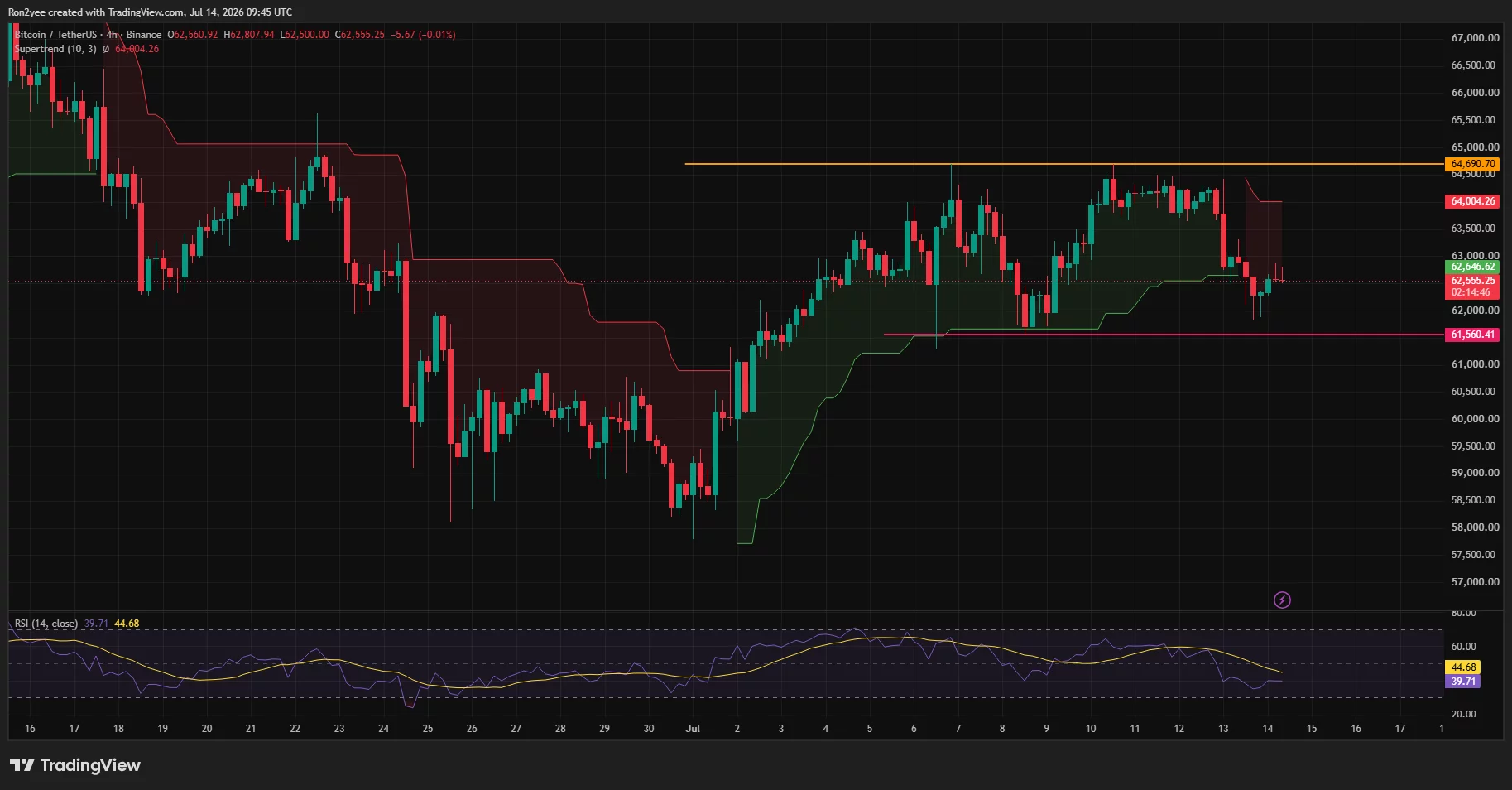
On the 4-hour chart, Bitcoin trades below the Supertrend barrier at $64,004, while the RSI sits at 39.71 and below its 44.68 moving average. Immediate support lies near $61,560, with the main range ceiling at $64,690.
CoinGlass’s one-week liquidation heatmap shows dense leverage around $61,000–$61,500 below price and another large cluster near $64,800–$65,000 above it. According to crypto analyst Lennaert Snyder, open interest rose during the latest drop as spot selling increased and funding stayed positive.
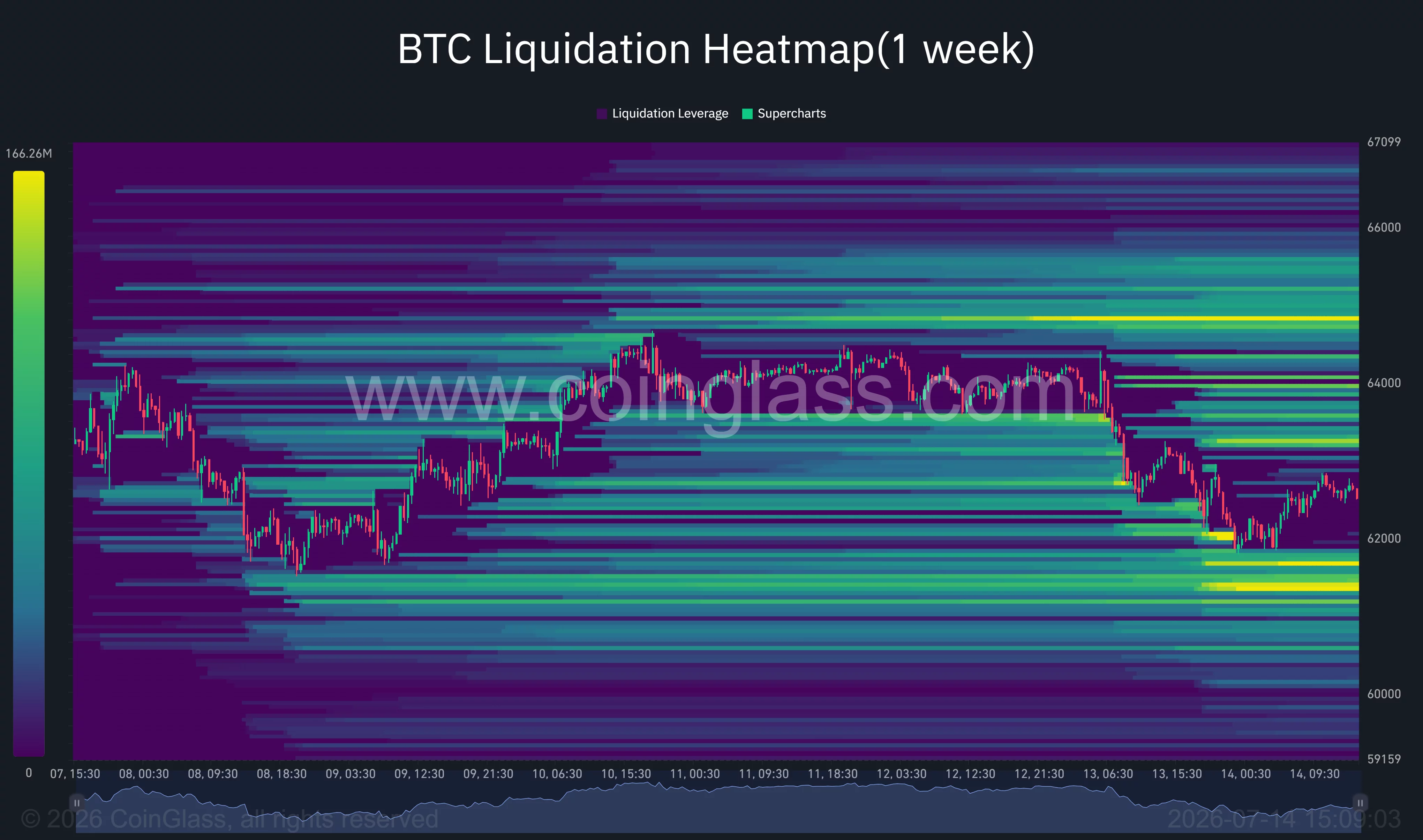
“If CPI triggers enough volatility and pushes price towards the 63.5K zone, I’m shorting the reaction towards 60.4K,” Snyder wrote.
A close below $62,000 would expose $60,400
Commenting on the key invalidation level, crypto analyst Ted Pillows noted that Bitcoin was still holding $62,500 but warned:
“A daily close below $62,000-$62,500 would be bad for Bitcoin.”
A breakdown below $61,560 would expose Snyder’s $60,400 target, followed by the monthly open near $58,700 and the daily swing low at $57,765. Renewed attacks near the Strait of Hormuz, another oil surge, persistent ETF withdrawals, or a hawkish CPI reaction would raise the chance of that move.
Bulls need to recover $63,131 first, then close above the Supertrend at $64,004 and horizontal resistance at $64,690. Until those levels fall, Bitcoin remains trapped between liquidation liquidity on both sides, with macro data likely to decide which cluster is tested first.
Disclosure: This article does not represent investment advice. The content and materials featured on this page are for educational purposes only.

The European Central Bank has moved the digital euro project into its next phase, selecting payment service providers to take part in a pilot designed to stress-test how a potential central bank digital currency could work in real-world payments.
In an announcement published Tuesday, the ECB said it has chosen 36 payment service providers (PSPs) to participate in the digital euro pilot. The project follows the ECB’s earlier work on the concept and comes as European policymakers continue exploring a CBDC while other jurisdictions take markedly different positions.
Key takeaways
- The ECB selected 36 payment service providers for a digital euro pilot after receiving more than 50 applications.
- The 12-month trial is scheduled to begin in the second half of 2027, with testing involving the ECB and central banks across 19 euro-area countries.
- Participants include both major banks and fintechs, such as Deutsche Bank, UniCredit, BPCE, Stripe, and Revolut.
- Italy leads the participant list with seven selected firms, while Germany, Portugal, and Greece have smaller groups.
- The pilot’s focus is on testing user access and merchant payment flows before any potential token issuance.
ECB selects 36 providers for the pilot
According to an official ECB announcement published Tuesday, the central bank has picked 36 PSPs to join the digital euro pilot. The ECB described the process as part of moving from design and planning into hands-on testing with the private sector.
The ECB said it opened a call for interest in March 2026 and received more than 50 applications from payment companies. The selected group spans a range of business types, including traditional banks, payment processors, and non-bank service providers.
Among the names included are fintechs such as Stripe and Revolut, alongside established banks including Deutsche Bank, UniCredit, and BPCE. While the ECB’s selection is specific to pilot participation, Revolut’s broader approach to crypto services has been in flux for EU customers in recent months, including a reported move to phase out support for Tether USDt in some regions.
A euro-area wide test with local and cross-border roles
The pilot is planned to involve the ECB and the central banks of 19 euro-area member states. The ECB noted that the testing will include institutions across countries such as Belgium, Germany, France, Italy, Spain, and the Netherlands—reflecting an effort to examine how a single digital euro framework could operate across different payment environments.
ECB officials said the selected providers are intended to create a “broad testing environment,” including the ability for participants to offer pilot services outside their home markets. That matters because payment rails, customer behavior, and commercial partner ecosystems differ significantly across the euro area. A wider spread of PSPs could therefore help the ECB identify friction points earlier.
The ECB also laid out that participants would carry different responsibilities. Some firms are expected to support user access to beta digital euro services, while others focus on merchant acceptance and payments. Several PSPs will take on both functions during the trial.
Italy leads participation as ECB tallies geography
Geographically, the ECB highlighted that Italy has the largest number of selected participants. Seven Italian firms were chosen to join the pilot: UniCredit, Poste Italiane, Nexi Payments, Banca Sella, Banca Monte dei Paschi di Siena, Isybank, and Numia.
Germany follows with five selected providers. Portugal and Greece each have three firms in the pilot cohort. The ECB said the country mix is designed to support testing across multiple national payment ecosystems, while also allowing selected PSPs to operate beyond their home markets.
Why the ECB is bringing in PSPs now
ECB Executive Board member Piero Cipollone—who chairs the high-level task force on the digital euro—said the level of participation shows strong private-sector interest in helping shape the project. He also suggested the central bank expects increased cooperation with payment providers as testing moves forward.
“We look forward to deeper engagement as we work with and learn alongside European payment service providers in developing a secure, efficient and inclusive digital euro,” Cipollone said.
For investors and builders watching the digital euro track, the selection signals that the ECB is prioritizing operational readiness and distribution-channel testing rather than focusing exclusively on design. By involving PSPs before any potential issuance, the pilot’s immediate goal is to evaluate how a digital euro could be accessed and used—through both customer interfaces and merchant payment systems—under realistic conditions.
That timing also places the digital euro in the middle of an international policy split. While Europe presses ahead with CBDC experimentation, the United States has moved to block the Federal Reserve from issuing a CBDC, according to earlier reporting. The contrast underscores how governance choices can shape the pace of experimentation, even when both sides acknowledge the broader question of what role public money-like digital instruments should play in future payment systems.
Next, the market will likely focus on how the pilot’s structure affects real adoption: which PSPs emphasize consumer onboarding versus merchant enablement, how interoperability is handled across the 19 participating central banks, and what technical or policy issues the ECB identifies during the 12-month run starting in the second half of 2027.
Stephen “Cap” Newnham, who leads the Solana community group Superteam UK, said he will run as an independent candidate in the Aug. 13 parliamentary by-election in Clacton against Reform UK leader Nigel Farage.
On Tuesday, Newnham outlined five campaign pledges, including support for local entrepreneurs, digital and artificial intelligence education, financial literacy in schools and onchain political transparency. He announced his intention to stand as an independent candidate on July 9.
Newnham’s fourth pledge, “You should own your pension,” argues that existing structures like self-invested personal pensions and small self-administered schemes allow savers to choose where their assets are held. He also pledged full transparency, with donations and meetings published in plain English and onchain.
The campaign has not detailed a role for blockchain technology in managing pension assets or proposed changes to pension law. A blockchain could make published records more difficult to alter, but it would not by itself ensure that every donation or meeting had been disclosed.
Cointelegraph contacted Newnham for more information about his proposals but had not received a response by publication.
According to his LinkedIn profile, Newnham studied economics at the University of Edinburgh before joining the Solana ecosystem. He leads Superteam UK and has co-authored a report on blockchain and the future of work with Coinbase’s Stand With Crypto campaign and the DLT Science Foundation.
Superteam UK said the Cap for Clacton community was established to help retain technical talent in Britain by supporting founders and developers building on Solana, arguing that many entrepreneurs leave the country in search of better funding and startup opportunities abroad.
Farage funding scrutiny shapes contest
The candidacy brings an explicit crypto platform into a contest triggered when Farage resigned from Parliament on Wednesday and opted to recontest his Clacton seat amid a parliamentary standards investigation into whether Farage should have declared a 5 million pound ($6.7 million) personal gift from crypto investor Christopher Harborne. Farage has said he was not required to declare the gift because it was received before he entered Parliament.
Farage has faced additional scrutiny over reported financial support from crypto entrepreneur George Cottrell and allegations that his financial relationships intersected with his advocacy on digital asset policy. Farage has denied wrongdoing and said he followed parliamentary rules.
Related: Bank of England governor denies Farage lobbying swayed CBDC policy: Report
National poll favors Count Binface
At the time of writing, Democracy Club lists 11 prospective candidates, including Newnham, Farage and satirical candidate Count Binface, though the council is not expected to confirm the official field until July 17.
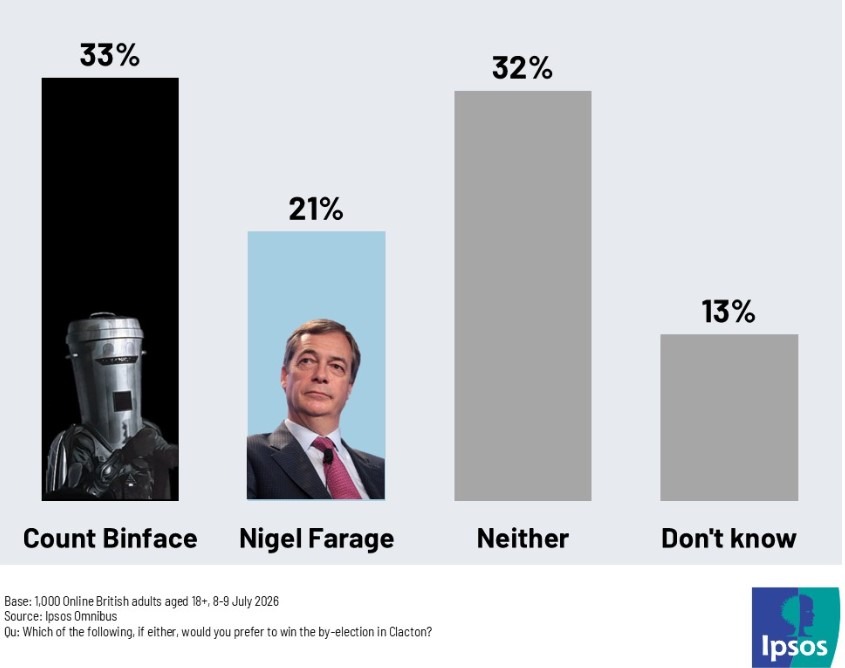
On Friday, an Ipsos survey of 1,000 British adults found 33% would prefer Binface to win, compared with 21% for Farage, but the national poll did not measure voting intentions among Clacton residents.
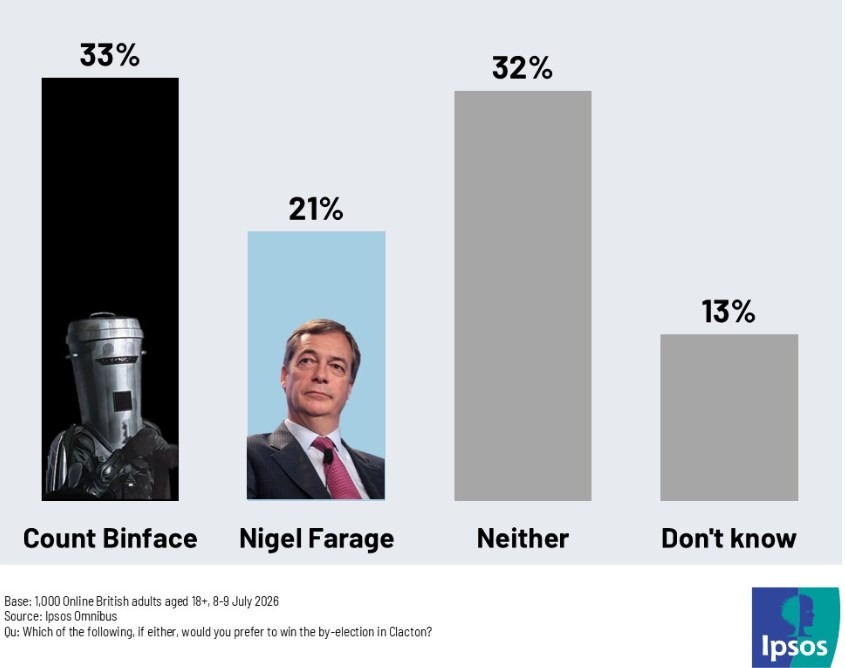
Early survey results on the upcoming by-election. Source: Ipsos
Despite the unconventional field, the result is being closely watched because of Farage’s involvement and the scrutiny surrounding his decision to force a new vote.
Magazine: Thai scammer’s $122M wallet, Japan embraces crypto credit: Asia Express
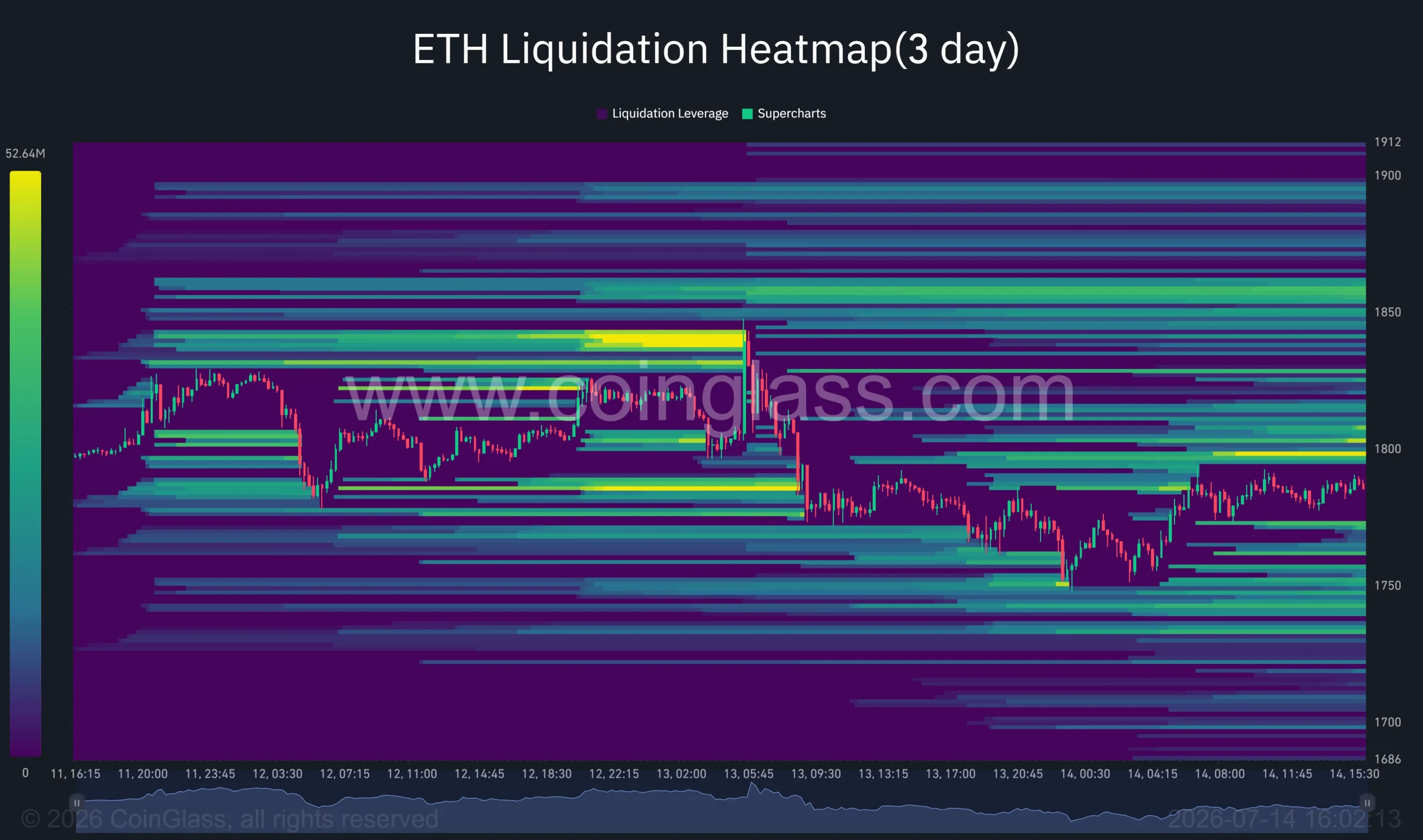
Ethereum has remained below $1,800 as traders await U.S. inflation data despite growing expectations of a breakout above $1,850.
Summary
- Ethereum remains below $1,800 as traders await U.S. CPI data and Fed signals.
- A breakout above $1,850 could trigger short liquidations and open a path toward $2,200.
- Analysts continue to back the bullish setup while $1,750 remains Ethereum’s key support.
The second-largest cryptocurrency traded around $1,780 after briefly slipping toward $1,770 following the latest geopolitical flare-up in the Middle East. Oil prices jumped after the weekend strikes, reviving concerns that inflation could remain elevated ahead of the June CPI release and Paul Warsh’s expected congressional testimony.
Any upside surprise could reinforce expectations for a hawkish Federal Reserve, limiting demand for risk assets and making the $1,800 barrier harder to overcome.
Derivatives positioning, however, presents a more balanced picture than price action alone. CoinGlass liquidation data shows one of the largest short liquidation clusters sitting between roughly $1,800 and $1,850, while additional liquidity rests closer to $1,900.
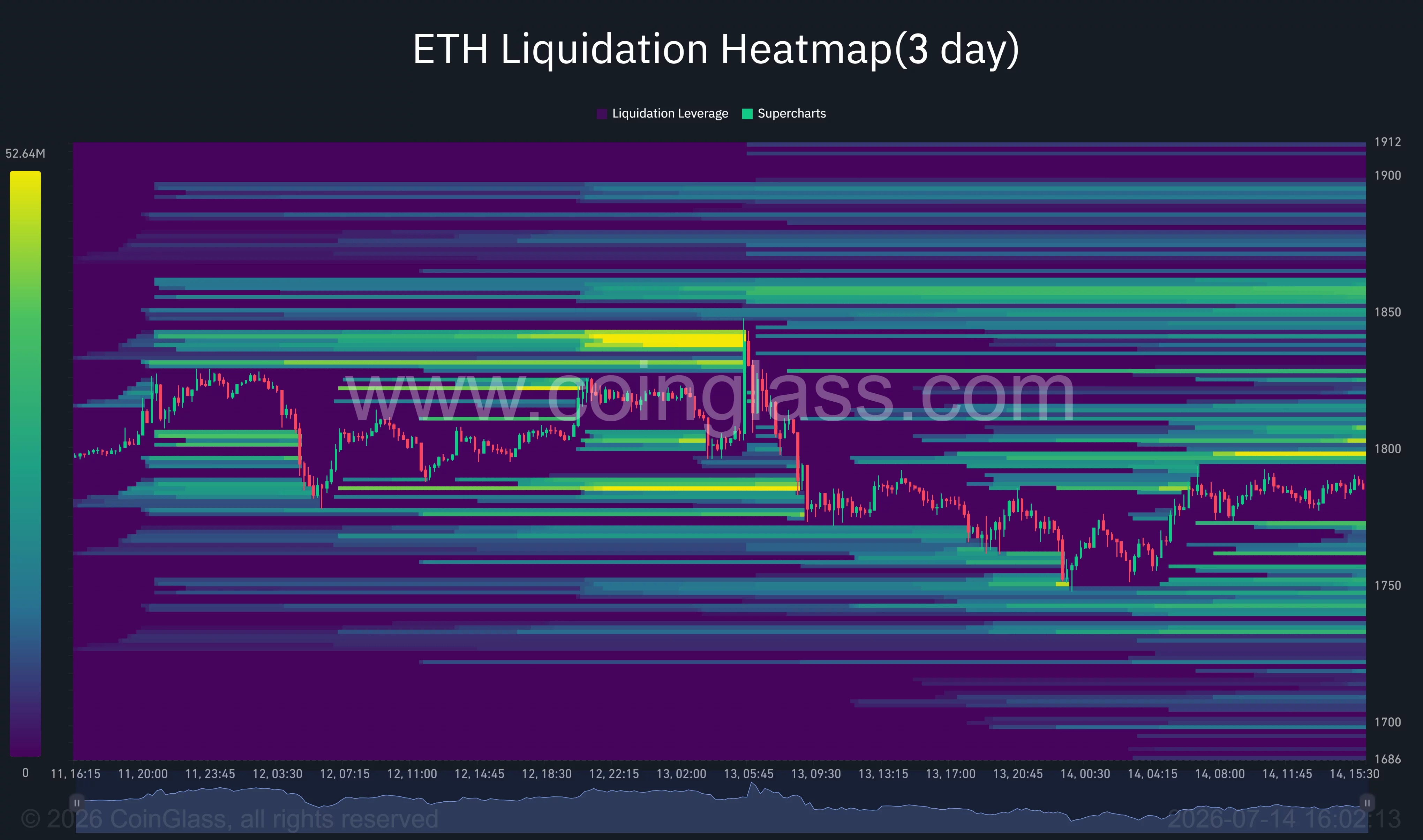
A decisive move through those levels could force short sellers to cover, accelerating momentum toward higher resistance. On the downside, liquidation pockets around $1,750 and below suggest sellers could regain control if support fails.
Ethereum needs a confirmed breakout above $1,850 to unlock higher targets
The daily chart shows Ethereum carving out what resembles a double-bottom formation after rebounding from June lows. Price now sits directly beneath horizontal resistance near $1,846, which coincides with the neckline of the pattern.
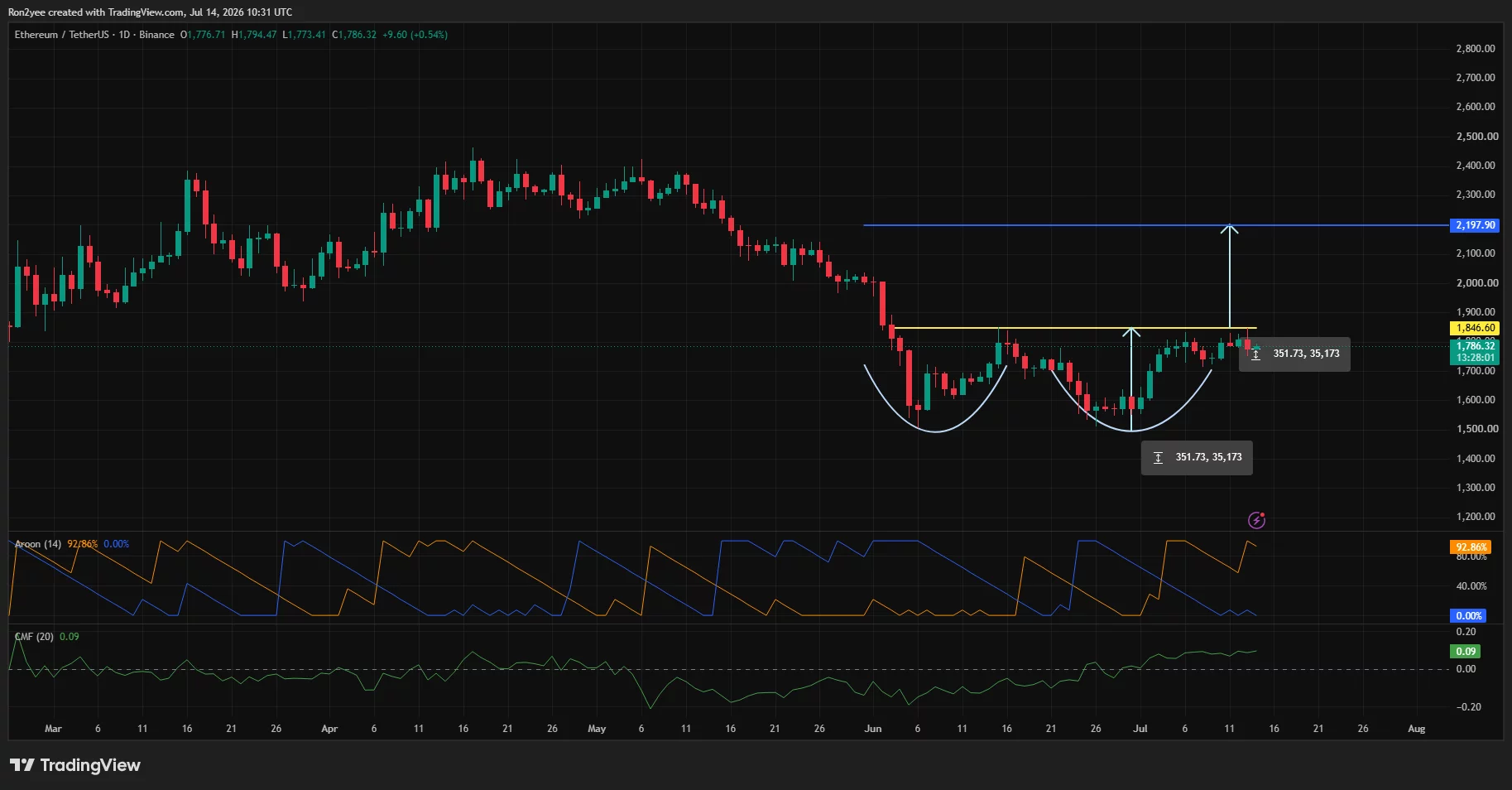
A successful breakout projects a measured move toward approximately $2,198, while the Aroon indicator favors buyers, with the bullish line holding above 90%. Chaikin Money Flow has also moved back into positive territory, suggesting capital has gradually returned after weeks of distribution.
Shorter-term momentum remains constructive but lacks confirmation. On the 4-hour chart, Ethereum continues to trade above the Supertrend support near $1,756, preserving the recent sequence of higher lows.
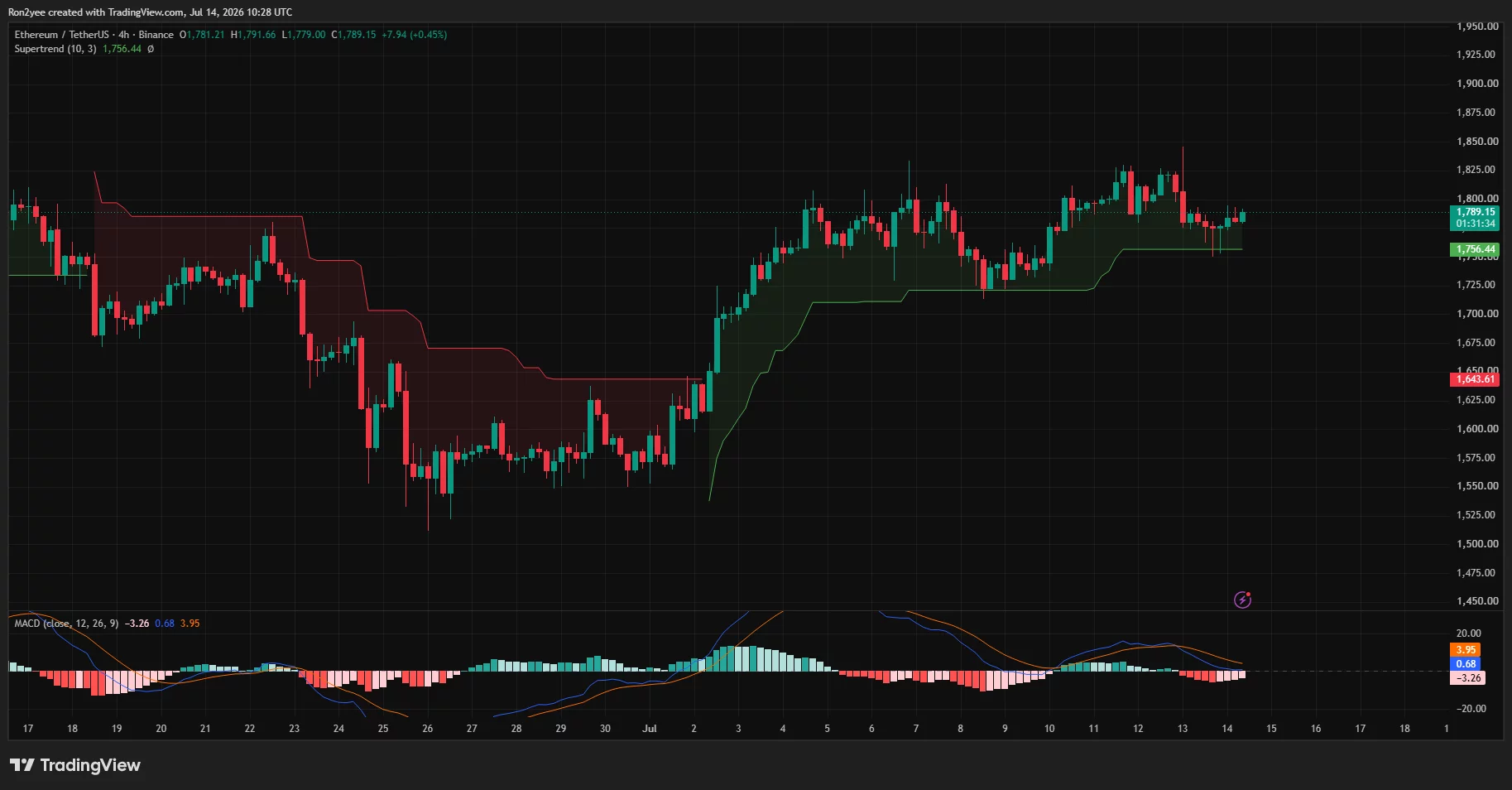
At the same time, the MACD histogram has weakened, and the MACD line has slipped beneath its signal line, showing that upside momentum has slowed as price approaches resistance rather than expanded into a fresh impulse.
Market participants are also watching the same technical level. According to analyst Ali Martinez, “I’m going LONG on Ethereum $ETH if it breaks $1,850.”
His view aligns with the neckline resistance visible on the daily chart, where a close above that level would invalidate the recent consolidation and expose the next objective near $2,200.
Another closely watched level sits slightly lower. Commenting on the latest structure, crypto analyst Ted Pillows argued that “$ETH held above its $1,750 support zone.” He added that buyers have defended the level and believes the next major move could develop to the upside as long as that floor remains intact.
Macro risks could quickly reverse Ethereum’s recovery
Even with the improving chart structure, macro conditions continue to dictate short-term direction. Ethereum has struggled to sustain rallies throughout 2026 as persistent spot ETF outflows, weaker network fee revenue following the Dencun upgrade, and competition from faster Layer-1 networks have weighed on investor demand.
Ethereum’s annual issuance has also returned to positive territory after reduced fee burns weakened the network’s deflationary narrative.
Failure to reclaim $1,800 before the CPI release would leave traders exposed to another round of volatility. A stronger-than-expected inflation print or renewed escalation in the Middle East could strengthen the U.S. dollar and Treasury yields, reducing appetite for crypto assets.
From a technical perspective, losing the $1,750-$1,756 support region would invalidate the current bullish setup and increase the probability of a retreat toward $1,680, with deeper demand waiting near the psychologically important $1,500 level.
Conversely, a confirmed break above $1,850 could trigger liquidations across leveraged short positions and shift attention toward the $1,900 area before the projected move toward $2,198 comes into focus.
Disclosure: This article does not represent investment advice. The content and materials featured on this page are for educational purposes only.
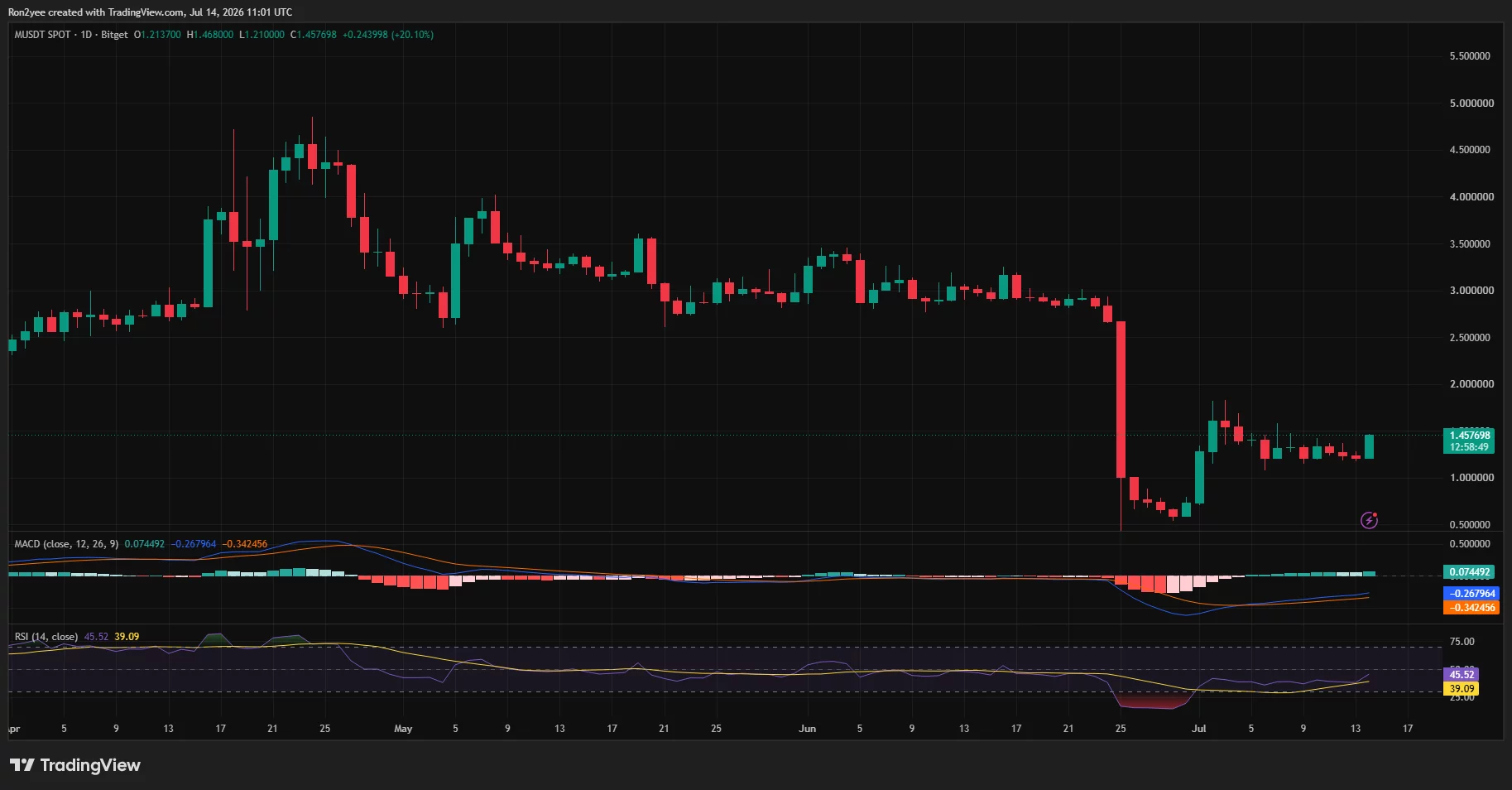
MemeCore price has surged more than 20% to an intraday high of $1.46 on July 14, breaking out of a two-week consolidation range after buyers defended support near $1.20.
Summary
- MemeCore surged over 20% to $1.46 after breaking above a two-week consolidation range.
- Bullish MACD momentum and a recovering RSI supported the move, though resistance remains near $1.50.
- Thin liquidity and concentrated token ownership could amplify both further gains and renewed selling.
As per data from crypto.news, MemeCore (M) opened near $1.21 before climbing to $1.468, placing it among the day’s strongest-performing large-cap crypto assets. The move has occurred despite weakness across Bitcoin and Ethereum, indicating that token-specific trading flows, rather than a market-wide rally, are driving the advance.
Buyers appear to have entered after MemeCore spent much of July trading between approximately $1.15 and $1.45. Repeated failures to push the token below the lower end of that range reduced immediate selling pressure, while the latest move through its recent highs likely triggered momentum orders and forced some bearish traders to reduce their exposure.
Alongside the technical breakout, traders have continued to monitor MemeCore’s ecosystem developments, including its Layer-1 blockchain, MemeX launchpad and planned on-chain project releases. Although no specific catalyst has been identified for Tuesday’s rally, continued attention on the project’s roadmap may have supported sentiment
The timing may have renewed attention around M one day before its breakout, although the update did not identify a specific announcement responsible for the rally.
Technical momentum has improved
On the daily chart, MemeCore’s moving average convergence divergence indicator has produced a bullish crossover, while its histogram has moved into positive territory. The pattern indicates that downside momentum from June’s collapse is fading, even though both MACD lines remain below zero and have not confirmed a complete trend reversal.
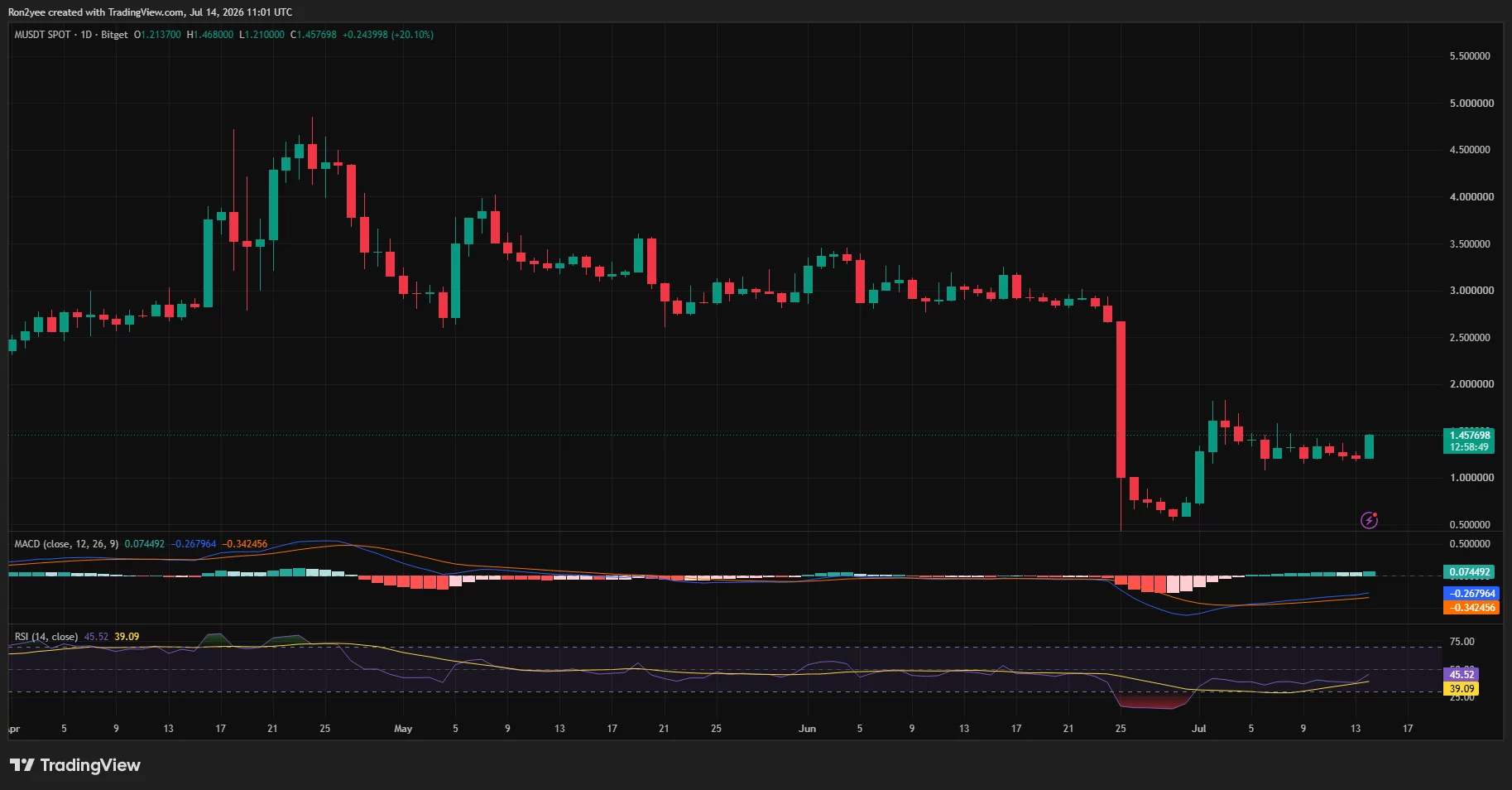
MemeCore’s relative strength index has risen to approximately 45.5 from deeply oversold levels recorded after the June crash. Because the RSI remains below the neutral reading of 50, the chart points to recovering demand rather than an established bullish trend.
Price structure offers a similar signal. M rebounded from a late-June low near $0.50 and reached approximately $1.80 before pulling back. It then formed a base above $1.10, and the July 14 candle has pushed it back toward the upper edge of that structure.
A daily close above $1.45-$1.50 would strengthen the breakout and leave the $1.70-$1.80 region as the next visible resistance zone on the supplied chart. Failure to hold above $1.45, however, could show that the move was another brief liquidity-driven spike, with support remaining around $1.20 and $1.10.
June’s collapse still clouds the recovery
The rally follows an unusually violent correction that erased more than 70% of MemeCore’s value within hours on June 25. MarketWatch reported that M fell from roughly $2.62 to $0.82, cutting its market capitalization below $1 billion and reducing its fully diluted valuation from about $14 billion to $3.8 billion.
During the sell-off, on-chain investigator ZachXBT renewed allegations that MemeCore’s supply was heavily concentrated among insiders and questioned how the token had passed listing reviews at several major exchanges.
In an earlier post, he had challenged the project to explain its multibillion-dollar valuation and his claim that insiders controlled more than 90% of the supply. MemeCore had not publicly answered requests for comment cited by MarketWatch at the time.
Such concentration concerns help explain both sides of M’s price action. Limited freely traded supply can deepen losses when large holders sell, but shallow order books can also magnify rebounds when demand suddenly increases. Research into meme-token markets has similarly found that concentrated ownership and thin liquidity can make prices unusually sensitive to sentiment and relatively small trading flows.
MemeCore’s breakout therefore signals a meaningful improvement in short-term momentum, but confirmation depends on whether buyers can sustain trading above $1.45 and eventually reclaim $1.80. Until then, the rebound remains exposed to the same liquidity, ownership and transparency risks that intensified June’s crash.
Disclosure: This article does not represent investment advice. The content and materials featured on this page are for educational purposes only.


Every few weeks, a token that has done nothing wrong falls ten percent in a day, and the explanation turns out to have been sitting in public view for years. A tranche of supply, promised to early investors back when the project raised money, hit its scheduled release date.
Insiders who bought at a fraction of the market price suddenly held tokens they could sell, and enough of them did. Traders call these events unlocks, and they are among the most predictable forces in crypto markets, which makes it strange how many investors get blindsided by them.
A token unlock is the moment previously locked supply becomes transferable and enters circulation under rules the project set in advance. The rules themselves are called a vesting schedule, and together they answer a question every serious investor should ask before buying any token: who is going to be allowed to sell, how much, and when. This guide explains what unlocks and vesting are, why projects lock tokens in the first place, the difference between cliffs and linear releases, who actually receives unlocked supply and how differently each group behaves, how unlocks move prices, the low float trap that defined the current market cycle, how to read an unlock calendar like a professional, and the honest limits of unlock analysis.
What a token unlock actually is
When a crypto project creates its token, it almost never releases the full supply into the market on day one. Instead, the total supply is divided into allocations: a slice for the founding team, a slice for the venture investors who funded development, a slice for advisors, a slice for the community, a slice for an ecosystem fund or treasury. Most of these allocations start locked, meaning the tokens exist on paper, and often on chain, but cannot be transferred or sold.
An unlock is the scheduled event that releases some of that locked supply. On the appointed date, or continuously according to a formula, tokens move from the locked state to the liquid state, and their owners can finally do what owners do: hold, stake, or sell. Nothing about an unlock is secret. The schedule is typically published in the project’s tokenomics documentation before the token ever trades, and modern vesting is usually enforced by smart contracts that release tokens automatically, with the whole timetable verifiable on chain.
The distinction between vesting and unlocking trips up newcomers. Vesting is the rulebook, the full timetable governing how allocations are earned and released over months or years. An unlock is a single event within that timetable, the moment a specific batch becomes tradable. A project has one vesting schedule and many unlocks. When traders say a token has an unlock next week, they mean one identifiable batch is crossing from locked to liquid, and the size, recipient, and context of that batch are what analysis is about.
Why projects lock tokens at all
Locking is a credibility device. Imagine a project that raised money by selling thirty percent of its supply to venture funds at an early stage price, then listed the token publicly at twenty times that price. If the investors could sell immediately, the rational move would be to dump everything into the listing hype, crush the price, and move on. Everyone who bought at listing would be exit liquidity. Projects that allowed this quickly found that nobody wanted to buy their tokens at all.
Vesting schedules exist to make the promise of long term alignment enforceable. A team whose tokens unlock over four years has four years of reasons to keep building. An investor with a one year cliff cannot flip the token at listing no matter how tempting the price. The lock converts a verbal commitment into a mechanical one, and because the schedule is public, the market can price the commitment instead of guessing at it.
Locking finally serves a signaling function that has nothing to do with mechanics. When a team accepts a four year schedule and investors accept a one year cliff, they are publishing their own confidence interval. Short schedules whisper that insiders want optionality. Long schedules, especially ones the team imposed on itself beyond what any exchange required, tell the market that the people with the most information expect the token to be worth holding. Markets read these signals imperfectly, but they read them.
Locking also manages the physics of supply. A token’s price is set at the margin, by the balance of buying and selling in liquid markets. Releasing supply gradually gives demand time to grow into it. Releasing it all at once is a flood, and floods move prices the way floods move everything else. The entire discipline of tokenomics, the economic design of a token’s supply, distribution, and incentives, treats the release schedule as one of its central levers.
Cliffs, linear vesting, and the shapes of release
Vesting schedules come in a small number of recognizable shapes, and the shape matters as much as the size. A cliff is a period, commonly six to twelve months after the token generation event, during which nothing unlocks at all. When the cliff ends, a large batch releases at once. Cliffs concentrate sell pressure into a single known date, which is why cliff expiries are the unlock events traders circle on calendars.
Linear vesting releases tokens continuously or in small regular steps, daily, weekly, or monthly, over a defined period. The drip is gentler on price because no single day carries a large release, but it creates persistent background pressure, a steady trickle of new supply that demand must absorb month after month.
Most real schedules are hybrids: a cliff followed by linear release. A typical structure for team tokens might be a one year cliff, then monthly unlocks over the following two or three years. Investor allocations often vest faster than team allocations, and community or ecosystem allocations sometimes have no lock at all, or unlock based on milestones instead of dates. Some projects add non linear schedules, with releases that accelerate or step up at intervals, and a few tie unlocks to performance conditions such as product launches. The token generation event, usually shortened to TGE, marks day zero for most schedules, and many tokens release a small percentage at TGE so that a market can exist at all.
Reading a vesting chart is mostly about learning to see these shapes. A wall of supply at a single future date is a cliff. A smooth ramp is linear release. The steeper the ramp and the taller the walls, the more supply the market will be asked to digest, and the more the token’s future depends on demand showing up on schedule.
Who receives unlocked tokens, and why it matters
The same unlock size can produce completely different market outcomes depending on whose tokens are being released, because different holders face different incentives. Venture investors are the most reliable sellers. Funds have limited lifespans and partners to repay, and a position bought at an early stage price that now trades far higher represents a return that fund managers are professionally obligated to realize. When a large investor tranche unlocks, systematic selling is the base case, not the exception.
Team allocations behave less predictably. Founders and employees have reputational reasons to avoid visible dumping, and many hold for belief or for optics, but personal diversification is a powerful force, and team selling after long cliffs is common enough that markets price it in. Ecosystem and treasury unlocks are different again: those tokens usually flow to grants, market making, or incentives instead of directly to exchanges, though grant recipients frequently sell what they receive, so the pressure arrives second hand and on a lag. Advisors sit somewhere in between, small in size but often quick to exit. Community allocations, including airdrops, scatter supply across thousands of small holders whose behavior varies from instant selling to permanent holding.
Sophisticated unlock analysis therefore never stops at the headline number. The question is not how many tokens unlock, but how many unlock into hands that are likely to sell, at what cost basis, and into how much liquidity.
How unlocks actually move prices
The mechanical story is simple: unlocks increase liquid supply, and if demand does not rise to meet it, price falls. But the mechanism deserves one more sentence of precision. Price is set by transactions, not by existence, so an unlock only moves the market to the degree that unlocked tokens are sold or that traders act on the expectation of selling. Supply that unlocks into wallets and stays there changes the risk picture without changing the order book. The market story is more interesting, because unlocks are public information, and public information gets traded in advance.
Ahead of a large unlock, traders who expect selling pressure sell first, or open short positions in perpetual futures to profit from the anticipated decline. This front running spreads the price impact across the weeks before the event, and it occasionally produces the counterintuitive pattern traders call sell the rumor, buy the news, where a token falls into an unlock and bounces after it, because the sellers finished selling early. Empirically, the price damage from major unlocks tends to arrive before and during the event, with the days after determined by how much of the released supply actually hits exchanges.
Context decides magnitude. The ratio of the unlock to average daily trading volume matters more than the ratio to market capitalization, because volume measures the market’s absorption capacity. An unlock worth three days of trading volume is a problem; an unlock worth an hour of volume is noise. Market regime matters just as much. Bull markets swallow unlocks that would crater the same token in a bear market, because absorption is a function of demand, and demand is cyclical. And holder cost basis sets the temptation: supply unlocking at a hundred times its purchase price wants to sell far more than supply unlocking underwater.
The clearest evidence that unlocks bind projects came during the 2024 and 2025 cycle, when several teams paused or restructured their own vesting schedules mid stream after watching unlock pressure grind their tokens down. A project that has to renegotiate its own tokenomics to defend its price is admitting that the original schedule asked the market to absorb more than it could.
From ICO free for all to institutional vesting
Vesting was not always standard. During the initial coin offering boom of 2017 and 2018, projects routinely sold tokens with no lockups at all: a whitepaper, a wallet address, and a promise. Teams and early buyers could sell the moment tokens listed, and many did, with predictable results. The wreckage of that era, thousands of tokens that listed, dumped, and died, is the reason vesting became a market requirement instead of a courtesy. Exchanges began expecting lockup disclosures before listing. Venture funds began accepting, and then demanding, multi year schedules as evidence of seriousness. By the early 2020s a token launching without published vesting for insiders read as a warning label.
The professionalization cut both ways. Structured vesting made token launches more credible, but it also standardized the low float playbook, in which a polished schedule defers the supply problem instead of solving it. A four year lockup does not remove twenty five times the float from the future; it just puts the future on a calendar. The modern unlock calendar industry, with dashboards, alerts, and analytics products tracking every scheduled release across the market, exists precisely because vesting became universal. What was once a question of whether insiders were locked at all became a question of exactly when the locks expire, and an entire analytical discipline grew in the gap.
The next stage of that evolution is already visible: on chain vesting contracts that anyone can audit, third party verification services, and standardized disclosure formats. The direction of travel is toward supply schedules as verifiable public infrastructure, which raises the analytical bar. When everyone can see the calendar, seeing it is no longer an edge. Interpreting it is.
The low float, high FDV trap
The defining supply structure of the recent cycle was the low float, high FDV launch. A project lists with a small fraction of total supply circulating, sometimes under ten percent, while the fully diluted valuation, the price of all tokens that will ever exist, implies a number many multiples higher. The small float makes the price easy to support at listing. The enormous locked overhang means years of scheduled unlocks stand between the listing price and the day the token’s market cap honestly reflects its supply.
The arithmetic is unforgiving. If a token trades at a two billion dollar fully diluted valuation with eight percent circulating, then over the coming years roughly twenty five times the current float will be released. For the price simply to stay flat, new demand must absorb all of it. Buyers of such tokens are, whether they realize it or not, betting that demand will grow faster than a supply schedule designed years earlier by people who bought at a fraction of the current price. The bet occasionally pays. The base rate does not favor it.
Markets learned this lesson expensively. Token after token from the low float era spent months in structural decline as unlocks arrived on schedule and demand did not, and by the middle of the cycle, unlock calendars had become one of the most watched datasets in DeFi and beyond. Aggregate unlock volume across the market now runs into billions of dollars in heavy months, and traders treat clusters of large unlocks as a marketwide supply headwind, particularly for assets far down the liquidity curve.
What big unlocks look like in practice
A few well known episodes show the full range of outcomes. Arbitrum’s ARB, one of the largest airdropped tokens of its generation, spent much of its first two years grinding lower as investor and team tranches unlocked month after month into demand that never matched the schedule, becoming the reference example of structural unlock pressure on a fundamentally serious project. The token’s technology kept shipping; the supply kept arriving; the price reflected the arithmetic.
AltLayer provided the reference example of a project blinking. After its first major unlock in mid 2024 hit the price hard, the team announced a six month vesting pause covering investors, team, advisors, and treasury. The pause relieved the calendar but not the market, and the token’s struggles afterward became a case study in why rescheduling supply does not manufacture demand.
Pump.fun’s PUMP token compressed the entire lifecycle into months. The July 2025 sale raised over a billion dollars at a valuation the open market immediately began stress testing, and every subsequent tranche movement from team and treasury wallets was tracked by thousands of traders in real time, a reminder that for high profile tokens, unlock analysis now happens wallet by wallet, not just date by date.
And Pi Network became the retail era’s unlock story: roughly 1.21 billion tokens scheduled to release across 2026 against thin exchange liquidity, an overhang so large relative to volume that the unlock calendar itself became the primary narrative around the asset. Whatever one thinks of the project, the episode taught millions of retail holders the vocabulary of cliffs, floats, and absorption for the first time.
The pattern across all four is consistent. Unlocks did not decide whether these projects mattered. They decided when the market was forced to render a verdict on how much demand actually existed at the prevailing price.
Reading an unlock calendar like a professional
Several platforms track unlock schedules across the market, including Tokenomist, CryptoRank, DropsTab, and CoinGecko, and they present broadly the same data: upcoming unlock dates, sizes in tokens and dollars, percentages of circulating supply, and the allocation buckets involved. The skill is in the interpretation, and it reduces to five questions.
First, how large is the unlock relative to circulating supply? Below one percent is usually noise; above five percent deserves attention. Second, how large is it relative to daily trading volume? This is the absorption test, and it is the single most predictive ratio. A useful rule of thumb: if the unlocked value exceeds three to five days of average volume, absorption will be slow and the price will likely do the absorbing. Third, who receives the tokens? Investor and team tranches carry the highest sell risk; ecosystem and treasury tranches are slower burning. Fourth, what is the recipients’ cost basis? Deeply profitable supply sells harder. Fifth, what happened at this token’s previous unlocks? Past behavior around identical events is the closest thing unlock analysis has to a controlled experiment.
Two practical refinements separate careful traders from calendar tourists. Cliff events deserve more respect than equivalent linear amounts, because concentration in time is what overwhelms order books. And exchange flow data, where available, tells you whether unlocked tokens are actually moving toward venues where they can be sold, or sitting in the same wallets that received them. Tokens that unlock and do not move are potential supply; tokens that unlock and flow to exchanges are incoming supply. On chain analytics platforms make this distinction observable in near real time, and the gap between the two is often where the actual trade lives.
What unlock analysis cannot tell you
Unlock data describes supply mechanics, and supply is only half of any price. A token with a brutal unlock schedule and explosive demand growth can rise through every release date, which is exactly what the strongest projects of every cycle have done. A token with a clean, fully vested supply and no demand will still go to zero, just without a schedule announcing it. Unlocks set the height of the wall; they say nothing about whether the buyers on the other side can climb it.
The data also cannot capture private arrangements. Locked tokens are routinely hedged through over the counter deals and derivatives, meaning the economic selling may have happened long before the unlock date, with the on chain release a mere formality. Conversely, some unlocked supply is contractually committed to market makers or custody and cannot hit the market as fast as the calendar implies. On chain vesting contracts have also occasionally diverged from published schedules, in both directions, which is why serious analysts verify the contract instead of trusting the documentation.
Treat unlocks the way professionals treat them: as one high quality, freely available input among several. In a market where edges are scarce and expensive, a public calendar of exactly when supply arrives, from Solana majors to the long tail of meme coins, is a gift. It is not a trading system. It is a schedule of when the questions get asked; demand still writes the answers.
Frequently asked questions
What is a token unlock in crypto?
A token unlock is a scheduled event in which previously locked tokens become transferable and enter circulating supply. Unlocks follow a vesting schedule the project defined in advance, and they typically release tokens to teams, early investors, advisors, or ecosystem funds.
What is the difference between vesting and unlocking?
Vesting is the overall timetable that governs how locked allocations are released over time. An unlock is a single event within that timetable. A project has one vesting schedule but many individual unlock events.
What is a cliff in a vesting schedule?
A cliff is an initial period, often six to twelve months, during which no tokens from an allocation are released. When the cliff ends, a large batch unlocks at once, which concentrates potential sell pressure into a single date.
Are token unlocks always bearish?
No. Unlocks add supply, but the price outcome depends on demand, on how much of the released supply actually gets sold, and on how much was priced in beforehand. Some tokens fall into an unlock and recover afterward once the anticipated selling clears.
How do I check when a token unlocks?
Unlock schedules appear in project tokenomics documentation and on tracking platforms such as Tokenomist, CryptoRank, DropsTab, and CoinGecko. These tools show upcoming dates, sizes, percentages of supply, and which allocation groups receive the tokens.
What is a low float, high FDV token?
It is a token that lists with a small share of total supply circulating while its fully diluted valuation implies a much larger market value. The structure supports the listing price but leaves years of scheduled unlocks that future demand must absorb.
Why do venture capital unlocks cause more selling?
Venture funds have finite lifespans and obligations to return capital to their partners, and their tokens were typically bought at prices far below market. Realizing those gains when tokens unlock is standard practice, so investor tranches carry the highest sell risk.
Can a project change its vesting schedule?
Sometimes, if governance or the token contract allows it. Several projects have paused or extended vesting to relieve price pressure. Any change should be publicly disclosed, and unexplained deviations between the published schedule and on chain behavior are a warning sign.
This article is for educational purposes only and does not constitute financial or investment advice. Vesting structures and unlock data vary by project and change over time. Details are accurate as of July 14, 2026.


The most important legal test in crypto was written in 1946 to settle a dispute about orange groves. That single sentence explains most of the past decade of American crypto regulation: the confusion, the lawsuits, the exodus of projects to friendlier jurisdictions, and the legislative fight now playing out in the United States Senate.
\Every argument about whether a token is a security eventually arrives at the same four questions, and those questions come from a Supreme Court case decided before the transistor was invented.
The Howey test is the legal standard American courts and regulators use to decide whether an arrangement counts as an investment contract, one of the categories of security defined in federal law. If a crypto token sale meets the test, the full weight of securities regulation applies: registration, disclosure, liability, and the jurisdiction of the Securities and Exchange Commission. If it does not, the token falls outside the SEC’s core authority and, increasingly, into the hands of the Commodity Futures Trading Commission. Billions of dollars, entire business models, and the architecture of pending legislation turn on which side of the line an asset lands.
This guide explains where the test came from, what its four prongs actually require, how the SEC applied it to crypto through a decade of enforcement, what the landmark cases decided and left undecided, how the March 2026 joint SEC and CFTC interpretation reshaped the analysis, and how the CLARITY Act now moving through Congress would change the rules again.
The orange groves that defined a security
In the 1940s, the W. J. Howey Company owned large citrus groves in Florida. To raise money, it sold small tracts of the groves to visitors, mostly tourists with no farming experience, and offered each buyer a service contract under which Howey’s own company would cultivate the land, harvest the oranges, pool the fruit, and remit a share of the profits. Buyers owned land on paper, but in substance they were handing money to a business and waiting for returns.
The Securities and Exchange Commission sued, arguing that these land sales were unregistered securities. The case, SEC v. W. J. Howey Co., reached the Supreme Court in 1946, and the Court agreed with the regulator. It held that an investment contract exists when there is an investment of money in a common enterprise with an expectation of profits derived from the efforts of others. The Court stressed that substance beats form: it does not matter what a scheme is called, what asset is nominally being sold, or how the paperwork is dressed. If the economic reality matches the definition, it is a security.
That flexibility was the point. Congress wrote the securities laws of 1933 and 1934 broadly, after a crash fueled by opaque investment schemes, and the Howey test gave courts a tool that could reach any new packaging of the same old arrangement: money in, promises made, profits expected from someone else’s work. Eighty years later, that packaging includes tokens, and the same interpretive flexibility that let the test reach franchise schemes, whiskey warehouse receipts, and payphone leaseback programs across the twentieth century is what let regulators reach token sales in the twenty first.
The four prongs, one at a time
The test has four elements, and all four must be satisfied. The first is an investment of money. Courts read this liberally: cash qualifies, but so do other crypto assets, property, services, or anything else of value given up in exchange. Buying a token with ether is an investment of money. Even effort, in some framings, can qualify, which is why free distributions raise their own questions, discussed below.
The second prong is a common enterprise. The investor’s money must be pooled with others, or the investor’s fortunes must be tied to those of the promoter, such that everyone rises and falls together. Courts have developed competing doctrines here, horizontal commonality focusing on pooled funds and shared outcomes, vertical commonality focusing on the link between investor and promoter, and the disagreement matters in crypto cases because token buyers do not always have any formal relationship with each other or with the issuer.
The prongs interact, which is why the test resists mechanical application. A strong showing on reliance can compensate for a fuzzy common enterprise; a purely consumptive purchase can defeat the whole analysis even where a promoter exists. Courts weigh the total mix of facts, and small factual differences flip outcomes, which is exactly what makes the test flexible for regulators and maddening for anyone trying to comply in advance.
The third prong is an expectation of profits. The buyer must be motivated primarily by the prospect of financial return, capital appreciation, dividends, yield, instead of by consumption or use. Someone who buys a token to pay for computation on a network looks like a customer; someone who buys the same token because they expect the price to rise looks like an investor. The same asset can be both things to different buyers, which is one of the deep awkwardnesses of applying Howey to tokens.
The fourth prong is that profits must come from the efforts of others. If returns depend predominantly on the managerial or entrepreneurial work of a promoter, a founding team, a company, the arrangement points toward a security. If value arises from broad market forces or the holder’s own activity, it points away. This prong carries most of the weight in crypto disputes: the more a token’s value story depends on a specific team shipping a roadmap, the more it resembles the orange grove.
Why crypto and Howey collided
For its first decade, crypto mostly sold itself as something new, and the law mostly did not care. That ended with the initial coin offering boom of 2017, when thousands of projects raised money by selling tokens to the public on the strength of whitepapers and roadmaps. Functionally, many of these sales were indistinguishable from Howey’s service contracts: money in, a team promising to build, buyers expecting the token to appreciate through that team’s efforts.
The SEC responded first with the DAO Report of 2017, concluding that tokens sold by a decentralized fundraising vehicle were securities, then with a 2019 staff framework listing dozens of factors relevant to applying Howey to digital assets, and then with years of enforcement. The commission’s central position hardened into a slogan associated with its then chairman: nearly every token except Bitcoin looked to the agency like a security, because nearly every token had a team whose efforts buyers relied on. The industry’s counterargument was equally simple: a token is just an asset, like a commodity or a collectible, and an asset is not a contract. The sale of a token might create an investment contract in some circumstances, but the token itself, trading hands years later between strangers on an exchange, carries no promises with it.
Courts spent years sorting between these views, one enforcement action at a time, in what the industry came to call regulation by enforcement. The commission brought actions against issuers over unregistered sales, against exchanges over listing alleged securities, against staking services over yield programs, and against promoters over undisclosed paid touting, naming along the way dozens of specific tokens it considered securities in complaint after complaint. The pattern imposed enormous costs: projects could not know their legal status without being sued, exchanges could not know which listings were lawful, and the question of who regulates crypto, the SEC or the CFTC, stayed unresolved because the answer depended on an asset by asset legal test from 1946.
The cases that drew the map
A handful of decisions define the current terrain. The fundraising cases came first and went badly for issuers. Telegram raised 1.7 billion dollars selling contracts for future tokens and was enjoined in 2020; Kik lost on summary judgment the same year over its token sale; LBRY lost in 2022 despite arguing its token had genuine utility. Together they settled the easy half of the question: selling tokens to fund development, with buyers expecting profit from that development, satisfies Howey.
The hard half arrived with the Ripple litigation. In 2023, a federal judge split the difference in a way that reorganized the entire debate: Ripple’s direct sales of XRP to institutional buyers were securities transactions, because those buyers knew they were funding Ripple’s efforts, but programmatic sales on exchanges to anonymous buyers were not, because a purchaser on an exchange has no idea whether their money goes to Ripple at all and relies on no specific promises. The decision was contested and other judges pushed back on parts of its reasoning, but the core distinction, between a primary sale that creates an investment contract and a secondary trade in the bare asset, became the intellectual center of the reform argument. The token is not the security; the transaction might be. Readers following the XRP saga watched this distinction move billions of dollars in market value in a single afternoon.
The later enforcement wave against exchanges, targeting the listing of dozens of alleged securities, raised the stakes further, because it put the secondary market question directly in play. If tokens themselves were securities, most of the American crypto market was operating illegally. If only certain sales were, most of it was fine. That was the unstable equilibrium the current reform era inherited. Notably, the courtroom record itself stayed mixed: judges in different districts reached different conclusions about secondary sales, some rejecting the Ripple court’s programmatic sales reasoning outright, which guaranteed that without either a definitive appellate ruling or a statute, the question would stay open indefinitely. Uncertainty, not hostility, became the binding constraint on the American market.
The March 2026 interpretation: Howey, narrowed
On March 17, 2026, the SEC issued a formal interpretation of how Howey applies to crypto assets, with the CFTC issuing companion guidance the same day, and it marked the most significant regulatory repositioning since the enforcement era began. The interpretation runs in the industry’s direction on almost every contested point, and although it is not legislation and not binding rulemaking, a Commission level interpretation carries real weight with courts and total weight with the agency’s own staff.
Three moves matter most. First, the interpretation centers the analysis on the issuer’s own representations and promises. A buyer’s expectation of profit counts only if it rests on what the issuer said and did, not on hype from third parties, influencers, or the market at large. Second, it reaffirms that a common enterprise is a genuine, independent requirement, narrowing a prong the agency had previously treated as nearly automatic, and making it harder for secondary market transactions between strangers to satisfy the test. Third, and most consequentially, it describes a pathway for separation: a token born inside an investment contract can shed that status once the issuer’s original promises have been fulfilled or abandoned and no reasonable buyer still relies on them. The asset and the contract can come apart over time, which is exactly what the industry had argued since the Ripple decision.
The interpretation also addressed activities. Protocol mining, protocol staking without discretionary management or guaranteed returns, wrapping of assets, and airdrops generally do not involve the offer or sale of securities when conducted as described. Alongside the interpretation, the agencies jointly classified a first group of sixteen assets, including Bitcoin, Ethereum, and XRP, as digital commodities falling under CFTC jurisdiction. The classification was a watershed and also a warning: what an interpretation gives, a future commission can take back. Only statute is permanent, which is why the legislative fight matters more than any agency document.
What Howey does not cover
Understanding the test also means understanding its limits, because three misconceptions do most of the damage in public debate. The first is that Howey is the whole definition of a security. It is not. Federal law lists dozens of instruments that are securities on their face, stocks, bonds, notes, options, and the investment contract category that Howey defines is the catch all at the end of the list. Tokenized stocks are securities because they are stocks, no Howey analysis required. The test matters for crypto because most tokens resemble nothing on the enumerated list, so everything turns on the catch all.
The second misconception is that failing the Howey test makes an asset unregulated. A digital commodity escapes SEC registration requirements, but it lands in CFTC territory, where fraud and manipulation rules still apply, and it remains subject to tax law, sanctions law, and money transmission rules regardless. The Howey question decides which regulator and which rulebook, not whether rules exist.
The third is that passing or failing is permanent. Because the analysis attaches to transactions, an asset’s status can change as facts change. A network that decentralizes can grow out of its investment contract origins, which the 2026 interpretation now recognizes explicitly, and a dormant project that resumes making promises can walk back into securities territory. Lawyers describe tokens as existing on a spectrum with a direction of travel, not in fixed categories.
One more boundary matters in practice: the test only reaches offers and sales. Simply holding a token, building software, or validating a network is not a securities transaction. This is why so much legal engineering in crypto concentrates on the moment of distribution, the single point where the securities laws attach or do not.
The CLARITY Act: replacing the test with a statute
The Digital Asset Market Clarity Act is Congress’s attempt to answer by statute the question Howey answers by litigation. The bill passed the House in July 2025 by a bipartisan 294 to 134 vote and cleared the Senate Banking Committee in May 2026, and as of mid July 2026 it awaits a Senate floor vote that must clear a sixty vote threshold. Its core mechanism is a formal division of the asset universe: digital commodities, defined largely by reference to decentralization and function, fall to the CFTC, while tokens sold as part of capital raising remain with the SEC, with defined pathways for assets to migrate from one category to the other as networks mature.
In effect, the bill writes the Ripple distinction and the 2026 interpretation into law: primary fundraising is securities territory, sufficiently decentralized assets trading in secondary markets are commodities territory, and the boundary is defined by criteria a project can evaluate in advance instead of a four part test applied after the fact by a court. Supporters call this the end of regulation by enforcement. Opponents, including state securities regulators, argue it weakens investor protection by letting issuers structure their way out of disclosure obligations. Prediction markets currently price passage this session as roughly a coin flip, and the market’s live odds, which fell sharply through early July as the Senate calendar tightened, have become the industry’s real time barometer of whether the Howey era is actually ending, a story crypto.news has tracked closely in its coverage of the CLARITY Act’s odds and what they mean for major assets.
Until a statute passes, Howey remains the operative standard. Committee votes do not reclassify tokens, and interpretations do not bind future commissions. The 1946 test is still the law of the land, which is precisely why it is still worth understanding.
Why free tokens still raise Howey questions
Airdrops look like the easy case, no money changes hands, so the first prong fails, but the analysis proved more tangled than that. The SEC argued in several matters that free distributions can still involve an investment of value, because recipients often provide something, promotional activity, network usage, personal data, or because the issuer benefits by creating a trading market for the remainder of its supply. Courts entertained versions of this theory as far back as internet stock giveaways in the 1990s, and the uncertainty was severe enough that some projects excluded American users from airdrops entirely for years, a self imposed geofence that became a running symbol of the enforcement era.
The 2026 interpretation defused most of this. Airdrops conducted as genuine distributions, without payment and without the issuer soliciting value in return, generally do not involve the offer or sale of securities under the interpretation, and the same logic extends to network rewards from protocol mining and staking. The reasoning follows the interpretation’s core move: securities law attaches to the issuer’s representations and the exchange of value, and a distribution lacking both sits outside the perimeter.
The practical consequence arrived quickly. Projects that had walled off American users began including them again, and airdrop design shifted from legal risk management back toward marketing mechanics. The episode stands as a compact illustration of how much economic behavior a single legal test can shape: for half a decade, the geography of free token distribution on the internet was drawn by a 1946 precedent about oranges.
How to think about any token under Howey
For a practical read on any asset, walk the prongs in order and be honest about the facts. Was there a sale in which buyers handed over value? Almost always yes. Were funds pooled toward a shared venture whose success buyers share? Usually yes for fundraising sales, murkier for secondary trades. Did buyers primarily expect profit? Marketing tells you: materials emphasizing price potential, scarcity, and listings point one way, materials emphasizing use point the other. And do those profits depend on a specific team’s ongoing efforts? This is where decentralization matters legally, not aesthetically: a network that would keep functioning and accruing value if its founding team vanished makes a weak Howey case, and a token whose entire value story is a company’s roadmap makes a strong one.
Two cautions complete the picture. First, labels are irrelevant. Calling something a utility token, a governance token, or a meme changes nothing; courts look at economic reality, and the regulatory history is littered with projects that discovered this in court. Second, the analysis is transaction by transaction, not asset by asset. The same token can be sold as a security in a fundraising round, trade as a non security on an exchange years later, and be offered as a security again if the issuer restarts making promises. The question is never what is this token. The question is always what was this transaction, and that is the insight the orange groves have been teaching for eighty years.
Frequently asked questions
What is the Howey test in simple terms?
It is the four part legal standard American courts use to decide whether an arrangement is an investment contract, and therefore a security. The four elements are an investment of money, in a common enterprise, with an expectation of profits, derived from the efforts of others. All four must be met.
Where does the name Howey come from?
From SEC v. W. J. Howey Co., a 1946 Supreme Court case about a Florida company that sold citrus grove plots along with service contracts to manage them. The Court ruled the packages were investment contracts, creating the test that still applies today.
Is Bitcoin a security under the Howey test?
No. Regulators have consistently treated Bitcoin as a commodity, because there is no central issuer or promoter whose efforts drive returns. The March 2026 joint SEC and CFTC action formally listed Bitcoin among the first group of digital commodities.
Why did the SEC treat most other tokens as securities?
Because most tokens were originally sold by identifiable teams to raise money, with buyers expecting the token to appreciate through those teams’ work, a fact pattern that maps closely onto the Howey prongs. That view drove years of enforcement actions against issuers and exchanges.
What did the Ripple ruling actually decide?
A federal court held in 2023 that Ripple’s direct institutional sales of XRP were securities transactions while its anonymous exchange based sales were not. The decision popularized the distinction between a token sale that creates an investment contract and the token itself trading later.
What changed in March 2026?
The SEC issued a formal interpretation narrowing how Howey applies to crypto: profit expectations must rest on the issuer’s own representations, common enterprise is a real requirement, and tokens can separate from their original investment contracts over time. Mining, staking, wrapping, and airdrops conducted as described generally fall outside securities offerings.
Would the CLARITY Act replace the Howey test?
For crypto assets, largely yes. The bill creates statutory categories, digital commodities under CFTC oversight and capital raising tokens under SEC oversight, with defined criteria replacing case by case Howey analysis. Until it becomes law, Howey remains the operative standard.
Does the Howey test apply outside the United States?
No. It is a doctrine of American federal law. Other jurisdictions use their own frameworks, such as the European Union’s MiCA regulation, though the underlying question of whether a token functions as an investment product appears in some form almost everywhere.
This article is for educational purposes only and does not constitute legal or investment advice. Securities law is fact specific, and regulatory positions change. Details are accurate as of July 14, 2026.

Man City legend’s comments on Youri Tielemans are what Manchester United needed to hear

OpenAI’s first hardware device will be a HomePod

Why Did the Beggar Run Away When I Offered Money? #funny #comedy #shorts


-

 Fashion6 days ago
Loro Piana Fall 2026 Enters Houston’s Art Scene
-

 Fashion4 days ago
Weekend Open Thread: Nutriplenish Leave-In Conditioner
-
 Sports5 days ago
2026 Genesis Scottish Open Thursday TV coverage: Round 1
-

 Sports5 days ago
Super Eagles star Moses Simon opens up on Liverpool transfer regret
-

 Tech6 days ago
Character.AI enters the microdrama arena with its own productions, but there’s a twist
-

 News Videos8 hours ago
XRP BOMBSHELL… XRP OMBOARDED FOR TRANSACTIONS!!!
-

 Tech23 hours ago
Get Your ESP32 Sunny Side Up With This Solar Dev Board
-

 Tech7 hours ago
Dark Secrets Emerge When Jailbreaking LLMs
-

 News Videos6 days ago
Crypto Just Entered Its Most Important 6-Month Candle (Could Decide Everything!)
-
 Business7 days ago
ASX 200 Slides Over 0.6% as Rare Earths and Lithium Stocks Tumble Amid Global Semiconductor Sell-Off Today
-
 NewsBeat6 days ago
Major update after Huntingdon train attack as man enters plea
-

 News Videos2 days ago
how to make coin bank box with cardboard #scienceproject #money #diy #shorts
-

 Business7 days ago
SpaceX Shares Slide Nearly 6% Amid Post-IPO Volatility and Starship Test Focus
-

 Sports7 days ago
39-year-old Djokovic wins five-hour thriller to enter Wimbledon semis | Other Sports News
-

 Tech6 days ago
Level Infinite Launches Gangstar Mirage City in India with Pre-Registrations
-
 Tech1 day ago
Cloudflare Precursor Watches Your Mouse and Keyboard To Decide If You Are Human
-

 Tech6 days ago
Entra passkey enrollment vishing targets Microsoft 365 users
-
 Crypto World6 days ago
DeFi Dashboard Zapper to Shut Down After 7 Years
-

 Business7 days ago
Maase Inc Shares Jump 16% as Speculative China-Based AI Pivot Stock Extends Its Volatile 2026 Rally Today
-

 Sports7 days ago
Tough task staring Gilas in the eyes entering second round of Qualifiers
You must be logged in to post a comment Login