

Crypto World
Tokenized Stocks Hit $2.3B Market Cap, Surpassing Record Gains

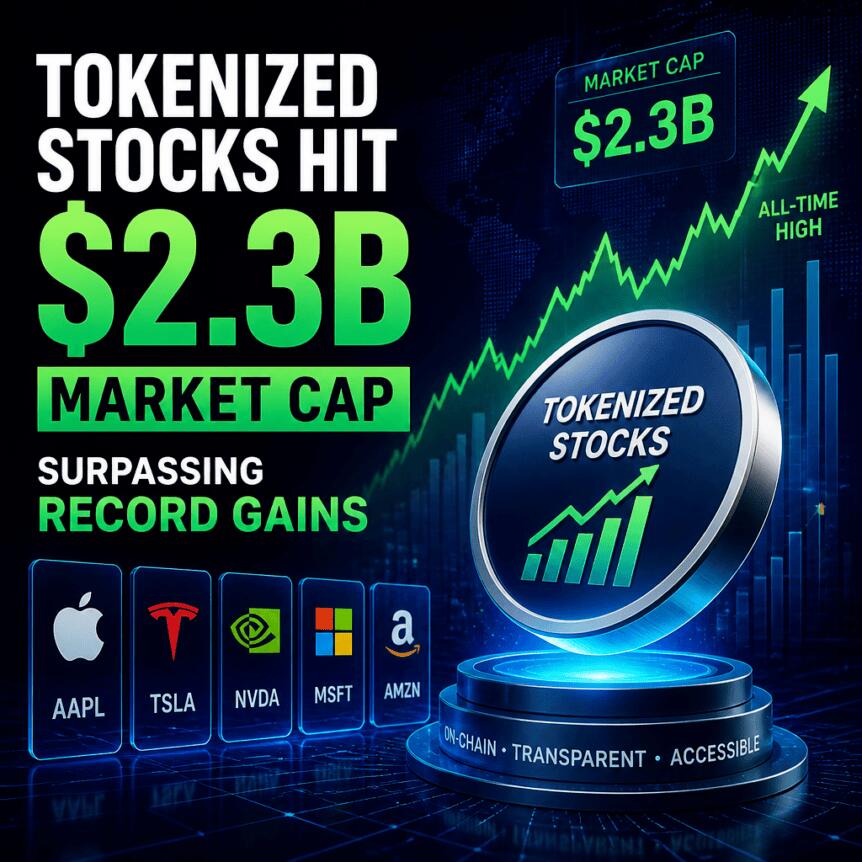
Tokenized stock products are continuing to gain traction even as wider crypto markets fluctuate. According to data aggregator Token Terminal, the total market capitalization of tokenized stocks climbed to a record $2.3 billion on Wednesday, reflecting renewed demand for blockchain-based access to equities.
The Ethereum ecosystem led the distribution of tokenized-stock market value with a 34% share, followed by BNB Chain at 30% and Solana at 23%, Token Terminal said in an X post. As more platforms expand “multi-asset” offerings, the shift highlights how tokenized equities are increasingly being treated as a mainstream bridge between traditional finance and onchain infrastructure.
Key takeaways
- Tokenized stocks reached a record $2.3 billion market capitalization, signaling stronger institutional-style exposure to equities onchain.
- Ethereum remains the largest venue for tokenized stocks by share (34%), with BNB Chain (30%) and Solana (23%) close behind.
- Kraken’s xStocks and Binance’s bStocks are among the biggest contributors to tokenized-stock market value, while Ondo Finance remains the top issuer.
- Despite rapid growth in tokenized real-world assets (RWAs), stocks still represent only about 5.5% of the overall tokenized RWA market.
Tokenized stocks hit a new high as access expands
The record figure—$2.3 billion—adds to a broader pattern of capital moving into tokenized versions of traditional financial instruments. Token Terminal’s breakdown points to a multi-chain race for distribution, with Ethereum still setting the pace for market share.
The issuer landscape also shows where liquidity is concentrating. Token Terminal data indicates Ondo Finance is the largest tokenized stock issuer, with $955 million in onchain equities. Two other large products—Kraken exchange’s xStocks and Binance’s bStocks—account for substantial portions of tokenized-stock market value, at $507 million and $334 million respectively, according to Token Terminal’s figures.
For investors, the practical appeal of tokenized stocks is often tied to two features: fractional ownership and the potential for faster, more continuous trading compared with traditional market schedules. For platforms and developers, these same characteristics support a broader product strategy—bringing familiar asset classes onto blockchain networks without requiring users to interact directly with settlement layers.
Which chains and products are driving tokenized-equity adoption
Token Terminal’s chain-level shares show a distribution that is increasingly difficult to ignore. Ethereum’s 34% share underscores that tokenized equities still find deep liquidity on the network with the longest track record for onchain asset issuance and trading. However, BNB Chain’s 30% share indicates that large centralized exchange ecosystems are successfully positioning themselves as distribution channels for tokenized financial products.
Solana’s 23% share suggests that speed and low fees—often associated with the network’s design—remain a meaningful part of the user experience for tokenized assets. Together, the three networks account for 87% of tokenized stock market share in Token Terminal’s dataset, implying that competition for tokenized-equity flows is currently concentrated rather than fragmented across dozens of chains.
On the product side, Kraken and Binance stand out for the scale of their tokenized equity offerings. Token Terminal’s numbers place Kraken’s xStocks as the largest single category contribution ($507 million), ahead of Binance’s bStocks ($334 million). These figures reinforce how exchange-led distribution can materially accelerate adoption by lowering friction for retail and active traders.
Push toward traditional assets keeps widening the onchain map
The tokenized-stock surge sits inside a larger expansion of crypto platforms adding regulated-style investment products to blockchain rails. Binance, for example, has been moving toward a multi-asset platform model. Earlier coverage noted that Binance opened zero-commission trading for eligible users in tokenized stocks—covering more than 7,000 US tokenized stocks—beginning June 1, as part of that strategy.
Coinbase has also signaled its intent to compete in traditional asset access. The exchange rolled out commission-free US stock and ETF trading with 24/5 availability in December 2025, according to its own update on its system changes. While these developments differ in implementation details from tokenized onchain equity products, they contribute to the same competitive direction: mainstream crypto platforms seeking to offer familiar “traditional” instruments in an exchange-like experience.
Kraken’s progress has likewise been rapid. Earlier reporting described Kraken launching access to 11,000 US-listed stocks and ETFs through xStocks in April 2025, positioning it as one of the first major crypto-native platforms to do so. That reporting also stated that cumulative xStocks trading volume exceeded $25 billion within about eight months of launch—an indicator of how quickly demand can build when liquidity and product choice meet user access.
Beyond stocks, tokenization efforts are showing up in other asset classes tied to traditional finance. For instance, in April, Bitget launched a proxy offering related to the pre-initial public offering phase of Elon Musk’s SpaceX. In January, Bitpanda outlined plans to expand its offering to include roughly 10,000 stocks and exchange-traded funds (ETFs). Earlier coverage from Cointelegraph also documented these moves as part of the broader push to bring traditional exposure onto blockchain-connected platforms.
Tokenized RWAs keep growing, but stocks are still a minority
Even with tokenized stocks hitting new highs, broader tokenized real-world assets (RWAs) remain dominated by fixed-income and cash-like instruments. Binance Research, in a June report, found that the tokenized RWA market surged 589% from early 2025 to June 2026. The growth was led by government bonds and money market funds.
In the same period, tokenized precious metals reportedly attracted about $1.5 billion in value, rising 39% during the timeframe. Those figures point to an increasingly diversified tokenized-assets landscape rather than a market focused exclusively on equities.
Still, stocks are a small piece of the total pie. The source data indicates that stocks account for roughly 5.5% of the $34 billion tokenized RWA market capitalization. In other words, tokenized stocks may be expanding quickly, but most tokenized RWA capital continues to flow into categories such as US Treasury debt.
According to RWA.xyz data cited in the report, about $15 billion in tokenized US Treasury debt is the largest segment—44% of the RWA market. Tokenized commodities represent a smaller share at $4.5 billion (13%). For readers, this matters because it helps explain why tokenized-stock headlines—while important—should be interpreted within a market where fixed income and cash-management-style products are currently the primary growth engines.
Going forward, investors should watch whether tokenized stocks can convert broader RWA growth into more sustained equity share, and whether chain distribution changes as exchanges scale their product offerings. The key unknown is how quickly tokenized equities can expand from a niche slice of RWAs into a larger allocation category without running into liquidity fragmentation or regulatory friction across jurisdictions.



- Ondo Finance (ONDO) jumps nearly 16% as trading volume approaches $290 million.
- DTCC-backed tokenised stocks strengthen institutional adoption.
- Bulls eye $0.50 if ONDO reclaims the 200-day EMA.
ONDO token extended its rally on Wednesday after a series of institutional developments strengthened confidence in the real-world asset (RWA) sector.
The token climbed nearly 16% over the past 24 hours to around $0.3737, reaching the upper end of its daily trading range of $0.321 and $0.376.
The price surge comes as Ondo Finance unveiled a new tokenised stock offering backed by infrastructure tied to the US Depository Trust Company (DTC).
The rally has also been accompanied by a sharp increase in trading activity.
ONDO recorded approximately $289.6 million in 24-hour trading volume, reflecting stronger market participation as investors responded to the latest developments.
DTCC-backed tokenised stocks mark a major milestone
The biggest catalyst behind ONDO’s recent gains is Ondo Finance’s launch of tokenised stocks backed by DTC Tokenised Entitlements, introducing a model that connects blockchain-based assets with the infrastructure used by traditional US capital markets.
Unlike many existing tokenized equity products, these digital assets are designed to maintain the same CUSIP numbers and ticker symbols as their underlying securities.
This approach is intended to improve compatibility with existing financial market systems rather than creating a separate blockchain-only ecosystem.
The announcement also highlighted Ondo Finance’s participation in a broader tokenisation initiative involving major financial institutions and market infrastructure providers.
We’re excited to announce that Ondo has launched the first tokenized stock representations based on DTC tokenized entitlements to DTC-held securities generated through the DTCC Tokenization Service.
The Depository Trust & Clearing Corporation (DTCC) is the premier post-trade… pic.twitter.com/r7KcGmDqa9
— Ondo Finance (@OndoFinance) July 15, 2026
Companies including BlackRock, JPMorgan, Goldman Sachs, Nasdaq, and the New York Stock Exchange (NYSE) are participating in efforts surrounding tokenised financial assets, underlining growing institutional interest in blockchain-based securities.
As the DTCC’s tokenization infrastructure expands, Ondo Finance plans to distribute tokenized stocks across exchanges, wallets, and decentralized finance applications, widening access to on-chain financial products.
Rising institutional interest supports ONDO’s momentum
The tokenised stock announcement builds on Ondo Finance’s growing presence in the real-world asset market.
The protocol has already established itself as one of the leading platforms for tokenised US Treasury products, and investors are increasingly watching its expansion into tokenised equities.
The broader RWA sector has continued to attract institutional capital as firms explore blockchain technology to improve settlement efficiency and expand access to financial products.
Another factor supporting attention around the ecosystem is the discussion surrounding a proposed 10% ONDO token burn, although no final decision has been made.
The proposal has become one of several developments investors are monitoring alongside continued institutional adoption.
The ecosystem has also benefited from demand for tokenized Treasury products that offer yields of around 5.2% APY, reinforcing interest in blockchain-based financial instruments backed by traditional assets.
The technical picture improves after the breakout
Beyond the fundamental developments, ONDO’s technical structure has strengthened.
The token is now trading close to the top of its recent weekly range of $0.305 to $0.376, while the latest rally pushed the price back above the widely watched 100-day Exponential Moving Average (EMA) though it still remains below the 200-day EMA.

Reclaiming the 200-day EMA would confirm the bullish trend after the prolonged decline.
However, the price surge has been supported by higher trading volume, suggesting that buying activity has accompanied the breakout rather than a low-liquidity price spike.
Eyes are now on the $0.50 level as the next significant resistance area.
A sustained move toward that level would require ONDO to maintain its recent momentum after recording gains of 15.9% over the past seven days and 11.8% during the last two weeks.


Keyrock, a digital-asset services firm, acquired the trading and brokerage assets of BlockFills’ institutional digital asset business, bolstering its push into institutional crypto markets, the company said in a press release Thursday.
The completed transaction adds BlockFills’ client relationships, trading technology and derivatives expertise to Brussels-based Keyrock’s existing businesses spanning market making, over-the-counter (OTC) trading, options, credit, onchain services and asset management.
CoinDesk reported in June that Keyrock was in the process of acquiring Chicago-based crypto trading and lending firm Blockfills. According to a bankruptcy filing, Keyrock agreed to pay $3.25 million for substantially all of BlockFills’ assets, while assuming certain liabilities, equity interests, customer relationships and proprietary technology.
The acquisition broadens Keyrock’s regulatory reach through a CIMA-registered entity in the Cayman Islands and the proposed acquisition of an FCA-authorized entity in the U.K., subject to regulatory approval.
The company said the combined platform will offer institutional clients enhanced execution capabilities backed by Keyrock’s balance sheet and regulatory infrastructure.


As a former financial regulator, I understand that no law can prevent every market failure or stop every bad actor. Fraud exists in every market, at every scale, but strong rules can mitigate the worst outcomes. They give regulators visibility, set obligations for companies before consumers engage with their products, and require firms to operate with basic and enforceable accountability. The bill is often described as crypto market structure legislation. That description is accurate, but it doesn’t capture the full scale. Market structure is the legal architecture that determines who must register with which agency, who supervises the market, what firms owe their customers, how assets are protected, what disclosures must be made, and what happens when something goes wrong.
Today, millions of Americans already use digital asset exchanges, brokers, dealers, and custodians. They open accounts, buy and sell assets, rely on platforms to execute transactions, and often trust intermediaries to hold their property. If those businesses are going to serve American consumers, they should operate under clear federal rules.
The Clarity Act would create those rules. Digital asset intermediaries would have to register, meet capital and risk-management standards, keep records, disclose material information to retail customers, monitor markets, address conflicts of interest, and follow conduct rules covering fraud, manipulation, marketing, supervision, and fair pricing. Those are basic safeguards in mature financial markets. They should apply here too.

A live feed shows SpaceX CEO Elon Musk on the day of SpaceX’s initial public offering (IPO) at the Nasdaq MarketSite, in New York City, U.S., June 12, 2026.
Jeenah Moon | Reuters
Short sellers are rapidly increasing their bets against SpaceX, driving bearish positioning to nearly one-third of the company’s public float as the struggling stock hovers around its IPO price.
About 185 million SpaceX shares are now sold short, representing roughly 29% of the company’s publicly tradable float and about $25 billion in bearish wagers, according to S3 Partners. The position has ballooned from an estimated 40 million shares, or roughly 5% to 7% of the float, just three weeks ago.
“We are seeing continuous demand from short sellers building speculative positions since the IPO,” Matthew Unterman, head of research at S3, told CNBC.
The surge in short interest comes as SpaceX shares have struggled after an initially strong debut. The stock has fallen about 20% in July and briefly slipped below its $135 IPO price on Wednesday for the first time. The stock last traded around $136 apiece.

SpaceX one month
The bearish positioning comes ahead of a closely watched lockup schedule that could substantially increase the number of shares available for trading over the coming months. SpaceX’s initial public float represented only about 5% of its roughly 13 billion shares outstanding, leaving the vast majority of stock still subject to lockup restrictions, according to KeyBanc Capital Markets,
KeyBanc estimated the first major unlock could come around the company’s second-quarter earnings report, when about 11% of outstanding shares may become eligible for sale.
Additional tranches of roughly 4% each are scheduled to be released beginning around day 70 after the IPO, followed by further unlocks tied to performance milestones and third-quarter earnings, the firm said.
The largest block remains Elon Musk’s stake, representing about 42% of shares outstanding, which is locked up until June 2027.
The company’s 13th Starship test flight is slated for Thursday, an catalyst that could influence sentiment toward the shares.
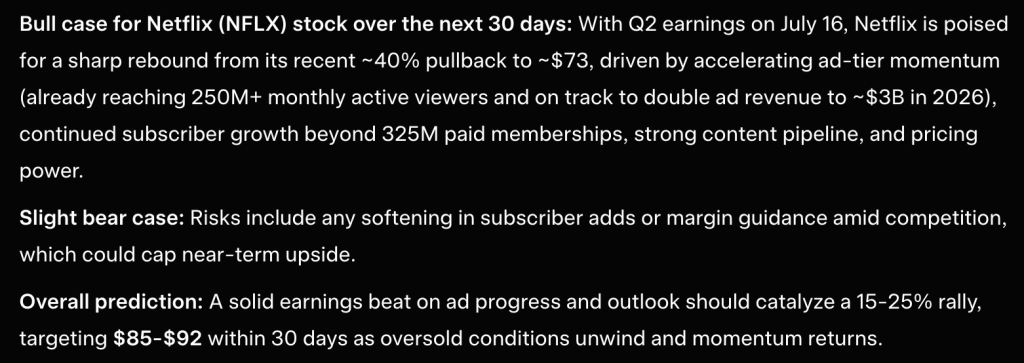
Elon Musk’s Grok AI looked at Netflix trading at $73.83 and predicts for $85 to $92 price prediction within 30 days. That is a 15% to 25% rally on a stock that just gave back 40% of its value.
The bull case hangs entirely on the July 16 earnings print. Grok argues the ad tier is the engine nobody is pricing correctly. It already reaches over 250M monthly active viewers and is on track to double ad revenue to roughly $3B in 2026.
Paid memberships sit above 325M and keep climbing. The content pipeline stays deep and pricing power has not cracked. Stack those and you get a company whose fundamentals never justified a 40% haircut. Grok AI predicts thesis is simple.

A clean beat on ad progress plus a confident outlook unwinds oversold conditions fast. Momentum names snap back hard once the fear trade gets a reason to leave.
The bear case is thinner, but it is nothing. Grok flags any softening in subscriber adds or a wobble in margin guidance as the thing that caps upside.
Competition is real, and it eats at the edges of both numbers. If management sounds even slightly defensive on margins, the rebound thesis dies on the call. Netflix does not need a bad quarter to disappoint here. It just needs to sound uncertain.
Discover: The Best Crypto to Diversify Your Portfolio
Netflix Stock Price Prediction: Why July 16 Is The Only Date On This Chart That Matters
Structure tells you exactly where we are. Netflix topped near $133 in July 2025 and has printed a long, ugly staircase of lower highs since. November broke it.
March found a floor around $77. May staged a rally to $108 and failed hard, which confirmed the downtrend was still in charge. Now price closed at $73.83, up 0.63%, with the session range between $73.71 and $75.45.
That is a descending channel with the price sitting at the bottom rail. The bounce from $77 in March is the pattern to watch, because we are testing that shelf again from below.

Support is right here at $73, then $70, then the $68 zone. Resistance stacks at $77, then $80, then $84. RSI reads roughly 36 with the signal line near 40.
The gap is negative but shallow, which means selling pressure is fading rather than accelerating. That is what a base looks like before it decides. Momentum is oversold but has not turned.
Grok AI $85 to $92 predicts the earnings needed to turn. Reclaim $80 on the print, and that target is live. Fail there, and $70 comes first.
Don’t Miss Out on Our $1,000 USDT Airdrop on ByBit
LiquidChain Is Catching the Attention of Netflix holders: ChatGPT AI Predicts It’s the Next 100x
The rotation is already happening. Most people will only see it in hindsight.
Large-cap crypto is not failing. It is capped. Bitcoin, Ethereum, and XRP have been pressing against the same resistance bands for weeks. The macro tailwinds keep getting delayed.
The institutional inflows keep getting pushed to next quarter. Holding assets where the upside depends on catalysts you cannot control is not a strategy. It is waiting.
A capital that has navigated enough cycles does not wait at resistance. It moves before the destination becomes obvious.
Early-stage infrastructure plays operate on different math entirely. A small enough market cap means a modest rotation produces dramatic price movement. The asymmetry exists because the market has not priced in what is being built yet. That gap between current valuation and what the project is actually worth is where the returns come from.
Multi-chain fragmentation costs DeFi real money every single day. Bitcoin, Ethereum, and Solana run completely isolated liquidity systems with no native way to connect them. Every user moving value between ecosystems absorbs that cost directly in fees, slippage, and failed transactions.
LiquidChain collapses all 3 networks into a single execution layer. One deployment. Full ecosystem access. No cross-chain tax on every interaction.
The market has not found this yet. That is the entire point.
The presale is at $0.01454 with just over $820,000 raised. Ground floor is not a marketing phrase here. It is a description of where this actually sits in its lifecycle.
Execution is unproven. Adoption is unknown. Those risks are real and worth naming directly. Established assets offer a smoother ride toward a ceiling that is already visible. This offers an earlier seat
Explore the LiquidChain Presale
The post Elon Musk Grok AI Predicts Incredible Netflix Stock Price by Next 30 Days appeared first on Cryptonews.

MoonPay has acquired the crypto infrastructure startup Glide, integrating Glide’s deposit and routing technology, the companies said in a joint announcement shared with Cointelegraph on Thursday.
MoonPay, a financial technology platform that provides fiat-to-crypto payment services, said the deal is part of MoonPay’s broader effort to become a digital asset infrastructure provider, adding capabilities beyond its original crypto payments business.
Glide was founded in 2023 by Tushar Soni and Qinyu Tong, former members of the team behind Robinhood Wallet. The company was founded to help applications accept deposits from different tokens, wallets, exchanges and payment sources. Glide supports more than 100 tokens across 30 blockchain networks, according to the platform’s documentation.
Glide aims to remove friction from crypto deposits
Soni and Tong founded Glide to solve recurring problem they observed while working with Web3 consumer startups, where users struggled to fund their wallets, Soni told Cointelegraph.
“Funds sat on the wrong chain, in the wrong token, on an exchange, or on a card, and every deposit meant bridges, swaps, and drop-offs,” he said.
The Glide co-founders met at Robinhood, where they worked together on Robinhood Wallet. “We got into Y Combinator with a plan to build wallet infrastructure for Web3 consumer startups, but working with those startups showed us that users struggled to get money into their wallets,” Soni said.

Qinyu Tong (left) and Tushar Soni. Source: Y Combinator
Glide eventually shifted its focus from wallet infrastructure to building a unified deposit flow that allows users to fund wallets from different chains, tokens, wallets, exchanges or cards without manually completing bridges and swaps.
MoonPay pushes deeper into digital asset infrastructure
Following the acquisition, Glide’s technology will be integrated into MoonPay Deposits, a product already used by applications including Wallet in Telegram, Moonshot and Paysafe.
MoonPay CEO and co-founder Ivan Soto-Wright told Cointelegraph the acquisition fits into the company’s broader infrastructure strategy, following recent deals for security, trading and accounting capabilities.
Related: Robinhood Chain sees over $70M in ETH bridged during first week
“Every acquisition this year has added a layer of the infrastructure that businesses and their users need to operate with digital assets: moving money, securing it, trading it, accounting for it,” Soto-Wright said.
He added that Glide addresses one of the biggest pain points in crypto transfers: users losing funds because they send the wrong token on the wrong chain, predicting that future blockchain-based platforms will require infrastructure that makes those complexities invisible.
MoonPay has not disclosed the financial terms of the Glide acquisition.
The deal marks MoonPay’s sixth acquisition announcement of 2026, as the company continues expanding its digital asset infrastructure stack through acquisitions including Sodot, Decent and DFlow, Entendre and Dawn Labs.
Its investors include Thrive Capital, Paradigm, Valhalla Ventures, Tiger Global Management and Coatue, according to startup data platform Tracxn.
Former acting chair of the US Commodity Futures Trading Commission, Caroline Pham, was named chief legal officer and chief administrative officer late last year.
Magazine: Is Robinhood Chain’s success bullish or bearish for ETH the asset?

Tax season is upon us, and with that, every investor is scrambling to file their Income Tax Returns (ITR) correctly. For crypto investors, this is a particularly tricky task because there is very little room for error. With the July 31 deadline looming, crypto investors must carefully review their tax records and avoid common mistakes such as failing to report, incorrectly calculating their gains, or using the wrong ITR schedule.
The Current State Of Crypto In India
Crypto in India has existed in a somewhat of a regulatory dead zone since 2018 after an Indian court struck down Reserve Bank of India (RBI) directives that effectively shadowbanned cryptocurrencies. The directives were issued in a circular titled Prohibition on Dealing with Virtual Currencies and instructed financial institutions to stop providing services to businesses engaging with cryptocurrencies.
The directive rendered fiat-to-crypto rails inoperable, and crypto exchanges were forced to scale back operations and rely on alternate avenues after banks severed their relationships with crypto-related businesses and exchanges. Despite the court ruling striking down the directives, the unofficial ban remained in place, with the RBI repeatedly issuing verbal warnings directing lenders to withhold services to the industry. The warnings led several major banks to sever relationships with crypto exchanges, and were one of the reasons Coinbase discontinued services and halted onboarding new users. The exchange has since restarted its operations in India.
The RBI recently reiterated its support for policies favoring banning crypto in India, and wants banks and financial institutions in the country barred from exposure to crypto and private stablecoins to limit risks to the country’s financial system. The Income Tax Department has also reported concerns around the misreporting of crypto assets in tax filings, further muddying the already muddled crypto industry in India.
India’s Tax Framework For Crypto
India has one of the strictest tax regimes for crypto. The Union Budget for 2026 retains the Virtual Digital Asset tax structure introduced in 2022, but tightens reporting obligations and introduces new penalties for non-compliance. The new provisions and penalties came into effect on April 1, 2026. Under the new framework, failure to furnish crypto transaction statements attracts a penalty of Rs. 200 per day. Inaccurate information about crypto transactions, or failing to correct such information, attracts a flat penalty of Rs. 50,000.
Now, let’s get into the crux of this article. India has established one of the most definitive tax regimes for crypto, and investors must stay updated on evolving income tax compliance rules. India taxes crypto assets under Section 115BBH of the Indian tax code, a section that has no provisions for reduced tax rates. The section also limits deductions to the asset’s acquisition cost, and investors cannot claim any other deductions when calculating their taxable income.
India imposes a flat tax rate of 30% on profits earned by selling, swapping, or spending crypto. Crypto transactions are also subject to an additional 4% health and education cess. Additionally, a 1% Tax Deducted at Source (TDS) is levied on all VDA transfers to ensure tax compliance. TDS is applicable on individual and institutional crypto transactions.
Let’s understand how this works. Assume a trader makes a profit of Rs. 1,00,000 on Bitcoin (BTC), but reports a loss of Rs. 50,000 on Ethereum (ETH). Indian tax law mandates the trader pay tax on the Rs. 1,00,000 and not on the Rs. 50,000. This is because traders cannot offset the Rs. 50,000 loss, a rule that catches most traders unaware. Traders can only deduct the asset’s acquisition cost. Deductions like brokerage, internet costs, and platform fees cannot be claimed.
Next, let’s discuss TDS. TDS is a tax collection mechanism where a percentage of tax is deducted at the point of income and remitted to the government. TDS helps the government track crypto trading and transactions, and is considered an advance tax. TDS deducted is reflected in Form 26AS and the Annual Information Statement (AIS). Traders can claim a refund if their tax liability is lower than their TDS. However, if their tax liability is higher, they must pay the difference.
Under the revised Income Tax Regulations for Crypto in India, crypto asset sales are subject to a 1% TDS. The rule came into effect on July 1, 2022, and applies to both individual and institutional transactions of crypto assets. It is important to note that TDS applies to crypto transactions above a specified threshold (Rs. 50,000 and Rs. 10,000 in specific cases). TDS is deducted automatically on Indian transactions. However, the responsibility of deducting and depositing TDS falls on the buyer in P2P transactions.
Additionally, a 4% Health and Education Cess is applied on the 30% flat tax on crypto, bringing the effective tax rate to 31.2%. Here’s an example to help you understand how the cess is applied. Let’s assume a trader makes a profit of Rs. 100, which attracts a flat 30% tax, making the base tax Rs. 30. A 4% cess on the Rs. 30 tax is Rs. 1.20, bringing the effective tax to Rs. 31.20.
Tax On Crypto Mining, Gifts, Airdrops, And Staking
This is an oft-ignored area when it comes to crypto tax. It is also likely to trigger the most notices to unsuspecting traders. Let’s look at the tax liability for each.
Staking or mining income is considered income at the fair market value on the date of receipt. This income is taxed according to the applicable income tax slab, not at the flat 30% rate. However, if the trader sells their staked tokens, the profit over the value at which they were originally taxed is taxed at 30%. Airdrops are also considered income at the fair market value on the date of receipt, and are taxed accordingly.
However, crypto received as a gift is taxed slightly differently. If the value exceeds Rs. 50,000, it is taxed as income from other sources. However, crypto received as a gift from relatives (spouse, siblings, parents) is exempt. When the gifted crypto is sold, the original buyer’s acquisition cost is considered the cost basis.
Cost Basis Method
The taxation rules have been relatively straightforward so far. Now, we’re getting into slightly complicated territory. What happens when a trader has purchased a cryptocurrency at different prices over time, and wishes to sell? In such a scenario, what would be the trader’s purchase price?
India uses the FIFO (First-In First-Out) method for crypto transactions. This method assumes that the oldest items, or in this case, cryptocurrency, are sold first and is used to determine the cost basis. The FIFO method is the default accounting method in several countries, including India. Let’s understand how this method works.
Suppose a trader purchases a coin for Rs. 1,000 in January. The trader then purchases another coin for Rs. 2,000 in February before selling one coin for Rs. 4,000. Under the FIFO method, the coin purchased in January was the first-in and will be treated as the first-out. This means the trader’s cost basis is Rs. 1,000 and results in a taxable gain of Rs. 3,000 (4,000 – 1,000 = 3,000).
Reporting Crypto Transactions
Crypto transactions in India are reported under Schedule VDA, introduced specifically for digital assets. Traders must report the following:
- Date of acquisition of assets
- Date of transfer of assets
- Cost of acquisition
- Sale consideration
- Profit and loss, noting that losses cannot be set off
Salaried individuals with crypto gains must file ITR-2, while businesses with crypto income and entities with crypto as their business income must file ITR-3.
Non Compliance
India has implemented stricter penalties for failure to report their crypto income accurately. The Union Budget 2026 introduced daily fines for cryptocurrency exchanges and other reporting entities if they failed to submit transaction data. It also implemented additional penalties on incomplete or inaccurate disclosures.
Individual taxpayers who don’t report their crypto gains will be scrutinized under Section 148 and be liable for penalties up to 200% of the tax evaded if it is found that they deliberately concealed their gains. Exchanges operating in India must also register with the Financial Intelligence Unit (FIU), putting crypto firmly in the eye of the tax authorities.
In Closing
India’s Union Budget 2026 reinforces the need for reporting crypto transactions to the relevant authorities, heavily penalizing inaccurate reporting and non-compliance.
Despite the uncertainty around crypto in India, it has implemented one of the most comprehensive tax frameworks governing the industry. Investors must be aware of reporting requirements, tax rates, and potential penalties. India’s tax framework is constantly changing as the government engages with stakeholders to draft a comprehensive regulatory framework for the industry. Keeping up with the evolving tax and regulatory landscape is crucial when making crypto transactions in India. Complete your ITR filing before the July 31 deadline to avoid any unnecessary delay.
Disclaimer: This article is provided for informational purposes only. It is not offered or intended to be used as legal, tax, investment, financial, or other advice. Please consult a qualified tax professional or chartered accountant before making filing decisions.
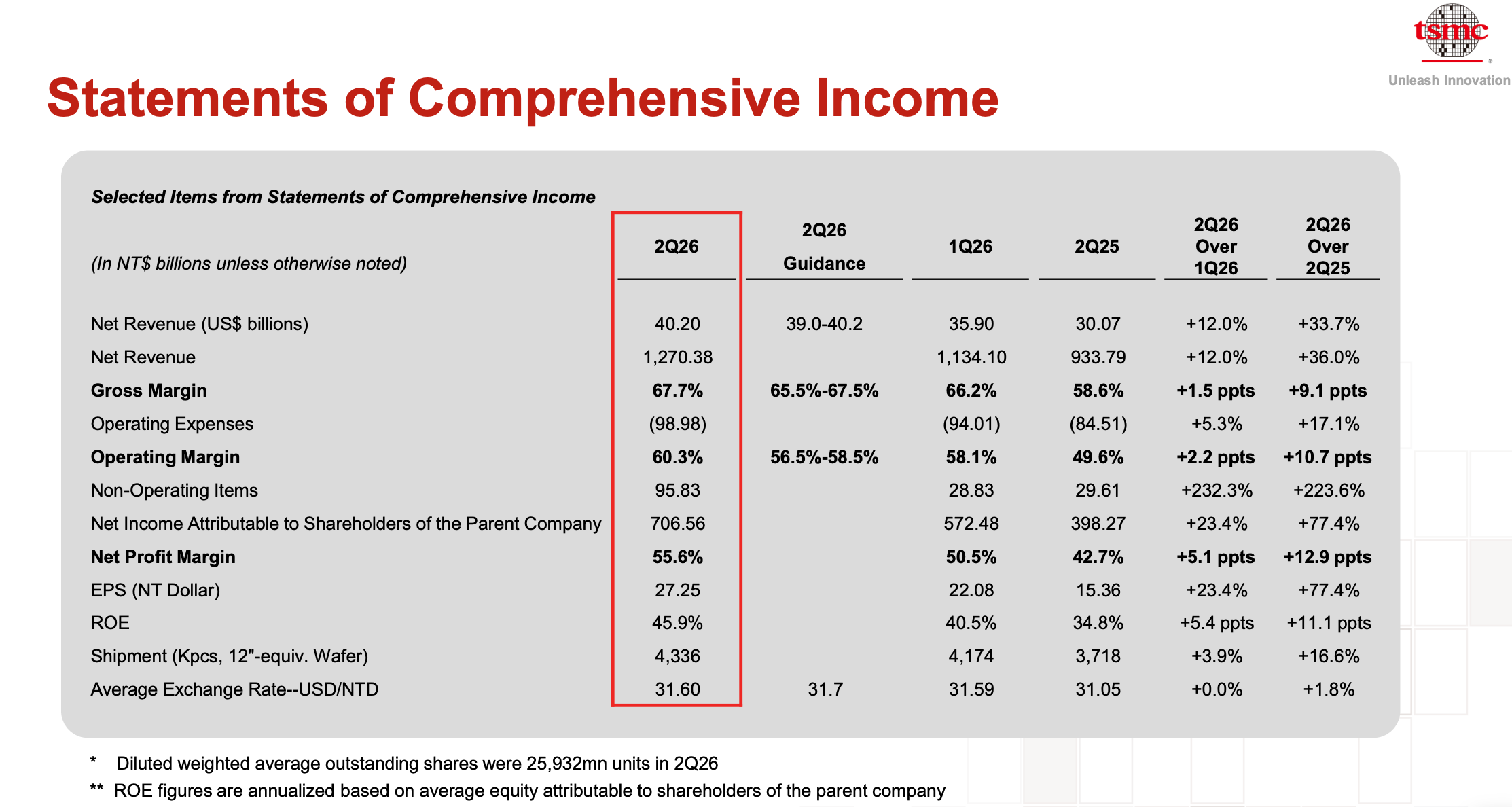
Taiwan Semiconductor Manufacturing Co. (TSMC) raised its full-year 2026 revenue growth guidance to slightly above 40%, up from more than 30%, after the second-quarter profit hit a record, and artificial intelligence (AI) chip demand held firm.
The chipmaker raised its 2026 capital spending target to between $60 billion and $64 billion. It also pledged a further $100 billion for chip factories in Arizona.
Record Profit Sets Up the Guidance Raise
TSMC posted second-quarter net income of NT$706.56 billion, a 77.4% jump from a year earlier. The result beat the NT$632.6 billion analyst forecast and marked a record high.
Profit also climbed 23.4% from the prior quarter, a fifth straight quarterly record. Revenue reached NT$1.27 trillion, or roughly $40 billion, up 36% year-on-year.
Follow us on X to get the latest news as it happens

Gross margin came in at 67.7%, above the company’s guided range. June capped the quarter as its strongest month, with revenue of NT$442.68 billion ($13.7 billion).
The stronger figures gave management room to lift its outlook. TSMC now expects 2026 capital spending of $60 billion to $64 billion. That is up to 14% above its prior $56 billion ceiling.
For the third quarter, TSMC guided revenue of $44.6 billion to $45.8 billion.
What TSMC’s 2026 Revenue Guidance Signals for Chip Demand
The figures matter beyond the headline. TSMC’s spending plans and margins act as a read on where chip demand is heading.
For now, the guidance raise points to a firm underlying demand. Analysts said orders for TSMC’s 3-nanometre and 2-nanometre process technologies remain strong. Interest in its CoWoS packaging is also holding up well.
The capital spending increase carries added weight. TSMC committed an additional $100 billion to Arizona, adding to $165 billion already set aside for factories there. The scale suggests management sees the AI buildout as durable rather than a short-cycle project.
“This is to build several or more semiconductor logical wafer fab for two nanometer MP [mass production] technologies, as well as advanced packaging fabs to support the strong multi-year demand from our leading U.S. customers,” said TSMC Chairman C.C. Wei.
Because TSMC supplies the most advanced AI chips, the twin raise reads as a green light for customers. That includes Nvidia, AMD, and other chip designers.
Still, the aggressive commitment raises the stakes. If AI spending slows, TSMC would feel it late, having added capacity at peak utilization.
The next test comes with third-quarter results, which will show whether the $45 billion revenue pace holds.
Subscribe to our YouTube channel to watch leaders and journalists provide expert insights
The post TSMC Raised Its 2026 Revenue Guidance: What It Means for AI Chip Demand appeared first on BeInCrypto.


There hasn’t been much to celebrate in crypto recently, but a mid-week algorithm adjustment on X, the industry’s most popular social media network, is cause for legitimate celebration. Crypto Twitter (CT) is back.
Six months ago, some members of CT decided X Head of Product Nikita Bier had murdered their social network. This week, he resurrected it, and the same crowd is overjoyed.
Bier shipped an algo change this week that he called a “tweak to boost visibility of your posts to your mutuals (people who you follow back).” That algo change is seeing X users “sending double our average of original posts & replies,” Bier disclosed.
Many users first noticed its impact on Tuesday and Wednesday.
The reply section, he wrote, had been feeling like “a battleground with people you don’t recognize.” The change pushes mutuals and more familiar accounts, especially people a user follows, back into the main feeds of the X website and app.
The reaction from crypto influencers was immediate and euphoric.
A rare moment of joy for Crypto Twitter
Influencers were first to notice the change, especially the Bitcoin element of CT.
Joe Consorti saluted, “Welcome back, Bitcoin Twitter.” Bitcoin Archive cheered, “Bitcoin Twitter is back… Let me know if you’re still here!” and drew 1,800 likes.
Meanwhile, a Bitcoin conference promoter rhetorically wondered whether any Bitcoiners could see his post, earning over 1,400 likes.
Soon, brands seized the opportunity for engagement. Coinbase posted, “Like this post to put crypto twitter back on your feed” to more than 4,000 likes.
MoonPay went all caps, declaring “BREAKING: CRYPTO TWITTER IS BACK.” Ledger asked followers, “what’s up with crypto twitter.”
Others treated the feed as a resurrection machine. Layah Heilpern marveled at seeing “crypto accounts that I haven’t seen in years,” then accused X of having “basically shadow banned all of crypto twitter” with prior algorithmic changes.
One user put it plainly, “They fixed the algo.”
For the summer, the algorithm is un-breaking. The reverse chronological feed is making a comeback.
‘Double our average of original posts & replies’
Bier claims that, aside from giving feedback, he hasn’t modified the algorithm significantly since joining X, placing responsibility mostly on xAI.
This week’s change was among the first experiments that he championed himself.
The test went live on a Friday and shipped late Monday.
The mutuals signal of followers had simply downranked, which is why friends and mutual follows appeared less in replies. Restoring it, he argued, would help “clusters form around interests more easily, which many people have asked for.”
The self-reported scoreboard after pushing the algo change was modest. Bier listed replies up 3.15%, original posts up 1.8%, and small-account reach up 1.19%.
Then came the critical anecdote and a percentage increase in the triple digits.
After an X user posted that she had replied to more posts in one day this week than in the prior three months, Bier answered that users were “sending double our average of original posts & replies.”
It was a rebirth announcement for CT.
Read more: Crypto Twitter says Nikita Bier killed X — and ‘gm’
Crypto Twitter battled, now applauds Nikita Bier
The celebration is remarkable mostly because the same community spent January eviscerating Bier.
Protos documented how CT momentarily decided Bier had killed their area of the social network. That same incident captured a viral claim that he considered “gm,” a common greeting within CT, as a waste of reach.
Critics dismissed Bier as unable to fix his own product.
Moreover, as Protos reported, a January algorithm change coincided with crypto posting volume briefly exploding from a few hundred thousand a day to more than 13 million, as bot armies flooded onto the X timeline.
Elon Musk vowed to publish a code fix within a week. CT members blamed Bier for the failure.
The complaint that the feed was rigged persisted over the past few months. Even if accounts were never banned outright, many members of CT searched for evidence of shadow bans and other algorithmic deprioritization of crypto content.
They felt outranked by strangers outside of the industry that the X algorithm preferred.
Relieved, Bitcoiners and other members of CT now see more posts from the people they follow. The algo is prioritizing a reverse chronological feed of followed users and mutuals for the first time in many years.
X spaces host Wicked Bitcoin admitted that X is back, alongside countless other posts with hundreds of likes apiece.
Got a tip? Send us an email securely via Protos Leaks. For more informed news and investigations, follow us on X, Bluesky, and Google News, or subscribe to our YouTube channel.


ZachXBT says an old iPhone beats any hardware wallet for storing crypto. Tornado Cash developer Roman Storm agrees, but says one missing feature breaks the whole iPhone wallet plan.
That feature is the BIP39 passphrase. It is a secret extra word that hides your real wallet behind an empty one.
The One Feature the iPhone Wallet Plan Is Missing
The on-chain investigator’s frustration has a track record behind it. Bybit lost $1.5 billion in February 2025 after attackers tricked its signers into approving a bad transaction. The keys stayed safe. The money is still left.
“All hardware wallets are complete garbage and I do not advise using them for important tasks like signing transactions or storing funds. Much better to have a separate iPhone with its only purpose being to use as your hardware wallet,” ZachXBT noted.
Follow us on X to get the latest news as it happens
Storm liked the idea. However, his reply comes with a warning.
“I’d agree – if there were actually a mobile app with BIP39 passphrase support.”
Here is why that matters. Your seed phrase is 12 or 24 words, usually written on paper. Add a passphrase, and those same words open a completely different wallet.
So a thief who finds the paper sees an empty account. One UK holder lost roughly $172 million after his Trezor recovery phrase appeared on home CCTV. A passphrase would have made that recording worthless.
The threat is growing, too. Chainalysis logged 158,000 personal wallet compromises in 2025, nearly triple 2022’s count. Those attacks hit 80,000 victims for $713 million. Moreover, one seed phrase vulnerability alone drained $3.1 million this month.
Hardware Wallets Have It. Mobile Wallets Don’t
Storm listed the split. Trezor, Ledger, Coldcard, Keystone, and BitBox all support passphrases. Meanwhile, MetaMask has ignored requests since 2021. Trust Wallet skips it, too. Rabby only offers it on desktop, leaving AirGap Vault as the lone mobile option.
His fix is simple. Mobile wallets should support passphrases and air-gapped signing, so the phone never connects to the internet. Trail of Bits research backs the same principle of capping losses when keys leak.
There is a downside, though. Casa co-founder Jameson Lopp warned in an interview that people often lose their passphrases and lock themselves out forever.
The threat is not just thieves. Hong Kong can already force travelers to unlock phones and wallets at the border.
Trezor Pushes Back on the Phone-as-Vault Plan
Trezor is not conceding the point. Like Storm, Danny Sanders, the company’s chief commercial officer, praised ZachXBT’s detective work but rejected the swap.
Sanders argued that phones are general-purpose devices with too many doors. Zero-click exploits are a documented reality, he noted.
A hardware wallet also acts as an independent second screen. If a phone is compromised, nothing separates checks from what you sign.
He added that creating seed words on a phone risks iCloud backups and clipboard leaks. Even the battery works against the plan. An iPhone stored for years can degrade, and reviving it needs Apple’s activation servers and an Apple ID.
Storm, who awaits a retrial in his Tornado Cash case, put the ball in wallet makers’ court. If MetaMask or Trust Wallet adds the field, millions of old phones could become real crypto vaults.
The post Using an iPhone as Crypto Wallet? ZachXBT and Roman Storm Weigh In appeared first on BeInCrypto.

ONDO price surges as DTCC-backed tokenized stocks fuel bullish momentum

Handmade Rings for Women by Ottoman Hands: Elegant & Timeless Designs

AMD: The CPU King


-

 Fashion6 days ago
Weekend Open Thread: Nutriplenish Leave-In Conditioner
-
 Sports7 days ago
2026 Genesis Scottish Open Thursday TV coverage: Round 1
-

 Sports6 days ago
Super Eagles star Moses Simon opens up on Liverpool transfer regret
-

 Politics1 day ago
Young campaigners urge incoming PM to act on outdoor junk food ads
-

 News Videos2 days ago
XRP BOMBSHELL… XRP OMBOARDED FOR TRANSACTIONS!!!
-

 Tech2 days ago
Get Your ESP32 Sunny Side Up With This Solar Dev Board
-

 Tech2 days ago
Dark Secrets Emerge When Jailbreaking LLMs
-
 Entertainment22 hours ago
Disney’s Most Ambitious Failed Star Wars Attraction Is Coming to SDCC
-
 Sports18 hours ago
New Cornerback Enters Vikings Trade Rumor Mill
-

 Crypto World15 hours ago
CFTC blocks Kalshi from unwinding Michigan trades after court order
-

 News Videos3 days ago
how to make coin bank box with cardboard #scienceproject #money #diy #shorts
-
 Tech3 days ago
Cloudflare Precursor Watches Your Mouse and Keyboard To Decide If You Are Human
-
 Entertainment21 hours ago
Vicki Gunvalson Defends Discussing Heather Dubrow’s Money
-
Crypto World2 days ago
Ripple, Coinbase, Circle Join Linux x402 Foundation to Help Shape AI Payments
-

 NewsBeat18 hours ago
Watch: Is Donald Trump facing a popular backlash on immigration?
-

 Sports15 hours ago
Michigan officials not expected to discuss AD Warde Manuel at Thursday meeting
-

 Business2 days ago
ACCC warns AI could lift insurance costs in risk-prone areas
-
 NewsBeat17 hours ago
Firefighters issue update on Dovestone moorland blaze as fire enters fourth day
-

 Business13 hours ago
Nvidia Stock Slips After Big Tuesday Rally as Huang Confirms Vera Rubin Chip Is Now in Production Today
-

 Entertainment4 days ago
Hollywood’s Biggest Director Just Called Out AI, And It’s Glorious
You must be logged in to post a comment Login