

Crypto World
ONDO price surges as DTCC-backed tokenized stocks fuel bullish momentum



- Ondo Finance (ONDO) jumps nearly 16% as trading volume approaches $290 million.
- DTCC-backed tokenised stocks strengthen institutional adoption.
- Bulls eye $0.50 if ONDO reclaims the 200-day EMA.
ONDO token extended its rally on Wednesday after a series of institutional developments strengthened confidence in the real-world asset (RWA) sector.
The token climbed nearly 16% over the past 24 hours to around $0.3737, reaching the upper end of its daily trading range of $0.321 and $0.376.
The price surge comes as Ondo Finance unveiled a new tokenised stock offering backed by infrastructure tied to the US Depository Trust Company (DTC).
The rally has also been accompanied by a sharp increase in trading activity.
ONDO recorded approximately $289.6 million in 24-hour trading volume, reflecting stronger market participation as investors responded to the latest developments.
DTCC-backed tokenised stocks mark a major milestone
The biggest catalyst behind ONDO’s recent gains is Ondo Finance’s launch of tokenised stocks backed by DTC Tokenised Entitlements, introducing a model that connects blockchain-based assets with the infrastructure used by traditional US capital markets.
Unlike many existing tokenized equity products, these digital assets are designed to maintain the same CUSIP numbers and ticker symbols as their underlying securities.
This approach is intended to improve compatibility with existing financial market systems rather than creating a separate blockchain-only ecosystem.
The announcement also highlighted Ondo Finance’s participation in a broader tokenisation initiative involving major financial institutions and market infrastructure providers.
We’re excited to announce that Ondo has launched the first tokenized stock representations based on DTC tokenized entitlements to DTC-held securities generated through the DTCC Tokenization Service.
The Depository Trust & Clearing Corporation (DTCC) is the premier post-trade… pic.twitter.com/r7KcGmDqa9
— Ondo Finance (@OndoFinance) July 15, 2026
Companies including BlackRock, JPMorgan, Goldman Sachs, Nasdaq, and the New York Stock Exchange (NYSE) are participating in efforts surrounding tokenised financial assets, underlining growing institutional interest in blockchain-based securities.
As the DTCC’s tokenization infrastructure expands, Ondo Finance plans to distribute tokenized stocks across exchanges, wallets, and decentralized finance applications, widening access to on-chain financial products.
Rising institutional interest supports ONDO’s momentum
The tokenised stock announcement builds on Ondo Finance’s growing presence in the real-world asset market.
The protocol has already established itself as one of the leading platforms for tokenised US Treasury products, and investors are increasingly watching its expansion into tokenised equities.
The broader RWA sector has continued to attract institutional capital as firms explore blockchain technology to improve settlement efficiency and expand access to financial products.
Another factor supporting attention around the ecosystem is the discussion surrounding a proposed 10% ONDO token burn, although no final decision has been made.
The proposal has become one of several developments investors are monitoring alongside continued institutional adoption.
The ecosystem has also benefited from demand for tokenized Treasury products that offer yields of around 5.2% APY, reinforcing interest in blockchain-based financial instruments backed by traditional assets.
The technical picture improves after the breakout
Beyond the fundamental developments, ONDO’s technical structure has strengthened.
The token is now trading close to the top of its recent weekly range of $0.305 to $0.376, while the latest rally pushed the price back above the widely watched 100-day Exponential Moving Average (EMA) though it still remains below the 200-day EMA.

Reclaiming the 200-day EMA would confirm the bullish trend after the prolonged decline.
However, the price surge has been supported by higher trading volume, suggesting that buying activity has accompanied the breakout rather than a low-liquidity price spike.
Eyes are now on the $0.50 level as the next significant resistance area.
A sustained move toward that level would require ONDO to maintain its recent momentum after recording gains of 15.9% over the past seven days and 11.8% during the last two weeks.


MoonPay has acquired crypto infrastructure startup Glide, aiming to fold Glide’s deposit and routing technology into MoonPay’s fiat-to-crypto offering. The companies announced the deal this week, positioning it as a step in MoonPay’s shift from payments toward broader digital asset infrastructure for other applications.
Glide, founded in 2023 by Tushar Soni and Qinyu Tong, is designed to help software applications accept deposits from a wide range of token and wallet sources without requiring users to manually coordinate cross-chain bridges, swaps, and other intermediate steps. Glide’s documentation states the platform supports more than 100 tokens across 30 blockchain networks.
Key takeaways
- MoonPay is integrating Glide’s deposit and routing capabilities into its MoonPay Deposits product.
- Glide’s core utility is simplifying wallet funding across chains, tokens, exchanges, and cards without manual bridge-and-swap workflows.
- The acquisition reinforces MoonPay’s strategy to expand beyond fiat-to-crypto payments into deeper infrastructure layers.
- MoonPay did not disclose financial terms of the acquisition.
Glide’s approach to cross-chain deposit friction
Soni said Glide was created after recurring issues surfaced while working with Web3 consumer startups: users struggled to add funds to their wallets smoothly. In those workflows, balances could end up on the wrong chain, in the wrong token, or sitting on the wrong venue—forcing users to complete multiple steps to get funds where they actually needed them.
“Funds sat on the wrong chain, in the wrong token, on an exchange, or on a card, and every deposit meant bridges, swaps, and drop-offs,” Soni told Cointelegraph.
According to Soni, the founders also met while working on Robinhood Wallet and later pursued Y Combinator with a plan to build wallet infrastructure for Web3 consumer startups. But their engagements with startups made the deposit problem more visible—prompting Glide to pivot from general wallet infrastructure toward a unified deposit flow.
From multiple sources to a single funding experience
Glide’s model centers on reducing the manual complexity that often accompanies deposits in multi-chain ecosystems. Instead of asking users to orchestrate the path from one asset or chain to another, Glide is intended to automate routing so applications can fund wallets from different sources—such as other chains, tokens, wallets, exchanges, or card-based funding.
As Glide evolved, the objective sharpened: enable users to top up without having to complete bridges and swaps themselves. That distinction matters for app developers because it shifts a portion of the user-experience burden away from end-users and into infrastructure logic that can be reused across products.
Glide was founded in 2023 by Soni and Tong, both formerly associated with the team behind Robinhood Wallet. Their focus on deposit flows reflects a broader trend in crypto—consumer-facing services increasingly depend on reliable onboarding and funding rails, not just token support or interfaces.
How MoonPay plans to use the technology
MoonPay said that after the acquisition, Glide’s technology will be integrated into MoonPay Deposits. MoonPay Deposits is already used by applications including Wallet in Telegram, Moonshot, and Paysafe, according to the announcement shared with Cointelegraph.
MoonPay CEO and co-founder Ivan Soto-Wright framed the purchase as part of a larger infrastructure strategy. He pointed to MoonPay’s recent deals expanding security, trading, and accounting capabilities, arguing that digital asset companies need more than checkout-style payments to help businesses and end users operate reliably with crypto.
“Every acquisition this year has added a layer of the infrastructure that businesses and their users need to operate with digital assets: moving money, securing it, trading it, accounting for it,” Soto-Wright said.
Soto-Wright also described the specific problem Glide targets: users can lose funds by sending the wrong token on the wrong chain. The implication is that future blockchain-based platforms will increasingly require infrastructure that removes these complexities from the user’s workflow, making the underlying transfers effectively invisible.
MoonPay’s expanding acquisition pipeline
The companies did not disclose the financial terms of the Glide acquisition.
For MoonPay, the deal adds to a busy stretch of dealmaking. The acquisition was described as MoonPay’s sixth acquisition announcement of 2026, with additional purchases previously reported by Cointelegraph including Sodot, Decent, DFlow, Entendre, and Dawn Labs. MoonPay’s investor roster includes Thrive Capital, Paradigm, Valhalla Ventures, Tiger Global Management, and Coatue, according to startup data platform Tracxn.
MoonPay also noted leadership changes in its compliance and administration function, with former acting chair of the US Commodity Futures Trading Commission Caroline Pham named chief legal officer and chief administrative officer late last year.
What to watch next for deposits and routing
With Glide’s deposit and routing technology slated for integration into MoonPay Deposits, the key open question for builders and users will be how quickly MoonPay can translate Glide’s cross-chain simplification into smoother funding experiences across supported apps—and whether that improvement reduces common user errors tied to token and network mismatches.

Dogecoin is holding the mid $0.07 range, and remains down about 55% from a year ago, even as much of the crypto market has clawed back losses. That leaves traders asking whether the Musk effect still has any fuel.
The latest talking point arrived on July 11, when Morgan Creek Capital’s Mark Yusko argued that Dogecoin’s value depends heavily on Elon Musk and other major holders avoiding large sales. His view paints DOGE as unusually exposed to concentrated ownership. That kind of narrative rarely gets institutions reaching for their wallets.
#Dogecoin upcoming catalysts — DogeDesigner (@cb_doge) May 11, 2022

– Doge Twitter Tip Jar
– Doge Payments for Twitter Blue
– Tesla Accepting Doge for Cars
– ETH Bridge & Smart Contracts
– Dogecoin Core v1.21
– BIG3 Basketball League
– SpaceX Doge1 Mission
– Libdogecoin & Gigawallet
– SpaceX & Starlink accepts Doge pic.twitter.com/17EMjXSWAC
SpaceX, Elon Musk’s company, is at an all-time low, while the DOGE ETFs launched in late 2025 have done little to change the trend. The largest fund still manages only about $13.7 million in net assets. Even Musk’s AI-generated “Dogefather” post in March barely stirred the market. Once upon a tweet, Dogecoin would sprint. Now it barely stretches.
Sentiment also remains fragile. The Crypto Fear and Greed Index is still sitting in fear territory, while only about 40% of the past 30 trading days finished green. Even so, DOGE has refused to roll over. That standoff between cautious sentiment and stubborn price action could make the second half of July worth watching.
Discover: The Best Token Presales
Can Dogecoin Price Break $0.09 Before August?
Dogecoin is trading around $0.0748, up roughly 3.0% over the past week with a modest daily gain. Trading volume sits near $550 million over the last 24 hours, healthy enough for a market catching its breath but still shy of the rush that usually kicks off a sustained rally.
Technically, $0.07 remains the line in the sand. Buyers have stepped in there several times, making it the level traders keep returning to. Meanwhile, resistance between $0.08 and $0.09 has swatted away every recent rally. Changelly’s projections, with a 2026 ceiling near $0.0810 and an average around $0.0793, fit that picture of a market stuck in a tight box.

From here, three paths stand out. In the bullish case, Bitcoin catches another wave, meme coins wake up, and DOGE finally takes another swing at $0.09. The base case is less dramatic, with DOGE drifting between $0.07 and $0.08 through August. Not exactly fireworks, but markets do enjoy making traders wait.
The bearish case needs a real catalyst, not just a slow news week. If $0.07 fails on a weekly close, momentum could fade toward $0.055. That makes the support level worth watching, because once a floor gives way, gravity tends to stop asking permission.
Longer term, some analysts still see $0.20 to $0.24 as a realistic upside target if fresh catalysts emerge. Retail calls for $1 also refuse to die, though they still rely on events that have yet to arrive. As for the DOGE-1 lunar mission, it remains unscheduled, so that story is still waiting for its next chapter.
Trade Ethereum, and Don’t Miss Out on Our $1,000 USDT Airdrop on ByBit
Maxi Doge Targets Early Mover Upside as DOGE Tests Key Levels
DOGE’s range-bound chart illustrates the core problem with large-cap meme coins at this stage: the upside math gets harder as market cap expands, catalysts become harder to manufacture, and the early-mover advantage belongs to a prior cycle. Traders who still want meme-coin exposure are rotating toward earlier-stage projects where the valuation starting point is dramatically lower. That rotation dynamic is already showing up in presale inflows across the meme-coin sector.
Maxi Doge ($MAXI) is an ERC-20 meme token built around a specific and surprisingly coherent concept: a 240-lb canine juggernaut embodying 1000x leverage trading mentality, wrapped in gym-bro humor and community-driven competition mechanics.
The presale has raised $4.8 million at a current price of $0.0002829, which is an entry-level pricing that DOGE hasn’t seen in years. The project offers dynamic staking APY, holder-only trading competitions with leaderboard rewards, and a Maxi Fund treasury earmarked for liquidity and partnerships.
The meme-first marketing angle is deliberate and on-brand. “Never skip leg-day, never skip a pump” is the kind of tagline that moves fast on social.
Research Maxi Doge before committing capital.
Discover: The Best Crypto to Diversify Your Portfolio
The post Dogecoin, Elon Musk, and SpaceX: Can DOGE Run Again? appeared first on Cryptonews.
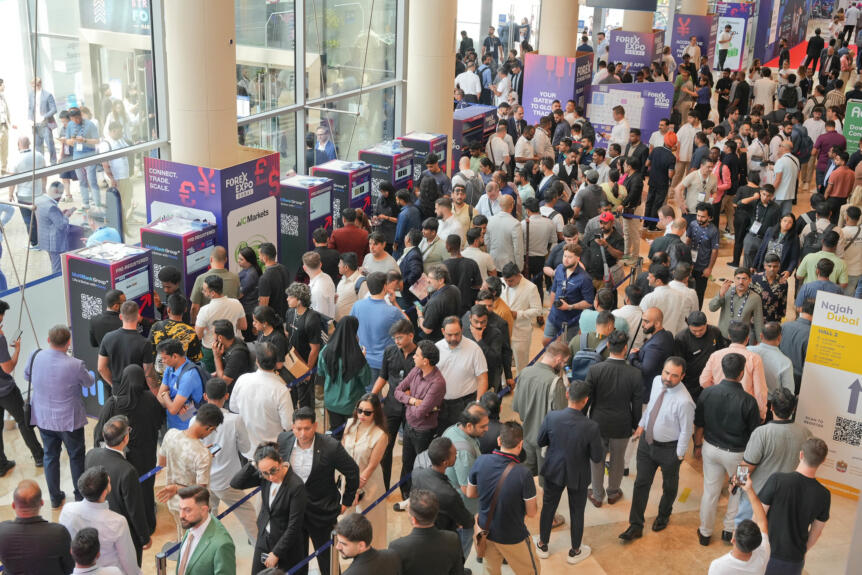
Expanding the Expo Experience
As preparations continue for Forex Expo Dubai 2026, the event is expanding its attendee experience while welcoming a growing lineup of exhibitors from across the forex and trading industry.
Confirmed exhibitors include Super Elite sponsors GTCFX, Valetax, Xchief, Funding Pips, and Honor Financial, alongside Elite sponsors EC Markets, TMGM, Metaquotes, JustMarkets, FP Markets, PU Prime, Dprime, Funded Firm, VPFX, Aegeanlabs Software LLC, Eplanet, SGFX, FortressFX, UEXO, Moneta Markets, and CXM.
As the forex and trading landscape evolves, industry events are adapting to changing attendee expectations. Traders, introducing brokers, and business professionals are increasingly seeking practical learning, direct access to industry specialists, and meaningful business engagement. In response, Forex Expo Dubai is introducing dedicated programmes tailored to its key attendee groups.
Personalizing Experiences
Verified traders gain access to dedicated seminar sessions, the Traders Lounge, and Traders Clinic that offers one-on-one guidance from market experts. They can also pre-book meetings ahead of the event and explore exclusive onboarding opportunities from selected exhibitors.
For Introducing Brokers, the dedicated IB Programme creates opportunities to connect with brokers, compare rebate options, and discuss partnership opportunities through face-to-face meetings. The IB Lounge and dedicated seminar sessions provide additional insights to help IBs strengthen their approach and grow their networks.
Expanding Opportunities for Engagement
Beyond these dedicated programmes, Forex Expo Dubai will feature private meeting zones for one-to-one business discussions, networking lounges, coffee areas, and interactive experiences throughout the two-day event. Additional side events taking place before and after the expo will further extend opportunities for engagement across the trading community.
“We’ve seen a clear shift in what attendees expect from industry events,” said Niyaz Mohammed, Commercial Director at HQMENA. “People still come to discover new products and meet brokers, but they’re also looking for more focused learning and higher-quality business interactions. These new programmes have been introduced to create dedicated environments where traders and introducing brokers can engage in conversations that are directly relevant to their goals.”
With an expanded exhibitor lineup and new attendee-focused initiatives, Forex Expo Dubai 2026 is set to offer a more personalised experience for both trading professionals and businesses, reflecting the changing needs of today’s global trading community.
About Forex Expo Dubai
Forex Expo Dubai is one of the region’s leading gatherings for the global online trading and fintech industry, bringing together brokerages, fintech innovators, institutional traders, investors, payment solution providers, IBs, affiliates and online trading technology companies under one roof. The expo serves as a platform for industry dialogue, business networking, technology showcases and market-focused conversations shaping the future of modern finance.


Crypto brokerage infrastructure firm Alpaca raised $135 million to expand the rails used by exchanges and tokenization platforms to offer U.S. stocks onchain.
Peak XV led Alpaca’s equity round, with participation from Elefund, BNP Paribas’ Opera Tech Ventures and Unbound, according to an announcement on Thursday. The raise follows a $150 million Series D in January that valued the company at $1.15 billion.
Debt financing, primarily from Kraken parent Payward and BMO, brought the total package to $435 million.
Alpaca clears or custodies roughly 94% of tokenized U.S. equities, including products connected to market leaders Binance, Ondo and Dinari. The company said it has more than $1.5 billion of underlying stocks backing tokenized equities held through its infrastructure.
The funding underscores a central constraint facing tokenized equities, where putting a stock onchain does not remove the need for a regulated firm to hold the underlying shares, process corporate actions and connect blockchain transactions to traditional markets.
Its Instant Tokenization Network allows market participants to mint and redeem tokenized stocks against underlying shares around the clock. The products often pair blockchain-based stock exposure with stablecoin funding or redemption, connecting equities to crypto’s 24/7 settlement rails.


– Kriti Bansal, vice president finance and accounting, AlphaPoint
Ask an Expert
Q. Can advisors work with AI to ensure clients are safe against fraud?
A.Yes, but AI should support advisors and not act as autonomous decision-maker. It can flag unusual wallet behavior, suspicious contracts, phishing patterns and risky approvals before damage happens. The biggest vulnerability today is granting AI agents direct, unmitigated wallet permission and this can turn the agent itself into a massive attack vector for social engineering or bad on-chain data.
Q. What security in real time looks like in the age of AI?
A. In the age of AI the real time security needs to be predictive and proactive and not reactive. Real-time security means warnings before signing, continuous wallet monitoring, instant alerts on abnormal activity and blocking risky approvals before funds can move.
Q. How can a money manager automate a defense layer that acts as a continuous threat monitor?
A.Money managers must move away from legacy externally owned wallets and transition to programmable smart accounts such as ERC-4337 or EIP-7702. This transition allows one to write automated, programmatic security guardrails directly at the account level. They can use automated monitoring for wallets, approvals, contract risks, transaction patterns and exposure limits, with human escalation for anything unusual.
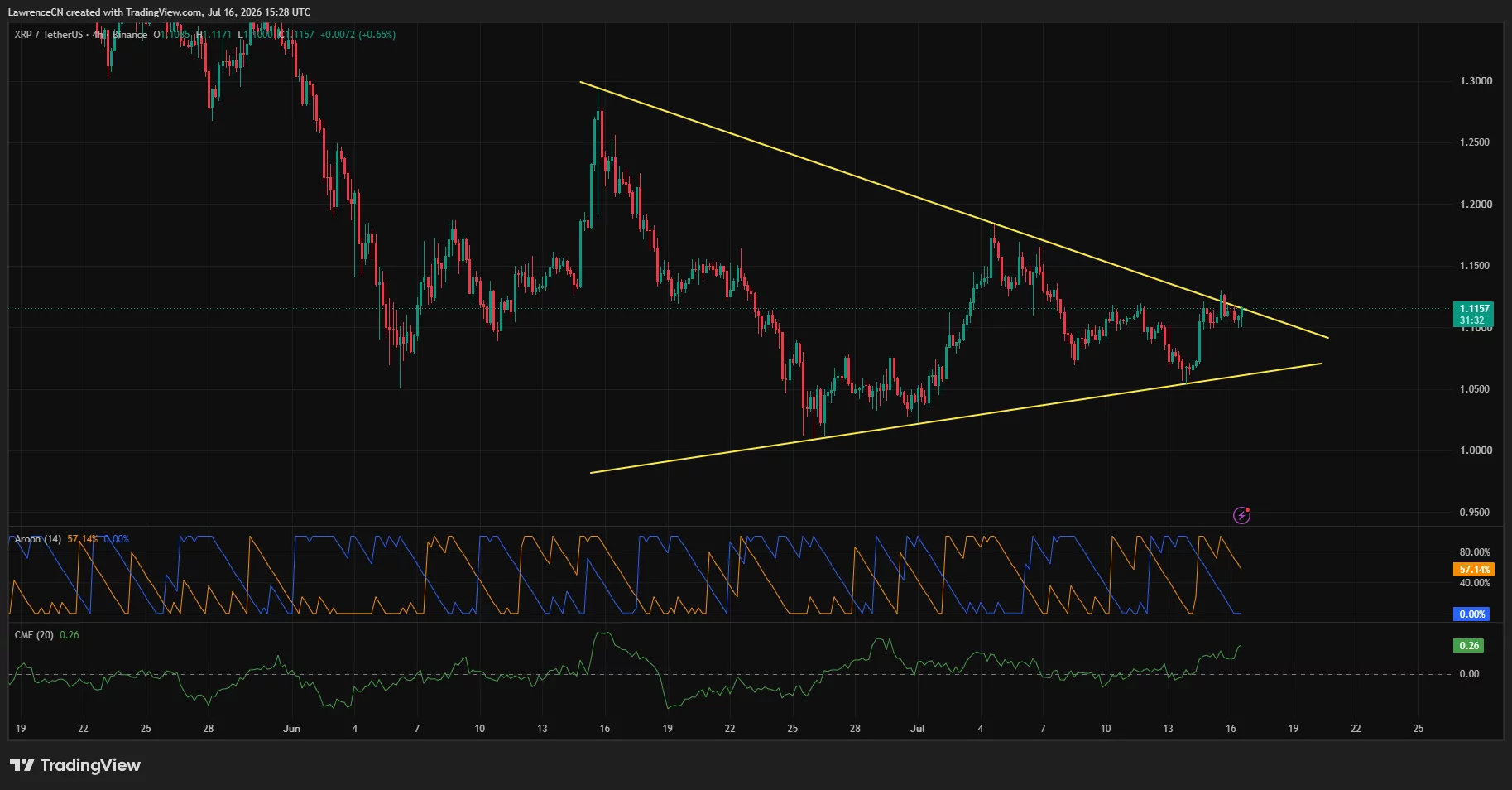
XRP whales have bought 70 million tokens in one week as the price rebounded above $1.11 and Binance reserves fell to a five-month low.
Summary
- XRP whales accumulated 70 million tokens as Binance reserves fell to a five-month low.
- XRP is testing triangle resistance near $1.12 as buying pressure remains positive.
- Futures open interest reached $2.5 billion, with liquidation clusters surrounding the current price.
Santiment data shared by crypto analyst Ali Martinez on July 16 showed that wallets holding between 1 million and 10 million XRP increased their combined balance to nearly 3.83 billion tokens. The accumulation continued despite volatility linked to the US-Iran conflict.
Whale buying coincided with improving sentiment across the XRP market. In a separate X post, Santiment previously showed 3.02 bullish social media comments for every bearish remark, giving XRP the highest level of fear of missing out among the assets tracked.
Cooling US inflation has also supported sentiment toward cryptocurrencies. Recent US consumer and producer price data weakened expectations for tighter monetary policy, helping XRP recover from a recent low near $1.05.
Exchange balances have moved in the opposite direction. CryptoQuant data showed that Binance held 2.61 billion XRP, its lowest reserve level since February. Falling exchange reserves can suggest that holders are moving tokens away from platforms, although CryptoQuant’s figure does not reveal whether those funds entered private wallets, custody services, or other venues.
Binance has also announced an $800,000 XRP airdrop for users holding Ripple USD. Running from July 17 through Aug. 14, the campaign will distribute XRP each Friday to eligible users across Binance Earn, Margin, and Futures as the exchange promotes RLUSD adoption.
XRP tests resistance inside a tightening triangle
As per data from crypto.news, XRP (XRP) traded near $1.11 at the time of writing after gaining more than 5% from its recent low, while its 24-hour range extended as high as roughly $1.13. Trading volume, however, fell more than 15%, according to the original market report, showing weaker spot activity during the rebound.
On the 4-hour Binance chart, XRP is pressing against the upper boundary of a symmetrical triangle after forming lower highs and higher lows since mid-June. The descending trendline sits close to $1.12, while the rising support line approaches the $1.06–$1.08 area.
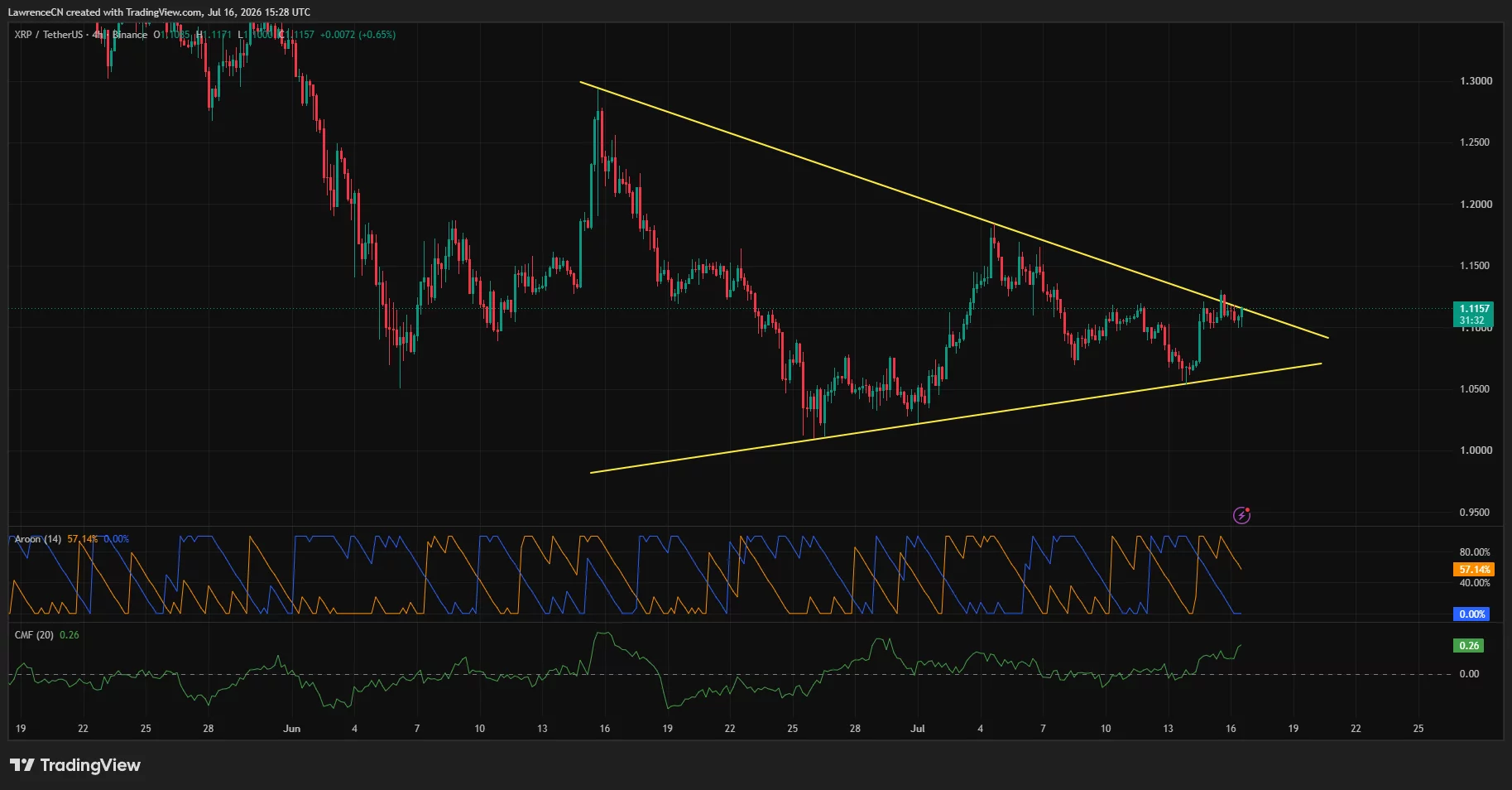
Capital flow remains positive despite the unresolved breakout. The 4-hour Chaikin Money Flow reading stands at 0.26, indicating net buying pressure, but the Aroon indicator presents a mixed signal: Aroon Up is at 0% while Aroon Down is at 57.14%.
Daily indicators also show improving momentum without confirming a full reversal. The MACD histogram has turned positive at 0.0053, while the MACD line remains below zero and the relative strength index sits at a neutral 49.
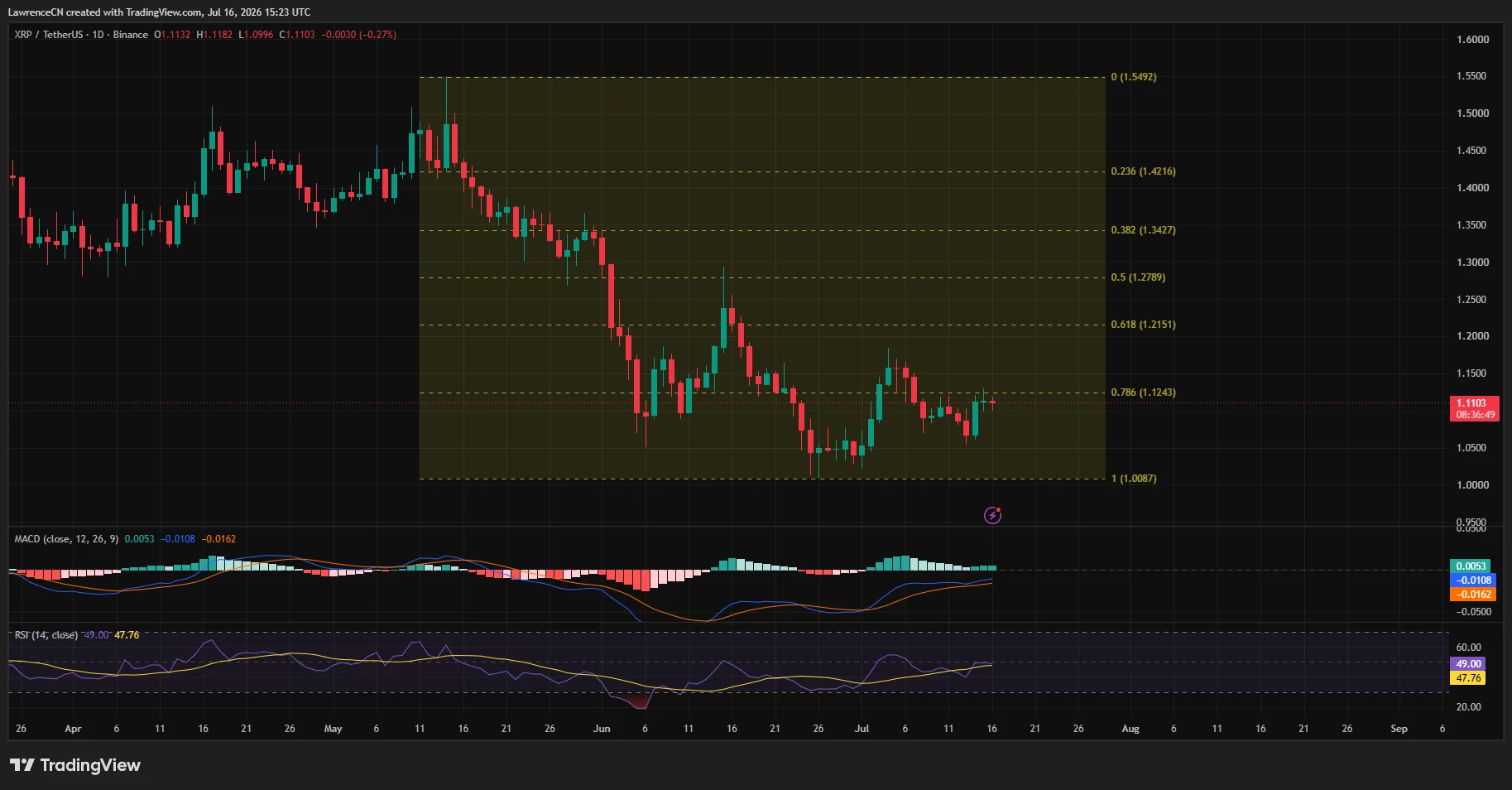
The daily Fibonacci retracement places immediate resistance at $1.124, followed by $1.215. A confirmed move through the first level would support a test of $1.15 before traders turn their attention to $1.20, while rejection could keep XRP within its current consolidation pattern.
Derivatives liquidity surrounds the current price
CoinGlass data placed XRP futures open interest near $2.50 billion after a 2.65% increase over 24 hours. CME recorded a 0.74% rise, while Binance posted a 0.28% increase during the same period, indicating that traders added exposure as XRP recovered.
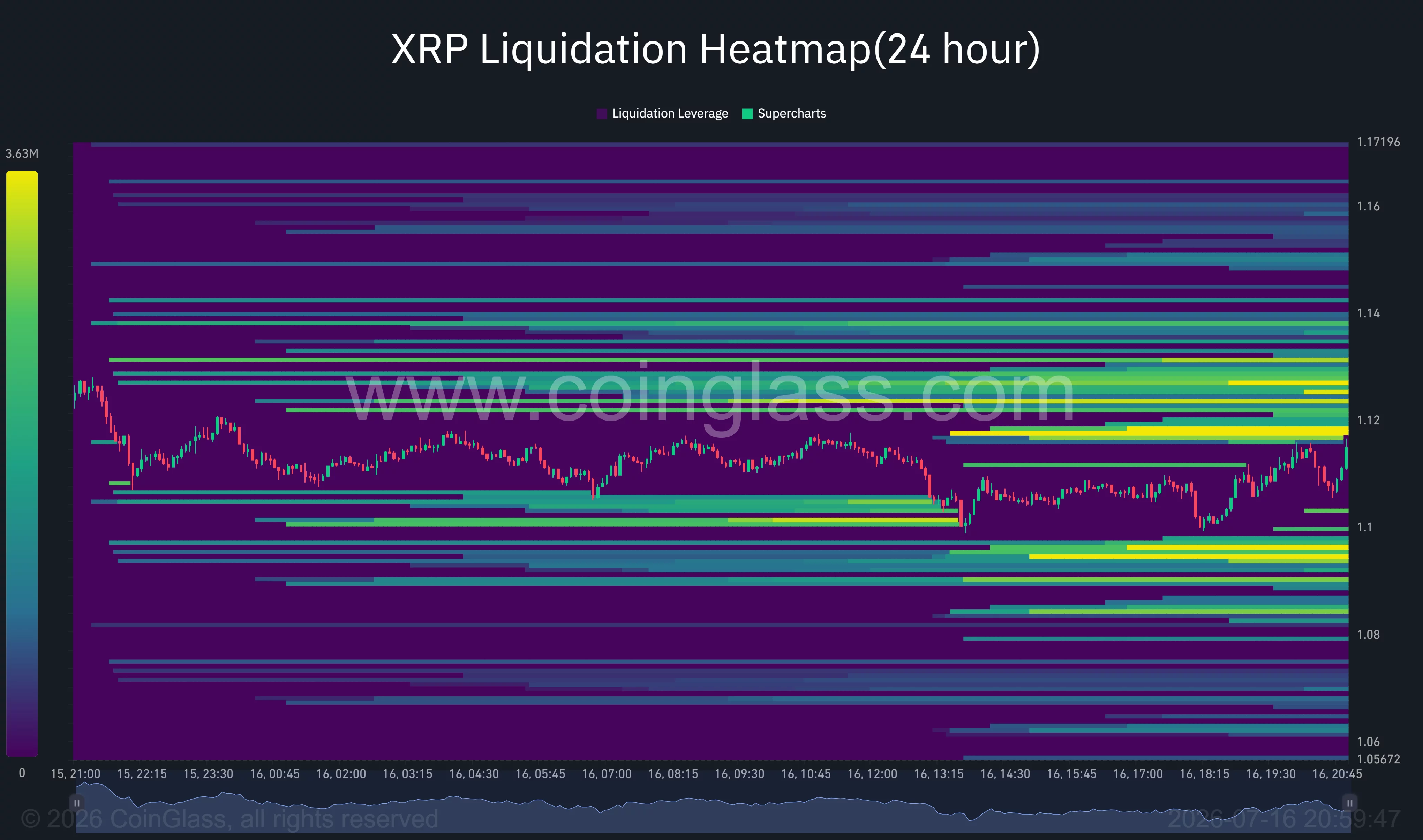
The 24-hour CoinGlass liquidation heatmap shows the strongest nearby liquidity concentrations between $1.117 and $1.13, just above the current price. Additional leveraged positions appear around $1.14, making that zone important if XRP breaks its descending trendline.
Below the market, the heatmap identifies another dense liquidity pocket around $1.09–$1.10. A failure to hold that region could expose the triangle’s rising support near $1.06, while a sustained break above $1.13 would clear the closest concentration of short-side liquidation levels.
Disclosure: This article does not represent investment advice. The content and materials featured on this page are for educational purposes only.
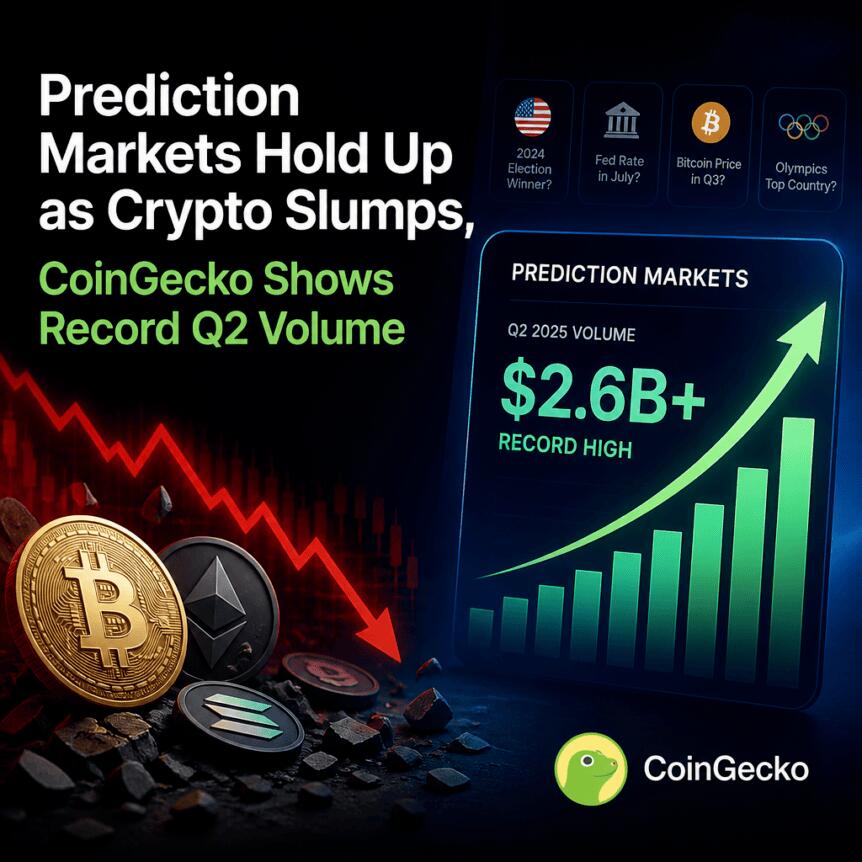
Crypto markets ended the second quarter of 2026 with broad weakness, but prediction platforms stood out as an exception. While spot trading, derivatives activity and stablecoin supply all retreated, prediction markets hit record levels, underscoring how quickly bettors are reallocating attention toward event-based contracts.
According to CoinGecko’s latest Crypto Industry Report (published Thursday), spot trading volume across the top 10 centralized exchanges fell to $1.95 trillion in Q2 2026—down 27.9% from $2.7 trillion in Q1. Perpetual futures volume also declined 10% to $12.7 trillion. Stablecoin market size slipped 1.6% to $305.1 billion, even as prediction markets surged to their strongest quarter on record with $113.8 billion in notional volume.
Key takeaways
- Broad Q2 weakness across crypto trading: Top-10 CEX spot volume dropped to $1.95T and perpetual futures to $12.7T, according to CoinGecko.
- Stablecoin growth stalled: The stablecoin market slipped 1.6% to $305.1B despite prediction-market momentum.
- Prediction markets reached a record quarter: Notional volume rose to $113.8B, highlighting a shift toward event-driven demand.
- Sports and politics led the demand: World Cup and the 2028 US presidential election were among the biggest drivers, per Polymarketscan and related reporting.
- Regulation pressure is mounting: US regulators and states continue to dispute whether prediction markets fit under financial-market rules or gambling regimes.
Trading volumes slide while prediction contracts break records
The gap between traditional trading and prediction-market activity was stark during Q2. CoinGecko’s report shows that while capital and activity flowed less consistently into spot and derivatives, prediction markets instead absorbed momentum—an important signal for traders evaluating where liquidity and attention are concentrating.
CoinGecko recorded prediction markets’ best quarter yet, with $113.8 billion in notional volume. This came alongside sector-specific demand: sports and politics are increasingly becoming the dominant categories for event-based contracts. Polymarket’s World Cup winner market alone reportedly attracted more than $3.3 billion in trading volume, and contracts tied to the 2028 US presidential election ranked among the platform’s largest markets, based on Polymarketscan data.
Binance stays on top, but DEX activity loses ground
Even with the market downturn, Binance maintained its dominant position among centralized exchanges. CoinGecko’s report estimates Binance held a 38.7% market share in Q2. At the same time, at least one major peer saw a more severe contraction in trading activity: MEXC recorded the sharpest slump among spot CEXs, with volume more than halving from $275.2 billion in Q1 to $121.2 billion in Q2.
Decentralized exchange performance also softened. The top 10 spot DEXs collectively processed $408.9 billion in Q2, down from $556.4 billion in Q1. Uniswap remained the leading venue with a 41.2% market share, though its volume fell 21.4% to $168.5 billion.
These figures align with the wider macro picture for the quarter. CoinGecko reported that total crypto market capitalization fell 12.6% to $2.1 trillion during Q2, reinforcing that the downturn was not limited to one segment of the market. The same broader weakness period also coincided with heightened security risks for DeFi: April was described as a record month for hacks in decentralized finance, according to earlier coverage that cited $630 million in losses.
Prediction market leaders shift as June demand surges
Within prediction markets themselves, activity peaked during June. CoinGecko’s report ties the high point to the start of the FIFA World Cup, when monthly notional volume reached an all-time high of $50.7 billion. That represented a 91.9% increase compared with the average of the previous five months—an indicator that the event-driven thesis may be pulling demand forward faster than typical, steady interest.
Over the quarter, Kalshi remained the largest prediction-market platform, retaining a 58.9% market share in Q2. Polymarket’s share declined over the same period, dropping from 35.8% to 30.2%. Robinhood-backed Rothera Markets improved its position, rising to fourth place.
Competition is not only technical or product-driven—it is also shaped by accessibility, compliance strategies, and market participation. For instance, related reporting noted that the Czech Republic told ISPs to block Polymarket after it was added to an unauthorized gambling blacklist, reflecting how local policy can affect user access and platform growth.
Regulatory disputes intensify over whether prediction markets are “financial” or “gambling”
Even as usage grows, prediction markets are drawing increased regulatory attention. In the United States, regulators and states are still divided over how these platforms should be categorized—whether they should be treated as financial markets or as gambling venues. Cointelegraph previously reported on disputes including a Michigan judge blocking Kalshi’s sports-bets effort, along with lawsuits involving platforms such as Kalshi that have escalated through 2026.
Outside the US, other jurisdictions have also moved to restrict prediction markets, citing concerns such as gambling regulation, market integrity, and risks associated with insider trading. The combination of rising volumes and uneven regulatory outcomes means platforms may face a fragmented compliance landscape, with winners depending on how quickly they can meet differing legal requirements.
For investors and builders, the next question is whether prediction-market volume is a temporary summer spike tied to major global events, or a durable shift in how users allocate attention during a weak crypto cycle. Readers should watch for Q3 notional-volume trends, any additional jurisdiction-level restrictions, and how leaders like Kalshi and Polymarket adapt as regulators sharpen their stance on classification and market integrity.
ARK Invest’s director of research disputed a16z crypto’s thesis that traditional finance will adopt permissioned blockchain infrastructure instead of decentralized finance, saying institutions will increasingly rely on DeFi rails.


Keyrock, a digital-asset services firm, acquired the trading and brokerage assets of BlockFills’ institutional digital asset business, bolstering its push into institutional crypto markets, the company said in a press release Thursday.
The completed transaction adds BlockFills’ client relationships, trading technology and derivatives expertise to Brussels-based Keyrock’s existing businesses spanning market making, over-the-counter (OTC) trading, options, credit, onchain services and asset management.
CoinDesk reported in June that Keyrock was in the process of acquiring Chicago-based crypto trading and lending firm Blockfills. According to a bankruptcy filing, Keyrock agreed to pay $3.25 million for substantially all of BlockFills’ assets, while assuming certain liabilities, equity interests, customer relationships and proprietary technology.
The acquisition broadens Keyrock’s regulatory reach through a CIMA-registered entity in the Cayman Islands and the proposed acquisition of an FCA-authorized entity in the U.K., subject to regulatory approval.
The company said the combined platform will offer institutional clients enhanced execution capabilities backed by Keyrock’s balance sheet and regulatory infrastructure.
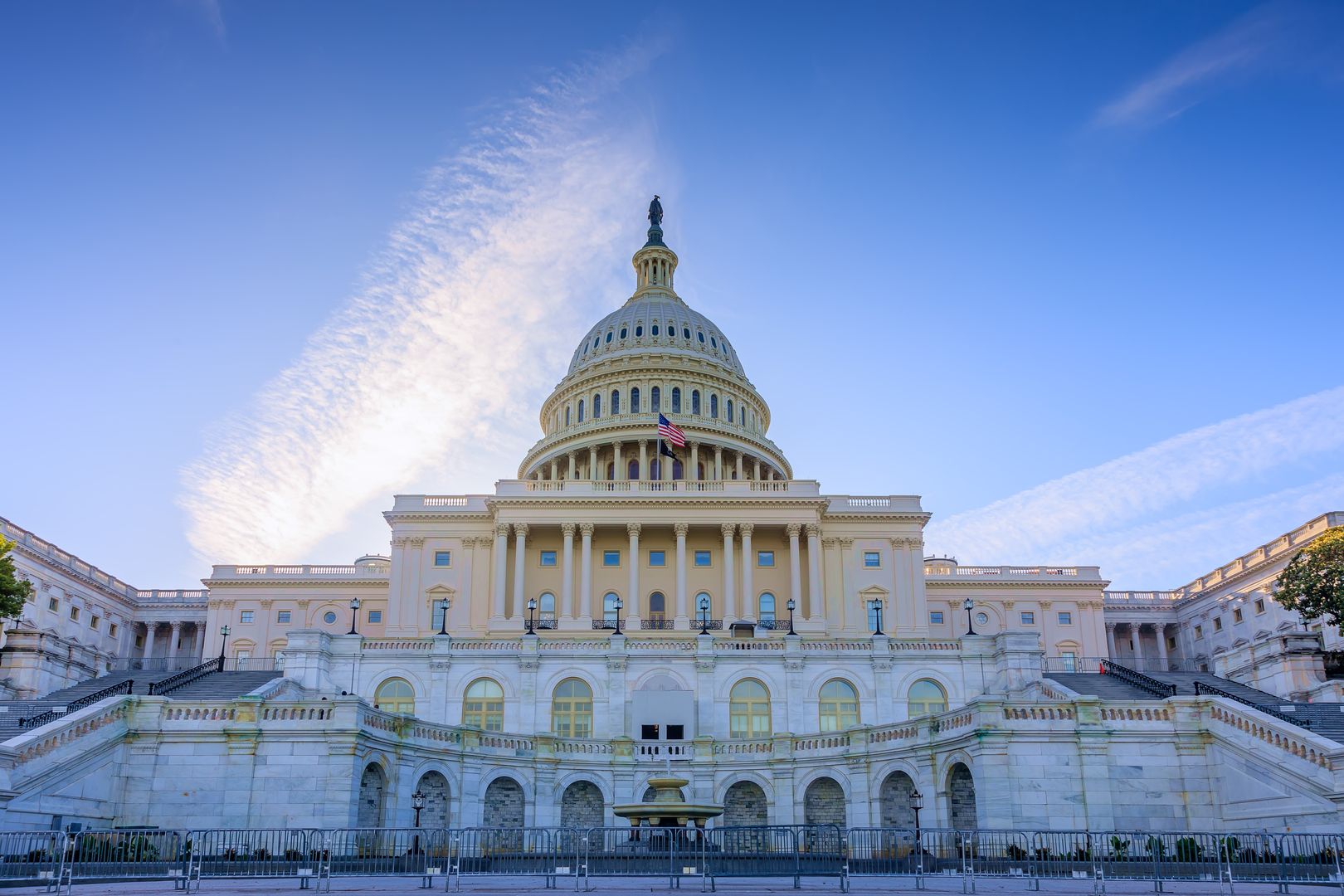
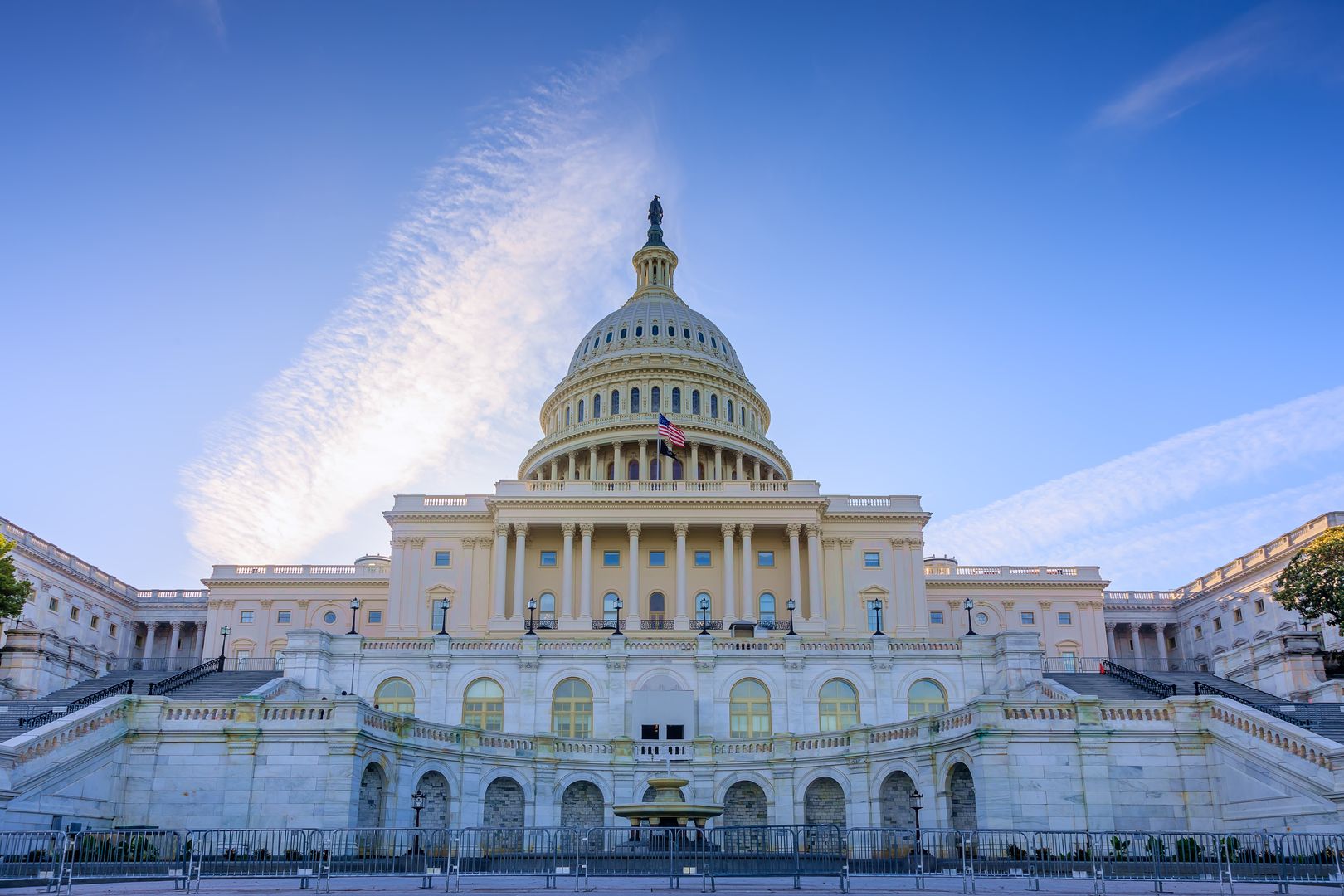
As a former financial regulator, I understand that no law can prevent every market failure or stop every bad actor. Fraud exists in every market, at every scale, but strong rules can mitigate the worst outcomes. They give regulators visibility, set obligations for companies before consumers engage with their products, and require firms to operate with basic and enforceable accountability. The bill is often described as crypto market structure legislation. That description is accurate, but it doesn’t capture the full scale. Market structure is the legal architecture that determines who must register with which agency, who supervises the market, what firms owe their customers, how assets are protected, what disclosures must be made, and what happens when something goes wrong.
Today, millions of Americans already use digital asset exchanges, brokers, dealers, and custodians. They open accounts, buy and sell assets, rely on platforms to execute transactions, and often trust intermediaries to hold their property. If those businesses are going to serve American consumers, they should operate under clear federal rules.
The Clarity Act would create those rules. Digital asset intermediaries would have to register, meet capital and risk-management standards, keep records, disclose material information to retail customers, monitor markets, address conflicts of interest, and follow conduct rules covering fraud, manipulation, marketing, supervision, and fair pricing. Those are basic safeguards in mature financial markets. They should apply here too.

The REAL REASON Why Bitcoin CRASHED TODAY!! (+ What Comes Next?)

Tom Kerridge names the worst thing he’s ‘ever eaten’ and says ‘it was rotten’

Fossil to close up to 15 stores in 2026 as turnaround plan shrinks retail footprint


-

 Fashion6 days ago
Weekend Open Thread: Nutriplenish Leave-In Conditioner
-
 Sports7 days ago
2026 Genesis Scottish Open Thursday TV coverage: Round 1
-

 Sports6 days ago
Super Eagles star Moses Simon opens up on Liverpool transfer regret
-

 Politics1 day ago
Young campaigners urge incoming PM to act on outdoor junk food ads
-

 News Videos2 days ago
XRP BOMBSHELL… XRP OMBOARDED FOR TRANSACTIONS!!!
-

 Tech2 days ago
Get Your ESP32 Sunny Side Up With This Solar Dev Board
-

 Tech2 days ago
Dark Secrets Emerge When Jailbreaking LLMs
-
 Entertainment24 hours ago
Disney’s Most Ambitious Failed Star Wars Attraction Is Coming to SDCC
-
 Sports19 hours ago
New Cornerback Enters Vikings Trade Rumor Mill
-

 Crypto World16 hours ago
CFTC blocks Kalshi from unwinding Michigan trades after court order
-

 News Videos3 days ago
how to make coin bank box with cardboard #scienceproject #money #diy #shorts
-
 Tech3 days ago
Cloudflare Precursor Watches Your Mouse and Keyboard To Decide If You Are Human
-
 Entertainment22 hours ago
Vicki Gunvalson Defends Discussing Heather Dubrow’s Money
-
Crypto World2 days ago
Ripple, Coinbase, Circle Join Linux x402 Foundation to Help Shape AI Payments
-

 NewsBeat19 hours ago
Watch: Is Donald Trump facing a popular backlash on immigration?
-

 Sports17 hours ago
Michigan officials not expected to discuss AD Warde Manuel at Thursday meeting
-

 Business2 days ago
ACCC warns AI could lift insurance costs in risk-prone areas
-
 NewsBeat19 hours ago
Firefighters issue update on Dovestone moorland blaze as fire enters fourth day
-

 Business2 days ago
AI blueprint looms as PM examines 'lessons from abroad'
-

 Business14 hours ago
Nvidia Stock Slips After Big Tuesday Rally as Huang Confirms Vera Rubin Chip Is Now in Production Today
You must be logged in to post a comment Login