

Crypto World
Prediction Markets Hold Up as Crypto Slumps, CoinGecko Shows Record Q2 Volume

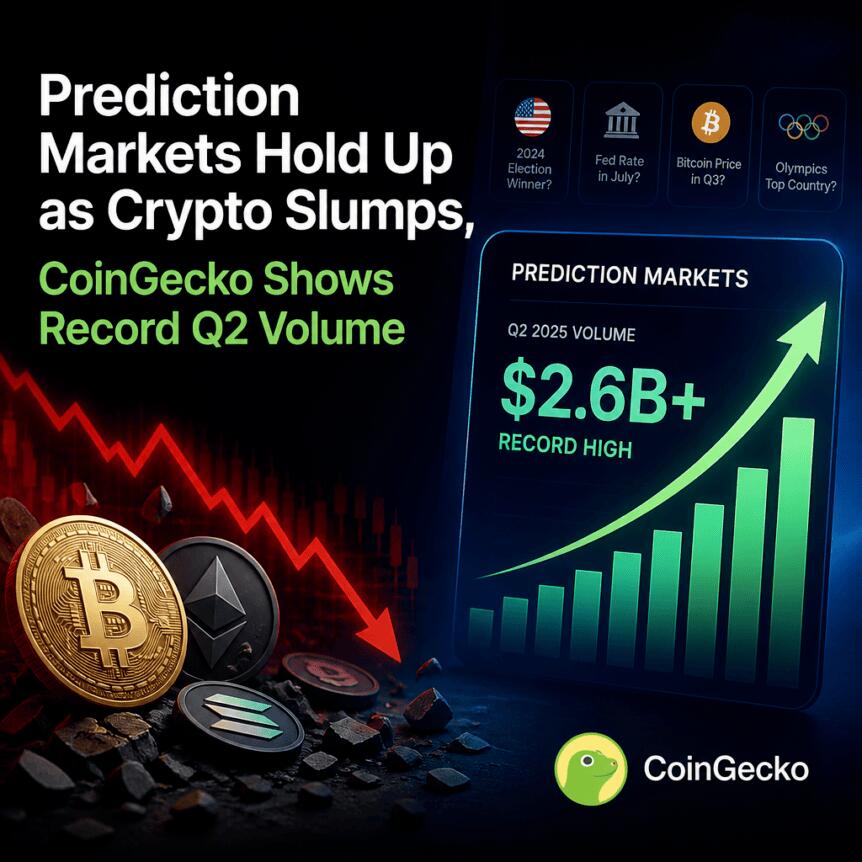
Crypto markets ended the second quarter of 2026 with broad weakness, but prediction platforms stood out as an exception. While spot trading, derivatives activity and stablecoin supply all retreated, prediction markets hit record levels, underscoring how quickly bettors are reallocating attention toward event-based contracts.
According to CoinGecko’s latest Crypto Industry Report (published Thursday), spot trading volume across the top 10 centralized exchanges fell to $1.95 trillion in Q2 2026—down 27.9% from $2.7 trillion in Q1. Perpetual futures volume also declined 10% to $12.7 trillion. Stablecoin market size slipped 1.6% to $305.1 billion, even as prediction markets surged to their strongest quarter on record with $113.8 billion in notional volume.
Key takeaways
- Broad Q2 weakness across crypto trading: Top-10 CEX spot volume dropped to $1.95T and perpetual futures to $12.7T, according to CoinGecko.
- Stablecoin growth stalled: The stablecoin market slipped 1.6% to $305.1B despite prediction-market momentum.
- Prediction markets reached a record quarter: Notional volume rose to $113.8B, highlighting a shift toward event-driven demand.
- Sports and politics led the demand: World Cup and the 2028 US presidential election were among the biggest drivers, per Polymarketscan and related reporting.
- Regulation pressure is mounting: US regulators and states continue to dispute whether prediction markets fit under financial-market rules or gambling regimes.
Trading volumes slide while prediction contracts break records
The gap between traditional trading and prediction-market activity was stark during Q2. CoinGecko’s report shows that while capital and activity flowed less consistently into spot and derivatives, prediction markets instead absorbed momentum—an important signal for traders evaluating where liquidity and attention are concentrating.
CoinGecko recorded prediction markets’ best quarter yet, with $113.8 billion in notional volume. This came alongside sector-specific demand: sports and politics are increasingly becoming the dominant categories for event-based contracts. Polymarket’s World Cup winner market alone reportedly attracted more than $3.3 billion in trading volume, and contracts tied to the 2028 US presidential election ranked among the platform’s largest markets, based on Polymarketscan data.
Binance stays on top, but DEX activity loses ground
Even with the market downturn, Binance maintained its dominant position among centralized exchanges. CoinGecko’s report estimates Binance held a 38.7% market share in Q2. At the same time, at least one major peer saw a more severe contraction in trading activity: MEXC recorded the sharpest slump among spot CEXs, with volume more than halving from $275.2 billion in Q1 to $121.2 billion in Q2.
Decentralized exchange performance also softened. The top 10 spot DEXs collectively processed $408.9 billion in Q2, down from $556.4 billion in Q1. Uniswap remained the leading venue with a 41.2% market share, though its volume fell 21.4% to $168.5 billion.
These figures align with the wider macro picture for the quarter. CoinGecko reported that total crypto market capitalization fell 12.6% to $2.1 trillion during Q2, reinforcing that the downturn was not limited to one segment of the market. The same broader weakness period also coincided with heightened security risks for DeFi: April was described as a record month for hacks in decentralized finance, according to earlier coverage that cited $630 million in losses.
Prediction market leaders shift as June demand surges
Within prediction markets themselves, activity peaked during June. CoinGecko’s report ties the high point to the start of the FIFA World Cup, when monthly notional volume reached an all-time high of $50.7 billion. That represented a 91.9% increase compared with the average of the previous five months—an indicator that the event-driven thesis may be pulling demand forward faster than typical, steady interest.
Over the quarter, Kalshi remained the largest prediction-market platform, retaining a 58.9% market share in Q2. Polymarket’s share declined over the same period, dropping from 35.8% to 30.2%. Robinhood-backed Rothera Markets improved its position, rising to fourth place.
Competition is not only technical or product-driven—it is also shaped by accessibility, compliance strategies, and market participation. For instance, related reporting noted that the Czech Republic told ISPs to block Polymarket after it was added to an unauthorized gambling blacklist, reflecting how local policy can affect user access and platform growth.
Regulatory disputes intensify over whether prediction markets are “financial” or “gambling”
Even as usage grows, prediction markets are drawing increased regulatory attention. In the United States, regulators and states are still divided over how these platforms should be categorized—whether they should be treated as financial markets or as gambling venues. Cointelegraph previously reported on disputes including a Michigan judge blocking Kalshi’s sports-bets effort, along with lawsuits involving platforms such as Kalshi that have escalated through 2026.
Outside the US, other jurisdictions have also moved to restrict prediction markets, citing concerns such as gambling regulation, market integrity, and risks associated with insider trading. The combination of rising volumes and uneven regulatory outcomes means platforms may face a fragmented compliance landscape, with winners depending on how quickly they can meet differing legal requirements.
For investors and builders, the next question is whether prediction-market volume is a temporary summer spike tied to major global events, or a durable shift in how users allocate attention during a weak crypto cycle. Readers should watch for Q3 notional-volume trends, any additional jurisdiction-level restrictions, and how leaders like Kalshi and Polymarket adapt as regulators sharpen their stance on classification and market integrity.

Earlier in July, the cat-themed meme coin defied the ongoing bear market by posting a whopping 2,000% weekly increase. Its ascent was primarily driven by the token’s affiliation with the official Robinhood platform, which recently introduced its own blockchain, as well as backing from Binance.
However, the uptrend came to an abrupt end, and over the past seven days, CASHCAT has crashed by more than 65%, raising the question of whether the hype is over.
The Traders’ Experience
CASHCAT, which exploded to $0.22 on July 12, is now worth roughly $0.05 (per CoinGecko), and some market observers have started speculating that it will hardly reclaim its previous peaks and instead collapse even lower.

Meanwhile, savvy traders have taken advantage of the meme coin’s decline. According to the analytics platform Lookonchain, one individual began shorting CASHCAT two days ago and is now sitting on over $500,000 in unrealized profits. Of course, this has prompted allegations of insider information that the rest of the market participants were unaware of.
However, not all benefited from the token’s wild trajectory. One trader made a paper loss of $460,000 due to CASHCAT’s meltdown, while another sold prematurely, turning a $69 position into $711. This is indeed 10x, but Lookonchain pointed out that if they had waited a bit more, they could have retired.
Is It Really Game Over?
Certain X users have been baffled by CASHCAT’s sudden move south, trying to figure out what triggered it. Fluffy asked their 125,000 followers for an explanation, and most of the responses weren’t exactly flattering to the meme coin.
Many of the people commenting on the post described the cat-themed token as a scam, claiming that “anybody that bought at these high valuations got played.”
It is true that CASHCAT resembles many other meme coins whose explosive rallies relied entirely on hype and speculation rather than fundamentals or real utility. Examples include Siren (SIREN) and MemeCore (M). The former was at the forefront of gains in June, yet it crashed by 96% in a single day after its controller supposedly sold roughly 94% of the supply.
Comebacks are not out of the question, and a renewed influx of speculative traders could help lift CASHCAT and similar tokens. Nonetheless, one should remain mindful of the risks and severe volatility, conduct proper due diligence before entering the ecosystem, and invest only what they can afford to lose.
The post CASHCAT Plummets 65% in a Week: The Doom of Another Meme Coin or New Pump Loading? appeared first on CryptoPotato.

Bitcoin recovered most of the losses seen during the day after dipping to $62,400 and is now back above $64,000. What’s intriguing about this rebound is that it came after some unfavorable reports for risk-on assets.
The first one focused on more threatening developments on the US/Israel-Iran war front, while the second was on the continuously growing US margin debt.
Two Major Signals
The tension in the Middle East skyrocketed a couple of weeks ago when the US and Iran broke the ceasefire with new attacks. There’s been little to no reporting on potential peace talks since then. In contrast, Trump’s new attack plan was recently leaked, while a new report from Axios outlined the next possible steps.
The Trump Administration has reportedly conveyed to Israel that it will send ‘dozens more’ refueling planes ahead of a potential ‘massive offense’ against Iran. Some of the more threatening details include possible bombing against key Iranian infrastructure like power plants and nuclear sites.
The report added that the POTUS is expected to order the escalation ‘in the coming days.’ As expected, oil prices reacted with an immediate increase, as USOIL is up by over 20% since the war restarted.
Separately, the Kobeissi Letter noted that the US margin debt has risen by over $86 billion in June to a new record of $1.5 trillion. This marked the third monthly increase in a row. Moreover, the margin debt has skyrocketed by nearly $500 billion in the past year.
The analysts concluded that “US investors have never been more leveraged,” as the broader measure of such positions is up to approximately 1.4% of the S&P’s total market cap. This is close to the 2018 peak and far exceeds the 2000 Dot-Com bubble of 1.1%.
BTC Rebounds
The primary cryptocurrency tends to slip following similar reports, especially escalations in the Middle East. However, the past few hours have shown a very different reaction. The asset had fallen to a multi-day low of $62,400 before the bulls took charge and helped it recover nearly $2,000.
Nevertheless, bitcoin remains below the recent local peak of $65,600 reached after the US CPI numbers for June came out on Tuesday. The market is still in a fragile place, and it’s unlikely that new attacks between the US and Iran will have a longer-term beneficial effect.
The post Bitcoin’s Surprising Reaction to Trump’s Iran Threats and Rising US Margin Debt appeared first on CryptoPotato.
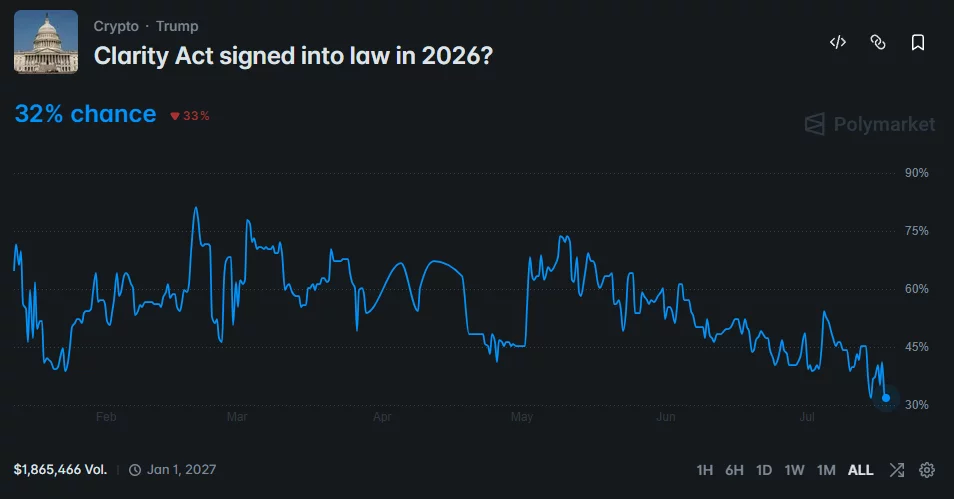
President Donald Trump has failed to unlock the stalled CLARITY Act after meeting Senate Republicans, with no revised text released and Polymarket traders cutting its 2026 passage odds to 32%.
Summary
- Trump’s meeting with Senate Republicans produced no revised CLARITY Act text.
- Polymarket traders cut the bill’s 2026 passage odds to 32%.
- Democratic opposition remains focused on ethics rules and consumer protections.
Journalist Eleanor Terrett reported on X that the updated bill remained unavailable after Thursday’s White House meeting, where Trump and Republican senators discussed ethics rules tied to the legislation. Industry leaders now expect the text to arrive next week, according to Terrett, extending a delay around one of Washington’s most closely watched crypto bills.
“Updated legislative text remains elusive following yesterday’s meeting between President Trump and Senate Republicans on ethics,” Terrett wrote.
Before the meeting, Republican senators had suggested the draft could emerge shortly after their talks with Trump. Sen. Bernie Moreno told reporters that lawmakers would release the plan once the president received a briefing, adding that journalists would have “a lot of reading to do.”
Moreno is still seeking a Senate vote before the August recess, according to Terrett. Sen. Cynthia Lummis also expressed hope that the language would become public after the White House discussion, although she did not offer a firm timetable.
Passage odds have fallen to 32%
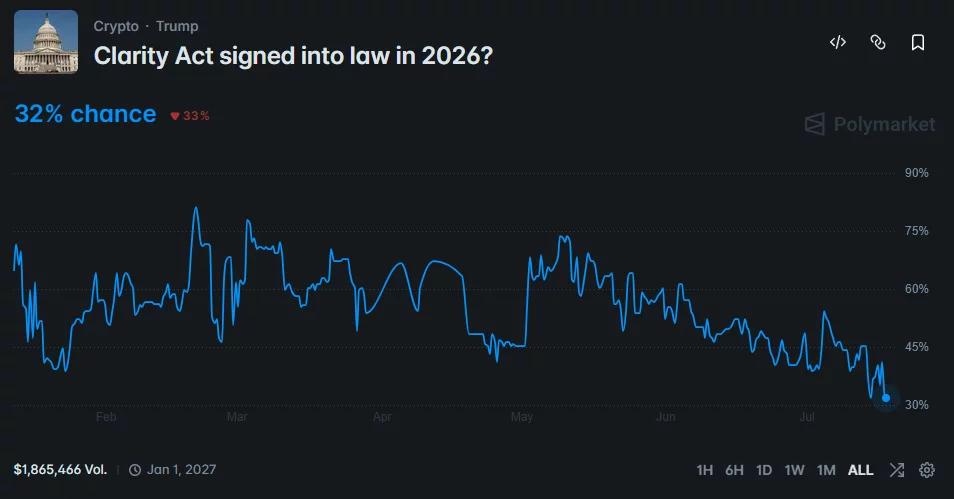
Polymarket traders have lowered the probability of the CLARITY Act becoming law in 2026 to 32% as Republicans and Democrats remain divided over the bill’s ethics provisions. The prediction-market decline has followed growing doubt over whether senators can secure enough bipartisan support to advance the measure.
In New York, the House Financial Services Committee’s Republican members are scheduled to hold a hearing at 10 a.m. ET on the legislation’s potential role in digital-asset development, according to Terrett. She noted that the event is informational and will not influence the Senate’s review of the bill.
The House passed its version of the CLARITY Act in 2025, but Senate negotiators have been working on separate language covering crypto market rules. Any final measure would need enough support to clear the Senate before lawmakers could reconcile it with the House bill.
Democratic ethics demands remain the main barrier
Sen. Ruben Gallego, one of the leading Democratic negotiators, told POLITICO that Republicans had presented ethics language his party could not support. Gallego linked the dispute to Trump’s business interests in the crypto sector and warned that the proposal would not attract the Democratic votes needed for passage.
“At the end of the day, we don’t have strong ethics,” Gallego said. “I don’t care what the president says. You’re not going to have the Democratic votes.”
After reviewing the Republican proposal, Gallego described it as “very weak,” arguing that it gave the president considerable freedom while offering limited consumer protections. A Democratic Senate aide also told POLITICO that the plan taken to the White House fell short of what Democrats would accept.
According to the same aide, Democratic lawmakers had neither reviewed nor approved the draft discussed during Thursday’s talks. The lack of agreement has left Republicans unable to present the delayed text as a bipartisan proposal.
Sen. Cory Booker has maintained that negotiations remain active, telling reporters that bipartisan cooperation is the only route to completing the legislation. Booker also indicated that negotiators should finish those discussions before releasing a new draft, leaving the publication date and Senate vote schedule unresolved.

Join Blockchain Life in Dubai on December 1–2, 2026!
On December 1–2, 2026, Blockchain Life 2026 returns to Dubai for one of the world’s largest gatherings focused on Web3, cryptocurrency, mining, and AI.
The event will bring together 15,000+ attendees from 130+ countries, 200+ world-class speakers, 200+ booths at expo, 3 dedicated stages, and the debut of AI Future – a brand-new track exploring the next generation of AI.
Why attend Blockchain Life?
🔹 A full week of high-impact networking with the industry’s biggest names: 2 days of the Blockchain Life Forum, hundreds of side events, exclusive business & private meetups, and the Formula 1 Grand Prix Finale.
🔹 200+ industry-leading speakers, including crypto whales, founders and C-level executives from top exchanges and leading Web3 projects, prominent investors, Tier 1 funds, AI innovators, and legendary traders.
🔹 200+ leading companies at one of the largest industry’s expo – from major crypto exchanges and mining firms to Web3 pioneers, AI developers, and cutting-edge startups.
🔹 The Debut of AI Future, a dedicated Forum exploring the future of AI, emerging trends, breakthrough robotics, and the convergence of AI, blockchain, and business.
🔹 The legendary Blockchain Life Afterparty at one of the world’s premier nightclubs, featuring a globally recognized headlining artist.
🔹 Startup Pitch & Blockchain Life Awards, where promising startups gain exposure and the industry’s leading companies are recognized for their achievements.
🎟 Book now at early bird price! Save 10% on your ticket with promo code: CRYPTOBREAKING
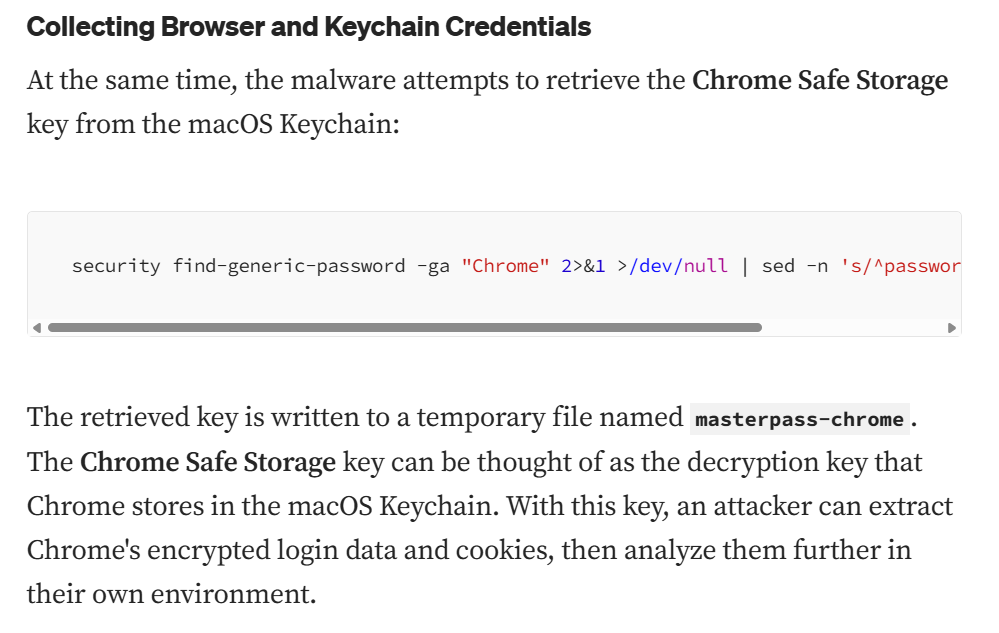
A macOS information-stealing malware can hijack Telegram Desktop sessions and compromise cryptocurrency wallets, according to blockchain security firm SlowMist.
The malware harvests data from the macOS Keychain, Safari cookies, Apple Notes, Telegram Desktop and databases associated with more than a dozen cryptocurrency wallets.
After collecting passwords and authenticated sessions, the malware copies users’ authenticated Telegram Desktop session data, wallet databases and browser wallet extension data.
SlowMist said attackers can then attempt to decrypt the stolen wallet databases offline using passwords harvested from the infected device or replace legitimate Ledger and Trezor applications with fake versions that trick users into entering their recovery phrases. The security firm reproduced the attack chain in an isolated environment.
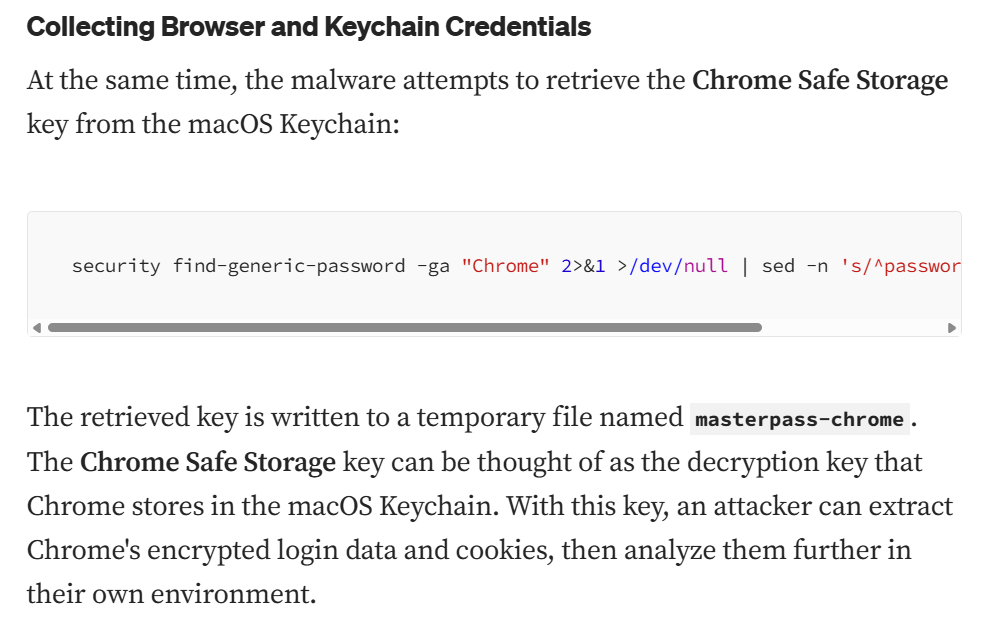
MacOS malware code used to steal keys and passwords. Source: SlowMist
Related: AI has not triggered DeFi ‘hackpocalypse,’ Dragonfly partner says
MacOS malware targets popular crypto wallets
According to SlowMist, the malware combines multiple techniques into a coordinated attack chain, allowing attackers to pursue different methods of compromising cryptocurrency accounts and wallets.
The malware targets software wallets including Exodus, Atomic, Electrum, Wasabi and Monero, as well as hardware wallet applications such as Ledger Live and Trezor Suite, according to SlowMist. It also searches for wallet data stored by full-node clients including Bitcoin Core, Litecoin Core, Dash Core and Dogecoin Core.
Telegram two-step verification does not prevent the attack because the malware reuses an authenticated local session instead of creating a new login, according to SlowMist. In tests, researchers restored stolen Telegram Desktop session data on another Mac without entering a phone number, verification code or two-step verification password.
SlowMist urged users who suspect their devices have been compromised to immediately terminate existing Telegram sessions, establish a new trusted login and change both their Telegram two-step verification password and Telegram Desktop Passcode. The company also recommended generating a new recovery phrase on a clean device and transferring all assets to new addresses.
Magazine: Does Botanix’s failure prove Bitcoiners don’t care about DeFi?


DeFi platform Spreadefi has reported that the total volume of funds users placed in liquidity pools topped $25 million in the second quarter. For a relatively young project, that’s a significant milestone, especially with interest in the decentralized finance sector only gradually picking back up after a long stretch of subdued activity.
Growth in total value locked (TVL) is traditionally seen as one of the key health indicators for a DeFi platform. The more capital users are willing to trust a protocol with, the deeper the liquidity, the more stable the service runs, and the wider the opportunities for further ecosystem development.
What drove the growth?
According to market participants, several factors fed into the increase.
Over the past year, the Spreadefi team has been actively building out the platform’s infrastructure, regularly rolling out technical updates and improving the user experience. A lot of focus went into optimizing liquidity pool management, making smart contracts more efficient, and sharpening the internal algorithms that handle capital allocation.
Beyond the technical side, the project significantly dialed up its public presence. Over the past year, the team has regularly published product development reports, maintained an official blog, shown up at industry conferences, and expanded its footprint inside the crypto community.
For users, that kind of openness is a major trust factor, especially against the backdrop of the countless anonymous projects popping up across the DeFi landscape.
The platform’s growth in 2025
Last year was a period of active scaling for Spreadefi. The team broadened the platform’s functionality, kept pushing liquidity pool staking solutions forward, and put a premium on infrastructure stability.
One of the standout moments was the formal establishment of the company in the United States, coming after more than two years of project development. That step made it possible to boost business transparency and strengthen trust from both users and potential partners.
At the same time, the platform’s community kept growing. The user base expanded, the audience across official channels widened, and the product gradually became more visible alongside other DeFi projects.
Why TVL is considered an important metric
For most decentralized financial platforms, the amount of funds sitting in liquidity pools is one of the primary development indicators.
TVL growth typically signals that users are willing to entrust their assets to a protocol over the long haul. Larger pools also have a positive knock-on effect on platform efficiency, cutting slippage, making trading operations more resilient, and opening up more ways to deploy capital.
That’s why a lot of analysts look at TVL dynamics as one of the most objective measures of a DeFi project’s health.
What’s next?
Spreadefi representatives note that the increase in liquidity pool volume is just one stage of the platform’s development. The team’s immediate plans include further infrastructure expansion, the rollout of new investment instruments, a growing number of supported networks, and ongoing work to sharpen the user experience.
If the current pace holds, Spreadefi will be in a position to strengthen its standing among emerging DeFi platforms and pull in even more users interested in staking and earning through liquidity pools.
In the second quarter, the project has already shown it can attract significant capital. Where things go from here will depend on how well the team keeps the community’s trust, advances its technology base, and adapts to a decentralized finance market that never stands still.
The post Spreadefi Users Deploy Over $25 Million in Liquidity Pools in the Second Quarter appeared first on BeInCrypto.


- 64 billion SHIB have left crypto exchanges today, so far.
- SBI inherited 1.111 trillion SHIB through the Coinhako acquisition.
- Exchange reserves climbed to 86.497 trillion SHIB.
Shiba Inu (SHIB) is navigating two very different stories at the same time.
On one side, the token is gaining more exposure in Asia through a major corporate acquisition involving one of Japan’s largest financial groups.
On the other, fresh on-chain data points to renewed selling pressure as more SHIB moves onto exchanges.
The conflicting signals have left the token under pressure, with buyers struggling to regain momentum despite positive adoption news.
Exchange outflows add pressure to SHIB price
Shiba Inu traded around $0.00000409 after extending its recent decline, reflecting a broader period of weakness across the cryptocurrency market.
The latest on-chain data suggests that exchange activity has become a key factor behind the token’s muted performance.
Data from CryptoQuant showed that 173.45 billion SHIB flowed into cryptocurrency exchanges over the latest 24-hour period, while 271.09 billion SHIB left exchanges.
That resulted in a negative exchange netflow of 97.64 billion SHIB, indicating that more tokens exited trading platforms than entered them.

The latest figures also showed that exchange reserves climbed to 86.497 trillion SHIB, highlighting a larger pool of tokens sitting on trading venues.
During the previous 10-day period, on-chain data showed more than 1.4 trillion SHIB leaving centralised exchanges.
Those outflows had reduced the amount of SHIB immediately available for sale and were viewed as a stronger accumulation signal.
Instead, the latest data points to a reversal in that trend.
Combined with the recent decline in price, the higher exchange balances illustrate the increased selling activity that has weighed on SHIB over recent trading sessions.
Japan expansion strengthens SHIB’s long-term visibility
While on-chain data has turned less favourable in the short term, Shiba Inu has simultaneously received a significant boost in institutional exposure through developments in Japan and Singapore.
SBI Holdings, one of Japan’s largest financial services companies, recently completed its acquisition of Coinhako after receiving approval from the Monetary Authority of Singapore (MAS).
The acquisition also transferred custody of approximately 1.111 trillion SHIB, valued at roughly $4.5 million at the time of the transaction.
The holdings were already part of Coinhako’s customer and exchange reserves, meaning the acquisition did not represent a fresh purchase of SHIB from the open market.
Coinhako manages a digital asset portfolio worth more than $164 million, with SHIB ranking among its larger cryptocurrency holdings.
Following the acquisition, SBI expanded its footprint in Southeast Asia while adding another regulated platform that offers SHIB trading against both the Singapore dollar (SGD) and the US dollar (USD).
The transaction adds to Shiba Inu’s growing presence within regulated Asian cryptocurrency markets.
However, the increased visibility has yet to translate into stronger price performance as traders continue to focus on short-term market activity.
Ripple’s win over the US Securities and Exchange Commission (SEC) had a hidden weapon. Attorney John Deaton says nearly 4,000 XRP holders helped swing the case by telling their stories to the court.
Deaton represented those holders as a friend of the court. He shared how they shaped the outcome, with the revelation coming only days after the ruling turned three years old.
The Judge Read the Holders’ Stories
Judge Analisa Torres issued her order on July 13, 2023. XRP itself is not a security, she ruled. However, $728.9 million in direct sales to institutions broke securities law. Sales to everyday buyers on exchanges did not.
Ripple paid a $125 million fine in 2024. The case formally closed in August 2025, when both sides dropped their appeals. The fight almost killed the company first. CEO Brad Garlinghouse admits Ripple nearly shut down rather than face the SEC in court.
So where do the holders come in?
Deaton collected sworn statements from almost 4,000 of them. By his account, Torres cited those statements in her decision and very little else.
“Out of the thousands of exhibits submitted in the case overall, in her final summary judgment decision, she only cited to several dozens exhibits. XRP holder affidavits was one of those exhibits,” Deaton finally revealed.
Follow us on X to get the latest news as it happens
He says the judge also cited his amicus brief and his courtroom exchange in the LBRY case, another SEC crypto lawsuit.
Why Small Holders Made a Big Difference
John Deaton made one simple argument. XRP is just computer code. Code cannot be a security on its own, even if someone sells it like one.
He pointed to orange groves, and that choice was no accident. The Howey test, which is the standard for determining whether something is a security, stems from a 1946 Supreme Court case about Florida orange groves. The groves were sold as investments, yet the fruit itself was never a security. Torres took the same view on XRP.
Meanwhile, Ripple Chief Legal Officer Stuart Alderoty marked the anniversary with a celebratory post declaring an unofficial holiday in honor of the ruling.
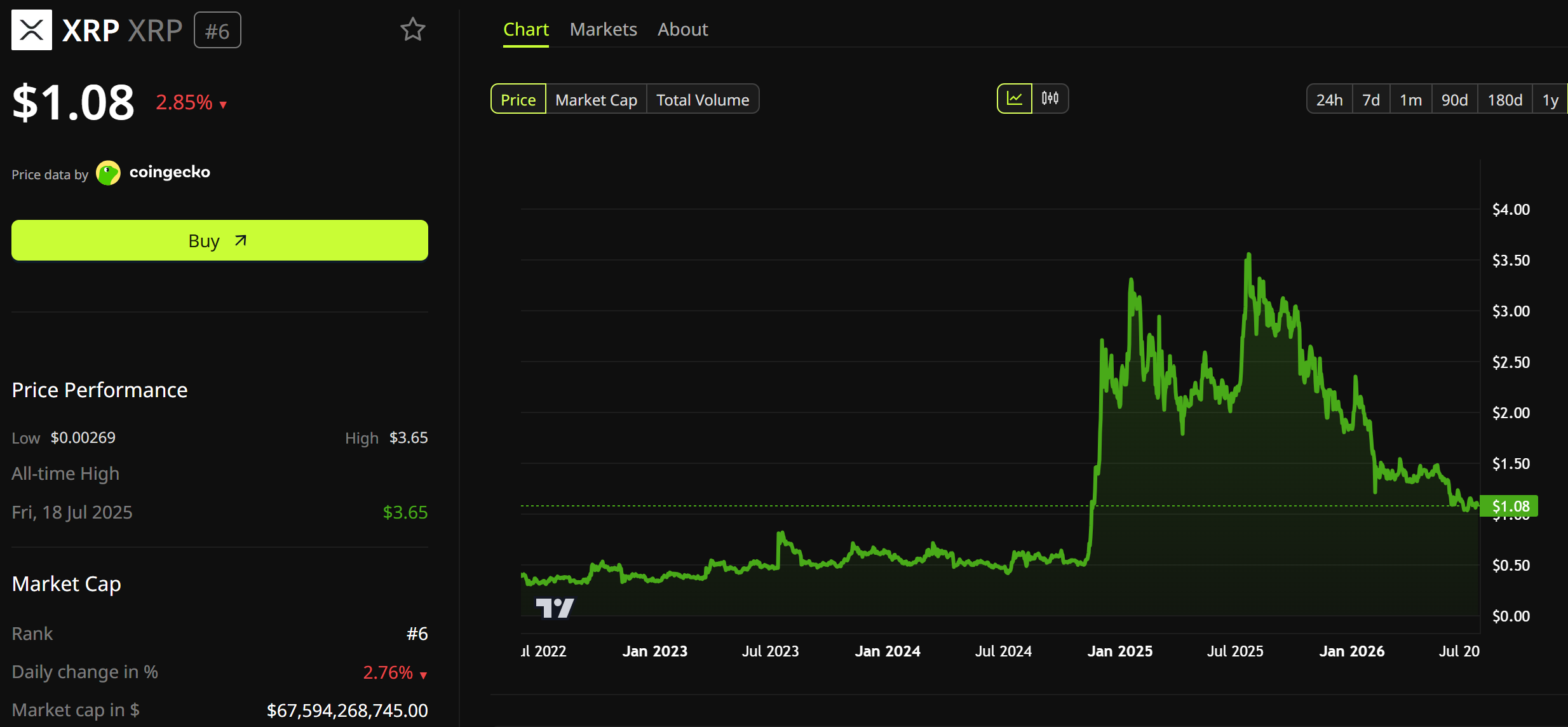
The token itself has less to celebrate. XRP traded near $1.08 at press time, down about 3% in a day, per BeInCrypto Markets data.

Still, the ruling shapes US crypto policy today, and Congress is now weighing crypto market structure rules. The bigger lesson may be simpler. Ordinary XRP holders showed up, and a federal judge listened.
The post John Deaton Says 4,000 XRP Holders Helped Secure Ripple’s SEC Victory appeared first on BeInCrypto.
Crypto World
Virtual Protocol Sees Breakout Opportunity Amid Increasing Momentum in the AI Ecosystem Expansion

Virtual Protocol is being closely monitored by traders to see if improved technical strength and ecosystem development could help the cryptocurrency move past important resistance levels. Despite VIRTUAL still trading below its downtrend line, constant defense of key support levels is helping drive the accumulation bias.
However, the positioning in derivatives markets is also neutral, which indicates that market participants are waiting for more proof before taking more leveraged bets. This, coupled with continued development in AI infrastructure, agent commerce, and robotics, keeps the overall outlook interesting.
Technical Structure Suggests Critical Turning Point
Virtual Protocol could continue trading below value due to its prolonged correction, according to recent market analyst Tanaka. Rather than dwelling on its price movements in the short term, it is worth mentioning the ecosystem expansion and development plan that the project is building. The weekly chart provides additional evidence for this viewpoint.
After dropping by almost 90% since its peak levels, VIRTUAL slowly stabilized, creating a downtrend in the form of a descending resistance trendline with consecutive lows. The price is currently trading right under the persistent resistance level, which brings us to a critical turning point for the token.
Price action keeps squeezing between the resistance and the solid support area. Buyers keep entering the market in the accumulation zone, whereas selling activity looks much weaker than before the start of the correction.
Currently, Virtual Protocol is priced at $0.6357, representing an increase of 5.13% over the previous day and 21.73% within the last week. Trading volume for the day amounts to about $102.44 million.
Expanding the AI Ecosystem Serves to Strengthen the Long-Term Narrative
Other than price movements, Virtual Protocol continues to expand the ecosystem of the protocol focusing on AI. One of the primary goals of the protocol is the creation of a system for intelligent AI agents where they can transact autonomously. The process of agent payments, task execution, and autonomous interactions forms an important part of the project’s long-term plan.
The other notable development is the Agent Commerce Protocol, which aims to enable independent AI agents to find each other, negotiate services, and make payments autonomously. This commerce layer might prove to be one of the most useful long-term aspects of the protocol, according to Tanaka.
VIRTUAL also acts as the key asset in the entire ecosystem. The agent tokens make use of the VIRTUAL trading pairs for their liquidity, whereas transactions made between AI agents through commerce are done using the token.
Further growth of the ecosystem is continuing via integrations with Base, Robinhood Chain, and robotics programs. Eastworlds is also collaborating with Unitree Robotics to experiment with the physical implementation of AI. Although this will contribute to making the future outlook of the platform more positive, validation of adoption and revenue generation is still needed.
Funding Rates Are Evidence of Well-Balanced Positioning
The analysis of derivatives data reveals a similarly balanced view of the prevailing market positioning. OI-weighted funding rates stayed relatively neutral despite prolonged market weakness. There was neither any domination of bulls nor bears during the latest period of trading activities, implying balanced market participation in perpetual futures trading.
Previously, in case of the price decline, there were occasional moments when funding rates went below the zero level due to increasing bearish positioning. But these were never extremely low values that indicate a state of market capitulation. Recently, funding rates moved around the equilibrium point along with the price consolidation in a narrow range.
Resistance Breakout Is the Critical Technical Level
For now, the key technical factors for Virtual Protocol are the positive improvement in technical stability, ecosystem development, and the neutral derivatives sentiment. Virtual Protocol still builds infrastructure through AI agents, autonomous commerce, and robotics and enjoys positive support from the long-term accumulation area.
Despite that, the falling resistance trendline is the main technical barrier at the moment. Its breakout might confirm bullish momentum and change the market structure, while inability to do that will keep the ongoing range. Until this critical move takes place, traders will watch whether accumulation, ecosystem development, and stable market positioning can help form the next trend for Virtual Protocol.
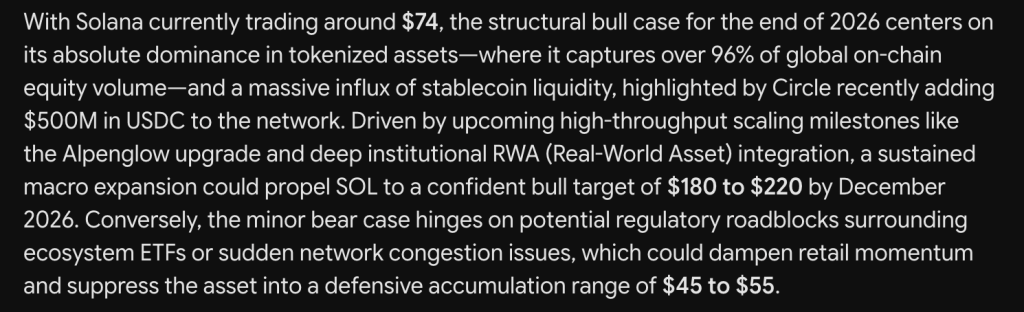
Google Gemini AI predicts a Solana price target that skips the usual talking points and goes straight to a number that made us pause.
Over 96% of global on-chain equity volume runs through Solana right now. That is not a growing market share story; that is a market that has already been won.
From $74, Gemini puts the December 2026 target at $180 to $220. Stablecoin liquidity is doing real work here too, with Circle adding $500M in USDC to the network in a single move.
The forward-looking piece is the Alpenglow upgrade, aimed at pushing throughput into territory that makes high-frequency use cases viable on chain for the first time. Pair that with deep institutional integration into real-world assets, and Gemini’s thesis is less about speculation and more about infrastructure quietly becoming unavoidable.
A sustained macro expansion is the condition attached to all of it. Without a broader risk appetite returning, even dominant infrastructure sits underpriced.
The bear case Gemini offers is almost an afterthought by comparison. Regulatory roadblocks around ecosystem ETFs or a sudden bout of network congestion could dampen retail momentum and push SOL into a defensive range of $45 to $55.
That is a specific, bounded downside rather than a collapse scenario. It reads more like a pause than a reversal.

Discover: The Best Token Presales
Solana Price Prediction: SOL RSI Just Crossed A Line It Has Not Held Since October
Price closed at $74.67, down 0.78%, with the session ranging between $74.12 and $75.69. On its own, that is an unremarkable day, but the chart underneath it tells a longer and more interesting story.
SOL peaked near $257 in September 2025, and the decline from there was almost uninterrupted through the February crash below $80. Since that crash, price has spent five months carving a wide range between roughly $60 and $100, with three separate rally attempts, March, May, and now July, each stalling near the same $95 to $100 ceiling.
That repetition matters. A level that rejects price three times stops being a coincidence and starts being the market’s actual opinion on fair value.
Support sits at $70, then the June low near $60 that has held twice now. Resistance stacks at $80, then $85, then that stubborn $95 to $100 zone.
The RSI panel shows something worth pausing on. RSI reads 46.03 with the signal line at 54.63, and that signal line has been climbing steadily since the June bottom, tracking the price recovery closely.
The current gap is negative, meaning short-term momentum has cooled slightly after the recent bounce, but the broader trend in the signal line itself is the more telling detail. It has not been this elevated since October, back when SOL was still trading above $200.
For Gemini AI, as it predicts, a $180 prediction becomes plausible. Solana needs to finally close above $100 with conviction, something it has failed to do three separate times since February. The infrastructure case may already be true. The chart has not been asked to agree with it yet.
Discover: The best crypto to diversify your portfolio with
Don’t Miss Out on Our $1,000 USDT Airdrop on ByBit
You Might Like What Gemini AI Predicts About This New Layer 3 Called LiquidChain
The money that wins cycles never waits at resistance.
Large caps are stuck. Bitcoin, Ethereum, and XRP keep testing the same ceilings with nothing breaking through. Every macro catalyst has a new arrival date. Every institutional wave has a new quarter attached. Waiting on someone else’s decision is not a trade.
Small market cap infrastructure plays operate on completely different physics. A rotation that vanishes as noise at Bitcoin’s scale reprices an undiscovered project by multiples. The opportunity lies in the gap between what something is genuinely worth and what the market has assigned it. That gap closes permanently the moment discovery happens.
Multi-chain fragmentation is one of the most expensive unsolved problems in DeFi. Bitcoin, Ethereum, and Solana run as completely isolated systems. No shared architecture. No native interoperability. Every time value crosses those boundaries it pays in fees, slippage, and failed transactions.
LiquidChain makes the crossing free. Gemini AI predicts and agrees. All 3 networks inside one execution environment. Single deployment. Complete ecosystem access. No tax on any interaction.
The presale is at $0.01454 with just over $900,000 raised. Early and undiscovered. That combination does not last long.
Explore the LiquidChain Presale
The post Google Gemini AI Reveals Shocking Solana Price Target for 2026 appeared first on Cryptonews.
CASHCAT Plummets 65% in a Week: The Doom of Another Meme Coin or New Pump Loading?

The Cost Of Summer Holiday Childcare In 2026

Swiss rider Schmid wins Tour de France’s longest stage as Pidcock climbs into fourth


-

 Fashion7 days ago
Weekend Open Thread: Nutriplenish Leave-In Conditioner
-
 NewsBeat1 day ago
London Mayor Sadiq Khan handed a peerage by Keir Starmer alongside 15 other Labour figures… just days before the PM leaves No10
-

 Crypto World2 days ago
CFTC blocks Kalshi from unwinding Michigan trades after court order
-

 Politics2 days ago
Young campaigners urge incoming PM to act on outdoor junk food ads
-

 Business2 days ago
Nvidia Stock Slips After Big Tuesday Rally as Huang Confirms Vera Rubin Chip Is Now in Production Today
-
 Entertainment2 days ago
Disney’s Most Ambitious Failed Star Wars Attraction Is Coming to SDCC
-

 Fashion2 hours ago
Weekend Open Thread – Corporette.com
-

 News Videos3 days ago
XRP BOMBSHELL… XRP OMBOARDED FOR TRANSACTIONS!!!
-

 Tech4 days ago
Get Your ESP32 Sunny Side Up With This Solar Dev Board
-

 Crypto World23 hours ago
Injective Submits SEC Transfer-Agent Registration to Onchain Ownership Records
-

 NewsBeat8 hours ago
Registration is now open for March for Men with Kev 2026
-

 Tech3 days ago
Dark Secrets Emerge When Jailbreaking LLMs
-

 Business2 days ago
Palantir Shares Rise After Expanded Nvidia Partnership and Fresh Analyst Upgrades Ahead of Earnings Day
-

 News Videos13 hours ago
Money | Class 12 Economics | CBSE Board Exam 2026-27
-
 Sports2 days ago
New Cornerback Enters Vikings Trade Rumor Mill
-

 Business18 hours ago
Banco Bilbao Vizcaya Argentaria, S.A. (BBVA) Discusses Global Macro Environment and Economic Outlook for Core Markets Transcript
-
 Tech4 days ago
Cloudflare Precursor Watches Your Mouse and Keyboard To Decide If You Are Human
-

 News Videos4 days ago
how to make coin bank box with cardboard #scienceproject #money #diy #shorts
-
 Entertainment2 days ago
Vicki Gunvalson Defends Discussing Heather Dubrow’s Money
-

 Business37 minutes ago
Airlines warn Sunshine Protection Act could disrupt flight scheduling
You must be logged in to post a comment Login