
TL;DR
Roblox launched Build, a mobile-first AI creation tab that generates games from text prompts, starting alpha in New Zealand on July 28.



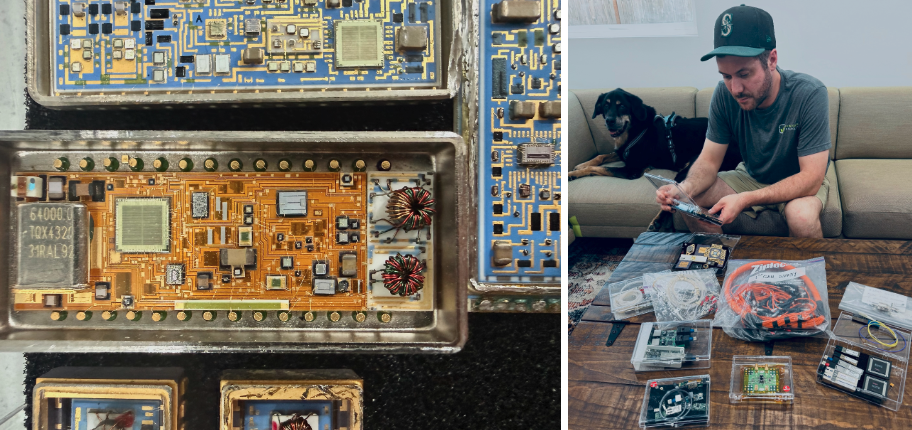

A technological time capsule of artifacts from the Seattle region’s aerospace history was saved from the waste bin by an electronics recycler this week. Now he’s trying to solve the mystery: Who owned them, where did they come from, and what exactly are they, anyway?
Computer and electronic parts dating back nearly 50 years were among a donation of items dropped off at the Bellevue, Wash., location of Living Green Technology. Instead of the usual assortment of obsolete laptops, gaming consoles and tangled cords, the lot was like a pristine engineering archive consisting of gold-plated prototype chips, raw silicon architectures exposed under glass, and experimental fiber-optic cables used to pioneer early flight control systems.
Tyler Rivers, founder and CEO of the 13-year-old company, personally inspects weekly collections from his company’s public drop-off sites, and he instantly realized the pieces were far too rare to be shredded for their precious metals.
“I’m kind of the nerd for all this stuff,” Rivers told GeekWire on Wednesday. “I go down many, many rabbit holes with different things.”
Rivers was looking into whether the donor could be tracked down to help piece together the high-tech puzzle. He did his own digging and GeekWire also leaned on Google’s Gemini AI to help identify items in photographs Rivers shared. We’re hoping readers might also email us with their own insights.
For now, we’ve determined that the collection paints a picture of a highly specialized, Cold War-era engineering workspace focused on the physical dawn of modern aviation, spacecraft engineering, and early fiber-optic data networks. It includes:
Texas Instruments SBP9900X microprocessor: A rare, military-grade 16-bit processor from 1977 marked “Experimental.” Built using a specialized architecture resistant to extreme temperatures and ionizing cosmic radiation, this line of chips was famously utilized by NASA and military defense contractors for deep-space and missile guidance systems. (Check out this report on testing radiation-hardened microprocessors.)

Canstar 8×8 optical star coupler: A beautifully preserved, heavy-duty glass-and-metal fiber-optic coupler stamped “8X8 100/120/140.” This component physically fused fiber-optic strands together to split and route light signals — a critical building block for prototyping early, interference-proof “Fly-by-Light” flight control systems.

DDC Total-AceXtreme avionics module: A mechanical engineering sample marked by Data Device Corporation (DDC), a pioneer of 1970s and ’80s military flight systems. The component is designed for MIL-STD-1553, the standard data bus protocol that allows cockpit flight computers, sensors, and avionics to communicate with one another on military aircraft and spacecraft.

Un-lidded hybrid microcircuits: Custom-engineered ceramic and metal cavities housing bare silicon architectures connected by microscopic, gold-bonded wire arrays. These high-reliability hybrids were custom-crafted by hand for military and aerospace programs to pack dense electronic circuitry into compact, hermetically sealed packages.
Rivers has no formal aerospace, computer science or electronics background — he’s a 2012 University of Washington graduate in economics. He started his company as a college student while working at a UPS Store, setting up a drop-off bin on the counter to collect, repair, and resell old cell phones and iPods.
Today, in addition to public e-recycling, Living Green Technology assists businesses, government agencies and others in secure data destruction, asset recovery and more.
Rivers’ hands-on curiosity regularly follows him home. When unique or puzzling items show up at his public drop-off sites, he often takes them home to dissect them in his garage. Among his previous saves is a NASA laptop, complete with receipts and tagging showing it was modified for spaceflight.
“I pretty much deep dive and gather as much information as I can,” Rivers said. “Usually, sadly after that, I stick it on a shelf in my workshop and just leave it there until I figure out what I want to do next with it.”
This particular assortment of salvaged history offers a physical look at engineering hurdles solved decades ago, representing a transition period when computers were first being ruggedized to survive the extreme environments of military aviation and space flight.

For further insight, GeekWire reached out to Andrew “bunnie” Huang, a renowned hardware hacker, author, and MIT-trained electrical engineering Ph.D. widely known for his pioneering work in reverse engineering and open-source hardware. His blog is a hardware geek’s must-read.
After reviewing photos of the Bellevue haul, Huang pointed out that the collection may not actually be a single, unified archive from a lone aerospace project. Instead, he suspects it is the ultimate “collage” of high-tech souvenirs.
“The random tray of components on the black ESD foam… I almost would be inclined to think this was more of a collage of components kept by a technician from various projects,” Huang said. “There’s some pretty nice optical sensors in there with enormous active areas, a random segmented LED display, and an old 2K EEPROM.”
Given the Seattle region’s history around aviation, aerospace and technology, there are surely countless boxes stuck in garages, attics and storage spaces holding the artifacts of innovation.
Lāth Carlson is the former executive director of Living Computers: Museum + Labs, the now-closed Seattle institution founded by Microsoft co-founder Paul Allen as a home for vintage computing equipment. Carlson was accustomed to random boxes showing up on his doorstep.
“Many people don’t realize that most museums would not exist without collectors — people that say, ‘well, that seems like it’s worth keeping’ and put it in a box,” said Carlson, who now leads Seattle’s National Nordic Museum. “Sometimes we get really lucky and they end up being more right than they realize.”
Without speaking for local e-recycling outfits, Carlson recommended getting in touch before just leaving things at a museum, because most are bound by policy to dispose of such items.
For now, Rivers’ latest rescue is safe from the shredder, perhaps waiting for its full story to be uncovered.

An anonymous reader quotes a report from NBC News: Trump Media & Technology Group has unveiled a paid-for, licensed data feed that will give banks and trading firms “the fastest” access to posts from influential Truth Social accounts, such as President Donald Trump’s, whose posts often move global markets. The product, called ‘Truth API,’ will deliver posts from the 10 most influential accounts to customers at a significantly faster pace than a regular push notification on the Truth Social platform, a spokesperson said. The feed is designed for organizations “most impacted by the cost of a delay in information,” such as algorithmic trading firms, the company said in a statement. “Until now… firms that prioritize tracking influential Truth posts have relied on manual monitoring. Truth API closes the gap.” “Markets already move on Truth Social posts … As adoption grows, we expect Truth API to become a meaningful, ongoing source of revenue for the company,” TMTG’s interim CEO Kevin McGurn said.
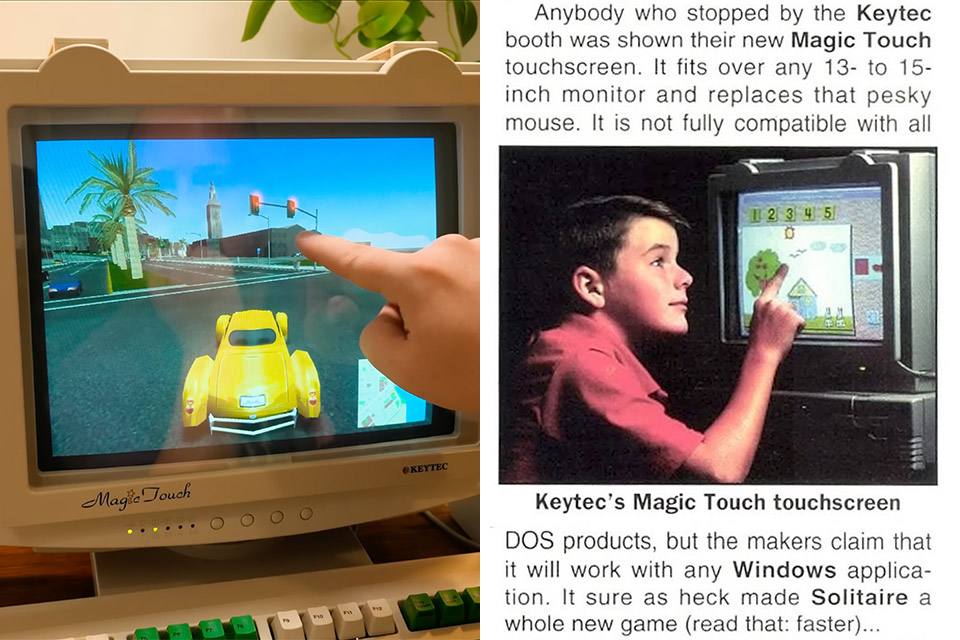
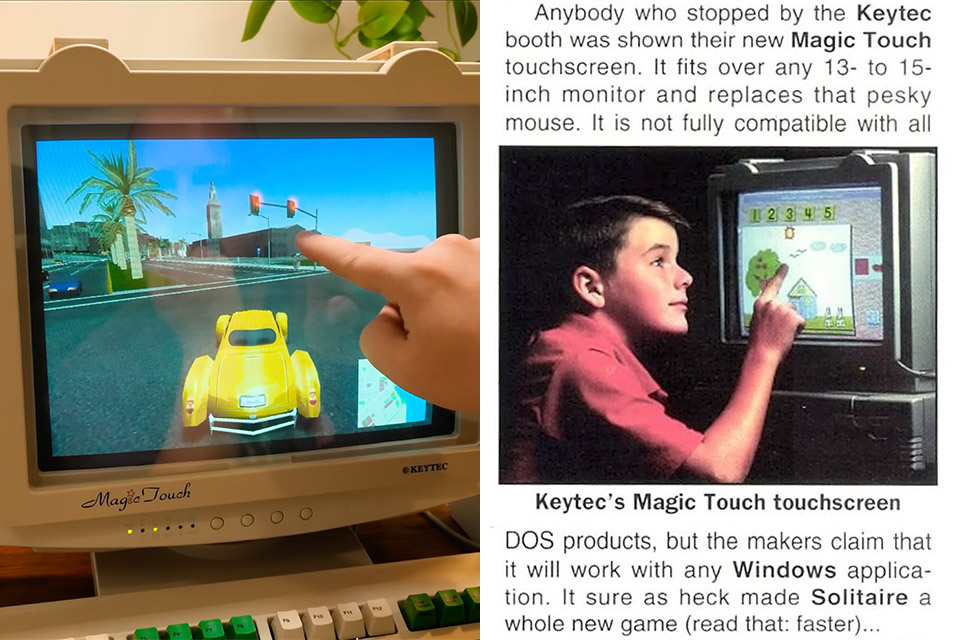
Keytec brought the Magic Touch to the 1994 Summer Consumer Electronics Show in Chicago. The Texas company, founded in 1987, offered a straightforward way to give standard CRT monitors and notebook screens touch input without replacing the entire display. At a moment when keyboards and mice defined personal computing, the idea of pressing a finger directly on the glass stood out as genuinely forward-looking.
The Magic Touch’s hardware took the shape of a framed overlay, similar to a plastic frame with a clear adhesive membrane inside. This membrane rested on top of whatever monitor you were using at the moment, with a nice border that matched the forum’s standard beige or black color scheme. Within this jumble of layers was a brilliant innovation: an invisible spacer system that kept the whole device light and didn’t interfere with your view while also protecting the screen from scratches. The membrane handled roughly 80% of the display, which isn’t awful, and it was strong enough to withstand the ordinary 3H pencil scratch.
Sale

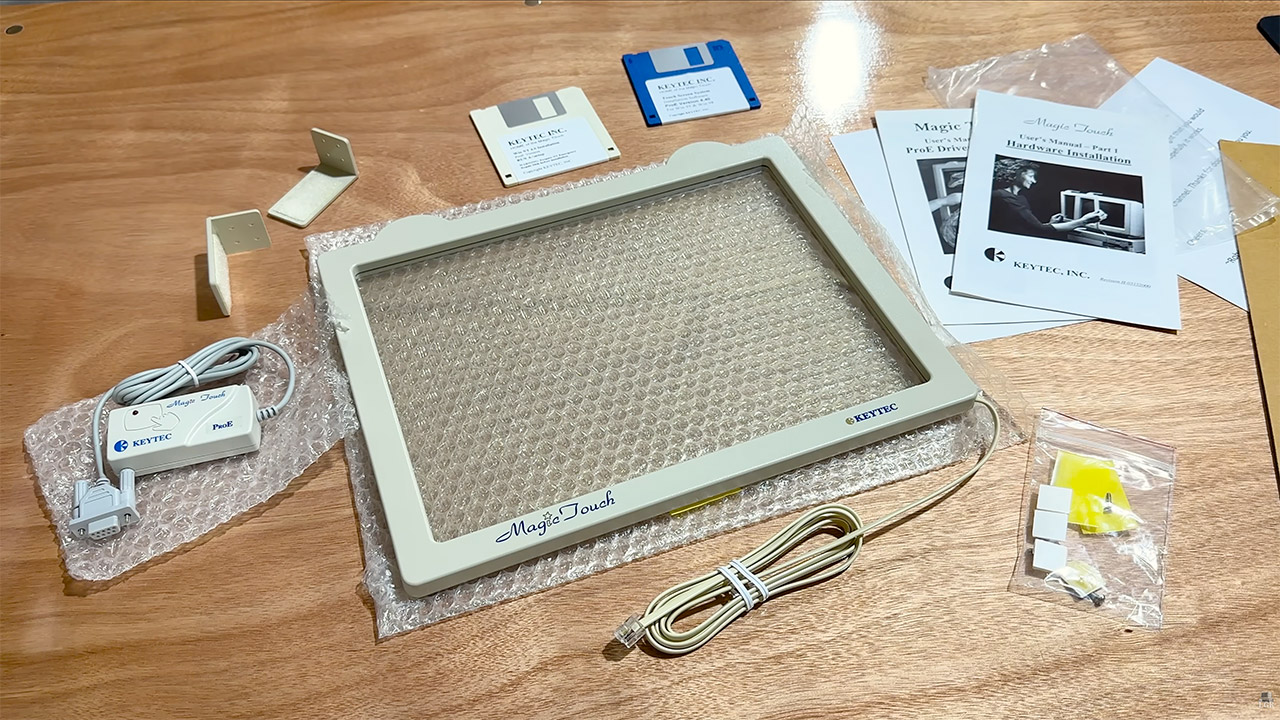
To make things work, you needed a little external controller. Early versions were connected via an obsolete serial port, whereas subsequent versions just used USB. The panel simply hooked into the controller, and many configurations provided power via the computer connection, eliminating the need for a bulky power brick on your desk. The items were offered in a number of sizes, ranging from 12 to 17 inches for poor laptops to 13 to 24 inches for desktop displays, with larger cousins appearing in related products. It was very simple to install; simply attach some clips or brackets for large desktop monitors that would clip over the top of the bezel, or use adjustable straps for laptops to keep everything in line with the screen. You finished in a few minutes, and the old screen was as good as new underneath.
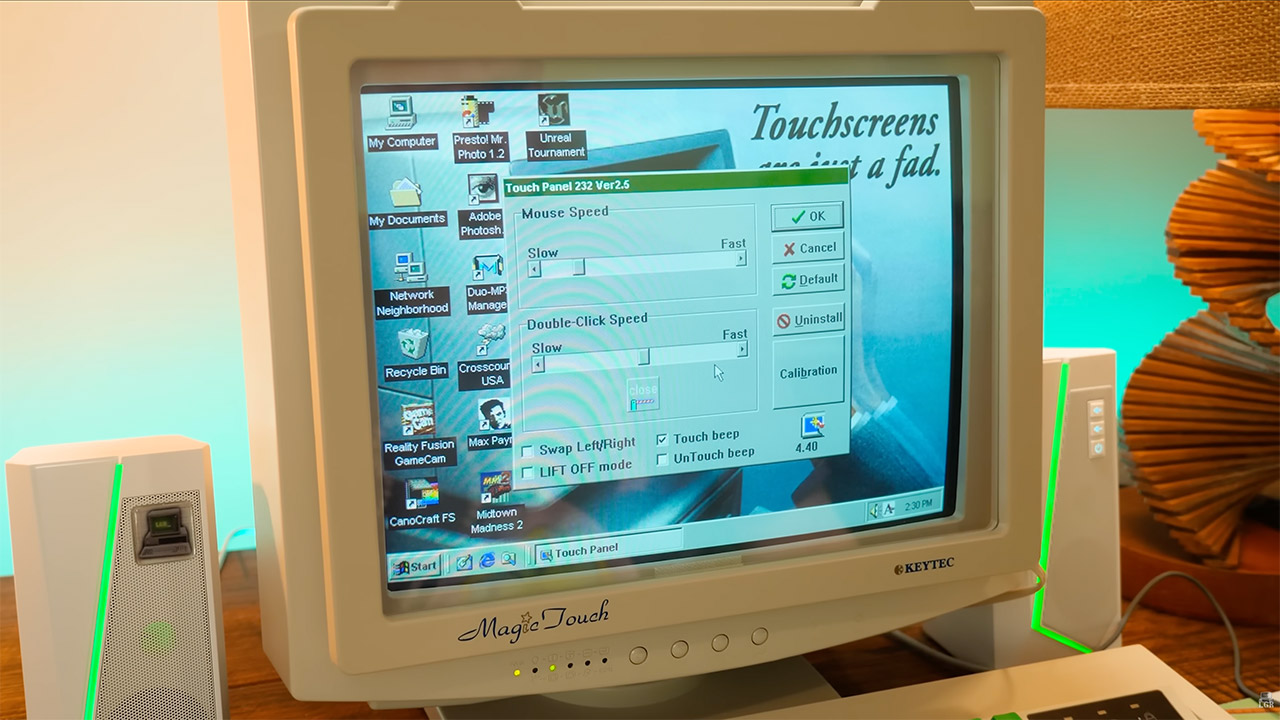
Once everything was set up and connected, you’d need some software to instruct the touchpad what to do. This would convert all of the touchy feely inputs into mouse operations. You’d go through a simple calibration process to get the pixels and the membrane in line. Then you could choose whether to click on contact or lift off to get the device to work, and you could even change for left or right hand preference, as well as temporary right click on using a software toggle. It performed all of the standard mouse actions: cursor movement, single clicks, double taps, and drags. The touch resolution was great and high, 4096 by 4096 points, and the entire thing responded to finger pressure, which ranged from 50 to 120 grams per square centimeter.

The effectiveness of the system was determined by the software being used. Big buttons on interface elements functioned perfectly with a finger or a stylus, and menu navigation was simple. You’re probably familiar with some of the older action games, which were more hit and miss. Because of the small physical space between the membrane and the screen, you had to make sure you had everything set up correctly for those tiny targets; otherwise, you’d have bizarre parallax, and glare may be an issue, especially if you had a shiny display. It also took some force to work, albeit not much.

After completing the initial Magic Touch launch, the company continued to develop subsequent versions that worked with a variety of operating systems and connection methods. They made this type of device until 2017, when it was handed over to a new business that continued to create custom touch-focused solutions for a variety of monitors and panels. Nowadays, you can get very much the same idea, just updated, and still purchase a Magic Touch-style gadget to convert an old display into a touchscreen.


AI AND ML
Adapting existing local LLM project for security and sovereignty purposes and hopes to one day match Mythos
South Korea is developing its own security-focused AI model and hopes to bring it online by the end of the year, to ensure the nation has sovereign bug-finding capabilities.
Deputy Prime Minister and Minister of Science and ICT Bae Kyung-hoon revealed the effort to create the model yesterday, and said it’s needed so South Korea possesses a bug-finding model to rival Anthropic’s Mythos.
The US government has twice blocked access to Mythos, once by requiring Anthropic to offer it only to American citizens – a demand the AI company could not meet and therefore blocked all access – and a second time by ordering the company to take down its services so Washington could investigate allegations of possible dangerous performance problems.
Those incidents led many other nations conclude that the US could in future deny access to powerful models – meaning US-based organizations and national security agencies would have an edge. Washington has since allowed limited access to Mythos to some of its allies.
Interest in developing sovereign AI capacity has nonetheless soared, and Bae said South Korea now aspires to develop its own Mythos-class model. The Register is aware of another effort to create Mythos-like tools, involving private firms and infrastructure operators across several countries.
In South Korea, the government’s approach is to add security-related information to the corpus it is using to train a locally developed frontier model. The minister said he expects that security-capable model will debut by the end of 2026.
South Korea has also sought bids to create a chatbot that will be made freely available to all residents, plus an agentic application that will help locals interact with government services.
Minister Bae made his remarks at a policy briefing session conducted by President Lee Jae Myung, during which discussions about AI also touched on using the technology to detect fake news in real time, and put it to work handling complaints about government services more quickly than is currently possible. ®

One features an optical illusion spoof of ‘They Live.’

Amid a growing backlash against Meta’s smart glasses, an activist group has taken over two London bus stops with fake ads for the product, including one that uses a clever optical illusions to turn Kylie Jenner’s face into a dystopian PSA about surveillance.
At first glance, the “ad” looks almost indistinguishable from a legitimate ad showing Kylie Jenner wearing a pair of smart glasses. But if you look at it from a different angle, the image turns to black and white and Jenner’s face takes on a creepy, skeletal look. Instead of “Meta AI glasses” the text changes to “Meta: We’re always watching.”
Recording everything we see and do constantly? It’s giving fascism, not fashion
It’s just been revealed Meta is planning to make the glasses “continuously record audio while taking photos every few seconds” without any warning light*
Literally NO ONE asked for this
#noncegoggles
*Source: the FT
— Everyone Hates Elon (@everyonehateselon.bsky.social) 2026-07-13T15:57:17.393Z
As Hyperallergic points out, the ad seems to be a cheeky nod to They Live, John Carpenter’s 1988 sci-fi classic in which a pair of strange sunglasses plays an important role. It also follows another fake Meta glasses ad that cropped up in London earlier this month that’s even less subtle. “The biggest advance in pervert technology since the trenchcoat,” it says above a pair of glasses. “Hey Meta, start filming.”
Both ads are the work of Everyone Hates Elon, an activist group that’s conducted similar guerrilla-style campaigns to protest Elon Musk and other tech oligarchs. The group was behind a series of and posters subway ads in New York that protested Jeff Bezos’ involvement with this year’s Met Gala.
“Just because you CAN create sunglasses that record people without their consent and use the footage to train robots… Doesn’t mean you should,” the group wrote in an Instagram post about the campaign. The group also pointed to a recent report from the Financial Times that claimed Meta is testing a new type of glasses that’s meant to continuously record audio and video.
Meta didn’t immediately respond to a request for comment. The company recently announced that it would disable the cameras on its smart glasses if it detects that the recording LEDs have been physically tampered with. Meta said it would “continue to work on ways to make them even safer and more trustworthy.”
Roblox launched Build, a mobile-first AI creation tab that generates games from text prompts, starting alpha in New Zealand on July 28.
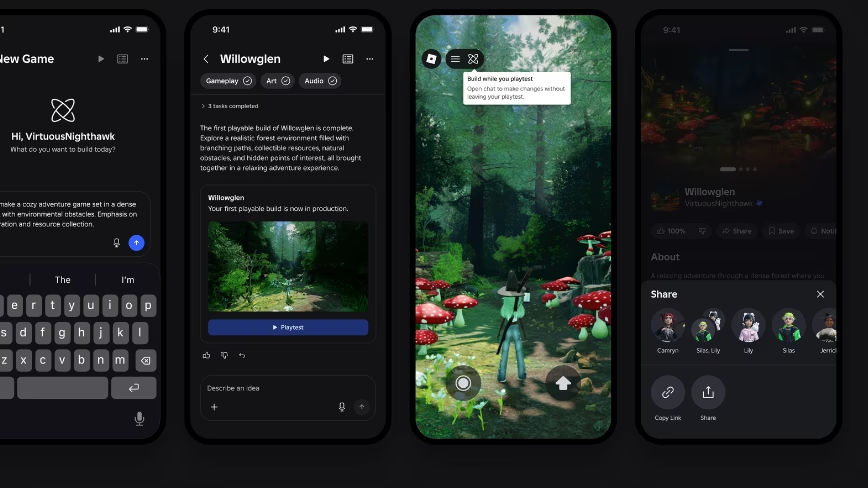
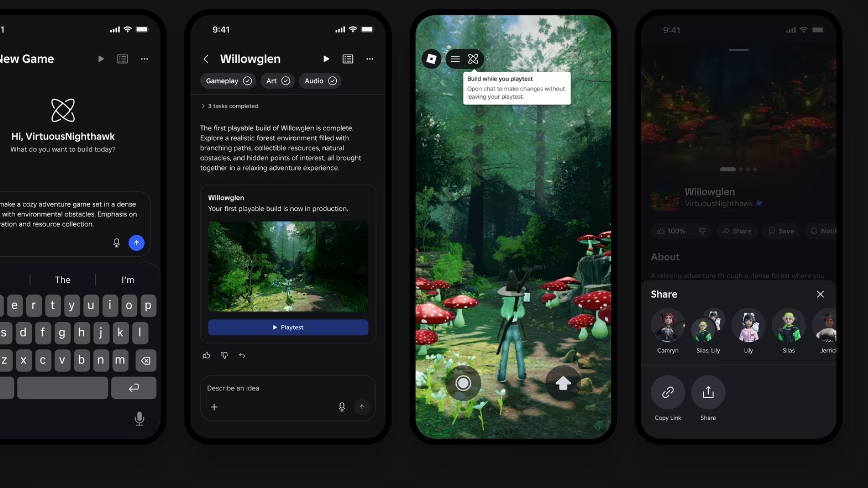
Roblox announced Build on Wednesday, a new creation tab inside the Roblox mobile app that lets anyone turn a text prompt into a basic playable game without touching Roblox Studio or writing a line of code. A creator can describe something like a cozy forest adventure game with environmental obstacles, and Build will generate a starting point with gameplay mechanics, environment, characters, sound, and visual style. The feature begins public alpha testing in New Zealand on July 28 for age-verified users nine and older.
Build shares a back end with Roblox Studio, meaning creators can start a project on their phone and continue refining it on desktop with the full Studio toolset, or launch agents from Studio and check progress from mobile. The system is powered by a mix of open-source and proprietary Roblox AI models trained on what the company describes as a uniquely large set of 3D models and gaming-specific data. Roblox’s Cube foundation model, which the company introduced earlier this year alongside agentic Studio tools, generates game-ready objects that can drive, shoot, or otherwise behave as expected without manual scripting.
Roblox said it is aware of the quality risk that comes with lowering the barrier to game creation. The company said its discovery system ranks games by long-term retention, not recency or volume, and that games nobody plays will not surface on the homepage regardless of how they were made. Published games from Build will go through the same safety checks and retention-based discovery ranking as all other Roblox titles, and games targeting younger players will undergo an extended review before being added to the Roblox Kids or Select catalogues.
Alongside Build, Roblox is shipping a suite of agentic tools for professional creators over the coming months. These include a playtesting agent that finds bugs before players encounter them, an analytics agent that answers questions about game performance in plain language, and an experiment agent that identifies tests to improve engagement and monetisation. A new scene-generation model is also in development that will create entire editable and playable 3D environments from a single text prompt.
The announcement comes as AI-generated content is flooding platforms faster than review systems can handle it, a dynamic that drove an 84 percent jump in App Store submissions and prompted Apple to crack down on low-quality AI-built apps. Roblox is betting that its retention-based discovery system will serve as a natural quality filter, surfacing only games that players actually want to keep playing.
A base version of Build will be free, with paid options for power users. The rollout will expand to more regions after the New Zealand alpha, and Roblox said it plans to share further creation tool announcements in the coming months. The platform has 132 million daily active users, any one of whom could now prototype a game from their phone.

Roblox is putting AI game creation inside its mobile app, giving more people a faster way to turn a written idea into a playable experience without starting in Roblox Studio.
The company will begin a public alpha of Build in New Zealand on July 28, 2026. The mobile-first AI tool turns text prompts into playable games inside the Roblox app and will include publishing among its selected early features.
Build adds a creation tab to the mobile app. A user can describe a game in ordinary language, and Build will generate an initial project with gameplay mechanics, environments, characters, visual styling, sound, and other elements.
Creators can playtest the result, request changes through chat, share the project with friends, or continue working in Roblox Studio. Build and Studio share the same back end, models, and chat history, so a project started on a phone can move into the company’s more advanced desktop tools.
Roblox is positioning Build as an easier entry point for people who have a game idea but don’t already use Studio. The creation platform reports 132 million daily active users and wants more of those players to become creators.
The initial rollout will remain limited. During the New Zealand alpha, Build is scheduled to be available to age-checked users 9 and older, although age requirements may vary by region.
 Roblox is positioning Build as an easier entry point for people who have a game idea but don’t already use Studio. Image credit: Roblox
Build-created games that pass Roblox’s safety checks will be available worldwide to age-checked users 16 and older. Games must also complete Roblox’s extended review process before entering its Kids or Select catalogs.
Roblox plans to expand Build to more creators and regions after the New Zealand alpha, but it hasn’t announced a broader rollout schedule.
Build combines open-source models with Roblox’s proprietary AI systems. Roblox says its models use gaming-specific data and a large collection of 3D models to generate functional objects and scenes.
Roblox is also developing AI tools for professional creators. Planned agents will identify bugs, answer plain-language questions about analytics, and suggest experiments tied to engagement, retention, and monetization.
Some of the underlying technology is already available. Procedural Models generate adjustable 3D assets from text or images, while Roblox’s Cube foundation model can create functional objects, including vehicles that drive and weapons that shoot.
Roblox also plans a scene-generation model that will create editable, playable environments from a single prompt. The company hasn’t announced a release date.
Faster game generation could increase the number of repetitive or unfinished projects competing for attention. Roblox addressed that concern directly in its announcement.
The company said its discovery system prioritizes long-term retention, which Roblox argues excludes what it called “AI slop,” and Build-created games will compete in the same candidate pool as other experiences.
 A basic version of Build will be free, with paid options planned for creators who need additional capabilities. Image credit: Roblox
Roblox argues that games that fail to attract players will remain difficult to discover under its retention-based ranking system. Faster generation could still leave Roblox with more projects to review, rank, and moderate as Build reaches additional markets.
A basic version of Build will be free, with paid options planned for creators who need additional capabilities. Roblox hasn’t disclosed pricing or identified which features will require payment.
Build can shorten the path to a first playable project, but generating a game isn’t the same as making one people want to keep playing. Roblox’s discovery system will help decide which Build projects find an audience and which disappear into the platform’s growing catalog.

Amazon’s $400 discount on Apple’s high-end 16-inch MacBook Pro with an M5 Max chip and 2TB SSD is available now, with delivery as early as tomorrow for Prime members.
The M5 Max 16-inch MacBook Pro is on sale for $3,999 at Amazon in your choice of Space Black or Silver. This high-end configuration has Apple’s M5 Max chip with an 18-core CPU and 32-core GPU, along with 36GB of unified memory and a spacious 2TB SSD.
Save $400 on M5 Max 16″ MacBook Pro
Amazon’s $400 discount delivers the lowest price available per our 16-inch MacBook Pro Price Guide, with the next lowest price coming in at $4,189 at Expercom.
In our hands-on 16-inch MacBook Pro review, we found the M5 Max chip is blazing fast and we were happy to see the laptop now supports Wi-Fi 7.
You can also find MacBook Pro deals on M5 Pro 14-inch and 16-inch models in our Price Guides, with a few highlights below.


The past two years have transformed the world of software development, but there’s at least one area that remains largely untouched by artificial intelligence: the operating-system layer inside phones, vehicles, and other connected devices.
A Seattle startup called logcat.ai has raised $2.55 million to change that.
Co-founded by CEO Varun Chitre and CTO Tarun Vashisth, two engineers with years of experience building device software, logcat.ai is developing a system of AI agents that autonomously hunt down bugs across the kernel, modem, and firmware of devices running Android or Linux.
The pre-seed round was led by Founders’ Co-op, with participation from Act One Ventures, TheFounderVC, Shorewind Capital, Clayoquot Capital, and Alumni Ventures.
“It’s one of the toughest areas of software engineering, and it doesn’t get a lot of exposure. Operating-system engineering is virtually hidden today,” Chitre said in an interview.
It’s also a challenge for many companies given a shortage of engineers who specialize in the field, compared to the much larger population of developers who build apps and software that run on top of the operating system.
How it works: An engineer using logcat.ai uploads the log files a device generates when something goes wrong — such as bug reports and kernel logs — and logcat.ai’s software analyzes them together to find the root cause and point to where in the code to fix it. Each finding cites the exact log line it came from, so an engineer can check the work.
Currently, logcat.ai finds the root cause and recommends a fix. The larger plan is to have the AI write the fixes, test them, and eventually build new features on its own, with engineers approving the work before it’s deployed.
@media (max-width: 600px) {
aside.callout { float:none !important; max-width:100% !important; margin-left:0 !important; margin-right:0 !important; }
}
The long-term goal, Chitre said, is to become the standard tool for building and maintaining operating systems on new and existing hardware — from smartphones to cars to robots and other embedded systems — so a company can ship without a full-stack specialist on staff.
“We’re moving toward a world where software and intelligence extend far beyond our laptops and phones, yet the tooling to build high-quality products for that world is still missing,” said Aviel Ginzburg, general partner at Founders’ Co-op, in a statement.
He called Chitre and Vashisth “one of the only teams in the world truly up for the challenge.”
Traction: The company says it has served hundreds of engineering teams in a public beta, analyzed more than 10 billion lines of trace data, and run thousands of automated investigations. It’s generating revenue but isn’t ready to disclose numbers or customers.
Competitive landscape: Chitre said logcat.ai’s main competition isn’t another product but in-house scripts and the knowledge locked in a few senior engineers’ heads. App-level crash tools like Google’s Crashlytics and Sentry stop at the app layer and don’t do the deeper system debugging.
Specialist vendors and the contract manufacturers that build devices are potential partners more than rivals, Chitre said, since they face the same engineer shortage.
GeekWire first reported on logcat.ai in March, in a Startup Radar roundup.
The team: Chitre and Vashisth met at Esper, the Bellevue, Wash.-based device-management company, where they worked together for more than seven years. They started logcat.ai because they had spent years doing debugging by hand and knew what was missing.
Chitre has spent more than 13 years in the field, getting operating systems to boot and run on new hardware and porting new Android releases and Linux kernels onto older devices. He was also a maintainer of LineageOS, a widely used open-source version of Android.
Vashisth has led engineering teams working across Android, Linux, and iOS, and brings a background in large-scale distributed systems. At Esper, he rose to senior software engineering manager. His prior experience includes platform-architecture engineering at Target.
For now, the company is just the two founders: Chitre in the Seattle area, Vashisth in Bengaluru, India. They plan to hire about 10 people over the next year, with a distributed team working remotely from wherever they can find the specialized talent.
They know those hires won’t be easy to find, given the scarcity of people in the field. “That’s the same shortage our product exists to address,” Chitre said, “and we’re not exempt from it.”

Don’t expect that number to shrink any time soon.

Netflix hasn’t made any secret of its interest in artificial intelligence, and now we have a sense of how those tools are being used in its content. “In 2026, GenAI workflows have been used in roughly 300 of our titles, with the largest concentration of work in post-production,” according to the shareholder letter detailing its second-quarter financials. The company named three projects — Glory (India), Brasil 70: A Saga do Tri (Brazil) and The American Experiment (US) — that used generative AI “to create highly complex sequences,” but the tech is becoming more widespread at this point.
We already knew that Netflix had applied generative AI in at least one original show as of last July, but between making acquisitions and launching new specialized studios, its ambitions clearly extended further. The streamer went on to note in its earnings letter that “We are increasingly leveraging these tools to deliver higher quality output more quickly and at a lower cost than traditional methods.”
Here’s the recurring reminder that yes, gen-AI is capable of making something much quicker than a VFX artist or animator. But it still takes some human touch to make sure the results actually work with the rest of the film or show. And just because AI can be a useful tool for skilled creators doesn’t mean it should be tasked with replacing entire teams. Hopefully that’s something Netflix and its partner studios understand as they continue to double down on the tech.


Across 107 enterprises, AI agents are being given real access to systems and data while the controls meant to contain them lag behind. More than half have already had a confirmed agent security incident or a near-miss; only about a third give every agent its own scoped identity, and most agents still share credentials; and only three in ten isolate their highest-risk agents. The security stack is overwhelmingly borrowed from the model providers and hyperscalers rather than purpose-built for agents, spending remains a thin slice of the security budget, and enterprises are evenly split on whether their defenses are keeping pace with AI-enabled attackers. The result is an agent security gap — autonomous agents proliferating faster than the identity, isolation, and enforcement controls needed to hold them.
This wave of VentureBeat Pulse Research examines how enterprises secure their AI agents: what tooling they run, how they manage agent identity and isolation, what has already gone wrong, how much they spend, and whether they believe their defenses are keeping pace with AI-enabled attackers.
The central finding is an agent security gap — the distance between the autonomy enterprises are granting their agents and the controls in place to contain them. More than half of organizations (54%) have already experienced a confirmed agent security incident (18%) or a near-miss caught before harm (36%). The structural weakness beneath those numbers is identity: only about a third (32%) give every agent its own scoped, managed identity, while the rest report that some agents share credentials or that agents mostly run on shared API keys and human or service-account credentials. When agents share credentials, a single compromised or over-permissioned agent carries a wide blast radius — and only three in ten enterprises (30%) isolate their highest-risk agents in sandboxes to bound that radius.
What makes the gap notable is how comfortable enterprises are inside it. The security stack is overwhelmingly provider-native — OpenAI’s guardrails (51%), Google’s and Microsoft’s cloud controls, and Anthropic’s managed-agent controls dominate, while the dedicated agent-security specialists barely register — and satisfaction with that borrowed stack is high, averaging 4.2 out of 5. Yet spending remains a thin slice of the security budget, only a third of enterprises believe their AI defenses are ahead of AI-enabled attackers, and a clear majority plan to change tooling within the year. Enterprises are satisfied with controls they are simultaneously preparing to replace.
VentureBeat fielded this survey as part of its ongoing Pulse Research series, this instrument focused on enterprise agent security — the tooling, identity, isolation, and enforcement controls organizations use to secure autonomous AI agents. Responses are filtered to organizations with more than 100 employees (n=107; the survey’s smallest size band, 1–100 employees, is excluded), drawn from a single June 2026 wave. Because this is one wave rather than a pooled multi-month sample, the report reads cross-sectionally and does not infer month-over-month trends. Several questions were multiple-select, so those shares can sum to more than 100%.
By role the sample is senior and buyer-credible: 45% are final decision-makers for AI purchases and another 30% recommenders or influencers. Managers (43%), individual contributors (24%), VPs and directors (15%), and the C-suite (11%) make up the seniority mix. By organization size the sample is mid-market-weighted: 251–1,000 (42%) and 101–250 (25%) employees lead, with 1,001–5,000 (19%), 5,001–10,000 (8%), and 10,001+ (7%) above them. Technology/Software is the largest industry at 23%, followed by Manufacturing (15%), Retail/E-commerce (14%), and Healthcare/Life Sciences (13%).
At 107 respondents the sample is large enough to read directionally but should be treated as a directional signal rather than a precise measurement; it is self-selected and is not a probability sample. It skews toward the mid-market, so it is best read as the view from organizations actively standing up agent security rather than from the largest operators.
Satisfaction ratings are computed on the respondents who answered each rating question; the overall satisfaction score reflects 82 of the 107 qualified respondents.
More than half have had an agent security incident or near-miss
We asked whether organizations had experienced an agent security incident — a confirmed breach, or a near-miss caught before harm. Most that run agents in production had.
Finding 1 — The incidents are already here
42%
no such incident identified
36%
yes — a near-miss caught before harm
18%
yes — a confirmed incident
5%
not applicable — no agents in production; 2% don’t track this
This is the report’s defining number. More than half of organizations (54%) have already had an agent security event — 18% a confirmed incident and 36% a near-miss caught before it caused harm. Only 42% report nothing, and a small remainder either run no agents in production or don’t track such events. That so many report near-misses rather than only confirmed incidents is telling: enterprises are catching problems, but they are catching them close to the edge. The controls examined in the rest of this report — identity, isolation, enforcement — are what determine whether the next near-miss stays a near-miss.
Exposure scales with company size, but containment does not. The incident-or-near-miss rate rises from 49% in the mid-market (companies with 101-1,000 employees) to 63% at larger enterprises (above 1,000 employees), while sandbox isolation of high-risk agents falls from 35% to 20%, and satisfaction with security tooling drops from 4.36 to 3.97. The organizations running the most agents across the most systems carry the most incidents and the least of the one control that bounds an incident’s blast radius.
Only a third give every agent its own scoped identity
We asked how enterprises manage the identity of their AI agents — whether each agent has its own credentials, or agents share them. Full per-agent identity is the exception.
Finding 2 — The identity gap
48%
some agents have scoped identities, but many still share credentials
32%
each agent has its own scoped, managed identity
32%
agents mostly run on shared API keys or human / service-account credentials
7%
not applicable — no agents in production; 5% don’t know
Rolled together, the overlapping answers show 69% of enterprises (74 of 107) with credential sharing somewhere in the agent fleet. Identity is the structural weakness beneath the incidents. Only about a third of enterprises (32%) give every agent its own scoped, managed identity — the precondition for least-privilege access and clean attribution. Nearly half (48%) say some agents have scoped identities but many still share credentials, and another 32% say agents mostly run on shared API keys or borrowed human and service-account credentials. (Respondents could describe more than one pattern across their agent fleet, so these overlap.)
The consequence is direct: when agents share credentials, an over-permissioned or compromised agent can act with far more reach than intended, and forensics after an incident cannot cleanly tell which agent did what. The non-human identity problem — giving every agent its own governed identity — is the single largest unfinished piece of enterprise agent security.
Moreover, a company’s agent credential posture is correlated with incidents. Organizations with credential sharing anywhere in the fleet were hit — with an incident or a near-miss in the past twelve months — at 63.5% (47 of 74). Organizations where every agent carries its own scoped identity were hit at 40.9% (9 of 22). The fully-scoped group is small, so for now the relationship is an association rather than proven causation, and the gap is concentrated in the mid-market — but within a single survey, a twenty-three point difference in incident rate suggests significance.
Only three in 10 sandbox their highest-risk agents
We asked what an organization’s agent security posture looks like in practice — whether they observe, enforce, isolate, or some combination. The control that bounds damage is the least common.
Finding 3 — Observe and enforce, but rarely isolate
49%
enforce — agents have scoped identities and permissions, enforced at runtime
47%
observe — they monitor and log agent activity, but runtime enforcement is limited
30%
isolate — high-risk agents run sandboxed, with bounded blast radius if controls fail
6%
don’t know; 5% have no dedicated agent security program yet
Monitoring and enforcement are reasonably common; containment is not. Roughly half of enterprises observe agent activity (47%) or enforce scoped permissions at runtime (49%), but only 30% isolate their highest-risk agents in sandboxes that bound the blast radius when the other controls fail. That ordering is backwards from a defense-in-depth standpoint: observation tells you what happened, enforcement tries to prevent it, but isolation is what limits the damage when prevention fails — and it is the control enterprises have adopted least. Combined with the identity gap in Finding 2, the picture is of agents that are watched and permissioned but rarely boxed in, which is precisely the configuration in which a single failure propagates.
Guardrails from OpenAI, Google and Microsoft dominate; specialists barely register
We asked which agent security tooling enterprises use, and which is their primary layer. The answer favors the model providers and hyperscalers over the dedicated security vendors.
Finding 4 — Security runs on borrowed, provider-native controls
51%
use OpenAI’s built-in guardrails; 36% Google Cloud controls; 35% Microsoft Azure (Purview / Copilot Studio DLP); 29% Anthropic’s managed-agent controls
13%
Microsoft Entra Agent ID; 10% AWS Bedrock Guardrails
8%
each uses open-source guardrails, Cloudflare, and Cisco; the dedicated specialists (Palo Alto, CrowdStrike, Zenity, HiddenLayer, Lakera, Okta) sit in low single digits
82%
name a provider-native or hyperscaler control as their primary agent security layer
Enterprises are securing agents with tools that came bundled with their models and clouds. OpenAI’s guardrails lead at 51%, followed by Google’s and Microsoft’s cloud-native controls and Anthropic’s managed-agent controls — and when asked to name their single primary security layer, 82% name one of these provider-native offerings. The purpose-built agent-security category — Palo Alto’s Prisma AIRS, CrowdStrike, Cisco AI Defense, Zenity, HiddenLayer, Check Point’s Lakera, Okta for AI Agents, non-human identity platforms — barely registers, each in the low single digits, and only 5% run no dedicated tooling at all. As with retrieval and evaluation elsewhere in this series, the provider bundle is winning the default: enterprises reach first for the guardrails their platform ships, and the independent security layer that would address the identity and isolation gaps has not yet been adopted at scale.
The provider-default pattern is consistent across both Q2 survey waves. In April–May (n=110), usage was led by the same names — OpenAI’s controls at 26%, Azure at 15%, AWS at 14%, Google at 12% — with every dedicated agent-security specialist at 3% or below and one in ten using no dedicated tooling at all. The common finding from the two surveys: Enterprises are defaulting to the solutions provided by the platform they’re using, and the specialist category vendors have yet to become big players here.
(A note on reading these shares. As described in the methodology section, the respondent sample is self-selected and skews mid-market, and the usage question counted every vendor or approach a respondent has in place — so the figures measure presence in the security stack rather than spending or exclusivity. Individual vendor percentages therefore carry all the usual sample caveats. The structural pattern, however, held across both Q2 waves on two differently worded questions: provider-native and hyperscaler controls lead, and dedicated agent-security specialists remain in low single digits. Read the individual shares loosely and the pattern with confidence.)
Satisfaction is high, even as incidents mount and identity lags
We asked how satisfied enterprises are with their current agent security tooling. The comfort is notably out of step with the exposure documented above.
Finding 5 — And enterprises are comfortable with it
4.2
average overall satisfaction with current agent security tooling, on a five-point scale
4.1
average value for money; ease of implementation trails slightly at 3.9
54%
have nonetheless already had a confirmed incident or near-miss (Finding 1)
32%
give every agent its own scoped identity (Finding 2)
Satisfaction with agent security tooling is high — 4.2 out of 5 overall, and 4.1 for value for money — among the most positive readings in this series. That is the striking part: enterprises are highly satisfied with a stack that is mostly borrowed provider guardrails, even though more than half have already had an incident or near-miss and only a third give their agents scoped identities. The comfort appears to rest on the convenience and low friction of provider-native controls rather than on demonstrated containment. It is a false comfort in the making — the same enterprises expressing satisfaction are, as Finding 8 shows, a clear majority planning to change tooling within the year, which suggests the confidence is thinner than the score implies.
Most spend under a tenth of the security budget on agents
We asked what share of the security budget enterprises allocate to securing AI agents. For a fast-emerging risk, the allocation is modest.
Finding 6 — Budgets haven’t caught up
46%
allocate 6–10% of their security budget to agent / AI security — the most common band
26%
allocate 1–5%; a further 8% under 1%
9%
allocate more than 25%
Spending on agent security is still a thin slice. The most common allocation is 6–10% of the security budget (46%), and a third of enterprises (34%) spend 5% or less; only a quarter (24%) devote more than a tenth. Given the incident rate in Finding 1 and the identity and isolation gaps in Findings 2 and 3, the budget looks like a lagging indicator — the risk has arrived faster than the funding to address it. The enterprises spending more than a tenth of their security budget on agents are a distinct minority, and they are likely the ones building the scoped-identity and isolation controls the rest have not.
Only a third think their AI defenses are ahead of AI-enabled attackers
We asked how enterprises assess the balance between their AI-enabled defenses and AI-enabled attackers. Confidence is far from settled.
Finding 7 — The arms race is even, at best
35%
our AI-enabled defenses are ahead
21%
attackers using AI are ahead of our defenses
21%
too early to tell; 6% don’t know
Enterprises are split on whether they are winning. Only about a third (35%) believe their AI-enabled defenses are ahead of AI-enabled attackers; the rest are less sure — 32% call it roughly even, 21% think attackers are ahead, and another 21% say it is too early to tell. Taken together, a clear majority (53%) rate the balance as even or tilted toward the attacker. That uncertainty sits uneasily beside the high satisfaction of Finding 5: enterprises are content with their tooling yet unconvinced it is winning the contest it exists to win. In a domain where the offense is also compounding with AI, an even race is not a comfortable place to be.
Nearly six in 10 plan to adopt or switch tooling within a year
We asked whether enterprises plan to adopt a new, additional, or replacement agent security solution, and which they are considering. Few intend to stand pat.
Finding 8 — A security reshuffle is coming
41%
have no plans to change
29%
plan to adopt or switch within the next 0–3 months
The security stack is not settled. While 41% have no plans to change, a clear majority (59%) intend to adopt a new, additional, or replacement agent security solution within twelve months, and 29% within the next quarter — a strong signal that, high satisfaction notwithstanding, enterprises know the current stack is provisional. Incidents are what start the buying cycle.
Among organizations that have been hit, 42.1% plan to adopt, add, or replace agent security tooling within the next ninety days, against 14.0% of organizations with no incident — and after a confirmed incident it becomes majority behavior, at 52.6%. Getting hit also changes the threat assessment: 33.3% of hit organizations say AI-armed attackers are ahead of their defenses, against 8.0% of the unhit. Experience, in this data, is the strongest predictor of both urgency and pessimism.
The consideration set still leans provider-native (OpenAI 34%, Google 30%, Anthropic 29%, Azure 25%), but the dedicated security vendors — Cloudflare, Cisco, Palo Alto, Okta, Check Point’s Lakera — draw early interest in the mid-to-high single digits, more than their current footprint.
What the shopping does not yet include is the identity layer specifically. Twelve percent of the respondents include an agent-identity product — Okta for AI Agents, Microsoft Entra Agent ID, or a non-human identity platform — anywhere in their consideration set, and among the credential-sharing organizations that have already had an incident, identity consideration is essentially unchanged, at roughly one in ten. The control most directly implicated by the incident data is the one largely missing from the purchase plans. Whether this wave hardens the provider-native default or finally opens the door to purpose-built agent security — the identity and isolation controls the incidents call for — is the question this series will keep tracking.
Organizations with more than 100 employees are giving AI agents real reach into systems and data while securing them with controls built for something else. More than half have already had an incident or near-miss; only a third give every agent its own scoped identity, and most still share credentials; only three in ten isolate their highest-risk agents; and the stack doing this work is overwhelmingly borrowed from the model providers and hyperscalers rather than purpose-built for agents.
The uncomfortable pairing is confidence with exposure: satisfaction with the current tooling is among the highest in this series, yet spending is a thin slice of the security budget, only a third believe their defenses are ahead of AI-enabled attackers, and a clear majority are already planning to replace what they have. At 107 respondents in a single wave this is a directional read, skewed toward the mid-market — but the direction is clear: agent adoption is running ahead of agent security, and the controls that matter most when something fails — scoped identity and isolation — are the ones enterprises have built least. The agent security gap is not a coverage problem that a provider guardrail will close on its own; it is a problem of identity, isolation, and enforcement built for autonomous software. The open question for later waves is whether enterprises close it deliberately — or whether a confirmed incident closes it for them.
Based on survey responses from 107 qualified enterprise respondents (100+ employees), drawn from a single June 2026 wave. This is a directional read, not a precise measurement — the sample is self-selected and skews mid-market, so it’s best read as the view from organizations actively standing up agent security rather than from the largest operators. Respondents are senior and buyer-credible (45% final decision-makers, 30% recommenders/influencers), spanning managers through the C-suite, and drawn primarily from Technology/Software, Manufacturing, Retail/E-commerce, and Healthcare/Life Sciences.






Weekend Open Thread: Nutriplenish Leave-In Conditioner

London Mayor Sadiq Khan handed a peerage by Keir Starmer alongside 15 other Labour figures… just days before the PM leaves No10


CFTC blocks Kalshi from unwinding Michigan trades after court order


Super Eagles star Moses Simon opens up on Liverpool transfer regret


Nvidia Stock Slips After Big Tuesday Rally as Huang Confirms Vera Rubin Chip Is Now in Production Today


Young campaigners urge incoming PM to act on outdoor junk food ads


XRP BOMBSHELL… XRP OMBOARDED FOR TRANSACTIONS!!!


Get Your ESP32 Sunny Side Up With This Solar Dev Board

Disney’s Most Ambitious Failed Star Wars Attraction Is Coming to SDCC


Dark Secrets Emerge When Jailbreaking LLMs


Injective Submits SEC Transfer-Agent Registration to Onchain Ownership Records

New Cornerback Enters Vikings Trade Rumor Mill


Banco Bilbao Vizcaya Argentaria, S.A. (BBVA) Discusses Global Macro Environment and Economic Outlook for Core Markets Transcript


how to make coin bank box with cardboard #scienceproject #money #diy #shorts

Cloudflare Precursor Watches Your Mouse and Keyboard To Decide If You Are Human

Vicki Gunvalson Defends Discussing Heather Dubrow’s Money
Ripple, Coinbase, Circle Join Linux x402 Foundation to Help Shape AI Payments
Nephros, Inc. (NEPH) Discusses Evolving Water Safety Strategies and Expansion Beyond Filtration Transcript


Claude Fable 5 Slips to Second in AI Coding Leaderboard


ACCC warns AI could lift insurance costs in risk-prone areas
You must be logged in to post a comment Login