

Crypto World
Bybit Launches in Indonesia After NOBI Acquisition

Crypto exchange Bybit announced Thursday it has launched a locally operated platform in Indonesia after acquiring a majority stake in digital asset firm PT Enkripsi Teknologi Handal, formerly known as NOBI.
The deal saw NOBI rebranded as Bybit Indonesia. The crypto exchange said it plans to introduce its services in phases, starting with 500 cryptocurrency trading pairs.
The exchange will be led by Lawrence Samantha, who will serve as CEO and Dionisius Evan, who serves as chief operating officer, both formerly senior executives at NOBI.
“This acquisition allows us to combine Bybit’s global capabilities with an experienced local team that understands Indonesia’s market and regulatory environment,” Samantha said in a statement.
As of February 2026, Indonesia had 21.07 million registered crypto asset users, according to the Indonesia Financial Services Authority, with total crypto transaction value reaching $26.85 billion (482 trillion Indonesian rupiah) in 2025.
As of April, Indonesia had licensed 31 crypto-related entities, including two crypto exchanges, two clearing institutions, two custodians, and 25 digital asset traders, one of which is PT Enkripsi Teknologi Handal.



MegaETH is shutting down its Mega Mafia accelerator after two years, saying the program helped startups raise substantial capital but failed to keep enough value inside its ecosystem.
Summary
- MegaETH ends Mega Mafia after most successful incubated applications stopped building on its blockchain network.
- Two accelerator cohorts supported about 20 teams that collectively raised approximately $80 million from investors.
- MegaETH will redirect funding toward first-party consumer apps and products designed specifically for its infrastructure.
Core team member Shuyao Kong said on X that most successful applications backed by the program are no longer being built on MegaETH.
The accelerator supported about 20 teams across two cohorts, which collectively raised roughly $80 million from pre-seed through Series A rounds. MegaETH selected teams to work closely with its core developers and provided technical, management and market-making support. However, the network did not take equity, governance rights or ownership positions in the projects it helped build.
MegaETH shifts resources toward first-party applications
Kong said MegaETH originally believed founders would remain aligned with the network without formal ownership arrangements. That approach produced successful startups, but many later chose different technical paths. “Very little of that value has trickled to Mega,” she wrote, while announcing that there will be no Mega Mafia 3.0 cohort.
Several projects show how that model changed. Global Token Exchange, or GTE, decided to build its own chain after participating in the first accelerator cohort.
Social attention market Noise later chose Base, while HelloTrade moved toward Monad. Meanwhile, stablecoin project Cap launched on MegaETH but has pursued a broader multichain strategy.
The decision comes only months after Mega Mafia applications helped MegaETH reach a key network milestone.MegaETH launched its MEGA token on April 30 after 10 ecosystem applications met the first performance target required to trigger the token generation event. The milestone tied the accelerator directly to the network’s early growth strategy.
MegaETH has since expanded the economic systems around its blockchain. As crypto.news reported in May, the MegaETH Foundation started a MEGA token buyback program funded by net income generated by the USDm stablecoin issuer. The structure connects stablecoin activity with recurring token purchases as MegaETH develops high-speed onchain applications.
However, ending Mega Mafia changes how the team plans to build future demand. Kong said MegaETH will focus resources on “OMEGA” applications, meaning products designed around capabilities that the team believes are specific to MegaETH. The network also plans to invest more directly in first-party consumer applications.
Under the new approach, MegaETH expects to build direct relationships with users instead of depending mainly on independent startups to create products and eventually return value to the network. Kong said first-party development would also give the team greater responsibility for product results.
The change comes after Mega Mafia played a central role in MegaETH’s move from development into mainnet activity and its MEGA token launch. The network is now testing whether building more consumer-facing products itself can keep users, activity and economic value closer to its core ecosystem.


While BIP 110 wants to restrict data through a consensus change and has almost no miner support, a new DOG Mode client wants the opposite and requires no vote at all.


Crypto trader Ansem has questioned whether token buybacks can create lasting value on their own, pointing to the wide valuation gap between Hyperliquid’s HYPE and Pump.fun’s PUMP.
Summary
- Ansem argues recurring token buybacks cannot overcome weak community trust or poor alignment with users.
- HYPE trades at a far richer valuation than PUMP despite both platforms using profit-funded buybacks.
- Pump.fun’s delayed airdrop remains central to Ansem’s view that PUMP lacks Hyperliquid’s trust premium.
In a July 17 X post, he argued that both businesses generate large revenues and regularly repurchase their tokens, yet the market values them very differently.
According to Ansem’s figures, Hyperliquid generates about $800 million in annualized revenue and carries a fully diluted valuation near $65 billion. Pump.fun, by comparison, generates roughly $440 million in annualized revenue while PUMP trades at an FDV of about $1.4 billion. He said the contrast challenges the view that recurring buybacks alone determine crypto valuations.
“I have a thesis that buybacks don’t actually work,” Ansem wrote.
His broader argument was that market confidence, community alignment and a project’s record of delivering on commitments can create an additional “trust premium” that financial metrics cannot fully measure.
Hyperliquid and Pump.fun show different results from buybacks
Ansem pointed to Hyperliquid as a platform that built strong confidence among core users. He said the team focused on shipping products without overpromising and rewarded users according to measurable activity. In his view, that approach strengthened trust and helped HYPE command a higher valuation relative to revenue.
Hyperliquid also operates one of crypto’s largest token repurchase programs. As previously reported by crypto.news, its Assistance Fund directs most protocol fees toward continuous open-market HYPE purchases. By May 2026, the mechanism had spent more than $1.3 billion on buybacks.
Pump.fun has also committed substantial resources to supporting PUMP. However, its token has struggled despite aggressive repurchases and burns. As crypto.news reported ahead of the July vesting event, the platform had spent $233 million buying back 62.2 billion PUMP by early January and later carried out a large token burn.
Meanwhile, Pump.fun distributed 57.279 billion PUMP worth about $86.49 million to 121 team and investor wallets on July 15, beginning a three-year vesting cycle after a one-year lockup. The transfers made the tokens available to move but did not confirm that recipients sold them.
Ansem argued that the missing factor is community trust. He pointed to Pump.fun’s previously discussed user airdrop, which has not yet been delivered, as a source of weaker alignment with its core audience. Pump.fun co-founder Alon Cohen said in July 2025 that an airdrop remained planned but would not arrive in the immediate future.
Therefore, Ansem said Pump.fun could potentially close part of its valuation gap by improving communication and delivering the distribution expected by users. That remains his market thesis rather than a guarantee of future price performance. He estimated that stronger community alignment could raise PUMP’s valuation and activity.
He also cited Bitcoin as an example of what he views as an extreme trust premium. Bitcoin produces no business revenue, yet its fixed 21 million supply and established network rules support a far larger valuation.
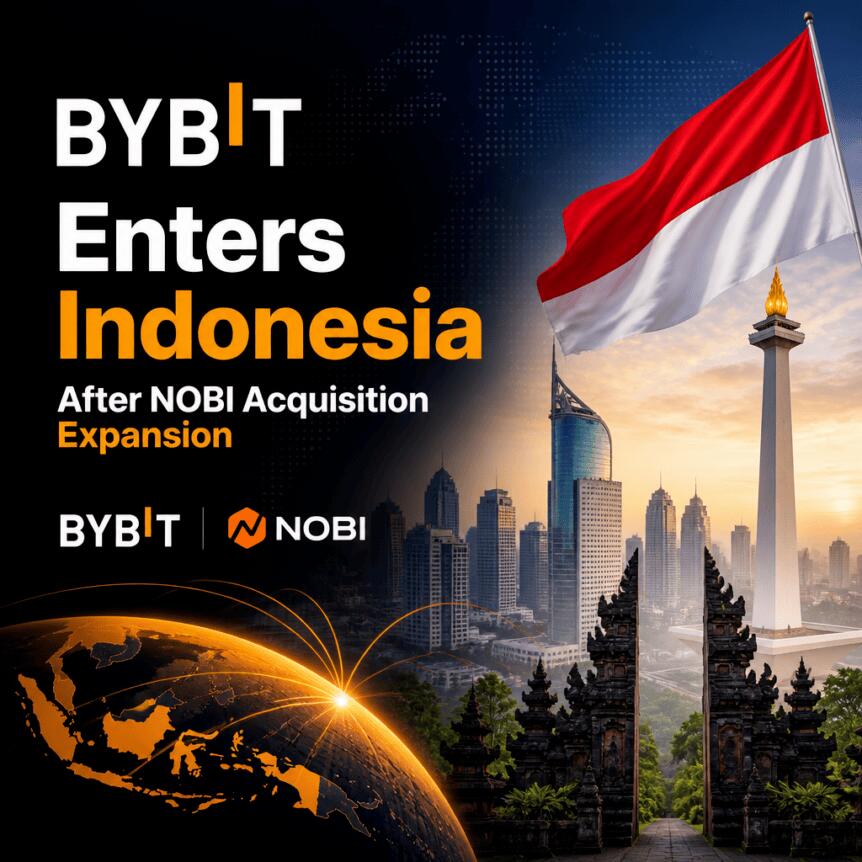
Bybit has moved deeper into Southeast Asia by launching a locally operated crypto trading platform in Indonesia, a step it says follows a majority acquisition of NOBI. The exchange announced Thursday that it has launched the new Indonesia entity after taking control of digital asset firm PT Enkripsi Teknologi Handal, which previously operated under the name NOBI.
The deal results in a rebrand: NOBI is now Bybit Indonesia. Bybit said it intends to roll out its services in stages, beginning with 500 cryptocurrency trading pairs, and to expand from there as the platform ramps up.
Key takeaways
- Bybit has launched a locally operated Indonesia platform after acquiring a majority stake in PT Enkripsi Teknologi Handal (formerly NOBI).
- NOBI has been rebranded as Bybit Indonesia, with the company set to expand its trading offering in phases.
- The exchange plans to start with 500 trading pairs and build from there rather than opening the full set at once.
- Leadership will come from former NOBI executives, with Lawrence Samantha as CEO and Dionisius Evan as chief operating officer.
- Indonesia’s regulator reports a rapidly growing crypto user base, alongside a licensing framework covering exchanges, custodians, and traders.
Bybit’s Indonesia push: acquisition to local operation
For Bybit, the launch is not just a marketing move—it reflects a shift toward operating within Indonesia’s local regulatory and market structure. The exchange said its acquisition allows it to pair Bybit’s global capabilities with an experienced local team that understands Indonesia’s market dynamics and regulatory requirements.
The company’s statement names Lawrence Samantha as CEO and Dionisius Evan as chief operating officer. Both previously served as senior executives at NOBI, indicating that Bybit is using the acquired firm’s institutional know-how and local relationships as it enters a regulated environment.
What Bybit plans to launch first
Bybit Indonesia will be introduced in phases. According to the announcement, the rollout will start with 500 cryptocurrency trading pairs. That staged approach suggests Bybit is likely pacing market access and product configuration rather than attempting a full-scale launch overnight, which can be important in jurisdictions where onboarding, compliance processes, and platform readiness must be managed carefully.
While Bybit did not provide a detailed timeline for subsequent phases in the information available, the initial pair count is a key operational signal: the exchange is aiming to offer broad spot market coverage from day one, giving Indonesian users a range of trading choices as liquidity and infrastructure are established.
Indonesia’s growing crypto market and the licensing environment
Indonesia has been steadily expanding its crypto user base under a framework overseen by the Indonesia Financial Services Authority (OJK). As of February 2026, OJK reported 21.07 million registered crypto asset users, and it cited total crypto transaction value of $26.85 billion (482 trillion Indonesian rupiah) in 2025.
Regulatory activity has also accelerated. As of April 2026, OJK reported that Indonesia had licensed 31 crypto-related entities. That includes two crypto exchanges, two clearing institutions, two custodians, and 25 digital asset traders. PT Enkripsi Teknologi Handal—Bybit’s acquired company—was listed among those licensed entities.
For investors and users, the significance is that Bybit’s local launch is arriving in a market where regulatory status and licensing are increasingly central to participation. In other words, the opportunity is expanding, but so are compliance expectations. Bybit’s decision to structure entry via an acquired, locally licensed firm may reduce friction compared with trying to build a local regulated presence from scratch.
Why the local leadership model matters
Bybit Indonesia’s management lineup is drawn from the former NOBI leadership, with Samantha taking the CEO role and Evan serving as COO. That continuity can matter operationally: local executives typically have deeper context around compliance workflows, relationships with regulated counterparties, and day-to-day execution in-country.
From a broader perspective, this model reflects a common pattern in regulated crypto markets. Global exchanges often need more than technology and brand recognition—they need a team that understands local rules, user behavior, and market structure well enough to execute quickly once a platform goes live.
Even so, readers should watch how the staged launch progresses beyond the initial 500 pairs. The next question will be whether Bybit increases liquidity and expands pair availability at a pace that matches Indonesia’s user growth, and how effectively it integrates the acquired platform into its wider global systems.
With Bybit Indonesia now live and using former NOBI executives to lead operations, the key developments to track are the timing of subsequent rollout phases, any expansion beyond the initial trading pairs, and how the platform performs within Indonesia’s regulated ecosystem as OJK continues to license and supervise crypto firms.

Around 19,500 Bitcoin options contracts will expire on Friday, July 17, with a notional value of roughly $1.23 billion. This expiry is much smaller than usual events, so it is unlikely to have any impact on spot markets.
Crypto markets have gained later in the week following cooler-than-expected US inflation data, but have lost those gains by Friday.
Bitcoin Options Expiry
This week’s batch of Bitcoin options contracts has a put/call ratio of 0.87, meaning that sellers of long (call) contracts and short (put) contracts are almost evenly matched. Max pain is around $62,500, which is lower than current spot prices, so some will be out of the money on expiry.
Open interest (OI), or the value or number of Bitcoin options contracts yet to expire, remains highest at the $70,000 strike price on Deribit, with $1.6 billion, but short sellers still have $1.1 billion in OI at $60,000. Total BTC options OI across all exchanges has ticked up a little to $30 billion, according to Coinglass.
“Puts continue to trade at a premium to calls across all major tenors, although the magnitude of that premium has become increasingly uniform,” said crypto derivatives provider Greeks Live this week.
This suggests that overall, the market is less panicked about an immediate crash than before, though people still pay a bit more for “drop protection” than for “rise bets” — just not as extremely as they did recently.
“The proportion of large-scale bullish trades continued to increase this week, primarily consisting of short-term bull spreads.”
Meanwhile, Deribit said, “This floods the market with liquidity and volatility, creating prime conditions for trading short-dated options on Deribit.”
At 08:00 UTC tomorrow, ~$1.45B in BTC and ETH options are set to expire on Deribit.$BTC : ~$1.23B notional | P/C: 0.86| Max Pain: $62.5K$ETH : ~$218M notional | P/C: 1.54| Max Pain: $1.75K
This floods the market with liquidity and volatility, creating prime conditions for… pic.twitter.com/OlYg6LQsls
— Deribit (@DeribitOfficial) July 16, 2026
In addition to today’s tiny batch of Bitcoin options, around 131,000 Ethereum contracts are expiring, with a notional value of $242 million, a max pain of $1,750, and a put/call ratio of 1.5.
Total ETH options OI across all exchanges is low at around $4.8 billion. This brings the total notional value of crypto options expirations to around $1.4 billion, a very small event.
Spot Market Outlook
Crypto markets bounced to a mid-week high of $2.3 trillion, but those gains had started to erode by the end of the week.
Bitcoin has fallen around 2% from its intraday high of $64,800 to $63,300 during the Friday morning Asian trading session. It appears to be heading for the weekly resistance area, which is around $62,000.
Ether has also broken down from its six-week high in an almost 4% decline to around $1,850 at the time of writing.
The post Will Crypto Markets Move When $1.2B Bitcoin Options Expire Today? appeared first on CryptoPotato.
Bybit has launched a locally operated cryptocurrency platform in Indonesia following its majority acquisition of PT Enkripsi Teknologi Handal, formerly known as NOBI.
Summary
- Bybit launches Indonesia platform after acquiring NOBI, entering a regulated market with 21.07 million accounts.
- Bybit Indonesia will roll out more than 500 trading pairs while keeping local management leadership.
- OJK licensed 31 crypto entities by March, as Indonesia tightened oversight across its digital market.
The company said the deal establishes Bybit Indonesia as a local entity operating under the supervision of the Financial Services Authority, or OJK.
The exchange plans to introduce its services in stages, starting with more than 500 trading pairs. According to Bybit’s announcement, the platform will use its global liquidity alongside market surveillance and risk controls designed to meet Indonesian requirements.
The acquisition gives Bybit a locally regulated route into Indonesia rather than operating solely through its global platform. NOBI has been rebranded as Bybit Indonesia, while its existing local management remains involved in running the business and handling regulatory compliance.
Lawrence Samantha, formerly part of NOBI’s senior management, will serve as CEO. Dionisius Evan will continue as chief operating officer, while Steven Gotama will serve as chief marketing officer.
Samantha said “this acquisition allows us to combine Bybit’s global capabilities with an experienced local team” familiar with Indonesia’s market and regulatory system.
Bybit targets a growing regulated crypto market
Indonesia had 21.07 million crypto consumer accounts as of February 2026, according to official OJK data. The figure rose to 21.37 million in March, while crypto transactions reached IDR22.24 trillion during that month.
Meanwhile, Indonesia’s crypto ecosystem has continued to expand under OJK oversight. The regulator had licensed 31 crypto-related entities by March, including two exchanges, two clearing institutions, two custodians and 25 digital financial asset traders. Indonesia also recorded IDR482.23 trillion in crypto transactions during 2025.
In additoin, Bybit is not the only international exchange expanding through a locally compliant structure. BTSE launched its own regulated Indonesian platform in July after rebranding local exchange NVX through a joint venture. The platform supports rupiah services under an OJK license.
The two launches come as authorities increase oversight of companies serving Indonesian crypto users. OJK has expanded licensing and consumer protection requirements since taking responsibility for the sector, creating a market where global exchanges increasingly need local entities and regulatory approval to expand their services.
Bybit continues regulated global expansion
The Indonesia launch also fits Bybit’s wider push into regulated markets. As previously reported by crypto.news, the exchange secured a full Virtual Asset Platform Operator license in the United Arab Emirates in October 2025 after receiving initial approval earlier that year.
Moreover, Bybit outlined plans in January to expand beyond its core cryptocurrency exchange business into a broader financial platform covering banking, custody and cross-border services. The acquisition of NOBI adds another locally operated market to that strategy.
Bybit Indonesia said future products will be introduced gradually and according to OJK requirements. The company also plans to offer local education through Bybit Learn as it transitions existing NOBI users onto the new platform and expands its services in the country.
Citadel Securities has invested $400 million in Crypto.com, valuing the exchange at $20 billion. It is the first institutional capital the platform has raised since launching in 2016.
The check stands out against a sharp pullback in crypto fundraising. Deal counts have collapsed even as a few large platforms continue to attract nine-figure investments.
Citadel Pours $400 Million Into Crypto.com
The funds will support expansion into new markets. Crypto.com said it plans to move into tokenized securities and derivatives.
Citadel Securities President Jim Esposito called the convergence of traditional finance and digital assets an “exciting evolution” with room to lift market efficiency.
Follow us on X to get the latest news as it happens
The exchange is not Citadel’s only crypto bet. The market maker invested $200 million in Kraken at a $20 billion valuation in November 2025.
Crypto Funding Falls to Its Lowest Since 2020
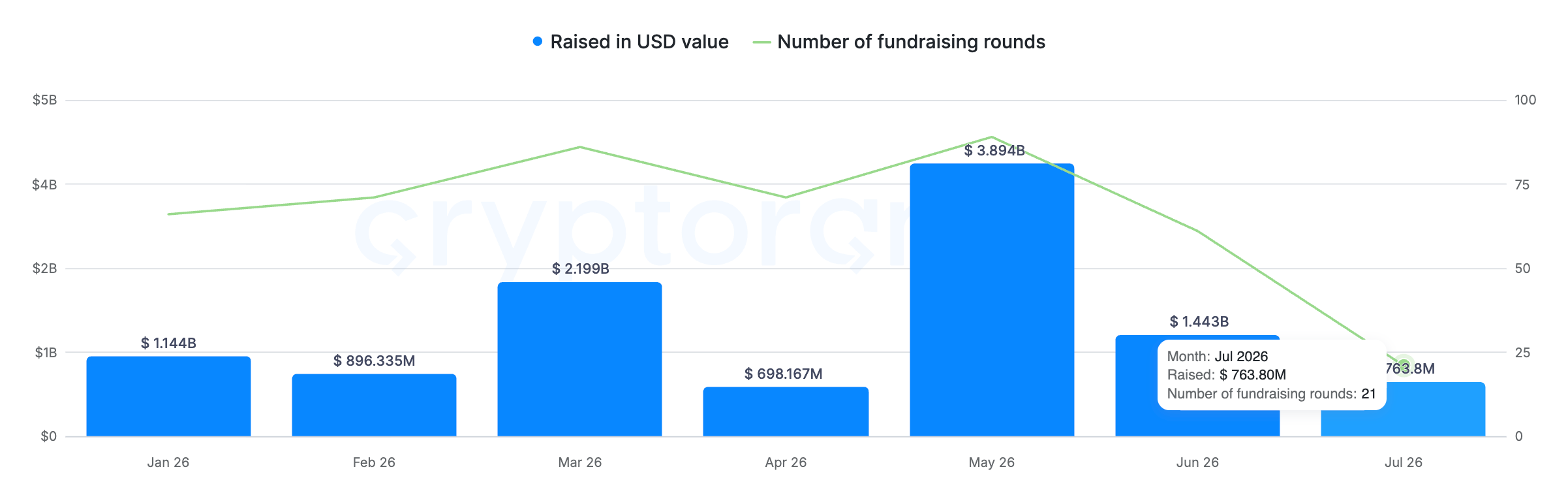
The Citadel deal runs against a retreat in crypto fundraising. Crypto companies closed 61 funding rounds in June, according to CryptoRank. That was the lowest monthly total since November 2020, when 49 rounds were recorded.
Round counts fell 31.5% from May’s 89 deals. In addition, the June figure sat 72% below the record of 218 rounds set in March 2022.
Monthly capital raised tells a similar story. June’s $1.44 billion dropped sharply from May’s $3.89 billion.

July has shown little change so far. Projects had raised $763.8 million by mid-July, keeping the sector near June’s subdued levels.
The figures point to a market splitting along size. Incumbent exchanges are drawing nine-figure checks, while the broader field sees fewer deals. The coming months will show whether that gap narrows or settles into a longer pattern.
Subscribe to our YouTube channel to watch leaders and journalists provide expert insights
The post Crypto.com Secures $400M From Citadel While Crypto Funding Hits Lowest Since 2020 appeared first on BeInCrypto.


A federal grand jury indicted Sioux Falls crypto investor Benjamin Paul Wiener, 43, on 29 counts tied to an alleged fraud scheme that prosecutors estimate cost victims roughly $20 million.
The charges include wire fraud, money laundering, bank fraud, and aggravated identity theft. Wiener pleaded not guilty on July 10 and was released on bond ahead of a September trial.
This Crypto Investor Allegedly Turned Dozens Into Fraud Victims
According to the indictment, Wiener solicited both money and digital currency from investors through his companies. He allegedly made false statements and fraudulent representations.
Dozens of victims across South Dakota and Minnesota were affected, prosecutors said. After collecting funds, Wiener allegedly moved the money to hide its source and ownership.
Prosecutors describe a structure common to Ponzi cases. When funds ran low or an investor sought a refund, Wiener allegedly recruited new investors. He then used that fresh money to repay earlier backers and cover personal expenses.
The laundering allegedly ran through both banks and cryptocurrency exchanges. This mixed flow of fiat and crypto helped conceal the activity, according to the government.
“As a result of Wiener’s conduct, the government alleges the estimated total loss is approximately $20 million,” the press release reads.
Follow us on X to get the latest news as it happens
Entities and Bank Fraud
Wiener allegedly operated the scheme through eight entities. Most carried the “Benaiah” name, including Benaiah Capital LLC and Benaiah Digital LP. The list also included Aslan Management LLC and Runway Four10.
Separately, prosecutors allege Wiener defrauded a Sioux Falls bank. In April 2025, he secured a $1 million credit line by falsifying documents, according to the indictment. He allegedly used another person’s identifying information without permission to do so.
The charges remain accusations, and Wiener is presumed innocent unless proven guilty. His trial is set for September 15, 2026.
The case joins a growing list of federal prosecutions targeting operators who allegedly defrauded investors and used crypto to move the proceeds. The Justice Department charged 265 fraud defendants in 2025, with intended losses topping $16 billion.
Subscribe to our YouTube channel to watch leaders and journalists provide expert insights
The post Federal Prosecutors Say This Sioux Falls Crypto Investor Ran a $20 Million Fraud appeared first on BeInCrypto.


Injective says it has filed for transfer agent registration with the U.S. Securities and Exchange Commission, seeking a regulated route to maintain ownership records for tokenized securities on blockchain infrastructure.
Summary
- Injective says its SEC filing could move tokenized securities ownership records directly onto blockchain infrastructure.
- The proposed transfer agent role would connect legal shareholder records with sub-second blockchain settlement systems.
- No public SEC filing was located, leaving the registration claim independently unverified at publication time.
The blockchain project announced the filing on X on July 16. The move could place Injective closer to the regulated systems that determine legal securities ownership.
However, Injective did not name the legal entity that submitted the application, and a public filing matching the announcement was not located in SEC materials reviewed at publication time.
Injective targets a regulated securities record system
Transfer agents perform a core role in U.S. securities markets. They record ownership changes, maintain security holder records, and handle other administrative functions for issuers. The SEC says a transfer agent must register with the appropriate regulator before performing transfer agent functions for qualifying securities.
Injective said its proposed system would move these records onto blockchain infrastructure.
“Tokenized securities and RWAs need compliant ownership records on infrastructure that settles in less than a second,” the project said.
Still, filing for registration does not mean that the SEC has approved the application.
Tokenization moves beyond issuing digital assets
The filing comes as blockchain firms and traditional financial companies move beyond simply issuing tokenized assets. Market infrastructure providers are now testing blockchain for trading data, settlement, collateral management, and securities administration.
As crypto.news previously reported, Nasdaq began distributing its TotalView order book data through Pyth Network in June. The arrangement gives blockchain applications access to institutional market data and forms part of Nasdaq’s broader work around tokenized markets.
Wall Street infrastructure continues moving onchain
Meanwhile, the Depository Trust & Clearing Corporation is developing blockchain-based infrastructure for post-trade markets. DTCC is working with Chainlink on a Collateral AppChain designed to support around-the-clock collateral pricing, valuation, margining, and settlement. The platform targets a Q4 2026 production launch.
Tokenized stock markets are also expanding. As previously reported, the New York Stock Exchange has partnered with Securitize on infrastructure for tokenized stocks and exchange-traded funds, while Nasdaq has pursued its own regulated tokenization initiatives.
Injective expands its focus on real-world assets
Injective has already positioned its network around decentralized finance and tokenized real-world assets. In 2025, the project partnered with Republic to expand access to tokenized private-market investments through its blockchain infrastructure.
The transfer agent application would take that strategy into another part of regulated market infrastructure if approved. Rather than only providing technology for issuing or trading tokenized assets, Injective would seek a role in maintaining the official records that show who owns securities.


1inch co-founder Anton Bukov says he has fully stepped away from the decentralized finance project’s operations after more than seven years and is now launching a new venture called Second Tier.
Summary
- Anton Bukov says 1inch fired him in November 2025 after he pushed for management changes.
- Bukov says he remains a co-founder and 50% shareholder but no longer oversees company operations.
- 1inch says Bukov stopped active involvement in December 2025 and insists its systems remain unaffected.
Bukov said the company fired him in late November 2025 after he pushed for changes to management and operations.
However, 1inch gave a different account of his recent role. The company said Bukov had not been actively involved in organizations linked to the project since December 2025. Bukov said he remains a co-founder and 50% shareholder but no longer has operational authority.
Bukov says management push ended with his firing
In a statement published on X, Bukov said feedback from users and colleagues led him to become more involved in leadership and company operations. He said he spent months working on his leadership and communication approach while trying to change how the organization operated. “In late November 2025 I was fired,” he said.
Bukov also drew a clear line between his ownership position and his current responsibilities. “I no longer take part in the company’s operations,” he said.
He added that he has no role in product architecture or security and no oversight of either area. His statement leaves him as a shareholder and co-founder without a stated day-to-day management role.
1inch says operations and infrastructure remain unaffected
1inch responded on X by saying Bukov had not been actively involved in any associated organizations since December 2025. The statement presents a different timeline for his operational departure but does not change Bukov’s claim that the company dismissed him the previous month. The company has not publicly detailed the internal discussions that preceded the split.
Meanwhile, co-founder Sergej Kunz sought to reassure users about the project’s operations. He said Bukov’s departure “is not disrupting, will not disrupt, 1inch Network’s infrastructure or systems.” Kunz remains in charge as the protocol continues developing its trading and liquidity products.
Second Tier becomes Bukov’s next project
Alongside his departure statement, Bukov announced Second Tier as his next venture. He said he is building the project with people who share the same values from the start. However, public information about its products, funding and launch schedule remains limited.
The move closes Bukov’s active operating role at a project he co-founded with Kunz in May 2019. During his time at 1inch, Bukov worked on protocol architecture and security, according to his account. The project later expanded from decentralized exchange aggregation into cross-chain trading tools and other DeFi infrastructure.
1inch continues expanding its DeFi products
As previously reported by crypto.news, 1inch partnered with Rewardy Wallet in January to provide gasless cross-chain swaps across five blockchain networks through its Swap API. The integration formed part of 1inch’s broader effort to simplify decentralized trading while keeping users in control of their assets.
More recently, the leadership split comes after renewed attention on security across 1inch-linked infrastructure. In May, TrustedVolumes lost about $5.87 million after an attacker targeted its custom RFQ swap proxy. The incident did not affect a standard 1inch user swap route.
Kunz later called for safer lending structures following separate stresses in DeFi markets. Bukov’s latest statement now makes clear that he no longer oversees 1inch product architecture or security, while the company maintains that its systems and ongoing operations remain unaffected by his departure.

2026 Already Near All-Time IPO Raise Record

MegaETH shuts Mega Mafia accelerator as successful apps leave

Mason Mount could be given a new Manchester United role if he takes his chance in pre-season

Renter of Home in Anne Heche Crash Denies Settlement With Son

No Jackpot Winner as $257 Million Prize Rolls Over to $269 Million Monday Draw

Weekend Open Thread: Staud – Corporette.com

Vaanam Tamil Movie Songs HD | No Money No Honey Video Song | Simbu | Anushka | Yuvan Shankar Raja

Crypto Holders – Bitcoin & Stocks Plummeting Due To This

This is what happens when you are greedy for other people’s money. #comedyvideos #funnyvideo #shorts
-

 Fashion6 days ago
Weekend Open Thread: Nutriplenish Leave-In Conditioner
-
 NewsBeat14 hours ago
London Mayor Sadiq Khan handed a peerage by Keir Starmer alongside 15 other Labour figures… just days before the PM leaves No10
-

 Crypto World1 day ago
CFTC blocks Kalshi from unwinding Michigan trades after court order
-

 Sports7 days ago
Super Eagles star Moses Simon opens up on Liverpool transfer regret
-

 Business1 day ago
Nvidia Stock Slips After Big Tuesday Rally as Huang Confirms Vera Rubin Chip Is Now in Production Today
-

 Politics2 days ago
Young campaigners urge incoming PM to act on outdoor junk food ads
-

 News Videos2 days ago
XRP BOMBSHELL… XRP OMBOARDED FOR TRANSACTIONS!!!
-

 Tech3 days ago
Get Your ESP32 Sunny Side Up With This Solar Dev Board
-
 Entertainment2 days ago
Disney’s Most Ambitious Failed Star Wars Attraction Is Coming to SDCC
-

 Tech2 days ago
Dark Secrets Emerge When Jailbreaking LLMs
-

 Crypto World9 hours ago
Injective Submits SEC Transfer-Agent Registration to Onchain Ownership Records
-
 Sports1 day ago
New Cornerback Enters Vikings Trade Rumor Mill
-

 Business4 hours ago
Banco Bilbao Vizcaya Argentaria, S.A. (BBVA) Discusses Global Macro Environment and Economic Outlook for Core Markets Transcript
-

 News Videos4 days ago
how to make coin bank box with cardboard #scienceproject #money #diy #shorts
-
 Tech3 days ago
Cloudflare Precursor Watches Your Mouse and Keyboard To Decide If You Are Human
-
 Entertainment1 day ago
Vicki Gunvalson Defends Discussing Heather Dubrow’s Money
-
Crypto World3 days ago
Ripple, Coinbase, Circle Join Linux x402 Foundation to Help Shape AI Payments
-
Business5 hours ago
Nephros, Inc. (NEPH) Discusses Evolving Water Safety Strategies and Expansion Beyond Filtration Transcript
-
 Crypto World8 hours ago
Claude Fable 5 Slips to Second in AI Coding Leaderboard
-

 Business2 days ago
ACCC warns AI could lift insurance costs in risk-prone areas
You must be logged in to post a comment Login