

Crypto World
Is there a Robinhood Chain token?

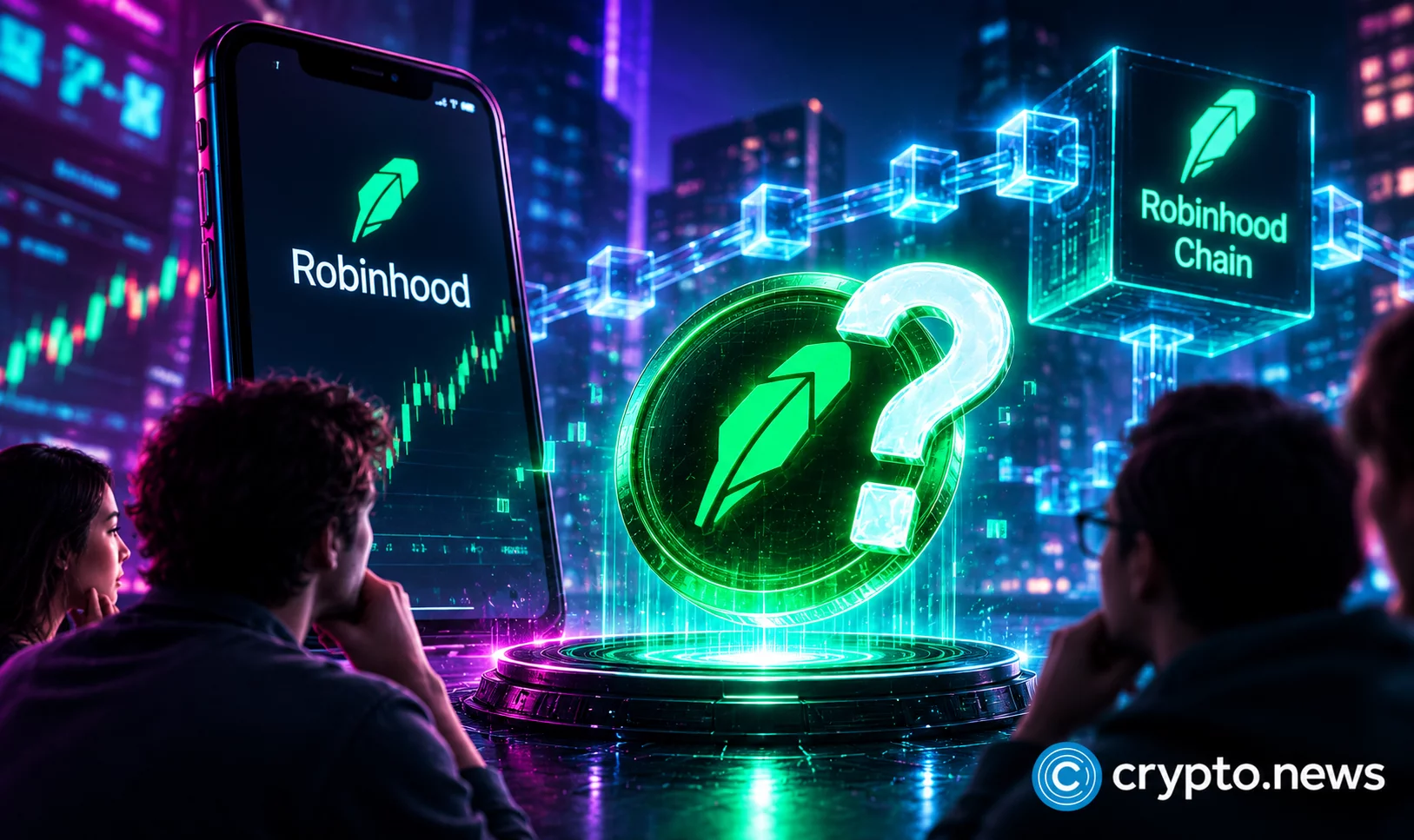
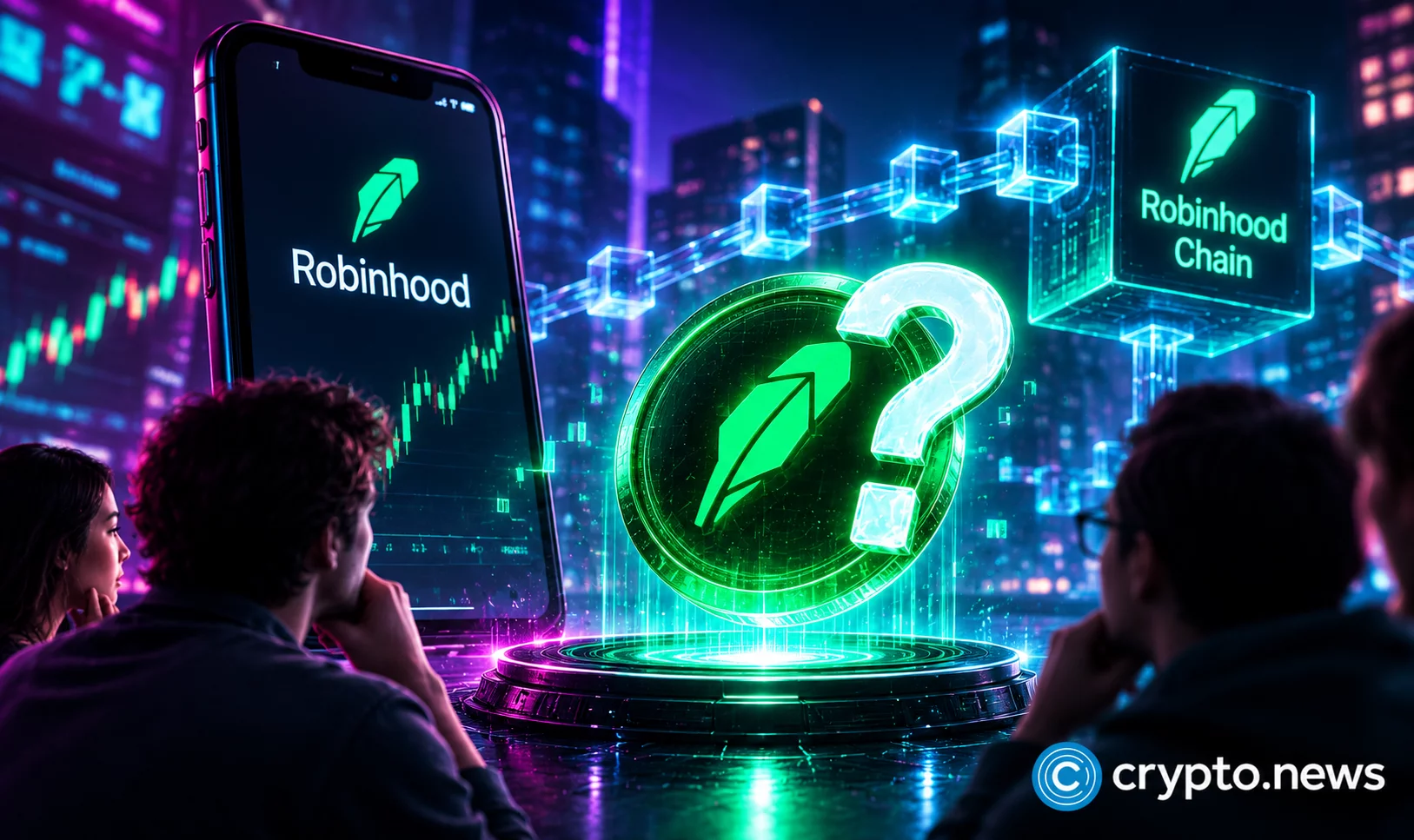
No. There is no official Robinhood Chain token, there is no airdrop, and there is no snapshot. Every token currently claiming that association is either a joke that admits it or a trap that does not.
Summary
- Robinhood has not issued a native token for Robinhood Chain. The network runs on ether for gas, which removes the main technical reason a chain needs a token of its own.
- Robinhood Markets trades as HOOD on Nasdaq. That equity is the only official way to own a piece of the company, and it is a stock, not a crypto asset.
- CASHCAT, the chain’s best-known token, is a community project with no affiliation to Robinhood. Its own website describes itself as fan fiction with a ticker.
- New tokens keep launching into the branding gap. STONKCAT opened a presale on July 16, and others are running alongside it.
- The absence of a token is the scam surface. Treat any airdrop claim, snapshot rumor, or official-looking token as false unless Robinhood confirms it through its own channels.
Ask the internet whether Robinhood Chain has a token and you will get a hundred confident answers, most of them wrong and several of them designed to be. The correct answer is short: no. Robinhood launched its blockchain on July 1, 2026 and did not issue a native token with it. What exists instead is a chain that runs on ether, a company stock that trades on Nasdaq, and a growing crowd of community tokens borrowing Robinhood’s branding without permission. Understanding why the chain has no token, and why that absence is precisely what makes the question dangerous, is worth more than any list of tickers.
The direct answer
Robinhood Chain has no official native token. There is no RHC, no HOODCHAIN, no chain coin.
The network is an Ethereum layer 2 built on Arbitrum’s Orbit stack, and it uses ether for gas. When you transact on Robinhood Chain, you pay fees in ETH, the same asset that secures Ethereum. That is a deliberate design choice and it is the single most important fact in this article, because gas is the primary reason most chains issue tokens at all. For readers new to the network, crypto.news has also explained the chain itself and its Stock Tokens.
The company’s only official tradable instrument is HOOD, the common stock of Robinhood Markets on Nasdaq. That is an equity: it carries shareholder rights, it is regulated as a security, and it is bought through a brokerage account. It is not a crypto token and it does not live on the chain.
Two other tickers cause confusion and neither is what people mean. USDG is the stablecoin used across Robinhood’s on-chain products, including as collateral for perpetual futures. It is not a Robinhood Chain token; it is a dollar stablecoin. LIT is the token of Lighter, the perpetuals exchange that partners with Robinhood Chain. Robinhood Ventures invested in Lighter and Lighter committed $11 million of LIT to the Robinhood community, which is a partner incentive and not a chain token.
So: ETH for gas, HOOD for equity, USDG for stable value, LIT for a partner protocol. No chain token.
Why the chain does not have one
Blockchains issue native tokens for three reasons, and Robinhood Chain has an answer for each.
Gas. A chain needs a unit to pay for computation. Most layer 1 networks mint their own. Robinhood Chain uses ether instead, inheriting Ethereum’s asset and its liquidity on day one. No new token required.
Governance. Some networks distribute tokens so holders can vote on protocol changes. Robinhood is a publicly listed brokerage running a chain as corporate infrastructure. It has shareholders and a board. It does not need a governance token, and issuing one would create an awkward second constituency with unclear legal standing next to the one that already owns the company.
Incentives. Chains hand out tokens to bootstrap usage. Robinhood has roughly 28 million customers across 38 countries and a distribution pipeline no new chain can match. It ran a 90-day gas fee subsidy instead, which achieves the same bootstrapping without issuing a security-shaped asset.
There is a fourth reason, unstated and probably decisive. Robinhood is a regulated broker with securities licenses in multiple jurisdictions. Issuing a token would invite an immediate question about whether that token is a security, from the same regulators who supervise its core business. The company has spent years building the relationships that let it offer Stock Tokens abroad and lending products at home. A native token would put all of that on the table in exchange for benefits it can already obtain without one.
The precedent supports the read. Coinbase’s Base, the most successful corporate chain to date, has no native token either, and Coinbase has repeatedly said it has no plans to issue one. Corporate chains built by regulated financial companies tend not to mint coins. That is the pattern, not the exception.
What CASHCAT actually is
CASHCAT is the token everyone means when they ask this question, so it deserves a direct treatment.
It is a community memecoin deployed on Robinhood Chain shortly after mainnet. It has a fixed supply of one billion tokens and its contract address is 0x020bfC650A365f8BB26819deAAbF3E21291018b4. It reached a market capitalization near $156 million within days and, at its peak, was worth roughly twelve times every tokenized real-world asset on the chain combined.
It has no affiliation with Robinhood. Not a partnership, not an endorsement, not a corporate project. The token’s own website says as much, disclaiming any connection to Robinhood Markets or to Vlad Tenev, and describing the project as fan fiction with a ticker. Asked what the utility is, the site answers that the utility is cat.
The name is where the confusion comes from, and it is a genuinely good story. Before Robinhood was Robinhood, Tenev and co-founder Baiju Bhatt called their company CashCat. The detail comes from a New Yorker profile and had been sitting in startup lore for years until someone realized it made a perfect memecoin. The token resurrects a discarded company name. That is the whole connection, and it is a connection of trivia, not of ownership.
What complicated matters is that on July 8, Tenev posted that while the company is building the chain to be the best for real-world assets, it works great for memes too, and he followed the token’s account. That is a CEO acknowledging something visible on his own network. It is not an endorsement, an affiliation, or a claim of ownership. But it is exactly the kind of signal that makes a retail buyer assume otherwise, which is why the disclaimer matters more than the follow.
The tokens filling the gap
The absence of an official token has not produced an absence of tokens. It has produced the opposite.
Within days of launch, Robinhood Chain hosted Cash Dog in Hood, Little John, Hoodrat, and Arrow, none of which existed before July 1. Noxa, the chain’s dominant launchpad, was averaging roughly 18,600 new token launches per day before it stopped accepting launches on July 11 and went dark two days later. Pump.fun added Robinhood Chain support on July 8, letting Solana’s memecoin crowd deploy without bridging. Crypto.news covered how memecoins took over the network as Robinhood’s RWA chain became dominated by speculative tokens.
The wave has not stopped. On July 16, STONKCAT opened a presale for $SCAT, pitching a community called The Litter and a running joke about a cat that never sells. A separate MemeToro presale is running alongside it, promising staking, AI-assisted launch tools, and prediction markets after the ecosystem expands.
Read the pattern rather than the individual tokens. Each new project borrows Robinhood’s branding, gestures at the chain’s legitimacy, and sells the association. None of them have the association. The branding gap that CASHCAT discovered is now a repeatable business model, and presales are where it converts fastest, because a presale asks for money before there is a market price to check.
How the scam works
This is the part worth internalizing, because the mechanics are predictable.
The airdrop rumor. New chains often reward early users with retroactive token distributions. Robinhood Chain will not, because there is no token to distribute. But the expectation exists, and it is exploited: posts claiming a snapshot has been taken, a claim window is open, or eligibility depends on connecting a wallet. Every one of those is false by construction. There is nothing to claim.
The official-looking token. A token deploys with Robinhood branding, a plausible ticker, and a website that mimics corporate design. It buys visibility. Retail buyers who have heard that Robinhood launched a chain assume this is the asset. It is not, and no amount of visual polish changes that.
The unaudited contract. CASHCAT itself illustrates the deeper problem: security audits of its contract were not possible because Robinhood Chain is too new for the tooling to have caught up. That applies across the chain. Tokens launching today are deploying into an environment where standard verification infrastructure does not yet exist, which removes the check that would normally catch a malicious contract.
Thin liquidity. CASHCAT’s trading pool has been worth far less than the token’s market capitalization, which means large trades swing the price hard in both directions. A nine-figure market cap sitting on a shallow pool is not a nine-figure asset. It is a small pool with a large number attached.
The defense is unglamorous and it works. Verify the contract address against a source you trust before buying anything. Assume any claim of official Robinhood affiliation is false unless Robinhood says otherwise on its own channels. Treat presales with more suspicion than listed tokens, since presales take money before price discovery. And accept the base case: there is no token, so there is nothing to be early to. That is also why understanding how token scams are structured matters before interacting with any new chain asset.
Why the question keeps getting asked
It is worth understanding why this particular question generates so much search traffic, because the answer explains the risk better than any warning does.
Crypto spent roughly four years training people that a new chain means a new token, and that being early to the token is where the money is. That training was accurate. Solana, Avalanche, Arbitrum, Optimism, and dozens of others issued native assets, and early participants in several of them did extraordinarily well. Airdrops turned unpaid testnet activity into five-figure windfalls. An entire behavioral pattern formed around it: hear about a new chain, find the token, get in before everyone else.
Robinhood Chain arrives carrying every signal that pattern responds to. It is new. It launched with a keynote. It is backed by a company with roughly 28 million customers and a Nasdaq listing. It has partners with real names, real volume, and real integrations. Every heuristic a crypto user has says there is a token here and being early to it matters.
There is not, and the mismatch between the expectation and the reality is the entire exploit surface. Scammers do not need to be clever when the audience has already convinced itself the thing exists. They only need to supply it. A token appears, the branding is close enough, and buyers who arrived expecting to find an official asset find something that looks like one. The pattern completes itself. That is why these tokens appear on new chains so quickly after launch.
The same dynamic explains why presales cluster here. STONKCAT opened a $SCAT presale on July 16 and a MemeToro presale is running alongside it, both pitching future products, staking, and ecosystem participation. A presale is the purest expression of the be-early instinct: it asks for money before there is any market price, any liquidity, or any way to verify what you bought is what was described. On a chain where audit tooling has not caught up, the ordinary checks that would flag a problem are also unavailable.
Notice too what the corporate structure means for anyone hoping the policy changes. If Robinhood ever issued a token, it would be a decision made by a listed company with a board, disclosed through filings and official channels, and scrutinized immediately by the regulators supervising its brokerage business. It would not leak through a countdown site or a Telegram group. The manner of any announcement would itself be evidence of whether it was real, and that is a more reliable filter than any list of red flags.
The uncomfortable framing worth sitting with: the reason there is no official token is the same reason the chain has institutional credibility at all. A regulated broker that minted a coin would be a different kind of company, facing a different set of questions, offering a different product. The absence people are searching for is not an oversight waiting to be corrected. It is the design.
What to watch instead
If the interest behind the question is genuine exposure to what Robinhood is building, three things are real and none of them are memecoins.
HOOD equity. The company’s stock is the direct instrument. Its crypto business is under real pressure, with transaction revenue down 47% year over year to $134 million in the first quarter of 2026 and native-app crypto volume down 48% to $24 billion. The chain is the response. Second-quarter earnings on July 29 are the first look at whether Stock Tokens are converting.
The chain’s real-world asset figure. This is the metric that matters and almost nobody quotes it. Tokenized real-world assets on Robinhood Chain total roughly $12.8 million against a network holding around $312 million in total value. If that number grows substantially while memecoin activity fades, the strategy is working. If it does not, the traffic never converted.
Whether the policy changes. Companies reverse themselves. If Robinhood ever does issue a token, it will announce it through its own channels, in filings and official communications, not through a countdown site. Until that happens, the answer to the question in the headline is the same as it was on July 1.
The honest summary is that the most valuable thing about Robinhood Chain having no token is that it tells you what kind of chain it is. Networks that mint coins are asking you to fund them. A network built by a listed brokerage running on someone else’s gas asset is asking you to use it. Those are different propositions, and only one of them has a ticker to chase.
The one number that answers everything
If you take a single thing from this article, make it this: the chain’s own scoreboard tells you whether any of it is working, and it is not the number anyone quotes.
Robinhood Chain holds roughly $312 million in total value locked. That figure gets cited constantly and it is close to meaningless, because value locked counts stablecoins parked, lending positions open, and assets sitting in automated market makers. It measures presence, not purpose. Transaction counts are worse, because a 90-day gas fee subsidy has been paying for activity since launch, which inflates the count and makes comparisons with chains like Base unreliable until the subsidy expires.
The number that means something is tokenized real-world assets: roughly $12.8 million, of which about $10.68 million is stocks and around $410,000 is Treasuries. That is approximately 4.1% of activity on a chain built entirely for that category. Every other metric on the network is measuring something the chain was not designed to do.
So the honest scorecard reads: enormous traffic, negligible product-market fit for the actual product, and a subsidy propping up the headline. That is not a verdict, because two weeks is not a verdict. It is a baseline. If tokenized assets grow well past $13 million while the memecoin volume fades, the speculation was the ignition sequence and Robinhood was right. If the assets stay flat while the traffic rotates to whichever chain is paying attention next, the chain attracted a crowd that was never going to convert.
Second-quarter earnings on July 29 are the first genuine look, because they will show Stock Token adoption from the company’s own books rather than from chain-level metrics that a subsidy is distorting. Watch that, and watch whether liquidity persists after the subsidy expires. Those two data points will tell you more than any token ever could, and neither of them requires you to buy anything.
Frequently asked questions
Is there an official Robinhood Chain token?
No. Robinhood has not issued a native token for the chain, which launched its public mainnet on July 1, 2026. The network uses ether for gas, which removes the primary technical reason a blockchain needs its own token. The only official way to own a stake in the company is HOOD, its common stock on Nasdaq, which is an equity and not a crypto asset.
Is CASHCAT the Robinhood Chain token?
No. CASHCAT is a community memecoin with no affiliation to Robinhood, no endorsement, and no partnership. Its own website disclaims any connection to Robinhood Markets or Vlad Tenev and describes the project as fan fiction with a ticker. The name references CashCat, the working name Tenev and co-founder Baiju Bhatt used before the company became Robinhood, which is a piece of trivia rather than a relationship.
Will there be a Robinhood Chain airdrop?
There is nothing to airdrop, because no token exists. Claims of a snapshot, a claim window, or eligibility requirements are false by construction and are a common scam pattern on new chains. If Robinhood ever changed this policy, it would be announced through official company channels and filings, not through a third-party claim site.
Why does Robinhood Chain not have a token?
Three technical reasons and one strategic one. Gas is paid in ether, so no new unit is needed. Governance runs through a listed company with shareholders and a board. Incentives come from roughly 28 million existing customers and a 90-day gas subsidy instead of a token distribution. Strategically, a regulated broker issuing a token would invite securities questions from the regulators supervising its core business.
Do other corporate chains have tokens?
Generally no. Coinbase’s Base, the most successful corporate chain to date, has no native token and Coinbase has repeatedly said it has no plans to issue one. Chains built by regulated financial companies tend not to mint coins, because the legal cost of doing so exceeds the benefit when the company already has distribution and a balance sheet.
What are USDG and LIT then?
USDG is a dollar stablecoin used across Robinhood’s on-chain products, including as collateral and quote asset for perpetual futures. LIT is the token of Lighter, the perpetuals exchange partnered with Robinhood Chain, in which Robinhood Ventures invested. Lighter committed $11 million of LIT to the Robinhood community as a partner incentive. Neither is a Robinhood Chain native token.
How do I avoid Robinhood Chain token scams?
Start from the base case that no official token exists, so any claim of one is false. Verify contract addresses against a trusted source before buying. Treat presales with extra caution, since they take money before any market price exists. Be aware that security audits are difficult on Robinhood Chain because the network is new enough that verification tooling has not caught up, which removes a check that would normally catch malicious contracts. Crypto.news has also explained verifying contracts before you transact as part of broader self-custody safety.
What should I look at instead?
If the interest is exposure to Robinhood’s strategy, HOOD equity is the direct instrument. If the interest is whether the chain is working, watch the tokenized real-world asset figure, which sits around $12.8 million against roughly $312 million in total value locked. Robinhood’s second-quarter earnings on July 29 are the first meaningful look at Stock Token adoption.
Disclaimer: This article is for information and educational purposes only and does not constitute financial or investment advice. Memecoins are highly speculative, frequently trade on thin liquidity, and most participants lose money. Token affiliations, contract addresses, and project claims change and should be verified independently before any transaction. Nothing here is a recommendation to buy any token or security. Always do your own research. Information is accurate as of July 17, 2026.



Galaxy Digital has signed a 15-year agreement to rename Texas Tech’s football venue Galaxy Stadium from the 2026 season.
Summary
- Galaxy Digital secured naming rights to Texas Tech’s football stadium for 15 years.
- Galaxy will support AI, digital asset, athlete and workforce programs at the university.
- The deal expands Galaxy’s presence near its 1.6-gigawatt Helios data center.
According to Friday’s announcement, the deal also makes Galaxy the official digital assets and data center partner of Texas Tech Athletics. Financial details were not disclosed.
The renamed stadium will host its first game on Sept. 5, when Texas Tech opens the season against Abilene Christian. Alongside the naming rights, Galaxy and the university plan to work on artificial intelligence projects, workforce training and opportunities involving student-athletes’ names, images and likenesses.
Galaxy already operates the Helios data center campus in Dickens County, about 60 miles east of Lubbock. Company figures show the site has approval for 1.6 gigawatts of capacity dedicated to artificial intelligence and high-performance computing.
Through the Texas Tech agreement, Galaxy is connecting its West Texas infrastructure business with one of the region’s most visible college sports programs. The announcement did not provide details on the planned AI projects, training programs or potential payments involving athletes.
Galaxy links its data center business with Texas Tech football
Once the 2026 season begins, Galaxy’s name will appear on a stadium used by a university competing in the Big 12 Conference. The company’s role will also extend beyond branding because the agreement covers digital assets, data centers and joint university programs.
Located in nearby Dickens County, the Helios campus gives Galaxy an existing operational base close to Texas Tech. Galaxy has positioned the facility for AI and high-performance computing workloads, while its approved power capacity places the site among the region’s large digital infrastructure developments.
The Texas Tech deal follows continued investment in computing facilities across the state. Texas already hosts Bitcoin miners and infrastructure operators including Riot Platforms, Cipher Mining, Core Scientific, CleanSpark, IREN and Hut 8.
In February, mining hardware maker Canaan purchased a 49% interest in three operating Texas mining sites from Cipher Mining for almost $40 million. Earlier this month, MARA Holdings announced plans to acquire a powered site with two gigawatts of capacity in Texas for a campus supporting high-performance computing and Bitcoin mining.
Texas attracts more crypto investment and political spending
Outside infrastructure development, crypto-linked political groups have increased their spending in Texas elections. Industry-affiliated political action committees spent more than $10 million in May on candidates contesting congressional primary runoffs, according to the supplied report.
All six candidates supported by those groups won their races, the report stated. The spending added another layer to the industry’s activity in a state already attracting miners, data center developers and digital asset companies.
Texas officials have also adopted policies involving Bitcoin. Last year, Gov. Greg Abbott signed legislation establishing the Texas Strategic Bitcoin Reserve.
In May, state officials began moving the reserve’s exposure away from a spot Bitcoin exchange-traded fund and toward directly custodied Bitcoin, according to the report. The transition placed Texas among the US states using public policy to hold Bitcoin directly rather than relying only on a regulated investment product.
Galaxy’s stadium agreement now adds a major college sports partnership to that activity. While the 15-year term gives the company a long presence at Texas Tech, neither party has disclosed the contract’s value or a timetable for the planned student and workforce programs.


A Dutch crypto exchange called Knaken has collapsed. A court declared it bankrupt for running without a license under the EU’s MiCA rules, its new crypto rulebook. In June, customers were suddenly locked out of their accounts. Prosecutors say about $8 million, or €7 million, has vanished.
Notably, Knaken has no relationship with Kraken. Knaken is a Dutch crypto broker based in Rotterdam that has since entered bankruptcy.
Kraken is a separate US-based global cryptocurrency exchange that continues operating. The two companies are entirely independent despite their almost similar names.
Why Knaken shut down
Knaken let people buy, sell, and store crypto. But it never got a license from the Dutch markets regulator, the AFM. The EU’s MiCA rules, formally known as the Markets in Crypto-Assets regulation, made that license mandatory.
The Netherlands enforced its MiCA licensing deadline early, on June 30, 2025, one of the strictest in the bloc. Knaken never complied, and it went offline in June 2026.
Dutch prosecutors asked a court to declare the company bankrupt on June 30. They said payouts had stopped and customers were at risk. Prosecutors put Knaken’s customer base at about 30,000 people. Dutch regulators had already fined OKX over MiCA breaches in 2025.
Knaken said it did not need to go bankrupt. It argued that customer money was already safe. The court disagreed. It named an independent trustee to take control and recover what it can.
Follow us on X to get the latest news as it happens
The Missing Money Tests the MiCA Rules
Dutch law gives crypto no automatic protection if a platform fails, the AFM says. So firms use a separate legal entity, usually a foundation, to hold client coins apart. Knaken set one up, called Stichting Knaken Payments. But that shield only works if the money is actually there.
Under MiCA, a licensed firm must keep client coins separate and safe. Done right, that money stays out of reach of the company’s creditors. The same problem hit the recent AscendEX exchange collapse.
Dutch financial crime investigators, the FIOD, raided Knaken on June 29 and seized computers and company assets. No one has been arrested. The criminal case is separate from the bankruptcy.
Customers also have little safety net. Dutch compensation schemes do not cover crypto, unlike bank deposits. So recovery depends on what the trustee can trace.
Payouts could take months, and nothing is guaranteed. For many, it renews an old warning about holding your own crypto.
The post MiCA Rules Trigger Dutch Crypto Exchange Collapse appeared first on BeInCrypto.
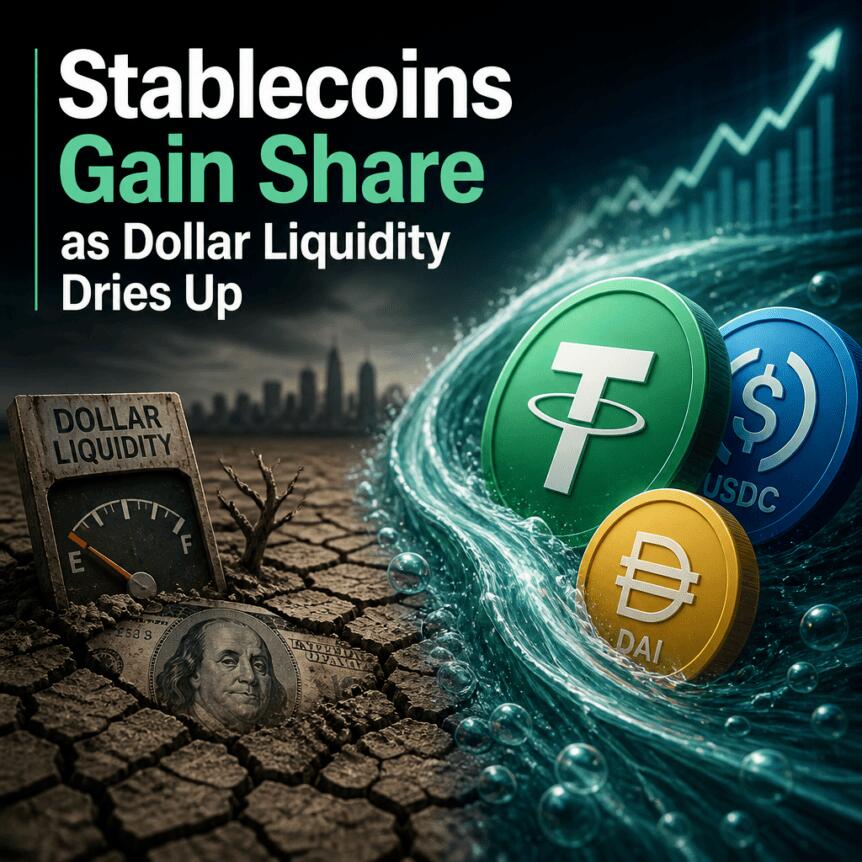
Stablecoins are increasingly moving from “cross-border convenience” to everyday financial infrastructure in parts of the developing world. In Bolivia, a new proposal would allow Tether’s USDt (USDT) to be used more broadly in payments and savings—an approach that reflects widening pressure on the local economy and the availability of dollars.
Meanwhile, the Bitcoin mining industry’s pivot toward AI and data-center infrastructure is drawing new scrutiny from investors, especially as insiders sell shares and governance questions rise. And in separate developments, CleanSpark highlighted the potential scale of long-term data-center revenue, while Bitmine reported strong results tied to Ethereum staking.
Key takeaways
- Bolivia is considering a regulatory framework that would recognize USDT as a payment currency amid a prolonged shortage of U.S. dollars.
- Bolivia is still on the Financial Action Task Force’s gray list, meaning any stablecoin rollout would need anti-money laundering controls.
- Investor focus is shifting for AI-focused Bitcoin miners, with recent disclosures of insider stock sales under Rule 10b5-1 plans.
- CleanSpark’s 20-year Georgia data-center lease could generate up to $6.6 billion in contracted revenue, with potential extensions taking the value higher.
- Bitmine reported $45.7 million in revenue from Ethereum staking and validation in the most recent quarter, with most income coming from staking.
Bolivia looks to formalize USDT payments as dollar scarcity deepens
Bolivia is weighing a regulatory path that would recognize Tether’s USDT as a payment currency, according to earlier reporting from Cointelegraph. The proposal, discussed by Economy and Public Finance Minister Jose Gabriel Espinoza, would allow USDT to circulate alongside the boliviano and the U.S. dollar for payments and savings.
Espinoza said the framework remains under review and would include anti-money laundering safeguards. The country still sits on the Financial Action Task Force’s gray list, which raises the compliance bar for any integration of stablecoins into regulated financial activity.
The policy debate comes after major currency stress earlier this year. Bolivia faced a sustained shortage of U.S. dollars following pressure on foreign exchange reserves, leading the government to abandon its long-standing currency peg. With a wider gap between the official and parallel exchange rates, demand for dollar-denominated alternatives has increased—boosting the role of stablecoins such as USDT for everyday transactions.
Bolivia’s latest move also follows two contextual shifts referenced by Cointelegraph: the lifting of the country’s crypto ban in 2024 and the new administration’s stated intent to expand access to digital asset services.
For investors and users, the practical question is not whether stablecoins are “faster,” but whether they can reliably substitute for dollars under local restrictions. A regulated USDT channel would potentially reduce friction for payments and savings while making compliance expectations clearer for financial providers that interact with the token.
AI pivots at Bitcoin miners face a new governance test
As some Bitcoin miners reorient toward AI infrastructure and high-performance computing, a separate theme is emerging: investors are increasingly paying attention to what insiders are doing while those strategies are being rolled out.
According to Blocksbridge Consulting, executives at TeraWulf, Cipher Digital, Riot Platforms, and Core Scientific have disclosed stock sales in recent months. Many of those sales were conducted under prearranged Rule 10b5-1 trading plans. Blocksbridge also pointed out that strategic investors have trimmed their holdings—including Tether, which reduced its stake in Bitdeer after Bitdeer’s AI-driven rally.
The backdrop is a softening of AI infrastructure optimism. Blocksbridge cited the TEM AI Infrastructure Growth Index, stating it fell 16% over the past month. The firm said the market is beginning to look beyond the AI growth narrative and toward whether the miners’ pivots translate into sustainable value for public shareholders.
This is a critical distinction for the sector. Miners may be building long-dated infrastructure bets, but if governance signals—such as insider selling—suggest executives are less confident in near-to-medium term returns, shareholders may demand stronger evidence before capital follows the thesis.
CleanSpark’s long-term data-center lease underscores miners’ infrastructure bet
CleanSpark drew strong market attention after announcing a 20-year data center lease in Georgia. Cointelegraph reported the shares rallied by as much as 22% on the news, reflecting how the market is evaluating the potential scale of contracted revenue as miners deepen their participation in AI-related computing.
The agreement covers a 175-megawatt data center at CleanSpark’s Sandersville, Georgia, campus and is tied to an undisclosed investment-grade global technology company. The tenant will install its computing equipment on-site, with phased deliveries expected to begin in the fourth quarter of 2027.
Under the announced terms, Cointelegraph reported that the contract could generate up to $6.6 billion in contracted revenue. If the customer exercises two five-year extension options, the contract’s total value could reach $11.6 billion.
The lease also fits a broader industry pattern highlighted in the coverage: miners have been searching for additional revenue streams as post-halving mining economics remain under pressure. While many publicly traded miners have reduced their Bitcoin holdings to strengthen liquidity, CleanSpark has largely remained a net accumulator, although it sold some BTC earlier in the year to fund operations.
For readers tracking this trend, the key variable to watch is how quickly these long-lead infrastructure commitments convert into realized cash flows, particularly once the phased deliveries begin. Contract size can be eye-catching; timing, utilization, and the cost of capital will ultimately determine whether these deals improve balance sheets or merely shift risk further out.
Bitmine posts $45.7 million in Ethereum staking revenue, powered by validator operations
In a different corner of the market, Bitmine Immersion Technologies reported revenue generated from Ethereum staking and validation. Cointelegraph reported that Bitmine earned $45.7 million in revenue in the most recent quarter, despite ongoing pressure on ETH prices.
According to the company’s results, Ethereum staking accounted for 98% of its revenue for the three months ended May 31. Other income streams included about $624,000 from self-mining Bitcoin and approximately $168,000 from consulting services.
Bitmine’s staking activity comes after the March launch of MAVAN, its institutional Ethereum staking platform. Cointelegraph noted that MAVAN was built on the acquisition of validator operator Pier Two Holdings. The company said it has staked roughly 85% of its Ether holdings—about 4.9 million ETH.
Chairman Tom Lee said Bitmine now stakes more Ether than any other entity and projected annualized staking rewards of $284 million once its holdings are fully staked through MAVAN and its partners.
For businesses and investors, the relevance is straightforward: staking revenue remains highly sensitive to staking participation, operational execution, and ETH market conditions. Bitmine’s figures suggest meaningful operating momentum, but readers should still focus on how staking yields evolve and whether partners and fully deployed staking capacity sustain growth into future reporting periods.
Looking ahead, stablecoin policy decisions in Bolivia and similar jurisdictions may determine how quickly dollar-like utility spreads beyond payments, while the Bitcoin mining-to-AI transition will likely be judged not just on infrastructure announcements, but on governance behavior and whether contracted deals begin translating into shareholder value. On the staking side, follow-on disclosures around full deployment through platforms like MAVAN will show whether recent revenue strength can hold.
ZachXBT has sparked debate after claiming on his Telegram channel that hardware wallets are “complete garbage” for serious crypto use.
According to him, people who often handle huge amounts are better off using a spare iPhone as a sign-in device.
ZachXBT Details the Daily Struggles of Hardware Wallet Users
The crypto investigator’s Telegram message was blunt:
“Hot take: All hardware wallets are complete garbage and I do not advise using them for important tasks like signing transactions or storing funds,” he wrote.
He went further, arguing that a separate iPhone used only as a wallet could provide a better experience than any hardware on the market right now, while he specifically criticized Ledger.
“Ledger is the worst and Ledger Live has regular updates for UI/apps for no good reason that break simple actions,” claimed ZachXBT.
Back on X, he listed several problems that hardware wallet users could face when making a typical time-sensitive high-value transaction. The issues included dead batteries, obligatory upgrades of the device and software, UI changes, and site bugs that prevent signing multisig transactions.
Soon after, security researchers, wallet developers, and regular crypto users began responding to ZachXBT’s post. Axel Bitblaze agreed with the on-chain detective’s criticism of hardware wallets but questioned whether a phone was really a better replacement for them, since they would still leave the user with “one device and one seed as the single point of failure.”
Instead, he recommended a 2-of-3 Safe multisig setup with separate signer devices. He also advised crypto holders to store their seed phrases offline and to do a test before moving large amounts, while keeping spending wallets separate from long-term holdings.
Tornado Cash co-founder Roman Storm also chipped in, agreeing with the idea behind ZachXBT’s proposal but arguing that mobile wallets lack one important feature: BIP39 passphrase support.
The developer, who is facing a lengthy prison term after being convicted of operating an unlicensed money-transmitting business in 2025, pointed out that the extra passphrase layer is the main advantage of hardware wallets and called on software wallet makers to add support for it, which, in his view, would make them more useful for self-custody.
The debate also attracted responses from hardware wallet companies, with one of the largest, Trezor, saying that because a phone runs a full operating system, it has many possible attack points. Meanwhile, a hardware wallet is designed as a dedicated device that keeps private keys away from general computing environments.
Keystone Wallet took a more balanced position. The team acknowledged that ZachXBT was “not wrong” about the potential of an isolated phone but contended that most users are better served by purpose-built units, since the security of a phone depends heavily on strict user discipline.
Ledger’s Stance
As of this writing, Ledger had not responded directly to ZachXBT’s claims. However, it did publish a well-timed post on its X account, where it stated that its core security model is based on keeping private keys away from internet-connected devices.
“A private key that never touches the internet can’t be phished, deepfaked, or prompt-injected out of existence,” it wrote. “That’s the whole bet on hardware.”
Still, such devices are not completely immune to human mistakes. For example, an incident earlier this year saw a victim lose $282 million in BTC and LTC from their offline device through a social engineering scam.
The post ZachXBT’s Hardware Wallet Criticism Ignites Debate Over Crypto Self-Custody appeared first on CryptoPotato.
Ripple Payments Europe has joined 14 other firms in ESMA’s latest MiCA register update, lifting the number of approved crypto asset service providers to 294.
Summary
- ESMA added Ripple Payments Europe and 14 other firms to its MiCA register.
- Ripple can now provide regulated crypto services across 29 EU countries.
- AMLA warned that post-MiCA customer migration could strain compliance systems.
ESMA’s updated register identifies Ripple Payments Europe SA as an authorized crypto asset service provider, allowing the company’s European payments unit to offer regulated crypto services across 29 EU countries.
The authorization follows Ripple’s earlier approval in Luxembourg under the Markets in Crypto-Assets framework. According to Ripple, the Luxembourg license permits its European subsidiary to serve financial institutions and businesses throughout the European Economic Area.
Combined with its existing electronic money institution license in Luxembourg, the CASP approval gives Ripple permission to provide crypto asset and stablecoin payment services. Ripple has stated that banks, fintech companies, and corporate clients can use one integration to collect funds, exchange assets, and make payments.
Ripple gains access as banks enter the MiCA market
Alongside Ripple, ESMA added Portugal-based Bison Bank, Croatia’s state-owned Hrvatska poštanska banka, and Liechtenstein-based Kaiser Partner Privatbank to the register. Their inclusion shows that regulated banks are also seeking permission to provide digital asset services under MiCA.
Payment processor BitPay has separately secured MiCA authorization from the Dutch financial regulator, according to the original report. The license allows BitPay to provide crypto and stablecoin payment services across eligible EU markets through MiCA’s passporting system.
With the latest additions, ESMA now lists 294 authorized CASPs. Licensing activity has slowed since MiCA’s 18-month transitional period ended on July 1, the report noted, although the register continues to add crypto companies, payment firms, and traditional financial institutions.
MiCA requires companies offering covered crypto services in the bloc to obtain authorization from a national regulator. Once licensed, a provider can use the framework’s passporting rules to operate in other participating European markets without applying for separate approval in each country.
Ripple has also received regulatory approval from the UK Financial Conduct Authority, according to the company’s previous announcements. Its European permissions apply to Ripple’s payment services and infrastructure, including products that may use XRP, the XRP Ledger, or the RLUSD stablecoin, depending on the service and client.
July deadline increases pressure on departing crypto firms
Ripple’s entry comes as European regulators monitor customer movements following the end of MiCA’s transition window. Crypto companies that failed to obtain authorization by the applicable deadline must stop offering regulated services in EU markets unless national arrangements provide otherwise.
During a briefing before the European Parliament’s Committee on Economic and Monetary Affairs, AMLA chair Bruna Szego warned that firms leaving the market could face a sharp rise in withdrawal requests as customers move their assets before services close.
According to Szego, licensed virtual asset service providers receiving those customers may also struggle to process a large number of new accounts while maintaining effective anti-money laundering checks. She called on departing firms to prepare for increased customer activity and urged authorized providers to preserve compliance standards during onboarding.
AMLA’s warning places Ripple’s registration within a more demanding phase of MiCA implementation. While ESMA’s register shows that authorized providers can now serve customers across participating markets, Szego’s comments indicate that regulators expect them to manage incoming business without weakening identity checks, transaction monitoring, or other anti-money laundering controls.


Bitcoin Ordinals advocate Leonidas has proposed a new open-source Bitcoin client that would raise transaction size limits and reduce the dust threshold, seeking to remove policy restrictions affecting Ordinals and Runes transactions.
Summary
- Leonidas has proposed a new Bitcoin client that raises transaction size limits and lowers the dust threshold for Ordinals and Runes.
- Bitcoin $DOG Mode is intended to remove policy restrictions enforced by Bitcoin Core and Bitcoin Knots rather than Bitcoin consensus rules.
- The proposal comes months after Ord.io shut down, as Leonidas continues to push for wider support for Bitcoin native digital assets.
In a Friday post on X, Bitcoin Ordinals advocate Leonidas introduced a proposal for an alternative Bitcoin client called Bitcoin $DOG Mode, describing it as software designed to remove limits enforced by existing Bitcoin clients rather than by the Bitcoin protocol itself.
The proposed client would increase the maximum individual transaction size to 3.9 million weight units (WU) from the 400,000 WU allowed under Bitcoin Core’s default policy. It would also reduce the dust limit to 1 satoshi, compared with the current 294 to 546 satoshis required by Bitcoin Core for standard transactions.
According to Leonidas, Bitcoin Core and Bitcoin Knots have enforced transaction policies for years that are not part of Bitcoin’s consensus rules. He said the new client is intended to remove what he described as unnecessary restrictions, adding that the long-term goal is to attract enough users for Bitcoin Core to eventually reconsider those policies.
Larger transactions and smaller outputs
If adopted, the higher transaction limit would allow Ordinals users to include much larger inscriptions or entire collections within a single Bitcoin transaction, including transactions that occupy most of a block.
The lower dust limit would also make it easier to create very small transaction outputs. Under the current default rules used by Bitcoin Core nodes, users often have to increase output values above the minimum threshold before their transactions are relayed across the network. Bitcoin $DOG Mode would instead allow outputs as small as 1 satoshi.
Bitcoin $DOG Mode is being positioned as an alternative to Bitcoin Core and Bitcoin Knots, the two most widely used Bitcoin clients.
Ordinals and Runes have remained divisive since their launch. Supporters view them as Bitcoin-native versions of non-fungible and fungible tokens, while critics have argued they consume valuable block space and amount to network spam.
Proposal follows Ord.io shutdown
The proposal comes just months after Leonidas announced the closure of Ord.io, one of the earliest Ordinals explorers. In May, he said the project would shut down after the team ran out of funding and no longer saw a sustainable path forward.
Ord.io, launched in 2023, had served more than 1 million users before announcing plans to go offline. The associated consumer app Zap also ceased operations after failing to reach sufficient user growth, while the team said it would preserve public Ord.io data on GitHub and remained open to another group taking over the project.
Activity around Bitcoin inscriptions has cooled since the strong demand seen during 2023 and early 2024. Runes generated $135 million in fees during the first week after Bitcoin’s 2024 halving, although transaction activity later declined.
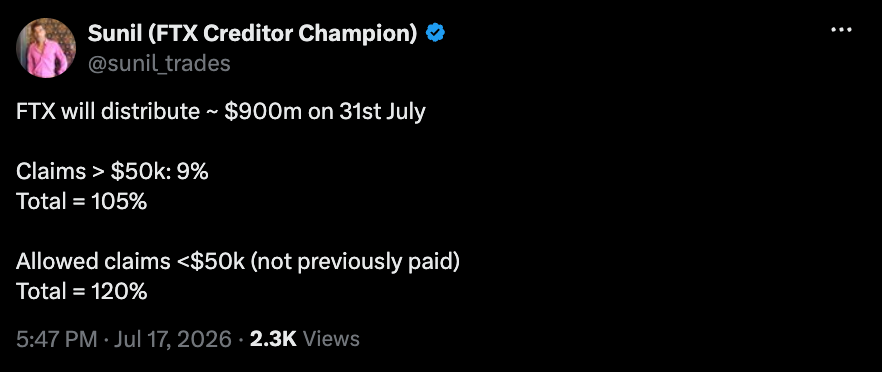
The trust behind reimbursing creditors with ties to defunct cryptocurrency exchange FTX announced that its next distribution of funds would start on July 31.
In a Friday notice, the FTX Recovery Trust and crypto exchange said that they would distribute about $900 million to claimants in the recovery plan’s “convenience and non-convenience classes.” Eligible creditors can receive funds through their BitGo, Kraken or Payoneer accounts within one to three business days starting from July 31.
The distribution will mark the fifth round of attempts of repaying FTX’s creditors. Convenience claims under $50,000 will receive a 120% reimbursement under FTX’s recovery plan, while others will receive between a 103-105% distribution.
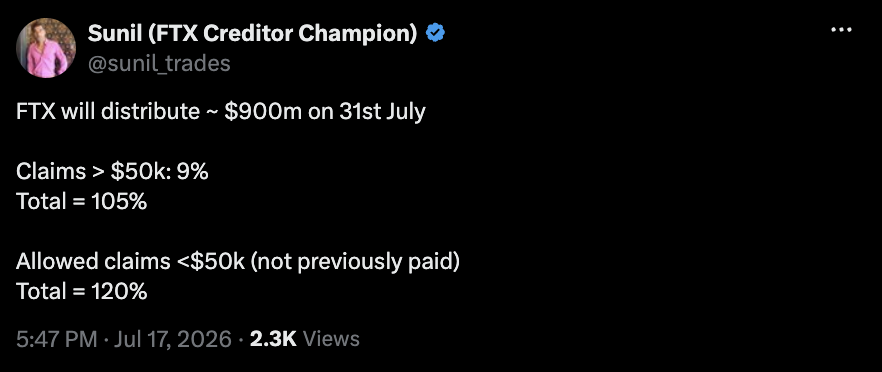
Source: Sunil Kavuri
Following a March distribution of $2.2 billion, the trust has paid out about $10 billion since the company filed for bankruptcy in November 2022 amid a crypto market downturn that resulted in many exchanges filing for Chapter 11 protection. Former FTX executives including CEO Sam “SBF” Bankman-Fried and Ryan Salame, the co-CEO of FTX’s Bahamian affiliate, are still in federal prison as part of their role in the exchange’s misuse of customer funds.
Related: FTX estate misses out on $3B Cursor stake value after $200K sale in 2023
In May, the law firm Fenwick & West, which advised FTX before its collapse, agreed to pay $54 million to settle a class action lawsuit filed by former users. A group of 20 FTX users sued the law firm for $525 million just days earlier.
Presidential pardon looking less likely for former FTX CEO
Bankman-Fried, who pleaded not guilty to criminal charges related to his role in the misuse of customer funds at FTX, was found guilty and sentenced to 25 years in prison in 2024. His appeal for his conviction and sentence was denied last month after a federal court upheld the New York court ruling.
However, even before the appellate court ruling became public, Bankman-Fried applied for a pardon from Donald Trump, something the US president said in a January interview that he did not plan on granting. Despite the statement from Trump, this week the US Senate unanimously adopted a resolution opposing clemency for the former FTX CEO.
The measure can’t stop Trump from issuing a pardon but reflected bipartisan opposition to the president granting clemency to a convicted felon. Many lawmakers have criticized the president issuing a pardon for former Binance CEO Changpeng Zhao after a UAE entity invested $2 billion into the crypto exchange using a stablecoin issued by the Trump family business, World Liberty Financial.
Magazine: Strategy became a symbol of the dot-com crash: Could history repeat?

Stablecoins have long been pitched as a faster way to move dollars across borders. In Bolivia, they’re increasingly becoming a way to access dollars in the first place. The country’s recent proposal to recognize Tether’s USDt (USDT) for payments underscores how economic instability is driving adoption in many emerging markets.
Elsewhere, Bitcoin miners are discovering that pivoting to AI infrastructure may unlock new revenue streams, but it doesn’t shield them from investor scrutiny.
Bolivia weighs recognizing USDT amid dollar shortage
Bolivia is considering a regulatory framework that would recognize Tether’s USDT as a payment currency, marking another step in the country’s push to integrate digital assets into its financial system.
Economy and Public Finance Minister Jose Gabriel Espinoza said the proposal would allow USDT to circulate alongside the boliviano and the US dollar for payments and savings. The framework remains under review and would include anti-money laundering safeguards, as Bolivia is still on the Financial Action Task Force’s gray list. The initiative follows the lifting of the country’s crypto ban in 2024 and the new administration’s pledge to expand access to digital asset services.
The proposal comes as Bolivia struggles with a prolonged shortage of US dollars after pressure on foreign exchange reserves forced the government to abandon its long-standing currency peg earlier this year. The resulting gap between the official and parallel exchange rates has increased demand for dollar-denominated alternatives such as USDT, which has become an increasingly popular payment tool in the country.

Source: EL DEBER
Bitcoin miners’ AI pivot draws scrutiny over insider stock sales
Investors are increasingly scrutinizing insider stock sales at Bitcoin miners pursuing AI infrastructure strategies as enthusiasm for the sector cools and governance concerns take center stage.
According to Blocksbridge Consulting, executives at TeraWulf, Cipher Digital, Riot Platforms and Core Scientific have disclosed stock sales in recent months, many of them made under prearranged Rule 10b5-1 trading plans. Strategic investors have also trimmed their holdings — including Tether — which reduced its stake in Bitdeer following the company’s AI-driven rally. The shift comes as the TEM AI Infrastructure Growth Index has fallen 16% over the past month.
Blocksbridge said investors are increasingly looking beyond the AI growth story to assess whether the benefits of miners’ strategic pivots will flow to public shareholders.
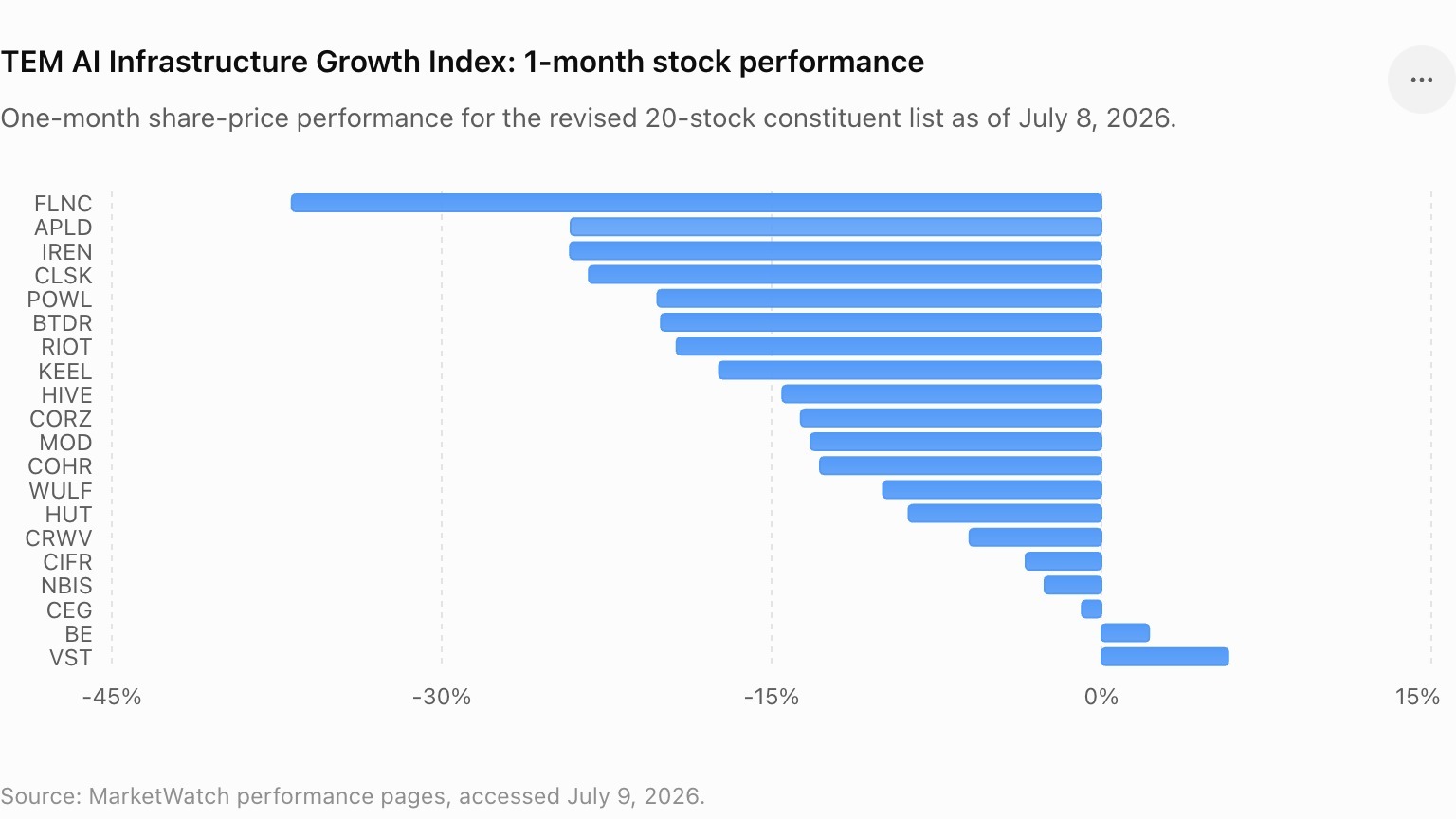
Most stocks in the 20-company TEM AI Infrastructure Growth Index were down over the past month through July 8. Source: Miner Weekly
CleanSpark stock jumps on $6.6 billion data center lease as AI pivot accelerates
CleanSpark shares rallied as much as 22% after the Bitcoin miner signed a 20-year data center lease in Georgia that could generate up to $6.6 billion in contracted revenue, underscoring its push into AI and high-performance computing infrastructure.
The agreement covers a 175-megawatt data center at the company’s Sandersville, Georgia, campus and was signed with an undisclosed investment-grade global technology company. The tenant will install its computing equipment at the site, with phased deliveries expected to begin in the fourth quarter of 2027. If the customer exercises two five-year extension options, the contract’s total value could reach $11.6 billion.
The deal reflects a broader trend among Bitcoin miners seeking new revenue streams as post-halving mining economics remain under pressure. While many publicly traded miners have reduced their Bitcoin holdings to shore up liquidity, CleanSpark has largely remained a net accumulator despite selling some BTC earlier this year to fund operations.
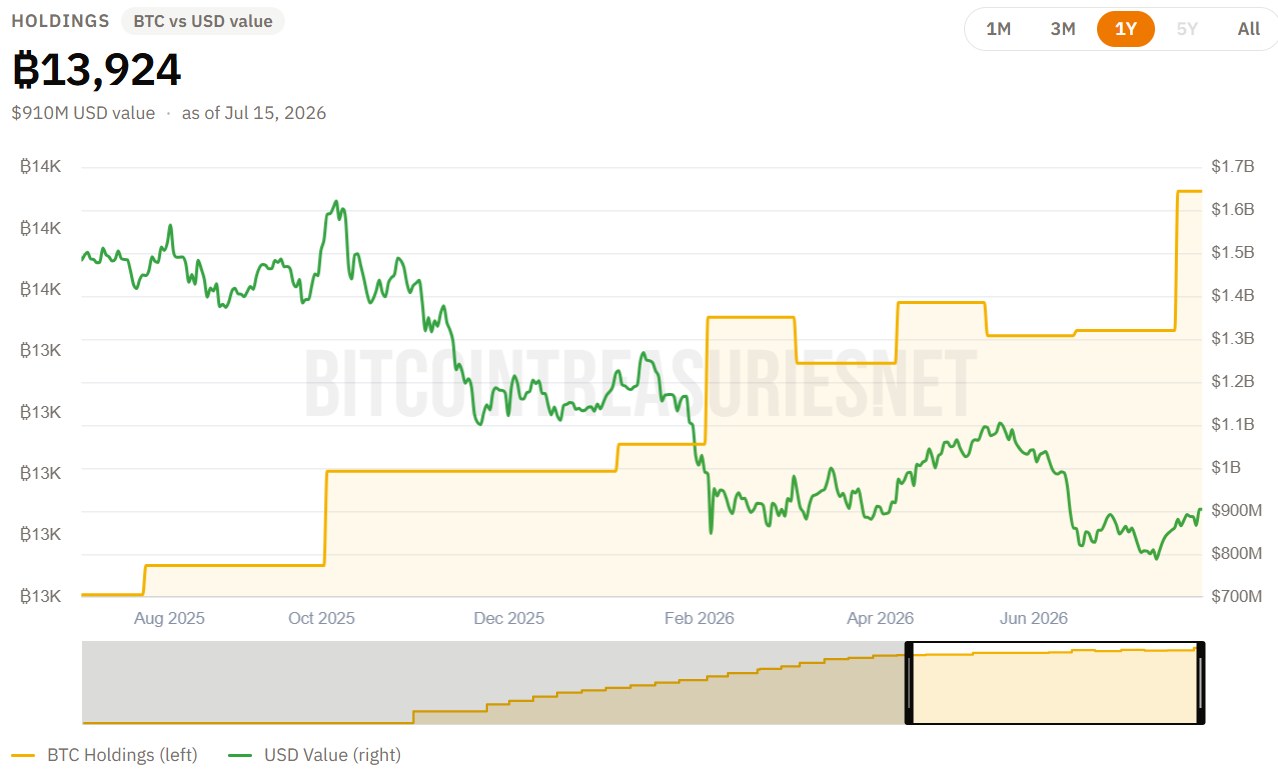
CleanSpark remains a net accumulator of Bitcoin. Source: BitcoinTreasuries.NET
Bitmine generated $46 million from Ethereum staking last quarter
Bitmine Immersion Technologies generated $45.7 million in revenue from Ethereum staking and validation last quarter, demonstrating the strength of its business even as ETH prices remained under pressure.
Ethereum staking accounted for 98% of the company’s revenue for the three months ended May 31, compared with $624,000 from self-mining Bitcoin and $168,000 from consulting services. The results follow the March launch of MAVAN, Bitmine’s institutional Ethereum staking platform, which was built on the acquisition of validator operator Pier Two Holdings. The company said it has staked roughly 85% of its Ether holdings, or about 4.9 million ETH.
Chairman Tom Lee said Bitmine now stakes more Ether than any other entity and projects annualized staking rewards of $284 million once its holdings of the token are fully staked through MAVAN and its partners.
Crypto Biz is your weekly pulse on the business behind blockchain and crypto, delivered directly to your inbox every Thursday.


Keyrock has completed its acquisition of the trading and brokerage assets of BlockFills’ institutional digital asset business, expanding its reach across crypto market making, over-the-counter trading, options and other capital-market services.
Summary
- Keyrock acquires BlockFills trading assets, adding institutional clients, derivatives expertise and technology to its platform.
- The transaction expands Keyrock’s regulatory reach through Cayman registration and a proposed U.K. FCA entity.
- BlockFills entered bankruptcy after reported losses, while Keyrock now plans phased integration of acquired operations.
The Brussels-based firm said the deal adds BlockFills’ client relationships, trading technology and derivatives expertise to its existing institutional platform.
According to Keyrock’s announcement, the transaction also expands its regulatory footprint through a CIMA-registered entity in the Cayman Islands. It also includes the proposed acquisition of an FCA-authorized entity in the U.K., subject to regulatory approval. Keyrock said the combined business will support institutional clients with trading infrastructure backed by its balance sheet and compliance framework.
The company did not disclose the purchase price in its announcement. However, earlier U.S. bankruptcy court filings showed that Keyrock agreed to pay $3.25 million for substantially all of BlockFills’ assets while assuming certain liabilities, customer relationships, equity interests and proprietary technology. A U.S. bankruptcy judge approved the sale in June.
BlockFills deal strengthens Keyrock’s derivatives business
The acquisition also brings experienced BlockFills staff into Keyrock. Perry Parker, who previously worked at Goldman Sachs and Deutsche Bank and led institutional options at BlockFills, is joining the company alongside Dan Schak, who oversaw risk and trading operations. Other employees across trading, operations and commercial functions will also move to Keyrock.
Keyrock co-founder and chief strategy officer Juan David Mendieta called the deal “an exceptional opportunity to further strengthen our team with outstanding talent and accelerate our global reach.” He also pointed to BlockFills’ institutional derivatives expertise and trading technology as key parts of the transaction.
Keyrock said digital asset derivatives are among its fastest-growing business lines as institutional demand for options and structured trading products expands. The BlockFills assets add specialist staff and client-facing systems in that area, giving the firm more capacity to serve hedge funds, asset managers, market makers and other professional counterparties.
The completed sale follows months of financial pressure at BlockFills. As crypto.news previously reported, the company froze deposits and withdrawals in February after suffering a reported $75 million lending loss. Co-founder and CEO Nicholas Hammer later stepped down as the firm searched for a buyer or strategic partner. BlockFills entered Chapter 11 bankruptcy protection in March.
Meanwhile, the acquisition comes as Keyrock expands its own institutional business. In March, the firm reached a $1.1 billion valuation in a Series C funding round led by Standard Chartered’s SC Ventures. The company has continued to build services covering liquidity, OTC execution, derivatives, credit, onchain markets and asset management.
Keyrock said it will integrate the acquired BlockFills operations in phases and communicate directly with clients as services become available. The deal gives the company a larger institutional client base and deeper derivatives capabilities while extending its regulatory presence across additional markets.
Piero Cipollone has warned that stablecoins could drain bank deposits as Coinbase fell 1.75% to $157 and Circle lost 6% across five sessions to trade near $60.
Summary
- Piero Cipollone warned that growing stablecoin use could pull deposits away from traditional banks.
- Coinbase shares are testing $157 support, with Compass Point maintaining a $140 downside target.
- Circle remains inside a descending channel as Mizuho forecasts a potential drop to $50.
The European Central Bank executive board member raised the concern during a July 17 speech at the Federation of Cooperative Credit Banks in Rome, where he linked increased stablecoin use with a possible decline in customer deposits.
According to Cipollone, consumers may become less willing to keep money in conventional bank accounts if stablecoins gain wider use. He argued that the European Union should speed up the digital euro to protect the role banks play in the financial system and limit reliance on privately issued tokens.
His comments have added a European voice to concerns already raised by US banking groups during negotiations over the CLARITY Act. In a letter to the Senate, the groups called for changes to Section 404 that would stop stablecoin companies from offering rewards or yield through affiliated firms.
Banking groups warned that interest-bearing stablecoins could pull deposits from community lenders and weaken their ability to provide credit. Circle, which issues the USDC stablecoin, has become especially exposed to the dispute because any limits on stablecoin rewards could affect how exchanges and other partners promote USDC.
Stablecoin fears deepen pressure on crypto stocks
Circle shares briefly dropped to $58 during pre-market trading on July 17, their lowest level since February 2026, before recovering toward $60.46. The decline continued even after Cathie Wood’s ARK Invest purchased about $15.4 million worth of Circle shares.
Legislative uncertainty has also weighed on sentiment. As crypto.news reported, President Donald Trump met with senators on July 16 as Republicans tried to resolve disputes holding up the CLARITY Act. The bill requires Democratic support in the Senate, where disagreements over ethics provisions and Trump’s crypto interests have complicated negotiations.
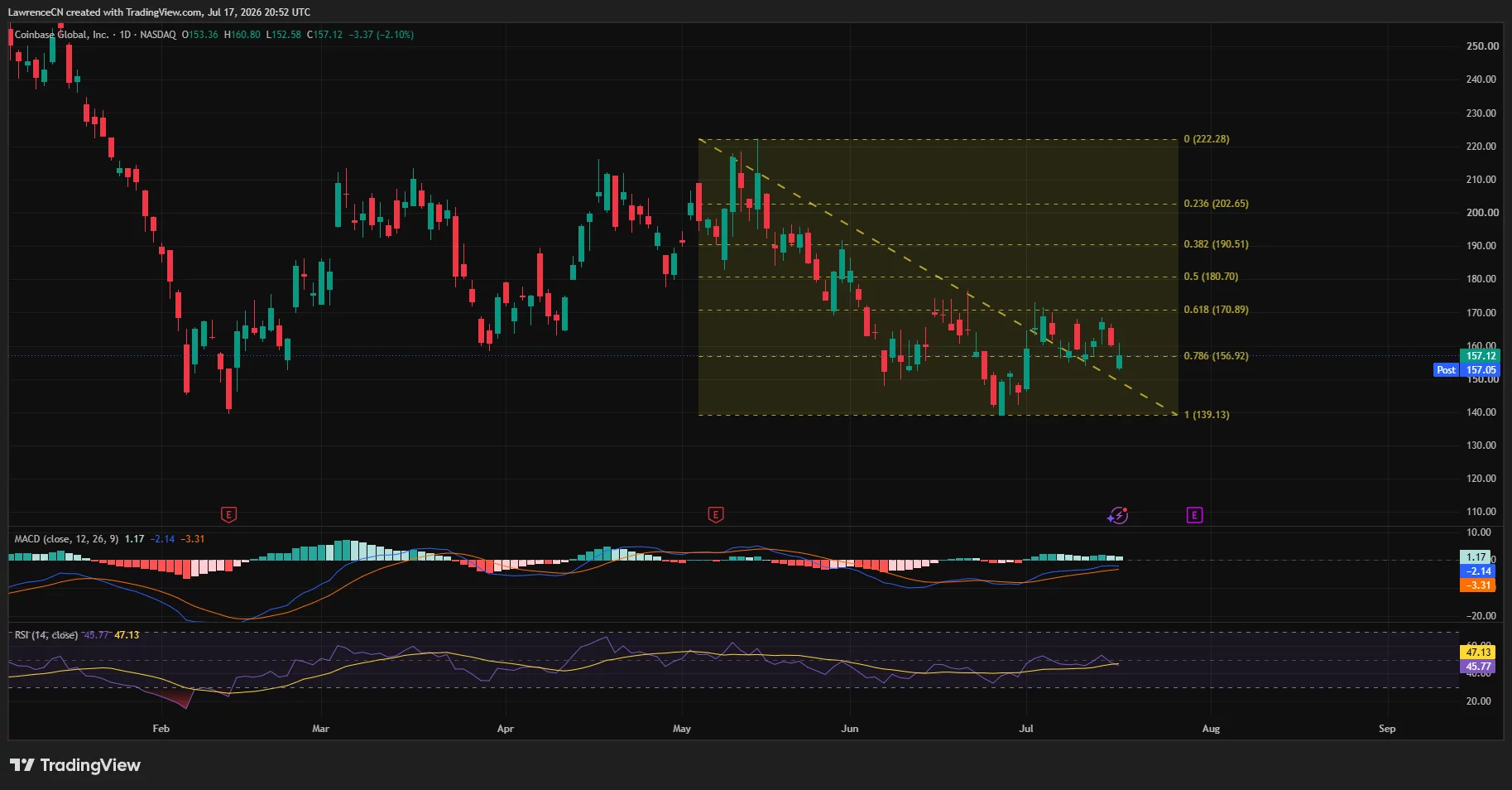
Coinbase faces a separate risk because changes to US market rules could affect stablecoin revenue, institutional services and trading activity. Compass Point analysts forecast that COIN could fall to $140 if Congress fails to pass the CLARITY Act, arguing that the bill may have more influence on the stock than Coinbase’s second-quarter earnings scheduled for July 30.
Oppenheimer has lowered its Coinbase price target to $209, citing weak trading volumes on the exchange. The revised target remains above the current market price but points to reduced expectations for transaction revenue.
COIN and CRCL remain pinned near key support
On the daily chart, COIN is testing the 78.6% Fibonacci retracement at $156.92 after closing around $157.12. A break below this area would expose the psychological support at $150, followed by the May low at $139.13, close to Compass Point’s $140 target.
COIN’s MACD line has crossed above its signal line and produced a positive histogram, suggesting that bearish momentum has eased. Both lines remain below zero, however, while the relative strength index at 45.77 stays under the neutral 50 level.
A recovery would first need to clear $160–$165 before testing the 61.8% Fibonacci level at $170.89.
Circle’s daily chart places CRCL inside a descending channel that has controlled its slide from roughly $100 in early June. The $58–$60 zone remains the first support area, while a breakdown could expose $50, matching Mizuho’s downside target.
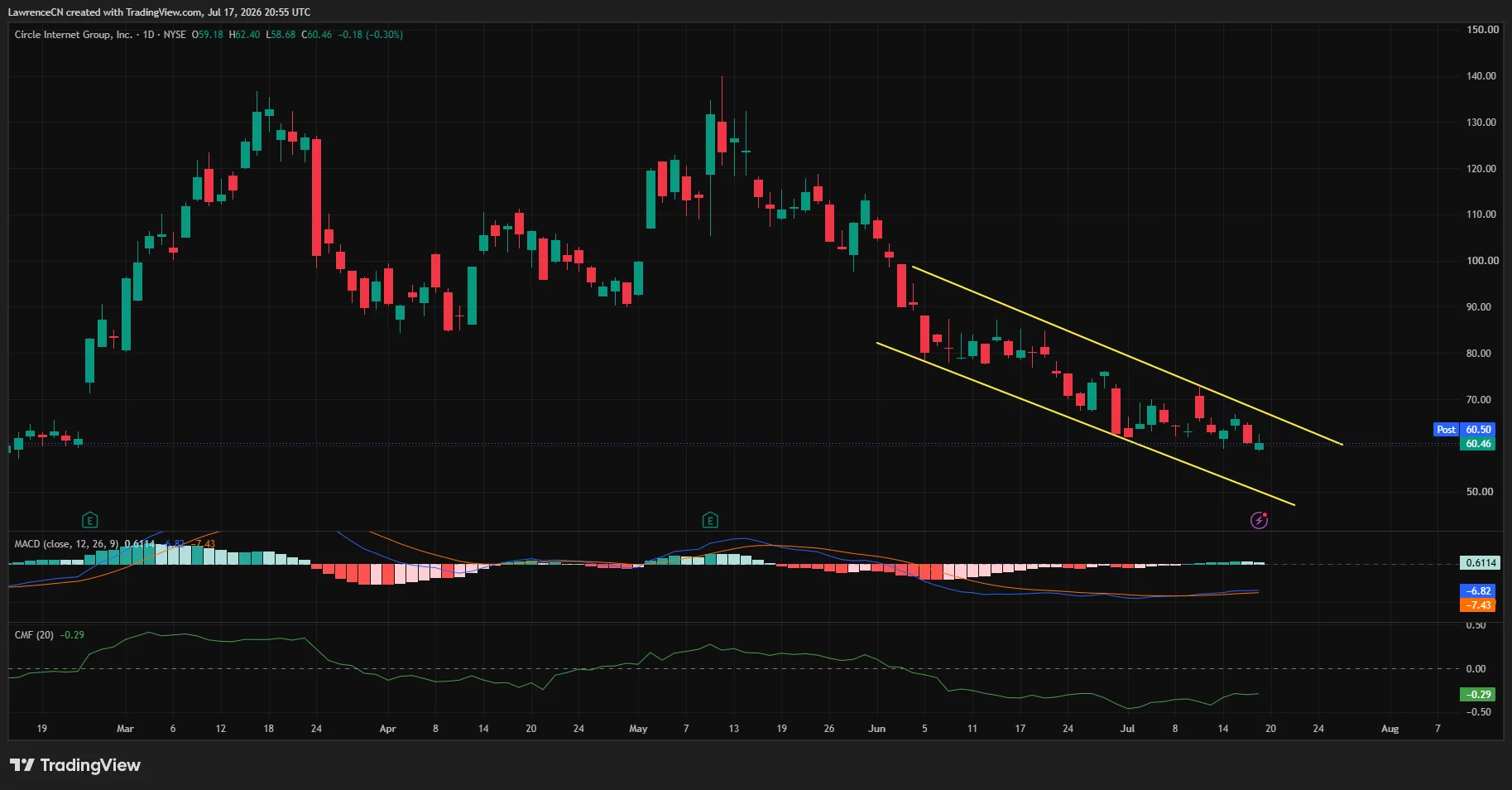
Mizuho analysts also warned that the new OpenUSD stablecoin could take market share from Circle, adding another risk to CRCL’s stock price.
CRCL’s MACD has formed an early bullish crossover below zero, but the Chaikin Money Flow reading of minus 0.29 shows continued capital outflows. A close above the channel resistance around $64–$65 would weaken the bearish setup, whereas another rejection could send the shares back toward $58 and Mizuho’s $50 forecast.

Dinosaur Adventure Live’s Danger On T-Rex Mountain in York

Super League: Huddersfield Giants 10-24 Wigan Warriors – Zach Eckersley hat-trick helps visitors to victory

Fifth Third Bancorp (FITB) Q2 2026 Earnings Call Transcript


-

 Fashion7 days ago
Weekend Open Thread: Nutriplenish Leave-In Conditioner
-
 NewsBeat1 day ago
London Mayor Sadiq Khan handed a peerage by Keir Starmer alongside 15 other Labour figures… just days before the PM leaves No10
-

 Politics2 days ago
Young campaigners urge incoming PM to act on outdoor junk food ads
-

 Crypto World2 days ago
CFTC blocks Kalshi from unwinding Michigan trades after court order
-

 Fashion5 hours ago
Weekend Open Thread – Corporette.com
-

 Business2 days ago
Nvidia Stock Slips After Big Tuesday Rally as Huang Confirms Vera Rubin Chip Is Now in Production Today
-
 Entertainment2 days ago
Disney’s Most Ambitious Failed Star Wars Attraction Is Coming to SDCC
-

 News Videos3 days ago
XRP BOMBSHELL… XRP OMBOARDED FOR TRANSACTIONS!!!
-

 Crypto World1 day ago
Injective Submits SEC Transfer-Agent Registration to Onchain Ownership Records
-

 Tech4 days ago
Get Your ESP32 Sunny Side Up With This Solar Dev Board
-

 NewsBeat10 hours ago
Registration is now open for March for Men with Kev 2026
-

 Tech3 days ago
Dark Secrets Emerge When Jailbreaking LLMs
-

 Business2 days ago
Palantir Shares Rise After Expanded Nvidia Partnership and Fresh Analyst Upgrades Ahead of Earnings Day
-

 News Videos16 hours ago
Money | Class 12 Economics | CBSE Board Exam 2026-27
-
 Sports2 days ago
New Cornerback Enters Vikings Trade Rumor Mill
-
 Business21 hours ago
Banco Bilbao Vizcaya Argentaria, S.A. (BBVA) Discusses Global Macro Environment and Economic Outlook for Core Markets Transcript
-
 Tech4 days ago
Cloudflare Precursor Watches Your Mouse and Keyboard To Decide If You Are Human
-

 Business4 hours ago
Airlines warn Sunshine Protection Act could disrupt flight scheduling
-

 News Videos4 days ago
how to make coin bank box with cardboard #scienceproject #money #diy #shorts
-
 Entertainment2 days ago
Vicki Gunvalson Defends Discussing Heather Dubrow’s Money
You must be logged in to post a comment Login