

Business
Debt Collectors Chase More Consumers in Court

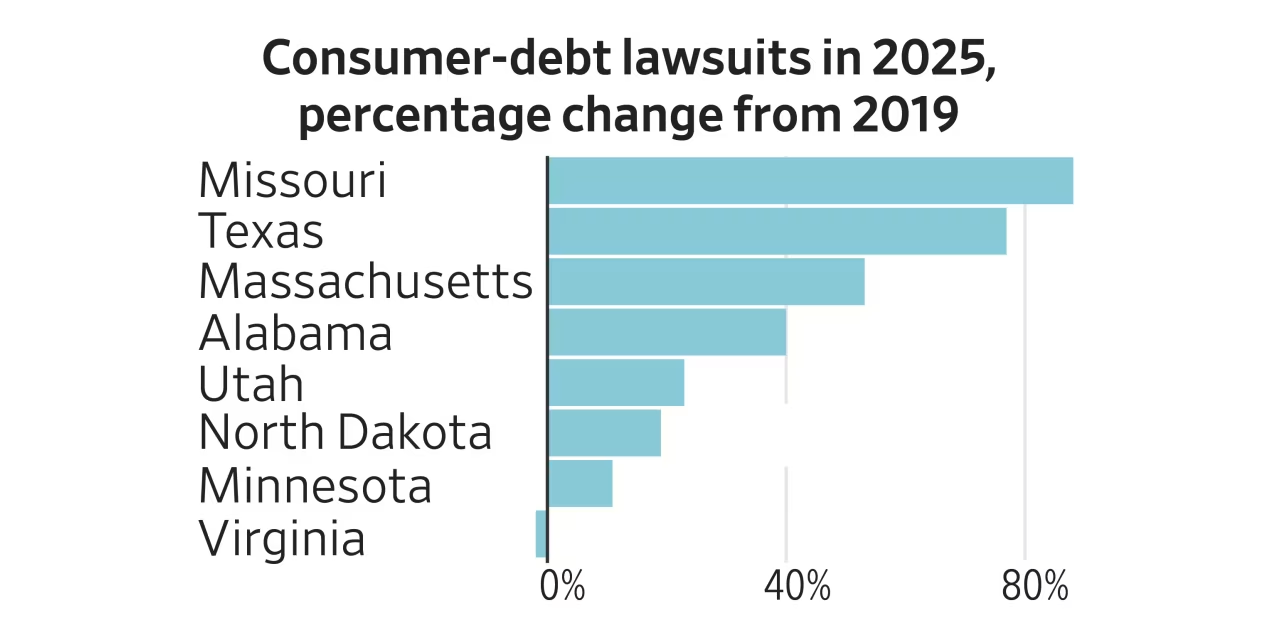
Lawsuits filed by debt collectors over unpaid credit-card bills and other outstanding balances have surged to their highest levels in years, according to a report released Thursday by the Pew Charitable Trusts.
The number of debt collection lawsuits filed in several states and metropolitan areas in 2025 outpaced prepandemic levels, continuing a trend that began a year earlier, according to the Pew report.
Copyright ©2026 Dow Jones & Company, Inc. All Rights Reserved. 87990cbe856818d5eddac44c7b1cdeb8


Some companies grow by doing more. Simply Shutters grew by doing less, but doing it better.
Founded on March 15, 2017, in Port St. Lucie, Florida, Simply Shutters was built around one clear idea. The company would focus only on plantation shutters. No blinds. No shades. No extra products to distract the team.
That simple choice helped shape the company’s path.
Started by Martin County natives Tim McBride and Stephen Bromstrup, Simply Shutters came from both experience and hard lessons. Before launching under its current name, the founders had run a shutter business in Stuart, Florida. That first venture did not work out the way they hoped. But it gave them a clear view of what needed to change.
“Our previous company failed because we tried to be like everyone else in the industry,” the founders said. “When we started Simply Shutters, we knew we had to do things differently.”
How Simply Shutters Started After a Business Setback
The story of Simply Shutters did not begin with instant success. It began with a reset.
After their earlier business struggled, McBride and Bromstrup took a hard look at the shutter industry. Many companies were buying parts from overseas, assembling them locally, and selling products in a similar way. The founders saw room for a better model.
They opened in Port St. Lucie with a new plan. They wanted to make shutters easier to buy, easier to price, and easier to install.
“The name Simply Shutters comes from making everything we do as easy as possible,” they said.
That idea became the company’s core. It also became a business lesson. A company does not always need to be complex to grow. Sometimes, the strongest idea is the clearest one.
Why Simply Shutters Focused Only on Plantation Shutters
From the start, Simply Shutters made a choice that many companies avoid. It chose a narrow focus.
The company sells plantation shutters only. That decision helped the team build deep knowledge in one product category.
“We only offer shutters,” the founders said. “That is what allows us to focus on quality, price, and process.”
This focus helped the company stand apart. While other businesses sold many types of window treatments, Simply Shutters put its full attention on improving one product.
For customers, that created a simpler buying path. For the business, it created stronger systems. Sales, installation, training, product design, and service could all be built around one clear offering.
How a Direct Manufacturing Partnership Changed the Business
One of the biggest moves in the company’s growth was signing a partnership agreement with a manufacturer in Xiamen, China.
This allowed Simply Shutters to sell directly from the source. It also helped reduce extra costs in the supply chain.
The model was important because affordability was part of the company’s purpose. The founders wanted middle-class homeowners to have access to quality plantation shutters without paying prices that felt out of reach.
“Our goal was to bring the highest quality shutters to people at a price they could afford,” they said.
That idea helped Simply Shutters grow quickly. The founders also used their background in internet marketing to reach more customers. Demand rose fast.
At one point, the company grew so quickly that it could not keep up.
“We exploded and couldn’t meet the demand,” they said. “We had to refund hundreds of customers and rethink how shutters should be sold.”
Instead of viewing that moment only as a failure, the team used it as a turning point.
How Simply Shutters Improved Its Product Over Time
In the early years, Simply Shutters sold products similar to what many competitors offered. Over time, that changed.
The company began investing heavily in product development. It spent millions of dollars rebuilding its PVC plantation shutters piece by piece.
“We have changed every single piece of the shutters,” the founders said. “We started with the same kind of product others were selling, but we kept improving it.”
That steady improvement became one of the company’s biggest ideas brought to life.
Instead of accepting the standard product in the market, Simply Shutters worked to make its shutters stronger, better looking, and more durable. The company kept its focus on value while upgrading the product.
This is where its story becomes more than a sales story. It is a business growth story. The company used customer demand, past mistakes, and product feedback to build a better operation.
What Helped Simply Shutters Grow Across Florida
Simply Shutters grew from a small warehouse with four employees into a company with about 50 full-time team members.
It now operates several warehouse locations across Florida. It has served more than 50,000 homes and installs thousands of shutters each week. The company is also preparing to expand into Texas with its first warehouse there.
Another key choice was keeping workers in-house.
“We do not use subcontractors,” the founders said. “Our installers and salespeople are full-time employees.”
That decision helps the company control service, training, and accountability. It also shows how the founders think about scale. Growth is not just about selling more. It is about building systems that can support more customers without losing control of quality.
What Business Owners Can Learn From Simply Shutters
The Simply Shutters story shows how one focused idea can create long-term growth.
The founders did not build the company by trying to offer everything. They built it by solving one problem better each year. They learned from an early setback. They changed their supply chain. They improved their product. They hired directly. They kept the buying process simple.
“We wanted to do this totally different from any other company in our space,” the founders said.
That mindset helped Simply Shutters move from a local Florida business to a growing shutter company with expansion plans beyond the state.
For business owners and career builders, the lesson is clear. Big ideas do not always have to sound dramatic. Sometimes, a big idea is choosing one lane, staying with it, and improving it until the market notices.
Simply Shutters built its growth on that kind of discipline. The result is a company that has turned focus, simplicity, and product improvement into a lasting business model.

The television market in the UK has never stood still, but the pace of change has accelerated over the last decade. Streaming platforms, faster broadband and connected devices have altered viewing habits in ways that would have been difficult to imagine twenty years ago.
The living room television is still central to many households, yet viewers now expect the freedom to start a programme on one device, continue it on another and choose from an ever-growing range of content.
IPTV, or Internet Protocol Television, has become part of that conversation. While traditional broadcasting remains firmly established, internet-delivered television has expanded alongside it, giving consumers another way to access live channels, sport, films and on-demand programming. Its growth says less about one particular technology and more about how expectations have changed across the UK’s digital economy.
Convenience Has Become the Standard
Consumer expectations have shifted well beyond television.
People now order groceries through mobile apps, manage bank accounts online, store documents in the cloud and subscribe to music, software and entertainment with a few clicks. Television has followed the same path.
Viewers increasingly expect services to be available whenever they want them, regardless of location or device. Waiting for scheduled broadcasts is no longer the only option, and many households now combine traditional television with internet-based services to suit different viewing preferences.
This flexibility has become one of the defining features of modern entertainment.
Better Broadband Has Changed More Than Internet Speeds
The UK’s continued investment in broadband infrastructure has affected far more than web browsing or remote working.
Reliable high-speed connections have made it practical for households to stream multiple high-definition or 4K video feeds at the same time without noticeably affecting the viewing experience. For consumers, that means fewer compromises when different members of the family want to watch different programmes on separate devices.
Broadband quality has therefore become an important part of the entertainment experience. Viewers often judge a service by how consistently it performs rather than by the technology used to deliver it.
This has encouraged television providers to place greater emphasis on platform stability, application performance and customer support.
Subscription Services Have Changed Consumer Expectations
Television is only one example of a much broader economic trend.
Subscription models have become common across software, cloud storage, fitness, music, education and entertainment. Instead of making one-off purchases, consumers are increasingly comfortable paying for services that provide ongoing value.
That change has altered how businesses compete.
Winning a customer is no longer enough. Keeping that customer month after month has become equally important. This places greater attention on service quality, reliability and the overall customer experience.
Businesses that make their services easier to use often gain an advantage over competitors that focus solely on price.
Competition Extends Beyond Content
Content remains important, but viewers often evaluate television services using other criteria.
Is the application easy to navigate?
Does it work across different devices?
Can programmes be found quickly?
Is customer support available when something goes wrong?
These questions matter because consumers now compare every digital service with the best online experiences they already use. Expectations created by banking apps, online retailers and streaming platforms influence how customers judge businesses in completely different industries.
For providers, improvements to usability and customer support can have just as much influence on customer satisfaction as new content.
Technology Behind the Scenes
Many of the changes taking place within television are largely invisible to viewers.
Cloud infrastructure allows services to scale more efficiently during periods of high demand.
Artificial intelligence helps improve search results, content recommendations and customer support. Modern applications receive regular updates that improve stability, compatibility and security without requiring new hardware.
These developments are not unique to television. They reflect wider changes across digital businesses, where software improvements often happen continuously rather than through occasional major releases.
Consumers may never notice the technology itself, but they notice when a service performs well.
IPTV Reflects Wider Business Trends
The continued growth of IPTV highlights several themes that business leaders encounter across many sectors.
Customers value convenience.
They expect services such as Xtreme HD IPTV to work across multiple devices.
They prefer straightforward pricing and simple account management.
They are more likely to remain loyal when support is responsive and problems are resolved quickly.
These are not lessons limited to entertainment companies. Software providers, financial technology firms, online retailers and professional service businesses all compete on similar factors.
Customer experience increasingly influences long-term growth.
The Role of Trust
As digital services become part of everyday life, trust becomes more valuable.
Consumers expect businesses to communicate clearly, maintain reliable services and respond promptly when assistance is needed.
Building that confidence takes time. It is rarely achieved through advertising alone. Consistency, transparency and dependable customer support often have a greater impact on reputation than promotional campaigns.
This explains why many subscription businesses now invest heavily in customer retention as well as customer acquisition.
A Market That Continues to Evolve
The UK television market remains highly competitive, with public broadcasters, commercial broadcasters, subscription platforms and internet-based television services all serving different audiences.
Rather than replacing one another, these services increasingly exist alongside each other. Many households combine free-to-air channels with streaming subscriptions and IPTV, choosing the mix that best suits their viewing habits.
One example is Xtreme HD IPTV, which illustrates how internet-based television providers are placing greater emphasis on platform performance, device compatibility and customer support as consumer expectations continue to rise.
Looking Ahead
Television has always adapted to new technology, from analogue broadcasting to digital television and from satellite services to online streaming. IPTV represents another stage in that progression rather than a complete departure from what came before.
For businesses, the wider message is straightforward. Consumer expectations continue to evolve, but the priorities remain familiar: reliability, convenience, simplicity and trust. Companies that deliver those qualities consistently are often better placed to build lasting customer relationships, regardless of the industry in which they operate.
Readers interested in UK communications, media and consumer research can explore the latest reports published by Ofcom, which regularly examines changes in television viewing, broadband adoption and digital media across the UK.
Business
SK Hynix ADR Rebounds 4.29% to $158.84 as Its Wild Post-IPO Trading Volatility Persists Into Third Week
Shares of SK Hynix’s American depositary receipts climbed 4.29%, or $6.53, to $158.84 Friday morning, offering a partial rebound after a rough stretch that has seen the newly listed stock swing wildly in both directions since its blockbuster Nasdaq debut earlier this month.
The bounce comes after another turbulent overnight session for the memory chipmaker’s U.S.-listed shares. The stock closed Thursday at $152.31, having fallen sharply in premarket trading by as much as 5.80% at one point, before staging a partial recovery into Friday’s session. The recent swings extend a pattern that has defined SK Hynix’s ADR since it began trading on the Nasdaq, with the stock repeatedly posting double-digit percentage moves, sometimes within the same trading week, as investors continue working out how to value the newly listed security.
SK Hynix made history on July 10 when its ADRs began trading on the Nasdaq following a $26.5 billion offering, the largest first-time share sale ever completed by a foreign company on a U.S. exchange. The ADRs opened at $170 per share, a 14% premium above their $149 offering price, before finishing their first session at $168.01. Demand for the offering reportedly exceeded available supply by more than seven to one, according to Reuters, with roughly $5 billion of the ADRs allocated to three cornerstone investors: Baillie Gifford, Coatue Management and Situational Awareness Partners.
At the opening bell ceremony held in Times Square, SK Hynix Chief Executive Kwak Noh-Jung called the moment a milestone for the company. “Today is a very proud day, and today is a truly historic day for SK Hynix,” Kwak said, adding that high-bandwidth memory, the category of chips in which SK Hynix holds the leading global market position, “stands at the heart of the AI revolution.” SK Group Chairman Chey Tae-won, speaking separately to CNBC, described the listing as “a dream come true.” Proceeds from the offering are expected to fund the purchase of extreme ultraviolet lithography equipment and the construction of new production facilities, according to the company’s regulatory filings.
Since that debut, the stock’s trading pattern has been anything but steady. The ADRs fell 9.3% the following Monday as a record selloff in South Korea’s own stock market bled into U.S. trading, before staging a dramatic 27% rebound the next day. That rally pushed the ADR’s premium over SK Hynix’s Seoul-listed common shares to more than 50%, according to Bloomberg data, far above the roughly 3% gap at which the ADRs were originally priced relative to the underlying Korean shares.
The volatility continued into this past week. The stock surged 17% on July 14 to a then-record high of $178.66, driven in part by heavy demand for short-term call options and the company’s announcement that it had officially begun mass production of its 12-layer HBM4 memory chips, a next-generation product central to SK Hynix’s position in the AI hardware supply chain. That rally was followed by a steep 9% decline the next session, then Thursday’s further slide to $152.31, before Friday’s partial rebound.
Wall Street’s outlook on the stock, despite the turbulence, remains notably bullish. According to data compiled by Investing.com, the average 12-month price target among covering analysts sits at $342.50, implying potential upside of more than 120% from current trading levels, with both analysts tracking the stock issuing buy recommendations and none recommending a sell. The stock’s 52-week range spans from $151.30 to $194.80, reflecting how much of that range has already been established in just the first two weeks of trading.
SK Hynix’s underlying business fundamentals remain strong even amid the share price volatility. The company holds roughly 33% of the global DRAM market and 21% of the NAND market as of the most recent available data, positioning it as the world’s second-largest supplier in both categories. Analysts covering the stock have pointed to SK Hynix’s long runway for growth as it capitalizes on the still-early artificial intelligence boom through its high-bandwidth memory products, though some have flagged the rapid expansion of Chinese memory manufacturers as a longer-term risk that could eventually pressure industry-wide pricing and returns if capacity growth outpaces demand.
The broader memory chip sector has experienced a similarly turbulent stretch in recent sessions. Micron Technology has fallen roughly 17% over the trailing month even as the stock traded around $851 as of Friday, while Western Digital shares dropped 7.7% in a single morning session earlier this week to reach $474.24, pressured by a combination of competitive concerns within the sector. Market commentators have described the recent pullback across memory names as a pause rather than a reversal in the broader AI-driven memory investment cycle, with one analysis characterizing the sector as “catching its breath” following an extraordinary run higher earlier in the year.
SK Hynix’s underlying Korean shares are scheduled to receive an additional listing on South Korea’s KOSPI market on July 29, a step expected to further formalize the connection between the company’s dual listings in Seoul and New York. In the meantime, the wide and fluctuating premium between the ADRs and the Korean shares has continued to draw scrutiny from analysts, who have pointed to the relatively limited float of the newly issued ADRs, combined with the launch of several leveraged exchange-traded products tied specifically to the stock, as key factors amplifying the day-to-day price swings investors have witnessed since the listing.
With earnings from the broader chip sector, including recent reports from ASML and Taiwan Semiconductor Manufacturing, continuing to shape sentiment around AI-related hardware spending, traders said they expect SK Hynix’s ADR to remain one of the most closely watched and volatile securities on the Nasdaq in the weeks ahead, as the market continues working to establish a stable trading range for one of the largest and most closely followed foreign listings in recent Wall Street history.


Daniel is an avid and active professional investor.
He runs Crude Value Insights, a value-oriented newsletter aimed at analyzing the cash flows and assessing the value of companies in the oil and gas space. His primary focus is on finding businesses that are trading at a significant discount to their intrinsic value by employing a combination of Benjamin Graham’s investment philosophy and a contrarian approach to the market and the securities therein. Learn more.
Analyst’s Disclosure: I/we have no stock, option or similar derivative position in any of the companies mentioned, and no plans to initiate any such positions within the next 72 hours. I wrote this article myself, and it expresses my own opinions. I am not receiving compensation for it (other than from Seeking Alpha). I have no business relationship with any company whose stock is mentioned in this article.
Seeking Alpha’s Disclosure: Past performance is no guarantee of future results. No recommendation or advice is being given as to whether any investment is suitable for a particular investor. Any views or opinions expressed above may not reflect those of Seeking Alpha as a whole. Seeking Alpha is not a licensed securities dealer, broker or US investment adviser or investment bank. Our analysts are third party authors that include both professional investors and individual investors who may not be licensed or certified by any institute or regulatory body.

SANTA CLARA, Calif. — NVIDIA Corp. shares fell about 1.8 percent Tuesday to around 203.74, reflecting a pause in the semiconductor giant’s recent rally as investors weighed strong artificial intelligence demand against lofty valuations and potential cyclical risks in the chip sector.
The move came amid broader market fluctuations, with NVIDIA remaining a bellwether for AI infrastructure spending. The company dominates the market for graphics processing units essential for training and running large language models and other advanced AI systems.
NVIDIA’s latest quarterly results, reported in May, highlighted continued explosive growth. Revenue for the fiscal first quarter surged more than 260 percent year-over-year to 26 billion dollars, driven by data center sales that more than tripled. Data center revenue alone reached 22.6 billion dollars, underscoring the insatiable appetite for its Hopper and Blackwell architecture chips.
Gross margins remained robust at 78.4 percent, supported by high-demand products and pricing power in the AI accelerator market. The performance reinforced NVIDIA’s position as the primary beneficiary of the global AI buildout.
Chief Executive Officer Jensen Huang has repeatedly emphasized the transformative nature of accelerated computing. “We are in the midst of a computing revolution,” Huang said during recent earnings discussions, highlighting how GPU-accelerated systems are reshaping industries from automotive to healthcare.
The company’s data center segment now accounts for the vast majority of revenue, shifting NVIDIA from its gaming roots to an enterprise infrastructure powerhouse. Blackwell platform shipments are ramping up, with expectations for significant contributions in the second half of the year.
NVIDIA’s software ecosystem, including CUDA and various AI frameworks, creates strong lock-in for developers and enterprises. This moat has proven difficult for competitors to overcome despite heavy investments in alternative architectures.
Tuesday’s trading reflected profit-taking after a strong run, with the stock still up substantially year-to-date. NVIDIA’s market capitalization has soared into the trillions, making it one of the world’s most valuable companies and a key component of major indices.
Analysts largely maintain bullish outlooks, citing multi-year AI tailwinds. Consensus revenue forecasts for the current fiscal year point to continued triple-digit growth, though at a moderating pace as comparisons become more challenging.
Potential headwinds include export restrictions on advanced chips to certain markets, supply chain constraints for advanced packaging and increased competition from custom silicon developed by hyperscalers. NVIDIA has navigated these dynamics by expanding production capacity and diversifying its customer base.
The company continues to invest heavily in research and development, with annual spending in the billions to maintain technological leadership. New architectures like Rubin are already in development, promising further performance leaps for future AI workloads.
Gaming and professional visualization segments provide diversification, though they contribute less to overall results than in previous years. Automotive and robotics initiatives represent longer-term growth avenues as autonomous systems advance.
NVIDIA’s financial strength supports ongoing innovation and capital returns. The company pays a quarterly dividend and has conducted share repurchases, balancing growth investments with shareholder returns.
Geopolitical factors remain a focus. U.S. restrictions on shipments to China have impacted a portion of sales, though NVIDIA has adapted by developing compliant products for those markets while prioritizing unrestricted regions.
Tuesday’s dip occurred on solid volume as traders reassessed near-term momentum. Broader semiconductor sector performance was mixed, with some names facing pressure from AI spending digestion concerns.
NVIDIA’s Blackwell ramp is a key focus for the second half. Production yields and customer adoption timelines will influence whether the company meets elevated expectations for sequential growth.
The stock trades at a premium valuation reflecting its growth profile. Forward price-to-earnings multiples remain elevated but are supported by projected earnings expansion as AI adoption accelerates across enterprises.
Industry analysts project the total addressable market for AI infrastructure to expand dramatically over the next several years. NVIDIA’s current share dominance positions it to capture a disproportionate portion of that opportunity.
Partnerships with major cloud providers and system integrators have expanded reach. NVIDIA’s DGX Cloud offerings and sovereign AI initiatives with governments further broaden its footprint.
Sustainability efforts include energy-efficient chip designs and data center optimization tools. As AI computing demands strain power grids, efficiency becomes a competitive differentiator.
NVIDIA’s culture of innovation, led by Huang, emphasizes long-term thinking. The company has successfully pivoted multiple times, from gaming to professional graphics to deep learning and now full-stack AI solutions.
Tuesday’s trading provided little new fundamental information, with the move appearing largely technical. Attention now shifts to upcoming industry events and potential updates on Blackwell availability.
The semiconductor cycle has historically featured booms and busts, but many observers believe AI represents a structural shift with more durable demand. NVIDIA’s exposure to this trend has driven its extraordinary market performance.
Risks include potential slowdowns in hyperscaler spending, technological disruptions or intensified regulatory scrutiny. Execution on new product ramps will be critical to sustaining momentum.
NVIDIA’s ecosystem effect, where software and hardware reinforce each other, creates barriers to entry. CUDA’s widespread adoption among developers ensures continued preference for its hardware.
As enterprises move beyond experimentation to production AI deployments, demand for high-performance computing infrastructure is expected to remain robust. NVIDIA is uniquely positioned to serve this need.
The stock’s recent volatility highlights its sensitivity to sentiment around AI investment levels. Periods of digestion often follow strong runs, creating potential entry points for long-term investors.
NVIDIA continues to shape the future of computing. Its GPUs power everything from scientific research to entertainment, with AI representing the latest frontier of exponential growth.
Tuesday’s share price adjustment came against a backdrop of strong fundamentals. The company’s ability to deliver on guidance and innovate will determine whether current valuations prove justified.
As the AI era unfolds, NVIDIA remains at its center. Its performance will continue influencing technology sector sentiment and broader market narratives around artificial intelligence.

Corcept Therapeutics CFO Mokari sells $3.5m in shares

Operator
Hello, everyone. Thank you for joining us, and welcome to the Fifth Third’s Second Quarter Earnings Call. [Operator Instructions]
I will now hand the conference over to Matt Curoe, Director of Investor Relations. Please go ahead.
Matt Curoe
Senior Director of Investor Relations
Good morning, everyone. Welcome to Fifth Third’s Second Quarter 2026 Earnings Call. This morning, our Chairman, CEO and President, Tim Spence; and CFO, Bryan Preston, will provide an overview of our second quarter results and outlook.
Please review the cautionary statements in our materials, which can be found in our earnings release and presentation. These materials contain information regarding the use of non-GAAP measures and reconciliations to the GAAP results as well as forward-looking statements about Fifth Third’s performance. These statements speak only as of July 17, 2026, and Fifth Third undertakes no obligation to update them. Following prepared remarks by Tim and Bryan, we will open up the call for questions.
With that, let me turn it over to Tim.
Timothy Spence
Chairman, CEO & President
Good morning, everyone, and thank you for joining us. At Fifth

When business leaders talk about risk, the conversation usually turns to the threats that feel most dramatic. Economic uncertainty, rising costs, cyber attacks, regulation, supply chain disruption and changing customer behaviour all tend to dominate boardroom discussions.
These issues deserve attention, but they can also distract from a quieter and often more damaging risk: the possibility that a business has grown faster than its internal systems can support.
For many growing companies, the greatest operational threat is not a sudden external shock. It is the gradual widening of the gap between commercial ambition and organisational capability. A business can continue winning customers, increasing turnover and expanding its team while becoming less consistent, less coordinated and less resilient behind the scenes. By the time those weaknesses become visible, they are often already affecting performance, culture and customer experience.
This is a risk that Sanjeev Kumar Soosaipillai believes growing businesses need to take far more seriously. The companies that scale successfully are not always the ones that move fastest or hire most aggressively. More often, they are the ones that recognise when their operating model needs to evolve. They understand that a business designed for twenty people cannot simply be stretched to accommodate two hundred without consequence.
Growth Can Hide Weakness as Easily as It Reveals Success
The early stages of a business are often powered by speed, instinct and close personal oversight. Founders and senior leaders usually sit at the centre of decision-making, staying close to customers, managing key relationships, overseeing recruitment and maintaining a detailed understanding of the company’s financial position. This can be a powerful advantage because it allows the organisation to move quickly and respond to opportunities without unnecessary delay.
The challenge begins when that same style of operation is expected to support a much larger business. As headcount increases, customers multiply and responsibilities spread across departments or sites, direct oversight becomes harder to maintain. Decisions that were once made through informal conversations now require clear processes. Knowledge that previously sat with one or two senior people must be shared across teams. Standards that once felt obvious need to be written down, communicated and managed consistently.
This is where many companies misread the situation. Strong sales figures can create the impression that the organisation is healthy, even when internal strain is increasing. Revenue may be rising while teams are becoming overstretched, managers are applying inconsistent standards and employees are relying on outdated processes. Growth can therefore mask weakness for longer than leaders expect, particularly when commercial results remain strong enough to distract from operational warning signs.
The danger is that these problems rarely announce themselves clearly. They appear as small frustrations: duplicated work, unclear accountability, missed deadlines, inconsistent customer service, poor handovers, slow decision-making or managers interpreting priorities differently. Individually, each issue may seem manageable. Collectively, they point to a business that has outgrown the way it is run.
Why More People Do Not Automatically Mean More Capability
One of the most common responses to operational pressure is recruitment. When teams are stretched, the instinctive answer is often to hire more people. In some cases, that is exactly what is needed. Yet recruitment alone cannot fix a business that lacks structure. Adding people to unclear processes can increase complexity rather than reduce it, because every new employee needs direction, context, management and a clear understanding of how their role fits into the wider organisation.
This is an area where Sanjeev Kumar Soosaipillai takes a practical view. Businesses do not become stronger simply because they become bigger. They become stronger when growth is matched by capability. That means investing in leadership, systems, communication and accountability at the same time as investing in headcount. Without those foundations, even talented people can struggle to perform effectively because the environment around them does not allow them to succeed.
A growing company needs more than activity. It needs coordination. Employees need to know who owns which decisions, how information should flow, what standards are expected and how success is measured. Managers need to understand not only their operational responsibilities but also their role in developing people, communicating priorities and maintaining consistency. When these elements are missing, businesses often find themselves in the uncomfortable position of having more employees but no greater clarity.
This is why operational risk is so closely connected to leadership capability. As businesses grow, leadership becomes more distributed. The founder or chief executive can no longer be involved in every decision, which means managers at different levels must be equipped to lead with judgement and consistency. If those managers are promoted quickly without support, or if expectations are never clearly defined, the organisation begins to depend too heavily on individual personality rather than shared standards.
Communication Is Often the First System to Break
Communication is one of the clearest indicators of whether a business is scaling well. In a small organisation, information moves naturally. People sit close to each other, decisions are explained quickly and employees often have direct access to senior leaders. As the company expands, that informality becomes harder to sustain. Teams become more specialised, new layers of management appear and employees may no longer hear the same message at the same time.
Poor communication rarely feels like a major strategic risk at first. It feels like a series of minor misunderstandings. One department believes a project is urgent while another has not been told it is a priority. A manager interprets a policy differently from a colleague in another team. Employees hear about changes informally before they receive any official explanation. Customers receive inconsistent answers because internal guidance has not been properly shared.
Over time, these issues become expensive. They slow execution, damage trust and create unnecessary friction between teams. They also make leadership less effective, because even the right strategy will fail if it is not understood by the people expected to deliver it. A growing business therefore needs communication to become more intentional. That does not mean flooding employees with corporate messaging. It means ensuring that priorities, responsibilities and decisions are explained clearly enough for people to act with confidence.
This is particularly important during periods of change. Expansion, restructuring, new investment, leadership changes and shifts in commercial direction all place additional pressure on communication. Employees do not need to know every confidential detail, but they do need enough clarity to understand what is changing, why it matters and what is expected of them. Without that clarity, uncertainty fills the gap.
The Role of Governance in Preventing Operational Drift
Governance is sometimes treated as a formal concern reserved for larger or more regulated organisations. That is a mistake. Good governance is not about creating bureaucracy or slowing down entrepreneurial decision-making. At its best, it provides clarity around authority, responsibility and accountability. It helps a business understand who makes decisions, how performance is monitored and how risks are escalated before they become crises.
For growing companies, governance is especially important because operational drift can happen quietly. Decisions may be made differently across departments. Policies may exist but not be followed. Financial controls may struggle to keep pace with expansion. Performance data may be available but not properly interpreted. Without governance, leaders can find themselves relying on presumptions rather than evidence.
Sanjeev Kumar Soosaipillai has consistently approached growth as a question of organisational discipline as much as commercial ambition. Businesses need the confidence to move quickly, but speed without control can create fragility. Governance allows leaders to retain agility while ensuring that decisions are made within a framework that protects the long-term health of the organisation.
This balance matters. Too little structure creates inconsistency, while too much structure can make a business slow and defensive. The aim is not to turn an entrepreneurial company into a rigid corporate machine. The aim is to build just enough structure to ensure that growth does not depend on constant personal intervention from a small number of senior people.
Operational Strength Is Becoming a Competitive Advantage
The most resilient businesses are often those that treat operations as a source of competitive advantage rather than a back-office concern. They understand that customers notice consistency, employees notice clarity and investors notice whether growth is being managed responsibly. A company with strong internal systems can respond to opportunity more confidently because it has the infrastructure required to absorb additional demand.
This is especially important in uncertain markets. When external conditions are difficult, businesses with weak internal structures are exposed quickly. Rising costs, changing demand or new regulation can place pressure on decision-making and reveal gaps that were previously hidden. Companies with stronger operating models are better placed to adapt because they already have clearer information, stronger accountability and more reliable processes.
The lesson for growing businesses is straightforward but often ignored. Operational risk should not only be addressed when something breaks. It should be considered early, while the company is still performing well and has the capacity to strengthen its foundations. Waiting until systems are under visible strain usually makes change harder, more expensive and more disruptive.
For Sanjeev Kumar Soosaipillai, the difference between growth and sustainable scale lies in this discipline. Growth can be achieved through demand, ambition and commercial energy, but scale requires an organisation capable of delivering consistently as complexity increases. That means investing in people, leadership, governance, communication and systems before weaknesses become impossible to ignore.
The biggest operational risk facing growing businesses is therefore not always the one that appears on a risk register. It is the presumption that yesterday’s way of working will be strong enough for tomorrow’s business. Companies that challenge that assumption early give themselves a far better chance of turning growth into lasting success.


FOX Business host Larry Kudlow discusses Vice President JD Vance’s economic and foreign policy views on ‘Kudlow.’
Kim Strassell writing today in the Wall Street Journal argues that Vice President Vance has gone AWOL.
The leader of the Senate could bring Congress together, but he’s hawking a book.
My pal Ben Domenech, writing in the Daily Wire, suggests that Mr. Vance is in desperate need of a “nineties summer”.
Right now, Mr. Domenech explains, Mr. Vance is too online. The vice president pays too much attention to social media that he appears to be blaming Israel for a peace deal with Iran that was poorly put together from the very beginning, and of course ripped to pieces by Iran.
A panel on ‘Kudlow’ discusses Vice President JD Vance’s controversial appearance on ‘The Joe Rogan Experience.’
The nineties summer? Chill out with minimal screen time, maximum outdoor time, and major family time.
The New York Post editorial board is even more direct: Mr. Vance is wrong to blame Israel for his Iran peace deal’s failure thus far.
And the Post warns that Mr. Vance is flirting with rank antisemitism.
Just as baffling was Mr. Vance’s podcast with The Daily Wire where he attacked the free-market, free-enterprise, school-choice icon, Milton Friedman, then attacked the equally capitalist free enterprise iconic British prime minister, Margaret Thatcher. And then later in the interview attacked the concept of meritocracy. Huh?
President Trump has done all he can to get rid of woke DEI affirmative action on steroids produced by President Obama and then President Biden, in order to restore the great American principle of merit-based achievement. And Mr. Vance is attacking that?
Or we have all these howling far-left socialists — Mayor Zohran Mamdani, Congresswoman Alexandria Ocasio-Cortez, Senator Bernie Sanders, virtually the whole Democratic Party — screaming for big-government socialism or communism in order to nationalize the economy and continue their antisemitic, hate-based policies railing against Israel and Jewish people in general. And Mr. Vance is somehow cross-ruffing to that?
Ret. U.S. Navy commander John ‘Fozzie’ Miller discusses U.S. Central Command’s seventh consecutive night of strikes targeting Iran’s military infrastructure and supply routes on ‘Kudlow.’
I’m sure he means well and I don’t want this to sound personal because I’ve always gotten along with him. Frankly, though, I don’t understand what he’s doing and I truly believe he needs to step back a moment for a great reset of his policy priorities and his own actions.

Oil soars nearly 16% for the week, WTI’s best advance since start of the Iran war

Turning One Focused Idea Into Growth

Why Seth Rogen Thanked Penélope Cruz During Intimate Scene

Bolton’s Diane Morgan on Ai, ageing and her new comedy Ann Droid


-

 Fashion7 days ago
Weekend Open Thread: Nutriplenish Leave-In Conditioner
-
 NewsBeat1 day ago
London Mayor Sadiq Khan handed a peerage by Keir Starmer alongside 15 other Labour figures… just days before the PM leaves No10
-

 Fashion5 hours ago
Weekend Open Thread – Corporette.com
-

 Politics2 days ago
Young campaigners urge incoming PM to act on outdoor junk food ads
-

 Crypto World2 days ago
CFTC blocks Kalshi from unwinding Michigan trades after court order
-

 Business2 days ago
Nvidia Stock Slips After Big Tuesday Rally as Huang Confirms Vera Rubin Chip Is Now in Production Today
-
 Entertainment2 days ago
Disney’s Most Ambitious Failed Star Wars Attraction Is Coming to SDCC
-

 Crypto World1 day ago
Injective Submits SEC Transfer-Agent Registration to Onchain Ownership Records
-

 News Videos3 days ago
XRP BOMBSHELL… XRP OMBOARDED FOR TRANSACTIONS!!!
-

 Tech4 days ago
Get Your ESP32 Sunny Side Up With This Solar Dev Board
-

 NewsBeat11 hours ago
Registration is now open for March for Men with Kev 2026
-

 Tech3 days ago
Dark Secrets Emerge When Jailbreaking LLMs
-

 Business2 days ago
Palantir Shares Rise After Expanded Nvidia Partnership and Fresh Analyst Upgrades Ahead of Earnings Day
-

 News Videos16 hours ago
Money | Class 12 Economics | CBSE Board Exam 2026-27
-
 Sports2 days ago
New Cornerback Enters Vikings Trade Rumor Mill
-

 Business21 hours ago
Banco Bilbao Vizcaya Argentaria, S.A. (BBVA) Discusses Global Macro Environment and Economic Outlook for Core Markets Transcript
-
 Tech4 days ago
Cloudflare Precursor Watches Your Mouse and Keyboard To Decide If You Are Human
-

 Business4 hours ago
Airlines warn Sunshine Protection Act could disrupt flight scheduling
-

 News Videos4 days ago
how to make coin bank box with cardboard #scienceproject #money #diy #shorts
-
 Entertainment2 days ago
Vicki Gunvalson Defends Discussing Heather Dubrow’s Money
You must be logged in to post a comment Login