Connect with us
DAPA Banner

NewsBeat

Above-inflation rise for Belfast City Council rate payers

Published

on

Ipso logo

Your elected representatives agreed an increase on a majority vote

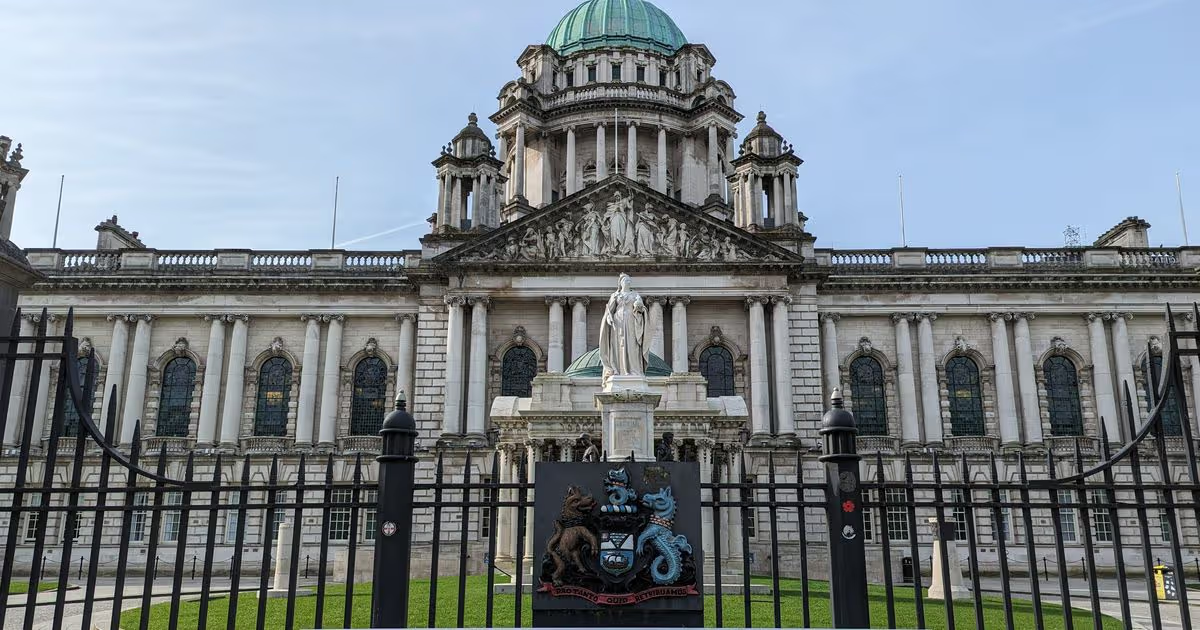
Belfast Council has agreed to raise its rates by 4.48 percent for the coming tax year, above the rate of inflation.

Advertisement

At the February full monthly meeting of Belfast City Council, held on Monday (February 3), elected representatives on a majority vote agreed an increase in the district rate of 4.48 per cent for 2026/27. As of December 2025, the UK annual inflation rate, measured by the Consumer Prices Index, was 3.4 percent.

It means there will be a non-domestic rate of 34.2388 percent and a domestic rate of 0.4492 percent, and that the amount raised through the tax rise in 2026/27 will result in an extra £220,388,739 going to the council. Last year the council agreed to an increase in the district rate of 5.99 per cent.

READ MORE: GAA pitches and soccer pitch for Boucher Road approved amid plans for new large scale venue

READ MORE: Sinn Féin and SDLP clash with council officials over controversial GAA pitch

Advertisement

Domestic rates are made up of a regional rate, set by Stormont or the Northern Ireland Office, and a district rate, set by Northern Ireland’s councils, with both parts of the rate funding the respective responsibilities of Stormont and local government.

The district rate is for home and business owners, and pays for multiple public services, including waste management leisure/community centres, parks, building control, environmental health, events and recreation, arts and tourism.

A proposal at the special City Hall meeting by the Alliance Party to raise the rates by the lower amount of 4.25 percent failed, with 13 elected representatives in support, 37 against, and 4 abstaining. A People Before Profit proposal not to raise the rates at all did not receive a seconder, and could not therefore go to the floor for a vote.

Belfast is one of only four out of Northern Ireland’s 11 councils to have raised rates above the UK level of inflation this year. Ards and North Down had the highest rate of 4.74 percent, while Fermanagh and Omagh saw the lowest increase at 1.96 percent.

Advertisement

Want to see more of the stories you love from Belfast Live? Making us your preferred source on Google means you’ll get more of our exclusives, top stories and must-read content straight away. To add Belfast Live as a preferred source, simply click here


Source link

Advertisement
Continue Reading
Click to comment

You must be logged in to post a comment Login

Leave a Reply

NewsBeat

What went right this week: social media’s ‘big tobacco’ moment, plus more

Published

on

What went right this week: social media’s ‘big tobacco’ moment, plus more
Chile made waves with its conservation plans

In the race to conserve our oceans, Chile has emerged as a frontrunner after its president signed a decree to create one of the world’s largest marine reserves. 

Following a campaign led by ecologists and coastal communities, President Gabriel Boric signed off plans to protect 337,000 sq km of ocean around the Juan Fernández archipelago. The region teems with species, including whales, seabirds and the Juan Fernández fur seal (pictured), once thought to be extinct.

Once implemented, the protected area will link up two other marine reserves, covering a combined total of 899,268 sq km, which is roughly the size of Nigeria. 

Advertisement

“For generations, our community has lived in harmony with the sea, relying on it for food, livelihoods, and identity,” said Julio Chamorro Solís, president of the Organización Comunitaria Funcional Mar de Juan Fernández. “By expanding our marine protections, we ensure that future generations will inherit healthy oceans, thriving fisheries, and the cultural traditions that bind us to our home.” 

The designation means that Chile will soon have more than 50% of its waters under protection, far exceeding the 30% by 2030 target agreed by 190 nations in 2022. 

Image: Flavien Saboureau

Advertisement

Source link

Continue Reading

NewsBeat

Calls to protect transparency amid possible restriction of FOI law

Published

on

Calls to protect transparency amid possible restriction of FOI law

​Reports that the Government is considering restricting Freedom of Information (FOI) requests have sparked concerns about implications for accountability and transparency of local decision-making.

​The Financial Times (FT) reported that the Government is considering introducing restrictions on FOI requests by reducing the cost ceiling for processing Freedom of Information requests as the number of annual submissions has increased.

​Currently, the cost threshold for complying with a request is set at £450 for public bodies and £600 for central government, but this could be reduced.

Advertisement

​Cllr Michelle Donohue-Moncrieff, an Independent on North Yorkshire Council, said: “Materials obtained through Freedom of Information requests are very important for the public and those who represent them.

​“As a councillor, I regularly use websites such as whatdotheyknow.com to see what information has been disclosed by public bodies. This helps me hold the council to account.

​“Some public bodies already exploit clauses in the current legislation to avoid being open and transparent.

“The proposed changes to FOI legislation will make public bodies less accountable.”

Advertisement

​The Freedom of Information Act provides public access to information held by public authorities by obliging public authorities to publish certain information about their activities, and by entitling members of the public to request information from public authorities.

​More than 10 million people have made an FOI request since the law came into force in 2005, according to Warren Seddon, director of FOI and transparency at the Information Commissioner’s Office.

​Responding to the reports, Dawn Alford, Chief Executive of the Society of Editors, said: “The Freedom of Information Act is a vital mechanism for ensuring accountability and transparency in government, and any attempt to restrict the scope of the legislation would be damaging to democracy.

​“The Prime Minister has spoken of his desire to restore trust and integrity in UK politics and the importance of openness and transparency. Restricting the scope of freedom of information requests – a vital tool for both the media and the public to hold government to account – would run counter to these objectives. We urge officials to urgently rethink such plans.”

Advertisement

​Labour councillor and former journalist, John Ritchie, said: “ I share the concerns expressed by leaders in the newspaper industry.

​“As a member of North Yorkshire Council, I fully appreciate that researching complicated and involved FOI requests can be costly and time consuming for local government employees, but this must be balanced against the damage this proposed reduction in costs would cause, foremost a lack of transparency and openness at a time when politicians of all hues need to rebuild public trust.”

​Speaking to the Local Democracy Reporting Service (LDRS), Alison Hume, the MP for Scarborough and Whitby, said it “would be concerning if people are having to pay more to get less”.

​Calls for “clarity” have also been made by the News Media Association (NMA), which represents the UK’s national and regional news businesses, citing the FT’s reporting.

Advertisement

​NMA chief executive Owen Meredith said: “It is not routine or trivial requests that would be excluded.

“It is the most sensitive and significant ones – those involving complex decision-making, high-value contracts, safeguarding, multi-agency correspondence, and procurement.”

​In March, the Government announced its Local Media Strategy with up to £12 million in funding to help local news publishers invest in digital technology and support community radio stations.

​The strategy states that “there is more that local authorities and other local public services can do in partnership with local media […], including through increased openness in providing local journalists with access to information”.

Advertisement


Source link

Advertisement
Continue Reading

NewsBeat

The generosity experiment – Positive News

Published

on

The generosity experiment - Positive News

A social experiment is giving away half a million dollars to fund acts of kindness globally – its already having a positive impact

Most of us, we would like to think, would help out a relative, a friend and perhaps even a stranger in need. Maybe giving directions or lending a few quid. But how many of us would donate one of our organs to someone we will never meet?

That is exactly what Tom Cledwyn did in 2012. Since then, his life has been shaped by acts of generosity towards strangers, culminating in Drop Dead Generous, a social experiment giving 1,000 people $500 (£378) each to spend on helping others in creative ways. Backed by an anonymous philanthropist, the project is part grant scheme, part provocation: what happens if you trust people to be generous?

Advertisement

Cledwyn donated his kidney at 25, after reading about Kay Mason, the first person in the UK to give a kidney to a stranger.

Solutions every Saturday
Uplift your inbox with our weekly newsletter. Positive News editors select the week’s top stories of progress, bringing you the essential briefing about what’s going right.
Sign up

“I read the article and didn’t think about it. It just felt like a very profound opportunity,” he says. After a year of medical and psychological assessments, he went through with it.

“The feeling I had when I woke up from that operation is something I want other people to experience.” Cledwyn is not the zealot you might expect. Thoughtful and measured, he says the act was a privilege.

Advertisement

“It was an honour to be able to do it. And the same applies to all forms of giving. It doesn’t have to be a kidney. It can be a smile, some time, or being there when someone is struggling,” he says. “The experience of giving is the closest thing I’ve experienced to something that really matters.

“I knew I’d get minimal feedback and would never meet the recipient. That felt important too, doing something without seeing the outcome.”

After donating his kidney aged 25, Tom Cledwyn’s life has been shaped by acts of generosity towards strangers. Pictured here with his wife Claudia. Image: Carys Huws

Advertisement

After the operation, he set up a blog called The Free Help Guy, trawling Gumtree and offering anonymous help to people who needed it, whether that meant moving house or fixing things around the home. Demand grew quickly, until the money ran out.

A stint at Meta followed, where he rose to become a senior executive, but after seven years he left, pulled back towards the idea that generosity could be scaled.

Together with co-founder John Sweeney, he launched Drop Dead Generous, with a $500,000 (£378,000) fund. At the time of writing, 266 grants have been awarded across 21 countries.

Advertisement

Applicants are asked two simple questions: who needs help, and what would you do with $500 to “blow their socks off”? 

 The experience of giving is the closest thing I’ve experienced to something that really matters

“We ask what’s the hook, the originality, the heart. You can’t just give the money away, it has to facilitate an idea. And it can’t be too similar to something we’ve already funded,” says Cledwyn.

The $500 fund is a fixed amount but what it can do varies not just on the project but the location too. “Someone in London gave out 80 flowers and someone in Uganda built a house,” he says.

In Brazil, one grant is helping to start a book club in a prison, where inmates can reduce their sentences by reading and writing about literature. Elsewhere in the country, two young chess players from a favela were able to enter national competitions and secure coaching, going on to win and attract wider support.


Advertisement

In Uganda, a communal dance floor now sits at the centre of a community, offering young people a space for creativity over conflict. In the UK, one project is giving an as yet undiscovered busker the chance to record a professional demo, while another brought a Shetland pony into a care home, coaxing residents out of their rooms.

Kendall Concini and her young family were one of the recipients who wanted to thank local librarians in her home town of Baltimore, US.

Advertisement

“We wanted to give back the same happiness they exude when you walk in and the best way I could think of was walking in with a fun surprise to give back,” says Concini. It started as an idea from her four-year-old, to bring librarians breakfast doughnuts but that was just the beginning.

“I wanted them to really feel the love, so we created an entire breakfast arrangement, collected love letters from friends, families and strangers online, and created giveaway gifts for librarians to pass on to patrons, keeping the acts of kindness going.”

You can’t just give the money away, it has to facilitate an idea

Concini’s initial concept has continued and now packages have been delivered to 12 libraries in the area, funded from profits from a children’s book she has written and from public donations.

“Seeing librarians go grab their colleagues with excitement, and hearing ‘I needed a pick me up this morning’, was an amazing feeling. The exact feeling actually that I had intended to give. ‘We care about you. Your community notices you’.”

Advertisement

For Cledwyn, that ripple effect is the real measure of success.

The philosopher Jacques Derrida argued that a pure gift cannot exist, because even the act of giving carries an expectation of return, whether that is gratitude or simply the feeling it gives the person who gives.

‘At a time when the opposite of generosity often feels normalised, even in how leaders communicate, it feels more important than ever to frame generosity as a superpower, not just a nice thing,’ says Cledwyn. Image: Meera Kumar

Advertisement

Cledwyn does not dismiss the idea. “There’s always a mixed set of motivations, and that’s fine. The danger is ignoring intrinsic motivation, because that’s what makes you do it again,” he says. “It becomes problematic only if you expect something back, rather than accept it if it comes.

“If I had donated my kidney expecting to feel something in return, that would have felt wrong. But waking up and feeling pride and meaning is something I’m happy to accept.”

The timing feels pointed. In a climate where division often dominates, generosity can feel either naive or performative. “At a time when the opposite of generosity often feels normalised, even in how leaders communicate, it feels more important than ever to frame generosity as a superpower, not just a nice thing,” says Cledwyn.

Advertisement

The project is now experimenting with handing decision-making to earlier recipients, allowing them to fund others in their own communities. If it works, generosity stops being a centralised act and becomes something more distributed, less controlled. 

For now, the invitation is simple. “Hop on the website and submit an idea,” he says. “Think imaginatively.”

https://www.dropdeadgenerous.org/

Main image: Carys Huws

Advertisement

Be part of the solution

At Positive News, we’re not chasing clicks or profits for media moguls – we’re here to serve you and have a positive social impact. We can’t do this unless enough people like you choose to support our journalism.

Give once from just £1, or join 1,800+ others who contribute an average of £3 or more per month. Together, we can build a healthier form of media – one that focuses on solutions, progress and possibilities, and empowers people to create positive change.

Support Positive News

Advertisement

Source link

Continue Reading

NewsBeat

The 14 best pizza ovens for inside and outdoor use, tried and tasted

Published

on

The 14 best pizza ovens for inside and outdoor use, tried and tasted

On the hunt for the best pizza oven to give to a foodie, or to get ahead for this summer’s al fresco dining? These days you can take your pick from hundreds of wood-fired, gas-fired and even electric pizza ovens. Wood-fired ovens deliver the classic smoky flavour preferred by traditionalists. Gas ovens are smaller, easier to use and offer better temperature control. Electric pizza ovens can cook more evenly.

Ooni leads the way, but Sage, Gozney and La Hacienda are also strong brands. At the top end sits Stefano Ferrara, whose domed, hand-bricked ovens appear in pizzerias worldwide, with prices starting at £6,000. For home cooks, you can achieve near-authentic results with a £300 model from Ninja.

We’ve tested all of these, among others, and you can read our reviews below, followed by answers to some frequently asked questions. But if you’re in a rush, here’s a quick look at our top five:

The best pizza ovens: At a glance

How to choose the best pizza oven

Matt Williams, Co-Founder of the The Oxford Charcoal Company, says the two things to factor is are size and fuel-type. Barbecue-top and portable pizza ovens which can run on gas or electricity are the best option for most homes, because they can be stored away more easily. If you want the best results, however, you do need a wood-fired oven.

Advertisement

“Being able to recreate that incredible wood-fired flavour and texture in your own garden is the ideal,” Williams says and for that, you’d probably need a wood-fired oven hot enough to cook a pizza in 60 seconds – which Italians will tell you is the best cooking time for a standout crust.”

Small wood-fired ovens are available, such as the Roccbox (reviewed below), but most are fairly large. All of the ovens in our guide will enable you to create a freshly-made pizza far superior to anything you’ll buy in a supermarket.


How we test pizza ovens

Source link

Advertisement
Continue Reading

NewsBeat

Tottenham: Roberto De Zerbi apologises for Mason Greenwood defence after fan backlash

Published

on

Tottenham: Roberto De Zerbi apologises for Mason Greenwood defence after fan backlash

Greenwood was arrested on January 31, 2022, on suspicion of rape and assault. He was further arrested on February 1, 2022, on suspicion of sexual assault and making threats to kill. He was charged that October with one count of attempted rape, one count of controlling and coercive behaviour and one count of assault occasioning actual bodily harm. Greenwood denied the charges.

Source link

Continue Reading

NewsBeat

Bolton motorist’s warning after his car was keyed

Published

on

Bolton motorist's warning after his car was keyed

Sheraz Rasul is counting the cost of the damage that he discovered on Tuesday March 24, after going to his vehicle that he parks in a designated resident’s spot on Bolton Gate Retail Park.

He was shocked to discover the vandalism to his white Volkswagen.

Mr Rasul, 49, who lives in the area, initially thought it had been done by youths, until he watched CCTV footage which apparently showed someone acting suspiciously around the vehicle.

Advertisement

“It wasn’t until a neighbour shared CCTV footage with me that I realised it was something quite concerning,” Mr Rasul told The Bolton News.

In the footage, a figure walking along the quiet road at 4.45am.

They appear to be examining Mr Rasul’s car as they pass by.

They continue past the vehicle and disappear from view behind a black van parked next to it.

Advertisement

After a few moments, the figure reappears, walking back in the opposite direction near to Mr Rasul’s car and eventually walking off in the direction they came from.

Mr Rasul said: “It’s not a very nice thing to come back to, especially as other people might have children or elders they care for.

“This person needs to be caught.”

He added that cars have been damaged recently in the area and is warning others to be cautious.

Advertisement

According to Mr Rasul, at least three other cars have been keyed in the area over the last few months.

A spokesperson for Greater Manchester Police confirmed to The Bolton News that they have received a report and enquiries are ongoing.

They said no further information is available at this time.

Anyone with information on the incident is asked to contact Greater Manchester Police, quoting crime reference number 06KK/0007209/26.

Advertisement

In October 2022, a similar incident occurred on Florence Avenue in Astley Bridge.

A number of vehicles were scratched in the early hours, causing thousands of pounds in damage.

CCTV footage from the scene showed a figure, believed to be a man, walking along the street and damaging at least three cars.

Advertisement

Source link

Continue Reading

NewsBeat

How ‘eco-dystopian’ novels from Asia and Africa are pushing boundaries

Published

on

How ‘eco-dystopian’ novels from Asia and Africa are pushing boundaries

Speculative and futuristic visions of environmental calamity are being imagined globally through environmental fiction. Eco-dystopian novels can help people process their fears or mourn the loss of a more stable climate.

My forthcoming book, Nature’s Return, shows that while anti-environmentalism is gaining traction in the west, the diversity and urgency of environmental visions from across Africa and Asia are coming into view.

Here are my favourite examples from China and Taiwan, Nigeria and India.

China and Taiwan

“You are bugs” is the sobering message of the aliens in Liu Cixin’s bestselling trilogy, Remembrance of Earth’s Past. Series two of Netflix’s adaptation, titled after the first volume, The Three Body Problem, is scheduled for release in late 2026. Liu’s vision of environmental retribution is anchored in a visceral portrait of Mao’s so-called “war against nature”, which reshaped the environment through things like mass irrigation and deforestation to boost economic production.

Advertisement

The trilogy is a leading example of a wide-ranging ecological turn in Chinese culture and Chinese science fiction. As the cultural critics Yue Zhou and Xi Liu explain, the story routinely takes aim at “rampant pollution, water shortage, natural resources depletion, overpopulation and electronic waste”.

Cara Healy, a professor of Chinese Studies at Wabash College in Indiana, US, argues that “for centuries, Chinese intellectuals wrote about the past as a way to critique the present”, but today it is the future that is employed and deployed “to comment on our contemporary world”.

In Waste Tide by Chen Qiufan, readers are told that science fiction is “the greatest realism at the present time”. Set in a gang ridden island covered in tech trash, and populated by desperate migrants and mutant humans, Waste Tide is a bleak parable of China’s abundance of garbage: “This island has no hope. The air, the water, the soil and the people have been immersed in trash for too long.”

The themes of tech waste and contamination have a particular resonance in modern China, but are understandable to readers everywhere. This explains the lively translation market for comparable Taiwanese titles, such as Chi Ta-wei’s The Membranes and Wu Ming-yi’s The Man with the Compound Eyes.

Advertisement

Nigeria

Climate catastrophe frames the drama and ethical vision of Lost Ark Dreaming, by Nigerian author Suyi Davies Okungbowa. Lagos has been drowned, and people are crowded inside the Pinnacle, a vast, partially submerged, high rise in which the wealthy and powerful live on the upper levels, trying to keep the poor and the rising waters at bay. In Nigeria as in China, the eco-dystopian imagination is animated by images of injustice and cruelty, often in ways that refract colonial history. Other Nigerian-American examples include Nnedi Okorafor’s Noor and Tochi Onyebuchi’s War Girls.

India

Indian contributors to the genre include Lavanya Lakshminarayan’s
Analog/Virtual and Varun Thomas Mathew’s The Black Dwarves of the Good Little Bay. The latter is set in the year 2041 in a post-Mumbai in which the population has also crowded into a towering redoubt, though this one is called the Bombadrome and is surrounded by a barren wasteland.

The mistrust of technologically driven change is a distinctive feature of Indian science fiction, but the new wave of eco-dystopias is part of a global conversation. They are diverse but united in their effort to make use of the future to register loss, yearning and possibility.

Malformed landscapes, biodiversity loss and tides of industrial debris are encountered throughout the genre, though climate change looms large in many examples from south Asia and Africa.

Advertisement

The Egyptian science fiction author Emad El-Din Aysha once speculated that dystopia was a distinctly western genre because those with “real-life anxieties around every corner” have no need to invent them. But it appears that real-life anxieties are not a brake but an engine for the imagination. Today’s dystopian imagination is ecological and urgent and asks us to travel far into the future and into every part of the world.

This article features references to books that have been included for editorial reasons. If you click on one of the bookshop.org links and go on to buy something, The Conversation UK may earn a commission.

Source link

Advertisement
Continue Reading

NewsBeat

This is the exact watch the crew on NASA’s Artemis II is wearing on their mission to the moon

Published

on

This is the exact watch the crew on NASA’s Artemis II is wearing on their mission to the moon

Best for: Bond, James Bond

  • Calibre: Co-Axial Master Chronometer 8806
  • Case: Titanium
  • Size: Dia. 42 x H13mm
  • Water resistance: 30 ATM (300m)

The name’s Seamaster, Omega Seamaster. Yes, long the choice of the world’s most famous fictional spy, albeit issued by Q Branch with some unusual extras built in, the Seamaster is as classic a dive watch as they come. And they come in many different styles, but for the sake of keeping the Bond theme going, here I’ve selected the model endorsed by 007 in his latest outing, No Time To Die, in which – no spoilers intended (come on, it’s been out since 2021) – Bond brushed-off the title and actually did find the time.

What we have here is a triumph of titanium-on-titanium action, with a Grade 2 titanium case and titanium mesh bracelet married to a unidirectional ‘brown tropical’ aluminium bezel and dial, making the 007 Edition look nothing less than eye-pleasingly immaculate.

Powered by the brand’s self-winding Co-Axial Master Chronometer 8806, this is a precision instrument for those who like to keep their timing tight, helped on by the silicon balance spring giving the watch resistance to troublesome magnetic fields.

Advertisement

Measuring 42mm in size, the 007 is a dive master, tackling 300m of the deep without issue, and featuring a screw-down crown and helium escape valve which, to simplify things massively, stop the watch suffering the clockwork version of the bends.

A power reserve of 55-hours keeps things ticking over nicely whether you’re taking it easy in St Tropez ahead of assignment, or shackled to a table in the hollowed-out volcano lair of yet another nefarious villain hell-bent on world domination, and the domed, scratch-resistant sapphire crystal glass will ensure the watch stays in good condition regardless how rough the scuffle was with the hired henchmen, ready to return to Q in one-piece, for once.

A classic wristwatch beautifully re-invented for Bond, this is a watch that gives you, ahem, All the Time in the World.

Source link

Advertisement
Continue Reading

NewsBeat

The best and worst TV streaming services, according to a TV critic

Published

on

The best and worst TV streaming services, according to a TV critic

A quick quiz question. What were the first original hits for streaming giants Netflix and Amazon? On Netflix, it was the Kevin Spacey-starring political drama House of Cards in 2013. On Amazon, it was police procedural Bosch, which premiered the following year.

That’s a measure of how far on-demand TV has come in such a short time. It took our traditional terrestrial broadcasters half a century to reach critical mass and become production powerhouses. The streamers have managed it in little more than a decade.

Never before has so much ­small screen entertainment been so easily available. But in a crowded and confusing market, how do you find the right streaming service, or services, for you? To help you decide, we’ve provided a guide to all the platforms available in the UK, comparing their cost, content and more, so you can confidently decide which is worth your money. Let the streaming wars begin…

Advertisement

The best TV streaming services: At a glance

  • Best Buy TV streaming service: Netflix
  • Best Value TV streaming service: Amazon Prime Video
  • Best TV streaming service for families: Disney+
  • Best TV streaming service for quality over quantity: Apple TV
  • Best TV streaming service for sports: Now

Note: All prices listed below are the starting costs and were accurate at the time of publication.


How to choose the best TV streaming service

Naturally, the most important factor for choosing a TV streaming service is the quality of the content. There’s an element of subjectivity here, depending on your personal tastes and the age ranges you’re catering to, but the big hitters tend to have a broader range of programming to appeal to more viewers.

If one show is especially important to you, it’s worth doing your research before subscribing. Visit the Just Watch website, type in the show you want to watch, and you’ll see a summary of where it can be streamed.

Beyond that, price is also important. While streaming platforms tend to be competitive, subscribing to multiple providers can quickly see costs spiral. Typically, subscription costs range from £3.99 per month all the way up to £34.99 per month if you care about live sports, but cheaper tiers sometimes compromise on image quality and other features, or may be ad-supported.

Finally, consider how easy each platform is to actually watch. Big players like Amazon, Netflix and Disney+ don’t just have smartphone apps, but easy-to-use software for smart TVs and games consoles. Smaller rivals may force you to use a web browser for a bumpier experience.

Advertisement

How we test TV streaming services

Source link

Continue Reading

NewsBeat

Future of Westhoughton CCTV cameras in doubt after NCP collapse

Published

on

Bolton MP says dirty money 'biggest threat to high street'

It was agreed that Westhoughton would be added to Bolton’s security system on March 4, following a three year struggle during which Westhoughton’s security system was deemed ‘outdated’.

But with the collapse of NCP, Westhoughton’s project has now been severely jeopardised.

Bolton Council operates a number of CCTV systems for the purposes of preventing and detecting crime, controlling traffic and to keep people safe . The CCTV network covering the town centre is operated by NCP

NCP went into liquidation in March (Image: Newsquest)

Westhoughton Mayor Cllr Gillian Wroe said: “I almost cried when I found out – this has been nearly three years of my life.

Advertisement

NCP going into liquidation has a massive impact on us and our CCTV.

“I’ve attempted to contact NCP about it, but nothing has been forthcoming – as we never fully signed the contract with them, we might not have the same right to information.”

Cllr Wroe contacted Bolton Council to ask what they were doing with their systems following the collapse of NCP.

Market Street, Westhoughton (Image: Dan Dougherty)

She said that Bolton Council officers responded that things were still in the air, and that until things were more settled, they could not give Westhoughton an update on potential next steps.

Advertisement

Although it was agreed that Westhoughton would be added to Bolton’s NCP contract, Westhoughton did not manage to finalise the deal before NCP collapsed.

This means that, although they do not have the CCTV cameras they wanted, they have not lost any money.

The six cameras would have monitored Westhoughton’s Market Street, Library Street car park, and Ditchfield Gardens car park.

Ditchfield Gardens Car Park, Westhoughton (Image: Google Maps)

NCP would have reviewed the footage from their office in Bolton town centre.

Advertisement

Cllr David Wilkinson said: “This is a major problem, not just for us to get a new system in place, but as a security issue.

“It also affects Bolton, so I imagine it will be resolved fairly quickly.”

The council will now hold off on making a decision until Bolton Council have made theirs.

The back of Library Street Car Park, Westhoughton (Image: Google Maps)

This is because they do not want to go back to monitoring their own CCTV after several years of work, and they anticipate Bolton will not take long in reaching a conclusion.

Advertisement

Councillors expressed concern that waiting too long may result in them getting a worse price for the service.

The contract they were about to sign with NCP was for a fixed price – waiting for a period before signing a contract with someone else is likely to result in a higher cost than they originally prepared to pay.

A spokesperson for Bolton Council said: “We are aware of the situation regarding NCP and the appointment of an administrator.

“Currently all NCP car parks in Bolton are open and CCTV provision is operating as normal.

Advertisement

“We are in close discussion with NCP, and the public will be informed if there is any change to NCP car parks in Bolton.”

Source link

Advertisement
Continue Reading

Trending

Copyright © 2025