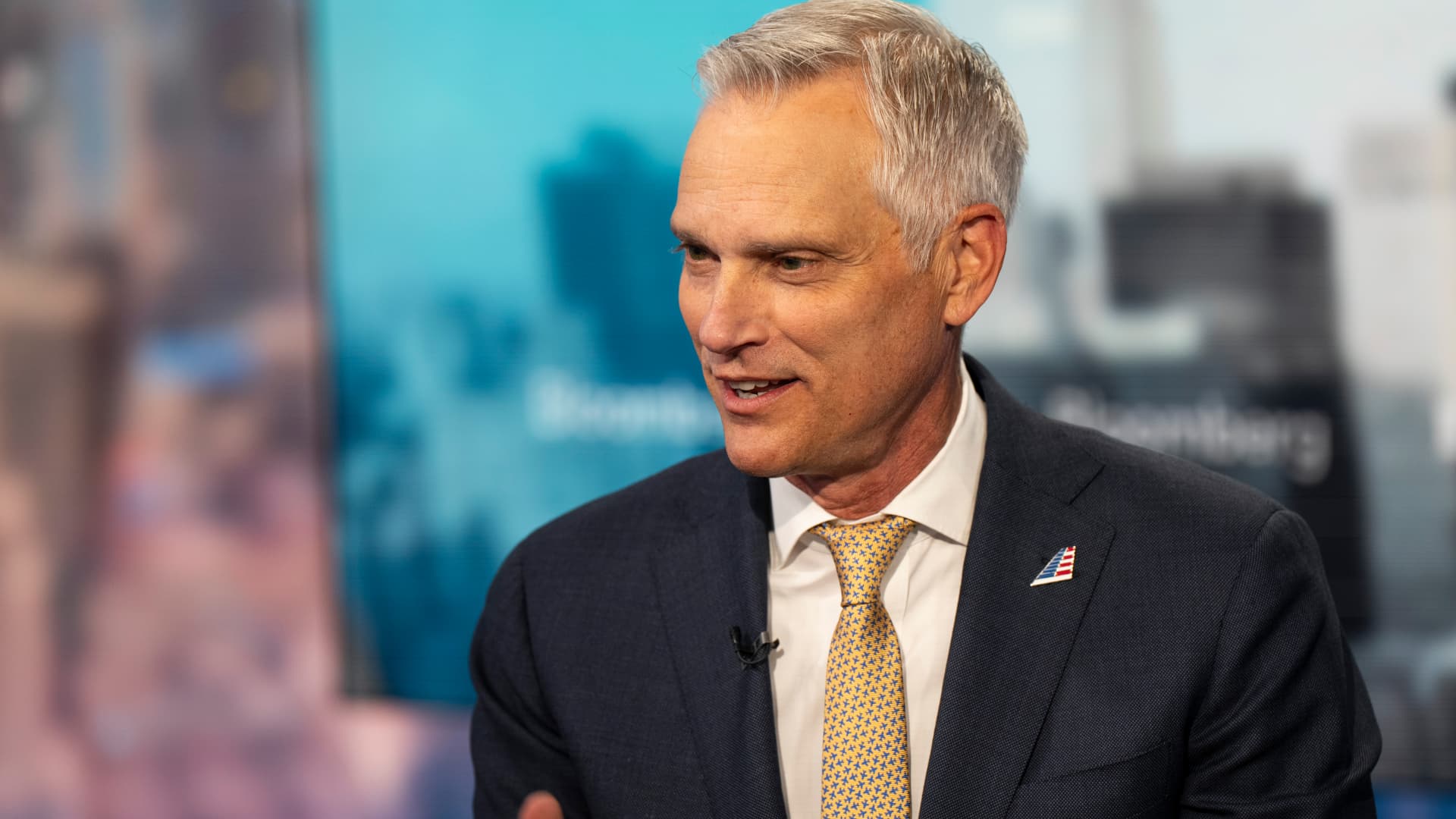
Robert Isom, chief executive officer of American Airlines Group Inc., speaks during a Bloomberg Television interview in New York, US, on Wednesday, Dec. 10, 2025.
Christian Monterrosa | Bloomberg | Getty Images
FORT WORTH, Texas — American Airlines CEO Robert Isom has a math problem.
Advertisement
The carrier is flying about 6,500 flights per day this year — nearly an entire Alaska Airlines more worth of travel more than its closest competitor, according to Cirium — yet American’s profit gap has grown. United Airlines brought in about $3 billion more than American last year, and U.S. profit leader Delta Air Lines made nearly $5 billion more.
In an exclusive interview with CNBC late last month, Isom said American and its nearly 140,000 employees want “to be best at everything that we do.” He said that carrier’s “long-range plan is certainly making up the margin gap,” but he didn’t put a timeline on that goal.
American’s top executives at the carrier’s headquarters late last month outlined new initiatives to CNBC: bigger, more luxe airport lounges, a new wide-body aircraft order, and fresh interiors for even more of its long-haul fleet to attract big spenders.
Isom described the carrier’s identity as “a premium global airline with the largest footprint in North America.”
Advertisement
American has more decisions it needs to make — and soon — to close the gap. Perhaps its biggest challenge is getting customers to shell out more to fly, something Delta and United zeroed in on years ago.
American has mastered running an efficient business but “what we will measure over time is: Are we closing this revenue gap and closing the unit revenue gap?” American CFO Devon May said.
Cabins, planes and lounges
The carrier’s executives reiterated that American’s plan rests on growing its ever-more important loyalty program, improving customers’ experience, expanding its network and increasing higher-end revenue.
The airline is forecast to earn 64 cents a share this year, on an adjusted basis, which would be up almost 80% from last year, according to analyst estimates. It will give an updated forecast when it reports second-quarter results on Thursday.
Advertisement
United and Delta earlier this month reported bookings are still strong. The surge in fuel prices have both helped and hurt the industry this year: The sudden run-up in prices because of the Iran war took carriers off guard, though they’re passing more of those costs along to travelers, and executives don’t expect fares will drop much anytime soon.
Wall Street is optimistic American will continue to improve, expecting it to quadruple adjusted earnings in 2027 to $2.58 a share.
American is now remodeling cabins across the fleet and taking deliveries of new planes with interiors that feature new amenities and more premium seats. Executives have said they’re considering but haven’t decided on bringing back seatback screens to much of its narrow-body fleet, though American recently joined the ranks of airlines that are adding satellite Wi-Fi from SpaceX‘s Starlink.
Customers who are willing to pay more for premium seats or other perks like lounge access have been a bright spot across the industry, and everyone from profit leader Delta to now-defunct budget carrier Spirit Airlines has tried to woo those travelers as airlines rush to get fancy, new seats — small but profitable real estate — in the air.
Advertisement
Isom told CNBC that work to refresh cabins will soon expand to American’s Boeing 787-8 Dreamliners. Its revamped cabins on its largest planes, the 777-300ERs, could debut in the next few weeks. Each business-class, lie-flat seat can bring in close to $10,000 on some long-haul international routes compared with $2,000 or even much less for a seat in the back.
Keeping up high-touch service levels could be a challenge, the airline’s flight attendant union said, as the 70-seat business class soon comes online. American has been phasing out planes with separate first and business classes.
“Now, as American introduces 70 Business Suites and markets a premium international experience, they’re expecting a reduced number of Flight Attendants to deliver significantly more personalized service,” Julie Hedrick, president of the Association of Professional Flight Attendants, said in a statement. (American reduced flight attendant staffing on those aircraft from 13 to 11 in 2020. Other carriers have made similar moves.) “The result will be longer service times and a customer experience that falls short of what passengers expect.”
In another lure for premium travelers, Chief Customer Officer Heather Garboden told CNBC that American is going to build the biggest Admirals Club lounge in its network, at 37,000 square feet, at its sprawling Dallas Fort Worth International Airport hub in Terminal C.
Advertisement
Dallas Fort Worth International Airport under construction, American Airlines’ largest hub, June 2026.
Leslie Josephs/CNBC
At the under-construction Terminal F at that airport, American is also planning a grab-and-go Provisions airport lounge, as well as a Flagship check-in area in Terminal D. The entire airport, American’s largest hub, is undergoing a $12 billion makeover, and the carrier recently unveiled new gates in Terminal C, which will expand further. American and others have been upgrading and expanding airport lounges for the spendiest customers around the U.S.
But United has had a roughly decade head start at catering to higher-paying travelers, while Delta has close to two decades of experience. In the late 2000s, Delta was giving away about 90% of its domestic first-class seats through free upgrades for frequent flyers, but now it says it sells the vast majority, with customers paying cash or redeeming miles, now a trend among big carriers, though American wants to increase buy-ups.
Advertisement
Under Isom, American has been upping its game in premium investments. American’s commercial team is working on technical changes that aim to offer customers more opportunities to buy pricier seats.
Aside from its of fortress hubs, American’s chief commercial officer, Nat Pieper, said the airline needs to win in so-called jump-ball markets like Los Angeles, Chicago and Washington, D.C. He said American continues to grow sign-ups for its lucrative credit card program in some of those, including New York.
American said it’s flying is split about 80% domestic versus 20% international. International flights often carry a high premium compared with domestic routes — and the planes serving them generally have more luxurious seats on board.
Isom said the airline’s network breadth is a major strong suit and will continue to be.
Advertisement
While American and other airlines rely on alliances and partnerships to expand reach, United is flying a lot of that itself.
United flies more internationally than Delta and American, and made its geography quiz-like network a calling card and , adding dots on the map from Mongolia to Galicia, Spain.
‘Never been deterred’
Robert Isom, chief executive officer of American Airlines Group Inc., center, following a news conference at the US Department of Transportation in Washington, DC, US, on Thursday, May 8, 2025.
Samuel Corum | Bloomberg | Getty Images
Advertisement
A mechanical engineer by education who took his first flight at about age 4, Isom rose up the ranks at Northwest Airlines and America West Airlines, which through mergers became modern-day Delta and American, respectively.
The airline industry is one of the most insular. In part, because of the safety-critical and specific knowledge needed to keep thousands of planes on track every day, airlines don’t often hire from other industries, especially at the top.
The executive team that long worked at American is split between that carrier and United. The CEO of United, Scott Kirby, used to work at American, until he was fired almost exactly 10 years ago. United announced it hired Kirby as president the same day.
Isom, 62, took over the top role at American in March 2022, after the airline industry had been rocked by the pandemic.
Advertisement
“I’ve never been deterred, no matter what the challenges that we face,” he said.
He took over in a quarter when American lost $1.6 billion.
“I’m clear-eyed about the challenges in this business,” he said, pointing to an industry that has been through everything from the 9/11 terrorist attacks, to the financial crisis, bankruptcies, mergers and wars and disease.
American ranked sixth of 11 U.S. airlines in punctuality in the first half of the year, according to Cirium data that pointed to with a 76.6% on-time rate, while Delta and United took the No. 2 and No. 3 spots, respectively. Under Isom and COO David Seymour, the carrier is working to improve its on-time rate, spreading out its schedule instead of jamming chaotic connecting banks in major hubs, and using artificial intelligence to predict maintenance problems.
Advertisement
On top of that, the carrier’s earnings are still hamstrung from its $35 billion debt load though American has slashed that from around a $54 billion peak coming out of the pandemic, with balance sheet improvement a major priority.
“They’re a giant — with a limp,” said Dennis Tajer, spokesman for the Allied Pilots Association, which represents American’s 15,000 aviators. Earlier this year, the APA and the flight attendants’ union called Isom’s leadership into question. Underperformance from the broader company means less profit-sharing for staff.
Getting customers to notice improvements could take time.
“Changing a service culture is hard, but not impossible,” said Jay Barney, a professor of strategic management at the University of Utah David Eccles School of Business. To alter overall brand perception, he said, “You have to make the changes obvious and visible, to current customers and potential customers.”
Advertisement
One issue is that flyers are often locked in because the biggest airlines have such overwhelming market share at major hub airports, he added.
What airlines might be trying to do is “charge more to their current customers,” Barney said.
Wide-body planes
An American Airlines Boeing 787-9 Dreamliner approaches for a landing at the Miami International Airport on December 10, 2021 in Miami, Florida.
Joe Raedle | Getty Images
Advertisement
American might be behind in its premium game, but Isom said customer satisfaction scores are rising. Chief Commercial Officer Pieper, an airline industry veteran whom the company appointed last fall as the carrier was recovering from a failed corporate sales strategy in 2024, said demand is strong across the board.
Buying new wide-body planes will be key to the airline’s next phase, Isom said. An order is on the table for this year, with both Boeing and Airbus in the mix, he said.
American’s more than 1,000 planes make up the youngest fleet of the three largest U.S. airlines, according to 2025 annual filings, thanks in part to a more than 400-airplane order it made about 15 years ago for new Boeing and Airbus narrow-body planes, but dozens of its Boeing 777 wide-bodies average more than two decades old.
American’s refresh of those older planes, Boeing 777-200s, are next, Isom said, but the carrier is shopping for new planes.
Advertisement
“I think that Airbus could play a big role” in the new order, Isom said. American’s wide-bodies are all currently Boeing planes.
American declined to say the size of its planned order. New aircraft for American would likely arrive in the early or middle of the next decade.
Up in Chicago, rival United — which has been duking it out with American at O’Hare International Airport — snatched up delivery slots for more than 100 Boeing Dreamliners in the last four years.
A future without United
As Isom lays out his vision for the future of the airline, there’s one path he says the carrier doesn’t see as feasible.
Advertisement
United CEO Kirby suggested this year a merger with American, an idea the airline rebuffed.
“I spoke with Scott,” Isom told CNBC. “Given history, given law, given past mergers, there wasn’t anyone that we talked to, our advisors, interested parties, politicians, that said that there was any chance of this happening.
“At the end of the day, we spend time looking at things that have a chance of happening. We don’t spend a lot of time pursuing impossibilities,” he said.
United has a partnership with JetBlue (American had a more involved one with JetBlue in the Northeast but it was blocked by a judge on antitrust grounds in 2023). But Kirby has repeatedly said this year he’s not interested in acquiring that New York airline. He also acknowledged that a merger with American won’t happen without a willing partner in that carrier’s management.
Advertisement
United, meanwhile, gets several slots at New York’s John F. Kennedy International Airport as early as next year under the JetBlue deal.
“Why buy the cow if you’re getting the milk for free?” said Brett Snyder, who writes the Cranky Flier blog.
Isom gave a standard line from executives when CNBC asked his own appetite for possible mergers and acquisitions, saying the carrier is always on the lookout for opportunities to serve the company’s customers.
For now, though, Isom said he is firmly focused on American’s new chapter.
Advertisement
He said he gravitated toward the industry “to be involved with something where you can make a difference.
“This is this one that you never wake up in the morning or going to bed at night thinking: Did I do good for somebody or something?” he said. “You certainly had the chance to in this business.”
PNC Bank customers began reporting widespread problems accessing the bank’s services starting around 9:32 a.m. Eastern time Monday, according to outage-tracking service Downdetector, sparking a wave of complaints on social media under the hashtag #PncDown as users sought answers about the disruption.
Downdetector, which aggregates user-submitted reports to identify potential service outages across major companies and platforms, flagged the spike in PNC-related complaints in a post on X shortly after 9:32 a.m., asking affected customers to share how the disruption was impacting them. The post had drawn thousands of views within a short period, reflecting the scale of user concern surrounding the reported issues.
What is known about the outage so far
As of publication, PNC had not issued a public statement addressing the specific cause or scope of Monday’s reported service disruption. Outage reports of this nature typically stem from issues affecting online banking platforms, mobile banking applications, or underlying processing systems that support customer transactions, though the precise nature of Monday’s problems had not been confirmed by the bank.
Advertisement
Downdetector-style outage trackers rely primarily on real-time, crowdsourced reports from affected users rather than direct confirmation from the companies involved, meaning the scale and specific nature of an issue can sometimes take time to become fully clear. Typical categories of complaints tracked by such services for banking institutions include problems with mobile app functionality, difficulty logging into online accounts, failed or delayed transactions, and general connectivity issues affecting a bank’s digital platforms.
PNC’s footprint and role in the banking sector
PNC Bank, formally PNC Financial Services Group, is one of the largest financial institutions in the United States, operating retail branches across 22 states and the District of Columbia. The bank provides a broad range of consumer and commercial banking services, including checking and savings accounts, mortgages, credit cards, and business banking products, serving millions of customers nationwide.
Given PNC’s scale and the extent of its digital banking infrastructure, any disruption affecting its online or mobile platforms has the potential to impact a large number of customers simultaneously, particularly during business hours when demand for banking services, including bill payments, transfers and balance checks, tends to be highest.
Advertisement
A pattern of occasional, typically brief disruptions
Outage-tracking services that monitor PNC’s service history show that the bank has experienced isolated incidents in the past, though such disruptions have generally been resolved relatively quickly. Previous incidents tracked by monitoring services have included brief login difficulties within PNC’s mobile application, in some cases lasting under half an hour before service was restored. Historical data from these tracking platforms generally shows PNC operating within normal parameters on most days, with occasional spikes in user reports corresponding to specific, usually short-lived, technical issues.
What affected customers should do
In the event of a confirmed service disruption, banking customers are typically advised to avoid making repeated attempts to log in or complete transactions, as doing so can sometimes exacerbate system strain during an active outage. Customers experiencing urgent banking needs during a reported outage are generally encouraged to try alternative access channels, such as visiting a physical branch location or contacting customer service by phone, if those channels remain unaffected by the underlying issue.
Advertisement
For account-specific concerns, including questions about whether a specific transaction was processed successfully during the disruption, customers are typically directed to monitor their accounts once service is restored and to contact PNC directly for confirmation, rather than relying solely on outage-tracking services, which reflect broad user sentiment rather than institution-specific technical diagnostics.
A reminder of banking’s growing reliance on digital infrastructure
Monday’s reported disruption, regardless of its ultimate cause or duration, underscores the broader dependence modern banking customers now have on continuous digital access to their financial accounts. As more day-to-day banking activity has shifted toward mobile apps and online portals over the past decade, even relatively brief outages at major financial institutions can generate significant customer concern and public attention, particularly when they occur during peak business hours on a weekday morning.
What comes next
Advertisement
As of this report, further details about the specific cause, scope and expected resolution timeline for Monday’s reported PNC outage remained unavailable. Customers seeking updates are encouraged to monitor PNC’s official channels, including its website and customer service lines, for confirmation of the issue’s status. This story may be updated as additional information becomes available regarding the outage’s cause and resolution.
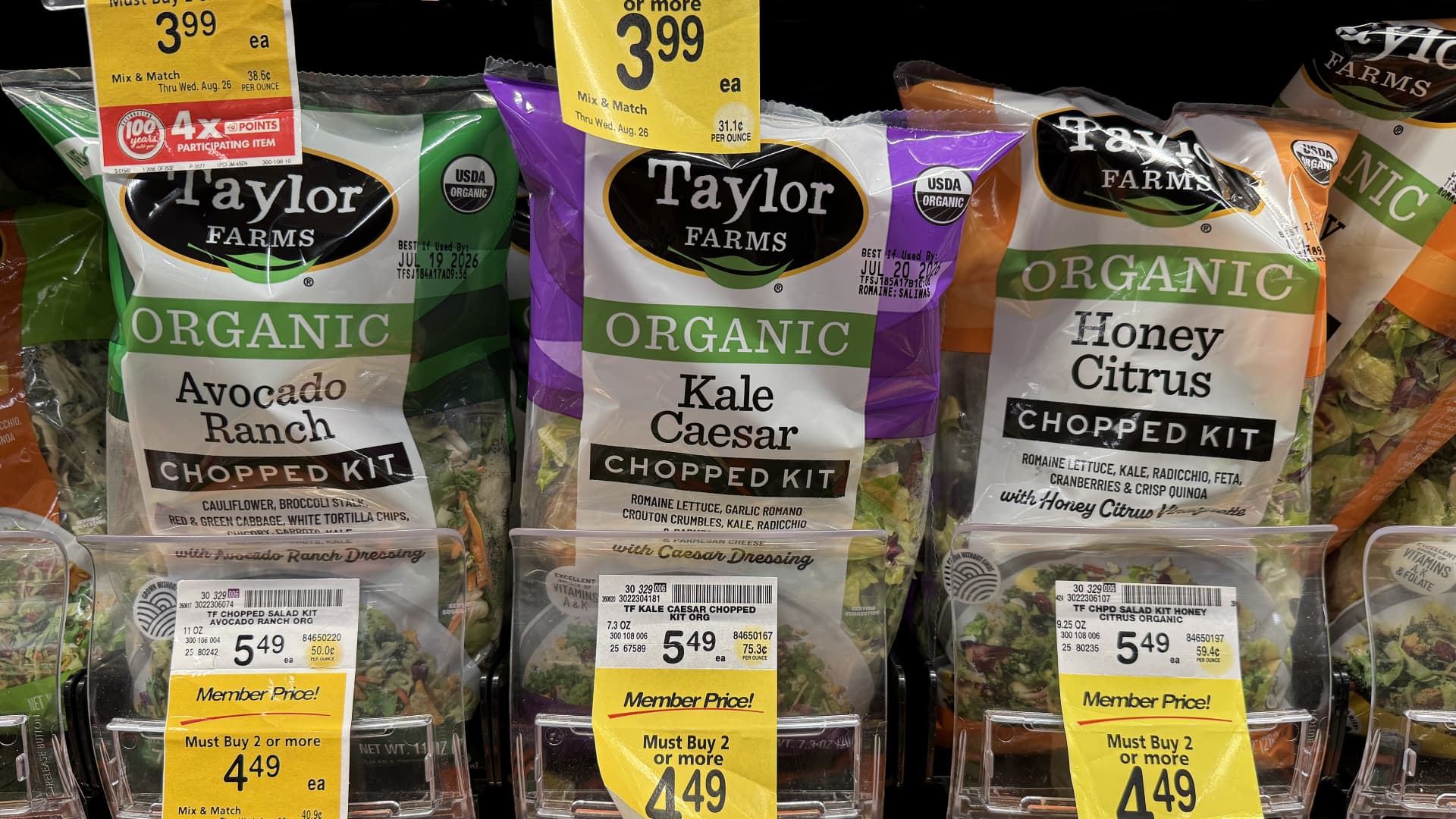
Packages of Taylor Farms salad greens are displayed at a Safeway store on July 16, 2026 in Kings Beach, California.
Justin Sullivan | Getty Images
The Food and Drug Administration’s reversal on a key piece of its cyclosporiasis investigation has sparked confusion in the U.S., but the agency said Monday that it has not changed its main conclusions about the outbreak.
Advertisement
The agency said Sunday a test that indicated a sample of iceberg lettuce supplied by Taylor Farms de Mexico carried the cyclospora parasite was a false positive. However, that only applies to one specific shipment of lettuce supplied by the company, which the agency does not believe was the vehicle that sickened more than 1,600 people and potentially thousands of others.
In a Monday clarification, the agency said its false positive does not change its prior conclusion that the outbreak is linked to shredded iceberg lettuce from central Mexico supplied by Taylor Farms, which was also served at some Taco Bell locations. The agency is still advising Americans not to eat recalled iceberg lettuce.
“FDA’s traceback investigation and outbreak data continue to converge on shredded iceberg lettuce from Taylor Farms locations in central Mexico,” it said in a statement. “FDA will continue to work with federal and state partners to investigate this multistate outbreak and ensure products implicated in this outbreak have been removed from the market.”
Investigators are continuing to examine what exactly caused the outbreak, which can lead to symptoms similar to a bad stomach bug for days or even weeks. CNBC has reached out to the FDA for details on the next phase of the investigation, including whether additional ingredients or suppliers are under scrutiny and whether the agency expects to issue further guidance. The agency has not yet responded.
Advertisement
The false positive test comes as the developing investigation creates uncertainty for both consumers and the food industry. While the FDA has said not to eat iceberg lettuce from Taylor Farms, some diners have stayed away from salads altogether as the number of cases rises.
“Unfortunately, this latest development may add further confusion to what has already been a complex situation for consumers,” said Frank Yiannas, former deputy commissioner of food policy and response at the FDA.
Though industry analysts do not expect the outbreak to have a long-term impact on Taco Bell or other restaurant chains, it could at least temporarily hit sales, based on foot traffic data, and cause a one-to-two quarter hit for companies linked to it. Foot traffic at Taco Bell sank roughly 19% on Friday compared to the day-of-the-weekaverage so far this year, according to data from research firm Placer.ai.
What the FDA’s false positive means
In foodborne outbreak investigations, a false positive can happen when an initial screening signal isn’t reproduced during confirmation testing. Some doctors have pointed out that cyclospora is particularly challenging to recreate in the lab.
Advertisement
But it has not caused a shift in how public officials view the root of the outbreak.
The Department of Health and Human Services in Michigan, where the outbreak has seen explosive growth, says it continues to recommend that people purchase whole heads of lettuce rather than pre-washed, bagged or pre-mixed salad kits.
The agency added that based on interviews with more than 2,000 infected patients, many of them did not report eating lettuce at a restaurant, though they frequently said they ate the leafy green in some setting.
Taylor Farms said Monday morning it will continue its voluntary recall of implicated iceberg lettuce from central Mexico, and Taco Bell has already started to remove the suspected lettuce from restaurants in affected states.
Advertisement
The ripple effects go beyond those companies.
Walmart said Monday that it proactively removed four bagged salad kit products, which are under its Marketside brand and supplied by Taylor Farms, from stores across 27 states even though it said there was no indication that its products are part of the outbreak.
“There have been no confirmed illnesses associated with these products at this time,” the company said in a statement. “We are working closely with our supplier and took immediate steps to remove the products from sale.”
Former FDA Commissioner Dr. Scott Gottlieb suggested to CNBC that the test result does not clear Taylor Farms of its link to the outbreak.The Friday recall was for a product that was imported several weeks ago and was separate from the lettuce that tested positive with the FDA, he said.
Advertisement
He also noted that because cyclospora has an incubation period of up to two weeks and lettuce has a short shelf life, it is important to test multiple shipments, even if they originated from the same farm.
While the outbreak may be sourced to a single vendor for now, it’s possible the contamination has already spread wider, according to Dr. Norman Beatty, an associate professor of medicine at the University of Florida College of Medicine.
“We may find that this current outbreak may have led to additional outbreaks because of the nature of this parasite,” Beatty told CNBC. “The reason why this is important for this current outbreak is because there’s over 30 states where this has been isolated, and there could be other smaller outbreaks occurring in other regions.”
Restaurant fallout
For restaurants, uncertainty is proving as challenging as the outbreak itself. Salad-focused chains and other operators that rely heavily on fresh produce are left without knowing whether any other ingredients are still a potential risk.
Advertisement
Taco Bell told CNBC in a Saturday statement that it had voluntarily removed all suspected lettuce from its locations within 72 hours of beginning the process and adjusted its supply chain accordingly. The company added that it is “confident” that consumers can eat safely at its locations.
“Clearly, this is a nationwide industry-wide issue, not a Taco Bell-specific issue,” the company said. “We hope that other members of the industry are taking the same degree of immediate action and accountability for the consumer as we have.”
Taco Bell isn’t the only restaurant seeing its business slow, according to Placer.ai. Other restaurant chains that sell lettuce, including Chopt, Panera Bread and Chipotle, also saw declines in traffic Friday, the firm said.
As headlines about the outbreak swirled last week, the industry’s top advocacy group stressed it is taking food safety seriously.
Advertisement
“The Food Code requires that every restaurant must have a manager that is food safety certified on every shift,” said National Restaurant Association CEO Michelle Korsmo in a post on LinkedIn.
“We’ll continue to support public health officials as they investigate the outbreak and ensure our members have the information they need to evaluate their food safety decisions,” she added.
And despite the false positive result, Taylor Farms and Taco Bell parent Yum Brands are still navigating the reputational fallout of an outbreak that prompted product removals and widespread headlines. Even so, restaurant analysts previously told CNBC they did not expect a long-term financial hit for the companies linked to the outbreak.
Shares of Yum Brands are down nearly 9% in the last five days.
Douglas Whitfield, SEW’s water supply director, said it was “deeply sorry” and “incredibly grateful to everyone helping us protect water supplies” after exceptionally hot and dry weather.
Eastbourne MP Josh Babarinde said he was “appalled”, calling it “the direct result of years of underinvestment in upgrading infrastructure and building resilience”.
Advertisement
Under the restrictions, households in the affected area will be banned from using a hosepipe in their homes for tasks including cleaning, filling ponds, or watering plants.
The ban will officially come in from 00:01 BST on Saturday, but SEW has asked its customers to abide by the restrictions immediately.
The UK record for the hottest day in June was broken for a third day in a row last month, with temperatures reaching 37.3C, the Met Office said.
The Nasdaq Composite rose 0.59%, or 149.70 points, to 25,669.95 Monday morning, as semiconductor stocks staged a rebound following a volatile week of losses and investors positioned themselves ahead of a pivotal stretch of Big Tech earnings reports later this week.
Broader U.S. markets moved higher in tandem with the tech-heavy index. The S&P 500 added roughly 0.5%, while the Dow Jones Industrial Average edged up about 0.3%, according to Monday morning trading data. Oil prices eased somewhat after briefly touching $90 a barrel over the weekend amid continued exchanges of military strikes between the United States and Iran, providing an additional source of relief for equity markets that have remained sensitive to swings in energy prices throughout the summer.
Chip stocks recover after a difficult week
Monday’s advance followed a bruising stretch for semiconductor shares, which had come under significant pressure last week amid renewed concerns about the sustainability of the elevated valuations that have accompanied the broader artificial intelligence investment boom. The Nasdaq had dropped 1.4% to 25,520.24 on Friday alone, while the Dow fell 406.55 points, or 0.77%, as chip and technology stocks came under intense scrutiny to close out the week. The S&P 500 finished Friday’s session down 1.01% at 7,457.69, and all three major indexes posted weekly losses, with the Nasdaq’s 2.9% decline standing out as the sharpest among them.
Advertisement
That selloff had been fueled in part by the debut of a new artificial intelligence model from Chinese startup Moonshot, which the company said performs on par with leading offerings from established Western AI developers, intensifying broader questions about whether current spending levels on AI infrastructure can be justified by near-term returns. The VanEck Semiconductor ETF fell more than 4% during that stretch, reflecting the scale of investor anxiety weighing on chip-related names heading into the new trading week.
A familiar pattern of sharp rotations
Monday’s rebound continues what has become a recurring pattern throughout 2026, in which chip and AI infrastructure stocks have repeatedly swung between sharp selloffs and equally sharp recoveries as investors continually reassess the durability of the sector’s underlying growth story. Earlier this month, the Nasdaq Composite surged 1.30% in a single session, climbing to 26,206.89, in a rally driven by broad-based buying across chip manufacturers, equipment makers and semiconductor companies following a prior period of pressure tied to valuation concerns.
That earlier rally was also supported by comments from President Donald Trump that investors interpreted as more conciliatory toward a diplomatic resolution with Iran, even as both countries continued exchanging military strikes at the time. Advanced Micro Devices surged more than 7% during that session, while Broadcom gained more than 3%, and the iShares Semiconductor ETF climbed more than 5%, illustrating how sensitive chip stocks have remained to both geopolitical developments and shifting sentiment around the broader AI trade throughout the year.
Advertisement
Big Tech earnings loom as the next major catalyst
With Monday’s gains extending into the start of a new trading week, attention across Wall Street is increasingly focused on a wave of earnings reports expected from major technology companies in the coming days. Alphabet, Microsoft, Meta and Amazon are among the companies scheduled to report results, with investors paying particularly close attention to capital expenditure guidance tied to artificial intelligence infrastructure spending, a factor that market strategists have identified as more consequential to stock reactions this earnings season than whether companies simply beat or miss consensus estimates.
That dynamic has already played out repeatedly in recent weeks, with more than 86% of S&P 500 companies that have reported results so far this earnings season beating analyst expectations, even as markets have continued to sell off shares in many of those companies regardless of the headline beat. Strategists have pointed to guidance and capital spending commentary, rather than backward-looking earnings figures, as the more decisive factor shaping investor reactions during this particular stretch of the reporting season.
A record-setting first half followed by turbulence
Advertisement
Monday’s advance comes against the backdrop of what has otherwise been an exceptionally strong, if volatile, year for the Nasdaq Composite. The index climbed 12.8% during the first half of 2026 alone, one of its strongest such performances in recent years, driven substantially by sustained investment in artificial intelligence infrastructure. That rally has not been without significant interruptions, however, with the index having fallen more than 2% in single sessions on multiple occasions this year amid periodic rotations out of richly valued technology names.
Geopolitical risk remains a persistent backdrop
Beyond the earnings-driven catalysts shaping this week’s trading, the ongoing conflict between the United States and Iran continues to represent a meaningful source of uncertainty for broader market sentiment. Oil prices have fluctuated sharply in recent weeks in response to escalating and, at times, easing tensions between the two countries, with any signs of renewed diplomatic engagement tending to provide at least temporary relief to both energy markets and the broader equity market’s risk appetite.
With chip stocks rebounding Monday and a critical stretch of Big Tech earnings reports set to begin later this week, market participants are likely to remain focused on capital expenditure guidance and broader commentary regarding the durability of AI-related demand as the key factors determining whether this week’s gains prove durable or give way to renewed volatility. At the same time, developments in the U.S.-Iran conflict are expected to continue shaping oil prices and broader risk sentiment, keeping markets attentive to geopolitical headlines alongside the corporate earnings calendar in the days ahead.
James Foord is an economist by trade and has been analyzing global markets for the past decade. He leads the investing group The Pragmatic Investor where the focus is on building robust and truly diversified portfolios that will continually preserve and increase wealth.
The Pragmatic Investor covers global macro, international equities, commodities, tech and cryptocurrencies and is designed to guide investors of all levels in their journey. Features include a The Pragmatic Investor Portfolio, weekly market update newsletter, actionable trades, technical analysis, and a chat room. Learn more.
Analyst’s Disclosure: I/we have no stock, option or similar derivative position in any of the companies mentioned, and no plans to initiate any such positions within the next 72 hours. I wrote this article myself, and it expresses my own opinions. I am not receiving compensation for it (other than from Seeking Alpha). I have no business relationship with any company whose stock is mentioned in this article.
Seeking Alpha’s Disclosure: Past performance is no guarantee of future results. No recommendation or advice is being given as to whether any investment is suitable for a particular investor. Any views or opinions expressed above may not reflect those of Seeking Alpha as a whole. Seeking Alpha is not a licensed securities dealer, broker or US investment adviser or investment bank. Our analysts are third party authors that include both professional investors and individual investors who may not be licensed or certified by any institute or regulatory body.
The new Labour leader has pledged to revive the country’s industrial heartlands
15:04, 20 Jul 2026Updated 15:12, 20 Jul 2026
Britain’s new Prime Minister Andy Burnham delivers his first speech outside 10 Downing Street(Image: Zeynep Demir/Anadolu via Getty Images)
Andy Burnham has pledged to “build a new economy” during his time as Prime Minister, vowing a suite of cost-of-living support measures for households will be unveiled as early as tomorrow.
Speaking on the steps of Downing Street, the new Labour leader said his government would put “life’s essentials back under stronger public control” and breathe new life into the nation’s industrial heartlands. He also restated his backing for the Starmer government’s defence commitments and vowed to bring “the welfare bill down”.
Advertisement
“We will make this moment a circuit breaker for Britain, bringing forward the biggest changes in the last 40 years, a new political model and a new economic model,” Burnham said, adding: “We will take power out of here and carry it into every postcode in the land, so that they can do more, and in doing more, build a new economy where we put life’s essentials back under stronger public control.”
The comments marked the former Manchester mayor’s maiden address as Prime Minister, having been sworn into the nation’s highest office by the King mere moments before delivering his speech.
Sir Keir Starmer formally submitted his resignation earlier on Monday, informing voters that “his work was done” and that it had been the “privilege of [his] life” to serve in Downing Street.
In a break from previous speeches, Burnham chose to forgo a lectern, reiterating his previously declared commitment to redistribute political authority away from Westminster towards local councils and devolved institutions.
Advertisement
The initiative will serve as the cornerstone of a “10-year plan” to introduce a fresh political and economic framework aimed at improving Britain, as reported by City AM.
“Later this year, I will bring forward a new plan for Britain, a 10-year plan,” he said, “laying out a path from where we are now to where I believe we all want Britain to be, wherever we’re coming from, whatever party we support.”
Burnham pledged to give voters “breathing space” with several costed measures to ease the cost of living expected to be unveiled as early as Tuesday.
“We will… build a new economy where we put life’s essentials back under stronger public control to make them affordable to you again, reindustrialising Britain using public procurement to back British industry,” he said.
Advertisement
The renewed outbreak of conflict in the Middle East has left Burnham confronting a challenging economic legacy. The UK’s borrowing costs remained stubbornly high throughout his first morning in Downing Street, after Washington announced two further nights of strikes over the weekend and shipping traffic through the Strait of Hormuz came to a standstill.
The 10-year gilt yield was hovering at just under five per cent by the close of the former Manchester mayor’s address, remaining elevated amid concerns that escalating tensions will further fuel inflationary pressures within the British economy.
The head of Britain’s largest industry body welcomed Burnham’s pledge to unveil a 10-year plan, stating that businesses “thrive on long-term certainty”.
“Our surveys show energy and taxation are squeezing businesses, hitting confidence and investment. Easing the cost of doing business will deliver the growth we all want to see,” Shevaun Haviland, British Chambers of Commerce director general, said.
Advertisement
“Getting growth in ‘every postcode’ of the UK is only possible if business is placed at the heart of the economic strategy,” she added. “Any structural changes to the economy must deliver growth – and that happens when firms invest and expand.”
CBI chief Rain Newton-Smith lent her voice to calls for businesses to play a central role in Burnham’s time in office.
She said: “Ambitious plans to improve the livelihoods of people across the country must be matched by action to get businesses thriving once again.
“Addressing the cost-of-living challenge needs to go hand in hand with tackling the cost of doing business, so we can deliver sustainable growth in jobs, wages and living standards.”


















































You must be logged in to post a comment Login