

Crypto World
Bitcoin Price Analysis: Here’s the Most Likely BTC Scenario for Next Week

Bitcoin continues to recover from its June capitulation but remains trapped beneath a major resistance cluster. Although buyers have managed to defend higher lows on the lower timeframe, the market is still approaching a critical confluence that could determine whether the recovery extends or transitions into another rejection.
BTC Price Analysis: The Daily Chart
On the daily timeframe, BTC continues to trade below the 100-day and 200-day moving averages, keeping the broader trend tilted to the downside.
The asset is now approaching the $65K-$66.5K supply zone, which also coincides with the descending long-term trendline. This confluence has capped every recovery attempt since the sharp breakdown in early June, making it the key barrier that bulls must reclaim to shift the higher-timeframe structure.
A successful breakout above this region would expose the next resistance between $72K and $74K. However, another rejection from the current supply zone would likely trigger a corrective move toward the $58K-$60K support area, which now represents the most important demand zone on the daily chart.
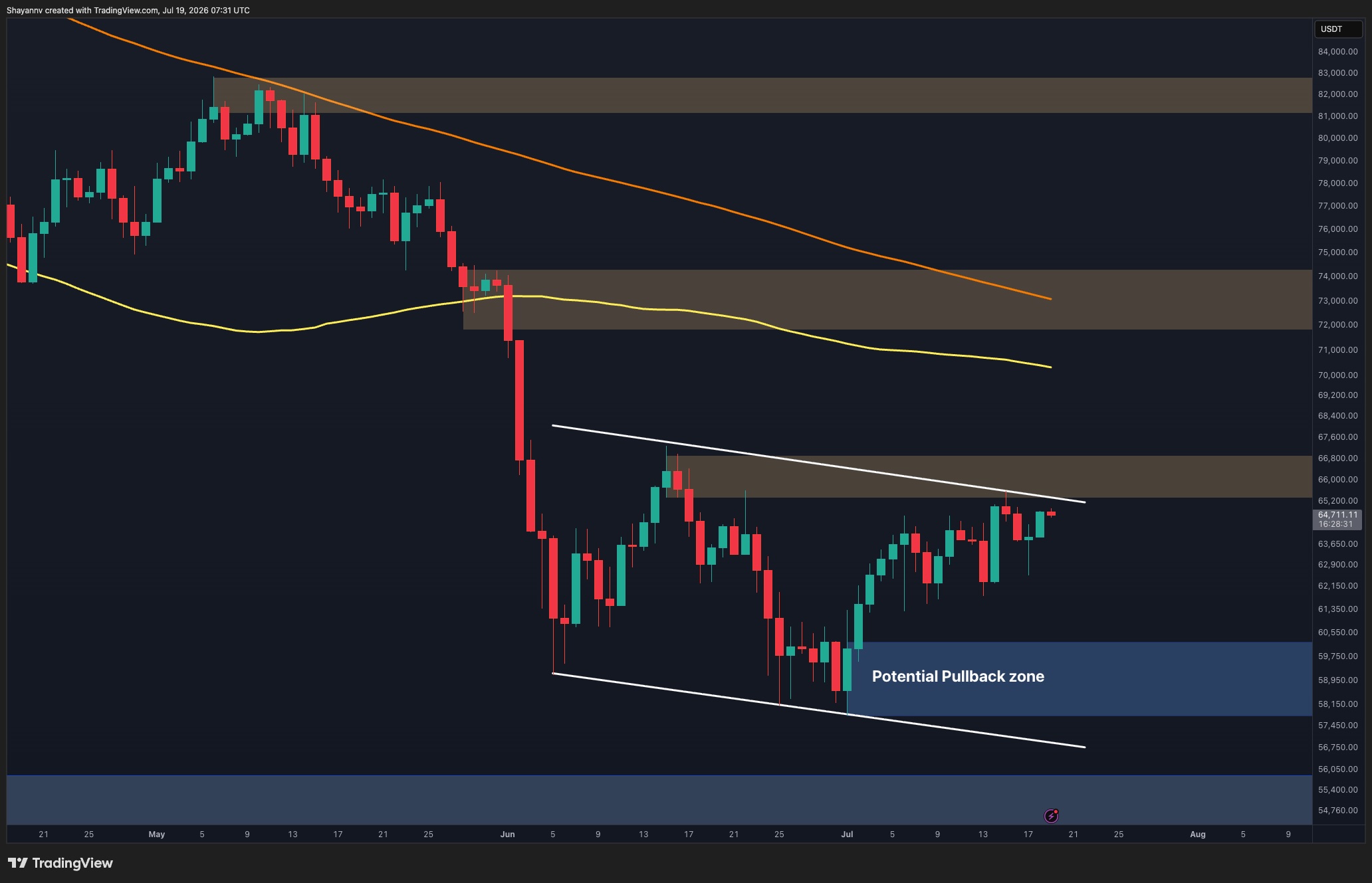
BTC/USDT 4-Hour Chart
The 4-hour chart shows Bitcoin consolidating within a rising channel after establishing a series of higher lows throughout July.
BTC is once again testing the upper boundary of the channel while simultaneously approaching the higher-timeframe supply zone around $65K-$66.5K. This creates a significant confluence of resistance, suggesting that bullish momentum is entering an important decision area.
As long as Bitcoin remains above the $61K-$62K support zone, buyers maintain a short-term advantage and another attempt to break the overhead resistance remains likely.
However, failure to overcome the confluence of the channel resistance, descending trendline, and supply zone could result in another pullback toward the $58K-$60K demand region. Since this price action pattern typically hints at a potential decline, Bitcoin is poised for another bearish leg, testing the lower demand zones.

Sentiment Analysis
The Realized Price UTXO Age Bands indicate that the realized prices of the 1-3 month and 3-6 month holder cohorts have converged near the current market structure, both sitting around the low $70K area.
Historically, the convergence of these younger holder cost bases often reflects a period of market transition, as recently accumulated coins begin to change hands at similar prices. At present, both realized price levels remain well above Bitcoin’s spot price, implying that these cohorts are still holding unrealized losses.
This reinforces the technical picture. While Bitcoin has recovered from its June lows, it remains below the realized cost basis of recent investors, suggesting that sentiment has not fully shifted back in favor of sustained accumulation.
A recovery above these realized price levels would strengthen the case for a broader trend reversal, whereas continued rejection below them would support the view that the current advance is still a relief rally within the broader bearish structure.

The post Bitcoin Price Analysis: Here’s the Most Likely BTC Scenario for Next Week appeared first on CryptoPotato.



The US House Agriculture Committee has scheduled a hearing on sports prediction markets as two gaming associations press Congress to prohibit sports contracts offered by platforms including Kalshi and Polymarket.
Summary
- US lawmakers will examine sports prediction markets amid pressure to prohibit sports contracts.
- Gaming associations argue Kalshi and Polymarket offer products resembling traditional sports betting.
- Hyperliquid plans permissionless HIP-4 outcome markets using validator-approved onchain templates.
According to a committee release, the Subcommittee on Commodity Markets, Digital Assets, and Rural Development will examine customer protections and market integrity across prediction markets. Legal specialists and executives representing the American Gaming Association and Indian Gaming Association are expected to testify.
The hearing comes as state authorities challenge whether sports event contracts qualify as federally regulated derivatives or unlicensed gambling products. Kalshi and Polymarket have faced claims from regulators that their sports markets resemble conventional betting services, despite operating within the prediction-market sector.
At the federal level, prediction-market supporters maintain that the Commodity Futures Trading Commission already possesses enough authority to oversee event contracts. Gaming associations, however, want lawmakers to prevent regulated exchanges from offering contracts based on sporting events.
Gaming groups want sports contracts prohibited
Legal expert Daniel Wallach, who reviewed the witnesses’ prepared testimony, noted that supporters of prediction markets are asking Congress not to pass new legislation clarifying the CFTC’s authority. According to Wallach, those witnesses believe the existing legal framework already allows the regulator to supervise platforms such as Polymarket.
Robert Schwartz, one of the witnesses supporting prediction markets, argued that the CFTC can decide which event contracts exchanges may list without receiving new powers from Congress.
“It has powerful authority to disallow exchanges from listing problematic contracts,” Schwartz said.
Drawing on the Dodd-Frank Act, Wallach argued that the CFTC can prohibit an exchange from listing a contract involving gaming when the agency determines that the product conflicts with the public interest. His interpretation places responsibility for approving or rejecting sports contracts with the federal derivatives regulator rather than state gambling authorities.
Gaming representatives have challenged that position. David Bean, chairman of the Indian Gaming Association, argued that Kalshi is bypassing gambling laws by offering products that mirror traditional sports wagers. Bean’s testimony treats the economic function of the contracts, rather than their classification as derivatives, as the central issue.
According to Bean, the CFTC’s proposed rule would turn federally regulated derivatives exchanges into nationwide online gambling platforms. The American Gaming Association and Indian Gaming Association are therefore seeking a ban on sports contracts instead of relying solely on the CFTC to assess individual products.
State-level enforcement has added urgency to the dispute. As previously reported by crypto.news, France’s gaming regulator blocked access to Polymarket after accusing the platform of providing illegal gambling services. The regulator also classified the alleged violation as a criminal offence carrying a financial penalty.
A US court ruling has created another obstacle for the sector. Judge Analisa Torres ruled that New York gambling laws apply to Kalshi’s sports-related event contracts. The decision challenged arguments that such products fall only within the CFTC’s federal jurisdiction and are therefore beyond state gambling controls.
Although the ruling directly concerned Kalshi, the report identified possible consequences for Polymarket and other platforms offering comparable event contracts. Under the court’s approach, federal commodities oversight would not automatically prevent states from applying their gambling laws to sports markets.
The House hearing will place those competing legal positions before lawmakers. Prediction-market supporters are expected to defend the CFTC’s existing power to reject harmful contracts, while gaming representatives will argue that sports products should not be permitted on federally regulated exchanges in the first place.
Outcome markets are expanding beyond sports
While lawmakers consider restrictions on sports contracts, Hyperliquid is preparing to let users create outcome markets through its HIP-4 system. As reported by crypto.news, the decentralized exchange has announced that permissionless deployment will begin on testnet before a planned mainnet release.
In a Sunday Telegram announcement, Hyperliquid explained that validators cannot individually manage every possible tradeable event as the number of potential outcomes grows. Its proposed system would instead ask validators to approve standardized templates defining how each category of market must operate.
Once validators approve a template, Hyperliquid will store and enforce its rules onchain. Any deployer could then launch a market using that format without seeking a separate validator vote for each listing, according to the platform.
Deployers would remain responsible for defining and settling individual markets under the approved template’s conditions. Hyperliquid said validators would still create “canonical markets,” although it expects them to approve fewer than 10 such outcomes or questions each year.
Hyperliquid’s proposal concerns the technical deployment of outcome markets and does not resolve the US legal dispute over sports contracts. The House hearing instead centers on whether existing CFTC powers provide adequate safeguards or whether Congress should prevent platforms such as Kalshi and Polymarket from offering sports-linked products altogether.
The recognition allows regulated firms in Abu Dhabi Global Market to offer services involving Tether Gold as tokenized commodities gain broader adoption.
Dogecoin price has held near $0.073 after whales accumulated 200 million DOGE and futures open interest climbed 3.74% to $1.08 billion.
Summary
- Dogecoin whales accumulated 200 million DOGE worth roughly $14 million through Robinhood.
- Futures open interest rose 3.74% to $1.08 billion as derivatives volume jumped 114%.
- DOGE must clear $0.07539 and $0.07965 to confirm a stronger bullish reversal.
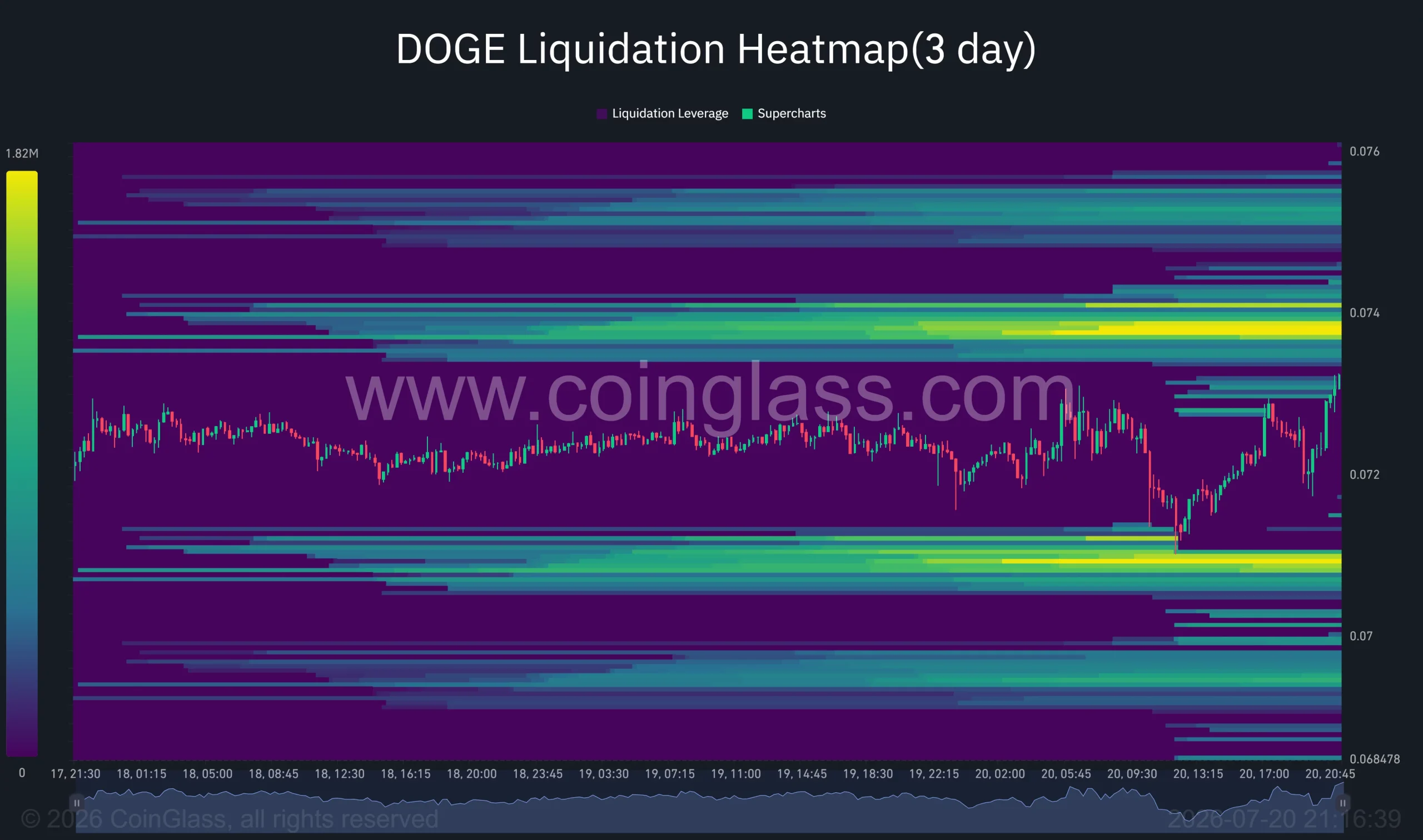
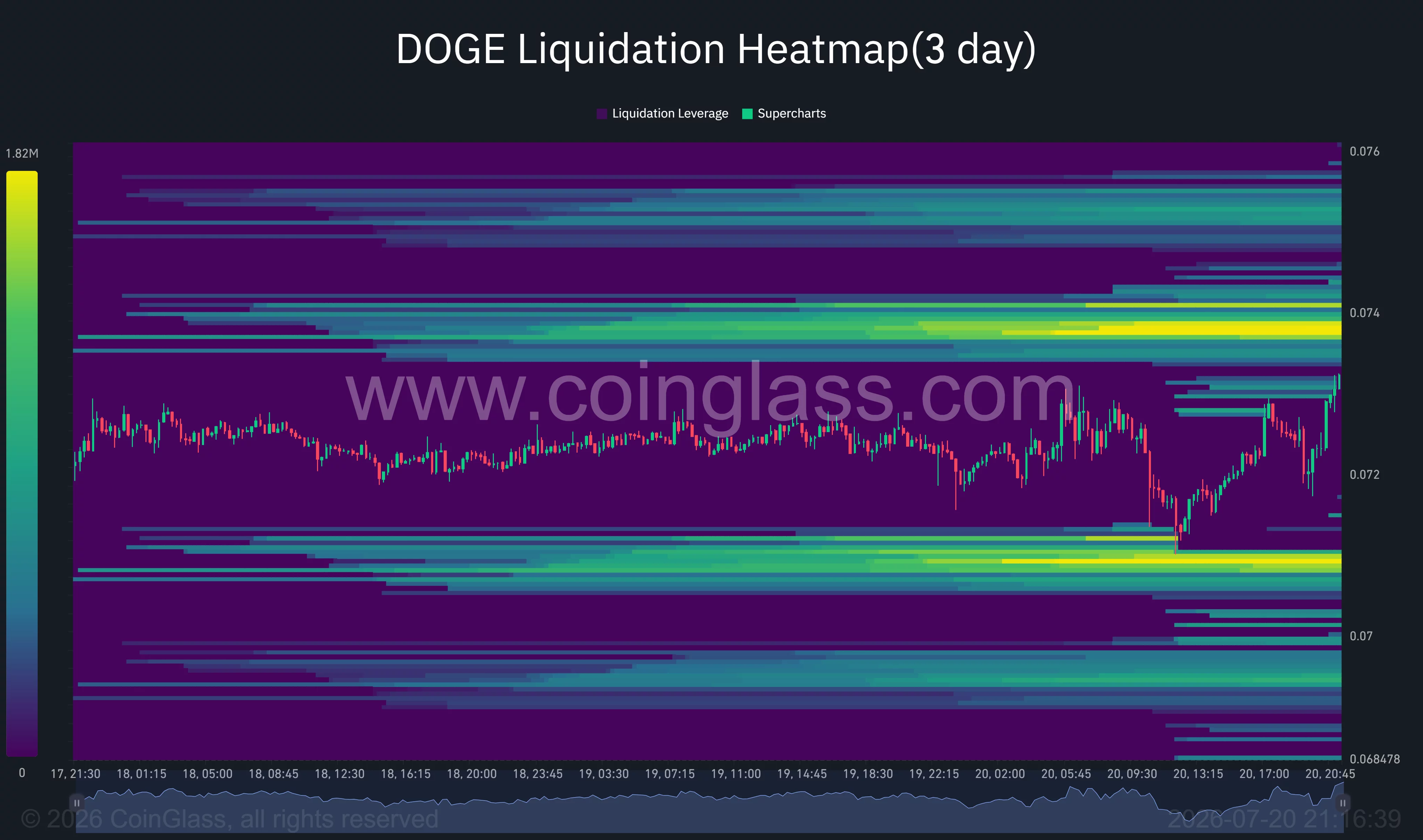
CoinGlass’s three-day liquidation heatmap shows DOGE trading between large leveraged-position clusters near $0.074 and $0.071, leaving the meme coin exposed to volatility in either direction. At the time the charts were captured, Dogecoin traded near $0.0732 after gaining about 1% on the daily chart.
Market conditions offered some support, with Bitcoin holding above $64,000 and Ethereum trading over $1,870. XRP, however, remained below $1.10, indicating that gains were uneven across large-cap cryptocurrencies.
According to an X post, large Dogecoin holders acquired 200 million DOGE through Robinhood. The purchase was valued at roughly $14 million based on DOGE’s price near $0.07, adding to evidence that large wallets were buying while the price moved sideways.
Whale purchases can affect exchange liquidity and trader sentiment, although the transaction alone does not confirm that DOGE will break higher. The impact will depend on whether the acquired coins remain in long-term wallets or return to exchanges for sale.
Derivatives activity rose alongside the whale accumulation. Notably, Dogecoin futures volume jumped 114% to approximately $739.56 million, while open interest increased 3.74% to $1.08 billion.
Rising volume and open interest show that traders added exposure instead of merely closing existing positions. CoinGlass’s heatmap indicates that this leverage has formed clear liquidation targets on both sides of the current price, raising the chance of a sharp move if either cluster is reached.
Liquidity favors an initial test of $0.074
The nearest large concentration of liquidation leverage sits between approximately $0.0737 and $0.0740, according to CoinGlass. Since the upper pool is closer to DOGE’s current price, a continued recovery could force short liquidations and pull the token toward that zone.
Above it, smaller liquidity bands appear near $0.0745 and between $0.0750 and $0.0755. A move through these areas would align with the four-hour chart’s upper Fibonacci resistance at $0.07539, which represents the top of the measured range.
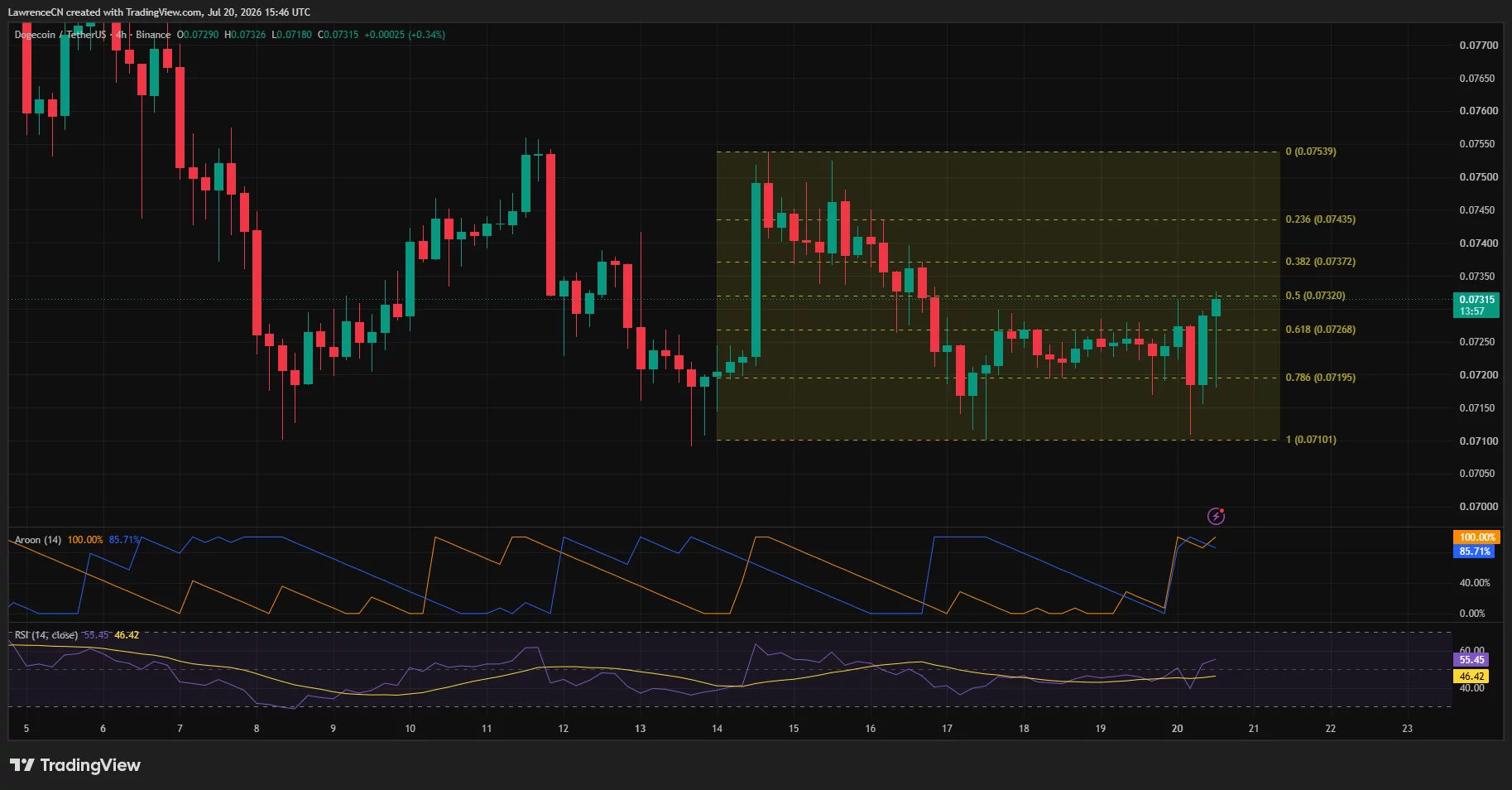
DOGE has already recovered the 50% Fibonacci retracement at $0.0732 on the four-hour chart. The next barriers stand at $0.0737, corresponding to the 38.2% level, and $0.0743 at the 0.236 retracement.
Momentum has also improved on the same timeframe. TradingView’s relative strength index has risen to 55.45, above its moving average of 46.42, showing that buying pressure has strengthened without pushing DOGE into overbought territory.
Aroon readings provide another constructive signal, with Aroon Up at 100% and Aroon Down at 85.71%. While the elevated readings indicate active price extremes on both sides, the fresh rise in Aroon Up supports the latest rebound from the lower end of the range.
Failure to retain $0.0732 would weaken the recovery setup. TradingView’s Fibonacci levels place subsequent support at $0.0726 and $0.0719, followed by the range floor at $0.0710.
CoinGlass data reinforces the importance of that lower boundary. The heatmap’s strongest downside liquidity pool is concentrated around $0.0708–$0.0710, where a breakdown could trigger leveraged long liquidations before DOGE tests the psychological $0.070 level.
Daily resistance still blocks a confirmed reversal
Despite improving short-term momentum, TradingView’s daily chart keeps Dogecoin below the Supertrend resistance at $0.0796. The indicator has remained bearish since DOGE lost the $0.10 region in early June, making a daily close above $0.0796 necessary before the trend can be considered reversed.
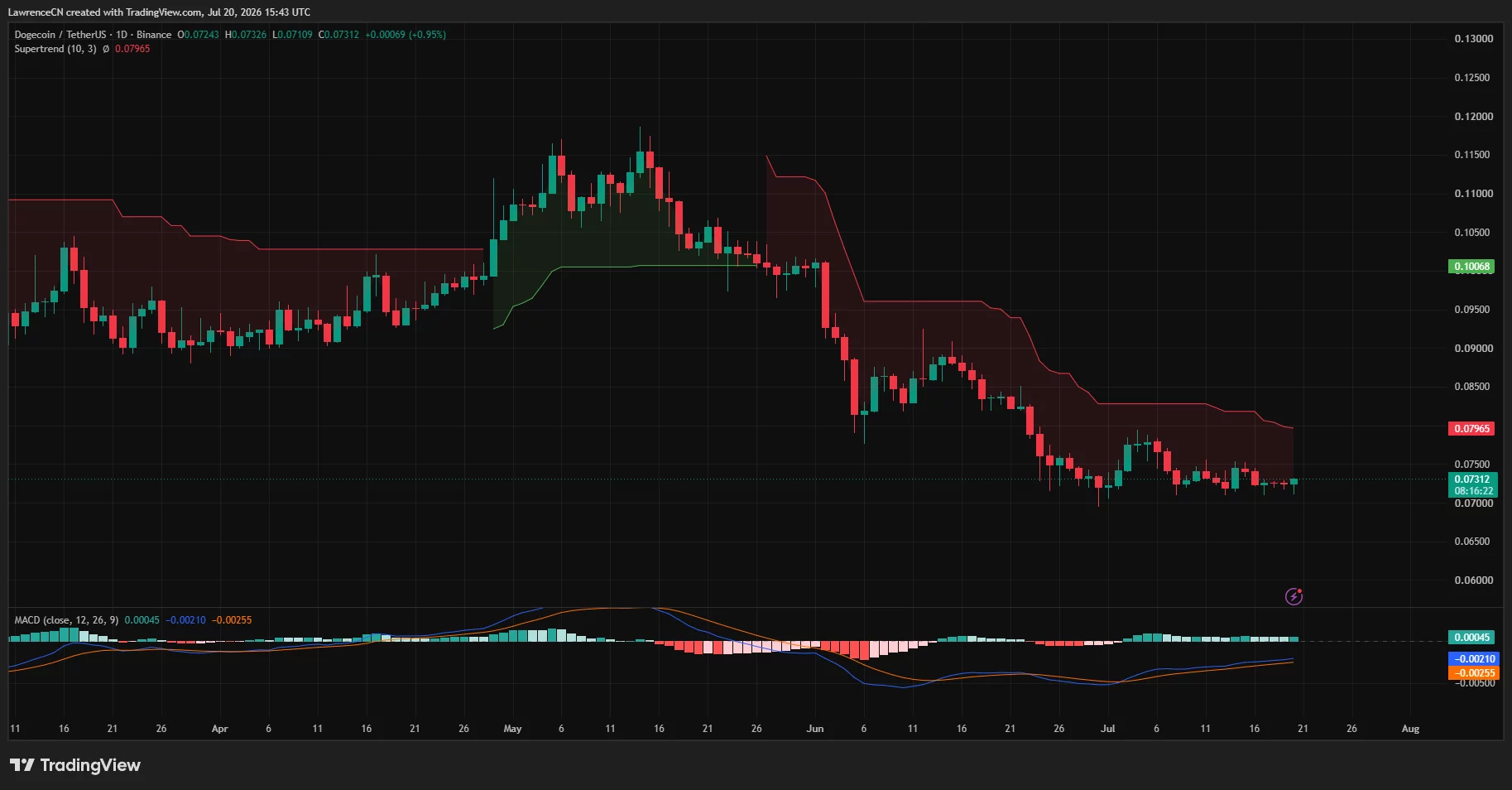
The daily MACD offers an early sign that selling pressure is easing. Its MACD line stands near minus 0.00210, above the signal line at minus 0.00255, while the histogram has turned positive at 0.00045. Both lines remain below zero, however, so the crossover has not yet confirmed sustained bullish momentum.
Commenting on the consolidation, crypto analyst CW linked the flat price action to improving internal strength.
“Strong accumulation of DOGE is occurring during the current sideways movement,” CW wrote, adding that the RSI was rising sharply and the accumulation score had reached 100.
Fellow analyst Javon Marks offered a more aggressive long-term view, describing the current phase as temporary post-breakout stagnation similar to structures that preceded previous Dogecoin rallies. Marks listed targets of $0.653, above $0.70, and beyond $1.25, although those projections depend on DOGE repeating earlier macro cycles.
A separate analyst projection cited in the original market report identified a weekly double-bottom pattern and placed a possible extended target near $3.25. The same analysis treated that level as hypothetical until DOGE clears the pattern’s neckline with a decisive weekly breakout.
For the immediate outlook, the TradingView chart places $0.07539 and $0.07965 as the main upside tests. On the downside, losing $0.0710 would invalidate the current range recovery and expose the dense liquidation zone below $0.071.
Disclosure: This article does not represent investment advice. The content and materials featured on this page are for educational purposes only.
Key takeaways:
- Bitcoin futures and options show whales still prefer hedging downside risks as socio-economic risks mount.
- Rising Treasury yields and declines in AI stocks fuel risk aversion, yet BTC’s strength signals continued decoupling.
Bitcoin (BTC) showed relative strength over the past week, despite failing to break above $65,500. More importantly, the cryptocurrency has decoupled from traditional markets as investors took profits in memory-chip makers amid fears of excessive valuations in the artificial intelligence sector. Still, judging by Bitcoin’s derivative metrics, top traders are not particularly confident about a rally toward $70,000.
Bitcoin perpetual futures annualized funding rate. Source: Laevitas
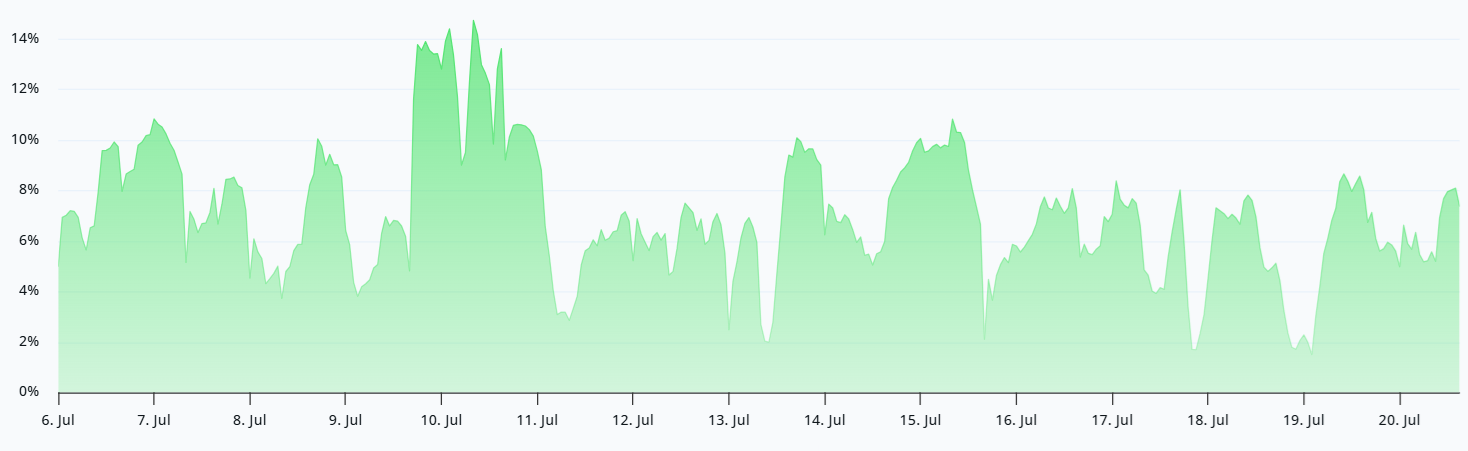
The Bitcoin perpetual futures annualized funding rate stood at a neutral 8% mark on Monday, flat from one week prior. Excessive demand for bullish leverage drives the indicator above the 12% level, which last occurred on July 10. It is unclear if Bitcoin traders’ lack of optimism is somewhat related to contagion fears from the sell-off in tech stocks or the war in Iran.
Nasdaq-100 futures (left) vs. Bitcoin/USD (right). Source: TradingView
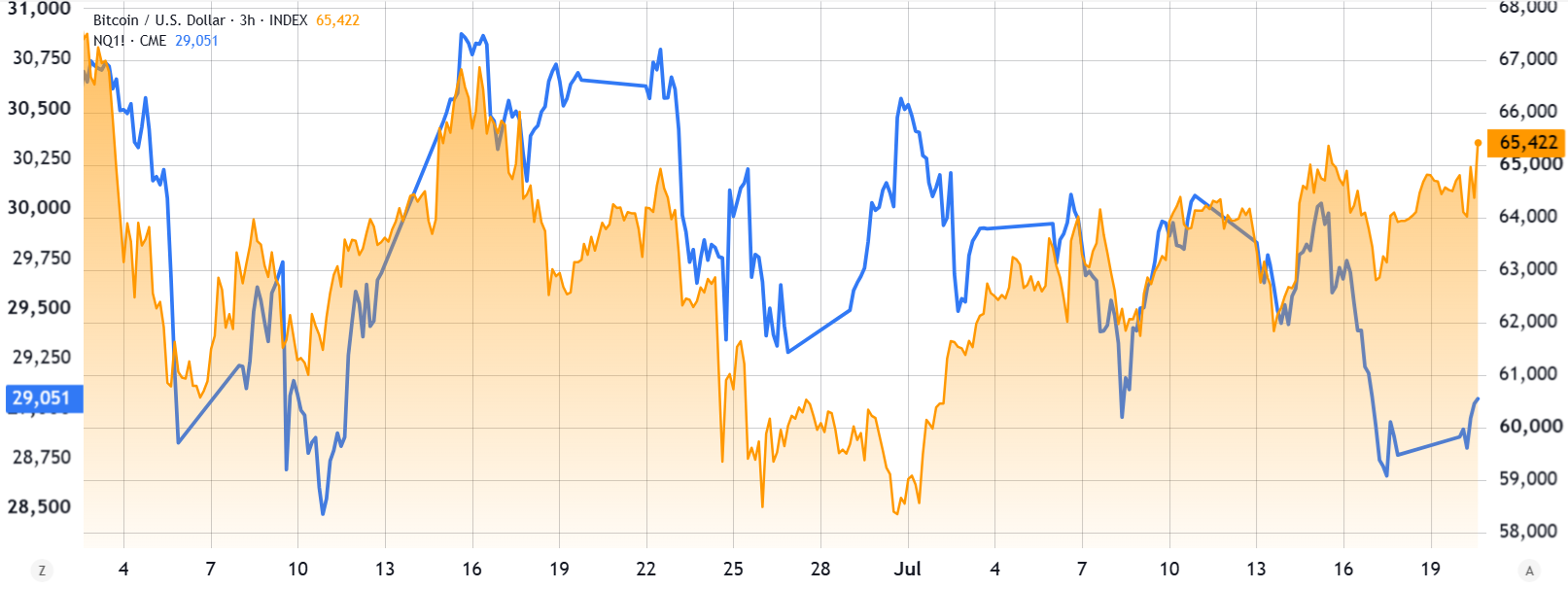
The tech-heavy Nasdaq-100 Index dropped below 28,800 on Friday for the first time in five weeks, while Bitcoin displayed strength over the weekend and eventually broke above $65,000 on Monday. Strategy announced a successful raise of $263 million in cash by selling common stock during the prior week, easing concerns of potential Bitcoin sell pressure.
Investors became extremely anxious about Strategy’s $1.76 billion annual dividend payout to its preferred perpetual equity shareholders, in addition to the $2.6 billion of convertible debt maturing in 2028 and 2029. By raising cash reserves to a comfortable $3.22 billion, the company hopes to eliminate the uncertainty caused by unrealized Bitcoin losses held in its balance sheet.
Bitcoin 30-day options delta skew (put-call) at Deribit. Source: Laevitas
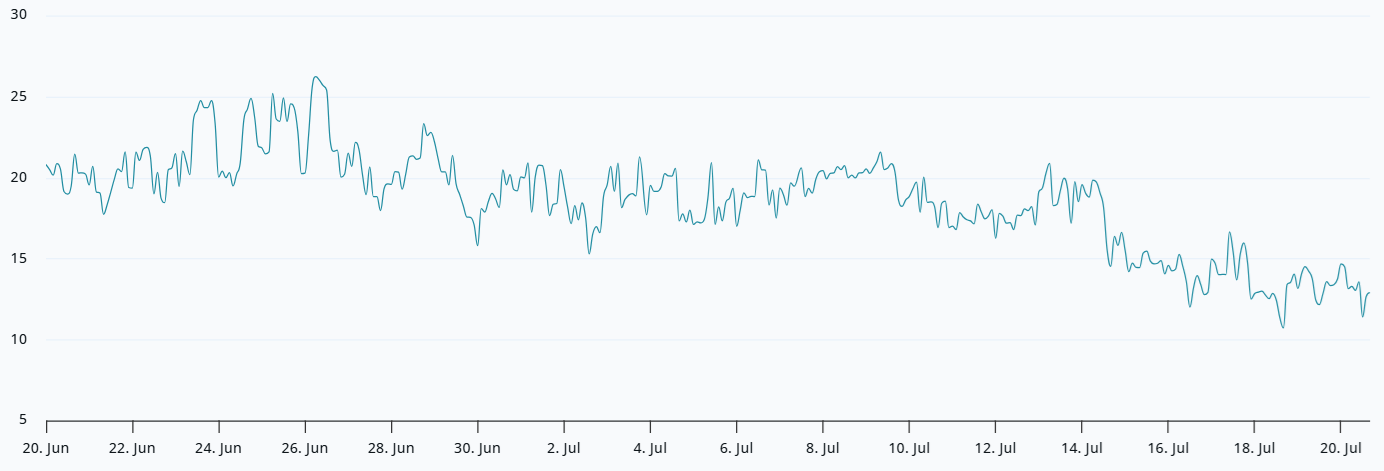
The Bitcoin 30-day options delta skew stood at 13% on Monday, meaning puts (sell) traded at a premium relative to calls (buy). Under neutral conditions, the indicator should range from -6% to +6%. Despite the modest improvement from the prior week’s 19% delta skew, whales and market makers remain reluctant to hold downside price exposure.
Bitcoin’s resilience amid AI stocks weakness and increased risk aversion
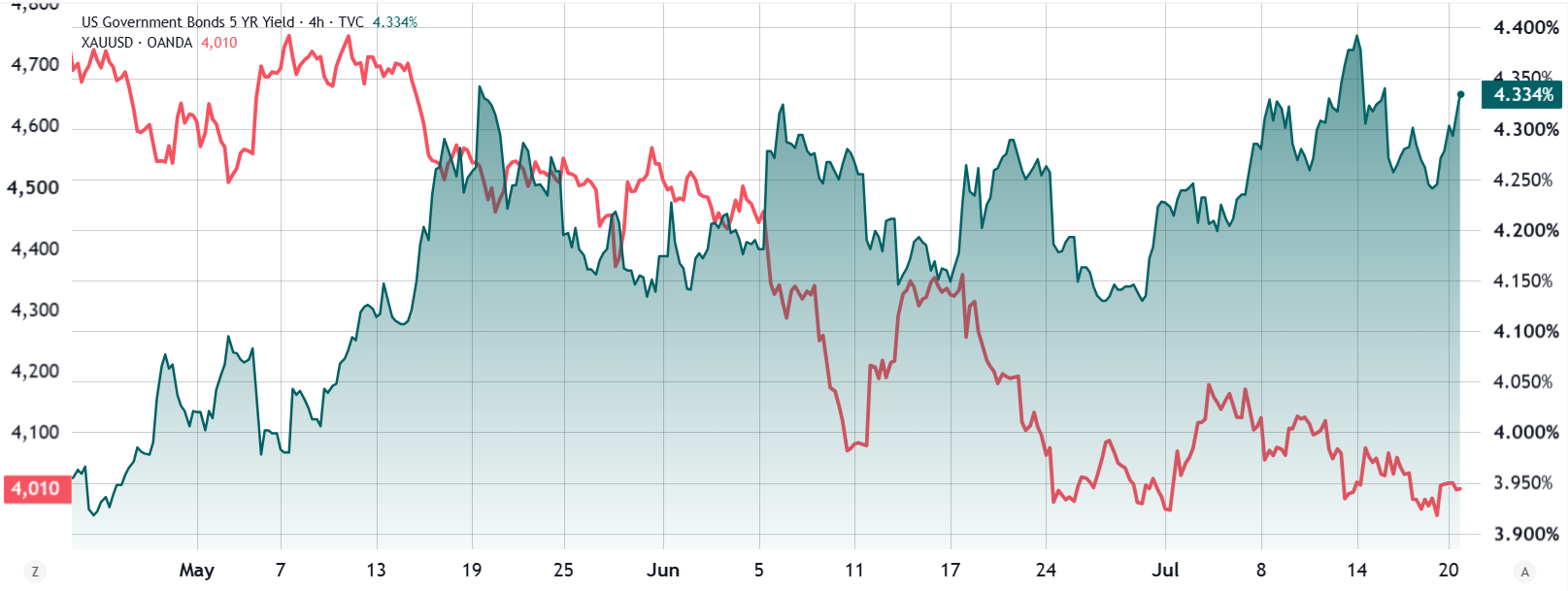
The sell-off in AI-related stocks has also caused investors to act more risk-averse. The sharp declines in the shares of IBM, SanDisk, Oracle, ARM, SpaceX and Intel coincided with a rally in 5-year US Treasury yields. Traders demanded higher returns to hold government bonds, indicating they anticipate further expansionary monetary measures due to the ongoing fiscal debt issue.
Gold/USD (left) vs. US 5-year Treasury yield (right): Source: TradingView
The US 5-year Treasury yield surged to 4.33% on Monday, up from 4.22% two weeks prior. Curiously, gold prices have been in a downtrend since mid-May, suggesting that no asset class has been immune to the deteriorating global economic growth outlook and ongoing geopolitical tensions in the Middle East.
On Monday, US President Trump vowed to retaliate against Iran for a missile strike that killed US soldiers in Jordan, putting risk assets on high alert. Bitcoin’s jump to $65,500 strengthens the case for further decoupling from traditional finance markets amid signs of monetary base expansion. Despite a lack of bullishness in BTC derivatives markets, a rally toward $70,000 could be ignited by weak corporate earnings, especially in the AI sector.
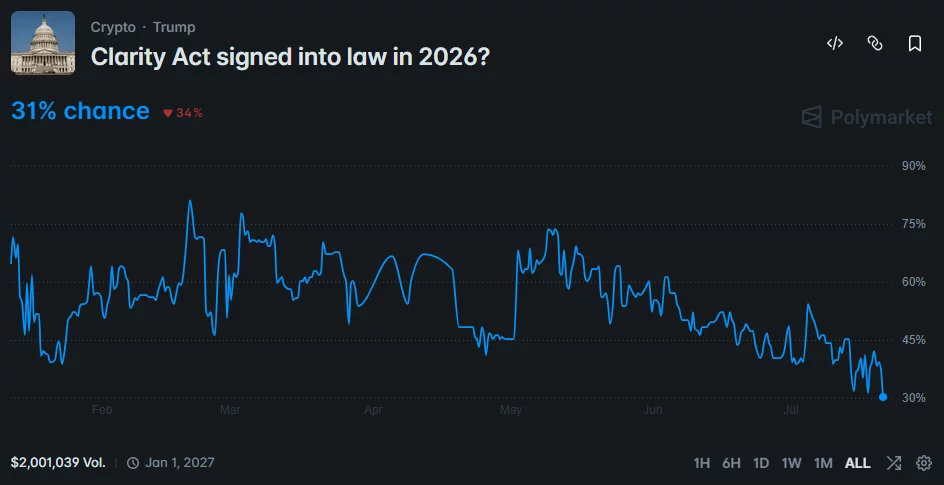
The CLARITY Act’s chance of becoming law in 2026 has fallen to 31% on Polymarket as the White House withholds support for a disputed ethics provision.
Summary
- White House resistance to ethics rules has delayed progress on the CLARITY Act.
- Polymarket traders place the bill’s 2026 approval odds at just 31%.
- Disputes over Trump’s crypto ties and DeFi protections threaten a Senate vote.
Crypto In America reported that the White House had not approved the ethics language as of July 20, despite President Donald Trump meeting Republican senators last week to discuss the crypto market structure bill. Sources cited by the outlet also said the administration has not explained which ethical limits it would accept.
Without a clear position from the White House, Senate negotiators may need more time to prepare an updated version of the legislation, according to the report. The delay could disrupt Republican plans to bring the CLARITY Act to the Senate floor before lawmakers leave Washington for their August recess.
Senate Majority Leader John Thune wants to schedule a floor vote before August, but he has acknowledged that Republicans have not secured a bipartisan agreement. Under Senate rules, the party would need Democratic support to overcome procedural barriers and advance the legislation.
Democrats have demanded restrictions on elected officials’ involvement in digital assets, with their concerns focused mainly on Trump’s crypto interests. According to the president’s financial disclosure, his digital-asset ventures generated as much as $1.4 billion in income last year.
Senator Elizabeth Warren has also requested an updated financial disclosure from Trump. As previously reported by crypto.news, Warren argued that senators need the document while considering ethics rules for the crypto legislation.
The dispute has begun to weigh on market expectations. Polymarket traders now assign a 31% probability that Trump will sign the CLARITY Act into law this year, placing the contract near its lowest level since the prediction market opened.
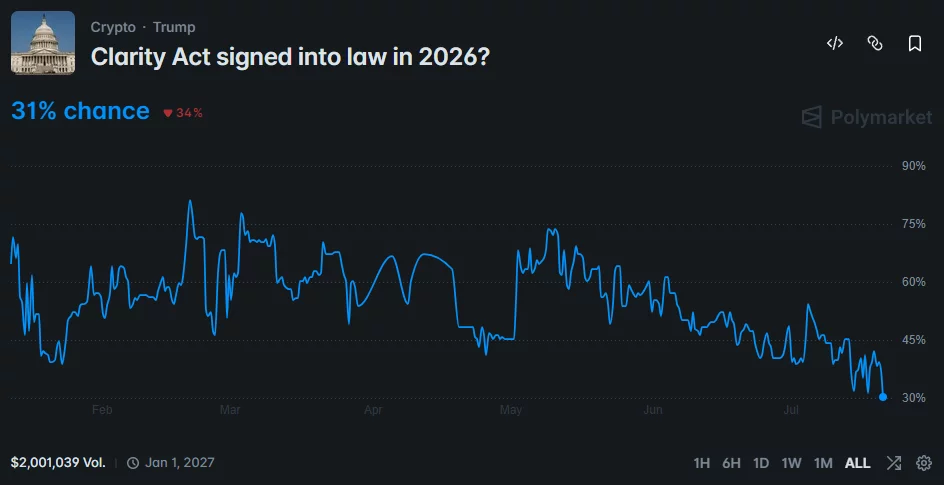
Ethics rules have become the main barrier
Democratic senators have accused Republicans of keeping them outside recent talks over the ethics provision, according to Crypto In America. Their complaints included the White House meeting last week, which reportedly involved Trump and Republican lawmakers but no Democratic negotiators.
Although Trump met senators to discuss the legislation, the White House has not told negotiators what restrictions the president would support, sources told the outlet. The lack of guidance leaves lawmakers without agreed language for separating public duties from private crypto interests.
Warren and other Democrats have linked their demand to Trump’s financial ties to the industry. Their proposed safeguards seek to limit the ability of presidents and other senior officials to profit from digital-asset businesses while shaping federal crypto policy.
Republicans must decide whether to accept an ethics provision strong enough to attract Democratic votes without losing support from Trump or members of their own party. Thune’s comments show that the Senate does not yet have the cross-party deal needed to proceed, while the approaching recess leaves negotiators with little time to settle the dispute.
The House has already passed its version of the CLARITY Act, but the Senate must approve its own text before the legislation can reach Trump’s desk. Any differences between the two versions would also need to be resolved and approved by both chambers, adding further steps to an already compressed timetable.
For crypto companies, the bill is intended to establish clearer federal oversight by defining the roles of the Securities and Exchange Commission and the Commodity Futures Trading Commission. Its delayed progress leaves those proposed rules tied to negotiations over presidential ethics and decentralized finance.
DeFi protections remain another source of conflict
Alongside the ethics debate, the Blockchain Regulatory Certainty Act has continued to divide supporters of the CLARITY Act and law enforcement groups. The BRCA language would protect developers of decentralized protocols from being held responsible for activity carried out by their users.
Under the provision, qualifying developers would not automatically be treated as money transmitters merely because they created or maintained decentralized software. Industry groups view that protection as necessary for developers who do not hold customer assets or control transactions.
Law enforcement organizations have taken the opposite position, arguing that the proposal could make investigations into illicit finance more difficult. Their objections have added another contested issue for senators preparing the revised market structure bill.
Blockchain Association CEO Summer Mersinger expects the BRCA protections to survive the Senate negotiations. Speaking to Crypto In America, Mersinger indicated that she believes lawmakers will keep the provision intact when they publish the updated text.
Mersinger has also predicted that the Senate could hold a floor vote this week, as previously reported by crypto.news. Despite concerns about whether the measure can attract enough votes, she expressed confidence that lawmakers could still move it through the chamber.
Thune’s admission that no bipartisan agreement exists, however, shows that a vote depends on negotiators resolving more than the DeFi language. According to Crypto In America’s reporting, the White House’s undecided position on ethics remains the immediate obstacle to releasing the next bill text.
With the August recess approaching, Senate leaders face a narrowing window to settle both disputes, publish revised language and build the coalition required for a floor vote. Polymarket’s 31% probability indicates that traders currently see those unresolved negotiations as a substantial threat to the bill becoming law this year.


Asset manager Grayscale plans to establish regular cash distributions from rewards generated by its Ether (ETH) and Solana (SOL) staking exchange-traded products (ETPs), giving holders recurring access to yield generated by underlying assets.
In Form 8-K filings submitted to the US Securities and Exchange Commission (SEC), Grayscale said it intends to amend the trust agreements governing the Grayscale Solana Staking ETF (GSOL) and the Grayscale Ethereum Staking ETF (ETHE) around Aug. 7. The amendments would require each trust to convert staking rewards into cash no less often than quarterly and distribute net proceeds to shareholders.
The framework could make staking returns more accessible to traditional investors by delivering cash rewards through broker-held products, eliminating the need for shareholders to hold crypto, pick validators and manage staking operations. However, Grayscale said distribution amounts cannot be predicted as they will depend on the staking rewards during each period and expenses deducted by the trusts.
Grayscale made its first ETHE staking distribution on Jan. 5, paying shareholders about $0.08 per share from the sale of rewards. The asset manager enabled staking for its ETH and SOL products on Oct. 6, 2025, becoming the first US crypto fund issuer to add staking to spot crypto ETPs.
ETHE ended the week with $1.22 billion in net assets, while GSOL had $101.13 million, Yahoo Finance data showed. The Ethereum fund’s gross staking rewards were 2.67%, as of July 17, while the Solana fund’s gross staking rewards were 6.10%, according to the fund’s home pages.
Aligning staking funds with US tax guidance
Grayscale said the changes are designed to keep the funds compliant with the Internal Revenue Service (IRS) rules that enable them to earn staking rewards without losing their current tax treatment.
The company said the amendments should not significantly harm shareholders, but it’s still giving them a 20-day notice. Once the changes take effect, the asset manager plans to update the funds to explain how the regular cash payouts will work.
Related: Bitcoin ETF inflows extend to second week, but recovery lacks momentum
Under the proposal, each trust could deduct expenses not assumed by Grayscale before making a distribution. These costs may include a portion of the staking rewards paid to the sponsor in exchange for arranging and facilitating the staking activities.
The filings do not set a fixed distribution amount or guarantee that payouts will be identical each quarter. Instead, the filings said that rewards may vary depending on the assets staked and network conditions.
Magazine: Inside the ‘fake police raid’ that forced a $1M Bitcoin transfer

The U.S. Securities and Exchange Commission (SEC) has filed a lawsuit against crypto mining investment business Mining Automatic and its founder, Zan Shaikh, accusing them of raising $22 million from investors while allegedly putting only a small fraction of that money into mining operations.
In its complaint, the SEC says the scheme—operated through Massachusetts-based Bright Vision Distribution LLC—took in funds from more than 380 investors between June 2023 and May 2025, promising guaranteed monthly returns from “crypto asset mining.” The regulator alleges the advertised payouts could not be supported by the underlying mining activity.
Key takeaways
- The SEC alleges Mining Automatic raised $22 million while spending about 13% on mining operations, despite promising monthly investor returns.
- According to the complaint, mining generated about $1.1 million, while investor payments in purported returns totaled roughly $1.8 million—creating a funding gap.
- The SEC claims investor funds were diverted to marketing, personal expenses, and unrelated ventures, with significant advertising costs reported.
- Mining Automatic allegedly stopped paying investors by March 2025, and the SEC states more than $20 million in principal remains unpaid.
- The SEC is seeking disgorgement, civil penalties, permanent injunctions, and a ban on Shaikh selling securities or serving as an officer or director of a public company.
SEC alleges promised mining returns were not supported by results
At the center of the SEC’s case is the mismatch between what Mining Automatic allegedly sold to investors and what the business could deliver. The SEC claims the company operated a marketing-led investment program that promised guaranteed monthly earnings tied to crypto mining, even though the operation reportedly produced far less revenue than needed to pay investors.
In the complaint, the SEC alleges the scheme generated approximately $1.1 million from mining while paying investors about $1.8 million in “purported returns.” The regulator says that shortfall meant some payments were funded with money from other investors, describing the arrangement as having “some of the hallmarks of a Ponzi scheme.”
Where investor money allegedly went
The SEC also outlines how it believes the funds were used once they entered the operation. It says Mining Automatic allegedly spent about $7 million on advertising intended to bring in new investors. Separately, the complaint alleges that Shaikh used investor funds for personal and lifestyle expenses, including real estate, vehicles, entertainment, and transfers to his personal bank accounts.
These allegations, if proven, aim to show not just a failure to deliver returns, but an intentional structure that depended on continued inflows rather than mining profitability. The SEC further states that none of the investors had recovered their original investment by the time Mining Automatic stopped paying, which allegedly occurred by March 2025.
Regulator seeks bans and financial remedies
Along with bringing the case, the SEC is seeking multiple forms of relief. The agency requests disgorgement, civil penalties, and permanent injunctions. It is also asking for court orders barring Shaikh from selling securities and from serving as an officer or director of a public company.
The complaint further states that more than $20 million in principal remains unpaid, underscoring the scope of alleged investor losses.
Case lands as the SEC pushes rulemaking priorities
The lawsuit is unfolding during a period in which the SEC has increasingly signaled a shift toward clearer regulation for digital assets, alongside its ongoing enforcement activity. Under Chair Paul Atkins, the SEC has emphasized rulemaking and long-term planning for how blockchain and token-based markets should fit into the agency’s investor-protection mandate.
In June, the SEC published its 2026–2030 Strategic Plan, identifying blockchain technology, tokenization, and crypto market infrastructure as long-term priorities while reaffirming its focus on protecting investors.
Then in July, the SEC expanded on its approach by describing its 2026 rulemaking agenda. That agenda reportedly includes proposals affecting crypto broker-dealers, digital assets traded on national securities exchanges and alternative trading systems, and possible exemptions or safe harbors for certain digital asset offerings.
At the same time, policy discussions on Capitol Hill continue. The lawsuit comes amid congressional efforts to clarify the roles of the SEC and the Commodity Futures Trading Commission (CFTC) through the proposed Digital Asset Market Clarity Act. If enacted, the bill would aim to define oversight boundaries between the agencies. According to the broader legislative reporting referenced by Cointelegraph, a key Senate vote is expected before lawmakers enter their August recess.
What to watch next
For investors and builders, the immediate next step will be how the SEC and the defense address the alleged “guaranteed return” model—particularly the claimed funding gap between mining revenues and investor payments. The outcome will likely also shape how aggressively regulators treat marketing-driven “mining investment” offerings as securities issues, especially as formal rulemaking efforts move forward.
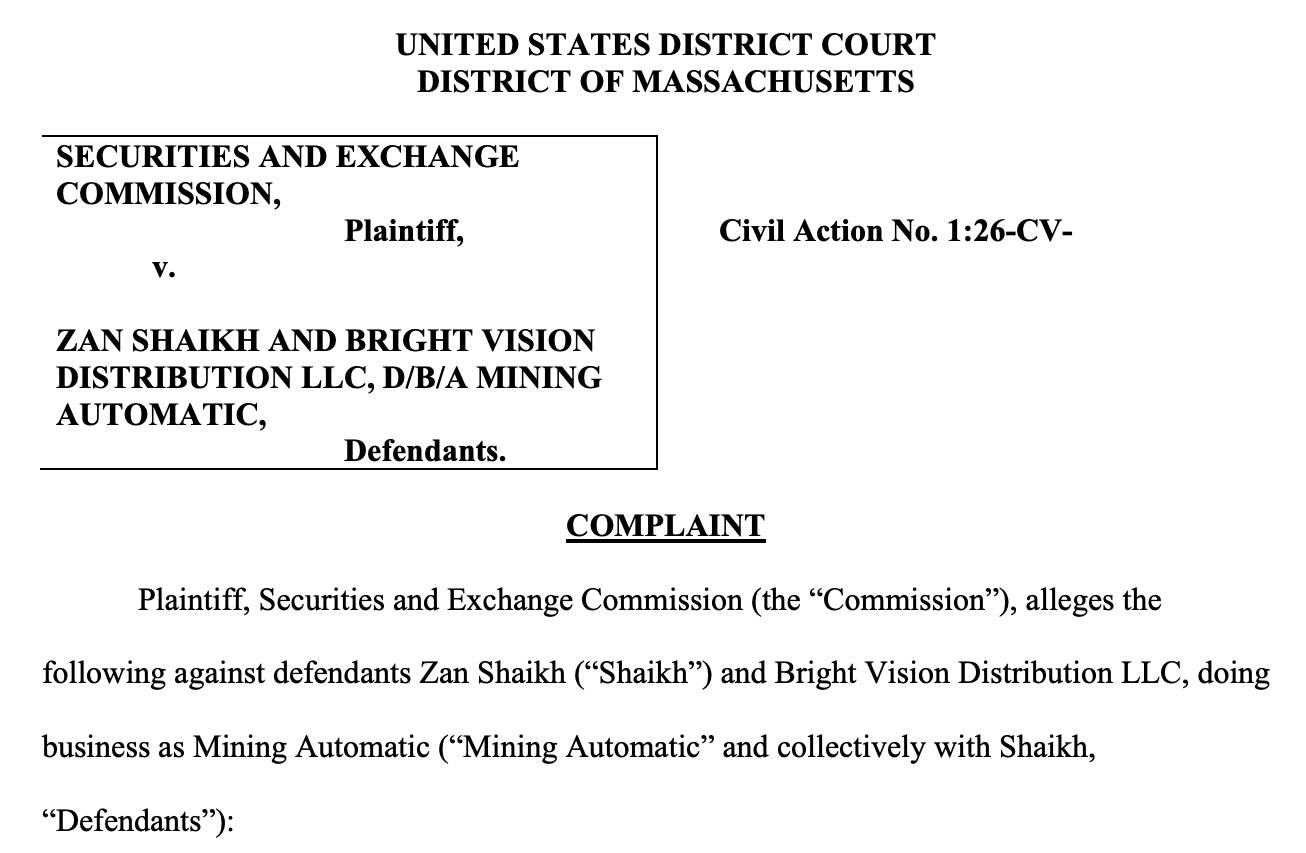
The US Securities and Exchange Commission (SEC) has sued crypto mining investment business Mining Automatic and its founder, Zan Shaikh, alleging they raised $22 million from investors while spending only about 13% of the funds on mining operations.
Mining Automatic was operated by Massachusetts-based Bright Vision Distribution LLC, which the SEC said raised the money from more than 380 investors between June 2023 and May 2025.
The company allegedly promised guaranteed monthly returns from crypto asset mining despite operating a business that could not generate the advertised payouts. The SEC said investor money was instead used for marketing, personal expenses and unrelated ventures.
According to the complaint, the operation generated about $1.1 million from mining while paying investors roughly $1.8 million in purported returns. The SEC alleged the shortfall meant some payments were funded with money from other investors, giving the scheme “some of the hallmarks of a Ponzi scheme.”
Mining Automatic also allegedly spent about $7 million on advertising to attract new investors, while Shaikh used investor funds for real estate, vehicles, entertainment and transfers to his personal bank accounts.
Related: White House says it received no Democratic response related to SEC, CFTC vacancies
Mining Automatic stopped paying investors by March 2025, and the SEC said none had recovered their original investment. More than $20 million in principal remains unpaid, according to the complaint.
The SEC is seeking disgorgement, civil penalties and permanent injunctions, along with orders barring Shaikh from selling securities or serving as an officer or director of a public company.
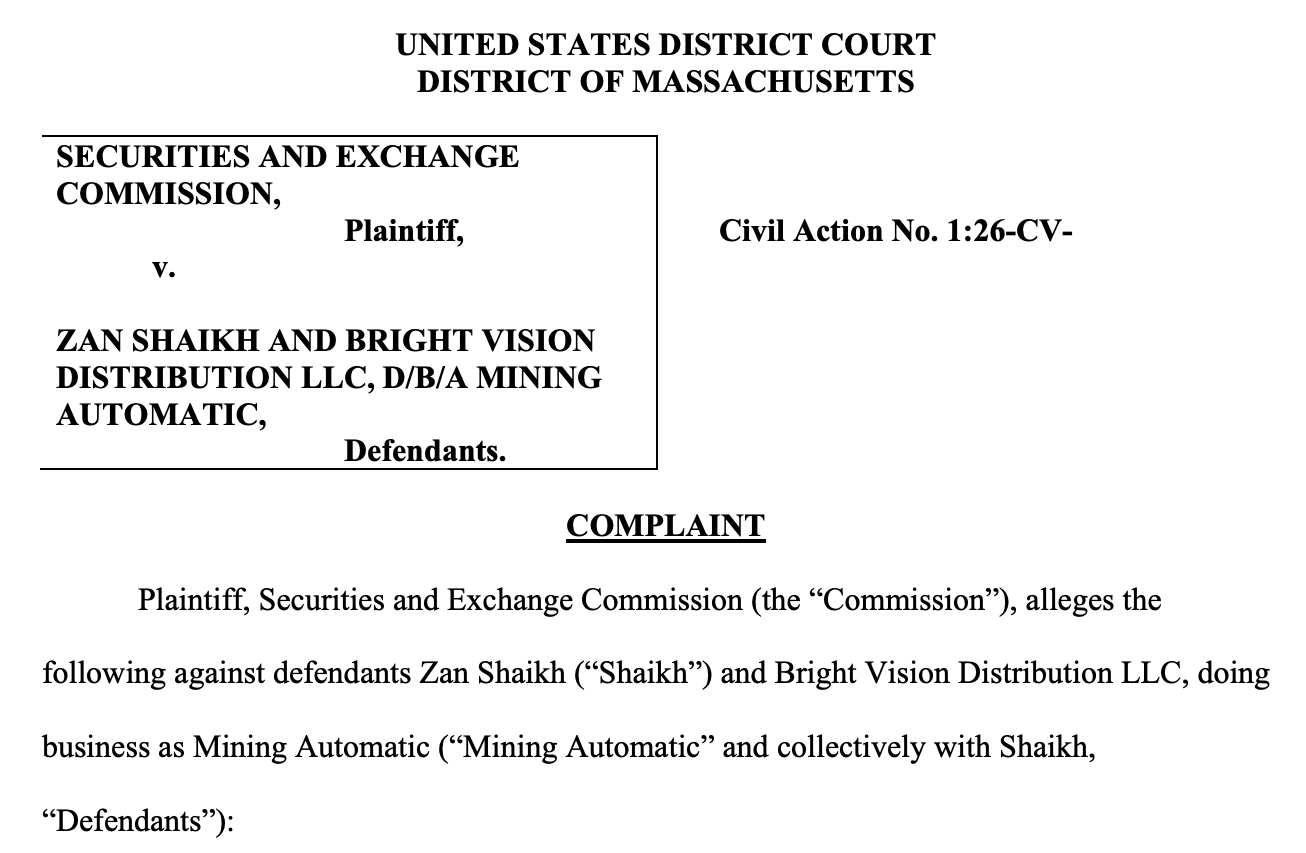
SEC complaint against Mining Automatic. Source: SEC
SEC shifts crypto focus toward rulemaking
The lawsuit comes as the SEC has increasingly emphasized developing clearer rules for digital assets under Chair Paul Atkins. In June, the agency published its 2026–2030 Strategic Plan, identifying blockchain technology, tokenization and crypto market infrastructure as long-term priorities while reaffirming its investor protection mandate.
The SEC expanded on that approach in July with its 2026 rulemaking agenda, proposing new rules for crypto broker-dealers, digital assets traded on national securities exchanges and alternative trading systems, and potential exemptions and safe harbors for certain digital asset offerings.
The regulatory push coincides with congressional efforts to reshape US crypto oversight through the Digital Asset Market Clarity Act, which would clarify the respective roles of the SEC and Commodity Futures Trading Commission (CFTC), if enacted. The bill is expected to face a key Senate vote before lawmakers begin their August recess.
Magazine: Peter Brandt predicts the exact day Bitcoin’s bear market will be over


The crypto sector continues to experience costly exploits on a near daily basis. In the past week alone, three blockchain bridges have been attacked, with an estimated total of over $5.7 million stolen.
The projects, Allswap, Across Protocol, and TeleSwap appear to have lost $1.65 million, $3.35 million and $735,000, respectively.
The sums lost this week may not be comparable to larger hacks during the first months of the year, but nevertheless show the continued vulnerability of blockchain bridges.
So far this year, Protos has tallied 20 bridge hacks, with a total of over $355 million lost.
Read more: Hackers switching to centralized exchanges to fund crypto attacks
Across Protocol
On Friday, Across Protocol disclosed an attack on Solana, advising users it had paused deposits on the affected blockchain.
The post reassured users that any lost funds “belong to the relayer operated by Risk Labs (the foundation supporting Across),” but didn’t state how much was stolen.
Examination of the two EVM addresses (1, 2) flagged by Across found inflows totalling $3.35 million on the morning of the exploit.
The majority of funds have since been consolidated to another address, which currently holds 1,500 ETH ($2.85 million).
Read more: More oracle exploits as Ostium loses over $20M
The attacker’s addresses were funded via privacy protocol Tornado Cash (on Ethereum) and no-KYC exchange FixedFloat (on Solana). Both are funding sources often favoured by illicit actors.
It remains unclear exactly what caused the hack, though Across said it would publish a “full technical post mortem next week.”
Allbridge
Late on Sunday, Allbridge was struck by a flash loan-powered exploit, also on Solana.
The price manipulation attack targeted one of Allbridge’s liquidity pools, draining $1.66 million in stablecoins USDC and USDT.
Read more: Supra patched oracle on 11 other chains before $9M Hedera exploit
In the firm’s initial alert warning of the attack, Allbridge asked any users who had profited off the “temporary positive arbitrage window” the attack caused to “consider returning funds,” which would be put towards compensation efforts.
TeleSwap
Finally, on Monday, pseudonymous blockchain investigator ZachXBT revealed that the self-styled “Bitcoin DeFi hub” TeleSwap had been exploited the previous week, on July 15.
The sleuth called out the firm for “not disclos[ing] the incident publicly after five days.”
He claims to have tracked suspicious outflows of over $735,000 and that TeleSwap’s “Bitcoin hot wallet stopped processing transactions” shortly afterward.
At the time of writing, TeleSwap is still to disclose the loss on its official X account.
Got a tip? Send us an email securely via Protos Leaks. For more informed news and investigations, follow us on X, Bluesky, and Google News, or subscribe to our YouTube channel.


The wallet company said it expected the layoffs to generate between $10 million and $13 million in savings as part of its strategy to build a full-stack card issuance and payments platform.

Researchers create a drone that becomes almost invisible by spinning 25 times per second

Yahoo Finance Live: Daily Market Coverage – July 14, 2026 9AM-11AM (ET)

Cambridgeshire nursery challenges Ofsted after ‘needs attention’ rating


-
 NewsBeat4 days ago
London Mayor Sadiq Khan handed a peerage by Keir Starmer alongside 15 other Labour figures… just days before the PM leaves No10
-

 Fashion3 days ago
Weekend Open Thread – Corporette.com
-

 Politics2 days ago
The House | The City of London can help the new chancellor deliver growth in every postcode
-

 Politics5 days ago
Young campaigners urge incoming PM to act on outdoor junk food ads
-

 Crypto World5 days ago
CFTC blocks Kalshi from unwinding Michigan trades after court order
-
 Crypto World3 days ago
Two July Windows Left: The CLARITY Act’s Senate Fight and What Failure Means
-

 Crypto World2 days ago
Ripple Payments Joins MiCA With 14 Firms, Does It Mean Anything For XRP?
-

 Business5 days ago
Nvidia Stock Slips After Big Tuesday Rally as Huang Confirms Vera Rubin Chip Is Now in Production Today
-

 Politics1 day ago
Democrats look to World Cup watch parties to register thousands of voters
-
 Entertainment5 days ago
Disney’s Most Ambitious Failed Star Wars Attraction Is Coming to SDCC
-

 Crypto World3 days ago
Ripple wins EU-wide access as ESMA adds it to MiCA register
-

 Business5 days ago
Palantir Shares Rise After Expanded Nvidia Partnership and Fresh Analyst Upgrades Ahead of Earnings Day
-

 Crypto World4 days ago
Injective Submits SEC Transfer-Agent Registration to Onchain Ownership Records
-

 NewsBeat3 days ago
Registration is now open for March for Men with Kev 2026
-

 Tech7 days ago
Get Your ESP32 Sunny Side Up With This Solar Dev Board
-

 News Videos6 days ago
XRP BOMBSHELL… XRP OMBOARDED FOR TRANSACTIONS!!!
-

 Tech6 days ago
Dark Secrets Emerge When Jailbreaking LLMs
-

 NewsBeat11 hours ago
Unregistered fitter used Gas Safe logo on business flyers
-
 Sports5 days ago
New Cornerback Enters Vikings Trade Rumor Mill
-

 News Videos4 days ago
Money | Class 12 Economics | CBSE Board Exam 2026-27
You must be logged in to post a comment Login