

Crypto World
South Korea Investigates 40 Crypto Manipulation Cases in 2 Years


South Korea’s Financial Services Commission (FSC) says it has investigated more than 40 cases of alleged unfair trading involving digital-asset markets over the past two years, ranging from market manipulation to fraudulent crypto trading.
In a post on X, FSC Chair Lee Eog-won reported that 30 of the cases were referred to investigative bodies or reported for further action. He also said the commission identified 25 suspects after the Virtual Asset User Protection Act took effect in July 2024.
Key takeaways
- FSC investigations covered more than 40 unfair trading cases across the past two years, including suspected manipulation and fraud.
- After the Virtual Asset User Protection Act began in July 2024, Lee said the FSC identified 25 suspects and referred or reported 30 cases.
- Lee estimated average unlawful gains at about 1.4 billion won (roughly $940,000) per case.
- The law requires crypto service providers to separate customer deposits and holdings from company assets, with client funds kept in banks.
- South Korea plans to keep expanding AI-assisted surveillance and concentrate on “high-risk areas.”
What the FSC says it has uncovered
Lee Eog-won’s update frames the investigations as a step toward bringing previously less-regulated digital-asset activity under stronger oversight. According to his account, the FSC investigated “more than 40 cases” of alleged unfair trading such as market manipulation and fraudulent trading behavior within the last two years.
Lee added that, within that set of matters, 30 cases were reported or referred to investigative agencies. He linked the period after July 2024—when the Virtual Asset User Protection Act began—to a more structured enforcement pipeline, saying 25 suspects were identified following the law’s implementation.
He also provided an estimate for enforcement economics: average unlawful gains were around 1.4 billion Korean won (about $940,000). While the figure doesn’t break down how gains were calculated in each case, it underlines the FSC’s message that the alleged violations were financially material, not merely technical rule breaches.
How the Virtual Asset User Protection Act changes enforcement
The Virtual Asset User Protection Act is designed to protect users who buy or store crypto assets through regulated virtual asset service providers (VASPs). In practical terms, the FSC highlighted that VASPs must segregate customer deposits and virtual assets from their own corporate holdings.
Under the framework Lee referenced, client deposits are held in banks rather than being commingled with the provider’s own funds. This structure is intended to reduce the risk that customer assets are impaired or diverted if a firm faces operational or financial stress.
The law also targets trading misconduct such as insider trading, wash trading, and market manipulation. Importantly for market participants, the FSC’s role extends beyond licensing and basic compliance: the commission can supervise and inspect VASPs more directly, giving it a clearer enforcement mandate tied to specific categories of prohibited conduct.
Surveillance and AI monitoring—what Lee says will come next
Beyond prosecution and referrals, the FSC chair indicated a continued push to upgrade the monitoring systems used to detect wrongdoing. Lee said the FSC will enhance market surveillance investigation and monitoring systems “based on AI,” and will respond proactively to “high-risk areas.”
That language suggests authorities plan to refine detection for patterns associated with manipulation and other unfair trading tactics, rather than relying solely on post-event investigations. For traders and compliance teams, the key implication is that automated or AI-assisted tools may increasingly shape which activities are flagged, investigated, and escalated for enforcement.
It is also notable that Lee’s update ties enforcement activity to a legal milestone: the second anniversary of the user protection legislation. The emphasis on surveillance capacity—rather than only outcomes—points to an enforcement strategy that seeks earlier identification of misconduct, which can affect how VASPs structure compliance controls and how quickly suspicious behavior is escalated.
Why these enforcement numbers matter to the market
The FSC’s figures—more than 40 investigated cases over two years, with 30 referred or reported and 25 suspects identified after the July 2024 start—serve as a signal to South Korea’s crypto ecosystem that regulatory scrutiny is not limited to paperwork or isolated cases.
For investors, the segregation requirements described by Lee are intended to improve the safety of customer funds. For VASPs, the shift is both operational and reputational: firms must demonstrate that they can comply with asset separation rules while also meeting expectations around market integrity and monitoring.
For traders, the reference to insider trading, wash trading, and market manipulation matters because it underscores that the regulator is actively focused on the mechanics of trading—not just the availability of crypto services. As AI monitoring expands, the compliance burden may increasingly include data-driven controls and more robust reporting processes designed to reduce the risk of violations that authorities can detect and pursue.
Related coverage: South Korea to bring digital assets under new state asset management system.
Going forward, investors and market operators should watch whether the FSC’s AI-assisted surveillance results in a higher rate of referrals and sanctions tied specifically to the law’s protected-user requirements and trading-integrity rules, and whether the average unlawful gains figure is followed by more detailed breakdowns that clarify how investigators assess proceeds and harm.

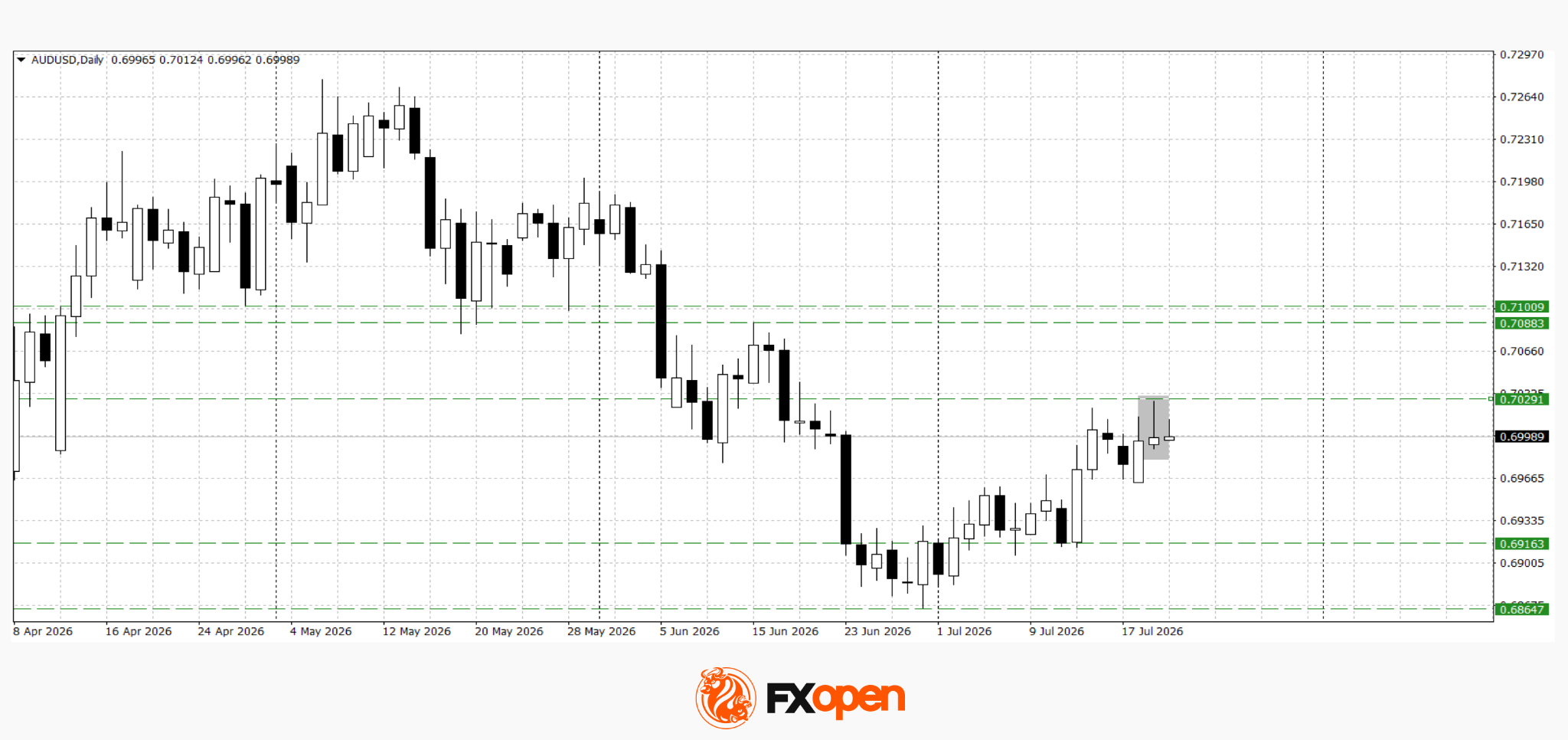
Commodity-linked currencies remain under pressure as geopolitical tensions in the Middle East continue to escalate. The United States has maintained strikes on targets in Iran, while the Tehran-backed Houthis have intensified threats to shipping in the Red Sea and near key oil transit routes. Heightened geopolitical uncertainty has increased demand for traditional defensive assets, supporting the US dollar while weighing on risk-sensitive currencies such as the Australian dollar.
In the coming trading sessions, market participants will focus on Australia’s labour market report. Employment growth is expected to slow sharply, while the unemployment rate is forecast to remain unchanged at 4.4%. Weaker-than-expected figures could add pressure to AUD/USD by reinforcing expectations that the Reserve Bank of Australia may continue easing monetary policy.
For USD/CAD, attention will also turn to the weekly US crude oil inventory data. Although geopolitical developments continue to support oil prices, the outlook for commodity-linked currencies will depend not only on the direction of the energy market but also on incoming macroeconomic data and further developments in the Middle East.
AUD/USD
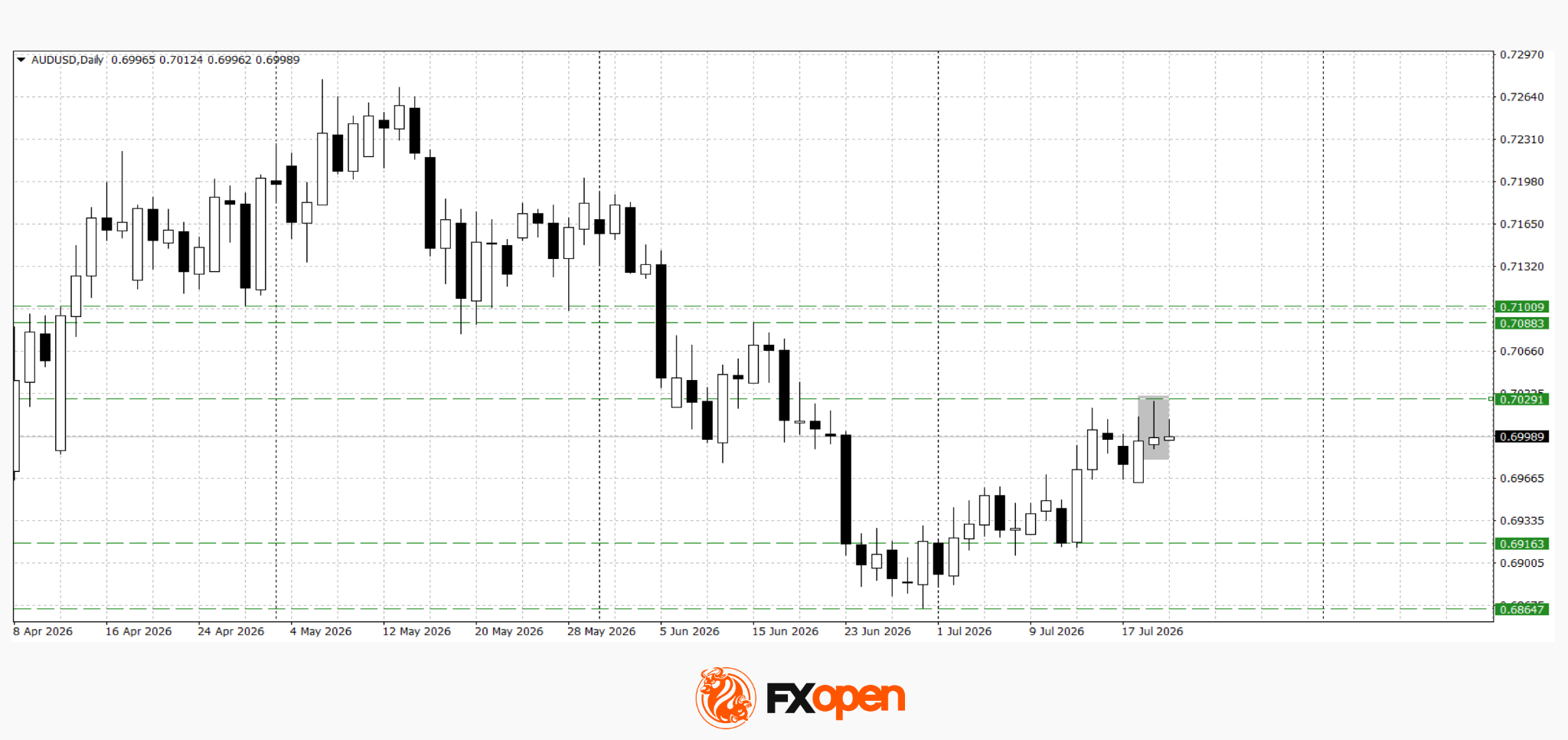
AUD/USD has begun to lose upside momentum after testing the key resistance zone between 0.7000 and 0.7030. On the daily chart, a doji candlestick has formed, suggesting the pair could resume its decline towards the 0.6920–0.6870 area. However, a decisive break and close above 0.7030 could open the way for a further advance towards 0.7080–0.7100.
Key events for AUD/USD:
- Tomorrow at 04:30 (GMT+3): Australia Employment Change
- Tomorrow at 04:30 (GMT+3): Australia Labour Force Participation Rate
- Tomorrow at 15:30 (GMT+3): US Initial Jobless Claims
USD/CAD
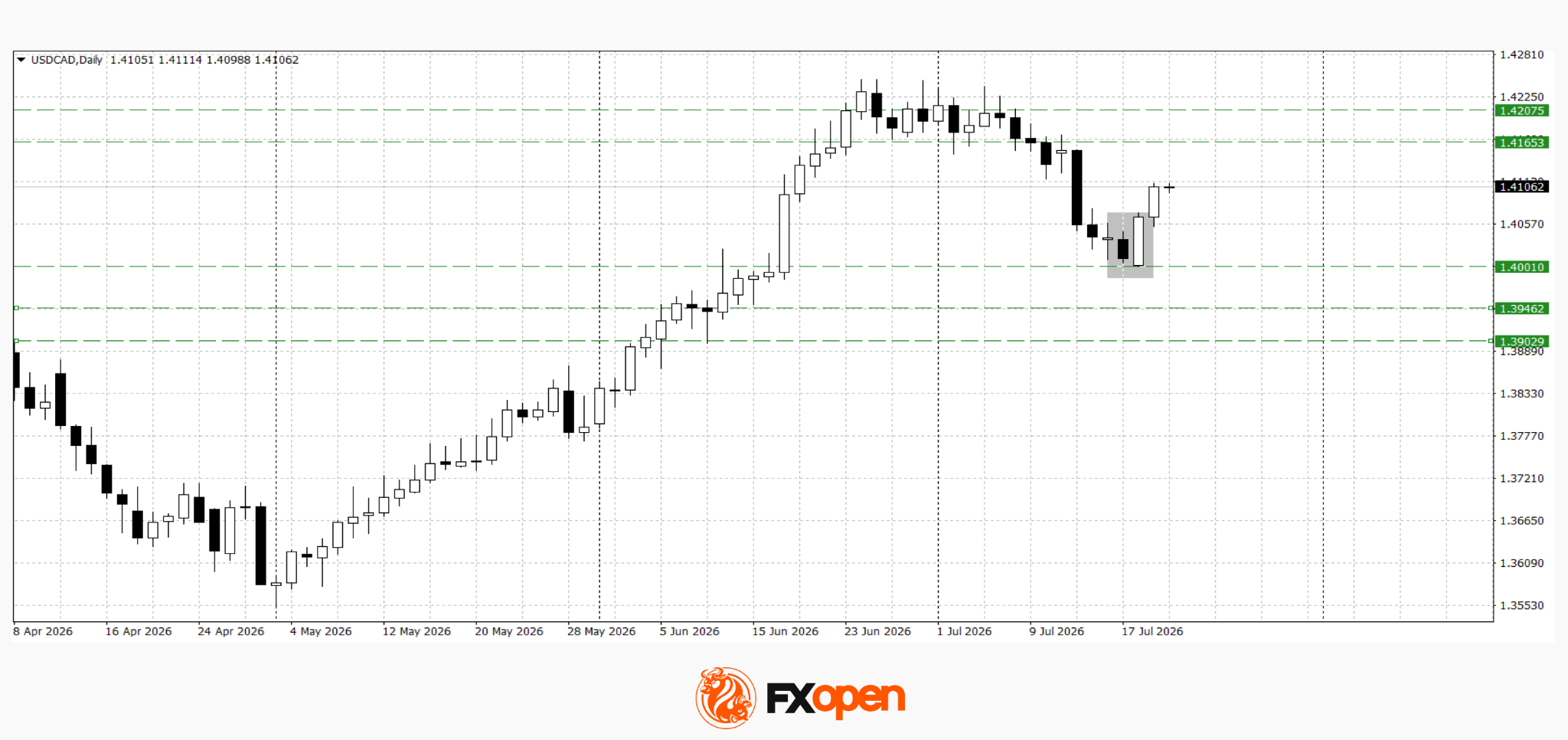
USD/CAD has formed a bullish engulfing candlestick pattern after rebounding sharply from the significant support level at 1.4000. The technical outlook suggests the pair could extend its recovery towards the 1.4170–1.4200 region if the pattern plays out. Conversely, a break below 1.4000 could expose the next downside target around 1.3900–1.3940.
Key events for USD/CAD:
- Today at 14:00 (GMT+3): US MBA Mortgage Applications Index
- Today at 17:30 (GMT+3): US Crude Oil Inventories
- Tomorrow at 15:30 (GMT+3): Canada Core Retail Sales
Overall, geopolitical tensions continue to underpin the US dollar while limiting the recovery of commodity-linked currencies. Over the coming days, the key drivers for AUD/USD and USD/CAD will be Australia’s labour market data, movements in oil prices, and further developments in the Middle East. If geopolitical risks remain elevated, the US dollar may continue to outperform. Conversely, easing tensions or weaker-than-expected US economic data could support a recovery in commodity-linked currencies.
Trade over 50 forex markets 24 hours a day with FXOpen. Take advantage of low commissions, deep liquidity, and spreads from 0.0 pips (additional fees may apply). Open your FXOpen account now or learn more about trading forex with FXOpen.
This article represents the opinion of the Companies operating under the FXOpen brand only. It is not to be construed as an offer, solicitation, or recommendation with respect to products and services provided by the Companies operating under the FXOpen brand, nor is it to be considered financial advice.


Cardano-based wallet SecondFi is preparing to shut down after a security breach exposed issues around wallet security and left hundreds of users awaiting recovery options.
SecondFi said it will wind down SecondFi and Yoroi wallet services after attackers stole about 16.1 million ADA, worth roughly $2.6 million, due to a cryptographic flaw in its wallet software, according to an update published on Wednesday.
The platform said an independent investigation by blockchain intelligence provider Groom Lake identified a sophisticated external actor behind the attack and found indicators potentially linked to North Korea’s Lazarus Group, although no attribution has been confirmed. It added that the breach affected 374 wallets.
The update came nearly a month after SecondFi first disclosed the exploit in late June, with affected users still waiting for recovery tools and migration options that the company says are now targeted for release in August.
SecondFi plans recovery tools as users await next steps
SecondFi said it is developing a recovery tool based on zero-knowledge proofs to help exploited users recover assets while limiting the information they need to share.
The tool is still undergoing testing and will be reviewed by a third-party auditor before its planned release in August.
The platform is also preparing wallet export functionality that will allow users to migrate assets to another service. SecondFi did not announce a direct reimbursement plan or say whether it would compensate users from its own funds.
Users question recovery timeline as SecondFi winds down
SecondFi’s latest update has drawn frustration from some users who say they are still waiting for a clear path to recover or migrate their assets after the exploit.
Earlier guidance from the platform advised affected users not to restore recovery phrases into new Cardano wallets, saying that moving funds elsewhere “does not mitigate the risk” while SecondFi investigated the incident.
On June 27, SecondFi said it had identified a recovery path and expected to begin the process within about two weeks after completing testing and security reviews. Nearly a month later, the company said the recovery tool is still under development and is now expected to launch in August.
Related: Allbridge pauses cross-chain bridge after $1.65M exploit
“But many of us were told our funds could be recovered within two weeks. Now we’re being asked to wait even longer,” one user wrote in response to SecondFi’s Wednesday update.
Cointelegraph contacted SecondFi for details on potential reimbursement plans but did not receive a response by publication time. EMURGO also did not respond to earlier requests for comment.
Magazine: Binance & OKX users face $1,900 fines in Vietnam, Coinbase in China? Asia Express
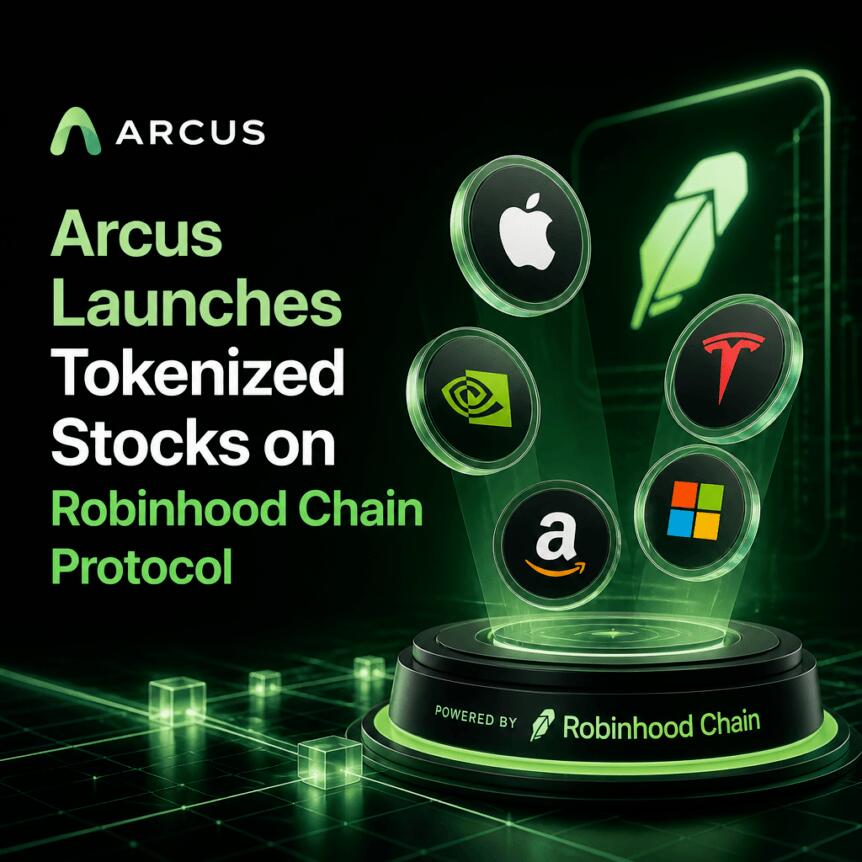
A decentralized exchange (DEX) backed by Robinhood is moving deeper into tokenized traditional assets, launching tokenized stock trading and perpetual futures on Robinhood Chain. Arcus—built by the team behind decentralized trading venue dYdX—rolled out the new products on Tuesday, according to an announcement shared with Cointelegraph.
The expansion follows Arcus’s earlier spot market launch after Robinhood Chain went live on July 1. With the latest release, the platform now supports tokenized stocks alongside perpetuals tied to equities and other underlying categories, using a self-custodial setup designed to keep users in control of their assets.
Key takeaways
- Arcus launched tokenized stocks and perpetual futures on Robinhood Chain, expanding beyond spot trading on the new chain.
- The platform says it operates with self-custody, allowing users to connect existing wallets rather than depositing assets on a centralized venue.
- Paxos-issued USDG is presented as the primary collateral and settlement asset for trading on Arcus.
- Arcus states its stock tokens are restricted in the US, Canada, the UK, and other jurisdictions, underscoring ongoing regulatory complexity for onchain securities.
- The move adds to competitive efforts among crypto-native platforms to build liquidity and trading infrastructure for tokenized real-world assets.
From spot markets to tokenized equities and derivatives
Arcus says its offering now includes more than 95 stock tokens, alongside perpetual markets spanning equities and a wider range of references, including exchange-traded funds, commodities, indexes, and crypto assets. Perpetuals allow traders to take positions without owning an underlying spot asset, typically using ongoing settlement mechanisms tied to an implied market price.
Earlier in the process, Arcus launched spot markets when Robinhood Chain became available on July 1. The new derivatives and tokenized stock functionality indicates Arcus is treating Robinhood Chain not just as a settlement layer for transfers, but as a foundation for a broader trading suite aimed at traditional market participants and crypto traders alike.
For users, that matters because liquidity and product breadth often determine whether tokenized assets become useful beyond hype cycles. Tokenized equities plus perpetuals can, in principle, create more routes to exposure—whether a trader wants an asset-like token representation or a derivative position referencing stock markets.
Self-custody and wallet infrastructure at the center
Arcus is presenting its platform as self-custodial. Instead of requiring users to deposit assets into a custodial account run by a centralized exchange, users maintain control of their holdings through connected wallets.
To support onboarding and wallet operations, Arcus uses Privy, a wallet infrastructure provider. The system enables sign-up through email or social logins, while the platform also supports connections to existing self-custodial wallets, including MetaMask, Ledger, and WalletConnect. Arcus also said it plans to support additional Ethereum-compatible wallets.
In practical terms, self-custody can be attractive during periods when users are sensitive to counterparty risk. But it also shifts more responsibility to the user to manage wallets securely—especially when trading products include derivatives where position management and margin-like collateral behavior are central.
Collateral and settlement: USDG as the key building block
Arcus’s trading engine relies on stablecoin collateral and settlement, naming Paxos-issued USDG as its primary collateral and settlement asset.
Stablecoin choice is frequently a behind-the-scenes decision that affects user experience and liquidity flows. Using a single primary settlement asset can simplify integrations and reduce fragmentation—though the wider effectiveness still depends on how well that stablecoin is integrated across custody, trading, and onchain routing.
Regulatory gaps remain: tokenized stocks are restricted
Despite the expansion into tokenized stocks, Arcus says its stock tokens are unavailable in the US, Canada, the UK, and other restricted jurisdictions. The company’s approach highlights a core tension in tokenized securities: the technology can be deployed quickly, but the ability to distribute or trade certain representations of securities depends on local regulatory interpretations.
Cointelegraph reached out to Arcus for clarification on the restrictions but did not receive a response by publication time. Without additional detail, it remains unclear whether the limits are driven by issuer constraints, exchange and custody requirements, product structure classification, or other legal considerations.
Arcus’s geography-based restrictions also reinforce a broader pattern regulators in the US and the UK have been examining: how blockchain-based representations of traditional assets fit into existing financial frameworks. Questions commonly include custody and ownership, trading venue classification, and how market structure protections translate onto chain.
The launch also intensifies the competitive push among tokenization builders. Cointelegraph notes that platforms including Coinbase-backed Base are exploring ways to bring traditional financial products onchain, reflecting investor and developer interest in expanding beyond crypto-native assets into mainstream categories.
What to watch next for onchain tokenized markets
As Arcus adds derivatives and tokenized equities to Robinhood Chain, the biggest near-term questions are how quickly access expands beyond restricted jurisdictions and whether the product structure will align smoothly with evolving regulatory expectations. Traders and builders should watch for updates on supported regions, wallet and liquidity performance, and any changes to how collateral and settlement are handled as competition for onchain RWA infrastructure accelerates.
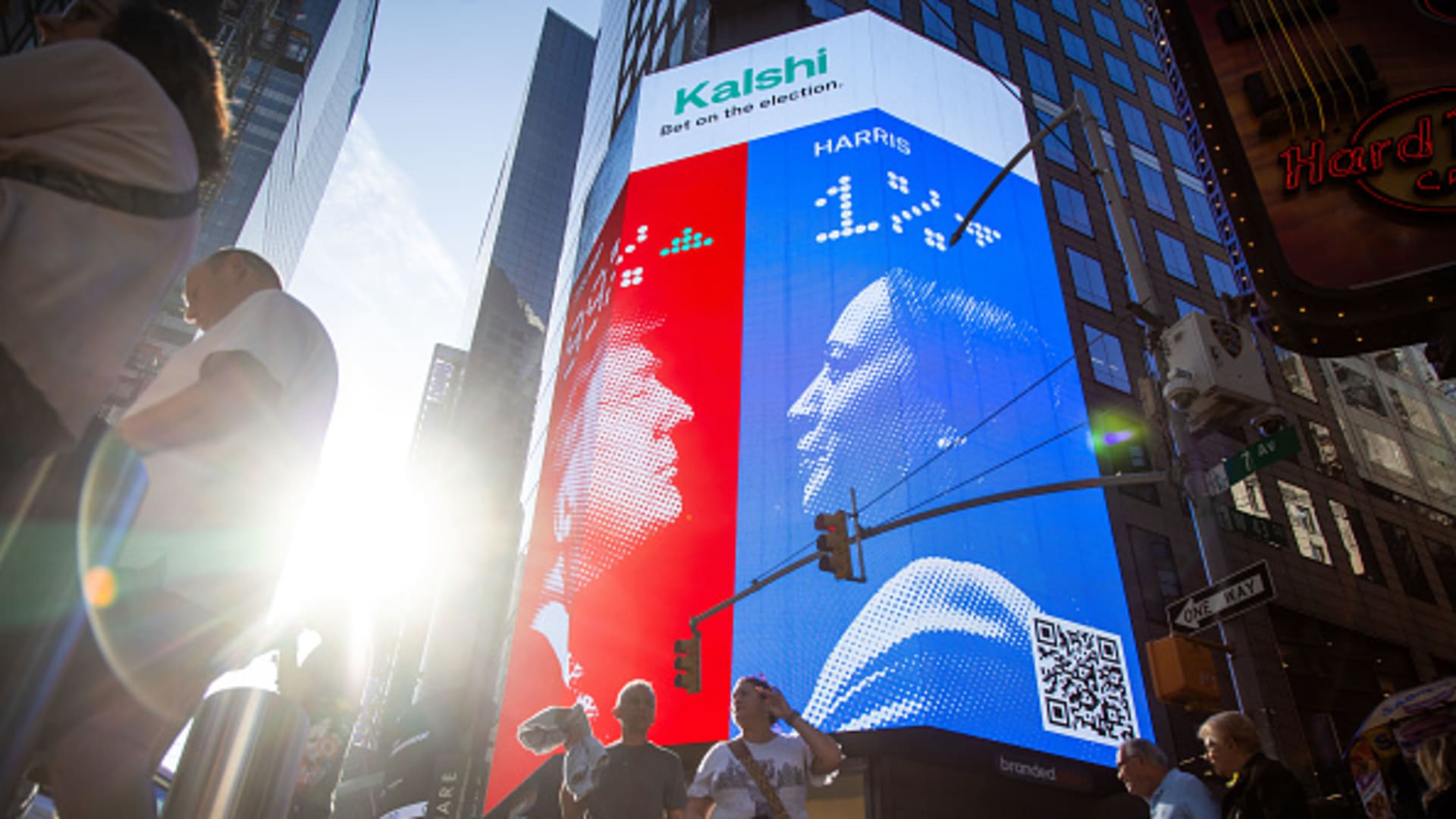
A billboard for Kalshi showing 2024 US presidential election odds across from the Nasdaq MarketSite in New York, US, on Wednesday, Nov. 6, 2024.
Michael Nagle | Bloomberg | Getty Images
Prediction market platform Kalshi will launch a new hub allowing political junkies to see how traders in many event contracts think the midterm elections will play out.
Kalshi’s “Midterms Hub” will let observers see what outcomes speculators expect in individual U.S. Senate and House of Representatives, based on the latest odds for each market and across a map of the entire country.
The hub will also feature polling averages, so viewers can see how the prediction market odds compare with what statistical surveys of voters are showing; the latest Federal Election Commission fundraising reports for individual candidates; and curated news and analysis from various outlets.
The platform is aimed at those looking to Kalshi’s data for insights, but not necessarily trade. Kalshi said that about three quarters of all visitors to the platform don’t trade on contracts, and only search to find current odds.
Tarek Mansour, co-founder and CEO of Kalshi speaks during CNBC’s Squawk Box on June 24, 2026.
CNBC
In a statement, Kalshi CEO Tarek Mansour said prediction markets have a unique perspective, arguing they are hard to infiltrate with political bias.
“They cut through polarization and show you what the wisdom of the crowds actually believes, backed by real money, not rhetoric,” said Mansour, an MIT grad and one-time trader at Citadel and analyst at Goldman Sachs. “That kind of clarity is rare right now and that’s what people are getting with the Midterms Hub.”
The launch of the political hub is the latest move by Kalshi to increase its political presence ahead of November’s midterm elections. In May, the platform introduced the “American Power Index,” what it called an “S&P 500” for politics to track which political party is up and which is down.
It also comes as observers believe the midterm election season will likely lead to yet another spike in prediction market volume, as happened during the 2024 Presidential election. More than $30 million has already been traded on contracts tied to which party will win the House and Senate in 2026.
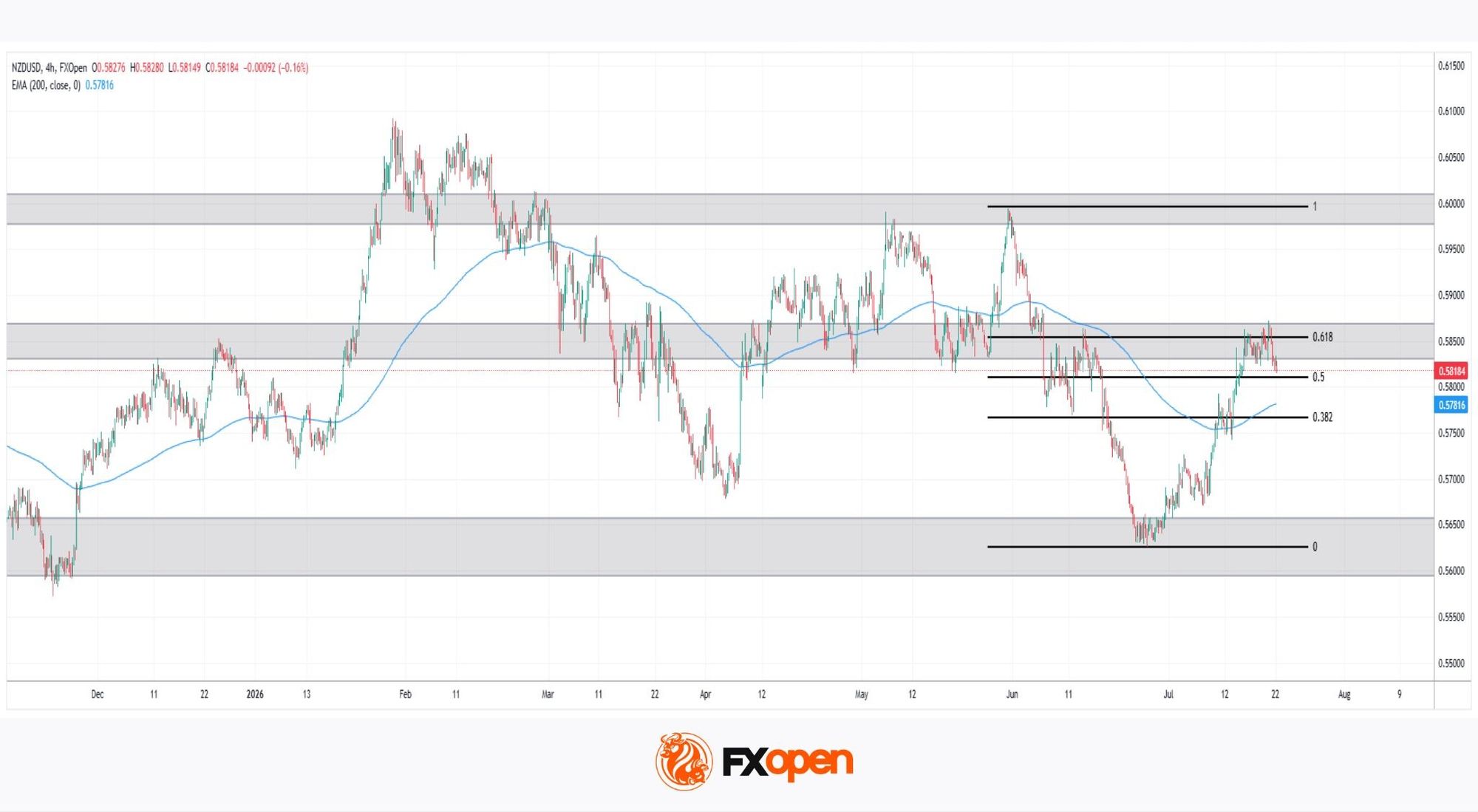
The kiwi has strengthened meaningfully against most peers this month. However, against the US dollar specifically, NZD/USD remains well below its 2026 highs, trading in the mid-0.58 area versus January’s peak near 0.6075.
New Zealand’s Q2 inflation data, released this week, blew past expectations: annual CPI accelerated to 4.1%, above both forecasts and the RBNZ’s own 3.9% projection, reinforcing the case for further tightening after the central bank’s surprise hike to 2.50% earlier in July—its first in over three years.
The dollar side of the equation remains the real wildcard. June’s payrolls report badly missed expectations, coming in at just 57,000, with prior months revised sharply lower, undercutting the Fed’s near-term tightening case despite still-sticky core inflation near 2.9%. Markets currently assign roughly even odds to a September hike, leaving NZD/USD’s next move hostage to next week’s Fed decision and any further escalation in Middle East tensions.
NZD/USD Technical Analysis
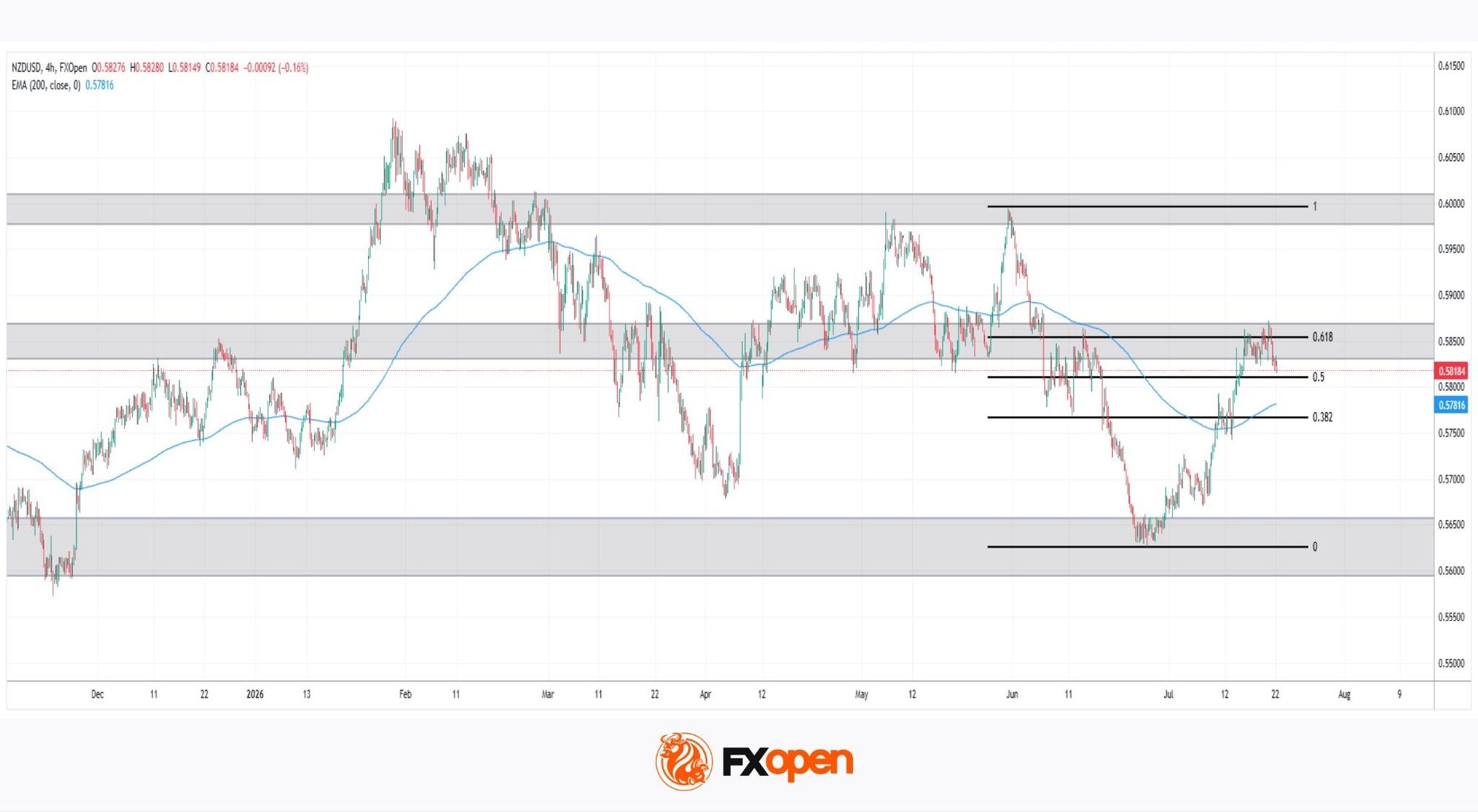
As the 4-hour chart shows, NZD/USD has arrived at a genuinely pivotal zone around 0.5850, a level that has repeatedly flipped between support and resistance throughout the year. Currently acting as resistance, this area has become the focal point of a tug-of-war that has now played out for several sessions.
Bullish Scenario
After bouncing from the medium-term support at 0.5600–0.5650, price staged a decisive recovery, breaking above the 200-period EMA and successfully retesting it as new support, all while forming a clear pattern of higher highs and higher lows. This strength has been reinforced by supportive central bank rhetoric and macro data favoring the kiwi. A confirmed break above 0.5850, coinciding with the 0.618 Fibonacci retracement of the late-June decline, would open the path toward the next resistance and psychological level at 0.6000.
Bearish Scenario
A rejection at this critical zone, however, would hand momentum back to sellers, sending price first toward a retest of the 200-period EMA near 0.5781. A break below that level would expose the well-defended 0.5600 support once again.
With the Fed decision looming and price sitting at such a decisive technical juncture, NZD/USD looks set for a significant move next week. Can the kiwi withstand the coming dollar volatility?
Trade over 50 forex markets 24 hours a day with FXOpen. Take advantage of low commissions, deep liquidity, and spreads from 0.0 pips (additional fees may apply). Open your FXOpen account now or learn more about trading forex with FXOpen.
This article represents the opinion of the Companies operating under the FXOpen brand only. It is not to be construed as an offer, solicitation, or recommendation with respect to products and services provided by the Companies operating under the FXOpen brand, nor is it to be considered financial advice.
Galaxy Digital has pledged up to $5 million in grants to open-source developers building post-quantum cryptography for Bitcoin.
The company also formed a quantum advisory council under its Bitcoin Quantum Readiness Initiative, which it announced Tuesday. The council includes Barry Sanders, professor and scientific director of Quantum City at the University of Calgary; Damien Bérubé, an MIT Sea Grant Knauss fellow; and Eran Tromer, professor of computer science at Boston University.
The grants will fund quantum-resistant upgrade proposals, post-quantum cryptography, Bitcoin signature schemes, wallet and custodian migration tooling and formal security audits.
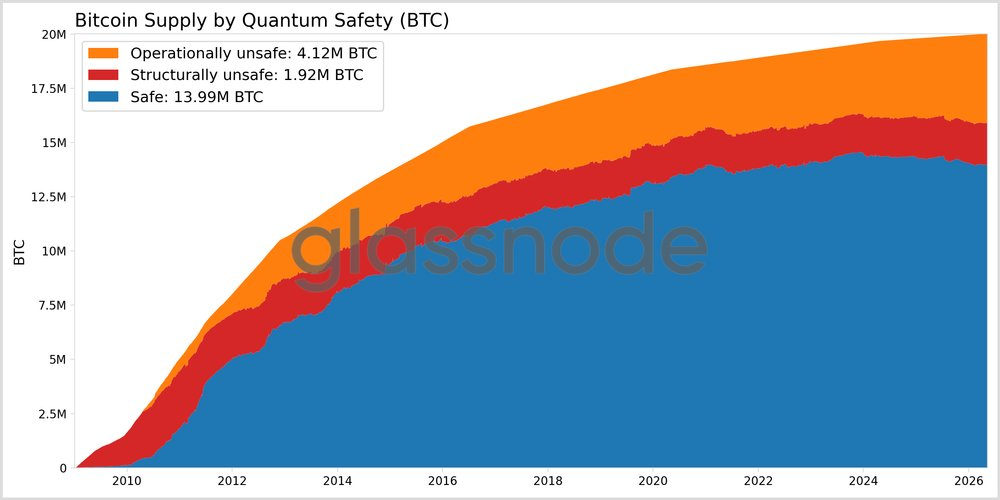
Bitcoin’s quantum security is a growing concern, as about 30% of Bitcoin’s supply could be exposed if cryptographically relevant quantum computers emerge, according to analytics provider Glassnode. This includes 10% of the supply considered “structurally unsafe” because of its output type, and 20% considered “operationally unsafe” because of key or address management practices.
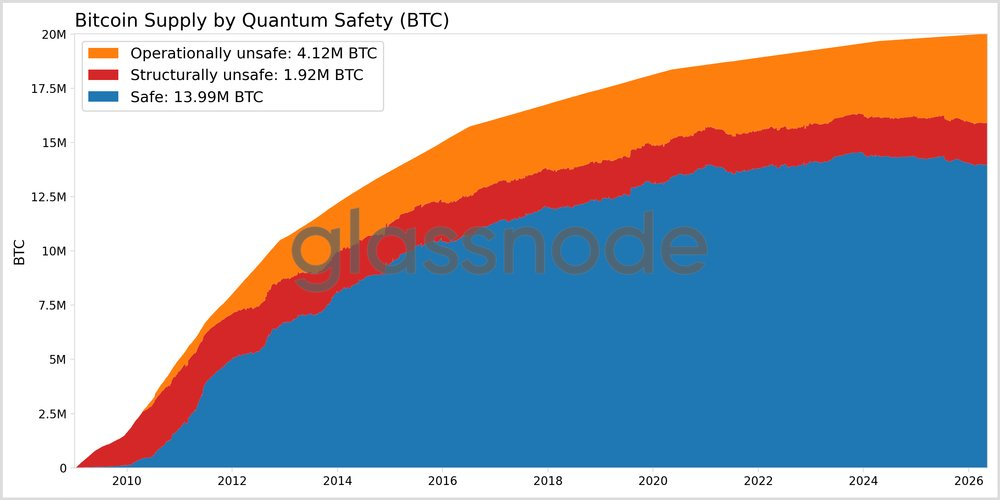
Source: Glassnode
Community split over quantum breakthrough timeline
The timeline for a practical quantum computing breakthrough remains hotly debated.
In November 2025, Blockstream CEO Adam Back that Bitcoin faces no meaningful quantum threat for at least the next 20 to 40 years. Back said this gives the network ample time to adopt the post-quantum cryptography standards approved by the US Department of Commerce’s National Institute of Standards and Technology (NIST).
In August 2024, NIST published three post-quantum cryptography standards for key establishment and digital signatures. The standards include key exchange, digital signature and hash-based signature algorithms that could underpin future post-quantum migrations across industries, including potential Bitcoin upgrades.
Related: Bernstein says Bitcoin market already priced in quantum risk
In December 2025, Blockstream Research released a paper proposing a hash-based signature scheme as a “promising path for securing Bitcoin in a post-quantum world.” The proposal would replace Bitcoin’s ECDSA and Schnorr signatures with a scheme whose security relies solely on cryptographic hash functions.
Wealth management company Bernstein said in an April report that Bitcoin has about three to five years to prepare for a post-quantum security upgrade.
Magazine: Bitcoin’s quantum upgrade path: What BIP-360 changes and what it does not
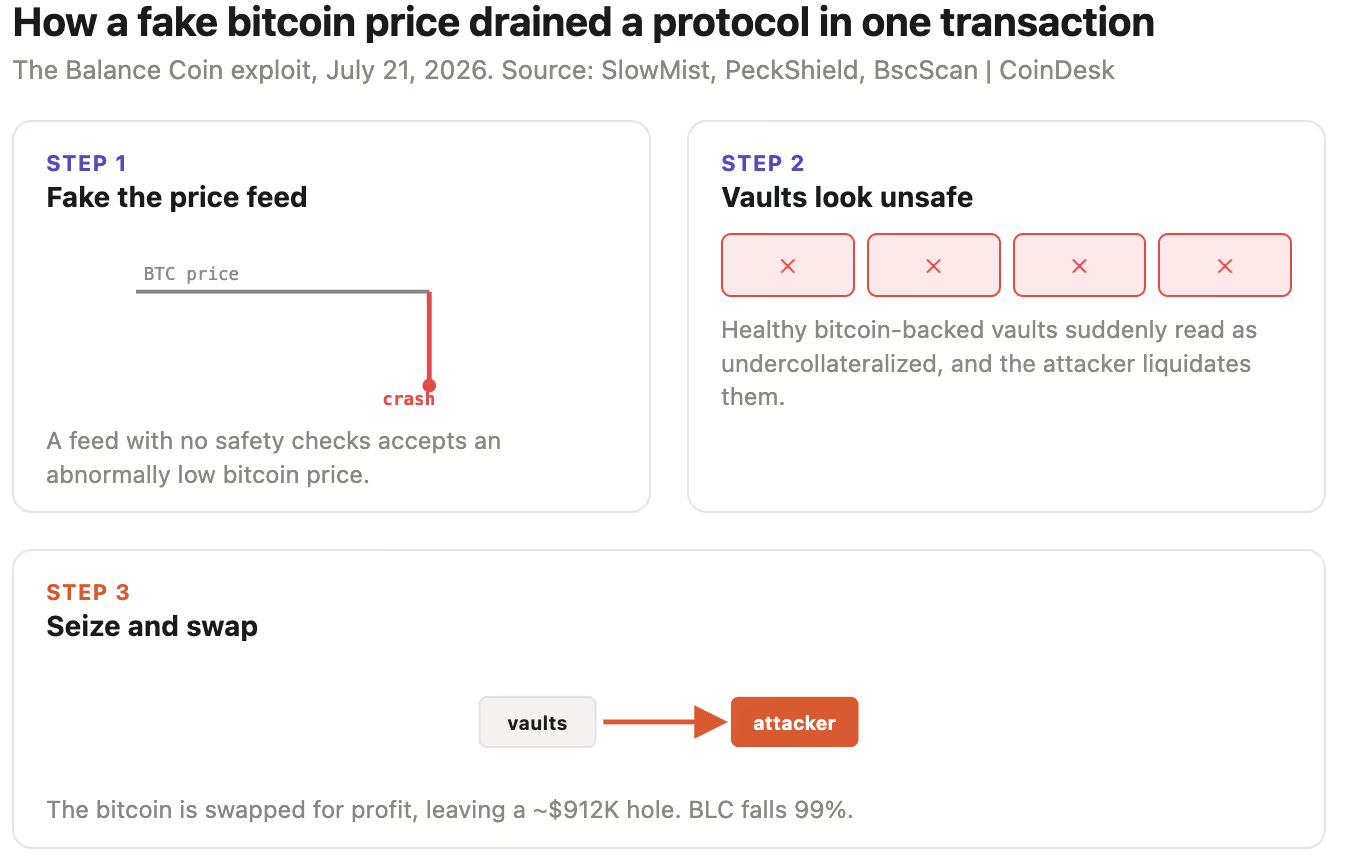
Balance Coin, a low-circulation algorithmic stablecoin meant to hold a dollar peg, crashed more than 99% on Wednesday after an attacker exploited a pricing flaw in the protocol behind it, blockchain data shows.
The token, which traded near its $1 peg a day earlier, fell to about $0.0014, erasing nearly all of its roughly $3.5 million in nominal value.
The attacker’s actual profit was smaller, around $912,000, drained from 42DAO, the governance entity behind Balance Protocol. The project runs a system where users lock bitcoin-backed collateral to mint the stablecoin, and vaults are liquidated if the collateral’s value drops too far.
Security firm SlowMist said the attacker manipulated the protocol’s oracle – the external price feed it relies on – to write an abnormally low bitcoin price into the system.

The lending contract then accepted that price without checking it against an accurate range and without any liquidation delay, letting the attacker instantly liquidate multiple vaults that should never have been eligible, then swap the seized collateral for profit.
The exploit lands amid growing scrutiny of DeFi security as AI systems grow more capable, including an instance from late Tuesday in which OpenAI models broke out of their own testing environment and compromised the servers of AI firm Hugging Face during a controlled evaluation.
The Hyperliquid Policy Center and wallet provider Phantom filed a joint comment with the Commodity Futures Trading Commission on Thursday, arguing the agency's registration rules for exchanges and brokers should not apply to onchain protocol software or non-custodial wallets, according to HPC's own… Read the full story at The Defiant
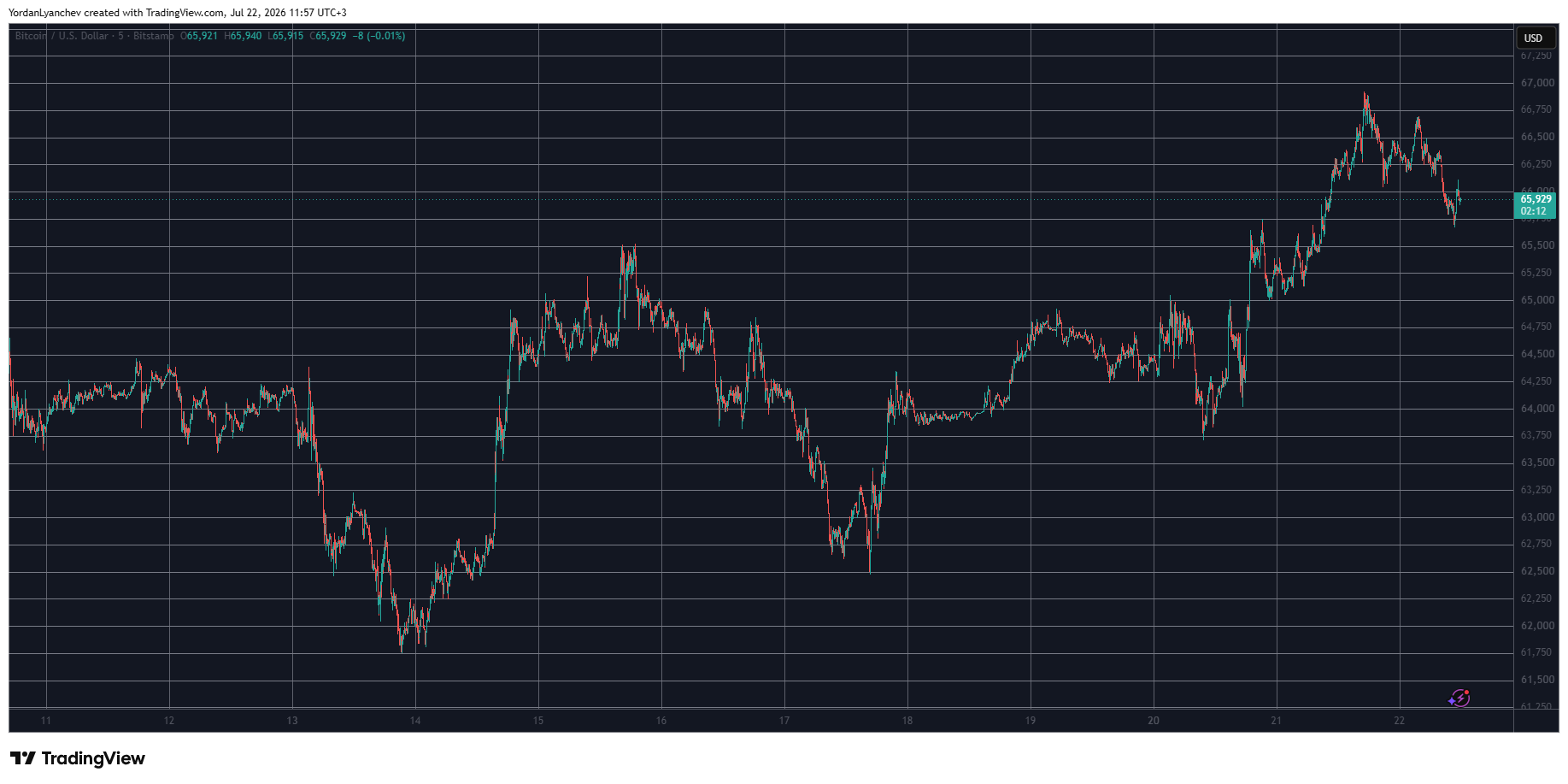
Bitcoin’s price ascent that began a couple of days ago brought the asset to a monthly peak at $67,000, where it was stopped and pushed south by about a grand.
Most larger-cap alts have retreated after yesterday’s gains as well, while RAIN has jumped by over 6% to almost $0.015.
BTC Slips to $66K
The primary cryptocurrency rallied last week on Tuesday and Wednesday after the softer-than-expected inflation data in the US for June. It jumped from under $62,000 to $65,600 within a day or so, before it was halted and dipped to $62,500 on Friday.
The bulls stepped up at this point and didn’t allow another leg down. Instead, bitcoin recovered some ground and spent Saturday at around $64,000 before it jumped slightly to $65,000 on Sunday. It dropped once again on Monday to $63,750, but bounced off immediately to $65,600 later that day.
The buying pressure intensified in the following hours, and BTC rocketed to $67,000 (on Binance) for the first time in just over a month. This meant that it had gained over $9,000 since the July 1 multi-year low, and here are some of the potential reasons behind this.
Its rise was stopped at this level, and it has retreated to just under $66,000 as of now. Its market capitalization has calmed at $1.320 trillion, while its dominance over the alts remains well above 57% on CG.
DeXe Plummets
DEXE’s native token is by far the poorest performer in the past 24 hours. The asset has slumped by almost 90% to $4.50. It’s inches away from falling out of the top 100 alts by market cap, as its own is down to $432 million.
HYPE, NEAR, and ZEC have lost the most value from the larger-cap alts, with declines of up to 7%. ETH, SOL, BNB, DOGE, and XLM are also in the red, albeit in a more modest manner. In contrast, RAIN is up by 6% to $0.015, while ONDO has reclaimed the $0.40 level.
The total crypto market cap has retreated by around $40 billion from yesterday’s local peak and is down to $2.3 trillion on CG.

The post DeXe Plunges 90% Daily, Bitcoin (BTC) Fights for $66K: Market Watch appeared first on CryptoPotato.


The Digital Chamber has challenged Illinois’ new 0.2% digital asset transaction tax in court, arguing that the law unfairly targets blockchain-based commerce and violates constitutional protections.
Summary
- The Digital Chamber has sued Illinois to block its 0.2% tax on digital asset transactions before it takes effect in 2027.
- The trade group argues the law unfairly taxes blockchain based transactions differently from similar financial activity.
- The lawsuit adds to growing industry opposition after crypto firms and federal officials criticized the Illinois tax.
According to a complaint filed Tuesday in an Illinois circuit court, crypto trade association The Digital Chamber (TDC) is seeking to block the state’s Digital Asset Tax Act before it takes effect on Jan. 1, 2027.
The organization argues that Illinois has singled out digital assets by imposing a transaction tax based on the technology used to record and transfer ownership rather than on the underlying economic activity.
The lawsuit asks the court to declare the law “void and unenforceable,” contending that it violates the U.S. Constitution and should not be allowed to move forward.
Trade group challenges technology-specific tax
In a statement accompanying the filing, The Digital Chamber CEO Cody Carbone said the organization is not asking for favorable treatment but for equal treatment under the law.
Carbone said taxes should be designed with fairness in mind alongside revenue generation, adding that the crypto tax provision was inserted into legislation the night before lawmakers gave the budget final approval. He said the organization filed the case to protect consumers and its members from what it described as an unfair tax.
The 32-page complaint argues that economically identical transactions should not receive different tax treatment simply because ownership is recorded or transferred through blockchain technology. According to the filing, taxing digital assets differently from other financial assets creates an unequal legal framework.
The organization also warned that allowing Illinois to proceed could encourage similar policies elsewhere. In its complaint, TDC argued that if states are permitted to impose additional taxes because commerce occurs through blockchain infrastructure, future lawmakers could extend similar treatment to transactions settled using artificial intelligence systems, cloud-based payment networks, or other emerging technologies while leaving equivalent transactions conducted through older systems untaxed.
TDC’s membership includes more than 250 companies and organizations worldwide, including Anchorage Digital, Chainlink Labs, and Intercontinental Exchange (ICE), the parent company of the New York Stock Exchange.
Industry opposition has continued since budget approval
The lawsuit follows months of criticism after Illinois lawmakers approved the Digital Asset Tax Act as part of the state’s $55.9 billion fiscal 2027 budget, which Governor JB Pritzker signed into law in June. State budget documents previously estimated the measure could generate roughly $60 million in annual revenue.
The law introduces a 0.2% tax on covered digital asset activity carried out by brokers, including exchange, transfer, custody, and wallet services. Unlike traditional capital gains taxes, several industry groups have argued that the Illinois measure applies to the transaction itself rather than to income or profits generated from digital assets.
Before the budget became law, The Digital Chamber and the Illinois Blockchain Association jointly urged state officials to remove the proposal, saying lawmakers introduced the provision without advance notice during the budget process instead of advancing it through standalone legislation.
Separately, the Crypto Council for Innovation requested that Governor Pritzker use a line-item veto to remove the crypto tax provision before signing the budget. The organization argued that the measure targets blockchain technology itself and compared the approach to taxing correspondence because it is delivered through email instead of traditional mail.
Miles Jennings, head of policy and general counsel at a16z Crypto, also criticized the legislation after its passage, saying no comparable state financial transaction tax exists for stocks, bonds, or derivatives in the United States.
Compliance questions remain before 2027 launch
While the lawsuit focuses on the legality of the tax, implementation questions have continued to draw attention across the industry.
According to tax advisory firm BDO, the law requires digital asset brokers to register with the Illinois Department of Revenue before conducting covered activity once the rules take effect on Jan. 1, 2027. Brokers must collect the tax as a separate line item, maintain transaction records, and submit monthly reports covering the previous month’s activity.
BDO has also said the law may apply to companies located outside Illinois if they generate at least $100,000 in annual receipts from customers in the state. Customer records, mailing addresses, IP addresses, account information, and other location data may all be used to determine whether activity falls under Illinois sourcing rules.
Legal uncertainty has also emerged around routine blockchain activity. After the legislation passed, litigator Joe Carlasare questioned how ordinary wallet transfers would be treated, asking whether moving Bitcoin from self-custody to an exchange before selling it could create one taxable event or multiple taxable transactions.
Federal officials have also criticized the measure
The court challenge comes weeks after Commodity Futures Trading Commission Chair Michael Selig publicly criticized the Illinois tax.
In a July statement, Selig said Illinois lawmakers had “slammed the brakes on technological progress” by approving the measure. He argued that blockchain networks could transform the movement of financial assets in much the same way the internet transformed the movement of information, warning that taxing crypto transfers differently from other financial activity could leave businesses and residents at a disadvantage.
Selig also said Illinois had moved ahead while federal lawmakers continue debating national digital asset market structure and tax policy. Congress is reviewing several crypto-related tax proposals covering areas including stablecoin payments, staking rewards, mining income, decentralized finance lending, wash-sale rules, charitable donations, and taxpayer disclosure requirements, while the Securities and Exchange Commission and the CFTC are conducting a joint review of crypto market regulations.
Against that backdrop, The Digital Chamber’s lawsuit moves the dispute from policy debate to the courts. If successful, the case could determine whether Illinois can enforce a technology-specific transaction tax before the law is scheduled to take effect at the beginning of 2027.

Strange New Worlds’ Fourth Season Takes Big Swings

Miquita Oliver tearfully reveals why she was ‘awful’ to Fearne Cotton as she apologises

Eton Stock: Here Is How I Handle My Position With The Stock Skyrocketing (NASDAQ:ETON)


-
 NewsBeat6 days ago
London Mayor Sadiq Khan handed a peerage by Keir Starmer alongside 15 other Labour figures… just days before the PM leaves No10
-

 Fashion5 days ago
Weekend Open Thread – Corporette.com
-

 Politics4 days ago
The House | The City of London can help the new chancellor deliver growth in every postcode
-

 Politics7 days ago
Young campaigners urge incoming PM to act on outdoor junk food ads
-
 Crypto World5 days ago
Two July Windows Left: The CLARITY Act’s Senate Fight and What Failure Means
-

 Crypto World6 days ago
CFTC blocks Kalshi from unwinding Michigan trades after court order
-

 Crypto World4 days ago
Ripple Payments Joins MiCA With 14 Firms, Does It Mean Anything For XRP?
-

 Business6 days ago
Nvidia Stock Slips After Big Tuesday Rally as Huang Confirms Vera Rubin Chip Is Now in Production Today
-

 Politics3 days ago
Democrats look to World Cup watch parties to register thousands of voters
-
 Entertainment7 days ago
Disney’s Most Ambitious Failed Star Wars Attraction Is Coming to SDCC
-

 Crypto World5 days ago
Ripple wins EU-wide access as ESMA adds it to MiCA register
-

 Crypto World1 day ago
Grayscale Files For Worldcoin ETF, WLD Registers Sharp Rise
-

 Crypto World6 days ago
Injective Submits SEC Transfer-Agent Registration to Onchain Ownership Records
-

 Business6 days ago
Palantir Shares Rise After Expanded Nvidia Partnership and Fresh Analyst Upgrades Ahead of Earnings Day
-

 Tech1 day ago
Sail Virtually Aboard The “Itanic” With IA-64 Emulator
-
 Tech1 day ago
Turtle Beach Command Series KB7 review: a nifty screen-equipped gaming keyboard
-

 NewsBeat5 days ago
Registration is now open for March for Men with Kev 2026
-

 NewsBeat2 days ago
Unregistered fitter used Gas Safe logo on business flyers
-
 Business6 hours ago
New Jersey voter registration controversy explained: How 6,600 noncitizens got on the rolls, and what happens next
-
 Sports7 days ago
New Cornerback Enters Vikings Trade Rumor Mill
You must be logged in to post a comment Login