

Crypto World
Allbridge Core Pauses Protocol After Attacker Drains More Than $1 Million



Allbridge Core paused its protocol after an attacker exploited its stablecoin liquidity pools, with blockchain tracker Onchain Lens estimating losses exceeding $1 million.
The incident adds to a growing number of attacks targeting crypto protocols, with exploits resulting in $57.8 million in losses in July 2026.
How the Allbridge Exploit Unfolded
Onchain Lens reported that Allbridge Core suffered an exploit on Solana, resulting in losses of more than $1.1 million.
According to the firm, the attacker used a $1.12 million USDC flash loan from Kamino to manipulate the protocol’s USDC/USDT stablecoin pool through a series of rapid swaps, distorting the pool’s ratios before withdrawing liquidity at inflated values.
The attacker repaid the flash loan within the same transaction. That move extracted roughly $1.1 million.
Onchain Lens added that the stolen funds were later routed through privacy protocols to obscure their movement. The post also identified the largest single withdrawal at $2.24 million USDC.
Follow us on X to get the latest news as it happens
Allbridge Seeks Recovery of Funds After Exploit
Allbridge paused the protocol as a precaution and opened an investigation. It said the imbalance briefly opened an arbitrage window for some traders. Allbridge asked traders who profited from the imbalance to return funds.
The team said they aim to “return all affected funds.”
“If you took advantage of it, please consider returning funds to the address below – this will go directly toward compensating affected LPs. 0x01a494079DCB715f622340301463cE50cd69A4D0,” the post read.
The latest attack follows another flash loan exploit that targeted Allbridge in April 2023. In that incident, an attacker exploited an Allbridge pool in the BNB network, resulting in losses of approximately $570,000.
BeInCrypto has reached out to Allbridge for comment.
Subscribe to our YouTube channel to watch leaders and journalists provide expert insights
The post Allbridge Core Pauses Protocol After Attacker Drains More Than $1 Million appeared first on BeInCrypto.


The U.S. Securities and Exchange Commission (SEC) has filed a lawsuit against crypto mining investment business Mining Automatic and its founder, Zan Shaikh, accusing them of raising $22 million from investors while allegedly putting only a small fraction of that money into mining operations.
In its complaint, the SEC says the scheme—operated through Massachusetts-based Bright Vision Distribution LLC—took in funds from more than 380 investors between June 2023 and May 2025, promising guaranteed monthly returns from “crypto asset mining.” The regulator alleges the advertised payouts could not be supported by the underlying mining activity.
Key takeaways
- The SEC alleges Mining Automatic raised $22 million while spending about 13% on mining operations, despite promising monthly investor returns.
- According to the complaint, mining generated about $1.1 million, while investor payments in purported returns totaled roughly $1.8 million—creating a funding gap.
- The SEC claims investor funds were diverted to marketing, personal expenses, and unrelated ventures, with significant advertising costs reported.
- Mining Automatic allegedly stopped paying investors by March 2025, and the SEC states more than $20 million in principal remains unpaid.
- The SEC is seeking disgorgement, civil penalties, permanent injunctions, and a ban on Shaikh selling securities or serving as an officer or director of a public company.
SEC alleges promised mining returns were not supported by results
At the center of the SEC’s case is the mismatch between what Mining Automatic allegedly sold to investors and what the business could deliver. The SEC claims the company operated a marketing-led investment program that promised guaranteed monthly earnings tied to crypto mining, even though the operation reportedly produced far less revenue than needed to pay investors.
In the complaint, the SEC alleges the scheme generated approximately $1.1 million from mining while paying investors about $1.8 million in “purported returns.” The regulator says that shortfall meant some payments were funded with money from other investors, describing the arrangement as having “some of the hallmarks of a Ponzi scheme.”
Where investor money allegedly went
The SEC also outlines how it believes the funds were used once they entered the operation. It says Mining Automatic allegedly spent about $7 million on advertising intended to bring in new investors. Separately, the complaint alleges that Shaikh used investor funds for personal and lifestyle expenses, including real estate, vehicles, entertainment, and transfers to his personal bank accounts.
These allegations, if proven, aim to show not just a failure to deliver returns, but an intentional structure that depended on continued inflows rather than mining profitability. The SEC further states that none of the investors had recovered their original investment by the time Mining Automatic stopped paying, which allegedly occurred by March 2025.
Regulator seeks bans and financial remedies
Along with bringing the case, the SEC is seeking multiple forms of relief. The agency requests disgorgement, civil penalties, and permanent injunctions. It is also asking for court orders barring Shaikh from selling securities and from serving as an officer or director of a public company.
The complaint further states that more than $20 million in principal remains unpaid, underscoring the scope of alleged investor losses.
Case lands as the SEC pushes rulemaking priorities
The lawsuit is unfolding during a period in which the SEC has increasingly signaled a shift toward clearer regulation for digital assets, alongside its ongoing enforcement activity. Under Chair Paul Atkins, the SEC has emphasized rulemaking and long-term planning for how blockchain and token-based markets should fit into the agency’s investor-protection mandate.
In June, the SEC published its 2026–2030 Strategic Plan, identifying blockchain technology, tokenization, and crypto market infrastructure as long-term priorities while reaffirming its focus on protecting investors.
Then in July, the SEC expanded on its approach by describing its 2026 rulemaking agenda. That agenda reportedly includes proposals affecting crypto broker-dealers, digital assets traded on national securities exchanges and alternative trading systems, and possible exemptions or safe harbors for certain digital asset offerings.
At the same time, policy discussions on Capitol Hill continue. The lawsuit comes amid congressional efforts to clarify the roles of the SEC and the Commodity Futures Trading Commission (CFTC) through the proposed Digital Asset Market Clarity Act. If enacted, the bill would aim to define oversight boundaries between the agencies. According to the broader legislative reporting referenced by Cointelegraph, a key Senate vote is expected before lawmakers enter their August recess.
What to watch next
For investors and builders, the immediate next step will be how the SEC and the defense address the alleged “guaranteed return” model—particularly the claimed funding gap between mining revenues and investor payments. The outcome will likely also shape how aggressively regulators treat marketing-driven “mining investment” offerings as securities issues, especially as formal rulemaking efforts move forward.
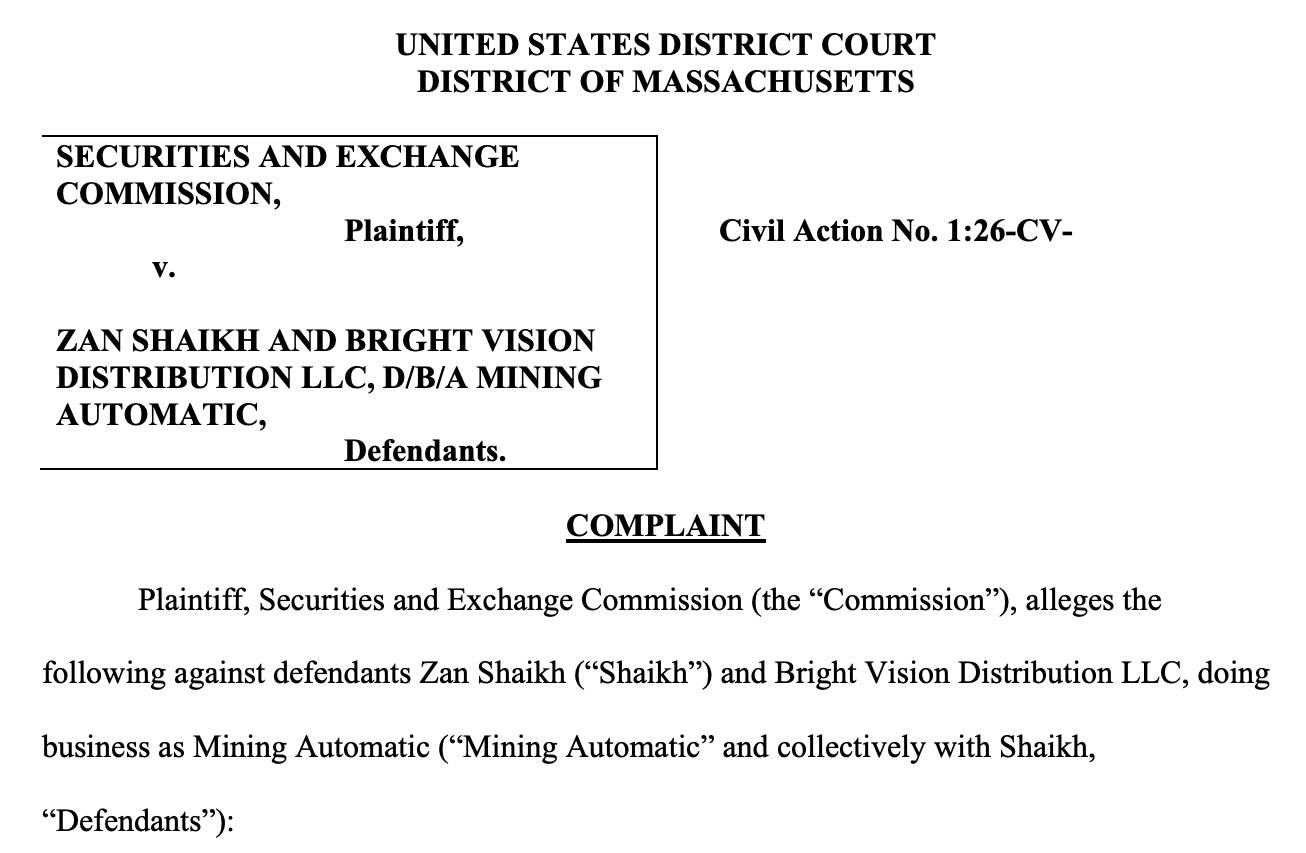
The US Securities and Exchange Commission (SEC) has sued crypto mining investment business Mining Automatic and its founder, Zan Shaikh, alleging they raised $22 million from investors while spending only about 13% of the funds on mining operations.
Mining Automatic was operated by Massachusetts-based Bright Vision Distribution LLC, which the SEC said raised the money from more than 380 investors between June 2023 and May 2025.
The company allegedly promised guaranteed monthly returns from crypto asset mining despite operating a business that could not generate the advertised payouts. The SEC said investor money was instead used for marketing, personal expenses and unrelated ventures.
According to the complaint, the operation generated about $1.1 million from mining while paying investors roughly $1.8 million in purported returns. The SEC alleged the shortfall meant some payments were funded with money from other investors, giving the scheme “some of the hallmarks of a Ponzi scheme.”
Mining Automatic also allegedly spent about $7 million on advertising to attract new investors, while Shaikh used investor funds for real estate, vehicles, entertainment and transfers to his personal bank accounts.
Related: White House says it received no Democratic response related to SEC, CFTC vacancies
Mining Automatic stopped paying investors by March 2025, and the SEC said none had recovered their original investment. More than $20 million in principal remains unpaid, according to the complaint.
The SEC is seeking disgorgement, civil penalties and permanent injunctions, along with orders barring Shaikh from selling securities or serving as an officer or director of a public company.
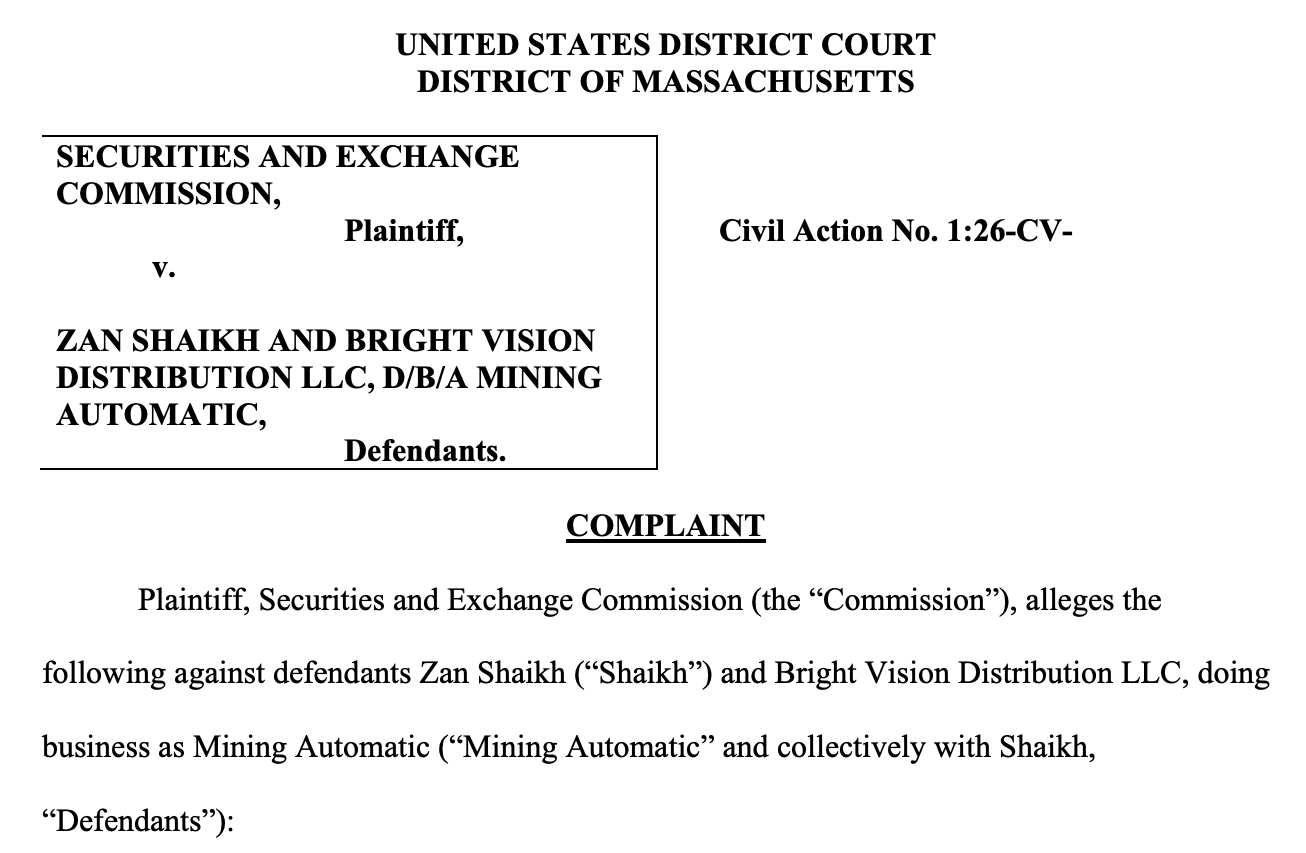
SEC complaint against Mining Automatic. Source: SEC
SEC shifts crypto focus toward rulemaking
The lawsuit comes as the SEC has increasingly emphasized developing clearer rules for digital assets under Chair Paul Atkins. In June, the agency published its 2026–2030 Strategic Plan, identifying blockchain technology, tokenization and crypto market infrastructure as long-term priorities while reaffirming its investor protection mandate.
The SEC expanded on that approach in July with its 2026 rulemaking agenda, proposing new rules for crypto broker-dealers, digital assets traded on national securities exchanges and alternative trading systems, and potential exemptions and safe harbors for certain digital asset offerings.
The regulatory push coincides with congressional efforts to reshape US crypto oversight through the Digital Asset Market Clarity Act, which would clarify the respective roles of the SEC and Commodity Futures Trading Commission (CFTC), if enacted. The bill is expected to face a key Senate vote before lawmakers begin their August recess.
Magazine: Peter Brandt predicts the exact day Bitcoin’s bear market will be over


The crypto sector continues to experience costly exploits on a near daily basis. In the past week alone, three blockchain bridges have been attacked, with an estimated total of over $5.7 million stolen.
The projects, Allswap, Across Protocol, and TeleSwap appear to have lost $1.65 million, $3.35 million and $735,000, respectively.
The sums lost this week may not be comparable to larger hacks during the first months of the year, but nevertheless show the continued vulnerability of blockchain bridges.
So far this year, Protos has tallied 20 bridge hacks, with a total of over $355 million lost.
Read more: Hackers switching to centralized exchanges to fund crypto attacks
Across Protocol
On Friday, Across Protocol disclosed an attack on Solana, advising users it had paused deposits on the affected blockchain.
The post reassured users that any lost funds “belong to the relayer operated by Risk Labs (the foundation supporting Across),” but didn’t state how much was stolen.
Examination of the two EVM addresses (1, 2) flagged by Across found inflows totalling $3.35 million on the morning of the exploit.
The majority of funds have since been consolidated to another address, which currently holds 1,500 ETH ($2.85 million).
Read more: More oracle exploits as Ostium loses over $20M
The attacker’s addresses were funded via privacy protocol Tornado Cash (on Ethereum) and no-KYC exchange FixedFloat (on Solana). Both are funding sources often favoured by illicit actors.
It remains unclear exactly what caused the hack, though Across said it would publish a “full technical post mortem next week.”
Allbridge
Late on Sunday, Allbridge was struck by a flash loan-powered exploit, also on Solana.
The price manipulation attack targeted one of Allbridge’s liquidity pools, draining $1.66 million in stablecoins USDC and USDT.
Read more: Supra patched oracle on 11 other chains before $9M Hedera exploit
In the firm’s initial alert warning of the attack, Allbridge asked any users who had profited off the “temporary positive arbitrage window” the attack caused to “consider returning funds,” which would be put towards compensation efforts.
TeleSwap
Finally, on Monday, pseudonymous blockchain investigator ZachXBT revealed that the self-styled “Bitcoin DeFi hub” TeleSwap had been exploited the previous week, on July 15.
The sleuth called out the firm for “not disclos[ing] the incident publicly after five days.”
He claims to have tracked suspicious outflows of over $735,000 and that TeleSwap’s “Bitcoin hot wallet stopped processing transactions” shortly afterward.
At the time of writing, TeleSwap is still to disclose the loss on its official X account.
Got a tip? Send us an email securely via Protos Leaks. For more informed news and investigations, follow us on X, Bluesky, and Google News, or subscribe to our YouTube channel.


The wallet company said it expected the layoffs to generate between $10 million and $13 million in savings as part of its strategy to build a full-stack card issuance and payments platform.
The cryptocurrency market has shown a minor resurgence today (July 20), yet the best-performing asset (from the top 100 club) isn’t Bitcoin (BTC) or Ethereum (ETH), but Pump.fun’s native token, PUMP.
Meanwhile, some believe this may not be just a temporary price spike but the beginning of a much more substantial rally.
What Comes Next?
PUMP registered a 20% daily increase, reaching approximately $0.002, its highest level since mid-May. Its market capitalization soared to nearly $800 million, making it the 71st-biggest cryptocurrency.

One potential catalyst for the solid performance could be the increased interest from popular industry participants. Lookonchain revealed that the well-known crypto trader and influencer Ansem bought PUMP with 1,500 SOL (worth around $115,000), while another anonymous individual opened a $1.5 million long position with 10x leverage.
Crypto X is now rammed with analysts who believe PUMP is on the verge of a further jump. Crypto Patel claimed the token has confirmed a high-timeframe breakout, indicating a potential 200% upside.
X user 0xNeena opined that a decisive push above $0.002 could unleash the next wave upward, while Greeny went even further, suggesting this might mark the beginning of a bull run that may stretch into 2027.
Captain Faibik also chipped in, forecasting that PUMP could soon explode to around $0.0047, thus reaching its highest point since November last year.
Mind the Potential Risks
In an environment dominated by sellers and a bear market that has shattered investor optimism, it’s worth remembering that PUMP’s resurgence could be short-lived. Over the past few months, numerous altcoins have posted revivals, only to head south by double digits within days, sometimes even hours.
PUMP’s Relative Strength Index (RSI) should also serve as a warning. Its ratio has risen above 70, meaning that the token has entered overbought territory and could be due for a correction. The technical analysis tool ranges from 0 to 100, and readings below 30 are considered buying opportunities.

The post PUMP Climbs to a 2-Month High: Key Catalysts and What’s Next? appeared first on CryptoPotato.

Ripple Prime says institutional demand for blockchain infrastructure continues growing despite weaker digital asset market conditions. Ripple Prime executives describe the company as a key provider of continuous financial infrastructure for modern institutional markets. The latest comments follow expanding adoption of blockchain settlement, financing, and collateral management across multiple asset classes.
Executive Outlines Institutional Blockchain Strategy
Michael Higgins, international chief executive, said Ripple Prime is building infrastructure for continuous institutional market operations. He told Markets Media that blockchain networks support financial services beyond traditional banking hours. He described this shift as the foundation of “Wall Street 2.0.”
Higgins said, “The current crypto winter is not a digital asset winter.” He added that Ripple Prime supports markets requiring always-on blockchain infrastructure and uninterrupted access. He said those capabilities help institutions operate beyond conventional settlement schedules.
Ripple completed its Hidden Road acquisition for approximately $1.25 billion during October 2025. The transaction expanded Ripple Prime through broader institutional brokerage and financing capabilities. Executives said the business has since reported triple year-over-year revenue growth.
Expansion Supported by Financing and Infrastructure
The company recently secured a $200 million debt facility from Neuberger Specialty Finance. Executives said Ripple Prime will use the financing to increase institutional margin lending capacity. The facility supports clients operating across digital assets, foreign exchange, derivatives, swaps, and fixed income.
Traditional prime brokerage often limits collateral movements to standard banking hours. However, Ripple Prime enables continuous collateral management through the RLUSD dollar-backed stablecoin. That approach reduces operational delays during weekends and public holidays.
Executives said institutions increasingly require unified infrastructure across several financial markets. They stated Ripple Prime applies one operational framework across digital assets, foreign exchange, and traditional exchanges. The company said this design improves operational consistency for institutional clients.
Competition With Traditional Financial Providers
Higgins said established banks are expected to expand digital prime brokerage after regulatory frameworks become clearer. However, he said many existing providers still depend upon older technology systems. He added that non-bank market makers already dominate several important trading segments.
Higgins said the largest market makers in United States equities and foreign exchange are no longer banks. He argued Ripple Prime can integrate new trading venues faster because of its unified technology platform. He said consistent operational workflows simplify onboarding across different financial markets.
Ripple Prime said institutional demand continues supporting revenue growth and broader infrastructure expansion. Company executives maintain that continuous blockchain-powered financial services remain central to evolving institutional market operations. The latest statements reinforce the company’s focus on supporting around-the-clock financial infrastructure through blockchain technology.

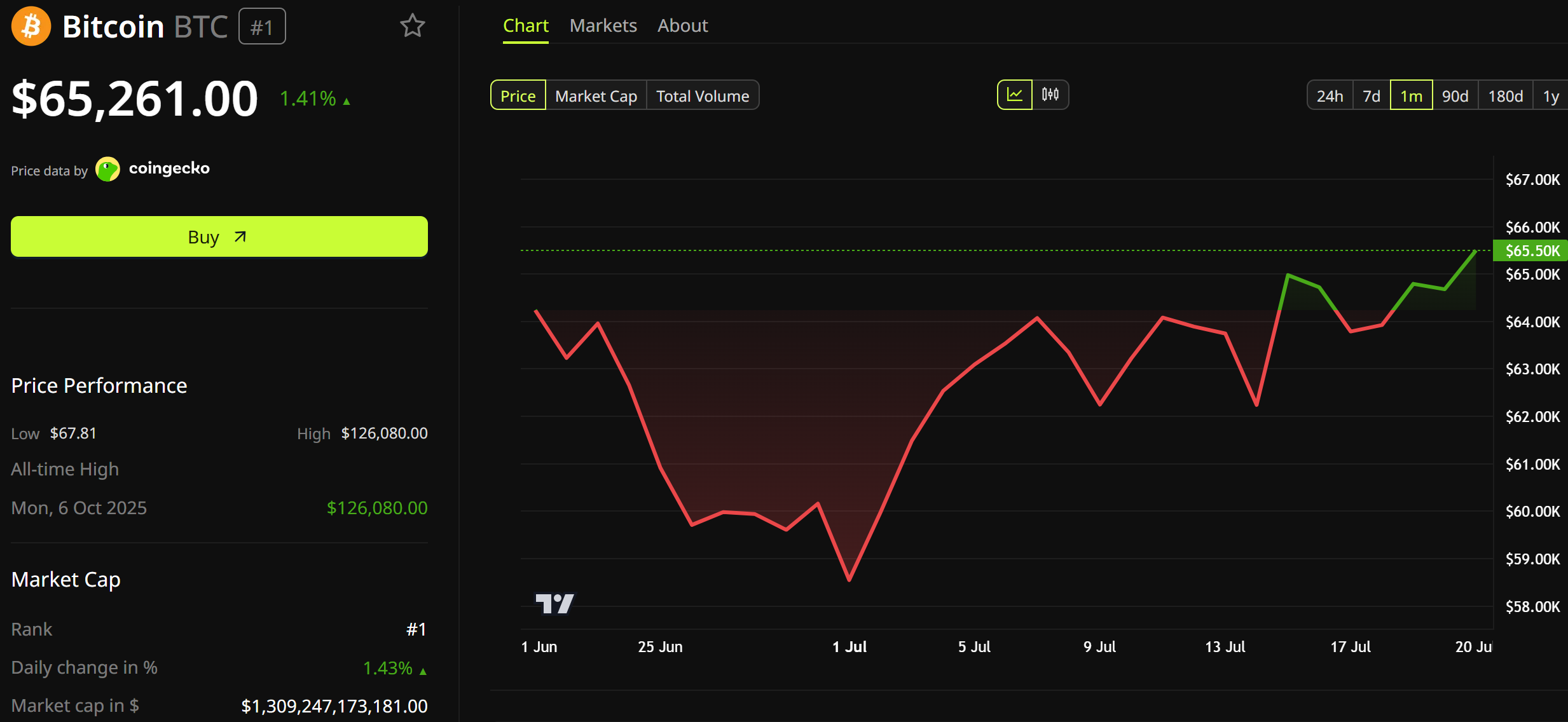
US spot Bitcoin (BTC) exchange-traded funds (ETFs) pulled in $75.7 million last week, their second winning week in a row. Bitcoin also reclaimed $65,000 on Monday as hopes grew that US-Iran talks may resume.
The rebound sounds big. It is not. The $273.1 million recovered so far is just 3.3% of the $8.2 billion that left the funds over the prior eight weeks.

A Modest Rebound After Record Bitcoin ETF Outflows
SoSoValue data shows the latest inflows followed $197.4 million the week before. When more money enters than leaves, investors are net buyers of the funds.
The recovery began in early July, when the funds snapped a 10-day streak of daily redemptions.
The hole is still deep, however. June was the worst month on record, with $4.5 billion exiting. That broke February 2025’s $3.56 billion record. BlackRock’s iShares Bitcoin Trust (IBIT) drove nearly 79% of the June exits.
Total assets tell the same story. The funds now hold about $77 billion, down from more than $104 billion in mid-May.

Follow us on X to get the latest news as it happens
Even the green week was bumpy. Monday alone saw $424.7 million leave, the biggest one-day exit since June 26, after US-Iran military tensions flared again. Buyers returned for the next four sessions.
BeInCrypto Markets data shows BTC trading near $65,261. The price is up 1.4% in a day and 5.2% on the week as Washington and Tehran signal talks could restart.
Gold’s Long Road or Citi’s Zero?
Bloomberg Intelligence senior ETF analyst Eric Balchunas says gold ETFs offer the best map for what comes next. Bitcoin and gold pay no interest or dividends. Sentiment alone moves them.
His case rests on GLD, the first US-listed gold ETF. It briefly became the world’s largest ETF in 2011. Assets then crashed from roughly $76 billion to $22 billion. Today it holds nearly $190 billion. Each cycle set a higher high.
IBIT looks familiar. It crossed $100 billion last October. Bitcoin then fell roughly 48% from its $126,080 peak.
“Bitcoin ETFs may be following the same script: spectacular gains, painful drawdowns and recoveries that may test investors’ patience,” Balchunas wrote, signaling that the pattern amounts to two steps forward and one step back.
Citigroup sees it differently. On July 1, the bank cut its 12-month Bitcoin target from $112,000 to $82,000, its second cut in a year that began at $143,000. It also expects zero ETF inflows over the next year, blaming stalled US crypto laws and weak institutional demand.
BlackRock CEO Larry Fink disagrees. He now calls the washout over as flows turn positive.
So who is right? Weekly flows will keep grabbing headlines. Yet gold’s history suggests multi-year cycles, not seven-day totals, may decide bitcoin’s next big move, especially with bond markets pricing renewed Fed hike risk.
The post Bitcoin Reclaims $65,000 as BTC ETF Inflows Return: Is the Worst Over? appeared first on BeInCrypto.


U.S. regulators have missed the GENIUS Act’s one-year rulemaking deadline, leaving the federal stablecoin framework awaiting final implementation even as industry participants say the law has already accelerated institutional adoption.
Summary
- U.S. regulators missed the GENIUS Act’s one year deadline to finalize key stablecoin rules, leaving several major proposals still under review.
- Industry participants said the law has already encouraged institutional stablecoin adoption, but unfinished rulemaking continues to create compliance uncertainty.
- Former SEC counsel Ashley Ebersole said the GENIUS Act established a strong legal framework but has fallen short in implementation because regulators missed the deadline.
According to federal rulemaking records and regulatory proposals reviewed after the July 18 deadline, none of the key agencies charged with implementing the Guiding and Establishing National Innovation for U.S. Stablecoins (GENIUS) Act have completed their final rules despite Congress requiring them to do so within one year of the law’s enactment.
President Donald Trump signed the GENIUS Act into law on July 18, 2025, creating the first standalone federal framework for payment stablecoins in the United States.
The legislation established reserve, redemption, disclosure, licensing and supervisory requirements for issuers while directing the Office of the Comptroller of the Currency, Federal Reserve, Federal Deposit Insurance Corporation, National Credit Union Administration, Treasury Department, and state regulators to complete implementing regulations through the notice-and-comment process within one year.
Although the deadline has now passed, the statute does not say that missing it delays the law’s effective date or suspends its requirements. Instead, much of the framework remains defined by the legislation itself while agencies continue working on the operational details that will govern compliance and supervision.
For companies building around stablecoins, however, the regulatory delay has become one of the biggest talking points one year after the law’s passage.
Legal clarity has improved but implementation remains unfinished
Speaking to crypto.news, Diogo Cassinelli, sales and partnerships manager at Trace Finance, said the anniversary serves as an opportunity to evaluate both the progress made under the GENIUS Act and the issues that remain unresolved.
“This week marks one year since the GENIUS Act was signed into law, and the anniversary is a useful checkpoint to reflect on how far the industry has come, and where we still need to go,” Cassinelli said.
While he described the creation of a federal framework for stablecoin issuance as “an incredible milestone,” he argued that operational questions extending beyond issuance continue to slow adoption.
According to Cassinelli, the unresolved issue is how stablecoins move through the traditional banking system and who ultimately bears responsibility for those transactions. He said this gap is one reason lawmakers and industry participants are paying close attention to the proposed Digital Asset Market Clarity Act, or CLARITY Act, which is expected to establish a wider market structure framework for digital assets.
Cassinelli said regulatory uncertainty has not stopped fintech firms from building cross-border payment products, but it has made expansion slower and more expensive because every banking relationship requires institutions to conduct their own compliance assessment instead of relying on a common federal standard.
“The process alone adds months to timelines that should take weeks,” he said, adding that those costs increase whenever companies enter new markets or onboard new banking partners.
Looking ahead, Cassinelli said passage of the CLARITY Act would allow banks and payment providers to approve stablecoin-related services more quickly because compliance expectations would already be established at the federal level.
“A definitive framework means banks and payment providers can say yes faster,” he said.
“CLARITY gives a definitive path for large institutions to move money with stablecoins, while also giving startups a clear map to build for these institutions.”
Agencies continue working through proposed rules
Several of the largest implementing rules remain at the proposal stage despite the statutory deadline.
The OCC previously proposed standards covering reserve assets, capital, liquidity, custody, reporting and risk management for issuers under its supervision. The FDIC later released its own proposal addressing prudential standards, reserve requirements, redemption, custody, capital treatment and the handling of tokenized deposits held by supervised institutions.
Meanwhile, the NCUA published separate licensing and operational proposals, with comments on its latest package closing only one day before the July 18 deadline, making completion of the rule impossible through the normal rulemaking process.
Treasury has yet to finalize guidance explaining when state stablecoin frameworks qualify as “substantially similar” to the federal regime, an important decision because issuers with no more than $10 billion in outstanding stablecoins may remain under state supervision if their regulatory framework receives Treasury certification.
At the same time, the Federal Reserve, FinCEN, OCC, FDIC and NCUA have jointly proposed customer identification requirements for primary-market participants, while additional anti-money laundering and sanctions proposals from FinCEN and the Office of Foreign Assets Control also remain under review.
Because several comment periods extend into August, at least part of the regulatory framework cannot be finalized before the one-year deadline.
Regulatory delays haven’t slowed industry growth
For investors, the first year of the GENIUS Act has still produced measurable changes across the stablecoin market.
Alex Witt, general partner at Verda Ventures, told crypto.news the legislation has already accomplished one of its main objectives by encouraging institutional participation.
“A year in, the GENIUS Act has clearly succeeded as a legitimization signal,” Witt said.
He pointed to stablecoin market capitalization exceeding $300 billion, transaction volumes increasing roughly fourfold, institutional entrants including Fidelity and Ripple obtaining charters, and Tether launching its USA₮ product through Anchorage as evidence that adoption has continued despite unfinished regulations.
At the same time, Witt argued that implementation has “badly lagged” because six federal agencies were expected to finalize rules by July 18 but have yet to complete any of them.
According to Witt, the absence of final regulations means the industry continues operating under legacy disclosure practices while charter approvals and Federal Reserve access decisions are occurring before the complete regulatory framework is in place.
“The unresolved pieces, the leaky yield ban pushing capital offshore and the January 2027 backstop effective date, mean the Act’s real test is still the next six months, not the year behind it,” he said.
Offering more insights on the matter, Ashley Ebersole, co-founder and chief legal officer of tx and a former senior counsel at the U.S. Securities and Exchange Commission, drew a similar distinction between the legislation itself and its implementation.
“One year post-enactment, it’s fair to say the GENIUS Act delivered a framework that established structural mandates, but has faltered in implementation,” Ebersole told crypto.news.
According to Ebersole, codifying payment stablecoins into federal law gave institutions the confidence needed to increase participation. She said stablecoin supply has expanded by approximately $55 billion since the law took effect, while tokenized U.S. Treasury assets have grown from about $3.9 billion to nearly $9 billion. She added that six separate real-world asset categories have now exceeded $1 billion in value, attributing part of that growth to the regulatory certainty created by the Act.
Ebersole nevertheless described the rulemaking delays as the legislation’s biggest execution challenge. She noted that agencies missed the one-year deadline despite Congress requiring implementation within that period, leaving eight major proposals still awaiting completion.
According to Ebersole, many institutions aligned their compliance planning with the original legislative timeline, making the administrative delays a setback even though the law contains a January 18, 2027, statutory backstop for implementation.
She also said stablecoins have become an essential settlement layer for tokenized assets, arguing that the legislation has reduced uncertainty surrounding long-term institutional blockchain infrastructure.
Ebersole identified the prohibition on issuer-paid yield as one of the biggest questions entering the framework’s second year.
“A definitive question for 2027 concerns the yield prohibition,” she said, explaining that decentralized finance protocols and wrapped products may continue offering interest-like returns through other mechanisms even though the GENIUS Act and Europe’s Markets in Crypto-Assets (MiCA) framework prohibit issuers from paying yield directly to token holders.
Jay File, chief executive and chief financial officer of Nasdaq-listed Lite Strategy, also pointed to the international regulatory environment rather than the delayed rulemaking alone.
“The GENIUS Act is the first serious federal framework for stablecoins,” File told crypto.news.
“Paired with MiCA’s enforcement baseline in Europe, we’re approaching a moment where the regulatory risk that caused institutional hesitation is finally being removed.”
File added that regulatory developments across multiple jurisdictions are moving digital assets toward “legitimacy, clarity, and institutional access,” which he described as beneficial for the industry.
Attention is now beginning to move toward the proposed CLARITY Act, which lawmakers continue negotiating in Congress. While discussions over ethics provisions and other outstanding issues remain unresolved, supporters, including Rep. Bryan Steil, have argued that the legislation would establish clearer rules for the wider digital asset market after the GENIUS Act created the first federal framework for payment stablecoins.

Robinhood Markets is drawing fresh attention from Wall Street as analysts argue the company’s next growth leg could come from tokenized assets and prediction markets rather than traditional retail crypto activity. In a Monday research note, Bernstein lifted its price target for Robinhood stock to $160 from $130, while keeping an Outperform rating. The shares were last reported around $101.
Bernstein’s thesis centers on the idea that two adjacent segments—prediction markets and tokenized equities—could scale faster than legacy revenue streams. The firm expects prediction markets to become Robinhood’s fastest-growing business, projecting segment revenue of $1.7 billion by 2028, which it frames as a 64% compound annual growth rate.
Key takeaways
- Bernstein raised Robinhood’s stock price target to $160 from $130 and maintained an Outperform rating.
- The research note argues prediction markets could become Robinhood’s fastest-growing segment, with revenue projected at $1.7 billion by 2028.
- Tokenized equities are presented as a major long-term opportunity, supported by Robinhood’s blockchain infrastructure strategy.
- Bernstein points to a broader market backdrop: growth in onchain real-world assets that could expand to $2 trillion–$4 trillion by 2030 from about $35 billion today.
- Infrastructure providers are also accelerating governance and issuance tooling for tokenized securities, suggesting institutional momentum is building.
Bernstein’s shift: prediction markets and tokenized equities
Bernstein’s Monday note emphasizes that Robinhood’s expansion path is increasingly tied to product categories that extend beyond straightforward crypto trading. The firm singled out prediction markets as the most immediate growth driver, forecasting rapid scaling that could outpace other lines of business.
Importantly, Bernstein also linked the prediction markets story to Robinhood’s broader platform ambitions—positioning the company to compete across multiple “battleground” asset types. While the note highlights several categories, its core investment case is that Robinhood can leverage its distribution and user base to build market activity around new trading paradigms.
Tokenized equities: Robinhood Chain and the infrastructure angle
On the tokenized equities front, Bernstein identified Robinhood’s engagement with blockchain infrastructure as a long-term differentiator. The firm referenced Robinhood Chain, describing it as the company’s Arbitrum-based layer-2 network used to support tokenized real-world assets.
According to Bernstein, Robinhood’s approach is designed to allow the platform to develop on-chain financial products without needing to depend on third-party blockchains. This matters for investors because infrastructure choices can affect product rollout speed, integration complexity, and the economics of building and operating blockchain-enabled services.
Bernstein tied its tokenization view to a macro capital markets shift, arguing tokenization is becoming a foundational layer for capital markets. The analysts projected the total value of onchain real-world assets could rise to $2 trillion to $4 trillion by 2030 from roughly $35 billion today. They further expect tokenized equities to capture an increasing portion of that growth as issuance and adoption broaden beyond certain asset types such as Treasury securities and private credit.
Rather than treating tokenized equities as a narrow experiment, Bernstein frames them as part of a larger, compounding trend in how financial institutions may issue, transfer, and govern assets digitally. For traders and users, that could eventually translate into more choices for tokenized instruments; for builders and issuers, it signals rising demand for compliant rails that can support custody, governance, and reporting.
Wall Street builds governance tooling for tokenized securities
Bernstein’s note landed as institutional infrastructure continues to mature. On Monday, Alpaca and Broadridge Financial Solutions announced they had integrated Broadridge’s shareholder governance capabilities into Alpaca’s Instant Tokenization Network.
The integration is aimed at giving holders of tokenized securities governance rights closer to those of traditional shareholders, including features such as proxy voting, investor communications, and regulatory disclosures.
That announcement follows last week’s partnership between Securitize and investment bank Cantor Fitzgerald, which focused on developing infrastructure for blockchain-based initial public offerings and follow-on equity offerings under existing U.S. securities regulations. Together, the developments suggest tokenized assets are moving beyond issuance experiments toward operational completeness—particularly around governance and regulatory workflows.
Tokenized stocks have also been gaining visibility in market tracking. RWA.xyz reports the asset class has grown to nearly $2 billion in market value this year.
What to watch next for Robinhood and tokenized markets
For readers following Robinhood’s trajectory, the key question is whether management can translate these infrastructure and segment-level bets into consistent revenue growth as prediction markets scale and tokenized equities gain traction. In the broader market, investors should watch whether governance tooling and compliance layers—such as the Broadridge-Alpaca integration—continue to expand, since that infrastructure often determines how quickly tokenized securities can move from pilots to repeatable offerings.

Cameron Young’s patented pause? Here’s why he does it

China’s New AI Model Halts New Subscriptions As Demand Swamps Capacity

Guisborough pub with 100-year-old history goes up for sale


-
 NewsBeat4 days ago
London Mayor Sadiq Khan handed a peerage by Keir Starmer alongside 15 other Labour figures… just days before the PM leaves No10
-

 Fashion3 days ago
Weekend Open Thread – Corporette.com
-

 Politics2 days ago
The House | The City of London can help the new chancellor deliver growth in every postcode
-

 Politics5 days ago
Young campaigners urge incoming PM to act on outdoor junk food ads
-

 Crypto World5 days ago
CFTC blocks Kalshi from unwinding Michigan trades after court order
-
 Crypto World3 days ago
Two July Windows Left: The CLARITY Act’s Senate Fight and What Failure Means
-

 Crypto World2 days ago
Ripple Payments Joins MiCA With 14 Firms, Does It Mean Anything For XRP?
-

 Business5 days ago
Nvidia Stock Slips After Big Tuesday Rally as Huang Confirms Vera Rubin Chip Is Now in Production Today
-

 Politics1 day ago
Democrats look to World Cup watch parties to register thousands of voters
-
 Entertainment5 days ago
Disney’s Most Ambitious Failed Star Wars Attraction Is Coming to SDCC
-

 Crypto World3 days ago
Ripple wins EU-wide access as ESMA adds it to MiCA register
-

 Business5 days ago
Palantir Shares Rise After Expanded Nvidia Partnership and Fresh Analyst Upgrades Ahead of Earnings Day
-

 Crypto World4 days ago
Injective Submits SEC Transfer-Agent Registration to Onchain Ownership Records
-

 NewsBeat3 days ago
Registration is now open for March for Men with Kev 2026
-

 Tech7 days ago
Get Your ESP32 Sunny Side Up With This Solar Dev Board
-

 News Videos6 days ago
XRP BOMBSHELL… XRP OMBOARDED FOR TRANSACTIONS!!!
-

 Tech6 days ago
Dark Secrets Emerge When Jailbreaking LLMs
-

 NewsBeat10 hours ago
Unregistered fitter used Gas Safe logo on business flyers
-
 Sports5 days ago
New Cornerback Enters Vikings Trade Rumor Mill
-

 News Videos4 days ago
Money | Class 12 Economics | CBSE Board Exam 2026-27
You must be logged in to post a comment Login