

Crypto World
Cardano activates van Rossem hard fork as Leios upgrade draws closer



Cardano has activated the van Rossem hard fork, moving its mainnet to Protocol Version 11 after the upgrade took effect at the epoch boundary on July 18.
Summary
- Cardano activated Protocol Version 11 after governance approval moved the van Rossem hard fork forward.
- The upgrade improves Plutus costs while preparing Cardano for Ouroboros Leios and higher future throughput.
- Van Rossem is Cardano’s first hard fork ratified through onchain governance, marking a governance milestone.
Intersect confirmed that the hard fork had been successfully enacted after weeks of testing, infrastructure updates, and governance voting.
The upgrade follows its ratification on July 13 by Cardano’s delegated representatives, stake pool operators, and Constitutional Committee. The Cardanoscan governance record shows that the proposal called for Protocol Version 11. Intersect reported 77.63% DRep support and 52.7% SPO support when the required thresholds were met.
Van Rossem is an intra-era hard fork, so Cardano remains within the Conway era while updating parts of its protocol. The upgrade introduces new Plutus capabilities and cost model changes designed to make some smart contract operations cheaper. It also includes technical updates aimed at improving Plutus performance and other parts of the network.
The mainnet activation followed earlier testing on the Preview and Preprod networks. Preview moved to Protocol Version 11 in May, while the Preprod upgrade followed in June after developers addressed tooling compatibility issues. As previously reported by crypto.news, the mainnet proposal arrived in June after those testing and preparation stages.
Dijkstra and Ouroboros Leios come next
The van Rossem hard fork also prepares Cardano for its next planned protocol upgrade. Input Output said, “As well as Plutus improvements and Plutus Cost Model enhancements, this upgrade lays the foundation for the next upgrade, the Dijkstra era hard fork, which will introduce Ouroboros Leios to Cardano.”
Leios is a proposed upgrade to Cardano’s Ouroboros proof-of-stake system that aims to raise transaction throughput while keeping its existing security model. Development remains underway. According to the latest Cardano weekly report, the consensus team has continued stabilizing the Leios testnet, released two new prototype builds, and worked on changes intended to improve block certification rates. Crypto.news previously reported that Leios forms part of Cardano’s wider protocol development roadmap.
Onchain governance takes control of the upgrade process
Van Rossem also marks the first Cardano hard fork to move through the network’s Voltaire onchain governance system rather than relying on the earlier coordination model led by founding development groups. Cardano said the final decision to ratify and execute the upgrade rested with DReps, SPOs, and the Constitutional Committee after technical teams completed the required preparation.
The process follows Cardano’s broader move toward community-led decisions. The same system has also produced different outcomes for funding proposals. As crypto.news reported earlier, the community rejected a 7.8 million ADA request for the 2026 Cardano Summit, leading to its cancellation. Meanwhile, other treasury funding has supported protocol work that includes Leios, Hydra, and Mithril.
With van Rossem now active, Cardano is operating on Protocol Version 11 while development continues on Dijkstra and Ouroboros Leios. The network has not announced a final mainnet launch date for Leios, although recent ecosystem coverage has placed the planned scaling upgrade later in 2026.



Four weeks without adding a coin, two of them spent selling, a $1.25 billion sale authorization on file, and stock sales now funding a cash pile instead of Bitcoin. The most influential machine in crypto has shifted into reverse, and the entire treasury sector is watching its own future run at MicroStrategy speed.
Summary
- Strategy has gone four consecutive weeks without increasing its Bitcoin position, its longest such stretch in two years: two weeks of selling followed by two weeks of no purchases, with holdings parked at 843,775 BTC since selling 3,588 coins for roughly $216 million to fund dividends.
- The famous flywheel has inverted. The company is still raising money, $466.7 million one week, $263.5 million the next, but proceeds now build a US dollar reserve of $3.2 billion instead of buying coins.
- The trigger is arithmetic: MSTR trades below the value of its own Bitcoin, with enterprise mNAV under 1, making share issuance to buy coins dilutive, while preferred dividends, with STRC raised to 12%, must be paid in cash the model never budgeted for.
- The reversal is systemic, not just corporate: Strategy invented the treasury-company playbook that dozens of imitators copied, and its shift to selling coins and hoarding cash rewrites the template while Capital B reverse-splits and MARA liquidates.
- The question the market is actually pricing: whether this is a disciplined pause by a company managing through a 50% Bitcoin drawdown, or the beginning of the sequence skeptics always predicted, where the largest corporate holder becomes the seller of last resort.
For five years, the most reliable event in crypto was not the halving or the Fed meeting. It was Michael Saylor’s Sunday night chart. The orange dots, the coy caption, the Monday 8-K, another tranche of Bitcoin added to the largest corporate stack on earth: 108 purchases, 843,775 coins, a ritual so dependable that traders built indicators around it and dozens of companies built entire business models by imitation.
The ritual has stopped. Strategy has now gone four consecutive weeks without adding a single Bitcoin, its longest fallow stretch in two years, and the composition of those weeks is the story: two of them were spent selling, 3,588 BTC liquidated for roughly $216 million to pay preferred dividends, under a standing authorization to sell up to $1.25 billion more. The company is still raising hundreds of millions weekly through stock sales, and the money now flows to a $3.2 billion cash reserve instead of coins.
Every component of the famous flywheel, issue stock, buy Bitcoin, watch the premium expand, issue more, is still moving. It is simply moving in the other direction, and because Strategy wrote the playbook that a whole sector runs on, the reversal is not one company’s capital management. It is the treasury era’s first controlled test of its own exit ramp.
The machine, and what seized it
To understand the reversal, state the original machine precisely, because its elegance was always its fragility.
Strategy’s model was a premium harvester. The company sold MSTR shares through at-the-market programs at a market capitalization above the value of its Bitcoin, the mNAV premium, and converted the proceeds into coins. Each purchase grew Bitcoin per share, the premium justified itself as amplified BTC exposure with index membership and options liquidity attached, and the loop compounded: at the peak, the market paid well over two dollars for a dollar of Strategy’s Bitcoin, and the machine converted that enthusiasm into 45,000 coins in a single month as late as the spring, the fastest accumulation pace in a year. Layered on top came the preferred stock complex, STRK, STRF, STRC, perpetual instruments sold to yield-hungry buyers, whose dividends were comfortably serviceable as long as the common-stock machine ran.
Then the input variable moved. Bitcoin’s slide from its October peak near $126,000 to below $60,000 dragged MSTR down 82% from its high, and on June 27 the number that governs everything crossed its threshold: enterprise mNAV, the company’s market value including debt and preferreds measured against its Bitcoin, fell below 1. The market now values Strategy at less than its own coins. At that level the flywheel’s core transaction inverts: issuing stock to buy Bitcoin destroys Bitcoin-per-share instead of growing it, every ATM dollar is dilutive by construction, and the premium harvester has no premium to harvest. Simultaneously the preferred complex’s dividends, obligations in cash, kept compounding against a falling asset, with STRC’s rate raised to 12% in an effort to defend a price that had collapsed into the seventies. The machine’s two assumptions, a durable premium and trivially fundable dividends, failed in the same quarter.
What the company actually did
Strategy’s response, reconstructed from a month of filings, is more coherent than the headlines suggest, and the coherence is what makes it consequential.
In late June, the company paused purchases and announced a Digital Credit Capital Framework: a board-level policy requiring a defended US dollar reserve, a $1 billion repurchase program for its own preferred instruments, and, in the filing that broke a five-year taboo, authorization to sell up to $1.25 billion of Bitcoin to fund dividends and interest. The first week of July it used the authorization, selling 3,588 BTC for about $216 million, the sales that reduced holdings to 843,775. The following weeks it sold no coins and bought none, while the ATM kept running, $466.7 million raised one week, $263.5 million the next, with proceeds routed to the reserve, which reached $3.225 billion, roughly 20 months of dividend coverage. On-chain and market observers who had spent June recommending exactly this sequence, CryptoQuant’s analysts prominent among them, graded the company as having substantially adopted the advice: stop buying, rebuild cash, cover the dividends, survive the drawdown.
Read as treasury management, it is defensible, arguably overdue. Read as signal, it is seismic, and markets trade signal. The company that defined itself by never selling has sold; the founder who answered every drawdown with a purchase now posts teaser charts, “What’s next?”, over an unchanged holdings number; and the equity sales that once meant more Bitcoin per share now mean more cash per share, a phrase no one bought MSTR to hear. The stock’s behavior confirms the regime change: shares rose on the news of the extended pause, investors relieved by liquidity rather than excited by accumulation, which is how the market tells a growth story it has been reclassified as a survival story.
The sector downstream
Strategy’s reversal would matter less if Strategy were merely large. It matters because it is upstream of an entire corporate category’s logic, and the category is visibly straining.
The treasury-company playbook, raise capital at a premium to NAV, convert to crypto, let the premium compound, was licensed from Saylor by dozens of imitators across Bitcoin, Ethereum, Solana, and XRP, and the license’s fine print always contained the same clause: the model works while the premium exists. The premiums are gone sector-wide. Strategy’s own compression below 1 put it, in The Block’s phrasing, into a cohort of treasury companies whose premiums have sharply collapsed, and the cohort’s weaker members are already running the exit sequence. Capital B, the European Bitcoin treasury pioneer, executed a 10-for-1 reverse split to keep its collapsed shares presentable. MARA, the miner whose treasury ambitions once rivaled Strategy’s accumulation, sold 15,133 BTC in March, over a billion dollars of coins, to deleverage. For context, crypto.news has also covered what miners did with the same drawdown. The marginal DAT is no longer a bid under the market; arithmetic says the marginal DAT is a seller, and the sector’s aggregate holdings, accumulated as a one-way flow through 2024 and 2025, now sit as overhang whose release schedule depends on dividend calendars and covenant math rather than conviction.
This is the channel through which one company’s capital framework becomes everyone’s market structure. Strategy alone holds roughly 4% of Bitcoin’s supply; the treasury sector collectively holds multiples of every month’s miner issuance; and the sector’s transition from programmatic buyer to conditional seller changes the demand curve Bitcoin’s price discovery runs on, at exactly the moment ETF flows have their own four-week negative streak. That is the other institutional bid and its own streak. The bull era’s reflexive loop, treasury buying lifts price, lifting premiums, funding more buying, ran in reverse for the first time this month, and the reverse loop has its own reflexivity: falling prices compress premiums, forcing sales, pressing prices. Strategy’s $3.2 billion reserve is, among other things, a firewall against its own participation in that cascade. The imitators without firewalls are the ones to watch.
The preferred stack, unpacked
The instrument class actually driving the reversal deserves its own examination, because the preferred complex is where Strategy’s engineering was boldest and where the constraint now binds.
Across 2025 the company built a capital stack unlike anything else in public markets: perpetual preferred securities, STRK, STRF, STRC among them, sold in the billions to buyers who wanted contractual yield adjacent to a Bitcoin balance sheet. The design logic was elegant. Preferreds raised money without diluting common shareholders’ Bitcoin per share, their dividends were modest against the scale of the coin position, and in the model’s happy path the common-stock premium machine would always fund them incidentally. The instruments effectively sold volatility insurance to income investors with the Bitcoin stack as collateral, and demand was strong enough that the company kept issuing.
The drawdown converted that elegance into the binding constraint, through three compounding mechanics. First, the obligations are cash and perpetual: unlike the coin position, which can wait out any winter, the dividends arrive monthly and quarterly regardless of price, which is how a company with $50 billion in Bitcoin found itself selling coins to make payments measured in hundreds of millions. Second, the instruments themselves broke: STRC, designed to trade near $100, collapsed into the seventies as Bitcoin fell, and the company’s response, raising the dividend rate 50 basis points to 12% and declaring a $99-100 price objective, defends the instrument’s credibility at the direct cost of enlarging the very obligations straining the model. A 12% perpetual coupon is distressed-issuer pricing, and the market can read it. Third, the stack inverted the shareholder hierarchy the flywheel depended on: with mNAV below 1, ATM sales dilute common holders to fund preferred payments, transferring value up the capital structure, the precise opposite of the accretion story that justified every prior raise.
The $1 billion repurchase program is the sophisticated response, and it is worth understanding why. With the preferreds trading far below par, buying them back retires a dollar of perpetual obligation for seventy-odd cents, mathematically the best Bitcoin-per-share trade available to the company, better than buying Bitcoin, at current prices. That the board authorized it is the clearest internal signal in any filing this month: management’s own arithmetic now ranks extinguishing its yield promises above accumulating its founding asset. For the treasury sector downstream, the lesson is sharper still, because the imitators copied the preferred playbook late, at smaller scale, with thinner reserves, and their versions of STRC are breaking without a $3 billion firewall behind them. The era’s defining trade was long Bitcoin, funded by promises. The promises are now the position, and Strategy, first into the trade, is first to show what managing out of it looks like.
The two readings, and the test between them
The bull and bear readings of the reversal are both fully available in the same filings, which is what makes the next quarter informative.
The disciplined-pause reading: this is what maturity looks like. The company saw the mNAV constraint, stopped dilutive purchases exactly as its own math demanded, funded twenty months of obligations, and built optionality, a $3.2 billion war chest that can resume buying at will, repurchase discounted preferreds at will, or simply wait. Nothing was liquidated beyond dividend needs; 843,775 BTC remains the largest corporate position on earth, untouched through a 50% drawdown that has bankrupted lesser structures. On this reading, Saylor’s teaser posts are honest: the machine is idling, not broken, and the resumption of purchases into a recovering market, funded by a reserve rather than dilution, would be the strongest possible refutation of the death narrative. The stock rising on pause news supports it; the market prefers a solvent accumulator to a compulsive one.
The flywheel-reversal reading: the model’s critics spent five years describing exactly this sequence, and it is now running on schedule. The premium was the product; it is gone. The dividends were the leverage; they now consume coin sales. The ATM was the engine; it now funds the dividend firewall, meaning new shareholders are diluted to pay old preferred holders, a structure with an uncomfortable genealogy. And the $1.25 billion sale authorization, only $216 million used, is the tell: the company has priced the scenario where it sells nine figures more, and a renewed leg down in Bitcoin, pressing the reserve’s 20-month runway against a 12% dividend rate, converts authorization into obligation. On this reading, the largest holder has quietly become the market’s most predictable future seller, and every treasury company below it in the capital structure follows the same gradient with less cushion.
The test between the readings is legible in advance. Watch whether purchases resume, and how they are funded: reserve-funded buying validates the pause; continued cash hoarding through any recovery says the premium era is understood internally to be over. Watch the mNAV line against 1, the boundary that decides whether the ATM builds or destroys value. Watch the preferred complex, STRC’s price against its defended $99-100 objective and any further rate increases, the dividend machinery is now the model’s binding constraint, and its cost curve is public. And watch the sale authorization’s utilization in each Monday filing, because the difference between a treasury program and a distribution program is, from here, a single 8-K. For five years the Sunday chart meant the same thing every week. The discipline now is reading what its absence means, and the honest answer is: the largest experiment in corporate Bitcoin ownership has entered the phase its design never specified, the one where the flywheel must prove it can stop without rolling downhill.
The historical rhyme worth logging before the FAQ: this is not the first time a dominant, levered accumulator defined an asset’s market structure, and the precedents are not comforting or damning so much as instructive about what to watch. The gold market of the late 1990s was shaped for years by central banks that had accumulated for decades becoming coordinated sellers, and the eventual solution was not abstinence but the Washington Agreement, a disclosed schedule that let the market price the supply instead of fearing it. Grayscale’s GBTC played the Strategy role of the prior crypto cycle, the one-way accumulation vehicle whose premium was the trade, and its premium’s collapse into a discount produced two years of overhang, arbitrage blowups, and, ultimately, conversion into an ETF that let the trapped supply exit in an orderly line. The pattern across both: concentrated positions built on premium mechanics do not unwind quietly by choice, they unwind on a schedule the market forces, and the difference between a crisis and a transition is disclosure. By that standard, Strategy’s current posture, weekly 8-Ks, a published sale authorization with a hard ceiling, a framework document stating the priority order of reserve, repurchases, and coins, is the Washington Agreement version of the problem and not the GBTC version: the supply risk is real, sized, and on a calendar anyone can read. Whether that discipline survives another 30% drawdown is the open question, but the market’s relatively calm digestion of the first corporate Bitcoin sales in the company’s history suggests the disclosure is doing its work. Panic needs surprise, and the filings have removed most of it. For market readers, crypto.news has explained reading positioning around MSTR and BTC and the macro regime pressing on the model.
Frequently asked questions
How long has Strategy gone without buying Bitcoin?
Four consecutive weeks without increasing its position as of the July 20 filing, the longest stretch in two years: two weeks that included selling 3,588 BTC for roughly $216 million to fund dividends, followed by two weeks of neither buying nor selling. Holdings have been unchanged at 843,775 BTC since the sales, with the last purchase disclosed in the week ending June 22.
Why did the company stop buying?
Arithmetic. MSTR’s enterprise value fell below the value of its Bitcoin in late June, with mNAV under 1, which makes issuing shares to buy coins dilutive to Bitcoin per share, the metric the entire model maximizes. Simultaneously, cash dividend obligations on its preferred stock complex grew while reserves had thinned, prompting a board framework requiring a defended dollar reserve before further accumulation.
Is Strategy actually selling Bitcoin now?
It has, in a limited and disclosed way. A June 29 filing authorized selling up to $1.25 billion of Bitcoin to fund preferred dividends and interest, and the company sold 3,588 BTC for about $216 million in early July under that authorization. No further sales have been disclosed since, and the remaining authorization functions as a standing liquidity mechanism the market now monitors weekly.
Where is the money from stock sales going?
Into cash. Strategy raised $466.7 million and $263.5 million in consecutive weeks through its at-the-market program, directing proceeds to a US dollar reserve that reached about $3.2 billion, roughly 20 months of dividend coverage. Under the new Digital Credit Capital Framework, the reserve and a $1 billion preferred-repurchase program take priority over Bitcoin accumulation while the mNAV discount persists.
What is mNAV and why does it matter so much?
Multiple to net asset value: the company’s market value, in enterprise form including debt and preferred stock minus cash, divided by the value of its Bitcoin. Above 1, issuing stock to buy coins adds Bitcoin per share and the flywheel compounds; below 1, the same transaction dilutes. Strategy’s enterprise mNAV crossed below 1 on June 27 for the first time, which is the single number behind the strategy shift.
How does this affect the broader treasury-company sector?
Structurally. Strategy invented the template dozens of companies copied, and its shift coincides with sector-wide premium compression: Capital B executed a 10-for-1 reverse split, MARA sold 15,133 BTC to deleverage, and the marginal treasury company has moved from programmatic buyer to conditional seller. A sector that was a reliable bid under Bitcoin now represents supply whose release depends on dividend calendars and covenants.
Is Strategy at risk of forced large-scale selling?
Not imminently, on disclosed numbers. The $3.2 billion reserve covers roughly 20 months of dividends, sales to date total $216 million against the largest corporate Bitcoin position in existence, and the company retains repurchase and financing options. The risk scenario is a prolonged further drawdown that erodes the reserve while the 12% STRC rate and other obligations persist, converting the standing sale authorization into a recurring funding tool.
What signals should investors watch next?
Four, all public. Whether and how purchases resume, with reserve-funded buying signaling a validated pause. The mNAV line against 1, which governs whether share issuance creates or destroys value. The preferred complex’s health, particularly STRC’s price against the company’s stated $99-100 objective and any dividend-rate changes. And each Monday 8-K’s disclosure of Bitcoin sales under the $1.25 billion authorization. This is not investment advice.
Disclaimer: This article is for information and educational purposes only and does not constitute financial or investment advice. It describes corporate actions and market conditions that change quickly, and holdings, prices, and policies cited reflect disclosures available at the time of writing. Nothing here is a recommendation to buy, sell, or hold any security or asset. Always do your own research. Information is accurate as of July 21, 2026.

The United States Department of Justice (DOJ) has moved to seize over $25 million in crypto linked to an international fraud network targeting US and Canadian citizens.
The seizure is the latest crackdown by federal authorities on cryptocurrencies linked to cross-border financial crimes.
US Justice Department Files Civil Forfeiture Complaints
The US Attorney’s Office for the District of Columbia has filed civil forfeiture complaints for the seizure of $25 million in cryptocurrency linked to a fraud network targeting US and Canadian citizens. According to a statement by the Attorney’s Office, investigators with the Cyber Fraud Task Force identified several money laundering operations.
These networks targeted thousands of unsuspecting victims who were tricked into believing they were making legitimate investments in crypto.
However, neither investigating officials nor the Department of Justice have disclosed details about the fraud or its perpetrators.
Multiple Fraud Investigations
The statement shares details about investigations into multiple laundering rings. The first investigation began in 2024 and traced over 270 transactions. Authorities are seeking the forfeiture of around $10.4 million.
The next investigation was into an online romance scheme. Over 200 individuals fell victim to the scheme, with the authorities seeking $12.1 million. Other investigations reported in March 2026 and May 2026 seek $2.4 million and $1.2 million, respectively. A fifth investigation into a fee-based recovery fraud is seeking $285,000.
The statement also disclosed that the money launderers were located in Southeast Asia, primarily in China, Malaysia, and Cambodia.
A Broader Effort
The investigations are part of a broader effort under the Scam Center Strike Force, an initiative launched by US Attorney Jeanine Ferris Pirro in 2025. The initiative has recovered over $800 million from international fraud networks. Attorney Pirro lauded the achievement, stating,
“This $25 million seizure is a direct result of the Scam Center Strike Force I launched in November 2025, and it demonstrates the power of aggressively targeting these international fraud networks. Our investigators cut through complex laundering schemes, protected victims, and shut down criminal pipelines.”
The Scam Center Strike Force initiative uses blockchain analytics and international cooperation to identify, track, and freeze illicit crypto assets. The DOJ’s actions could soothe concerns around rising crypto fraud. They also indicate a regulatory environment prioritizing asset recovery and consumer protection.
The next challenge is that of proving ownership of the seized assets. How the government and the Department of Justice handle the seizure could set a precedent for the future.
Disclaimer: This article is provided for informational purposes only. It is not offered or intended to be used as legal, tax, investment, financial, or other advice.
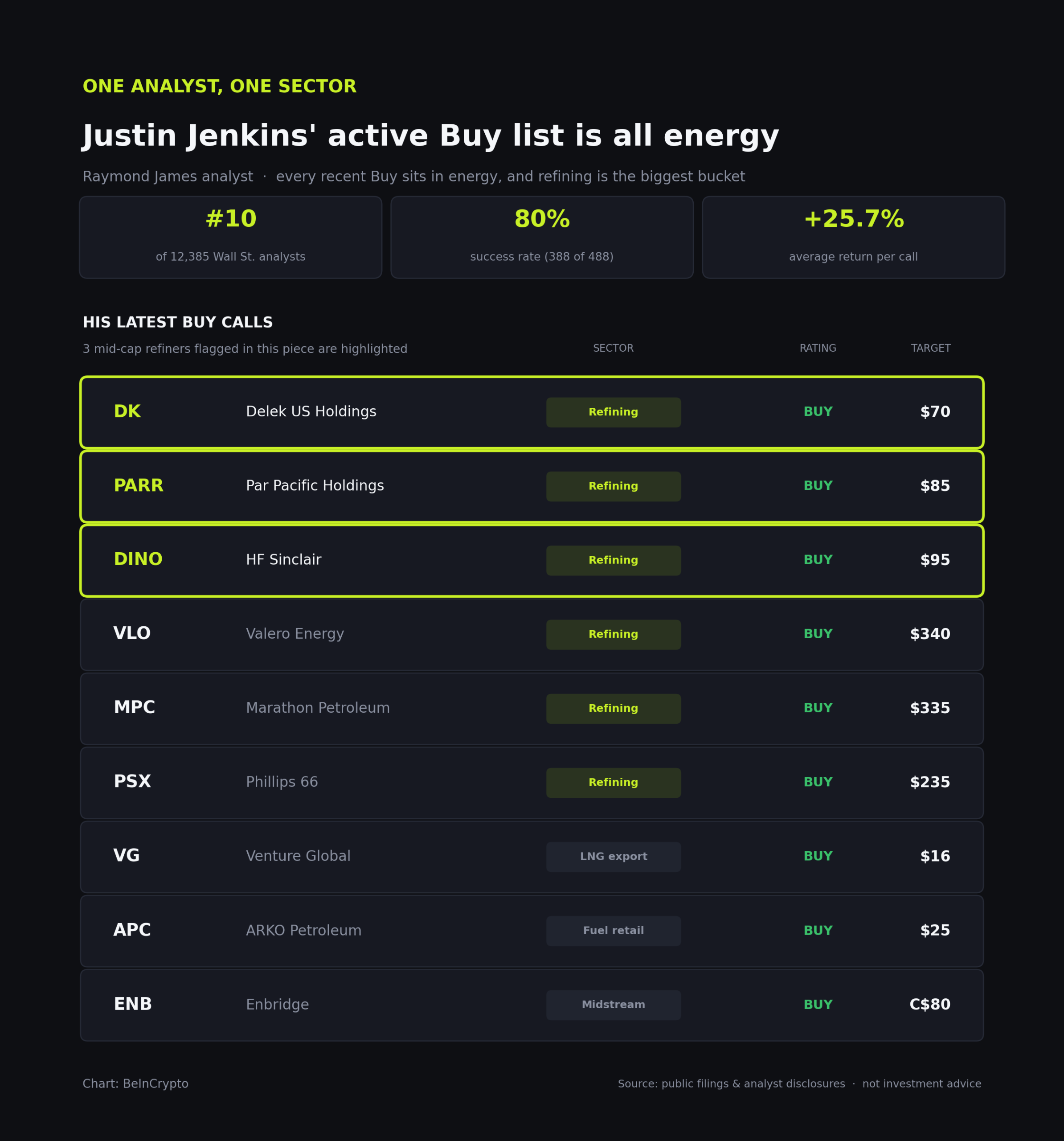
US oil refiners are booming, and Wall Street’s 10th-ranked analyst just named three energy stocks to watch to play the run. The margin refiners earn by turning crude into fuel hit a record, and none of his three picks are the oil majors everyone knows.
That analyst is Raymond James’ Justin Jenkins, who has an 80% success rate.

He reiterated Buy on three mid-cap refiners, so BeInCrypto checked the money flow behind each to see which call holds up.
Delek US Holdings (NYSE: DK)
Delek is the most refining-focused of the three, with little diversification to steady other energy stocks on the list. That makes it the most direct bet on the record crack spread, the gap between what refiners pay for crude oil and what they earn on gasoline and diesel.

That spread hit a record near $59 a barrel in July, nearly triple where it started the year. So Delek can print cash even if crude goes nowhere.
Jenkins reiterated a Buy with a $70 price target on July 13. One more bank leans bullish. Goldman Sachs lifted its target to $73 on July 17.
JPMorgan, however, raised its number to $62 (already hit) but stayed on Hold. The stock is already up about 127% this year.

Meanwhile, the chart backs the call. Chaikin Money Flow (CMF), a proxy for institutional buying and selling, broke out of a falling channel in late June.
It then pushed above its early-March peak in mid-July. That shows large buyers accumulating just as Jenkins made his call.

Therefore, Delek offers the cleanest setup. Jenkins’ $70 target sits about 4% above the recent price near $67, and Goldman’s $73 is the more bullish case.
The main risk is the crack spread itself, since that’s where refiners make their money. Because Delek leans so heavily on refining, a sharp drop in it would hit the stock harder than the more diversified names, and spreads this wide rarely last.
HF Sinclair (NYSE: DINO)
HF Sinclair is the largest and steadiest of the trio, spanning refining, marketing, and renewables. Yet its bull case looks the most stretched.
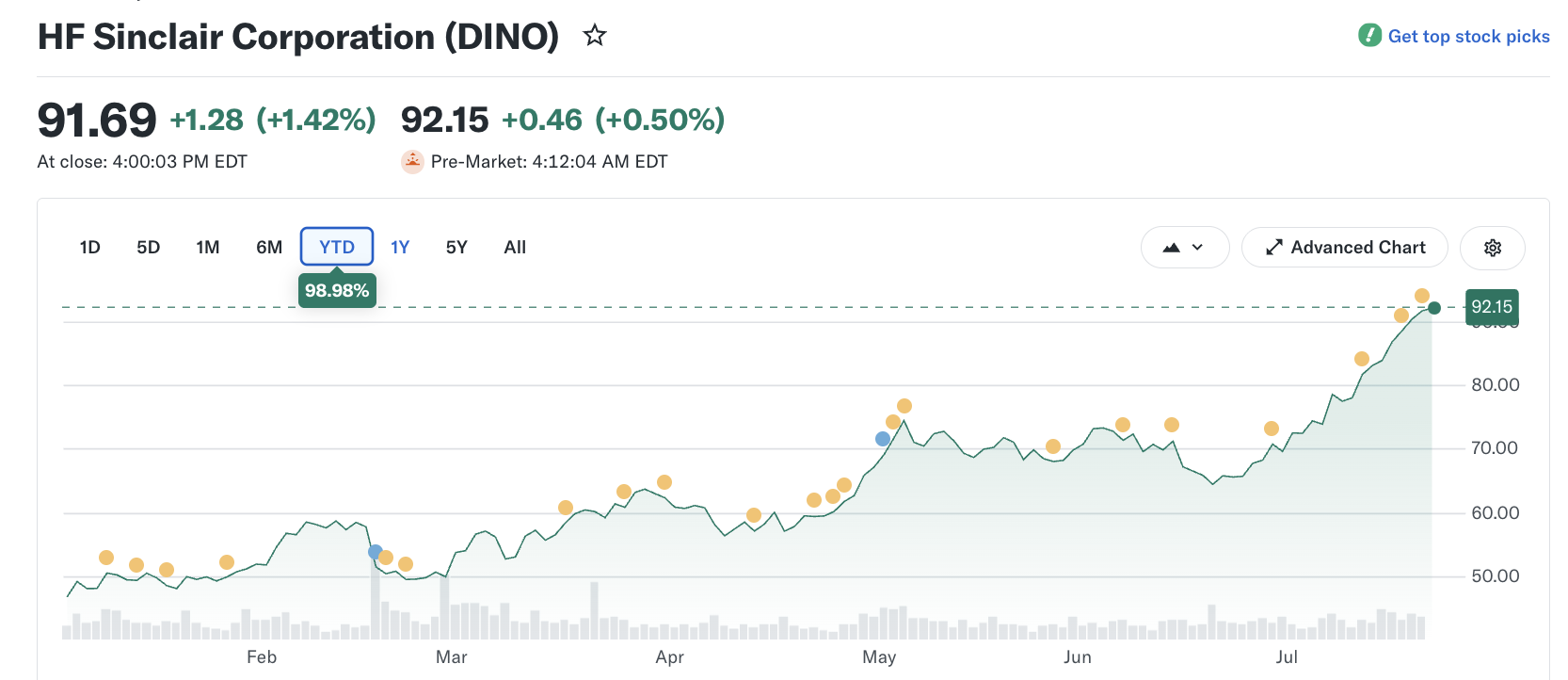
Here, Jenkins is the outlier. He reiterated a Buy and a Street-high $95 target on July 13, while much of Wall Street sat on Hold. Evercore initiated coverage with a Hold rating, while Barclays and JPMorgan maintained neutral ratings.
The stock’s 99% run this year pushed its price past several targets.

However, the chart flashes a warning. CMF peaked in early May. As DINO kept making higher highs into July, money flow failed to follow. This bearish divergence, now below the 0.51 level that capped it in May, suggests the buying is fading.
A close above 0.51 would ease the concern.

Still, not everyone is cautious. Options desks flagged fresh January call buying on the stock.
So the reward looks thin for now. Jenkins’ $95 target implies only about 4% upside from the recent price near $92, and the divergence warns that momentum could stall.
Par Pacific Holdings (NYSE: PARR)
Par Pacific is the best performer, up about 129% this year. Its niche markets in Hawaii, the Pacific Northwest and the Rockies keep its fuel insulated, which helped it ride the same margin wave.

This time, the banks agree on this energy stock to watch. Jenkins lifted his target to $85 on July 13, matching JPMorgan, while Mizuho reiterated Buy at $80 (already hit).
That rare alignment marks $85 as a shared ceiling. It also caps the upside, since the price near $80 already sits close.

Meanwhile, institutional buying still looks strong. CMF recently made a fresh high before easing, holding well above zero. That shows large investors kept accumulating through the July surge, unlike the divergence in HF Sinclair.

The catch is that record margins may already be priced in. Some strategists warn refiners have run too far, too fast.
However, more than half of Russian refining capacity is offline.
That supply squeeze could keep the crack spread high.
That is exactly the bet Jenkins is making across all three, and it is why an analyst with an 80% hit rate is pointing to small refiners rather than Exxon or Chevron.
The post Analyst With 80% Success Rate Names 3 Energy Stocks to Watch appeared first on BeInCrypto.
Crypto World
Profit-taking, oil spike knock bitcoin (BTC) price off its best levels in a month: Crypto Markets Today
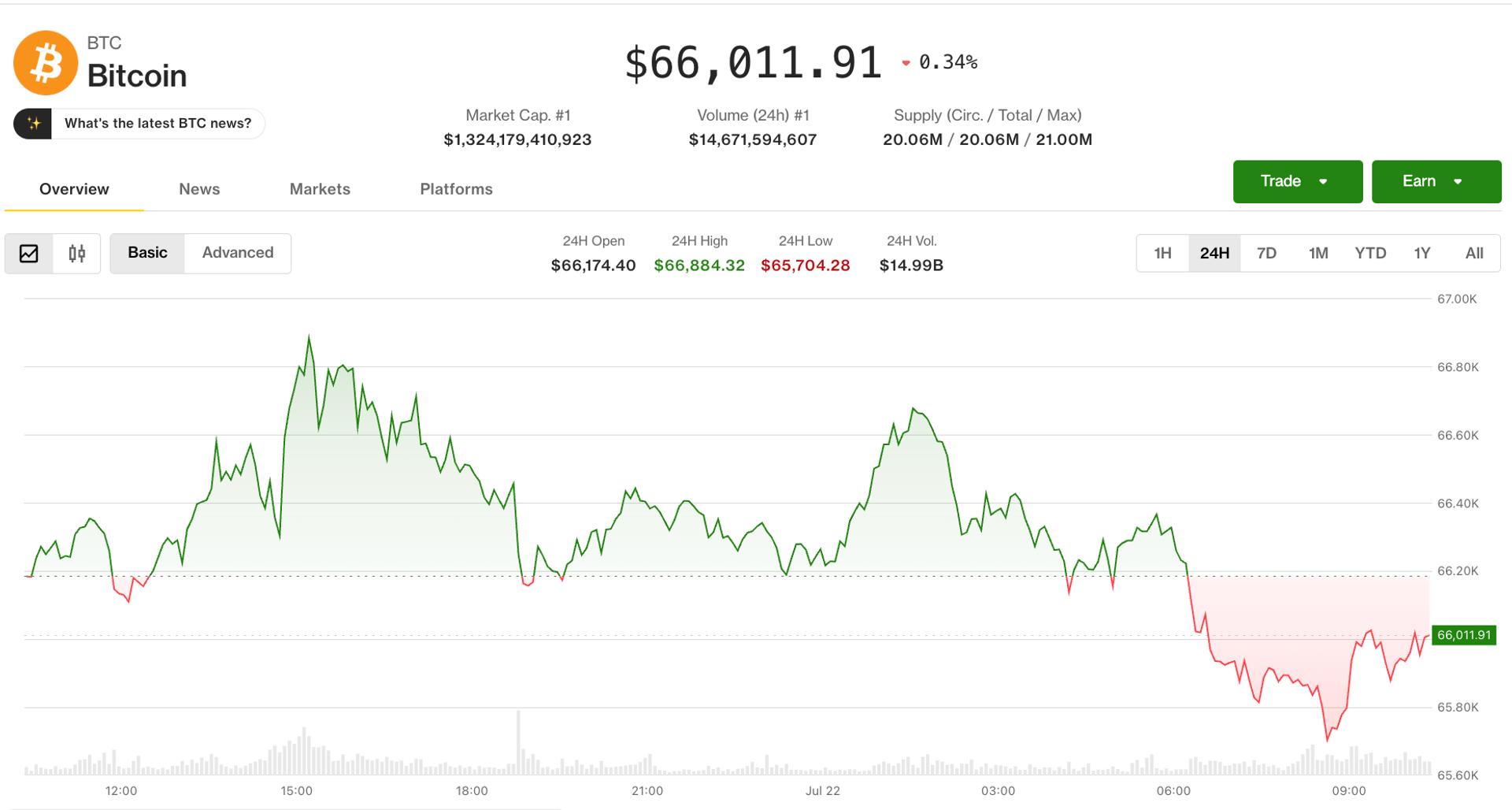
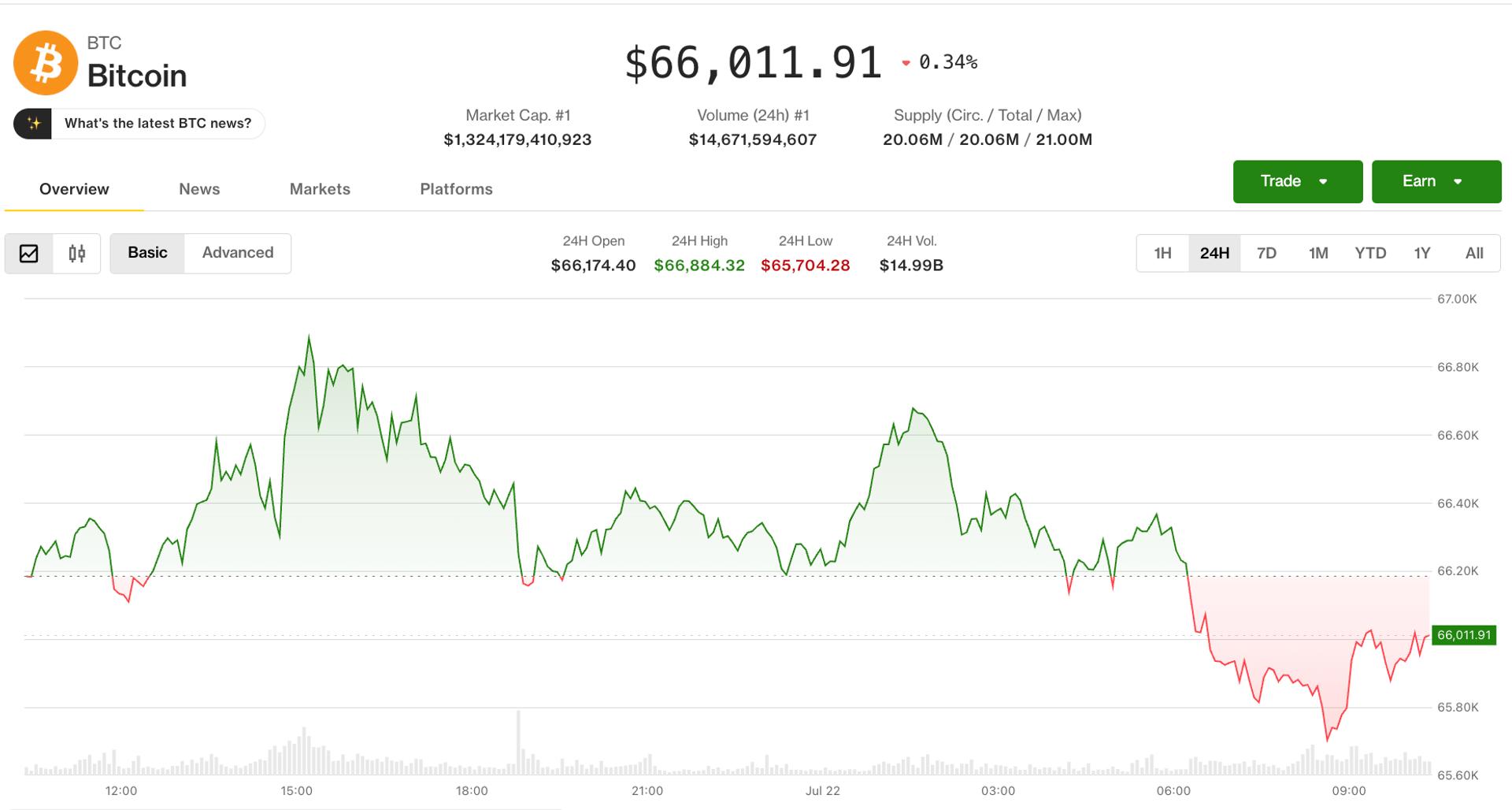
The crypto market edged lower on Wednesday, with bitcoin falling about 0.9% since midnight UTC to $65,900 and ether (ETH) shedding 0.5% to $1,920.
The pullback came after the largest cryptocurrency rose to its highest point in more than a month on Tuesday, with a degree of profit-taking always a likely outcome.
One major macroeonomic influence was the surge in the WTI crude price. The U.S. oil benchmark topped $85 per barrel for the first time since June 12 as the Iran conflict escalated, reviving the inflation concerns that have weighed on risk assets for much of the year.
Nasdaq 100 and S&P 500 index futures both fell while gold climbed 0.95% to $4,118 and silver gained 1.2% as investors flocked to haven assets.
The demand for safety was visible in crypto assets too, with bitcoin’s dominance climbing to 59% as capital retreated from altcoins and stablecoins into the relative safety of the largest token.
Derivatives positioning
- Market activity slows down: Trading volume over the past 24 hours dropped 12% to $150 billion, while open interest (OI) remained static around $116 billion. With just $165 million in liquidations, the market appears to be taking a breather.
- Long/short ratio tightens: The 24-hour long/short ratio stands at 50.59/49.41, a tighter and more indecisive reading than a day ago. While technically every long position is matched by a short in terms of total contracts, this ratio specifically tracks the number of accounts that are net-long versus net-short. The tightening suggests that the bullish bias seen yesterday is evaporating.
- Short interest builds in HYPE: Hyperliquid’s HYPE token has dropped over 6% over 24 hours, one of the biggest losers among major tokens. The decline comes alongside a marked upswing in futures open interest to 42.8 million HYPE, the highest level since June 4. With annualized perpetual funding rates slightly negative and the 24-hour cumulative volume delta (CVD) in the red, the data suggests a clear bias for short positioning. Traders appear to be aggressively positioning for, or anticipating, a deeper price drop in the token.
- Bearish momentum continues in XLM: Open interest in XLM futures rose for a third straight day to a total of 1 billion tokens. XLM is also reporting a negative 24-hour CVD, a sign that bears are leading the price action by shorting through market orders rather than limit orders. Consequently, it is no surprise that the token’s price has failed to maintain gains above 19 cents for the second consecutive day.
- Steady open interest in top-tier assets: OI in BTC and ETH has held steady over the last 24 hours. This lack of movement signals that there has been very little position adjustment or conviction to change exposure despite spot prices pulling back from the highs reached on Tuesday.
- Broad-based bear leadership: Most major cryptocurrencies, excluding XMR, XAUT and HBAR, are exhibiting negative 24-hour CVDs. This confirms that the current market environment is characterized by broad-based bearish leadership, with sellers more active than buyers at current levels.
- Rising volatility expectations: Bitcoin’s 30-day implied volatility index (BVIV) has increased to 40% from 37.5%, a sign that traders are beginning to pay a higher premium for protection as they anticipate more turbulent price action ahead. The ether volatility index (EVIV) is also showing signs of increased buoyancy.
- Demand for upside exposure in options: BTC calls continue to dominate the 24-hour volume rankings on Deribit, with activity heavily concentrated in the $70,000 and $72,000 contracts. Calls provide traders with bullish exposure to the underlying asset, suggesting that some are looking past the current decline. Ether options are also seeing a preference for calls, with the $3,000 strike emerging as the most-traded contract over the past 24 hours.
Token talk
- Dash (DASH) led losses on Wednesday, falling 4.1% since midnight UTC to $33.44, with hyperliquid (HYPE) not far behind, losing 3.42% to $58.79 as the decentralized exchange’s token continues to retrace from last month’s highs.
- Midnight (NIGHT) was the standout gainer of the past 24 hours, surging 19%, following a selloff on Monday. Charles Hoskinson, founder of the Cardano blockchain platform, described the project on X as an “incredible ecosystem with “wonderful technology.”
- Ether.fi (ETHFI) and ethena (ENA) bucked the broader weakness, rising 2.63% and 1.27%, respectively, to extend a run of outperformance from DeFi tokens.
- Ondo is among the week’s more compelling movers, up 26% over seven days to $0.40 as tokenized real-world assets continue to attract speculative interest despite the subdued macro environment.
- CoinMarketCap’s Altcoin Season indicator read 50/100, down slightly from last week’s high as investors focused back on bitcoin.

Balance Coin (BLC) collapsed by over 99% on Tuesday after DeFi protocol 42DAO suffered an exploit that security researchers estimate may have drained about $915,000 from the platform.
The attack sent BLC from nearly $1 to fractions of a cent in one fell swoop, adding another entry to a growing list of crypto protocols breached in 2026.
Oracle Manipulation Triggered Rapid Liquidation
The incident was first flagged by blockchain security firm PeckShield, which reported that 42DAO had been exploited for approximately $915,000. SlowMist later published a more detailed breakdown, putting the loss closer to $912,000 and tracing the root cause to 42DAO’s Median Oracle, which reportedly fed an abnormally low BTCB price into the system.
According to SlowMist, the attacker used the protocol’s Spotter poke function to write that bad price straight into the VAT contract since the Spotter lacked several safeguards, including no price deviation checks, no maximum drawdown limits, and no minimum price floor protections.
Once the manipulated price entered the protocol’s accounting system, the Dog module picked it up with “no liquidation delay or oracle price validation,” allowing the attacker to trigger instant liquidations across several BTCB vaults in one transaction. SlowMist identified the bad actor’s wallet as 0x9d8d…231c and the victim contract as 0x973a…a9c0c, while the exploited Spotter and Dog contracts sit at 0x849d…29288 and 0x0010…1f634e.
The market reaction was swift, with data from GeckoTerminal showing BLC trading around $0.0025 at the time of writing, down 99.75% in the last 24 hours after previously trading at around $0.997. The token’s market cap has also fallen to about $12,000, with trading volume at $94,900 across more than 1,600 transactions, over 1,000 of those being buys and the rest being sells.
Another Security Breach Hits DeFi
42DAO is the latest in a run of DeFi and bridge exploits this year. Other recent ones include an attack on Allbridge, a cross-chain stablecoin bridge, which was forced to pause activity on July 20 after a hacker made off with $1.65 million. According to investigators, the thief manipulated Allbridge’s stablecoin pool ratios using transactions funded by a flash loan before extracting funds from distorted liquidity pools.
In June, Syscoin suffered a bridge exploit that allowed an attacker to mint as many as 5 billion SYS tokens, an act that triggered a near 20% drop in the asset’s price. A month before that, the Echo Protocol ended up suspending cross-chain transactions after an exploit involving the minting of 1000 eBTC. That particular incident also hurt Echo’s native token, as it immediately dumped more than 12% of its value.
While the technical details may be different, the 42DAO incident followed a familiar pattern where the exploit did not rely on breaking cryptography or stealing keys but instead took advantage of missing safeguards around price feeds and liquidations.
The post Balance Coin (BLC) Crashes 99% After 42DAO Suffers Exploit appeared first on CryptoPotato.


Bitget plans to enter the U.S. market regardless of whether Congress passes the CLARITY Act, according to CEO Gracy Chen.
Summary
- Bitget plans its regulated U.S. launch regardless of whether Congress passes the CLARITY Act bill.
- Chen says Bitget will seek money-transmitter, derivatives and broker-dealer approvals before offering services to Americans.
- Tokenized traditional assets now drive growing activity as Bitget explores collaboration with NYSE and Nasdaq.
The exchange is reviving an expansion effort it shelved after the 2022 collapse of FTX and the regulatory pressure that followed.
Chen said she is leading the push and wants Bitget to establish a U.S. entity before offering services. The company plans to pursue money-transmitter, derivatives and broker-dealer approvals before launching services.
Bitget revives U.S. expansion after years on sidelines
Bitget considered setting up a U.S. business in 2022 but later dropped the plan as enforcement actions and regulatory disputes increased across the crypto industry. Chen said the company has now made a decision to return.
“With or without the Clarity Act, Bitget has already made a decision to enter the U.S. market,” she said.
The launch will still depend on regulatory approvals. Chen said Bitget wants licenses in place before rolling out services. The exchange intends to operate through an independent U.S.-based entity, separating the planned business from its offshore platform.
That approach follows Bitget’s wider effort to seek local approvals in markets. Bitget EU submitted a MiCAR application to Austria’s Financial Market Authority in June. The company has also expanded through registrations in markets including Argentina while keeping restricted jurisdictions separate from its growth plans.
Tokenized stocks become part of Bitget’s U.S. strategy
Bitget’s U.S. ambitions extend beyond standard crypto trading. Chen said the company has held discussions with the New York Stock Exchange and Nasdaq about distributing tokenized traditional assets. She described the exchanges as collaborators as platforms across the financial sector bring stocks onto blockchain-based systems.
The talks come as tokenized equities take a larger role inside Bitget’s business. Chen said traditional assets represented between 20% and 30% of the exchange’s spot trading volume in the previous quarter. She also said 52% of users now hold both crypto and stocks, while its tokenized-stock products have accumulated more than $100 million in assets.
As crypto.news reported on July 16, Bitget recently brought more than 100 tokenized U.S. stocks into a unified margin system alongside over 370 eligible assets. Its Reality platform offers 1:1-backed tokenized equities and ETFs, while selected products can also serve as trading collateral.
However, a U.S. launch may require a different structure from products available elsewhere. Securities rules, broker-dealer requirements and derivatives oversight could determine which services Bitget can offer and how customers access them. Chen said the company wants those approvals settled before entering the market.
CLARITY uncertainty will not decide Bitget’s entry
Chen said the CLARITY Act could make the regulatory environment clearer, but she has become less confident that Congress will pass the bill before the midterm elections. The legislation seeks to create a federal framework for digital assets and divide oversight responsibilities between agencies including the SEC and CFTC.
The bill gained momentum this week after the White House accepted proposed ethics restrictions aimed at resolving one of the disputes delaying negotiations. However, as crypto.news reported, the Senate still needs enough Democratic support to reach the 60-vote threshold, while revised legislative text had not been publicly released as of July 22.
The House passed an earlier version of the CLARITY Act, but the Senate must approve its own text before the legislation can move toward final passage. Any differences between the two versions would then need to be resolved. Chen said those uncertainties will not determine whether Bitget enters the U.S., although clearer federal rules could simplify parts of the licensing process.
Bitget’s position comes as the exchange adjusts access and licensing across other jurisdictions. On July 22, it confirmed that it is not licensed or supervised by the Monetary Authority of Singapore and that Singapore remains a restricted market. Bitget said it does not target residents there while continuing regulatory work elsewhere.
Its MiCAR application in Austria remains under review. Meanwhile, the company has expanded its regulated footprint in other markets, including Argentina. The U.S. plan follows the same stated approach: establish a local structure, obtain the required approvals and only then launch services.
Bitget has not announced a U.S. launch date. Chen’s comments show that the company has moved beyond simply considering an entry and is now preparing for the licensing process. The CLARITY Act could alter parts of the federal framework if Congress passes it, but Bitget’s expansion plan no longer depends on that outcome.


Privy pairs Stripe’s Crypto Onramp for the US and EU with its own aggregator covering more than 100 other countries, all funneling into a single wallet.
Privy, the crypto wallet infrastructure provider Stripe acquired in 2025, launched global fiat onramps that let developers add card-based crypto purchases to their apps in a single integration, the company said in a post on its official X account Tuesday.
In the US and EU, Stripe’s own Crypto Onramp product handles payment processing, card, Apple Pay, Google Pay and ACH transactions, identity verification and compliance, according to Privy’s announcement. Outside those two regions, Privy’s own aggregator routes users through “the best available provider” across more than 100 additional countries, with funds landing in the same destination wallet regardless of which rail processed the purchase.
Stripe corroborated the integration on its own account, saying Privy uses Stripe Crypto Onramp “to handle payments, KYC, and compliance in the US and EU, letting your users go from signup to funded wallet without leaving your app.” Stripe’s Crypto Onramp product uses its Link network for what Privy described as minimal identity verification, rather than requiring a separate KYC flow inside the host app.
Building On the Acquisition
The launch is the first major product rollout to surface publicly since Stripe acquired Privy last year, folding the wallet-as-a-service provider into its payments stack. Privy CEO Henri Stern had previously described wallets as a path toward treating crypto accounts like global financial accounts in an interview with The Defiant in January.
The onramp gives app developers built on Privy a single API to onboard users from card payment to a funded wallet across most of the world, rather than integrating separate regional payment providers.


The lobby representing JPMorgan, Goldman Sachs, and Citigroup has retained counsel to challenge the regulator that approved crypto’s bank charters. No suit has been filed. The threat is doing the work, and the fight underneath it decides who gets to be a bank in America.
Summary
- The Bank Policy Institute, whose board includes the CEOs of JPMorgan, Goldman Sachs, and Citigroup, has retained outside counsel and is weighing a lawsuit against the OCC over national trust bank charters granted to crypto firms.
- The trigger was December’s batch of conditional approvals, Ripple, Circle, Paxos, BitGo, and Fidelity Digital Assets in a single wave, followed by February conditionals for Crypto.com, Bridge, and Stripe: eleven applicants in roughly 83 days.
- The banks’ argument is that a limited-purpose trust charter now delivers bank-like national powers under a lighter rulebook, after the OCC reinterpreted what a trust company may do, a change finalized in an April 1 rule.
- The subtext is competitive: the same charters let stablecoin issuers and custodians operate nationwide without deposit insurance obligations, state-by-state licensing, or the capital regime full-service banks carry.
- No lawsuit exists yet, and that is the strategy. The threat hangs over every pending application, over Ripple’s unfinished conditions, and over the one firm, Anchorage, that has ever completed the journey.
The most consequential legal document in crypto right now has not been filed, may never be filed, and is shaping behavior anyway. Since March, the Bank Policy Institute, the Washington lobby whose membership rolls read as a list of everyone crypto was built to route around, JPMorgan, Goldman Sachs, Citigroup, roughly forty of America’s largest lenders, has had outside counsel engaged and litigation options under active review against the Office of the Comptroller of the Currency.
The offense being contemplated is not against any crypto company. It is against the regulator that has spent eight months converting crypto companies into federally chartered trust banks, the charter at the center of the fight, Ripple and Circle and Paxos among them, through what the banks describe as a quiet reinterpretation of what the word bank means. The industry celebrated those charters as its arrival inside the perimeter. The incumbents read them as the perimeter being moved, and their response, a retained-counsel threat that never quite becomes a case, is a more sophisticated weapon than a lawsuit. It is worth understanding precisely, because whichever way it resolves determines whether the charter wave that Ripple is riding reaches shore.
What the OCC actually did
The fight is about a specific licensing artifact, and the details are where both sides’ arguments live.
A national trust bank charter is a federal license from the OCC that lets a company operate as a trust bank: fiduciary services, custody, asset safekeeping, without taking deposits or making loans. It is a limited-purpose vehicle, historically used by trust companies doing exactly what the name says, and it comes with a decisive feature: national preemption. A firm holding one operates in all fifty states under a single federal supervisor, escaping the state-by-state money-transmitter licensing maze that costs crypto firms years and tens of millions to assemble.
For most of crypto’s history, this path was nearly shut; Anchorage Digital, chartered in 2021, remains to this day the only crypto-native firm to have completed the full journey from conditional approval to an operating national trust bank. Then came the current OCC, under Comptroller Jonathan Gould, and the door swung open on a schedule that startled everyone. On December 12, the agency issued conditional approvals in a batch, Ripple, Circle, Paxos, BitGo, and Fidelity Digital Assets at once, the first mass grant of federal charters to crypto firms in history. February brought conditionals for Crypto.com, Bridge, and Stripe. By early March, eleven companies had either received conditional approval or filed applications within roughly 83 days, and more, including Zerohash, were queuing.
Alongside the approvals came the reinterpretation the banks consider the real offense. In February the OCC finalized a rule, effective April 1, revising the description of what a chartered trust bank may do, from language centered on fiduciary activities to trust company operations and related activities, wording critics argue blesses substantial non-fiduciary business, custody of stablecoin reserves, payments-adjacent services, inside a limited-purpose charter. The agency insists the rule neither expands nor contracts its authority. The banks’ lawyers read it as the load-bearing sentence of the entire crypto-charter project, and there is a biographical detail they will not need to invent for a complaint: the interpretive groundwork was laid in OCC letters authored when Gould was the agency’s chief counsel, and it is now administered by the same man as Comptroller. The author of the theory runs the agency enforcing it.
The banks’ case, on its merits
Strip away the self-interest for a moment, because the BPI’s legal argument is not frivolous, and pretending it is would misread the risk.
The core claim is statutory: a national trust bank charter exists for companies in the business of exercising fiduciary powers, and the new wave of applicants, the argument runs, are not meaningfully trust companies at all. A stablecoin issuer chartering its reserve-custody function, a payments firm housing its settlement stack, an exchange federalizing its custody arm, each is using the trust wrapper to obtain the valuable parts of bankhood, federal preemption, the word bank, proximity to the payment system, without the burdens that define it: deposit insurance and its assessments, the Bank Holding Company Act’s supervision of affiliates, community reinvestment obligations, and the capital and liquidity regime built for institutions whose failure hurts depositors. In the BPI’s October letters urging rejection of the Ripple and Circle applications, and in parallel objections from the Conference of State Bank Supervisors and community banking groups, the through-line is charter arbitrage: if the cheapest federal charter confers national banking powers, the expensive ones become optional, and the two-tier structure of American banking law collapses from the bottom.
There is also a safety argument the banks deploy with practiced solemnity: trust banks sit outside deposit insurance, their customers may not grasp the difference, and a failure inside a federally chartered, bank-labeled crypto custodian would land on public confidence in the charter itself. Skeptics note the sincerity gradient here, the same institutions rarely worried about consumer confusion when the confused were crypto customers, but the doctrinal point stands independent of motive. And procedurally, the banks hold a genuine card: administrative law. An agency that changes the effective meaning of a charter category through interpretive letters and a lightly noticed rule, without what challengers would call adequate statutory grounding, is exposed to exactly the kind of Administrative Procedure Act challenge that has felled ambitious regulators of every ideological stripe in the past decade. The BPI has sued a banking regulator before, joining the litigation against the Federal Reserve’s stress-testing framework in late 2024, and won concessions. This is not a lobby that bluffs from weakness.
Why there is still no lawsuit
Which raises the question the crypto industry should sit with: if the case is strong, why has it spent four months as a threat?
Because the threat may be worth more than the verdict. Consider what the retained-counsel posture accomplishes without a single filing. Every pending application is now processed by an agency that knows its next approval could be Exhibit A. Every conditionally approved firm, and conditional is the operative word, Ripple’s charter still carries unmet pre-opening conditions, faces the possibility that the ground rules will be relitigated mid-construction. Banks that might partner with newly chartered crypto firms price in headline and legal risk. And the OCC itself is invited to slow down, attach heavier conditions, and narrow the April rule in application, all of which the BPI would count as victory, none of which requires persuading a judge. The banking lobby’s earlier letters asked the OCC to pause charters until the GENIUS Act’s rules were finalized; with the unwritten rules the war is fought over now late past their statutory deadline, the pause argument renews itself monthly for free.
Litigation, by contrast, carries risks the lobby’s members feel acutely. A loss would ratify the charter pathway with precedent, converting today’s reversible policy into settled law. Discovery cuts both ways in a fight where JPMorgan operates its own digital-asset platform and half the plaintiffs’ members are building what the incumbents are building instead on the same technological ground they would be calling dangerous. And suing the Trump administration’s OCC, run by a Comptroller aligned with the White House’s explicit crypto agenda, is a political expenditure the banks may prefer to save for a fight they cannot win by leaning. The likeliest reading of the last four months is that the lawsuit is being held, not drafted toward a deadline: a live round chambered where the agency can see it.
What it means for Ripple and the charter class
For the chartered firms, the standoff defines the next year more than any product roadmap.
Ripple’s position is emblematic. Its conditional approval, December’s headline, remains exactly that, conditional, with pre-opening requirements to satisfy before its trust bank operates, while the April rule that defines what the bank could do is precisely the rule under legal threat. Circle crossed to final approval on July 10, the second crypto firm ever to finish, which sharpens rather than settles the question: a BPI suit filed tomorrow would seek to unwind the pathway under firms already standing on it, and administrative litigation has unwound completed approvals before. The strategic consequence is a quiet race, chartered firms hurrying to convert conditional status into operating reality and operating reality into reliance interests a court would hesitate to disturb, while the lobby decides whether hurrying itself is the provocation that finally files the complaint.
The deeper stakes belong to the whole industry, and they connect to every regulatory story this year. The trust charter is the load-bearing structure of crypto’s institutional strategy: it is how stablecoin issuers will hold GENIUS-regime reserves, how custodians serve ETFs, how firms like Ripple bolt a federal entity onto global operations. The banks understand this, which is why the fight is here and not somewhere symbolic. It is also the other government bet Ripple holders carry. And both sides are arguing in the shadow of the same missed deadline: the GENIUS rules that would define what reserve custodians actually are remain unfinished, meaning the charter war is being fought over territory whose map the agencies have not drawn. A court asked to decide what a trust bank may custody, before the rules defining custodial obligations exist, would be legislating twice over, which is one more reason everyone involved may prefer the current arrangement: the banks holding their fire, the OCC holding its pace, and eleven applications holding their breath.
The Anchorage precedent
One firm has walked the entire road the December cohort is now on, and its five years as the only finisher are the most underused evidence in the debate.
Anchorage Digital received its conditional national trust charter in January 2021, under a different administration and before the current controversy had a name, and converted it into a fully operational national trust bank, a journey no other crypto-native firm completed until Circle this month. What the intervening years looked like is the part both sides of the current fight selectively quote. Anchorage operated under close, sometimes bruising supervision: it absorbed a public consent order over Bank Secrecy Act compliance shortfalls, spent years and substantial sums remediating, and built the examination relationship, reporting cadence, and compliance headcount that full federal supervision actually demands. The charter delivered exactly what the applicants now queuing want, federal legitimacy, national operation, custody mandates from institutions that require a chartered counterparty, and it extracted exactly the price the OCC’s defenders say the framework imposes: continuous supervision with teeth.
Both litigating narratives have to contend with that record. The banks’ claim that trust charters confer bank-like powers under a lighter rulebook must explain why the one operating example spent years under enforcement-grade scrutiny for compliance failures a state money-transmitter regime might never have surfaced; light-touch is not how Anchorage would describe its decade. The industry’s claim that the charter wave is routine must explain the inverse: if converting conditional approval into an operating bank took the best-resourced early mover four-plus years and a consent order, then the December cohort’s eleven applicants are not weeks from operation, they are at the start of a supervisory gauntlet the OCC can lengthen or shorten at will, which is precisely the discretion the BPI’s pressure campaign is designed to influence.
The precedent also frames the fight’s genuine open question: whether the OCC of 2026 intends Anchorage-grade supervision at eleven-firm scale, or something faster. The agency’s staffing, examination capacity, and the conditions attached to each approval are the observable variables, and the answer determines which caricature is true. A slow, conditions-heavy pipeline vindicates the framework and starves the lawsuit of its best facts. A rapid wave of final approvals with thin supervision behind them hands the banks their complaint’s opening paragraph, and puts the first crypto trust bank failure, whenever it comes, at the center of a charter-legitimacy crisis the whole industry would share.
Anchorage proved the road exists. What nobody has proved is that it can carry this much traffic at this speed, and that, beneath the doctrine, is what the retained counsel are actually waiting to see.
What to watch
The first filing, or the first final approval wave. Either breaks the equilibrium. A BPI complaint converts the threat into years of litigation with the whole charter class as hostages; a rapid OCC push moving Ripple, Paxos, and the December cohort to final approval builds the reliance wall higher and dares the lobby to sue over facts on the ground. Watch which side blinks at the other’s calendar.
The GENIUS rulemaking’s custody provisions. Final rules defining reserve custody would either legitimize the trust-charter model, custodians regulated as the OCC envisions, or hand the banks statutory language to litigate with. The late rulebook is the war’s missing map, and whoever it favors when it lands inherits the high ground.
Whether Congress notices. Charter-arbitrage fights historically end legislatively, and both CLARITY’s drafts and the bank lobby’s Senate letters already gesture at the question of who may hold what charter. A single provision in a moving bill could moot the entire threatened lawsuit in either direction, which is why the same institutions threatening the OCC in March were writing to Senate leadership in June.
The banks did not hire lawyers because Ripple got a charter. They hired lawyers because the definition of a bank, the regulatory moat their entire industry sits behind, was rewritten in an interpretive letter, and the companies walking through the gap are the ones built to replace them. No complaint has been filed, and none may ever be, and the fight is fully underway regardless, conducted in comment letters, conditions, and calendars. Crypto spent fifteen years asking to be let inside the banking system. The incumbents’ answer, delivered through retained counsel, is that the doorway itself is now in dispute. It is also a reminder of the backstop the chartered firms will not get: a federal charter changes supervision, not the politics of rescue.
Frequently asked questions
Who is threatening to sue whom?
The Bank Policy Institute, a trade group representing roughly 40 major US lenders including JPMorgan, Goldman Sachs, Citigroup, and American Express, has retained outside counsel and is weighing a lawsuit against the Office of the Comptroller of the Currency. The target is the OCC’s practice of granting national trust bank charters to crypto and fintech firms, not any crypto company directly. As of late July 2026, no suit has been filed.
What charters triggered the fight?
A December 12 batch of conditional approvals for Ripple, Circle, Paxos, BitGo, and Fidelity Digital Assets, the first mass grant of federal trust charters to crypto firms, followed by February conditionals for Crypto.com, Bridge, and Stripe. Roughly eleven firms received approvals or filed applications within about 83 days. Anchorage Digital remains the only crypto-native firm to have fully completed the journey to an operating national trust bank, with Circle reaching final approval on July 10.
What is the banks’ legal argument?
That the OCC exceeded its authority by reinterpreting the limited-purpose trust charter, historically for genuine fiduciary businesses, to accommodate firms whose real activities are custody, payments, and stablecoin reserves. An April 1 rule change describing permissible activities as trust company operations and related activities is central. The banks argue this creates charter arbitrage: national bank-like powers without deposit insurance, holding-company supervision, or full-service capital requirements.
Why does a trust charter matter so much to crypto firms?
Federal preemption. One OCC charter replaces the state-by-state money-transmitter licensing maze, provides a single federal supervisor, and confers institutional legitimacy that ETF custody mandates and banking partnerships increasingly require. For stablecoin issuers, it is also the expected vehicle for holding reserves under the GENIUS Act regime, making the charter the structural foundation of the industry’s institutional strategy.
Why has no lawsuit been filed yet?
Plausibly because the threat outperforms the case. The retained-counsel posture pressures the OCC to slow approvals and heighten conditions, clouds every pending application, and costs nothing, while actual litigation risks creating pro-charter precedent, invites uncomfortable discovery given that BPI members run their own digital-asset businesses, and spends political capital against an administration-aligned regulator. The BPI has litigated against regulators before, joining the 2024 stress-test suit against the Federal Reserve.
Where does this leave Ripple specifically?
Exposed but moving. Ripple’s charter remains conditional, with pre-opening requirements outstanding, and the April rule defining its future bank’s powers is exactly what the banks contest. Its incentive is to reach final, operating status quickly, building reliance interests courts hesitate to unwind, while the pending Fed master account application adds a second, separate regulatory bet. A filed lawsuit would cloud the pathway even without immediately stopping it.
Could the GENIUS Act rules resolve the fight?
They are the missing map. Final rules defining stablecoin reserve custody would clarify whether trust-chartered firms are the intended custodians, legitimizing the OCC’s approach, or give challengers statutory text to litigate against. All the relevant agencies missed the law’s July 18 rulemaking deadline, so the charter war is currently being fought over territory whose governing rules remain unwritten.
What are the possible endgames?
Four broad paths: the BPI sues and courts decide the charter’s scope over years, with the December cohort in limbo; the OCC completes final approvals quickly and the threat fades against facts on the ground; the agency quietly narrows conditions and slows the pipeline, a negotiated de-escalation; or Congress settles the definition legislatively inside a market-structure bill. Each path assigns different values to the charters crypto firms are counting on. This is not legal or investment advice.
Disclaimer: This article is for information and educational purposes only and does not constitute financial, investment, or legal advice. It describes a contemplated legal challenge and regulatory processes that can change quickly, and no outcome discussed is guaranteed. Always do your own research. Information is accurate as of July 21, 2026.


Earlier this month, Robinhood (HOOD) expanded its tokenized stock offering beyond European users, and Coinbase (COIN) is also planning to offer stock tokens. The Depository Trust & Clearing Corporation (DTCC), the backbone of the U.S. securities markets, has begun testing tokenized securities infrastructure, while Nasdaq and the New York Stock Exchange have also started tokenization initiatives.
The push points to growing conviction that tokenization — the process of representing traditional assets as blockchain-based tokens — could upgrade capital markets with faster settlement, round-the-clock trading and more efficient movement of assets. Citi estimated that tokenized securities could grow into a $5.5 trillion market by 2030, including $2.6 trillion in tokenized equities.
Until now, tokenized equity platforms have largely focused on replicating U.S. markets onchain, offering blockchain-based versions of popular stocks such as Nvidia (NVDA), Apple (AAPL) and Tesla (TSLA). Expanding xStocks to overseas markets gives investors access to a broader universe of companies, including high-flying Asian firms tied to the AI supply chain, which have become popular among global retail traders.
The GTN partnership marks the next stage of xStocks, which started last year with tokenized U.S. stocks and exchange-traded funds. The platform now supports more than 500 tokenized securities, has processed more than $35 billion in trading volume and has nearly 200,000 holders, according to Payward. The products remain unavailable to U.S. investors.

[PRESS RELEASE – London, United Kingdom, July 22nd, 2026]
Recognition in the Enterprise Fintech category reflects OpenPayd’s role in building the universal financial infrastructure for the digital economy
OpenPayd, a leading provider of financial infrastructure, has been recognized among CNBC’s World’s Top Fintech Companies 2026, earning a place in the Enterprise Fintech category.
Following an assessment of more than 3,500 companies and 25,000 data points, CNBC and Statista recognized 500 companies across eight fintech segments spanning more than 50 countries and territories. This year’s editorial highlights a fintech industry entering a new phase of maturity, where scale, profitability and regulatory maturity are increasingly defining success, while enterprise technology, artificial intelligence and digital assets continue to reshape how financial services are delivered.
Enterprise Fintech represents one of the industry’s fastest-evolving segments, encompassing companies delivering technology-driven solutions for financial institutions and businesses, including embedded finance, Banking-as-a-Service, Open Banking and finance-related process automation. CNBC describes the category as representing “a crucial part of how financial services operate today”, reflecting the growing importance of the infrastructure underpinning modern financial services.
Through a single API, OpenPayd’s rails-agnostic platform enables more than 1,200 businesses to move and manage money globally across traditional finance and digital assets, combining embedded accounts, domestic and international payments, foreign exchange, Open Banking and stablecoin infrastructure into one regulated platform. Today, the company processes more than $280 billion in annualized payment volume and continues to expand its regulatory footprint and financial infrastructure capabilities, helping businesses simplify global money movement across an increasingly interconnected financial ecosystem.
OpenPayd’s inclusion among CNBC’s World’s Top Fintech Companies 2026 reflects the growing importance of enterprise financial infrastructure as businesses modernize how they move and manage money globally. As financial services become increasingly interconnected across payment rails, currencies and digital assets, OpenPayd remains focused on removing complexity through a single, interoperable platform that enables businesses to scale globally with confidence.
About OpenPayd
OpenPayd is building the universal financial infrastructure for the digital economy. Founded in 2018 by Dr. Ozan Ozerk, its rails-agnostic platform enables businesses to move and manage money globally – across fiat and digital assets – through a single, powerful API. OpenPayd provides embedded accounts, FX, domestic and international payments, Open Banking, and stablecoin on/off ramps – delivering interoperability between traditional finance and digital assets. With one of the most comprehensive banking networks in the market, OpenPayd enables real-time money movement, everywhere.
Trusted by global brands including eToro, Kraken, OKX, and B2C2, OpenPayd processes more than $280 billion in annual volumes for over 1200 businesses. It is the infrastructure layer powering the next generation of financial services.
Note to Editor
For further information, contact press@openpayd.com
The post OpenPayd recognised among CNBC’s World’s Top Fintech Companies 2026 appeared first on CryptoPotato.

Cher Lloyd hints at reasons for split from hairdresser husband Craig Monk with post saying ‘the disrespect at the end was louder than any good memory we ever had’ as she shares song about heartbreak

Finnair Q2 2026 slides: record profit on Asia demand surge

Strategy stopped buying Bitcoin. The flywheel runs backward


-
 NewsBeat6 days ago
London Mayor Sadiq Khan handed a peerage by Keir Starmer alongside 15 other Labour figures… just days before the PM leaves No10
-

 Fashion5 days ago
Weekend Open Thread – Corporette.com
-

 Politics4 days ago
The House | The City of London can help the new chancellor deliver growth in every postcode
-

 Politics7 days ago
Young campaigners urge incoming PM to act on outdoor junk food ads
-
 Crypto World5 days ago
Two July Windows Left: The CLARITY Act’s Senate Fight and What Failure Means
-

 Crypto World6 days ago
CFTC blocks Kalshi from unwinding Michigan trades after court order
-

 Crypto World4 days ago
Ripple Payments Joins MiCA With 14 Firms, Does It Mean Anything For XRP?
-

 Business6 days ago
Nvidia Stock Slips After Big Tuesday Rally as Huang Confirms Vera Rubin Chip Is Now in Production Today
-

 Politics3 days ago
Democrats look to World Cup watch parties to register thousands of voters
-
 Entertainment7 days ago
Disney’s Most Ambitious Failed Star Wars Attraction Is Coming to SDCC
-

 Crypto World5 days ago
Ripple wins EU-wide access as ESMA adds it to MiCA register
-

 Crypto World1 day ago
Grayscale Files For Worldcoin ETF, WLD Registers Sharp Rise
-

 Business6 days ago
Palantir Shares Rise After Expanded Nvidia Partnership and Fresh Analyst Upgrades Ahead of Earnings Day
-

 Crypto World6 days ago
Injective Submits SEC Transfer-Agent Registration to Onchain Ownership Records
-

 Tech1 day ago
Sail Virtually Aboard The “Itanic” With IA-64 Emulator
-
 Tech1 day ago
Turtle Beach Command Series KB7 review: a nifty screen-equipped gaming keyboard
-

 NewsBeat2 days ago
Unregistered fitter used Gas Safe logo on business flyers
-

 NewsBeat5 days ago
Registration is now open for March for Men with Kev 2026
-
 Business7 hours ago
New Jersey voter registration controversy explained: How 6,600 noncitizens got on the rolls, and what happens next
-
 Sports7 days ago
New Cornerback Enters Vikings Trade Rumor Mill
You must be logged in to post a comment Login