

Crypto World
Celsius Co-Founders Leon and Goldstein to Pay FTC $6M+

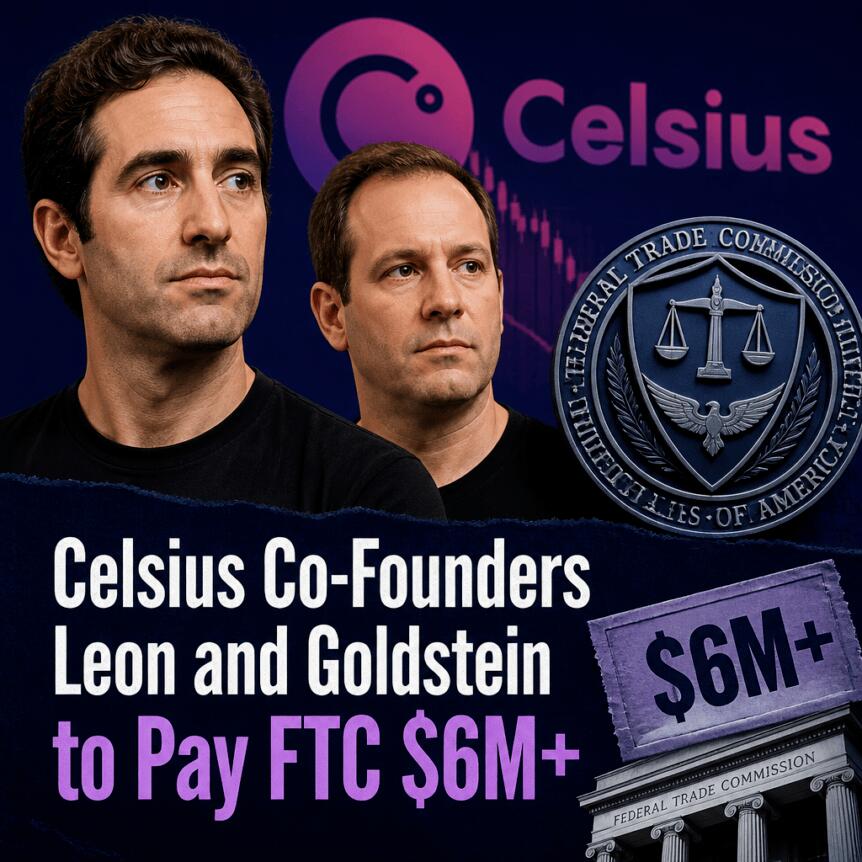
Federal regulators have extended the legal fallout from Celsius’ 2022 collapse by ordering two of the company’s former co-founders to pay more than $6 million to resolve Federal Trade Commission (FTC) allegations that they misrepresented the safety of the crypto lending platform.
On Monday, the FTC announced that Hanoch “Nuke” Goldstein, Celsius’ former chief technology officer, was ordered to pay $2.014 million. Shlomi Daniel Leon, the firm’s former chief strategy officer, was ordered to pay $4.1 million under a separate stipulated order entered on June 29.
Key takeaways
- Goldstein and Leon have been ordered to pay a combined $6.114 million to settle FTC consumer protection allegations tied to Celsius’ failure.
- The orders include marketing and sales bans affecting products or services that could be used to deposit, exchange, invest, or withdraw crypto assets.
- The FTC’s claims focus on alleged misstatements about Celsius’ reserves, insurance coverage, and whether loans were unsecured.
- The settlements build on a separate FTC resolution involving Alex Mashinsky, which already included a $10 million payment and a permanent marketing ban.
- Payments from the co-founders are also set to be credited against the FTC’s consumer-harm judgment tied to the case.
What the FTC says the co-founders got wrong
According to the FTC’s allegations, Celsius made assurances to customers about the platform’s financial safety that were not consistent with the company’s actual position as it moved toward bankruptcy. The regulator said Celsius falsely told customers it maintained sufficient reserves to satisfy withdrawal demands, claimed it had a $750 million insurance policy covering customer deposits, and represented that it did not issue unsecured loans.
The FTC further alleged that these public assurances persisted even shortly before the company’s collapse. As the agency put it in its statement Monday, the promises were allegedly false and “its top executives continued to claim that customers’ deposits were safe days before the company filed for bankruptcy.”
Goldstein and Leon are being held responsible for the misconduct the FTC described in connection with how Celsius marketed its operations during the period leading up to the shutdown.
Court-ordered bans restrict Celsius-related promotion and sales
Beyond the monetary payments, the FTC’s settlement terms also impose restrictions designed to limit future involvement in crypto custody and dealing workflows. The agency said the orders bar Leon from marketing or selling products or services that could be used to deposit, exchange, invest, or withdraw assets.
For Goldstein, the restrictions are similarly broad. The FTC’s statement Monday said Goldstein agreed to a ban on marketing or selling retail products or services that can be used to buy, sell, deposit, withdraw, distribute, or trade cryptocurrency.
“Similarly, Goldstein has agreed to a ban on marketing or selling retail products or services that can be used to buy, sell, deposit, withdraw, distribute or trade cryptocurrency.”
How the payments fit into the wider Celsius settlements
The settlements add another layer to the ongoing enforcement picture surrounding Celsius’ collapse and its impact on customers. The platform, which the settlement narrative places in a much larger consumer-harm context, held $25 billion in assets at its peak and owed $4.7 billion to users when it filed for bankruptcy in July 2022.
The FTC’s co-founder orders also relate directly to an earlier resolution involving Alex Mashinsky. In April, Mashinsky agreed to an FTC settlement that included a permanent ban from promoting asset-related products and a requirement to pay $10 million, alongside a broader, partially suspended $4.72 billion judgment.
In the current cases, the FTC said that the $2.014 million and $4.1 million payments from Goldstein and Leon, respectively, will be credited against the $4.72 billion judgment. That crediting mechanism is intended to prevent double-counting of consumer-harm-related penalties across related FTC outcomes.
Criminal case developments underscore the regulatory focus
While these are FTC consumer protection resolutions, other enforcement tracks have also advanced. Separately, US prosecutors have pursued criminal charges against Mashinsky. The filing timeline described in the source indicates Mashinsky pleaded guilty to commodities and securities fraud charges and was sentenced to 12 years in prison in May 2025.
Prosecutors, as described in the reporting referenced in the source, said he misled Celsius customers about the company’s profitability, investment risks, and the safety of customer funds. That criminal framing aligns with the FTC’s core theory in the co-founder cases: that customers were allegedly given assurances about safety and risk management that did not match reality.
For investors and industry participants, the practical takeaway is that Celsius-related enforcement is not confined to one executive or one courtroom. The FTC’s added restrictions on future marketing and sales of crypto asset-related products suggest regulators are targeting the ability of former insiders to re-enter similar distribution and promotion channels. Readers should watch whether additional Celsius-linked proceedings—civil or criminal—continue to expand the circle of accountability and how courts treat the scope of the marketing bans as the industry adapts to ongoing compliance demands.



Yesterday, crypto exchange OKX appointed to its board Andrew Cuomo — the New York governor whose administration created the BitLicense that OKX never received.
Maybe that’s what it takes to finally get that state license.
Cuomo and his administration created the BitLicense back in 2014, and OKX, the world’s fourth largest crypto exchange, has been chasing one ever since.
However, despite having well over a decade to apply, OKX still doesn’t appear on the New York Department of Financial Services (NYDFS) register. Somewhat embarrassingly, competitors, including Coinbase, Gemini, Mastercard, MoonPay, and other crypto companies, do.
With yesterday’s news, however, the path for OKX to win its approval might finally have opened up.
Tough to get, even for the world’s fourth largest crypto exchange
The license is famously difficult to obtain.
Kraken, facing the same daunting application in 2015, called the BitLicense “a creature so foul, so cruel that not even Kraken possesses the courage or strength to face its nasty, big, pointy teeth” and left the state.
Fortune, for context, reported that the BitLicense’s first three years of availability produced just four licensees.
OKX founder Star Xu boasted that Cuomo’s new board seat will help him build “the world’s most trustworthy large digital asset exchange.” This is something that could take some work.
Indeed, between 2018 and early 2024, US customers conducted more than $1 trillion worth of transactions through OKX, even though OKX’s official policy at that time prohibited US persons from transacting on the exchange.
In fact, one OKX employee advised an American in 2023: “I know you’re in the US, but you could just put a random country and it should go through.”
For its part, OKX blamed the episode on “legacy compliance gaps.”
Read more: Flaws in New York regulator’s BitLicense operation prompt action
OKX gets Cuomo plus a BitLicense enforcement superintendent
While Cuomo is certainly OKX’s most influential BitLicense-related hire, he’s not the first.
Bloomberg previously reported that Cuomo, then a paid OKX adviser regarding the federal probe, had urged the exchange to add former NYDFS superintendent Linda Lacewell to its board.
Around that time, lo and behold, Lacewell joined OKX and even became the exchange’s chief legal officer by March 2025, five weeks after OKX’s guilty plea.
The company said her promotion would “bolster our global regulatory presence and reinforce OKX’s position as a licensing juggernaut.”
The NYDFS is the agency that granted the BitLicense OKX does not have.
‘Certain regulatory approvals’ are forthcoming
In June 2026, Intercontinental Exchange, owner of the New York Stock Exchange, announced a 50/50 joint venture with OKX, co-chaired by Cuomo.
The venture expects to operate a US broker-dealer and futures firm, pending “certain regulatory approvals.”
Those “certain regulatory approvals” aren’t difficult to imagine.
Cuomo said in the release, “The next chapter of financial markets will be defined by how well innovation and government regulation can move forward together.”
Well, the chapter before this one ended in a guilty plea for OKX for New York financial misconduct. The next one probably will not, if Cuomo can help.
A BitLicense application costs $5,000 while operating an unlicensed money transmitting business in New York and other states cost OKX more than $500 million in federal penalties.
What OKX is paying the two New Yorkers who oversaw that licensing regime, the company hasn’t disclosed.
Got a tip? Send us an email securely via Protos Leaks. For more informed news and investigations, follow us on X, Bluesky, and Google News, or subscribe to our YouTube channel.
Ethereum’s market dominance climbed back above 10% on Tuesday after weeks below that level, while the token outperformed every other top-10 cryptocurrency with an almost 9% gain in the last seven days.
The move has rekindled bullish sentiment around ETH, even though one analyst is cautioning that no single event appears to have triggered the latest rally.
ETH Retakes 10% Market Share as Sentiment Improves
Data from CoinGecko shows Ethereum’s market cap at around $233.2 billion, with the total crypto market up nearly 2% and valued at just over $2.34 trillion. That put ETH’s share of the market at slightly more than 10%, a figure BIT analyst Markus Thielen described as a “psychologically important” threshold in a July 21 update.
Thielen also noted that when ETH dominance rose in the past, it often coincided with conditions that favored bullish traders. Indeed, at the time of writing, ETH had gained over 4% in 24 hours, but according to the analyst, there was “no immediate catalyst” behind the rise in dominance.
Some big names in the market appear to have picked up on the changing mood, with BitMEX co-founder and avid crypto trader Arthur Hayes spending over $2.5 million on 1,332.5 ETH earlier today. That was his second multi-million dollar splurge on the token in a week after earlier buying 1,293 others for a similar amount on June 16.
BIT’s weekly market watch, also published on July 21, argued that last week’s softer-than-expected US inflation data had reversed a rough start to the week, one that had briefly pushed Bitcoin (BTC) under $62,000 after conflict between the US and Iran flared again. BTC closed that week above $65,000, up almost 4%, while ETH added over 7% in the same period, ending up above $1,900 and marking its second consecutive week of outperforming Bitcoin. This also lifted the ETH/BTC ratio to 0.0293 from a June low of 0.0264.
Institutional Positioning Shifts Toward Ethereum
At the time of writing, the world’s second-largest cryptocurrency was still trading well over the $1,900 mark, having gained about 8.8% in one week and more than 12% in the last 30 days.
That weekly performance was the best among the top ten digital assets by market cap, with XRP and BTC following closely after jumping more than 6% in XRP’s case and about 5.7% in BTC’s case in that period. ETH’s daily trading volume also saw a huge uptick, adding more than 31% to the previous day’s amount to hit $11.6 billion.
Beyond spot prices, BIT’s report said perpetual funding rates have remained close to neutral despite ETH’s gains, while implied volatility stayed relatively subdued.
It also noted that institutional investors appeared to favor call options, with buy-call activity accounting for more than three-quarters of Ethereum block trades, while retail participants largely opted for call spreads to gain upside exposure with limited cost.
The post Ethereum Reclaims 10% Market Dominance as ETH Outperforms Top Cryptocurrencies appeared first on CryptoPotato.


Russia’s State Duma passed legislation establishing the country’s first comprehensive framework for regulating cryptocurrencies with most of the new rules set to take effect on Sept. 1.
The law creates a legal framework for crypto exchanges, depositories and other digital asset providers, while setting rules for who can buy crypto and under what conditions, Russia’s state-owned news agency TASS reported Tuesday.
Only organizations included in a special registry will be permitted to operate as cryptocurrency exchanges, although firms will be allowed to continue operating without registration until July 1, 2027.
Under the new law, banks will be required to refuse transfers if they suspect an unauthorized entity is operating a cryptocurrency exchange.
The legislation also guarantees judicial protection for holders of digital currencies regardless of whether the assets were previously declared.
Retail investors will be allowed to buy the most liquid cryptocurrencies through licensed intermediaries, subject to an annual limit equivalent to roughly $3,800 per intermediary. Qualified investors will be able to purchase any crypto without restrictions.

Onchain lending just gained a new option on Base: Morpho has launched Morpho Midnight, a fixed-rate, fixed-term lending market that sits alongside its existing variable-rate venue, Morpho Blue. The move introduces an intent-driven model where loans are structured around competing offers—rather than being priced by a protocol-defined utilization curve.
According to an announcement shared with Cointelegraph, Midnight is live on the Base mainnet and begins by supporting cbBTC and USDC across multiple maturity dates. Morpho says the rollout is intentionally contained to support a progressive deployment focused on security.
Key takeaways
- Morpho Midnight brings fixed-rate, fixed-term borrowing to Base, complementing Morpho’s variable-rate Blue pools.
- Loan pricing is offer-driven: lenders and borrowers propose interest rates, maturities, and other terms instead of relying on algorithmic pool utilization curves.
- Midnight is positioned to better match needs found in traditional credit markets, where funding costs and repayment schedules are known in advance.
- The initial deployment supports cbBTC and USDC with multiple maturity dates, and Morpho says additional integrations and features may come as the rollout expands.
Fixed terms arrive on Base, but with a different pricing engine
DeFi lending has historically struggled to replicate the predictability offered by conventional finance. In many onchain markets, borrowing costs rise or fall with changing utilization—meaning lenders and borrowers face pricing that can shift over time.
Morpho’s Midnight is designed to address that gap by shifting from pool-based algorithmic pricing to a marketplace of offers. As Morpho explained to Cointelegraph, the system lets participants propose interest rates, maturities, and other loan parameters. Instead of relying on a continuously running utilization curve, Midnight issues loans as fixed obligations matched through competition among offers.
For institutions and businesses, this matters because fixed repayment schedules can make it easier to manage funding costs, expected returns, and risk exposure. While the DeFi sector can approximate fixed income through complex strategies, a dedicated fixed-rate lending venue can reduce reliance on workarounds.
Morpho also emphasized that Midnight is not intended as a replacement for Morpho Blue. Blue remains focused on open-ended, variable-rate lending pools, while Midnight is structured to externalize loan risk, interest rates, and duration to market participants—turning those elements into negotiated terms.
How Morpho framed the “Midnight” design before launch
Morpho first discussed the fixed-rate approach as part of a broader “Morpho V2” roadmap. In a 2025 post referenced by Morpho’s development timeline, the protocol described an intent-based, peer-to-peer marketplace where users could submit custom offers. In that framing, capital could continue earning variable yield until it becomes matched to a fixed-rate offer—before locking into the fixed obligation.
In April, Morpho named the fixed-rate system Midnight and clarified again that it would complement, not replace, Morpho Blue. Later, Morpho released Midnight’s whitepaper and codebase in May. In connection with that release, Morpho said the “offered capital” model was meant to avoid a recurring problem in fixed-rate DeFi: liquidity lockups and fragmentation across maturity dates.
That design goal is important because fixed-rate markets can face an inherent mismatch—capital providers may not always want to commit for the exact maturities demanded by borrowers. By centering loan terms around offers, Midnight aims to make maturity selection more market-responsive while still offering borrowers defined terms.
Rollout status: live on Base with cbBTC and USDC
According to the Morpho spokesperson who spoke to Cointelegraph, Midnight is already live on the Base mainnet. The first version supports cbBTC and USDC, and it offers loans across multiple maturity dates.
Morpho said it kept the launch deliberately contained as part of a progressive rollout strategy, prioritizing security. The spokesperson also told Cointelegraph that crypto-native lenders, borrowers, and curators active on Morpho Blue have shown interest in moving into Midnight’s fixed-term environment.
Beyond existing Morpho participants, Morpho indicated that several enterprises and institutions are building products on the protocol in beta. Morpho did not provide details of those initiatives at this stage, saying announcements are expected as those products go live.
Where this fits in Morpho’s broader growth and DeFi lending trends
Midnight’s launch arrives after a period of rapid expansion for Morpho. Earlier in June, Morpho announced a $175 million funding round led by Paradigm, with participation from a16z crypto (Andreessen Horowitz) and Ribbit Capital. At the time, Morpho said it planned to expand integrations with banks, asset managers, and large platforms, while adding features associated with traditional credit markets—an aim that aligns with Midnight’s fixed-rate proposition.
Morpho’s infrastructure is already used by major crypto platforms for variable-rate lending. In April, Cointelegraph reported that Coinbase launched Morpho-powered USDC loans for United Kingdom users. Those loans reportedly allowed borrowers to take positions against Bitcoin (BTC), Ether (ETH), and cbETH on Base, using variable rates and with no fixed repayment schedule—an example of the open-ended borrowing model that Midnight is designed to complement.
In other words, Midnight extends Morpho’s toolkit toward a segment of lending that may feel more familiar to legacy finance workflows, where counterparties often value certainty in pricing and maturity. Still, the practical impact for users will depend on liquidity at specific rates and maturities, as well as how quickly lenders and borrowers coordinate around those offer terms.
Readers should watch how Midnight’s liquidity develops across maturity dates and whether more assets beyond cbBTC and USDC are added as the rollout expands. The key uncertainty is whether fixed-term demand can consistently find matching offers at attractive terms—because the economics of fixed-rate lending live and die by market participation.
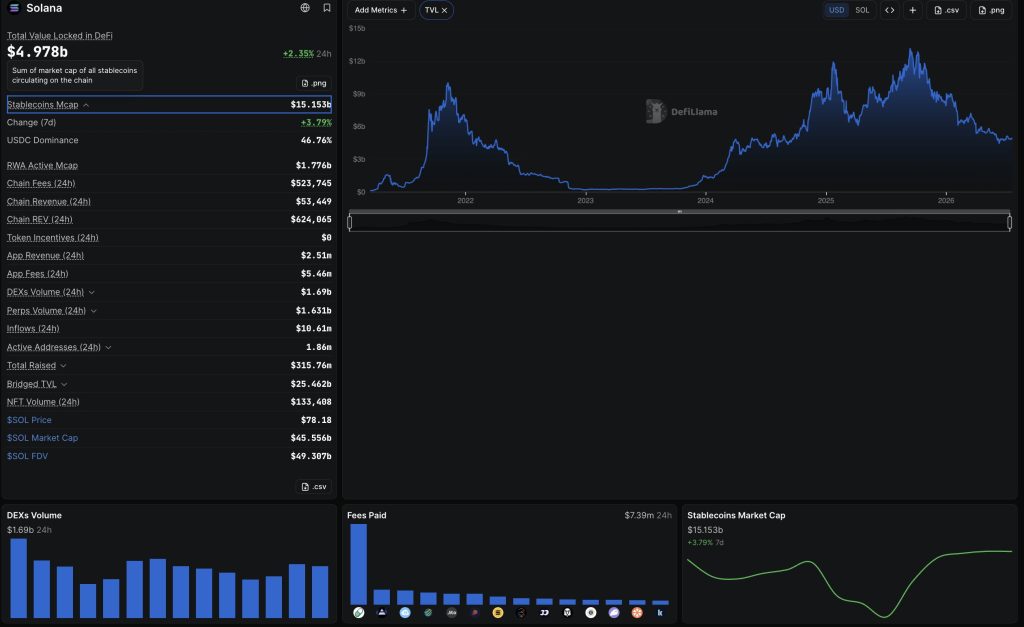
In Solana news today, the network’s total stablecoin market cap crossed $15Bn for the first time, according to Token Terminal data. The question the number forces onto the table is whether this supply base holds structural depth or remains tethered to cyclical retail flows.
USDC accounts for a large share of Solana’s stablecoin supply, with DeFiLlama reporting USDC at $7.09Bn and total Solana stablecoins at $15.16Bn. Circle’s $250M USDC minting on Solana has been reported as part of a pattern of supply growth contributing to the $15Bn milestone.
This Stablecoin surge across the Solana network comes as SOL USD spiked +3% over the past 24-hours, reaching over $78, with a daily trading volume of $1.94Bn.
Solana News: Beyond USDC/USDT and the New Stablecoins on the Block
The more structurally significant development sits outside the USDC/USDT duopoly. The non-USDC/USDT stablecoin segment on Solana hit an all-time high of $4.81Bn, driven by USD1 and USDG, according to SolanaFloor data. That segment now accounts for nearly one-third of Solana’s total stablecoin market cap.
USD1, a dollar-pegged stablecoin associated with World Liberty Financial, and USDG (Global Dollar) are the primary drivers of that growth.
USDT sits at $2.91Bn on Solana per DeFiLlama, leaving the remaining $4.81Bn distributed across these newer entrants. The diversification of the issuer base matters: it signals that dollar liquidity on Solana is no longer a two-party dependency.
Anchorage Digital’s USDGO reached a $1Bn market cap on Solana, up approximately 20x since January 2026. USDGO is a regulated, USD-pegged stablecoin launched on Solana in February 2026.
Two Demand Drivers, One Supply Stack
JUST IN: Total stablecoin market cap on @solana surpasses $15B, marking an all-time high.
Leading currencies: USD, EUR, & more
Leading assets: USDC, USDT, USD1, USDGO, & more
Leading issuers: Circle, Tether, Paxos, & more
~5% of all stablecoins are currently issued on Solana. pic.twitter.com/pGrojYxwfP— Token Terminal
(@tokenterminal) July 20, 2026
Solana’s stablecoin boom is being driven by two overlapping forces that reinforce each other but do not depend on each other. The first is renewed retail activity: DEX trading volume on Solana rose 13.1% week over week, daily transactions climbed 17.3%, and TVL expanded 12.5%, per DeFiLlama metrics.
Memecoin cycle activity is generating real on-chain dollar demand, with Jupiter and Raydium as notable liquidity venues. More than $900M in new stablecoins were minted in a single 24-hour window per Token Terminal.
The second driver is settlement-layer adoption. BlockEden reports Solana processed $650Bn in adjusted stablecoin volume in February 2026, surpassing Ethereum and Tron combined. That figure predates the current $15Bn supply milestone by several months, implying settlement throughput has likely expanded further since then.
DeFi protocols on Solana benefit directly from deeper stablecoin liquidity, tighter spreads, higher utilization rates, and more capital-efficient collateral pools, all of which follow from a larger on-chain dollar base. The growing dominance of Solana in tokenized assets, which hit a record $6Bn in Q2, compounds this dynamic: real-world asset settlement and stablecoin liquidity are co-locating on the same chain.
The regulatory context is not peripheral here. Stablecoin legislation moving through Congress, including a Crypto Clarity Act framework discussed toward a Senate vote, could create clearer rules of the road for stablecoin issuers. A clear federal standard accelerates institutional issuance and removes regulatory ambiguity that has kept some treasury desks from deploying at scale on public chains.
Discover: The Best Token Presales
What the $15Bn Figure Does and Does Not Confirm
In other Solana news, the $15Bn supply level confirms that Solana has accumulated a dollar base large enough to sustain serious DeFi and settlement activity independent of any single issuer.
It does not confirm that this base is cycle-resistant. A meaningful portion of current stablecoin demand on Solana is memecoin-adjacent, speculative liquidity that migrates when retail attention rotates.
The non-USDC/USDT segment’s 15x growth since January 2025 is impressive, but some of that reflects specific product launches (USDGO’s February debut, USD1’s expansion) rather than purely organic demand accumulation.
The credible bear case is a memecoin cycle cooling combined with stalled stablecoin legislation, which would simultaneously slow both retail-driven USDC minting and institutional USDGO deployment.
The bull case is that institutional settlement demand, evidenced by USDGO’s trajectory and Solana’s stablecoin volume market share, provides a structural floor that persists through retail drawdowns.
Circle’s aggressive minting cadence and Anchorage Digital’s institutional positioning suggest at least one major issuer is betting on the latter.
Discover: The Best Crypto to Diversify Your Portfolio
The post Solana News: Stablecoin Supply Hits $15Bn With New Issuers Reshaping the Mix appeared first on Cryptonews.
A decentralized exchange (DEX) backed by Robinhood is expanding into tokenized stocks and derivatives as platforms compete to build onchain markets for traditional assets.
Arcus, a DEX built by the team behind decentralized trading platform dYdX and backed by Robinhood Crypto, launched tokenized stocks and perpetual futures on Robinhood Chain on Tuesday, according to an announcement shared with Cointelegraph.
The company previously launched spot markets when Robinhood Chain went live on July 1. Arcus offers more than 95 stock tokens, perpetual markets and crypto assets through a self-custodial trading account, with Paxos-issued stablecoin USDG serving as its primary collateral and settlement asset.
The launch comes as crypto companies and financial platforms increasingly compete to build infrastructure for tokenized real-world assets (RWAs), while regulatory questions around access and product structure remain a key challenge for the sector.
Related: Bernstein raises Robinhood price target, cites tokenization and prediction markets
Self-custody shapes approach to onchain trading
Arcus’s launch includes tokenized versions of stock in major US companies such as Nvidia, Tesla, Apple, Microsoft, Meta, Google and Amazon, as well as perpetual markets tied to equities, exchange-traded funds, commodities, indexes and crypto assets.
The platform uses a self-custodial model, allowing users to retain control of their assets rather than deposit them with a centralized exchange. Arcus uses Privy, a wallet infrastructure company that helps applications create and manage crypto wallets, allowing users to sign up through email or social logins.
Source: Robinhood Chain
Users who already hold crypto can connect existing self-custodial wallets, including MetaMask, Ledger and WalletConnect, with the company citing support for additional Ethereum-compatible wallets.
Tokenized stocks face regulatory questions
Arcus said its stock tokens are unavailable in the US, Canada, the UK and other restricted jurisdictions, highlighting the different regulatory approaches to tokenized securities across markets.
Cointelegraph contacted Arcus for clarification on the restrictions but did not receive a response by publication time.
Regulators in markets including the US and UK have been examining how blockchain-based representations of traditional assets fit within existing financial frameworks, with questions around custody, ownership and market structure being addressed.
The launch adds another player to the growing race to build infrastructure for tokenized assets, with platforms including Coinbase-backed Base exploring ways to bring traditional financial products onchain.
Magazine: Is Robinhood Chain’s success bullish or bearish for ETH the asset?
Circle is building a four-layer financial stack around Arc, its new blockchain. Tether still controls the digital dollar most of crypto actually uses.
Investors still see Circle as a stablecoin issuer. The numbers mostly agree. Reserve interest produced 94% of its first-quarter revenue.
Inside Circle’s Four-Layer Financial Stack
Circle calls Arc an economic operating system. It settles in under a second. Fees are paid in USDC, and privacy is optional and built in.
The layers stack like this. Assets such as USDC, EURC, and the yield-bearing USYC sit on the base chain. Developer products like wallets and the Cross-Chain Transfer Protocol (CCTP) come next. Circle’s own apps, including Mint and StableFX, sit on top.
Circle’s report says more than 100 firms joined the Arc testnet after its October 2025 launch. Goldman Sachs, Mastercard, and Visa are among the early partners. The testnet handled roughly 15 million transactions in the week ending July 15.
Big money is following. Circle’s first-quarter results revealed a $222 million ARC token presale at a $3 billion valuation. BlackRock, a16z crypto, and ARK Invest joined the raise.
Why the rush? Reserve income of $653 million made up 94% of Circle’s $694 million first-quarter revenue. Other revenue doubled in a year yet reached just $42 million. The stack is Circle’s escape plan.
Circle’s final OCC approval for a national trust bank adds regulatory muscle. The license comes from the Office of the Comptroller of the Currency.
Why Tether Still Owns Crypto’s Dollar
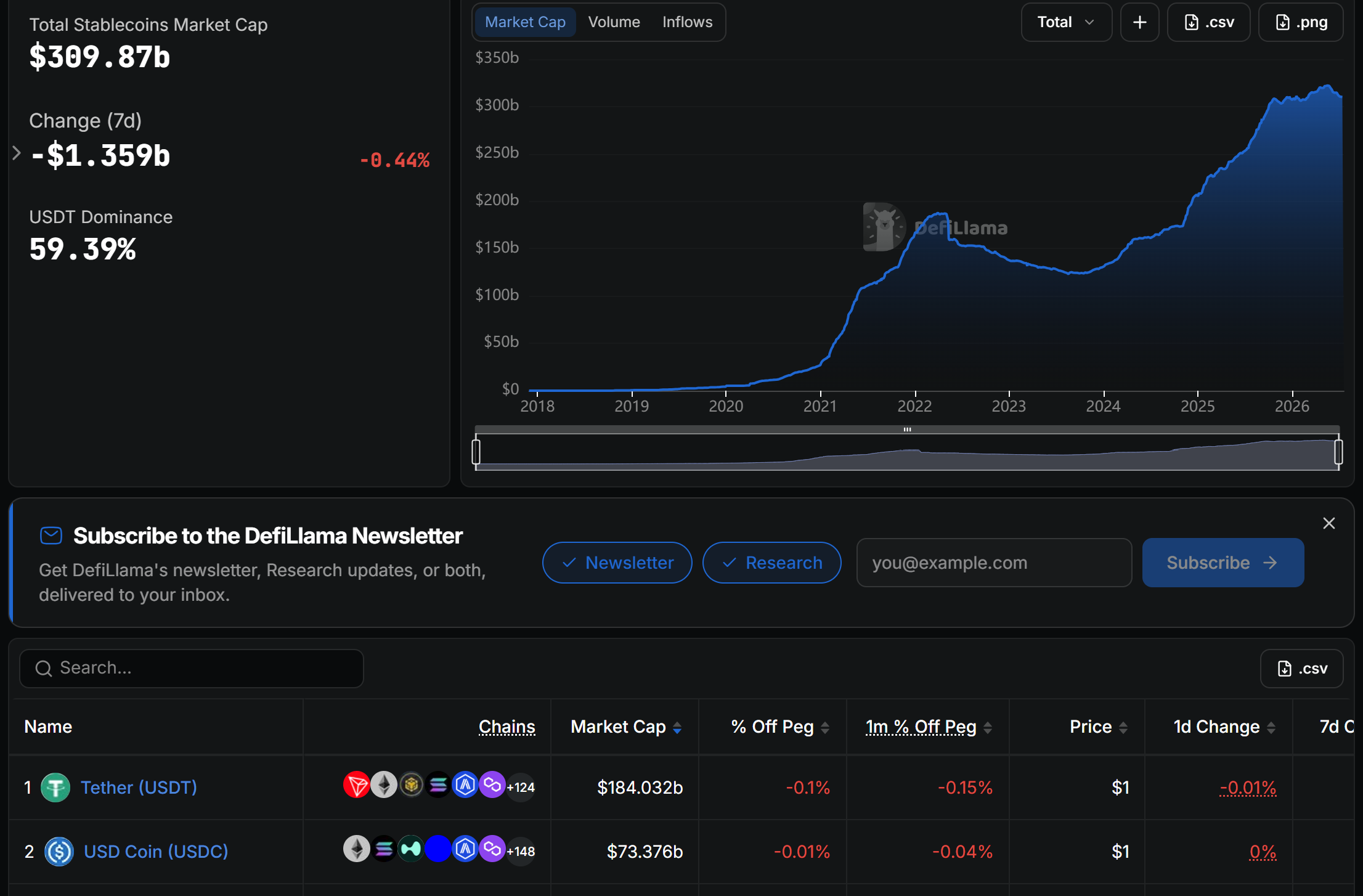
Tether’s USDT market cap stands near $184 billion. USDC holds $73 billion. It has slipped from $77 billion since the end of March.

The trading gap is wider still. USDT turned over roughly $48 billion in the past day. That is four times USDC’s total. Tron alone carries some $89 billion in dollar-pegged stablecoins, DefiLlama data shows. That single chain outweighs USDC’s entire supply.
History explains the loyalty. USDC fell to $0.88 in March 2023. Some $3.3 billion of its reserves sat frozen at the collapsed Silicon Valley Bank. Traders remember.
Tether also moves fast when Washington calls. It froze Iran-linked USDT worth $131 million within hours of new US sanctions this month. Circle, meanwhile, faces a Wisconsin criminal complaint for refusing to recover a scam victim’s funds without a court order.
Circle has one strong counter. USDC handled 63% of stablecoin transaction volume in the first quarter, per Visa Onchain Analytics figures in its results.
The stock market is not sold yet. Circle shares have collapsed roughly 76% from their post-IPO peak. A split market may be forming.
The GENIUS Act, America’s 2025 stablecoin law, steers regulated money to USDC. Offshore trading keeps USDT. Arc’s mainnet launch will test whether new rails can pull liquidity from a dollar Tether still owns.
The post Circle Wants to Own Crypto’s Financial Stack, but Tether Still Owns the Dollar appeared first on BeInCrypto.
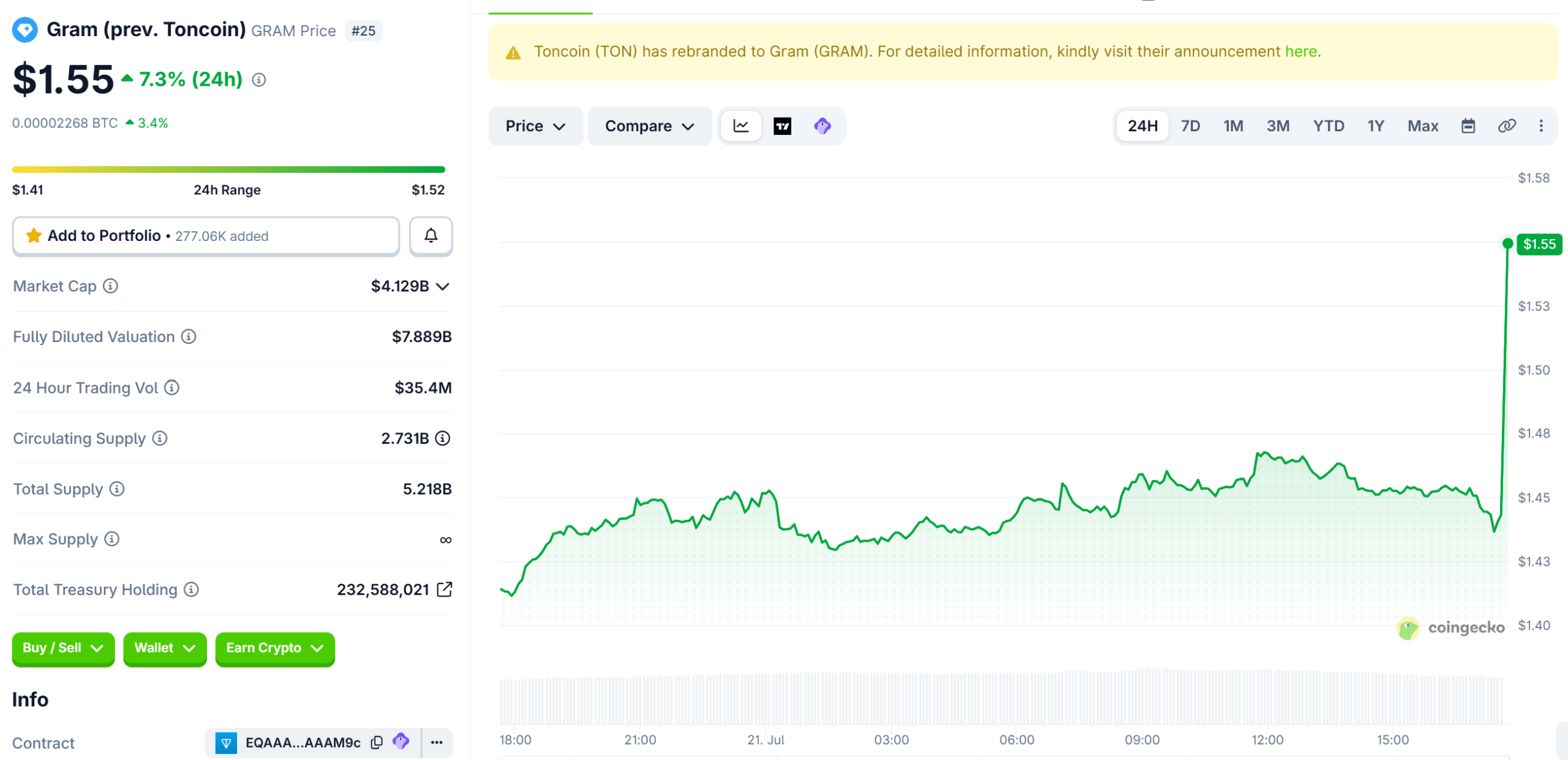
Telegram is embedding a native non-custodial Gram wallet directly into its messaging app for one billion users, triggering a 10% price surge in the token formerly known as Toncoin.
Pavel Durov’s initiative aims to deliver instant, near-zero-fee transactions inside chats. The development follows the June rebrand and positions Gram as a core part of Telegram’s expanding financial tools.

The post GRAM Jumps 10% as Pavel Durov Unveils New Product for Telegram Users appeared first on BeInCrypto.


The UCITS ETF, CoinShares’ first in Europe, began trading on Deutsche Börse Xetra, tracking a rules-based index of publicly listed BTC miners.


Augustus, a startup building a federally chartered clearing bank for fintechs and financial institutions, said it raised $180 million to expand its dollar payment infrastructure as stablecoins reshape global finance.
The fundraising valued the company at $1 billion, with Tiger Global leading the round and investors such as Hummingbird, QED and the founders of Nubank, Ramp, Circle and Deel participating, the company said in a Tuesday press release.
The investment comes as banks, fintechs and crypto firms are racing to modernize the infrastructure behind cross-border payments. While much of the attention has centered on stablecoin issuers, Augustus is targeting a less visible but crucial part of the financial system: correspondent banking.
“We think distribution breaks at the clearing bank layer,” CEO Ferdinand Dabitz told CoinDesk in an interview. Legacy clearing systems are “slow, unavailable, take two days to settle and close on the weekends,” he argued.
Taking on correspondent banking
The firm is building what Dabitz described as an “AI-native” clearing bank designed around stablecoins, programmable money and always-on settlement.
Augustus doesn’t plan to issue its own stablecoin, Dabitz said. Instead, it wants to provide the banking infrastructure that lets financial institutions move money across traditional payment systems and blockchain networks.

Kaylee Hottle dead at 18: Godzilla vs Kong child star passes away after tragic car crash

Wall Street is selling more rental homes, as buying ban takes effect

OKX hires the architect of the BitLicense it never won

Renter of Home in Anne Heche Crash Denies Settlement With Son

No Jackpot Winner as $257 Million Prize Rolls Over to $269 Million Monday Draw

Weekend Open Thread: Staud – Corporette.com

Crypto Live Trading| 20 july #vinbullindia #livetrading #vinbulllive #live #trading #cryptotrading

Bitcoin (BTC): WARNING.. The Final Crash Is About To Begin! (BE READY)

XRP $50.10 IS NOT CRAZY – “XRP LEDGER ACTIVITY HITS RARE LOWS” On-Chain Analytics Firm Reports
-
 NewsBeat5 days ago
London Mayor Sadiq Khan handed a peerage by Keir Starmer alongside 15 other Labour figures… just days before the PM leaves No10
-

 Fashion4 days ago
Weekend Open Thread – Corporette.com
-

 Politics3 days ago
The House | The City of London can help the new chancellor deliver growth in every postcode
-

 Politics6 days ago
Young campaigners urge incoming PM to act on outdoor junk food ads
-

 Crypto World6 days ago
CFTC blocks Kalshi from unwinding Michigan trades after court order
-
 Crypto World4 days ago
Two July Windows Left: The CLARITY Act’s Senate Fight and What Failure Means
-

 Crypto World3 days ago
Ripple Payments Joins MiCA With 14 Firms, Does It Mean Anything For XRP?
-

 Business6 days ago
Nvidia Stock Slips After Big Tuesday Rally as Huang Confirms Vera Rubin Chip Is Now in Production Today
-

 Politics2 days ago
Democrats look to World Cup watch parties to register thousands of voters
-
 Entertainment6 days ago
Disney’s Most Ambitious Failed Star Wars Attraction Is Coming to SDCC
-

 Crypto World4 days ago
Ripple wins EU-wide access as ESMA adds it to MiCA register
-

 Crypto World5 days ago
Injective Submits SEC Transfer-Agent Registration to Onchain Ownership Records
-

 Crypto World7 hours ago
Grayscale Files For Worldcoin ETF, WLD Registers Sharp Rise
-

 Business6 days ago
Palantir Shares Rise After Expanded Nvidia Partnership and Fresh Analyst Upgrades Ahead of Earnings Day
-

 Tech15 hours ago
Sail Virtually Aboard The “Itanic” With IA-64 Emulator
-
 Tech13 hours ago
Turtle Beach Command Series KB7 review: a nifty screen-equipped gaming keyboard
-

 Tech7 days ago
Dark Secrets Emerge When Jailbreaking LLMs
-

 NewsBeat4 days ago
Registration is now open for March for Men with Kev 2026
-

 News Videos7 days ago
XRP BOMBSHELL… XRP OMBOARDED FOR TRANSACTIONS!!!
-

 NewsBeat1 day ago
Unregistered fitter used Gas Safe logo on business flyers
You must be logged in to post a comment Login