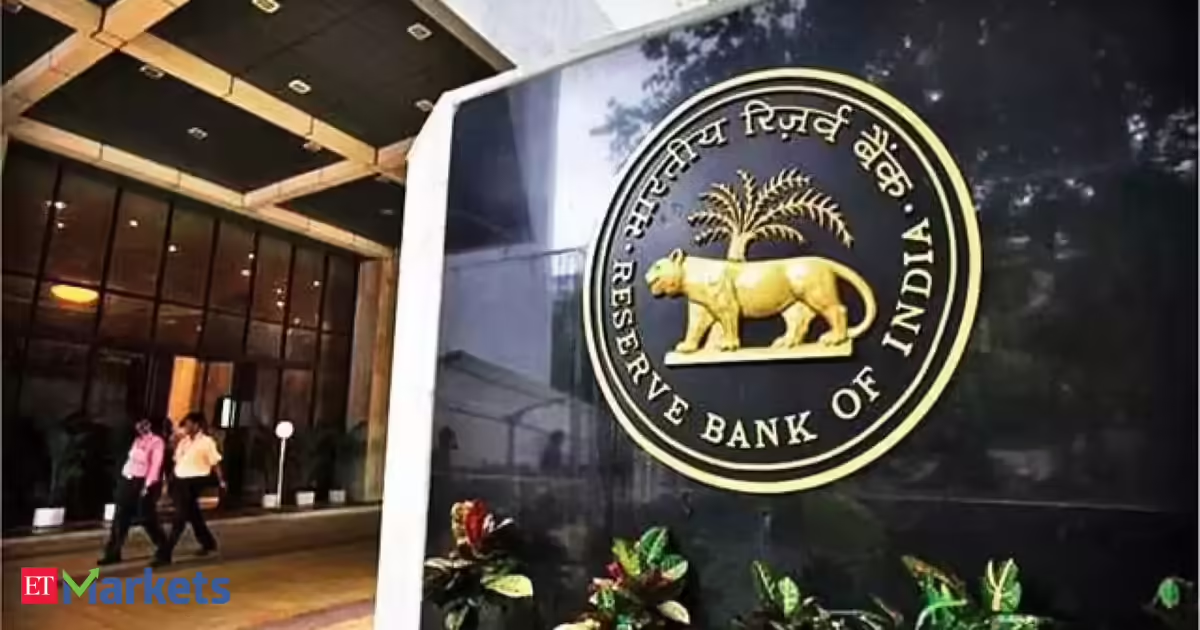
The Reserve Bank of India’s amendment, effective 1 April 2026, ushers in sweeping changes to funding structures, collateral norms, and exposure rules within the capital markets ecosystem — a move that could reshape the operating landscape for stock brokers.
A key change under the amendment is the shift toward fully secured funding for brokers. Going forward, only 100% secured funding will be permitted, with limited carve-outs such as intra-day settlement timing facilities. Earlier, bank guarantees for instance of Rs 100 could be structured with Rs 50 backed by fixed deposits and the remaining Rs 50 supported through unsecured instruments such as personal or corporate guarantees. The revised framework removes this flexibility.
The amendment also introduces stricter rules for bank guarantees issued in favour of exchanges or clearing corporations. A minimum of 50% collateral will now be required, of which at least 25% must be in cash. In addition, equity shares accepted as collateral will be subject to a minimum haircut of 40%, marking a tightening of collateral valuation norms.
Another significant change relates to proprietary trading. Banks will no longer be permitted to provide funding for prop trading activities, with exceptions limited to areas such as market making and certain debt warehousing functions. Further, all exposures will now be classified as capital market exposure, meaning that banks’ overall limits for such exposures will apply, potentially affecting lending appetite.
Advertisement
The framework also introduces ongoing collateral monitoring and margin call provisions. Collateral cover will need to be maintained on a continuous basis, and facility agreements must include explicit clauses for margin calls in the event of shortfalls.
Live Events
Overall, the amendment is expected to reduce leverage across the system and increase capital blockage for brokers. Bank guarantee costs are likely to rise under the revised structure, while promoter guarantees alone will no longer suffice as adequate support. (Disclaimer: Recommendations, suggestions, views and opinions given by the experts are their own. These do not represent the views of The Economic Times)
The markets traded in a relatively narrower range through the week with a clear negative bias and ended lower. After opening near the higher end of the range, Nifty attempted an early push toward 26,009 but failed to sustain the move and gradually drifted lower. Selling pressure intensified toward the latter half, dragging the index to an intra-week low of 25,444 before settling near the lower end of the range.
The index oscillated within a 565-point band. India VIX rose sharply by 11.33% to 13.29, reflecting a pickup in volatility and some nervousness creeping back into the system. Nifty ended the week with a net loss of 222.60 points (-0.87%).
Agencies
The broader structure continues to show a market that is in a medium-term uptrend but currently undergoing a corrective phase within that trend. On the weekly chart, Nifty has slipped below its 20-week moving average (25,728) and is hovering above the 50-week MA (24,931), placing it in a critical intermediate support zone.
The price action over the past several weeks resembles a mild distribution phase near the recent highs, and the index is now testing the lower boundary of the falling trend line. The 24,900–24,950 zone remains a major support area on a closing basis; a sustained breach below this band could open the door for a deeper retracement toward the 24,350–24,400 region. On the upside, only a decisive move back above 25,800–26,000 would negate the immediate weakness and restore directional strength.
For the coming week, the markets are likely to see a cautious and potentially volatile start given the rise in VIX and the index closing near its weekly low. Immediate resistance levels are placed at 25,728 (20-week MA) and 26,000. Key supports come in at 25100 and 24,950. The weekly RSI stands at 50.17, having slipped below its recent peaks and now sitting in neutral territory; there is no visible bullish or bearish divergence against price at this point. The weekly MACD remains above the zero line but is below its signal line, indicating a loss of upward momentum. The latest candle is a bearish body following a phase of hesitation near the highs, hinting at growing supply at elevated levels.
Advertisement
Live Events
From a pattern perspective, the index appears to be forming a short-term topping structure after failing to sustain above the recent highs. The inability to hold above the upper Bollinger Band and the subsequent drift toward the middle band reflect waning momentum. The 50-week MA at 24,931 and the 100-week MA at 24,359 form a layered support cluster below current levels, while the 200-week MA continues to slope upward, underscoring that the long-term trend remains intact despite near-term pressure. Given this setup, a measured and stock-specific approach is advisable. Traders should avoid aggressive fresh longs until the index either reclaims 25,800 decisively or retests and stabilizes around the 24,900–24,950 support zone. Protection of existing gains should take precedence over chasing momentum. The coming week demands disciplined risk management and selective participation rather than broad-based aggressive positioning.In our look at Relative Rotation Graphs®, we compared various sectors against the CNX500 (NIFTY 500 Index), representing over 95% of the free-float market cap of all the listed stocks.
Agencies
Agencies
Relative Rotation Graphs (RRG) show that the Nifty PSE Sector Index has rolled inside the leading quadrant. Besides this, even IT index is inside the leading quadrant, but is seen rapidly giving up on its relative momentum. The other sector Indices that are inside the leading quadrant are Services Sector, Bank Nifty, PSU Bank, Metal, and Financial Services Indices. These groups may relatively outperform the broader markets.
The Auto and the Midcap 100 Index are inside the weakening quadrant. The Infrastructure Index is also inside this quadrant but it is improving on its relative momentum.
The Nifty Pharma Index has rolled inside the lagging quadrant. While the FMCG Index languishes inside the lagging quadrant, the Realty Index is seen improving its relative momentum.
The Media and the Energy Indices are placed inside the improving quadrant. Important Note: RRGTM chartsshow the relative strength and momentum of a group of stocks. In the above Chart, they show relative performance against NIFTY500 Index (Broader Markets) and should not be used directly as buy or sell signals.
Funds which generate better returns and have low expense ratio vis-à-vis category. High returns and low costs are two key parameters which an investor should look for while investing in a mutual fund. Here are top five funds in the last six months (Source: MF Screener)
Bangladesh’s prime minister-designate and Bangladesh Nationalist Party (BNP) chairman Tarique Rahman on Saturday said his country’s national interest and the welfare of its people would remain the top priority.
Addressing a press conference, Rahman said, “We have made ourselves clear about foreign policy, the interest of Bangladesh and the interest of the people of Bangladesh come first.”

His remarks come amid strained ties with India after former prime minister Sheikh Hasina fled to India in August 2024 following massive student-led protests that forced her resignation. She has been living in New Delhi since then.
On Friday, the BNP reiterated its demand for Hasina’s extradition from India to face trial in Bangladesh. Senior BNP leader Salahuddin Ahmed said the party supports efforts to bring her back through diplomatic channels.
“The foreign ministry has already taken up the matter, and we support it. We have consistently called for her extradition in accordance with the law. This is an issue between the foreign ministries of the two countries. We urge the Indian government to send her back to face trial in Bangladesh,” Ahmed said.
Advertisement
Live Events
He added that Bangladesh seeks normal relations with all its neighbours, including India, but based on mutual respect and equality. “We want friendly relations with all countries, including India, founded on mutual respect and equality,” he said. Rahman, who lived in self-imposed exile in London for 17 years, has emerged as Bangladesh’s new political leader, with the BNP — founded by his father Ziaur Rahman — set to return to power after two decades. The 60-year-old leader’s party secured 209 of 297 seats in the elections, while the right-wing Jamaat-e-Islami won 68 seats. The Awami League, led by Hasina, was barred from contesting the polls, which saw a voter turnout of 59.44%.
The result marks a dramatic turnaround for the BNP, which faced sustained political pressure during Hasina’s 15-year rule that ended after nationwide protests in August 2024.
Rahman is the son of former prime minister Khaleda Zia and former president Ziaur Rahman, who founded the BNP and was assassinated in 1981. Having returned to Bangladesh after years in exile, Rahman now faces the challenge of delivering meaningful political and economic change and meeting public expectations for a decisive break from dynastic politics.
Galaxy Digital Inc. (GLXY) Q4 2025 Earnings Call February 12, 2026 1:30 PM EST
Company Participants
Michael Wursthorn Michael Novogratz – Founder, CEO & Director Jonathan Goldowsky – Head of Investor Relations Anthony Paquette – Chief Financial Officer
Presentation
Advertisement
Michael Wursthorn
All right. Sorry about that, guys. A little bit of a technical difficulty, but we finally got it going. I am the Head of Comms here at Galaxy, Mike Wursthorn. And I just want to start with a little bit of a disclaimer before we get going.
First of all, we’re really excited to be hosting our latest quarterly X Spaces following our Q4 earnings. It’s a great chance to connect with our retail investors and share more of what we’re working on with Galaxy. And today, I’m here joined by our CEO, Mike Novogratz; and our CFO, Tony Paquette. And as always, we’re going to try to answer as many questions as we can. But as usual, there are some that we won’t be able to answer. So we won’t be addressing nonpublic financials or other information that might be inappropriate or
[Technical Difficulty]
Advertisement
Michael Novogratz Founder, CEO & Director
All right, guys, can you hear us? Sorry about this. The last few times, we seemed to have gotten this thing right. And this time, we are striking out. I hope that doesn’t say a lot for the Bitcoin price action, which has also been pretty s*****. Listen, I’m going to talk to you a little bit about my macro view to start and a quick update on Galaxy, and then we’re going to open up to Q&A.
This is a bear market in crypto right now. We are below every moving average. We had expected better performance last year with gold up. The Bitcoin narratives were working, and we had a good administration, yet