

Business
Four Corners Property Trust acquires South Carolina property




Separate research from charity Christians Against Poverty found about 35% of adults in the UK worry about their finances every day.
As the VAT announcement will save households about £45 a year, “the fear of juggling budgets that simply don’t balance remains”, says Juliette Flachm, Acting Head of Policy and Public Affair.
“With incomes failing to keep pace with the high cost of essentials, many of the people we see are left facing impossible decisions.”
JRF’s chief economist Chris Belfield said: “Andy Burnham starts his time as prime minister at a time when the cost-of-living crisis has never been more widely felt.
“Government policy can work. We need greater intervention to control rental prices, make energy affordable and improve the adequacy of Universal Credit so everyone can afford the essentials.”
A government spokesperson said: “We’re determined to turn the tide on poverty after years of rising hardship. Our recent statistics show that effort is beginning to make a difference – household incomes have risen 5% in real terms, food bank usage has fallen, and food insecurity is down.
“Work is underway to tackle the cost-of-living pressures through measures such as increasing the National Minimum Wage, removing the two-child limit, implementing the first ever sustained above inflation increase to Universal Credit, and launching the £1bn Crisis and Resilience Fund which will act as a genuine safety net for those in financial crisis.”
The figures come from the Joseph Rowntree Foundation’s poverty tracker, which surveys about 4,000 people from households in the lowest 40% of incomes.
The charity noted that food inflation averaged 4.1% between May 2025 and May 2026, compared to 3.6% for overall inflation, which has greater impact on lower-income households because they spend more of their income on food.
But it also noted that the number of poorer households that couldn’t afford to keep their homes warm has fallen by half a million in two years, after the government reduced average household energy bills by about £150 a year through changes to green levies and support like the warm homes discount.

MadamLead/iStock via Getty Images

I know I said I’d likely stop writing these big letters, but I just couldn’t help myself this quarter. So much is happening, and I wanted to jot my thoughts down as much for myself as anything else. And also to crow about a big win we had.
Quickly on the returns. We had a big quarter, with YTD returns up to 15.91% vs 9.3% for the S&P (my main target benchmark) and 16.96% for the USRT (USRT) (again not really relevant comp these days but including for historical continuity). Since inception we are up to 236.3%, vs 181.29% for the S&P and 89.84% for the USRT. And we did it with no semiconductor exposure (and thus we have avoided the momentum bloodbath since Q2 ended), and a fairly good sized short book to boot.
I will lead with the star of the show this quarter, which was Uniqure (QURE), a stock I mentioned first in late 2025 I believe. As a reminder this is a biotech that has developed a promising treatment for Huntington’s disease, a relatively rare, 100% fatal neurodegenerative disease. It published results in September, the stock skyrocketed to ~$70, then in November the FDA changed tack on what seems to have been previously agreed to guidance accepting an external control group for an accelerated approval and the stock crashed down into the $20s (where I first bought). Then in March, the FDA fully refused to even consider Qure (QURE)’s accelerated application, saying Qure needed to run a full phase 3, and the stock crashed down to as low as $9/share, below cash balances.

I doubled down near these lows, believing that if the drug worked (and no one really seems to think it doesn’t), that worst case you waited out the phase 3 (which Qure had cash to complete), and best case the FDA could change its mind either via personnel change, when additional data came out (they have year 4 data slated for September), or Qure could monetize via approvals abroad (which they are pursuing).
In an absolute whirlwind of a few months, the former FDA leadership was canned after what they did to Qure and several other promising disease treatments, and the new FDA interim leaders have allowed Qure to proceed with a filing for accelerated approval, with the stock now trading around $40s/share.
I will be honest and admit I didn’t think it would happen this quickly, but what a ride! Sadly for me I subscribe to some levels of risk/concentration management and sold some of my position after the initial pop from the lows around $10. But we still have a large position here. I was a bit worried about competition but after Roche (RHHBY) pulled its latest trial I am increasingly convinced that drugs which lower wild type Huntingtins protein across the whole brain or body, which essentially all the major competitors do, are problematic1. This then makes Qure’s approach of selective targeting of the striatum all the more strategic, and I think there is still significant upside from here if Qure can get full approval.
All that said, Qure is not our biggest position right now, that honor goes to Gitlab (GTLB), which has done quite well since we bought earlier this year.
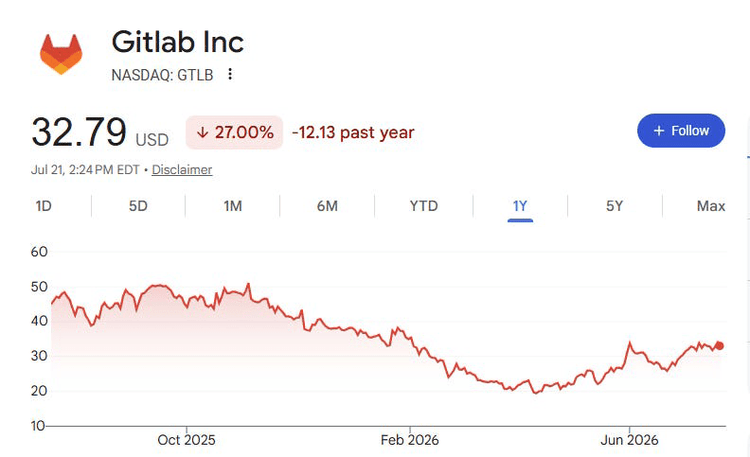
Gitlab crashed significantly from fall of 2025 to today along with basically all other software businesses on a fear that LLMs would replace them all.
The basic thesis here is that as AI dramatically increases the velocity of code production, code control, review and approval (which Git sits at the center of), becomes even more critical than it ever was. The code repos also offer a very natural place to serve up coding agents – most easily visible in Microsoft (MSFT) pushing its Copilot agent through competitor Github.
The growth is already visible in Gitlab’s usage, with code pushes up nearly 50% YoY. Gitlab doesn’t get paid on usage (yet)2, but its a really good sign when people are using your platform a lot more generally speaking.
I believe Gitlab is well positioned to monetize this growth itself, or that it would present an incredibly strategic acquisition opportunity for one of the major AI labs or companies. The market cap is a mere ~$5.5B (and $4.2 ev after cash), a drop in the bucket against the trillion dollar plus valuations in play elsewhere. Gitlab serves a whopping 50% of the F100, and would be a really valuable distribution tool. Microsoft already bought major competitor Git Hub, so there is precedent here as well. One of the firm’s trying to produce an AI model that is struggling with adoption I think would find a company like Gitlab very tempting, such as Meta (META) or SpaceX (SPCX).
Stepping back, the investment book feels about as good as it has since covid times, there are many interesting firms trading at attractive valuations, and I feel fairly good about returns continuing to be strong from here despite significant economic uncertainty.
Macro Musings
And speaking of uncertainty, I am growing more concerned about our two big macro risks, the reclosure of the Strait of Hormuz, and the AI boom. In order to keep this letter brief I won’t spend too much time on Hormuz – but if a deal is not reached soon and the strait remains closed it looks like oil inventories could hit crisis levels in 1-3 months. I suspect/hope something will get done as Trump seems to be aware of this, although unfortunately it may involve paying off Iran or conceding Iranian control of the strait, an effective strategic defeat for the US.
The AI boom is a bit less binary, and therefore there is more to discuss. I believe the AI space is getting overheated, and as the scale has continued to ramp up I am worried that the impact of a bust is approaching a level that may cause a downturn.
The numbers involved here are absolutely staggering, and simply put, there does not appear to be any way that a reasonable return on the investment is earned barring the achievement of AGI within the next few years.
I have written about this several times before, but to repeat, at today’s level of investment (~$700 billion/year), there needs to be ~$1 trillion in end AI annual revenue (from the model cos / providers) by 2029, and that figure would ramp to nearly $4 trillion by 2036 assuming capex stays constant. Here is a link to a quick tweet summary of the math if you are interested3.
What is crazy to me is that many estimates have AI capex increasing significantly in 2027, and some even have it approaching $2 trillion by 2030! Obviously as the capex grows the required revenues also grow.
The tech industry is simply not prepared for their formerly asset light, high margin golden children to turn into low margin commodity capital intensive industrial companies. Almost no one in the industry has the heuristics or experience for this. I cannot tell you how many times I see supposedly knowledgeable Silicon Valley people talking about inference gross margins with no reference to capital investment or D&A – this is like talking about the marginal cost of running an oil well but ignoring the cost to drill it! Or its like asking – ‘is building apartments profitable’, and someone responding ‘ yes, the rental operating margins are very high’. The answer is absolutely and completely irrelevant on its own without reference to a return on capital invested & the cost to build the apartments.
Amusingly, the one group of tech people who viscerally understand this, the management team’s of the memory companies (a business famous for its boom/bust cycles), have opted into a strategy that seems to capitalize on this knowledge by riding the wave and maximizing their own profits, damage to the overall ecosystem be damned. This is, I suspect, the optimal strategy here, although if they push too hard they may incentivize the hyperscalers to enter into the memory game as well. I rather liked my friend Andrew Walker’s observation relating to Micron (MU) and its total capital investment vs Google (GOOGL). Micron has only spent ~$125 billion in capex in its entire history (or at least since 1992, if ChatGPT is accurate). Or alternatively, its book value is $73 billion – this is perhaps a more realistic assessment of the current ‘replacement cost’, if you will. Google is going to spend $185 billion this year. How hard would it be for Google to spin up a memory division? Or Amazon (AMZN). Perhaps more likely is Apple (AAPL) or someone stands up a new player in China to secure and permanently commodify the memory supply chain so critical to their products.
Obviously such a thing would not be easy, but it would not be impossible, and if memory profits were to stay elevated it may happen. It also incentivizes chip designs and model utilization that would be less reliant upon memory as well – human ingenuity is a powerful thing, and I do not like betting against it long term.
More likely though I would guess the whole thing crashes down, and the memory executives know this is likely to occur before too many new entrants come into the space. They are also probably aware of China’s rapid ramp of memory capacity via the growth of CXMT (now almost as large as Micron in terms of capacity! ) & YMTC, and the likely terrible price wars and margin pressure to come in several years from China’s entry into this market. China has successfully commoditized every other electronics sector they have entered, and have moved up the value chain into autos. I don’t see why memory should be any different.
How Much Longer
The big question is, how much longer can this AI capex boom last? It is hard to say, but I think the canary in the coal mine will be when model co revenues slow down. Given their epic growth thus far this year, it wouldn’t surprise me if this happens soon, but honestly I have no idea. It is notable that in the last few days we have seen the release of GPT 5.6, a new Meta Spark model, and Grok 4.5, and all 3 release put significant emphasis on their lower costs and price points. Not to mention a new open weights model out of China that is competitive with Fable and GPT 5.6 trained at what was supposedly a fraction of the cost.
These releases with an emphasis on cost mark a pretty big change from earlier releases which were really only focused on performance, and is potentially a dangerous sign of things to come for model providers.
It could even indicate that the model cos are seeing corporate users become price sensitive in real time, which would presage revenue growth beginning to slow down. Broadly speaking my read on the narrative is that frontier AI users are now actively working to rein in spend. However this may be counterbalanced or even overwhelmed by continuing diffusion throughout the broader corporate ecosystem. At some point though that diffusion completes and reality begins to set in.
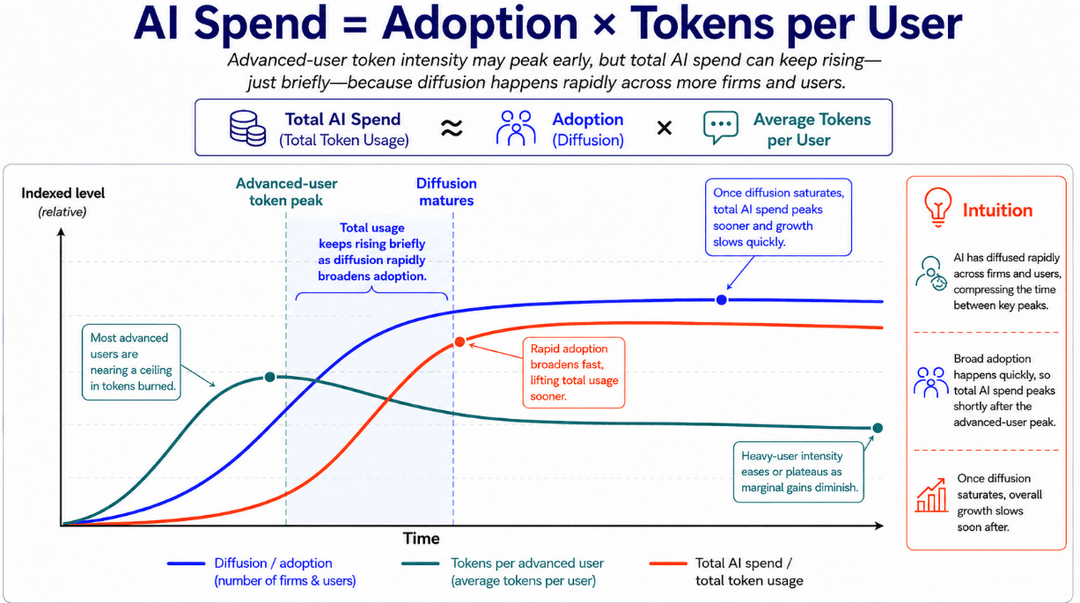
A little rough AI generated summary of this concept – since diffusion is rapidly completing, the key unknown is where token intensity shakes out. It will peak or at least level off at some point, the question is simply when.
The adoption of AI in corporate America has been incredible – I don’t think any technology has ever diffused quite so quickly. McKinsey and BCG have some surveys on this subject – McKinsey estimates 88% of employees surveyed said their company was using AI, back in 2025. BCG had a survey with 72% of respondents (all corporate employees), saying they were regular AI users, over a year ago in June of 2025.4 We are likely approaching effective full employee diffusion, with recent revenue growth driven by more complex workflows and agent usage ((aka each user spending more)).
This rapid diffusion has been great for AI revenues, but also means that the end of the adoption cycle is going to come much faster than previous technologies, and that the crash could be all the more violent because of how compressed the cycle is.
We will have to wait for the Q2 financial leaks to see the latest. But the model cos will need to approach $300-400B of revenues in a year, and ~$1 trillion by 2030, to justify all the AI capex investment. They are growing quite quickly today, but would need to accelerate further to hit these lofty targets.
If revenue growth slows and/or the capex spend slows down, it could well take down the entire US economy given the size of the AI sector in the public markets5, and how important public markets are as a percentage of household net worth today.
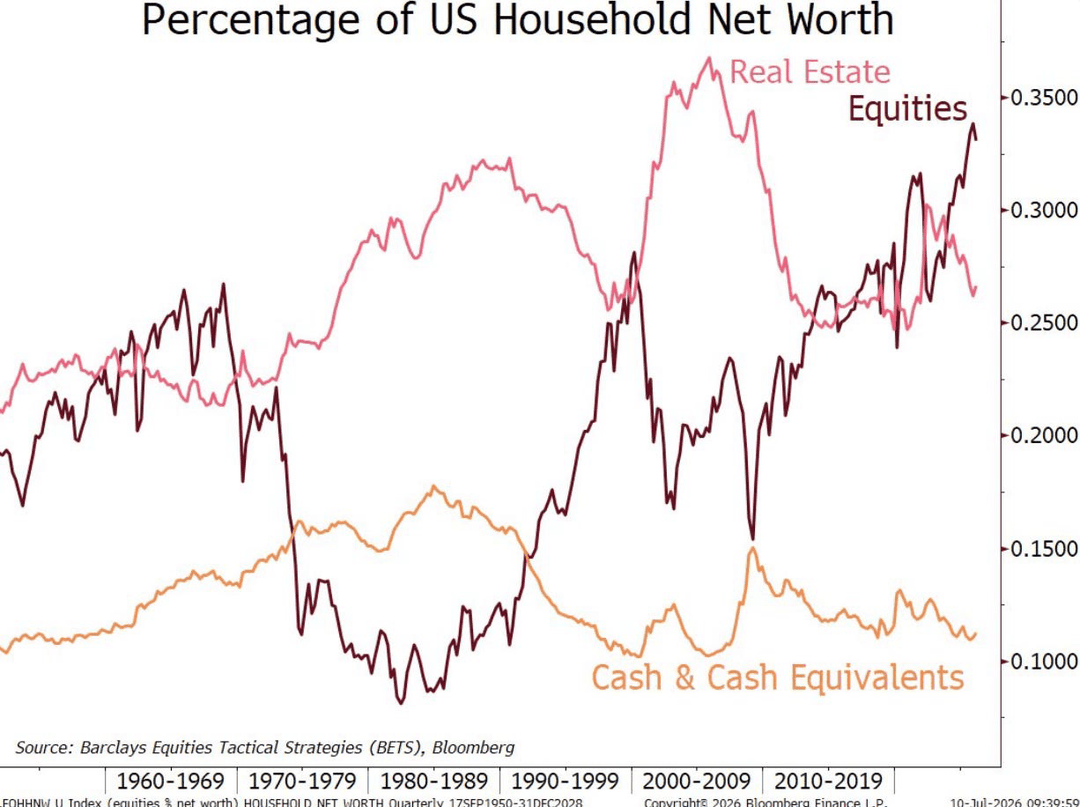
From Bloomberg and Barclays (BCS). Stocks are at an all time high as a percentage of HH networth.
The stock market is also near a record on the cyclically adjusted PE measure, second only to the dotcom bubble.
The CAPE P/E uses inflation adjusted earnings over the last 10 years, in this way it can capture potential earnings bubbles and price bubbles. Today’s absolute P/E is not as high relative to prior figures, but the massive recent spike in earnings means the CAPE is much higher.
And setting aside the stock market, at this point a fairly large chunk of GDP is directly & indirectly tied to data center and power investments at this point. Even the automakers are re-orienting their battery operations around datacenters!
All that said, it is hard to predict with much certainty what is going to happen with the overall economy. While I am relatively confident the AI boom turns into a bust at some point, I do not know when, and I am not 100% sure it will cause a US recession, and even if it does it is very hard to know how bad that might be. Ideally it would be a shallow, concentrated one a la 2000.
There is some risk though of a broader, deeper crisis though, as one of the biggest differences this cycle is the asset & debt heavy nature of much of the investment, at least in the neocloud and datacenter space. Debt distress is much more likely to cause a longer, more painful crisis than equity. However much of this issuance appears to be backstopped by the still fairly good credit hyperscalers, so I am hopeful that a downturn wouldn’t lead to a full blown financial crisis (but I wouldn’t rule it out, especially the longer the boom goes!).
Fin
As always, thanks for reading. Despite the macro uncertainty I feel good about our portfolio, our stocks are quite cheap & may even benefit from a rotation out of momentum into value. And we have a significant short book that would hopefully offset a broader economic downturn.
Stay safe out there.
Thanks for reading Warden Capital!
Hawkins Entrekin
Editor’s Note: The summary bullets for this article were chosen by Seeking Alpha editors.

US military says it has ended its latest strikes on Iran
Tankers with Saudi crude turn back as Houthis open new front in US-Iran war
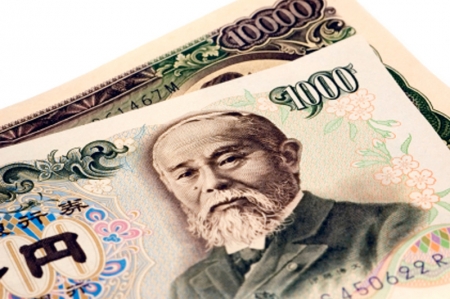
Japan’s exports jump in June on weak yen, AI-linked demand


With an investment banking cash and derivatives trading background, Binary Tree Analytics (‘BTA’) aims to provide transparency and analytics in respect to capital markets instruments and trades. BTA focuses on CEFs, ETFs and Special Situations, and aims to deliver high annualized returns with a low volatility profile. We have been investing for over 20 years after obtaining a Finance major at a top university.
Analyst’s Disclosure: I/we have no stock, option or similar derivative position in any of the companies mentioned, and no plans to initiate any such positions within the next 72 hours. I wrote this article myself, and it expresses my own opinions. I am not receiving compensation for it (other than from Seeking Alpha). I have no business relationship with any company whose stock is mentioned in this article.
Seeking Alpha’s Disclosure: Past performance is no guarantee of future results. No recommendation or advice is being given as to whether any investment is suitable for a particular investor. Any views or opinions expressed above may not reflect those of Seeking Alpha as a whole. Seeking Alpha is not a licensed securities dealer, broker or US investment adviser or investment bank. Our analysts are third party authors that include both professional investors and individual investors who may not be licensed or certified by any institute or regulatory body.

Wall Street’s main indices have closed higher, with the Nasdaq leading gains as a steep rally in semiconductor shares helped shift the focus away from the latest Middle East hostilities and tariff battles while investors looked ahead to major technology earnings reports.

FOX Business’ Grady Trimble reports live from Chicago O’Hare on jet fuel prices, which jumped 10% from Tuesday to Wednesday.
At least 7,000 flights were disrupted Tuesday as severe thunderstorms swept across the East Coast, snarling air travel at some of the nation’s busiest airports.
More than 2,000 flights within, into or out of the United States were canceled, while over 5,000 others were delayed, according to FlightAware.
The storms prompted flood warnings and tornado watches across parts of the Northeast on Tuesday. Weather and emergency officials indicated at least two tornadoes were spotted — one in northeast Pennsylvania and another in northern New Jersey, according to Fox Weather.
Airports in the New York City area, Boston, Philadelphia and Washington, D.C., experienced some of the most significant disruptions.
FAA BEGINS DJT TRANSITION AS TRUMP AIRPORT NAME TAKES EFFECT

Delta Air Lines passengers wait to retrieve luggage after flight cancellations at La Guardia Airport July 18, 2026. (Erik McGregor/LightRocket / Getty Images)
The Federal Aviation Administration (FAA) issued ground stops for at least eight U.S. airports due to the thunderstorms, including:
- Maryland – Baltimore/Washington International Airport (BWI)
- Massachusetts – Boston Logan International Airport (BOS)
- New Jersey – Newark Liberty International Airport (EWR)
- New Jersey – Teterboro Airport (TEB)
- New York – LaGuardia Airport (LGA)
- New York – Westchester County Airport (HPN) in White Plains
- Pennsylvania – Philadelphia International Airport (PHL)
- Virginia – Ronald Reagan Washington National Airport (DCA)
- Virginia – Washington Dulles International Airport (IAD)
Canada’s Toronto Pearson International Airport (YYZ) also received a ground stop.
HOUSE PASSES DAYLIGHT SAVING TIME REFORM AS TRUMP SIGNALS SUPPORT FOR ENDING CLOCK CHANGE
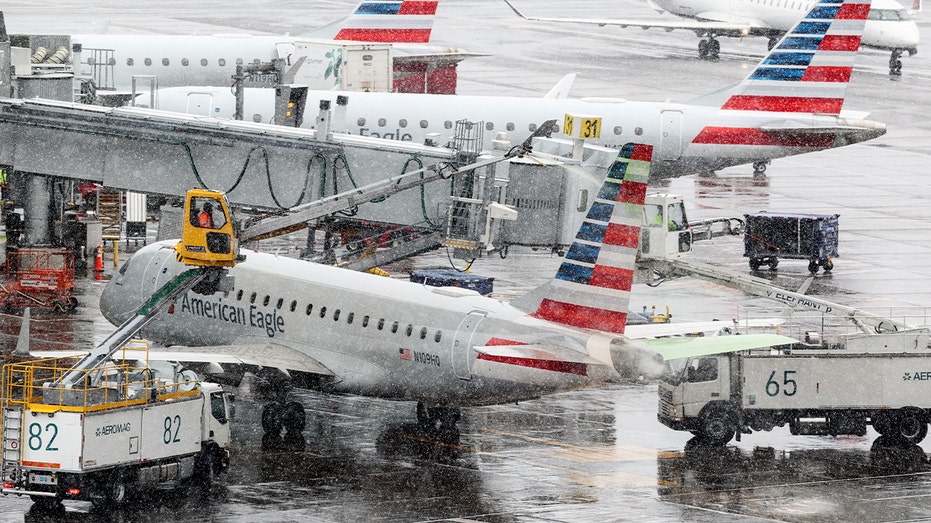
A passenger plane is stationed at a gate during severe weather at LaGuardia Airport in New York Feb. 22, 2026. (Charly Triballeau/AFP / Getty Images)
While John F. Kennedy International Airport (JFK) was not under a ground stop as of Tuesday afternoon, it was experiencing an average ground delay of about four hours due to the severe weather, according to FlightAware.
In the New York City metropolitan area alone, nearly 600 departing flights had been canceled and more than 500 others delayed, the outlet reported.
Figures are expected to rise as the storms continue to move through the region.

People walk through the rain along 5th Avenue in Manhattan on June 22, 2026, in New York City. (Spencer Platt / Getty Images)
Several U.S. airlines issued travel advisories and flexible rebooking options for affected passengers.
“Repeated rounds of severe weather across the Northeast and Mid-Atlantic have significantly disrupted travel plans for many of our customers. Our teams are working around the clock to help affected customers reach their destinations,” JetBlue said.
The airline said customers whose flights were affected may rebook travel through Sunday or request a refund to their original form of payment.
| Ticker | Security | Last | Change | Change % |
|---|---|---|---|---|
| UAL | UNITED AIRLINES HOLDINGS INC. | 117.70 | +0.18 | +0.15% |
| JBLU | JETBLUE AIRWAYS CORP. | 5.35 | -0.10 | -1.83% |
| AAL | AMERICAN AIRLINES GROUP INC. | 15.28 | +0.14 | +0.92% |
GET FOX BUSINESS ON THE GO BY CLICKING HERE
United Airlines said it is waiving trip change fees for eligible customers who rebook flights departing by Thursday.
“You can reschedule your trip, and we’ll waive change fees and fare differences. But your new flight must be a United flight departing between July 20, 2026, and July 23, 2026,” the airline said. “Tickets must be in the same cabin and between the same cities as originally booked.”
American Airlines said it will notify affected customers by email or through its mobile app. Eligible travelers must rebook by Wednesday, with new travel scheduled by Friday.
Business
(VIDEO) 10 Things to Know About TUIDE, HYBE’s Highly Anticipated New K-Pop Girl Group Set to Debut This Year

K-pop powerhouse HYBE unveiled the name of its newest girl group, TUIDE, on Monday, sparking a wave of anticipation ahead of the septet’s planned debut later this year. Here are 10 things to know about the group as fans gear up for their arrival.
1. The group’s name comes from a specific phrase
TUIDE’s name is a creative play on the phrase “tune the tide,” reflecting the group’s stated ambition to absorb the world’s many changing cultural and musical currents and tune them into new forms of enjoyment, according to an official press release from the group’s label. The imagery is meant to evoke the ocean, symbolizing TUIDE’s goal of creating a new wave within K-pop.
2. TUIDE has seven members
The group consists of seven members: Seohee, Seoyeon, Elena, Jia, Saki, Seah and Yi Hani, according to HYBE’s official announcement. The members are set to showcase distinct individual personalities while working together to create a harmonious group sound and performance style.
3. One member has a notable family connection to another K-pop group
Among TUIDE’s members is Seoyeon, the younger sister of Jihyo, the leader of the established K-pop girl group Twice, according to the Korea Herald. Seoyeon was among three members who first appeared in an earlier teaser video released in May, introducing the label behind TUIDE’s creation.
4. TUIDE will be the first group under a brand-new HYBE label
TUIDE will debut under ABD, a newly established HYBE label focused exclusively on developing girl groups. ABD, whose name stands for “A Bold Dream,” officially launched in May with a stated mission of pursuing the intrinsic joy of music while exploring new creative possibilities within K-pop, according to a statement from HYBE at the time.
5. A veteran producer is leading the group’s creative direction
TUIDE’s overall production, including its music, concepts and performances, is being led by Han Sung-soo, the founder of Pledis Entertainment. Han has a lengthy track record of shaping successful K-pop acts, having previously produced girl group After School as well as boy bands Seventeen and TWS. Han was named one of Billboard’s Indie Power Players in May, according to the Korea Herald.
6. ABD is led by a former Pledis Entertainment executive
The ABD label itself is headed by Jiwon No, who previously served as Head of Artist Planning at Pledis Entertainment, according to Music Business Worldwide. No oversees the label’s overall management and strategic direction as TUIDE prepares for its debut.
7. The group’s name and logo were revealed through a stylized teaser
ABD launched TUIDE’s official social media channels at midnight KST on July 20, unveiling the group’s name alongside a logo motion video. According to allkpop, the visual featured different colors blending seamlessly into vibrant new hues before the group’s name and logo appeared, symbolizing the members’ individual talents merging into a unified identity.
8. TUIDE is taking an unconventional approach to pre-debut marketing
As part of a distinctive promotional strategy, TUIDE’s official Instagram account turned private starting July 21 for an unspecified period, a deliberate marketing choice intended to build anticipation and create an interactive storytelling experience for fans ahead of the group’s full debut, according to the Korea Daily.
9. Fans can attend an exclusive pre-debut event in Seoul
TUIDE is scheduled to hold an exclusive pre-debut experience called “TUIDE Exclusive Preview [Playground]” in Seoul from August 1 to 2, according to Forbes, giving fans an early opportunity to engage with the group ahead of its official music debut later in the year.
10. TUIDE joins an expanding roster of HYBE girl groups
With TUIDE’s upcoming debut, HYBE continues to grow its lineup of girl groups across its various sub-labels, joining acts including Le Sserafim under Source Music, NewJeans under Ador, Illit under Belift Lab and Katseye under HYBE Labels, according to the Korea Times. TUIDE’s launch also comes as HYBE expands its search for girl-group talent internationally, having opened nationwide auditions in India through HYBE India earlier this year, alongside a second global girl-group project launched in Japan through its joint venture with Universal Music Group’s Geffen Records.
With TUIDE’s name, logo and member lineup now confirmed, fans can expect additional promotional content to roll out in the coming weeks, culminating in the group’s official debut sometime in the second half of 2026. Given Han Sung-soo’s track record producing multiple successful HYBE acts and the broader company’s continued global expansion strategy, TUIDE is positioned as one of the more closely watched rookie debuts in K-pop this year, with additional details about the group’s music and concept expected to emerge as its debut date approaches.
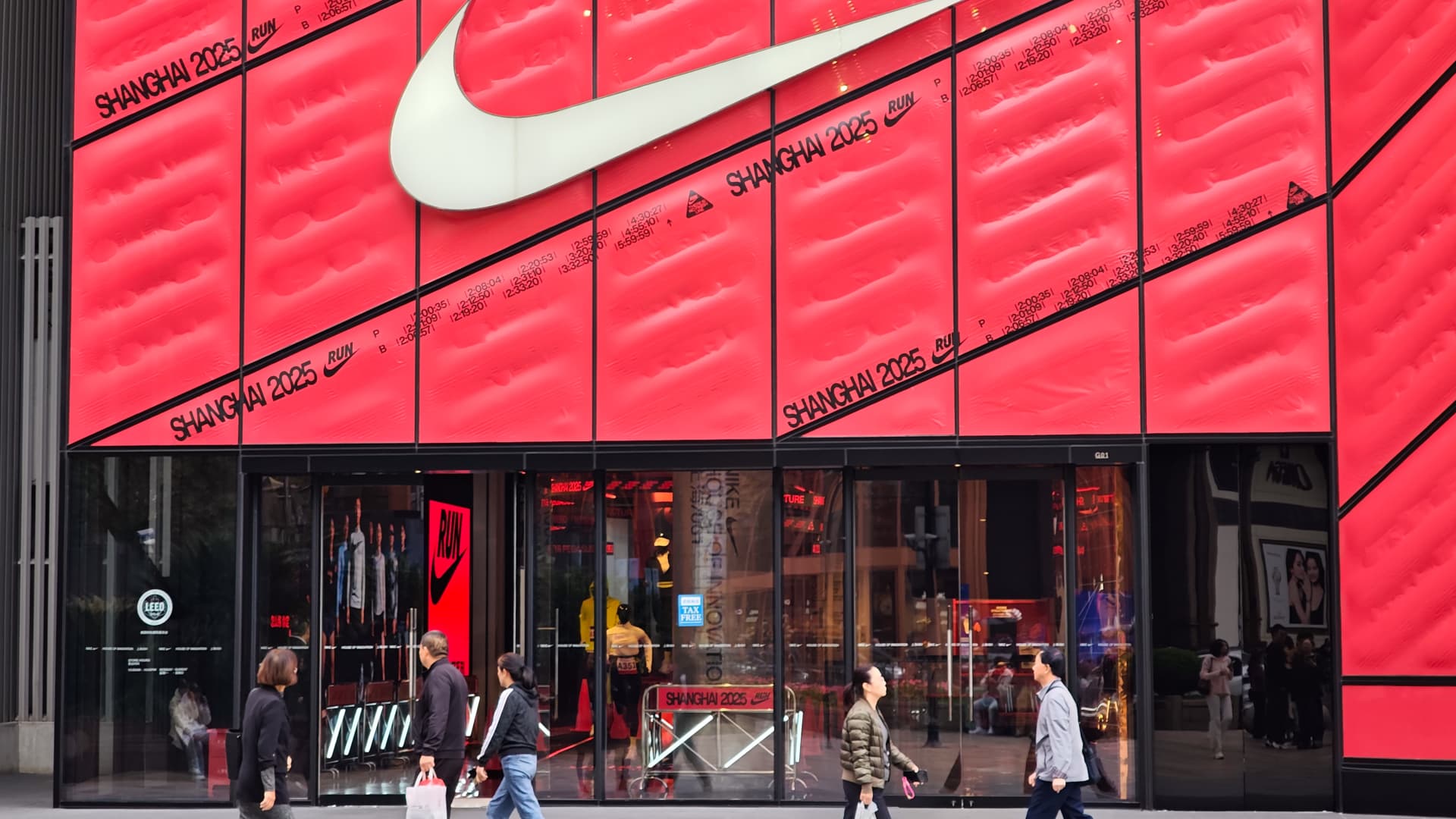
The Nike flagship store in Nanjing Road Walkway in Shanghai, Nov. 4, 2025.
Cfoto | Future Publishing | Getty Images
Nike is planning to cut off thousands of online distributors in China beginning in January as the sneaker giant looks to clean up what’s become a messy digital marketplace and get the region back to growth, the company said Tuesday.
Starting next year, Nike’s online footprint will shift primarily to the retailer’s official website and app, and the storefronts it operates on Tmall, JD.com and Douyin, some of China’s largest online marketplaces and social platforms.
Currently, consumers can shop Nike through all of those channels as well as thousands of other online storefronts powered by Nike’s brick-and-mortar partners in the region and a network of secondary distributors. While the vast digital network has led to widespread consumer access to Nike’s products, it’s also created an inconsistent branding and pricing experience and hampered the company’s efforts to reverse a sales decline in the region.
“These new flagships will serve as the single, elevated destination for Nike within these ecosystems, with clearer product presentation, stronger storytelling and more connected consumer journeys,” Cathy Sparks, Nike’s new vice president and general manager of Greater China, wrote in a letter. “This is about strengthening the platforms where consumers already begin and end their shopping journey, making sure those experiences are direct, consistent and unmistakably Nike.”
“This is not about reducing access. It is about reducing fragmentation and strengthening the consumer journey,” she said. “When the experience is consistent, the brand becomes stronger.”
Nike’s plans to pare back its online footprint are designed to create a better, more consistent experience for the consumer and allow it to take back pricing control online. However, there are also concerns it could lead to a material drop in revenue in a region that’s already shrunk about 30% in the last five years.
News about Nike’s plans to cut off online distributors first came to light late last month in a local Chinese media report. It prompted a note from BNP Paribas equity analyst Laurent Vasilescu, who wrote the move is reminiscent of Nike’s ill-fated decision to cut off wholesalers in North America, which contributed to its collapse of market dominance in the region, as well as steep declines in sales and margins.
“This strategy opened up shelf space for competitors and the strategy ended poorly for Nike. We believe the same could happen if it takes the same approach in China,” Vasilescu wrote last month, adding that BNP was sticking with its underperform rating for the company. “We don’t think Nike has a distributor problem but rather a product problem which also applies in other markets.”
The change is also expected to hurt Nike’s brick-and-mortar partners in the region, which have expanded their online presence in recent years to grow their own businesses.
Still, Topsports, Nike’s largest distributor in mainland China, said it supports the company’s decision.
“Topsports has worked with Nike for 27 years based on the principle of mutual benefit and shared growth,” Topsports CEO Yu Wu said in a statement. “This adjustment will bring some short-term pressure to our business. But we firmly believe that, over the medium- to long-term, this direction will help promote a healthier, more orderly, and more sustainable retail ecosystem in China, while further improving consumer experience and product appeal.”
“Looking ahead, we will continue to work closely with Nike, leveraging our strengths in offline retail operations, local consumer service, and deep market development across city tiers,” Wu said. “Through new concept sport stores and high-quality physical retail experiences, we will bring Chinese consumers richer and more meaningful sport experiences.”
QUENTIN LETTS: Miliband is a gauche and dangerous nincompoop, demonstrably ill-suited to this acutely sensitive job

‘I can’t afford to turn the oven on’: 7.4m households struggling to buy essentials

Coinbase Matches Robinhood's 7% Yield With a Different Design


-
 NewsBeat5 days ago
London Mayor Sadiq Khan handed a peerage by Keir Starmer alongside 15 other Labour figures… just days before the PM leaves No10
-

 Fashion4 days ago
Weekend Open Thread – Corporette.com
-

 Politics4 days ago
The House | The City of London can help the new chancellor deliver growth in every postcode
-

 Politics7 days ago
Young campaigners urge incoming PM to act on outdoor junk food ads
-
 Crypto World5 days ago
Two July Windows Left: The CLARITY Act’s Senate Fight and What Failure Means
-

 Crypto World6 days ago
CFTC blocks Kalshi from unwinding Michigan trades after court order
-

 Crypto World4 days ago
Ripple Payments Joins MiCA With 14 Firms, Does It Mean Anything For XRP?
-

 Business6 days ago
Nvidia Stock Slips After Big Tuesday Rally as Huang Confirms Vera Rubin Chip Is Now in Production Today
-

 Politics2 days ago
Democrats look to World Cup watch parties to register thousands of voters
-
 Entertainment6 days ago
Disney’s Most Ambitious Failed Star Wars Attraction Is Coming to SDCC
-

 Crypto World4 days ago
Ripple wins EU-wide access as ESMA adds it to MiCA register
-

 Crypto World16 hours ago
Grayscale Files For Worldcoin ETF, WLD Registers Sharp Rise
-

 Crypto World5 days ago
Injective Submits SEC Transfer-Agent Registration to Onchain Ownership Records
-

 Business6 days ago
Palantir Shares Rise After Expanded Nvidia Partnership and Fresh Analyst Upgrades Ahead of Earnings Day
-

 Tech1 day ago
Sail Virtually Aboard The “Itanic” With IA-64 Emulator
-
 Tech22 hours ago
Turtle Beach Command Series KB7 review: a nifty screen-equipped gaming keyboard
-

 NewsBeat5 days ago
Registration is now open for March for Men with Kev 2026
-

 NewsBeat2 days ago
Unregistered fitter used Gas Safe logo on business flyers
-
 Sports6 days ago
New Cornerback Enters Vikings Trade Rumor Mill
-

 News Videos5 days ago
Money | Class 12 Economics | CBSE Board Exam 2026-27
You must be logged in to post a comment Login