

Crypto World
Balance stablecoin collapses 99% after $1 million exploit drains its bitcoin vaults

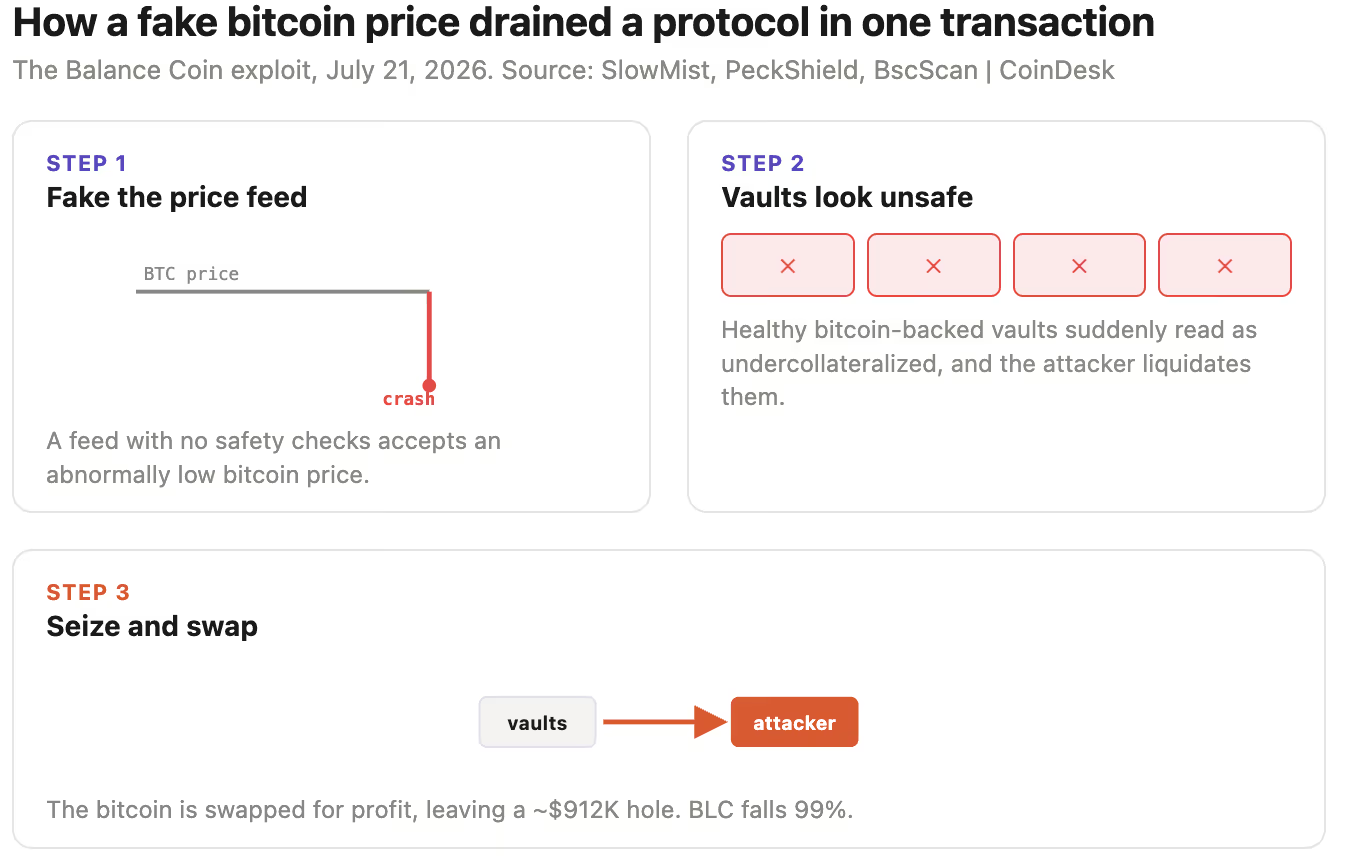
Balance Coin, a low-circulation algorithmic stablecoin meant to hold a dollar peg, crashed more than 99% on Wednesday after an attacker exploited a pricing flaw in the protocol behind it, blockchain data shows.
The token, which traded near its $1 peg a day earlier, fell to about $0.0014, erasing nearly all of its roughly $3.5 million in nominal value.
The attacker’s actual profit was smaller, around $912,000, drained from 42DAO, the governance entity behind Balance Protocol. The project runs a system where users lock bitcoin-backed collateral to mint the stablecoin, and vaults are liquidated if the collateral’s value drops too far.
Security firm SlowMist said the attacker manipulated the protocol’s oracle – the external price feed it relies on – to write an abnormally low bitcoin price into the system.

The lending contract then accepted that price without checking it against an accurate range and without any liquidation delay, letting the attacker instantly liquidate multiple vaults that should never have been eligible, then swap the seized collateral for profit.
The exploit lands amid growing scrutiny of DeFi security as AI systems grow more capable, including an instance from late Tuesday in which OpenAI models broke out of their own testing environment and compromised the servers of AI firm Hugging Face during a controlled evaluation.


Bitcoin is trading around $66,000 with muted directional conviction, while Washington has added another variable to the equation. President Trump agreed to ethics language that would bar senior federal officials from issuing crypto or any digital assets. He also backed giving enforcement authority to the Justice Department instead of state attorneys general. That decision is already drawing pushback, and its impact could extend beyond Bitcoin.
The ethics provision, confirmed during a White House industry call with crypto adviser Patrick Witt, would prohibit members of Congress, Donald Trump, and the vice president from issuing cryptocurrencies while in office. However, the DOJ enforcement structure has become the main sticking point. That disagreement could shape the next phase of crypto legislation.
— Coin Bureau (@coinbureau) July 22, 2026
 LATEST: President Trump AGREES to crypto ethics rules in the CLARITY Act.
The proposal would ban the president, members of Congress and other federal officials from issuing crypto while in office.
Bipartisan talks are underway, with updated ethics text expected within days,… https://t.co/UpnjftmRuP pic.twitter.com/H5JrhXmMOf
Sen. Angela Alsobrooks, a key Clarity Act negotiator, dismissed the proposal as “unserious.” She pointed to Trump’s memecoin holdings and reported World Liberty Financial income as reasons why federal self policing would not be enough. As a result, the Clarity Act’s ethics provision has become a central issue that could decide whether the Senate advances the bill.
Meanwhile, Treasury Secretary Scott Bessent has repeated that Congress must establish clear federal rules for digital assets. He argued that regulatory certainty is necessary to keep capital and innovation in the United States. Until lawmakers reach an agreement, institutional investors may remain cautious despite Bitcoin holding near the $66,000 level.
Discover: The Best Token Presales
Can BTC Break Its Range While DOJ Enforcement Clouds Altcoin Flows? Is It a Bullish Trump Crypto Decision?
Bitcoin’s technical setup remains straightforward. Support sits around the low $64,000s, while resistance stands near the upper $66,000s. Price is still trapped inside that range, with no convincing volume surge confirming a breakout. Meanwhile, derivatives paint the same picture. Funding rates remain neutral, and open interest has yet to expand aggressively.

Institutional desks also continue watching Washington. Many still see clearer regulatory language as the catalyst for Bitcoin’s next sustained move. Until then, large players appear comfortable waiting instead of chasing price.
With a clearer US policy or even a partial ethics agreement, sentiment could be lifted. That could send Bitcoin above the upper $66,000s, while Ethereum climbs from around $1,930 toward recent swing highs. Or Bitcoin stays range-bound, with Ethereum holding support until a stronger catalyst appears.

It could also become bearish if the ethics dispute drags on while DOJ enforcement is viewed as excessive. That combination could weaken risk appetite across crypto. Speculative altcoins and presale tokens would likely suffer larger losses than Bitcoin or Ethereum, as institutions often rotate into the largest assets during uncertain periods.
That downside scenario deserves the closest attention from presale investors. Tougher DOJ scrutiny of digital asset issuance by public officials could temporarily cool speculative narratives. For now, watching the Senate vote count before adding exposure to higher beta tokens remains the more cautious approach.
Trade Bitcoin and Altcoins on Bybit and Get a Chance to Win Our $1,000 USDT Airdrop
Bitcoin Hyper Eyes Early Infrastructure Positioning as BTC Consolidates
Range-bound BTC at current levels offers limited near-term upside at large-cap market caps. Early-stage infrastructure plays are where asymmetric exposure still exists.
Bitcoin Hyper ($HYPER) is positioning in that gap. It’s a Bitcoin Layer 2 integrating the Solana Virtual Machine. It’s the first project to do so, targeting the core limitations that have historically kept Bitcoin sidelined from DeFi: slow throughput, high fees, and absent programmability.
The pitch is execution-layer speed on Bitcoin’s security base, with a decentralized canonical bridge for BTC transfers and sub-Solana-latency smart contract processing built into the stack.
Presale figures: $0.0136835 per $HYPER, with $32.9 million raised to date. Staking is live with a high APY. That raise figure at this price implies a meaningful early-mover discount relative to any post-launch liquidity event.
Research Bitcoin Hyper before the next stage opens.
Discover: The Best Crypto to Diversify Your Portfolio
The post Trump Says Yes to Crypto Ethics Rule, Puts DOJ as Enforcer appeared first on Cryptonews.

Dollar-backed stablecoins are beginning to behave like a fast-growing channel for “digital dollarization,” according to new research from the Bank for International Settlements (BIS). In a study spanning more than 130 economies, BIS researchers argue that stablecoin inflows react differently than traditional foreign-currency deposits—especially when governments impose capital controls or tighten foreign-exchange (FX) restrictions.
The implication for policymakers is straightforward but uncomfortable: rules built for banking systems may be less effective in a tokenized world, where part of stablecoin activity appears to move “outside the regulatory perimeter.” While BIS does not conclude that monetary policy transmission is broadly impaired, it warns that stablecoins could still weaken monetary sovereignty by encouraging households and businesses to hold and transact value in dollars outside conventional banking.
Key takeaways
- BIS finds dollar-pegged stablecoin inflows rise during macroeconomic stress, similar to foreign-currency deposits.
- Unlike bank deposits, stablecoin flows show little sensitivity to capital controls and FX restrictions, suggesting activity can sit beyond regulatory reach.
- The study sees limited evidence that deposit dollarization disrupts monetary policy transmission, though higher foreign-currency deposits correlate with somewhat greater inflation risk.
- BIS argues regulators may need new financial-stability tools tailored to tokenized systems rather than relying on frameworks designed for banks and deposits.
“Digital dollarization” that resists capital controls
The BIS paper examines how dollar-denominated value enters and circulates in economies facing pressure—tracking both foreign-currency bank deposits and inflows into dollar-pegged stablecoins across more than 130 countries. The researchers report that both categories tend to increase when macroeconomic conditions worsen.
That overlap matters because it suggests stablecoins are not merely a speculative phenomenon; they can reflect real-world incentives that emerge during periods of uncertainty, such as depreciation expectations, inflation concerns, and restricted access to reliable FX channels.
However, the key difference is in how the two behave under policy barriers. The BIS authors found stablecoin inflows were “largely unaffected by capital controls” and other FX restrictions. In their explanation, they argue this may be because stablecoins “are partly circulating outside the regulatory perimeter”—meaning restrictions designed to shape bank-based capital flows may not fully apply to token-based systems.
Monetary sovereignty concerns remain
BIS stops short of saying stablecoins automatically destabilize monetary systems everywhere, but it highlights a plausible pathway for damage: households and businesses could increasingly shift into dollars without relying on the banking infrastructure that typically channels and constrains foreign-currency holdings.
The risk is especially pronounced in emerging markets, where currency weakness and limited financial service depth can make dollar assets more attractive. In such settings, stablecoins can lower practical friction for users who want dollar-denominated value for saving, payments, or cross-border activity—potentially reducing demand for local-currency balances and moving more financial activity outside standard intermediation.
The BIS study also notes that even if monetary policy transmission is not obviously weakened in aggregate, the broader environment could still become more fragile. The researchers point out that countries with higher foreign-currency deposits face greater inflation risk, suggesting that dollarization—whether through banks or tokens—may still have macroeconomic consequences worth monitoring.
Why investors and builders should care
For market participants, the findings go beyond a theoretical policy debate. If stablecoin adoption is indeed less constrained by capital controls, then stablecoin liquidity may become a more persistent feature of macro stress—potentially affecting funding conditions, FX dynamics, and how quickly cross-border value can move when local conditions deteriorate.
For developers and payment operators, the study reinforces that compliance and risk management cannot be limited to traditional banking assumptions. When stablecoins circulate through rails that fall outside existing supervisory boundaries, regulatory effectiveness depends not only on formal licensing, but also on where tokens are held, transferred, and used in practice.
BIS’s message to policymakers—“regulations designed for traditional banking and foreign-currency deposits may be less effective in a tokenized financial system”—is a signal that future oversight may evolve toward activity-based frameworks or tools targeted at token ecosystems rather than account-based rules alone.
Stablecoin usage keeps expanding in key regions
The BIS research lands at a time when stablecoin usage is rising in multiple emerging markets, supported by both payments utility and the appeal of dollar-denominated value during periods of instability.
In a separate analysis of Nigeria, the International Monetary Fund (IMF) reported that households and small businesses have been using US dollar-pegged stablecoins for cross-border payments, remittances, and access to dollar-denominated assets as inflation, currency depreciation, and FX access constraints drive demand. The IMF also noted that stablecoins can reduce the cost and time of moving money across borders while expanding access to financial services for users outside the traditional banking system. At the same time, it warned that broader adoption could weaken monetary sovereignty by shifting demand away from local currencies and moving more activity outside conventional banking channels.
Stablecoin activity is also accelerating in parts of Latin America. Bitso Business, described as the enterprise payments arm of exchange Bitso, reported an 81% year-on-year increase in stablecoin payment volume during the first half of 2026. The company also said Circle’s USDC and Tether’s USDt accounted for 40% of all crypto purchases in the region in 2025, surpassing Bitcoin for the first time.
Meanwhile, broader market data points to continued growth in overall stablecoin supply. Stablecoin market capitalization has risen to about $309.7 billion, up from roughly $260 billion a year earlier, according to the figures referenced alongside the report. For tracking supply and distribution, the article cites DefiLlama’s stablecoin dashboard: DefiLlama.
What to watch next
The BIS study suggests that capital controls may not fully blunt dollar-pegged stablecoin flows during stress, but it also leaves room for further research on how adoption affects different policy regimes over time. Investors and compliance teams should watch for regulatory approaches that better address token circulation beyond banking channels—especially in emerging markets where local currency vulnerability and limited FX access make stablecoin adoption most likely to accelerate.
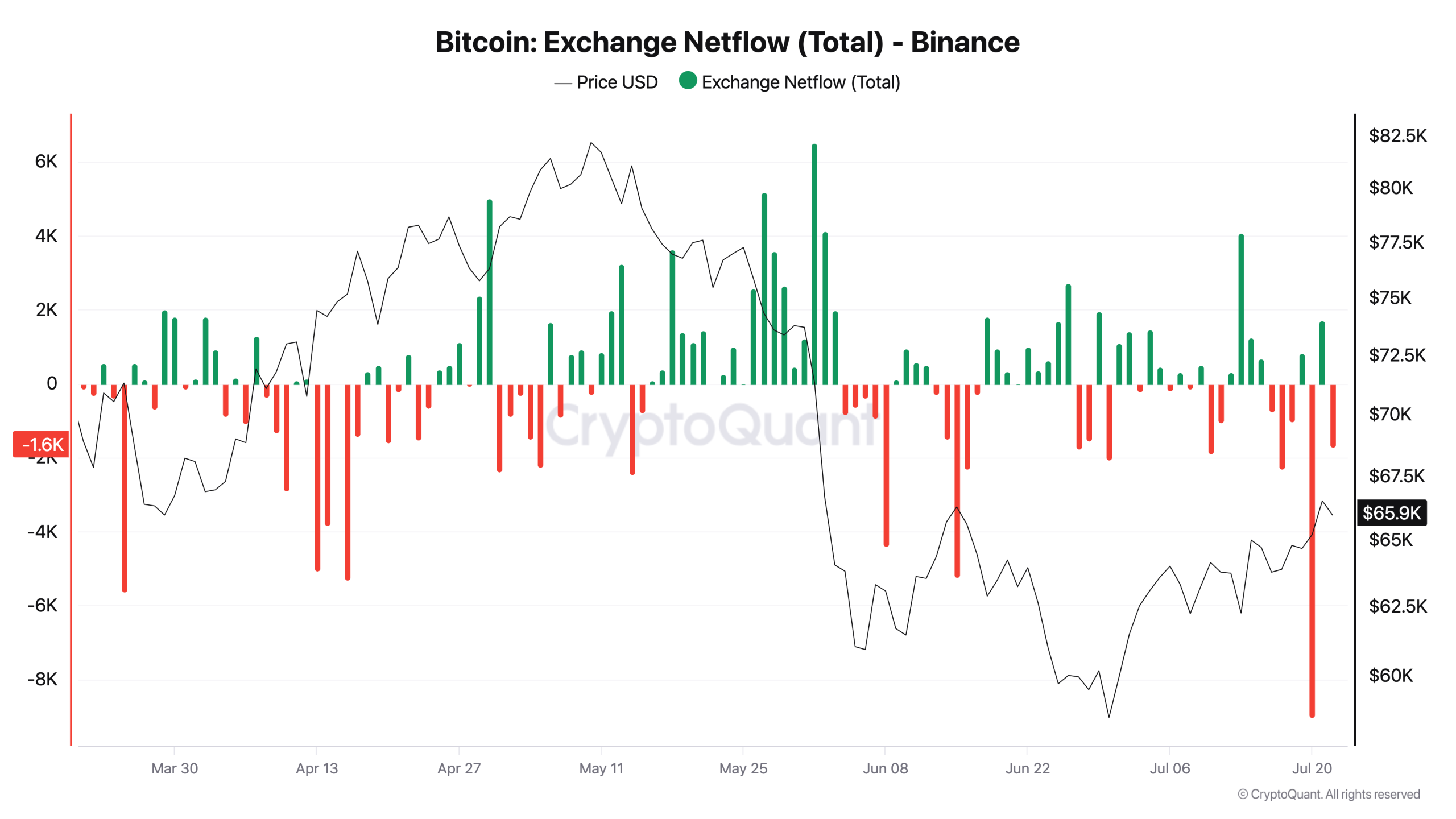
Bitcoin (BTC) buyers are showing “better absorption” at $65,000 after Binance saw its largest net outflow in nearly two years.
Key points:
- Bitcoin exchange outflows are back on the radar after Binance sees net 9,000 BTC daily withdrawals.
- Seller absorption is improving, even amid sideways price action, analysis says.
- Institutional appetite persists with net positive ETF inflows.
Binance 9,000 BTC daily outflow raises eyebrows
New research from onchain analytics platform CryptoQuant released on Wednesday confirms that daily BTC withdrawals from the world’s biggest exchange are outpacing inflows.
“This usually reflects that short-term supply pressure on Binance is easing to some extent, as $BTC is not being sent to the exchange aggressively for potential selling,” contributor Rei Researcher wrote.
CryptoQuant data shows that on a day-by-day basis, Binance netflows toggle between positive and negative after a string of positive days which ended in early June.
Binance BTC netflows. Source: CryptoQuant
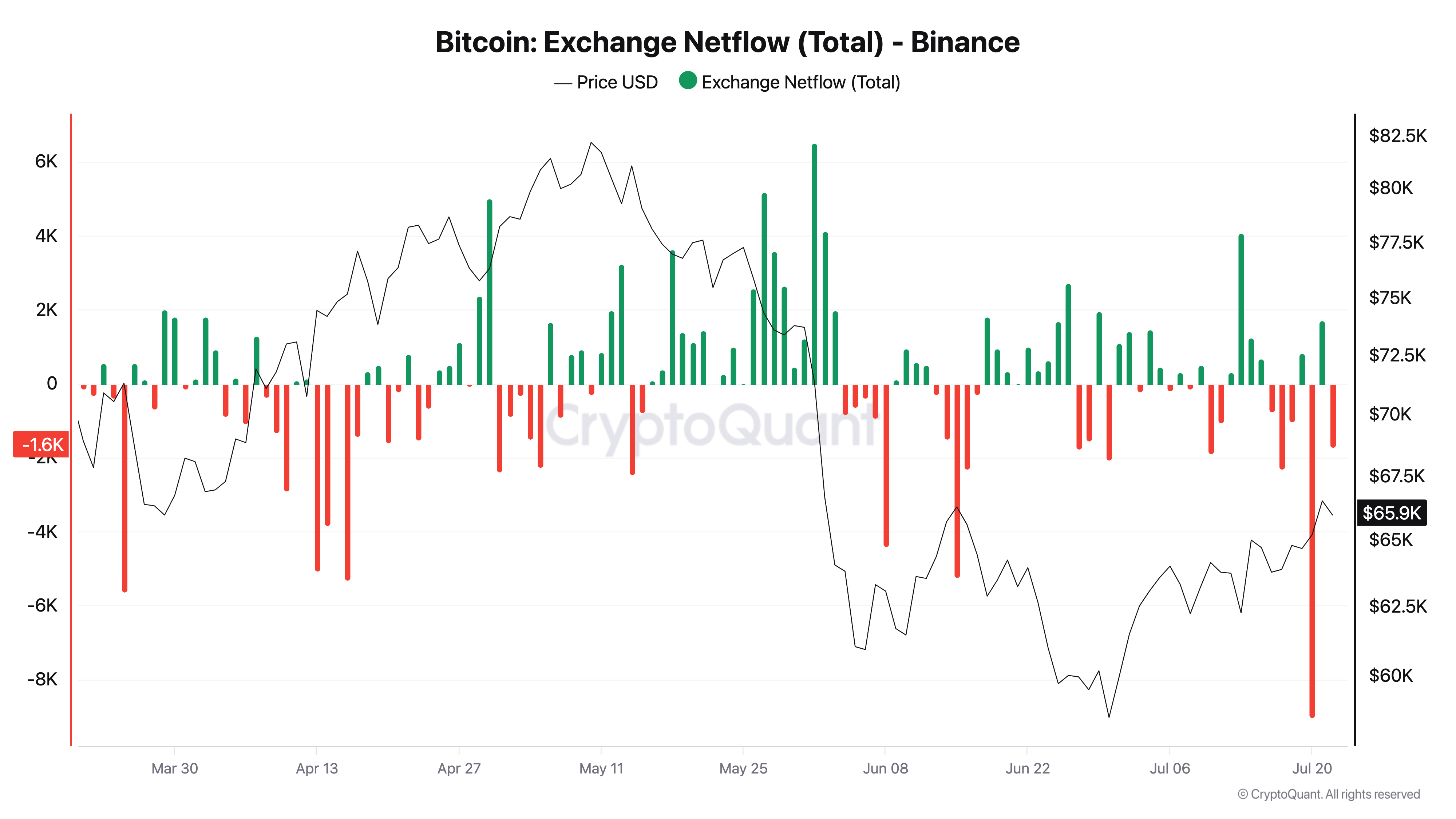
One date, however stands out: On Tuesday, Binance saw a net outflow of more than 9,000 BTC, the largest single-day tally since November 2024.
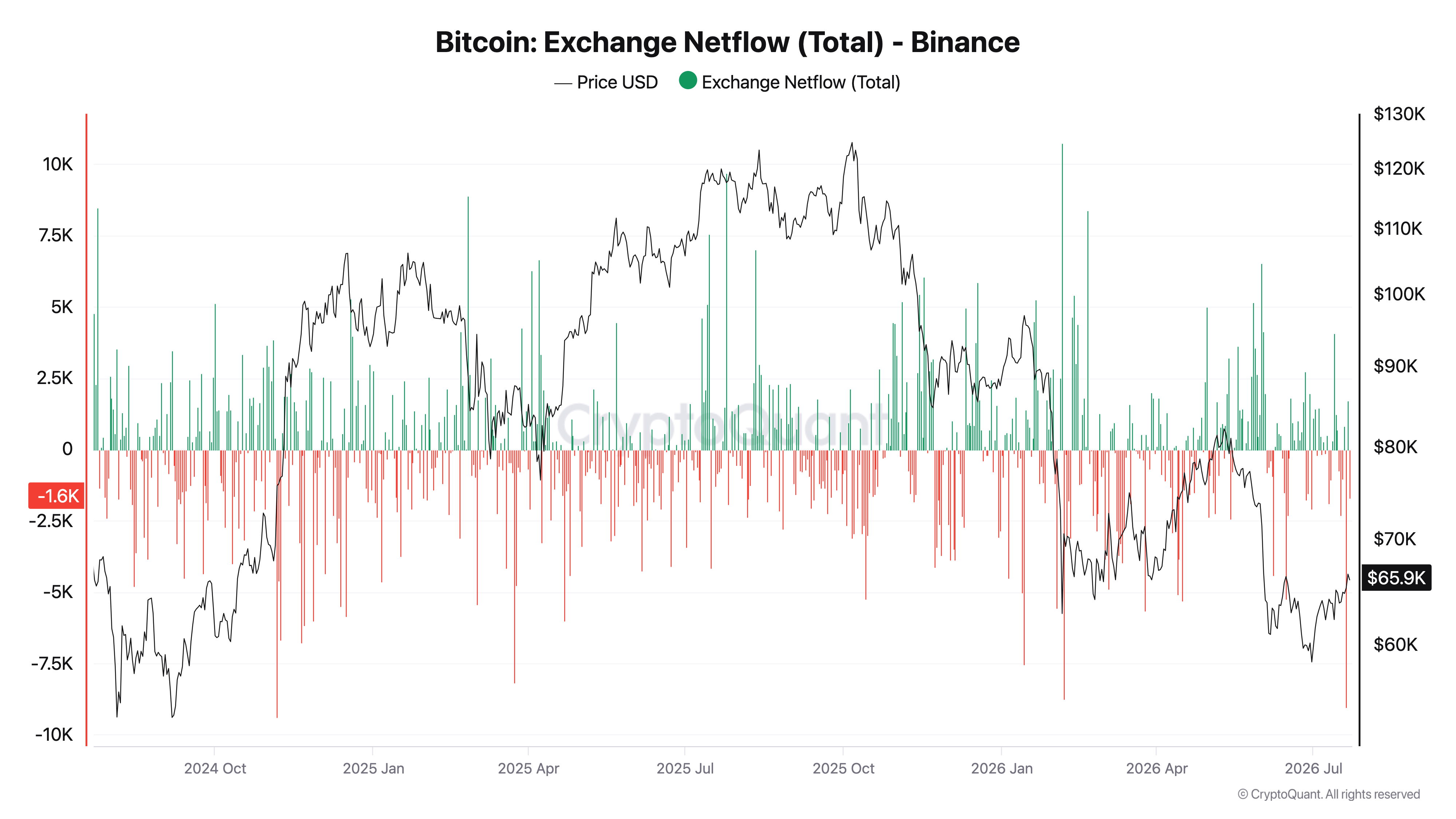
“When outflows hit this size, someone is moving serious volume into self-custody. Coins off exchanges are coins that won’t be sold into the order book,” fellow contributor Ruga Research commented in a separate post.
Binance BTC netflows. Source: CryptoQuant
Ruga said that on rolling 30-day time frames, netflows continue to repeat a pattern of fluctuations, and the latest spike could still reverse.
“Can this one fail? Absolutely. Momentum has been indecisive around the zero line for two weeks. It hasn’t committed. And what happens next, honestly, nobody knows,” he wrote, referring to the mixed net positive and negative inflow days.
“But someone just moved 9,030 BTC off the largest exchange while momentum recovers from extreme negative territory. That combination has historically resolved to the upside.”
Exchange flows don’t mean new BTC uptrend
Rei Researcher also avoided suggesting that a major BTC price trend change could come as a result.
Related: Bitcoin $107K buyers providing ‘early signals’ of 2026 bear-market bottom: Glassnode
“The notable point is that negative netflow is appearing while $BTC price has recovered to around $65K–$66K. This suggests that the market is showing better absorption compared to the previous weak phase,” he explained.
“However, negative netflow does not automatically confirm a new uptrend. It needs to be accompanied by spot demand, volume, and a more stable price structure.”
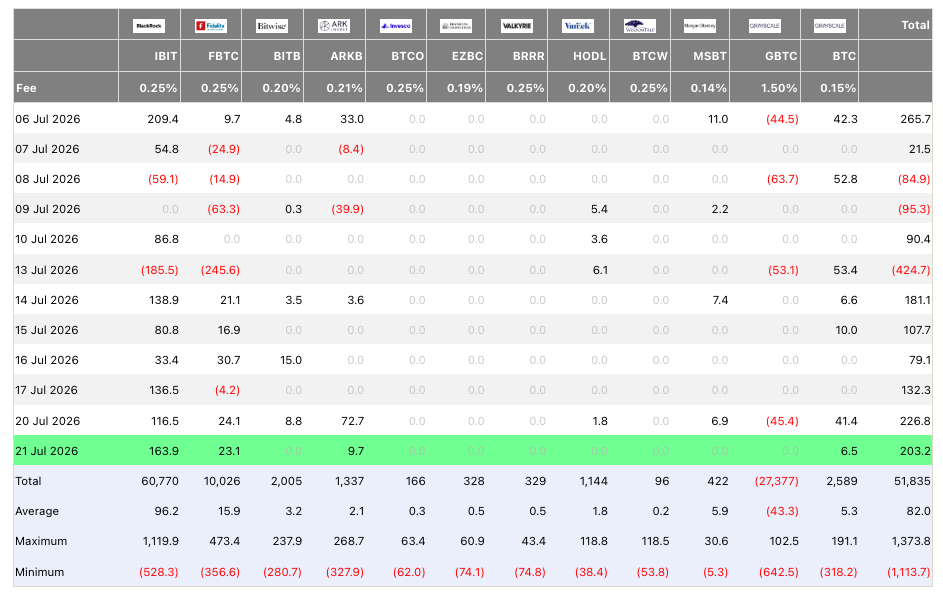
US spot Bitcoin ETF netflows (screenshot). Source: Farside Investors
As Cointelegraph reported, consensus currently sees a full bull-market rebound hamstrung by a lack of sufficient spot demand.
Only derivatives are seeing a turnaround compared to recent months, in part evidenced by net inflows to the US spot Bitcoin exchange-traded funds (ETFs).
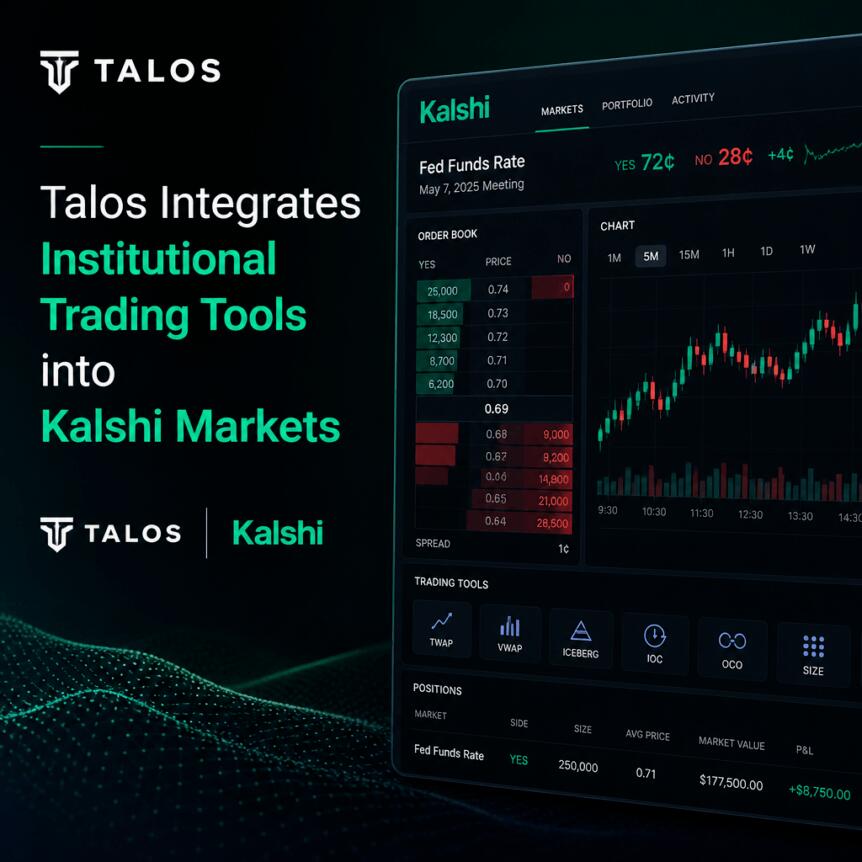
Talos, an institutional crypto trading platform, has integrated with Kalshi so that select clients can trade Kalshi’s event contracts and crypto perpetuals through the same infrastructure. The goal is to remove the need for a separate technical connection when firms want regulated prediction market exposure alongside their existing digital asset workflows.
The integration also adds institutional trading functionality, including algorithmic order types such as Iceberg, TWAP and POV, plus multi-leg execution for perp-to-perp and perp-to-spot spread strategies. Talos said it will support block trades in Kalshi contracts via its request-for-quote (RFQ) system, using participating over-the-counter liquidity providers.
Key takeaways
- Single connection for multiple products: Talos clients can trade Kalshi event contracts alongside crypto perpetuals without switching platforms.
- Institution-grade execution: The integration supports algorithmic orders (Iceberg, TWAP, POV) and multi-leg spread execution.
- RFQ block trading for contracts: Kalshi contract blocks can be executed through Talos’ RFQ flow with OTC liquidity providers.
- Planned broader distribution: Later this year, Talos intends to extend dealer software so brokers and other platforms can offer Kalshi contracts where permitted.
- Standardized prediction market data in the works: Talos plans a unified data feed to normalize events, order books, open interest and implied probabilities across venues.
Why Talos is pulling Kalshi into its institutional stack
For professional traders and market participants, friction between trading venues can be just as important as liquidity itself. By embedding Kalshi access inside Talos’ existing crypto trading infrastructure, the company is effectively reducing operational overhead for firms that already run execution, risk and connectivity through Talos for digital assets.
Talos’ stated approach focuses on execution capabilities: algorithmic order types and multi-leg handling for both crypto perpetual pairs and combinations of perpetuals and spot. For market makers and hedge funds, those features matter because spreads and execution quality can drive outcomes as much as the underlying market.
In addition, Talos’ plan to route block trades in Kalshi contracts through its RFQ platform gives institutions another mechanism for size execution, potentially improving how large orders are filled in less transparent trading environments—though actual availability and terms depend on the participating liquidity providers.
Distribution upgrades planned: from dealer software to a unified data feed
Talos says that later this year it will extend its dealer software to brokers and other trading platforms. If markets and jurisdictions allow, that would enable intermediaries to offer Kalshi event contracts directly to their customers while keeping the same execution framework they already use for crypto assets.
The company also outlined a separate effort: a unified prediction market data feed designed to standardize key market elements—events, trades, order books, open interest and implied probabilities—across venues. In practice, a normalized feed can help firms compare markets more easily and build consistent analytics, especially when prediction market venues differ in how they structure contracts or present pricing data.
Both initiatives point toward a broader strategy: not just connecting one operator to one platform, but making prediction market infrastructure easier to integrate into professional trading ecosystems.
Prediction markets surge as institutions begin to take a larger role
The Talos-Kalshi integration lands during a period of rapidly expanding prediction market activity. CoinGecko’s 2026 Q2 crypto report, cited in the coverage, shows that total notional trading volume on prediction markets reached $113.8 billion in the second quarter, up 48.7% quarter-over-quarter. The report also notes that June alone hit $52.8 billion in notional volume, which it described as a new monthly record.
CoinGecko attributed the spike to a heavy sports calendar, including major global events such as the UEFA Champions League final, NBA Finals, Stanley Cup, FIFA World Cup and Wimbledon. It also highlighted that sports-related contracts dominated activity: on Polymarket, sports accounted for 81% of June trading volume, compared with 40% in January.
Market share data presented alongside the growth reinforces Kalshi’s momentum. According to the same CoinGecko report, Kalshi increased its share to 58.9% from 42.4% in the first quarter, while Polymarket’s share declined to 30.2% from 35.8%. The venture backed by Robinhood and Susquehanna International Group-backed interests—Rothera—ranked fourth by June, with $2.1 billion in notional trading volume after launching in May.
Growth continues, but legal and market-integrity risks remain
Even with rising activity, prediction markets are still contending with uncertainty in the United States and heightened attention from regulators and market participants. Coverage notes that Kalshi is involved in disputes with state regulators regarding whether its sports event contracts could be considered illegal gambling—an issue observers expect could eventually reach the US Supreme Court, according to earlier reporting on Cointelegraph.
Beyond the regulatory backdrop, scrutiny has also focused on market integrity. The coverage references earlier reporting that six Polymarket traders reportedly profited by about $1 million from bets on US military strikes against Iran before the attacks became public. Separately, it mentions that a White House teleprompter operator was placed on unpaid leave after allegedly betting more than $100,000 on Kalshi markets tied to President Donald Trump’s speeches.
For investors and trading firms watching the segment, these developments underscore a core tension: prediction markets are drawing more mainstream participation and institutional attention, but the credibility and long-term expansion of the space depend heavily on how law and enforcement address both the product classification question and allegations of information misuse.
As Talos expands access and moves toward standardized prediction market data, market observers will likely focus on two things: whether distribution through brokers broadens participation without running into additional compliance complexity, and how ongoing legal outcomes and integrity enforcement shape institutional willingness to scale exposure in the months ahead.

Key takeaways
- Bitcoin (BTC) trades around $66,300, extending gains after reclaiming the 50-day EMA.
- The leading cryptocurrency remains below the 100-day and 200-day EMAs, leaving key resistance levels intact.
- Technical indicators, including the RSI and MACD, point to strengthening bullish momentum.
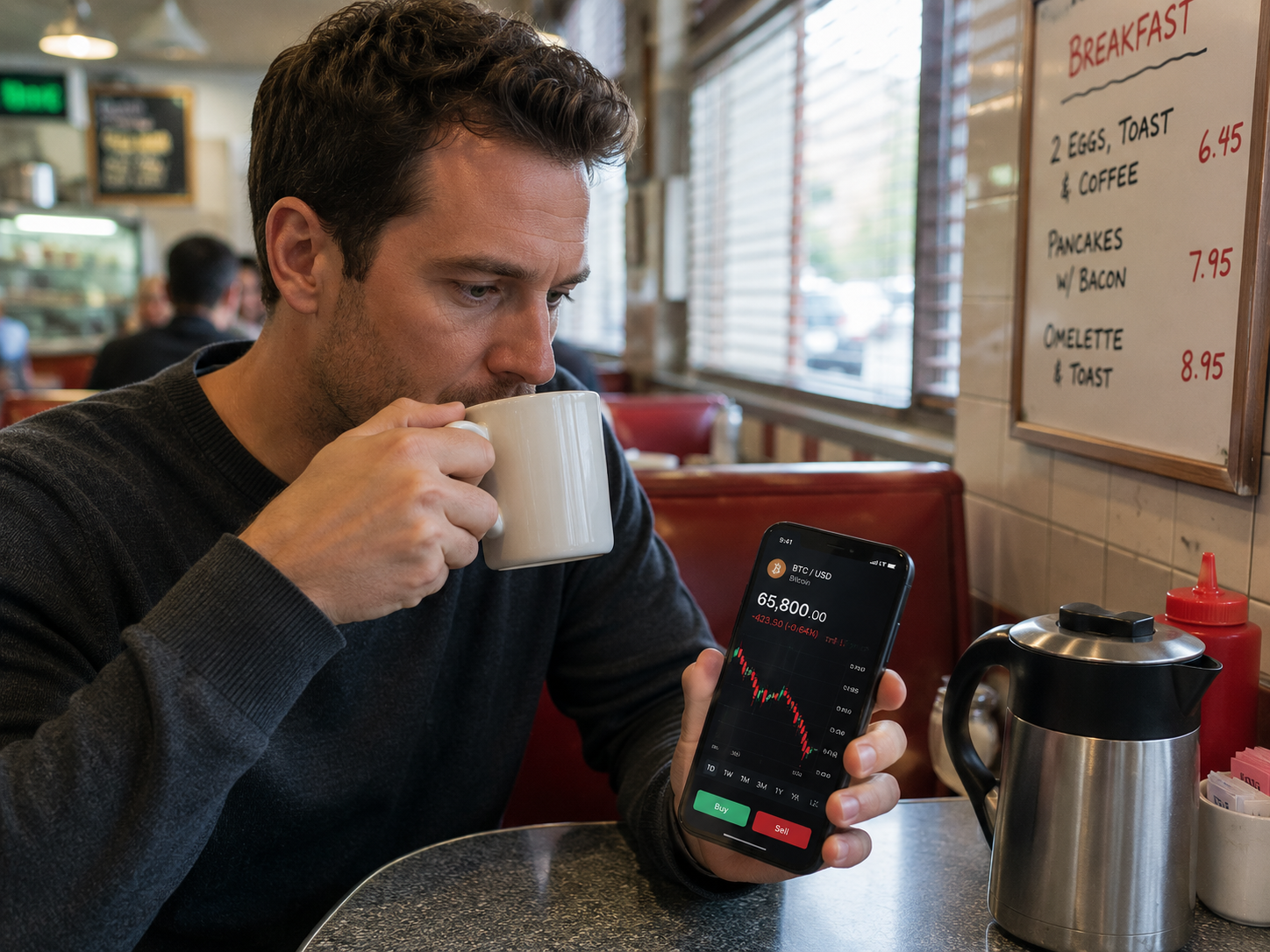
Bitcoin (BTC) remained firm around $65,800 on Wednesday, extending this week’s rally as the broader cryptocurrency market continued its recovery.
The world’s largest cryptocurrency strengthened its short-term outlook after closing above the 50-day Exponential Moving Average (EMA), a technical development that suggests buyers are gradually regaining control.
However, Bitcoin still faces significant resistance from longer-term moving averages that must be cleared before a stronger bullish trend can emerge.
Bitcoin reclaims key technical support
Bitcoin’s recent move above the 50-day EMA at $65,150 marks an important improvement in market structure after weeks of corrective trading.
While the breakout has strengthened short-term momentum, BTC continues to trade below the 100-day EMA at $68,082 and the 200-day EMA at $73,982, indicating that the broader recovery remains incomplete.
As long as Bitcoin holds above the 50-day EMA, buyers maintain a near-term advantage. However, reclaiming the higher moving averages will be essential to confirm a sustained bullish trend.
Technical indicators continue to support the improving market outlook. The Relative Strength Index (RSI) has climbed to 60, remaining comfortably above the neutral 50 level while staying below overbought territory. This suggests buying momentum is strengthening without showing signs of exhaustion.
Meanwhile, the Moving Average Convergence Divergence (MACD) remains in positive territory, indicating that bullish momentum continues to build. Although the indicator has yet to signal a decisive breakout, it reinforces the view that buyers are steadily gaining confidence.
Bulls eye the $68k resistance level
The next major hurdle for Bitcoin sits at the 100-day EMA around $68,082. A successful breakout above this resistance would improve the medium-term outlook and shift attention toward the 200-day EMA at $73,982.
If bullish momentum continues beyond that level, BTC could target the longer-term resistance zone near $84,410.
On the downside, immediate support is provided by the 50-day EMA at $65,150. A stronger support area lies around $64,004, where buyers may attempt to defend the recent breakout.

However, a sustained move below $64,004 would weaken the current bullish structure and increase the risk of a broader correction.
For now, Bitcoin’s recovery above its 50-day EMA, coupled with strengthening momentum indicators, suggests bulls are regaining control. The next decisive test will be whether buyers can overcome resistance near $68,082 to extend the current rally.


A security vulnerability in the Zilliqa Ledger app is enabling attackers to reconstruct private keys using publicly available onchain data.
![TSLA expected move by expiry table, July 24 at ±5.63%, Source: OptionCharts.io]](https://wordupnews.com/wp-content/uploads/2026/07/2e1c830a984e4271b796409715d958a9.webp)
Tesla, Alphabet, and IBM all report second-quarter earnings after Wednesday’s closing bell. Options traders are bracing for big single-day swings from all three.
Recent history explains the nerves. Alphabet’s last report moved the stock almost twice as much as expected. IBM’s July warning erased a quarter of its value in one day.
Tesla Options Price Their Widest Earnings Move in a Year
Tesla (TSLA) options point to a move of about 5.6% by Friday, per OptionCharts data from Wednesday morning. That widens to 7.4% a week out. In dollar terms, traders see the stock landing between $356 and $399.
That is a wide range. Tesla has averaged just a 4.4% move after its last four reports, per CNBC.
![TSLA expected move by expiry table, July 24 at ±5.63%, Source: OptionCharts.io]](https://assets.beincrypto.com/img/KpjdhOniGa6BgWYjMd6Xm3AViAA=/smart/2e1c830a984e4271b796409715d958a9)
Many traders are bracing for a fall. Put options, which pay off when a stock drops, outnumber calls in Friday’s expiry. The biggest bets sit at strikes far below the current price.
CNBC options analyst Mike Khouw counted roughly $550 million in net bets against the stock. That is the same $550 million options bet backing chart analyst Carter Worth’s bearish call.
![TSLA open interest, puts vs. calls for July 24 expiry, Source: OptionCharts.io]](https://assets.beincrypto.com/img/cyMXkheOxUKFXaKs9Qz9F7fB3XM=/smart/85bfc3f2ed9e43359e8b01863b924ae8)
BeInCrypto’s Tesla earnings preview flags margins and robotaxi updates as the things to watch.
Alphabet and IBM Earnings Show Opposite Risk Profiles
Alphabet (GOOGL) is the opposite trade. Options price a 5% move, and bullish calls outnumber puts almost five to one.

Traders remember April. Alphabet earned $5.11 per share when Wall Street expected about $2.65. The stock jumped 10% and added $421 billion in value, the second-biggest one-day gain ever, per Bloomberg.
The Google earnings preview points to cloud growth and AI spending as the first tests.
IBM is the strange one. It already revealed its numbers on July 14. Revenue came in at $17.2 billion, below forecasts. The stock lost a quarter of its value that day, its worst drop on record, per CNBC.
CEO Arvind Krishna blamed big deals that slipped past quarter-end.
“This quarter we faltered.”
Yet IBM options are now the priciest of the three. Implied volatility, a measure of expected swings, sits above 86% for Friday.

Traders are not paying for the results. They are paying for protection against bad guidance.
What Options Flow Can and Cannot Confirm
One caution. Options data is anonymous. It shows the size of bets, not who made them. Hedge fund positions only become public in filings 45 days after each quarter ends. Sentiment was already split after Jim Cramer dumped tech stocks days before the reports.
Expected moves are estimates, not limits. Alphabet and IBM both proved that this year.
The post Tesla, Alphabet, IBM Report Today: Why Are Options Traders Paying 86% Volatility? appeared first on BeInCrypto.
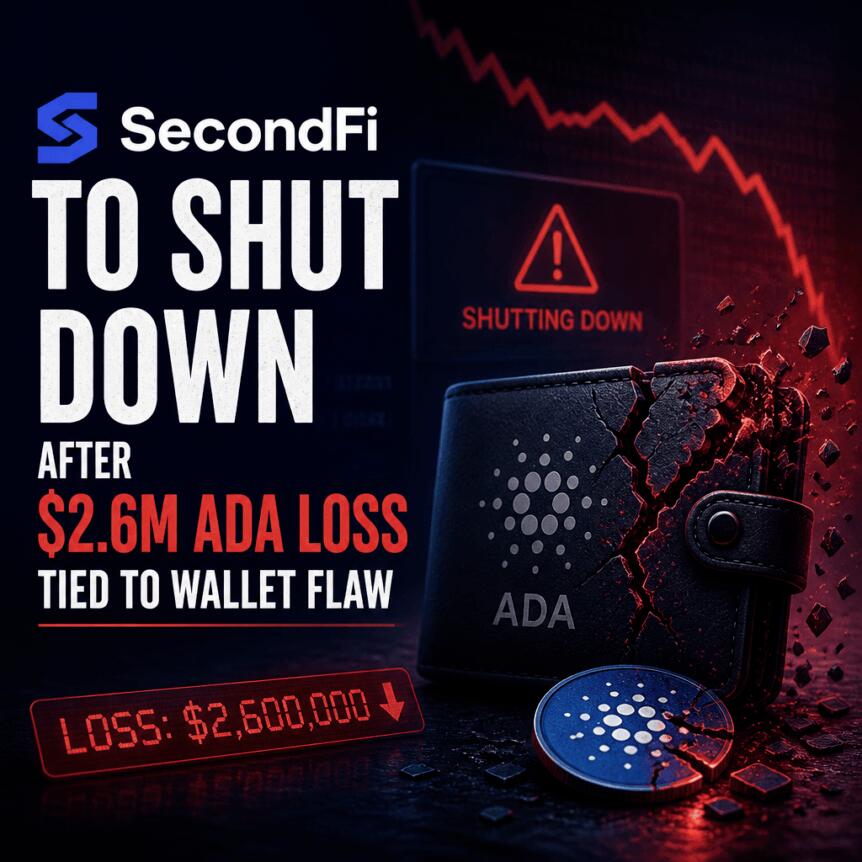
Cardano-focused wallet provider SecondFi says it will shut down its SecondFi and Yoroi wallet services after a security incident exposed a cryptographic weakness in its wallet software. In a public update published Wednesday on X, the company stated that attackers stole about 16.1 million ADA—valued at roughly $2.6 million at the time of disclosure—affecting 374 wallets.
The news arrives nearly a month after SecondFi first disclosed the exploit in late June, when it said it had identified a path toward recovery and expected the process to begin soon after security reviews. Now, users are being told to wait for new tools targeted for release in August, even as the company prepares to wind down operations.
Key takeaways
- SecondFi plans to wind down both its SecondFi and Yoroi wallet services following a cryptographic flaw that enabled theft of about 16.1 million ADA.
- The breach impacted 374 wallets, according to SecondFi, and involved external activity assessed by an independent investigation.
- SecondFi is developing a recovery tool using zero-knowledge proofs, with testing and third-party review before an August launch.
- The company also plans wallet export functionality for migration, but has not announced whether it will reimburse losses.
Shutdown after an ADA theft tied to a wallet weakness
SecondFi’s Wednesday update marks a decisive shift from its earlier stance that recovery would follow after additional work. The company said the attackers exploited a cryptographic flaw in its wallet software to gain access to user funds, resulting in the theft of approximately 16.1 million ADA.
SecondFi’s post further states that an independent investigation conducted with blockchain intelligence provider Groom Lake identified a “sophisticated external actor” and found indicators potentially consistent with North Korea’s Lazarus Group. Importantly, SecondFi’s update does not claim confirmed attribution.
For affected users, the immediate practical consequence is that the wallet services are being phased out rather than remaining fully operational while remediation continues. That increases the urgency for recovery and migration options, since users may no longer be able to rely on the same support channels tied to the compromised service.
Recovery tool planned for August, pending testing and audit
SecondFi said it is building a recovery tool intended to help exploited users retrieve assets while limiting what information they must disclose. According to the company, the approach uses zero-knowledge proofs, a technique designed to prove certain facts without revealing underlying sensitive data.
The wallet provider added that the tool is still in testing and will be reviewed by a third-party auditor before it is released. SecondFi’s stated goal is an August launch, aligning with its broader plan to provide recovery and migration functionality on a delayed timeline.
Alongside recovery, SecondFi said it is also preparing wallet export functionality. The export feature is meant to help users move their assets to another service, giving them a concrete migration path even if SecondFi and Yoroi services are being wound down.
However, SecondFi did not announce any direct reimbursement plan, nor did it specify whether it would compensate users from its own funds. For many in the Cardano ecosystem, that omission matters as much as the technical plan, because wallet recovery typically depends on the quality and timeliness of tooling rather than on centralized discretion.
Timeline criticism: from “two weeks” guidance to an August target
SecondFi’s operational change has been met with frustration from users who say earlier messaging implied a faster recovery window. Nearly a month after the initial disclosure, some users claim they still lack a clear, dependable path to regain or migrate their funds.
In guidance SecondFi posted earlier during the investigation, the company advised affected users not to restore recovery phrases into new Cardano wallets. The stated rationale was that moving funds elsewhere “does not mitigate the risk” while SecondFi investigated the incident.
SecondFi’s recovery expectations were also time-bound during the initial disclosure phase. On June 27, according to earlier reporting by Cointelegraph, the company said it had identified a recovery path and expected to begin the process within roughly two weeks after completing testing and security reviews. Wednesday’s update effectively pushed that horizon further out, saying recovery tools were now targeted for August due to ongoing development and review.
One user response posted to X criticized the mismatch between the earlier “two weeks” expectation and the updated delay, stating that they had been told recovery could occur within that shorter timeframe but are now being asked to wait longer.
Cointelegraph attempted to obtain further details from SecondFi about possible reimbursement plans but did not receive a response by publication time. The report also notes that EMURGO did not respond to earlier requests for comment.
Why this incident matters for Cardano wallet users
Wallet security incidents are often assessed not just by how much was stolen, but by how quickly users can safely regain control of funds and whether the remediation process is both verifiable and operationally feasible. In this case, SecondFi’s plan—recovery via zero-knowledge proofs plus export tools—shows an effort to create a safer workflow for exploited users, particularly by reducing the need to share sensitive material.
At the same time, the decision to wind down wallet services introduces a second challenge: continuity. Even a well-designed recovery tool can become harder to coordinate when a provider is closing down and users need to migrate away during remediation. For impacted users, the next steps hinge on whether SecondFi’s August release aligns with its testing and third-party audit schedule, and whether the export function is available in a way that supports migration without introducing new risk.
For the wider Cardano ecosystem, the incident also underscores the fragility of cryptographic assumptions inside wallet software. The company has not attributed the attack with certainty, but the mention of indicators possibly linked to Lazarus suggests that the event may reflect a persistent, externally driven threat model rather than an isolated bug.
As August approaches, the most important questions for affected users are straightforward: will the recovery tool and wallet export features ship on schedule, will they work reliably for all impacted wallets, and will SecondFi clarify whether any compensation is planned. Until those details are confirmed, the practical recovery timeline—and the safety of any migration steps—remains the central uncertainty.
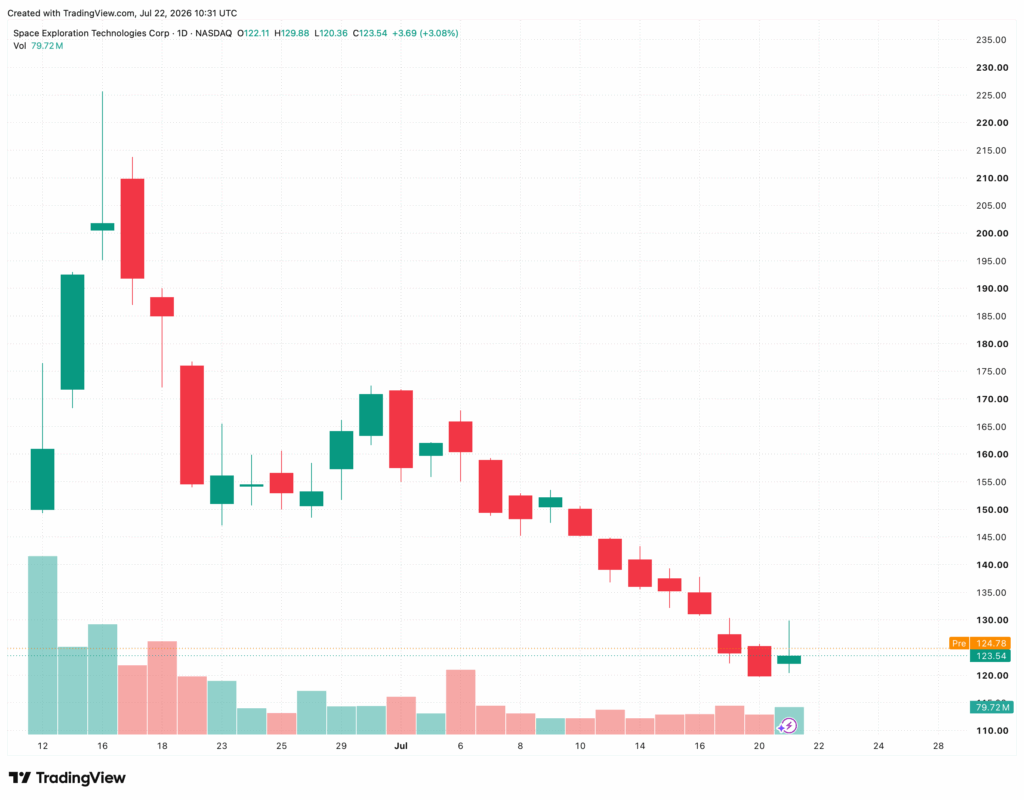
Wall Street analysts are trying to rescue Elon Musk’s floundering IPO, SpaceX after the stock erased $1.1 trillion of market capitalization in five weeks.
Almost every Wall Street analyst has a price target (PT) higher than the stock price, with reiterations and upgraded forecasts arriving by the day, and all 12 IPO underwriters whose analysts have published research on SPCX rated it a “buy” or equivalent.
Bullish analyst ratings have showered Musk’s company with weeks of praise as the stock price has crashed. Yesterday, Macquarie reiterated its “outperform” rating with a PT 100% higher than SPCX’s closing price.
Last week, Piper Sandler initiated coverage with a $156 PT, $32 higher than yesterday’s close. The same week, Needham maintained its buy rating and increased its PT 25% to $250, Evercore ISI Group initiated at outperform with a $230 PT, and Zephirin Group initiated coverage at buy with a $310 PT.
The tone around these ratings has been one-sided for weeks. Ratings by the investment banks that actually helped sell the stock during the IPO have sustained a sound wall shouting nothing but buy.
Raymond James initiated coverage at “strong buy” and an $800 PT. Eight hundred dollars.
The stock closed yesterday below $125, down 45% from its June 16 high.
Hiking PTs and buys since the SpaceX IPO
Goldman Sachs led a record-shattering, 23-bank syndicate that priced SpaceX’s record $75 billion IPO at $135 a share on June 11. It would open for trading on the Nasdaq at $150.
For that one day in the sun, the banks split roughly $500 million in fees, with Goldman and fellow lead Morgan Stanley collecting about $100 million apiece.
Their gratitude showed. Bank of America crowned SpaceX the “King of the Cosmos” alongside a $235 PT. Deutsche Bank called the company the “apex of civilizational ambition” and set a $255 PT.
Citi described its $200 target as a “milestone along the path to $900.” Morgan Stanley titled its SPCX analysis “AI’s Final Frontier,” attaching a $300 PT.
Gushing affirmations reeked of conflicts of interest.
Raymond James, a co-manager on the IPO, called SpaceX “one of the defining industrial infrastructure companies of the 21st century.” Its $800 PT, Wall Street’s highest, is more than six times the current share price.
Read more: Some SpaceX bonds have already sunk to junk-like territory
Analysts without conflicts of interest have lower PTs
Firms that didn’t directly benefit from the IPO saw a different, far more accurate future.
MoffettNathanson initiated at neutral with a $131 PT and wrote, “There is simply no credible financial model that can support what is at the time of this writing a roughly $2 trillion valuation. Our own certainly does not.”
CFRA issued Wall Street’s only outright “sell” rating and a $115 PT on the stock’s first day of trading. It was the most accurate PT to date, with shares falling to within $5 of that forecast this week.
Another IPO outsider, KeyBanc, added the first “hold-equivalent” analyst rating on June 22, a session in which the shares dropped 16%.
So far, the stock price is rewarding skeptics, not the conflicted banks and Wall Street giants that SpaceX compensated to remain permabullish.
SpaceX peaked at $225.64 on June 16, when the company was briefly worth more than $2.9 trillion. The shares broke below their $135 IPO price on July 15 and closed under it a day later.
This week, they traded below $120 after SpaceX delayed its highly-anticipated Starship test flight when some of its engines failed to start.
Meanwhile, some SpaceX bonds have already declined to 90.7 cents on the dollar with junk-like, 7.5% yields. Yet 29 analyst ratings still average a $236 PT, as though the stock has a realistic chance of nearly doubling from Tuesday’s close near $124.
Whatever the stock does next, Wall Street’s IPO fees settled weeks ago.
Got a tip? Send us an email securely via Protos Leaks. For more informed news and investigations, follow us on X, Bluesky, and Google News, or subscribe to our YouTube channel.
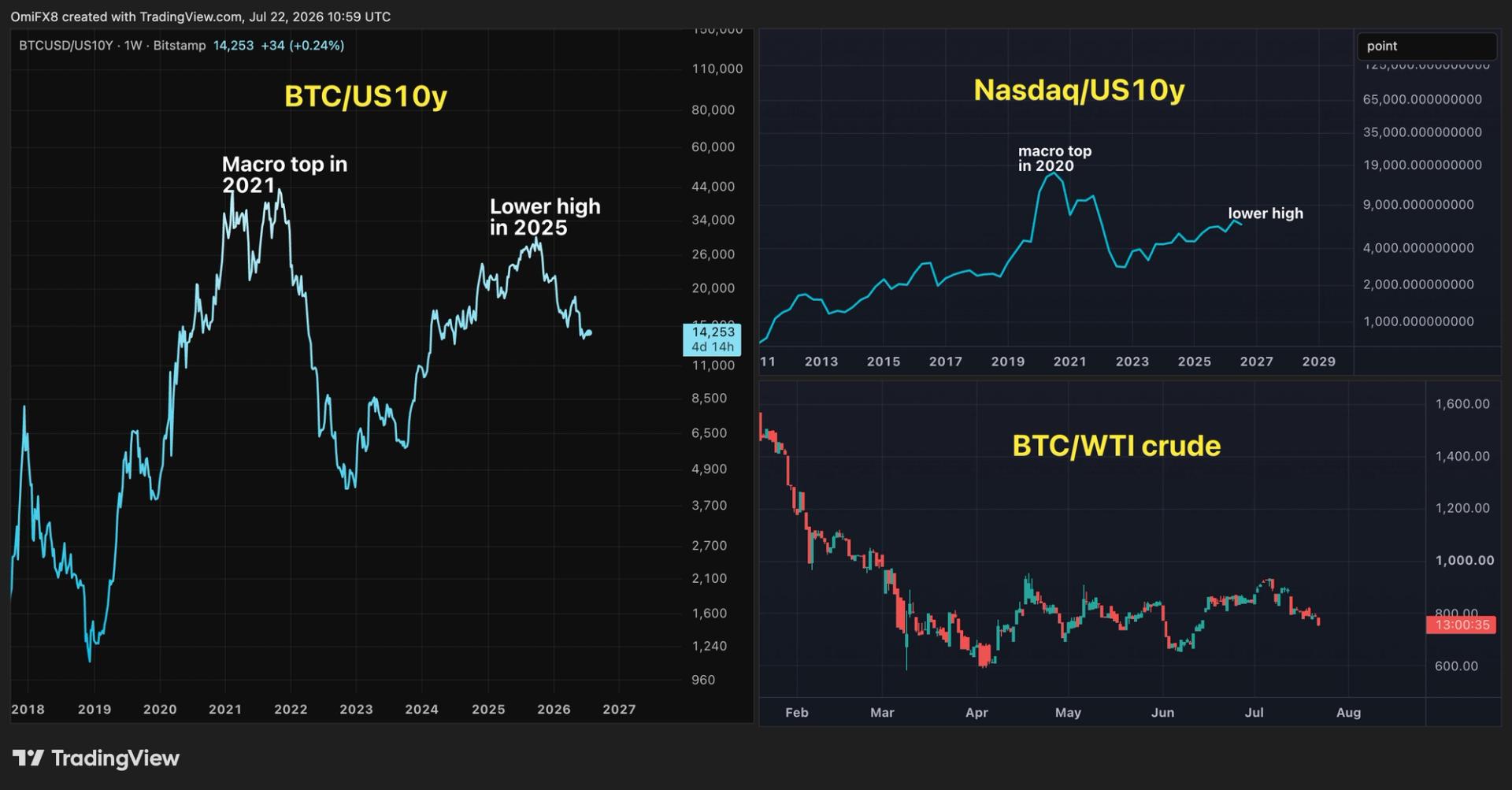
As bitcoin regains its footing, optimism has returned to the market, and several observers are calling the recent price rise the start of a decisive bull run for valuations well beyond last year’s $126,000 peak.
But a look back at trends in bitcoin and Nasdaq valuations, adjusted for the cost of capital represented by the U.S. 10-year yield (US10Y), suggests bull runs may be more measured. (check Today’s signal)
Both the BTC/US10Y and Nasdaq/US10Y ratios have failed to eclipse their 2020-2021 peaks, even though their dollar-denominated prices set new record highs over the past 12 months. In other words, when adjusted for the cost of capital, the true macro tops for bitcoin and the broader tech sector likely occurred in 2020-21.
This divergence between nominal prices and yield-adjusted valuations can resolve in one of two ways. Either interest rates collapse, shrinking the denominator and propelling these ratios toward a fresh breakout, or the dollar prices of these assets decline to realign with the structural weakness revealed by the ratios.
The latter scenario appears the more likely for two reasons. First, recent rhetoric from Fed officials has remained decidedly hawkish, with some even floating the possibility of interest-rate increases.

Q1 Results today: Eternal, Nestle, IndusInd Bank among 63 companies announcing June earnings. What to expect?
Trump Says Yes to Crypto Ethics Rule, Puts DOJ as Enforcer

England football icon Kevin Keegan, former Ballon d’Or winner, dies at 75 | Football News

Renter of Home in Anne Heche Crash Denies Settlement With Son

No Jackpot Winner as $257 Million Prize Rolls Over to $269 Million Monday Draw

Weekend Open Thread: Staud – Corporette.com

Tom Lee :”A TSUNAMI Is Coming For Bitcoin & Ethereum” | 2026 Crypto Prediction

5 Things You MUST Have by Age 40 | Financial Checklist #shorts#youtubeshorts

CLARITY GRIDLOCK: Senate SCRAMBLES to pass crypto bill as TIME RUNS OUT
-
 NewsBeat6 days ago
London Mayor Sadiq Khan handed a peerage by Keir Starmer alongside 15 other Labour figures… just days before the PM leaves No10
-

 Fashion5 days ago
Weekend Open Thread – Corporette.com
-

 Politics4 days ago
The House | The City of London can help the new chancellor deliver growth in every postcode
-
 Crypto World5 days ago
Two July Windows Left: The CLARITY Act’s Senate Fight and What Failure Means
-

 Crypto World6 days ago
CFTC blocks Kalshi from unwinding Michigan trades after court order
-

 Crypto World4 days ago
Ripple Payments Joins MiCA With 14 Firms, Does It Mean Anything For XRP?
-

 Business6 days ago
Nvidia Stock Slips After Big Tuesday Rally as Huang Confirms Vera Rubin Chip Is Now in Production Today
-

 Politics3 days ago
Democrats look to World Cup watch parties to register thousands of voters
-
 Entertainment7 days ago
Disney’s Most Ambitious Failed Star Wars Attraction Is Coming to SDCC
-

 Crypto World5 days ago
Ripple wins EU-wide access as ESMA adds it to MiCA register
-

 Crypto World1 day ago
Grayscale Files For Worldcoin ETF, WLD Registers Sharp Rise
-

 Business6 days ago
Palantir Shares Rise After Expanded Nvidia Partnership and Fresh Analyst Upgrades Ahead of Earnings Day
-

 Crypto World6 days ago
Injective Submits SEC Transfer-Agent Registration to Onchain Ownership Records
-

 Tech1 day ago
Sail Virtually Aboard The “Itanic” With IA-64 Emulator
-
 Tech1 day ago
Turtle Beach Command Series KB7 review: a nifty screen-equipped gaming keyboard
-

 NewsBeat2 days ago
Unregistered fitter used Gas Safe logo on business flyers
-

 NewsBeat5 days ago
Registration is now open for March for Men with Kev 2026
-
 Sports7 days ago
New Cornerback Enters Vikings Trade Rumor Mill
-
 Business8 hours ago
New Jersey voter registration controversy explained: How 6,600 noncitizens got on the rolls, and what happens next
-

 News Videos5 days ago
Money | Class 12 Economics | CBSE Board Exam 2026-27
You must be logged in to post a comment Login