

Crypto World
Bitcoin Traders Watch for “Serious Volume” After Binance BTC Outflows Rise to 9K


Bitcoin buyers appear to be absorbing sell pressure more effectively around the $65,000 area, according to analysis tied to exchange flow data. The signal comes after Binance posted its largest single-day net outflow in nearly two years, with more BTC leaving the platform than entering.
Onchain analytics firm CryptoQuant highlighted that Binance withdrawals have recently been running ahead of deposits—an environment traders often watch for because it can indicate reduced immediate supply on the exchange order book. Still, analysts caution that exchange outflows alone do not confirm a fresh, sustainable uptrend.
Key takeaways
- CryptoQuant data shows Binance daily netflows have oscillated between inflows and outflows, with a notable outflow spike on Tuesday.
- More than 9,000 BTC net left Binance in a single day, the largest tally since November 2024, suggesting significant movement toward self-custody.
- Analysts frame the latest pattern as improved “absorption” near $65,000–$66,000 rather than immediate proof of a new rally.
- US spot Bitcoin ETF flows remain net positive, pointing to ongoing institutional demand even as spot market momentum appears uneven.
Binance’s outflow spike draws attention
A CryptoQuant research note released Wednesday focused on Binance’s spot exchange balances, showing that daily BTC withdrawals are outpacing inflows. The takeaway is that short-term pressure from supply moving onto Binance appears to be easing—at least on the days where net outflows dominate.
CryptoQuant contributor Rei Researcher wrote that this pattern typically reflects reduced urgency to send BTC to the exchange “for potential selling.” In other words, when a large exchange sees net withdrawals, it often suggests sellers are not adding to immediate market liquidity at that moment.
The broader context from CryptoQuant is that Binance netflows have been switching signs—turning positive and negative—after a stretch of positive days that ended in early June. One day, however, stands out: on Tuesday, Binance recorded a net outflow of more than 9,000 BTC, which CryptoQuant described as the largest single-day figure since November 2024.
Ruga Research, another CryptoQuant contributor, argued that outsized outflows generally point to participants moving “serious volume” into self-custody. In a separate post, he emphasized that coins leaving an exchange are less likely to be sold directly into the order book, at least in the near term.
“When outflows hit this size, someone is moving serious volume into self-custody. Coins off exchanges are coins that won’t be sold into the order book,” Ruga Research said in that post.
Ruga also noted that on rolling 30-day time frames, netflows continue to repeat a fluctuation pattern and that sharp spikes can still reverse. His warning reflects a key nuance investors often overlook: exchange flow metrics can shift quickly, and a single dramatic day does not automatically define the next trend.
“Can this one fail? Absolutely. Momentum has been indecisive around the zero line for two weeks. It hasn’t committed. And what happens next, honestly, nobody knows,” he wrote, referring to mixed netflow days.
Absorption improves, but the trend still needs confirmation
Rei Researcher stopped short of claiming the outflow data by itself signals a durable new bull phase. Instead, he pointed to a more subtle implication: the presence of negative netflow while BTC trades around $65,000–$66,000 suggests buyers are doing a better job absorbing whatever supply remains in the system compared with an earlier weak period.
In his assessment, the key distinction is between “absorption” and a confirmed uptrend. Negative netflow can reduce exchange liquidity, but price still depends on spot demand, traded volume, and the market’s ability to maintain a stable structure.
“However, negative netflow does not automatically confirm a new uptrend. It needs to be accompanied by spot demand, volume, and a more stable price structure,” Rei Researcher said.
This framing matters because BTC’s reaction has been relatively range-bound compared to the momentum traders typically look for when a sustained move begins. If exchange outflows are rising but price remains choppy, the market may be transitioning into a steadier equilibrium rather than launching immediately into a higher trajectory.
ETF inflows remain a supportive counterweight
While exchange flow data is one part of the picture, ETF activity is another. Earlier coverage from Cointelegraph noted that consensus expectations for a full bull-market rebound have been constrained by a perceived lack of consistent spot demand. In that context, derivatives-related improvement has been easier to observe than a corresponding surge in spot buying.
Cointelegraph previously reported that net inflows into US spot Bitcoin ETFs suggest a continuation of institutional interest. CryptoQuant’s flow-focused analysis aligns with that broader narrative: even if the spot market’s immediate impulse is inconsistent, larger investors and structured products can help sustain demand.
In the current setup described by CryptoQuant and referenced by Cointelegraph, the most relevant tension is this: Binance outflows may be reducing available supply on exchanges, but the market still needs clear evidence that spot buyers are expanding participation rather than simply absorbing intermittent supply.
What to watch next for traders and long-term holders
For readers tracking whether this move becomes meaningful, the immediate question is whether Binance netflows keep favoring withdrawals and whether spot market behavior follows through. CryptoQuant contributors themselves underscored that netflow momentum has been mixed and that outflow spikes can fail. The next confirmations to monitor are steadier spot demand and improved price structure around the $65,000–$66,000 band, alongside continued net positive ETF inflows that could support broader risk appetite.

Bitcoin price has fallen more than 1% below $66,000 as renewed U.S.-Iran threats have lifted oil prices and increased expectations for another Federal Reserve rate hike this year.
Summary
- Bitcoin price slipped below $66,000 as Trump’s latest Iran threat pressured risk assets.
- Rising oil prices pushed traders to increase bets on another Fed rate hike.
- BTC faces resistance near $67,300, while support sits between $64,500 and $65,500.
According to data from crypto.news, Bitcoin (BTC) price was trading near $65,700 on July 22 after reaching an intraday high of roughly $66,886, leaving the cryptocurrency under pressure as traders weighed another escalation around the Strait of Hormuz.
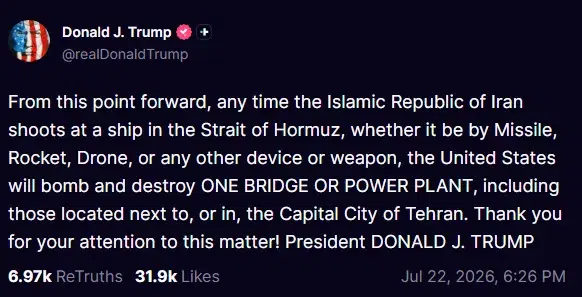
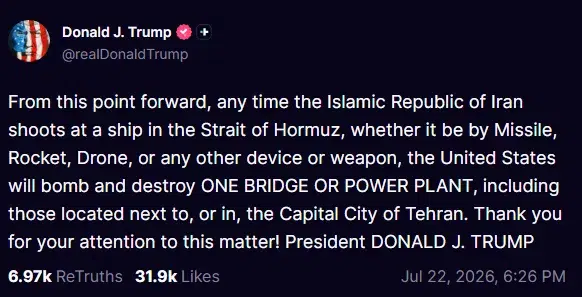
President Donald Trump warned in a Truth Social post that the United States would destroy one Iranian bridge or power plant each time Iran attacks a ship in the waterway. Trump added that the targets could include infrastructure located in or close to Tehran.
The warning followed the collapse of the interim ceasefire terms agreed under the Islamabad Memorandum of Understanding. The agreement, signed in June, called for the restoration of commercial traffic through Hormuz and the gradual removal of the U.S. naval blockade.
Iranian authorities have threatened to respond against regional infrastructure if Washington attacks the country’s bridges or electricity network, according to Iran’s Tasnim News Agency. Tasnim also reported that Iran’s Islamic Revolutionary Guard Corps had targeted Amazon data infrastructure in Bahrain during an earlier missile operation.
Shipping risks have increased further after Iran-backed Houthi forces threatened to block the Bab el-Mandeb Strait. Seven tankers had already changed course following the threat, which placed another key energy route under pressure while traffic through Hormuz remained disrupted.
Rising oil prices have revived inflation concerns
Brent crude climbed above $95 per barrel on July 22, reaching its highest point in six weeks as traders priced in risks to Gulf exports. Brent touched $95.24 before easing to about $94.40, representing a daily gain of more than 3%.
Around 20% of global petroleum consumption passes through the Strait of Hormuz, according to the U.S. Energy Information Administration. Continued disruption can therefore raise transport and fuel costs for countries that depend on Gulf oil, particularly if the Bab el-Mandeb route also faces restrictions.
Those energy risks have changed interest-rate expectations days before the Federal Open Market Committee meets on July 28–29. CME FedWatch data cited by MarketWatch placed the probability of a July increase at 33.7%, up from 25.7% one day earlier.
Polymarket traders, meanwhile, assigned a 65% probability to at least one Fed rate hike during 2026. The contract covers the rest of the year rather than only the July meeting, where futures traders continued to favor unchanged rates.
Before the latest oil increase, softer U.S. inflation data had reduced expectations for immediate tightening. A July 14 Reuters report showed that traders then assigned only a 10% chance to a July hike after annual headline inflation slowed to 3.5% in June from 4.2% in May.
The Federal Reserve’s June meeting minutes showed that policymakers were already watching energy-driven price pressure. Fed staff estimated that headline personal consumption expenditure inflation reached 4.1% in May, while core PCE inflation stood at 3.4%, according to the central bank.
Bitcoin price faces resistance between $67,000 and $69,340
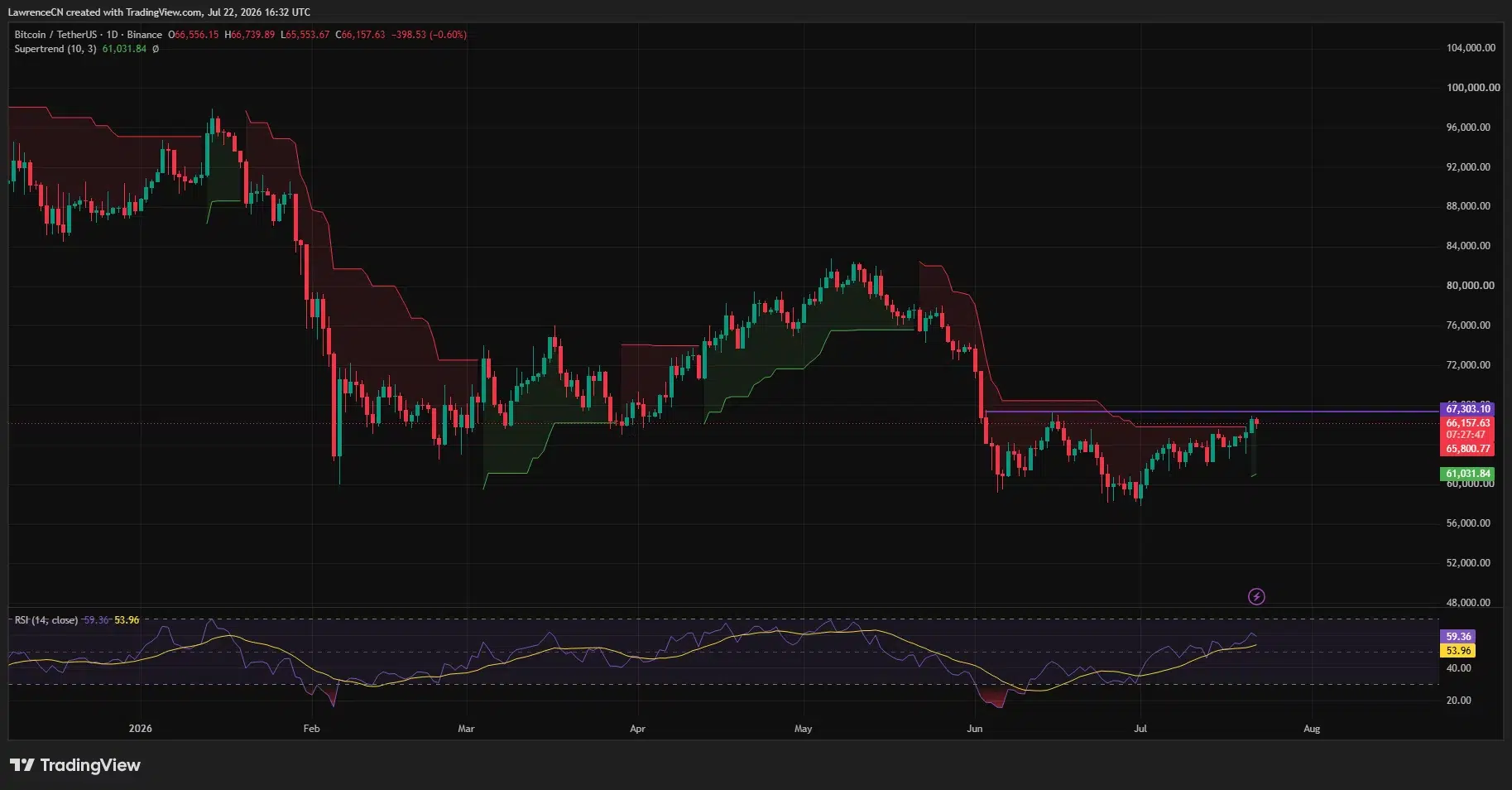
Bitcoin’s daily chart shows that price has remained below Supertrend resistance at $67,303 despite recovering from its late-June low near $58,000. The daily Relative Strength Index has risen to 59.36, above its signal average of 53.96, indicating improving momentum without reaching overbought territory.
On the 4-hour chart, BTC has traded inside an ascending channel since early July. Price recently tested the channel’s upper boundary near $66,986 before retreating, while the 78.6% Fibonacci retracement at $65,021 now forms the first visible support.
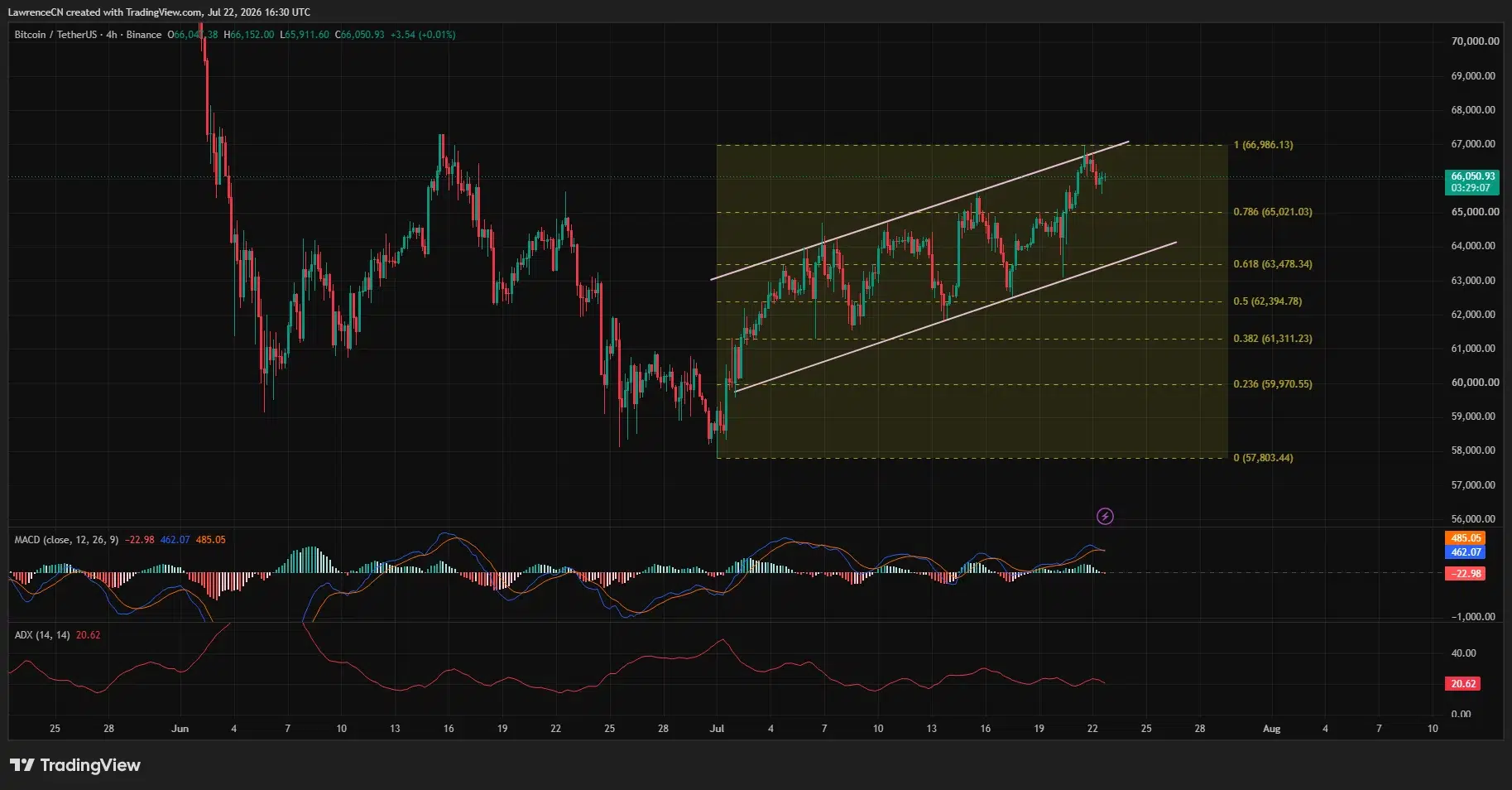
A deeper pullback would place the 61.8% retracement at $63,478 in focus, followed by the channel floor near $64,000. The 4-hour MACD histogram has moved slightly negative, and the MACD line has slipped below its signal line, showing that momentum weakened after the rejection near $67,000.
ADX has remained at 20.62, indicating that the current trend lacks strong directional force. A confirmed move above $66,986 and daily Supertrend resistance at $67,303 would be needed to improve the chart structure, while a break below $65,021 could expose the lower channel support.
Order-book data shared by crypto analyst Ted Pillows showed buy orders concentrated between $64,500 and $65,500, with sell orders stacked from $67,000 to $68,000. Commenting on the setup, Pillows wrote:
“If Bitcoin breaks above it, a rally to $70,000 will happen quick.”
Another barrier sits at $69,340, which crypto analyst Ali Charts identified as the short-term holder realized price. According to Ali, every Bitcoin rebound since November has been rejected around this on-chain cost basis, making the level an important test if buyers clear the immediate sell wall.
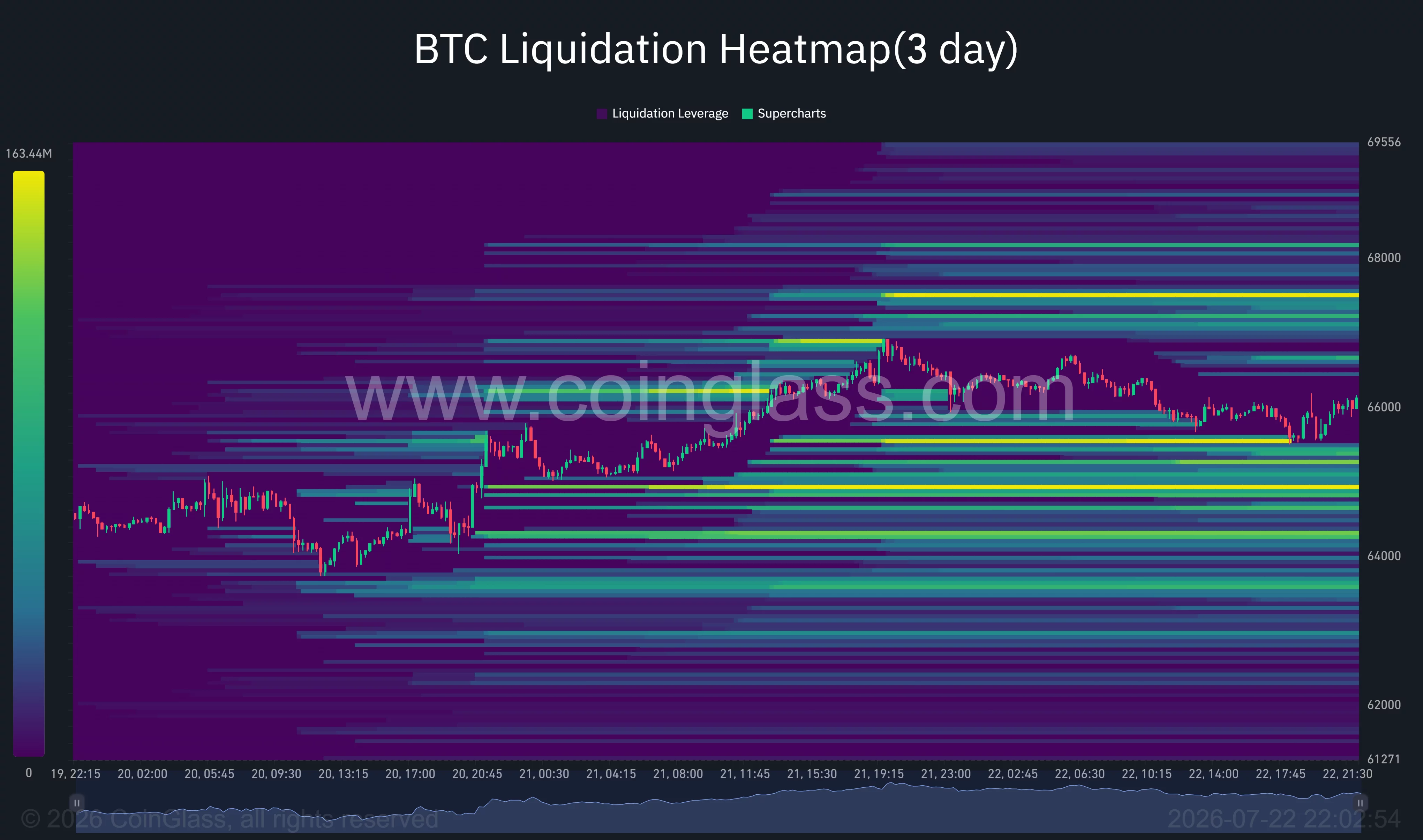
CoinGlass’s three-day liquidation heatmap supports the same resistance picture, showing the largest overhead liquidity cluster near $67,300, followed by dense positions around $68,000. Below the market, notable liquidation pools appear near $65,000, $64,400 and $63,500, leaving Bitcoin exposed to sharp moves in either direction as traders respond to oil prices, military developments and the July Fed decision.
Disclosure: This article does not represent investment advice. The content and materials featured on this page are for educational purposes only.


A self-proclaimed crypto rugpuller claims he was robbed of $14,000 worth of SOL by a group of drunk Australian girls while partying in Bali.
Ronnie Magrehbi, who has previously admitted to using the stories of cancer-afflicted babies to pump and dump crypto, shared footage of himself drinking shots with a group of female strangers he’d met at a beach club in Bali.
According to Magrehbi, he gave his unlocked phone to one of the girls so that she could look up and follow her Instagram account for him.
When she returned his phone, he noted that the vibe shifted and the girls disappeared after going to the bathroom.
Read more: FC Barcelona Instagram hacker made $26K in Pump Fun rewards
Upon checking his phone, he realised that $14,000 worth of SOL had been transferred from his Phantom mobile wallet to a wallet he’d never interacted with before.
Footage appears to show him confronting the girls and accusing them of stealing his funds. One girl panics, while another stands silent as he films.
Magrehbi subsequently called the police, leading to 12 undercover officers tracking the girls down and arresting them.
He then continued to film the girls in a police station, where he’s heard saying, “They wanna steal and not follow the law of the land, they can deal with the consequences. All of them. How about that.”
Bali crypto robbery karma for Magrehbi’s crimes
Magrehbi, who goes by the name “29” on X, was 19-years-old when he was charged in January 2020 with armed robbery and burglary after police caught him and three accomplices robbing a man at gunpoint and stealing his jacket and bag.
Later that year, Magrehbi was charged with conspiracy to commit wire fraud after allegedly taking over the social media account of a National Football League (NFL) player and holding it ransom.
Magrehbi allegedly took a ransom payment from the athlete, but never relinquished access to the account. Authorities claim his accomplice, Trevontae Washington, targeted both NFL and National Basketball Association players.
In 2025, Magrehbi was branded a “scumbag crypto scammer” after he rug-pulled investors with Pump Fun memecoins that appeared to exploit children with cancer.
Afterwards, he was recorded apparently mocking the children and “thanking” them for helping him make thousands of dollars.
Read more: UK gang who posed as cops to steal $5.4M in crypto jailed
In an interview with YouTuber THURL DES, Magrehbi also admitted to “draining” crypto wallets with malware.
He’s also linked to the alias “Ronny Fargo,” and he has repeatedly claimed to have hacked the Twitter and Pinterest accounts of Mark Zuckerberg back in 2017.
Another YouTuber, Atozy, doubted these claims, noting that there’s no reported connection between hacking group OurMine, which hacked Zuckerberg, and Magrehbi’s other alleged NFL social media takeovers.
Got a tip? Send us an email securely via Protos Leaks. For more informed news and investigations, follow us on X, Bluesky, and Google News, or subscribe to our YouTube channel.


Cointelegraph is committed to providing independent, high-quality journalism across the crypto, blockchain, AI, and fintech industries.
All news, reviews, and analyses are produced with full journalistic independence and integrity. For more details on our standards and processes, please read our Editorial Policy.


Blockchain intelligence firm TRM Labs has claimed in a new analysis that Justin Sun-owned HTX has been “rotating its wallet infrastructure on a rapid cycle” following sanctions issued by the UK Foreign, Commonwealth, and Development Office (FCDO) against Huobi Global S.A.
The FCDO sanctions, which landed in May, claimed that Huobi Global S.A. was being used by the A7 Network in Russia to bypass sanctions meant to target Russia.
HTX quickly claimed that “the listed entity Huobi Global S. A. is distinct from the online HTX exchange.”
Read more: UK sanctions HTX for alleged Russian sanctions violations
However, this wasn’t the whole story, as Huobi Global S.A. owned the United States trademark for HTX, and Huobi Global S.A. had filed documents in court that claimed that it “owns and operates HTX.”
Following this, HTX took its already problematic reserves and hid them in a new category on its proof-of-reserves called “ThirdParty.”
HTX has been unwilling to disclose to Protos what custodian is behind this new arrangement, despite claiming on its proof-of-reserves page that users should “directly contact the third-party custodians” to verify the reserves.
Ari Redbord, global head of policy at TRM Labs, has described the behavior as “HTX changing its wallets every few hours to stay a step ahead of screening built on static lists.”
HTX has claimed to The Block that these practices “reflect routine, security-driven platform operations common across the industry.” Further, it adds that it “categorically rejects any characterization implying otherwise.”
TRM Labs works with Sun-related entities in other partnerships.
It’s a part of the so-called “T3 Financial Crime Unit,” a partnership between TRM Labs, Sun-founded TRON, and Tether which was formed “to combat illicit activity associated with the use of USDT on TRON blockchain.”
Got a tip? Send us an email securely via Protos Leaks. For more informed news and investigations, follow us on X, Bluesky, and Google News, or subscribe to our YouTube channel.


Senate Republicans released the long-awaited Clarity Act text on Wednesday, adding strict new ethics rules that bar public officials—including the President—from issuing or sponsoring digital assets during their time in office.
The 616-page amendment in the nature of a substitute to H.R. 3633 delivers the first comprehensive federal framework for digital asset markets while addressing Democratic demands for conflict-of-interest protections.
The post Clarity Act Text Is Out: What Does It Say? appeared first on BeInCrypto.

The U.S. Department of Justice has filed five civil forfeiture complaints seeking more than $25 million in cryptocurrency it alleges is linked to international romance and investment frauds that targeted victims in both Canada and the United States. According to the U.S. Attorney’s Office for the District of Columbia and the U.S. Secret Service, the case stems from separate investigations conducted by the Cyber Fraud Task Force.
Prosecutors say victims were persuaded into believing they were making legitimate digital asset investments, only for their funds to be routed through laundering networks designed to obscure the origin and movement of stolen crypto. The DOJ describes tactics that frequently blend social engineering, fraudulent trading platforms, and layered wallet transfers to make recovery difficult.
Key takeaways
- The DOJ is pursuing five civil forfeiture actions targeting more than $25 million in crypto tied to romance and investment scams.
- One complaint seeks about $12.1 million connected to romance schemes affecting more than 200 victims.
- Another action seeks $10.4 million tied to suspected victim transactions involving more than 270 people.
- Authorities allege the launderers were largely based in Southeast Asia, with related IP activity associated with China, Malaysia, and Cambodia.
- International enforcement has recently intensified against similar social engineering–to-crypto laundering pipelines, including Interpol’s Operation First Light 2026.
DOJ targets crypto tied to romance and fake investment platforms
In a statement, the U.S. Attorney’s Office for the District of Columbia and the U.S. Secret Service said the assets were recovered as part of investigations associated with the Cyber Fraud Task Force. DOJ officials allege that scammers identified thousands of victims worldwide and misled them into believing they were investing in digital assets.
The largest complaint seeks approximately $12.1 million and is tied to romance-based frauds that reportedly defrauded more than 200 victims. Prosecutors say proceeds were routed through intermediary addresses and commingled with funds from other victims—an approach that can complicate attribution and recovery efforts.
A second complaint seeks $10.4 million and involves more than 270 suspected victim transactions. DOJ also filed three smaller complaints, which prosecutors describe as involving fake investment accounts and an additional “recovery” scheme—an escalation pattern seen in many fraud ecosystems, where initial victims are later targeted again with offers to help them get their money back for a new fee or deposit.
Where laundering allegedly operated—and how identities were masked
The DOJ said the alleged laundering infrastructure was predominantly located in Southeast Asia, while related IP addresses were associated with China, Malaysia, and Cambodia. While the filing describes these characteristics at a high level, the enforcement theory is consistent: criminals sought to break the on-chain connection between victim payments and the addresses that ultimately benefited.
Prosecutors frame the problem as more than a direct “investment” fraud. They argue that crypto-enabled romance scams typically rely on social engineering to build trust, then steer victims toward fraudulent trading or investment platforms. After funds are placed, investigators say the money is moved through multiple wallet layers and networks that help conceal the stolen funds’ trail.
Interpol operation highlights the scale of social engineering to crypto laundering
This DOJ filing follows broader international enforcement activity focused on social engineering scams and the financial networks used to launder their proceeds. According to earlier reporting from Cointelegraph, Interpol-coordinated Operation First Light 2026 involved 97 countries and territories. Interpol said the operation led to 5,811 arrests and the interception of $283 million in illicit assets.
Interpol also reported that the operation identified more than 142,000 victims and blocked more than 31,000 bank accounts. Within the operation, Thai authorities reportedly uncovered a network that allegedly converted romance-scam proceeds into crypto. Investigators also described the use of cross-chain token swaps to further obscure the movement of funds.
Cointelegraph reported that a wallet associated with a suspected money launderer processed more than $122.5 million in crypto over a period of 10 months. While that figure comes from Interpol-linked reporting rather than the DOJ civil forfeiture filings themselves, the overlap underscores the same operational playbook: trust-building scams, movement of funds into crypto, then multi-step transfers and trading-like activity to frustrate tracing.
Earlier U.S. actions show stablecoin laundering patterns
The DOJ’s move also fits into a wider pattern of U.S. enforcement against crypto used in romance and investment frauds. Cointelegraph previously noted that, in February, federal agents seized over $61 million in USDT stablecoin from addresses allegedly associated with laundering proceeds tied to fraudulent investment platforms.
In that earlier account, investigators described a workflow similar to the one now reflected in the forfeiture complaints: scammers build trust through romantic relationships, steer victims to fake trading platforms, and then move funds across multiple wallets. The DOJ complaint language adds further detail about how schemes can evolve into “recovery” scams and about how funds can be commingled among victims—both of which affect how law enforcement attempts to dismantle networks and how victims may later attempt to locate assets.
For readers, the key point is practical: these cases show that the fraud often shifts from social manipulation to financial plumbing. Even when victims send funds into what appears to be a legitimate digital asset transaction, the traceable parts can be deliberately fragmented through intermediaries, layered transfers, and cross-network activity.
As the forfeiture cases proceed, the next watchpoints are straightforward: whether courts allow the government to establish ownership and tracing theories at the complaint stage, and whether additional actions follow targeting other wallets or infrastructure tied to the same alleged laundering clusters.
Ethereum has staged a notable recovery from its June lows. It has reclaimed some important support levels and is now pushing toward a major technical barrier. While short-term momentum continues to favor buyers, the broader trend remains challenged by overhead resistance and a still-negative Coinbase Premium Index, suggesting institutional demand from U.S. investors has yet to fully return.
Ethereum Price Analysis: The Daily Chart
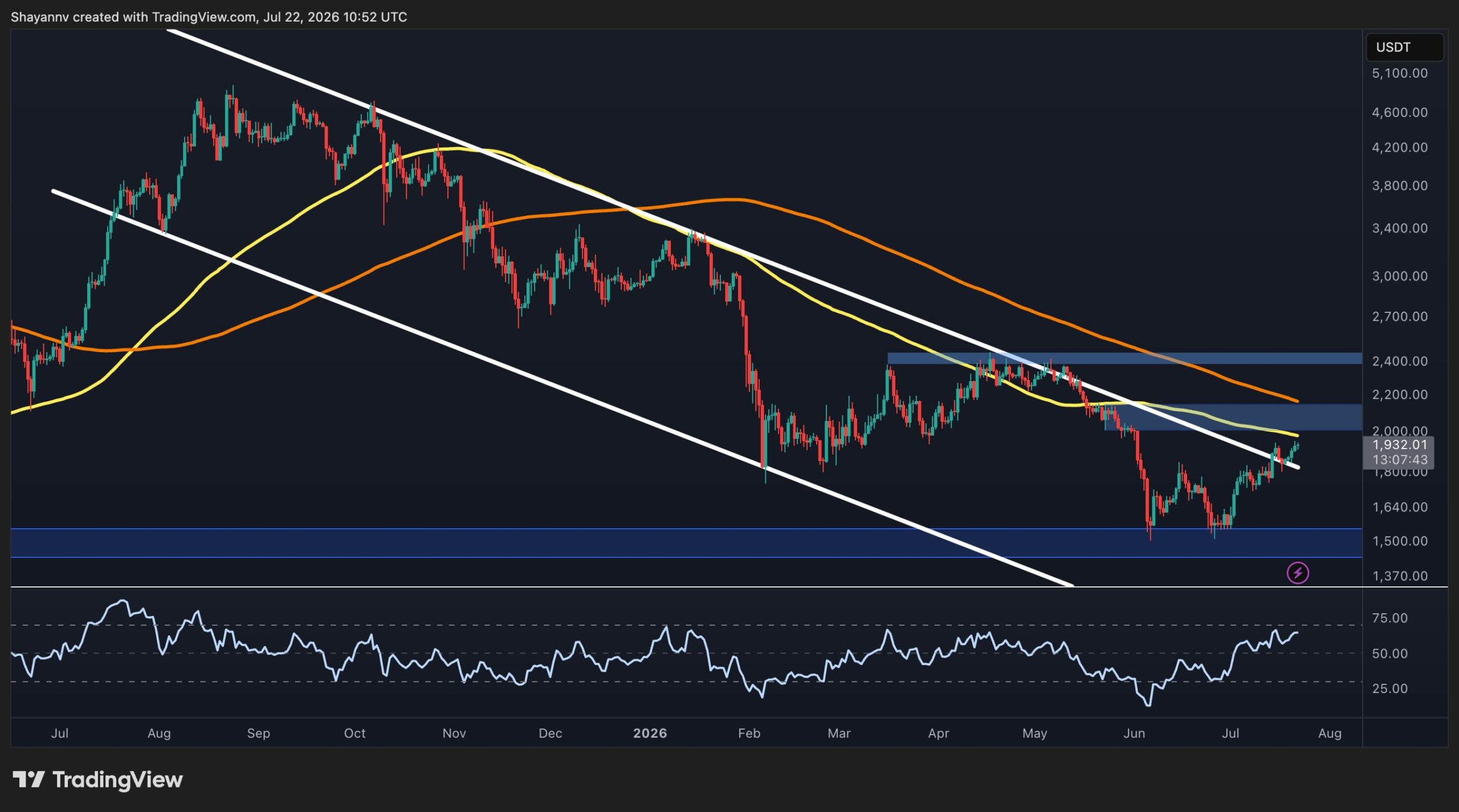
On the daily timeframe, ETH has rebounded sharply after defending the $1.5K demand zone, where buyers repeatedly stepped in to halt the broader downtrend. The recovery has carried price back above the descending channel’s higher boundary.
The price is also approaching an important confluence of resistance. The descending trendline aligns closely with the 100-day moving average, while the 200-day moving average remains higher around the $2.2K region. These dynamic resistance levels reinforce the nearby horizontal supply zones at $2K and $2.4K. This confluence makes this area the primary obstacle before any larger bullish reversal can develop.
Momentum has also improved considerably, with the RSI climbing toward the upper half of its range, reflecting strengthening buying pressure without yet reaching overbought territory. As things stand, the path toward the $2K to $2.2K resistance area is open. Yet, a rejection from this zone would keep the broader bearish structure intact and increase the likelihood of another retracement back inside the channel and toward the $1.5K support zone.
ETH/USDT 4-Hour Chart
The lower timeframe shows a much more constructive market structure. ETH has been producing higher highs and higher lows while respecting an ascending channel that has supported the advance throughout June and July.
After rebounding from the $1.7K short-term demand zone, the price accelerated toward the upper boundary of the large channel, where it is currently consolidating around $1.9K. This places ETH directly beneath a key resistance trendline that has capped rallies over the past several weeks.
The immediate support lies around $1.76K, where a previous resistance zone has flipped into support. Holding above this region and the short-term rising trendline would preserve the current bullish structure and keep the focus on another attempt to break above the channel resistance near $1.95K.
A successful breakout could trigger a continuation toward the psychological $2K level, while a loss of the ascending trendline would likely shift momentum back in favor of sellers and expose the $1.7K support area once again.

Sentiment Analysis
The Coinbase Premium Index continues to paint a more cautious picture despite ETH’s recent price recovery. Although the metric has rebounded from its deeply negative readings seen earlier this summer, it remains below zero, indicating that Ethereum continues to trade at a discount on Coinbase relative to offshore exchanges.
Historically, sustained positive readings have reflected stronger buying activity from U.S.-based institutional participants. The current negative premium suggests that this segment of the market has not yet returned aggressively, even as price attempts to establish a short-term uptrend.
This divergence implies that the ongoing recovery is being driven primarily by broader market demand rather than strong institutional accumulation. A move back into positive territory would strengthen the bullish case and increase confidence that the current advance has sufficient underlying support to challenge the major resistance levels overhead.
Until then, traders should monitor the current breakout attempt with some caution, as weakening demand at resistance could still lead to another corrective move.

The post Ethereum Price Analysis: ETH Holds Crucial Support as $2K Comes Into View appeared first on CryptoPotato.
In Bitcoin news today, shareholders of Satsuma Technology voted by more than 90% on Monday to sell the company’s remaining 668 BTC, worth roughly $43.5M at current prices, and to cancel its LSE delisting, overruling four of six board members and formally ending a Bitcoin treasury experiment that lasted less than 12 months.
The decision crystallizes one of the sharper destructions of investor capital in the UK crypto space: against the £163.6M raised in August 2025, shareholders now expect to recover between £26.8M and £30M after wind-down costs, less than 20 pence on the pound.
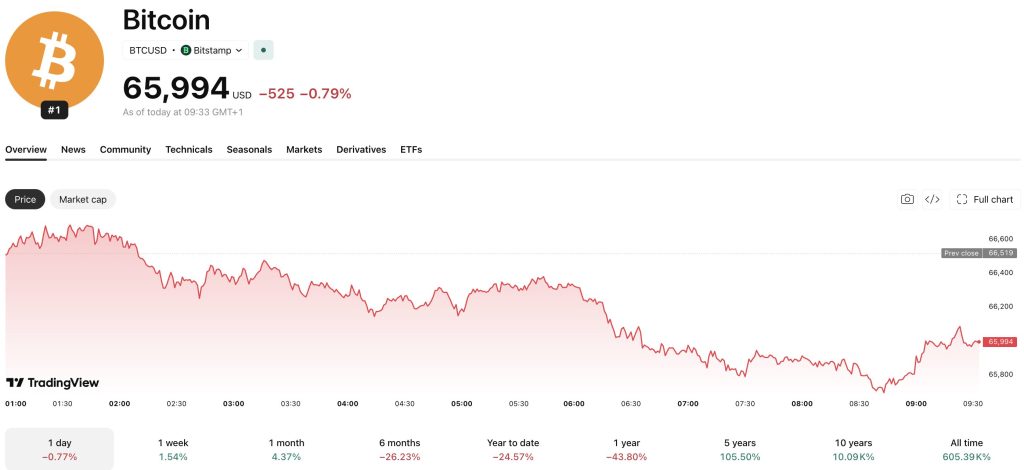
This latest Bitcoin Treasury firm news dropped as BTC climbed a modest +0.4% overnight, dropping under $66,000 since yesterday but still trading at $65,700, with a daily trading volume of $31.8Bn.
Bitcoin News Today: From £163M Raise to Fractional Recovery
Satsuma started life as TAO Alpha, a small AI firm, before rebranding and pivoting to a Bitcoin treasury accumulation strategy. In August 2025, it hired Mark Moss, an American Bitcoin commentator with over 700,000 YouTube subscribers, as Chief Bitcoin Strategist.
The firm then raised £163.6M through convertible notes led by ParaFi Capital, with Pantera Capital, Digital Currency Group, and Kraken participating. Some investors contributed 1,097 BTC directly in place of roughly $97M in cash.
The stock peaked around £14 per share in June 2025. Bitcoin reached its $126,000 all-time high in October before sliding into the current crypto winter, dragging Satsuma’s share price with it.
By December 2025, the company was already liquidating assets to stay solvent, selling 579 BTC for £40M to repay noteholders who declined to convert their debt into equity.
The CFO departed in February 2026; the CEO followed in March. By April, shares had lost more than 99% of their June 2025 peak value, trading at fractions of a penny. At that point, Pantera Capital, holding approximately 6.7% of Satsuma’s stock, began publicly calling for a full liquidation, with a straightforward rationale.
The company’s market cap had fallen well below the value of the Bitcoin on its balance sheet, making the equity position strictly worse than owning the underlying coin. A shareholder group representing more than 20% of issued capital formally put the resolution to a vote.
The board split hard. Four of the six directors opposed liquidation, arguing that Satsuma remained a viable, publicly listed corporate vehicle for Bitcoin. Two sided with shareholders. The 90%-plus vote to wind down left the board majority’s position moot.
Discover: The Best Crypto to Diversify Your Portfolio
The DAT Model Under Scrutiny
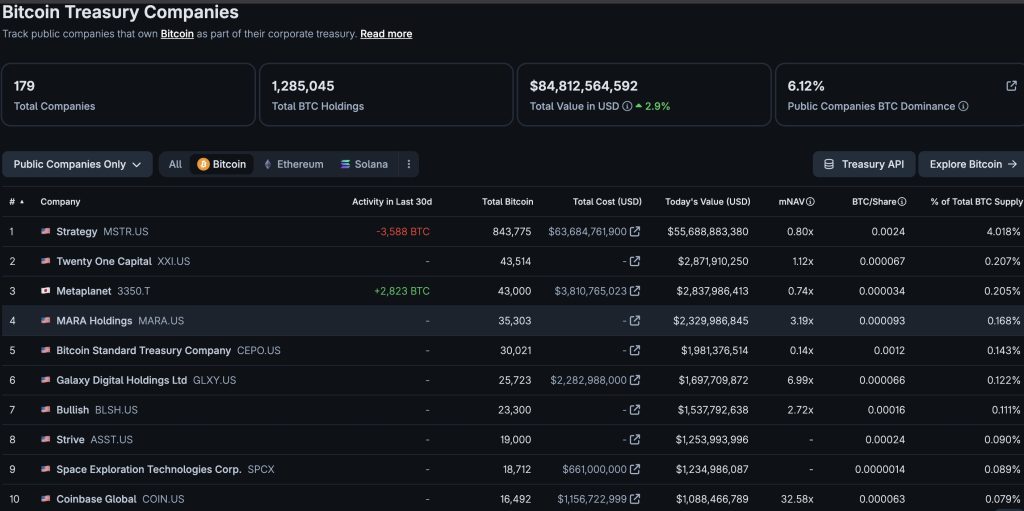
Satsuma’s collapse is the most visible failure yet of the DAT, a digital asset treasury structure that proliferated across UK small-caps in 2025.
These companies, modeled loosely on MicroStrategy’s approach, give equity investors indirect exposure to Bitcoin while bolting on a thin operating business to satisfy UK listing rules on alternative investment fund classification.
The structure works when Bitcoin price momentum and equity premiums reinforce each other; it unravels quickly when both reverse simultaneously, as the convertible note obligations create a sell-to-survive dynamic at exactly the wrong point in the cycle.
The broader regulatory environment for UK crypto companies adds another layer of structural pressure that pure-play listed treasuries are poorly positioned to absorb.
The wind-down proceeds through a “B Share Scheme,” a UK legal mechanism for distributing cash assets back to shareholders. Estimated termination costs run to £2.7M: legal fees, severance, delisting charges, and run-off insurance.
Combined with the £40M recovered from December’s BTC sale, the total capital returned is roughly £66–70M, against the £163.6M raised.
Critically, convertible noteholders rank above common equity in the payout waterfall, so ordinary shareholders may receive considerably less than even those aggregated figures suggest.
Satsuma was the second-largest UK-listed Bitcoin treasury company by holdings at the time of the vote. The Smarter Web Company, holding 2,878 BTC, currently sits at the top of that ranking and has not indicated any plans to wind down, though Satsuma’s outcome will sharpen investor focus on the NAV-to-market-cap gap across all remaining UK crypto treasury vehicles.
The contrast with Michael Saylor’s approach, maintaining Bitcoin conviction through drawdowns rather than liquidating under shareholder pressure, is a live debate in the corporate Bitcoin treasury space right now.
Trade Bitcoin on Bybit and Get a Chance to Win Our $1,000 USDT Airdrop
Bitcoin News: Court Approval and Satsuma Delisting Timeline
UK High Court hearings to approve the capital return scheme are scheduled for August and September 2026. The LSE delisting is expected in mid-September, with shareholder payments due by late September.
High Court hearings to approve the capital return are set for August and September 2026, before distributions begin. For traders still holding Satsuma shares, the key variable is whether the 668 BTC sale executes above or below current spot.
With the Bitcoin price trajectory remaining contested at current levels, even a modest move in either direction will shift the final distribution range away from the £26.8–30M estimate. Noteholders’ priority claim means ordinary equity holders are effectively last in line for whatever remains after costs are settled.
Discover: The Best Token Presales
The post Bitcoin News: BTC Treasury Strategy Casualty as Satsuma Technology Votes to Wind Down appeared first on Cryptonews.
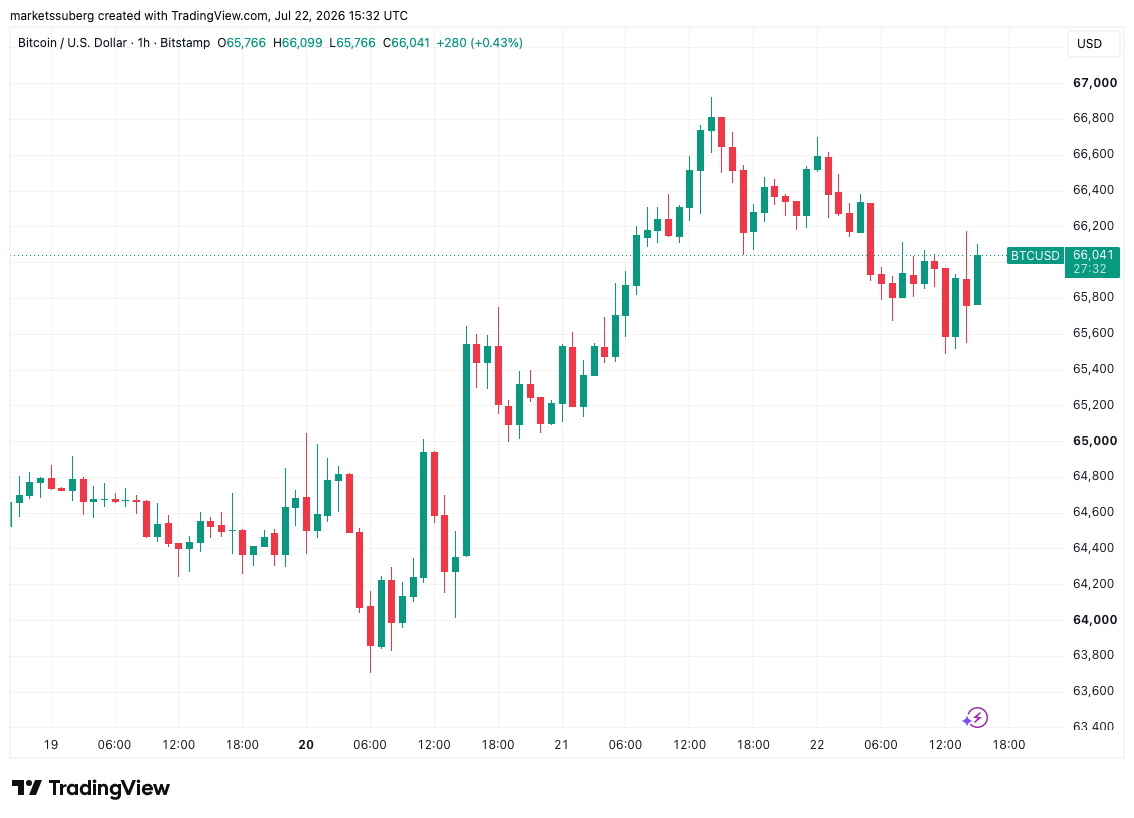
Bitcoin (BTC) held higher on Wednesday as crypto and risk assets continued to brush off US-Iran war tensions.
Key points:
- Bitcoin limits its comedown from five-week highs despite fresh escalation in the US-Iran war.
- US stocks also ignore the potential risks, as analysis warns that shorts could pay as a result.
- A Bitcoin trader sees BTC/USD outperforming the S&P 500 going forward.
Bitcoin, stocks digest Trump pledge to “destroy” Iran power plants
Data from TradingView showed BTC/USD down 1% on the day, having earlier hit five-week highs near $67,000.
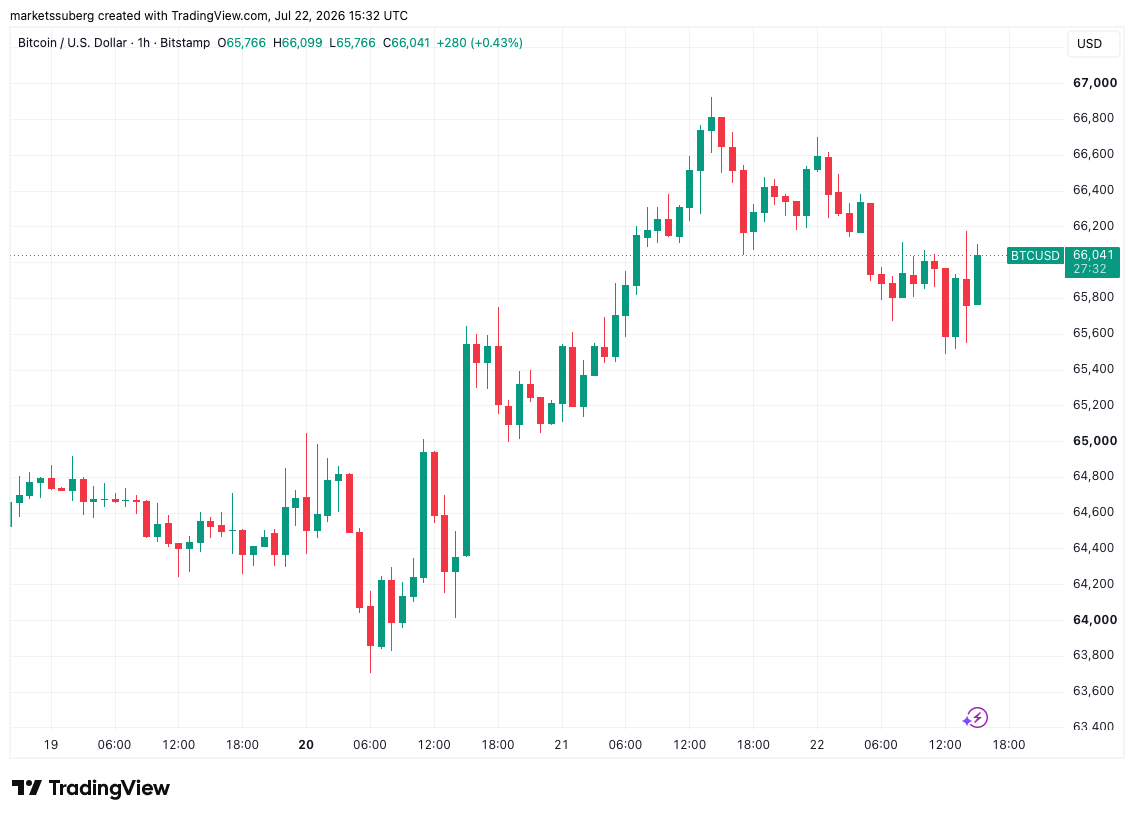
BTC/USD one-hour chart. Source: Cointelegraph/TradingView
Crypto and US stocks continued Tuesday’s direction, which saw them ignore escalation in the Middle East, including direct strikes by both Iran and the US.
US president Donald Trump threatened attacks on Iranian bridges and energy infrastructure, which had only a mild impact on market performance.
“From this point forward, any time the Islamic Republic of Iran shoots at a ship in the Strait of Hormuz, whether it be by Missile, Rocket, Drone, or any other device or weapon, the United States will bomb and destroy ONE BRIDGE OR POWER PLANT, including those located next to, or in, the Capital City of Tehran,” he wrote in a post on Truth Social.
Only oil prices saw volatility on the day, with WTI and Brent crude reaching $88.60 and $95.50, respectively, both at their highest since June 11.
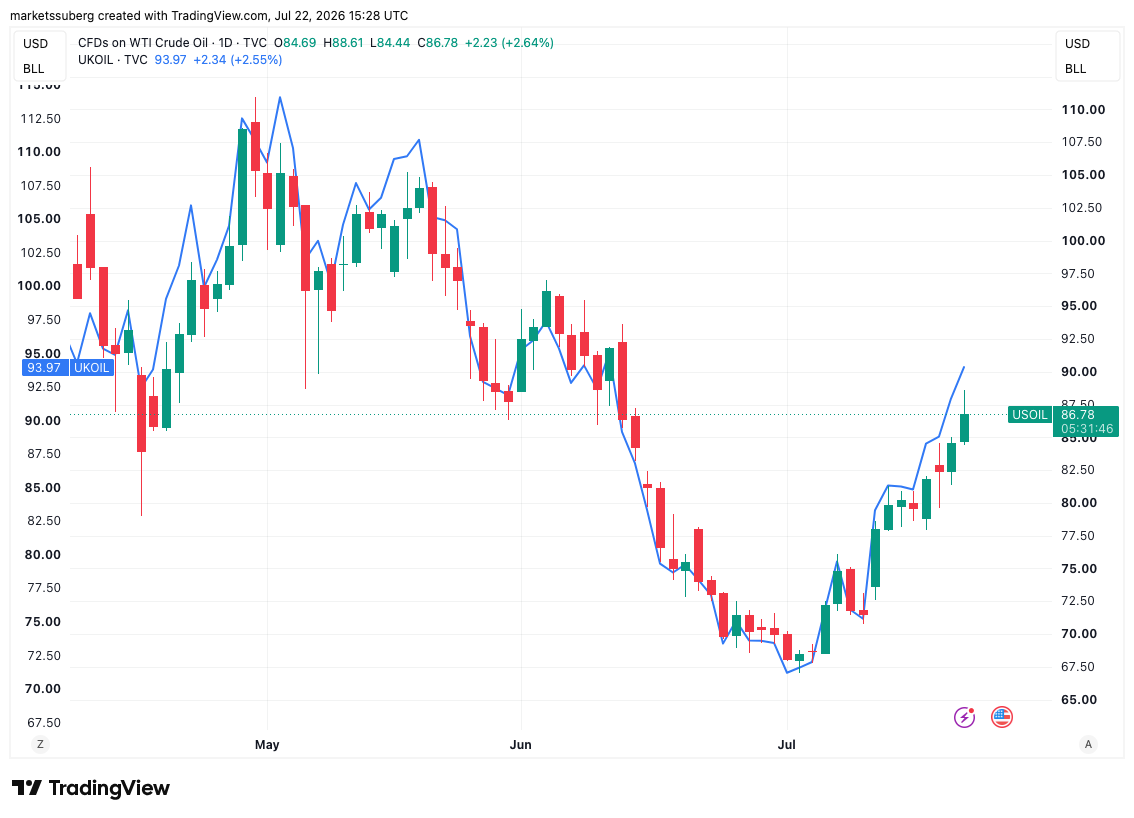
CFDs on WTI crude oil vs. CFDs on Brent crude oil one-day chart.
Source: Cointelegraph/TradingView
Stocks’ bullish momentum prompted trading resource The Kobeissi Letter to suggest that those betting on a market reversal could see more pain.
“Short interest in the S&P 500 is up to ~3.7% of its free float, near the highest in data going back to 2010. Short interest in the Russell 3000 is up to ~6.1%, also near an all-time high,” it reported on Tuesday alongside data from Bloomberg.
“Both metrics have steadily increased since the start of 2025.”
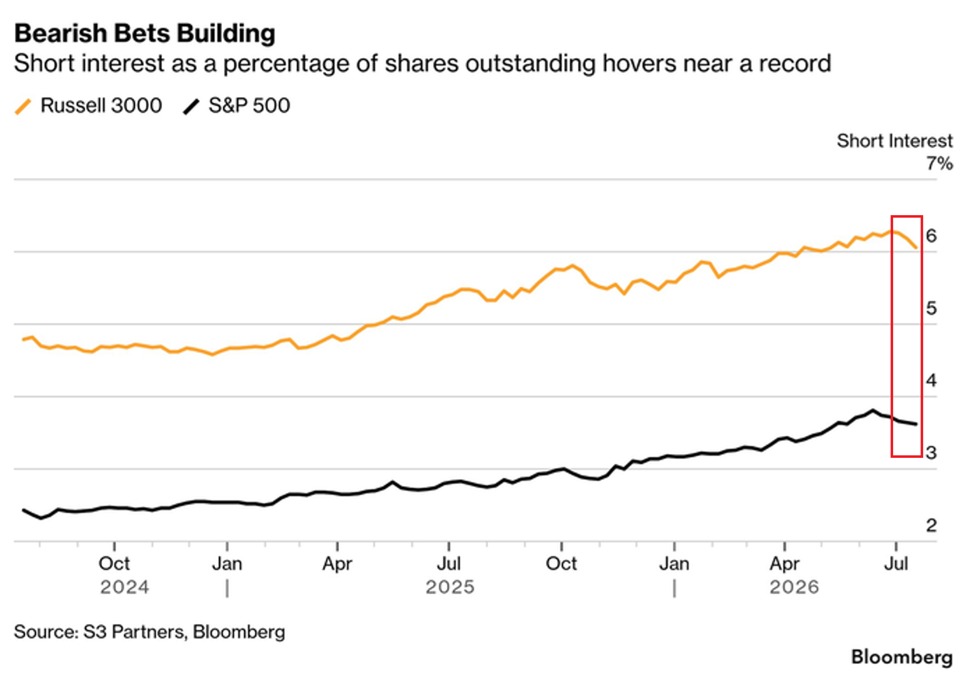
S&P 500 index short-interest data. Source: The Kobeissi Letter on X.com
Kobeissi suggested that a “short squeeze” could result, punishing late short positions.
Trader sees BTC price outperforming stocks
As for Bitcoin, traders continued to wait for a more decisive move, with $67,000 a particular focus. At time of publication, it was at roughly $65,975, with 24-hour trading volume topping $30.3 billion, according to CoinMarketCap data.
Related: Bitcoin analysis eyes ‘serious volume’ after Binance sees 9K BTC daily outflow
“Breaking above that point would make for a daily bullish market structure break putting in a higher high,” trader Daan Crypto Trades told X followers earlier Wednesday.
“This is the first daily higher high since the push up in May.”
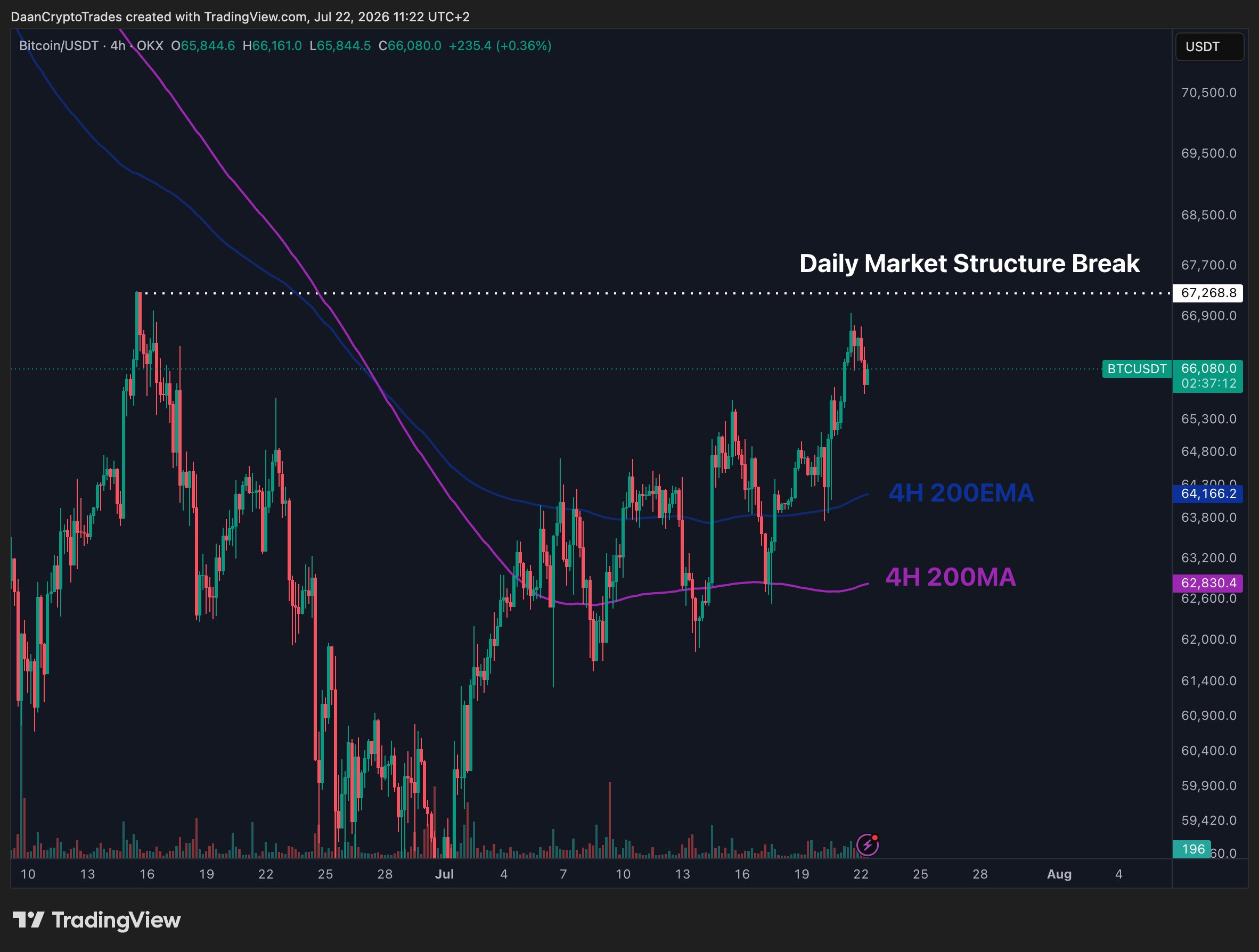
BTC/USDT four-hour chart. Source: Daan Crypto Trades on X.com
To be sure, some traderseyed pronounced BTC price strength against the S&P 500.
“$BTC vs. US stocks is seeing a strong weekly bullish divergence and is at the brink of an RSI trend breakout,” an X post by Osemka read, referring to the relative strength index (RSI) leading indicator.
“Divergent lows are 5 months apart, similar to literal 2022 lows. $BTC should outperform the US stock market nicely for the foreseeable future from the most mis-priced territory in history, as the lows should already be in.”
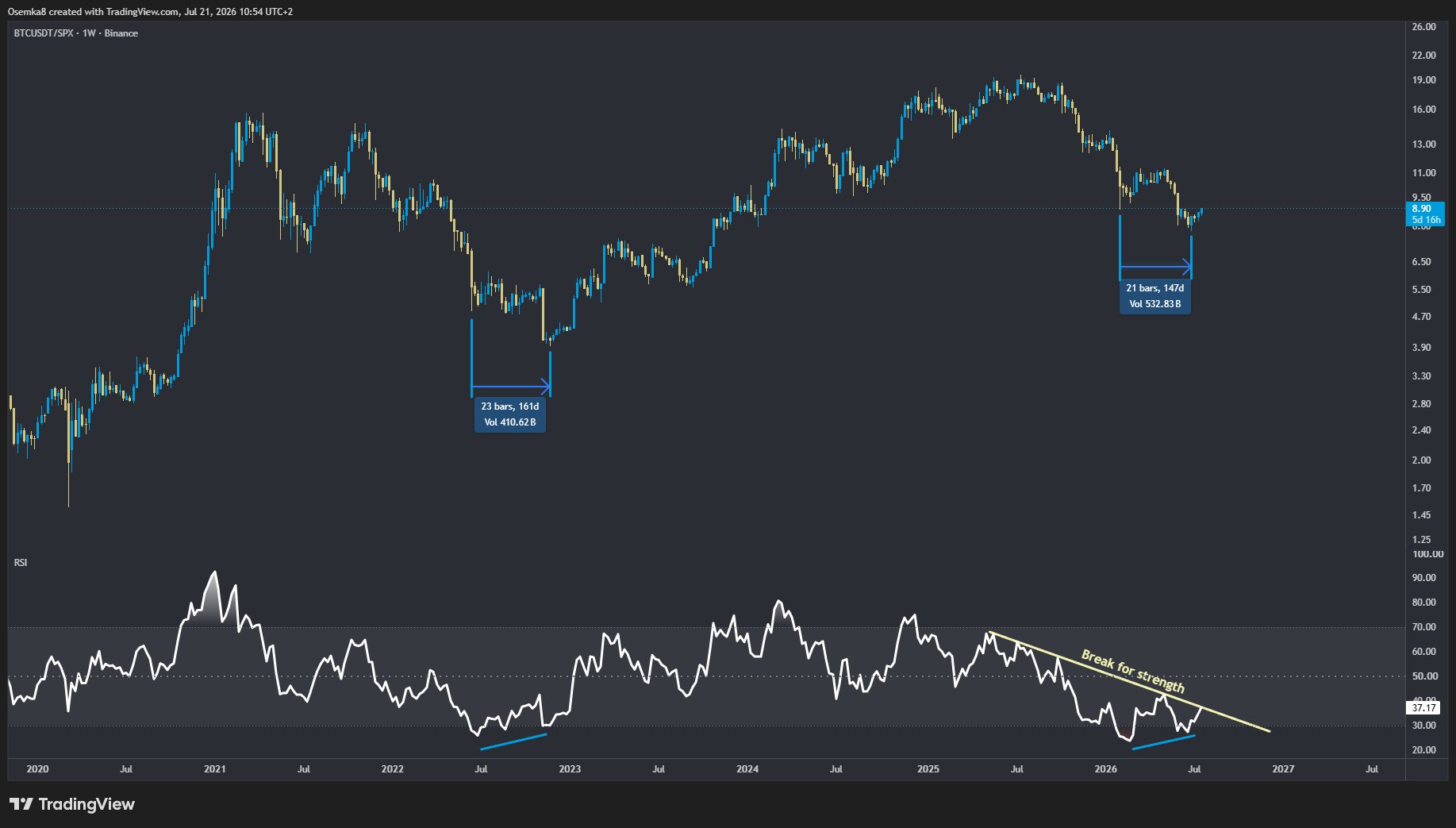
BTC/USD vs. S&P 500 one-week chart. Source: Osemka on X.com
As Cointelegraph reported, broad consensus continues to favor Bitcoin’s next bear-market low coming later this year or in early 2027.
Crypto World
Reddit May Block Google AI Access as $60 Million Deal Nears Expiry: Will RDDT Stock Crash?
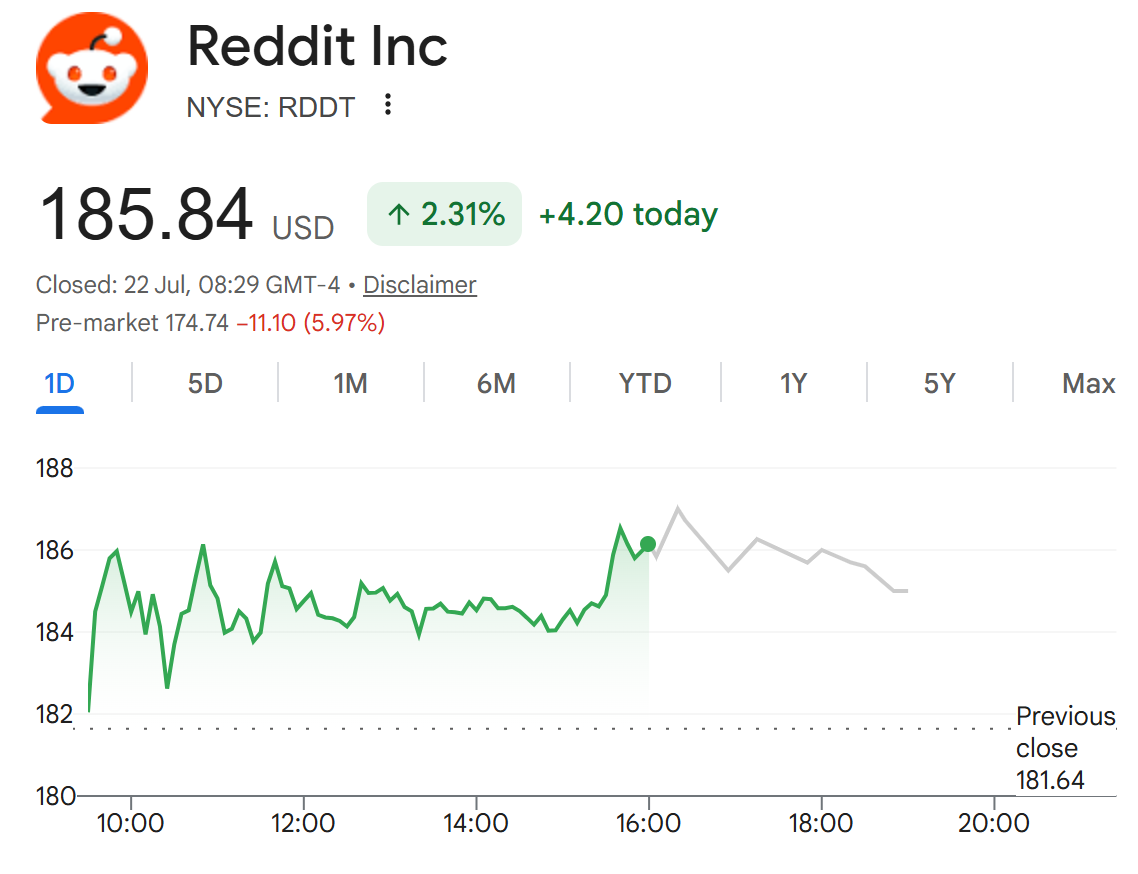
Reddit may block Google’s AI from using its content. Their licensing deal, reportedly worth $60 million per year, is about to expire. Reddit (RDDT) shares fell as much as 5.8% in premarket trading Wednesday.
The 2024 deal lets Google use Reddit’s posts to train and power its AI models. Talks over a renewal are ongoing. Neither company has made a final call.

Why Publishers Are Rethinking Google AI Deals
Reddit is not alone. The Journal also named USA Today, Politico, the Economist, People Inc., and Reuters. All are rethinking their ties with Google.
The anger comes down to one thing. Google’s AI Overviews answer questions right on the search page. Readers get the answer. Publishers lose the click.
Pew Research Center data shows how big the hit is. Users clicked a regular result just 8% of the time when an AI summary appeared. Without one, the rate was 15%. Only 1% clicked a source inside the summary itself.
Semrush data cited in the Journal’s reporting points the same way. USA Today’s Google traffic fell nearly 50% in a year. Politico’s dropped 23%.
Regulators are stepping in too. On June 3, Britain’s antitrust watchdog, the Competition and Markets Authority (CMA), gave publishers a new right. They can now opt out of Google’s AI features without vanishing from search.
“It is crucial that content publishers, including news organizations, have appropriate bargaining power over how their content is used,” CMA Chief Executive Sarah Cardell said in the announcement.
Similar complaints about Google stealing publisher traffic now reach crypto media, where AI answers are already siphoning publisher visits.
Will RDDT Stock Crash?
A crash looks far from certain. Reddit’s threat may be a bargaining chip, not an exit. Its human conversations are among the most cited sources in AI answers. It also licenses data to OpenAI. That gives it rare pricing power.
Executives reportedly want usage-based fees that grow as Reddit becomes more central to AI results. A new Reddit Google AI deal could reset prices across the market. AI training data lawsuits are already testing what unlicensed content costs.
Timing adds pressure. Alphabet reports Q2 earnings after Wednesday’s close. Options traders are already pricing outsized earnings moves across big tech. Any comment on content costs could move both stocks, as noted in BeInCrypto’s Alphabet Q2 earnings preview.
For now, this looks like hardball, not a breakup. The renewal terms, and Alphabet’s comments tonight, should soon show what Reddit’s data is really worth.
The post Reddit May Block Google AI Access as $60 Million Deal Nears Expiry: Will RDDT Stock Crash? appeared first on BeInCrypto.

New EPA Proposal Could Roll Back Some DEF-System Requirements For Diesel Engines

House price growth outpacing wages despite market slowdown | Finance Report | ABC NEWS

Dead Body Found In Clothing Donation Box


-
 NewsBeat6 days ago
London Mayor Sadiq Khan handed a peerage by Keir Starmer alongside 15 other Labour figures… just days before the PM leaves No10
-

 Fashion5 days ago
Weekend Open Thread – Corporette.com
-

 Politics4 days ago
The House | The City of London can help the new chancellor deliver growth in every postcode
-
 Crypto World5 days ago
Two July Windows Left: The CLARITY Act’s Senate Fight and What Failure Means
-

 Crypto World7 days ago
CFTC blocks Kalshi from unwinding Michigan trades after court order
-

 Crypto World4 days ago
Ripple Payments Joins MiCA With 14 Firms, Does It Mean Anything For XRP?
-

 Business7 days ago
Nvidia Stock Slips After Big Tuesday Rally as Huang Confirms Vera Rubin Chip Is Now in Production Today
-

 Politics3 days ago
Democrats look to World Cup watch parties to register thousands of voters
-

 Crypto World5 days ago
Ripple wins EU-wide access as ESMA adds it to MiCA register
-

 Crypto World1 day ago
Grayscale Files For Worldcoin ETF, WLD Registers Sharp Rise
-

 Crypto World6 days ago
Injective Submits SEC Transfer-Agent Registration to Onchain Ownership Records
-

 NewsBeat2 days ago
Unregistered fitter used Gas Safe logo on business flyers
-

 Business7 days ago
Palantir Shares Rise After Expanded Nvidia Partnership and Fresh Analyst Upgrades Ahead of Earnings Day
-

 Tech2 days ago
Sail Virtually Aboard The “Itanic” With IA-64 Emulator
-
 Tech2 days ago
Turtle Beach Command Series KB7 review: a nifty screen-equipped gaming keyboard
-

 NewsBeat5 days ago
Registration is now open for March for Men with Kev 2026
-
 Sports7 days ago
New Cornerback Enters Vikings Trade Rumor Mill
-
 Business13 hours ago
New Jersey voter registration controversy explained: How 6,600 noncitizens got on the rolls, and what happens next
-

 News Videos5 days ago
Money | Class 12 Economics | CBSE Board Exam 2026-27
-
 Crypto World6 days ago
Claude Fable 5 Slips to Second in AI Coding Leaderboard
You must be logged in to post a comment Login