

Crypto World
Interpol Ties $122.5M Crypto Wallet to Romance Scam Ring



A 20-year-old's cryptocurrency wallet processed more than $122.5 million in suspected romance-scam proceeds over 10 months, Interpol said, after Thai police made two arrests tied to a cross-chain laundering scheme uncovered during a global crackdown. The case surfaced from Operation First Light… Read the full story at The Defiant



Cardano wallet SecondFi is winding down after attackers exploited a flaw in its transaction signing software to steal 16.1 million ADA, worth roughly $2.4 million, from 374 wallets.
The service, which replaced EMURGO’s Yoroi wallet, said it will not resume normal operations despite patching the vulnerability.and at the time securing 129 million ADA before attackers could reach the funds.
The flaw allowed attackers to derive private key material from transaction data visible on the Cardano blockchain, SecondFi said. The Cardano network itself was not compromised, and hardware wallet users were not affected.
Groom Lake, the blockchain intelligence firm hired by EMURGO, found that the main attacker was sophisticated and well-funded. Some indicators point to North Korea’s Lazarus Group, though no attribution has been confirmed, the firm said.
A separate attacker targeted another set of wallets during the same period.
SecondFi expects to release wallet export tools in early August and a zero-knowledge recovery portal later that month. EMURGO has funded an asset recovery wallet, but no firm distribution date has been given.


The attacker behind the $6 million Summer.fi exploit has begun laundering the stolen funds, moving roughly $1.35 million in DAI through Tornado Cash, the sanctioned crypto mixer, according to Summer.fi's own post-mortem of the July 6 attack. Summer.fi, the front-end for the Lazy Summer Protocol,… Read the full story at The Defiant


Midnight’s NIGHT token staged a sharp recovery after crashing to an all-time low following a bridge exploit earlier this week, with Charles Hoskinson using the incident to make a broader case for rethinking crypto security from the ground up.
NIGHT fell roughly 43% after 290 million tokens were stolen and dumped through a legacy Wanchain bridge on the Binance-Cardano corridor. The token has since bounced nearly 19% in 24 hours, trading around $0.022. Hoskinson pushed back at coverage that focused only on the crash. “Magically, they forget to mention the rebound,” he posted on X.
Hoskinson described the hack as a “case of the Mondays” in an interview with CoinDesk but did acknowledge its seriousness in the broader context.
“All software is under this enormous assault,” he said, pointing to a surge in Linux kernel vulnerabilities he attributed to AI-powered exploit discovery. He was direct about the limits of even well-built systems: “That’s like being 90% resistant to a deadly disease. If you’re exposed to it enough, eventually you still catch the disease.”

Matt Damon plays a king on screen. Off-screen, he holds a $33.8 million real estate portfolio. “The Odyssey” star built it with three homes in Brooklyn, Bedford, and West Hollywood.
Christopher Nolan’s film earned $264 million in its opening weekend, his biggest debut ever. Then Elon Musk vowed to make a rival AI version. All eyes are back on its star.

Inside Matt Damon’s Investment Portfolio
Start in Brooklyn. Damon paid $16.7 million in 2018 for a penthouse at The Standish in Brooklyn Heights. No home in the borough had ever sold for a higher price. The six-bedroom triplex spans 6,200 square feet atop a converted 1903 hotel.
Next came the countryside. In June 2022, he bought a 13-acre estate in Bedford, New York, for $8.5 million. The deal ran through an LLC that shares an address with Pearl Street Films, the studio he owns with Ben Affleck. The home comes with a saltwater pool, tennis court, and antique barn.
The last piece is small on purpose. Damon sold his 13,500-square-foot Los Angeles mansion for roughly $18 million in 2021. Three years later, he bought a 2,900-square-foot condo at 8899 Beverly in West Hollywood for $8.6 million. That cut his Los Angeles footprint by nearly 80%.
All this wealth still sits off-chain, even as real-world asset tokenization moves into housing.

Odyssey Buzz Meets Musk’s AI Challenge
So where are the stocks, the gold, the coins? Nowhere public. Damon has never disclosed holdings in any of them, and actors file no ownership records. Property deeds are his only visible paper trail.
His crypto ties are about charity, not bags. He fronted Crypto.com’s “Fortune Favors the Brave” ad in 2021, weeks before Bitcoin peaked that cycle.
He later told the Associated Press he gave his entire fee to Water.org, his clean water charity. Crypto.com then donated $1 million on top.
In June, his Ripple Swell 2026 appearance promoted a water aid campaign with Water.org, funded through Ripple’s RLUSD stablecoin.
Now Musk has entered the story. On Wednesday, he said Grok Imagine, xAI’s video tool, will make a full-length AI Odyssey before 2026 ends. He calls it a historically accurate answer to Nolan’s reported $250 million film, whose casting he has attacked.
Damon’s playbook is simple. Fewer homes, each with a clear job. Musk’s AI feud keeps the film in the news, and its star’s money right beside it.
The post Odyssey Actor Matt Damon’s Investment Portfolio Revealed appeared first on BeInCrypto.


That shift is already beginning. Robinhood launched AI-powered investing tools in May that let agents trade stocks and make purchases for users. CEO Vlad Tenev has said AI agents will eventually rival the capabilities of human traders, while OpenAI and Anthropic are racing to build increasingly autonomous systems that can navigate software and complete complex tasks on their own.
For Kaul, those agents introduce a problem that today’s payment systems weren’t built to solve.
Many transactions between AI agents could be worth only fractions of a cent, such as paying for an API call, a second of computing power or access to a dataset. Traditional payment networks become expensive when fees cost more than the transaction itself.
That’s where Kaul believes blockchains come in.
She argued public blockchain networks are better suited to machine-to-machine payments because they offer programmable transactions, cryptographic identity and near-instant settlement. Instead of relying on banks or card networks, AI agents could hold digital assets and pay one another directly over blockchain rails.
If that happens at scale, demand for blockchain networks could grow alongside AI adoption.
Since agents would need native cryptocurrencies to pay network fees, Kaul argued rising transaction volumes could increase demand for those tokens while generating more revenue for developer incentives, network security and decentralized applications.
Federal prosecutors filed five civil forfeiture complaints seeking more than $25 million in cryptocurrency that investigators say came from international romance and investment scams targeting people in the U.S. and Canada.
The complaints, filed in U.S. District Court for the District of Columbia, stem from separate Secret Service investigations.
Agents traced funds through hundreds of wallet addresses and frozen crypto linked to more than 270 suspected investment scam transactions, more than 200 romance scam victims and several victims in the Washington area, according to the U.S. Attorney’s Office.
The two largest cases seek about $12.1 million tied to online romance schemes and $10.4 million linked to fraudulent investment platforms. Another three complaints seek roughly $1.23 million, $2.39 million and $285,000.
In one case, scammers cut off contact after a victim tried to withdraw money from what appeared to be a crypto investment account. In another, fraudsters contacted someone who had already lost money and claimed they could recover it for a fee in what’s known as a recovery scam.
The cases are part of the Scam Center Strike Force, which launched in November 2025. The U.S. Attorney’s Office said the task force has recovered more than $800 million.
Crypto World
4 Important Binance Announcements Concerning Tron (TRX), Zcash (ZEC), and Other Alts: Details
The world’s largest cryptocurrency exchange will temporarily suspend certain services later this month.
Additionally, it will delist numerous trading pairs “to protect users and maintain a high-quality trading market.”
The Upcoming Disruptions
Binance will perform a wallet maintenance for the Tron Network on July 23, and to support the process, it will briefly pause TRX deposits and withdrawals. The operation is expected to take about one hour, following which everything should resume normally. In addition, the exchange will support an upcoming Zcash hard fork and, as a result, temporarily suspend ZEC deposits and withdrawals.
“The network upgrade and hard fork will take place at block height 3,428,143, or approximately 2026-07-28 13:00 (UTC),” the disclosure reads.
In both cases, token trading will not be impacted, while Binance promised to handle all technical requirements involving users.
Such efforts are quite common and usually cause no serious implications for clients. Less than a month ago, Binance briefly halted deposits and withdrawals on the Bitcoin (BTC) network to perform similar wallet maintenance.
Prior to that, it took similar actions to support improvements across various ecosystems, including Ethereum (ETH), Cardano (ADA), and more. There haven’t been reports or complaints of major issues, and everything was restored promptly.
The Other Updates
Binance is known for closely monitoring all services and digital assets listed on its platform to ensure they meet industry standards, such as team commitment, development activity, trading volume, liquidity, network stability, and more. Based on its latest review, it decided to remove the spot trading pairs: ACX/USDC, ALGO/BTC, CVC/USDC, LPT/USDC, ONG/BTC, RVN/USDC, and XRP/BNB. The actual delisting is scheduled for July 24.
Meanwhile, the same action will apply to several pairs from the Margin section on July 24. Those include the cross margin pairs CYBER/USDC, DOLO/USDC, PIXEL/USDC, and STEEM/USDC, as well as the isolated margin pairs DOLO/USDC, PIXEL/USDC, and STEEM/USDC.
The announcements have not triggered a negative price impact for the involved cryptocurrencies. However, it is a completely different story when Binance terminates all services with a certain digital asset. Last month, it delisted Alchemix (ALCX), Ardor (ARDR), NFPrompt Token (NFP), and Marlin (POND), causing double-digit collapses for the affected ones. A very similar thing was observed at the start of June when it said goodbye to Contentos (COS), Dar Open Network (D), Highstreet (HIGH), and MOBOX (MBOX).
The post 4 Important Binance Announcements Concerning Tron (TRX), Zcash (ZEC), and Other Alts: Details appeared first on CryptoPotato.
The digital euro is one of Europe’s most contentious financial projects.
Supporters see it as a way to preserve the bloc’s monetary sovereignty, reduce its reliance on foreign payment providers, and ensure central bank money survives in an online economy dominated by USD stablecoins.
Critics, however, argue the digital euro could be a way for a supranational organization to surveil — and in certain circumstances, even control — the population of Europe.
The official view is that: “The digital euro will reduce Europe’s excessive dependence on non-European providers. It will ensure that Europeans can pay with their money — the sovereign money issued by their central bank — in the digital economy,” said Piero Cipollone, member of the executive board of the European Central Bank (ECB).
The alternative perspective is that the Central Bank Digital Currency (CBDC) may curtail the freedom of citizens to spend money how they wish.
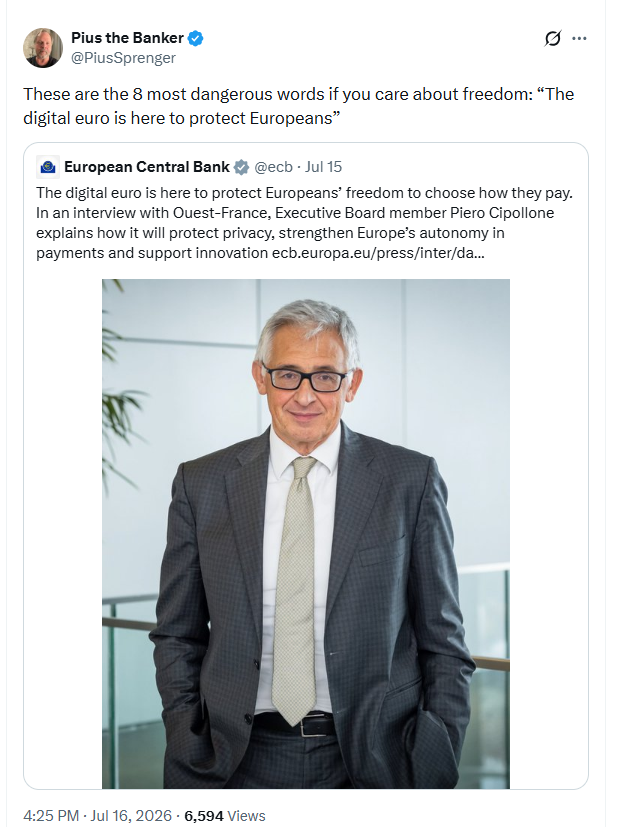
“These are the 8 most dangerous words if you care about freedom: “The digital euro is here to protect Europeans,” said former Deutsche Bank managing director Pius Sprenger.
“This is how they will be able to control EVERY euro you spend. Goodbye money. The ECB will decide how much digital money you can have,” said José Vizner, a Spanish financial commentator.
So who’s right? The suited Brussels bureaucrats who seem to get a kick out of reading your private messages or the tinfoil hat adjacent cypherpunks who want to separate money and state?
What is the digital euro?
The digital euro is a proposed digital form of the euro that would be issued by the ECB, making it a digital form of central bank money, or CBDC.
The term “CBDC” tends to raise the hairs on the back of the necks of privacy-loving crypto folk, invoking 1984-style vibes of government overreach and surveillance.
President Donald Trump signed an executive order to ban CBDCs from the US in January, citing threats to the financial system, individual privacy and the country’s sovereignty. A ban until 2030 was formalized more recently in housing bill legislation. Despite this, the ECB says they’ll do just fine for Europe.
Related: US CBDC ban to go into effect without Trump signoff on housing bill
It argues the digital euro would give people living in the euro zone another way to make everyday transactions with central bank money as payments move increasingly online; and that it will complement, rather than replace, physical banknotes and coins.
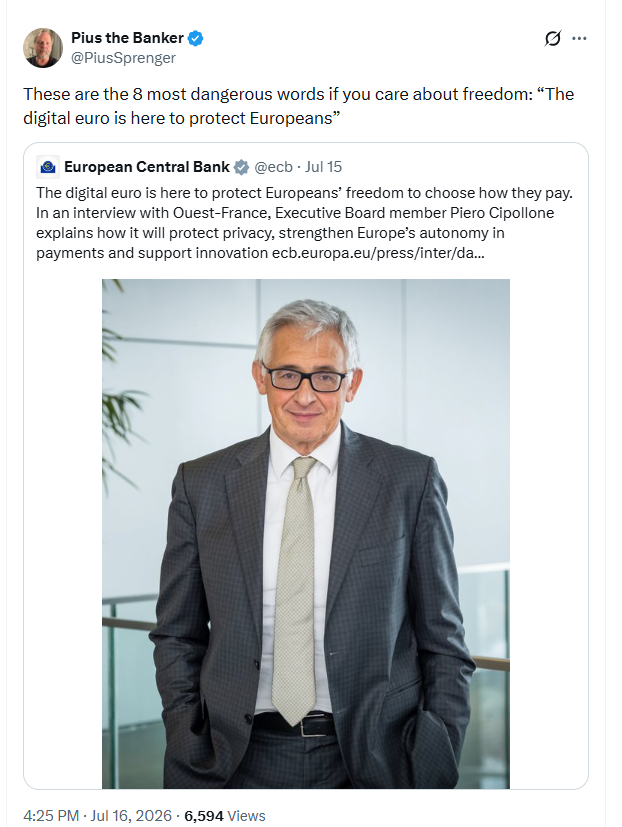
Not everyone is sold on the benefits of the digital euro. Source: Pius the Banker
“The main reason for issuing a digital euro is to preserve the benefits of cash in the digital era,” Cipellone said in an interview on July 14.
That’s nice, except that one of the major benefits of banknotes that is they can be tracked, traced and frozen at will, as Vizner pointed out. “They promise privacy… but it’s money that’s trackable by design.”
Why does Europe want one?
The ECB obviously isn’t talking up the benefits of spying on everyday payments. Instead, officials argue that as cash use declines, Europe risks becoming more reliant on private or overseas-operated payment systems like Visa or Mastercard.
Some policymakers have expressed concern that the continent lacks control over its critical payment infrastructure, with ECB President Christine Lagarde saying in 2025:
“The entire infrastructure mechanism that allows for payment, credit and debit, is not a European solution… We need to make sure there is a European offer, just in case.”
Consumer groups such as the European Consumer Organization (BEUC) have also highlighted potential benefits for users.
Deputy head of communications, Andrew Canning, told Cointelegraph that the digital euro could provide consumers with a “secure and inclusive” payment option that complements existing solutions, particularly for people who face barriers accessing digital payments.
Related: South Korea eyes September launch for second phase of CBDC pilot: Report
Yet critics argue that the digital euro would give governments and central banks control over how citizens can spend money.
These fears are not theoretical, even in Western democracies. During Canada’s 2022 Freedom Convoy protests, authorities ordered banks, crowdfunding platforms and other financial institutions to freeze accounts linked to the blockades.
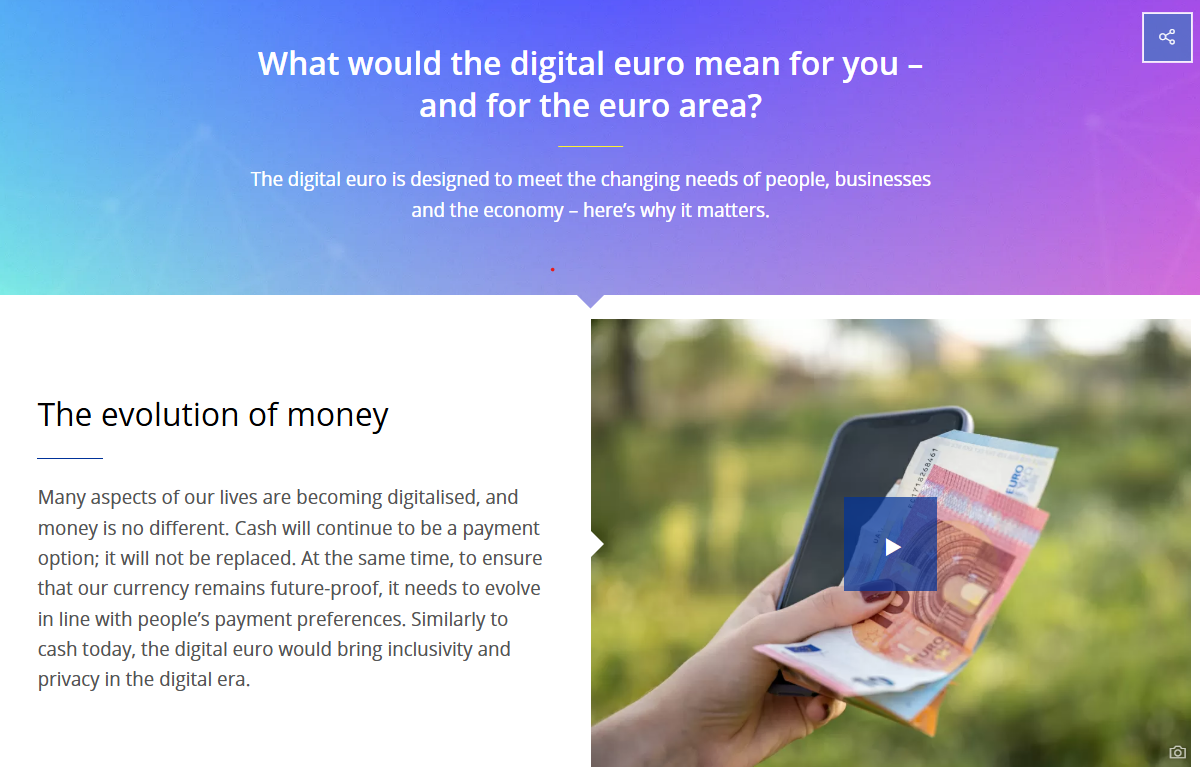
Why do we need a digital euro? Source: ECB
Efrat Fenigson, a tech entrepreneur and privacy advocate, said that the digital euro could become “the infrastructure for programmable money, programmable identity and programmable behavior,” warning that “freedom doesn’t disappear overnight. It disappears one permission at a time.”
Patrick Schueffel, a professor of banking and finance at the Fribourg School of Management, also warned that CBDCs could significantly expand governments’ ability to monitor financial activity.
Are there safeguards?
The EU’s own privacy watchdogs have said the project needs strong safeguards, with both the Data Protection Supervisor (EDPS) and the European Data Protection Board (EDPB) saying a high level of privacy and data protection is essential for the digital euro to gain public trust.
The ECB’s digital euro privacy materials assure skeptics that offline payments will exist to enable ‘cash-like’ privacy and insist that the bank will not see personal transaction data.
Canning told Cointelegraph that the BEUC is “currently happy” with the proposal and that “we trust that consumer safeguards are protected in the final negotiations between EU lawmakers.”
However, the ECB’s arguments may not be enough to persuade the doubters.
How does the digital euro work?
Unlike privately issued stablecoins like Tether or USDC, which are denominated in US dollars, the digital euro would be denominated in euros and issued by the central bank. Consumers would still access it through their regular bank or payment provider.
Unlike physical cash, which people hold directly in their wallets, the digital euro would be accessed through electronic wallets and used to make payments in stores, online, or from wallet to wallet.
The underlying money would remain a liability of the ECB rather than a commercial bank, which supporters say would give it the same public backing as cash rather than being a claim on a commercial bank’s deposits.
Related: Bank of England governor denies Farage lobbying swayed CBDC policy: Report
Unusual bedfellows: Crypto and the banks
Crypto and privacy advocates have an unusual ally in the fight against the digital euro, as parts of the banking industry isn’t too keen on it either.
They worry a shift to central bank digital euros would reduce bank deposits, forcing them to rethink loans to businesses and consumers.
Lorenzo Bini Smaghi, an Italian economist and banker who served on the executive board of the ECB from 2005 to 2011, said, “There is a high risk of financial instability, with strong repercussions for the real economy.”
The ECB argues that the design choices have been taken to “minimize any potential risks” to the banking sector. Users would be limited to holding a small amount of digital euros in their wallets at any time to “prevent excessive outflows of bank deposits,” and “as with cash in your wallet, no interest would be paid on digital euro holdings.”
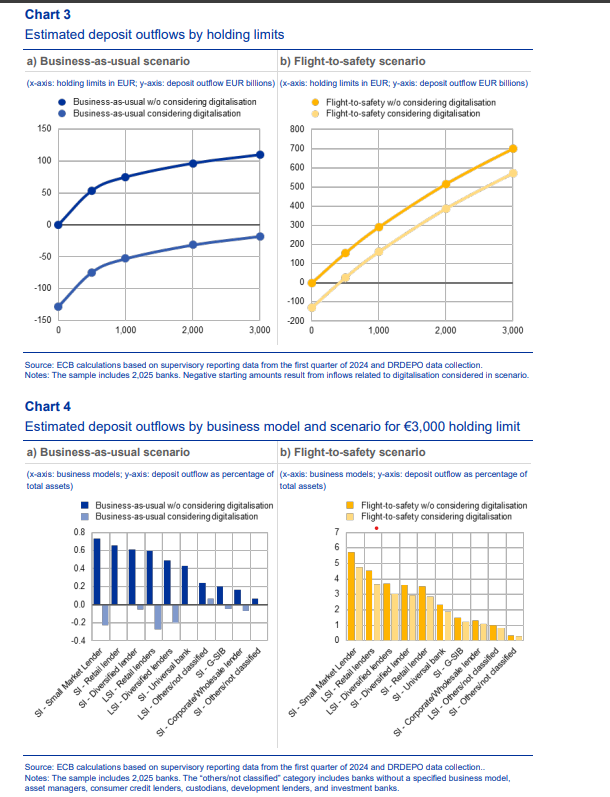
Estimated bank deposit outflows by holding limits. Source: ECB
How much will it cost?
The cost of implementing a digital euro has become a bone of contention among critics, as the ECB estimates that it will run to around 1.3 billion euros (approximately $1.5 billion) in investment, with ongoing operating costs of around €320 million ($370 million) annually.
Commercial banks and other payment providers face steep costs integrating the digital euro into their services. The ECB expects implementation costs for the banking sector of between $4.6 billion and $6.9 billion.
When is it coming?
After years of discussions, lawmakers across the European Parliament, EU member states and the European Commission have begun negotiations on the final legislation for the digital euro, and aim to reach an agreement within the next six months.
Cipollone said in an interview on July 13:
“We hope the text will be finalized by the end of the year, at which point we’ll be in a position to take a decision on the future issuance of the digital euro.”
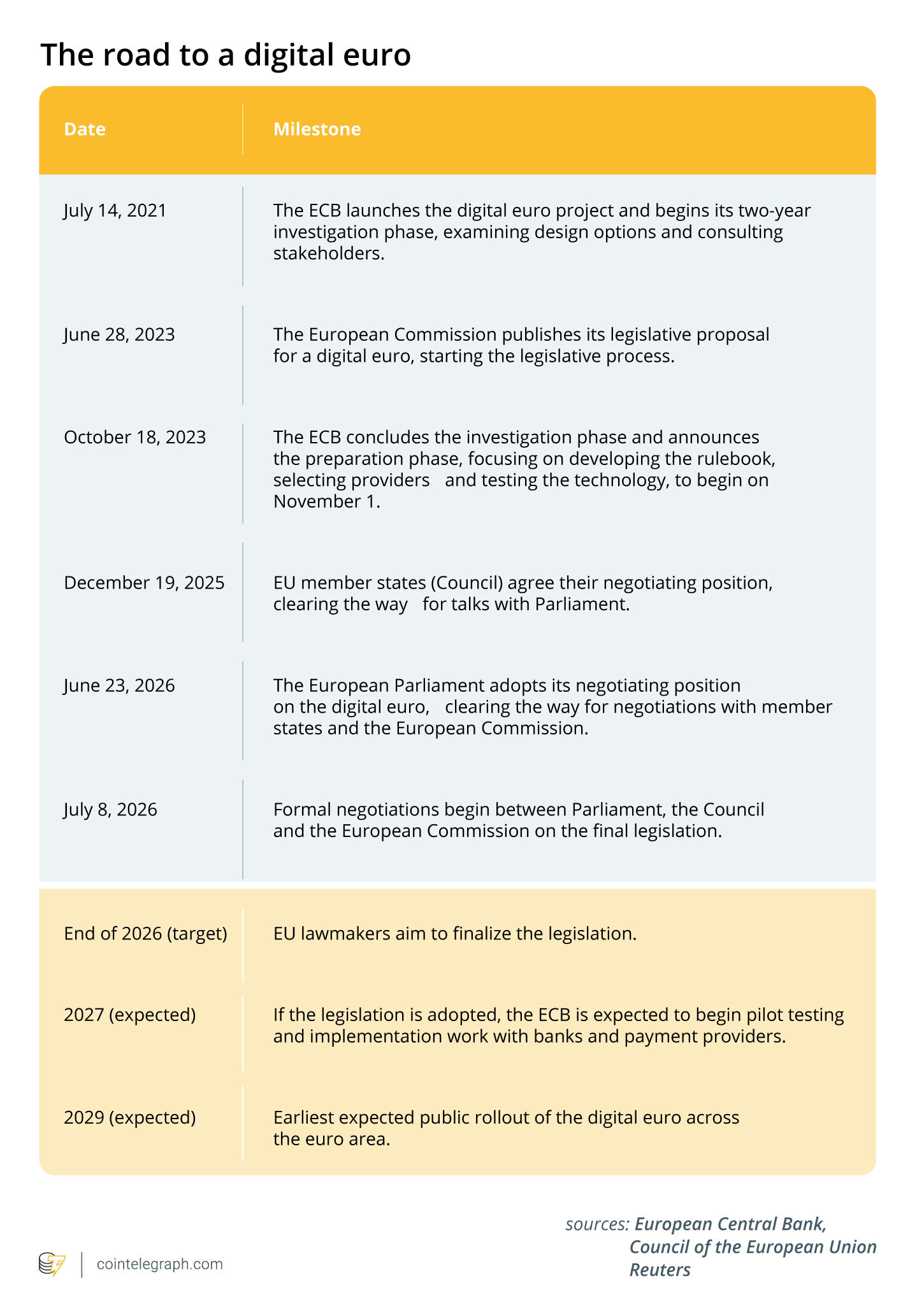
The road to a digital euro. Source: Cointelegraph
If that legislation goes through, the next move will be up to the ECB’s Governing Council, which will decide whether to launch the digital euro sometime in 2027. Europeans are unlikely to encounter it in their everyday lives before 2029, if it is approved at all.
Has this been tried before?
More than 100 countries started exploring CBDCs a few years ago, with most abandoning the idea or shifting to a wholesale model, rather than a retail currency. The few CBDCs in production have not been widely adopted.
China began piloting its digital yuan, or e-CNY, in 2019, later rolling it out across the country. Even though it has processed trillions of yuan in transactions, most Chinese consumers still prefer using familiar payment apps such as Alipay and WeChat Pay.
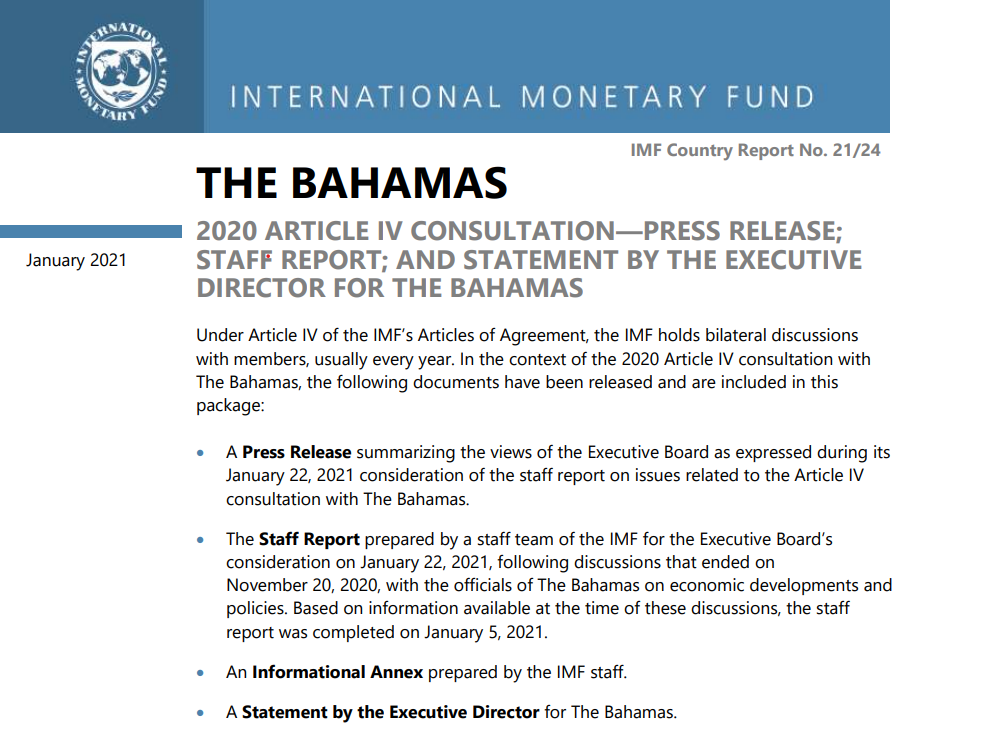
The Bahamas Sand Dollar project. Source: IMF
The Bahamas became the first country to roll out a nationwide retail CBDC when it launched the Sand Dollar in 2020. While the project was intended to improve financial inclusion, adoption was slower than many hoped, prompting authorities to push for wider distribution through commercial banks.
Elsewhere, Nigeria’s eNaira also struggled to gain traction after its 2021 launch despite strong government support, and Brazil’s central bank shut down its Drex CBDC platform in 2025, citing cost and privacy concerns.
As the Bank for International Settlements concluded in 2023, “a retail CBDC is a complex undertaking, and not only for the central banks.”
Magazine: The British Virgin Islands are a top crypto hub no one ever talks about. Here’s why
Cointelegraph publishes long-form journalism, analysis and narrative reporting produced by Cointelegraph’s in-house editorial team with subject-matter expertise. All articles are edited and reviewed by Cointelegraph editors in line with our editorial standards. Content published in here does not constitute financial, legal or investment advice. Readers should conduct their own research and consult qualified professionals where appropriate. Cointelegraph maintains full editorial independence.

Bitcoin buyers appear to be absorbing sell pressure more effectively around the $65,000 area, according to analysis tied to exchange flow data. The signal comes after Binance posted its largest single-day net outflow in nearly two years, with more BTC leaving the platform than entering.
Onchain analytics firm CryptoQuant highlighted that Binance withdrawals have recently been running ahead of deposits—an environment traders often watch for because it can indicate reduced immediate supply on the exchange order book. Still, analysts caution that exchange outflows alone do not confirm a fresh, sustainable uptrend.
Key takeaways
- CryptoQuant data shows Binance daily netflows have oscillated between inflows and outflows, with a notable outflow spike on Tuesday.
- More than 9,000 BTC net left Binance in a single day, the largest tally since November 2024, suggesting significant movement toward self-custody.
- Analysts frame the latest pattern as improved “absorption” near $65,000–$66,000 rather than immediate proof of a new rally.
- US spot Bitcoin ETF flows remain net positive, pointing to ongoing institutional demand even as spot market momentum appears uneven.
Binance’s outflow spike draws attention
A CryptoQuant research note released Wednesday focused on Binance’s spot exchange balances, showing that daily BTC withdrawals are outpacing inflows. The takeaway is that short-term pressure from supply moving onto Binance appears to be easing—at least on the days where net outflows dominate.
CryptoQuant contributor Rei Researcher wrote that this pattern typically reflects reduced urgency to send BTC to the exchange “for potential selling.” In other words, when a large exchange sees net withdrawals, it often suggests sellers are not adding to immediate market liquidity at that moment.
The broader context from CryptoQuant is that Binance netflows have been switching signs—turning positive and negative—after a stretch of positive days that ended in early June. One day, however, stands out: on Tuesday, Binance recorded a net outflow of more than 9,000 BTC, which CryptoQuant described as the largest single-day figure since November 2024.
Ruga Research, another CryptoQuant contributor, argued that outsized outflows generally point to participants moving “serious volume” into self-custody. In a separate post, he emphasized that coins leaving an exchange are less likely to be sold directly into the order book, at least in the near term.
“When outflows hit this size, someone is moving serious volume into self-custody. Coins off exchanges are coins that won’t be sold into the order book,” Ruga Research said in that post.
Ruga also noted that on rolling 30-day time frames, netflows continue to repeat a fluctuation pattern and that sharp spikes can still reverse. His warning reflects a key nuance investors often overlook: exchange flow metrics can shift quickly, and a single dramatic day does not automatically define the next trend.
“Can this one fail? Absolutely. Momentum has been indecisive around the zero line for two weeks. It hasn’t committed. And what happens next, honestly, nobody knows,” he wrote, referring to mixed netflow days.
Absorption improves, but the trend still needs confirmation
Rei Researcher stopped short of claiming the outflow data by itself signals a durable new bull phase. Instead, he pointed to a more subtle implication: the presence of negative netflow while BTC trades around $65,000–$66,000 suggests buyers are doing a better job absorbing whatever supply remains in the system compared with an earlier weak period.
In his assessment, the key distinction is between “absorption” and a confirmed uptrend. Negative netflow can reduce exchange liquidity, but price still depends on spot demand, traded volume, and the market’s ability to maintain a stable structure.
“However, negative netflow does not automatically confirm a new uptrend. It needs to be accompanied by spot demand, volume, and a more stable price structure,” Rei Researcher said.
This framing matters because BTC’s reaction has been relatively range-bound compared to the momentum traders typically look for when a sustained move begins. If exchange outflows are rising but price remains choppy, the market may be transitioning into a steadier equilibrium rather than launching immediately into a higher trajectory.
ETF inflows remain a supportive counterweight
While exchange flow data is one part of the picture, ETF activity is another. Earlier coverage from Cointelegraph noted that consensus expectations for a full bull-market rebound have been constrained by a perceived lack of consistent spot demand. In that context, derivatives-related improvement has been easier to observe than a corresponding surge in spot buying.
Cointelegraph previously reported that net inflows into US spot Bitcoin ETFs suggest a continuation of institutional interest. CryptoQuant’s flow-focused analysis aligns with that broader narrative: even if the spot market’s immediate impulse is inconsistent, larger investors and structured products can help sustain demand.
In the current setup described by CryptoQuant and referenced by Cointelegraph, the most relevant tension is this: Binance outflows may be reducing available supply on exchanges, but the market still needs clear evidence that spot buyers are expanding participation rather than simply absorbing intermittent supply.
What to watch next for traders and long-term holders
For readers tracking whether this move becomes meaningful, the immediate question is whether Binance netflows keep favoring withdrawals and whether spot market behavior follows through. CryptoQuant contributors themselves underscored that netflow momentum has been mixed and that outflow spikes can fail. The next confirmations to monitor are steadier spot demand and improved price structure around the $65,000–$66,000 band, alongside continued net positive ETF inflows that could support broader risk appetite.


Key takeaways
- Solana (SOL) trades around $78, gaining more than 2% this week.
- Spot Solana ETFs recorded $5.83 million in inflows, marking the second straight day of institutional buying.
- Derivatives data points to growing bullish sentiment, with the long-to-short ratio rising to 1.12.
Solana (SOL) remained steady around $77 on Wednesday, extending its weekly gains to more than 2% as institutional investors returned to the market.
Growing inflows into spot Solana exchange-traded funds (ETFs), combined with increasingly bullish derivatives positioning, are improving the outlook for the cryptocurrency despite technical resistance continuing to cap upside momentum.
Solana ETFs record strongest inflows in weeks
Institutional demand for Solana showed further improvement this week. According to SoSoValue, spot Solana ETFs attracted $5.83 million in net inflows on Tuesday, marking the second consecutive day of positive flows.
It was also the largest single-day inflow since July 6, suggesting institutional confidence may be recovering after a quieter period.
If ETF inflows continue throughout the week, they could provide additional buying pressure and support a broader price recovery for SOL.
The derivatives market is also showing signs of growing optimism. Data from CoinGlass reveals that Solana’s long-to-short ratio climbed to 1.12 on Wednesday, approaching its highest level in more than a month.
The increase indicates that leveraged traders are increasingly positioning for additional price gains.
The stronger long positioning reinforces the improving institutional sentiment reflected in recent ETF inflows, suggesting both retail and professional traders are becoming more constructive on SOL’s near-term outlook.
Solana price analysis: Can SOL break above $80?
From a technical standpoint, Solana continues to consolidate after recovering above its 50-day Exponential Moving Average (EMA).
SOL is currently trading near $78.05, holding above the 50-day EMA at $76.76 and the horizontal support level around $77.06.
These levels continue to provide a solid foundation for the current recovery. However, the cryptocurrency remains below the 100-day EMA at $80.39 and well beneath the 200-day EMA at $92.87, leaving the broader trend cautious until these resistance levels are reclaimed.
Momentum indicators present a mixed picture. The Relative Strength Index (RSI) sits around 54, indicating modest bullish momentum without reaching overbought territory.
Meanwhile, the Moving Average Convergence Divergence (MACD) remains slightly below the neutral line, suggesting buyers have gained some traction but have yet to establish a decisive uptrend.
The first resistance level lies at the 50% Fibonacci retracement around $79.27, followed closely by the 100-day EMA at $80.39.
A sustained daily close above this resistance zone would strengthen the bullish outlook and could open the door for a rally toward the 61.8% Fibonacci retracement at $83.78.
On the downside, immediate support remains at $77.06, reinforced by the 50-day EMA at $76.76. A break below this area could trigger a decline toward the 38.2% Fibonacci retracement at $74.75.

If bearish momentum intensifies, additional support levels are located at $69.16 and $60.13, although those areas are likely to come into focus only if sellers regain firm control of the broader trend.
For now, improving ETF inflows, rising bullish positioning in the derivatives market, and resilient price action above key support suggest Solana retains a cautiously optimistic outlook, provided buyers can push the token above the critical $80.39 resistance level.

Co Antrim man denies assisting offenders after death of Colin Crawley

SecondFi to shut down after $2.4 million ADA wallet theft

McGlynn demands more hunger and bravery from Falkirk


-
 NewsBeat6 days ago
London Mayor Sadiq Khan handed a peerage by Keir Starmer alongside 15 other Labour figures… just days before the PM leaves No10
-

 Fashion5 days ago
Weekend Open Thread – Corporette.com
-

 Politics4 days ago
The House | The City of London can help the new chancellor deliver growth in every postcode
-
 Crypto World5 days ago
Two July Windows Left: The CLARITY Act’s Senate Fight and What Failure Means
-

 Crypto World7 days ago
CFTC blocks Kalshi from unwinding Michigan trades after court order
-

 Crypto World4 days ago
Ripple Payments Joins MiCA With 14 Firms, Does It Mean Anything For XRP?
-

 Business6 days ago
Nvidia Stock Slips After Big Tuesday Rally as Huang Confirms Vera Rubin Chip Is Now in Production Today
-

 Politics3 days ago
Democrats look to World Cup watch parties to register thousands of voters
-
 Entertainment7 days ago
Disney’s Most Ambitious Failed Star Wars Attraction Is Coming to SDCC
-

 Crypto World5 days ago
Ripple wins EU-wide access as ESMA adds it to MiCA register
-

 Crypto World1 day ago
Grayscale Files For Worldcoin ETF, WLD Registers Sharp Rise
-

 Crypto World6 days ago
Injective Submits SEC Transfer-Agent Registration to Onchain Ownership Records
-

 Business6 days ago
Palantir Shares Rise After Expanded Nvidia Partnership and Fresh Analyst Upgrades Ahead of Earnings Day
-

 Tech2 days ago
Sail Virtually Aboard The “Itanic” With IA-64 Emulator
-
 Tech1 day ago
Turtle Beach Command Series KB7 review: a nifty screen-equipped gaming keyboard
-

 NewsBeat2 days ago
Unregistered fitter used Gas Safe logo on business flyers
-

 NewsBeat5 days ago
Registration is now open for March for Men with Kev 2026
-
 Sports7 days ago
New Cornerback Enters Vikings Trade Rumor Mill
-
 Business11 hours ago
New Jersey voter registration controversy explained: How 6,600 noncitizens got on the rolls, and what happens next
-

 News Videos5 days ago
Money | Class 12 Economics | CBSE Board Exam 2026-27
You must be logged in to post a comment Login