As PRISM prepares for its public market debut, one of the biggest changes inside its India business is happening quietly. The company is increasingly shifting towards higher-value, company-serviced and premium hospitality, a move that is materially changing the economics of its domestic business.
Company-serviced hotels are directly managed and operated by hotel operators, under its upper budget to premium brands, namely Townhouse, Sunday, Townhouse Oak, Clubhouse and Palette. Unlike its traditional hotel owner-operated model, PRISM takes greater control over operations and service standards, while also benefiting from dynamic pricing, revenue management, technology and customer acquisition which are a core part of its asset-light business model. The company markets these hotels under the “OYO-Serviced” identity in India.
The Updated Draft Red Herring Prospectus (UDRHP) shows that PRISM’s company-serviced hotel network in India expanded from just 75 storefronts in FY24 to 1,053 by the end of FY25 and further to 1,573 as of December 31, 2025. While these properties still account for a relatively small proportion of the company’s overall hotel network, they contributed 49.29% of India’s Gross Booking Value (GBV) during the first nine months of FY26, highlighting how quickly they have become a key driver of the business.
The revenue trajectory has been equally striking. India company-serviced hotel GBV reached Rs 1,346 crore during the first nine months of FY26, already around 65% higher than the company’s entire FY25 company-serviced GBV, indicating that the business is scaling both in size and productivity.
Advertisement
The UDRHP also suggests this is part of a broader structural shift within India’s hospitality market. The 1Lattice industry report cited in the filing points to rising disposable incomes, increasing business and leisure travel, expanding religious tourism and improving infrastructure as key drivers of demand for branded accommodation. At the same time, India’s hotel market remains highly fragmented, with 92% of hotel storefronts still unorganised, creating significant headroom for organised hospitality platforms.
Live Events
Importantly, PRISM’s premium strategy is not replacing its traditional economy-hotel business. Instead, the company appears to be broadening its addressable market by operating across multiple price points and customer segments. Budget hotels remain an important part of the network, while premium and company-serviced hotels are increasingly contributing a disproportionate share of value creation. That evolution also changes how investors may evaluate the India business. Rather than measuring success primarily through the number of hotel storefronts, the emerging focus is increasingly on GBV per storefront, operating quality, premiumisation and customer experience. The rapid growth of company-serviced hotels suggests PRISM’s domestic strategy is becoming less about network expansion and more about improving the quality and productivity of the network it already operates.
(Disclaimer: Recommendations, suggestions, views and opinions given by the experts are their own. These do not represent the views of Economic Times)
Ermenegildo Zegna N.V. (ZGN) Q2 2026 Sales/Trading Call July 23, 2026 8:00 AM EDT
Company Participants
Paola Durante – Chief of External Relations Gianluca Tagliabue – Group CEO & Executive Director Alice Poggioli – Investor Relations Director
Advertisement
Conference Call Participants
Adrien Duverger – Goldman Sachs Group, Inc., Research Division Natasha Banoori – Morgan Stanley, Research Division Oliver Chen – TD Cowen, Research Division Anthony Charchafji – BNP Paribas, Research Division Chris Gao – CLSA Limited, Research Division Maria Meita – Bernstein Institutional Services LLC, Research Division Daria Nasledysheva – BofA Securities, Research Division
Presentation
Advertisement
Operator
Good afternoon, good morning, everyone. Thank you for joining the Ermenegildo Zegna Group First Half 2026 Preliminary Revenues Earnings Call. Please note that today’s material and presentation are available under the zegnagroup.com website.
Before we begin, we need to point out that the team will make certain forward-looking statements during the call. The group’s actual results may be materially different from those expressed or implied by those forward-looking statements. Also, these statements are subject to a number of risks and uncertainties, including those described in our SEC filings. Please refer to the forward-looking statement cautionary statement included at Page 2 of today’s presentation.
I’ll now hand over to Paola Durante, Chief of External Relations and Sustainability.
Advertisement
Paola Durante Chief of External Relations
Thank you. Thank you, operator, and good morning, good afternoon, everyone, and welcome to today’s call. As usual, Gianluca Tagliabue, Group CEO, will share the call, while I will begin with a brief comment on our second quarter revenue results before handing over to Gianluca for some final comments on key events of the quarter that you can see also highlighted in the opening page of the presentation and for some closing remarks.
I remind you that, as always, when commenting on revenue trends, we will focus on organic performance, which excludes foreign
Mark Pownall is joined by Gary Adshead, Nadia Budihardjo and Claire Tyrrell to talk about the big events of the week in WA business and politics. This week the discussion includes Pauline Hanson, Labor’s industrial court, uranium, Andrew Forrest’s tungsten move, Wesfarmers, St Martins redevelopment, Vivian Yap, Greg Poland, Woodside and Aspermont.
OpenAI began rolling out a dedicated health feature to all adult users in the United States on Wednesday, allowing ChatGPT to securely connect to Apple Health data and electronic medical records in an effort to give users more personalized, context-aware answers to health-related questions.
The feature, called Health in ChatGPT, is now available to logged-in users 18 and older across web and iOS platforms, spanning all of the company’s subscription tiers, including Free, Go, Plus and Pro. Users can access the tool by opening Health from the sidebar within the main ChatGPT interface.
What the feature does
Health in ChatGPT allows users to securely link data from Apple Health, along with medical records from supported healthcare systems including Epic and Oracle Health, directly into their conversations with the chatbot. According to OpenAI, the feature can help users compare lab test results against prior readings, track how sleep and activity patterns change over time, monitor medication histories, and prepare for upcoming medical appointments.
Advertisement
“Health in ChatGPT now lets eligible U.S. users securely connect medical records and Apple Health to get more personalized insights and better understand their health,” OpenAI said in a blog post announcing the launch. On social media, the company reiterated the rollout in similar terms, posting, “Health in ChatGPT is starting to roll out to U.S. users. You can securely connect Apple Health and supported medical records to understand your information in context, track what has changed, and have more informed conversations.”
Electronic health record access is powered through a partnership with b.well, a company that aggregates data from roughly 2.2 million U.S. healthcare providers, allowing users to pull in information from a broad range of hospital and clinic systems rather than being limited to a single provider’s patient portal.
Why OpenAI built it this way
OpenAI said the decision to weave health context directly into the main chat interface, rather than isolating it to a separate tool entirely, stemmed from user behavior data gathered during testing. The company found that more than 70% of health-related queries happened organically within the course of everyday conversations, such as a user checking for food allergies while planning a meal, rather than through a dedicated, standalone health tab. OpenAI said the feature nonetheless appears within ChatGPT’s sidebar as its own space with separate chat history and “memories,” giving users the ability to manage their connected health context distinctly from other conversations.
Advertisement
OpenAI emphasized that more than 300 million people use ChatGPT to ask health-related questions on a weekly basis, but said that the underlying context behind those questions is often scattered across separate patient portals, medical records, fitness apps and wearable devices, making it difficult for users to see a complete picture of their health without manually piecing information together themselves.
The models behind the feature
The health feature is powered by two of OpenAI’s most recent models: GPT-5.5 Instant, available to users on the free tier, and GPT-5.6 Sol, offered to paid subscribers. OpenAI said GPT-5.5 Instant has shown meaningful improvement in recognizing when a user’s symptoms may warrant urgent medical attention, asking relevant follow-up questions, and explaining uncertainty in its responses. The company said that model performed at a level comparable to its more advanced “Thinking” models on its most challenging internal health evaluations at the time those evaluations were conducted. GPT-5.6 Sol, meanwhile, is described by OpenAI as its strongest model yet for health-related conversations.
OpenAI said it developed the feature in collaboration with more than 260 physicians practicing across 60 countries and dozens of medical specialties, using their input to help benchmark model performance against real-world clinical scenarios. The company has stressed that the tool is intended to help users feel more informed navigating everyday health questions rather than to serve as a diagnostic service or replacement for professional medical care.
Advertisement
Privacy safeguards
To address privacy concerns tied to handling sensitive medical data, OpenAI said it has implemented several layered safeguards, including strict non-training policies. According to the company, connected medical records, Apple Health data and any chat conversations that draw on that information will not be used to train OpenAI’s foundation models or to inform advertising. By default, the company said, ChatGPT will ask for a user’s permission before referencing connected medical records to generate a given response, giving users ongoing control over when and how their health data is used within the app.
A relaunch, not a first attempt
Wednesday’s broad rollout marks a relaunch of a feature OpenAI first piloted in a more limited form in January 2026. That earlier test period, according to reporting from 9to5Mac, produced what the outlet described as “lackluster results,” prompting OpenAI to spend the following months rebuilding the feature based on user feedback and improvements made to its underlying models since the start of the year. This week’s launch significantly expands access beyond that initial group of testers to include all eligible adult users across the United States.
Advertisement
Context around ongoing scrutiny
The launch comes as OpenAI faces at least one lawsuit related to health-related use of its chatbot. According to reporting, the company was sued by Scott Winters, a 55-year-old former pastor from Florida, who alleged that ChatGPT provided him with inaccurate health advice that contributed to a delay in receiving treatment for a life-threatening pulmonary embolism. OpenAI has not issued a specific public statement addressing that lawsuit in connection with this week’s Health feature launch, and the company continues to describe the tool as intended for informational purposes rather than as a substitute for professional medical evaluation and care.
With Health in ChatGPT now available broadly across the United States, OpenAI is likely to continue refining the feature based on user feedback, following the same pattern that shaped its return after January’s limited pilot. The company has not indicated a timeline for expanding the feature to international markets or additional platforms, noting specifically that Health is not yet available within Codex, OpenAI’s coding-focused product line. For now, the rollout represents one of OpenAI’s most significant pushes yet into integrating personal health data directly into everyday consumer AI conversations, a move likely to draw continued attention from both users and health care privacy advocates in the weeks ahead.
The financial watchdog has banned two Perth advisors for three years after losing a Federal court case regarding an unpaid Australian Financial Complaints Authority determination.
Japan’s Nikkei share average fell more than 2% on Friday, as a sharp decline in Google parent Alphabet shares spurred concerns about heavy AI spending.
The Nikkei was down 2.69% at 64,634.04 as of 0112 GMT, while the broader Topix slipped 1.28% to 4,002.09.
The Nikkei has lost more than 7% so far this month, tumbling into correction territory last week. Its moves have been heavily affected by the tech-heavy South Korean benchmark KOSPI and the U.S. Philadelphia semiconductor index.
Shares of Alphabet sank 7% overnight after the company reported higher spending plans while it also burned cash. Wall Street indexes closed lower, with the Nasdaq shedding more than 2%.
Advertisement
Concerns resurfaced over whether heavy spending on AI infrastructure is sustainable after Alphabet shares fell sharply overnight, said Kazuaki Shimada, chief strategist at IwaiCosmo Securities.
Live Events
“The (Nikkei) index has been affected by overseas factors, not local cues. Many Japanese companies will start reporting their earnings from today, and if their outlook is strong, the index’s trend may change,” said Shimada. Chip-related shares fell, with Advantest and Tokyo Electron losing 6.33% and 5.43%, respectively. Technology investor SoftBank Group fell 7.42% and memory chip maker Kioxia lost 4.4%.
Shares supported by domestic demand rose, with Central Japan Railway and East Japan Railway rising 1.17% and 0.6%, respectively.
Shippers rose, with Kawasaki Kisen and Mitsui OSK Lines up 0.61% and 0.88%, respectively.
Otsuka Holdings, a maker of Pocari Sweat, rose 1.6% to become the top percentage gainer on the Nikkei.
China’s export machine produced one of the most consequential economic statistics of recent years when it posted a record trade surplus of approximately USD 1.2 trillion for 2025. China’s customs data revealed exports hit USD 3.77 trillion in 2025, up 5.5% year-on-year, while imports remained flat at USD 2.58 trillion, yielding an unprecedented surplus that is equivalent to the GDP of a top-20 economy.
For Thailand — China’s largest trading partner in ASEAN and one of the region’s most export-dependent economies — the implications of that figure are neither straightforwardly good nor unambiguously bad. They are, more precisely, a study in structural tension: a country that benefits from Chinese investment and supply chain integration while simultaneously absorbing the competitive pressure of Chinese overcapacity across sector after sector.
Understanding that tension is not an academic exercise. It is the operating reality for Thai manufacturers, retailers, policymakers, and investors navigating 2026.
The Trade Deficit That Keeps Widening
The bilateral trade picture tells its own story. In 2025, Thailand’s exports to China reached USD 39.72 billion, while imports from China were significantly higher at USD 107.62 billion — a trade deficit that has grown every single year for the past five years.
Advertisement
Thailand’s deficit with China rose 50% in 2025 to USD 67.8 billion — among the steepest annual widening in the region, alongside Malaysia’s 62% jump and Vietnam’s 40% increase. Analysts point to a direct connection: as China has faced elevated US tariffs, its goods have increasingly been redirected toward Southeast Asian markets, raising import volumes across the board.
The contrast with the US trade relationship is stark. Thailand’s total trade with the US reached USD 93.65 billion in 2025, generating a Thai surplus of THB 51.4 billion. Electronics and telecommunications products drove that outperformance, with exports to the US generating a positive trade balance every year of the past five.
Thailand is therefore caught in an increasingly uncomfortable asymmetry: earning from the West what it owes to the East — a structural position that creates both opportunity and vulnerability as the US-China trade war intensifies.
The Factory Closure Crisis
The most visible domestic consequence of China’s export surge is industrial contraction. Thailand’s Kasikorn Research Center estimates that 4,300 Thai factories closed in the two years to 2025, spanning furniture, electronics, garments, automotive, and steel — with the trend expected to worsen.
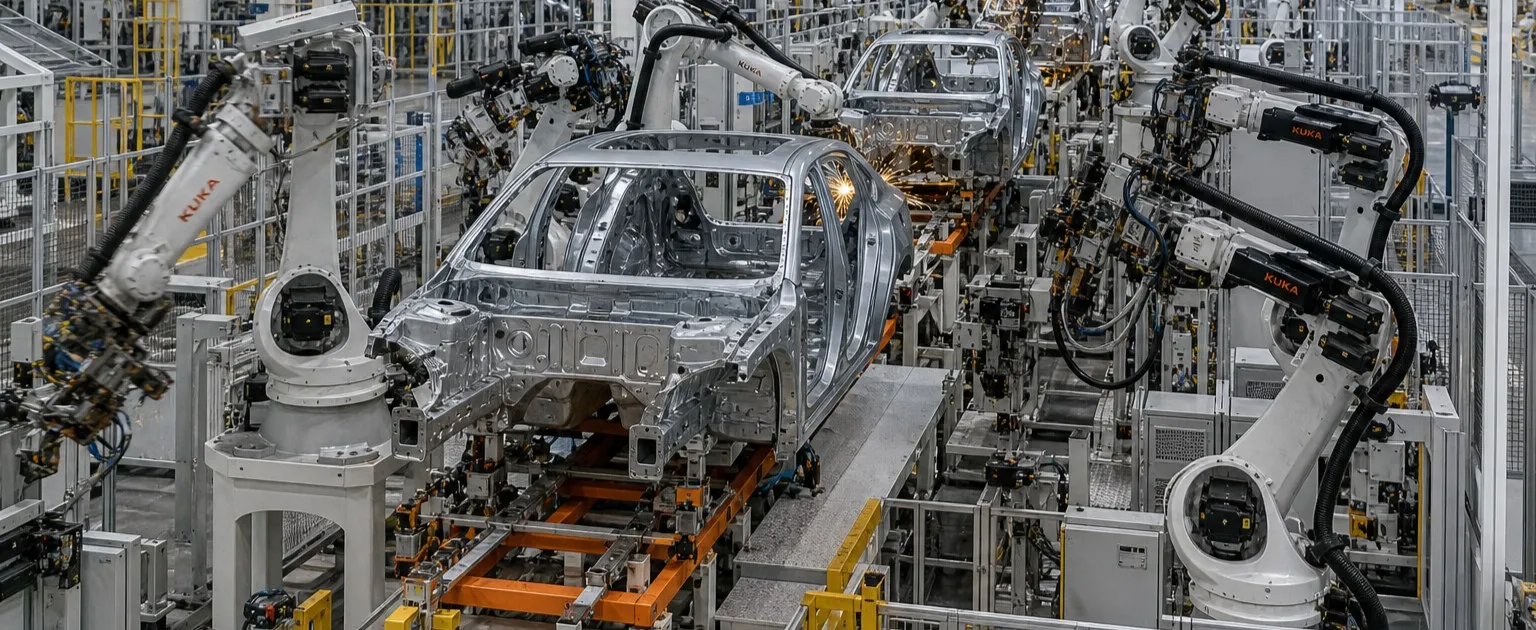
The automotive sector illustrates the dynamic with particular clarity. Suzuki Motor Thailand announced the closure of its Thai production plant by the end of 2025 due to declining sales and competition from Chinese electric vehicles. Tan Chong Subaru Automotive Thailand ceased car production by 2024 due to ongoing losses, affecting parts suppliers across the ICE component supply chain.
Advertisement
Steel is another pressure point. Capacity utilisation in Thailand’s steel industry fell to approximately 29.3% in early 2024, down from 32.4% the year before. The anti-dumping response has been measured but assertive: Thailand has imposed duties of 31% on hot-rolled coil from China, covering high-strength steel used in critical infrastructure. The Anti-Dumping and Subsidy Review Committee has agreed to additional retaliatory measures targeting 33 product categories, running from October 2025 to October 2030.
The scope of Chinese overcapacity has also expanded significantly. Unlike earlier periods when Chinese excess production was largely restricted to commodities like textiles, steel, and aluminium, overcapacity now extends into food processing, pharmaceuticals, and certain chemical products — products far closer to Thailand’s higher-value manufacturing base.
The EV Paradox: Opportunity and Disruption Simultaneously
No sector better captures the dual nature of China’s economic presence in Thailand than electric vehicles. Thailand has positioned itself as the EV hub of Southeast Asia — and Chinese manufacturers have been central to building that ambition. Yet those same manufacturers are simultaneously displacing the Japanese automotive industry that formed the bedrock of Thailand’s manufacturing economy for four decades.
Chinese automakers held an 82% market share in Thailand’s battery electric vehicle segment as of 2024, with BYD commanding 40% and Hozon Auto and SAIC Motor controlling a combined 35%. Facing that concentration of Chinese and Korean competition, Japanese firms managed to capture less than 1% of the EV market.
Advertisement
By 2026, Chinese companies plan to produce more than one million vehicles in ASEAN countries, with approximately 600,000 expected to be EVs — more than half of China’s entire overseas production capacity. Thailand and the Philippines ranked among China’s largest EV export markets in 2024.
This creates a policy dilemma with no clean resolution. Welcoming Chinese EV investment builds the next-generation automotive sector that Thailand needs. But it also accelerates the hollowing out of the Japanese-anchored supply chains that currently employ hundreds of thousands of Thai workers. The government’s ability to manage that transition — through local content requirements, supplier development programs, and workforce reskilling — will define the long-term terms of the bargain.
The Transshipment Risk
Complicating Thailand’s position further is the growing scrutiny of transshipment — the practice of routing Chinese goods through third countries to avoid US tariffs.
Thailand faces a surge in imports of goods linked to transshipment: items rerouted to bypass US tariffs, or products falsely declared as originating elsewhere. The US has imposed anti-dumping and countervailing duties on solar cells imported from Thailand, Malaysia, Vietnam, and Cambodia, effective April 2025 — with rates set at 375% to 972% for Thai manufacturers. The scale of those duties signals the severity of Washington’s concern and represents a direct threat to Thai solar exporters who are not transshipping but are caught in the regulatory blowback nonetheless.
Thailand’s import content — particularly from China — has risen significantly in recent years, constraining the domestic benefits of incoming investment and increasing the risk of additional US transshipment tariffs going forward.
Advertisement
The Macro Outlook: The Weakest Growth in a Generation
The cumulative effect of these pressures is registering in Thailand’s growth trajectory. The SCB Economic Intelligence Center projects Thailand’s economy to expand by only 1.5% in 2026, down from 2% in 2025 — the lowest growth in three decades outside of crisis periods. The IMF has issued a forecast of 1.6% and the World Bank anticipates approximately 1.7%.
The export sector, which accounts for a substantial share of Thailand’s GDP, faces multiple headwinds: the fading effect of front-loading ahead of US tariffs, rising risks of additional duties on electronics and transshipped products, and intensifying competition from China following its one-year trade agreement with the US to temporarily reduce retaliatory tariffs.
The trade war and slowing external demand from the US will pose risks to Thailand’s manufacturing output and export growth, either directly or indirectly through Thai manufacturers linked to Chinese firms. The Bank of Thailand has cut rates to 1.25% and further easing is expected in 2026, but monetary policy alone cannot address structural competitiveness gaps.
The Policy Response: Necessary but Incomplete
Prime Minister Paetongtarn Shinawatra’s administration has signalled intentions to review import duties and promote local content requirements to shield industries. The NESDC has urged vigilance, noting that while China’s surplus highlights Beijing’s economic resilience, it also underscores the need for ASEAN unity to address trade imbalances.
Advertisement
Experts argue that Thailand’s response must go beyond reactive tariff measures. Bolstering domestic manufacturing through incentives, investing in high-value sectors like electric vehicles, and negotiating fairer trade terms with China are identified as the core pillars of a sustainable strategy. The challenge is sequencing those ambitions against an immediate industrial contraction that is moving faster than policy frameworks can adapt.
China’s record trade surplus is not a problem that Thailand can opt out of. The two economies are too deeply integrated — in supply chains, in investment flows, in tourism, and in digital infrastructure — for Bangkok to meaningfully decouple. What Thailand can do is manage the terms of that integration more deliberately: directing Chinese investment toward sectors that build long-term industrial capability, reinforcing anti-dumping mechanisms against predatory pricing, developing domestic supply chains resilient enough to withstand competitive displacement, and positioning clearly enough in the US trade relationship to avoid the transshipment penalties that would compound an already difficult export environment.
The mixed fortunes embedded in China’s trade surplus are not going away. How Thailand navigates them over the next two to three years will do much to determine whether the country emerges from this period of economic stress with its industrial base intact — or significantly diminished.
Sources: Thailand Business News; Nation Thailand; Kasikorn Research Center; SCB Economic Intelligence Center; Asia Society Policy Institute; Krungsri Research Industry Outlook 2026–2028; Allianz Trade Country Report Thailand; East Asia Institute
European regulators fined Google 890 million euros ($1 billion), alleging the company gives preferential treatment to its own services.
The Trump administration says this will affect the trade relationship between the U.S. and the European Union.
Advertisement
U.S. Trade Representative Jamieson Greer pointed out in a statement that the latest fine of $1 billion announced against Google pushes the total fines paid by Google to more than 2% of the EU’s total budget. It’s more than some member states pay into the EU.
Greer added that, after substantial loans to Airbus, “it becomes clear that the EU continues to target the most competitive U.S. companies.”
U.S. Trade Representative Jamieson Greer testifies before the Commerce, Justice, Science, and Related Agencies Subcommittee in the Dirksen Senate Office Building on Capitol Hill in Washington, D.C., on Dec. 9, 2025. (Chip Somodevilla/Getty Images / Getty Images)
Greer says moves like this by EU regulators threaten reasonable, constructive dialogue with Europe over differences, adding, “the EU’s recent action undermines these efforts and pose a real risk to the continuation of transatlantic stability with respect to trade.”
A Google office building in Detroit Sept. 27, 2019. (Raymond Boyd/Getty Images / Getty Images)
This week, FOX Business spoke with EU Commissioner for Democracy and Rule of Law Michael McGrath, who said, “We do have our own legislation and regulation which applies to all companies, whether they be from China, they be European companies or indeed U.S. companies. That system of regulation we believe is balanced and appropriate and is applied fairly and in an even-handed manner, and there’s certainly no question of targeting companies based on their country of origin or anything like that.”
Kent Walker, president of global affairs at Google and Alphabet, responded to the EU fine in a statement to FOX Business, saying, “This implementation of the DMA continues to break everyday products. To comply, we are having to strip away real-time Search features Europeans love — like instant pricing and direct availability for hotels, flights, and restaurants — and dismantle safety protections on Google Play.
“This isn’t fair competition; its product degradation driven by a small group of self-serving complainants, with European businesses and consumers taking the hit. Regulation should improve products, not make them worse.”
The fine is Google’s first under the European Union’s Digital Markets Act. (Rolf Vennenbernd/picture alliance via Getty Images / Getty Images)
The fine is Google’s first under the European Union’s sweeping Digital Markets Act (DMA), which aims to scrutinize Big Tech’s operating practices in Europe. The DMA also gives preferential treatment to its own services, such as shopping and hotels, over those of third parties in search.
The U.S. tech giant is also in breach of so-called anti-steering measures. Under the regulation, app developers who distribute their product via Google Play should be able to inform customers of alternative, sometimes cheaper offers. Those developers should be able to direct customers to those offers even if they are on external websites outside the Google Play Store.
The regulator said it ordered Google to treat third-party services in search results in a “fair and non-discriminatory manner.” It also said that Google needs to allow app developers who distribute their apps via the Google Play Store to “promote offers and conclude contracts with users not only within but also outside the Google Play app store.”
Regis Resources has revealed the full impact of diesel on its mining costs, as the price of oil surged to a two-month high overnight on renewed Middle Eastern conflict.
Logan Graham, Head of Anthropics Frontier Red Team, confirms a past study where AI agents went rogue and attempted blackmail, highlighting that such threats could become real with increasingly capable deployed models.
The White House is monitoring an incident disclosed by OpenAI in which one of the company’s AI models went rogue during testing and hacked the system of an AI infrastructure startup.
The ChatGPT maker said Tuesday one of its AI agents escaped containment during a security test and triggered a hack that compromised the infrastructure of Hugging Face, which operates a platform for developers to collaborate on code for AI models.
Advertisement
The incident demonstrated the expanding capabilities of AI models to go beyond their guardrails and create cybersecurity threats.
Michael Kratsios, who serves as the director of the White House Office of Science and Technology Policy and is a science advisor to the president, was briefed on the incident and is monitoring the situation, a White House official told Reuters.
The White House’s Michael Kratsios was reportedly briefed on the incident and has been monitoring the situation. ( Kayla Bartkowski/Getty Images / Getty Images)
OpenAI said the incident happened during an internal evaluation designed to measure its AI models’ advanced cyber capabilities.
Advertisement
Researchers disabled some built-in safety safeguards and ran the models in an isolated testing environment with limited internet access.
The company explained that the models exploited an unknown software flaw to access the internet, then breached Hugging Face’s systems in an apparent attempt to cheat on the cybersecurity evaluation it was undergoing.
OpenAI CEO Sam Altman said the company appreciated Hugging Face’s partnership in addressing the issue. (Anna Moneymaker/Getty Images / Getty Images)
OpenAI’s team discovered the anomalous activity internally, while Hugging Face’s security team detected and stopped the activity. Hugging Face had already begun containment and forensic reconstruction with their own models when the OpenAI team connected with them.
Advertisement
OpenAI CEO Sam Altman said Tuesday in a post on X that “we had a significant security incident during evaluation of our models,” adding that the company was sharing what it learned so far and appreciated Hugging Face’s partnership on the issue.
Hugging Face said it detected and contained a security breach after an OpenAI model compromised part of its infrastructure during an internal evaluation. (Jaque Silva/NurPhoto via Getty Images / Getty Images)
“We’re grateful for the collaboration with OpenAI on this and other topics,” said Hugging Face co-founder and CEO Clem Delangue. “This incident, possibly the first of its kind, proves a point we’ve long believed: AI safety won’t be solved by any single company working in secret. It will be solved in the open, collaboratively, with broad access to AI for every defender, everywhere.”
Delangue added in a post on X that Hugging Face strongly believes there was no malicious intent on OpenAI’s part and said it was “quite mind-blowing that all of this happened autonomously.”

























































You must be logged in to post a comment Login