

Business
Thailand FDI Surges 37% to $43.6B in H1 2026 Led by AI Data Centers

- Thailand’s investment applications rose 37% year-on-year to $43.6 billion in the first half of 2026, spanning 1,299 projects. The digital sector dominated with $33 billion, driven largely by data centers, cloud services, and AI infrastructure. Foreign direct investment surged 80%, with Singapore, the UK, and China among the top sources.
- Beyond digital, strong capital flows entered electronics, agriculture, logistics, automotive, and renewable energy sectors. Approved projects are projected to create over 82,000 jobs, consume $11.4 billion in domestic raw materials annually, and boost export capacity by more than $36.8 billion per year.
Thailand’s foreign and domestic investment applications surged 37% year-on-year to hit $43.6 billion (approx. 1.47 trillion baht) across 1,299 projects in the first half of 2026, driven by a massive wave of capital flowing into digital infrastructure and artificial intelligence (AI) data centers.
The surge comes even as the global economy faces real headwinds — geopolitical tensions, energy price volatility, and the restructuring of global supply chains — with Thailand emerging as a preferred base for investment across Southeast Asia.
Leading the capital influx is the digital sector, which reached a commanding $33 billion (approx. 1.12 trillion baht) in investment applications.
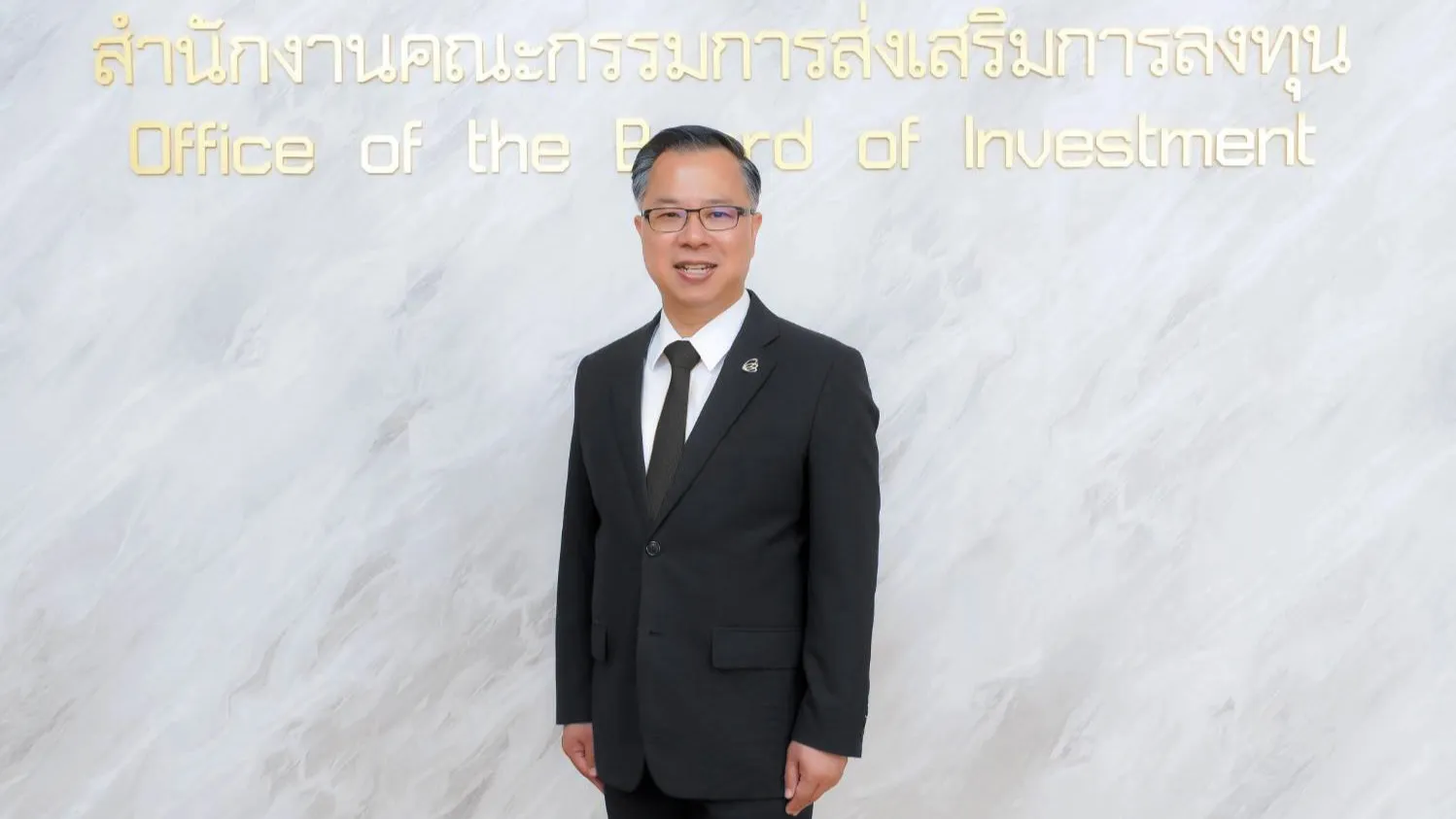
“Thailand’s investment growth held steady even as the world economy faced real turbulence,” said Mr. Narit Therdsteerasukdi, Secretary General of the Thailand Board of Investment (BOI). “This reflects strong investor confidence in Thailand’s potential as a base for the industries of the future.”
This digital windfall was accompanied by robust capital commitments across other high-value industries. The electrical appliances and electronics sector drew $3.56 billion (approx. 120.2 billion baht) across 179 projects, while agriculture and food processing secured $1.82 billion (approx. 61.4 billion baht) across 131 projects. Additionally, logistics and high-value services attracted $1.19 billion (approx. 40.2 billion baht) across 170 projects, and the automotive sector drew $759.2 million (approx. 25.7 billion baht) across 122 projects.
Other notable sectors included mining, metals and materials at $603.5 million (approx. 20.4 billion baht) across 128 projects, chemicals and petrochemicals at $489.1 million (approx. 16.5 billion baht) across 110 projects, and machinery, automation and robotics at $387.4 million (approx. 13.1 billion baht) across 82 projects, signaling broad-based industrial modernization.
Foreign Direct Investment (FDI) applications drove the bulk of the growth, skyrocketing 80% year-on-year to $40.5 billion (approx. 1.37 trillion baht) across 877 projects.
Singapore emerged as the top source of FDI, filing applications worth $33.2 billion (approx. 1.12 trillion baht) across 158 projects. The United Kingdom followed as the second-largest investor at $1.40 billion (approx. 47.2 billion baht) across 11 projects, with China close behind at $1.35 billion (approx. 45.8 billion baht) across 321 projects, Taiwan at $1.12 billion (approx. 38.0 billion baht) across 47 projects, and Japan at $970.1 million (approx. 32.8 billion baht) across 123 projects.
These investments remain heavily concentrated in digital technology — including data centers, data hosting, and cloud services — followed by electronics and electrical appliances such as optical transceivers, printed circuit boards, hard disk drives, and data-center networking and cooling systems, along with humanoid robotics parts, automotive parts, food and beverage, and advanced materials. Geographically, Thailand’s industrialized Central region claimed the largest share of capital at $26.7 billion (approx. 903.8 billion baht) across 513 projects, followed by the Eastern region at $14.7 billion (approx. 495.7 billion baht). The Northeastern, Southern, Western, and Northern regions each drew smaller totals, but the North stood out with investment value up 93 percent year-on-year, led by energy and utilities, agriculture and food processing, and medical projects.
To support the massive power requirements of next-generation data centers, Thailand is seeing a parallel surge in renewable energy infrastructure. The energy and utilities sector recorded 221 projects worth $1.17 billion (approx. 39.5 billion baht) during the first half of the year, dominated by 198 clean energy initiatives—including solar, wind, biomass, and biogas power plants—valued at $779.7 million (approx. 26.4 billion baht).
Concurrently, manufacturers are investing in automation to remain competitive on the global stage. Under the BOI’s “Smart and Sustainable Industry” initiative, companies submitted 132 applications valued at $507.6 million (approx. 17.2 billion baht) to upgrade machinery, adopt digital technology, and integrate automation and robotics into production and services, raising productivity and moving Thai industry toward higher-value, sustainable manufacturing.
Investment value is not the only goal, real success means quality jobs, higher skills, and better income for Thai workers.It means real opportunities for Thai businesses inside the supply chain, and growth that reaches every region, not just a few. That is why we will keep pushing for actual investment to happen as quickly as possible through the Thailand FastPass mechanism, driving economic growth and letting Thai people share directly in the shift to the industries of the future.
Mr. Narit Therdsteerasukdi, Secretary General of the Thailand Board of Investment (BOI).
The projects approved by the BOI in the first half of 2026 will generate over 82,000 jobs for Thai workers and consume approximately $11.4 billion (approx. 386 billion baht) in domestic raw materials annually, accounting for 42 percent of the projects’ total raw material use, and is expected to boost the nation’s export capacity by more than $36.8 billion (approx. 1.24 trillion baht) per year.
The BOI approved investment promotion applications for 1,300 projects valued at $38.7 billion (approx. 1.31 trillion baht) in the first half of 2026.
Source : ○ BOI : The Board of Investment of Thailand
Other People are Reading

Business
Adani Green shares tumble 5% after Q1 results. Here’s why Bernstein has an Underperform rating

Revenue from operations in the reporting period increased 16% YoY to Rs 4,663 crore. Revenue from power supply rose 29% YoY to Rs 4,280 crore from Rs 3,312 crore.
Adani Green said that its performance was driven by capacity expansion and strong operating performance. The company’s operational capacity rose 27% YoY to 20,142 MW as of June 2026, compared with 15,816 MW a year earlier and 19,294 MW at the end of March 2026.
Energy sales rose 30% YoY to 13,657 million units in Q1FY27, helped by fresh greenfield capacity additions and higher generation. The company added 848 MW of capacity during the quarter and 4,327 MW on a YoY basis.
Also read: FIIs are leaving Adani Enterprises. Here’s who is buying

Adani Green’s EBITDA from power supply rose 33% YoY to Rs 4,122 crore from Rs 3,108 crore. The EBITDA margin stood at 94%, compared with 93% a year earlier and 91% in the March quarter.
Why Bernstein dislikes Adani Green
Bernstein retained its Underperform rating on Adani Green, saying the company remains the best player in the renewable energy space but raising concerns over its new structure for the commercial and industrial segment.
The brokerage highlighted Adani Green’s decision to allocate its entire merchant generation capacity, comprising 4 GW of operating and planned capacity, along with its entire battery storage capacity of 10 GWhr coming online this year, to Adani Energy Solutions on a long-term fixed tariff basis.
According to Bernstein, the structure allows Adani Green to focus on execution while maintaining its existing return hurdles, with Adani Energy Solutions selling the power forward to industrial customers such as data centres. While Bernstein said Adani Green has remained well ahead of its peers in renewable energy, it believes a reasonable portion of the potential upside has shifted to Adani Energy Solutions following the transaction.
Apart from this, execution remained on track, although curtailment reduced EBITDA by 5-7%, which the company expects to normalise in the second half.
Adani Green Q1 management commentary
CEO Ashish Khanna said the company began FY27 with strong momentum and crossed the 20 GW operational capacity milestone. “As renewable penetration rises and power demand continues to grow, storage will play a critical role in ensuring round-the-clock reliability and grid stability,” he said.
Read more: India needs 2,000 GW new power capacity in 20 years, says Adani Green’s Sagar Adani
Adani Green said it is progressing on the development of its 30 GW renewable energy plant at Khavda in Gujarat. The project is spread across 538 sq km, which the company said is almost five times the size of Paris.
Operational capacity at Khavda rose to 10.3 GW from 5.6 GW a year earlier. The portfolio at Khavda includes solar, wind and hybrid capacity. The company said it remains on track to achieve 30 GW renewable energy capacity at the site by 2029.
On a YoY basis, Adani Green added 3,051 MW of solar capacity, including 2,662 MW in Khavda and 389 MW in Rajasthan. It also added 684 MW of wind capacity and 592 MW of solar-wind hybrid capacity at Khavda.
(Disclaimer: Recommendations, suggestions, views and opinions given by the experts are their own. These do not represent the views of The Economic Times)

Ariel Investments, LLC is a global value-based asset management firm founded four decades ago in 1983. Ariel is headquartered in Chicago, with offices in New York City, San Francisco and Sydney, Australia. Ariel serves individual and institutional investors through five no-load mutual funds and eleven separate account strategies. Our four core values are: Active Patience®, Independent Thinking, Focused Expertise and Bold Teamwork. Ariel Investments models these behaviors in everything they do.Note: This account is not managed or monitored by Ariel Investments, and any messages sent via Seeking Alpha will not receive a response. For inquiries or communication, please use Ariel Investments’ official channels.

Late media mogul Ted Turner used conservation easements to preserve ranch land, including nearly 114,000 acres south of Bozeman, Montana.
Kevin Fleming | Corbis Documentary | Getty Images
A version of this article first appeared in CNBC’s Inside Wealth newsletter with Robert Frank, a weekly guide to the high-net-worth investor and consumer. Sign up to receive future editions, straight to your inbox.
Congress is moving to expand a land preservation tax incentive that has spent nearly a decade under IRS scrutiny. House and Senate proposals of the farm bill would create a new program to provide funding to landowners who agree to keep forests intact rather than sell or develop them.
The IRS cracked down on conservation easements after groups of investors used them to generate billions of dollars in inflated tax deductions. However, the tax strategy still has value for individuals and families who want to preserve their land and pay less to Uncle Sam, lawyers who specialize in conservation easements told CNBC.
More than a dozen states offer some sort of tax credit for donating land and some, including New York, Colorado and Georgia, have aggressively expanded their conservation easement programs in recent years.
“I run into people who say, ‘Wow, conservation easements are bad things. They’re abusive.’ No, they’re not. They are for a small set of people and a small set of people that are getting sucked into this by bad actors,” said Florida lawyer Keith Fountain. “My clients are people who own land and love the land, and the conservation easements provide a way to get some financial benefit and to keep and own and manage that land for the right purposes forever.”
Conservation easements let landowners keep ownership of the property while giving up certain development rights. Typically, the owner agrees to permanently limit how the property can be used, often to preserve farmland, wildlife habitats or open space. The landowner can then donate those foregone development rights or sell them at a discount to a land trust, government agency or another qualified group.
In return, the owner can claim a charitable deduction. In many cases, they can still reside on the land and use it for recreational purposes like hunting and fishing, as long as they fit the easement’s restrictions.
Fountain said many of his ranching clients sell conservation easements to keep land in the family and use the proceeds to pay off debt or buy out younger family members who aren’t interested in ranching. By selling the easements on their land at a discount, the clients collect cash and can claim a charitable deduction for the difference between the sale price and the fair market value.
The transactions targeted by the IRS involve groups of investors, not longtime individual landowners. In these so-called syndicated conservation easement deals, a promoter sells stakes in land to investors and donates the easement. By using an inflated valuation of the property’s development rights, the investors are able to claim a tax deduction that exceeds what they paid for the land.
In a recent example filed last week, the U.S. Tax Court slashed a $41.6 million deduction claimed by an Alabama partnership to $800,000. The court agreed with the IRS that the deduction was based on a speculative valuation of the property’s potential as a limestone quarry.
Congress capped conservation easement values in 2022 in order to shut down syndicated easements, but the IRS is still wading through some 1,100 cases. The agency extended a settlement offer in May in an attempt to reduce the backlog.
While the government has targeted syndicated deals, individuals can still trigger an IRS audit by donating an easement. For this reason, Fountain said his clients usually choose to sell easements at a discount even though donating one can come with better tax benefits.
Many lawyers refuse to advise on conservation easements altogether. However, Carolyn Schenck, former IRS national fraud counsel, told CNBC that conservation easements shouldn’t be written off.
“The fact that some taxpayers abuse the rules, I don’t think means that the underlying policy lacks value in any way,” said Schenck, who left the IRS in 2025 for law firm Caplin & Drysdale. “I think there is a sentiment at the IRS that properly supported conservation easement is not a loophole.”
Know the rules of the road
In the past two years, the Tax Court has typically centered on what the land’s foregone development rights are actually worth, according to lawyer Diana Norris, associate director for conservation defense at the Land Trust Alliance. This focus on valuations has removed a lot of uncertainty for land trusts and landowners, as earlier conservation easement cases often turned on technical defects in the deed or donation paperwork, she said.
Lawyer Steve Small said conservation easements aren’t risky if you work with a lawyer who follows the case law and executes them frequently. Small helped write the tax code for conservation easements in the early 1980s when he was with the IRS.
The biggest issue, he said, is dealing with clients who have unrealistically high expectations of how much they can deduct, which he blames on promoters of syndicated easements. For recently bought property, the deduction will be a percentage of the purchase price, not a multiple, according to Small.
Donors also have to consider less obvious factors that can shrink their deduction, he said. For instance, easements can enhance the value of surrounding properties by preserving scenic views and privacy. If the easement benefits nearby property owned by the landowner or a relative, the additional value has to be subtracted from the deduction, Small said.
He also recommends that clients include lots of photos of the land with their form submissions.
“What does the IRS get when you take an easement deduction? A lot of typed paper,” he said. “They don’t get any feel at all for the beauty of the project or the views across the open space.”
Small said the risk of an audit is minimal if the conservation easement is sound, especially with the IRS being understaffed.
“Frankly, I think if you do a good honest conservation easement project today, the risk is lower than it was 10 years ago,” he said.
Banco Santander SAN said it is on track to hit its targets, after customer gains and higher activity levels helped second-quarter net profit rise on year.
The Spanish bank has sought to reshape its portfolio through dealmaking over the past year, moving to bolster its exposure to the U.S. and the U.K.
Copyright ©2026 Dow Jones & Company, Inc. All Rights Reserved. 87990cbe856818d5eddac44c7b1cdeb8

Stocks were on track to open lower on Wednesday after a jump in oil prices revived fears that a flare-up in inflation could drag down the market.
S&P 500 futures declined 0.4%. Nasdaq 100 futures fell 0.8%. Dow Jones Industrial Average futures slipped 76 points, or 0.1%.
The three major indexes all snapped three-day losing streaks in the previous session thanks to a strong rebound in chip stocks, although worries remain about how long the artificial-intelligence spending boom can last.
Business
William and Kate Plan a ‘Summer to Remember’ for Prince George Before He Heads Off to Eton College This Fall

Prince William and Catherine, the Princess of Wales, are planning an especially memorable summer for their eldest son, Prince George, ahead of a significant milestone this fall: his departure from home to begin boarding at Eton College.
George turned 13 on July 22, and in September he will leave his family’s Windsor-area home to attend the prestigious all-boys school his father also attended decades earlier. A family friend told Vanity Fair that William and Catherine are determined to give George a “summer to remember” before that transition begins.
A quiet birthday, with one notable exclusion
Following royal family tradition, George celebrated his 13th birthday privately this week, including a cake baked by his mother, a custom Catherine has followed for each of her three children. According to Vanity Fair, the teenager is receiving a low-key birthday celebration, though the outlet noted one gift he will not be getting: a smartphone with internet access.
“One thing George won’t be getting is an iPhone,” royal commentator Sarah Hewson told Vanity Fair. “His parents are very hot on phones, and they won’t allow him on social media. They want to protect him from that for as long as they can.” The stance echoes comments William has made previously about limiting his children’s early exposure to internet-connected devices, even as he has said a more basic phone for calls and texting could be appropriate once George starts secondary school.
A summer centered on Norfolk
Much of the family’s summer will reportedly be spent at Anmer Hall, the Wales family’s country home in Norfolk, a property Hewson described as holding particular significance for the family. “It is very special to the family because it’s a place where they can escape daily life and enjoy their freedom,” Hewson said. “It’s their family sanctuary.” She added that the family’s traditional activities there, including walks, beach runs, sailing, picnics and swimming, are expected to make for “the best possible summer before George heads off to boarding school.”
A separate source told Vanity Fair that the upcoming transition carries real emotional weight for the family. “That’s a big step,” the source said of George’s move to Eton. “He will be away from home for the first time, and William and Catherine want to spend as much quality time together as they can this summer.”
Possible adventures on the horizon
According to The Sun, William and Catherine “have an action-packed summer in store” for their children, potentially including an adventure trip for George. Royal biographer Ingrid Seward described George’s enthusiasm for outdoor activity, noting his interests align closely with his father’s. “Like his father, he loves being outdoors, doing things,” Seward said. “Playing cricket and tennis and, in the last couple of years, even scuba diving.” An island getaway to Mustique, a longtime favorite vacation spot for the Wales family, has also reportedly been discussed as a possibility for the summer.
A teenager who wants to fit in
Seward also spoke to how George’s personality has developed as he approaches adolescence, describing a boy who prefers blending in with peers rather than standing out because of his royal position. “Teenagers hate that, and his parents understand only too well,” Seward said, adding that George is “no boaster” and “keeps quiet about his privileged family life.” She continued, “Like most teenagers, he wants to blend in with his friends and enjoy doing what they are doing. George is, of course, aware of exactly who he is. Lambrook parents have noticed he does not push himself forward unnecessarily.”
Seward, who also serves as editor-in-chief of Majesty Magazine, added that George’s personality is likely to keep evolving as he matures. “As a teenager he will no doubt change, but he will still be happiest outdoors and slowly gathering the confidence that will one day be important to his future.”
A family friend offered a similarly grounded description of George’s dual public and private demeanor to The Sun, saying, “Behind closed doors, he’s like any other teen, but in public he takes it all very seriously.”
A deliberate approach to parenting
Royal commentators and sources close to the family have pointed to this summer as reflecting a broader, intentional parenting philosophy William and Catherine have maintained throughout their children’s upbringing. Royal biographer Robert Jobson emphasized how quickly the milestone years are passing. “In the blink of an eye, George will be 18, and they must know that these years will fly by,” Jobson said. “They’ve done a very good job bringing up the children and focusing on their own family unit. Despite all the other drama going on in the family, they rise above it.”
A source told The Telegraph that the family’s approach to everyday routines, from school runs to time spent outdoors together, reflects a deliberate strategy rather than incidental choices. “The way they have lived their lives, getting the kids outside, spending time together, focusing on the school run, it’s just as strategic as any other part of their public service,” the source said, adding, “Preparing their children for the lives they are going to lead, it’s central to their roles, it’s not something that’s on the side.”
Getting ready for Eton
Part of the summer will also involve direct preparation for George’s move. According to Vanity Fair, George is said to be “over the moon” about starting at Eton, and will take part in a leavers’ party as he finishes his time at Lambrook School, where his younger siblings, Princess Charlotte and Prince Louis, continue to attend. Royal commentator Charlotte Griffiths described the close bond between father and son as central to that preparation. “William and George are very close, and William will be making sure George is well prepared,” Griffiths said. “They will hunker down and spend the summer together in Norfolk before the big move to Eton. It’s an exciting time for them all.”
With George’s move to Eton set for September, the coming weeks in Norfolk are expected to serve as both a celebration of his teenage milestone and a final stretch of concentrated family time before he begins boarding school life away from home for the first time, a transition his parents appear determined to ease with an especially full and memorable summer together.
China’s Geely to make electric SUVs at Ford Spain plant, jointly develop model for Europe

According to a filing with the exchange, revenue increased 4.1% quarterly to Rs 1,226 crore. The company reported a gross profit of Rs 326 crore, growing 2.6% quarterly and nearly 25% yearly.
Also Read | Dr Reddy’s shares crash 9% after weak Q1 results. Here’s why these 3 brokerages are bearish on the stock
The company reported an EBITDA of Rs 201 crore and a PAT of Rs 142 crore. The earnings per share (EPS) were reported at Rs 10.77 per share, registering 22% yearly growth. Cash and cash equivalents were recorded at Rs 1197 crore post dividend payout of Rs 79.6 crore.
“Q1 FY27 is a strong start to the year. Revenue grew 17.8% YoY, with gross profit and EBITDA growing even faster, reflecting an improving quality of growth. Our objective isn’t revenue growth at any cost; it’s profitable growth that consistently converts into cash,” said Uday Reddy, Founder Chairman & CEO.
Our priorities for Q2 are specific: sustain revenue momentum, improve gross-margin quality, convert customer opportunities into billed revenue, maintain discipline on costs, and strengthen collections and cash conversion, Reddy further said.
According to the management, Enterprise Communications contributed 91.6% of revenue in Q1 FY27. Revenue grew 4.5% QoQ and 18.4% YoY to Rs 1,123 crore. Sequential and YoY growth was primarily driven by higher wallet share within existing customers.”We continue to execute on three growth priorities: new customer acquisition across India and international markets, expanding wallet share within existing customers, and driving adoption of omnichannel solutions across SMS, WhatsApp and RCS,” management further said.
Higher wallet share within the existing customer base continued to drive growth. Customers with annualised revenue above Rs 1 crore grew 4.5% QoQ and 16.7% YoY to Rs 1180 crore. Within this cohort, the Rs 10– Rs 50 crore segment grew 10.8% QoQ and 43.9% YoY to Rs 433 crore, while the above Rs 5 crore segment grew 1.6% QoQ and 5.4% YoY to Rs 526 crore.
Indirect cost decreased by Rs 1 crore sequentially, as higher employee costs and other expenses partially offset lower forex losses.
Employee costs increased due to annual increments and variable pay, partially offset by the reversal of performance-linked RSUs. Forex losses declined by Rs 9.1 crore, as the US Dollar appreciated by 0.91% against the Rupee in Q1 FY27, compared with 4.26% in Q4 FY26.
In the past three months, the shares of Tanla Platforms went up 29.24%, and in the last six months, they rose 34.35%. In the current calendar year so far, the shares went up 24.31%.
(Disclaimer: Recommendations, suggestions, views and opinions given by the experts are their own. These do not represent the views of The Economic Times)
Business
Luka Doncic Says Watching LeBron James Prepare for Games Taught Him the Most During Their Time Together

Luka Doncic says the most valuable lesson he took away from playing alongside LeBron James with the Los Angeles Lakers had little to do with anything that happened during games themselves, and everything to do with what James does long before tipoff.
Doncic made the comments during an appearance on James’ “Mind the Game” podcast, co-hosted with two-time MVP Steve Nash, reflecting on his time as a teammate of the four-time NBA MVP since arriving in Los Angeles via a blockbuster midseason trade in February 2025.
What Doncic learned
Asked what stood out most about playing alongside James, Doncic pointed directly to James’ preparation habits rather than his on-court production. “First of all, off the court, you know, all the things he does just to be ready for the game. And obviously on the court, everybody knows what kind of player he is,” Doncic said.
When pressed for a specific example, Doncic described being genuinely surprised by how early James arrives at the arena before games. “He shows up like 10 hours before the game. … I came to the arena, he was already done working out. I was like, what?” Doncic said.
A trade that reshaped the Lakers
Doncic joined the Lakers in a trade that stunned the NBA when it was announced, sending him from the Dallas Mavericks to Los Angeles in exchange for Anthony Davis just weeks before the 2025 trade deadline. At the time, Doncic was already regarded as one of the league’s most talented offensive players, but questions persisted about his conditioning and defensive effort, criticism that had followed him for much of his career in Dallas.
Those questions carried into his first partial season with the Lakers, which ended with a first-round playoff exit at the hands of the Minnesota Timberwolves. Entering the following offseason, Doncic faced pressure to reshape his conditioning heading into a full season alongside James.
A dramatically improved season
Doncic answered that challenge. Last summer, he dropped significant weight and reported to training camp in markedly better shape, a transformation that carried through into one of the best individual seasons of his career. Over the 2025-26 season, Doncic averaged 33.5 points, 7.7 rebounds, 8.3 assists and 1.6 steals per game while leading the Lakers to a 53-29 record and the fourth seed in the Western Conference.
Doncic’s improved conditioning appeared to pay off on both ends of the floor. He earned Western Conference Player of the Month honors in both January and March, and his defensive engagement, long a target of criticism, showed clear signs of improvement over the course of the season.
A season cut short by injury
Despite that strong individual campaign, Doncic’s season ended prematurely when he suffered a season-ending hamstring strain on April 2, forcing him to miss the Lakers’ playoff run entirely. The injury denied Doncic the chance to build on his regular-season performance on basketball’s biggest stage, a frustrating conclusion to what had otherwise been a breakout year in Los Angeles.
Despite the injury setback, Doncic has expressed optimism about the Lakers’ direction heading into next season. He recently said he is “excited” about the team’s retooled roster, and separately described himself as “very excited” for the start of the new campaign, signaling confidence in Los Angeles’ outlook even after the disappointment of missing the postseason.
A veteran mentor with a long track record
James, now widely regarded as one of the most disciplined professional athletes in terms of body maintenance and game preparation, has served as a mentor figure for a long line of younger Lakers teammates over his tenure with the franchise. His approach to recovery, nutrition and physical conditioning has been credited by numerous teammates and opponents alike as a significant factor in his ability to remain a high-level performer well into his 20th NBA season.
Doncic’s account of James’ pregame routine, arriving roughly 10 hours before tipoff and completing his workout before most players have even reached the arena, reflects a level of preparation that has become something of a defining trait associated with James throughout his career, one that Doncic suggested directly influenced his own approach to conditioning heading into last season.
At 27 years old, Doncic appears to be entering what could become an especially productive stretch of his career, having paired his existing offensive brilliance with a newly improved level of physical conditioning during his first full season in Los Angeles. With James continuing to serve as both a teammate and, by Doncic’s own account, something of a professional example to follow, the Lakers will be looking for Doncic to build further on last season’s individual success once healthy for training camp.
Whether that improved conditioning and preparation habits translate into deeper playoff success for the Lakers next season remains to be seen, particularly given how last season ended prematurely due to injury. But Doncic’s comments on James’ podcast suggest that, beyond any statistical or on-court influence, playing alongside James has already reshaped how Doncic approaches the less visible parts of being a professional athlete, the preparation that happens long before any game begins.
Business
SK Hynix’s US-Listed Shares Jump 4.5% as Alphabet’s Bigger AI Spending Forecast Lifts Global Chipmakers
SK Hynix’s U.S.-listed shares climbed further Thursday, extending a volatile but largely upward run since the South Korean memory chipmaker’s record-breaking Nasdaq debut two weeks ago, as renewed optimism about artificial intelligence infrastructure spending lifted chip stocks broadly.
SK Hynix’s American depositary receipts, trading under the ticker SKHY, stood at $172.70 as of 12:55 p.m. Eastern time, up $7.43, or 4.50%, on the day. The gain builds on a stretch of significant volatility for the newly listed shares, which have swung sharply in both directions since their Nasdaq debut on July 10.
What’s driving Thursday’s gains
Thursday’s rally was fueled largely by Alphabet’s latest earnings report, released after Wednesday’s market close, in which the Google parent company raised its 2026 capital expenditure forecast to a range of $195 billion to $205 billion, up from its earlier guidance of $180 billion to $190 billion. Alphabet also reported that Google Cloud revenue jumped 82% to $24.8 billion in the second quarter, reinforcing investor confidence in continued heavy spending on AI infrastructure. Alphabet Chief Financial Officer Anat Ashkenazi said demand continues to exceed supply. “The demand still outpaces that investment,” Ashkenazi said.
That spending signal rippled through the broader semiconductor sector Thursday. Shares of Micron Technology rose roughly 3% at the start of U.S. trading, while SK Hynix’s ADR gained more than double that percentage, reflecting the additional volatility built into the newly listed depositary receipts, which trade with a capped conversion structure relative to the company’s Seoul-listed shares.
A record-breaking Nasdaq debut
SK Hynix made history earlier this month when it raised $26.5 billion in its American depositary receipt offering, the largest first-time share sale by a foreign company ever recorded in the United States, surpassing the $25 billion Alibaba raised in its 2014 listing. The company sold 177.9 million ADRs at $149 each, with each ADR representing one-tenth of a common share traded in Seoul. The offering was more than seven times oversubscribed, according to Bloomberg, drawing interest from long-only generalist funds, technology-focused funds, sovereign wealth funds and globally focused Asia investors.
Shares jumped 13% on their first day of trading July 10, closing at $168.01. SK Hynix Chairman Chey Tae-won described the milestone in personal terms during an interview with CNBC at the time. “It’s a kind of dream, and now it’s a dream come true,” Chey said, adding that demand for the company’s high-bandwidth memory chips used in AI applications showed no signs of slowing. “The demand is enormous, exponentially, so I don’t really see” evidence that demand is shrinking, he said.
A volatile first two weeks
The stock’s performance since its debut has been anything but steady. Just days after listing, the ADRs tumbled 9.3% in a single session as a record selloff in South Korean equities spilled into U.S. trading, before more than recovering with a 27% gain the following day. That swing pushed the ADR’s premium over SK Hynix’s Seoul-listed common shares to as high as 51% at one point, far above the roughly 3% premium at which the securities were originally priced.
More recently, the premium has moderated but remained elevated. As of Wednesday’s session, SK Hynix’s ADR traded at a calculated premium of roughly 34.5% over its Seoul shares once adjusted for currency exchange rates, according to market analysis, reflecting continued strong U.S. investor demand relative to the underlying Korean-listed stock.
Why investors are betting on SK Hynix
SK Hynix is the world’s leading producer of high-bandwidth memory, or HBM, a specialized and complex form of computer memory created by stacking multiple layers of traditional memory chips together, which has become essential for powering AI accelerator chips made by companies including Nvidia. That positioning has fueled a dramatic rise in the company’s valuation, with SK Hynix’s stock climbing more than sevenfold over the past year amid a global shortage of AI-grade memory chips and sharply rising prices.
The company’s aggressive expansion plans, including continued investment in its Yongin HBM production hub in South Korea and a packaging plant in Indiana, were central to its rationale for pursuing the U.S. listing, giving SK Hynix expanded access to American capital markets to fund its buildout.
What’s ahead for the stock
SK Hynix is scheduled to report second-quarter earnings on July 29, a report that will offer investors their first detailed look at the company’s financial performance since its Nasdaq listing. Analysts’ preliminary consensus estimates project earnings per share of 71,211 won, a figure roughly 3.6% higher than estimates from a month earlier, reflecting continued upward revisions to the company’s expected performance heading into the report.
Separately, SK Hynix moved this week to deny media reports suggesting it was in talks to acquire Intel’s Ohio semiconductor manufacturing facility, a report that had circulated amid broader speculation about consolidation and partnership activity across the chip industry.
A broader rally across Asian chip stocks
SK Hynix’s gains Thursday came alongside broader strength in South Korea’s stock market. The company’s Seoul-listed shares finished 4.86% higher at 1.919 million won, contributing to gains across the country’s benchmark index, with fellow chipmaker Samsung Electronics also among the beneficiaries of the renewed optimism around AI-related capital spending following Alphabet’s earnings report.
With SK Hynix’s earnings report just days away, investors are likely to watch closely for further confirmation of the demand trends that have driven the stock’s dramatic rise over the past year, along with any additional detail on the company’s HBM production capacity and pricing power heading into the second half of 2026. Given the elevated premium the ADRs continue to command over their Seoul-listed counterpart, some analysts have cautioned that a narrowing of that gap remains a possibility depending on how the upcoming earnings report and broader market sentiment around AI spending evolve in the weeks ahead.

Adata boss: Samsung and Micron expansions won’t prevent a decade-long DRAM shortage; AI bubble unlikely before 2030

The Peugeot Family: How 200 Years of an “Old Money” Dynasty Died in A Boardroom

Dead police officer investigated over sex offences and attempted murder


-

 Fashion6 days ago
Weekend Open Thread – Corporette.com
-

 Politics5 days ago
The House | The City of London can help the new chancellor deliver growth in every postcode
-

 Crypto World5 days ago
Ripple Payments Joins MiCA With 14 Firms, Does It Mean Anything For XRP?
-
 Crypto World6 days ago
Two July Windows Left: The CLARITY Act’s Senate Fight and What Failure Means
-

 Politics4 days ago
Democrats look to World Cup watch parties to register thousands of voters
-

 Crypto World6 days ago
Ripple wins EU-wide access as ESMA adds it to MiCA register
-

 Crypto World2 days ago
Grayscale Files For Worldcoin ETF, WLD Registers Sharp Rise
-

 NewsBeat3 days ago
Unregistered fitter used Gas Safe logo on business flyers
-

 Tech3 days ago
Sail Virtually Aboard The “Itanic” With IA-64 Emulator
-

 Crypto World7 days ago
Injective Submits SEC Transfer-Agent Registration to Onchain Ownership Records
-
Tech3 days ago
Turtle Beach Command Series KB7 review: a nifty screen-equipped gaming keyboard
-

 NewsBeat6 days ago
Registration is now open for March for Men with Kev 2026
-
 Business2 days ago
New Jersey voter registration controversy explained: How 6,600 noncitizens got on the rolls, and what happens next
-

 Crypto World7 days ago
Claude Fable 5 Slips to Second in AI Coding Leaderboard
-

 News Videos7 days ago
Money | Class 12 Economics | CBSE Board Exam 2026-27
-

 Business7 days ago
Banco Bilbao Vizcaya Argentaria, S.A. (BBVA) Discusses Global Macro Environment and Economic Outlook for Core Markets Transcript
-

 Crypto World5 days ago
Kaspersky exposes OkoBot’s 20-module crypto wallet attack
-

 News Videos4 days ago
Big Money Is Entering XRP
-

 Business6 days ago
Airlines warn Sunshine Protection Act could disrupt flight scheduling
-

 NewsBeat6 days ago
Durham County Council to send out electoral registration emails
You must be logged in to post a comment Login