

Crypto World
The new XRP card is a margin loan with a Visa logo



RedotPay’s RLUSD card lets 8 million users spend against their XRP without selling it: pledge coins at 50% loan-to-value, borrow in Ripple’s stablecoin, swipe anywhere Visa works. It is being sold as convenience. It is, mechanically, collateralized leverage on a token that fell 60% in a year, and the difference matters.
Summary
- RedotPay, a stablecoin payments fintech with more than 8 million users across 100-plus countries and roughly $12 billion in annualized volume, launched an XRP Ledger-powered card that combines XRP-backed credit, Ripple’s RLUSD stablecoin, and Visa’s network.
- The mechanics are a loan, not a payment: users pledge XRP as collateral at a 50% loan-to-value ratio, receive a credit line settled in RLUSD on the XRPL, and spend at any Visa merchant, keeping their XRP exposure intact.
- The pitch, spending without selling, is genuine and genuinely double-edged: it preserves upside and defers taxable disposals, and it converts holders into leveraged borrowers against one of the cycle’s worst-performing major assets.
- The launch is a real distribution event for RLUSD, routing consumer settlement through the XRP Ledger itself, and it arrives on the strength of a real trend: RedotPay reports stablecoin card volume up 80% this year and 250% year over year.
- The unpublished numbers are the ones that decide the product: borrowing costs, liquidation thresholds, and what happens to pledged collateral in the next 40% drawdown. The card’s true test is not adoption. It is the first liquidation cycle.
The most successful trick in consumer finance is making a loan feel like something else. The credit card made borrowing feel like paying; the mortgage refinance made it feel like unlocking; buy-now-pay-later made it feel like nothing at all. This week the trick arrived for XRP holders, wearing Ripple’s stablecoin and Visa’s logo. RedotPay, a Hong Kong-grown stablecoin payments company that has quietly assembled more than 8 million users across a hundred countries, launched what it calls the RLUSD card: pledge your XRP as collateral, receive a credit line at half its value, spend that credit, settled in RLUSD on the XRP Ledger, anywhere on earth Visa is accepted. The marketing frame, spend without selling your XRP, is accurate, appealing, and incomplete, because the product it describes has an older and less romantic name. It is a securities-backed line of credit, the margin loan of the wealth-management world, ported to a volatile digital asset and distributed to a retail base of eight million. That porting is a genuine milestone for stablecoin payments, a genuine distribution win for RLUSD and the XRPL, and a genuine risk transfer whose terms nobody outside RedotPay has yet seen. All three things are true at once, and this piece takes them in order.
What the card actually is
Start with the mechanics, because every claim about the product, for and against, lives inside them.
A RedotPay user with XRP does not load the card by selling coins. They pledge the XRP as collateral into RedotPay’s system, and against that pledge the platform extends a credit line at a 50% loan-to-value ratio: a thousand dollars of XRP unlocks five hundred dollars of spending power. The credit is denominated and settled in RLUSD, Ripple’s dollar stablecoin, with settlement executed on the XRP Ledger before the money reaches the Visa rails, where it spends like any card balance at any merchant. The user’s XRP position remains theirs, still exposed to every tick of the price, while the borrowed RLUSD buys groceries. When they repay, the collateral releases; while they borrow, it is encumbered.
Strip the branding and the structure is instantly recognizable from traditional finance: this is a securities-backed lending product, the same architecture private banks use when a client borrows against a stock portfolio instead of selling it. The appeal there and here is identical and real. The holder keeps upside exposure. No taxable disposal occurs at the moment of borrowing, since a loan is not a sale, which for long-term XRP holders sitting on complicated cost bases is a material feature, not a gimmick. And liquidity arrives instantly, at swipe speed, rather than through the sell-withdraw-wait cycle that still makes exiting crypto positions clumsy in much of the world.
RedotPay is a credible vehicle for the port. The company’s platform numbers, 8 million-plus users, 100-plus countries, roughly $12 billion in annualized payment volume, describe its whole stablecoin card business rather than this product, a distinction worth keeping crisp, but the underlying trend is corroborated and steep: the company reports stablecoin-powered card transaction volume up 80% since January and 250% year over year, and it has an existing Ripple relationship through African remittance corridors plus a May rollout of direct XRP payment features. The RLUSD card is not a startup’s cold launch. It is a proven distribution machine adding a leverage product to its shelf, which is exactly why the product deserves the scrutiny its marketing does not invite.
The half the marketing carries
The bull case for the card is worth making properly, because it is more substantial than launch-week boosterism suggests, and it rests on three distinct legs.
The first is the stablecoin-payments wave, which is real and measurable. Card products that settle in stablecoins have moved from crypto curiosity to functioning consumer infrastructure, particularly in the markets RedotPay concentrates on, where local banking friction makes a dollar-denominated spending instrument valuable in itself. An 80% year-to-date volume increase on a large existing base is not narrative; it is throughput, and every analysis of the sector points the same direction. A card that lets crypto holders join that throughput without liquidating their positions extends the product category along its natural axis.
The second leg is what the launch does for RLUSD and the XRP Ledger, and here the significance runs deeper than one fintech’s product shelf. RLUSD’s short life has been dominated by institutional settings, exchange collateral, treasury products, cross-border settlement, and its circulation has notably concentrated on Ethereum rather than the XRP Ledger it was nominally built to showcase. The RedotPay card is the first mass-market consumer product that routes RLUSD settlement through the XRPL itself, every credit draw an on-ledger transaction, which makes it a distribution event for the home chain in precisely the dimension, ordinary payment volume, where the ledger’s activity metrics have chronically underdelivered. If the card scales, it manufactures the daily, boring, non-speculative XRPL transaction flow that a decade of partnership announcements promised and rarely produced.
The third leg is the honest version of the consumer argument. For a holder who would otherwise sell XRP to fund spending, borrowing at 50% LTV is not obviously the riskier choice; it is a portfolio decision with a respectable pedigree, and the tax-deferral mechanics are the same ones wealthy households have used against equity portfolios for generations. Democratizing an instrument the private-banking class already enjoys is, on its face, exactly what crypto claimed it came to do. The case against the card is not that borrowing against assets is illegitimate. It is about what happens when the asset is this one, the borrower is retail, and the terms are unpublished, which is where the second half begins.
The half it does not
Now run the same mechanics forward through a drawdown, because the product’s defining events will not happen at launch. They will happen at liquidation.
A 50% loan-to-value line against XRP is a bet, embedded in a payment card, that XRP will not fall far enough to impair the collateral, and the recent record of that bet is the uncomfortable part: the token has fallen more than 60% from its 2025 high and traded at fifteen-month lows this month. A user who pledges coins at $1.14 and borrows to the limit has no buffer question until the price falls, and then has only questions the launch coverage does not answer. At what threshold does RedotPay demand more collateral or repayment? At what threshold does it liquidate, selling the pledged XRP into a falling market to close the line? What notice does a user in one of a hundred countries get, on what timeline, in what language of what agreement? None of this is disclosed in the launch materials, and none of it is exotic pessimism; it is the operating manual of every collateralized lending product ever built, and the crypto industry has run this exact experiment before at scale.
The lesson of the 2022 lending collapses was not that crypto-backed loans cannot work; it was that retail borrowers systematically underestimate liquidation mechanics until the first cascade executes them, and that products marketed as spend without selling are experienced, in the drawdown, as sold without asking.
The structural critique goes one layer deeper. A margin loan against a portfolio is typically one instrument inside a diversified balance sheet, extended by a lender whose terms are regulated, disclosed, and court-tested for a century. This product concentrates instead of diversifying: the collateral is a single volatile asset, the borrower base is by construction the token’s most committed holders, and the leverage is being introduced near cycle lows in sentiment, when the marketing pitch, do not sell here, keep your upside, lands hardest on precisely the users least able to absorb a liquidation. There is also a reflexivity worth naming for the asset itself: if the card scales, a meaningful stock of XRP becomes pledged collateral with mechanical sell triggers below the market, which is a new, price-insensitive seller waiting inside every future drawdown, the same structure that turned miner loans and DeFi collateral into accelerants in prior cycles. Individually rational borrowing, aggregated, becomes a market feature.
And the unknowns are not neutral. Borrowing costs are unpublished; whether pledged XRP is rehypothecated, lent onward, or held bankruptcy-remote is unpublished; the custody arrangement behind the collateral is unpublished. These may all resolve benignly, and RedotPay’s operating history earns it the presumption of competence. But a leverage product for eight million retail users, on a drawdown-prone asset, whose core risk terms are absent from its launch communications, has earned exactly one sentence of verdict: the card’s success metric is not sign-ups, and everyone will learn its real design the first month the collateral falls 40%.
The precedent shelf
The card did not invent its category, and its neighbors on the shelf are the fastest way to calibrate both the opportunity and the risk, because each ran a version of this experiment and left a legible result.
The closest structural relative is the crypto-backed loan book of the last cycle, and its lesson is precise, not general. Celsius, BlockFi, and their cohort did not fail because lending against crypto is impossible; they failed at the treasury layer, rehypothecating collateral, mismatching duration, running invisible leverage on the lender’s own balance sheet, while their retail borrowers discovered that liquidation clauses they had never read executed automatically in the March and June 2022 cascades. The two failure surfaces are separable, and the RedotPay product should be examined on each independently: what the borrower signs, which will surface quickly, and what happens to pledged XRP inside the company, which will not. The industry’s post-2022 vocabulary, segregated collateral, no-rehypothecation attestations, proof of reserves, exists precisely because the second surface stayed dark until it ruptured, and a launch that leads with adoption numbers while omitting collateral treatment has, knowingly or not, reproduced the sequencing of the last cycle’s marketing.
The happier precedent is the securities-backed lending business this product is modeled on, roughly a $150 billion book at the major US wirehouses, run for decades with unremarkable loss rates. Its stability rests on three legs worth naming because each is currently absent here: conservative advance rates against diversified, comparatively low-volatility collateral; regulated disclosure of every material term; and margin machinery tested through multiple market cycles with borrowers who mostly have other assets. Single-asset collateral at 50% LTV on an instrument that routinely moves 10% in a week, sold to a retail base whose crypto position may be their principal asset, is the same architecture at triple the stress with none of the disclosure. That does not doom it. It means the product’s safety is an empirical question the traditional version never had to ask, and the first drawdown will answer it in public.
And the nearest crypto-native success, the exchange-issued collateral cards and stablecoin debit products that RedotPay itself sells, offers the final calibration: those work, at scale, precisely because they carry no leverage, which is the feature this launch adds. The category’s entire history compresses into one sentence the marketing will never use: crypto payment cards succeed in proportion to how little borrowing they contain, and this is the most borrowing one has ever contained.
What to watch
Credit issuance volume, when it publishes. The company has indicated reporting on credit volumes will follow. Watch the ratio of pledged collateral to platform XRP balances: a niche convenience product and a system-relevant leverage layer look identical at launch and completely different at scale.
The terms, as users surface them. Interest rates, margin-call thresholds, liquidation procedures, and rehypothecation language will emerge from user agreements even if never press-released. The gap between the marketing and the margin schedule is the product’s honest description, and it will be visible within weeks.
The first drawdown. XRP at fifteen-month lows means the collateral question is not hypothetical for long in either direction. A 30-40% decline from pledge prices is the product’s first real audit: orderly margin management, or the familiar cascade. Every future XRP-collateral product, and competitors will copy this one if it scales, inherits whatever precedent this launch sets.
RLUSD’s chain split. Each card settlement is XRPL-side RLUSD volume. Watch whether the stablecoin’s circulation begins migrating from Ethereum toward its home ledger; if it does, this unglamorous consumer product will have done more for the XRPL’s activity metrics than any institutional announcement this year, which would be its own quiet verdict on where adoption actually comes from.
The card is a genuine innovation, a genuine RLUSD milestone, and a genuine margin loan, and the industry’s habit of celebrating the first two while ignoring the third is how every crypto credit cycle has started. Eight million users are about to learn, in the product’s own language, whether spend without selling survives its first encounter with sell without asking. The answer will arrive with the next drawdown, on schedule, as it always does.
A closing note on the geography, because where this product launches shapes what it becomes. RedotPay’s hundred countries are not a uniform market; the platform’s center of gravity runs through Southeast Asia, the Gulf, Africa, and Latin America, regions where the card’s stablecoin core solves problems a US or EU user does not have: unstable local currencies, thin card penetration, expensive remittance corridors, and banking systems that make holding dollars hard. In those markets the RLUSD card’s leverage feature rides on top of a genuinely useful dollar-spending instrument, which will flatter its adoption numbers and complicate their interpretation, since sign-ups driven by the stablecoin utility will be counted as validation of the credit product.
The regulatory map matters in the same way: crypto-collateralized consumer credit occupies wildly different legal positions across those hundred jurisdictions, from regulated lending to unlicensed gray zones, and a product distributed at this breadth will inevitably become a test case somewhere, most plausibly in whichever market first combines mass adoption with a drawdown-driven liquidation wave and an ombudsman. The US, notably, is where products like this face the sharpest scrutiny and where RedotPay’s footprint is lightest, meaning the card will scale, and its risks will surface, largely outside the regulatory perimeter American observers instinctively assume. That is not an accident of the launch. It is the strategy, and it is the same strategy every offshore crypto credit product has run: grow where the rules are unwritten, and let the first crisis write them.
Disclaimer: This article is for information and educational purposes only and does not constitute financial, investment, tax, or legal advice. Product terms described reflect launch communications and may change or be incomplete; borrowing against volatile assets carries liquidation risk up to loss of collateral. Always do your own research. Information is accurate as of July 23, 2026.
Frequently Asked Questions
What is the RedotPay RLUSD card?
A Visa-network payment card launched by RedotPay, a stablecoin payments fintech serving more than 8 million users in over 100 countries. Users pledge XRP as collateral at a 50% loan-to-value ratio to unlock a credit line, which is settled in Ripple’s RLUSD stablecoin on the XRP Ledger and spendable at any Visa merchant, allowing holders to access liquidity without selling their XRP.
How is this different from a normal crypto debit card?
A debit card sells or converts your crypto at the point of purchase; you spend the asset itself. This card lends against your crypto: your XRP stays yours, remains exposed to price moves, and serves as collateral for borrowed RLUSD. Mechanically it is a collateralized credit line, the crypto equivalent of a securities-backed loan, with the corresponding benefits, retained upside, no taxable disposal at borrowing, and the corresponding risks, margin calls and liquidation.
What does the 50% loan-to-value ratio mean in practice?
You can borrow up to half the market value of the XRP you pledge: $1,000 of XRP supports up to $500 of credit. The ratio is the lender’s buffer against price declines. If XRP falls substantially, the loan can approach the collateral’s value, triggering demands for repayment or additional collateral, and ultimately liquidation of the pledged XRP. The specific thresholds and procedures were not disclosed in launch materials.
Is spending without selling really tax-advantaged?
Generally, borrowing against an asset is not a disposal, so drawing the credit line does not itself crystallize capital gains the way selling XRP would, a genuine feature for long-term holders, subject to local tax law. The offset is borrowing cost: interest on the credit line, whose rate RedotPay has not published, plus liquidation risk. Whether deferral beats disposal depends on those terms and the token’s subsequent path. This is not tax advice.
Why does this matter for RLUSD and the XRP Ledger?
Distribution. RLUSD’s circulation has concentrated in institutional venues and largely on Ethereum, while this card routes consumer settlement through the XRP Ledger itself, every credit draw an on-ledger RLUSD transaction. At scale, it would generate the routine, non-speculative XRPL payment volume the ecosystem has long promised, and shift RLUSD activity toward its home chain, making the card a meaningful test of where the stablecoin’s real usage develops.
What are the main risks for users?
Liquidation is the central one: a significant XRP price decline can force sale of pledged collateral, potentially near market lows, converting a spend-without-selling product into an involuntary sale. Undisclosed terms compound it: borrowing costs, margin thresholds, notice procedures, and whether collateral is rehypothecated are not public. Standard platform risks, custody, jurisdiction, counterparty, apply as with any centralized fintech holding user assets.
Could this product affect the XRP market itself?
At scale, yes. Widely pledged collateral with mechanical liquidation triggers creates a price-insensitive seller beneath the market: drawdowns that breach margin thresholds force sales that deepen the drawdown. Similar structures, miner loans, DeFi collateral, amplified prior cycles. Whether this card reaches system-relevant size depends on issuance volumes the company has yet to report, which is why those numbers are the ones to watch.
Should XRP holders use it?
That is an individual financial decision this article does not make. The honest framing: it is a leverage product with real convenience and tax-deferral features and real, partially undisclosed risks, appropriate in the way margin borrowing is appropriate, for users who understand liquidation mechanics, borrow well below limits, and can repay without selling collateral in a drawdown. Anyone for whom those conditions do not hold is the product’s risk case, not its customer. Always do your own research.

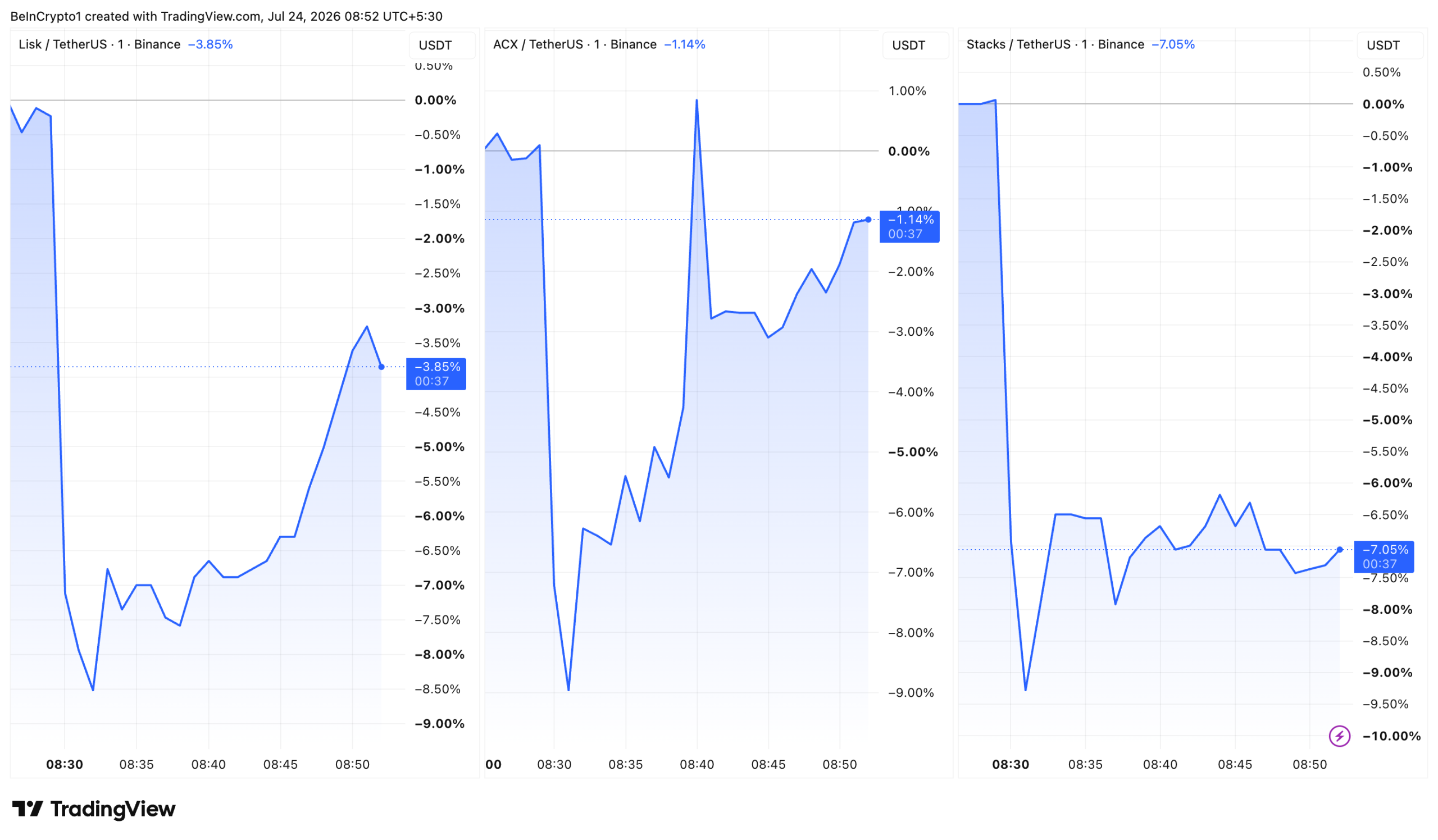
Binance added Across Protocol (ACX), Lisk (LSK), and Stacks (STX) to its Monitoring Tag on July 24, signaling all three now carry delisting risk on the world’s largest crypto exchange.
The tag marks tokens that show higher volatility and risk than other listed assets. Binance reviews these projects regularly and can delist them if they fail to meet its criteria.
Why the Binance Monitoring Tag Matters
The Monitoring Tag is Binance’s warning system for assets it deems higher risk. It does not remove a token right away.
Instead, it puts projects on notice. Binance weighs team commitment, development activity, trading volume, network stability, and tokenomics changes during each review. Evidence of fraud or negligence can also trigger the tag.
“These tokens are closely monitored, with regular reviews conducted. Keep in mind that tokens with the Monitoring Tag are at risk of no longer meeting our listing criteria and being delisted from the platform,” the exchange said.
Follow us on X to get the latest news as it happens
Token Prices Slide Amid Binance Delisting Threat
All three tokens fell sharply after the news before paring some losses. Lisk dropped to $0.074 on Binance, an all-time low.

At press time, LSK traded down 3.85% on the day. Across Protocol slid to an intraday low of $0.035, its weakest level since March.
ACX had recovered to a 1.14% loss by press time. Stacks fell to an intraday low of $0.143, its lowest since late 2020. STX showed the steepest drop of the three, down 7.05% at press time.
The tag does not guarantee removal. Still, it serves as a warning signal. The exchange added it to Beefy.Finance (BIFI) and Measurable Data Token (MDT) in June 2025.
FunToken (FUN) and Orchid (OXT) received it in March 2026. All four were confirmed for delisting from Binance in April 2026, alongside FIO Protocol (FIO) and Wanchain (WAN).
Subscribe to our YouTube channel to watch leaders and journalists provide expert insights
The post 3 Altcoins Decline as Binance Flags Delisting Risk appeared first on BeInCrypto.

A federal court is set to review whether a $5 million settlement between the US Commodity Futures Trading Commission (CFTC) and Gemini should be reversed, even as Gemini co-founder Cameron and Tyler Winklevoss have directed substantial Bitcoin donations to political groups supporting President Donald Trump. The latest development comes from a new disclosure by the MAGA Inc. Super PAC.
In a Federal Election Commission (FEC) filing dated Monday, MAGA Inc. Super PAC reported receiving two Bitcoin contributions exceeding $5 million each on June 19—totaling $10 million in BTC—sent by the Winklevoss-run Gemini Trust Company. The donation timing overlaps with the period when the CFTC and Gemini are seeking to revisit the earlier enforcement outcome in federal court.
Key takeaways
- MAGA Inc. Super PAC’s July FEC report says Gemini Trust Company sent two Bitcoin contributions of more than $5 million each on June 19.
- The payments were made about three weeks after the CFTC and Gemini jointly filed a motion to reverse a January 2025 settlement.
- CFTC Chair Michael Selig previously characterized the original enforcement as politically targeted under the prior administration.
- A CFTC spokesperson told Cointelegraph in June that, if the court grants relief, the $5 million penalty would not be returned to Gemini.
- Separately, lawmakers have pushed the Trump White House to nominate additional CFTC commissioners as the agency prepares to oversee broader crypto-market rules.
Bitcoin donations disclosed amid court fight over Gemini settlement
According to the MAGA Inc. Super PAC report filed with the FEC, Gemini Trust Company made two separate transfers of Bitcoin on June 19. Each contribution was valued at more than $5 million, bringing the disclosed total to $10 million.
The filing indicates the super PAC can use the funds for independent expenditures supporting Trump. That matters because super PAC spending can influence elections indirectly—by funding advertising and other political activities—rather than making direct coordination with candidates.
The June 19 contributions came roughly three weeks after the CFTC and Gemini jointly moved in federal court to revisit a settlement dated to January 2025. In that earlier case, the CFTC alleged Gemini made false or misleading statements. The current joint filing seeks a reversal of that settlement in the US District Court for the Southern District of New York.
When the CFTC and Gemini filed their joint motion, Cointelegraph reported that CFTC Chair Michael Selig argued at the time that the enforcement during the Biden administration “politically targeted” the Winklevosses. The broader implication is that the dispute is not only about legal interpretation of statements, but also about whether the CFTC’s enforcement posture should be treated as politically motivated.
What’s known about the CFTC-Gemini motion—and what remains unanswered
While the joint motion was filed in May, Cointelegraph reported that no decision has yet been posted to the public docket. That means the court’s view on whether the settlement should be reversed is still pending.
Cointelegraph also said it reached out to the CFTC and Gemini’s counsel, Avi Perry, for comment on the $10 million contribution but did not receive an immediate response. A CFTC spokesperson, however, provided context in June about the penalty outcome: both sides “agreed that the $5 million penalty will not be returned to Gemini” if the court grants the reversal.
This point is important for market watchers because it separates two possible outcomes. Even if the settlement is overturned, the agency’s position (as relayed by a spokesperson) suggests the immediate financial consequence may not change in Gemini’s favor. In other words, the court fight may affect precedent or regulatory record more than it affects the transfer of funds already paid.
The dispute is occurring as crypto regulation in the US continues to evolve—especially around how regulators determine what constitutes improper statements and how they translate market-facing communications into enforcement actions.
Winklevoss political support spans multiple BTC donations
The MAGA Inc. disclosure is the latest entry in a broader pattern of political involvement by the Winklevoss brothers and Gemini leadership.
Cointelegraph reported that both brothers donated $1 million each to Trump’s 2024 election campaign and supported the then-candidate through social media posts. After Trump took office in January 2025, the twins attended a stablecoin payments bill signing ceremony for the GENIUS Act. They also supported American Bitcoin, a crypto mining venture associated with Trump’s sons, and contributed $21 million in Bitcoin to the Digital Freedom Fund PAC, according to earlier coverage.
These actions do not establish any legal relationship to the CFTC-Gemini case on their own. But they do intensify political attention on the timing and dynamics between regulatory enforcement, court strategy, and high-profile political backing—particularly when lawmakers are already debating the degree of independence regulators should maintain.
Concerns from lawmakers and a CFTC shaped by a lone chair
Criticism of the CFTC’s joint approach to reversal has come from members of Congress. Cointelegraph reported that Senator Elizabeth Warren, in a June letter to CFTC Chair Selig, described the joint motion for reversal and other factors as “concerning signs” of a commission influenced by political pressures and aligned interests, rather than governed strictly by rule of law and a duty to protect investors and market integrity.
At the same time, the CFTC’s internal composition remains a central policy issue. Cointelegraph noted that Selig remains the sole commissioner leading the agency, with no additional nominations announced as of Thursday. The CFTC is usually governed by a bipartisan set of five commissioners, so a one-person board structure can shape both enforcement priorities and how quickly the agency can adopt new regulatory approaches.
Many lawmakers have been urging the Trump administration to nominate additional commissioners. That pressure coincides with congressional work on crypto market structure legislation, including the Digital Asset Market Clarity (CLARITY) Act, which—per Cointelegraph’s reporting—is expected to expand the CFTC’s authority in regulating and overseeing digital assets.
With the White House not yet announcing nominations, Selig effectively directs the agency’s agenda for now. That matters to investors and market participants because the CFTC’s leadership and regulatory posture can influence which enforcement theories are pursued, how compliance expectations are interpreted, and what rulemaking momentum looks like in practice.
Separately, Cointelegraph reported that as of June 30, MAGA Inc. had received more than $397 million. That figure underscores the scale of political fundraising activity around the election cycle, even as individual disclosures like the June 19 BTC transfers keep drawing scrutiny to the intersection of crypto wealth, regulation, and politics.
As the court considers whether the Gemini settlement should be reversed, the key watchpoints are whether the docket produces a ruling soon, how the CFTC frames the reversal in legal terms if relief is granted, and whether additional CFTC commissioner nominations are announced—developments that could determine how aggressively the agency’s crypto oversight evolves next.

Japan is moving closer to allowing Bitcoin exchange-traded funds (ETFs). The country’s first product could potentially arrive in 2028 if planned regulatory changes move forward, according to the latest Nikkei report.
The development comes after amendments approved by lawmakers that bring crypto assets under the Financial Instruments and Exchange Act, prompting the Financial Services Agency (FSA) to begin revising investment-fund rules so investment trusts and ETFs can directly hold digital assets.
The transition also means that crypto oversight will move away from the Payment Services Act.
Bitcoin ETF Momentum Builds in Japan
Some estimates suggest Japanese Bitcoin ETFs could attract up to JPY 3 trillion by fiscal 2028. However, it is important to note that no such investment vehicle has been cleared for launch. Before any such product reaches the market, Japan must complete further regulatory revisions to permit funds offering exposure to crypto assets. Major financial firms such as SBI Holdings and Nomura are reportedly developing crypto investment products.
Community reaction was quick. One member said that the development is a “quiet policy U-turn” for Japan, which had taken a cautious approach to the industry since the collapse of Mt. Gox. A regulated spot Bitcoin ETF could eventually provide Asian investors with an easier way to gain exposure to the asset and end up influencing other countries in the region, such as South Korea, which often looks to Tokyo when shaping financial policies.
Meanwhile, the new legislation imposes harsher penalties on unregistered crypto operators. The maximum prison term has increased from three years to 10 years, while the highest fine has been raised from 3 million yen ($18,500) to 10 million yen. It also expands disclosure requirements and introduces stricter insider trading rules.
Corporate Adoption
The regulatory push also comes as corporate interest in the asset class continues to grow in Japan. Earlier this month, SBI VC Trade said more companies are adding not just Bitcoin but also XRP to their treasury holdings as the weakening yen encourages businesses to diversify their reserves. The exchange also reported higher adoption of crypto for shareholder benefit programs and growing demand for its institutional services.
Japan remains one of XRP’s strongest markets, with SBI playing a crucial role through its partnership with Ripple on cross-border payments. It recently launched Ripple’s RLUSD stablecoin after regulatory approval and has filed for a product that could become the country’s first XRP ETF.
The post Bitcoin ETFs Edge Closer in Japan as Regulators Tighten Crypto Oversight appeared first on CryptoPotato.
Crypto World
Wall Street Analyst Says AI Spending Arms Race Is at 15% After Tesla and Google Selloff


Wedbush Securities managing director Dan Ives says the artificial intelligence spending buildout is still in its early stages. He pushed back against Thursday’s selloff in Tesla and Alphabet shares.
Ives made the case on CNBC’s “Power Lunch.” Both companies had just posted revenue beats, yet investors punished them for heavier AI capital spending.
“Only 15% of the Way Through”
Ives called the pullback a timing problem, not a valuation problem. Tesla (TSLA) stock fell 14.5% Thursday. Alphabet (GOOGL) slid nearly 7%, even though Google Cloud revenue jumped 82% to $24.8 billion. Ives said:
“This is an arms race that’s playing out and we’re only 15% of the way through.”
He likened the hyperscalers’ spending to early Las Vegas Strip construction. The buildings came first, he argued, and the payoff followed later. That framing runs counter to growing AI bubble fears elsewhere in tech.
Patience Wearing Thin, Not Broken
On Tesla specifically, Ives said investor patience is fading. The AI story, autonomous driving, and Optimus robotics haven’t delivered near-term payoff yet. He called Tesla’s capex spending a “gut check moment” rather than grounds to abandon the thesis.
Ives also weighed in on Musk’s broader corporate structure. He estimates better-than-80% odds that SpaceX eventually acquires Tesla, running ahead of the market. Kalshi’s prediction market currently prices around a 69% chance of a merger before 2028.
Intel reported earnings the same evening. Ives’ framing sets up a real test for next week’s Big Tech reports. Investors will find out soon whether demand data backs his “early innings” call or the market’s more skeptical read wins out.
The post Wall Street Analyst Says AI Spending Arms Race Is at 15% After Tesla and Google Selloff appeared first on BeInCrypto.


Jim Cramer laid out a framework for judging stock market crashes on Mad Money on Thursday. He said most selloffs are mechanical malfunctions worth buying, while only a handful pose real economic threats.
Cramer, the CNBC host who has traded through four decades of market cycles, compared three events to make his case. He cited Black Monday in 1987, the 2010 flash crash and the 2007-2009 financial crisis.
Mechanical Selloffs Look Scarier Than They Are
Cramer pointed to the Dow Jones Industrial Average’s 508-point drop on October 19, 1987, as his clearest example. That 22.6% single-day plunge became known as Black Monday.
He blamed a flawed hedging strategy called portfolio insurance for turning a bad week into a historic crash. The strategy used futures contracts to try to cap losses automatically.
He reached a similar conclusion about the 2010 flash crash. The Dow fell nearly 1,000 points in about 36 minutes on May 6, 2010. It recovered most of that loss the same day.
Cramer said a nearly identical pattern played out during the market’s sharp opening plunge in August 2015. He blamed futures-market malfunctions, not weakening fundamentals, for both events.
Systemic Crises Demand a Different Read
Cramer called the 2007-2009 financial crisis a different animal entirely. The Dow fell from its October 2007 peak above 14,000 to roughly 6,470 by early March 2009. That marked a decline of more than 54%. The index did not fully recover until 2013.
Cramer, whose own market calls have had mixed results recently, said the difference comes down to real economic damage. He cited failing banks, rising job losses and a Federal Reserve that moved too slowly at first. He credited the Fed’s later shift toward aggressive intervention with helping the market eventually find its footing.
Cramer’s takeaway is straightforward. Investors should check whether a selloff coincides with genuine economic deterioration before assuming the worst. Mechanical declines have historically reversed within months, while systemic ones can take years.
The post Jim Cramer Shares His Framework for Telling a Buyable Crash From a Real One appeared first on BeInCrypto.

Bitcoin may be nearing a more stable trading base, but at least one prominent asset manager says investors shouldn’t pin the next major upside cycle on the same drivers that defined earlier booms. In a new write-up, Bitwise chief investment officer Matt Hougan argues that the next bull market will be powered by deeper TradFi-to-crypto integration—specifically by platforms that can bring crypto’s 24/7 trading features into mainstream financial workflows.
Hougan points to Hyperliquid’s widening footprint and Robinhood’s push into crypto infrastructure as two concrete examples. In parallel, Bitwise data cited by Hougan and a separate X post from Bitwise research head Andre Dragosch suggest that “apparent demand” for BTC may be starting to improve after a prolonged period of weakness.
Key takeaways
- Matt Hougan (Bitwise) says the next crypto bull market is more likely to be driven by TradFi integrations than by purely crypto-native catalysts.
- He highlights Hyperliquid’s growing use cases across conventional assets and product expansion as a sign of broader convergence.
- Hougan sees Robinhood-related infrastructure as another bridge that could help “lift” a wide range of crypto assets.
- Bitwise’s framework for “apparent demand” indicates BTC demand may be “re-accelerating,” even as spot demand remains a recurring concern.
Why Bitwise thinks the next cycle starts in TradFi
Hougan framed his positioning thesis around the idea that the market’s next sustained expansion will come from crypto benefits becoming easier to access for traditional investors. In a blog post published Wednesday, he asked how to begin positioning for what he expects to be a new bull market and answered with a pair of entities he believes represent convergence from opposite directions.
“By looking at two entities that are leading this convergence from opposite sides: Hyperliquid and Robinhood.”
The underlying premise is that crypto’s structure—particularly constant markets and instant settlement—creates advantages that traditional finance has historically lacked. For Hougan, the key question is not whether Bitcoin will bottom, but whether new demand channels will be able to scale once mainstream firms and familiar interfaces adopt crypto trading patterns.
On Hyperliquid, Hougan emphasized that the platform’s activity is not confined to crypto pairs. According to his description, nearly half of Hyperliquid’s volume is tied to “conventional assets like oil, silver, and the S&P 500,” and the venue is reportedly expanding into spot commodities, prediction markets, and options.
That mix matters because it signals an appetite for trading experiences that look and feel familiar while still operating with crypto-native mechanics. If those flows continue to grow, Hougan argues that the effect should reach beyond isolated tokens and instead support the broader sector.
The “rising tide” thesis for majors and crypto equities
Hougan also ties his outlook to the competitive pressure from traditional financial players entering the crypto ecosystem through infrastructure and distribution. He referenced Robinhood’s “Chain layer-2 network” as an example of how legacy finance might become more directly connected to crypto market dynamics.
“I suspect the coming bull market will be big enough to lift most of the sector.”
From there, he lays out a portfolio-style approach: he says he remains bullish on major assets such as Bitcoin, Ethereum, and Solana, while also expressing optimism about crypto equities. The common thread in his argument is that broadening participation tends to support liquidity across the market, not just the most narrative-driven names.
Hougan’s positioning aligns with his broader tone entering 2026. Earlier this year, he argued that the end of the “crypto winter” could arrive sooner than expected, and he maintained that view while markets continued to work through weakness.
BTC: “apparent demand” shows a possible reversal
While Hougan’s thesis focuses on what could power the next cycle, the day-to-day question for traders is whether Bitcoin’s demand backdrop is stabilizing. Cointelegraph previously reported that many market participants were looking for bottoming signals, but also suggested the bear phase could still have months left depending on how spot demand evolves.
In that context, the spotlight has remained on the question of whether spot buying is returning—particularly on shorter time frames where demand can appear fragile even when longer-term conditions are improving.
However, Bitwise is pointing to a different metric that may be shifting. According to an X post on Thursday by Andre Dragosch, Bitwise’s European head of research, BTC “apparent demand” is “re-accelerating.” Dragosch’s post frames the change as a meaningful departure from the prior slowdown.
What “apparent demand” means: it measures the difference between newly mined BTC and the supply that has remained inactive for at least one year. In effect, it provides a way to infer whether recently produced coins are being absorbed rather than circulating from dormant holdings.
That distinction matters for investors because a sustained improvement in apparent demand can indicate that the market is finding new buyers—even if spot volumes are not yet fully convincing across every trading window. Still, the metric is not identical to spot demand, and it won’t resolve instantly the question of where a bottom will form on price alone.
What to watch next as TradFi integration and demand signals collide
Hougan’s argument implies that even if Bitcoin’s near-term chart shows gradual stabilization, the bigger inflection point will likely depend on how quickly mainstream access and crypto trading mechanics begin to reinforce each other. Hyperliquid’s ability to attract volume tied to conventional assets and its expansion into additional derivatives-style products could provide one path, while Robinhood-related ecosystem development is another.
At the same time, BTC investors appear to be watching for whether the “re-accelerating” apparent demand signal persists beyond a short burst. If apparent demand continues to improve while broader spot demand recovers, the market may be closer to a durable transition than “bottom” headlines alone would suggest.


On Wednesday, Senate Republicans released the proposed text for the CLARITY Act, which has been met with pushback from Democrats regarding ethics provisions.


Crypto-related “wrench attacks” continued through the first half of 2026, with 52 verified incidents worldwide and $124.1 million in recorded financial exposure, according to CertiK.
Summary
- CertiK recorded 52 wrench attacks in H1 2026, with financial exposure reaching $124.1 million worldwide.
- France accounted for 33 verified incidents as Europe became main center of physical crypto attacks.
- Home invasions rose from one to 20 cases, becoming the most common attack type recorded.
The total includes stolen funds, ransom demands, frozen assets and other values tied to documented cases, rather than only money confirmed as lost.
The number of attacks rose 33.3% from 39 cases in H1 2025. Recorded financial exposure rose much faster from about $10.5 million a year earlier. CertiK calculated a 1,079% increase, while average exposure per incident climbed from roughly $270,000 to $2.39 million.
Meanwhile, the first quarter drove most of the increase in attack frequency. CertiK recorded 35 incidents in Q1 2026, compared with 22 during the same period last year. Activity then slowed to 17 verified attacks in the second quarter, matching the Q2 2025 total.
CertiK cautioned that its financial figures are “indicative, not exhaustive.” Some victims do not report attacks, while public records may not show whether ransoms were paid, recovered or frozen. The company therefore treats the $124.1 million figure as recorded exposure rather than confirmed criminal proceeds.
The report also warned against simply doubling the first-half total to predict the full year. A repeat of the H1 pace would put 2026 near 100 verified incidents, but CertiK said the calculation is not a forecast because Q1 and Q2 showed different trends.
France accounts for most verified wrench attacks
Europe recorded 39 of the 52 verified attacks, or 75% of the global total. France alone accounted for 33 incidents in CertiK’s dataset, equal to 63.5% of all verified cases worldwide and 84.6% of Europe’s total. The U.S. recorded four incidents, while Sweden and the UK recorded two each.
The French total may be higher than CertiK’s verified public dataset. The report cited France’s National Directorate of Judicial Police as recording 41 incidents between January and March. CertiK said some cases can be classified as robbery, kidnapping, assault or extortion without a clear crypto label.
As crypto.news previously reported, France has stepped up its response. Prosecutors charged 88 suspects across 12 investigations by late April, while authorities also prepared prevention measures for crypto holders after a rise in kidnappings and home invasions.
Home invasions become the leading attack method
Home invasions showed the sharpest change. CertiK recorded 20 such incidents in H1 2026, up from one in the same period last year. The category accounted for about 41% of first-half attacks. Kidnappings increased from 12 to 16, while torture remained at four cases and murder at one.
Wrench attacks rely on physical force, threats or intimidation to make victims transfer crypto, reveal private keys or unlock wallets. This can bypass digital safeguards because an attacker targets the person controlling the assets rather than the wallet software itself.
Recent cases have also involved relatives and people close to crypto holders.The wife of The Sandbox co-founder Sébastien Borget was targeted in an attempted kidnapping in France. Other reports have described attackers using fake delivery workers to gain access to victims.
Security spending rises as threats move offline
The increase in physical attacks has pushed some crypto companies to spend more on executive protection. As previously reported by crypto.news, Coinbase spent about $8.7 million on security and protection costs linked to CEO Brian Armstrong in 2025, while Gemini agreed to pay $400,000 per month for executive protection services.
MARA also disclosed $4.3 million in security spending connected to CEO Fred Thiel, including $430,000 for vehicle armoring. These costs have grown as public executives, investors and founders face risks tied to visible crypto wealth and personal information available online.
CertiK advised holders to limit public information connecting their identity, location and routines to crypto ownership. It also recommended separating signing devices from recovery materials, using multi-party controls for large holdings and avoiding setups in which one person can instantly move all assets under pressure.
The firm also urged families to prepare emergency plans and advised high-risk users to keep sensitive accounts off devices used while traveling. For companies, it recommended tighter controls around employee and customer data, along with security reviews for executives, travel and public events.
The H1 report shows that attack frequency slowed after the first quarter, but the financial value connected to known cases remained far above last year’s level. France accounted for most verified cases, while home invasions became the most common attack method in CertiK’s dataset.


BitMEX will have removed 65 derivative contracts and trading pairs in July, compared with just 19 across the first six months of the year.


U.S. Securities and Exchange Commission Commissioner Hester Peirce has warned that some crypto vaults and onchain lending strategies may fall under federal securities laws, depending on how operators structure and manage them.
Summary
- Peirce warned crypto vaults may trigger securities laws when managers control investment decisions and strategies.
- Onchain lending can also fall under SEC rules depending on loan structure, distribution, and management.
- SEC will assess vaults and lending strategies individually rather than treating all products the same.
In a July 22 statement, Peirce said moving financial activity onchain does not remove legal duties when that activity already sits within the SEC’s regulatory scope. She urged developers and operators to examine how their products work instead of assuming blockchain technology places them outside existing law.
Peirce said the SEC has spent the past year and a half clarifying which crypto assets and activities fall under federal securities laws. She also stressed that a more tailored approach to crypto does not mean every product sits outside the agency’s reach.
“You will have a painful fall,” she said.
The warning targeted market participants who try to interpret the law in ways that exclude activities already covered by the securities framework. Peirce said companies whose products fall inside that framework should work with the SEC to find a compliant path.
Her comments build on a position she took in 2025 when she said tokenized securities remain subject to securities laws. She now applies the same principle to vaults and lending tools: moving a regulated activity to a blockchain does not change its legal character.
How crypto vaults may enter SEC jurisdiction
Crypto vaults let users deposit assets into smart contracts that direct funds toward yield-generating activities such as staking and lending. Some follow fixed rules written into code, while others give managers or curators discretion over where to place funds.
Peirce said those differences matter. A vault operator may choose strategies, move assets between opportunities or select people who make those decisions. Those functions can bring securities laws into the analysis, depending on the structure and the role of those managing the product.
A vault may resemble an investment contract when users put money into a common enterprise and expect profits from another party’s managerial work. Vaults that hold securities or invest user assets in securities may also fall under investment company rules.
The SEC will look at each arrangement individually. Some vaults may resemble unit investment trusts with mostly fixed portfolios. Others may operate more like actively managed investment companies or separately managed accounts.
Onchain lending can face securities rules too
Peirce gave a similar warning to operators of onchain lending products. These systems let users deposit assets that borrowers can use in exchange for fees or interest. Operators may set rates, choose supported assets, set loan-to-value limits and decide when liquidations occur.
Those decisions can bring securities rules into play even when the assets being lent are not securities. Peirce said some onchain loans may have features associated with notes that qualify as securities, depending on the parties’ reasons for the transaction, distribution plans and other factors.
People who manage vaults or lending strategies may also need to consider investment adviser rules. The SEC will assess each product based on its specific facts and circumstances while staying within the authority Congress gave the agency.
The statement also connects with the SEC’s wider work on tokenized markets. As crypto.news previously reported, Peirce pushed back against expectations that the agency’s planned innovation exemption would open the door to every form of tokenized stock trading.
SEC keeps a case-by-case approach as crypto rules evolve
Peirce did not call for a ban on crypto vaults or onchain lending. Instead, she invited developers and operators to contact the SEC when they are unsure whether their products fall under federal securities laws. She also asked the industry to suggest rule changes where current regulations block new technology.
The statement comes as the SEC continues reviewing tokenization. On July 22, securities transfer groups urged the agency to favor issuer-backed tokenized stocks and draw clearer lines around third-party products that may not provide direct ownership rights.
Meanwhile, as previously reported, Peirce plans to leave the SEC in November to join Regent University School of Law. She has led the Crypto Task Force since January 2025 while the agency has worked on token status, registration and market structure.
Lawmakers are also working on the CLARITY Act, which aims to define the roles of the SEC and Commodity Futures Trading Commission across digital asset markets. The legislation remains part of the wider debate over how U.S. regulators should divide oversight of crypto activities.
Peirce’s statement leaves room for crypto vaults and lending strategies outside SEC jurisdiction. It also makes clear that blockchain technology alone does not remove federal securities duties when a product performs functions already covered by those laws.

My wee boy was mowed down by a dangerous e-bike rider – we need to clamp down on these thugs

3 Altcoins Decline as Binance Flags Delisting Risk

WWE officials reportedly unhappy with major Saturday Night’s Main Event decision


-

 Fashion6 days ago
Weekend Open Thread – Corporette.com
-

 Politics6 days ago
The House | The City of London can help the new chancellor deliver growth in every postcode
-

 Crypto World6 days ago
Ripple Payments Joins MiCA With 14 Firms, Does It Mean Anything For XRP?
-
 Crypto World7 days ago
Two July Windows Left: The CLARITY Act’s Senate Fight and What Failure Means
-

 Politics5 days ago
Democrats look to World Cup watch parties to register thousands of voters
-

 Crypto World6 days ago
Ripple wins EU-wide access as ESMA adds it to MiCA register
-

 Crypto World3 days ago
Grayscale Files For Worldcoin ETF, WLD Registers Sharp Rise
-

 NewsBeat4 days ago
Unregistered fitter used Gas Safe logo on business flyers
-

 Tech3 days ago
Sail Virtually Aboard The “Itanic” With IA-64 Emulator
-
 Tech3 days ago
Turtle Beach Command Series KB7 review: a nifty screen-equipped gaming keyboard
-

 NewsBeat7 days ago
Registration is now open for March for Men with Kev 2026
-

 News Videos4 days ago
Big Money Is Entering XRP
-
 Business2 days ago
New Jersey voter registration controversy explained: How 6,600 noncitizens got on the rolls, and what happens next
-

 News Videos7 days ago
Money | Class 12 Economics | CBSE Board Exam 2026-27
-

 Crypto World6 days ago
Kaspersky exposes OkoBot’s 20-module crypto wallet attack
-

 Business6 days ago
Airlines warn Sunshine Protection Act could disrupt flight scheduling
-
 Entertainment2 days ago
Johnny Depp’s R-Rated Gothic Cult Classic Gets New Release Ahead of Sydney Sweeney Remake
-

 NewsBeat6 days ago
Durham County Council to send out electoral registration emails
-

 Crypto World6 days ago
MiCA Licensing Faces Delays as ESMA Adds 14 CASPs to Register
-

 Crypto World6 days ago
Chip Stocks Enter Bear Market After Moonshot Ai Unveils Kimi K3 Model
You must be logged in to post a comment Login