

Crypto World
Why did The Smarter Web Company sell 177.89 Bitcoin?



The Smarter Web Company has repaid its $11.7 million Smarter Convert instrument ahead of schedule by selling 177.89 Bitcoin, removing a potential 7.7 million-share issuance while retaining a treasury of 2,700 BTC.
Summary
- The Smarter Web Company repaid its $11.7 million Smarter Convert instrument about two weeks before maturity by selling 177.89 Bitcoin.
- The early repayment removed the potential issuance of more than 7.7 million ordinary shares linked to the financing structure.
- The company continues to hold 2,700 Bitcoin and said convertible instruments are no longer its preferred source of capital.
According to an official announcement from The Smarter Web Company, the London-listed firm settled its Smarter Convert instrument around two weeks before maturity after requesting an early repayment with the support of investment manager TOBAM, whose affiliated entities held the instrument.
The company said it repaid $11,698,540 by disposing of 177.8909127 BTC at an average sale price of $65,762 per coin. The Bitcoin sold represented the holdings originally acquired through the proceeds of the Smarter Convert financing.
Under the original agreement announced in August 2025, at least 98% of the subscription proceeds had to be invested in Bitcoin. The company said it instead allocated the full amount into Bitcoin, making it responsible for returning all of the Bitcoin purchased with those funds when the instrument was repaid.
With the repayment completed, the company said the potential issuance of 7,718,551 ordinary shares linked to the Smarter Convert structure has been eliminated. It also removed those potential shares, along with the 177.8909127 BTC used for repayment, from its fully diluted Bitcoin treasury analytics.
Following the transaction, The Smarter Web Company said it now holds 2,700 BTC.
Company moves away from convertible structure
Chief executive Andrew Webley said the Smarter Convert instrument had provided an alternative source of financing when the company was still building its Bitcoin treasury strategy.
According to Webley, the structure helped strengthen the balance sheet while preserving financial flexibility during the early stages of the company’s Bitcoin accumulation plan. He added that although the company continues to recognize the value of both fiat and Bitcoin-denominated convertible instruments, it no longer considers them the right funding option for its current stage of development.
Webley also thanked TOBAM for supporting the structure and helping develop the financing arrangement.
The repayment comes after the company spent much of 2025 expanding its Bitcoin reserves through repeated purchases under what it calls its “10 Year Plan.”
Earlier in September 2025, The Smarter Web Company appointed Coinbase Institutional as an additional Bitcoin custody partner to work alongside its existing custodians through Coinbase Prime. At the time, the company said the multi-custodian approach was intended to strengthen security, improve risk management, and support the continued growth of its Bitcoin treasury.
When announcing that partnership, the company held 2,470 BTC, following a 30 BTC purchase completed earlier that month.
By October 2025, the company had increased its treasury to 2,650 BTC after acquiring another 100 BTC for approximately £9.08 million ($12.1 million). The purchase formed part of the same long-term accumulation strategy, which management has described as a core element of its corporate treasury policy.
The latest repayment indicates that the company continued adding Bitcoin after October, as its holdings now stand at 2,700 BTC despite disposing of nearly 178 BTC to settle the Smarter Convert obligation.
Bitcoin strategy remains in place
Although the financing structure has now been retired, the announcement does not indicate any change to the company’s long-term Bitcoin treasury strategy.
The Smarter Web Company has repeatedly said it intends to continue building its Bitcoin reserves under its 10 Year Plan. Earlier in 2025, it also raised £17.5 million to support additional Bitcoin purchases while expanding the infrastructure around its treasury operations.
Previous company announcements described the firm as the UK’s largest publicly traded Bitcoin-holding company. It has also climbed the global rankings of corporate Bitcoin holders during the past year as it continued increasing its reserves through regular acquisitions.
The removal of the convertible instrument also simplifies the company’s capital structure by eliminating millions of potential new shares that could have been issued under the agreement. Instead of leaving the instrument outstanding until maturity, the company chose to repay it early using the Bitcoin originally purchased with the financing proceeds.
With the repayment complete, The Smarter Web Company has closed one of the financing arrangements used during the early phase of its Bitcoin treasury expansion while continuing to hold 2,700 BTC on its balance sheet.

Crypto World
Wall Street Analyst Says AI Spending Arms Race Is at 15% After Tesla and Google Selloff


Wedbush Securities managing director Dan Ives says the artificial intelligence spending buildout is still in its early stages. He pushed back against Thursday’s selloff in Tesla and Alphabet shares.
Ives made the case on CNBC’s “Power Lunch.” Both companies had just posted revenue beats, yet investors punished them for heavier AI capital spending.
“Only 15% of the Way Through”
Ives called the pullback a timing problem, not a valuation problem. Tesla (TSLA) stock fell 14.5% Thursday. Alphabet (GOOGL) slid nearly 7%, even though Google Cloud revenue jumped 82% to $24.8 billion. Ives said:
“This is an arms race that’s playing out and we’re only 15% of the way through.”
He likened the hyperscalers’ spending to early Las Vegas Strip construction. The buildings came first, he argued, and the payoff followed later. That framing runs counter to growing AI bubble fears elsewhere in tech.
Patience Wearing Thin, Not Broken
On Tesla specifically, Ives said investor patience is fading. The AI story, autonomous driving, and Optimus robotics haven’t delivered near-term payoff yet. He called Tesla’s capex spending a “gut check moment” rather than grounds to abandon the thesis.
Ives also weighed in on Musk’s broader corporate structure. He estimates better-than-80% odds that SpaceX eventually acquires Tesla, running ahead of the market. Kalshi’s prediction market currently prices around a 69% chance of a merger before 2028.
Intel reported earnings the same evening. Ives’ framing sets up a real test for next week’s Big Tech reports. Investors will find out soon whether demand data backs his “early innings” call or the market’s more skeptical read wins out.
The post Wall Street Analyst Says AI Spending Arms Race Is at 15% After Tesla and Google Selloff appeared first on BeInCrypto.


Jim Cramer laid out a framework for judging stock market crashes on Mad Money on Thursday. He said most selloffs are mechanical malfunctions worth buying, while only a handful pose real economic threats.
Cramer, the CNBC host who has traded through four decades of market cycles, compared three events to make his case. He cited Black Monday in 1987, the 2010 flash crash and the 2007-2009 financial crisis.
Mechanical Selloffs Look Scarier Than They Are
Cramer pointed to the Dow Jones Industrial Average’s 508-point drop on October 19, 1987, as his clearest example. That 22.6% single-day plunge became known as Black Monday.
He blamed a flawed hedging strategy called portfolio insurance for turning a bad week into a historic crash. The strategy used futures contracts to try to cap losses automatically.
He reached a similar conclusion about the 2010 flash crash. The Dow fell nearly 1,000 points in about 36 minutes on May 6, 2010. It recovered most of that loss the same day.
Cramer said a nearly identical pattern played out during the market’s sharp opening plunge in August 2015. He blamed futures-market malfunctions, not weakening fundamentals, for both events.
Systemic Crises Demand a Different Read
Cramer called the 2007-2009 financial crisis a different animal entirely. The Dow fell from its October 2007 peak above 14,000 to roughly 6,470 by early March 2009. That marked a decline of more than 54%. The index did not fully recover until 2013.
Cramer, whose own market calls have had mixed results recently, said the difference comes down to real economic damage. He cited failing banks, rising job losses and a Federal Reserve that moved too slowly at first. He credited the Fed’s later shift toward aggressive intervention with helping the market eventually find its footing.
Cramer’s takeaway is straightforward. Investors should check whether a selloff coincides with genuine economic deterioration before assuming the worst. Mechanical declines have historically reversed within months, while systemic ones can take years.
The post Jim Cramer Shares His Framework for Telling a Buyable Crash From a Real One appeared first on BeInCrypto.

Bitcoin may be nearing a more stable trading base, but at least one prominent asset manager says investors shouldn’t pin the next major upside cycle on the same drivers that defined earlier booms. In a new write-up, Bitwise chief investment officer Matt Hougan argues that the next bull market will be powered by deeper TradFi-to-crypto integration—specifically by platforms that can bring crypto’s 24/7 trading features into mainstream financial workflows.
Hougan points to Hyperliquid’s widening footprint and Robinhood’s push into crypto infrastructure as two concrete examples. In parallel, Bitwise data cited by Hougan and a separate X post from Bitwise research head Andre Dragosch suggest that “apparent demand” for BTC may be starting to improve after a prolonged period of weakness.
Key takeaways
- Matt Hougan (Bitwise) says the next crypto bull market is more likely to be driven by TradFi integrations than by purely crypto-native catalysts.
- He highlights Hyperliquid’s growing use cases across conventional assets and product expansion as a sign of broader convergence.
- Hougan sees Robinhood-related infrastructure as another bridge that could help “lift” a wide range of crypto assets.
- Bitwise’s framework for “apparent demand” indicates BTC demand may be “re-accelerating,” even as spot demand remains a recurring concern.
Why Bitwise thinks the next cycle starts in TradFi
Hougan framed his positioning thesis around the idea that the market’s next sustained expansion will come from crypto benefits becoming easier to access for traditional investors. In a blog post published Wednesday, he asked how to begin positioning for what he expects to be a new bull market and answered with a pair of entities he believes represent convergence from opposite directions.
“By looking at two entities that are leading this convergence from opposite sides: Hyperliquid and Robinhood.”
The underlying premise is that crypto’s structure—particularly constant markets and instant settlement—creates advantages that traditional finance has historically lacked. For Hougan, the key question is not whether Bitcoin will bottom, but whether new demand channels will be able to scale once mainstream firms and familiar interfaces adopt crypto trading patterns.
On Hyperliquid, Hougan emphasized that the platform’s activity is not confined to crypto pairs. According to his description, nearly half of Hyperliquid’s volume is tied to “conventional assets like oil, silver, and the S&P 500,” and the venue is reportedly expanding into spot commodities, prediction markets, and options.
That mix matters because it signals an appetite for trading experiences that look and feel familiar while still operating with crypto-native mechanics. If those flows continue to grow, Hougan argues that the effect should reach beyond isolated tokens and instead support the broader sector.
The “rising tide” thesis for majors and crypto equities
Hougan also ties his outlook to the competitive pressure from traditional financial players entering the crypto ecosystem through infrastructure and distribution. He referenced Robinhood’s “Chain layer-2 network” as an example of how legacy finance might become more directly connected to crypto market dynamics.
“I suspect the coming bull market will be big enough to lift most of the sector.”
From there, he lays out a portfolio-style approach: he says he remains bullish on major assets such as Bitcoin, Ethereum, and Solana, while also expressing optimism about crypto equities. The common thread in his argument is that broadening participation tends to support liquidity across the market, not just the most narrative-driven names.
Hougan’s positioning aligns with his broader tone entering 2026. Earlier this year, he argued that the end of the “crypto winter” could arrive sooner than expected, and he maintained that view while markets continued to work through weakness.
BTC: “apparent demand” shows a possible reversal
While Hougan’s thesis focuses on what could power the next cycle, the day-to-day question for traders is whether Bitcoin’s demand backdrop is stabilizing. Cointelegraph previously reported that many market participants were looking for bottoming signals, but also suggested the bear phase could still have months left depending on how spot demand evolves.
In that context, the spotlight has remained on the question of whether spot buying is returning—particularly on shorter time frames where demand can appear fragile even when longer-term conditions are improving.
However, Bitwise is pointing to a different metric that may be shifting. According to an X post on Thursday by Andre Dragosch, Bitwise’s European head of research, BTC “apparent demand” is “re-accelerating.” Dragosch’s post frames the change as a meaningful departure from the prior slowdown.
What “apparent demand” means: it measures the difference between newly mined BTC and the supply that has remained inactive for at least one year. In effect, it provides a way to infer whether recently produced coins are being absorbed rather than circulating from dormant holdings.
That distinction matters for investors because a sustained improvement in apparent demand can indicate that the market is finding new buyers—even if spot volumes are not yet fully convincing across every trading window. Still, the metric is not identical to spot demand, and it won’t resolve instantly the question of where a bottom will form on price alone.
What to watch next as TradFi integration and demand signals collide
Hougan’s argument implies that even if Bitcoin’s near-term chart shows gradual stabilization, the bigger inflection point will likely depend on how quickly mainstream access and crypto trading mechanics begin to reinforce each other. Hyperliquid’s ability to attract volume tied to conventional assets and its expansion into additional derivatives-style products could provide one path, while Robinhood-related ecosystem development is another.
At the same time, BTC investors appear to be watching for whether the “re-accelerating” apparent demand signal persists beyond a short burst. If apparent demand continues to improve while broader spot demand recovers, the market may be closer to a durable transition than “bottom” headlines alone would suggest.


On Wednesday, Senate Republicans released the proposed text for the CLARITY Act, which has been met with pushback from Democrats regarding ethics provisions.


Crypto-related “wrench attacks” continued through the first half of 2026, with 52 verified incidents worldwide and $124.1 million in recorded financial exposure, according to CertiK.
Summary
- CertiK recorded 52 wrench attacks in H1 2026, with financial exposure reaching $124.1 million worldwide.
- France accounted for 33 verified incidents as Europe became main center of physical crypto attacks.
- Home invasions rose from one to 20 cases, becoming the most common attack type recorded.
The total includes stolen funds, ransom demands, frozen assets and other values tied to documented cases, rather than only money confirmed as lost.
The number of attacks rose 33.3% from 39 cases in H1 2025. Recorded financial exposure rose much faster from about $10.5 million a year earlier. CertiK calculated a 1,079% increase, while average exposure per incident climbed from roughly $270,000 to $2.39 million.
Meanwhile, the first quarter drove most of the increase in attack frequency. CertiK recorded 35 incidents in Q1 2026, compared with 22 during the same period last year. Activity then slowed to 17 verified attacks in the second quarter, matching the Q2 2025 total.
CertiK cautioned that its financial figures are “indicative, not exhaustive.” Some victims do not report attacks, while public records may not show whether ransoms were paid, recovered or frozen. The company therefore treats the $124.1 million figure as recorded exposure rather than confirmed criminal proceeds.
The report also warned against simply doubling the first-half total to predict the full year. A repeat of the H1 pace would put 2026 near 100 verified incidents, but CertiK said the calculation is not a forecast because Q1 and Q2 showed different trends.
France accounts for most verified wrench attacks
Europe recorded 39 of the 52 verified attacks, or 75% of the global total. France alone accounted for 33 incidents in CertiK’s dataset, equal to 63.5% of all verified cases worldwide and 84.6% of Europe’s total. The U.S. recorded four incidents, while Sweden and the UK recorded two each.
The French total may be higher than CertiK’s verified public dataset. The report cited France’s National Directorate of Judicial Police as recording 41 incidents between January and March. CertiK said some cases can be classified as robbery, kidnapping, assault or extortion without a clear crypto label.
As crypto.news previously reported, France has stepped up its response. Prosecutors charged 88 suspects across 12 investigations by late April, while authorities also prepared prevention measures for crypto holders after a rise in kidnappings and home invasions.
Home invasions become the leading attack method
Home invasions showed the sharpest change. CertiK recorded 20 such incidents in H1 2026, up from one in the same period last year. The category accounted for about 41% of first-half attacks. Kidnappings increased from 12 to 16, while torture remained at four cases and murder at one.
Wrench attacks rely on physical force, threats or intimidation to make victims transfer crypto, reveal private keys or unlock wallets. This can bypass digital safeguards because an attacker targets the person controlling the assets rather than the wallet software itself.
Recent cases have also involved relatives and people close to crypto holders.The wife of The Sandbox co-founder Sébastien Borget was targeted in an attempted kidnapping in France. Other reports have described attackers using fake delivery workers to gain access to victims.
Security spending rises as threats move offline
The increase in physical attacks has pushed some crypto companies to spend more on executive protection. As previously reported by crypto.news, Coinbase spent about $8.7 million on security and protection costs linked to CEO Brian Armstrong in 2025, while Gemini agreed to pay $400,000 per month for executive protection services.
MARA also disclosed $4.3 million in security spending connected to CEO Fred Thiel, including $430,000 for vehicle armoring. These costs have grown as public executives, investors and founders face risks tied to visible crypto wealth and personal information available online.
CertiK advised holders to limit public information connecting their identity, location and routines to crypto ownership. It also recommended separating signing devices from recovery materials, using multi-party controls for large holdings and avoiding setups in which one person can instantly move all assets under pressure.
The firm also urged families to prepare emergency plans and advised high-risk users to keep sensitive accounts off devices used while traveling. For companies, it recommended tighter controls around employee and customer data, along with security reviews for executives, travel and public events.
The H1 report shows that attack frequency slowed after the first quarter, but the financial value connected to known cases remained far above last year’s level. France accounted for most verified cases, while home invasions became the most common attack method in CertiK’s dataset.


BitMEX will have removed 65 derivative contracts and trading pairs in July, compared with just 19 across the first six months of the year.
U.S. Securities and Exchange Commission Commissioner Hester Peirce has warned that some crypto vaults and onchain lending strategies may fall under federal securities laws, depending on how operators structure and manage them.
Summary
- Peirce warned crypto vaults may trigger securities laws when managers control investment decisions and strategies.
- Onchain lending can also fall under SEC rules depending on loan structure, distribution, and management.
- SEC will assess vaults and lending strategies individually rather than treating all products the same.
In a July 22 statement, Peirce said moving financial activity onchain does not remove legal duties when that activity already sits within the SEC’s regulatory scope. She urged developers and operators to examine how their products work instead of assuming blockchain technology places them outside existing law.
Peirce said the SEC has spent the past year and a half clarifying which crypto assets and activities fall under federal securities laws. She also stressed that a more tailored approach to crypto does not mean every product sits outside the agency’s reach.
“You will have a painful fall,” she said.
The warning targeted market participants who try to interpret the law in ways that exclude activities already covered by the securities framework. Peirce said companies whose products fall inside that framework should work with the SEC to find a compliant path.
Her comments build on a position she took in 2025 when she said tokenized securities remain subject to securities laws. She now applies the same principle to vaults and lending tools: moving a regulated activity to a blockchain does not change its legal character.
How crypto vaults may enter SEC jurisdiction
Crypto vaults let users deposit assets into smart contracts that direct funds toward yield-generating activities such as staking and lending. Some follow fixed rules written into code, while others give managers or curators discretion over where to place funds.
Peirce said those differences matter. A vault operator may choose strategies, move assets between opportunities or select people who make those decisions. Those functions can bring securities laws into the analysis, depending on the structure and the role of those managing the product.
A vault may resemble an investment contract when users put money into a common enterprise and expect profits from another party’s managerial work. Vaults that hold securities or invest user assets in securities may also fall under investment company rules.
The SEC will look at each arrangement individually. Some vaults may resemble unit investment trusts with mostly fixed portfolios. Others may operate more like actively managed investment companies or separately managed accounts.
Onchain lending can face securities rules too
Peirce gave a similar warning to operators of onchain lending products. These systems let users deposit assets that borrowers can use in exchange for fees or interest. Operators may set rates, choose supported assets, set loan-to-value limits and decide when liquidations occur.
Those decisions can bring securities rules into play even when the assets being lent are not securities. Peirce said some onchain loans may have features associated with notes that qualify as securities, depending on the parties’ reasons for the transaction, distribution plans and other factors.
People who manage vaults or lending strategies may also need to consider investment adviser rules. The SEC will assess each product based on its specific facts and circumstances while staying within the authority Congress gave the agency.
The statement also connects with the SEC’s wider work on tokenized markets. As crypto.news previously reported, Peirce pushed back against expectations that the agency’s planned innovation exemption would open the door to every form of tokenized stock trading.
SEC keeps a case-by-case approach as crypto rules evolve
Peirce did not call for a ban on crypto vaults or onchain lending. Instead, she invited developers and operators to contact the SEC when they are unsure whether their products fall under federal securities laws. She also asked the industry to suggest rule changes where current regulations block new technology.
The statement comes as the SEC continues reviewing tokenization. On July 22, securities transfer groups urged the agency to favor issuer-backed tokenized stocks and draw clearer lines around third-party products that may not provide direct ownership rights.
Meanwhile, as previously reported, Peirce plans to leave the SEC in November to join Regent University School of Law. She has led the Crypto Task Force since January 2025 while the agency has worked on token status, registration and market structure.
Lawmakers are also working on the CLARITY Act, which aims to define the roles of the SEC and Commodity Futures Trading Commission across digital asset markets. The legislation remains part of the wider debate over how U.S. regulators should divide oversight of crypto activities.
Peirce’s statement leaves room for crypto vaults and lending strategies outside SEC jurisdiction. It also makes clear that blockchain technology alone does not remove federal securities duties when a product performs functions already covered by those laws.

Li Lecheng, China’s Minister of Industry and Information Technology, spoke at a press conference on July 23, 2026, in Chengdu, China, as part of the APEC Digital Weeks.
Evelyn Cheng | CNBC
CHENGDU, China — Governments increasingly want to control artificial intelligence, as companies release more powerful open-source models, a new multilateral statement indicates.
The 21 APEC member economies, which include the U.S. and China, released a “Chengdu statement” on AI that emphasized respect for “security, data protection and intellectual property rights,” while calling for supporting open-source development.
The statement released Thursday also specified support for models and projects “that employ strong security assurance through development and deployment.”
Those details reflect how open source is moving further away from its libertarian roots, and toward one involving more state oversight. China has led recent open-source AI development, amid U.S. claims of stealing from American tech to do so.
Open-source models from Chinese companies such as DeepSeek and GLM 5.2 are free to use and download, in contrast to U.S. companies such as Anthropic that only offer closed, pay-to-use AI models.
The Chengdu statement’s “explicit alignment around open-source ecosystems and compute infrastructure” confirms that Asia-Pacific is moving away from closed models to open-weight systems that are combined with state-coordinated energy, telecom and digital infrastructure, said Winston Ma, adjunct professor of law at New York University,
The APEC AI statement is the first one to include open-source cooperation at a minister level, according to Li Lecheng, China’s industry and information technology minister, who chaired the leaders’ meeting on Thursday.
He noted all parties recognized the risks of AI, and encouraged dialogue across the government, private sector and academia to share information about cybersecurity, supply chain resilience and online scams.
The comments come amid growing reports that Washington and Beijing seek tighter controls on homegrown AI capabilities.
“Getting 21 economies, including both China and the United States, to recognize trusted open-source AI as something worth supporting is meaningful,” said Wei Sun, principal analyst, artificial intelligence, Counterpoint Research.
“The phrase ‘strong security assurance’ gives more security-conscious economies room to support open models while still demanding testing, transparency, data protection and deployment controls,” she said. “The debate is moving beyond open vs. closed and towards: who can now build an open ecosystem that is also trusted enough for governments and enterprises to deploy.”
But technology might end up moving much faster.
Janet De Silva, chair of the APEC Business Advisory Council Digital and innovation working group, earlier on Thursday urged the ministers to prepare for the quantum computing era.
“We need trusted encryption to ensure the security of our entire financial system, ensuring that quantum computing is not only a security measure but also an opportunity to bring competitiveness.”

Kazakhstan has approved a new regulatory framework for large-scale “strategic” crypto mining that ties access to electricity quotas at regulated tariffs to participation in a state-backed digital asset reserve. The rules were approved on July 18, according to Zakon.kz, which cited Government Resolution No. 638 published in Kazakhstan’s PRG.kz legal database.
Under the framework, designated miners receive electricity access in exchange for transferring part of the cryptocurrency they mine to Astana Hub, a government-supported technology cluster. The Kremlin of mining policy is likely to be felt first by industrial operators looking to scale, as the new model sets relatively high technical and infrastructure thresholds before a company can qualify.
Key takeaways
- Kazakhstan’s strategic digital mining rules link regulated electricity tariff access to transfers of mined crypto assets to Astana Hub.
- Applicants must meet infrastructure requirements, including a mining data center capacity of at least 150 MW and hardware with minimum 150 TH/s per unit.
- The framework introduces additional operational and compliance conditions, including staffing, repair capabilities, internet service contracts, and being current on tax and other payments.
- The government resolution is set to enter into force on Aug. 1, 2026.
Why Kazakhstan’s “strategic” model matters
Kazakhstan is widely recognized as one of the world’s largest Bitcoin mining jurisdictions. In the April 2025 Cambridge Digital Mining Industry Report, it ranked fifth globally by Bitcoin mining activity, according to the Cambridge Centre for Alternative Finance. The approval of this new framework suggests the country wants to keep mining activity moving while steering it into a more formal state-linked structure.
Investors and operators should pay attention to how the policy could change the economics of mining. Instead of purely commercial arrangements for power and site operations, “strategic” miners will gain access to electricity quotas at regulated tariffs, but in return they must participate in a reserve mechanism tied to Astana Hub. That trade-off effectively adds a new policy-driven cost component—sharing mined assets—while potentially improving power affordability for eligible participants.
Eligibility requirements: a high bar for applicants
The rules define strategic digital mining as an arrangement that grants miners electricity quotas at regulated tariffs, contingent on transferring a portion of mined assets to Astana Hub. Zakon.kz reports that applicants must satisfy strict prerequisites before they can be recognized as strategic miners.
Among the cited requirements, mining companies must:
- Own a digital mining data center with at least 150 megawatts (MW) of capacity.
- Use mining hardware where each unit has a minimum computing power of 150 terahashes per second (TH/s).
- Have qualified technical staff and repair facilities located at their data centers.
- Maintain multiple internet service contracts.
- Be current on required tax and other payments.
In addition, the rules place the operational burden on firms to demonstrate readiness beyond just having equipment and power. For large-scale operators, this may reinforce an industry shift toward purpose-built facilities and contracted power and connectivity. For smaller miners, it could mean the “strategic” pathway is out of reach even if electricity costs are attractive.
Electricity access traded for a mined-asset reserve
Once approved, strategic miners must enter into agreements connected to Astana Hub’s autonomous cluster fund and purchase electricity from eligible power-generating companies under the new framework. The policy is designed to function like a barter between subsidized or regulated electricity access and transfers into a reserve mechanism.
However, the precise transfer percentage is not stated in the publicly described summary of the rules. Local media cited a 10% transfer rate, but the article notes that Cointelegraph could not independently verify that figure. For market participants, that uncertainty is significant: even small changes in the transfer share can materially affect cash flow and treasury planning for mining firms.
The reserve mechanism also reflects a broader policy direction: Kazakhstan appears to be building state-linked digital asset infrastructure rather than leaving mining incentives entirely to market forces. This approach could influence how miners structure operations, including whether they treat mined reserves as liquid holdings or as assets bound by policy transfer obligations.
A wider state-backed crypto push
The strategic mining framework arrives as Kazakhstan expands the role of state-backed structures in the crypto sector. In September 2025, Kazakhstan launched the Alem Crypto Fund, described in earlier coverage as a state-backed vehicle focused on long-term digital asset reserves, with its first investment involving BNB through a partnership with Binance Kazakhstan (as reported by Cointelegraph).
Kazakhstan has also been moving toward regulated crypto-related financial services. In July 2026, Alatau City Bank and Binance Kazakhstan launched Crypto Pay, a service allowing users to make crypto payments via QR codes and point-of-sale terminals integrated into the bank’s acquiring network, according to the bank’s announcement on its website.
These steps—mining policy, a reserve fund, and payment infrastructure—point to a coordinated national approach: rather than treating crypto as a purely private activity, Kazakhstan is assembling mechanisms that funnel participation into government-supported platforms and compliance-oriented channels.
As the strategic mining rules transition from approval to implementation, the most important details to watch are how the reserve transfer works in practice—especially the actual share miners must contribute—and how the eligibility requirements will be enforced during the run-up to the Aug. 1, 2026 effective date. For miners, the next question is whether the promise of regulated electricity quotas will outweigh the added reserve transfer obligation for companies that qualify.
Bitcoin (BTC) trades near $65,000 after climbing about 13% from its late-June low near $58,000. However, on-chain analysis suggests the bounce remains a relief rally rather than a confirmed recovery.
Unrealized losses remain larger than during the February crash, and spot demand continues to contract. Meanwhile, the price is below almost every major cost-basis model tracked on-chain.
On-Chain Analysis Shows Deeper Losses Than the February Crash
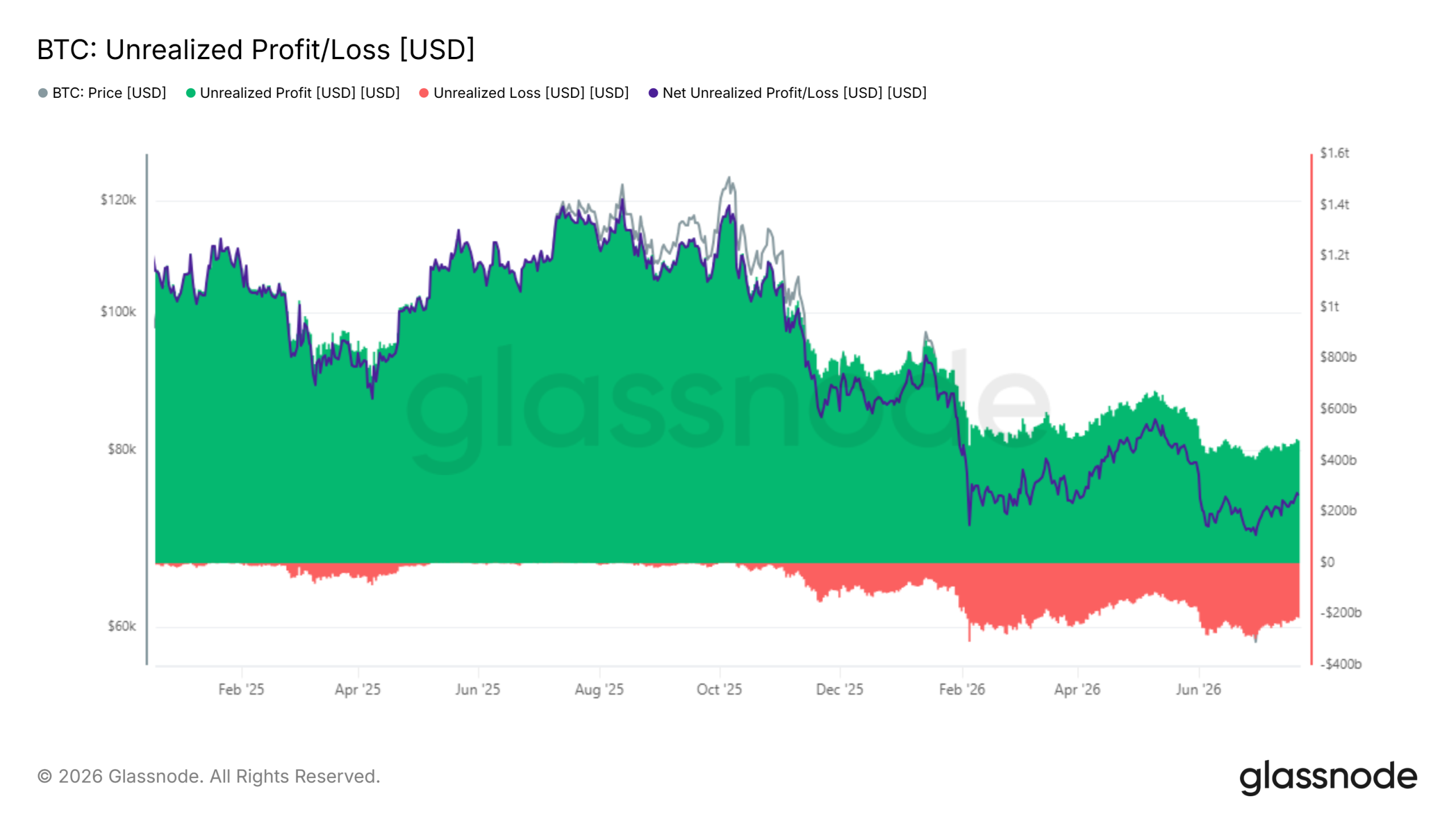
Glassnode data shows unrealized profit collapsed from roughly $1.4 trillion at the October 2025 peak. By late June, it fell to about $400 billion, the lowest reading of the cycle.
Net Unrealized Profit/Loss also bottomed lower in June than during the February crash, despite similar prices both times. The gap indicates coins changed hands during the drawdown, lifting the market’s aggregate cost basis.

Unrealized losses held between $200 billion and $300 billion for most of 2026. In contrast, they hovered near zero throughout 2025. Such prolonged pain historically resembles late-stage capitulation, and early bottom signals have already appeared elsewhere.
July brought some relief. Unrealized profit recovered to roughly $500 billion as losses narrowed. For the signal to flip bullish, however, profit must expand beyond its spring high near $580 billion.
Futures Traders Are the Only Buyers Left
The recovery in holder profitability comes with a caveat. CryptoQuant data shows futures demand flipped back to net positive in July, while spot demand continued to shrink.
The 30-day sum of perpetual futures demand grew by roughly 30,000 to 50,000 BTC this month. However, the April expansion neared 250,000 BTC and fueled the rally to $82,000. Today’s futures appetite is about five times smaller.

Spot demand tells a worse story. The metric has remained negative all year and is now contracting by about 200,000 BTC per month. Total demand collapsed to nearly minus 550,000 BTC in early June, the worst reading of 2026.
Bounces built on leverage without spot absorption have historically proven fragile. A cooler US inflation print helped BTC break above its mid-June resistance, but organic buyers have yet to return.
BTC Price Prediction Hinges on the $69,500 Cost Basis
Bitcoin trades below three of the four major on-chain valuation models. Only the Realized Price at $52,900 remains as support beneath the market.

The price last spent this long between the Realized Price and the True Market Mean during the 2022 bear market. Every attempt to reclaim the Short-Term Holder (STH) cost basis since late 2025 has failed, including the March rebound.
The first real victory for bulls sits at $69,500, about 6% above the current price. Reclaiming it would return most recent buyers to profit, a shift that has historically marked the start of recovery phases.
On-chain model
Level
Position vs. price
Active Realized Price
$83,500
27% above
True Market Mean
$76,200
16% above
Short-Term Holder Cost Basis
$69,500
6% above
Realized Price
$52,900
19% below
Losing the $52,900 Realized Price would signal a deep bear market instead. One projection already points to a potential Q4 bottom near $44,000.
The Federal Reserve’s next rate decision could accelerate the move in either direction. A reclaim of $69,500 could open the path to the $76,200 True Market Mean, while rejection risks another test of $58,000.
The post Why Bitcoin’s Latest Bounce Back to $65,000 Might Not Last appeared first on BeInCrypto.
Brown-Forman Corporation (BF.B) Shareholder/Analyst Call – Slideshow

Rob Bonta on blocking the Paramount merger, CNN concerns and Trump’s DOJ

Fire transfer high-scoring Hugo Cuypers to CF Monterrey


-

 Fashion6 days ago
Weekend Open Thread – Corporette.com
-

 Politics6 days ago
The House | The City of London can help the new chancellor deliver growth in every postcode
-

 Crypto World6 days ago
Ripple Payments Joins MiCA With 14 Firms, Does It Mean Anything For XRP?
-
 Crypto World7 days ago
Two July Windows Left: The CLARITY Act’s Senate Fight and What Failure Means
-

 Politics5 days ago
Democrats look to World Cup watch parties to register thousands of voters
-

 Crypto World6 days ago
Ripple wins EU-wide access as ESMA adds it to MiCA register
-

 Crypto World3 days ago
Grayscale Files For Worldcoin ETF, WLD Registers Sharp Rise
-

 NewsBeat4 days ago
Unregistered fitter used Gas Safe logo on business flyers
-

 Tech3 days ago
Sail Virtually Aboard The “Itanic” With IA-64 Emulator
-
 Tech3 days ago
Turtle Beach Command Series KB7 review: a nifty screen-equipped gaming keyboard
-

 NewsBeat7 days ago
Registration is now open for March for Men with Kev 2026
-

 News Videos4 days ago
Big Money Is Entering XRP
-
 Business2 days ago
New Jersey voter registration controversy explained: How 6,600 noncitizens got on the rolls, and what happens next
-

 News Videos7 days ago
Money | Class 12 Economics | CBSE Board Exam 2026-27
-

 Crypto World6 days ago
Kaspersky exposes OkoBot’s 20-module crypto wallet attack
-

 Business6 days ago
Airlines warn Sunshine Protection Act could disrupt flight scheduling
-
 Entertainment2 days ago
Johnny Depp’s R-Rated Gothic Cult Classic Gets New Release Ahead of Sydney Sweeney Remake
-

 NewsBeat6 days ago
Durham County Council to send out electoral registration emails
-

 Crypto World6 days ago
MiCA Licensing Faces Delays as ESMA Adds 14 CASPs to Register
-

 Crypto World6 days ago
Chip Stocks Enter Bear Market After Moonshot Ai Unveils Kimi K3 Model
You must be logged in to post a comment Login