

Crypto World
$7 Trillion Wall Street Giant is Watching This Key Bitcoin Metric

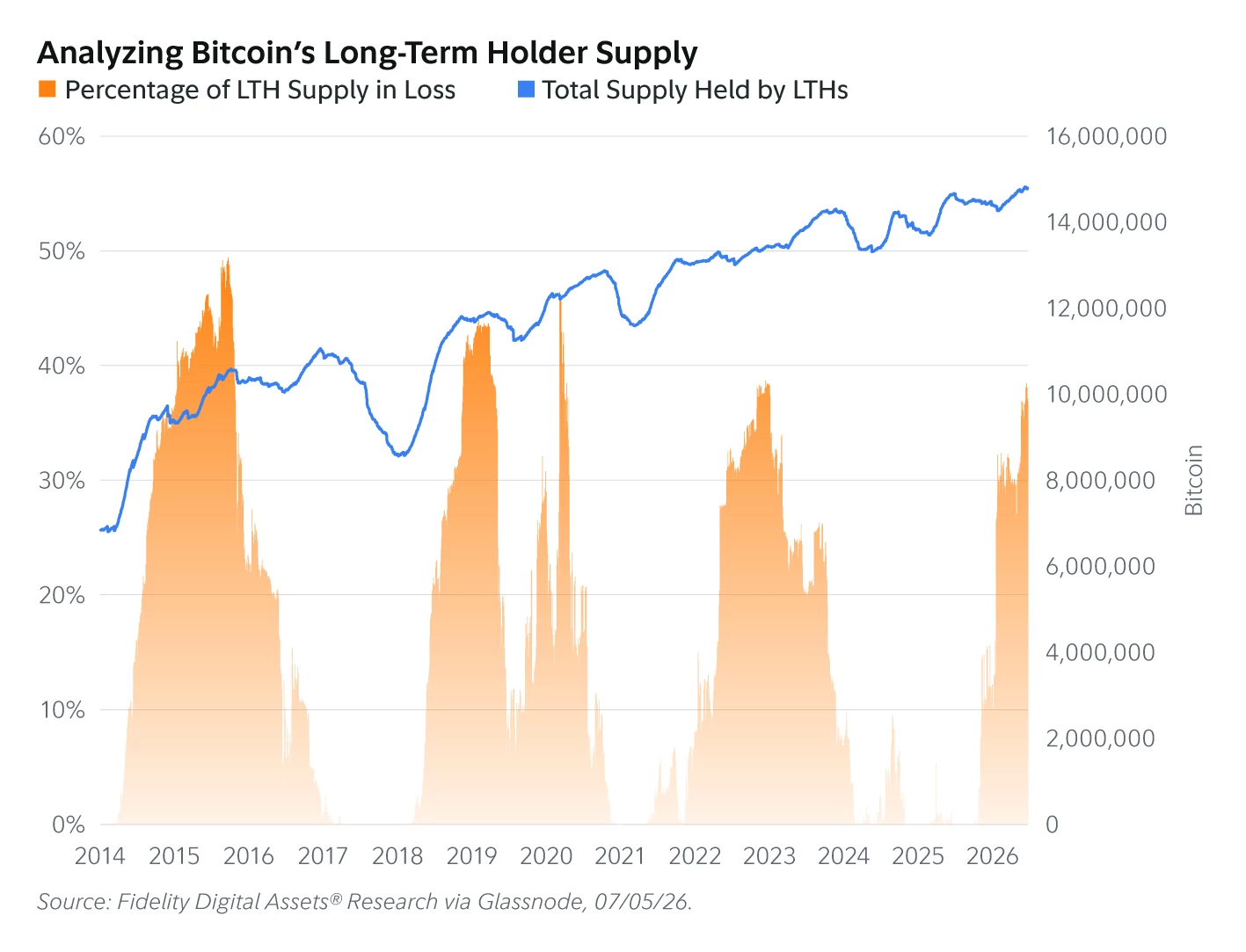
Fidelity Digital Assets says the supply of Bitcoin (BTC) held by long-term investors has reached an all-time high.
Research analyst Zack Wainwright treats that cohort as one of the clearest reads on investor conviction. Fidelity says the long-term holder data appear consistent with on-chain metrics that are approaching past-cycle bottom levels.
Why Fidelity Watches This Cohort
The asset manager noted that nearly 15 million coins have now sat unmoved for at least 155 days. The post framed it as a signal for conviction.
That supply has historically expanded through bear markets and contracted through bull markets. It set its record on July 5, 2026, while prices stayed under pressure.
Nearly 40% of the cohort now sits at an unrealized loss. Most of these holders kept their exposure anyway, Wainwright wrote.
Bitcoin trades roughly 50% below its October 2025 peak of above $126,000. Earlier bear markets cut 70%, 80%, and even 90%. Wainwright reads that shallower decline as a sign of maturation.
“A variety of on-chain metrics are approaching levels historically associated with bitcoin’s market cycle bottoms. Whether these signals ultimately mark a turning point remains to be seen, but the long-term holder data appears consistent with that sentiment as well,” Wainwright said.

Follow us on X to get the latest news as it happens
Meanwhile, Benjamin Cowen, a member of BeInCrypto’s Market Intelligence experts council, puts the fourth-quarter bottoming window as a base case. His seasonal math suggests a low near $44,000.
“The bear-market framework remains intact and the focus shifts from confirming the markdown to watching for the low,” he wrote.
Wainwright lands on the same open question. Fidelity’s data shows conviction holding firm, yet the firm will not say whether the bear market has reached its final stage.
August offers the next test. That month turned negative in all three prior midterm election years, with losses between 15% and 18%.
Subscribe to our YouTube channel to watch leaders and journalists provide expert insights
The post $7 Trillion Wall Street Giant is Watching This Key Bitcoin Metric appeared first on BeInCrypto.



Dango will shut down its trading platform and its own blockchain after concluding the project has no path to lasting commercial success. The team told users to close positions and withdraw funds.
The wind-down arrives only months after Dango opened perpetual futures trading in April. Similar closures have hit the sector repeatedly through 2026.
Dango Sets 2 Deadlines for Users to Exit
Dango operates a Layer 1 (L1) blockchain and a decentralized exchange (DEX). Both are now on a countdown.
Trading stops on Wednesday, July 29, at 12 pm UTC. Remaining positions will close at the oracle price, and deposits in its liquidity provider vaults will unlock. The team said that all balances will be returned in USDC to spot accounts.
The L1 then stops running on Wednesday, August 13, at 12 pm UTC. Deposits left behind at that point go back to their original Ethereum (ETH) addresses.
“Funds are safe. Limits to withdrawals will be lifted shortly. We encourage you to close positions and withdraw funds. Be careful of slippage, as liquidity is expected to be thin,” Dango wrote.
Follow us on X to get the latest news as it happens
Founder Larry pointed to a stack of pressures rather than a single failure.
“Since the launch in April, our team has faced strong headwind: cash running out, legal/compliance challenges that led to large delays in our ability to ship new features, the resulting lose of growth momentum, lose of talents from the team, and the overall highly adverse market conditions,” he explained.
Dango is far from alone. CryptoRank counted 17 major crypto shutdowns and bankruptcies through July 23, including Loopring DEX, Movement Labs, and Bitcoin Depot.
Subscribe to our YouTube channel to watch leaders and journalists provide expert insights
The post Another Crypto Project Goes Dark as Dango Winds Down appeared first on BeInCrypto.
The spot Bitcoin exchange-traded funds ended their third consecutive week in the green, but momentum faded at the end of it.
In the meantime, the funds tracking Ethereum continue to outperform, gaining over $100 million as the underlying asset challenged the $1,950 level.
BTC ETFs Still in the Green but…
The funds tracking the market leader were in a tough spot for weeks. Eight, to be precise. In this streak that began in mid-May and felt it went on for eternity, they saw over $8 billion withdrawn from investors, with the total net inflows going down from over $59.34 billion to $51.08 billion on July 2.
However, investors finally changed their tune at this point and broke this negative trend during the first full week of July, inserting nearly $200 million. Another $75.67 million followed during the subsequent week, and the one that just ended began on a high note. In fact, the actual net inflows stood at approximately $1 billion during the seven consecutive green days – from July 14 until July 22.
This coincided (or propelled) with bitcoin’s price rally that drove the asset to $67,000 on Wednesday for the first time in over a month. However, the asset was rejected there, driven south to $64,000 on Friday, while the ETF outflows returned. On Thursday and Friday, investors pulled out $225.18 million and $240 million, respectively.
As such, even though the week ended slightly in the green, it was a relatively modest $33.79 million.

ETH ETFs Still Do Better
A rather interesting trend that began two weeks ago was replicated once again. The spot Ethereum ETFs turned out to be more attractive to investors, with almost $104 million in net inflows. Only one day was in the red, with investors pulling out $70.62 million on Friday. Before that, they had poured in $38.09 million on Monday, $37.47 million on Tuesday, $72.64 million on Wednesday, and $26.32 million on Thursday.
Perhaps due to these rather impressive numbers, the underlying asset surged past $1,900 mid-week and peaked at just over $1,950. However, it couldn’t keep the momentum going and slipped by about $100 on Friday and Saturday.
The total net inflows of the ETH ETFs have recovered over $200 million in the past three weeks, but are still well below the $12.09 billion seen in May.

The post Crypto ETF Recap: Ethereum Still Outpaces Bitcoin, but Cracks Are Emerging appeared first on CryptoPotato.

The New York Stock Exchange’s parent just completed a $2 billion bet on Polymarket. Kalshi raised a billion at $22 billion while generating fee revenue most exchanges would envy. Seven bills in Congress want the whole category banned. Wall Street is not gambling on prediction markets; it is buying the probability layer of the financial system, and the difference explains everything.
Summary
- Intercontinental Exchange, parent of the NYSE, completed a $2 billion commitment to Polymarket in March, $1 billion in October plus a fresh $600 million, with the platform now discussing new funding near a $15 billion valuation.
- Kalshi raised more than $1 billion this spring at a $22 billion valuation, roughly doubling in months, on volumes that reached $31.5 billion in June against Polymarket’s $10.8 billion, with fee revenue estimates running from $850 million to $1.5 billion annualized.
- The tell is the deal structure: ICE bought global distribution rights to Polymarket’s event data and launched institutional probability feeds within months, chairman Jeffrey Sprecher framing the stake as a new layer of financial intelligence, not a venture flyer.
- The consolidation is visible everywhere: the rival CEOs jointly backed a $35 million VC fund for the sector, Kalshi struck institutional distribution through Tradeweb, Robinhood’s event contracts out-earned its crypto business, and banks project the industry toward $10 billion in annual revenue by 2030.
- All of it is happening against maximal legal hostility: at least seven bills targeting the category in 2026, a bipartisan act to ban sports contracts outright, and the 50-state jurisdictional war this publication has mapped, a contradiction the valuations are pricing as temporary.
Wall Street has a reliable tell: watch what the exchanges buy. Exchanges are the market’s landlords; they monetize activity without taking its risks, and when an exchange operator writes a ten-figure check, it has concluded that a new kind of activity is durable enough to tax.
In March, Intercontinental Exchange, the $80-billion-class operator of the New York Stock Exchange and twelve other regulated venues, completed exactly that judgment: a $600 million investment closing out a $2 billion total commitment to Polymarket, the crypto-native prediction market, at valuations that climbed from $9 billion toward the $15 billion its next round now targets.
Weeks earlier, Kalshi, Polymarket’s regulated arch-rival, raised more than a billion dollars at a $22 billion valuation, double its winter mark, on revenue that estimates place between $850 million and $1.5 billion a year.
The two firms’ founders then jointly seeded a venture fund for their own sector, the corporate equivalent of rival generals founding a military academy, while Robinhood’s earnings quietly revealed that event contracts already out-earn its crypto business. And Congress, watching all of it, introduced at least seven bills to restrict or ban the category.
This piece is the cluster-opener the moment deserves: what the exchanges actually bought, why the valuations disagree with the volumes, and why the industry’s legal peril and its institutional embrace are, strangely, the same story.
What ICE actually bought
The most analyzed deal in the sector is also the most misread, because the commentary priced it as a bet on betting, and the structure says something else.
ICE’s $2 billion did not primarily buy a share of trading fees. It bought, alongside equity, global distribution rights to Polymarket’s event-driven data, and the follow-through arrived within months: Polymarket Signals and Sentiment, launched in February, packages real-time prediction-market pricing into structured feeds for institutional clients, sold through the same ICE data machine that distributes bond pricing and commodity curves to every terminal on earth.
https://x.com/cryptodotnews/status/2046178311332925655
Chairman Jeffrey Sprecher’s framing was explicit and deserves to be taken literally, not as deal-announcement poetry: the investment adds a new layer of financial intelligence. Translated from exchange-operator: markets on events generate a product exchanges have never had, continuously priced probabilities of the world’s discrete outcomes, elections, rate decisions, wars, product launches, and the firm that owns the distribution of those probabilities owns something adjacent to what Bloomberg owns in reference data.
The trading is the factory; the data is the product; and ICE, whose entire modern history is converting exchanges into data companies, ran its signature play on the newest exchange category in existence. The tokenization collaboration attached to the deal, and Polymarket’s acquisition of DeFi infrastructure startup Brahma to harden its on-chain stack, complete the picture of a platform being fitted for institutional plumbing, not fattened for retail.
Read that way, the sector’s other moves stop looking like a bubble and start looking like a supply chain assembling. Kalshi’s deal with Tradeweb points the same direction: prediction pricing distributed into institutional macro workflows, where a Fed-decision market is not a casino but a hedging instrument with cleaner event definition than any rates option.
The $35 million venture fund jointly backed by both CEOs is the infrastructure tell, seeding the tooling layer, the Bloomberg-style terminals, the risk systems that a maturing asset class requires. And Citizens Bank’s projection, a $3 billion industry revenue run rate with a credible path toward $10 billion by 2030, is the sell-side arriving to cover a category it can finally model, because fee-on-volume businesses are the one thing Wall Street knows how to value.
The scoreboard, and why it disagrees with the valuations
Now the numbers, because they contain a genuine puzzle: the market leader by volume is not the platform the world’s biggest exchange bought, and the valuations invert the operating data.
Kalshi leads operationally, and not narrowly. June volume near $31.5 billion against Polymarket’s $10.8 billion, roughly three-to-one; revenue estimates, whether the conservative $850 million fee figure or the $1.5 billion annualized estimates, that would flatter mid-tier traditional exchanges; 994% year-over-year growth into 2025’s $260 million; a CFTC-regulated perch that makes it the only fully domestic, fully legal venue for American event trading; distribution through Robinhood’s hundred-million-account retail machine; and an international expansion running through Brazil.
Its $22 billion valuation, double in months, prices continued category leadership. Polymarket’s operating story is choppier: bigger brand, deeper crypto-native liquidity, the QCEX acquisition purchasing a CFTC-licensed re-entry to the US market it was exiled from, February volume that touched $23 billion in the World Cup’s glow, but June at a third of Kalshi’s tape, revenue still being switched on, taker fees arriving only this spring, and a valuation, $9-10 billion post-ICE, now reaching for $15 billion, that trails its rival’s by a third despite the grander patron.
The resolution of the puzzle is the thesis of this piece. Kalshi is valued as an exchange: volumes, fees, growth, multiply. Polymarket is valued as infrastructure: the ICE relationship prices not its current fee take but its position as the probability layer ICE intends to distribute, the way index providers are valued not on their own revenue but on their irreplaceability in other people’s products.
Two different theories of what a prediction market is, held by two different kinds of capital, produce valuations that disagree with the volume table, and the disagreement is the sector’s live experiment: whether the money is in operating the casino or in owning the odds. The honest answer, visible in ICE’s own history, is that the second usually wins over decades, and the first pays for the war in the meantime.
The paradox: embraced and indicted at once
Everything above happened while the American legal system escalated its hostility, and the contradiction is not a footnote; it is the sector’s defining condition.
The docket, which this publication’s fifty-state-war coverage maps in detail, has only thickened: at least seven bills introduced in 2026 targeting prediction markets, headlined by the bipartisan Prediction Markets Are Gambling Act from Senators Schiff and Curtis, which would ban CFTC-regulated exchanges from listing sports contracts outright; Nevada’s temporary restraining order against Kalshi in March; state gaming regulators across a dozen jurisdictions pressing the position that event contracts on sports are wagers wearing derivative costumes; and a parallel insider-trading discourse, sharpened by suspicious trades around geopolitical events on Polymarket’s offshore book, that has drawn congressional letters.
The CFTC has intervened repeatedly on the federal-preemption side, backing the position that its regulated exchanges answer to it exclusively, the exact architecture, federal license against state police power, whose constitutional endgame our earlier coverage called the sector’s real stakes. Sports is the war’s center of gravity because sports is the revenue’s center of gravity, and a Schiff-Curtis world would amputate the category’s largest limb.
So why do the checks keep clearing? Because institutional capital has concluded the contradiction resolves in one direction, and the reasoning deserves to be stated plainly rather than dismissed as bravado.
First, the federal question is being litigated on ground the industry mostly wins: preemption doctrine has historically favored federally licensed markets, and every court that lets a CFTC venue keep operating strengthens the ratchet.
Second, the political economy shifts with every acquisition: when the NYSE’s parent owns the odds layer, when Robinhood’s earnings depend on event contracts, when Tradeweb distributes the pricing, a ban stops being a consumer-protection bill and becomes an attack on exchange infrastructure, and exchange infrastructure has the best lobbyists money retains.
Third, the data thesis is jurisdiction-proof in a way the trading thesis is not: even a sports-banned, state-harried American prediction market generates probability data on everything else, elections, rates, geopolitics, and the data product ICE bought travels globally regardless of where the trading is licensed.
The valuations, read correctly, are not ignoring the legal war; they are pricing its outcome, a federally consolidated, institutionally owned category whose bumpy state-level litigation is the cost of the moat being built, because the same legal complexity that harasses the incumbents forecloses new entrants. Whether that pricing is right is the decade’s question. That it is the pricing is no longer in doubt, and the November midterms, the category’s largest-ever volume event arriving in the middle of its largest-ever legal fight, will be the first full-scale test of both theses at once.
The third front: retail distribution and the Robinhood wedge
Between Kalshi’s regulated exchange and Polymarket’s crypto-native book runs a third front this publication has tracked from its earnings angle, and the cluster map is incomplete without it: the brokerages, who own the customers everyone else is paying to reach.
Robinhood’s numbers made the case before any thesis did: event-contract revenue of $147 million in a single quarter, up 320%, out-earning the firm’s entire crypto trading business, on 8.8 billion contracts, distribution economics that no standalone platform matches because the marginal customer already has the app, the account, and the balance. The firm’s response to its own data was vertical integration, the Rothera exchange venture, converting Robinhood from Kalshi’s largest distributor into its future competitor, a sequence every platform economist recognizes: distribute, learn the margins, then own the venue.
The World Cup quarter’s industry-wide records, Kalshi clearing $31 billion in a month with retail brokerage flow as a major tributary, previewed the steady state: prediction volume as a standard feature of every retail trading app, the way options became one, with the venues competing for the pipes as much as the punters.
The retail front reframes the legal war’s stakes too. The seven bills and the state actions target venues, but the wedge that actually carried event contracts into American living rooms is the brokerage integration: regulated firms with licenses to protect, distributing CFTC-listed contracts to mass-market accounts, and any legislative ban must therefore run through the brokerage lobby as well as the exchange lobby, a coalition that has historically been the most effective in financial politics.
It also sharpens the insider-trading and consumer-protection critiques, because the retail customer buying an election contract in a stock-trading app is precisely the participant the gambling framing worries about, and the industry’s response, self-surveillance regimes, contract-design standards, position limits, will be written under that spotlight. The cluster’s honest frame holds all three fronts at once: an exchange war for volume, a data war for institutional relevance, and a distribution war for the retail default, with the same November stress test scheduled for all three.
What to watch
The Schiff-Curtis whip count. The sports-ban bill is the one legislative vehicle that changes the revenue math rather than the compliance math. Its committee progress, and whether the exchange lobby’s fingerprints appear in the amendments, will reveal how far the political economy has already shifted.
Polymarket’s US re-entry mechanics. The QCEX license converting into live, fee-charging American operations is the event that would collapse the two rivals into one regulatory arena, and one comparable revenue table, for the first time. The valuation gap gets its verdict there.
The data products’ uptake. Signals feeds on terminals, Tradeweb integration metrics, the first hedge-fund letters citing prediction-market pricing as an input: the ICE thesis is falsifiable, and its evidence will be subscription revenue, not trading volume.
Midterm November. Record volumes are certain; the tests are operational integrity under peak load, insider-trading headlines under maximum scrutiny, and whether the state-law war produces an injunction that actually interrupts trading during the event. The category’s institutional era either survives its first American election as infrastructure, or it does not.
A final calibration for the cluster this piece opens: the honest bear case, stated without the valuations’ optimism. The category’s revenue concentrates in sports, the exact segment one live bipartisan bill would ban; its growth statistics are inflated by a World Cup and will meet a quieter 2027; its two leaders are burning venture capital on customer acquisition in a fee war that has already produced zero-fee promotional pairs; its insider-trading surface, markets on events their participants can influence or foreknow, is structurally worse than equities and has already generated congressional attention; and its institutional data thesis, however elegant, currently books a fraction of the revenue the trading does, meaning the valuations rest on the segment most exposed to the law and least proven under stress.
If the Schiff-Curtis framework passes, if a state supreme court cracks the preemption shield, or if November produces a manipulation scandal at scale, the $22 billion and $15 billion marks will be repriced as artifacts of the same exuberance that priced every previous financial-innovation wave at its legislative peak.
The bull case, argued above, is that the exchanges have already made the category too systemic to kill. The bear case is that Congress has killed systemic things before, and that betting on gambling’s legal normalization has broken sophisticated investors for a century. The cluster’s coverage will hold both, which is the only honest way to cover an industry whose defining trade is, fittingly, a binary contract on its own survival.
Frequently Asked Questions
What exactly did ICE invest in Polymarket?
A total commitment of $2 billion: $1 billion in October 2025, a further $600 million closing the agreement in March 2026, plus up to $40 million in secondary purchases from existing holders. The structure centers on global distribution rights to Polymarket’s event data alongside equity, and ICE launched institutional probability feeds, Polymarket Signals and Sentiment, in February, with a tokenization collaboration attached to the partnership.
How do Kalshi and Polymarket compare today?
Kalshi leads operationally: roughly $31.5 billion in June volume versus Polymarket’s $10.8 billion, fee revenue estimated between $850 million and $1.5 billion annualized, CFTC regulation, Robinhood distribution, and a Brazil expansion, at a $22 billion valuation after this spring’s billion-dollar raise. Polymarket holds the larger brand, crypto-native liquidity, the ICE partnership, and a CFTC-licensed US re-entry path via its QCEX acquisition, at a $9-10 billion valuation reaching toward $15 billion.
Why would the NYSE’s parent want a prediction market?
For the data, on the reading the deal structure supports. Prediction markets continuously price probabilities of discrete events, elections, rate decisions, geopolitical outcomes, a data product traditional exchanges have never generated, and ICE’s modern business is data distribution as much as trading. Chairman Jeffrey Sprecher framed the stake as a new layer of financial intelligence, and the February launch of institutional feeds executed exactly that thesis.
Are prediction markets actually profitable?
The leaders’ figures suggest strongly yes, with caveats. Kalshi’s revenue estimates range from $850 million in fees to $1.5 billion annualized against 994% growth into 2025; Polymarket only began charging taker fees this spring, with early annualized projections around $300 million; and Robinhood’s event-contract line reached $147 million in a quarter, exceeding its crypto revenue. Citizens Bank models the industry at a $3 billion run rate with a path toward $10 billion by 2030.
What is the legal threat, concretely?
Layered. At least seven 2026 bills target the category, led by the bipartisan Schiff-Curtis Prediction Markets Are Gambling Act, which would ban sports contracts on CFTC-regulated exchanges, the sector’s largest revenue source. State gaming regulators in a dozen-plus jurisdictions are litigating that event contracts are unlicensed wagers, with Nevada winning a temporary restraining order against Kalshi in March, while the CFTC backs federal preemption, the constitutional collision this publication’s earlier coverage maps.
Why does institutional money keep flowing despite the bills?
Because it is pricing a resolved endgame: preemption doctrine historically favors federal licenses, each acquisition shifts the political economy, banning bookies is easier than banning the NYSE’s data layer, and the probability-data thesis survives even adverse trading rulings, since data distributes globally regardless of where trading is licensed. The valuations treat the legal war as the moat’s construction cost, deterring entrants while incumbents entrench.
What is the joint VC fund the rivals backed?
A $35 million venture fund targeting the prediction-market sector, backed by the chief executives of both Kalshi and Polymarket, seeding infrastructure like analytics tooling and Bloomberg-style terminals for event markets. Rival operators jointly funding their category’s supply chain is the clearest signal that both view the sector’s growth, and its institutional legitimacy, as a shared asset that precedes their competition.
What should observers watch next?
Four things: the Schiff-Curtis bill’s committee progress, the one vehicle that changes revenue rather than compliance; Polymarket’s QCEX-licensed US operations going live, which puts both rivals in one arena; adoption evidence for the institutional data feeds, where the ICE thesis is falsifiable; and November’s midterms, the category’s biggest volume event colliding with its biggest legal fight, the first full-scale stress test of the institutional era. This is educational analysis, not investment advice.
Disclaimer: This article is for information and educational purposes only and does not constitute financial or investment advice. Valuations, volumes, and revenue figures are drawn from reporting and estimates that vary by source and change rapidly, and pending legislation and litigation described here are unresolved. Nothing here is a recommendation regarding any company, token, or contract. Always do your own research. Information is accurate as of July 24, 2026.


Daily NK reported that North Korea arrested former state cyber operators accused of hacking two state banks and laundering funds through crypto.
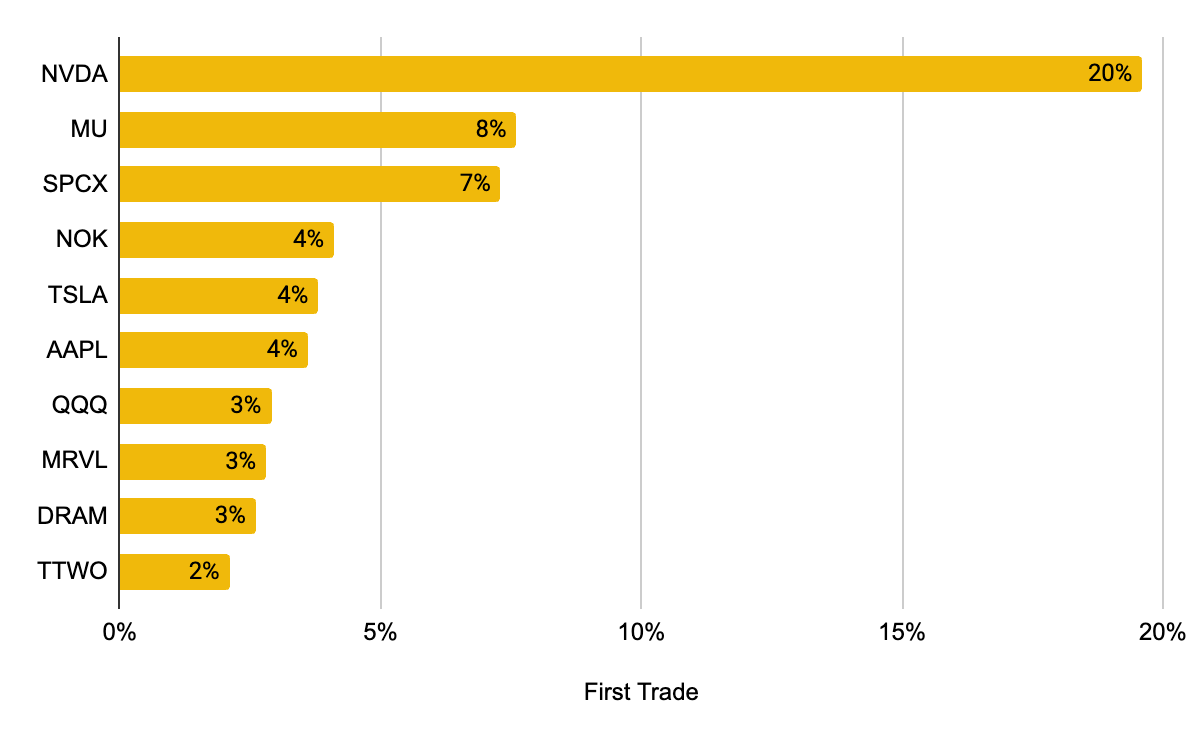
Nvidia (NVDA) is the most common first stock trade among the youngest and smallest equity accounts on Binance. The stock took 20% of first trades, according to a Binance Research report.
The finding covers a segment that Binance labels Next Gen Users. These are Gen Z customers in emerging markets holding under $2,000 in equity assets under management.
Semiconductor Stocks Dominate the First Trade List
Micron Technology (MU) ranks second at 8%, according to the report. Tesla (TSLA), Apple (AAPL), and the Nasdaq-100 exchange-traded fund (ETF) appear further down the list.
“Across the wider equity base, the same discipline is visible at portfolio level: users allocate roughly 60% of equity holdings to Information Technology and Communication Services, with around 26% concentrated in semiconductors, a thematically coherent tilt toward the artificial-intelligence complex rather than scattered speculation,” Binance Research noted.

The report noted that Next Gen Users make up 13% of Binance Direct Stocks customers. Gen Z as a whole accounts for 44%, the largest single cohort on the product.
Geography narrows the picture further. Binance Research highlighted that 95% of Gen Z traditional finance (TradFi) users are in emerging markets. Every other generation on the platform clears 90%.
Follow us on X to get the latest news as it happens
Trading Frequency Runs Below Other Cohorts
Binance Research presents the trading pattern as a discipline rather than speculation. Two further measures support that reading.
“The prevailing assumption about young, first-time investors, particularly those reached through a crypto-native platform, is that they trade aggressively and speculatively. The data does not support that characterization. It points, consistently, in the opposite direction,” the report read.
Next Gen Users average 2.6 trades per day, compared with 3.0 for other cohorts, according to platform data. Leverage use points the same way, with leveraged ETFs at 5.9% of Gen Z volume. Baby Boomers recorded 8.1%.
Scale has followed regardless. Gen Z has contributed approximately $80 billion in TradFi volume so far in 2026, compounding at nearly 24% per month.
Subscribe to our YouTube channel to watch leaders and journalists provide expert insights
The post Binance Data Shows How Crypto is Using AI Stocks to Attract Gen Z Investors appeared first on BeInCrypto.


Cathie Wood’s ARK Invest has added about $251,500 in BitMine Immersion Technologies shares and the 3iQ Solana Staking ETF across three of its exchange-traded funds.
Summary
- ARKK bought 5,264 BitMine shares worth about $83,100 at Friday’s $15.79 close.
- ARKW and ARKF added 28,018 SOLQ.U shares valued at roughly $168,400 combined.
- The 3iQ Solana Staking ETF fell 2.12% to $6.01 during Friday’s session.
ARK Invest adds BitMine exposure
ARK Invest’s Friday trade disclosures show its flagship ARK Innovation ETF, or ARKK, purchased 5,264 shares of BitMine Immersion Technologies (BMNR).
Based on BMNR’s $15.79 closing price, the purchase was worth approximately $83,100. The position represented roughly 0.0014% of ARKK’s portfolio, making it a small allocation within the fund but another addition to ARK’s crypto-linked investment exposure.
BitMine has positioned itself as an Ethereum treasury company, placing ARK’s purchase alongside its wider investments in publicly traded firms connected to digital assets.
The transaction was part of a broader ARKK rebalance that also included additional purchases of X-Energy shares and sales of Figma stock. ARK also sold shares of Strata Critical Medical, ATAI Life Sciences and Elbit Systems across its funds, according to the disclosures.
3iQ Solana Staking ETF receives $168K allocation
ARK’s ARK Next Generation Internet ETF (ARKW) and ARK Fintech Innovation ETF (ARKF) also increased their holdings in the 3iQ Solana Staking ETF, which trades under the ticker SOLQ.U.
ARKW purchased 16,917 shares, worth about $101,700 at Friday’s close. ARKF added 11,101 shares, valued at approximately $66,700.
Together, the two funds acquired 28,018 SOLQ.U shares worth around $168,400. The purchases came as the Solana-based investment product declined $0.13, or 2.12%, to close at $6.01 on Friday.
The move gives ARK further exposure to Solana through an exchange-traded product that includes staking-related exposure, rather than a direct purchase of SOL tokens.
ARK’s crypto and AI buying spree continues
Friday’s trades followed a more active week for ARK Invest, which bought nearly $60 million in Tesla, Circle Internet Group and Securitize shares on Thursday amid a broader U.S. equity market sell-off.
Tesla accounted for more than $51 million of that total, according to the firm’s daily trade reports. ARK also added roughly $14 million in SpaceX stock earlier in the week.
Outside crypto-related holdings, Friday’s filings showed new purchases of Pony AI, Kodiak AI, Scribe Therapeutics and Compass Pathways. The transactions point to continued portfolio adjustments across artificial intelligence, healthcare and digital-asset-linked companies.
What it means for U.S. investors
ARK Invest’s latest activity offers U.S. investors another snapshot of how one of the country’s best-known thematic ETF managers is approaching crypto exposure.
The purchases were modest relative to ARK’s overall assets, but they spread exposure across two distinct parts of the market: BitMine’s Ethereum treasury strategy and a Solana staking-focused ETF product.
U.S. investors considering similar exposure should note that ARK’s purchases do not amount to a forecast on either asset. They instead show the firm’s continued use of public equities and exchange-traded products to gain exposure to crypto-related themes while it also rotates positions in technology and AI stocks.
Crypto World
Democratizing weather derivatives through tokenization could be blockchain industry’s most important real-world use case


Democratizing weather derivatives with tokenization
This is where tokenization enters, and where I think the crypto industry has a genuinely important role to play in democratizing weather risk hedging. It’s an initiative that I think is significantly more important than simply offering traditional yield-generating assets like bonds onchain.
The core advantages of putting weather derivatives on a blockchain are not theoretical. Smart contracts can automatically trigger payouts when verified weather data crosses a predetermined threshold, while bypassing manual processing, disputes, delays, and counterparty risk. With tokenized weather derivatives, a farmer in a rain-dependent economy no longer needs a Goldman Sachs relationship to hedge against a failed monsoon. A parametric insurance product built on a smart contract that reads verified rainfall data and pays out automatically is, in principle, exactly the kind of market that properly prices and distributes climate risk.
In Value(s), Carney puts it well: “We need financial markets to work alongside climate policies in order to maximize their impact. With the right foundations, the financial system can build a virtuous circle of better understanding of tomorrow’s risks, better pricing for investors, better decisions by policymakers and a smoother transition to a lower-carbon economy.”
Tokenization also addresses the liquidity and accessibility problems that have stunted the traditional market. Fractional ownership allows weather risk to be divided into smaller units.and the resulting composability facilitates integration of weather derivatives with lending protocols, insurance products and yield-generating instruments. Transparency on every trade, every position, every settlement recorded on a public blockchain addresses the opacity that has historically made price discovery poor and participation limited.


Official Trump’s team has transferred about $16.91 million in TRUMP tokens to Fireblocks custody wallets as Senate negotiations over ethics rules in the CLARITY Act remain stalled.
Summary
- 16.84 million TRUMP tokens were sent to three Fireblocks custody addresses, according to Arkham Intelligence.
- Arkham said the addresses had previously moved received TRUMP tokens onward to BitGo.
- Senate Democrats are resisting ethics provisions that leave enforcement solely with the Department of Justice.
- TRUMP has fallen about 98% from its January 2025 peak of $73.43, based on the supplied market data.
TRUMP tokens move to Fireblocks custody wallets
Arkham Intelligence reported that the Official Trump team transferred 16.84 million TRUMP tokens, valued at roughly $16.91 million, to three Fireblocks custody addresses on July 25.
“TRUMP TEAM SENT $16M TRUMP TO CUSTODY,” Arkham wrote in its alert, adding that the transfers were split among three Fireblocks wallets.
The blockchain analytics firm noted that each destination address had received TRUMP tokens before and later sent those holdings to BitGo. Arkham asked whether the latest movements could be connected to the distribution of TRUMP unlocks.
The transaction does not by itself show that tokens were sold or sent to an exchange. However, the use of custody addresses has drawn attention because a large share of the memecoin’s supply remains tied to insider-controlled wallets.
Crypto tools data cited in the report shows that the team could sell up to 96 million tokens, equal to 9.6% of the total supply and about 40% of the reported circulating supply of 237 million tokens. About 80% of the total supply remains in insider hands, while roughly 670 million tokens, or 67%, have already unlocked.
TRUMP traded near $1.57 at press time, according to the supplied data. That price represents an 83% decline from its year-over-year high and a nearly 98% drop from the $73.43 level reached in January 2025.
CLARITY Act ethics rules put Trump’s crypto ties in focus
The transfer comes as Senate Republicans attempt to secure backing for the Digital Asset Market Clarity Act, known as the CLARITY Act, before the August recess.
Senate Majority Leader John Thune has pushed to bring the bill to the floor even without the 60 votes needed to overcome a filibuster. “I would like to at least get Clarity started. We’ll see where the votes are,” Thune previously said.
The House passed the legislation in July 2025, while the Senate Banking Committee advanced it in May 2026 by a 15-9 vote. The bill still needs additional Democratic support, with ethics standards and consumer protections remaining central obstacles.
Republicans have added restrictions on crypto activity by senior elected officials to the latest draft. According to reports by Crypto in America’s Eleanor Terrett and Punchbowl News’ Brendan Pedersen, the White House sent the proposed language to Republican senators on July 20 before Democrats had reviewed it.
The draft would cover the president, vice president, members of Congress, federal judges and their spouses. Covered officials would be barred from issuing or sponsoring digital assets and would have to sell their crypto holdings, use a blind trust, or take both steps.
The provision would expire at noon on Jan. 20, 2029, when Trump’s term is scheduled to end. It would also permit companies to continue using an official’s name, image or likeness when that arrangement existed before the official became subject to the restrictions.
Democratic opposition centers on enforcement
Democratic Sen. Angela Alsobrooks has objected to relying only on the Department of Justice to enforce the ethics rules, calling that approach “unserious.”
Alsobrooks said she would oppose the CLARITY Act if the current wording reached the Senate floor. Her stance carries added weight because she was one of two Democrats who supported advancing the bill through the Senate Banking Committee in May.
President Donald Trump accepted the ethics provision earlier this week after Democratic lawmakers made limits on elected officials’ crypto dealings a condition for continued talks. Yet disagreement over who enforces those restrictions has prevented a bipartisan deal.
Democrats pushed for the language after financial disclosures showed Trump earned as much as $1.4 billion from crypto-related ventures last year. Alsobrooks and Sen. Kirsten Gillibrand had told colleagues that the market-structure bill could not advance without conflict-of-interest rules.
What the TRUMP transfer means for US holders
For U.S. TRUMP holders, the on-chain movement adds a fresh supply-related risk while the Senate debates whether elected officials can retain ties to token projects. The Fireblocks transfers do not prove sales, but Arkham’s note about prior transfers from the same addresses to BitGo has fueled scrutiny over their potential purpose.
The immediate focus is whether the wallets make further transfers to exchanges or other custodians, and whether negotiators can resolve the DOJ enforcement dispute before the Senate’s August recess.


Fidelity called on the US Senate to pass the CLARITY Act, joining industry groups and crypto firms pushing for market structure legislation.

For much of the past two years, publicly listed companies competed to raise capital to buy BTC and presented themselves as leveraged alternatives to holding the asset directly.
The model worked quite promisingly for a while, and their shares traded comfortably above the value of the BTC on their balance sheets. Some experienced massive growth within months. However, Scorpions’ immortal song has come to life – there’s a wind of change.
Who Is Selling?
Although we have talked extensively about Strategy’s change of attitude over the past several months, the company remains the largest corporate holder and the pioneer of the entire move, so we can’t skip it. It began accumulating BTC roughly six years ago. It increased the rate and size of its purchases after the US presidential elections in late 2024. The market became accustomed to hearing new multi-million- (and sometimes billion-) dollar accumulations every Monday.
However, it all changed with a tiny sale in Q2 and a significantly larger one in early July of over 3,500 units. The company has made no new acquisitions for weeks now, while focusing on rebuilding its USD reserve. On the plus side, it didn’t sell in the past couple of weeks either. Nevertheless, analysts are adamant that the first sale changed everything, even though it’s apparent (for now) that Strategy has not abandoned Bitcoin.
Satsuma Technologies, though, did. The UK-listed BTC treasury company proposed selling all of its remaining BTC, returning most of the proceeds to shareholders, delisting from the London Stock Exchange, and effectively dismantling the treasury vehicle. The firm had already sold 579 BTC in December last year to raise approximately $50 million to address convertible loan obligations. Now, shareholders have approved plans to dispose of the remaining 668 BTC.
Recent reports suggested that Bitcoin miners have disposed of a record 32,000 units in the first quarter of the year, further intensifying the selling pressure.
Separately, Jack Mallers stepped down as CEO of Twenty One Capital earlier this week to focus on Strike. Although this doesn’t necessarily mean that the firm will sell its BTC holdings, it originally promoted itself as a passive Bitcoin holder.
Mallers’ departure, in which he said there are too many differences between himself and the Board of Directors, hints at a major restructuring. It serves as another example of a major treasury vehicle being forced to rethink how it creates value beyond BTC exposure.
Who Might Follow?
Metaplanet, described as Asia’s Strategy, joined the trend a couple of years ago and made some major BTC acquisitions. Its stock benefited immensely, as its business transformed. However, the late 2025 market crash and subsequent bear cycle have not been kind, with the same stock plunging by nearly 90% at one point. It halted its Bitcoin acquisitions for months before returning with a 2,823 purchase in early July.
It has remained silent since then, but there’s no sign that its strategy has changed or that it might need to dispose of some crypto holdings soon.
Perhaps the most vulnerable companies are the smaller ones, trading below net asset value, carrying expensive debt, lacking meaningful operating revenue, or facing shareholder pressure to unlock their crypto holdings. Nakamoto Inc. is among those that stand out, as it already sold about 5% of its BTC position in March, and another 600 units in June.
Despite the evident trend change, none of the above means that the corporate Bitcoin treasury is finished. However, it marked the end of a period in which every treasury announcement involved another purchase. Now, uncertainty dominates, just like the market phase, but those who survive will likely be the strongest companies generating operating revenue and managing their liabilities. The weakest may have to sell and restructure.
The post The Bitcoin Treasury Shakeout Has Begun: Which Companies Are Selling and Who’s Next? appeared first on CryptoPotato.

DEVENIR MILLIARDAIRE AVEC LA CRYPTO C’EST POSSIBLE ?

Man, 21, dies after horror crash between car and lorry in Moray as police launch probe

Top 10 Self Storage Companies in London for Businesses and Homeowners


-

 Fashion21 hours ago
Weekend Open Thread: Brooks Brothers
-

 Politics6 days ago
Democrats look to World Cup watch parties to register thousands of voters
-

 News Videos6 days ago
Big Money Is Entering XRP
-

 Crypto World4 days ago
Grayscale Files For Worldcoin ETF, WLD Registers Sharp Rise
-

 Tech5 days ago
Sail Virtually Aboard The “Itanic” With IA-64 Emulator
-
 Tech4 days ago
Turtle Beach Command Series KB7 review: a nifty screen-equipped gaming keyboard
-

 NewsBeat5 days ago
Unregistered fitter used Gas Safe logo on business flyers
-
 Business3 days ago
New Jersey voter registration controversy explained: How 6,600 noncitizens got on the rolls, and what happens next
-
 Entertainment4 days ago
Johnny Depp’s R-Rated Gothic Cult Classic Gets New Release Ahead of Sydney Sweeney Remake
-

 Crypto World3 days ago
Ethics, other provisions in crypto Clarity Act to be further discussed
-

 Tech5 days ago
Watch Flock Safety CEO Garrett Langley discuss the future of surveillance at TechCrunch Disrupt 2026
-
 NewsBeat4 days ago
Shanghai science forum photos show China’s AI and robotics advances in rivalry with US
-

 Crypto World5 days ago
Circle’s President Sold Over 360,000 Shares, The Filings Explain Why
-

 Tech5 days ago
Subway Sandwich Computers Get a Second Life as Gaming Machines
-

 News Videos2 days ago
The Peugeot Family: How 200 Years of an “Old Money” Dynasty Died in A Boardroom
-

 Sports1 day ago
2026 3M Open leaderboard: Scottie Scheffler finds putter in Round 1, sits three back
-

 Tech5 days ago
The 35 Best Board Games for Family Game Night
-

 Fashion1 day ago
16 Dresses for the High Summer Event
-

 Tech6 days ago
How To Use Claude’s Reflect Dashboard And Learn When It’s Time To Touch Grass
-

 Entertainment5 days ago
Stephen Colbert Returns to Social Media After Late Show End
You must be logged in to post a comment Login