


Connect with us
DAPA Banner
DAPA Coin
DAPA
COIN PAYMENT ASSET
PRIVACY · BLOCKDAG · HOMOMORPHIC ENCRYPTION · RUST
ElGamal Encrypted MINE DAPA
🚫 GENESIS SOLD OUT
DAPAPAY COMING

Tech

What Was The Top Speed Of The Original 1965 Ford Mustang?

Published

on


Answering the question of the top speed of the original Ford Mustang that was made in 1965 is tricky — it depends. For our purposes here, we will use the highest possible top speed that was produced by the highest-performing Ford-produced Mustang of this particular year. We are not including Shelby Mustangs, which were initially made for racing and were not production-line Mustangs. Instead, we will focus on the famous K-code Mustang, about which we have covered how to identify one and what one’s worth today.

The K-code Mustang was available between 1964 1/2 and 1967. The K-code engine was a high-performance 289 cubic-inch V8 that produced 271 horsepower, thanks to upgrades to its four-barrel carburetor, cylinder heads, pistons, connecting rods, and lifters. A handling package and dual red-stripe tires were also included, with a fender badge proclaiming “High Performance 289.” A four-speed manual transmission was required. In addition, you couldn’t get air conditioning or power steering on a K-code, while the car’s warranty was shrunken to three months or 4,000 miles. Ford seemed to know exactly who the buyers of these “hi-po” Mustangs would be, which had a lot to do with what made these early Ford Mustangs so iconic.

Advertisement

The performance of the Mustang with the K-code engine was revealed in a road test contained in a 1965 special Mustang edition of Car Life magazine. It did 0-60 mph in 8.3 seconds, made it through the quarter-mile in 15.9 seconds at 85 mph, and hit a top speed of 120 mph at 6500 rpm in top gear.

Advertisement

What else should you know about the 1965 Mustang?

The 1965 Ford Mustang was a runaway sales success, with a total of 559,451 sold that year alone, or 680,989 if you include the 1964 1/2 models that are considered to be 1965s. The Mustang was initially introduced at the 1964 New York City World’s Fair, while Ford also ran Mustang commercials on all three TV networks, reaching 29 million viewers with the Mustang message. Over four million people visited Ford showrooms during the first weekend, while 22,000 placed orders for a Mustang. Four months later, sales surpassed 100,000. It was March 2, 1966, when one million Mustangs had been produced, with a retail value of $2.8 billion. Ford had a winner on its hands.

The Ford Mustang was an iconic vehicle for the Baby Boomers, who were just reaching college age. This was also a time when many families were moving to suburban areas, where they found a need for an extra car. This “youth market” had a set of needs and desires that were unique, yet they did not have much cash, which drove Ford to keep the Mustang’s price low. The Mustang prototype that Ford developed to gauge public reaction was intended to be, “…demure enough for church-going, racy enough for the dragstrip, modish enough for the country club.” While the 1965 Mustang represents the car’s first iteration, we have done a deep dive into every generation of the iconic pony car. The Ford Mustang made history back in 1965, and continues today as the only “pony car” that has been in continuous production since it debuted.

Advertisement


Source link

Continue Reading
Click to comment

You must be logged in to post a comment Login

Leave a Reply

Tech

How much impact does the onboarding process have on job commitment?

Published

on

For some employees, organisational loyalty can begin as early as the first few weeks when you are just finding your feet.

Starting a new job comes with a medley of feelings. There is the anticipation of starting something unknown, the excitement of progress and, of course, a healthy dose of concern as you make a big change. 

More often than not, the early anxiety of starting anew shifts in those first few weeks, as you become acclimatised to your surroundings and establish yourself, not just as a new hire but as a team member and organisational asset. But what if the onboarding process creates more doubt?

That is the question being asked by Robert Walters. The recruitment agency recently published the results of a report exploring the wider impact of onboarding strategies that fail to put the employee at the centre of the process. 

Advertisement

What was discovered is that a weak or negative onboarding experience can result in an employee having a poor first impression of an organisation, with the potential to limit long-term loyalty. 

Airy fairy

Robert Walters’ data indicated that 22pc of contributing junior employees would consider themselves more likely to leave their role, based on the onboarding experience. 

Less than 30pc felt as though they had been adequately supported by their manager during this time and 45pc said they were more than six months in before they began to feel effective in their role. 

The research also highlighted a key disconnect in sentiment, with 60pc of participating middle managers of the opinion that they had been supported by their manager during onboarding – however, only 34pc said they felt fully effective in their roles after more than six months.

Advertisement

Commenting on the results, Andrew Powell, the chief commercial officer at Robert Walters, said, “A lot of attention is rightly being paid to the challenges early-career talent is facing in securing a role. In addition to a highly competitive jobs market, the expectations placed on junior employees once they start a job are changing rapidly. 

“They are often being asked to contribute sooner, navigate AI advancements and develop skills that have traditionally been associated with more experienced professionals. Effective onboarding plays a critical role in helping young people build confidence, understand expectations and become productive more quickly.”

Across the wider workforce, beyond junior employees, 33pc of all contributing professionals rated their onboarding experience as good or excellent, but 26pc described it as poor or very poor. Less than half (44pc) said their onboarding experience made them more likely to stay with their employer, while 9pc said it made them more likely to leave.

Powell added, “Onboarding is often seen as an administrative process focused on policies, systems and compliance. In reality, it is one of the most important stages of the employee experience. The first few months in a role shape how employees feel about their manager, their team, future career opportunities and the organisation as a whole.”

Advertisement

Where are the gaps?

But, for modern-day employees, what qualifies as a less than stellar onboarding experience? According to Robert Walters and the 1,000 Irish professionals who participated in the research, confusion about roles presented a significant challenge. 

41pc of junior professionals identified training and role clarity as a weak area for companies. This was followed by company culture (28pc), while 23pc pointed to a lack of clear role expectations.

This was backed up by 50pc of middle managers who agreed that training and role clarity were lacking during onboarding, with 21pc of the opinion that communication before their start date could have been improved. 15pc also experienced challenges accessing the tools and systems needed to perform their role effectively.

Powell noted, “Many organisations continue to focus heavily on administrative onboarding tasks instead of seeing it as an opportunity to strengthen communication, development and support.”

Advertisement

So what does a positive onboarding experience consist of? According to Robert Walters’ Complete Guide to Onboarding, recommendations include: keeping the process focused on the new hire; equipping leaders with the tools, training and frameworks needed to support new hires effectively; creating structured consistency; extending onboarding beyond the first week; and enabling cultural immersion. 

“The organisations seeing the strongest onboarding outcomes recognise that onboarding is not a one-day induction or a first-week checklist. It is a structured process that helps employees build relationships, understand expectations and develop confidence over time,” said Powell. 

“At a time when many organisations are focused on building future talent pipelines and developing critical skills, onboarding has become a far more strategic business priority than many may realise.”

Don’t miss out on the knowledge you need to succeed. Sign up for the Daily Brief, Silicon Republic’s digest of need-to-know sci-tech news.
Advertisement

Source link

Continue Reading

Tech

Signalis and Dying Light 2 Dominate PlayStation Plus’s Free August Games

Published

on

Sony on Tuesday announced the next batch of PlayStation Plus monthly games, coming in August, and these games confirm for me that gaming inside to beat the heat all summer was one of my better ideas. People online rave about Signalis, and Dying Light 2 has generally favorable reviews on Metacritic. Big Walk seems like a fun, cartoony co-op game that many people should enjoy for its silliness and puzzles. And all PlayStation Plus subscribers can play these games starting on Aug. 4.

PlayStation Plus, which is Sony’s version of Xbox Game Pass, offers a large, constantly expanding library of games. Subscribers can choose from the Essential, Extra and Premium tiers, each with unique perks and benefits. Starting at $11 per month, the plans give subscribers access to monthly games and rewards, and each month, all subscribers can access a handful of games at no additional charge.

If you subscribe to PlayStation Plus, here are the games you can play at no additional cost from Aug. 4 through Aug. 31.


Signalis

Advertisement

Some folks on Reddit call this game a “Resident Evil game that’s secretly a Silent Hill game that’s actually a love story,” which should pique the interest of many horror game enthusiasts. You play as Elster, a humanoid android called a Replika, who is searching for her lost partner and missing dreams in a dystopian solar system. You’ll explore a derelict spaceship, fight nightmarish creatures and solve puzzles along the way with limited resources. Maybe play this survival horror game with the lights on.


Dying Light 2 Stay Human: Reloaded Edition

This game takes place about 20 years after the original and – spoiler – the virus that turns people into zombies has nearly won. You play as one of the last survivors, who is tasked with delivering goods and news between settlements. But really, you’re looking for your sister in all the chaos. The only issue is you’ve got hordes of zombies to get through. Use parkour and brutal weapons to get through the undead and survive another day.


Big Walk

Advertisement

This goofy-looking game from the makers of Untitled Goose Game is all about solving puzzles, cooperation and talking. Set off with your friends in a wide world filled with puzzles and adventure, and that’s just half the fun. The other half is hanging out with your pals as you all watch a sunset, or stealing your friends’ binoculars and kicking them over a cliff. It’s all in good fun.

For more on PlayStation Plus, here’s what to know about the gaming service and a rundown of PS Plus Extra and Premium games added in July. You can also check out the latest and upcoming games on Xbox Game Pass.

Sony to End Game Discs, Anthropic's Deal With California and Meta Smart Glasses Rate Limits | Tech Today

Source link

Continue Reading

Tech

realme Narzo Days Sale Is Live: Get Discounts on Narzo 100X, 90X, and More

Published

on

If you’ve been planning to buy a new budget or mid-range smartphone without giving in to the AI price increases, realme has announced a limited-time sale that could help you save some money. The company’s Narzo Days Sale is now live on Amazon, offering discounts and EMI offers across several smartphones in the Narzo lineup. The sale runs from July 28 to July 31 and includes devices such as the Narzo 100X, Narzo 90X, Narzo 80 Lite 4G, Narzo 100 Lite, and Narzo Power. Here’s what you should know.

realme Narzo Days Sale Offers

The biggest discount during the sale is available on the realme Narzo 100X, which receives a ₹1,000 instant discount across all storage variants, along with up to 6 months of No Cost EMI. The Narzo 80 Lite 4G also gets a ₹1,000 discount, bringing its effective price below ₹12,000. Meanwhile, buyers interested in the Narzo 90X can avail a ₹500 discount and six months of No Cost EMI. The Narzo 100 Lite and Narzo Power don’t receive any direct price cuts but are available with No Cost EMI options for up to nine months, depending on the model.

The realme Narzo Days Sale is available exclusively on Amazon until July 31. If you’re considering a new Narzo smartphone, this is a good opportunity to grab one at a lower price or take advantage of No Cost EMI offers, especially on the Narzo 100X, Narzo 90X, and Narzo 80 Lite 4G.

Source link

Advertisement
Continue Reading

Tech

Why Is Textile Work Not Taught To Engineers?

Published

on

A talk from the recent Electromagnetic Field event in the UK caught our eye, in which [Amy Jeskins] looked at the overlooked engineering skill of pattern cutting. She takes us through the mechanics of creating a pattern for a piece of clothing, and asks why it is not a skill taught to engineers.

She’s a specialist in theatrical costume, and the talk takes us through some examples of her work before looking at the history of tailoring and pattern making. She explores flat cutting and draping a pattern on a form before coming into the present day with CAD packages designed for clothing work. It’s the social aspect of the talk that’s perhaps the most interesting, looking at how it has become a gendered skill and thus not something considered where it should belong, as engineering. We’re reminded of one of the most important additions for a healthy hackerspace, a textile room, as we’ve seen people there bridge this divide from both directions.

If you have never made a piece of clothing then we’d suggest giving this talk a watch, and maybe taking up a sewing machine to give it a try. In the past we’ve taken you through some of the prerequisites for a textile bench. The full talk is below the break.

Advertisement

Source link

Advertisement
Continue Reading

Tech

Pepsiman Sprints Into the Browser from Japan’s PlayStation Discs, Still Chasing That Can

Published

on

Pepsiman Recompiled Japan PlayStation Browser Play
A silver-suited hero once limited to Japanese PlayStation discs now races across any modern screen you point him at. Pepsiman Recompiled takes the 1999 cult classic, turns its original code into something a browser can run directly, and lets anyone with a legal disc image jump back into the chase at a smooth 60 frames per second.


In March 1999, developer KID released Pepsiman exclusively in Japan. You play as the Pepsi mascot, physically running, sliding, and hopping your way through city streets and obstacle courses, grabbing cans and dodging trucks, roadwork, and public humiliation, all in order to reach the next vending machine. There are also live-action videos of Mike Butters drinking Pepsi to break up the action. Pepsiman never officially left Japan, but it amassed a sizable fan base thanks to imports, emulator enthusiasts, and speedrun crowds.


PlayStation®5 console – 1TB
  • PlayStation 5 Console – 1TB, includes wireless controller, 1TBSSD, Disc Drive, 2 Horizontal Stand Feet, HDMI cable, AC power cord, USB cable, printed…
  • 1TB of Storage, keep your favorite games ready and waiting for you to jump in and play
  • Ultra-High Speed SSD, maximize you play sessions with near instant load times for installed PS5 games

Kem0x (aka Kareem Olim) revived the old game with the PSXRecomp framework. Unlike straight-up emulators, his version recompiles the original PlayStation code into WebAssembly, allowing it to run directly in a compatible browser, eliminating the need to draw around an outdated platform. Users must bring their own CUE and BIN files, which are simply image files from a physical disc, but that’s it. It’s entirely done on your machine, with no server issues.

Advertisement

Click on the page, then select your disk images to reveal the silver runner. The default presentation is widescreen, but if you prefer a more traditional format, there is also a 4:3 alternative. Another good detail is that the browser-based version plays at 60fps, smoothing out the animation while maintaining the original timing, physics, and music. It all only works with regular gamepads. You can also remap the keyboard controls. Another cool feature is that memory card saves occur in real time, and you can even import or export them in raw format. Just for fun, they included a pause menu with level selectors, restart, and return to title choices, which the original did not have. As you continue through the stages, you will gain access to practice sessions distinct from the saves. All of this is wrapped up as a progressive web app, so once the files are cached, you may play them offline.

Chromium desktop browsers for macOS are now the most dependable alternative, although other browsers and mobile devices still have certain flaws. They still need to test several later-stage visual options and full campaign audio looping, but despite these constraints, the game is totally playable from beginning to end. To view the source code and release notes, visit the RepsiMan GitHub website. To play, simply go to pepsiman.ol.mr, provide your own disc image, respect the rights holders, and you’ll be set.
[Source]

Advertisement

Source link

Advertisement
Continue Reading

Tech

Paramount Merger Gets Further Delayed, And Things Could Get Expensive

Published

on

from the everything-is-going-great dept

Just as Larry Ellison and Paramount executives had worried, the state antitrust challenge to their $111 billion merger with Warner Brothers has resulted in significant delays that could prove terminal.

Two weeks ago California and eleven other states filed an antitrust lawsuit to block the merger, pointing out that the consolidation would undermine market competition, resulting in mass layoffs, higher consumer prices, and product quality hits as the merged company attempts to pay down a massive debt load. This isn’t hard to predict or prove given that every single merger that Warner Brothers has been involved with in the last quarter century has been a disastrous dud.

The judge overseeing the case granted a 14-day restraining order pausing the deal. But Paramount has now agreed to suspend the merger for far longer in the apparent belief that this could speed up the looming trial:

Paramount framed the agreement as a “significant win” that would help it close the deal. The company said the move would speed up the legal process by pushing the case to a trial sooner. It will also help avoid prolonged back-and-forth over some legal issues, like the merits of a court-ordered delay.

So as it stands, the Paramount merger will simply expire if they can’t win or dismantle the antitrust trial by June 4, 2027. That’s a problem for all sorts of reasons, the biggest being that the terms of the agreement involve Paramount being forced to pay a ticking fee of about $7 million per day (or $650 million per quarter) to investors starting in October until the deal closes (or doesn’t).

Advertisement

As mentioned previously, Larry Ellison and Oracle are also hugely over-leveraged on the AI bubble and data center investment; if that bubble pops during this window (which is broadly expected since nobody but Nvidia is making any money), that could heavily complicate his financial backing for the already very debt-heavy deal. At the same time, broadcast television isn’t magically getting more popular anytime soon.

And even if this deal does ultimately succeed, there’s been very little evidence that Paramount, much like the Trump administration that rubber-stamped the superunion, has any idea what they’re doing.

Filed Under: consolidation, hollywood, journalism, larry ellison, layoffs, media, mergers

Companies: paramount, warner bros.

Advertisement

Source link

Continue Reading

Tech

Beyerdynamic DT 275 PRO Uses Passive Isolation Instead of ANC for $149

Published

on

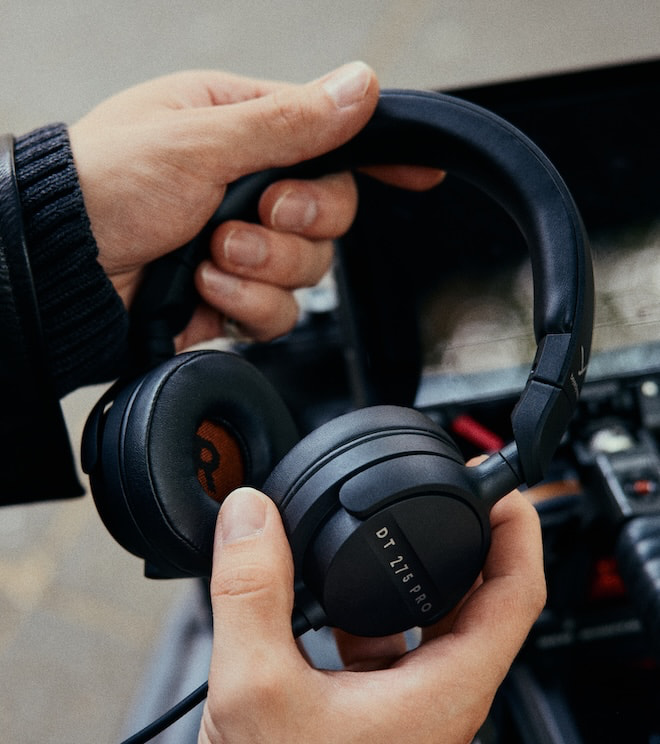
Trying to monitor a camera feed, cue the next track in a crowded booth or hear what is actually coming through the console is not the moment to discover that the ANC battery is dead or Bluetooth has decided to take the afternoon off. The Beyerdynamic DT 275 PRO is built around that problem, using a compact closed back on-ear design, 22dBA of passive isolation, a 195 gram chassis and a locking cable that can connect to either earcup. It sells for $149 and should be just as useful on location as it is later that night when I want to hear the horns, strings and vocals on Dusty in Memphis without the room joining the performance.

The DT 275 PRO is available now through Beyerdynamic’s U.S. website and authorized retailers. It joins the DT 270 PRO but serves a different purpose: the DT 270 PRO is an over-ear model for recording, podcasting and indoor studio work, while the DT 275 PRO trades some long-session comfort for greater isolation, faster handling and a smaller footprint. 

Built for Rooms That Have Abandoned Indoor Voices

Active noise cancellation works well on airplanes and commuter trains, but it can introduce processing, latency and another battery that inevitably dies during the part of the production nobody can repeat.

beyerdynamic-dt-275-pro-headphones-in-hand
Beyerdynamic DT 275 PRO

The DT 275 PRO takes the less fashionable approach of using closed earcups, leatherette pads and clamping pressure to reduce outside noise mechanically. Beyerdynamic specifies 22dBA of ambient-noise attenuation, which is the feature separating it from most compact studio headphones at this price. 

The sound is tuned for clear speech, controlled bass and reliable signal assessment rather than a dramatic consumer presentation. Beyerdynamic specifies a frequency response of 5Hz to 24kHz, 45-ohm impedance, 105dB SPL at 1mW and total harmonic distortion below 0.04 percent. 

Advertisement

The 45-ohm load should make the headphones practical with field recorders, cameras, audio interfaces, laptops and mobile devices without requiring a dedicated headphone amplifier. They can also produce substantial output, so protecting one’s hearing remains preferable to discovering the maximum level personally.

The Cable Goes Where You Need It

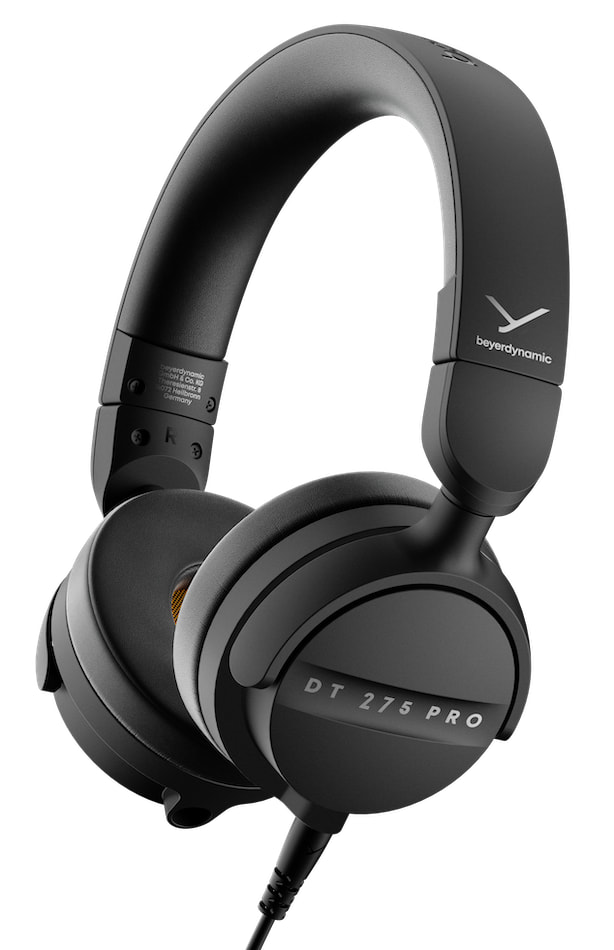
beyerdynamic-dt-275-pro-headphones-angle

The detachable 1.5-meter cable can connect to either the left or right earcup and uses a locking bayonet mechanism to prevent an accidental disconnection. Beyerdynamic says the decoupled design also reduces cable and handling noise when the headphones are used with cameras, recorders and portable audio bags. 

That sounds like a minor detail until a cable runs across the wrong side of a camera rig or escapes during a live take.

The earcups swivel for storage and single-ear monitoring, while the ear pads, headband pad and cable are replaceable. The connection cable is also compatible with Beyerdynamic’s DJ 300 PRO X and CLUB models. 

Replaceable wear components should be mandatory on professional headphones. Throwing away an otherwise functional pair because the ear pads have absorbed five years of sweat is not innovation.

Advertisement

Beyerdynamic DT 275 PRO Specifications

  • Design: Closed back, wired, on-ear
  • Driver type: Dynamic
  • Frequency response: 5Hz to 24kHz
  • Impedance: 45 ohms
  • Sensitivity: 105dB SPL at 1mW and 500Hz
  • Passive noise attenuation: 22dBA
  • Total harmonic distortion: Below 0.04 percent
  • Maximum short term power handling: 100mW
  • Cable: 1.5 meters, detachable and lockable
  • Cable connection: Left or right earcup
  • Connector: 3.5mm with 6.35mm adapter
  • Weight: 195 grams without cable
  • Replaceable parts: Ear pads, headband pad and cable

What Is Missing?

The DT 275 PRO does not include Bluetooth, ANC, a microphone or an inline remote. None belongs on a professional monitoring headphone built to avoid latency and electronic processing, but buyers looking for one pair to handle production work, commuting and phone calls should understand what is not included. 

Advertisement. Scroll to continue reading.

Unlike the DT 270 PRO, the product page does not list a USB-C audio adapter. The DT 275 PRO terminates in a conventional 3.5mm plug and includes a 6.35mm adapter, so owners of port-free smartphones and laptops will need a separate dongle. 

The larger concern is comfort. The DT 275 PRO is light at 195 grams, but its on-ear design uses a fairly firm clamp to achieve that 22dBA of passive isolation. That should help keep outside noise where it belongs, although the pressure may become noticeable during a long production session. Isolation and all-day comfort rarely arrive holding hands.

The Competition

The Sennheiser HD 25 is the most direct rival. It also costs approximately $150, uses a closed on-ear design and has remained a fixture in DJ booths and broadcast bags for decades. It is lighter and already has an enormous replacement-parts ecosystem, while the DT 275 PRO counters with its dual-side locking cable, newer design and published 22dBA attenuation rating. 

Advertisement
Sony MDR-7506 Professional Studio Headphones
Sony MDR-7506

The Sony MDR-7506 currently sells for $113 and remains one of the most widely used production headphones ever made. Its over-ear design may prove more comfortable, but the fixed coiled cable is considerably less convenient for mobile work and Sony does not position it around the same level of passive isolation. 

Audio-Technica’s ATH-M40x costs $109 and offers an over-ear fit, detachable cables and swiveling earcups. The ATH-M50x moves closer to the Beyerdynamic’s price at $159 and adds larger 45mm drivers and three supplied cables, but both occupy more room in a production bag. 

Beyerdynamic’s own DT 270 PRO remains the obvious alternative for podcasting, music production and longer indoor sessions. It uses velour over-ear pads and weighs almost exactly the same, but offers lower passive isolation and a less compact wearing style. 

Who Is It For?

The DT 275 PRO is intended for production crews, field recordists, broadcast engineers, livestream operators, front of house staff and DJs who need compact wired headphones with strong isolation and no wireless delay.

It should also appeal to commuters who value durability and passive isolation more than apps, firmware updates and hearing a synthetic voice announce that the battery is low.

Advertisement

Who Should Avoid It?

Home-studio users working in a quiet room will probably find the DT 270 PRO or DT 770 PRO X more comfortable over longer sessions.

Anyone who needs wireless connectivity, calls or active noise cancellation should also look elsewhere. The DT 275 PRO is a tool, not a lifestyle platform with a login screen.

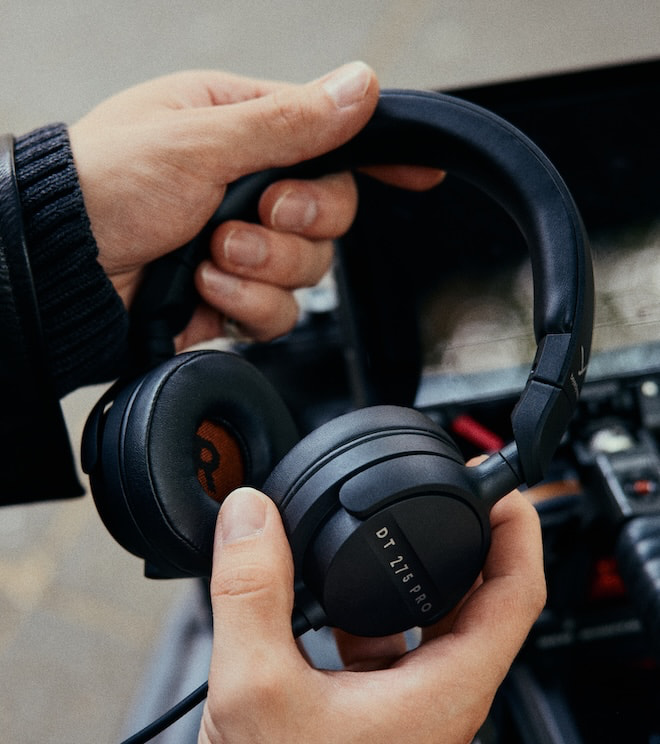
beyerdynamic-dt-275-pro-headphones-lifestyle
Beyerdynamic DT 275 PRO

The Bottom Line

The Beyerdynamic DT 275 PRO fills a specific gap between traditional studio headphones and DJ models. Its combination of 22dBA passive isolation, low weight, swiveling earcups, replaceable parts and a cable that locks into either side makes sense for people who monitor audio in environments where the environment refuses to cooperate.

Beyerdynamic’s advantage is that it has designed the DT 275 PRO around modern mobile-production workflows rather than asking another 35-year-old headphone to keep learning new tricks.

Advertisement. Scroll to continue reading.
Advertisement

For more information: beyerdynamic.com

Source link

Continue Reading

Tech

The story of the CIA, the KGB, and the Xerox machine that caught fire

Published

on

The CIA has never confirmed or denied the following story.

The only evidence we have that it happened at all is a 1997 article in Popular Science Vol. 250, Issue 1, where journalist Dawn Stover spoke to the mastermind behind one of the best-kept secrets of the Cold War.

Source link

Continue Reading

Tech

Study says relying on AI can turn doubt into false confidence

Published

on

You’d think getting wrong advice would make you more cautious. New research says the opposite happens when that advice comes from AI. A study led by Valerio Capraro, a psychology professor at the University of Milan-Bicocca, found that incorrect AI advice made people less accurate, yet noticeably more confident in their answers (via IBM Think).

The study also found that people who received incorrect AI advice became far less willing to admit they didn’t know an answer, even when staying silent was an option, and they were rewarded for accuracy.

Why does wrong AI advice make people so sure of themselves?

Researchers asked participants six questions about obscure movie details, deliberately picking ones the AI model consistently answered incorrectly. This let them isolate what happens when people consult AI, regardless of whether its advice is actually good.

The results were striking. Without AI, participants declined to answer roughly 36 to 44% of the time across two experiments. With AI available, that dropped to just 3 to 6%. Accuracy fell too, from 27.5 percent correct when working alone to just 9.2 percent with AI involved.

Capraro suspects AI may lower the amount of confidence people need before committing to an answer, essentially shifting how they judge their own certainty. Oddly, this held true even when AI advice appeared automatically without being requested, suggesting the effect isn’t just about actively seeking help.

Advertisement

Does raising the stakes change anything?

Adding financial rewards and penalties made people somewhat more cautious and accurate, though the underlying pattern never fully disappeared. Capraro draws a clear distinction here. AI should augment human judgment, not replace it entirely.

He worries this effect extends to children too, since growing up with instant answers could prevent kids from experiencing doubt as part of learning. New reports suggest that the AI-hooked younger generation is sourcing chatbot help even for in-person talks. As Capraro puts it, doubt isn’t a failure of knowledge. It’s often where real knowledge actually begins.

Source link

Advertisement
Continue Reading

Tech

Free and inexpensive courses to upgrade your research skills

Published

on

If you are working or aim to work in the research and development field, then consider undertaking an online course to boost your skills.

Whether you are an industry veteran, a newbie, or somewhere in the middle, the industry you are in is likely changing as fast as you can keep up with. That is certainly true of the research and development sector, where innovation and transformation are par for the course. 

As a result, it is an absolute necessity that professionals, regardless of which stage of their career they are in, stay aware of the skills, techniques and processes making waves in the sector. If you want your career to evolve in step with the space itself, then make use of every educational opportunity that comes your way – starting with some free and inexpensive online courses. 

Coursera  

For students or professionals looking to better develop an understanding of research methodologies, Coursera, via the Queen Mary University of London, is running the Research Methodologies programme.

Advertisement

This flexible 20-hour course consists of four modules in which participants will study different research methodologies, different sampling approaches, and primary and secondary data collection approaches. Students will also look at the role of the internet in market research as well as non-comparative scaling techniques and the course will end with a discussion on different data collection approaches, observation, content analysis, narrative research, phenomenology and the collection of data using ethnography.

A similar course suited to those looking to develop foundational skills is the Coursera/University of London programme titled Understanding Research Methods. This flexible, six-hour course has four core modules and is particularly suited to those conducting research as part of their postgraduate studies or who are looking to build their knowledge base. No prior knowledge or experience in research is required.

Alison

Alison and NPTEL are running the Understanding Research Methods and Approaches programme which involves exploring qualitative research methods, fieldwork and literature reviews among other topics. The free online course offers a general introduction to understanding different research methodologies and various approaches. Students will learn the significance of linking the gap between theory and practice. The advanced level course takes around five to six hours, includes three modules and is CPD accredited.

If you want a more specific education, Alison and NPTEL have additional courses such as a beginner level Introduction to Biomedical Research programme, an Academic and Research Skills for Business Success course and a Research Skills for Healthcare programme.  

Advertisement

Oxford Home Study Centre

The Oxford Home Study Centre is running a free Research Skills training course designed to teach students how to conduct effective research and make efficient use of their time.

The course is flexible, takes around 20 hours to complete and comes with a certificate upon completion. This course delves into the fundamental elements and benefits of research capabilities and will focus on why research skills are important, tips and tricks for reading and note-taking techniques, and how to utilise Miller’s Law, which is a proposed memory retention rule that the average person can only keep seven (plus or minus two) items in their working memory at any given time.

It is ideal for an individual looking to boost the skills that empower research in the long-term, at a core level. 

Class Central

Class Central, via Yale University, is running a Fundamentals of Qualitative Research Methods programme.

Advertisement

The course, which is a Yale University programme accessed for free through YouTube, is a self-paced video course that takes under an hour and a half to finish. Students will learn the fundamentals of qualitative research methods, develop a qualitative research question and gather data using interviews and focus groups.  

Class Central, via various other edtech platforms, also offers research programmes such as the Understanding Clinical Research: Behind the Statistics module, Research Ethics and Plagiarism course, and Research Skills, Communication and Dissemination. 

Don’t miss out on the knowledge you need to succeed. Sign up for the Daily Brief, Silicon Republic’s digest of need-to-know sci-tech news.

Advertisement

Source link

Continue Reading

Trending

Copyright © 2025