Connect with us

Business

Can Sensex, Nifty snap 2-day fall on Monday? 7 factors that could decide market mood this week

Published

on

Can Sensex, Nifty snap 2-day fall on Monday? 7 factors that could decide market mood this week
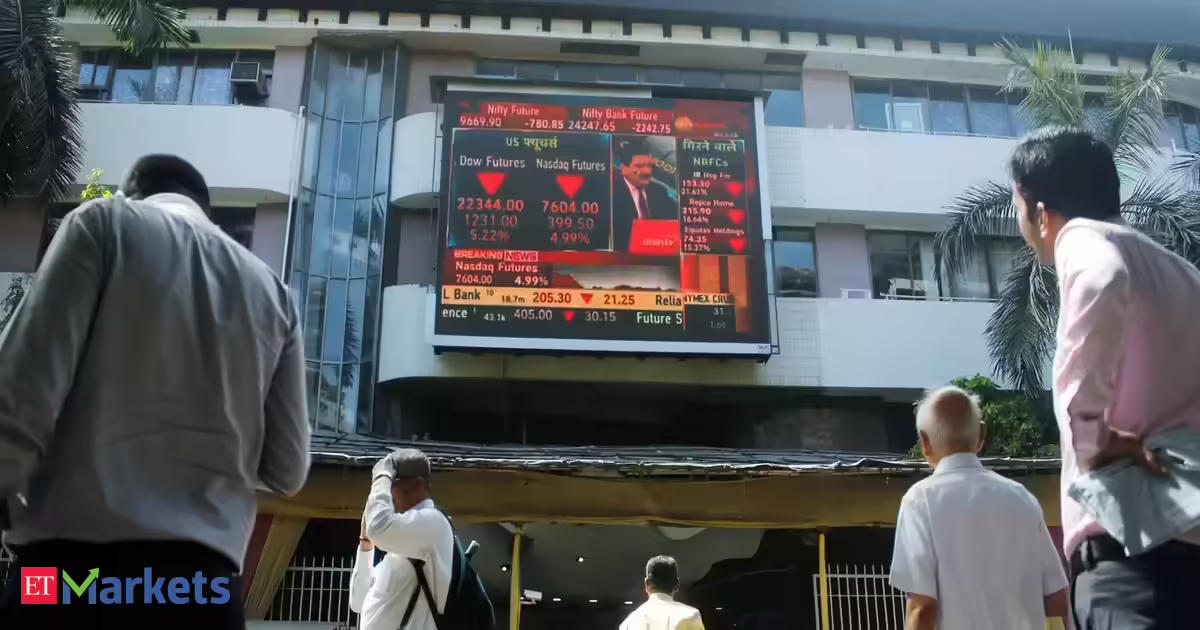
Benchmark indices Sensex and Nifty ended the week on a bearish note, closing over a percent lower each as a deepening selloff in IT stocks rattled investor sentiment amid mounting fears of AI-led disruption. Further, stronger-than-expected jobs data for January dampened hopes of a US Fed interest rate cut.

Here are 7 factors that could decide market action in the coming week:


1.) Infosys, Wipro ADRs rebound –
After a brutal two-day selloff that saw Infosys and Wipro ADRs plunge as much as 14.5%, Friday’s session brought a much-needed breather. Bargain hunting kicked in at lower levels, sparking a sharp rebound as Infosys climbed 3% while Wipro gained 4%—helping both stocks close the week on a far stronger note. International brokerage firm JP Morgan has a message for panic-stricken investors: IT services firms are the indispensable “plumbers of the tech world” and their dividend yields have now hit levels last seen only during the global financial crisis and COVID-19.

As Rs 5.7 lakh crore evaporates from the sector in just eight trading sessions and the Nifty IT index crashes 19% in the short span, the Wall Street giant is turning contrarian, declaring “deep value” buying opportunities in bloodied bellwethers Infosys and TCS.

Advertisement

2.) US CPI numbers lift rate cut bets – U.S. inflation data lifted expectations of monetary easing after the Consumer Price Index rose 2.4% year-on-year, slightly below economists’ estimates of 2.5%, according to a poll by Reuters. The softer print boosted market bets that the Federal Reserve could deliver at least two rate cuts this year.

The moderation in overall inflation drew a positive response from the White House, with a spokesperson saying on social media that America’s economy could gain further momentum through long-awaited interest rate cuts from the Federal Reserve. Even so, concerns over the labour market and rising living costs continue to weigh on public sentiment, with many Americans expressing unease about economic conditions and voicing dissatisfaction with Donald Trump’s handling of the economy.
3.) How FIIs navigate AI-led disruption fears – VK Vijayakumar, Chief Investment Strategist at Geojit Investments Limited FIIs remained net sellers to the tune of Rs 1,374 crore for the month so far. The overall figure was skewed by a sharp selloff of Rs 7,395 crore on February 13, when the Nifty fell 336 points amid heavy selling in IT stocks following the Anthropic-related shock, with the IT index plunging 8.2% during the week ended February 13.Vijayakumar added that market sentiment has strengthened after the fiscally prudent and growth-oriented 2026 Budget and the India–US trade agreement, with large-cap valuations appearing fair given improving corporate earnings prospects for FY27. He expects FIIs to turn buyers once volatility in the IT sector subsides, adding that any extended unwinding of the AI trade in the US could further encourage foreign flows into India, which he described as a non-AI market.

4.) Rupee vs Dollar – The Indian rupee closed at 90.64 per U.S. dollar, little changed from its previous close of 90.59. A strengthening U.S. dollar, which has risen for a third straight session to 96.95 is generally negative for equities as it can trigger foreign fund outflows from emerging markets like India toward safer assets in the United States.

“USD/INR remains in a short-term corrective consolidation after rejecting recent highs but continues to trade comfortably above rising channel support near 90.20–90.40. The 90.00 zone remains the structural pivot; as long as this base is defended, the broader upward bias remains intact. A phase of consolidation appears likely before a renewed attempt toward 91.80–92.50, which in turn continues to provide underlying support to domestic bullion pricing dynamics,” Ponmudi R, CEO of Enrich Money said.

5.) Technicals flashing weakness – The Nifty has broken decisively below its recent consolidation range, closing under 25,500 after testing lower levels and forming a strong bearish candle amid rising downside momentum, largely led by weakness in IT stocks. The index is now hovering near a critical support zone of 25,400–25,300, which coincides with the 200-DMA and 200-EMA cluster, while a deeper safety net is seen around 25,200–25,000, says Ponmudi R, CEO of Enrich Money.

Advertisement

Immediate resistance is placed at 25,550–25,600, near the 20-SMA and a previous support area. A sustained move above 25,700–25,800 will be required to signal stabilization and potentially pave the way toward 26,000, where strong overhead supply remains.

As long as 25,300 holds on a closing basis, the broader structural uptrend stays technically intact. However, a decisive breach below this level could trigger sharper downside pressure toward lower supports. Options data suggests a bearish bias, with aggressive call writing at higher strikes and fresh put buildup at lower levels. The near-term trading range is seen between 25,200 and 25,700, with a strategy leaning toward selective dip buying at strong support zones while closely tracking global cues and shifts in open interest.

6.) US GDP data next week – Market participants will closely track the upcoming minutes of the Federal Reserve’s latest policy meeting, along with U.S. GDP data for the October–December quarter, both due next week. These releases are expected to offer clearer signals on the central bank’s policy trajectory and the near-term outlook for interest rates.

For Indian markets, such global cues carry added weight, particularly amid volatile Foreign Portfolio Investor (FPI) flows. While there were early indications of a pickup in inflows, sentiment turned cautious after sharp selling on the final trading day of the week during a global technology-led rout.

Advertisement

7.) Geopolitical tensions – The U.S. military is preparing for the possibility of sustained, weeks-long operations against Iran if US President Donald Trump authorises military action, Reuters reported, citing two officials, signalling the risk of a far more serious escalation between the two countries. The disclosure has raised the stakes for ongoing diplomacy, even as U.S. and Iranian representatives recently met in Oman in an effort to revive talks over Tehran’s nuclear programme after a buildup of American forces in the region heightened tensions. Meanwhile, the Pentagon has begun deploying an additional aircraft carrier to the Middle East, along with thousands of troops, fighter aircraft and guided-missile destroyers, strengthening both offensive and defensive military capabilities.

(Disclaimer: Recommendations, suggestions, views and opinions given by the experts are their own. These do not represent the views of The Economic Times)

Continue Reading
Click to comment

Leave a Reply

Your email address will not be published. Required fields are marked *

Business

China Deploys a ‘National Team’ of Investors to Keep AI Stock Boom in Check

Published

on

China Deploys a ‘National Team’ of Investors to Keep AI Stock Boom in Check

When the Dow Jones Industrial Average crossed 50000 for the first time this month, President Trump celebrated and predicted it would be double that by the end of his term.

In China, officials have had a different reaction to the country’s own stock-market boom. A group of state-linked investors has stepped in, unloading holdings to cool things down. 

Copyright ©2026 Dow Jones & Company, Inc. All Rights Reserved. 87990cbe856818d5eddac44c7b1cdeb8

Continue Reading

Business

Robotics Could Be a Boon for the Elderly

Published

on

Robotics Could Be a Boon for the Elderly

To the Editor:
The new robotic industry may have some surprise funding sources (“The Robot Revolution Is Real. Tesla, Hyundai, and More Stocks to Play It,” Cover Story, Feb. 6). For example, long-term care insurance may cover the cost of robots for home healthcare associated with daily-living activities for the elderly. The longer we can keep people in their homes, the better the quality of life and the longer expensive assisted-living centers can be put off. Robots, self-driving cars, and home delivery of groceries and goods should, in theory, reduce the cost of caring for aging people. Lawn care and landscaping may be one of the first service industries to be disrupted by robotics.

Continue Reading

Business

SOLT: Not For The Faint Of Heart

Published

on

SOLT: Not For The Faint Of Heart

SOLT: Not For The Faint Of Heart

Continue Reading

Business

Competing on equal terms: How trade agreements can reshape India’s growth model

Published

on

Competing on equal terms: How trade agreements can reshape India’s growth model
India’s recent trade agreements mark more than incremental policy changes. They signal a strategic repositioning. India is no longer competing only on cost or capability; it is competing on market access. For a country that runs a structural current account deficit driven by energy and electronics imports, export competitiveness becomes central to macro stability. The real challenge, therefore, is not reducing imports but funding them sustainably. Exports remain India’s most dependable answer.

Global trade today is intensely competitive. Countries that combine lower production costs with preferential tariff access capture supply chains quickly. Even small tariff differences can gradually shift sourcing decisions. If a competing manufacturing hub offers similar quality at lower cost and enjoys better tariff access, global buyers will move. India’s industrial and services capabilities are globally competitive; what increasingly determines success is whether exporters compete on equal terms.

India’s approach to trade partnerships is undergoing a subtle but important evolution. The country is no longer negotiating trade agreements from a position of vulnerability, but from a position of capability. Recent engagements with major economic blocs, including the United States, the UK and the European Union, reflect this shift. Preferential access to large consumption markets such as Europe strengthens export visibility and industrial scale.

Improved tariff alignment with the United States enhances competitiveness in sectors directly linked to global manufacturing realignment. Collectively, these agreements are gradually repositioning India from being primarily a consumption-led economy to becoming an increasingly important participant in global production networks.

Advertisement

Securing competitive access

The India-EU trade agreement brings India into deeper economic engagement with a bloc that includes major industrial powerhouses such as Germany, France, Italy, Spain and the Netherlands and significantly expands India’s global trade integration by providing preferential market access for most exports. Given that India and the EU together account for roughly 25% of global GDP and a third of world trade flows, the pact marks a structural milestone in India’s journey toward export competitiveness and deeper global capital alignment.

Improved tariff parity can drive tangible outcomes:

  • Higher export volumes in labour-intensive sectors
  • Greater participation in the US friend-shoring supply chains
  • Increased manufacturing scale and employment

India’s tariff position is now broadly comparable to that of other major exporting economies supplying the US. In labour-intensive sectors such as textiles and leather, where even marginal cost differences matter, the earlier tariff disadvantage has narrowed significantly. In global trade, sourcing decisions are often made on narrow margins. India is now firmly on equal footing, competing on capability rather than tariff differential.

Markets prefer visibility

Recent tariff clarity coincided with renewed FII inflows of approximately USD 1.7 billion, highlighting how trade visibility influences capital allocation decisions. Stronger export momentum is increasingly shaping earnings quality and market valuations.
Export-oriented businesses typically demonstrate better earnings visibility and natural currency support during periods of rupee weakness. Export-heavy sectors such as IT and pharmaceuticals reflect this trend, with Nifty IT trading at 24-25x P/E and Nifty Pharma at c.30x, compared with discounted valuations in commodity cyclicals.

Few sectors illustrate India’s export transformation more clearly than electronics manufacturing. Not too long ago, India was largely a consumption market for global electronics brands. Today, it is emerging as a major production hub. Electronics exports have climbed to USD 48.2 billion in 2025, moving from seventh to third among India’s export categories. Yet India’s export-to-GDP ratio remains c.21%, well below several Asian manufacturing economies – highlighting the scale of opportunity ahead.

Advertisement

Over the past year, FPI flows into Indian equities have turned volatile. After strong inflows through 2023-24, India saw net FPI outflows of nearly USD 17-18 billion in 2025 as global liquidity tightened and US yields moved higher. Even in early 2026, flows have remained uneven, with brief inflow spurts followed by profit-taking.

For an economy managing a current account deficit driven by oil and electronics imports, strong export growth reduces dependence on unpredictable capital flows. It strengthens foreign exchange reserves, supports currency stability and enhances macro credibility. For investors, that stability matters. This is one reason export-oriented sectors such as IT services and pharmaceuticals have historically commanded premium valuations relative to purely domestic cyclicals.

A clear strategic shift

If India intends to sustain high growth while managing external stability, trade integration will be important. India is gradually moving from protection-led caution to competitiveness-led integration. At a time when global supply chains are being redefined, this shift is timely.

Trade agreements do three important things: First, they improve export competitiveness and protect market share. Second, they strengthen foreign exchange management by expanding stable earnings. Third, they enhance India’s attractiveness as a global manufacturing and services partner.

Advertisement

These agreements reflect India’s aspiration to lead, to compete, and to be counted among the world’s most open, dynamic, and forward-looking economies. The message is clear: the world is opening its markets to India. It’s time for us to step forward and lead from the front.

(The author, Neerja Ajit, is Vice President at NovaaOne)

(Disclaimer: Recommendations, suggestions, views, and opinions given by experts are their own. These do not represent the views of The Economic Times.)

Advertisement
Continue Reading

Business

Could Manchester be a model for the UK to kickstart growth?

Published

on

Could Manchester be a model for the UK to kickstart growth?

With an annual growth rate of 3.1%, Manchester’s economy has performed twice as well as that of the UK as a whole.

Continue Reading

Business

Fortinet Stock: Preparing The Growth (NASDAQ:FTNT)

Published

on

Fortinet Stock: Preparing The Growth (NASDAQ:FTNT)

This article was written by

Quality Growth Investor. I have the simplest of tastes, I only like the best. Here I will analyze the companies in my investment universe. I am looking for the best businesses in the world in order to create a long term portfolio that can outperform the market.

Analyst’s Disclosure: I/we have no stock, option or similar derivative position in any of the companies mentioned, and no plans to initiate any such positions within the next 72 hours. I wrote this article myself, and it expresses my own opinions. I am not receiving compensation for it (other than from Seeking Alpha). I have no business relationship with any company whose stock is mentioned in this article.

Seeking Alpha’s Disclosure: Past performance is no guarantee of future results. No recommendation or advice is being given as to whether any investment is suitable for a particular investor. Any views or opinions expressed above may not reflect those of Seeking Alpha as a whole. Seeking Alpha is not a licensed securities dealer, broker or US investment adviser or investment bank. Our analysts are third party authors that include both professional investors and individual investors who may not be licensed or certified by any institute or regulatory body.

Advertisement
Continue Reading

Business

Los Angeles Sues American Industrial Partners Over Firetruck Rollup

Published

on

Los Angeles Sues American Industrial Partners Over Firetruck Rollup

Los Angeles County accused American Industrial Partners of conspiring to monopolize the market for firetrucks, alleging the private-equity firm’s tactics led to shortages and high prices. 

The county on Thursday brought the antitrust lawsuit against the private-equity firm and Rev Group, a firetruck manufacturer AIP formed two decades ago, as well as Pierce Manufacturing and its parent company, Oshkosh Corp., which aren’t affiliated with private equity. The case was filed in the U.S. District Court in Los Angeles.

Copyright ©2026 Dow Jones & Company, Inc. All Rights Reserved. 87990cbe856818d5eddac44c7b1cdeb8

Advertisement
Continue Reading

Business

Ahead of Market: 10 key factors to steer markets on Monday

Published

on

Ahead of Market: 10 key factors to steer markets on Monday
Indian benchmark indices closed sharply lower on Friday, dragged down by broad-based selling across sectors. Consumer, IT, and energy stocks were among the biggest laggards.

The Nifty settled at 25,471.10, down 336 points or 1.30%, while the BSE Sensex tumbled 1,048.16 points, or 1.25%, to close at 82,626.76.

The volatility gauge, India VIX, ended at 11.73, down 1.53% from the previous close.

Analysts’ Take

Nilesh Jain, Vice President – Head of Technical & Derivative Research at Centrum Finverse, said the Nifty opened with a gap-down and slipped below its key 21-, 50-, and 100-day moving averages, placed at 25,480, 25,770, and 25,690, respectively.
The index is attempting to fill last week’s downside gap, and the crucial support at the 200-DMA near 25,300 is likely to be tested in the near term, Jain added.

Advertisement


“India VIX had surged sharply earlier to around 13, and any further rise in volatility could be a cause for concern. Overall, the market structure appears sideways to weak, and pullback rallies are likely to face selling pressure as long as the Nifty remains below 25,800,” he said.

European Markets

Most major European indices were trading broadly positive around 2:07 p.m. GMT (7:52 p.m. IST). Germany’s DAX was higher, while France’s CAC 40, the Stoxx 600, and the UK’s FTSE 100 were also trading in the green. Spain’s IBEX, however, was marginally lower.

Tech View

Rupak De, Senior Technical Analyst at LKP Securities, said India VIX has moved back above its 200-DMA, indicating rising caution among market participants.

From a technical perspective, the setup has turned relatively cautious, with the index slipping below its 20-DMA for the first time in recent sessions. He added that the Nifty has breached the 38.2% Fibonacci retracement of the prior upward move from 24,571 to 26,341.

“With the index closing below the key support level of 25,500, the near-term bias appears weak, with potential for a decline toward 25,000 in the short term. On the upside, immediate resistance is seen around 25,800,” he said.

Advertisement

Most Active Stocks (Value)

Bajaj Finance (Rs 591 crore), Infosys (Rs 377 crore), HDFC Bank (Rs 375 crore), Larsen & Toubro (Rs 222 crore), TCS (Rs 211 crore), HCL Technologies (Rs 194 crore), and Reliance Industries (Rs 144 crore) were among the most active stocks on the BSE in value terms.

Most Active Stocks (Volume)

SpiceJet (4.86 crore shares), Vodafone Idea (3.59 crore shares), YES Bank (78.48 lakh shares), Suzlon Energy (66.30 lakh shares), Bajaj Finance (58.42 lakh shares), Eternal (44.23 lakh shares), and Ola Electric (43.51 lakh shares) were among the most actively traded stocks in volume terms on the BSE

Stocks Showing Buying Interest

Bajaj Finance, Lenskart Solutions, Engineers India (EIL), GE Power India, Universus Photo Imagings, Repro India, Laxmi Cotspin, and Anmol India witnessed notable buying interest.

52-Week High/Low

A total of 83 stocks hit their 52-week highs, while 193 slipped to 52-week lows. Stocks touching fresh highs included Apex, Avanti Feeds, Bharat Forge, Eicher Motors, Jamna Auto Industries, Lenskart, and Sharda Cropchem.

Advertisement

Stocks Seeing Selling Pressure

Among large-cap names, HDFC Bank, Reliance Industries, and ICICI Bank saw significant selling pressure. Other laggards included SpiceJet, Hindustan Unilever, Hindalco Industries, Eternal, Adani Enterprises, Crown Lifters, Muthoot Finance, and ONGC.

Market Breadth

Heavyweights such as HDFC Bank, Reliance Industries, ICICI Bank, and Hindustan Unilever weighed on the indices. Market breadth remained negative. Of the 4,364 stocks traded on the BSE, 1,253 advanced, 2,960 declined, and 151 remained unchanged.

(Disclaimer: Recommendations, suggestions, views and opinions given by the experts are their own. These do not represent the views of Economic Times)

Advertisement
Continue Reading

Business

Market Trading Guide: Bajaj Finance and a smallcap stock offer up to 5% upside in near term. Here’s why

Published

on

Market Trading Guide: Bajaj Finance and a smallcap stock offer up to 5% upside in near term. Here’s why
Nifty ended Friday with sharp cuts amid selling pressure across the board, with consumer, IT and energy stocks dragging the markets the most. India VIX also moved back above its 200-DMA, indicating rising fear among the market participants.

Commenting on the technical charts, Rupak De, Senior Technical Analyst at LKP Securities, said that the setup has turned relatively cautious, with the index slipping below its 20-DMA for the first time in the past few sessions. Additionally, it has breached the 38.2% Fibonacci retracement of the prior up move from 24,571 to 26,341, he added. “With the index closing below the key support level of 25,500, the near-term bias appears weak, and there is potential for a decline toward the 25,000 mark in the short term. On the upside, immediate resistance is seen around 25,800,” De said.

Here are 2 stock recommendations for Friday:

Buy Kirloskar Oil Engines at Rs 1,375-1,385 | Upside: 5% | Target: Rs 1,500 | Stop Loss: Rs 1,320

Kirloskar Oil Engines is currently taking a breakout of the rounding bottom formation on the daily time frame. The RSI is trending upward, reflecting positive momentum, and the stock finds support at the 21-day EMA, with all key EMAs rising. The stock is trading above important moving averages, indicating a bullish trend. 1,320 could work as an immediate support, and a hurdle can be seen at 1,500.(Drumil Vithlani, Technical Research Analyst, Bonanza Portfolio)

Advertisement

Buy Bajaj Finance at Rs 1,024-1,026 | Upside: 4% | Stop Loss: Rs 990 | Target: Rs 1,070

Bajaj Finance is currently taking a breakout of the downward-moving channel on the daily time frame. The lower trend line has provided support, accompanied by the formation of a bullish candlestick pattern, indicating a potential short-term upward movement in the stock. Momentum Indicator RSI is trading near the overbought region, which confirms the bullishness in the script.


(Drumil Vithlani, Technical Research Analyst, Bonanza Portfolio)
(Disclaimer: Recommendations, suggestions, views and opinions given by the experts are their own. These do not represent the views of The Economic Times.)

Continue Reading

Business

US Markets | In a frothy market, Brookfield’s Bruce Flatt backs value over fashion for long-term gains

Published

on

US Markets | In a frothy market, Brookfield’s Bruce Flatt backs value over fashion for long-term gains
With global equity markets swinging sharply on rate expectations, geopolitical risks and shifting sector narratives, Brookfield Asset Management CEO Bruce Flatt’s long-standing investment philosophy appears especially relevant for today’s environment. Flatt continues to stress that long-term wealth creation comes not from chasing popular themes, but from identifying genuine value where others are reluctant to invest.

Speaking on Brookfield’s investment approach a few years ago in a presentation made at the Talk @ Google, whose video is available on YouTube, Flatt consistently highlighted the importance of moving away from crowded trades and focusing instead on areas where capital is scarce. In periods when investor sentiment is driven by short-term news flow and momentum, he believes the biggest opportunities often lie in segments that are temporarily out of favour.

Flatt’s framework centres on profitability and durable cash flows rather than headline growth. He has repeatedly argued that growth, by itself, does not necessarily translate into value creation. Instead, Brookfield prioritises assets and businesses that can generate steady returns over long periods, even if they are not part of the market’s prevailing narrative.

A key pillar of this strategy is investing in real assets such as infrastructure, real estate and renewable power, which tend to offer long-term contracted cash flows and inflation protection. According to Flatt, these assets provide resilience during market cycles and can help smooth volatility when traditional equity markets are driven by shifting risk appetite.

Advertisement

In an environment where investors are increasingly influenced by fast-moving trends, Flatt also warns against being swayed by popular stories or excessive optimism. He has noted that successful investing often requires a contrarian mindset of being willing to commit capital when others are pulling back, and maintaining discipline when markets become overheated.


Another core principle of Brookfield’s approach is buying quality assets, even if that means paying a modest premium, while ensuring they are acquired below long-term replacement costs. This, Flatt believes, provides a margin of safety and improves the odds of superior returns over time.
With market volatility expected to remain elevated amid global policy shifts and economic uncertainty, Flatt suggests long-term investors to stick to fundamentals, focusing on cash generation and resisting the urge to follow market fashion. Over time, he believes, patience and value-driven discipline continue to be the most reliable drivers of sustainable returns.(Disclaimer: Recommendations, suggestions, views and opinions given by the experts are their own. These do not represent the views of The Economic Times)
Continue Reading

Trending

Copyright © 2025