
Entertainment
Forget ‘Game of Thrones,’ These Beloved Books Have the Best Dragons in Fantasy

Since the release of Game of Thrones in 2011, audiences around the world have become obsessed with the A Song of Ice and Fire franchise by George R. R. Martin. Though the show ended in one of the worst-received final seasons in television history, the franchise keeps people coming back thanks to its rich worldbuilding, gripping political intrigue, and stunning visuals, especially regarding the dragons. Two spin-offs have since come out: House of the Dragon, which focuses on a civil between House Targaryen that sees dragons burning entire armies, and A Knight of the Seven Kingdoms, set many decades later, after the dragons are gone.
While iconic thanks to their size, bonds with their riders, and ties to magic, Martin’s dragons are far from the best in fantasy media, partially because Martin wanted the dragons to be more realistic, with only four limbs instead of six, and keeping their intelligence closer to animals than sentient, ancient creatures. Thus, they lack the presence and personality of dragons from J. R. R. Tolkien‘s Middle-earth, or the ancient majesty of the dragons of Ursula K. Le Guin‘s Earthsea. But another series has dragons that can stand alongside them in terms of their design and execution: Jennifer Rowe‘s (under pen name Emily Rodda) Deltora Quest.
What Are the Dragons of Deltora?

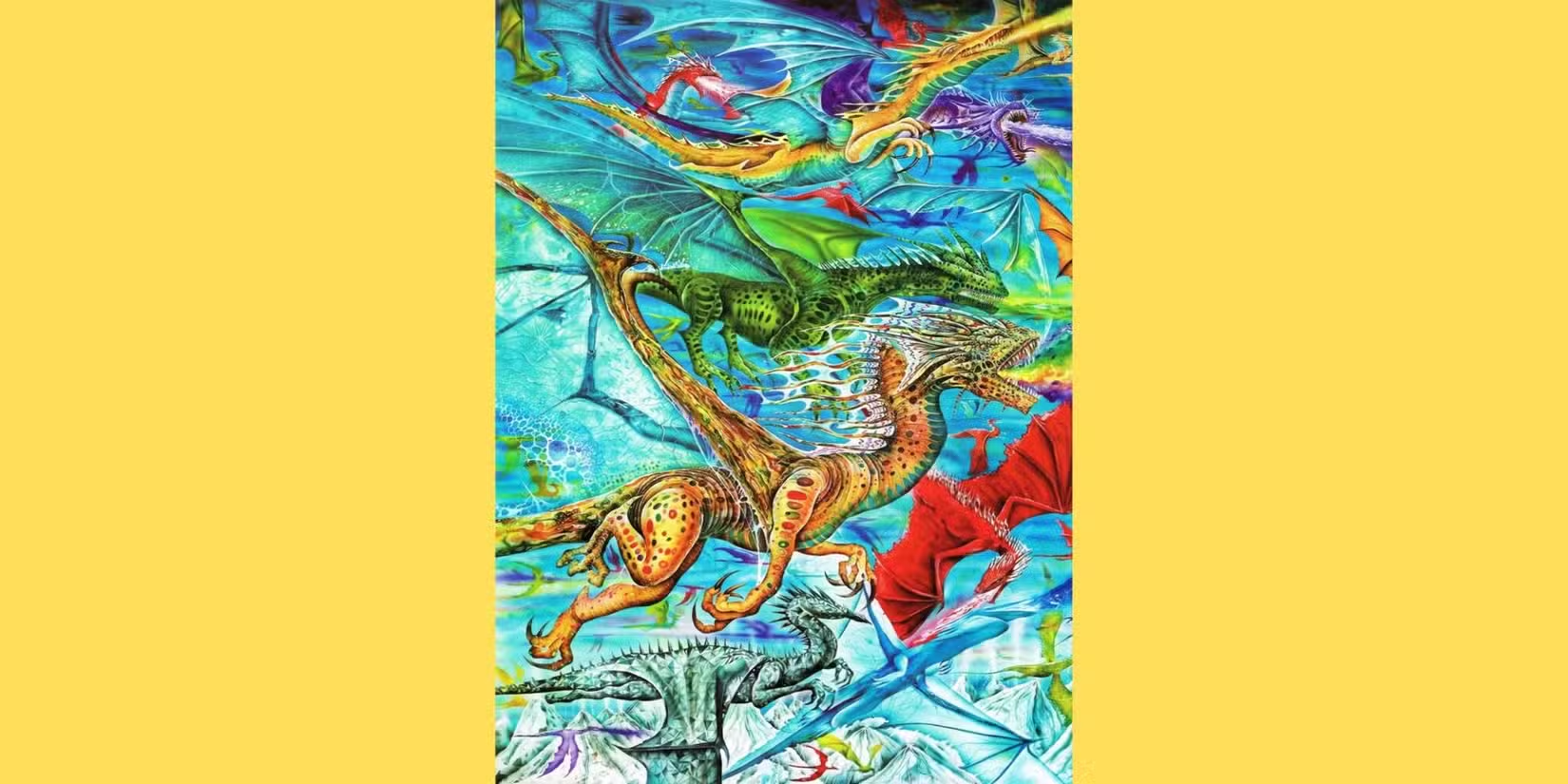
The titular land of Deltora is part of a larger universe made up of Rowe’s other fantasy series, including Rowan of Rin, The Three Doors, and the sequel series Star of Deltora. It is notable for the seven different tribes of people who live on it, each of whom possesses a magic gemstone: a diamond, emerald, lapis lazuli, topaz, opal, ruby, and amethyst. Prior to Deltora’s unification under its first king, Adin, it was known as the Land of Dragons because of how many of the beasts lived there. They, too, were divided based on the seven tribes, resulting in unique visual distinctions, something further emphasized through illustrator Marc McBride‘s beautiful work, which not only gives the dragons vibrant colorations, but appearances that are inspired by marine life.
Like most fantasy series, the dragons of Deltora are sentient creatures, and their personalities vary based on their tribes. Topaz dragons are loyal and thoughtful; Ruby dragons are kind and good-natured; Opal dragons are meticulous and observant; Lapis Lazuli dragons are impulsive and eccentric; Emerald dragons are honorable and stubborn; Amethyst dragons are philosophical and wise; and Diamond dragons are aggressive and dutiful. Their diets are also different, such as Lapis Lazuli hunting vicious Sand Beasts from the Shifting Sands, Topaz hunting cruel gray-furred creatures called Granous who love to bite the fingers and toes off their victims, and Diamond grazing on Blood Lillies when they’re not hunting meat. The dragons have a unique identity compared to other franchises, feeling closer to distinct cultures of people while remaining powerful and ancient.
Deltora’s Dragons Are Woven Into the Bones of the World
Many times it is said that dragons are “of the land,” which the series demonstrates in two main ways: the first is physically. While dragons are sentient creatures, they feel more “natural” compared to other franchises. Their soft underbellies are a pale blue that blends into the sky, making them nearly impossible to see from the ground. The reason they kidnap maidens like in fairy tales is not to eat them, but because human hair makes for a great lining for their nests. They are solitary hunters whose territories overlap with other dragons of the same tribe, but socializing is reserved only for mates and their children. Even the way they speak to humans feels like an apex predator speaking to something far beneath them, but they don’t feel like killing unless angered. Winning a dragon’s trust is a very tricky thing; if they tell someone their name, it means they trust that person.
The other example is that their magical presence is tied directly to the land; dragons are an extension of Deltora itself. They cause the land to prosper, while their absence causes crops to fail and animals to reduce in number. They can tell at a glance what tribe a person belongs to, and can sense when things are off, such as disease or the presence of evil magic. In such cases, they try to destroy the source of corruption as quickly as possible, but know to show restraint if humans and non-human tribes of Deltora are caught in the crossfire.
Speaking of the tribes of Deltora, many of them have certain customs based around the dragons. The women of Broome in Ruby territory shave their heads to deter dragons from abducting them for their hair, while the warrior-like Jalis of the Diamond territory often seek out dragons as the ultimate challenge. Others, like the magical Torans of Amethyst territory, befriend dragons and enjoy philosophical conversations with them. Again, this lore helps the dragons feel like integral parts of the world rather than an arbitrary addition.
Deltora Quest Knows Not to Overuse Its Dragons

With how much detail Rowe put into the dragons, you would think they are an ever-present force in the series. However, they are believed to be extinct by the time of the first book, The Forests of Silence. Most of the information about them comes from the in-universe writings of an explorer named Doran the Dragonlover, and is recorded in the companion book Secrets of Deltora. Dragons also feature prominently in the Tenna Birdsong Tales—a collection of myths gathered by a woman who could speak to birds—and the written history of Deltora, which are detailed in Tales of Deltora.
Of course, being believed to be extinct isn’t the same as actually being extinct. The longer the main series goes on, the more Rowe shifts from talking about the dragons in a mythological sense to a theoretical possibility. This approach mirrors how Martin handled the dragons in his first Ice and Fire novel, A Game of Thrones. Rowe isn’t as graphic in the return of her dragons as Martin is, but the result is no less magical. Like how Daenerys hatching her dragons comes at her lowest moment, the return of the dragons in Deltora Quest comes when the land is near its own breaking point. There is a clear shift in tone — not only does magic return to the world, but so too does hope.
Even once they appear, dragons do not dominate this story, an understandable trap that some franchises can fall into. After all, dragons are the most iconic creature in all of fantasy, and nearly every culture on Earth has its take on them. Naturally, authors want to get the most out of them to inject their world with more fantastical wonder. However, Rowe’s restraint in using the dragons sparingly ensures that they never feel mundane. They remain awe-inspiring manifestations of the will of Deltora itself that also serve as a physical representation of hope and renewal, presented in a more naturalistic way in terms of their culture and lifestyle. All these choices make Deltora’s dragons truly singular in the fantasy world, a crucial aspect of the saga’s lore and a natural evolution of the role they usually play in fantasy stories.

Continue Reading
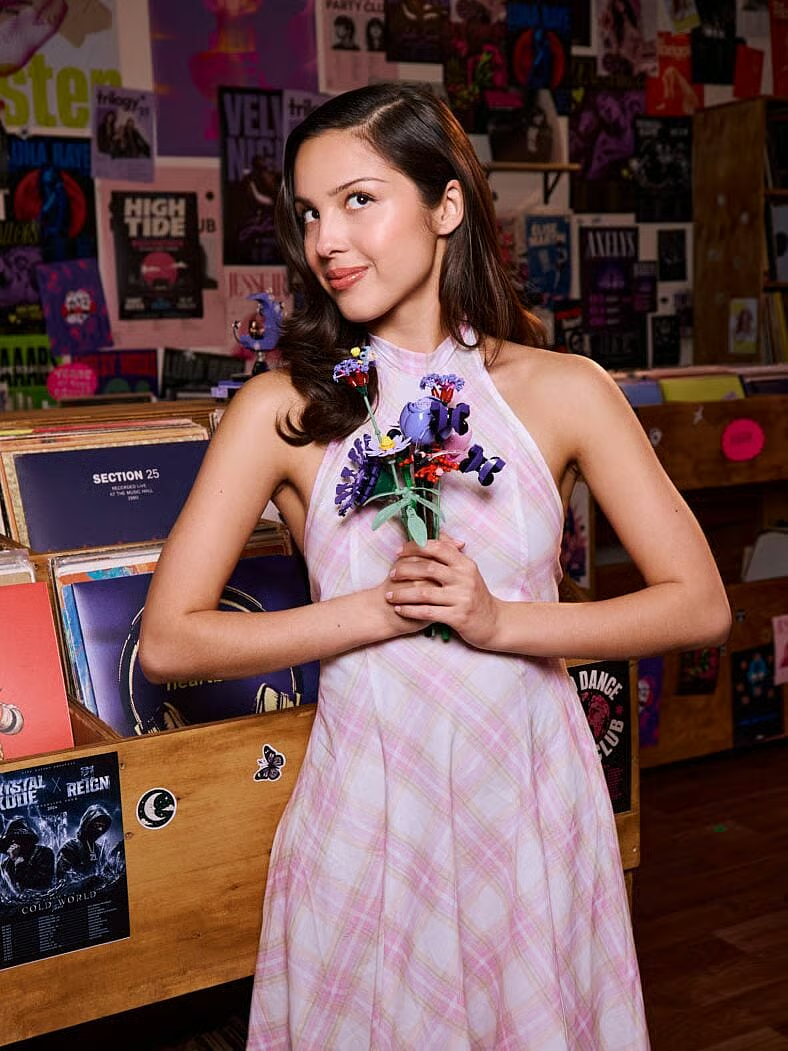
Olivia Rodrigo‘s latest public outing with rumored boyfriend Julian Croonenberghs may have looked like another sweet date to fans, but according to a body language expert, the singer’s affectionate display revealed far more than simple chemistry.
After the pair packed on the PDA during a laid-back day in New York City, expert Inbaal Honigman believes the “Vampire” hitmaker is showing signs of a dramatic evolution in how she approaches romance, suggesting she’s more confident, emotionally open, and secure than in previous relationships.
After photos of Olivia Rodrigo and Julian Croonenberghs embracing in a New York park surfaced online, body language expert Inbaal Honigman analyzed the couple’s interactions and concluded that the singer appeared captivated by her new partner.
“Olivia is seen glancing up at Julian, her mouth is dropped open as if in awe of him,” Honigman, speaking via Casino.org Canada, explained while analyzing the photographs. “The singing star’s smile is mixed with a rounded mouth shape, signifying a sense of wonder. She is clearly smitten.”
According to the expert, Rodrigo’s facial expressions also point to genuine happiness rather than a carefully staged public appearance.
“Her cheeks are rounded and raised, which suggests happiness,” Honigman added.
Julian Croonenberghs Reacted Differently To Olivia Rodrigo’s Affection
While Rodrigo appeared completely focused on Croonenberghs, the private equity associate displayed a slightly different response.
“Julian himself is seen glancing away from Olivia momentarily, as if her direct eye contact is too intense for him,” Inbaal Honigman observed. “He might be overwhelmed by the sheer emotion directed at him.”
Olivia Rodrigo And Julian Croonenberghs Are Still Finding Their Rhythm

Although the chemistry between the pair appeared undeniable, Inbaal Honigman believes their body language also suggested they’re still settling into the relationship.
“The pair both use some protective body language moves,” she explained.
She pointed to Rodrigo resting two fingers against her chin while Croonenberghs positioned his hands protectively in front of his body.
Honigman said, “Olivia’s pointer and middle fingers are on her chin, covering part of her face, which is a protective gesture, while Julian’s hands are in front of him, protecting his body.”
Rather than viewing those gestures negatively, Honigman interpreted them as signs of a romance that is still in its early stages.
She said, “This abundance of protective moves could say that they’re still getting used to each other’s company.”
She also noted that while the couple stood close together, they weren’t completely absorbed in one another, noting, “Their torsos are facing the same way forwards, slightly angled towards one another, indicating that they’re giving each other attention, but not all the attention.”
Their Body Language Suggests They Already Share The Same Direction

Despite those early relationship nerves, Honigman believes the couple’s posture points toward compatibility.
“That their bodies face the same way is a sign that their goals are aligned and they’re on the same life path as each other,” she explained.
She also highlighted the confidence both displayed while standing together.
Honigman said,”Both Olivia and Julian are standing confidently, their feet firmly on the ground, shoulder width apart.”
The expert added, “This strong ‘hero’ stance shows comfort and confidence, meaning that they are developing feelings of trust in each other, and that they know they’ve got each other’s backs.”
Those observations align with what fans witnessed during the pair’s recent New York outing, where the couple appeared relaxed while sharing affectionate moments and enjoying each other’s company away from the spotlight.
Olivia Rodrigo’s Body Language Shows She’s More Confident In Love

One of Honigman’s most striking observations came when she compared Rodrigo’s current demeanor with photographs from previous relationships.
According to the expert, the Grammy winner projects far more confidence now than she did with former partners.
Honigman said, “In comparison, old photos of Olivia with former flames feature her head lowered, her shoulders rolled inwards, and overall much more timid body language than what we see here with Julian.”
Rather than appearing hesitant, Rodrigo now seems far more secure in expressing affection publicly.
The body language expert noted, “She used to be more submissive in love, but has grown into becoming a more assertive girlfriend.”
Honigman believes that transformation is visible throughout the latest photographs.
She concluded, “Her romantic growth is expressed in Olivia’s increased confidence of strong, angled poses, and fearless adoration of her new beau as she gazes up and straight into his face.”
Entertainment
Cuba Gooding Jr.’s son Mason recalls wanting to be ‘so small’ he could ‘disappear’ as a kid
:max_bytes(150000):strip_icc():format(jpeg)/mason-gooding-i-want-your-sex-la-premiere-072926-3c72c6cb26cb4077963cb933fd8910d4.jpg)
Gooding has spoken publicly about his fitness transformation for movies such as “Scream 7.”
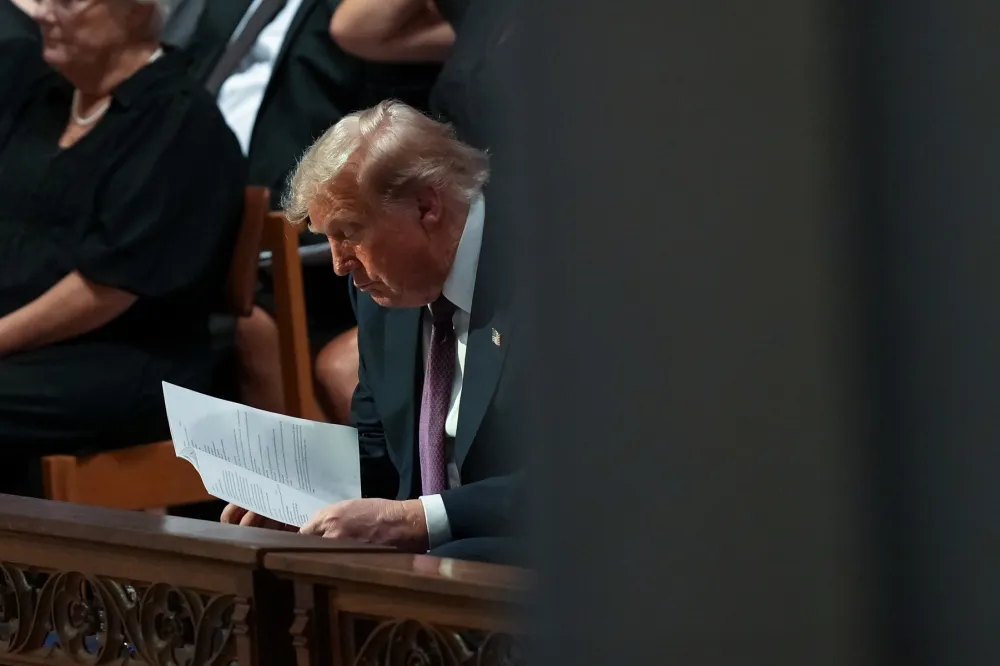
The White House is responding to pervasive claims that President Donald Trump fell asleep during the late Sen. Lindsey Graham’s funeral.
“This is Fake News,” White House spokesman Davis Ingle shared in a statement to Us on Wednesday, July 29, claiming that any allegation the command-in-chief was unconscious during the late politician’s celebration of life is being “peddled by individuals who clearly suffer from a severe and incurable disease known as Trump Derangement Syndrome.”
Ingle’s statement to Us differed from his previous claim to People, made earlier on Wednesday, in which the WH spokesperson alleged the president was simply “reflecting on the loss of his dear friend Lindsey Graham, for whom he had just delivered a beautiful eulogy.”
“Anyone suggesting otherwise is a depraved moron,” Ingle added to the outlet.
On Tuesday, July 28, Trump joined Vice President JD Vance, former Vice President Mike Pence, Fox News host Sean Hannity, Supreme Court Justice Brett Kavanaugh and other politicians on both sides of the political aisle in paying respects to Graham.
The South Carolina senator died on July 11 from a brief and sudden illness, his spokesperson previously confirmed. He was 71.
Trump delivered a eulogy for Graham during the service held at Cathedral Church of Saint Peter & Saint Paul. At one point during the funeral, however, he was spotted by TV cameras and photographers briefly closing his eyes.
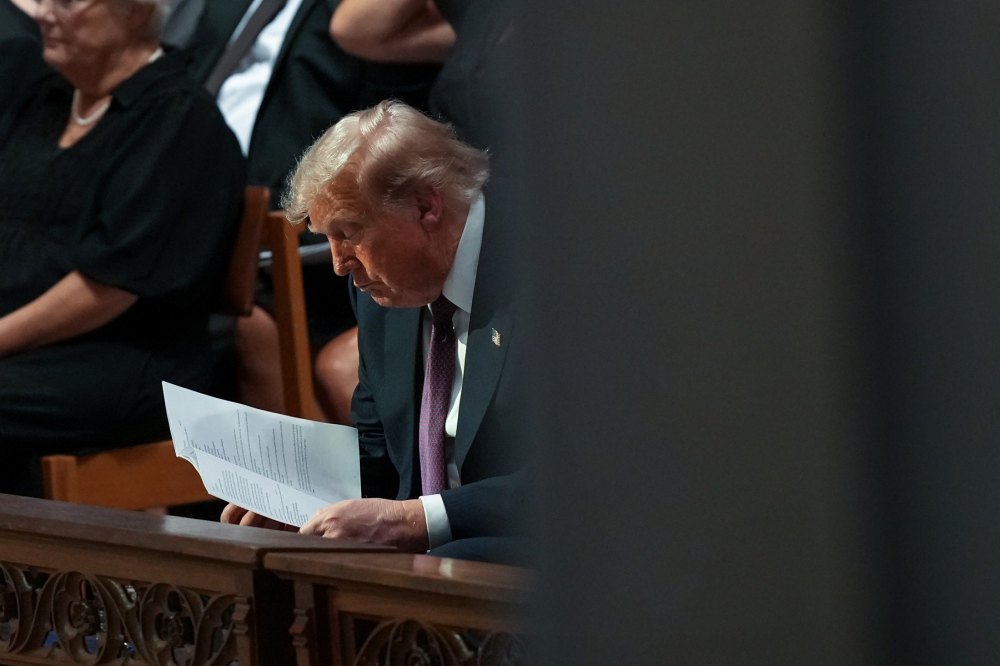
President Donald Trump Andrew Harnik/Getty Images
“For more than 30 years, nothing of consequence happened in this capital without Lindsey Graham knowing about it,” Trump said in his eulogy to Graham via NBC News. “Nothing of significance happened anywhere in the world without Lindsey Graham having a view on it, and no bill became law in the most exceptional republic in human history without Lindsey Graham having a say in it.”
Although Graham was once a vocal critic of Trump’s when they ran against each other in the 2016 presidential race, the senator eventually became one of Trump’s closest and most trusted allies on Capitol Hill.
“He was a man who gave America the full measure of his good and mighty heart until that heart itself just gave out,” Trump said.



Ana Navarro is not impressed with those rejoicing over Sen. Lindsey Graham’s sudden death. “I saw a lot of posts online this week kind of celebrating his death,” Navarro, 54, said on the Monday, July 13, episode of The View. “Listen, I know that [Donald] Trump does that. He did it with Robert Mueller. He […]
The White House, including chief of staff Susie Wiles, has repeatedly denied any speculation that Trump falls asleep during important meetings.
The chatter has arisen following previous public appearances, including an NBA Finals game Trump attended in June where he appeared to be dozing off as the New York Knicks played.
“When you love your job, when you love your country, and when you’re in a position like we are … you’re thinking about your country,” Trump told reporters in November 2025 during a sit-down with Saudi Crown Prince Mohammed bin Salman. “I think about my country. I don’t want to sleep.”
Thrillers can fool readers with speed. Hide one fact, delay one reveal, add a killer, and the pages will probably turn. A masterpiece has a harder job. The tension has to survive after the secret is known, and the characters must stay interesting after the danger passes.
That is the standard here. Every book on this list can be reread without losing its grip. The shock may change, but the psychology, fear, moral pressure, and human damage become clearer. These are stories people finish quickly and continue thinking about for years. That’s also perhaps why most of these were later adapted into books as well.
8
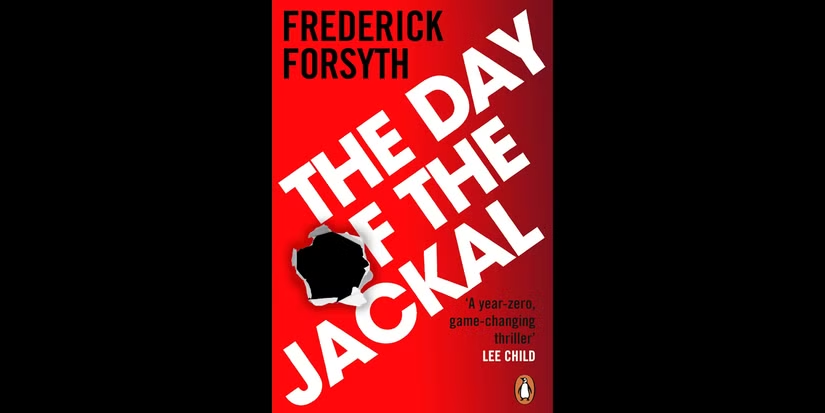
‘The Day of the Jackal’ (1971)

The Day of the Jackal should have no suspense. Frederick Forsyth is writing about a fictional attempt to assassinate Charles de Gaulle, and readers already know de Gaulle was never killed. Forsyth turns that limitation into the smartest part of the book. The question shifts from whether the Jackal succeeds to how close an unknown professional can get before the French authorities identify him.
The preparation is incredibly detailed without becoming lifeless. The assassin builds false identities, commissions a custom weapon, changes his appearance, studies security, and removes anyone who threatens the plan. On the other side, investigator Claude Lebel has almost no useful description and a deadline that keeps shrinking. Forsyth respects procedure enough to make paperwork, border checks, phone calls, and hotel records genuinely tense. The Jackal remains frightening since he treats murder as a technical assignment rather than a personal cause. You understand every step he takes, yet you never really know him. That distance makes the hunt colder and much harder to shake.
7
‘Shutter Island’ (2003)

Most twist-driven novels become smaller once the answer is revealed. Shutter Island becomes crueler. U.S. Marshal Teddy Daniels arrives at Ashecliffe Hospital in 1954 to investigate the disappearance of patient Rachel Solando. A hurricane cuts the island off, the staff answer questions carefully, and Teddy suspects that the hospital is conducting experiments on people who cannot defend themselves.
Dennis Lehane lets Teddy’s investigation operate as both detective story and personal escape. His memories of Dachau, grief over his wife Dolores, anger toward the doctors, and obsession with a patient named Andrew Laeddis all influence what he sees. The clues are real, but Teddy has arranged them into a version of events he can survive. That is much more painful than a cheap reveal. The doctors are also divided over treatment, punishment, and whether a damaged mind can be reached without violence. Once the truth is known, every earlier conversation changes. The staff were never hiding only one secret. They were trying to find out whether Teddy could face his own life.
6
‘Misery’ (1987)

In Misery, Stephen King traps bestselling novelist Paul Sheldon in a farmhouse with Annie Wilkes, the nurse who rescued him after a car accident. Paul initially thinks he has been saved. Then Annie reads his latest book, learns that he killed off her beloved character Misery Chastain, and decides that he owes her a new novel.
Annie is terrifying since her violence comes with rules that change whenever she needs them to. She calls herself Paul’s number-one fan, but she has no interest in Paul as a human being. She wants ownership over his imagination. The captivity also forces Paul to confront his own contempt for the books that made him successful. Writing becomes survival, punishment, and eventually a source of control. King understands the physical misery of the room too. Paul’s injuries, painkillers, thirst, typewriter, hidden pills, and attempts to move around the house make every small decision dangerous. Annie later amputates his foot, and even that horror does not end the deeper fight. Paul has to finish a story for the person destroying him and somehow keep part of it for himself.
5
‘The Girl with the Dragon Tattoo’ (2005)

The Girl with the Dragon Tattoo follows Harriet Vanger who vanished from a family gathering decades ago, and her uncle Henrik still receives a pressed flower every year on his birthday. He believes her killer is taunting him. Disgraced journalist Mikael Blomkvist accepts the investigation, partly to escape the damage caused by his libel conviction. Lisbeth Salander enters from another direction, first hired to investigate Mikael before becoming the person he needs most.
Stieg Larsson takes his time connecting the Vanger mystery to corporate corruption, misogyny, financial crime, and generations of protected violence. That slow build has a purpose. The respectable surfaces of Swedish business and family life begin to look worse with every document Mikael and Lisbeth uncover. Lisbeth is also far more than a brilliant hacker attached to a male detective. Her distrust has been earned through institutional abuse, and her methods come from knowing official systems rarely protect people like her. The investigation succeeds through journalism, research, memory, and technology working together. Then Lisbeth allows herself one small hope outside the case, only to have it crushed. The crime is solved. Her loneliness is not.
4
‘Rebecca’ (1938)

The first Mrs. de Winter is dead before Rebecca begins, yet the unnamed narrator cannot find a single room at Manderley that seems free of her. She marries Maxim de Winter after a rushed courtship and arrives at his estate painfully aware of her youth, lower social position, and lack of confidence. Everyone appears to know how the new Mrs. de Winter should behave except her. Daphne du Maurier turns insecurity into genuine suspense in this book.
Mrs. Danvers protects Rebecca’s memory with frightening devotion and knows exactly how to make the new bride feel like an intruder. Maxim responds to questions with anger or silence, which leaves his wife guessing what kind of marriage she has entered. The later revelations change Rebecca from an idealized dead wife into something far more complicated, but they also expose Maxim in ways romance cannot clean up. The narrator gains confidence while becoming involved in his secrecy. That moral shift is easy to miss if the book is treated only as a Gothic love story. Manderley was never simply haunted by Rebecca. It was built around people choosing which version of her helped them live with themselves.
3
‘The Talented Mr. Ripley’ (1955)

The Talented Mr. Ripley follows Tom Ripley who wants Dickie Greenleaf’s money, confidence, clothes, friends, and freedom. He also wants Dickie himself in a way Tom cannot separate from envy. When Dickie’s father pays him to travel to Italy and persuade his son to return home, Tom treats the assignment as entry into the life he believes he should have had.
Patricia Highsmith puts the reader dangerously close to Tom’s thinking. His lies are quick, his shame is intense, and his ability to copy other people becomes more impressive as his crimes become worse. Dickie’s rejection humiliates him, but murder is never presented as one sudden break from normality. Tom has been studying how to disappear into other identities long before violence becomes necessary. The truly disturbing choice is Highsmith’s refusal to build the story around punishment. Readers start worrying about whether Tom will be exposed, even though exposure would be justice. That uncomfortable loyalty is the whole trap. Tom does terrible things, and Highsmith makes us anxious on his behalf.
2
‘Gone Girl’ (2012)

Gone Girl turned a missing-wife plot into one of the nastiest books ever written about marriage. Amy Dunne disappears on her fifth wedding anniversary, and Nick quickly becomes the husband everyone suspects. He lies badly, smiles at the wrong moment, has an affair, and cannot control how television turns his marriage into public entertainment.
Then Amy’s account tears up the story readers thought they understood. This is written by Gillian Flynn and she uses the competing narrators to show two people who spent years performing ideal versions of themselves. Amy created the Cool Girl Nick wanted. Nick created the attentive husband Amy expected. Resentment grew once both stopped enjoying the act. Amy’s revenge is extreme, brilliant, cruel, and built around a precise understanding of how gender shapes public sympathy. Nick is a victim of her plan, but he is never rewritten as innocent. The book refuses that easy comfort. They know each other too well, hate each other too deeply, and still find a reason to stay together. Murder would have been a cleaner conclusion. Marriage becomes the real life sentence.
1
‘The Silence of the Lambs’ (1988)

Hannibal Lecter gets most of the cultural attention, but Clarice Starling is the reason The Silence of the Lambs belongs at number one. She is still an FBI trainee when Jack Crawford sends her to interview Lecter, hoping the imprisoned psychiatrist can help identify the serial killer known as Buffalo Bill. Lecter immediately notices her accent, cheap shoes, ambition, and discomfort. He understands how badly she wants to escape the life she came from. Thomas Harris makes every conversation between them a contest.
Clarice needs information, while Lecter demands personal memories in exchange. She has to remain honest enough to interest him without surrendering control. Outside the cell, Buffalo Bill’s latest victim is still alive, which gives the psychological games a real deadline. Harris also fills the investigation with forensic detail, institutional pressure, sexism, and mistakes that cost time. Clarice earns progress through observation rather than sudden genius. Her fear never disappears, especially when she enters Bill’s house alone. She continues anyway. In a book filled with men who study, test, dismiss, or hunt women, Clarice refuses to become someone else’s object.
With just its two main stars alone, Apple TV’s Cape Fear has a total of 10 Oscar nominations and one win. After all, not only are Javier Bardem and Amy Adams well-known actors in the business, but they’re consistent scene-stealers in every project they’re in. From Adams’ work in The Fighter and American Hustle, to Bardem’s deserved Oscar win for his role in No Country for Old Men, Adams and Barden are bona fide actors in Hollywood in their own right. So, of course, it’s perhaps no surprise that their first project together has been winning over fans and critics alike.
First premiered on June 5, 2026, Adams and Bardem co-star in Cape Fear, Apple TV’s latest thriller that will come to a long-awaited, surely intense end later this week on July 31. Ahead of the finale, the series is surging through the charts. Per FlixPatrol, Cape Fear is the second-most watched series on Apple TV worldwide, only losing to Silo, which is premiering its third season.
‘Cape Fear’ Is a Movie Remake and a Book Adaptation
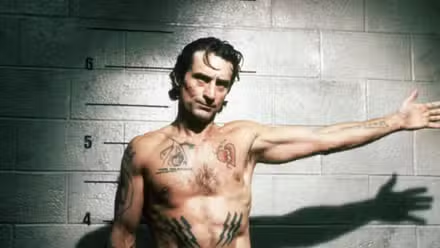
Apple TV’s latest hit, Cape Fear, is both an adaptation and a remake. The original source material for the series comes from John D. MacDonald’s 1956 novel The Executioners, but the miniseries is also inspired by Martin Scorsese‘s 1991 movie adaptation of the novel, also titled Cape Fear. Each of these stories follows a lawyer and their family being stalked and tormented by a criminal named Max Cady. Scorsese’s film starred Robert De Niro, Nick Nolte, Jessica Lange, and Juliette Lewis (who also stars in the new miniseries).
Not only was the movie a source of inspiration, but Scorsese executive produced the series alongside Steven Spielberg, who produced the 1991 movie through Amblin Entertainment. Speaking on the collaboration, Cape Fear showrunner Nick Antosca praised Spielberg and Scorsese’s input. “They were active producers,” Antosca told Entertainment Weekly. “They gave notes, they watched the cuts, they read scripts. For somebody who grew up loving their films, and, of course, loving Scorsese’s Cape Fear, that was tremendously meaningful and it’s pretty surreal to see their names on the show.”
Altogether, the experience of working with these Hollywood legends was not only a pleasure for Antosca, but potentially an industry first. “His notes are tremendously generous,” Antosca said about Scorsese’s edits and suggestions. “It’s never a mandate. It’s, ‘Well, you might try this.’ He really speaks to you like an artist. And I mean, I just feel very lucky that we got to have his involvement in the remake of his own movie.”
‘Cape Fear’ Is Surging Through the Charts
Before the series finale even airs, Cape Fear is already a powerful force on Apple TV. Not only is it #2 worldwide right now, but the series is the second most popular TV show on Apple TV this month, and 11th in 2026 so far. And while the reception on Rotten Tomatoes has been mixed, with an average 75% from critics and an even more disappointing 52% from the audience, the series is still gaining traction.
According to Tania Hussain‘s review for Collider, that’s certainly partly due to the series’ unmistakable and unsettling tone. “Incredibly dark, unpredictable, and often so deeply unnerving with moments you will think of long after the episode ends, the series never loses its grip on the audience,” she wrote. Hussain then acknowledged what the series does best, which is exploring the sense of dread and sheer anticipation. “Between every lingering glance, strange encounter, malfunctioning security camera, and unexplained guest, it all feels like another crack forming under the Bowden family’s feet,” the review reads. “It works so well for the viewer, who is quickly aware that something is wrong long before the characters can acknowledge it, creating a persistent feeling of anxiety through every episode.”
With that said, if you’re a fan of MacDonald’s original 1956 novel, Scorsese’s 1991 film, or Adams and Bardem as actors, the new Cape Fear series should be your next watch. With two mega-directors in the executive producing seat, and an impressive cast led by Adams and Barden, the series is quickly establishing itself as one of Apple TV’s strongest originals to date.

- Release Date
-
2026 – 2026-00-00
- Network
-
Apple TV
- Showrunner
-
Nick Antosca
- Directors
-
Amanda Marsalis, Morten Tyldum, Stephen Williams, Jon S. Baird, Jonathan van Tulleken, Reed Morano, S.J. Clarkson, Trey Edward Shults
- Writers
-
Peter Blake, Alan Page Arriaga, Tara Shivkumar, Maria Jacquemetton, Diana Pawell
Entertainment
Ben Affleck and “Jeopardy” fave Jamie Ding win “Who Wants to Be a Millionaire” — with help from Jimmy Kimmel
:max_bytes(150000):strip_icc():format(jpeg)/who-wants-to-be-a-millionaire-winner-072926-799254dc46a94b31b4abe3e329bfb347.jpg)
There were multiple Matt Damon jokes along the way.
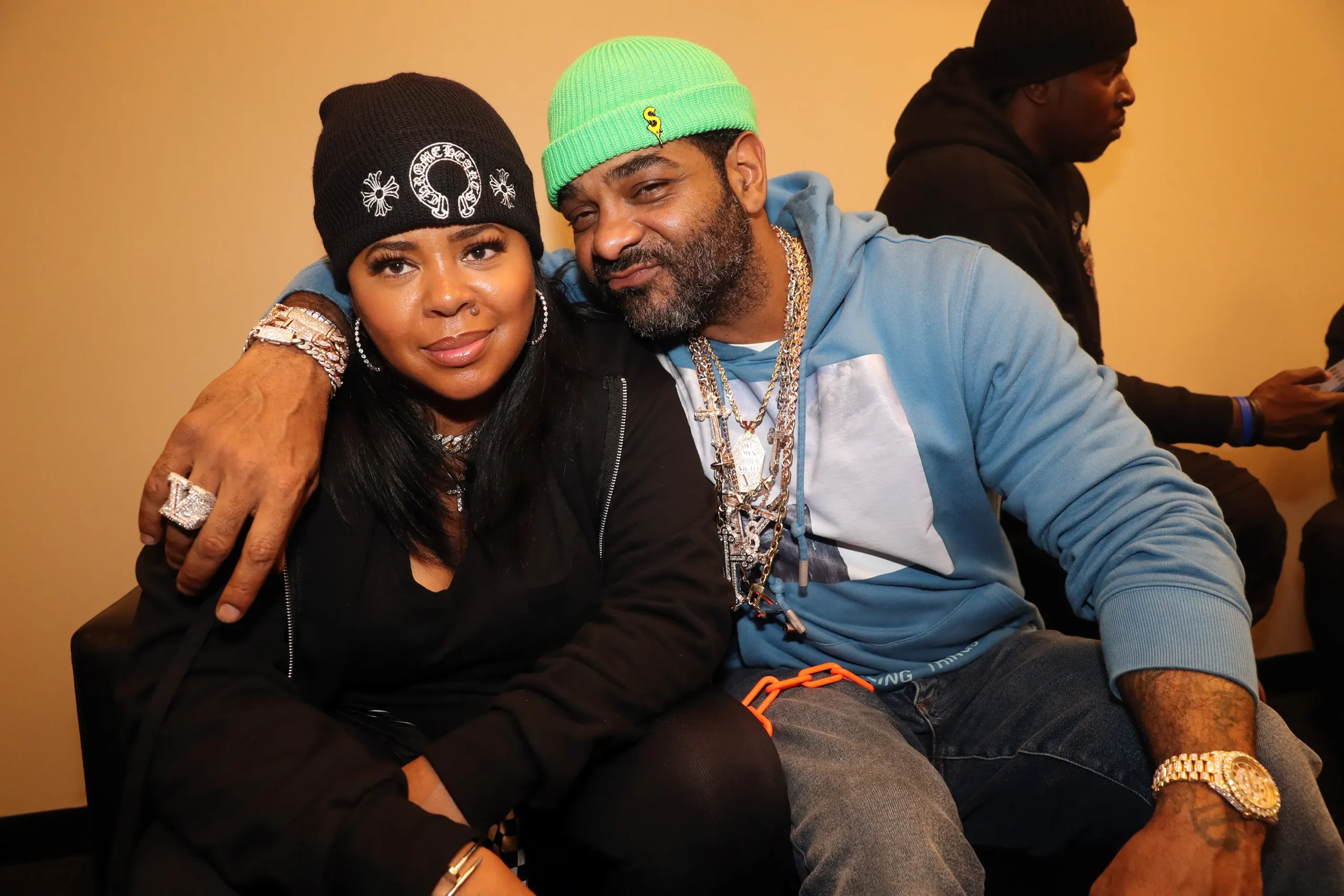
Whew, Roomies! Jim Jones has the internet mentioning Chrissy Lampkin after sharing his thoughts on having women in his club section. The conversation popped off on the ‘Let’s Rap About It’ podcast, now fans are wondering if his comments have anything to do with why Chrissy allegedly still doesn’t have a ring.
RELATED: Big Energy! Fans Are Flooding The Comment Section After Jim Jones Celebrates 50th Birthday With Chrissy Lampkin (VIDEO)
Jim Jones’ Club Comments Have Fans Discussing His Relationship With Chrissy Lampkin
The internet is going IN on Jim Jones live after he shared his thoughts on letting women hang out in his club section. Jimmy chopped it up with Dave East, Maino, and Fabolous on their podcast about inviting women to kick it, but he quickly made it clear he wasn’t with it. Jones said he’s not handing out any invites, especially with the price of bottles at the club. “No b***h! You ain’t put in on this bottle.” Jim continued, “You talking about 800 a bottle of Rosé.”
Jim quickly changed his tune after Maino and Fab jumped in and told him he was sending the wrong message. hey made it clear that women are always welcome in their sections and can sip on whatever they want. Maino even doubled down, saying his section stays female-friendly at all times. “It’s female safe and female friendly. Come over here, bring your friends. Is she pretty too? Bring her!”
Social Media Enters The Chat With Mixed Reactions To Jimmy’s Comments
Chile, Jim Jones’ response sparked a whole conversation in The Shade Room comment section, with plenty of folks bringing Chrissy Lampkin into the mix. Some folks joked that Jim’s spending habits might be the real reason Chrissy still doesn’t have a ring, while others said they loved his answer because at the end of the day he has a queen at home.
Instagram user @4ever.em_ wrote, “That’s why he never married Chrissy….she ain’t put in on the bottle.”
Instagram user @miss_kitty_88 wrote, “Listen Jimmy knows Chrissy is listening and she don’t play hahahaha.”
While Instagram user @aprnbeauty wrote, “The bigger conversation is why are y’all in the club with a section at 50 years old anyway?”
Then Instagram user @doitlikemelissa wrote, “Jim Jones is why the club has become a boys club, he answered in real time.”
Instagram user @_corihardy wrote, “Jim was deadass serious 😂 that’s why Chrissy proposed to him!”
Another Instagram user @kendra.la wrote, “Chrissy is this your king 🥴”
Instagram user @zarialinton wrote, “He meant every f**n word LMAOOOOO that’s why Chrissy was on one knee 🥀🥀🥀🥀”
Then another Instagram user @nicknamedcake wrote, “In his defense, Jim has Chrissy so he absolutely answered that question correctly!!!”
While another Instagram user @s.nashay wrote, “lmao Jim meant that but he seen the way Maino was looking appalled 🤣🤣🤣🤣🤣🤣”
Finally, Instagram user @damn_letmebegreat wrote, “He answered for Chrissy 😂😂”
Chrissy Previously Went All Out For Jim’s 50th Birthday
Despite the online debates, Chrissy previously showed folks that she doesn’t play about Jimmy. Per TSR, Lampkin did her big one for her man he hit 50 on July 15, throwing him a surprise party surrounded by close friends and family. Jim looked genuinely grateful for the gesture, hugging his lady before thanking everyone who pulled up to celebrate him.
RELATED: Whew! Jim Jones’ Reaction To Chrissy Lampkn’s SPICY Swimsuit Photos Has Fans Debating About An Engagement Ring
What Do You Think Roomies?
As time goes on and technology evolves, both in our reality and in entertainment, the caliber of science fiction storytelling has gotten stronger. In fact, as much as we love sci-fi films, television has slowly been bypassing cinema as the place for peak sci-fi content. With the ability to take more time to explain and explore, television’s recent bevy of sci-fi shows is better than ever. The past ten years are complete proof.
The titles on the list are among the best sci-fi shows out there. From epic sci-fi horror thrillers that blew up pop culture to a brand new Star Wars story that rivaled its big screen predecessor. These series have taken us to space, introduced us to extraterrestrial hiveminds, and showed us what living life in a 144-story silo in a dystopian future might be like. Science fiction has pushed the bounds of storytelling to places unimaginable. And we couldn’t be happier.
10
‘Foundation’ (2021–Present)

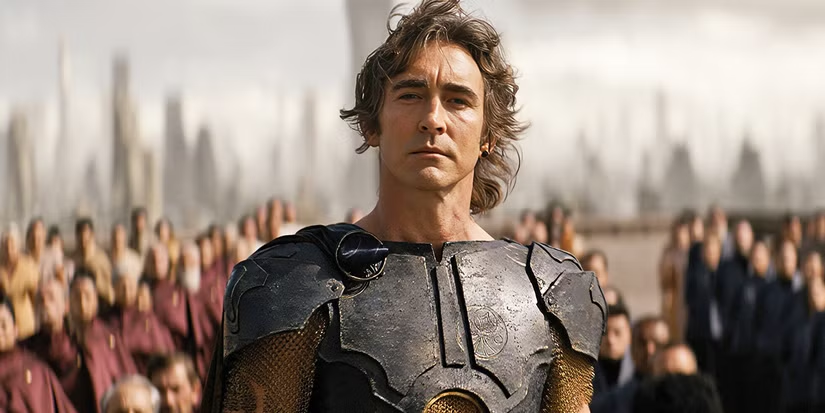
As you’ll notice quite often on this list, lifting a project from a source material often leads to excellent content. First up is a series based on novels once believed to be “unfilmable”: Foundation. Based on Isaac Asimov’s epic stories, the three-season thriller chronicles a band of exiles who try to save humanity after Hari Seldon (Jared Harris) predicts the unavoidable collapse of the 12,000-year-old Galactic Empire. The mission is to rebuild civilization. Thus, he creates the Foundation on the remote planet Terminus to preserve human knowledge. The century-spanning story centers on the conflict between the ruling imperial Genetic Dynasty via the clones of Emperor Cleon (Lee Pace), and the Foundation, including Gaal Dornick (Lou Llobell), a prodigy who helps develop the plan, and Salvor Hardin (Leah Harvey), the warden of Terminus, as they navigate the predicted fall. Created by David S. Goyer and Josh Friedman, Foundation balances epic, galaxy-spanning storytelling and staggering visual production value with deeply personal character arcs and intense political philosophy.
Foundation is a masterful and poetic space opera that tackles grand themes like the cyclical nature of empires, psychohistory, destiny, and the survival of human knowledge over thousands of years. The series does a stellar job exploring the tension between science and faith, the nature of power, and whether historical events can be altered. With Asimov’s invention of psychohistory, Foundation has, well, a foundation on which to stand. It’s a daunting tale, but brought to life as a breathtaking screen-space spectacle. While any series opts in for a one-for-one adaptation, the Apple TV series is wonderfully unpredictable. Because it spans hundreds of years and takes unexpected narrative leaps, even fans of the original books are treated to unpredictable twists. With a fourth season in the works with new showrunners Ian Goldberg and David Kob, there is a glorious roadmap to set out on to maintain narrative continuity.
9
‘Dark Matter’ (2024–Present)

The multiverse narrative device has become a major plot point across all media of late. Some creators have been overwhelmed by it, botching the execution. Others have mastered it, proving just how brilliantly it could work. Dark Matter is the latter. Created by Blake Crouch based on his 2016 novel, the enthralling Apple TV thriller follows Jason Dessen (Joel Edgerton), a Chicago physicist who is abducted and thrust into the multiverse. He wakes up in alternate realities where his life choices went differently, and he must fight his way back home through a labyrinth of parallel worlds to save his true family from the most dangerous foe imaginable: himself. A deeply character-driven love story set within a high-stakes multiverse thriller, Dark Matter explores the roads not taken, challenging viewers with a core question: Are you happy in your life?
Dark Matter is a perfect high-concept series that mixes the multiverse mechanic with a deeply emotional, grounded love story. Beneath the science, it is ultimately a story about a man desperately trying to get back to his true family. But as he questions whether it’s a journey worth taking, that’s when Dark Matter becomes truly gripping. The profound questions it raises about happiness, fulfillment, and marriage make it deeply introspective and relatable. Edgerton does a remarkable job playing multiple, vastly different versions of Jason. He leads an extraordinary ensemble which also features Jennifer Connelly and Jimmi Simpson. Crouch has the unique ability to craft his own content for the small screen, translating it flawlessly without risking contradictions or tonal derailments. If you haven’t checked out Dark Matter, now’s the perfect time to binge, as Season 2 is set to drop this August.
8
‘Fallout’ (2024–Present)

Some video game-to-series adaptations fall flat. Not Fallout! In fact, it’s one of the best of all time. Created by Graham Wagner and Geneva Robertson-Dworet, the Prime Video series takes the popular video game franchise and breathes new life into it while maintaining its iconic integrity. Fallout takes place 200 years after a nuclear war, following three main characters who collide in the irradiated ruins of America: Lucy MacLean (Ella Purnell), an optimistic Vault-dweller forced to leave her utopian bunker and venture into the lawless “Wasteland” to rescue her father, Hank (Kyle McLachlan); Maximus (Aaron Moten), an idealistic young soldier in a zealous, tech-hoarding military group tries to navigate the ruins while balancing his survival with the rigid rules of his organization; and The Ghoul (Walton Goggins), a centuries-old, radiation-mutated bounty hunter whose backstory bridges the gap between the modern-day wasteland and pre-war America. Blending a bleak retro-futuristic setting with satirical, dark humor, the series explores class disparity in a world where society has collapsed.
While the video game lore and mythology are ever-present, Fallout forges its own identity that allows gamers and series-only viewers an exciting, visceral experience. The world-building is simply unmatched. With three perspectives that intertwine at times. Thanks to the original storyline within the established canon, Fallout has room to breathe while rewarding observant viewers with authentic props, armor designs, and references. Viewers get a chance to see the vast universe that is brilliantly crafted straight from the games. Fallout has emerged as a top-tier sci-fi series thanks to its willingness to play. That stems from the extraordinary ensemble. Whether it’s the main trio, recurring stars like Leslie Uggams and Justin Theroux, or special guests Michael Emerson, Fred Armisen, Kumail Nanjiani, or Macaulay Culkin, everyone brings joy to the hauntingly delightful series. With Season 3 pushing beyond into new games with new stars, including Aaron Paul and Manny Jacinto, it’s going to be something worth tuning in to.
7
‘For All Mankind’ (2019–Present)

Imagine rewriting the events of one of the most crucial moments in American history where the future goes in an entirely new direction. That’s the premise of Apple TV’s For All Mankind. Created by Ronald D. Moore, Matt Wolpert, and Ben Nedivi, the series dramatizes an alternate history that explores what would have happened if the global space race had never ended. The premise begins in 1969 when the Soviet Union successfully lands the first man on the Moon, dealing a devastating blow to the United States and intensifying the Cold War. By changing a single significant historical event, For All Mankind creates a massive butterfly effect, featuring rapid technological innovation, political intrigue, and an optimistic vision of human perseverance.
For All Mankind is a brilliant “what if” drama. Across each season, the series organically leaps about a decade forward, showcasing how that inciting event reshaped reality. For All Mankind is rooted in character-driven drama, centered on human ambition, sacrifice, and the emotional toll that space exploration and grueling career choices take on the astronauts and their families. Rather than presenting space magic, For All Mankind is solidly rooted in hard science, respecting the laws of fiction. The innate tension in the story then comes from the mechanical realities of spaceflight, including navigating lunar storms, managing orbital mechanics, or dealing with equipment malfunctions. Even though the story is fiction, this makes the events feel factual. Most importantly, the series avoids a simple “good guys vs. bad guys” trope. The Cold War extends into space, but treats Russian and American characters with equal nuance. Now, the exploration from the other perspective is explored in the acclaimed spin-off, Star City.
6
‘Silo’ (2023–Present)

No show is more thrillingly claustrophobic than Silo. Created by Graham Yost and based on Hugh Howey‘s novels, Silo is set in a dystopian future where a community lives in a giant underground silo with 144 levels. The residents are governed by strict rules and believe the outside world is a toxic, ruined wasteland. Engineer Juliette Nichols (Rebecca Ferguson) becomes embroiled in the mystery of the past and the present as she seeks to uncover the dark, murderous conspiracy behind their existence. The more she investigates, the more she unravels, which extends deep into the toxic wasteland outside. A brilliant mystery box that continues to expand the universe’s lore season by season, Silo is a fight for survival after a lie to survive.
Silo is a standout Apple TV series that’s built on extreme dread and slow-burning tension. Silo unleashes a bevy of questions that you want answers to, allowing you to stick around for the addictive thriller. Each episode unravels another layer of the conspiracy without feeling rushed. And now, each season unleashes even more depth. Silo thrives on world-building in the sense that it captures the past in a terrifying manner. Because technological evolution has been halted in the silo, its inhabitants rely on recognizable mechanical tools, making the futuristic society feel tangible and real. The story resonates because it’s a human story about being stuck in an inhumane society. Whether hero, villain, or morally in between, each character is richly crafted. Ferguson leads a sensational ensemble that included, throughout its run, Rashida Jones, David Oyelowo, Common, Tim Robbins, Harriet Walter, Steve Zahn, and many more. Now in Season 3, Silo is a must-watch.
5
‘Stranger Things’ (2016–2025)
Very few shows took over the world quite like Stranger Things. One of the biggest Netflix shows in history, the Duffer Brothers‘ creation is set in the 1980s and follows the residents of a fictional town of Hawkins, Indiana, as they uncover a web of secret government experiments and battle terrifying monsters from a parallel, nightmarish dimension known as “The Upside Down.” Following the disappearance of a young Will Byers (Noah Schnapp), his mother, Joyce (Winona Ryder) and local cop Jim Hopper (David Harbour) search for him as his friends stumble upon a girl with psychokinetic powers named Eleven (Millie Bobby Brown). Over the course of five seasons, the adults, teens, and kids must repeatedly save their town from the growing horrors of this dark realm. The sci-fi horror series is a love letter to pop culture, blending a Steven Spielberg-style coming-of-age adventure with the horrors of a Stephen King supernatural thriller.
Stranger Things, at its core, is all about loyalty, bravery, and the trauma of growing up in a world where ordinary people are forced to confront impossible evils. And they do so with a happily ever after. The series brilliantly balances high-stakes concepts with a deeply relatable, character-driven narrative. The supernatural elements are infused into the truly heartfelt human themes. For those who watched the series from the start grew up with the characters, watching their enduring bonds of friendship on and off-screen. The world-building is precisely structured with clear sci-fi and fantasy rules. Though you may shake your head at the events as they unfold. Stranger Things revolutionized streaming culture forever.
4
‘Dark’ (2017–2020)

Don’t sleep on foreign language series! One of the most underrated sci-fi series on Netflix is Baran bo Odar and Jantje Friese‘s three-season thriller, Dark. Dark tells the story of four interconnected families in the town of Winden, where a child’s disappearance unveils a sinister, generation-spanning time-travel conspiracy. The story centers on Jonas Kahnwald (Jonas Gerzabek, Louis Hofmann, Andreas Pietschmann, and Dietrich Holllinderbäumer) as he uncovers the town’s secrets, navigating deterministic time loops, the 33-year cycle, and an apocalypse to prevent a tragic, knotted fate. Capturing the existential implications of time and its effects on human life through the bootstrap paradox, Dark delivers a perfectly plotted time-travel story rooted in deep philosophical questions about human nature, destiny, and free will.
Many mystery box series play with plot as they go along. Dark was intricately structured before the show even began shooting. In doing so, every twist, reveal, and paradox links back together, making it a wonderfully rewarding series. That said, it requires close viewer attention. Missing anything may require a rewind. The series sees a grounded approach to time travel in which the concept of fixed, casual loops where the past and future mutually influence one another. This lends itself to a tragic, fascinating tone that tackles profound themes of determinism. Dark is flawless.
3
‘Pluribus’ (2025–Present)

Only one season in and Vince Gilligan‘s newest creation is already taking science fiction by storm. Pluribus is slowly rising to the top as Apple TV’s brightest. The story centers on an Albuquerque novelist named Carol Sturka (Rhea Seehorn), who is one of the few humans mysteriously immune to the “Joining,” an alien virus that merges humanity into a peaceful, content hive mind. Carol’s cynicism and refusal to reform causes her to fight to reverse its effects as she meets a small group of fellow unaffected. A brilliant dissertation on grief and isolation, Pluribus serves to make us ponder what happens to purpose, art, and meaning when there is no longer friction, cultural clash, or individual friction.
Rather than play into easy dystopian tropes, Pluribus forces the audience to question whether peace and happiness are worth it if free will and individuality are stripped away. The philosophical depth is truly unmatched. Gilligan infuses his signature style into the series. It’s perfectly paced, featuring stunning cinematography, all while balancing psychological dread and dark humor. Seehorn is better than ever, leading the series, taking on the deeply flawed and reluctant protagonist navigating her new reality. That said, the breakout performance comes from Karolina Wydra as Zosia, the mouthpiece of the Others and Carol’s chaperone. Pluribus‘ first season fed us, but we have an appetite for more. And, based on where we think the story might head, we’ll be fully served in Season 2.
2
‘Andor’ (2022–2025)

The galaxy far, far away has expanded beyond the big screen thanks to Disney+. There have been a handful of Star Wars series, but the standout that fires on all cylinders is none other than Andor. Created by Tony Gilroy, Andor serves as a prequel to the anthology film Rogue One: A Star Wars Story, which itself is a prequel to the original Star Wars trilogy. The story follows Rebel spy Cassian Andor (Diego Luna), a cynical, revolution-averse thief whose sole focus is his own survival. As he witnesses the Empire’s casual cruelties and exploitation, he transforms from a reluctant scavenger into a passionate Rebel hero. Far from a space fairy tale, Andor captures the harsh, morally grey sacrifices required to fight a tyrannical regime. Andor brings further intrigue into the greater Star Wars mythology and lore.
Andor stands out among other Star Wars entries as a masterclass in science fiction storytelling. In addition to the general tropes that root it in the genre, Andor is also grounded as a mature political thriller. Andor showcases the Galactic Empire as a terrifying, bureaucratic machine of oppression. In turn, Andor depicts the brutal compromises required to build a successful rebellion, in which not even the greatest of heroes can make it out alive. Alongside Luna, the ensemble is one of the best in the galaxy, with the likes of Kyle Soller, Adria Arjona, Stellan Skarsgård, Fiona Shaw, Denise Gough, and Genevieve O’Reilly taking on the Rebels and the Empire. Who is the hero, and who is the villain? That’s the ambiguity that propels the story. Andor has its own identity, and yet feels completely a part of the Star Wars universe. If you have to pick one Star Wars show to watch, pick Andor.
1
‘Severance’ (2022–Present)

Celebrated for the brilliant execution of its masterful high concept and sharp satire of corporate work culture, Severance remains a complete television game-changer. Created by Dan Erickson and primarily directed by Ben Stiller, Severance follows the lives of employees at Lumon Industries who have voluntarily undergone a medical procedure called “severance” to separate their memories. At work, they are called “innies,” who have no recollection of the world outside. At home, they are called “outies,” where they have no memory of the action at work. Led by Mark Scout (Adam Scott), the “innies” begin to question their trapped existence, sparking a rebellion as they uncover a sprawling, sinister corporate conspiracy about what their work actually entails. Seamlessly blending elements of sci-fi with workplace antics, conspiracy mystery, and psychological thriller, Severance is perfect as perfect can be.
Rather than typical sci-fi tropes, Severance goes where no shows have gone before. The usage of the severance chip creates a newfound exploration of themes of bodily autonomy and human exploitation. In turn, Severance further explores the absurdity of modern office environments, in which the mysterious Lumon Industries operates as a cultish dystopia that fronts as caring for its workers while it actually treats them as disposable cogs in an endless, brutalist maze. Severance features immaculate world-building thanks to its surrealist retro-futuristic aesthetic. Every visual, set piece, and bizarre act builds up to a captivating lore. Severance boasts one of the best ensembles, including Scott, Britt Lower, Zach Cherry, Tramell Tillman, John Turturro, Christopher Walken, Patricia Arquette, and more. It’s best to get in and watch Severance so you’re not out of the loop.

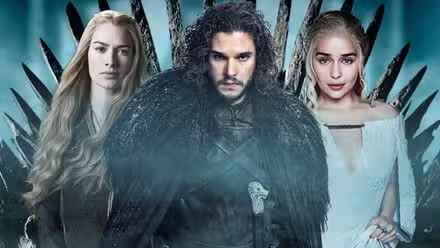
Since its controversial conclusion in 2019, Game of Thrones has been used as one of the prime examples of the trend of multimedia adaptations being of lesser quality than their source material. But although there are some major problems with the final seasons of the blockbuster fantasy series that are hard to deny, one of the middle seasons is, for the most part, stronger than some viewers remember or are willing to admit. By Season 6, most of the source material from the completed entries in George R.R. Martin’s A Song of Ice and Fire series had been exhausted, and, while Martin told the series’ creators David Benioff and D.B. Weiss some of the most crucial aspects of his plans for the still unreleased final novels, for the most part, it was up to them to continue the show how they saw fit. Without the guidance of the books, the ending provided by Seasons 7 and 8 became uneven, but the first full post-book season is one of the series’ most exhilarating and perhaps, its best.
‘Game of Thrones’ Season 6 Made Necessary Cuts to the Cast
An earlier decision that Season 6 continued to benefit from was the creators’ choice to keep the cast a bit smaller than it is in the books. Both the written and filmed versions of Martin’s world are incredibly expansive, but the former became even more so during the most recent novels in the series, A Feast for Crows and A Dance With Dragons, which each introduced a host of new characters and storylines to the already sprawling narrative. After adhering fairly closely to the written canon of the first three novels throughout the first four seasons, the show began to diverge onto its own path in Season 5 by excluding a number of these additions and reducing the significance of others.
Although these choices remain divisive with the books’ most passionate fans and likely did contribute in at least some ways to the series’ later problems, for the most part, they paid off in Season 6. While the complexities of the world and plot are huge parts of the appeal of both the books and the show, the additions from Feast and Dance complicated things so much that the stories of some longer-running, more central characters arguably lost some of their momentum — and many fans suspect the increased scale is one of the major reasons Martin has not yet completed the final volumes. Reducing the complexity of the storylines centered on Dorne and the Iron Islands, and excluding the character of Young Griff, who was introduced in Dance, with the possibility raised that he is a long-lost relative of Daenerys Targaryen’s (Emilia Clarke) and therefore a possible heir to the Iron Throne, allowed Season 6 to maintain a tighter focus on the main cast and conclude the stories of some other supporting players.
Both the books and the show are famous for their willingness to kill off major characters. But while none of the deaths featured in Season 6 are as dramatically impactful as, say, the death of Ned Stark (Sean Bean) or Tywin Lannister (Charles Dance) from earlier seasons, the sixth installment does have a particularly high body count, with many important supporting characters meeting their fates. Detractors will likely argue that this reduced the intricacy of the series’ plotting, and that’s true to some extent, but it also allowed for significant forward progress to be made in the more central storylines, much more so than in the recent novels.
Most of Season 6’s deaths contribute to the story arcs of main characters in crucial ways. For example, Ramsay Bolton’s (Iwan Rheon) murder of his father Roose (Michael McElhatton) sets the former up as the ultimate tyrannical ruler in the North before his own defeat at the hands of Sansa Stark (Sophie Turner) and Jon Snow (Kit Harington) earns the latter pair their family’s home region back, which in turn allows them to shift their focus to the inevitable battle with the undead White Walkers. Likewise, Cersei Lannister (Lena Headey) assassinating several of her enemies, including the High Sparrow (Jonathan Pryce) and Margaery Tyrell (Natalie Dormer), by bombing the Sept of Baelor, cements her as the series’ main human antagonist, a role she would occupy until Daenerys’ heel turn in the final episodes. And the tragic death of Hodor (Kristian Nairn) reveals the full extent of Bran Stark’s (Isaac Hempstead Wright) supernatural powers.
In addition to propelling the plot forward, these developments also have important relevance to the series’ themes. Cersei taking power just before her son Tommen (Dean-Charles Chapman) kills himself is one of the show’s most devastatingly elegant illustrations of what an empty, costly prize the Iron Throne really is. Sansa feeding Ramsay to the dogs he used to slaughter many of his other victims is somewhat cathartic given the horrible things he did to her, but is also itself pretty chilling, again raising the kinds of questions about vengeance and when and to what extent violence is justified. And Bran’s time-traveling brainwashing of Hodor, though mostly accidental, is a dark turning point in the former’s story that foreshadows the cold character he becomes when he completes his mystical training. Though Hodor’s fate was one of the beats Martin informed the series creators of, Benioff and Weiss still deserve credit for how well the twist is executed within the series, especially given that a finished version of it hasn’t appeared in the books yet.
‘Game of Thrones’ Season 6 Shouldn’t Be Blamed for the Show’s Later Problems
Another argument against Season 6 is that some of the momentous events that happen within it don’t have their aftermaths explored thoroughly enough. This is hard to completely refute in some cases, but it should really be used as a criticism of the subsequent seasons. Two of the events subject to this kind of discussion are Jon’s resurrection and Cersei’s aforementioned bombing of the Sept. Detractors argue that Melisandre (Carice van Houten) is able to resurrect Jon too easily, but at this point in the series, another follower of her religion, Thoros of Myr (Paul Kaye), is shown to be able to bring Beric Dondarrion (Richard Dormer) back from the dead multiple times. It is only after Jon does not prove instrumental in vanquishing the Whites in Season 8, suggesting that he might not be the prophesied “Prince That Was Promised” after all, that his resurrection and the other supernatural occurrences related to him begin to seem forced.
Similarly, given the earlier worldbuilding, one would assume that Cersei would have a harder time maintaining control over King’s Landing without a living child in whose stead to rule than she does in Seasons 7 and 8. The actual bombing of the Sept is entirely in character for her, as it shows great ambition and ruthlessness while not necessarily being the most strategically wise choice, as has been the case with many of her past plots, to say nothing of the fact that she didn’t know Margaery’s death would lead Tommen to kill himself.
‘Game of Thrones’ Season 6 Is an Underrated Epic

Hindsight seems to have warped the public perception of Season 6. Like earlier seasons, it does an excellent job of weaving the various storylines together and setting up future developments, even if one of the ways it does so is by trimming down the cast. The fact that the subsequent seasons squandered some of the potential it generated should not be held against the season itself. Indeed, between the faster pacing, the expected aesthetic mastery, and some iconic sequences, like the Battle of the Bastards, Hodor holding the door, and Daenerys eliminating the slavers before preparing to finally return to Westeros, Season 6 could easily be dubbed the most eventful and exciting installment and stands as proof that the series didn’t always need to adhere closely to the books to be great.
Nolan Wells’ friend is speaking out as online speculation continues to swirl around his name. Now, Bart Edmiston Jr. and his family are pushing back against the claims, with legal action on the table after what they call a wave of “fabricated” accusations.
RELATED: Nolan Wells’ Family Reportedly Issues Subpoenas To Social Media Companies Seeking His Account Information Amid Death Investigation
Bart’s Attorney Addresses Online Theories Surrounding Nolan Wells
A friend of Nolan Wells, Bart Edmiston Jr., is reportedly lawyering up after a viral photo and online theories attempted to connect him to Nolan’s death. Attorney Russell Latino says the photo circulating online does show Bart with a young woman, but he insists the woman is not Katie McCormick — someone social media users have tried to romantically link to both Bart and Nolan. Latino also says Bart never dated Katie and did not know who she was before Nolan’s death.
Latino is also pushing back on claims that Bart had any involvement in Nolan’s death, saying there is no evidence to support those allegations. According to the attorney, Bart helped a boat in distress on July 4 and fully cooperated with investigators by providing access to his boat, GPS device, phone, photos, videos, and answering questions about what happened that day.
Bart’s Family Says Enough Is Enough
In a statement shared by Latino on Facebook, the Edmiston family expressed condolences to Nolan’s loved ones while saying they remained quiet out of respect for the investigation. However, they said recent attacks against Bart Jr. forced them to address what they describe as “dangerous speculation” and “outright fabrications.”
The family claims Bart was among the many people who traveled to Horn Island for the holiday and says he assisted a boat experiencing mechanical issues by helping drain water from the vessel and towing it briefly. They added that Bart was never identified as a suspect and voluntarily worked with law enforcement throughout the investigation. The family also says Bart received a “credible death threat” amid the online accusations and that they have retained legal counsel to pursue action against people they believe spread false claims. They say they are working with authorities, including the FBI and local law enforcement, to address alleged threats and potential cyberstalking concerns.
Where Did The Claims Connecting Bart & Katie To Wells Start?
Photos circulating online have sparked new speculation surrounding Bart Edmiston Jr. and Katie McCormick, with some social media users questioning whether the two have a past connection. However, the claims remain part of online discussion and speculation, while Bart’s attorney has denied that the two ever dated or that Bart even knew Katie before Nolan Wells’ death.
Bart, 21, has become a name frequently discussed online amid the ongoing conversation surrounding Nolan’s case. Some internet users have raised questions about his connection to the events of July 4, while others have focused on his reported role in helping a boat in distress and his cooperation with investigators. Online theories have also attempted to connect Bart and Katie romantically, with some users speculating about a possible motive. However, Bart’s legal team has pushed back on those claims, stating that the rumors are based on false information and that there is no evidence linking Bart to Nolan’s death.
🚨 IS KATIE BART’S GIRL?
Bart Edmiston Jr., 21
affectionately referred to as “My buddy” in Warren Hudson’s interview with Officer Tatum is the one name that seems to have been purposely kept out of the main equation.WHO IS BART EDMISTON JR.?
Bart is a 6’0″, 200-pound… pic.twitter.com/I3BuhcFOOV
— Amy Leigh (@IAmyLeigh) July 29, 2026
RELATED: Warren Hudson Reveals Why He Chose Not To Attend Nolan Wells’ Funeral (VIDEO)
What Do You Think Roomies?

Crypto World32 seconds ago
US Sanctions Iranian Shipping Firm After It Reportedly Accepted Bitcoin

Sports3 minutes ago
Man United transfer news LIVE: Marcus Rashford ‘option’, Dusan Vlahovic latest, striker ‘offer’

Tech4 minutes ago
Google Play Is Expanding Age Confirmation Tools For App Developers


-

 Fashion6 days ago
Weekend Open Thread: Brooks Brothers
-
 Sports3 days ago
Commonwealth Games boxing: Jadumani Singh seals dominant 5-0 win over Pakistan’s Sumama Rehman to enter quarter-finals | Commonwealth Games News
-

 Tech3 days ago
Intel is reversing course and bringing hyper-threading back to its server chips
-

 Business10 hours ago
Why Trees Belong on the Risk Register
-

 Politics3 days ago
Luke Littler dismantles Gerwyn Price to retain title in Blackpool
-

 Crypto World5 days ago
Ripple bought a bank in pieces. The $4 billion audit
-

 Politics2 days ago
The Part of the Electric Transition Nobody Wants to Discuss
-
 Entertainment6 days ago
A New Post-Apocalyptic Gundam Anime Series Blasts Into SDCC
-

 News Videos3 days ago
BITCOIN JUST ENTERED THIS CRITICAL ZONE…
-

 Fashion6 days ago
16 Dresses for the High Summer Event
-

 Sports6 days ago
2026 3M Open leaderboard: Scottie Scheffler finds putter in Round 1, sits three back
-

 News Videos6 days ago
The Peugeot Family: How 200 Years of an “Old Money” Dynasty Died in A Boardroom
-

 Business1 day ago
Major shareholder moves on Canyon
-

 Crypto World4 days ago
XRP Ledger adds $2.6B as RWA inflows rank second
-

 Politics4 days ago
Spain sweeps the board at 2026 World Cup with individual awards
-

 Crypto World7 days ago
Uniswap (UNI) pushes deeper into tokenized RWAs with permissioned trading pools
-
 Entertainment1 day ago
‘Stargate’ Creator’s New Sci-Fi Series Returns for Season 3 Tomorrow
-

 Tech5 days ago
Anthropic launches Claude Opus 5, a cheaper AI model for coding, agents and enterprise workflows
-

 Entertainment4 days ago
Sara Gilson Killed By Husband After Viral “Pedophile” TikTok Video
-

 News Videos1 day ago
Claude: Build Financial Dashboards in Minutes (2026)
You must be logged in to post a comment Login