
Crypto World
The DTCC already won tokenization. Nobody noticed.



For a decade the pitch was that blockchains would route around the plumbing of American finance. On July 15 the plumbing processed its first live tokenized trades, with forty firms participating and the crypto-native issuers sitting inside its working group instead of competing with it. The incumbent did not lose. It joined, and then it became the largest venue in the category.
Summary
- The Depository Trust and Clearing Corporation processed its first live production trades of tokenized stocks, ETFs, and US Treasuries on July 15, under an SEC no-action letter authorising a three-year pilot.
- Participation spans more than forty firms including BlackRock, JPMorgan, Goldman Sachs, Vanguard, NYSE, Nasdaq, CME Group, and State Street, with full service launch scheduled for October.
- The scale comparison is the story: DTC custodies more than $114 trillion in securities and DTCC processed roughly $4.7 quadrillion in transactions last year, against a crypto-native tokenized equity market where the largest issuer holds under a billion dollars.
- Crypto-native firms including Circle, Ondo Finance, and Ripple Prime are participants in DTCC’s fifty-firm industry working group, not competitors to it.
- The tokenized versions preserve identical legal ownership rights, which is precisely what offshore tokenized-stock products cannot offer, and which resolves the question our post-IPO settlement audit found unanswered.
Tokenization has been sold for roughly a decade on a specific promise: that putting securities on a blockchain would make the existing settlement apparatus unnecessary. Trades would clear instantly, intermediaries would be disintermediated, and the institutions that sit between a buyer and a share certificate would find themselves routed around by software. It was a coherent thesis, it attracted enormous capital, and on July 15 it was answered in a way almost nobody has processed. The Depository Trust and Clearing Corporation, the entity whose depository arm custodies more than $114 trillion in securities and which processed something in the region of $4.7 quadrillion in transactions last year, ran its first live production trades of tokenized stocks, exchange-traded funds, and US Treasuries. More than forty firms took part, including the largest asset managers, the largest banks, and both major American exchanges. Full service launch is scheduled for October. And the crypto-native firms that spent the decade building the alternative are inside the working group helping design it. The incumbent did not get disintermediated. It ran a pilot, and the pilot is now the biggest tokenization venue in the country.
What actually happened on July 15
The mechanics matter, because the announcement has been reported as a milestone and not examined as a market structure event.
DTCC processed live production trades of tokenized assets held at its depository arm, covering equities, exchange-traded funds, and US Treasuries. Not a simulation, not a sandbox with test assets, but real trades in real instruments settled through tokenized representations of securities the depository already holds. The platform runs with Chainlink providing the blockchain infrastructure layer.
The legal foundation is an SEC no-action letter issued on December 11, authorising a three-year pilot covering constituents of the Russell 1000, major index exchange-traded funds, and US Treasuries. A no-action letter is not a permanent regulatory framework, a limitation this piece returns to, but it is sufficient authority for the institutions involved to participate without the classification uncertainty that has constrained every previous attempt.
The participant list is the part that should have generated more coverage than it did. BlackRock, JPMorgan, Goldman Sachs, Vanguard, State Street, NYSE, Nasdaq, CME Group, and Microsoft among more than forty firms. That is not an experiment being run at the edge of the industry by its most adventurous members. It is the core of American capital markets participating simultaneously.
And one design decision resolves a question that has hung over every tokenized equity product to date: the tokenized versions preserve identical legal ownership rights to the underlying securities. The token is the security, held through the same depository chain, and not a claim on someone’s promise to hold the security for you.
The scale nobody has put side by side
Set the two markets against each other and the framing of the past decade inverts.
The crypto-native tokenized equity market, the collection of products that were supposed to replace this infrastructure, currently amounts to something in the region of a billion dollars in total. Ondo Finance, the largest issuer, holds under a billion. The xStocks product suite sits in the hundreds of millions. Robinhood’s tokenized stock offering leads the category on holder count, with several hundred thousand holders, and carries roughly forty-four million dollars in value, which our coverage of that market noted works out to an average position near a hundred and thirty dollars.
Against that, DTC custodies more than $114 trillion in securities.
The ratio is not a hundred to one or a thousand to one. It is approximately a hundred thousand to one, and it explains why the participant list looks the way it does. Institutions that were never going to move meaningful volume onto an offshore mirror-token venue will move it onto a tokenized rail operated by the depository they already use, because doing so requires changing the settlement technology without changing the legal, custodial, or counterparty arrangements at all.
The entire competitive insight. The crypto-native products asked institutions to accept a new legal structure in exchange for better technology. DTCC is offering the same technology with the existing legal structure attached. Almost nobody chooses the first option when the second exists.
The crypto firms are inside the tent
The detail that makes this a feature instead of a milestone report is who is participating.
DTCC’s industry working group spans more than fifty firms across traditional finance and decentralised finance, and its members include Circle, Ondo Finance, and Ripple Prime. Each of those is a company whose tokenization business was, on the original thesis, a competitor to exactly this infrastructure.
Ripple Prime’s presence is the most striking given what we documented in our audit of that company’s acquisition strategy. Ripple spent roughly four billion dollars assembling custody, prime brokerage, treasury software, and payment rails, an empire built on the proposition that the company could operate institutional financial infrastructure instead of depending on it. Its prime brokerage arm now sits in a working group helping the incumbent depository build the tokenization rail that the same institutional clients will use.
Circle’s participation follows a similar logic. A company that just completed a national trust bank charter, as our coverage of the OCC charter wave described, is positioning inside the regulated perimeter instead of outside it, and joining DTCC’s working group is the settlement-layer version of the same move.
None of this is capitulation, and reading it that way would be lazy. The crypto-native firms have genuine capabilities the incumbents lack: stablecoin settlement, twenty-four-hour operation, programmable compliance, and years of operational experience with blockchain infrastructure. Participating in the standard-setting body is how those capabilities get built into the rail that ends up mattering. The strategic question is whether they end up as suppliers to DTCC’s platform or as competitors with a fraction of its volume, and the working group membership suggests they have made that calculation already.
Why the incumbents win this particular fight
The structural reasons deserve stating, because they generalise beyond this case.
Legal identity beats technical elegance. A tokenized security that is legally the same security, with the same ownership rights, transfer mechanics, and regulatory treatment, requires no new legal analysis from any participant. A mirror token that references a security requires every institution to determine what it actually owns, and our audit of the tokenized products that existed through the SpaceX listing found that question resolved badly for several of them, with products scrapped and buyers refunded.
The counterparty is already approved. Every institution in the participant list already faces DTCC daily. Adding a settlement technology to an existing relationship is an operational project. Adding a new counterparty is a credit, legal, and compliance project measured in quarters.
Volume attracts volume. Settlement infrastructure is a network business with extreme returns to scale, which is why depositories are natural near-monopolies in the first place. A tokenization rail attached to the venue where the securities already sit inherits the liquidity of the entire market.
And the regulator prefers it. A pilot conducted by the depository under a no-action letter, with the largest institutions participating and identical legal treatment preserved, is a substantially easier supervisory proposition than a parallel market operating on different assumptions.
The uncomfortable implication for the sector is that the disintermediation thesis may have been backwards from the start. Blockchain settlement was not a threat to the incumbent clearing layer. It was a technology upgrade the incumbent could adopt once the regulatory path existed, and the decade of crypto-native building may have functioned primarily as the research and development phase that proved the technology worked.
The exchanges are converging too
The settlement layer is only half of it. The trading layer is moving on a parallel track and the two are arriving at roughly the same time.
Nasdaq is developing blockchain-based share issuance in partnership with Kraken’s parent company, targeting 2027. Intercontinental Exchange and the New York Stock Exchange are working with OKX on tokenized stock trading. Both incumbents are approaching from the trading side while DTCC approaches from settlement, which means the tokenized equity market that exists in two years is likely to be operated end to end by the same institutions that operate the untokenized one.
For the crypto-native venues, that is a materially different competitive landscape than the one they were built for. The shadow markets that made SpaceX tradable before its IPO, which our proxy-math piece examined, filled a genuine gap: global retail could not access American equities and crypto rails could deliver that access. If the incumbents tokenize their own listings with identical legal rights and the settlement runs through the depository, the gap that justified the offshore products narrows to the jurisdictions the incumbents will not serve.
That is still a real market. It is a smaller one than the thesis assumed.
What could still go wrong
An honest assessment names the ways this does not play out as described, and there are three.
The authority is temporary. A no-action letter authorising a three-year pilot is not a permanent framework. It can be withdrawn, it expires, and converting it into durable regulation requires either SEC rulemaking or legislation, both of which take years and neither of which is scheduled. Institutions building on a three-year permission are building with a clock running.
Pilots stall. The gap between a live production trade with forty participants and a functioning market with meaningful volume is large, and financial infrastructure projects of this scope routinely take longer than announced. The October full-launch date is a target, not a delivery.
And the incumbents may not actually want it. Faster settlement compresses the float and the fee income that existing market structure generates. T+1 settlement moving toward instantaneous removes revenue for several participants in the current chain, and institutions rarely accelerate their own disintermediation with enthusiasm. The pilot’s participants have every reason to explore the technology and some reason to implement it slowly.
None of those undo the central point. Even a slow, temporary, partially-implemented DTCC tokenization platform is operating at a scale the crypto-native market has not approached, with participants the crypto-native market cannot attract.
The precedent for this, from the last time
There is a historical rhyme worth knowing, because the sequence has run before in the same industry with the same participants.
Electronic trading arrived in American equities as an outsider technology, promoted by upstarts arguing that floor-based exchanges were an unnecessary intermediary layer that software would eliminate. Electronic communication networks grew through the 1990s, took meaningful share, and were treated as an existential threat by the incumbents they were routing around. The eventual outcome was not disintermediation. The exchanges bought the networks, adopted the technology, and emerged operating the electronic markets that were supposed to replace them, with the incumbents’ names on the venues and considerably more market power than before.
The pattern held because the challengers had the better technology and the incumbents had everything else: the listings, the regulatory relationships, the institutional client base, and the balance sheets to acquire whatever they lacked. Technology is purchasable. Distribution and legal standing are not.
Tokenization looks like the same shape at an earlier stage. The crypto-native sector spent a decade proving that blockchain settlement works, building the tooling, and demonstrating institutional demand exists. The incumbents watched, waited for a regulatory path, and then launched with forty of the largest firms in American finance participating from day one. The working group membership of the crypto-native issuers is the current-era equivalent of the acquisition phase: capability moving inside the incumbent structure rather than competing with it from outside.
Where the analogy could break is jurisdiction. Electronic trading was a domestic story with a single regulator. Tokenization is global, and the incumbents’ advantages are strongest precisely where regulation is strongest. The markets the DTCC platform will not serve, the jurisdictions where American securities law does not reach and where offshore products currently supply access, remain genuinely open to crypto-native venues. That is a real market and a smaller ambition than the one the sector started with.
What this means for the products already trading
For anyone holding tokenized equity exposure today, the practical consequences arrive before October and deserve stating plainly.
The offshore mirror-token products currently available occupy a market defined by an absence: global retail cannot easily access American equities, and crypto rails deliver that access. Their legal substance varies considerably, from derivatives referencing a price to collateralised certificates to arrangements where the issuer holds shares through a broker, and our audit of what happened to those products through the SpaceX listing found the differences resolved badly for several holders, with some products scrapped and buyers refunded.
A DTCC-settled tokenized security is a different instrument in the way that matters most: it is the security. Same ownership rights, same corporate actions, same regulatory treatment, same place in the custody chain. When both exist, the comparison is not close for anyone who can access either.
The constraint is who can access it. The pilot covers Russell 1000 constituents, major index funds, and Treasuries, and it operates within the American regulatory perimeter, which means the participants are institutions and, eventually, the retail clients of firms inside that perimeter. A trader in a jurisdiction American brokers do not serve gains nothing from the depository tokenizing its holdings, and that trader is the entire addressable market for the offshore products.
So the honest guidance is a split. If you can hold securities through a regulated intermediary, the tokenized versions arriving through the incumbent rail will be strictly better instruments than mirror tokens, and the question is only when they reach retail wrappers. If you cannot, the offshore products remain the only route, their legal substance still varies, and reading exactly what a given product represents remains as necessary as it was before July 15.
What to watch
The October launch. Whether full service arrives on schedule, and with what scope. Slippage would be the first evidence that the pilot’s momentum is slower than the announcement suggested.
Volume, not participation. Forty firms taking part in a pilot is a headline. Dollar volume settled through the tokenized rail is the measure, and it is the number that would tell you whether institutions are using this or evaluating it.
The no-action letter’s successor. Watch for SEC rulemaking or legislative language that would convert temporary authority into a permanent framework. Its absence as the three-year window runs down is the largest risk to everything described here.
What the crypto-native issuers do next. Circle, Ondo, and Ripple Prime are inside the working group. Whether they emerge as suppliers of specific capabilities to the DTCC rail, or pivot toward the jurisdictions the incumbents will not serve, is the strategic tell for the entire tokenization sector.
The exchange track. Nasdaq’s 2027 target with Kraken’s parent, and the ICE work with OKX. If trading and settlement both tokenize under incumbent operation, the category consolidates faster than anyone forecast.
A closing note on how this changes the reading of everything adjacent to it.
If tokenized securities end up settling through the depository with identical legal rights, several arguments the crypto sector has been having become less important than they looked. The debate over whether mirror tokens confer ownership stops mattering for the assets DTCC covers, because a better answer exists in the same market. The competitive question between offshore tokenized-stock venues resolves toward whichever ones serve jurisdictions the incumbents will not. And the case for building a parallel settlement layer weakens considerably when the existing one accepts the technology.
What does not change is everything outside the perimeter. Assets that are not Russell 1000 constituents, index funds, or Treasuries sit outside the pilot’s scope entirely. Investors outside the jurisdictions American institutions serve remain unserved. Twenty-four-hour trading, stablecoin settlement, and programmable compliance are capabilities the incumbent rail has not yet demonstrated and may adopt slowly given the float and fee income that current settlement timing generates.
That is the honest map of what remains. A large and legally clean tokenized market operated by the institutions that already operate American finance, and a smaller, faster, less regulated market serving what the first one will not touch. It is a considerably more modest outcome than the decade’s rhetoric promised, and it is arriving substantially faster than the rhetoric predicted, which is the pattern financial technology usually follows.
Frequently Asked Questions
What did DTCC actually launch?
On July 15 it processed its first live production trades of tokenized assets held at its depository, covering stocks, exchange-traded funds, and US Treasuries, with Chainlink providing blockchain infrastructure. More than forty firms participated, including BlackRock, JPMorgan, Goldman Sachs, Vanguard, State Street, NYSE, Nasdaq, and CME Group. Full service launch is scheduled for October.
What legal authority permits this?
An SEC no-action letter issued December 11, 2025, authorising a three-year pilot covering Russell 1000 constituents, major index exchange-traded funds, and US Treasuries. A no-action letter indicates the SEC will not recommend enforcement action; it is not a permanent regulatory framework, and converting it into one would require rulemaking or legislation.
How large is DTCC relative to crypto tokenization?
Approximately a hundred thousand times larger. DTC custodies more than $114 trillion in securities and DTCC processed roughly $4.7 quadrillion in transactions last year. The entire crypto-native tokenized equity market amounts to roughly a billion dollars, with the largest issuer holding under a billion and the most widely held product carrying about forty-four million in value.
Are crypto companies competing with this or participating?
Participating. DTCC’s industry working group spans more than fifty firms across traditional and decentralised finance, with members including Circle, Ondo Finance, and Ripple Prime. Each built businesses that the original tokenization thesis positioned as alternatives to depository infrastructure, and each is now helping design the incumbent’s platform.
What makes DTCC’s tokens different from existing tokenized stocks?
Legal identity. DTCC’s tokenized versions preserve identical ownership rights to the underlying securities, held through the same depository chain. Most existing tokenized equity products are mirror tokens or contractual claims referencing a security held elsewhere, which means holders own a promise, not the instrument, a distinction that resolved badly for several products during the SpaceX listing.
Does this mean crypto tokenization has failed?
No, but it means the disintermediation thesis was probably wrong. Blockchain settlement turned out to be a technology the incumbent could adopt, not a threat that would route around it. The crypto-native sector proved the technology worked and built genuine capabilities in stablecoin settlement, continuous operation, and programmable compliance, and the open question is whether those become inputs to the incumbent rail or the basis of a smaller parallel market.
What could prevent this from succeeding?
Three things. The authority is a three-year pilot, not permanent regulation. Financial infrastructure projects of this scope routinely slip, so October is a target, not a delivery. And faster settlement compresses float and fee income for several participants in the existing chain, which gives some of them reason to implement slowly.
What should observers actually track?
Dollar volume settled through the tokenized rail rather than the number of participating firms, whether October’s full launch arrives on schedule and with what scope, any SEC rulemaking that would make the authority permanent, and what the crypto-native working group members do as the platform matures. This is educational analysis, not investment advice.
Disclaimer: This article is for information and educational purposes only and does not constitute financial or investment advice. It describes a pilot programme operating under temporary regulatory authority whose scope, timeline, and outcome may change. Figures reflect reporting available at the time of writing. Always do your own research. Information is accurate as of July 30, 2026.

Tokenized asset specialist Ondo Finance is evaluating a potential acquisition of between $250 million and $500 million, according to a person with knowledge of the matter.
The New York-based company is considering wealthtech targets, among other subsectors, said the person, who spoke on condition of anonymity because the matter is private.
Ondo has not yet appointed any formal advisers, the person said.
Founded in 2021 by former Goldman Sachs executives, Ondo Finance is a tokenization platform that brings traditional financial assets onchain. The company issues tokenized U.S. Treasuries and stocks and has become one of the largest providers of tokenized real-world assets, with more than $2.5 billion across its products.
“As a fast-growing company, Ondo regularly evaluates the market as part of normal business operations. We are not in conversations with any party at this time,” an Ondo representative said in emailed comments to CoinDesk.
Crypto dealmaking has remained strong in 2026 as traditional financial firms and larger digital-asset companies use acquisitions to add licenses, technology and distribution.

Telegram is facing a fresh legal fight in Australia after the country’s online safety regulator moved to seek civil penalties, alleging the messaging service did not adequately address terrorism-linked content.
According to a statement from Australia’s eSafety Commissioner, the regulator filed civil penalty proceedings against Telegram in the Federal Court on Thursday, accusing the platform of failing to meet obligations under the nation’s Online Safety Act.
Key takeaways
- Australia’s eSafety Commissioner has launched civil penalty proceedings against Telegram in Federal Court over alleged failures to tackle pro-terror content.
- The regulator alleges Telegram did not respond sufficiently to multiple user complaints and that some reported material remained visible for as long as three weeks.
- eSafety claims Telegram failed to take adequate preventive steps, including actions to remove or disrupt repeat violators such as channels and groups.
- The case forms part of broader, escalating scrutiny of Telegram’s moderation practices in multiple countries.
- eSafety says penalties could reach up to 54.6 million Australian dollars (about $35.8 million) for violations of the Online Safety Act.
Australia’s allegations focus on delayed takedowns and repeat violations
In its filing, eSafety says it conducted a year-long investigation and concluded that Telegram did not remove certain unlawful material after it became aware of it. The regulator alleges that, in some instances, reported content continued to be visible for up to three weeks.
eSafety further argues that Telegram’s approach was not only reactive but insufficiently protective against repeat behavior. The regulator alleges Telegram did not take adequate steps to prevent renewed violations, including removing accounts and groups used to distribute pro-terror material.
The regulator also contends Telegram failed to detect known extremist content in advance. eSafety cites examples that later were removed, including footage from the 2019 Christchurch mosque shootings and the 2022 Buffalo mass shooting.
What the regulator is asking the court to decide
eSafety is seeking financial penalties, reflecting the seriousness of its claimed breaches of Australia’s online safety framework. Under the Online Safety Act, eSafety notes that violations can carry penalties up to 54.6 million Australian dollars (about $35.8 million).
Telegram has not publicly issued an official statement addressing the Australian proceedings. However, its official X account posted a video captioned “freedom of expression.”
Telegram did not immediately respond to a request for comment regarding the case.
Telegram’s moderation scrutiny extends beyond Australia
Australia’s action arrives amid intensifying pressure on Telegram’s leadership and the platform’s content-handling practices internationally.
Earlier coverage from Cointelegraph noted that Russia’s Federal Security Service (FSB) announced it had charged Telegram founder Pavel Durov with facilitating terrorist activity and initiated steps to place him on an international wanted list. The Russian authorities alleged Telegram failed to remove channels, chats and bots that they say were used by Ukrainian intelligence services, terrorist groups and extremist organizations to coordinate attacks, recruit operatives and conduct cyber fraud.
Telegram has not issued an official response to the latest legal developments in Russia, though it has posted content related to Durov on its social channels.
Broader legal pressure on Durov in Europe
Durov also remains under investigation in France following his arrest in August 2024 at Le Bourget Airport, as previously reported by Cointelegraph. French prosecutors have charged him with offenses including complicity in the distribution of illegal content, including material connected to organized crime, through Telegram.
Durov has in the past criticized what he described as increasing threats to online privacy, warning that governments were rolling back protections for a free internet.
In an October 2025 post on X, Durov wrote that “What was once the promise of the free exchange of information is being turned into the ultimate tool of control.”
Why this matters for investors and platform users
Even beyond the immediate legal stakes, regulators targeting moderation and takedown performance could reshape how Telegram handles harmful content at scale—especially if courts accept eSafety’s allegations about delayed removal and insufficient preventive measures. Readers should watch for the court’s findings and any changes Telegram makes to notice-and-action processes, repeat-violation handling, and detection workflows.
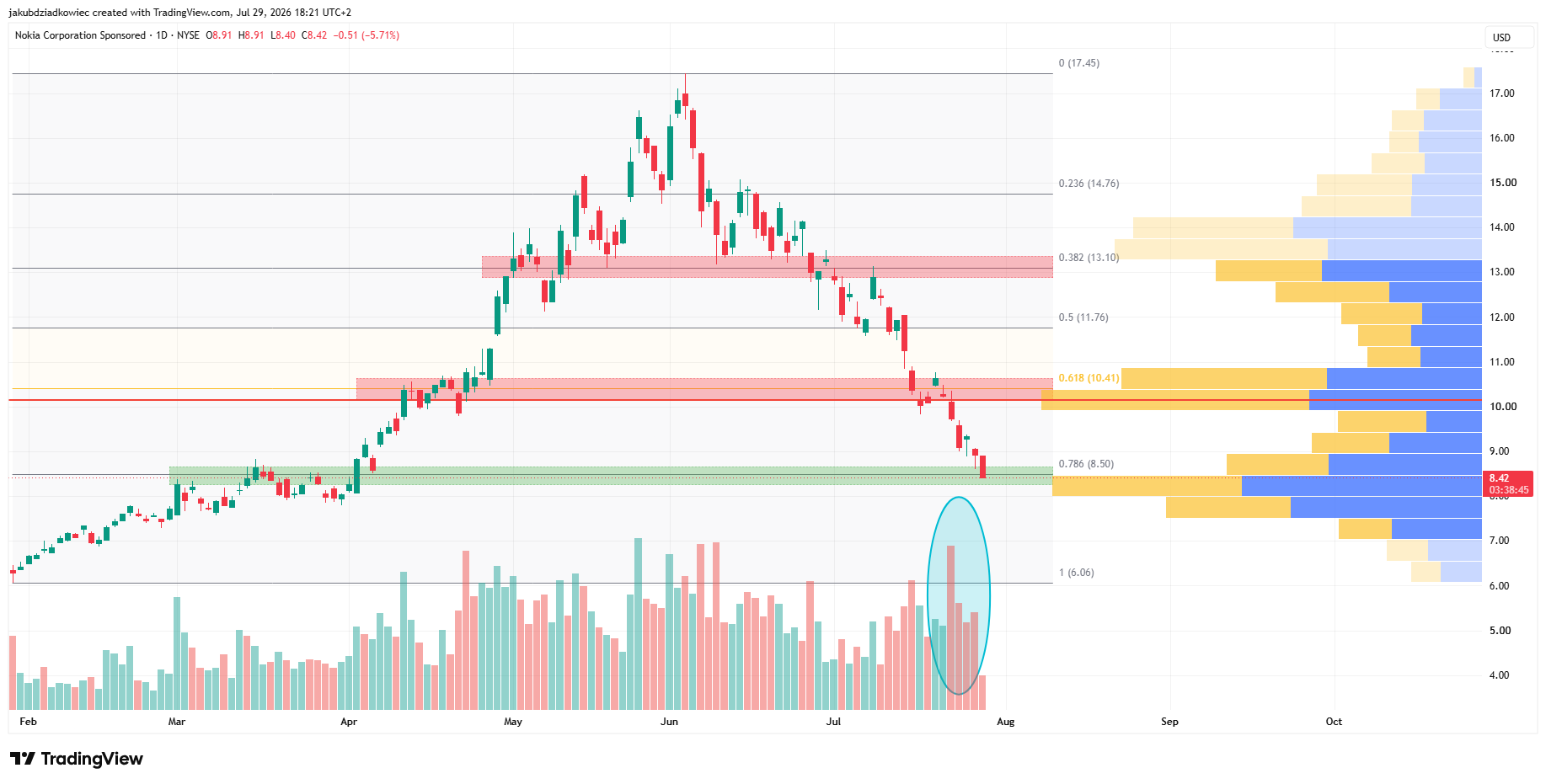
Nokia (NOK) stock traded at $8.44 on Wednesday, down 5.54% intraday, after sellers pushed the price to the 0.786 Fibonacci retracement at $8.50. It is the last major support above the January low of $6.06.
The drop extends Tuesday’s 5.6% slide and deepens a decline that started at the June peak of $17.45. NOK has lost roughly 52% of its value in less than two months.
Why Nokia Stock Is Falling Again This Week
Part of this week’s weakness was mechanical. Tuesday, July 28, was the ex-dividend date for Nokia’s quarterly dividend of 0.04 euros per share, which will be paid on August 6.
However, the adjustment explains only about 0.5% of the move. The rest reflects profit-taking that has continued since last week’s post-earnings breakdown, when investors sold the memory shortage outlook rather than the strong quarter.
Analysts have also started trimming expectations. On July 27, Deutsche Bank lowered its Nokia price target to 11.50 euros from 13.50 euros, while keeping a Buy rating on the shares.
Meanwhile, the sector backdrop remains heavy. Intel dropped 11% after an earnings beat, and profit-taking spread across AI hardware names. Nokia now falls with the sector rather than on company-specific news alone.
NOK Price Analysis Shows Bulls Defending the $8.50 Level
On the daily chart, the Fibonacci retracement drawn from the January low of $6.06 to the June top of $17.45 still maps the decline. The June peak ended a months-long rally fueled by AI and cloud demand.
NOK lost the 0.618 golden pocket at $10.41 last week, and a large spike in volume accompanied the breakdown. Such volume signals conviction among sellers, which favors trend continuation.

The slide has now reached the 0.786 retracement at exactly $8.50. This is the bulls’ final line of defense, and they must step in immediately to hold it.
The Visible Range Volume Profile (VRVP) adds weight to both levels. Its two largest volume nodes sit near $10.41 and $8.50, so these zones will likely act as resistance and support over the coming days or weeks.
Nokia RSI at 27 Gives Bulls No Divergence to Lean On
The daily Relative Strength Index (RSI) reads 27, below the oversold threshold at 30. Historically, such depressed readings can produce short-term bounces, as other beaten-down names showed during this earnings week.
However, there is no sign of a bullish divergence yet. The indicator keeps printing lower lows together with the price, so momentum still favors the sellers.

If NOK loses $8.50 on a daily close, the next support zone sits at the $6.06 anchor low, roughly 28% below Wednesday’s price. In contrast, a daily close back above $10.41 would invalidate the bearish outlook.
Until then, the market decides between a defended floor at $8.50 and a full retest of $6.06.
To read the latest stock market analysis from BeInCrypto, click here.
The post Nokia Bulls Have One Level Left to Defend After 52% Crash From June Peak appeared first on BeInCrypto.
Veteran macro investor Jordi Visser says the easy money in artificial intelligence (AI) is gone. He thinks Bitcoin (BTC) is where the next big gains turn up.
New company filings help explain why. The biggest AI spenders are now burning cash faster than they bring it in.
Big Tech Is Burning Cash to Build AI
Google spent more cash last quarter than it collected. That has never happened since the company listed in 2004.
The measure that matters here is free cash flow. It is simply the money left over after a company pays for the data centers it is building.
All three of the biggest AI spenders saw that cushion shrink.
Company
Cash left over, April to June
Same quarter last year
Microsoft
$19.6 billion
$25.6 billion
Meta
$784 million
$8.5 billion
Alphabet
Negative $5.9 billion
Positive $5.3 billion
Meta’s drop is the eye-catching one. A year ago it kept $8.5 billion. This time it kept $784 million.
Its own release shows why. Sales rose 28%. Costs rose 55%. Meta then borrowed $24.91 billion to keep building. It spent $31.08 billion on new capacity in three months.
One fair caveat. Some of those costs were legal bills and layoff payments, not AI. Together they came to $3.58 billion.
Microsoft looks the healthiest of the three. Its filing shows sales up 18% and its Azure cloud business up 43%.
Even so, its spare cash fell 23%. Nobody escaped the squeeze. Only the size of it changed.
Why Jordi Visser Says the AI Trade Is Over
Visser has worked in markets for more than 30 years. He runs AI research at 22V Research and founded Visser-Labs. He used to be chief investment officer at hedge fund Weiss Multi-Strategy Advisers.
“The AI trade’s over. The ability of getting seven, eight times your money in that is over,” Jordi Visser, on a podcast.
Follow us on X to get the latest news as it happens
He does not think AI is finished. He thinks the returns are shrinking.
Investors used to hope for seven or eight times their money. He now expects closer to 30% a year. That is still good. It is just no longer a windfall.
The reason is competition. Cheap open-source models keep catching up, so no company stays ahead for long. Wall Street is already split on AI chips as a result.
Goldman Says US Stocks Have No Fuel Left
Big investors have little spare money to put to work. Goldman Sachs told clients that leaves stocks stuck.
Hedge funds have already borrowed heavily to buy shares. Their borrowing sits near the top of the past five years.
“There are limited sources of ‘juice’ for rallies in the immediate term. We still need to get through rubble of the past couple weeks before we can start the conversation for any meaningful re-risking,” Bloomberg reported, citing Goldman Sachs trading desk.
Regular investors are pulling back too. Trading activity this month is more than 3% below the five-year average.
Computer-driven funds are the bigger worry. They hold about $196 billion in US shares. A further slide could force them to sell $15.7 billion inside a week.
The wider mood is nervous. The Federal Reserve held rates steady in a 9 to 3 vote. The Dow then fell 1,153 points, its worst day since April 2025.
Long-term borrowing costs jumped as well. The 30-year Treasury closed at 5.20%, its highest level since 2007.
Why Bitcoin and Ethereum Could Benefit
Visser expects AI programs to start moving money on their own. Blockchains are where that would happen.
He does not think Bitcoin leads the way, though. He expects Ethereum to do better, because investors now prefer networks that earn fees.
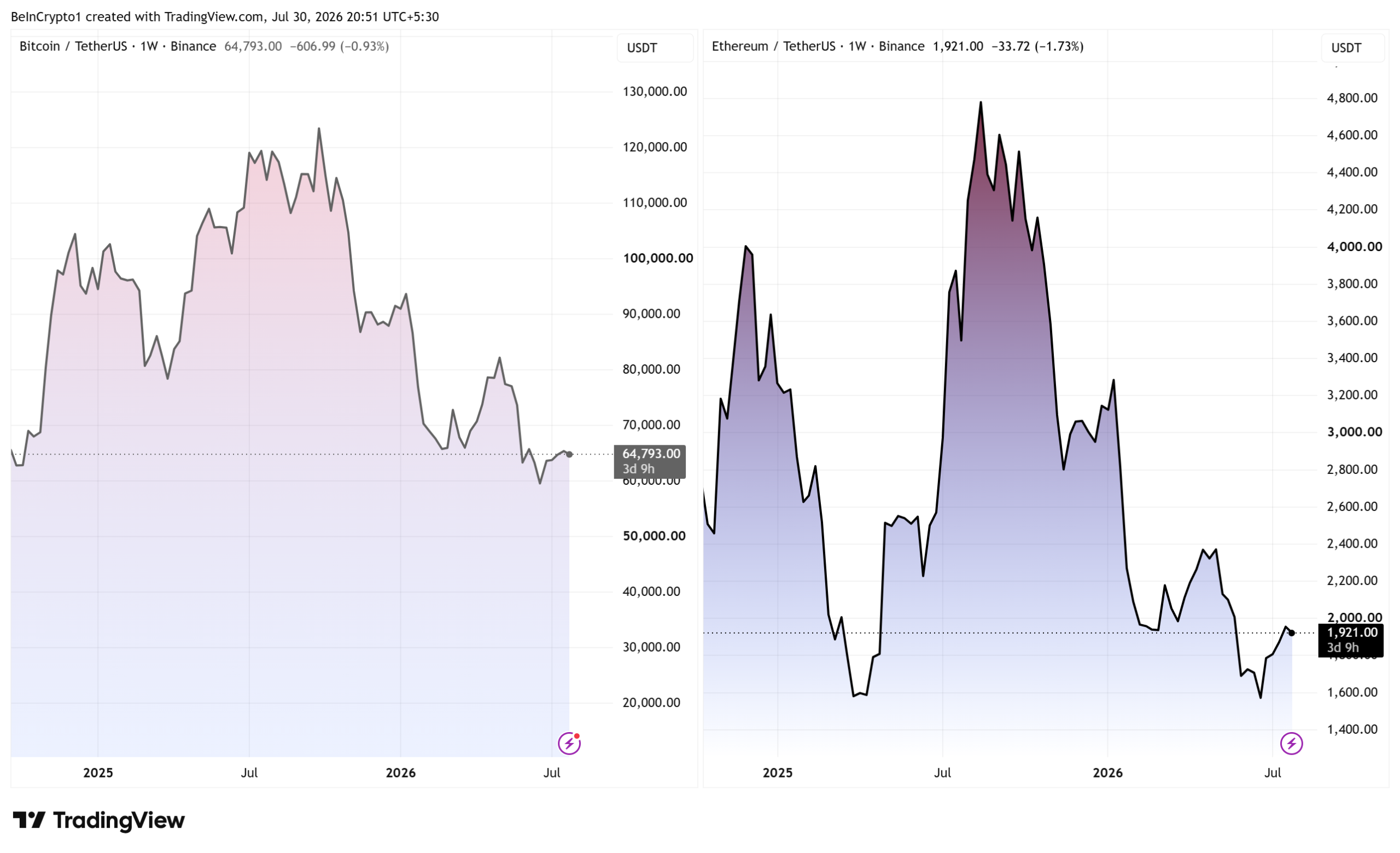
The past month backs him up. Ethereum (ETH) trades near $1,921 and is up 23.3% in 30 days. Bitcoin trades near $64,793 and is up 10.9%.

Zoom out and the picture flips. Over a year, Bitcoin is down 45% and Ethereum 49%.ETH also sits 61% below its 2025 peak. Bitcoin’s current price is 49% below its own record.
So this is a one-month shift, not proof of a new cycle. It matches three bullish Ethereum signals spotted this week, and not much more.
What to Watch Over the Next 30 Days
Visser is waiting on one law. The CLARITY Act would finally decide which US regulator watches which crypto asset.
Traders doubt it passes. Polymarket puts the odds near 30%, and seven roadblocks remain in the Senate.
Rates are the other question. Morgan Stanley economist Mike Gapen expects inflation to ease to about 3.3% by December. That would keep the Fed still. Three officials already wanted a rise.
Then there are buybacks. Goldman expects 90% of big US companies to be free to buy their own shares by mid-August.
Visser needs a law and a buyer. Whichever shows up first will tell us more than any earnings call did.
The post Veteran Macro Investor Says AI’s Easy Money Is Over and Bitcoin Is Next appeared first on BeInCrypto.
Japan slashed its growth forecast for the current fiscal year to 0.9% on Thursday, blaming surging crude oil prices and a weaker yen for squeezing the import-dependent economy.
The downgrade exposes how quickly Middle East tensions can reshape the outlook for an advanced economy.
The Oil and Currency Assumptions Behind the Downgrade
Fiscal year 2026 in Japan runs from April 2026 through March 2027, the standard period governments use for budgeting and forecasting. The Cabinet Office presented the revision alongside updated fiscal projections.
The new figure marks a sharp cut from January. Officials had projected 1.3% growth just six months ago, before global energy markets turned against the country.
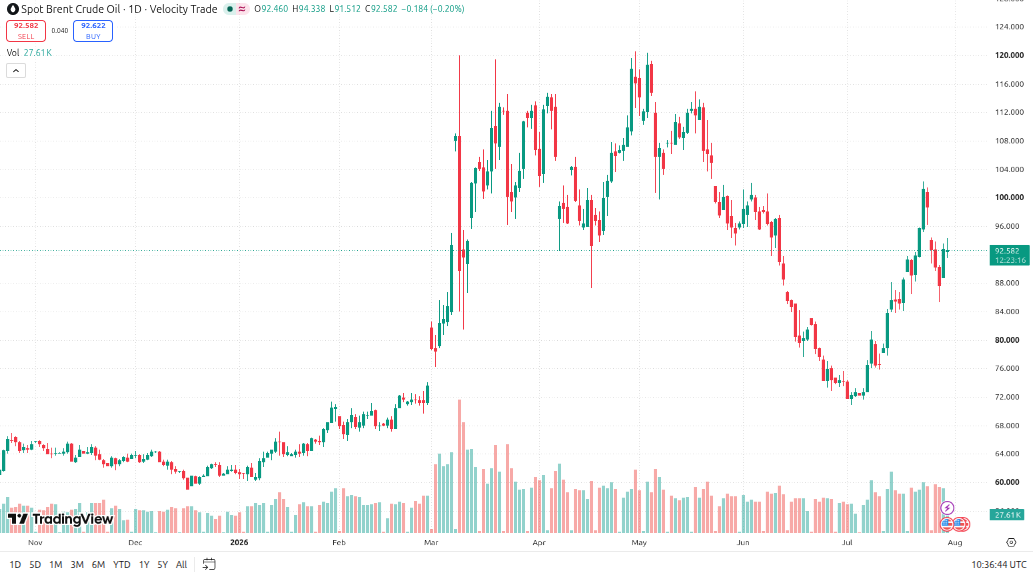
Two assumptions drive the revision. The government now models crude oil at $92.5 per barrel, well above its earlier estimate of $68.
Currency expectations shifted just as dramatically. Officials assume the yen is trading at 161.4 per dollar, compared with 155.2 in the previous forecast.
Follow us on X to get the latest news as it happens.

Both changes hit the same pressure point. Resource-poor Japan imports nearly all of its energy, so higher prices and a weaker currency inflate costs across the entire economy. Household spending absorbs much of that initial shock. Private consumption, which drives more than half of Japanese output, is now forecast to grow just 0.9% instead of 1.3%.
Business investment faces similar pressure. Capital expenditure should rise just 2.3% this year, down from the 2.8% that officials projected back in January.
Inflation moves in the opposite direction. Consumer prices are now expected to climb 2.2%, up from the earlier 1.9% estimate, further testing household purchasing power.
Can Japan Recover Growth in Fiscal Year 2027
Prime Minister Sanae Takaichi’s administration paired the downgrade with a more optimistic medium-term view. Growth should recover to 1.1% in fiscal 2027, according to the same projections.
That rebound depends on policy execution. The government is promoting investment in crisis management, strategic sectors, and public-private partnerships, while new budget guidelines give ministries greater flexibility for growth-oriented projects.
The fiscal arithmetic tells a mixed story. The primary balance, which excludes debt interest, should post a wider deficit of 1.2 trillion yen ($7.4 billion) this year because of supplementary budgets.
Next year looks considerably better on paper. Officials expect a surplus of 1.4 trillion yen ($8.7 billion) in fiscal 2027, driven largely by higher tax revenues.
Subscribe to our YouTube channel to watch leaders and journalists provide expert insights.
That projected swing carries genuine political significance. Japan holds one of the heaviest public debt burdens among developed nations, making credibility with bond markets essential.
Oil markets still remain the central variable. Brent crude has traded around the $80 range recently, while the Bank of Japan points to underlying resilience in exports and specific industrial sectors.
The post Japan Cuts Fiscal 2026 Growth Forecast to 0.9% on Oil and Weaker Yen appeared first on BeInCrypto.
The proposed act is widely viewed as a cornerstone for the next phase of institutional crypto adoption. By establishing clear rules for digital assets, the legislation could give banks, brokers, exchanges and asset managers greater confidence to invest, launch products and build market infrastructure, accelerating the migration of trading and liquidity to regulated U.S. venues.
JPMorgan analysts said the legislation would encourage institutional investment, boost U.S.-regulated trading and lower barriers for banks, exchanges, custodians and market makers.
Some of those trends are already emerging, the bank said, citing Citadel Securities’ $400 million investment in Crypto.com and the CFTC’s approval of the first U.S.-regulated perpetual crypto futures contracts.
The report cautioned, however, that parts of the current draft could deter institutional participation by allowing some tokenized securities and derivatives trading outside SEC or CFTC oversight and imposing lighter anti-money laundering requirements than those faced by traditional financial firms.
Investment bank Jefferies warned that the Clarity Act still faces significant hurdles despite clearing the Senate Banking Committee, according to a report last month.
Read more: Jefferies warns of crypto market volatility as Clarity Act faces Senate test


Aave, the largest decentralized lending protocol, is considering a proposal to abandon six of the blockchains it had expanded onto, in a cleanup affecting about $98 million in deposits. The proposal would see Aave retire “low-adoption” asset markets and 21 expired Pendle principal tokens across 11 Aave deployments, while shutting down its presence on Sonic, Scroll, zkSync, Metis, Soneium and Aptos entirely.
The arguments is based on economics. Each of the six deployments now generate less than $5,000 a quarter. Metis, Soneium and Aptos bring in under $1,000 each, according to the proposal. That does not cover the cost of running them, which includes maintaining price feeds, liquidation systems and monitoring for each market.
For context, Aave’s Ethereum mainnet deployment generates more than $142 million a year and Base about $4.7 million, while Metis produces roughly $3,000.
Deposits have collapsed across all six over six months. Soneium fell 95%, available liquidity on Aptos dropped 94%, zkSync declined 88% to about $844,000, Scroll fell 86% to roughly $2 million, Metis dropped 79%, and Sonic, the largest of the group, fell 74% to just under $8 million.
Ethereum continues to trade within a critical technical area after recovering sharply from its June lows. While the broader rebound remains intact, the latest price action suggests momentum is fading as buyers and sellers battle for control beneath major resistance.
Ethereum Price Analysis: The Daily Chart
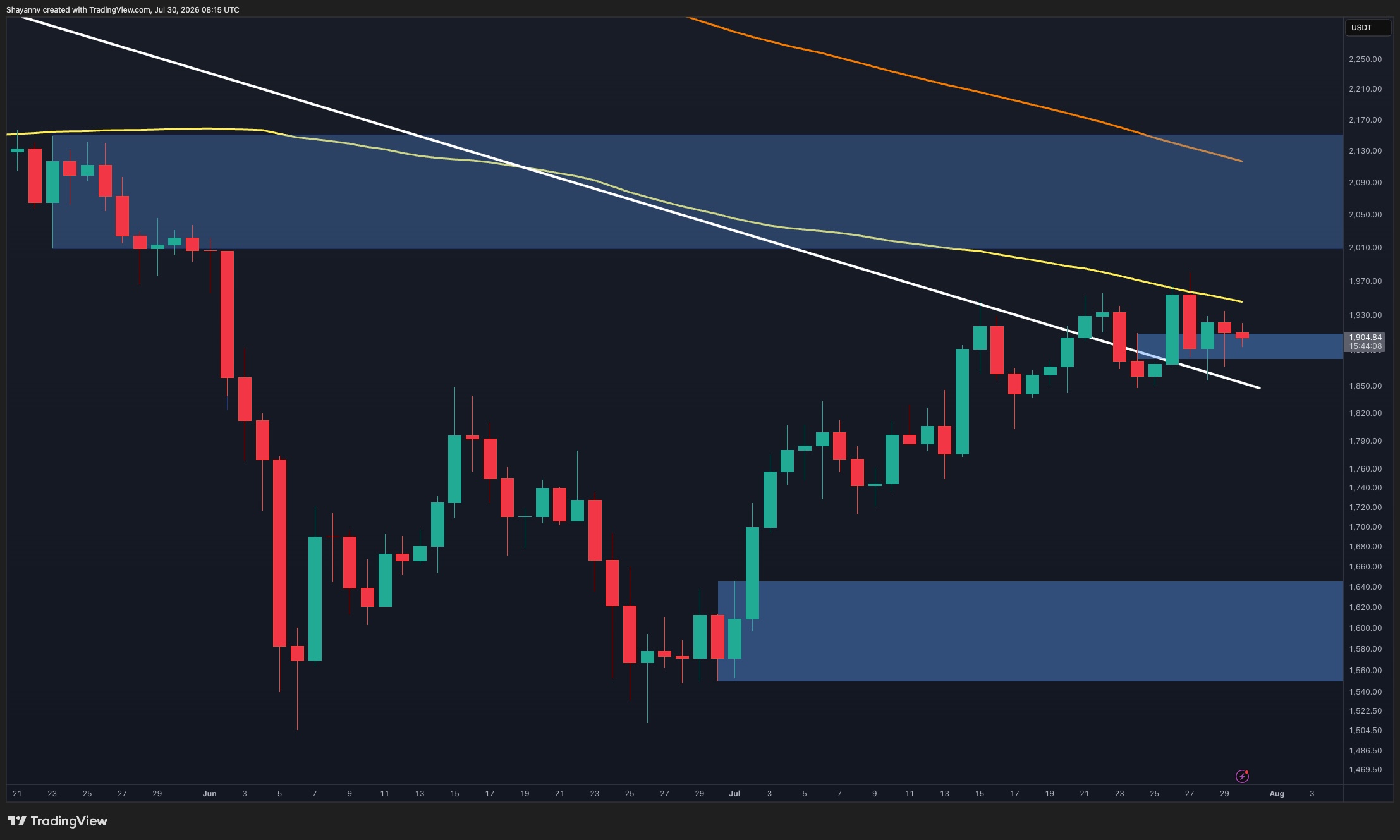
On the daily timeframe, Ethereum remains below both the 100-day and 200-day moving averages, keeping the broader trend cautious despite the recovery from the June bottom. The recent rally stalled just below the 100-day MA near the $1.95K region, where sellers quickly stepped in and pushed the price back toward the $1.88K to $1.91K supply zone.
This area is now acting as immediate resistance. A successful breakout above it would improve the medium-term outlook and expose the confluence of the 100-day and 200-day moving averages inside the $2.02K to $2.15K resistance zone. Until then, ETH remains vulnerable to another rejection.
On the downside, the $1.75K to $1.79K demand zone remains the first important support. Losing this area would likely trigger a deeper correction toward the major demand region around $1.56K to $1.64K.
ETH/USDT 4-Hour Chart
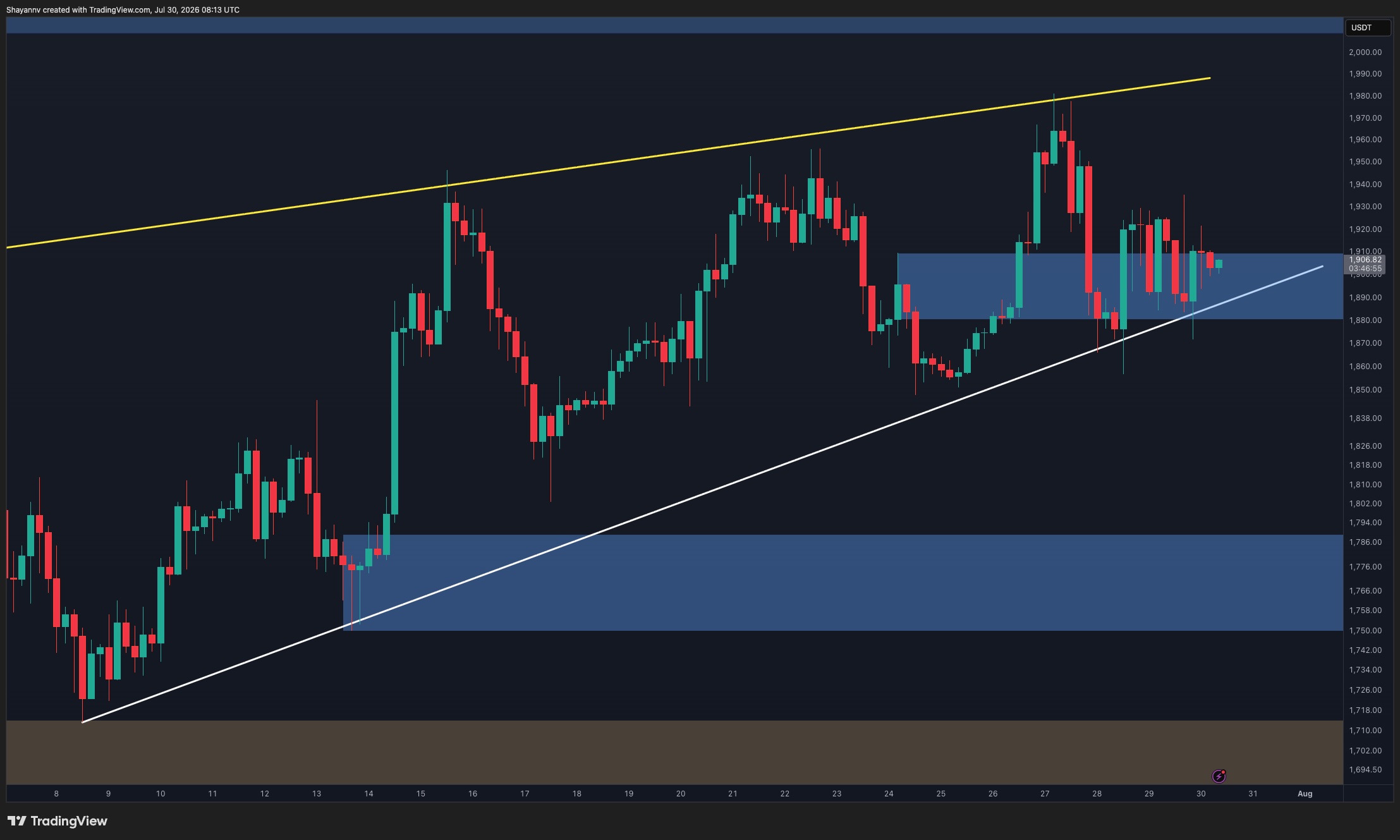
The 4-hour chart shows Ethereum trading inside a compression pattern, with price action confined between the rising white trendline and the descending yellow trendline. This narrowing range reflects increasing indecision as neither buyers nor sellers have been able to establish a decisive directional move.
Ethereum is currently consolidating around the $1.88K to $1.91K resistance zone while continuing to respect the ascending support trendline. A breakout above both the resistance zone and the descending trendline would likely strengthen bullish momentum and pave the way for another attempt at the recent highs.
However, a breakdown below the white ascending trendline would invalidate the current sequence of higher lows and could accelerate a correction toward the $1.75K to $1.79K demand zone, where buyers would be expected to defend the broader recovery structure.
Sentiment Analysis
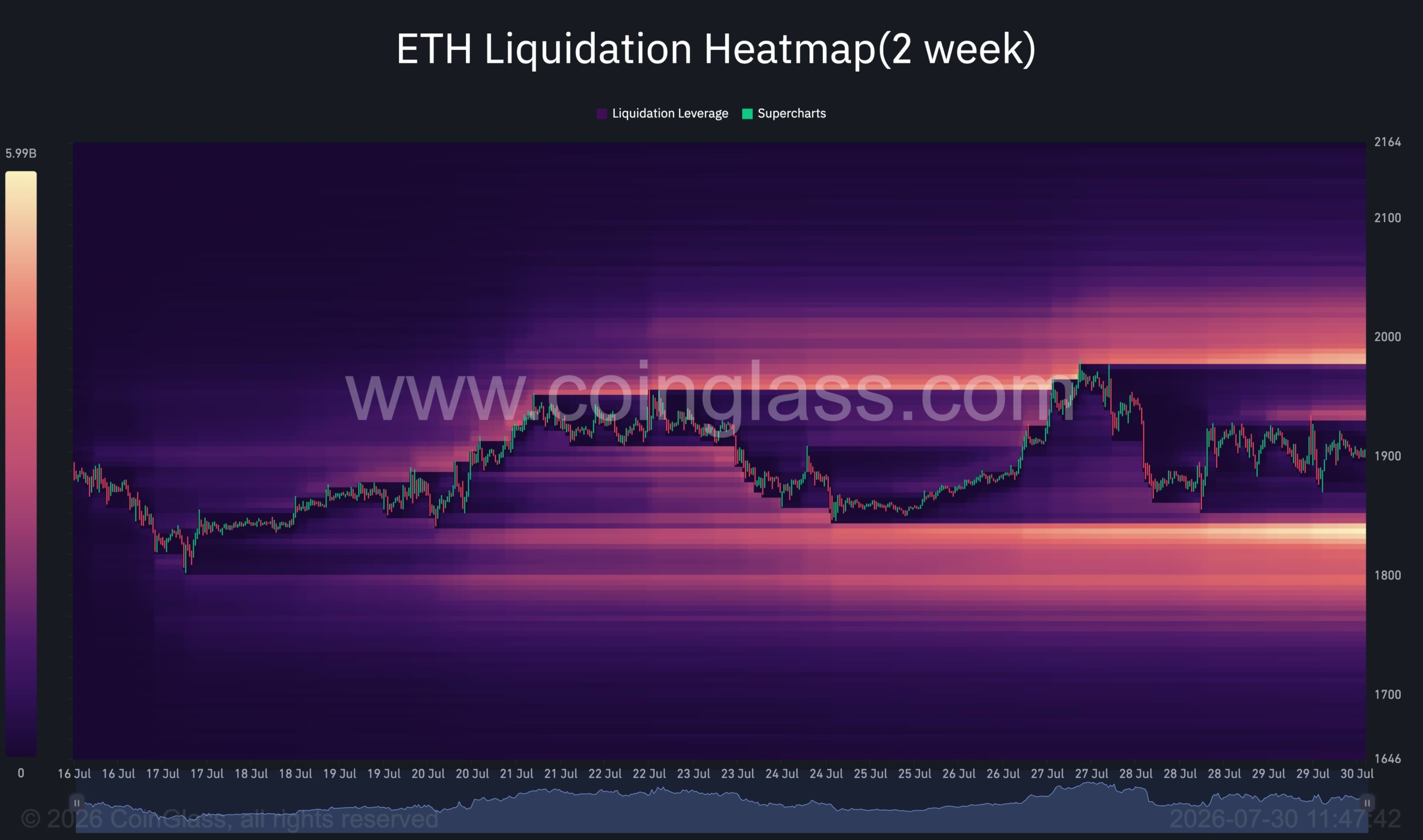
The two-week Binance liquidation heatmap highlights a notable concentration of liquidity above the current price around the $2K level, making it the primary upside liquidity target if buyers regain momentum.
At the same time, a significant liquidation cluster has formed around the $1.82K region beneath the market. Since price is currently trading between these two liquidity pools, Ethereum may continue to experience choppy and range-bound price action before making a decisive move toward one of these high-liquidity areas. A sweep of either cluster could trigger increased volatility as leveraged positions are liquidated.
The post Ethereum Price Analysis: ETH Holds Key Support but Bullish Momentum Fades appeared first on CryptoPotato.

Yet rather than add nurses, many hospitals are paring back, sometimes turning to apps where they can hire nurses as gig workers. Such apps often allow hospitals to avoid paying for benefits for these workers, says Katie Wells, a senior fellow at the AI Now Institute, which has studied gig apps for nursing. “Lean staffing has just become the norm,” Wells says.
The American Hospital Association argues that the issue is not lean staffing but that instead there are workforce shortages that are projected to continue for more than a decade.
“The growing complexity and intensity of patient care, along with overly burdensome regulatory requirements and increased administrative demands from corporate insurers, continue to place significant demands on nurses,” the association said in a statement provided to TIME.
Hospitals are also facing increased costs of caring for patients, according to a March 2026 post by Rick Pollack, AHA’s president and CEO. In 2025, he writes, hospital expenses grew 7.5%, more than twice the rate of growth in hospital prices. Hospitals are also caring for patients who are sicker and whose care is more complex than it used to be, he points out.
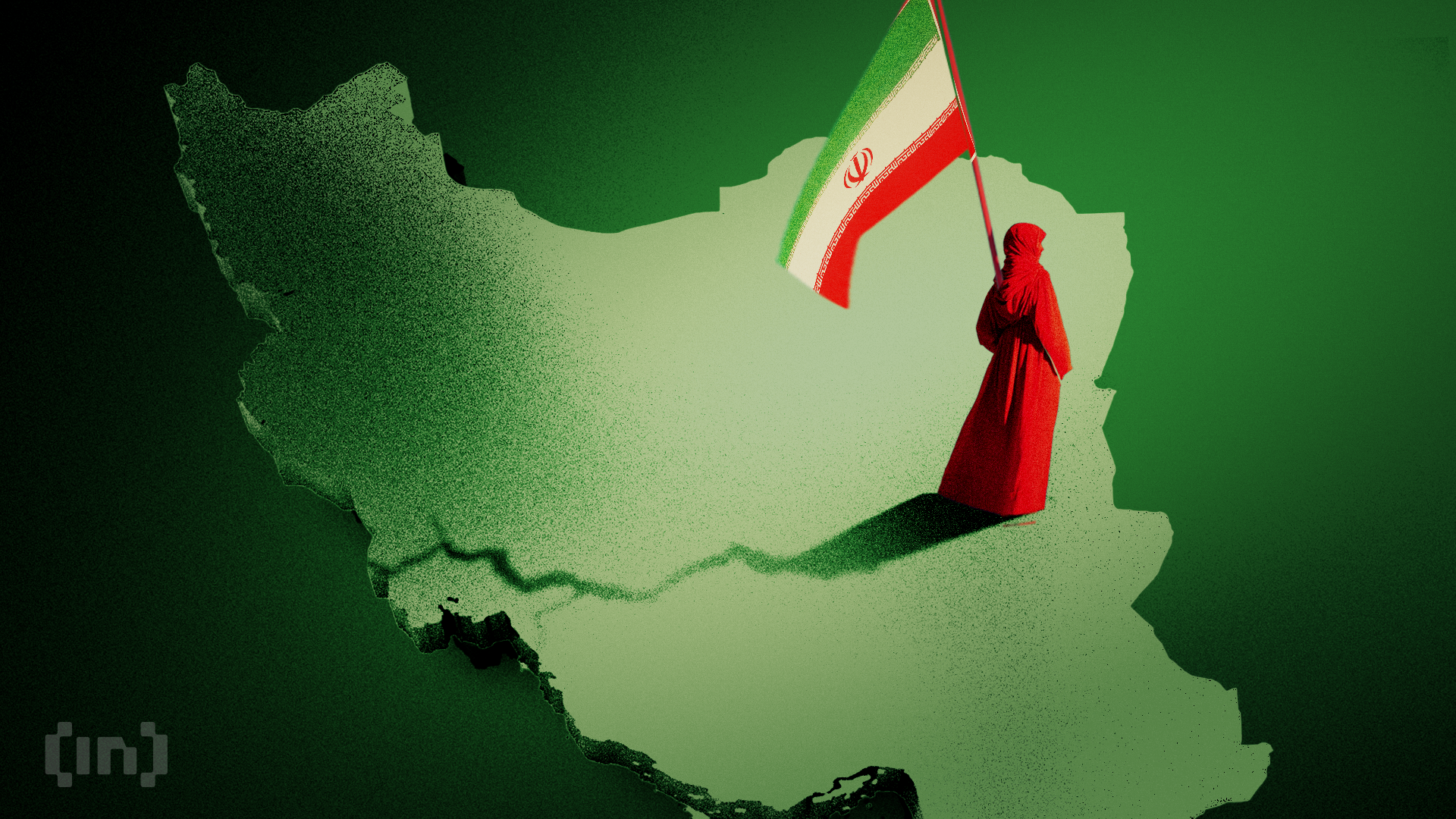
The US Treasury’s Office of Foreign Assets Control (OFAC) sanctioned two firms accused of supporting an IRGC-backed scheme that allegedly extorted commercial vessels transiting the Strait of Hormuz by requiring them to purchase maritime insurance.
Wednesday’s designations hit the Persian Gulf Marine Insurance Company and HormuzSafe Marine Services Authority, known as Hormuz Safe. Treasury says the policies extract revenue while covering risks that Iran itself creates.
Follow us on X to get the latest news as it happens
How Iran’s Hormuz Insurance Scheme Drew US Sanctions
The IRGC reportedly began collecting transit fees from tankers passing through the Strait of Hormuz in April, with charges starting at approximately $1 per barrel.
The Treasury said the insurance scheme was created to offset revenue lost following Operation Epic Fury. Treasury Secretary Scott Bessent linked the initiative to Iran’s worsening economic conditions.
“With its economy in freefall and inflation in the triple digits, the regime is desperate for cash,” he said.
According to the department, Iran established the “illegitimate schemes” through the Persian Gulf Marine Insurance Company (PGMIC) and HormuzSafe Marine Services Authority.
It said Iran’s Ministry of Economy developed HormuzSafe. It offers insurance, traffic control, security, and emergency response services to vessels transiting the strait.
The firm accepts payments in Bitcoin (BTC) and other digital assets as part of Iran’s efforts to circumvent Western sanctions.
The Treasury also noted that Iran’s insurance regulator created the Persian Gulf Marine Insurance Company, which issues policies approved by the Persian Gulf Strait Authority.
OFAC sanctioned the IRGC-backed authority on May 27. It has now designated both the Persian Gulf Marine Insurance Company and HormuzSafe Marine Services Authority under Executive Order 13902 for operating in Iran’s financial sector.
In addition, OFAC sanctioned eight shipping companies and identified eight oil tankers as blocked property. The operators are registered in Hong Kong, the Marshall Islands, and China. According to the Treasury, the vessels transported Iranian crude oil and petroleum products.
The agency has now sanctioned more than 100 shadow fleet vessels since January. The latest measure is part of a broader US enforcement action against Iran.
In mid-July, the Treasury sanctioned four cryptocurrency wallets linked to Iran’s central bank. At the same time, Tether froze approximately $131 million in USDT held in those addresses.
Subscribe to our YouTube channel to watch leaders and journalists provide expert insights
The post OFAC Targets Iran’s Crypto-Funded Toll Scheme in Strait of Hormuz appeared first on BeInCrypto.
Earnings call transcript: Whitecap beats Q2 2026 estimates on record cash flow

Ondo Finance explores deal valued at up to $500 million

Mum who murdered toddler daughter filmed smoking cigarette as tot lay dying


-

 Fashion6 days ago
Weekend Open Thread: Brooks Brothers
-
 Sports4 days ago
Commonwealth Games boxing: Jadumani Singh seals dominant 5-0 win over Pakistan’s Sumama Rehman to enter quarter-finals | Commonwealth Games News
-

 Business20 hours ago
Why Trees Belong on the Risk Register
-

 Tech4 days ago
Intel is reversing course and bringing hyper-threading back to its server chips
-

 Crypto World5 days ago
Ripple bought a bank in pieces. The $4 billion audit
-

 Politics3 days ago
Luke Littler dismantles Gerwyn Price to retain title in Blackpool
-

 Politics2 days ago
The Part of the Electric Transition Nobody Wants to Discuss
-
 Entertainment6 days ago
A New Post-Apocalyptic Gundam Anime Series Blasts Into SDCC
-

 News Videos4 days ago
BITCOIN JUST ENTERED THIS CRITICAL ZONE…
-

 Fashion7 days ago
16 Dresses for the High Summer Event
-

 Sports7 days ago
2026 3M Open leaderboard: Scottie Scheffler finds putter in Round 1, sits three back
-

 News Videos7 days ago
The Peugeot Family: How 200 Years of an “Old Money” Dynasty Died in A Boardroom
-

 Business1 day ago
Major shareholder moves on Canyon
-

 Crypto World4 days ago
XRP Ledger adds $2.6B as RWA inflows rank second
-

 Politics4 days ago
Spain sweeps the board at 2026 World Cup with individual awards
-

 News Videos5 hours ago
Bitcoin Enters the 3rd Stage of the Bear Market
-
 Entertainment2 days ago
‘Stargate’ Creator’s New Sci-Fi Series Returns for Season 3 Tomorrow
-

 Tech5 days ago
Anthropic launches Claude Opus 5, a cheaper AI model for coding, agents and enterprise workflows
-

 Crypto World2 days ago
Kraken Enables Retail Access to Jersey Mike’s IPO via Tokenized Shares
-

 Entertainment5 days ago
Sara Gilson Killed By Husband After Viral “Pedophile” TikTok Video
You must be logged in to post a comment Login