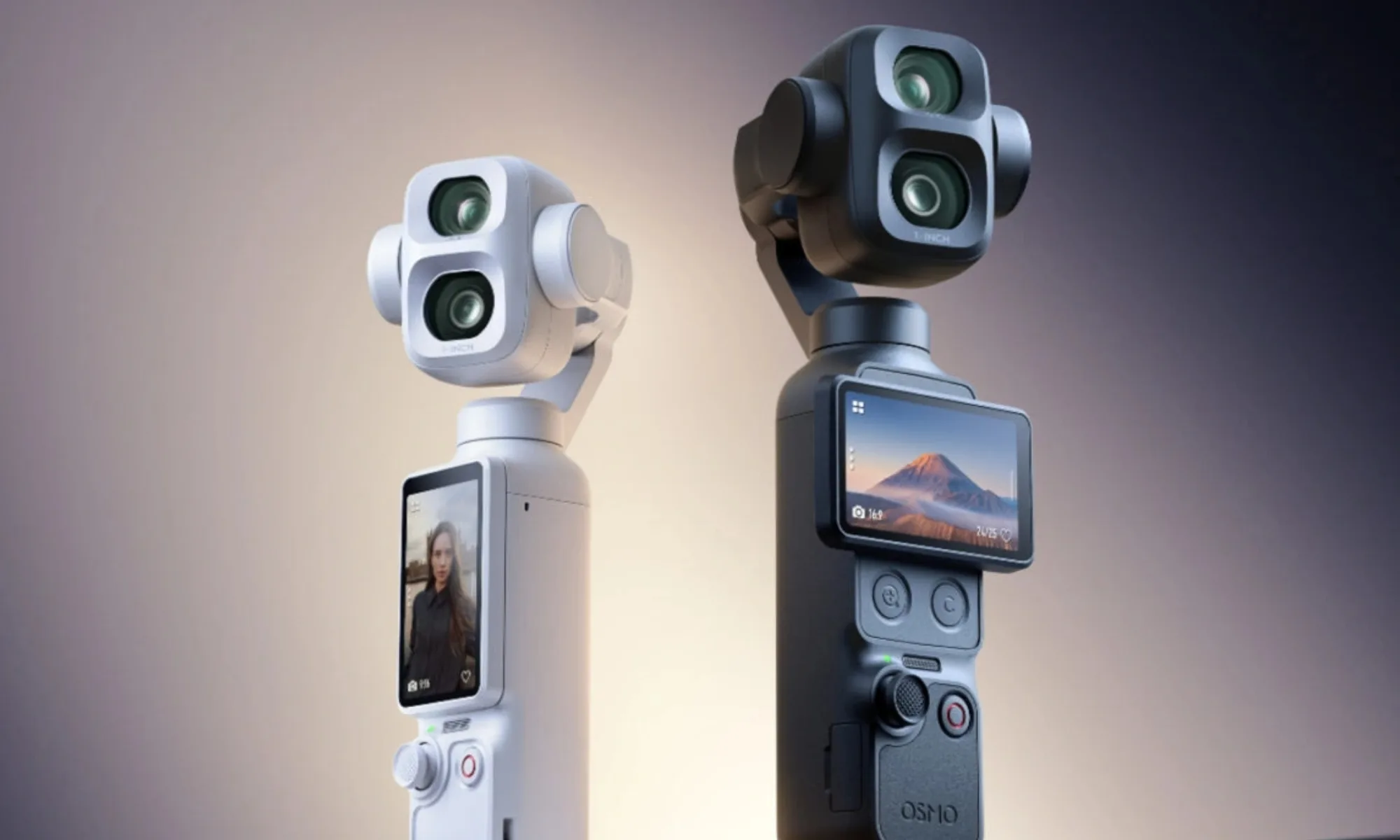
DJI has now given the Osmo Pocket 4P a wider global release after initially limiting its most capable pocket camera to China. It is now available across the UK, Europe, Canada, and Australia, but the US remains missing from the list.
The Standard Combo starts at £529 or €599 and includes the camera, a fill light, carrying pouch, and a handle with a tripod thread. In Canada, DJI lists the same bundle at US$619, as prices on its Canadian storefront are displayed in US dollars. The Vlog Combo costs £605, €689, or US$669 in Canada and adds a Mic Mini 2, Mini Tripod, larger carrying bag, and the Osmo FrameTap remote.
The second camera is the big upgrade
The Osmo Pocket 4P uses a 1-inch primary sensor paired with a 20mm equivalent f/2.0 lens. It supports up to 17 stops of dynamic range using DJI’s new 10-bit D-Log 2 profile, giving creators more room to adjust highlights, shadows, and colors during editing.
DJI
The bigger addition is a second 1/1.28-inch sensor paired with a 60mm equivalent f/1.8 telephoto lens. It delivers 3x optical zoom and gives creators another framing option for portraits, products, and distant subjects without relying entirely on digital cropping. The wide camera records slow-motion video at up to 4K/240 fps, while the telephoto reaches 4K/200 fps. A 2-inch OLED screen offers 1,000 nits of brightness, and DJI claims up to 210 minutes of battery life.
Why is the US still being left out?
DJI has not announced US pricing or a release date for the Pocket 4P. The company’s recent launches continue to face roadblocks as the FCC tightens restrictions around DJI and foreign-made technology. Older products such as the Osmo Pocket 3 remain available because they received authorization before the crackdown.
Advertisement
The government has since expanded the same Covered List approach to foreign-made robots, including future robot vacuums and Roombas. For US creators, the Pocket 4P is therefore another DJI product they can see launched almost everywhere else but cannot officially buy at home.
We may receive a commission on purchases made from links.
Vinyl is, as you’re probably tired of hearing by now, huge. Driven by megastars such as Taylor Swift, vinyl sales broke past the $1 billion mark in 2025, capping a meteoric rise in sales of $800 million since 2016. It’s undoubtedly the vanguard of the general resurgence of physical media, and it looks like the format is merely going from strength to strength: According to MusicWeek, vinyl sales grew 16.4% year-on-year in the first half of 2026, setting the stage for another massive 12 months.
Advertisement
This is not a new phenomenon, of course. Vinyl has been back for nearly two decades as of 2026. This means that, unlike the modern cassette player market, which is much smaller, there’s a dizzying number of new turntables out there. From big-name, legacy brands like Technics and Rega to newer entrants like Fluance and U-Turn, there really is a turntable out there for everyone. It just depends, as ever, on how much you’re willing to spend.
Thankfully, you don’t actually have to part with that much cash to get a solid, reliable turntable. There are a handful of great options under the $600 mark that can do a great job and will serve as a solid upgrade, be it from an old thrifted turntable or a cheap all-in-one record player. And while, yes, you could go with one of the latter to really save money, there are plenty of reasons to prefer turntables to record players, and so we’ll focus on the former.
Advertisement
Audio-Technica AT-LP70XBT
I spent over five years working part-time at a record store, and one of our most common recommendations when a customer asked for a starter turntable was the Audio-Technica AT-LP60. While it’s still a great option for absolute beginners, it has some limitations that mean it won’t be for everyone, not least the lack of a significant upgrade path due to its lower-quality fixed cartridge.
The newer Audio-Technica AT-LP70XBT does not, admittedly, resolve that issue entirely, as it still has a tonearm with an integrated cartridge. The difference is that it uses the brand’s VM95 styli, which are higher quality than the ones available to the LP60. They also include higher-end variations like the Shibata-equipped VMN95SH, which is a very capable stylus for the price. The 95C stylus it comes with isn’t amazing, but it’s honestly not that bad, either, and the LP70 sounds good enough to serve most vinyl hobbyists well. Sure, it’s pricier than the LP60 at around $300, but you could conceivably use the LP70XBT as it is for a while and focus your energy on, say, getting acquainted with the quirks of shopping for used vinyl instead.
The LP70XBT has, as the final two letters suggest, Bluetooth connectivity, but those of you interested in wired operation will appreciate the inclusion of a defeatable phono preamp that sounds surprisingly good. It’s also a fully automatic turntable, which is a good newbie-friendly feature. You press a button to start, and it does the rest, including lifting the tonearm once the record ends.
Advertisement
Sony PS-LX310BT
Sony’s PS-LX310BT does not immediately stand out, at least not based on its specs. This isn’t to say that it’s a bad turntable — far from that — but what it offers is not, on paper, unique. It has Bluetooth connectivity and is automatic, both of which are quite common. It also has a not-insignificant downside in the form of an integrated cartridge without any adjustability, which means you can’t really tweak it or get a better cart once your tastes evolve. This makes the Sony essentially plug-and-play, though, which some of you will appreciate.
Advertisement
The reason the PS-LX310BT is on this list is that it sounds remarkably good for the price, and has a decent phono stage as well. No, you’re not getting audiophile-grade output from the Sony, and putting it side-by-side to a higher-end turntable (especially one with a better cartridge) will show up its deficiencies, but what audio it does pump out is very enjoyable. I’ve spent time with one and, while I would never take it over my Technics SL1200, I wouldn’t say it’s leagues worse either.
Sony’s offering is also one of the most living-room-friendly turntables in its $450-ish price bracket, too. While most will probably accept that a turntable will never fully blend into the furniture, the PS-LX310BT’s sleek, unobtrusive lines and minimalist cool do at least mean it won’t stick out like a sore thumb in a modern living space either. Not everyone wants their Hi-Fi setup to be the center of attention, after all.
Advertisement
Fluance RT85 and RT85N
There are quite a lot of options for the buyer seeking a longterm solution and willing to spend $600 to do so. Pro-Ject and Rega have some appealing options in this price range, but we think that the one to go for, and one of the best turntables overall, is the Fluance RT85 or RT85N — especially given its availability in the U.S. and $550 MSRP.
The RT85 is, spec-wise, probably one of the best deals in its price bracket. The standout is the cartridge: The 85 ships with an Ortofon 2M Blue cartridge, which, in my experience, is noticeably better than almost every other cartridge you’ll get on a comparably priced new turntable. It’s not the greatest cart ever, but it’s a detailed performer that’s a cut above carts like the Ortofon 2M Red on the U-Turn Orbit Special, which costs about the same. The Fluance RT85N swaps the Ortofon for the similarly great Nagaoka MP-110, my entry-level cartridge of choice.
Both versions have auto-stop, an MDF plinth and acrylic platter combo, speed control, a fully adjustable tonearm, and a removable headshell for easy cartridge swaps — all features that I guarantee you will find useful if you stick with the vinyl hobby for a few years. No, you don’t get a phono preamp, which means will have to spend more than the RT85’s $550 MSRP, but that’s a small price to pay in the long run. Either way, once you figure that out, though, you’ll be treated to a great-sounding turntable that makes good use of the cartridge it comes with.
Advertisement
Audio-Technica AT-LP120XBT
Most affordable turntables are belt-driven, which means that the motor spins a belt, which then pulls the platter around. It’s a perfectly adequate technology present on cheap and high-end decks alike, but having choice — and the chance to go with an alternative — can only be a good thing. That’s what the Audio-Technica AT-LP120XBT offers. And a lot more besides, of course.
Advertisement
The AT-LP120 is a direct-drive turntable, which means that it has a motor that spins the platter directly. This has some benefits, such as better torque and more stable rotational speed, at the cost of noise from the motor potentially being transmitted to the stylus. As a dyed-in-the-wool direct-drive turntable user, though, I feel that said drawback is somewhat overstated — especially in this context, where you’re not likely to be pairing a $450 turntable with a setup that’s revealing (and expensive) enough to expose any noise issues.
Admittedly, the LP120 isn’t the biggest and best-sounding turntable ever, but it is perfectly adequate for the price, with solid sound quality and an easy upgrade path. You can either swap new VM95 stylus onto the included Audio-Technica cartridge or install an entirely new cartridge, thanks to the standard cartridge mount and fully-adjustable tonearm. You also get a pitch control, support for 78s, a built-in phono preamp, Bluetooth connectivity, and a USB output — although the latter is a bit noisy. None of these are must-haves, but they’re all great value-adds that make the LP120 quite compelling.
Advertisement
U-Turn Orbit Basic and Special
If you’re looking for turntables with the potential to serve you well for a very long time and don’t mind compromising on features to hit lower price points, U-Turn’s Orbit turntables are worth considering. The starter model, the Orbit Basic, comes in at just $249. It’s as basic as turntables can get, with manual switching between 33 and 45 RPM, no tonearm cue lever, fixed tracking weight, and non-adjustable anti-skate.
Not everyone will like the no-frills design, but it delivers on the sound quality front and is a significant upgrade over bad turntables like the $280 Victrola Automatic. Of course, you can get better-sounding turntables, but the Orbit Basic will give you a fine taste of what vinyl can offer — and that’s more than enough for the price. If you’re willing to spend a bit more, you can step up to the $400 Orbit Plus or the $550 Orbit Special. These have better cartridges — an Ortofon OM5E on the Plus and a 2M Red on the Special — and upgraded materials, such as an acrylic platter on the Orbit Plus (versus the MDF platter on the Basic).
If you can afford it, the Orbit Special is the U-Turn product to consider. Not only does it sound genuinely good, it also includes creature comforts like a cue lever and convenient speed switching via a dial. The value proposition does diminish slightly, given that anti-skate and tracking weight are still fixed (not an issue on, say, the Fluance RT85), but it’s a fine purchase if you like U-Turn’s vibe.
Advertisement
Our methodology
Lfo62/Getty Images
To put together this list of affordable turntables, we first had to decide on a definition of “affordable.” We settled on a $600 ceiling, which, while not outright cheap, is relatively affordable considering that higher-end turntables can easily cost $2,500 or more. After setting a cutoff point for price, we then selected a handful of turntables based primarily on professional reviews from reputable publications, combined with hands-on experience.
Generally speaking, we made sure to choose turntables with a reputation for good build quality, enjoyable sound, long-term viability, and solid functionality for a wide range of users with no major deal-breakers. Sub-$600 turntables will never be the final word in terms of vinyl reproduction, materials, or premium design cues, of course, and there will always be compromises, but a good one can and will serve as a great starting point for new record collectors and budding Hi-Fi enthusiasts.
When selecting a new ride-on mower, there are a variety of options available in terms of cutting width, engine performance, and features. One aspect of mower builds that doesn’t receive as much attention is the type of deck. You can find models that feature a stamped or fabricated deck, which are made differently and offer their own advantages. Mower decks are made primarily from steel, but you can also find units comprised of aluminum and even composite.
Stamped and fabricated decks differ in their construction, thickness, and appearance. The stamped version is made with thinner material, between 14-and 16-gauge, and is essentially shaped by a premade mold and pressed into form. Visually, you might notice a lack of seams and a rounded design, as it’s made out of a single piece of material. Although, not nearly as tough as fabricated decks, stamped ones are often lighter in weight, and may offer superior performance in terms of how air flows through the unit.
Fabricated decks aren’t made using a mold and press but instead are multiple pieces welded together. Depending on the mower, you could see as low as 7-gauge steel, but not more than 12-gauge, making them thicker than stamped decks and more resistant to impacts and damage. However, they are also heavier and often more expensive, so there are trade-offs. You can spot a fabricated deck by looking closely and noticing the welding beads some models have between pieces at the joints.
Advertisement
Fabricated vs stamped mower deck: which one is better?
Adam bartosik/Shutterstock
The short answer is, it depends. Each type of mower deck provides a best-use case, making it crucial to determine your needs prior to choosing. For instance, you’ll find stamped decks primarily in residential level machines that don’t necessarily require the additional durability. For the average homeowner covering familiar ground, thicker metal wouldn’t add much benefit, unless they happened upon hazardous debris. Though this is often preventable by walking the property prior to mowing, which eliminates at least one of the dangerous mistakes people make when using their lawn mowers.
Where fabricated mowing decks come into play is primarily in the commercial-grade machines utilized by grounds crews and landscapers. These mowers are designed to tackle much larger swaths of land well beyond your typical backyard, with enhanced productivity and durability the primary focus. Although not all machines are created equal, as there are lawn mower brands you should avoid in lieu of those that professionals gravitate toward. With fabricated decks, these machines aren’t as susceptible to debris or contact from obstacles, which is good considering the scope and variety of terrain a commercial mower might encounter. This means the deck can potentially last longer as it holds up to the rigors of commercial work.
This week on Uncanny Valley, we discuss the open- vs. closed-source debate in AI, key players in White House AI policy, and how to stop your chatbot logs from showing up in search-engine results.
LinkedIn is taking aim at the “AI slop” — low-quality, artificially generated content — filling its feed. On Thursday, the company announced that it’s adding a new feature to let users click a “seems like AI slop” button when someone’s post appears to have been written with AI.
The move reflects a broader shift across online publishing platforms to cut back on AI content, as people have grown frustrated with the computer-written, inauthentic posts filling the web.
Internet infrastructure firm Cloudflare says the problem is just getting worse, as there is now more bot traffic on the web than human-generated requests — a milestone that was reached faster than it had previously predicted.
Advertisement
Image Credits:LinkedIn
In a post on LinkedIn, the company’s Chief Product Officer Hari Srinivasan admitted the Microsoft-owned social network is facing similar problems. “AI slop is a top priority for all of us. We really care about this. People come to LinkedIn to connect with real people and share their real perspectives, ideas, and expertise,” he said.
The exec explained that the new “Seems like AI slop” button is now one of several measures LinkedIn is using to reduce the amount of low-quality, AI-generated content on its platform. The company is also investing in automation defenses, where it now blocks “hundreds of thousands” of automated comment attempts daily, and millions of other automation attempts in just the past couple of months.
Srinivasan said LinkedIn is also introducing new classifiers to identify if a post is AI slop or other low-quality content, which would reduce the amount of slop you’d see in suggested content recommendations from outside your network. (The button ties into this measure as it will provide a source of signal that will allow LinkedIn to tune its AI models to better identify slop.)
Plus, LinkedIn will begin privately flagging in users’ dashboards when people believe their content is coming off as inauthentic due to heavy use of AI. The company believes that this will help posters improve their writing, in the case that they’re simply using AI technology to refine their own work, rather than when they’re posting what’s considered full-on “slop” content.
Notably, the company is pulling its own “enhance your post” feature that had used AI to help you write. It’s replacing it with a feature that proofreads your words, instead of changing your voice.
Advertisement
Other improvements include expanding access to profile and page verification tools, and adding an option to block comments from company pages you no longer want to see, Srinivasan said.
When you purchase through links in our articles, we may earn a small commission. This doesn’t affect our editorial independence.
Logging and telemetry in remote controlled racing is a great thing, and not only does [jwachlin]’s Open RC Spotter do a fantastic job of that, it has quite a few clever tricks up its sleeve that make it extra special.
Open RC Spotter is an ESP32-based hardware platform for high performance RC car racing that reads from various sensors (including IMU, GPS, temperature, battery, and IR receiver for IR lap beacons) to create a filtered stream of readings that include position, velocity, lap time, battery voltage, and more.
Got RC car telemetry? Feed it to a virtual race engineer for real-time voice feedback.
This data gets logged to an SD card, but can also be broadcast wirelessly via ESP-NOW to a receiver that can in turn send it over serial USB, or do whatever else one wishes. There’s also a neat feature that fires up a temporary WiFi access point on demand so log files can be downloaded with a web browser, no need to hook up a cable.
So far, so cool. But there’s still another nifty feature. Open RC Spotter supports the Crew Chief telemetry protocol. Crew Chief is a piece of free Windows software that serves as a companion application for sim racing. It acts as a virtual race crew member, providing spoken information based on live telemetry read from supported racing sims.
Since Open RC Spotter supports the same telemetry format, one can use the virtual race engineer with RC car racing by simply feeding Open RC Spotter‘s serial data to the Crew Chief application. The RC telemetry data isn’t as rich as what comes from the racing sim APIs, but it’s more than enough to be useful.
Advertisement
People come up with all kinds of neat ideas when it comes to RC racing, and most of them depend on having access to good data. For example, a load cell in the steering mechanism can provides the data for force-feedback steering. We’ve even seen LiDAR and a depth camera used to automatically compute optimal racing lines.
Steven Bartlett has built one of the world’s biggest podcasts on the idea that the right people, obsessively managed, make the machine. Now four of those people have walked out the door. The star host of “The Diary of a CEO” has lost four core staffers in five months, Business Insider reported.
The exits are not junior. One is Jack Sylvester, who calls himself a co-founder of the show and built its YouTube presence to more than 18 million subscribers. Also gone: executive producer Jem Erith, trailers director Anthony Smith, and Grace Miller, whose job title was “head of failure and experimentation.”
Former colleagues did not undersell them. One described Sylvester and Erith as the “inner circle” behind the “heavy lifting” of the podcast. “They’re the reason it gets delivered twice a week,” another said of the four.
A friendly framing, and a bigger picture
Everyone is being nice about it. Bartlett’s company, FlightStory, said the departures were planned over almost a year and that the staff left on good terms. All four posted warm goodbyes. “I owe Steve more than I could ever put into words,” Sylvester wrote, while admitting he did not know what was next.
Advertisement
The 💜 of EU tech
The latest rumblings from the EU tech scene, a story from our wise ol’ founder Boris, and some questionable AI art. It’s free, every week, in your inbox. Sign up now!
Bartlett returned the compliment, saying nobody had a bigger impact on the show. Sylvester told Business Insider he was looking for his next move after the podcast left its early growth phase. Turnover is normal at fast-growing startups, and Bartlett’s previous company, Social Chain, spun off plenty of founders.
The empire is going west
The timing is the story. The nine-year-old show is pushing hard into the US just as its longtime team thins out. Bartlett has moved to Los Angeles and opened a studio there. He is closing on Joe Rogan in YouTube subscribers, and regularly beats him on views.
Advertisement
Around the podcast, he is building a media company. FlightStory has about 150 staff and took in roughly $47m last year, and recently raised an eight-figure round. It now runs a speakers arm and a distribution unit for other creators. It is also exploring a paid membership to squeeze more from its superfans.
Bartlett is also a self-styled operating guru. He is known for obsessing over details, down to the carbon-monoxide level in the studio. He also screens hires with a “Culture Test” that scores how they would handle workplace scenarios. Losing four people who aced that test, all at once, is a curious look for a leadership brand.
The part the goodbye posts skip
There is a harder edge to the DOAC story, too. A BBC World Service investigation found a problem, according to reporting on the probe. Many of the show’s health episodes carried claims that ran against the scientific evidence.
It examined 23 health-related episodes and flagged an average of 14 harmful claims across most of them.
Advertisement
Bartlett has since added fact-check labels to some YouTube episodes where guests make contentious claims. The tension is the interesting bit. He has moved from interviewing chief executives to platforming wellness and self-help voices, the format that drives the biggest numbers and the loudest criticism.
None of that is slowing the growth. Like the wider creator economy, DOAC is a business built on one person’s name, scaling faster than the team around it.
The departures raise a real question. Can a show defined by its inner circle keep its edge once that circle is gone? Like so many media empires before it, DOAC now has to prove the brand outlasts the moment.
When gaming chair maker Secretlab announced the release of its very first home office chair, I wasn’t shocked.
There’s been a gradual trend with office chair makers like Herman Miller teaming up with Logitech to create a gamer-focused version of the Embody, alongside brands like FlexiSpot and Eureka Ergonomic launching its own line of gaming chairs.
On the flips-side, companies like Boulies, which has a long gaming heritage with its Master series, have branched out into office chairs (I still think the EP200 is the best value all-rounder, after over a year of constant use). With the rise of hybrid and remote working, it seemed like just a matter of time before Secretlab got in on the action.
Advertisement
Latest Videos FromTechRadar
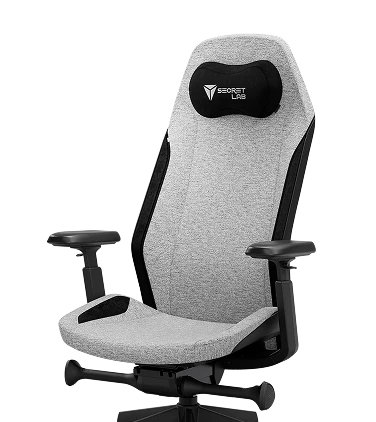
I’ve been using mine for over a month now, and, as resident office furniture expert here at TechRadar Pro, I think the company nailed it. It’s a world away from the magisterial Titan Evo, and I suspect Evo fans may not appreciate what the Atlas is doing here. But it’s one of the top office chairs I’ve used precisely because it’s such a terrible gaming chair.
The anti-gaming silhouette
I’m obsessed with gaming chairs that look right at home in an office. I’ve covered stealth gaming and office chairs for years. Those understated seats that don’t draw attention on a Zoom call with the boss, but are perfect for late-night play sessions (the Corsair TC100 Relaxed is a good budget example).
Advertisement
On that score, the Secretlab Atlas is a total success. Now, it’s not a gaming chair. But you can see it’s taken inspiration from the Titan Evo. Sit them side by side and it’s clear they share the same brand heritage, with those cleanly carved and subtle contours.
However, the design skips on two aggressive elements you’ll find on pretty much every gaming chair: the racing-style bucket seat bolsters and the shoulder wings. Both are designed to lock you into position that’s perfect for precision play on controller or M+K.
Sign up to the TechRadar Pro newsletter to get all the top news, opinion, features and guidance your business needs to succeed!
Advertisement
But an office worker needs that unrestricted extra space, allowing upper body movement. Fingers flying over the keyboard, constantly sweeping the mouse, and pivoting at the desk.
So, instead, it’s got a sleek look – Secretlab calls it “our lightest silhouette yet”, and I totally agree here. Because of that style, I find it works very well in the home office, even smaller ones. I carted it downstairs so my wife could use it in the dining room when she was working from home.
The Atlas blended in so well, feeling more like home furniture than any bulky leatherette bucket chair ever could. Weirdly, despite the higher backrest, it’s far less noticeable than her office-engineered Boulies OP180 was.
Professionally styled in Dune, Cookies & Cream, and Black³, the base model Secretlab Atlas features a SoftWeave Plus Fabric covering over cold-cure foam for a firm, ergonomic fit. It’s available in Regular and Large to accommodate your height and weight class.
Built for typing, not chilling
All the best office chairs my team and I have reviewed have one thing in common: adjustability.
Given Secretlab’s experience, it’s no surprise that the Atlas has plenty to help tailor the sit. That includes mechanisms for tweaking the seat depth, backrest, and armrests, as well as synchronous tilt.
Advertisement
What this means in practice is that you can lean back with your feet on the ground, and the backrest and seat move as one for continued support. Effectively, it’s designed to keep your hips open to relieve pressure on your lower back.
It’s a world away from the traditional gaming setup, where the backrest tilts and reclines independently. It’s absolutely perfect for laying back, playing games, watching movies. But this mechanism also sends you into a horizontal slouch – one of the main reasons why so many modern chairs come with built-in footrests.
However, it’s not as adjustable as many of the office chairs I’ve tested out. When our gaming editor Dash Wood spoke to Vincent Sin, the company’s head of product development and industrial design, he explained: “What we found is that more often than not, with task chairs that have a lot of adjustments, it’s very confusing and people often will get it wrong. And I would say that’s worse than having something that automatically adjusts for you.”
But this brings me to the one adjustable element I actually would change. The chair does feel low to the ground – a view echoed in our Secretlab Atlas review.
Advertisement
The Large model does offer slightly more height over the Regular version, but I still think extra height range would’ve stripped away the only real complaint I have here. As an average man of average height, it’s not a deal-breaker for me. But it’s definitely something I’ve noticed during my time with it compared to other office chairs.
(Image credit: Future)
The lumbar support gamble
Also missing is the adjustable or dynamic lumbar support I tend to see on more premium office and gaming chairs. The Titan Evo famously uses the 4-Way L-Adapt Lumbar Support System, giving you control over the lower back support.
Instead, the Atlas uses a simplified Re-Curve backrest. Again, Sin said this design choice was intentional. “People don’t know that having too much lumbar support is also a bad thing.” Instead, the company pressure-mapped sitters to figure out where back support is needed and where it isn’t.
Advertisement
Now, I’m not entirely convinced by that. I still think adjustable support is essential, especially for those who need lower back pain relief. I suspect economics and aesthetics are playing a bigger role here than anyone is prepared to admit.
For a chair costing over $500 / £400, I was a little concerned when I first parked myself into the Secretlab Atlas.
The results, though, surprised me. Maybe Secretlab are right: we are over-engineering modern office chairs.
Advertisement
Why firmness wins for the workday
So far, so gaming and office chair. But there’s one major change with the Secretlab Atlas that I think makes it an ideal task chair, but absolutely useless for gaming.
It’s firm.
I think a lot of people expect office chairs to feel like a well-worn armchair or a couch. Soft, cushiony, like sinking into a foamy cloud.
That squishiness feels good for an hour or two while working. And it’s perfect for gaming – you want to feel snug, even during the sweatiest of battles. But it’s not recommended for an 8-hour workday, 5 days a week where you’re upright, typing away, maintaining your posture.
Advertisement
Now, I’m not saying you need to sit on a concrete slab at your desk. And the Atlas definitely doesn’t feel that way. I appreciate support it has as I work, and actually look forward to sitting on it.
I’m not the only one convinced by it.
My pregnant wife is suffering chronic back pain during her pregnancy. She’s hijacked the Secretlab Atlas because her softer office chair just made the pain worse. The Atlas eased the pressure. Her verdict (politely sanitized for this family-friendly publication: “It’s ridiculously comfortable.”
The Atlas is basically designed for a very different sitting profile. You’ll immediately notice the difference coming from a Titan Evo or similar. So, it’s not the best gaming chair, but it was never meant to be.
Flock Safety’s aggressive expansion into the law enforcement market has been coupled with nearly constant negative coverage of its tech and its practices. Multiple cities have paused or cancelled their agreements with Flock following public outcry over the surveillance tech.
Flock’s willingness to allow law enforcement agencies to search a nationwide network of cameras has generated plenty of negative headlines of their own, including the fact that Texas cops were using Flock to track someone (possibly) seeking an abortion after she’d already left the state.
Flock’s statements in its defense are, well, super-defensive. It claims it can’t control what cops do with its tech. That’s somewhat true, but it’s also true that Flock has made zero effort to limit abusive access until it’s been forced to by its government customers or outside pressure.
Flock also claims its tech has contributed to investigations and reducing crime. This is probably true but it doesn’t mean all that much when pretty much any extensive surveillance network is going to generate some additional arrests. It’s the trade-off that’s the problem and Flock doesn’t seem to care at all about the millions of people subjected to its surveillance. Martial law would likely lower crime rates, but that’s not a an acceptable justification for martial law.
Advertisement
The problem with ALPR tech being ubiquitous is that it isn’t really making police work better or smarter. Instead, it just seems to be allowing cops to be wrong faster and at scale. And police officials who love this tech will always remind us that there’s a price to be paid to live in a safe society. What they never admit is that they keep changing the price tag with each new rollout of surveillance tech.
Flock’s contribution to the problem means it’s just going to keep making headlines. And while Flock may not be a direct contributor to what’s discussed here, these things wouldn’t have happened if it weren’t for Flock.
First, there’s this story, which involves automotive journalist Joel Felder and the Range Rover he was test driving. His loaner from Range Rover kept getting flagged by Flock as stolen. That Felder is alive to tell his story is more due to his race and location than the so-called police work that resulted in him being ambushed by Minneapolis cops in mall parking lot.
On an otherwise normal Sunday afternoon in late June, I’d decided to take the $155,000 Range Rover I was testing that week out to run some errands with my wife. Little did I know that choice would complete a technological chain linking surveillance cameras, AI, and law enforcement that led to me and my wife being surrounded by police, hands on their guns, in a Kohl’s parking lot in suburban Minnesota.
After dropping off our Amazon returns, we’d just gotten back in the Range Rover and reversed maybe two feet out of the spot when four cop cars came flying out of nowhere and boxed us in. The officers jumped out and started shouting. It’s a situation that can quickly and frequently turn bad, so as unprepared as I was, I followed their orders, got out with my hands up, and tried to figure out what the hell was happening.
Advertisement
It turns out cops in the area had been tracking the Range Rover for days, following alerts from Flock. But they kept losing the trail when Felder returned home. When he passed a Flock camera near his stop, Plymouth, MN police showed up to accost him.
The main problem was something either Flock or the PD could have taken a closer look at. The Range Rover loaner had New Jersey plates. And on NJ plates, two digits are printed smaller than the rest of them.
The New Jersey plates that were allegedly stolen from the LA dealer were 34 03 DTM, not 34 10 DTM. But when the police report was created and the plate was entered into Flock’s system, it was just recorded as 34 DTM. Just the five large characters, no little number in the middle. And Flock’s AI tech wasn’t registering that non-standard little number when it began picking up the Range Rover around town. It just saw 34 DTM in large type and started alerting the local police.
Which means this is also a nationwide problem, on top of being a specifically New Jersey problem. The automated plate readers are reading these plates wrong, meaning any plate starting with 34 and ending with DTM would automatically be flagged as stolen. Who knows how bad that’s going in New Jersey (we’ll wait for those headlines to roll in!), but it’s already a bit of problem in Minnesota, and not just for this particular The Drive contributor.
In fact, four other 34 ## DTM cars were being tracked around Minnesota that week, according to Officer Ganshyn. I was just the first one to get nabbed. The only way to stop it would be for the LAPD to correct their initial report and update Flock’s system, which Jaguar Land Rover was now racing to make happen following the phone call.
And just to let you know how the cop problem possibly outweighs the Flock problem, I’ll let these Plymouth (a suburb of Minneapolis) cops speak for themselves:
Advertisement
“You’re lucky we’re in Plymouth. If you were in Minneapolis, they definitely would’ve come at you with guns drawn.”
Cool cool cool.
No doubt this also kept the gun-play to a minimum, according to the Plymouth PD report:
“I observed the driver, who was a white male wearing shorts and a green shirt, as he was putting something in the back seat of the car. I could also see a white female getting into the front passenger seat…”
But Flock’s contribution to public danger isn’t limited to stolen plates. Its system also tracks vehicles of people who are suspected to have stolen something other than the vehicle they’re riding in. Here’s what happened to an unlucky Colorado resident who found herself on the wrong side of this surveillance tech:
Chrisanna Elser got a summons from Columbine Valley police accusing her of stealing a package. The evidence? A license-plate-reader camera that placed her truck near the scene. The problem? She wasn’t there. According to Denverite, Elser had to dig up her own timestamped truck video and a neighbor’s doorbell camera footage to prove it. Nobody verified the camera’s implication before the summons landed. The camera spoke, and the system listened — no further questions asked.
Elser was forced to prove her own innocence as a cop stood in her doorway. Fortunately, she had the evidence on her phone. Otherwise, who knows what would have happened? Certainly not the officer who did nothing more than convert the faulty data into a summons.
Advertisement
When Elser tried to get the officer to watch the time-stamped video from her truck, the officer told her he simply wasn’t interested in anything she had to show him that might prove her innocence:
On her doorstep, the officer issued a summons, without ever looking at the surveillance video Elser had.
“We can show you exactly where we were,” she told him.
“I already know where you were,” he replied.
It took Elser five weeks to get the charges dropped and it took escalating it to the Chief of Police to get it done. While the chief didn’t go so far as to apologize, he did at least let her know she did a “great job” proving her innocence, when that’s not how it’s supposed to work in the first place.
Advertisement
While I understand the presumption of innocence only really applies once criminal proceedings are underway, law enforcement’s reliance on unreliable tech is now forcing people to document their own movements and actions just as thoroughly as Flock tracks theirs, just in case the cops have it wrong. That’s fucked up. We shouldn’t be obligated to constantly generate a history of our movements just to get bogus criminal charges dropped, especially when we know that doing so just means providing the government with additional ways to track our movements.
When cops are boxing you in as you’re trying to leave the mall, they’re the ones who should be as absolutely sure as possible that their actions are justified. The imbalance of power between citizens and law enforcement demands better from law enforcement, but every new tech tool that cops embrace just makes it easier to make more mistakes faster. There’s nothing out there that even slightly suggests pervasive surveillance is reducing crime, but cops treat everything an algorithm spits out as gospel because it means they won’t have to think for themselves. This is unacceptable. And just because no one got arrested or killed doesn’t mean these errors are harmless.
Since the early days of smartphones, storage space continues to be a persistent problem. More specifically, running out of it. For Android users, that often translates to your Google account storageand with Google now counting Android device backups toward your account storage limits, it’s worth reviewing your backup settings to check for any redundancies. After all, no one wants to pay for more cloud storage space if they don’t actually need it.
Android device backups themselves typically only need a small amount of storage, but there’s an overlooked setting that might be wasting gigabytes of extra space in your cloud: backing up WhatsApp media through Google Photos. Turns out, this giant messaging app is probably already saving those very same files to the cloud. So by opting in for separate WhatsApp backups to your Google account storage, you’re actually backing them up twice.
It’s like this: WhatsApp automatically downloads any photos and videos you open and places them into a specific folder on your device. And if you chose to back up every device folder to Google Photos (which you probably did during initial setup way back when), then those downloaded files might also be getting uploaded to Google Photos. The result is the same images and videos being stored twice to your Google account. Messaging apps eat up storage as it is, but this issue doubles the trouble.
Advertisement
Change your Google settings instead of turning off WhatsApp backups
Melnikov Dmitriy/Shutterstock
If you send and receive a ton of photos and videos through WhatsApp, you could be wasting dozens of gigabytes of duplicated data over the course of a year. Backing up isn’t a bad idea, but backing up twice is just unnecessary. So, rather than turning off WhatsApp backups altogether, the smarter solution is to simply stop Google Photos from backing up WhatsApp folders. That way, you can keep allowing this Facebook-owned app to do its chat backups without creating duplicates in your Google account.
For most Android users, the easiest thing to do is to change your Google Photos settings to stop backing up the folders that contain WhatsApp images and videos. Open the Google Photos app, hit your profile picture in the top right corner, tap “Photos settings,” then hit “Backup.” From there, scroll down to “Back up device folders” and toggle off WhatsApp.
Advertisement
WhatsApp users can also adjust the specific app’s backup frequency to daily, weekly, monthly or never within WhatsApp’s chat backup settings. You can also reduce backup size by excluding videos, which are typically going to be the largest files included in backups. Past WhatsApp backups can also be removed separately through Google One’s WhatsApp backup management tools.
A lesson for aspiring vandals: Take out all the cameras, not just the ones that flout your ideals
Note to privacy-conscious vandals: If you’re going to destroy Flock license plate readers, make sure you also take out the other CCTV cameras in the area that could catch you in your crime. Otherwise, you’ll end up like one unlucky Californian.
Marcus Bee, 40, was arrested by the Monterey County Sheriff’s Office on Tuesday, accused of joining the ever-growing band of US citizens damaging the controversial cameras popping up across the country.
Advertisement
A police report filed this week stated that Bee, of Pismo Beach, was arrested on suspicion of attacking at least three Flock cameras in Lockwood and Bradley.
According to the deflock.org website, which maps Flock camera deployments, there are only three of the automated license plate readers (ALPRs) running in the two communities – one in Lockwood and two in Bradley, roughly 25 miles away.
Police allege Bee caused thousands of dollars’ worth of damage to “public safety infrastructure.”
Monterey County Sheriff’s Office added that Bee was caught after “his actions were captured by other surveillance cameras located nearby,” along with other investigative leads.
Advertisement
“This arrest sends a clear message that anyone who intentionally damages public safety equipment will be identified, arrested, and held accountable,” said Monterey County Sheriff Tina Nieto.
“These cameras have become an invaluable investigative resource that helps us solve crimes, recover stolen vehicles and ag equipment, locate missing persons, and protect our communities. Any attempts to disable these systems will not prevent us from doing our job.
“In this case, the suspect’s own actions were captured on surveillance cameras, leading directly to his arrest. We will continue to aggressively investigate these crimes and seek prosecution against anyone who targets public safety infrastructure.”
Bee was jailed with bail set at $30,000.
Advertisement
The case follows a similar one in Georgia last week, although local police were unable to identify the suspect(s) behind the two attacks, which involved setting two ALPRs on fire.
The two attacks were timed fairly close together, although the phenomenon of inflicting criminal damage onto Flock cameras is something of a long-running trend.
Several US police forces have been tasked with arresting alleged Flock vandals, including Jeffrey Scott Sovern, 41, who authorities believe was behind a spate of attacks on ALPR cameras in North Suffolk, Virginia, between April and October 2025.
He said, at a hearing in June, that he believed the technology was unconstitutional.
Advertisement
Flock cameras: A problem or simply misunderstood?
Monterey County Sheriff’s Office said Flock’s cameras “are an important investigative tool” used to help solve various types of crimes, including missing persons cases, car thefts, and violent crimes such as shootings and homicides where suspect vehicles are involved.
Contrary to the opinions held by many, it went on to say that the cameras “are used exclusively to support legitimate criminal investigations,” and refuted the notion that they are used to support the US government’s anti-immigration efforts.
Likewise, Flock has repeatedly denied offering contracts to agencies such as Immigration and Customs Enforcement (ICE), although reports suggest police were instead carrying out searches on ICE’s behalf. Customs and Border Protection (CBP) has also allegedly used Flock data in its own immigration investigations.
The Institute of Justice is aware of at least 26 cases of this behavior, it reported earlier this month, with the majority taking place since 2024.
Additionally, the American Civil Liberties Union (ACLU) takes issue with the scale of data gathering by ALPRs.
It claims that less than 1 percent of the cars scanned are connected to crime, yet they still have details added to a database, such as vehicle manufacturer, model, color, license plate number, bumper stickers, and scratches.
Flock CEO Garrett Langley claimed this week in an interview with The Drive that the company’s cameras were used to solve around 1 million crimes across the US last year.
Advertisement
Responding to claims such as Sovern’s – that the cameras are unconstitutional, specifically that they violate Americans’ Fourth Amendment rights – Langley said there are no legal issues, and he doesn’t foresee any arising in the future.
Flock’s spokespeople have repeatedly condemned the cases of camera vandalism, highlighting the risk of losing evidence that could be crucial to solving ongoing criminal cases. ®






























































You must be logged in to post a comment Login