Connect with us

Business

(REF) starts trading on NYSE

Published

on

(REF) starts trading on NYSE

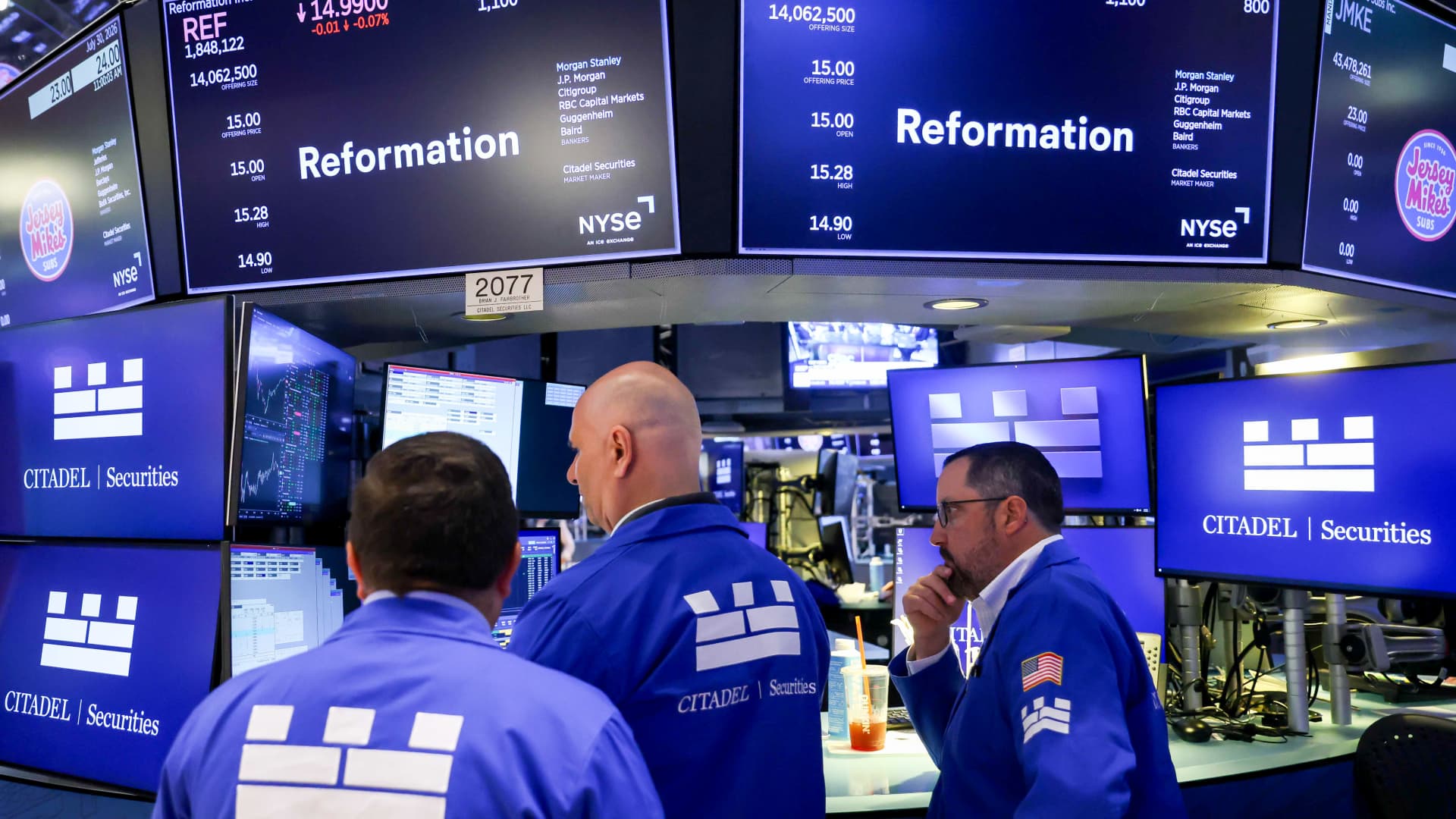
Reformation Inc. signage as traders work during the company’s initial public offering (IPO) on the floor of the New York Stock Exchange (NYSE) in New York, US, on Thursday, July 30, 2026.

Michael Nagle | Bloomberg | Getty Images

Women’s clothing retailer Reformation began trading on the New York Stock Exchange on Thursday, with the stock essentially unchanged after pricing its IPO at $15.

Advertisement

The company, which is trading under the ticker symbol “REF,” is offering 14,062,500 shares, putting its IPO raise at $210.9 million.

“Reformation is ready, and that is really the driving reason we’ve spent a lot of time working to build a business that redefines retail, really innovates on what the role of a brand is in the fashion space, and we’ve done a great job at that,” CEO Hali Borenstein told CNBC on Thursday. “Today, we have a foundation that is ready to scale.”

It joins just a handful of consumer and retail companies that have gone public this year amid a slump in IPOs since the 2021 boom. Reformation went public the same day as sandwich chain Jersey Mike’s, which also listed on the NYSE.

According to its S-1 fact sheet, Reformation has seen 20 consecutive quarters of double-digit net revenue growth through the first quarter of 2026. Its net revenue for the full year 2025 came in at $507.1 million, and net income was $12.6 million, including the impact of President Donald Trump‘s tariffs.

Advertisement

As of the first quarter of 2026, the company owns 70 stores across the U.S., UK, Canada and France.

“We believe we will continue to benefit from operating within the highly fragmented fashion industry, and that we are well positioned to capitalize on growing global demand for sustainable fashion,” the company wrote in its S-1 filing.

Borenstein said Reformation’s focus in its next phase of growth is to increase its distribution with more stores, accelerate its e-commerce business, invest in category diversification and expand overseas.

She added that the retailer is seeing “really strong double-digit growth” across the U.S., with 70% of its revenue coming from outside of New York and California.

Advertisement

Reformation also said it saw more than 1 million active customers across its direct-to-consumer channel in 2025. The majority of its customers, 70%, are aged between 25 and 50 years old.

Borenstein told CNBC’s “Morning Call” that the company’s customer base is diverse, with 20% of new customers last year under the age of 25 and 20% over the age of 50.

She added that the company’s average consumer makes over $100,000 in a year, making it more insulated from macroeconomic pressures hitting other retailers.

Reformation CEO says retailer is 'ready' for the public markets

Despite tariff and trade uncertainty, Borenstein told CNBC the company has a “good track record” of navigating the macro backdrop, with 34% of its units last year coming from North America.

“We are really focused on two things: our brand and our product. We think those are the winning recipes for consumers, so Reformation has a brand that cuts through,” Borenstein said.

Advertisement

The IPO is backed by J.P. Morgan, Morgan Stanley, Citigroup and RBC Capital Markets.

As the company embarks on its public journey, Borenstein said she’ll define success as the way that Reformation makes its customers feel.

“Today is the first day,” she said. “It’s a long journey ahead, and at Reformation, we have very big goals. We’re ambitious, and so where we are really focused is on building a once-in-a-generation type brand.”

Choose CNBC as your preferred source on Google and never miss a moment from the most trusted name in business news.
Advertisement
Continue Reading
Click to comment

You must be logged in to post a comment Login

Leave a Reply

Business

Diagnostics firm EKF upbeat on full year trading while cash held in Russia rises

Published

on

Business Live

The Penarth headquartered firm has released a trading statement to the City

Penarth headquartered global point of care diagnostics firm EKF Diagnostics said it is on track for a stronger end to the year after posting first half numbers in line with management expectations, while confirming that cash levels held in Russia have risen.

In a trading statement the Alternative Investment Market listed firm that in the first half of this year revenues remained broadly flat at £25.m (H1 2025: £25.2m), reflecting the higher weighting of sales expected in the second half of the year. Gross margin improved to 53% (H1 2025: 50%) and adjusted Ebitda showed continued growth.

The group’s cash balance as at 30 June 2026 was £16 (31 December 2025: £15.8m), which included £2.4m held in Russia (31 December 2025: £2.1m).

Advertisement

It operates in Russia via its German-based subsidiary, in which it has a 60% stake, selling non sanctioned medical devices. However, since Russia’s invasion of Ukraine the Putin administration has put tight limits on the amount of cash from trading that foreign firms are able to move out of the country.

It is a counter measure to western sanctions. For the last two years EKF’s subsidiary has been able to release around £500,000 per annum in dividend payments. The rise in cash from £2.1m to £2.5m has in part been driven by improved exchange rates.

EKF has no bank borrowings, and the closing cash balance reflects the allocation of £1.4m for the ongoing share buyback programme, of which £900,000 has been deployed during the period, together with the continued investment for growth that is part of the five-year strategic development plan for the business.

It said: “The progress of the five-year strategy continues in line with management expectations. Diabetes and hematology delivered steady performances in the first half, with the majority of high-volume tenders already won and scheduled to be delivered in the historically stronger second half year.”

Advertisement

It added that its remains on track to deliver growth at the revenue and adjusted Ebitda levels for full year 2026 in line with current market expectations.

Following the trading statement brokers Singer, Stifel and Panmure Liberum all maintained their buy share positions. Panmure Liberum has a share price target of 34p with the other two slightly higher at 35p.

In its note Panmure Liberum said: “The shares are still cheap, and remain range bound with he buy-back providing a floor to the price.

“There is little in the statement to change this prior to the interims. However, the longer-term outlook remains more encouraging and we expect the growth rate to improve, margins to continue to expand and strong cash conversion. We retain our buy (share recommendation).

Advertisement

Shares in EKF fell slightly after the trading statement to around 25p.

Continue Reading

Business

Social care: Four ways to reform the system

Published

on

A care worker helps a woman down a flight of stairs

An alternative approach is to ensure that everyone who is eligible, based on their needs, should get state-funded personal care that is free at the point of use.

This would be provided free regardless of an individual’s means and whether it was received by an elderly person in their own house or a residential care home.

Scotland has implemented such a system.

However, it’s important to note that personal care takes in things like helping frail elderly people wash and dress and go to the toilet.

Advertisement

But it does not include accommodation, food and everyday living costs which are subject to means testing.

The Health Foundation think tank estimates that implementing a Scottish-style system in England would cost £7.5bn a year by 2036.

Like Scotland, Japan and Germany have systems which base entitlement to personal social care mainly on people’s care needs rather than their ability to pay.

Japan and Germany though have a mandatory long-term care insurance system which is funded through contributions from workers and employers.

Advertisement

Both countries also do not usually cover the full cost of personal care so individuals are responsible for some of the expenses.

Continue Reading

Business

Data centres could pay hundreds of millions in deposits for power demands

Published

on

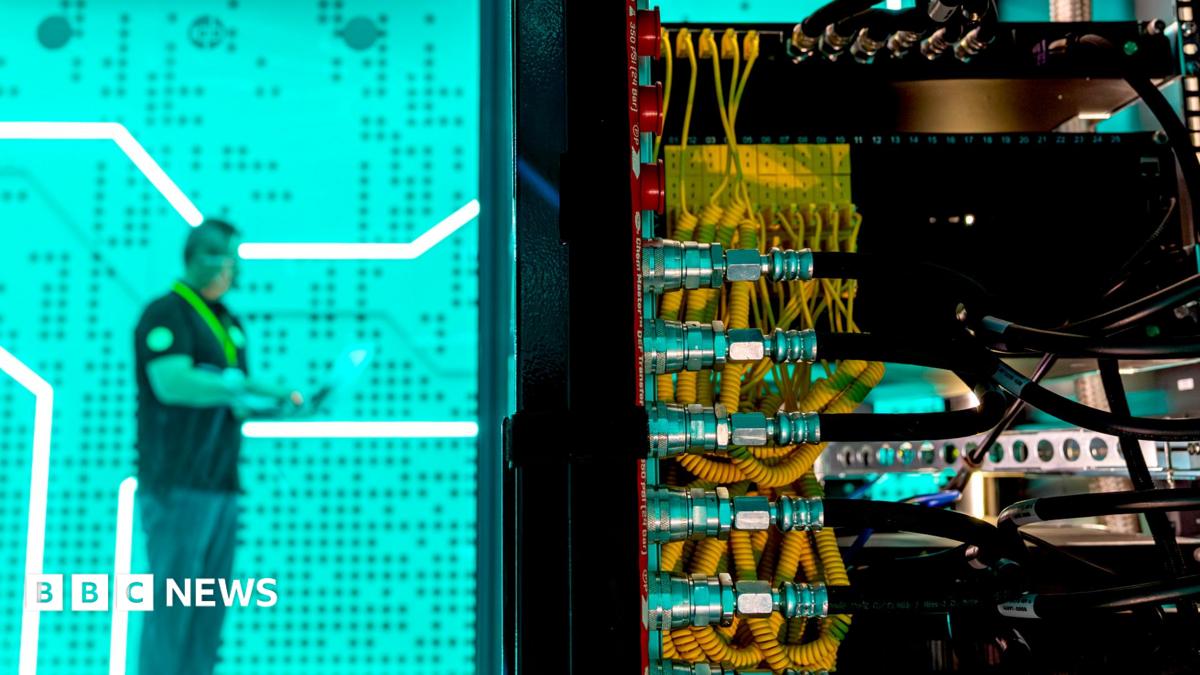
A man standing against a bright green background in a data centre - in the foreground is the back of a large computer with lots of yellow and black wires.

Ofgem has proposed new measures which could see developers of data centres made to pay hundreds of millions of pounds up front.

The British energy regulator said a refundable fee should be charged for projects that want to connect to the network, amid mounting demand for connections to the electricity grid.

It is proposing developers pay a deposit between £237,500 to £712,500 per megawatt – meaning data centres seeking 1 gigawatt (GW) of power would have to pay hundreds of millions up front, paid back if the project was completed.

The proposal follows growing opposition in parts of the country to plans for new data centres, which are needed to power the artificial intelligence boom.

Advertisement

Data centres are large buildings which house computer servers used to store and process data and run the digital services which power the internet.

Ofgem has started a consultation on its proposals, which will run until 16 September.

It said the amount of electricity capacity being requested by projects seeking to connect to the grid had risen from 41 GW to 125 GW in the past year, reflecting a sharp increase in demand.

This is significantly more than double 2025’s peak electricity demand in Britain of around 46 GW.

Advertisement

The regulator said the projects would have to hit key milestones to keep their place in the grid connection queue, which has seen a surge in demand.

An increasing number of centres have been built around the world in recent years to provide the computing power needed to train and run AI systems.

But they are controversial, especially for people who live near them.

Residents have raised concerns about noise, electricity demand and the large amounts of water sometimes used to cool the high-performance chips that generate vast amounts of heat.

Advertisement
Continue Reading

Business

Bausch + Lomb Upgrades Full-Year Outlook on Strong Quarter

Published

on

Bausch + Lomb Upgrades Full-Year Outlook on Strong Quarter

Bausch + Lomb lifted its full-year targets after narrowing its second-quarter loss as its core segments drove revenue higher.

The dual Toronto and New York-listed eye health company on Wednesday raised its full-year guidance across the board, bumping its revenue target up by $20 million to a new range of $5.44 billion to $5.54 billion. The increase would represent 5.8% to 7.7% constant currency growth.

Copyright ©2026 Dow Jones & Company, Inc. All Rights Reserved. 87990cbe856818d5eddac44c7b1cdeb8

Continue Reading

Business

Nvidia Stock: It’s Time to Stop Worrying About Circular Financing

Published

on

Nvidia Stock: It’s Time to Stop Worrying About Circular Financing

The Bank of Nvidia. When it comes to circular financing, Wall Street may have the wrong idea. Nvidia’s need to invest across the AI landscape doesn’t stem from a lack of financing options—it comes from having too much cash. Nvidia has generated $191 billion in cash flow over the last two years, with another $49 billion coming this quarter alone, according to LSEG estimates.

Continue Reading

Business

E-Trade Down Today? Users Report Login and Access Problems as Outage Complaints Spike During Volatile Day

Published

on

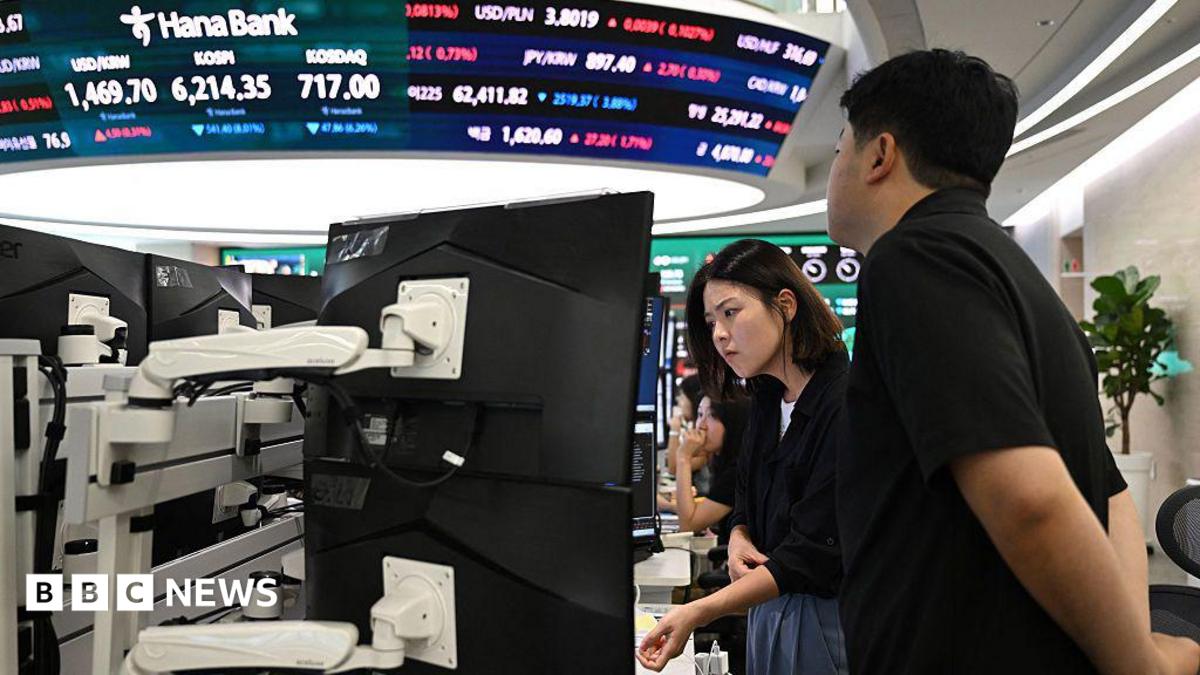
South Korea is home to the world's largest memory chip maker Samsung, and largest memory chip supplier SK Hynix

Users of the online brokerage platform E-Trade reported widespread login and account access problems Thursday morning, with outage-tracking service Downdetector logging a sharp spike in complaints beginning around 10:33 a.m. Eastern time, in the middle of an active and volatile trading session on Wall Street.

Downdetector’s official social media account posted an alert flagging the rise in user-submitted reports shortly after the issues began, using the hashtag “#ETradeDown” to solicit further reports from affected users about how the outage was impacting them.

Frustrated customers took to social media in real time to describe their experiences trying to access the platform. One user wrote directly to E-Trade’s official account, “Hey E*Trade, your systems are down right now at 7/30/2026 at 10:34am. When is it coming back up?” Another user, describing themselves as a customer of nearly two decades, expressed frustration with the outage in a post that read, in part, “E-Trade is down… get your act together or I will leave the platform.” A separate user reported being unable to log in despite what they described as one of their best trading days, writing that the platform displayed a message indicating the website was too busy to process their request.

As of Thursday morning, E-Trade had not issued a public statement confirming a company-wide outage or explaining the specific cause of the access problems some users were experiencing. Outage-tracking services showed mixed readings on the scope of the disruption. One monitoring service reported E-Trade as operational with no significant outage detected, showing only a small number of user reports over the prior 24-hour period, while a separate outage-tracking site reported that E-Trade had been experiencing issues since approximately 10:20 a.m. Eastern time, based on a spike in user complaints that exceeded the platform’s typical baseline volume for that time of day.

Advertisement

The reported issues Thursday came during an active session for U.S. financial markets more broadly, with major indexes moving significantly following a wave of high-profile corporate earnings reports, including results from Microsoft and Meta Platforms released the previous afternoon. Periods of heightened market volatility and elevated trading volume have historically coincided with increased strain on online brokerage platforms’ technical infrastructure, as a larger-than-usual number of users attempt to log in, check account balances or execute trades simultaneously.

Online brokerage outages during periods of market volatility are not without recent precedent. In August 2024, several major online brokerage firms, including Charles Schwab, Fidelity and Vanguard, experienced widespread access problems for thousands of users during one of the largest stock market selloffs of that year, with user complaints on Downdetector peaking around and shortly before 10 a.m. Eastern time on that occasion as well. Charles Schwab acknowledged the issue at the time in a statement posted to social media, saying that a technical issue was preventing some clients from logging into its platforms.

E-Trade, founded as one of the earliest online discount brokerage firms in the United States, has grown over the decades into one of the most widely used platforms for individual investors and traders to buy and sell stocks, exchange-traded funds, options, mutual funds and other financial securities. The company was acquired by Morgan Stanley in 2020, integrating its retail brokerage operations into the larger financial services firm’s broader wealth management business.

Downdetector, the platform used to track and aggregate the Thursday morning complaints, monitors user-submitted reports across thousands of websites and applications rather than directly accessing the internal systems of the companies it tracks. Because the service relies on self-reported complaints rather than direct server monitoring, spikes in reported issues can sometimes reflect a genuine platform-wide outage, while other spikes may result from more localized problems affecting a subset of users, specific devices, internet service providers or regional network issues rather than a broader systemic failure affecting the entire platform.

Advertisement

For users experiencing difficulty accessing E-Trade during the reported disruption, common troubleshooting steps recommended for online brokerage access issues include refreshing the browser or app, clearing cached data, verifying that the device’s internet connection is functioning properly through other online services, and checking the company’s official social media channels or status pages for updates. If the underlying cause proves to be a service-side technical issue rather than a problem specific to an individual user’s device or connection, however, these troubleshooting steps are unlikely to resolve the access problems until E-Trade restores normal functionality on its end.

As of the most recent available information Thursday, E-Trade had not provided a public timeline for resolving the reported access issues, nor had the company responded publicly to the elevated volume of complaints registered through Downdetector and other outage-tracking platforms throughout the morning. Given the platform’s role in facilitating real-time trading, any extended access disruption during an active market session carries particular significance for affected users attempting to manage positions or execute trades in response to fast-moving market conditions.

Users continuing to experience problems accessing their E-Trade accounts were encouraged to monitor the company’s official channels directly for updates, rather than relying solely on third-party outage trackers, which can offer a useful gauge of the scale of user-reported complaints in near real time but cannot independently confirm the underlying cause or expected resolution timeline for a suspected service disruption.

Advertisement
Continue Reading

Business

Hexcel Corporation (HXL) Q2 2026 Earnings Call Transcript

Published

on

OneWater Marine Inc. (ONEW) Q1 2026 Earnings Call Transcript