Connect with us

NewsBeat

I’ve visited riverside towns across Wales and one stands out from the crowd

Published

on

Wales Online

I’ve clocked up a fair few riverside towns across Wales, and people usually ask me which one’s my favourite

Advertisement

Regular readers will know I’m not exactly subtle about my fondness for Welsh towns. Give me a selection of proper pubs, independent shops, and quirky cafes selling local produce and decent coffee, and I’m as happy as a clam in cheap chardonnay.

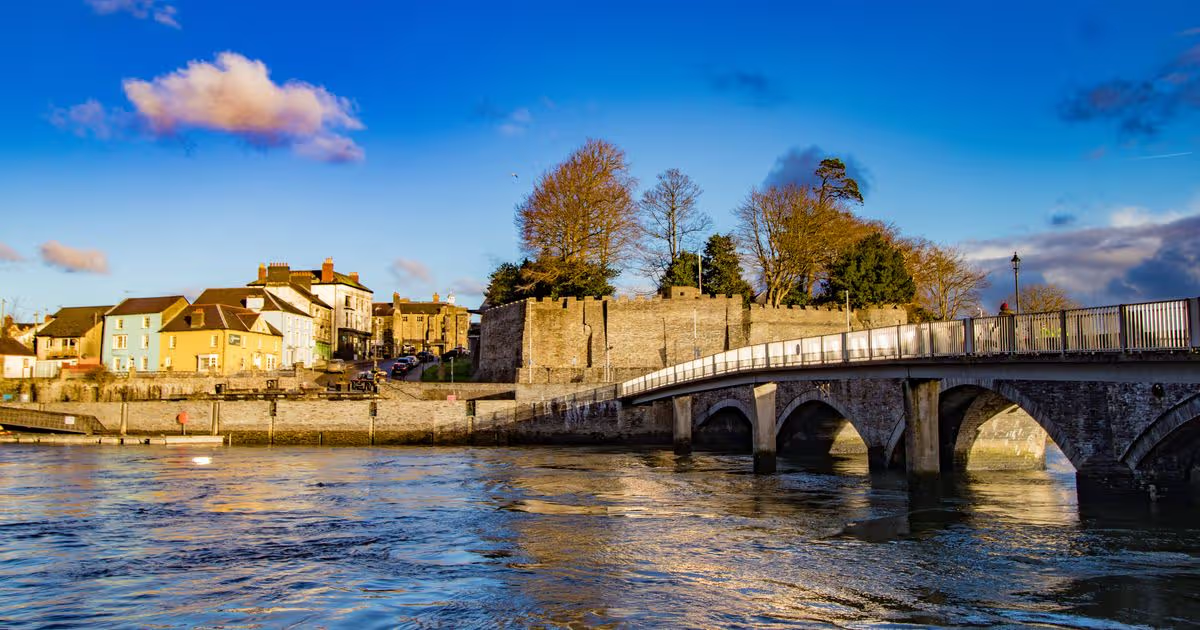
I’ve clocked up a fair few riverside towns across Wales, and people usually ask me which one’s my favourite. It’s a difficult question when our lush country is basically wall-to-wall charm, but after much serious thought, mostly conducted in pubs, I have an answer. Cardigan (Welsh Aberteifi).

Positioned on the tidal reach of the River Teifi at the point where Ceredigion meets Pembrokeshire, Cardigan is one of my favourite riverside towns in Wales, and I keep returning for weekend breaks near the coast.

It’s home to one of my favourite hotels right now, which is really conveniently located in the centre of town. Perched on the riverside in Cardigan, The Albion Aberteifi blends seafaring charm with maritime design and is a great place for an adults-only break.

Advertisement

Often outshone by tourist hotspots like Tenby, Cardigan is sometimes overlooked by tourists, but it really shouldn’t be. It’s the gateway to the Teifi Valley and both the Ceredigion and Pembrokeshire coastal paths, which makes it a great base for exploring this glorious coastal sweep.

Cardigan is the second-largest town in Ceredigion. It packs a punch culture-wise, having transcended from a significant 18th-century Atlantic seaport to a swish, artsy enclave with theatres and galleries. It’s fast becoming one of my favourite spots for a weekend break for excellent eats, coastal walks and a spot of culture.

As I’m now in my history era, it’s also grabbed my attention with its rich heritage and handsome stone castle. Found on the bend of the River Teifi, Cardigan has a long and varied history.

Advertisement

Henry VIII granted Cardigan its charter in 1543; by the 18th century, it was the most important seaport in southern Wales. It had a thriving herring and shipbuilding industry, and its merchant fleet carried fish, slate, bricks, tannery bark, corn, and ale.

Its heritage is also found in the town’s varied architecture, where you can still see Georgian buildings, including the restored Castle House and original 17th-century arches.

Today, it has a thriving small-town feel with boutiques, an independent bakery, an acclaimed hotel, and waymarked coastal paths that guide you along the glorious shoreline. I have visited several times and fallen a little more in love with the town each time.

Advertisement

Despite the buzzing town’s many offerings, it’s not quite as well known as tourist hotspots like Tenby or the Pembrokeshire Coast National Park.

Perhaps that’s because the Cardigan Bay area remains one of Wales’s most underrated stretches of coastline, sandwiched between the headline-grabbing beauty of Pembrokeshire and the Llŷn Peninsula. In 2023, Time Out magazine even dubbed its main town, Cardigan, the “most underrated” spot in west Wales.

Here, you can experience Wales as its most authentic self, zipping between secluded bays to spot dolphins, trekking the coastal path and feasting on piping hot fish and chips in small fishing villages.

Advertisement

The relative remoteness of Ceredigion and the proud, resilient character of its communities have long made this coastline a stronghold of Welsh language and culture.

Cardigan is the main hub here and is ideal for exploring the Ceredigion coast. As the birthplace of the Eisteddfod, Wales’s most important cultural festival, the town has long been a hub for storytelling, music, and art. Wander its streets, and you’ll find charming cafes, pubs, and a thriving collection of independent shops and businesses.

At the heart of the town sits the beautifully restored Cardigan Castle, the first stone castle built by a Welshman and the birthplace of the first Eisteddfod in 1176.

This ancient Norman fortress, originally rebuilt in 1244, underwent a £12 million transformation in 2015, reviving its role as the town’s crowning centrepiece.

Advertisement

With a history spanning more than 900 years, the Castle has weathered many brutal power struggles between Wales and England. Today, it’s a vibrant heritage site featuring a museum, restaurant, open-air concert space, and Grade II-listed pleasure gardens.

According to Discover Ceredigion, the Castle also has a cultural connection. To celebrate the Castle’s completion, Lord Rhys hosted the first recorded Eisteddfod, a festival of music and poetry. This competitive arts festival is a uniquely Welsh tradition that thrives locally and follows Welsh people wherever they migrate.

After stomping the castle grounds, I always head for my favourite cafe spot – Crwst. This swish Cardigan cafe and deli has garnered a cult following for its banging brunch and bakery items and has also caught the eye of food writers.

Advertisement

Founded by husband and wife Osian and Catrin Jones, it is a swish 80-seater cardigan cafe and deli that attracts customers from miles around.

Five years ago, a married couple decided to pack in their jobs and make a living from what they loved most: baking and drinking coffee. Crwst is the happy, bricks-and-mortar result of this foodie journey. For the latest restaurant news and reviews, sign up to our food and drink newsletter here

Since their launch in 2018, the dynamic duo have grown the business and the foodie brand, taking on a second venue at Poppit Sands at the start of the Pembrokeshire coast path, where they serve Crwst’s most popular bakes, ice creams and coffees.

Advertisement

The Cardigan cafe is nearly always busy after it was named in the Good Food Guide. People arrive in droves for its delicious dishes and fresh-baked goods, including sourdough loaves, brioche doughnuts, and cinnamon swirls.

The Cardigan Cafe also offers a delicious brunch menu, ranging from harissa halloumi burgers to pancake stacks and Turkish eggs, and has earned glowing reviews from food writers.

Guardian writer Genevieve Fox writes: “Brunch is the ticket at this bright, trendy Cardigan craft bakery. The Full Welsh Brekkie includes Crwst’s signature beans and a cockle and laverbread gratin, the halloumi is made locally, and the blow-out Sausage & Egg McDoughnut is filled with melted cheese.”

My personal favourite, though, is the rum and Banana French Toast, loaded with brule banana streaky bacon and topped with creamy Barti Rum Caramel ice cream. It’s sweet and salty goodness with a lovely rum kick, which is exactly what you want at 10 a.m.

Outside of baked goods, there’s plenty to eat in and around the town. A great spot for pizza is the unique riverside venue Grain.

Formerly Pizzatipi, this rustic restaurant has a large tipi with a standout feature in the middle that I loved instantly – a roaring fire.

Here you can expect made-to-order stone-baked pizzas with bold, fresh flavours, a rotating list of craft beers from Bluestone Brewing Company, and a buzzing outdoor space and huge fire to keep you warm on cold winter nights.

Advertisement

There’s also Yr Hen Printworks, Templebar Cafe, and Farmshop in Nevern if you want to continue your culinary journey in Cardigan.

Another highlight is the shopping offering. While it’s not a major scene, Cardigan has a small selection of shops and boutiques selling crafts, surfwear, and books. Most shops and businesses are located along or just off High Street and further up on Pendre, with several shops at Black Lion Mews off the main street.

Cardigan’s indoor market is the retail showstopper, housed in the historic Guildhall building. The two-level market hall was originally the town’s meat and dairy marketplace. Today, it is a lively shopping area for locals and visitors, with over 50 stalls run by independent local traders selling an impressive variety of goods and gifts.

Advertisement

For a small town, Cardigan also has a fizzing arts scene with two theatres and music held at several venues across town, including the Castle grounds. Theatr Mwldan Arts Centre is an impressive cinema complex in the centre of Cardigan, with three fully digital screens, and is Wales’ only truly Independent multiplex.

There’s a gallery and cafe here, and it’s also the base of Gwyl Fawr, the town’s Eisteddfod, which has several concerts and musical, literary, and dance competitions.

Along with Mwldan, St Mary’s, a Grade II-listed 12th-century church, is the main base for the November Other Voices festival concerts featuring contemporary, internationally known Welsh musicians. Several smaller venues, from cellar bars to art galleries and bakeries, create a great atmosphere along the festival’s music trail around town.

Advertisement

Nearby Small World is an environmental theatre company that creates giant puppets, public events, and art commissions. It is a wildly creative, near-zero-carbon space that hosts family-friendly events, including children’s theatre shows featuring live music and puppetry.

For a show with a wow factor, Cardigan Castle hosts a range of performances. The Castle’s beautiful surroundings provide the perfect setting for choirs, bands, opera performances and concerts.

Outside the town, there’s plenty to explore, as Cardigan Bay stretches over 129 miles, from Bardsey Island off the Llŷn Peninsula in the north to the wild headland of Strumble Head in the south. It’s home to the largest population of dolphins in Europe, and its rich waters are a haven for wildlife, including seals and seabirds.

Advertisement

For nature lovers, this is the best place in Europe to spot dolphins, especially if you’re skimming over the waves on a fast-paced RIB ride through the bay’s choppy waters.

When the weather is decent, book a budget-friendly Bay Explorer boat trip with local pros, ‘A Bay to Remember‘.

Departing from nearby St Dogmaels, this hour-long trip wizzes you around the shore on high-speed RHIBs, where your knowledgeable skipper will keep their eyes peeled for wildlife. This was one of my favourite wildlife tours, and I got loads of lush snaps of seals and seabirds.

Bouncing over the waves, you’ll likely spot herring gulls and razorbills swooping through the air and landing on rocky outcrops. Your vessel will also speed past Mwnt, a sandy bay that’s one of the best places in Ceredigion to spot dolphins, so keep a good lookout for those distinctive dorsal fins slicing through the water.

These zippy boat trips also visit secluded, pebbled bays where Atlantic grey seals lounge lazily on the rocks. These resident seals are easy to recognise thanks to their distinctive heads. Their scientific name even translates to “sea pig with a hooked nose.” Adorbs or what?

For hiking, the Ceredigion Coast Path is one of the most rewarding sections of the 870-mile Wales Coast Path. Stretching for 60 glorious miles between Ynyslas and Cardigan, it offers some of the most varied terrain and scenery on the entire route, ranging from soft dunes and sandy coves to craggy cliffs and windswept headlands.

This waymarked path can be walked in seven manageable sections, each ending in a village or town with accommodation and transport options.

Advertisement

You can also tackle the full route over a week or choose shorter sections, such as New Quay to Aberaeron or the 11.7-mile stretch from Cardigan to Aberporth.

Highlights along the way include the dramatic headland at Mwnt, the birdlife of Birds Rock, the tidal island of Ynys Lochtyn, and the expansive Ynyslas dunes.

Wildlife sightings are common; watch for bottlenose dolphins, seals, and even porpoises along the pebble-strewn cliffs and coves.

Advertisement

The trail’s southern end begins in Cardigan, where the Ceredigion and Pembrokeshire Coast Paths meet. Once the largest port on Wales’s west coast, this historic town gave its name to Cardigan Bay.

A bronze otter statue marks the official start of the route, standing beside a quayside wall inscribed with poetry by local writer Ceri Wyn Jones.

As you leave town, the path follows the north bank of the River Teifi, passing farmland and the likely site of the original wooden Cardigan Castle, hastily built to control the river and access to the sea.

Advertisement

The route continues past the Cardigan Golf Club and the Victorian-era Cliff Hotel, once part of a grand vision to turn this coastline into a rival to Brighton.

From there, it’s a clifftop walk toward Aberporth, with panoramic sea views and a coastline dotted with caves, sea stacks and rock formations with evocative local names like Hatling Bigni, Pen Peles and Pencestyll. These rocky markers were once essential reference points for mariners navigating this wild stretch of coast.

Poppit Sands is my go-to beach in this area, even in winter, as the lovely Crwst bakery is open for bakes and brews.

This wide, dune-backed beach at the mouth of the River Teifi has all the hallmarks of a brilliant Welsh beach, expansive golden sands, big skies, sweeping estuary views and even dolphin sightings if you’re lucky!

Advertisement

Making a weekend of it? The town and surrounding area offer a range of hotels, B&Bs, cottages, and campsites. You can check prices and book on Airbnb and booking.com.

I would recommend booking at one of my favourite hotels in the area for a stylish stay with a river view.

Perched on the riverside in Cardigan, the adults-only Albion Aberteifi hotel blends seafaring charm with maritime design, featuring original sketches and calculations by 1800s shipwrights.

Advertisement

Just four months after opening, The Times and The Sunday Times named it the Best Place to Stay in Wales 2023, and it’s easy to see why.

The Times journalist said of the property: “Expect more of a grown-up vibe here (no children are allowed) with a moody bar serving the Albion Collins, a heavenly blend of mead and local gin.”

Each of the 12 en suite rooms feels like a captain’s cabin with reclaimed wood-panelled walls, 150-year-old oak floors, Welsh wool blankets, custom furniture, and river views from every window.

Advertisement

The hotel wears the town’s maritime past with plenty of character and design features. Contemporary comforts sit alongside the quirks of the original buildings, giving a historic feel while providing plenty of modern amenities.

Old stone and timber are proudly left on show, giving the place a sense of history you can actually feel. Head up to the third floor, and the walls tell their own story – lime-washed surfaces covered with mid-19th-century pencil sketches of tall ships alongside careful notes on rope lengths and sail sizes.

Breakfast is served in the relaxed resident lounge, where you’ll also find crafted cocktails, wines, and local beers by night and coffee and cake by day.

Book your stay here.

Advertisement

Source link

Continue Reading
Click to comment

Leave a Reply

Your email address will not be published. Required fields are marked *

NewsBeat

UK’s chief prosecutor warns Royals like Andrew are not above the law

Published

on

UK’s chief prosecutor warns Royals like Andrew are not above the law

The UK’s top prosecutor has warned “nobody is above the law” as Andrew Mountbatten-Windsor faces a police probe over alleged leaks to Jeffrey Epstein.

Stephen Parkinson, the director of public prosecutions, said “no, of course not” when asked whether he thought the royals were above the law. He added that he has “total confidence” that the police will be independent.

It comes as Thames Valley Police examine claims that Mr Mountbatten-Windsor shared confidential reports while in his role as the UK’s trade envoy with the paedophile financier.

Speaking to The Sunday Times, he said: “Nobody is above the law… It’s my job to enforce the law, and I do so without fear or favour, and that is unaffected by the status of the individual concerned.”

Advertisement

The warning from Mr Parkinson comes as evidence of the former prince’s alleged involvement with Epstein has mounted, with more revelations published in the latest tranche of Epstein files.

According to emails released by the US Department of Justice, Mr Mountbatten-Windsor appeared to have forwarded official reports on trips to Singapore, Hong Kong, and Vietnam in 2010 and 2011 to Epstein, when he was a government trade envoy. Trade envoys have a duty of confidentiality.

Thames Valley Police’s prosecution will look into whether the sharing of this information constitutes misconduct in public office.

Peter Mandelson, the disgraced former UK ambassador to the US, also faces a police probe over allegations he sent market-sensitive information to Epstein while he was business secretary during the financial crisis.

Advertisement

The Metropolitan Police have searched two of Lord Mandelson’s properties as part of their investigation.

Andrew Mountbatten-Windsor shared confidential reports while in his role as the UK’s trade envoy with the paedophile financier, Jeffrey Epstein

Andrew Mountbatten-Windsor shared confidential reports while in his role as the UK’s trade envoy with the paedophile financier, Jeffrey Epstein (Copyright 2025 The Associated Press. All rights reserved)

Mr Parkinson told The Sunday Times that misconduct in public office was a relatively popular offence with which to charge a public officer.

He said: “From my perspective, I don’t find it a difficult offence to prosecute because the core of it is a gross breach of trust by someone performing the function of a public officer.”

Advertisement

If Mr Mountbatten-Windsor were to be charged after a new police investigation, he would become the first royal in modern times to face trial over a serious offence.

Last week, Prince William and Princess Kate spoke out publicly for the first time regarding the ongoing revelations, saying they are “deeply concerned” by the scandal, and their thoughts are with the victims.

Source link

Advertisement
Continue Reading

NewsBeat

It says everything about Welsh rugby that humiliating France defeat was an improvement

Published

on

It says everything about Welsh rugby that humiliating France defeat was an improvement

And considering the Antoine Dupont-inspired visitors – of which his half-back, Matthieu Jalibert, maybe enjoying his best performance in the blue shirt – were 19-0 ahead after only 15 minutes, it was something of an achievement for Wales to limit the damage of the ensuing 65 minutes to 35-14. 

Indeed, the scoreline might not even have reflected the improvement in the Welsh from the insipid dross they delivered in the 48-7 annihilation against England eight days before. 

Their defence was better, their set-piece was in a different class and at last, after two games of not even scoring a point in the first half of their last two Tests, they gave the Welsh public something to cheer on before they went off to get their leek bovril. 

Advertisement

But still, they lost by 42 points and this was their worst defeat in Cardiff against France. Furthermore, it was their 13th Six Nations defeat in succession and their 21st loss in 23 games in the the championship since winning the title in 2021.  

Regardless of whatever signs of promise the red-shirted faithful carried out into the wet Welsh air on Sunday evening, this must now be regarded as one of the most dramatically quick downfalls in the history of any sport.

A third wooden spoon beckons and with the Welsh Rugby Union overseeing something approaching a civil war in the domestic game, it is all the governing body deserves. It is a shocking mess.

More to follow…

Advertisement

Scoring sequence 0-5 Gailleton try, 0-7 Ramos con; 0-12 Bielle-Biarrey try; 0-17 Brau-Boirie try, 0-19 Ramos con; 5-19 Carre try, 7-19 Edwards con; 7-24 Jalibert try, 7-26 Ramos con; 7-31 Marchand try, 7-33 Lopez con; 7-38 Attissogbe try, 7-40 Ramos con; 7-45 Attissogbe try, 7-47 Ramos con; 7-52 Ollivon try, 7-54 Ramos con; 12-54 Grady try.

Source link

Continue Reading

NewsBeat

Durham mobile fish & chip van closes hatch for good

Published

on

Durham mobile fish & chip van closes hatch for good

The Mobile traditional Fish & Chip Van, a familiar sight across Durham for many years, confirmed in an emotional social media statement that the business will not be returning.

In a Facebook post, owners Adele and Scott said: “As you may already know, we have had our business off the road for the last four months.

“It is with a heavy heart and much sadness that The Mobile traditional Fish & Chip Van has closed its hatch for good.”

Advertisement

Following a crash in October last year, the van has been out of action for the past four months.  

The owners said the insurance payout was not enough for them to reopen, bringing an end to “many happy years of frying”.

The post added: “So unfortunately after the accident, the payout hasn’t been what we hoped for so unfortunately, the decision has been made for us.

“After many happy years of frying, we, Adele and Scott, won’t be coming back and would like to thank you all for your support, loyalty, gossip, general chit chat, moans, groans, getting wet and cold, coming out in the snow, putting up with us and for all you whom turned in to our friends. We thank you all.

Advertisement

“We genuinely cannot thank our suppliers and everyone enough for the continued support through such hard times, which allowed our business to grow and succeed for all those years!

“Lastly, customers, a huge and massive thanks to you. Our amazing supporters and everyone who has helped us in any way, thank you for keeping us going.

“This is a very emotional farewell.”

Advertisement

Since announcing the news of the closure, customers have inundated the couple with support.

One person said: “You will definitely be missed; they were the best fish and chips about.”

While another person commented: “So sorry to hear this, the best fish and chips I’ve ever had.

“You have to do what’s best for you and I wish you all the best for whatever the future holds for you both.”

Advertisement

Source link

Continue Reading

NewsBeat

Channel 4’s 24 Hours in Police Custody hit with huge change this week

Published

on

Cambridgeshire Live

24 Hours in Police Custody will see the second part to a harrowing special released this week.

Channel 4 has confirmed a huge change to its 24 Hours in Police Custody scheduling this week after its “worst ever” episode airs.

The landmark documentary has become a firm favourite amongst true crime fans over the years as it follows real life investigations within a local police force.

Advertisement

Capturing real life urgency in a race against time, viewers are plunged into intense chaos as they follow detectives investigating serious crimes that shock a whole community.

From the moment a harrowing call is made to police, viewers often witness an investigation from start to finish as horrific truths are uncovered.

Over the years, the show has been branded as the “best ever”, with fans eagerly awaiting new instalments. Just this month, Channel 4 released brand new episodes that had not been aired before, bringing harrowing new crimes.

Advertisement

Airing weekly at 9pm on Tuesday, the broadcaster has confirmed a change this week that 24 Hours in Police Custody fans will need to be aware of.

Instead of airing on Tuesday at 9pm, the next instalment will instead air at 9pm on Monday, February 16 followed by another true crime show 999 What Happened Next. Instead, Tuesday evening will see a documentary titled The Tony Blair Story.

Monday evenings episode of 24 Hours in Police Custody is set to follow on from last week’s instalment titled Horror House, which was a repeat, but equally harrowing, episode.

Horror House part one saw a lone detective who was on the trail of a Luton man who sexually abused scores of young people in what was branded a “complex, disturbing pursuit”.

Viewers admitted it was a “tough watch” as one person previously wrote on social media: “Catching up on last night’s #24hoursinpolicecustody, the horror house part 2, and it’s so shocking, the worst I have seen!”

Monday evening will see part 2 of the special instalment as Bedfordshire Police’s largest operation into historic abuse continues.

Channel 4 teases: “24 Hours in Police Custody The Horror House part two: Will the victims of alleged historic child sex abuse finally get justice? Or will the suspect walk free, like he did before?”

Advertisement

This week will see another repeat episode as it is not yet known when new instalments will be released.

Episodes of the landmark documentary are also available to stream on Channel 4 online.

24 Hours in Police Custody Horror House part 2 airs Monday, February 16 at 9pm on Channel 4. Episodes are also available to stream online.

Source link

Advertisement
Continue Reading

NewsBeat

Two teens to appear in court after woman ‘raped’ in Glasgow city centre

Published

on

Daily Record

Police were called to Clyde Street shortly after 3am on Saturday after a report that a woman had been seriously sexually assaulted.

Two teenagers have been charged after a woman was allegedly raped in Glasgow city centre.

Advertisement

Officers from Police Scotland were called to Clyde Street shortly after 3am on Saturday, February 14, after a report that a woman had been seriously sexually assaulted.

The woman was taken to hospital. Two men aged 18 and 19 are due to appear in court on Monday in connection with the alleged attack.

A Police Scotland spokesperson said: “Around 3.05am on Saturday, February 14, 2026, we were called to a report of a serious sexual assault in the Clyde Street area of Glasgow. The woman attended hospital.

“Two men, aged 19 and 18, have been arrested and charged in connection. They are due to appear at Glasgow Sheriff Court on Monday, February 16, 2026.”

Advertisement

Police said in an earlier statement that they had received a report of “concern for a woman”.

The area, close to the River Clyde, was taped off yesterday as investigations were carried out.

Get more Daily Record exclusives by signing up for free to Google’s preferred sources. Click HERE

Source link

Advertisement
Continue Reading

NewsBeat

just some of the injuries risked by Winter Olympians

Published

on

just some of the injuries risked by Winter Olympians

The sports featured at the Winter Olympics defy gravity and physics. Many competitors move at breakneck speeds down steep, snowy inclines or careen across icy surfaces in a bid to set world records and earn their place on the podium.

But as exciting as these events are for spectators, they also place competitors at serious risk of injury. This is something we have been reminded of after US alpine ski racer Lindsey Vonn fractured her leg during a horror crash just seconds into her downhill run in the Milan Cortina games.

Of course, this isn’t the first time a Winter Olympian has suffered injury at the Games. Four athletes have died during Winter Olympic events or in preparation for them – most recently, Georgian luge athlete Nodar Kumaritashvili, who died after colliding with a wall during a training run at the 2010 Winter Olympics in Vancouver, Canada.

But of the 15 sports disciplines featured at this year’s Winter Olympics, a few stand out in terms of their riskiness to competitors:

Advertisement

Skiing and snowboarding

Of the snow-based events, skiing and snowboarding appear to be the most risky.

In alpine (downhill) skiing, there’s a 75% risk of professional athletes suffering at least one injury per season. And the majority of these are trauma injuries from a fall or collision. Male alpine skiers are at greater risk of overall injury and upper-body injuries, while women are a greater risk of knee injuries.

Video analysis of alpine skiing injuries shows that almost all occur when the skier is turning or landing from a jump. When you consider Olympic athletes are on the edge of doing what is possible, this is hardly surprising.

Turning and landing also put the knees into a particularly vulnerable position. The forces placed on them can be the equivalent of bearing up to three times a skier’s bodyweight.

Advertisement

This is one of the reasons why knee ligament injuries are common in skiing. Male skiers are at greater risk of medial collateral ligament injuries – a ligament that plays a key role in stabilising the knee. The same study showed that female skiers are almost three times more likely to suffer an anterior cruciate ligament (ACL) injury. This ligament plays a key role in standing and bending the knee.

If you were to look at 100 skiers in a single season, around eight female skiers will experience a severe ACL injury. Vonn had ruptured her ACL just days before competing in these Winter Olympics, illustrating just how harsh the sport can be.

Finger, hand and wrist injuries are common too. These typically happen during falls – either from crashing into an object or while trying to break a fall. Falling with a ski-pole in hand can cause a specific injury known as “skier’s thumb”. This causes damage to the ligament that helps stabilise the thumb.

While finger injuries are an inconvenience, they certainly don’t mean that athletes can’t continue to compete. The Italian skier Sofia Goggia proved this in 2022 when she broke multiple fingers during an event, had surgery overnight, then returned to the slopes the next day.

Advertisement


À lire aussi :
Three common injuries skiers should watch out for this season


Snowboarding also accounts for a large number of injuries – including from falling on outstretched arms, as well as spinal and head injuries. As snowboarding events become more extreme, with athletes performing death-defying tricks and pushing the boundaries of what is possible, this could result in even more injuries per season.

Sledding

Of all the risky winter events performed on ice, bobsleigh, luge and skeleton all rank near the top in terms of injury risk.

“Sled head” is the aptly named condition used to describe the catalogue of symptoms affecting athletes competing in these sports. These include headaches, dizziness and brain fog arising from the multiple small impacts the head receives as athletes rattle down a track.

Advertisement

Approximately 13–15% of athletes in sledding sports also report experiencing concussion at a high-level competition such as the Olympics.

‘Sled head’ can be a common problem for sledding athletes.
Associated Press

Due to the explosive start needed in sled events, particularly bobsleigh, muscle and tendon tears and ruptures can be common. This creates a problem for bobsledders because the event requires an explosive start, placing the legs’ large hamstring and quadriceps muscles under a lot of pressure. Similar injuries are also seen in sprinters.

Cross-country skiing

Cross-country skiing is far less extreme that its downhill counterparts, but still results in plenty of injuries.

The most common are repetitive strain and overuse injuries, such as shin splints, damaged knee ligaments and stress fractures in the feet. It’s estimated that for every 1,000 hours of cross-country skiing an athlete does, they will sustain an average of around four injuries.

Advertisement

Then there’s also the risk of frostbite, even on the most intimate parts of an athlete’s anatomy – as the Finn Remi Lindholm found out in Beijing in 2022.

Curling

When we think of extreme winter sports, we certainly don’t think of curling. Predictably, curlers suffer far fewer serious injuries than most other winter sport competitors.

But injuries from overuse are common. These are particularly caused by being in the “tuck” position used to deliver the curling stone, since the knee has to flex beyond 90 degrees.

Similar issues arise in the spine and the shoulder from the frantic sweeping of the ice – with team sweepers typically covering over 1km per match. Interestingly, men are more likely to get injured in curling than women, although the reason isn’t clear.

Advertisement

Physical injuries aren’t the only risk to athletes. Over 42% of athletes competing at the Winter Olympics report suffering from a respiratory illness. This can affect their balance, which may increase the risk of falls and sustaining injury.

So, as you watch the athletes doing their thing, it’s worth remembering they may be hiding all sorts of aches and pains – and may be one slip or fall from a season- or career-halting injury.

Source link

Advertisement
Continue Reading

NewsBeat

Paul Anka, 84, teases possible retirement

Published

on

Paul Anka, 84, teases possible retirement

Paul Anka, 84, says that after 70 years in show business, he’ll know when it is time for him to retire.

The iconic “Put Your Head on My Shoulder” singer reflected on his career in an interview with CBS News.

“When it’s time for my body to say enough, I’ll know,” he said on the outlet’s Sunday morning program. “I’m playing with the house’s money now. I’m one lucky guy!”

Anka has stayed on Billboard ‘s Top 100 chart for nearly his entire career. He wrote Frank Sinatra’s classic “My Way,” along his own hit songs like “Diana” and “Lonely Boy.”

Advertisement

The songwriter told the outlet that he started in the music business when he was just 10 years old, growing up in Ottawa, Canada.

Paul Anka, 84, is considering retirement after seven decades in show business
Paul Anka, 84, is considering retirement after seven decades in show business (Getty Images for the Songwriters)

“It was very difficult to go from a modest background in a small town, to everybody’s all over you and you’re famous and you’re a celebrity,” Anka said.

More to follow…

Source link

Advertisement
Continue Reading

NewsBeat

The science behind the trend for showering in the dark before bed

Published

on

The science behind the trend for showering in the dark before bed

The latest wellness trend and “sleep hack” involves switching off the bathroom light before stepping into the shower. In the dimness, the water feels louder, the day’s visual clutter fades and the hope is that sleep will come more easily. This practice, often called “dark showering”, has spread on social media, with people claiming that washing before bed in near darkness leads to deeper and faster sleep.

There is little research on dark showering as a standalone sleep technique. However, sleep science is clear about two key factors this ritual changes: light and heat. Both can nudge the body toward sleep or keep it alert.

Light is not only for seeing. Bright light in the evening signals to the brain’s internal body clock that it is still daytime. This delays the release of melatonin, a hormone that helps regulate sleep and is often described as the body’s “darkness signal”.

In a laboratory study of 116 adults, typical room lighting between dusk and bedtime reduced early night melatonin levels by about 70% compared with very dim light. Exposure to room light before bed also shortened the total duration of melatonin release by about 90 minutes. Participants reported feeling more alert.

Advertisement


À lire aussi :
Light at night can disrupt circadian rhythms in children – are there long-term risks?


Bathrooms are often the brightest rooms in a home. Overhead lighting and illuminated mirrors are designed for precision tasks that are useful in the morning but less helpful late at night. Turning these lights off, or dimming them, removes a strong signal that it is still daytime.

One experiment exposed volunteers to standard bathroom lighting for just 30 minutes at bedtime. Melatonin levels dropped and self reported alertness increased, even though participants remained in the bathroom.

Advertisement

More recent research supports this. A 2025 crossover trial compared exposure before bed to cool white LED lighting with softer fluorescent lighting at the same brightness. The LED lighting delayed the time it took participants to fall asleep by about ten minutes and left them feeling less sleepy.

Another study of adolescents found that a burst of bright light in the early evening reduced melatonin levels three hours later and delayed the normal rise in sleepiness.

The same pattern appears in studies of screens. A controlled experiment comparing reading on a light emitting e-reader with reading a printed book found that the glowing device delayed the body clock, reduced melatonin and made it take longer to fall asleep.

A 2023 laboratory study that adjusted the “blue weighted” impact of screens, meaning the part of light most likely to affect the body clock, found that reducing this blue component lessened melatonin suppression and shortened the time needed to fall asleep.

Advertisement

If dark showering replaces time spent under bright bathroom lights or scrolling on a phone, it may help simply by reducing evening light exposure. The benefit will be smaller if the shower is followed by time under full lighting to dry hair, choose clothes for the next day and tidy up.

Darkness also works gradually. Melatonin does not switch on instantly when the lights go out, and a brief shower will not reset a body clock that has been running late for weeks.

Shower water may provide a second benefit. Research on passive body heating, which means warming the body without exercise, has shown that a warm shower or bath taken at the right time can help people fall asleep more quickly.

A 2019 meta analysis of 13 trials concluded that about ten minutes in warm water one to two hours before bedtime shortened the time it took to fall asleep by roughly nine minutes and improved sleep efficiency, the proportion of time in bed actually spent asleep. Warm water widens blood vessels in the hands and feet, helping core body temperature drop afterwards, a key signal for drowsiness.

Advertisement


À lire aussi :
Want better sleep? Try a warm bath or shower 1-2 hours before bedtime, study suggests


Dark showering may also help prepare the nervous system for sleep. Low light reduces the brain’s alerting signals and makes it easier to shift from a state of vigilance, often called the “fight or flight” response, into a calmer “rest and digest” state.

One lab study asked volunteers to lie in a bath while sensors monitored their heartbeat. When the water was close to normal body temperature, about 37 to 38 degrees Celsius, the parasympathetic nervous system became more active. This is the part of the nervous system that slows the heart and supports relaxation. Heart rate slowed slightly and heart rate variability increased, a sign the body is adapting and settling.

A simpler experiment found a similar effect using only warm foot baths. Young women who soaked their feet in warm water for ten minutes showed an increase in vagal tone within 15 minutes.

Advertisement

Vagal tone refers to signals carried by the vagus nerve, which helps regulate heart rate, breathing and relaxation. Higher vagal tone is linked to steadier breathing, lower stress hormone levels and an easier transition into sleep.

Darkness supports the same process from another angle. Bright, blue rich LED lighting can raise heart rate and reduce vagal tone within minutes. A 2025 systematic review found that dimmer, warmer lighting allows heart rate variability to increase, signalling a calmer nervous system.


À lire aussi :
LED face masks are popular on social media for glowing skin – but they could disrupt your sleep


Another factor is the sound of running water. A 2024 analysis found that natural sounds such as rainfall or flowing rivers can lower cortisol, a stress hormone, and stabilise heart rate more effectively than silence. Heat, darkness and soft background noise may therefore combine to signal that it is safe to relax.

Advertisement

There are important caveats. No large trial has directly compared dark showers with brightly lit showers while measuring objective sleep outcomes, so the idea is based on combining related findings rather than direct evidence.

People with mobility difficulties may need some light to reduce the risk of slips, and those who experience night-time anxiety may feel uneasy in complete darkness. As with most sleep advice, no single habit is a cure for chronic insomnia. Daytime light exposure, caffeine timing and stress management all play an important role.

Source link

Advertisement
Continue Reading

NewsBeat

The strange Cambridgeshire cemetery that forbade church rectors from entering

Published

on

Cambridgeshire Live

The cemetery was founded in 1845 and rectors were banned from it for nearly 100 years.

While many people associate cemeteries with churches, men of the cloth were once forbidden to enter a Victorian cemetery in Cambridgeshire. Cemeteries across the UK go back hundreds of years.

Advertisement

One in Cambridgeshire – the Cottenham Dissenters’ Cemetery – goes back to Victorian times. Founded in 1845, this cemetery was established as a burial ground for non-conformists. Also known as dissenters, these are members of a non-established church.

In the 1700s, there were two dissenting groups in Cottenham. The original dissenters’ group met in a barn in Broad Lane, Cottenham. The group grew over the years that followed, and in 1783, it opened the Old Baptist Chapel.

It was enlarged in 1798, then rebuilt in 1856. There was another chapel, known as Ebenezer Chapel, that opened in 1813, and the Wesleyan Chapel was built in 1865.

In 1839, there was a confrontation with Reverend John Frere when he became rector of All Saints Church. The Revd Frere was a member of the aristocracy, and people believed he didn’t fit in Cottenham.

Advertisement

For over 250 years, Cottenham had been a self-governing village, and many of those who made orders were well-educated farmers. When the church wardens had to collect a church rate from the villagers, who were dissenters, the wardens went on strike.

After the strike, the rector claimed he paid for the upkeep of the church and also the ropes for the bell ringing. In retaliation, the rector refused to bury the bodies or ring the bells.

The Revd Frere shared his concerns with the Bishop of Ely in a letter on May 27, 1843. Still in confrontation, Joseph Green, a minister at the Old Baptist Church, gave the dissenters an idea.

Mr Green suggested that the dissenters have their own burial ground – where church rectors were not allowed to set foot. So in 1845, an acre of ground in Lanes Lane was bought from a farmer for £280.

Advertisement

This money was raised from public subscription. The new cemetery officially opened in 1845. The first person reported to be buried there was three-year-old Ann Norman. Only five years after it opened, 137 bodies were buried there.

The cemetery nearly went 100 years without the rector being allowed onto the grounds. An entry from the diary of Horace Gautrey in 1937 said: “Until four or five years ago the church rector [was] not allowed to pass through the cemetery gates.” This is according to the Cambridgeshire Community Archive Network.

The cemetery is still in operation today. More than 4,000 people have been laid to rest there.

Source link

Advertisement
Continue Reading

NewsBeat

IOC under fire for selling replica 1936 Olympics t-shirt used to promote Nazi Germany

Published

on

IOC under fire for selling replica 1936 Olympics t-shirt used to promote Nazi Germany

The International Olympics Committee is under fire over the sale of a T-shirt that features artwork from the 1936 Berlin Olympic Games, which Adolf Hitler used to promote Nazi Germany.

The Olympics’ official online shop has sold out of the controversial T-shirt, which replicates designs from the propaganda used 90 years ago: a man wearing a laurel crown, the Olympic rings and the Brandenburg Gate.

Introduced as part of the Olympic Heritage Collection, the limited-edition shirt immediately sparked backlash for commemorating the dark time in Germany’s history.

“History should be taught, not merchandised,” one X user wrote on social media. Another said: “Shocking sell-out—Olympics merch team really thought Nazi-era Berlin art was a good vibe? History lesson needed ASAP.”

Advertisement

One person criticized on Reddit, “IOC is rotten to the core. Have always been.”

The International Olympics Committee is under fire for selling shirts with artwork that was used at the 1936 Berlin Olympic Games, which Adolf Hitler famously used to promote Nazi Germany

The International Olympics Committee is under fire for selling shirts with artwork that was used at the 1936 Berlin Olympic Games, which Adolf Hitler famously used to promote Nazi Germany (Olympic Shop)
The International Olympics Committee defended its sale of a controversial T-shirt by saying that it was a part of its Heritage Collection

The International Olympics Committee defended its sale of a controversial T-shirt by saying that it was a part of its Heritage Collection (Getty Images)

“Selling Berlin 1936 merch is tone-deaf; it risks normalizing Nazi propaganda rather than critically acknowledging that dark chapter in Olympic history,” another said on X.

Advertisement

Taking place three years after Hitler’s regime rose to power, the 1936 Olympics are remembered by historians for the way that Hitler used the event to push his ideals of racial supremacy and antisemitism. The Nazis blocked German-Jewish athletes from competing in the games and openly referred to Black athletes as “non-humans.”

“The 1936 Olympic Games were a central propaganda tool of the Nazi regime,” German politician Klara Schedlich said in a statement. She accused the IOC of “clearly not reflecting sufficiently on its own history,” adding that, without context: “the choice of image is problematic and unsuitable for a T-shirt.”

In response to the criticism, the IOC has defended the shirt — which reproduces the original 1936 poster by German artist Franz Würbel — as part of its Heritage Collection, which features artwork from every Olympic Games.

“Of course, we recognize the profound historical context surrounding the Berlin 1936 Olympic Games,” the IOC said in a statement to the New York Post. “The 1936 Games also brought together 4,483 athletes from 49 countries competing in 149 events and included remarkable sporting achievements.

Advertisement

“Many of them stunned the world with their athletic achievements, including Jesse Owens,” the IOC added.

Owens, a American track-and-field American Olympian, directly challenged Hitler’s racist ideology with his record-shattering victories at the 1936 Games. He won four gold medals in the 100m, 200m, 4x100m relay and long jump.

The IOC did not immediately return The Independent’s request for comment.

This is not the first time that the Olympics has sparked backlash over its reference to the 1936 games. In 2020, the IOC posted a Throwback Thursday picture commemorating the controversial year.

Advertisement

Source link

Continue Reading

Trending

Copyright © 2025