
Politics
CAAT condemns conviction of peaceful protest organisers as part of ongoing assault on civil liberties


Campaign Against Arms Trade (CAAT) has spoken out following the conviction of Palestine Solidarity Campaign director Ben Jamal and Stop the War Coalition vice-chair Chris Nineham. They were convicted on 1 April of public order offences at Westminster magistrates court. The charges related to a peaceful protest in January.
Additionally, district judge Daniel Sternberg convicted Jamal of ‘incitement’, claiming that his speech at the peaceful protest breached “lawfully imposed conditions”.
The Metropolitan police had originally allowed the 18 January protest to take place but then reversed its decision. It cited spurious claims of “cumulative impact” on Jewish Londoners. The reversal came after lobbying by pro-Israel individuals and groups, including the Jewish Leadership Council.
On the day of the illegal US-Israeli aggression on Iran, the Jewish Leadership Council expressed its support for the unprecedented bombing campaign, claiming it “will make the world a safer place.”
CAAT speaks out on political policing
CAAT notes that the conditions the Met imposed were far from lawful. They prohibited peaceful protesters from gathering outside the BBC’s office to protest its systematic editorialising in favour of Israel.
As Netpol pointed out in a recent report titled How Repression Became Routine, police – specifically, the Met – are exercising powers beyond or ahead of lawful authority. Cumulative disruption powers, for example, have yet to pass through parliament.
Moreover, in reflection of the government’s zeal for suppressing anti-genocide protest, police use of powers to restrict assemblies in 2024–25 rose by 230% across Britain.
As part of the trial against Jamal and Nineham, district judge Sternberg threw out a “no case to answer” defence. However, Sternberg curiously declined to give reasons for doing so.
The 18 January protest was designed to start or end at BBC headquarters in Portland Place to protest against the broadcaster’s coverage of the Israeli genocide in Gaza. The BBC’s systematic bias, which downplays Israeli crimes against humanity, while dehumanising its Palestinian victims, has provoked documented turmoil at the organisation.
CAAT notes that the zeal with which the police and Crown have pursued peaceful protesters demonstrating against the UK-backed Israeli genocide stands in contrast to its gross inaction against UK nationals serving in the Israeli Occupation Forces, as well as executives of companies providing weapons to Israel.
In February the Public Interest Law Centre, supported by CAAT, submitted a detailed complaint to Metropolitan Police Counter Terrorism Command (SO15). This asked it to open a criminal investigation into four current and former British directors of Elbit Systems UK Ltd for possible complicity in war crimes, crimes against humanity and genocide in Gaza. No response, or acknowledgement, has come from the Met.
A spokesperson for CAAT said:
As members of an anti-genocide movement proud to share its platform with Ben Jamal and Chris Nineham, we are dismayed at Westminster magistrate court’s decision to convict them in a trial that should never have taken place.
Jamal and Nineham should be feted for their service to humanity, and opposition to crimes against it. Yet, in this dire state of affairs, our government gets away with supporting Israel’s systematic slaughter of Palestinians, the ongoing theft of their land, and providing a steady stream of murder weapons, while prosecuting those protesting against it. The Met police’s failure to even acknowledge the Public Interest Law Centre complaint against Elbit directors, over possible complicity in war crimes, crimes against humanity and genocide in Gaza, shows just how politicised the police has become.
Featured image via the Canary

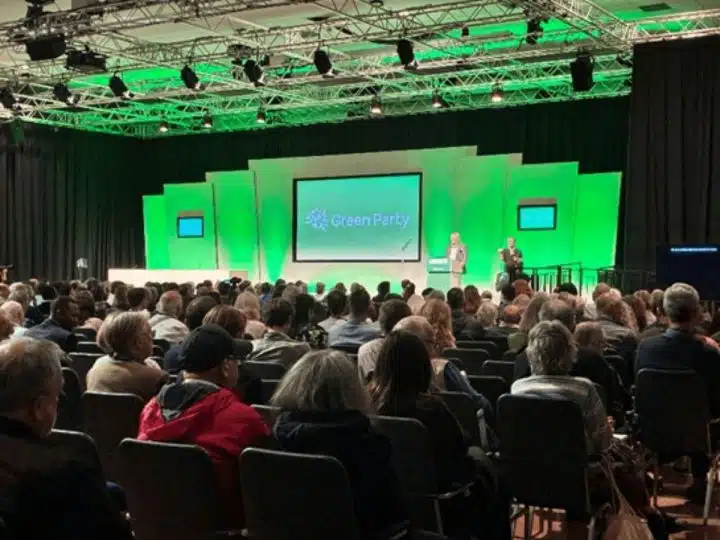

The Green Party has announced policies to tackle the affordability crisis. But will they work?
Green Party: 10:1 pay ratio
A key policy Green Party leader Zack Polanski and deputy leader Rachel Millward spoke of is that CEOs cannot earn more than 10 times their lowest-paid employee.
This will likely be a progressive regulation, generally. A possible issue is that it does not guarantee that the lowest-paid workers will earn more. That’s because the company may simply reduce CEO pay, rather than raise pay for the majority.
An example is Tesco, which shows the scale of the problem and how the 10:1 ratio could well deliver. The boss of Tesco got £9.93 million in the 2023-24 year. But the lowest yearly rate for Tesco workers was £22,304 for the same period. That means the boss receives £39,249 every day compared to £88.16 for an employee.
The thing is, if Tesco’s CEO pay was cut in half to around £5 million, workers would need a pay increase to £440,080.
And if 340,000 employees, nearly all of whom earn less than 10% of the boss’s pay, received a pay increase of £423,776, that would cost Tesco £145 billion, which is clearly too much of a cost.
The largest companies, at the least, do seem obsessed with paying CEOs excessive amounts – with boss pay of the Financial Times Stock Exchange 100 up to an average £5.9 million in 2025. So perhaps they would raise worker pay to meet the 10:1 ratio.
But, as mentioned, some corporations may just cut boss pay rather than raise workers’ salaries across the board. Another possible option is for workers’ pay to rise with company profits.
Universal free school meals
Another policy the Green Party announced is providing free school meals for all primary and secondary pupils. The universalism of this policy may well be beneficial for young people. Otherwise, the fact that some pupils dine for free and some pay could increase classism, leaving some children feeling less worthy.
Rent controls
The Green Party further said it’s in favour of rent controls. For more than 70 years, between WWI and the late 1980s, the UK had a system of rent control. Short of stopping treating housing like an asset altogether, it’s a policy that could drive down poverty and put more pounds in peoples’ pockets – as Labour has repeatedly pledged to do, and failed.
Resolution Foundation analysis has revealed that over one million children would actually not be in poverty were it not for eye-watering housing costs and particularly private sector rents.
In many European countries there is some control over rents. For example, in Sweden, tenant unions and landlords negotiate rents based on average earnings, inflation, and costs. In the UK, we do not have such a procedure and under 45s alone wasted £56.2bn in passive income for landlords in 2024.
Featured image via the Canary
By James Wright
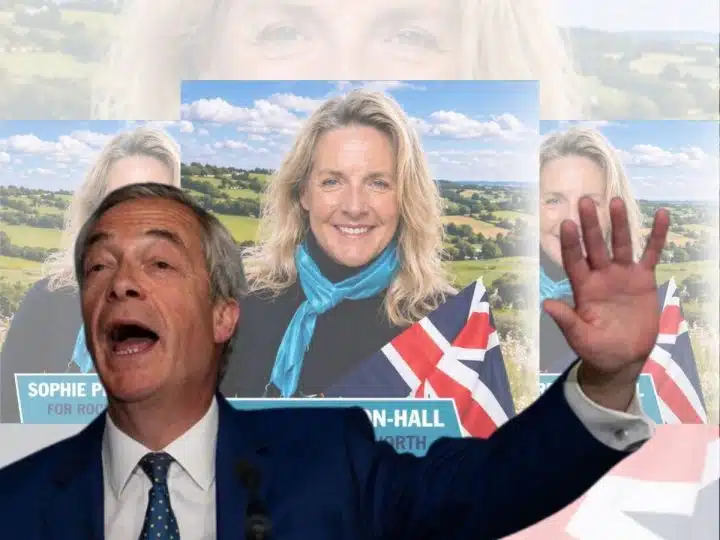

Reform Party UK Exposed have flagged that one of Nigel Farage’s council candidates was seemingly using AI:
Reform UK’s candidate @SophiePrestonHa’s Facebook posts being flagged as AI info is pretty much par for the course.
Lazy. pic.twitter.com/boQKwk7EyK
— Reform Party UK Exposed
 (@reformexposed) April 23, 2026
Looking into it, Facebook no longer seems to be flagging the post as ‘AI’, but signs are there that it was at some point. And it’s far from the only example of Reform UK dabbling with AI.
I, Reformbot
The following is the post as highlighted by Reform Exposed (note the ‘AI info’ tag in the second to top line):

Facebook flags posts as ‘AI info’ whenever they detect AI (or the poster flags that they used it). Hall’s post no longer contains the label, but locals did react to the label when it was there:

Hall could have used AI to generate the text, or Facebook could have detected that AI was used in her ‘Essex Deserves Better’ leaflet. Reform and its candidates have certainly used AI to generate images before, as the Canary and Reform Exposed have covered:
Back in February 2022, @drdavidbull and I spent weeks in Erdington leading a newly rebranded Reform UK. My team and I knocked on thousands of doors in all weathers, speaking to anyone who would listen, putting everything we had into that campaign. In the end, we received just 293… pic.twitter.com/aWBAv6hxAE
— Richard Tice MP
(@TiceRichard) April 19, 2026
We need to talk about @DonnaLouise1212. Ex UKIP, now Reform UK.
Yes, the one who uses AI photos of herself to farm engagement. pic.twitter.com/TM8WTejlKA — Reform Party UK Exposed
(@reformexposed) January 21, 2025
Reform politicians have also used AI to attack their opponents:
It's @DarrenGrimes using AI again. It's all he's got.
To answer his question, probably ask why a Green Party activist can't spell Zack. pic.twitter.com/w1O7z0hEEI — Reform Party UK Exposed
(@reformexposed) April 21, 2026
Seeing double
Reform Exposed have previously reported that Hall is one of several Reform candidates who were “doubling up”:
Reform UK are obviously struggling for candidates in Essex.
They’re doubling up all over the place.
Sophie Preston-Hall lives in Mersea, is standing for Colchester City Council in Prettygate, but also for Essex Council in Rochford.
Aimee Keteca is already a Reform UK councillor on Tendring District Council, and is standing for Essex Council in Brightlingsea BUT is also a candidate for Colchester City Council in Tiptree.
Wonder how they are going to do their role(s) justice.
Obviously it’s a worse deal for residents to have councillors whose attention is split across multiple roles. Doubling up does allow the party to give the impression that it’s running pretty much everywhere, though, even when it’s not:
Just as we fielded more candidates than any other party last year – a history making event.
Few appreciate just what @Nigel_Farage has built in the blink of an eye.
Huge…
— Zia Yusuf (@ZiaYusufUK) April 10, 2026
 Reform UK is standing candidates in more wards than any other party in the upcoming May 7 elections.
On this front, Reform have also sought to find so-called ‘paper’ candidates. As the Guardian reported:
Those who have been asked to stand include members of other parties and even a Guardian journalist, who was asked in a call last week: “Will you come in to become a paper candidate today and help us to win the election?” The caller added: “Just have your name on the ballot and maybe you will actually win the election.”
Prospective paper candidates are told they would not need to do anything apart from provide their name and address. They are then asked if they are bankrupt and if they have any criminal convictions, before being offered a candidate application pack.
It’s not unheard of for political parties to field paper candidates to make up the numbers. The difference with Reform is that they’re not just asking their own members; they’re asking people who’ve signed up to their mailing list.
Is this who we want running our councils?
Absolute randoms?
And all because Farage’s party want to juice their numbers?
Oh, and Hall isn’t the only candidate attracting controversy in Essex:
Meet Jaymey McIvor. He is standing to represent local residents on Essex County Council. — Parody Nigel Farage (@Parody_PM) April 22, 2026
Oh, and he got kicked out of the Tory party for sending dick pics. https://t.co/8rPs8MIWCl
A Reform Counsellor…
Hall is also on the record for misspelling ‘councillor’:
Reform UK’s Sophie Preston-Hall is standing to be a Counsellor. pic.twitter.com/iKZTM0KZZO
— Reform Party UK Exposed
(@reformexposed) March 31, 2026
As an experienced wroter, I’ve got to say I find the above to be completely unacceptable.
Jokes aside, the problem isn’t whether these Reform candidates can spell ‘councillor’; it’s whether they care or know what a councillor is, and whether they have any intention of putting the effort in.
Featured image via The Canary
By Willem Moore
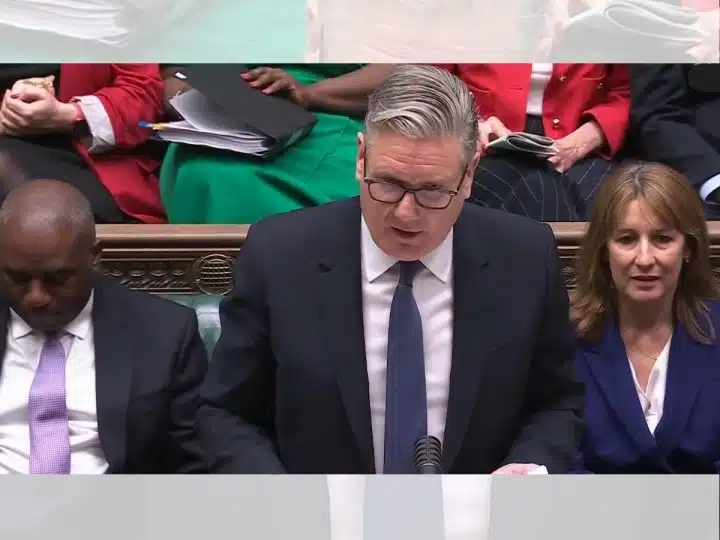

On Wednesday 23 April, Keir Starmer responded to his critics at Prime Minister’s Questions (PMQs). Several of his rivals probed him to establish if he’d previously misled Parliament on the subject of Peter Mandelson’s vetting. Because Starmer is so ruthlessly incompetent, it seems he may have misled Parliament AGAIN in the course of trying to defend himself:
It’s quite incredible. In the PMQs session where Starmer attacked Kemi Badenoch for saying he mislead the House Keir Starmer again mislead the House. https://t.co/5D7DDAT9W6
— (((Dan Hodges))) (@DPJHodges) April 22, 2026
And to be clear, misleading Parliament is grounds for a member of government to resign.
Starmer: misleading from the front
In the clip above, commentator Dan Hodges says:
A minister told me there is; what they said was there is a bit of a panic on in Number 10 this evening because there’s now a feeling that Keir Starmer actually misled the House in one of the answers he gave to Kemi Badenoch.
So if you go back and check the transcript – it’s at the point where he was talking about the fact that pressure – whether pressure had been put on Ollie Robbins. Now, the way it was described to me was that Starmer diverted from his briefing book and came out with a statement which says absolutely no pressure whatsoever had been put on Olly Robbins or any other civil servants. Now I think you were probably watching, I was watching, I was a bit surprised by that.
People have gone back and checked what Olly Robbins actually said, and they’ve put that against what Keir Starmer said. And the people raising concerns are right. It’s impossible to square what Starmer said with what Robbins said.
Struggling to see how Starmer’s claim today at Prime Minister’s Questions that “no pressure existed whatsoever” in relation to the Mandelson vetting is compatible with Sir Olly Robbins’ evidence to Parliament. pic.twitter.com/R2wqeoHqxv
— Matthew Stadlen (@MatthewStadlen) April 22, 2026
Hodges also noted that Robbins’ predecessor Phillip Barton will testify next week, stating:
my understanding from the same ministerial sources, Downing Street believes he will explicitly say he was put under pressure as well. Now, if he does that, then you’ve got Keir Starmer bang to right misleading the House of Commons.
Lawyer Mike Gardner said:
No idea why Starmer thought he could get away with selectively quoting from Robbins.
Robbins made clear there was serious pressure from No.10 to approve Mandelson.
Starmer turned that on its head. Mad. https://t.co/h2TJ3rggul — Mike Gardner (@mikegardner_wb) April 22, 2026
The most straightforward answer to this seems to be that Starmer simply struggles with the truth. As we’ve covered again and again, dishonesty is a constant with him.
Suspended Labour MP and Starmer critic Karl Turner, meanwhile, said the following:
That’s NOT what Sir. Olly Robbins told the select committee. pic.twitter.com/S0e9StYbUJ
— Karl Turner MP (@KarlTurnerMP) April 22, 2026
And again
There’s also a suggestion that Starmer may have misled Parliament twice at PMQs. As Ava-Santina from New Statesman highlighted:
Detail here where Starmer may indeed have misled the House…
Sir Julian Lewis: Did PM ask Robbins why he overruled the security vetters
Starmer replies that he did, but didn’t accept his explanation.
Linked below, it seems he did NOT ask him. pic.twitter.com/smXOaVfGcE — Ava-Santina (@AvaSantina) April 22, 2026
Since posting the above, Santina has said:
Being told Robbins *was* asked to explain his handling to Starmer before sacking.

— Ava-Santina (@AvaSantina) April 22, 2026
Conservative MP Aphra Brandreth noted that she put this question to Olly Robbins:
The PM told us he spoke to Oliver Robbins, asked him why he overruled security vetters, didn’t accept his explanation, so sacked him
I put this to Sir Oliver during the @CommonsForeign
Media reports now suggest the PM may not have asked him the question. We need clarity on this https://t.co/Un6GPy3Mjt pic.twitter.com/SsH6Vw4hxA — Aphra Brandreth (@AphraBrandreth) April 22, 2026
This was how Robbins responded in the clip above when asked if Starmer had asked him what happened:
It’s a very legitimate question, Ms. Brander. The reason I wrote to the committee ahead of this hearing on this matter is I’m afraid, given I’m in unknown territory, honestly, for me personally, about the HR position I am in and what this means for my family, I must remain quiet on that until my advisors have told me what the appropriate thing to do is about it.
Bad, bad, not good
At this point we’re going to remind you that regardless of anything else, Starmer hired Peter Mandelson despite knowing that he’d:
- Twice resigned from government in disgrace.
- Maintained a relationship with the convicted paedophile Jeffrey Epstein.
It’s good that the establishment seem to be catching up, because we’ve been saying he needs to go for some time now.
Featured image via Guardian
By Willem Moore


On 22 April, at Birmingham Crown Court, the trial of Majid Freeman formally commenced, presided over by Judge Andrew Smith KC. Freeman is charged with encouraging terrorism, as well as expressing and/or inviting support for Hamas, a Palestinian political and military organisation that is proscribed in the UK.
Persecution of a humanitarian
Freeman first travelled to Gaza in 2012 with the “Games 2 Gaza” summer camp, which worked to support traumatised children in the besieged territory. He travelled there again in 2013 to distribute medical aid to hospitals.
But when he had his home raided in July 2024, as the people of Gaza strained under the weight of a brutal genocide and with tens of thousands already killed by the Israeli military, Freeman had not travelled to Palestine or taken up arms. Indeed, there has been no allegation of any physical act of terrorism, financial support, or operational involvement on his part. Rather, he faces up to ten years in prison for charges based on a series of social media posts.
The right to resist
Freeman appeared in the dock just after 10.30am, wearing a light gray suit and black-and-white keffiyah. He sat at the back of the court, alone, separated from the main chamber by a glass barrier. He looked calm and sipped on a cup of water, but his liberty hangs in the balance. Supporters of the defendant filled the public gallery.
Freeman’s case is seen as a litmus test for both freedom of speech in Britain and for the ability of British citizens to express support for the right of Palestinians to resist against genocide and ethnic cleansing. The legitimacy of armed resistance against military occupation has long been enshrined in international law, with UN resolutions and the Geneva Conventions affirming the right of colonised peoples to fight back, but the prosecution seeks to convince a British jury that expressing one’s support of that right amounts to terrorism.
The prosecution sets out its case
This week, it is the prosecution’s turn to set out their case. Lead prosecution barrister Tom Williams, acting on behalf of the Crown, began by instructing the jury that his opening statement would be about providing a “wider picture, rather than evidence itself”. This is a theme that would be repeated, with the prosecutor saying at one point:
The message is coded, but it’s meaning, if you think about it, is quite clear.
Attempting to set the tone early on, the prosecution statement attempted to link reportage of the Charlie Hebdo terrorist attack to an entirely separate Instagram post Freeman had made about a cartoon published in the French magazine Libération, which mocked starving Palestinians during the month of Ramadan.
The cartoon, which Freeman had naturally condemned, showed a Palestinian man attempting to catch rats to eat. “Not before sunset”, another female character in the cartoon instructs, slapping his hand.
Freeman did not encourage violence in his response to the reprehensible cartoon, but the prosecution lawyer seemed to want the jury to read further into his intentions. “What did he want his followers to take from it?” he asked. It was a strange way to open a day that focused almost exclusively on posts related to the genocide in Gaza, but this was about “establishing a narrative”.
Prosecution’s first witness
At 11.50am, the jury were given a ten-minute break, and the judge, prosecution, and defence all left the chamber. When they returned, DC Sean Lambert, the East Midlands counter-terrorism officer overseeing Freeman’s case, was already waiting on the stand. Placing his right hand on the Bible, he was duly sworn in as the prosecution’s first witness.
As the trial stretched into the afternoon, the prosecution moved from one social media post to another, all related to the Gaza genocide. Some were written by Freeman himself; others were reposted without comment. Lambert was asked to confirm the time and precise number of likes on an endless stream of Twitter and Instagram posts, each one brought up on the screen in front of the witness stand for him to view.
One post presented as evidence read:
The heroic resistance are repelling the most depraved army in the world. The people of Gaza have ashamed us all with their bravery.
Another slide showed the jury that Freeman had reposted a video of someone arguing that:
most people in the world see Hamas as a legitimate resistance movement resisting against UK-sponsored Israeli genocide.
The prosecution noted that the defendant “didn’t say anything about the post”, but argued that a malign intention could be “gather[ed] from other context”.
A young lady speaking passionately in another video reposted by Freeman states:
Hamas are not a terrorist organisation just because the US and Israel deem it so; it is a legitimate resistance organisation.
Again, the defendant had not added any comment of his own, but merely shared the clip.
‘This is not a forum for solving the Israeli-Palestinian conflict’
Earlier in the day, the prosecution lawyer had told the jury that “this is not the forum for solving the Israeli-Palestinian conflict”, but it is hard to deny the political connotations of the trial.
Freeman was originally arrested just days after the general election on 4th July 2024, before which he had been active in the successful grassroots campaign to unseat Labour MP Jonathan Ashworth in Leicester South.
The Gaza genocide changed everything. The sheer brutality of the Israeli assault has stirred hearts and brought tears to the eyes of many. The bravery and dignity of the Palestinian people, as communicated in several of the social media posts presented as evidence today, has not only inspired others, but also highlighted the shame of humanity’s inability to effect change or justice.
Globally, public opinion will never go back to what it was, but rather than investigating the over 2000 citizens who travelled to serve with the Israeli military in its genocidal campaign, the British establishment seems more interested in suppressing the public’s natural affinity to those under the bombs.
Regardless of the outcome of Freeman’s case, the people of Gaza will continue to resist, and billions around the world will continue to support them.
The trial continues tomorrow.
Featured image via CAGE International


4 min read
When I look at the structure of our student loan system in 2026, I don’t recognise it as a loan.
It is a retrospectively rewritten graduate tax that punishes aspiration, entrenches inequality, and falls hardest on women at every stage of their working lives.
An entire generation was told repayments would feel like “a phone contract” or “a few coffees a week.” That was a lie. Only a third of Plan 2 borrowers will ever clear the balance.
The rest pay 9 per cent of every pound above a frozen threshold for up to 40 years – a 51 per cent marginal rate when combined with income tax and National Insurance. A graduate on £50,000 will only keep 49p of each additional pound – how dare politicians continue to call it a loan.
Beneath these headline injustices sits a deeper one policymakers refuse to name: this system is gendered from the day it is signed to the day a woman retires.
Women make up 57 per cent of UK students. They leave with the same debts as men but a labour market that pays them 14 – 15 per cent less and expects them to take career breaks for caring but doesn’t give financial relief. In the student loan system they pay for longer, pay more in real terms, and rarely clear their balance.
Our research found Ms JD puts the arithmetic in words ministers should read: “Unless you are being paid over £66k annually, you do not even start to break even. To earn £66k as a female in a male-dominated industry will be almost impossible.” Seven and a half years of consistent repayment have taken her balance from £57,000 to £83,000. She finds it “near impossible to buy a house on my own.”
Then there is motherhood – if a woman can afford it. Interest does not pause for maternity leave.
Ms HS, 32 and child-free despite wanting to be a parent, says: “Knowing my student loan balance would still be growing during maternity leave adds an extra layer of financial pressure.” Ms HG and her husband pay £420 a month and have put off starting a family: “This is why the birth rate is so low, we can’t afford to do so.” Westminster wonders about falling birth rates. It has engineered one of them.
The unfairness begins before a woman has even taken out her own loan. Ms CM describes how the parental assessment for maintenance loans assumes a stepparent will fund an adult stepchild’s university costs – penalising single mothers who re-partner. Most single-parent households are headed by women. That is not a footnote. It is structural.
Then there is the pension pipeline. The part that should stop ministers in their tracks. Every pound deducted in a woman’s 20s, 30s and 40s is a pound not compounding in her pension. Women retire with 40 per cent less pension wealth than men. As Ms HS puts it: “Ultimately, it’s a 9 per cent additional tax for life.” The state that raids her payslip now will rescue her later. That is not social policy. It is a doom loop.
Layered on top is a retrospective rewriting of the deal. The repayment threshold was promised to rise with earnings; it has been frozen and re-frozen. Interest rate bands were tightened at the 2025 Budget without mention in the Treasury’s own Budget documents. The 6 per cent cap from September 2026 does not enable graduates to clear their debts, it merely slows the rate at which those debts become unrepayable. In any regulated consumer credit market, marketing debt on terms this misleading would be a clear breach of consumer protection law and bee deemed a scandal.
What I have described is, on its face, indirect sex discrimination under the Equality Act 2010. No gender impact assessment has been published for the threshold freeze or the hidden tightening of the interest bands, raising a serious question about whether ministers have discharged the Public Sector Equality Duty at all.
Fairness is not free; nor is unfairness. Proper reform, retrospective justice, a lifetime repayment cap, and a mandatory gender impact assessment on every future change – costs roughly 0.3–0.4 per cent of GDP. Reforming the triple lock releases savings that would address this intergenerational unfairness. A political choice, not about affordability.
The student loan system promised social mobility and has delivered a debt trap.
This government has committed to closing the gender pay gap, the gender pension gap and reversing birth rate decline, so cannot credibly defend a policy that measurably widens all three. Ms HG asks the question ministers must answer: “When did hard work mean only surviving?”
Gina Miller is founder of MoneyShe, and co-founder of SCM Direct. You can read her TSC submission here and policy white paper here.

6 min read
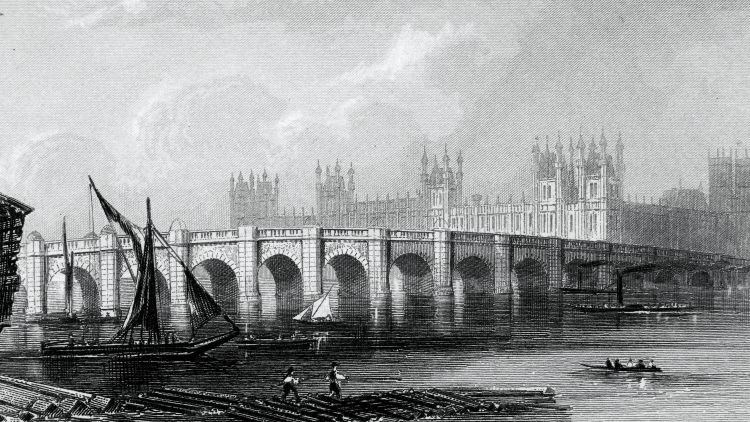
When the original Palace of Westminster burned down in 1834, contemporaries found it hard to resist a symbolic interpretation. Just two years after the Reform Act had widened the franchise, the old political landscape lay in ruins.
Sir Charles Barry, the architect selected to rebuild the Palace, faced a technically challenging site next to an open sewer and intense political scrutiny of a project that was to define the new political order. Even apparently mundane decisions – for example, the size of the press gallery or the number of committee rooms – could become politically contested.
Practical solutions and new purpose-built facilities were seen by some as an attempt to replace the sovereign deliberation of Parliament with the ‘unthinking’ methods of the modern factory.
Intriguingly, the political impasse would be broken by effectively turning the rebuilt Palace of Westminster into a cutting-edge scientific laboratory. In theory, a new consensus would form around ‘what worked’ while Parliament was partly decanted.
“There is a real flourishing of scientific culture after the Napoleonic Wars; science became fashionable and the redevelopment of Westminster gets caught up in that,” says Dr Ed Gillin, an academic based at UCL Bartlett School of Sustainable Construction and author of The Victorian Palace of Science.
“At places like the Royal Institution and the Royal Society, you get this huge overlap between the political class and the scientific elites, as well as a hope that the application of science can alleviate some of the rising social unrest and bring about national unity.”
For a brief period, nothing was off-limits. To give one example, in order to measure the foulness of the atmosphere in the House of Commons, lumps of meat were hung from the ceiling.
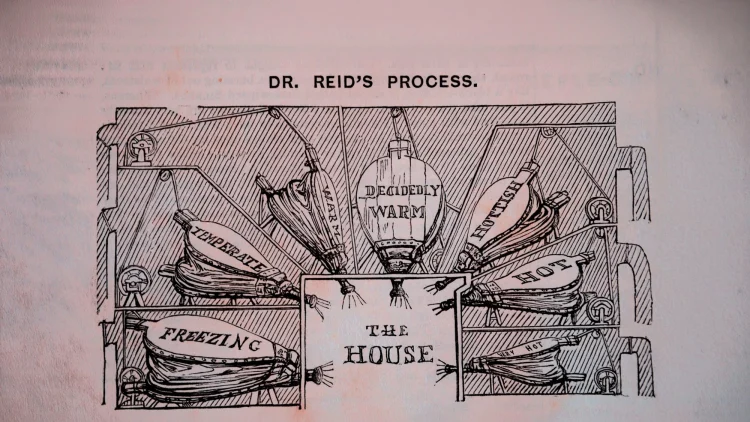
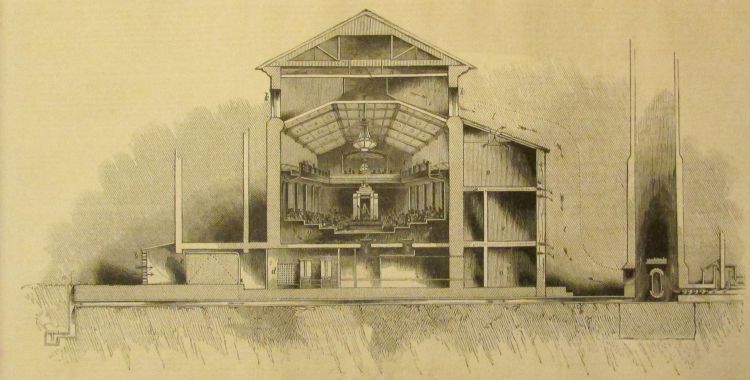
The experiment was devised by Dr David Boswell Reid, now dubbed ‘the grandfather of aircon’, a Scottish chemist brought to Westminster on account of his pioneering work in developing ventilation systems.
To win MPs over to the value of circulating fresh air, Reid hoped to demonstrate that while meat hung from 10 to 20 feet in the Chamber would go off within 24 hours, when suspended from 30 to 40 feet it could still be eaten safely several days later.
Reid was just one of a number of pioneering figures brought into Barry’s rebuilding project, as hundreds of innovations in everything from electric timekeeping to novel methods of drainage, as well as innovations in lighting and masonry, were explored.
It was a period when the status of architecture was also undergoing a rapid transformation. The first chair in architecture was created at UCL in 1841, a move that followed the creation in 1834 of the Institute of British Architects (which received its Royal Charter two years later). Part of this process entailed architects finding a balance between ‘art’ and ‘science’, which proved every bit as fractious as the political debates excited by Barry’s building.
While employing scientists might have helped to break the political impasse about the redevelopment of the Palace of Westminster, it will perhaps not be a huge surprise to learn that it did not end all argument.
Frustrated by the lack of enthusiasm for his theories, Reid began to devise ever more extreme demonstrations. To illustrate the effectiveness of his methods in dispersing ‘bad air’, he drafted a platoon of soldiers into the Chamber of the Commons and filled it with acrid smoke as well as a variety of scents from lavender to cinnamon. Despite the rapidity with which his smoke bombs cleared, MPs remained unconvinced.
“Reid begins his experiments at Westminster in 1835, is appointed to a permanent position in 1838, and is still experimenting in 1850,” explains Gillin.
“There’s just the sense that the experimenting has got a bit out of hand and Barry is driven absolutely mad by the stream of constant alterations.”
The contestability, and potential lack of durability of the scientists’ findings, made their recommendations risky and difficult to implement. Barry and his political backers slowly became impatient with visionary and experimental prototypes. Reliable methods that could be safely systemised were needed.
Disagreements over how far to incorporate new methods also played out along religious and class lines.
Barry had designed the Whiggish Reform Club building and was friends with Edward Cust, the politician overseeing the competition to rebuild the Houses of Parliament. By contrast, for illustrative example, Reid’s interest in ventilation was bound up with his evangelism; he saw the task of cleansing the atmosphere as inextricably bound up with the process of moral purification. It was a particular strand of religious thinking that marked Reid out as a Scot, and an outsider, whose ‘science’ could be more easily dismissed as crankery, whatever its practical effectiveness.
“The majority of MPs were Anglican, were educated at Oxbridge, and had a leaning towards ‘small c’ conservative sciences like geometry,” says Gillin, “whereas north of the border, science was associated with industry, practical uses of knowledge, and utilitarianism.”
While a handful of radicals wanted the new Houses of Parliament reconfigured into a centre of rational governance, most MPs wanted the new building to embody the continuing authority of Parliament and to forestall the kinds of instability that had led to the French Revolution.
Whiggish reformers had favoured rebuilding Parliament in a neo-classical style, while conservatives preferred a more regal gothic mode. By the time Barry had completed both Chambers in 1852, the end result was described as a gothic shell encasing a neo-classical interior.
Without losing its sense of grandeur, Westminster had been rebuilt as a state-of-the-art building. It was a design able to contain the wildly differing preferences of those who fantasised about a pre-Reformation (Catholic) Britain as well as those politically and aesthetically centred in post-Reformation (Protestant) Britain.
For all that that enthusiasm for the renovation to exploit the benefits of rapid scientific advances helped unite competing factions, ultimately the visionary ambitions had to be tempered by a certain degree of nostalgia.
“A fashion for ‘the olden time’ – the period of the Tudors and early Stuarts romanticised as nationalist, mercantile, imperialist, even populist – spread rapidly in the 1830s and 40s,” explains professor Peter Mandler, a Cambridge historian, “and the Palace of Westminster could be seen as an early form of that fashion.”
In the 19th century as now, popular debates about the restoration of Parliament had shifted rapidly from material issues on to far more symbolic and intractable questions about the proper form of British government.
Politics
Neil Gittoes: Wes Streeting’s made 63 promises to stop preventable deaths so why is there still no plan to do so?
Professor Neil Gittoes is a Consultant Endocrinologist, Honorary Professor of Endocrinology, and chair of the Board of Trustees at the Royal Osteoporosis Society.
Two years ago, the Health Secretary promised people with osteoporosis life-saving early diagnosis clinics. He has repeated that promise 63 times – yet nothing has changed. And for every year Ministers delay, another 2,000 people die needlessly.
People with osteoporosis have been overlooked for decades, driven by the mistaken belief that broken bones are a normal part of ageing rather than a treatable medical condition. This cruel disease silently weakens bones until they can break from coughs, sneezes or even a hug. For someone with osteoporosis, a fall from standing height can be enough to break a hip. Half of women over 50 will experience fractures due to the condition, alongside one in five men.
I meet grandmothers terrified to lift a newborn baby for fear their bones could shatter. And women in early menopause told by GPs they have the bones of an 80-year-old.
Yet help exists. Safe, effective treatments costing as little as £1 a week can restore independence and save lives. So why are millions still missing out?
The answer is a brutal postcode lottery. Half of NHS Trusts still lack Fracture Liaison Services (FLS) – specialist clinics that identify patients and get them onto treatment before it’s too late. Without them, the consequences are devastating. A broken hip is often a death sentence – killing over a quarter of patients within a year.
During the 2024 election, this community was given hope for the first time. All three main parties proposed a national rollout of FLS clinics to every area by 2030. Since then, Reform and the Greens have added their support too.
Wes Streeting went furthest: he promised a plan for national roll-out would be one of his first acts in government. But two years on, no plan has been delivered. And we’ve seen no new clinics at all.
Around 60 NHS Trusts in England still lack Fracture Liaison Services. A national roll-out takes time and requires steady progress year by year. Ministers needed to deliver FLS to around 24 Trusts by now to stay on track for full roll-out by 2030. Instead, delivery stands at zero.
In opposition, Wes Streeting described delays to these clinics as a “betrayal of patients”. With nearly two years now passed, we’ve had more delay under this government than the last.
And delay costs lives. Around 2,000 people die each year following hip fractures that these clinics prevent. In the time since this promise was made, 4,000 lives have been lost waiting for roll-out.
Meanwhile, the NHS has spent £150 million treating avoidable fractures since the election – far more than it would have cost to put these preventative clinics in place. This isn’t just a missed opportunity. It’s a failure that is harming patients right now.
We should be making progress. More than 60 countries already are. New Zealand has just rolled out these services to cover 99% of its population, while Japan has quadrupled FLS in three years. In Wales, Ministers made FLS a national priority and mandated that, within five years, each service should develop the bandwidth to treat every citizen aged over 50 in their area.
By 2030, therefore, it will be markedly safer to grow old in Wales than in England. There is no excuse for England falling so far behind.
Ministers point to a very small investment in bone scanners, made to honour a separate (very welcome) election promise. But a scan without treatment saves no one. Without assessment and follow-up through Fracture Liaison Services, patients remain at high risk of another fracture.
Worse still, uncertainty from Whitehall is pushing fracture prevention locally into reverse. Some areas have paused their own plans, expecting a national rollout that has yet to materialise.
Ultimately, the question is about political will. Ministers have made the commitment. They’ve repeated it 63 times. They know it will save lives and money. Why won’t they deliver it? People with osteoporosis have waited long enough. After decades of neglect, they were promised change.
If the promise is broken, it will deepen the sense that their lives simply don’t matter.
We stand ready to work with government to achieve the outcome they promised. We won’t let the perfect be the enemy of the good. If a credible plan is published, we’ll get behind it and help Ministers get those clinics set up.
But progress starts with a plan.
During the election, people with osteoporosis were promised change. Two years on, they’re still waiting. So I ask the Health Secretary Wes Streeting directly: will you now publish the plan for the life-saving bone clinics you promised?
For more information, visit theros.org.uk/StillNoPlan

The post Neil Gittoes: Wes Streeting’s made 63 promises to stop preventable deaths so why is there still no plan to do so? appeared first on Conservative Home.

Simon Dudley was sacked by Reform UK at the beginning of April. His brief career as housing spokesperson ended when, according to the headlines, he said Grenfell was a ‘tragedy’, before adding that ‘everybody dies in the end’.
Dudley was referring to the Grenfell Tower fire of 2017, in which 72 people were killed. On the face of it, his comments seem heartless and his dismissal justified. But the problem is that they were very far from his full comments. The real story here isn’t Dudley’s apparent disregard for human life – it is how the 24-hour news cycle, combined with lazy journalism and performative outrage, is destroying careers.
Dudley was speaking to Inside Housing. Asked by the interviewer about Grenfell, he described it as a ‘tragedy’ and a ‘failure’. But he also thought that onerous building regulations, introduced as a response to the fire, had created an unnecessary burden – one that was preventing houses from being built. He made the perfectly reasonable point that deaths from housefires were, statistically speaking, very rare. ‘Many, many more people die on the roads driving cars, but we’re not making cars illegal, so why are we stopping houses being built?’ He has a point.
Dudley no doubt regrets the sentence which has since cost him his political career. But that does not change the fact that a single comment, made in a wide-ranging interview, was clipped and twisted so far out of its context that what came to be reported verged on untrue. Within hours of the interview coming to light, the mainstream media was at his throat. ‘Grenfell was tragic “but everyone dies in the end”, says Reform’s new housing chief’, ran a headline in the i newspaper. Then the prime minister joined the pile-on. Keir Starmer declared the remarks ‘shameful’ and told Reform leader Nigel Farage to ‘do the decent thing’ and sack Dudley.
Faced with this storm in the run-up to council elections in May, Reform buckled. By sacking Dudley (who is not exactly a household name), it successfully killed the story. The outraged Panzer divisions were stopped in their tracks.
But so too was the important point Dudley raised. Two things can be true at once. Grenfell was horrific. But over-regulation is now trapping thousands in buildings as dangerous as Grenfell was nine years ago. It is also dooming a generation to perma-renter status, millions who will never own a stake in the country and their children’s future.
Home ownership remains the surest route to social mobility, providing skin in the game, and the best opportunity to pass on something meaningful to your children. There is no more important conservative cause than putting working people in their own home. Dudley’s long record at Homes England and his success in the private sector showed he had the knowledge and experience to come up with housing policy that might, for once, succeed. He couldn’t have been any more different from the current fourth-rate nobodies that inhabit the government front bench, virtually none of whom have a science, engineering or building background – and almost none have ever had a job outside politics, let alone building houses.
The political hypocrisy has been glaring. Sadiq Khan, who was mayor of London when Grenfell happened and remains in charge today, was quick to call for Dudley’s head. Keir Starmer has elevated Andy Roe – the incident commander on the night of the fire, when the London Fire Brigade’s leadership was heavily criticised by the inquiry – to the House of Lords and made him chair of the Building Safety Regulator. Almost nine years on, there have been no prosecutions of anyone involved in the fire. Meanwhile, the families of the 72 who died are still waiting for justice.
We cannot have an adult conversation about the housing crisis if every attempt at honest trade-off analysis is shouted down as disrespect for the dead. Grenfell was a tragedy. Fire safety matters enormously. But we will never build the homes Britain desperately needs if regulators ignore basic cost-benefit realities and the arithmetic about where people die.
This episode was never about one politician’s wording. It exposed a culture in which gotcha headlines and insincere outrage have made nuance impossible. Everything must be reduced to good or bad, black or white.
Meanwhile, the housing crisis is unsolved. Swathes of the country continue to spend half their wage to live in cramped, run-down rental properties. Who’s the real bad guy – Simon Dudley, or our hopeless MPs who have allowed things to get to this point?
Rory Hanrahan is a writer and a publican.

The Labour government last week confirmed that it intends to hand British lawmaking power back to the European Union. UK prime minister Keir Starmer said he planned to introduce legislation that will bring the UK into so-called dynamic alignment with the EU laws on energy policy, electricity markets and food standards.
We should be perfectly clear about what this means: the UK will match its laws and regulations to the EU’s, word for word. If the EU changes its laws on an area affected, Britain will then change its own laws to match them. If Brussels says ‘jump’, Britain will reply ‘how high?’. This is the situation that Britain is going to find herself in, thanks to Starmer’s ‘reset’ with the EU.
Despite claims by the government that it is making a ‘sovereign choice’ to copy foreign regulations, the reality could not be further from the truth. Dynamic alignment with the EU turns Britain from a competitive trading partner with the EU to a subordinate satellite market. This is exactly how the EU likes it, and it is indeed what the EU hoped Britain would agree to when then prime minister Theresa May presented her Chequers proposal to Parliament in 2018. Parliament said no in 2018, although it seems less likely that it will say no this year.
Dynamic alignment is offensive for a number of reasons. The government’s attempts to defend it are misguided at best, dishonest at worst.
Let’s start with the economic arguments. Under Starmer’s plan, EU laws will be applied across the entire British economy, including on businesses and consumers which have no trading relationship with the EU. This means that a British farmer selling British beef to British families will have to follow EU rules when doing so. British farms and British supermarkets may be subjected to inspection by EU officials to ensure they are compliant with foreign rules, and British taxpayers will be expected to fund the operations of these officials in this country.
Britain has become a home for innovative businesses experimenting with new genetic technology, thanks to the liberalisation of gene-editing laws post-Brexit. A nascent and dynamic sector of the economy will be snuffed out in the pursuit of closer relations with the EU, which is opposed to evidence-based innovation in this area.
The pursuit of dynamic alignment also misunderstands the nature of the trading relationship between the UK and the EU post-Brexit. When it comes to food, the sector affected by Sanitary and Phytosanitary (SPS) regulations, it is worth remembering that the UK is a net importer of food from the EU and around the world. British food producers overwhelmingly produce for the domestic market, so they will not see any kind of economic opportunity from following foreign laws.
The suggestion that alignment will lead to a boom in British exports to the EU is also laughable. Since Brexit, British sheep and lamb exports to the EU have done incredibly well, growing by 15 per cent in 2025. To suggest that these figures would be significantly higher if there was an SPS agreement, especially as the EU imports plenty of lamb from other non-EU markets like Australia and New Zealand, is economically illiterate. Similarly, beef exports to the EU also reached record highs in both value and volume in 2024. Dairy exports to the EU have also shown strong growth over the last two years – this, in a sector that was often held up as one which suffered the most from Brexit.
Dynamic alignment of food-standards regulations appears to be motivated by a misdiagnosis of the trading relationship between Britain and Europe. But the proposed alignment of carbon pricing is a straightforward attack on British industrial competitiveness. Proposed as a means of ensuring Britain avoids facing an EU carbon tariff, the government has agreed to link carbon prices for energy-intensive industries with the EU’s.
This is an act of catastrophic self-harm. In 2025, the EU’s carbon price was some 50 per cent greater than Britain’s. So the prime minister has decided to increase the operating costs of British industry, at a time when the government should be doing all it can to reduce the crippling price of energy.
It is a double-whammy. Not only does the UK suffer – the EU benefits, too. Labour is effectively allowing Brussels to shield itself against any competitive threat from the UK, even in industries that do not export manufactured goods. Data centres pay carbon taxes, and their running costs will be increased by this policy, even though they do not produce goods which could be affected by an EU tariff.
Labour claims that dynamic alignment is good for the British economy. But, in reality, the only winner will be the EU, which will be able to treat Britain like a captive market for its exports. Considering the EU’s poor economic performance and declining share of the global economy, this is no path to prosperity.
None of this touches on the real problem with Starmer’s plan for closer EU integration – namely, that it is a betrayal of everything the British people have voted for. The UK has effectively had two votes on the EU – the first in 2016, when Leave won the biggest democratic mandate in British history. And again, in 2019, when Boris Johnson’s campaign pledge to ‘get Brexit done’ delivered him a landslide majority. The latest betrayal is made even worse after Starmer’s own promise, before the General Election, that Brexit was ‘safe’ in ‘his hands’. Now here he is, trying to wheedle the UK back under Brussels’ dominion, without parliamentary scrutiny.
The whole thing reeks of desperation. Starmer, having abandoned any kind of domestic policy agenda, is instead choosing to take Britain back into the EU, step by step. Its implications are already clear: a weaker economy and a steady erosion of parliamentary sovereignty. The EU reset is a road to nowhere – we must chart a new course as soon as we can.
Fred de Fossard is the director of strategy at the Prosperity Institute.
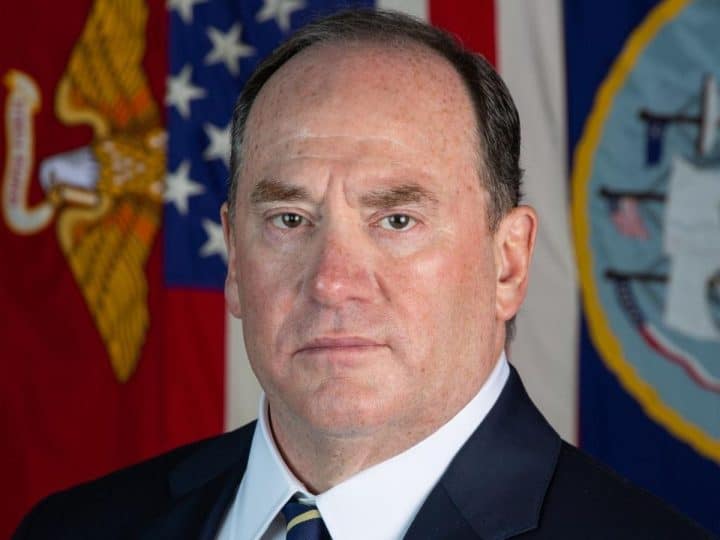

US ‘secretary of the navy’ John C Phelan has rocked the Trump administration by suddenly resigning his position. The move is unexplained. However, it comes as the US navy attempts farcically and unlawfully to blockade the Hormuz Strait and prevent ships entering it from the Indian Ocean. It has also been preceded by alleged mutinies and sabotage on board US aircraft carriers by crew outraged at their mission and desperate to go home.
A statement from chief Pentagon spokesman Sean Parnell confirmed the departure:
STATEMENT:
Secretary of the Navy John C. Phelan is departing the administration, effective immediately.
On behalf of the Secretary of War and Deputy Secretary of War, we are grateful to Secretary Phelan for his service to the Department and the United States Navy.
We wish…
— Sean Parnell (@SeanParnellASW) April 22, 2026
Featured image via the Canary
By Skwawkbox

Mineral explorers get tenement spend waiver as fuel costs bite

Michigan AD Warde Manuel says he felt ‘betrayed’ by Sherrone Moore’s actions

Autonomous cars were supposed to free us from traffic hell. Research says otherwise

Manchester United reach agreement with Casemiro over contract clause amid transfer speculation

Steven Gerrard disagrees with Gary Neville over ‘shock’ Chelsea and Arsenal claim | Football

US brings back mandatory military draft registration

Comment l’argent circulait dans l’affaire Gims

What Is Financial Management | Explain Financial Management | Meaning | Definition #bcom #commerce

Beginner’s Guide to Crypto Trading | Where to Start? | @BudhilVyas | Sagar Sinha Show
-

 Sports6 days ago
NWFL Suspends Two Players Over Post-Match Clash in Ado-Ekiti
-

 Fashion6 days ago
Weekend Open Thread: Theodora Dress
-

 Politics6 days ago
Palestine barred from entering Canada for FIFA Congress
-
Entertainment3 days ago
NBA Analyst Charles Barkley Chimes in on Ice Spice McDonald’s Fiasco
-

 Business4 days ago
Powerball Result April 18, 2026: No Jackpot Winner in Powerball Draw: $75 Million Rolls Over
-

 Tech4 days ago
Auto Enthusiast Scores Running Tesla Model 3 for Two Grand and Turns It Into Bare-Bones Go-Kart
-

 Politics4 days ago
Zack Polanski demands ‘council homes not luxury flats for foreign investors’
-

 Crypto World5 days ago
Russia Pushes Bill to Criminalize Unregistered Crypto Services
-

 Politics3 days ago
Gary Stevenson delivers timely reminder to register to vote as deadline TODAY
-

 Politics15 hours ago
Disabled people challenge government SEND proposals over segregation concerns
-

 Politics15 hours ago
Making troops accountable for war crimes threatens US alliance, ex-SAS colonel warns
-

 Business24 hours ago
Rolls-Royce Voted UK’s Most Iconic Trade Mark as IPO Register Hits 150
-
 Business7 days ago
Creo Medical agree sale of its manufacturing operation
-

 Crypto World5 days ago
Russia Introduces Bill To Criminalize Unregistered Crypto Services
-

 Politics16 hours ago
Starmer handler McSweeney to be dragged from shadows by Foreign Affairs Committee
-

 Politics16 hours ago
Zack Polanski responds to home secretary’s taser threat
-
Politics17 hours ago
Wings Over Scotland | How To Get Away With Crimes
-
 Crypto World4 days ago
Kelp DAO rsETH Bridge Hack Drains $292M as DeFi Losses Top $600M in Two Weeks
-

 Politics14 hours ago
‘Iran is still a nuclear threat’
-

 Business7 days ago
Cheaper Doritos and Lays helps PepsiCo win back struggling snackers
You must be logged in to post a comment Login